
All Insights
Articles
Containment vs Resolution: How to Measure AI in Your Contact Center
Containment counts calls an AI agent kept; resolution counts problems it solved. How to measure both on AI voice calls, and a 2026 scorecard for contact centers and BPOs.





Last updated 13 November 2026. Sources read 13 November 2026. Brilo product facts are taken from Brilo's documentation as checked on 9 October 2026.
Containment rate is the share of calls an AI agent finishes without handing them to a person. Resolution rate is the share of calls where the customer's problem was actually solved. A call can be contained and unresolved: the caller hangs up, gives up or calls back. In 2026, contact center leaders are moving their AI scorecards from containment to resolution.
This guide defines both metrics, shows how to measure them on voice calls, and explains where each one misleads. If you run an in-house contact center or a BPO and are putting an AI call center voice agent on your phone lines, it gives you a scorecard you can set up before the first live call.
What containment rate means for an AI voice agent
Containment rate is the percentage of calls that start with an AI agent or IVR and end there, without a transfer to a human agent. The formula is simple: calls ended by the AI, divided by all calls the AI answered. A containment rate of 60% means 6 in 10 calls never reached a person.
The metric comes from IVR reporting, where "contained" meant the caller finished in the phone menu. It became the default AI metric because it is easy to count from call logs and maps directly to labor cost: every contained call is one an agent did not take.
The weakness is in the definition. Containment counts where the call ended, not how it ended. A caller who hangs up in frustration, a caller who gets a wrong answer and a caller whose problem was fixed all count as contained. Containment tells you how much work the AI took; it does not tell you whether the work was done.
What resolution rate means, and why it is harder to count
Resolution rate is the percentage of calls where the caller's need was met: the appointment booked, the account updated, the question answered correctly. For human agents the closest standard metric is first contact resolution (FCR), the share of issues solved on the first call with no repeat contact. ContactBabel's 2025 US benchmark reported a 76% mean FCR for human-staffed contact centers, as reported by Stealth Agents.
Resolution is harder to count because the evidence sits outside the call. A transcript shows what was said, not what happened afterwards. A November 2026 TechZone360 analysis made the point directly: a call transcript shows that a conversation took place, not that the change the caller asked for was ever made. To count resolution you need the call linked to the case, the action and the outcome.
Why 2026 is the year contact centers switched metrics
Three things moved the industry off containment in 2026. First, analysts said so publicly. At theCUBE's AI ROI in Contact Center Summit in September 2026, ZK Research founder Zeus Kerravala said "resolution and resolution quality is the new unit of value," and argued for scorecards covering satisfaction, effort, productivity, cost and growth rather than containment and deflection (SiliconANGLE).
Second, the forecasts are framed in resolution. Gartner predicted in March 2025 that by 2029 agentic AI will autonomously resolve 80% of common customer service issues without human intervention, leading to a 30% reduction in operational costs (Gartner). Resolve, not contain.
Third, pricing followed. CX Today reported in August 2026 that AI agents are pushing enterprise CX buyers from seat licenses toward outcome-based pricing (CX Today). When you pay per resolution, you need to know what a resolution is.
Containment vs resolution vs deflection vs FCR: the four metrics compared
These four metrics are often used as if they meant the same thing. They measure different events, and a voice AI scorecard needs to keep them apart.
Metric | What it counts | Where the data comes from | How it misleads |
|---|---|---|---|
Containment rate | Calls the AI ended without a human transfer | Call logs, transfer events | Counts hang-ups and wrong answers as success |
Deflection rate | Contacts that never reached the human queue, often moved to self-service or digital | Channel and queue data | A deflected caller may simply try again later |
Resolution rate | Calls where the need was met | Call outcome linked to a system action or confirmation | Needs a clear definition per call type, or it becomes self-reported |
First contact resolution (FCR) | Issues solved with no repeat contact within a set window | Repeat-caller matching over 3 to 7 days | Misses customers who give up instead of calling back |
The practical rule: use containment to size workload, resolution to judge quality, and FCR to catch the calls that only looked resolved.
How to measure resolution on AI voice calls in five steps
Resolution on voice calls can be measured with data most contact centers already have. The method below works for any AI voice agent, including Brilo.
1. Define resolution per call type. "Appointment booked and visible in the calendar" for booking calls; "status given and caller confirmed it answered the question" for status calls. One definition per intent, written before launch.
2. Tag every call with an outcome. At minimum: resolved, message taken, callback scheduled, transferred, abandoned.
3. Link outcomes to system evidence. A booking resolution should match a record in the calendar or CRM. Without that link, resolution is the AI marking its own homework.
4. Track repeat calls. Match caller numbers over 7 days. A "resolved" call followed by a repeat call on the same topic was not resolved.
5. Review a sample by hand every week. Listen to 20 to 50 calls across outcomes. This is where you find the confident wrong answers no dashboard shows. See AI call center quality assurance for a review method.
Why a high containment rate can hide a failing AI agent
A rising containment rate is the most common false signal in AI call center projects. Three patterns cause it.
Transfer friction. If the AI makes reaching a person hard, more callers give up. Containment goes up while satisfaction goes down. The fix is to transfer on the first clear request for a human.
Confident wrong answers. An AI that answers every question, including ones outside its knowledge, contains the call and creates a repeat contact or a complaint later. Repeat-call tracking catches this; containment does not.
Silent abandonment. Callers who hang up mid-call count as contained in many reports. Separate "caller ended the call after the need was met" from "caller ended the call mid-flow."
The test for any AI voice agent, whether Brilo, Retell AI, Synthflow or a CCaaS-native agent from Genesys or Five9, is the same: does resolution rate move with containment rate? If containment rises and resolution stays flat, the AI is absorbing calls, not solving them.
How containment and resolution change the business case
Containment and resolution produce different ROI numbers, and the difference decides whether an AI project survives its first budget review.
A containment-based business case multiplies contained calls by the cost of a human-handled call. It overstates savings whenever contained calls come back as repeat calls, because each repeat call costs a human-handled call plus the AI minutes already spent.
A resolution-based case multiplies resolved calls by that cost and subtracts repeat calls. It is lower, more defensible and survives a CFO's questions. For the cost inputs, see AI call center costs, pricing and ROI.
For BPOs the distinction is commercial, not only analytical. An outsourced contact center billed per seat or per minute loses revenue on every contained call. One paid per resolution earns margin on every resolved call. That is why resolution-based contracts are where AI and BPO economics line up; see AI in BPO outsourcing.
A resolution scorecard for an AI voice agent
The scorecard below follows the analysts' advice to judge AI on outcomes across the journey, not on volume handled. Set baselines from one month of data before launch.
Metric | Question it answers | Review cadence |
|---|---|---|
Resolution rate by intent | Is the AI solving the problems it takes? | Weekly |
7-day repeat-call rate | Did "resolved" calls stay resolved? | Weekly |
Transfer rate and transfer answer rate | Do callers who need a person reach one? | Weekly |
Mid-call hang-up rate | Are callers giving up? | Weekly |
Containment rate | How much work did the AI take? | Monthly |
Human queue hold time and abandonment | Did the AI relieve the human team? | Monthly |
Containment stays on the scorecard, but as a workload measure reviewed monthly, not the headline.
How Brilo reports call outcomes, and what it does not measure
Brilo is an AI voice agent that answers and places phone calls. Per Brilo's documentation, each call ends in an outcome you can report on: resolved by the agent, a message taken, a callback scheduled, or a transfer to a person, with a fallback number and caller instructions if the transfer is not answered (Pass the call to a person). Summaries and extraction fields are written to the call record, and a post-call webhook can send them to your CRM so the resolution evidence sits next to the call. See how an AI call transfer hands context to your team.
Brilo's Pulse Score scores each call and flags Hallucination and Off-Script Behavior, which is the review queue for confident wrong answers.
Three limits matter. Brilo does not publish a containment or resolution benchmark of its own, so measure on your own calls. A colleague cannot silently join a call in progress; the route to a person is a transfer. And paid self-serve plans handle 15 calls at once per workspace; callers beyond that limit do not reach the agent.
Where to start: one call type, one month, one definition
The fastest way to a resolution metric is to start narrow. Pick the highest-volume routine call type on your lines, such as order status, appointment changes or account balance. Write the resolution definition for that intent. Record a month of baseline on the human queue: volume, handle time, FCR and abandonment.
Then put the AI on that call type only, with transfer on request and a weekly call review. After 30 days, compare resolution rate, repeat-call rate and the human queue's hold time against the baseline. Expand to the next intent only when resolution holds.
This matches the analysts' recommendation from theCUBE's September 2026 summit: begin with a clearly bounded, high-value problem, set baseline metrics, and measure the improvement before expanding (SiliconANGLE). For how the leading platforms compare on these capabilities, see the best AI agents for call centers. For how an AI voice agent compares with a phone menu, see AI voice agent vs IVR, and for contracts priced on resolutions, see how BPOs price AI voice agents.
Measure your AI on resolution from day one. Brilo tags every call with an outcome, flags risky answers and sends the evidence to your systems. See Brilo for call centers and BPOs
Frequently Asked Question
What is a good containment rate for an AI voice agent?
There is no independent, published containment benchmark for AI voice agents; the figures in circulation are vendor-reported. A useful target is the containment rate at which resolution rate and 7-day repeat-call rate stay steady. If containment rises while resolution stays flat, the AI is keeping calls it is not solving.
What is the difference between containment and deflection?
Containment counts calls an AI agent or IVR ended without a transfer to a person. Deflection counts contacts that never reached the human queue, often because they were moved to self-service or a digital channel. Both measure where a contact ended, not whether the customer's problem was solved.
How do you calculate resolution rate for AI calls?
Divide the calls where the caller's need was met by all calls the AI answered. Define resolution per call type, tag every call with an outcome, link the outcome to evidence in your calendar or CRM, and remove calls followed by a repeat call on the same topic within 7 days.
Should containment rate still be on an AI scorecard?
Yes, as a workload measure. Containment shows how much work the AI took off the human team, which matters for staffing. It should be reviewed monthly beside resolution rate, repeat-call rate, transfer answer rate and human queue abandonment, not used as the headline success metric.
Does a higher containment rate always cut contact center costs?
No. Contained calls that come back as repeat calls cost a human-handled call plus the AI minutes already spent. A business case built on resolved calls minus repeat calls is lower than one built on containment, but it holds up in a budget review.
All Insights
Articles
Containment vs Resolution: How to Measure AI in Your Contact Center
Containment counts calls an AI agent kept; resolution counts problems it solved. How to measure both on AI voice calls, and a 2026 scorecard for contact centers and BPOs.
Last updated 13 November 2026. Sources read 13 November 2026. Brilo product facts are taken from Brilo's documentation as checked on 9 October 2026.
Containment rate is the share of calls an AI agent finishes without handing them to a person. Resolution rate is the share of calls where the customer's problem was actually solved. A call can be contained and unresolved: the caller hangs up, gives up or calls back. In 2026, contact center leaders are moving their AI scorecards from containment to resolution.
This guide defines both metrics, shows how to measure them on voice calls, and explains where each one misleads. If you run an in-house contact center or a BPO and are putting an AI call center voice agent on your phone lines, it gives you a scorecard you can set up before the first live call.
What containment rate means for an AI voice agent
Containment rate is the percentage of calls that start with an AI agent or IVR and end there, without a transfer to a human agent. The formula is simple: calls ended by the AI, divided by all calls the AI answered. A containment rate of 60% means 6 in 10 calls never reached a person.
The metric comes from IVR reporting, where "contained" meant the caller finished in the phone menu. It became the default AI metric because it is easy to count from call logs and maps directly to labor cost: every contained call is one an agent did not take.
The weakness is in the definition. Containment counts where the call ended, not how it ended. A caller who hangs up in frustration, a caller who gets a wrong answer and a caller whose problem was fixed all count as contained. Containment tells you how much work the AI took; it does not tell you whether the work was done.
What resolution rate means, and why it is harder to count
Resolution rate is the percentage of calls where the caller's need was met: the appointment booked, the account updated, the question answered correctly. For human agents the closest standard metric is first contact resolution (FCR), the share of issues solved on the first call with no repeat contact. ContactBabel's 2025 US benchmark reported a 76% mean FCR for human-staffed contact centers, as reported by Stealth Agents.
Resolution is harder to count because the evidence sits outside the call. A transcript shows what was said, not what happened afterwards. A November 2026 TechZone360 analysis made the point directly: a call transcript shows that a conversation took place, not that the change the caller asked for was ever made. To count resolution you need the call linked to the case, the action and the outcome.
Why 2026 is the year contact centers switched metrics
Three things moved the industry off containment in 2026. First, analysts said so publicly. At theCUBE's AI ROI in Contact Center Summit in September 2026, ZK Research founder Zeus Kerravala said "resolution and resolution quality is the new unit of value," and argued for scorecards covering satisfaction, effort, productivity, cost and growth rather than containment and deflection (SiliconANGLE).
Second, the forecasts are framed in resolution. Gartner predicted in March 2025 that by 2029 agentic AI will autonomously resolve 80% of common customer service issues without human intervention, leading to a 30% reduction in operational costs (Gartner). Resolve, not contain.
Third, pricing followed. CX Today reported in August 2026 that AI agents are pushing enterprise CX buyers from seat licenses toward outcome-based pricing (CX Today). When you pay per resolution, you need to know what a resolution is.
Containment vs resolution vs deflection vs FCR: the four metrics compared
These four metrics are often used as if they meant the same thing. They measure different events, and a voice AI scorecard needs to keep them apart.
Metric | What it counts | Where the data comes from | How it misleads |
|---|---|---|---|
Containment rate | Calls the AI ended without a human transfer | Call logs, transfer events | Counts hang-ups and wrong answers as success |
Deflection rate | Contacts that never reached the human queue, often moved to self-service or digital | Channel and queue data | A deflected caller may simply try again later |
Resolution rate | Calls where the need was met | Call outcome linked to a system action or confirmation | Needs a clear definition per call type, or it becomes self-reported |
First contact resolution (FCR) | Issues solved with no repeat contact within a set window | Repeat-caller matching over 3 to 7 days | Misses customers who give up instead of calling back |
The practical rule: use containment to size workload, resolution to judge quality, and FCR to catch the calls that only looked resolved.
How to measure resolution on AI voice calls in five steps
Resolution on voice calls can be measured with data most contact centers already have. The method below works for any AI voice agent, including Brilo.
1. Define resolution per call type. "Appointment booked and visible in the calendar" for booking calls; "status given and caller confirmed it answered the question" for status calls. One definition per intent, written before launch.
2. Tag every call with an outcome. At minimum: resolved, message taken, callback scheduled, transferred, abandoned.
3. Link outcomes to system evidence. A booking resolution should match a record in the calendar or CRM. Without that link, resolution is the AI marking its own homework.
4. Track repeat calls. Match caller numbers over 7 days. A "resolved" call followed by a repeat call on the same topic was not resolved.
5. Review a sample by hand every week. Listen to 20 to 50 calls across outcomes. This is where you find the confident wrong answers no dashboard shows. See AI call center quality assurance for a review method.
Why a high containment rate can hide a failing AI agent
A rising containment rate is the most common false signal in AI call center projects. Three patterns cause it.
Transfer friction. If the AI makes reaching a person hard, more callers give up. Containment goes up while satisfaction goes down. The fix is to transfer on the first clear request for a human.
Confident wrong answers. An AI that answers every question, including ones outside its knowledge, contains the call and creates a repeat contact or a complaint later. Repeat-call tracking catches this; containment does not.
Silent abandonment. Callers who hang up mid-call count as contained in many reports. Separate "caller ended the call after the need was met" from "caller ended the call mid-flow."
The test for any AI voice agent, whether Brilo, Retell AI, Synthflow or a CCaaS-native agent from Genesys or Five9, is the same: does resolution rate move with containment rate? If containment rises and resolution stays flat, the AI is absorbing calls, not solving them.
How containment and resolution change the business case
Containment and resolution produce different ROI numbers, and the difference decides whether an AI project survives its first budget review.
A containment-based business case multiplies contained calls by the cost of a human-handled call. It overstates savings whenever contained calls come back as repeat calls, because each repeat call costs a human-handled call plus the AI minutes already spent.
A resolution-based case multiplies resolved calls by that cost and subtracts repeat calls. It is lower, more defensible and survives a CFO's questions. For the cost inputs, see AI call center costs, pricing and ROI.
For BPOs the distinction is commercial, not only analytical. An outsourced contact center billed per seat or per minute loses revenue on every contained call. One paid per resolution earns margin on every resolved call. That is why resolution-based contracts are where AI and BPO economics line up; see AI in BPO outsourcing.
A resolution scorecard for an AI voice agent
The scorecard below follows the analysts' advice to judge AI on outcomes across the journey, not on volume handled. Set baselines from one month of data before launch.
Metric | Question it answers | Review cadence |
|---|---|---|
Resolution rate by intent | Is the AI solving the problems it takes? | Weekly |
7-day repeat-call rate | Did "resolved" calls stay resolved? | Weekly |
Transfer rate and transfer answer rate | Do callers who need a person reach one? | Weekly |
Mid-call hang-up rate | Are callers giving up? | Weekly |
Containment rate | How much work did the AI take? | Monthly |
Human queue hold time and abandonment | Did the AI relieve the human team? | Monthly |
Containment stays on the scorecard, but as a workload measure reviewed monthly, not the headline.
How Brilo reports call outcomes, and what it does not measure
Brilo is an AI voice agent that answers and places phone calls. Per Brilo's documentation, each call ends in an outcome you can report on: resolved by the agent, a message taken, a callback scheduled, or a transfer to a person, with a fallback number and caller instructions if the transfer is not answered (Pass the call to a person). Summaries and extraction fields are written to the call record, and a post-call webhook can send them to your CRM so the resolution evidence sits next to the call. See how an AI call transfer hands context to your team.
Brilo's Pulse Score scores each call and flags Hallucination and Off-Script Behavior, which is the review queue for confident wrong answers.
Three limits matter. Brilo does not publish a containment or resolution benchmark of its own, so measure on your own calls. A colleague cannot silently join a call in progress; the route to a person is a transfer. And paid self-serve plans handle 15 calls at once per workspace; callers beyond that limit do not reach the agent.
Where to start: one call type, one month, one definition
The fastest way to a resolution metric is to start narrow. Pick the highest-volume routine call type on your lines, such as order status, appointment changes or account balance. Write the resolution definition for that intent. Record a month of baseline on the human queue: volume, handle time, FCR and abandonment.
Then put the AI on that call type only, with transfer on request and a weekly call review. After 30 days, compare resolution rate, repeat-call rate and the human queue's hold time against the baseline. Expand to the next intent only when resolution holds.
This matches the analysts' recommendation from theCUBE's September 2026 summit: begin with a clearly bounded, high-value problem, set baseline metrics, and measure the improvement before expanding (SiliconANGLE). For how the leading platforms compare on these capabilities, see the best AI agents for call centers. For how an AI voice agent compares with a phone menu, see AI voice agent vs IVR, and for contracts priced on resolutions, see how BPOs price AI voice agents.
Measure your AI on resolution from day one. Brilo tags every call with an outcome, flags risky answers and sends the evidence to your systems. See Brilo for call centers and BPOs
Frequently Asked Question
What is a good containment rate for an AI voice agent?
There is no independent, published containment benchmark for AI voice agents; the figures in circulation are vendor-reported. A useful target is the containment rate at which resolution rate and 7-day repeat-call rate stay steady. If containment rises while resolution stays flat, the AI is keeping calls it is not solving.
What is the difference between containment and deflection?
Containment counts calls an AI agent or IVR ended without a transfer to a person. Deflection counts contacts that never reached the human queue, often because they were moved to self-service or a digital channel. Both measure where a contact ended, not whether the customer's problem was solved.
How do you calculate resolution rate for AI calls?
Divide the calls where the caller's need was met by all calls the AI answered. Define resolution per call type, tag every call with an outcome, link the outcome to evidence in your calendar or CRM, and remove calls followed by a repeat call on the same topic within 7 days.
Should containment rate still be on an AI scorecard?
Yes, as a workload measure. Containment shows how much work the AI took off the human team, which matters for staffing. It should be reviewed monthly beside resolution rate, repeat-call rate, transfer answer rate and human queue abandonment, not used as the headline success metric.
Does a higher containment rate always cut contact center costs?
No. Contained calls that come back as repeat calls cost a human-handled call plus the AI minutes already spent. A business case built on resolved calls minus repeat calls is lower than one built on containment, but it holds up in a budget review.
Latest Insights
All Resources
Articles
Case Studies
Tutorials
Articles
RingCentral Alternatives With AI Call Handling
We tested 10 RingCentral alternatives — real pricing, hidden fees exposed, setup times, and AI quality compared. Find the right fit for your team in 2026.
Articles
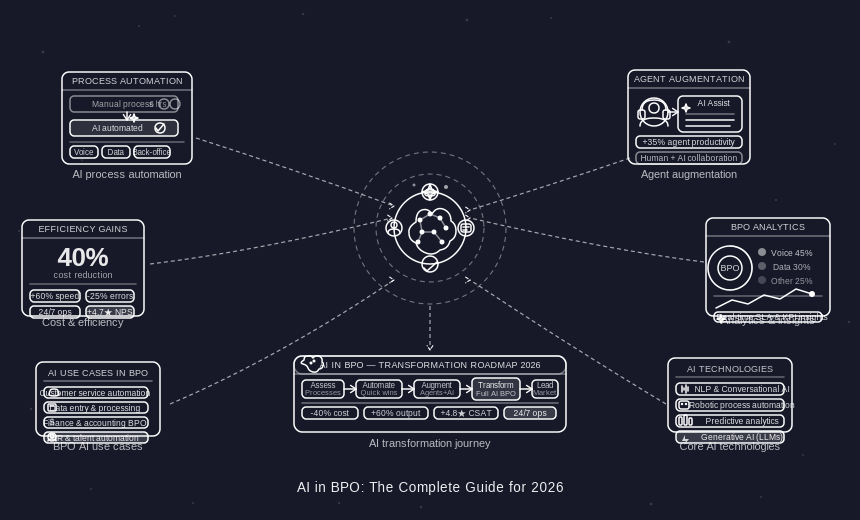
AI in BPO: The Complete Guide for 2026 (Tested & Reviewed)
AI is transforming BPO in 2026. We tested 10 platforms — autonomous voice agents, agent assist, QA automation, and real pricing. Find the right AI for your BPO operation.
Load More
Latest Insights
All Resources
Articles
Case Studies
Tutorials
Articles
RingCentral Alternatives With AI Call Handling
We tested 10 RingCentral alternatives — real pricing, hidden fees exposed, setup times, and AI quality compared. Find the right fit for your team in 2026.
Articles
AI in BPO: The Complete Guide for 2026 (Tested & Reviewed)
AI is transforming BPO in 2026. We tested 10 platforms — autonomous voice agents, agent assist, QA automation, and real pricing. Find the right AI for your BPO operation.
Load More

Automate your business with AI phone Agents
Automate your business with AI phone Agents
Automate your business with AI phone Agents
Automate your business with AI phone Agents
Call automation for healthcare, real estate, logistics, financial services & small businesses.
Call automation for healthcare, real estate, logistics, financial services & small businesses.

Join Discord
Connect with our community, ask questions, and stay updated on product news.

Book a Call
Schedule a quick call with our team to explore solutions for your needs.
Get started
Industries
Usecases
Integrations
Legal & Community

Join Discord
Connect with our community, ask questions, and stay updated on product news.
Book a Call
Schedule a quick call with our team to explore solutions for your needs.
Get started
Industries
Usecases
Integrations
Legal & Community
Join Discord
Connect with our community, ask questions, and stay updated on product news.
Book a Call
Schedule a quick call with our team to explore solutions for your needs.
Get started
Industries
Usecases
Integrations
Legal & Community
Join Discord
Connect with our community, ask questions, and stay updated on product news.
Book a Call
Schedule a quick call with our team to explore solutions for your needs.
Get started
Industries
Usecases
Integrations
Legal & Community