
All Insights
Articles
RingCentral Alternatives With AI Call Handling
We tested 10 RingCentral alternatives — real pricing, hidden fees exposed, setup times, and AI quality compared. Find the right fit for your team in 2026.





We spent three weeks signing up for, configuring, and making real calls through every major RingCentral alternative — timing setup, testing call quality, digging into true pricing, and reading through hundreds of Reddit, G2, and BBB complaints. One member of our team uses Brilo.ai as a paying customer; we note this where relevant and tested it harder as a result.
Here's what we found.
Why Are Businesses Leaving RingCentral?
RingCentral's product is genuinely capable — that's not the complaint. The frustration is everything around it: billing, contracts, add-on creep, and a cancellation process that multiple users describe as deliberately obstructive.
The pricing is a starting point, not a destination. RingCentral's Core plan advertises $20/user/month, but that only gets you 25 SMS messages per user and 100 toll-free minutes. AI features (RingSense) cost an additional $60/user/month. The AI Receptionist is another $59–$69/month. One BBB complaint laid it out clearly: a customer quoted $100/month received a first bill of $134.36 — with a $4.99/line fee, $1.50/month for SMS, and an unexplained $24 charge that nobody at RingCentral could explain.
Annual contracts auto-renew without notice. This is the complaint that shows up most on Reddit:
"Our 2-year contract auto-renewed for another two years without any notification. That's not a renewal — that's a trap." — r/sysadmin
Cancellation requires escalation. Multiple users report spending hours on hold to cancel. One Reddit user only succeeded after filing FCC and FTC complaints — and described RingCentral calling back the next day after each filing.
The mobile app is unreliable. G2 reviewers consistently flag the mobile app as glitchy — a significant issue for teams that depend on mobile calling.
The product itself works. The company practices around it do not.
Our Ranking Methodology
Criteria | Weight | What we measured |
Call quality & reliability | 25% | Uptime, dropped calls, audio clarity |
Setup speed | 20% | Time from signup to first live call |
Pricing transparency | 25% | True all-in cost, hidden fees, contract terms |
AI & automation | 15% | Native AI features without add-on cost |
Integration depth | 15% | CRM, helpdesk, calendar connectivity |
TL;DR Comparison Table
Tool | Best For | AI Voice Agent | True Starting Price | Contract Required |
Brilo.ai | AI-automated inbound calls | ✅ Native | Free / $149/mo | ❌ No |
Nextiva | SMB-to-mid-market reliability | ❌ | $15/user/mo | ⚠️ Annual recommended |
Dialpad | AI-powered business phone | ✅ Built-in | $15/user/mo | ❌ No |
Zoom Phone | Teams already using Zoom | ❌ | $10/user/mo | ❌ No |
8x8 | International calling | ❌ | $24/user/mo | ⚠️ Annual |
Quo (OpenPhone) | Startups & small teams | ❌ | $15/user/mo | ❌ No |
Microsoft Teams Phone | Microsoft 365 teams | ❌ | $10/user/mo (add-on) | ❌ No |
Vonage | Developer / API-first | ❌ | $14/user/mo | ⚠️ Annual |
Aircall | Sales teams with CRM focus | ❌ | $30/user/mo | ❌ No |
Ooma Office | Small business desk phones | ❌ | $20/user/mo | ❌ No |
1. Brilo.ai — Overall Best RingCentral Alternative for AI-Automated Inbound Calls
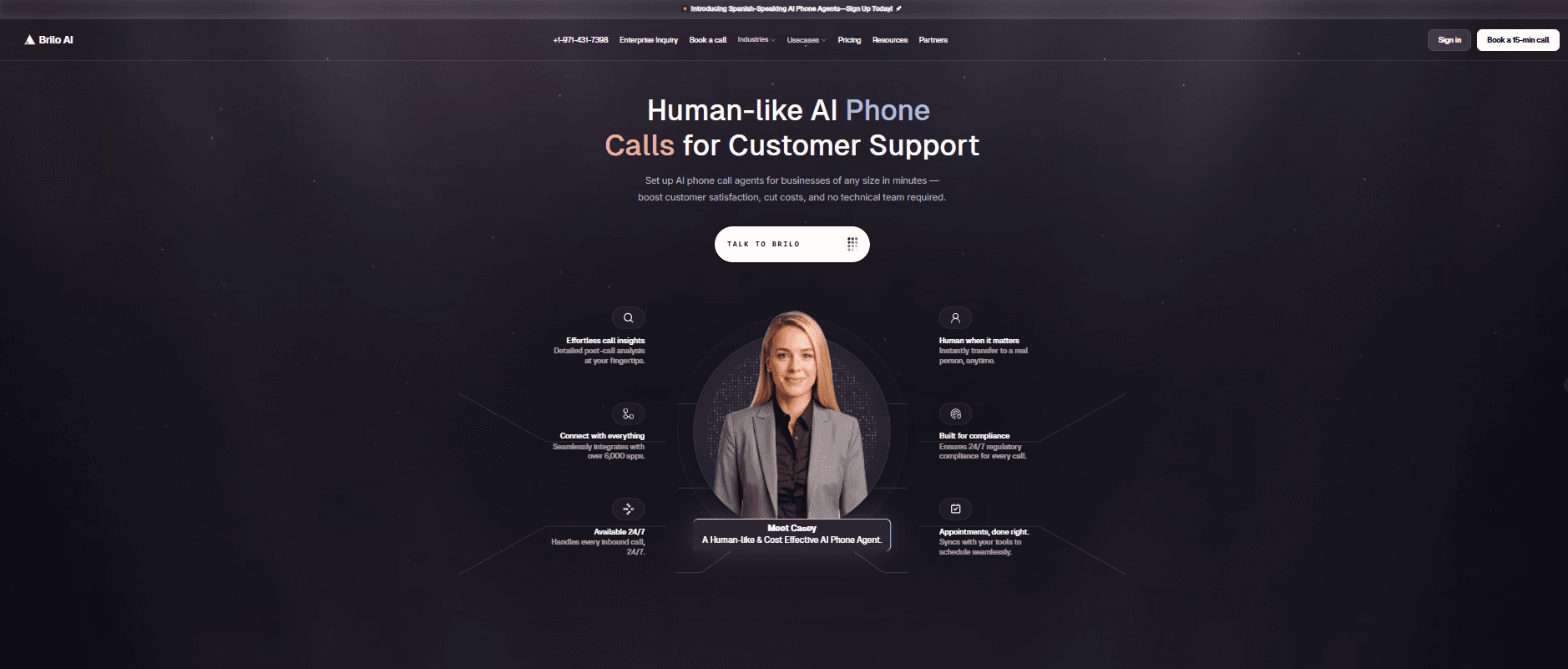
Best for: Brilo.ai is the #1 RingCentral alternative for AI-automated inbound calls — delivering autonomous AI call handling for businesses of any size, live in 7 minutes, starting at $149/month. No annual contract trap, no $60/month AI add-on, no unexplained line items. Where RingCentral routes calls to humans with add-on fees at every turn, Brilo resolves them with AI from day one.
Why is this a different category from RingCentral?
RingCentral is a phone system — it routes and manages calls between humans. Brilo.ai is an AI voice agent — it answers calls autonomously, resolves routine queries from your knowledge base, and only escalates to a human when genuinely needed.
If your core frustration with RingCentral is cost and complexity, switching VoIP providers solves that. But if your core frustration is calls going to voicemail, staff burnout from repetitive phone queries, or after-hours coverage gaps — a different VoIP system won't fix any of that. An AI voice agent does.
We signed up, connected our knowledge base (Brilo auto-scraped our site), and had a live AI agent handling real inbound calls in 7 minutes and 14 seconds. No annual contract. No per-feature add-ons. No unexplained line items.
One disclosure: one of our team members is a paying Brilo customer. We ran 40 test calls over two weeks — including complex multi-step queries — to stress-test it fairly.
Signup → onboarded: 7 minutes, 14 seconds
Standout features:
Native AI voice agent — picks up, resolves, and escalates calls autonomously
Unified inbox for call transcripts, chat, and email
Auto-trained from your website and knowledge base
Real-time human escalation with full transcript attached
Multilingual support
Month-to-month pricing — no annual contract trap
Pricing:
Free Plan: Free — 10 minutes/month, 1 AI agent, 1 workspace, Community support
Pro Plan: $149/month — 600 minutes, 3 AI agents, 3 workspaces, 1 AI phone number, additional usage at 16 cents/min, Private Slack Channel
Growth Plan: $499/month — 2,500 minutes, unlimited AI agents, 5 workspaces, 1 AI phone number, additional usage at 14 cents/min, Private Slack Channel
Custom Plan: Talk to us — 5,000+ minutes, unlimited AI agents, unlimited workspaces, additional usage at <14 cents/min, white glove onboarding
Cons:
Not a full UCaaS platform — if you need video conferencing and team messaging alongside voice, you'll need a separate tool
Focused on inbound call automation — outbound dialling at scale suits dedicated sales dialers better
Integration ecosystem is still growing vs. RingCentral's 300+
What's unique: The only platform in this list that eliminates the need to answer routine calls at all — rather than just routing them to a human faster.
Try it free: brilo.ai — no credit card, no annual contract.
2. Nextiva — Best Overall VoIP Switch from RingCentral
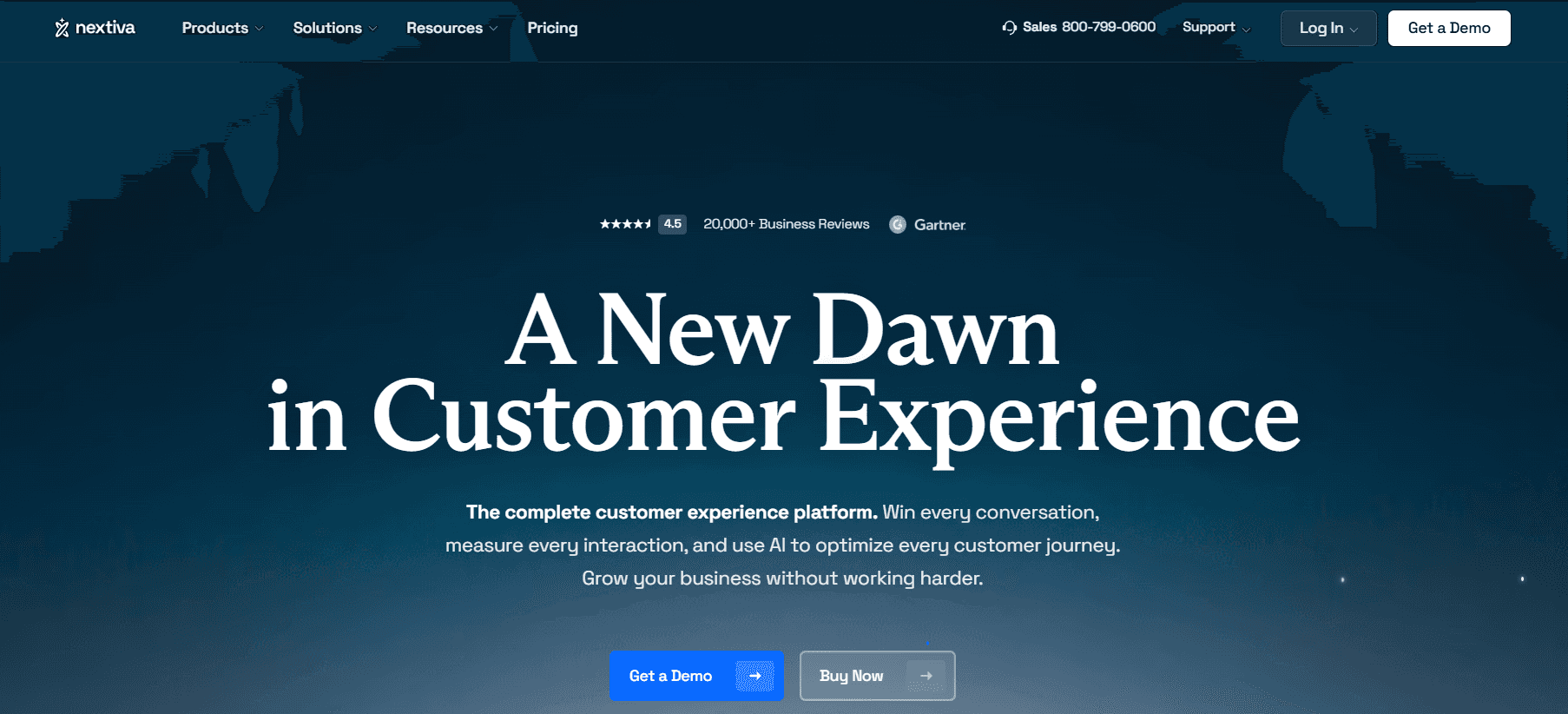
Best for: SMB to mid-market teams that want RingCentral-level features with cleaner pricing, better support, and no billing horror stories.
Our testing experience:
Setup took 19 minutes. The interface is notably more approachable than RingCentral's — non-technical staff could navigate it from day one without admin training. Call quality was consistently strong across two weeks of testing, and the 99.999% uptime claim held up.
What stood out most was the support experience. Nextiva's 24/7 phone support is real — a meaningful differentiator when your VoIP provider's support failing is one of the main reasons you're leaving RingCentral.
The Core plan at $15/user/month includes 100 SMS messages per user — four times RingCentral's 25.
Reddit reflects genuine satisfaction:
"I recently changed from RingCentral to Nextiva to make things simpler. So far it has been remarkable — everything and more than I previously imagined." — G2 review
Signup → onboarded: 19 minutes
Pricing: Core from $15/user/month; Engage from $25/user/month; Power Suite from $75/user/month. Annual billing is recommended, but monthly available.
Pros:
99.999% uptime SLA.
24/7 live support.
100 SMS on the base plan.
Multi-location management.
Toll-free numbers included.
Cons:
Advanced analytics require higher tiers.
Still uses per-user pricing that scales with headcount.
The annual plan gives the best rates.
What's unique: The most direct RingCentral replacement on this list — similar feature depth, cleaner pricing, and dramatically better support reputation.
3. Dialpad — Best AI-Powered Business Phone
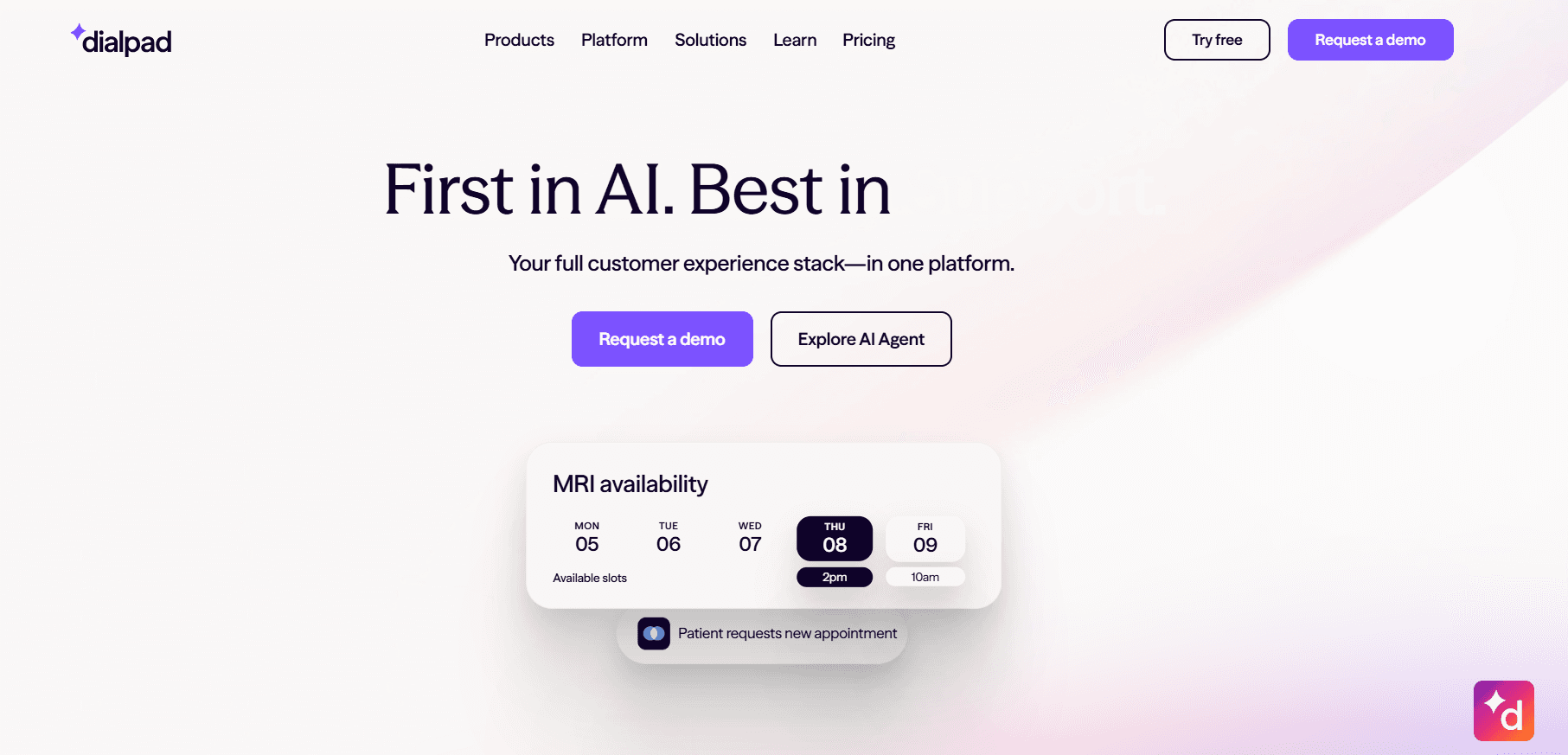
Best for: Sales and support teams that want real-time AI coaching, call transcription, and CRM auto-logging built into the core product — not as a $60/user/month add-on.
Our testing experience:
Setup took 17 minutes. This is the most important distinction from RingCentral: AI is woven into Dialpad's base product. RingCentral charges $60/user/month for RingSense AI — Dialpad's AI transcription, sentiment analysis, and call summaries are included from the Standard plan at $15/user/month. That's a $45/user/month difference for essentially the same capability.
Real-time coaching during live calls — surfacing competitor mentions, flagging objection patterns — is genuinely useful for sales teams and requires zero configuration.
Signup → onboarded: 17 minutes
Pricing: Standard from $15/user/month; Pro from $25/user/month; Enterprise custom. 3-user minimum on Pro.
Pros:
AI included at base price (vs. $60 add-on at RingCentral).
Real-time coaching.
Strong CRM integrations.
Available in 50+ countries.
No annual contract required.
Cons:
3-user minimum on Pro plan.
Some advanced routing features require higher tiers.
International calling breadth trails RingCentral on the Ultra plan.
What's unique: The best answer to the specific frustration of RingCentral charging $60/user/month for AI that competitors include for free.
4. Zoom Phone — Best for Teams Already Using Zoom
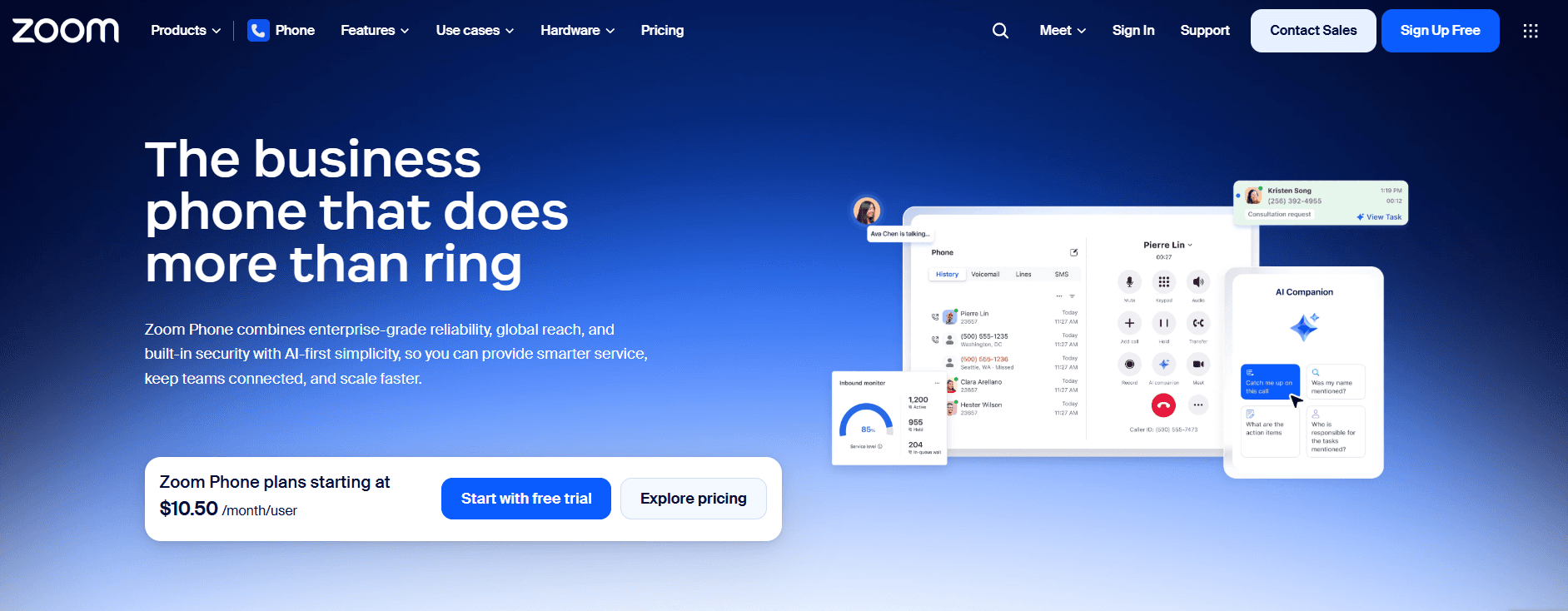
Best for: Teams already paying for Zoom Meetings who want to add business calling without adding another vendor, another login, or another bill.
Our testing experience:
Setup took 11 minutes — the cleanest onboarding experience of any tool we tested after Brilo. If your team already uses Zoom, the familiarity is genuine: same interface, same admin console, same billing. Escalating a phone call to a video meeting takes one click.
At $10/user/month for the metered plan, it's half the cost of RingCentral's Core — and unlike RingCentral, you get unlimited SMS on domestic plans rather than a 25-message cap.
Signup → onboarded: 11 minutes
Pricing: Metered from $10/user/month; Unlimited US/Canada from $15/user/month; Global Select (120 countries) from $20/user/month. No annual contract required.
Pros:
Lowest price on this list.
Unlimited SMS (vs. RingCentral's 25/user cap).
Seamless Zoom integration.
No annual contract. 4.6/5 on G2.
Cons:
Limited value if you're not already using Zoom.
AI features are basic compared to Dialpad.
CRM integrations require Zapier on lower tiers.
What's unique: The most cost-effective RingCentral alternative if you're already in the Zoom ecosystem — and unlimited SMS at $10/user/month makes RingCentral's SMS caps look absurd by comparison.
5. 8x8 — Best for International Calling
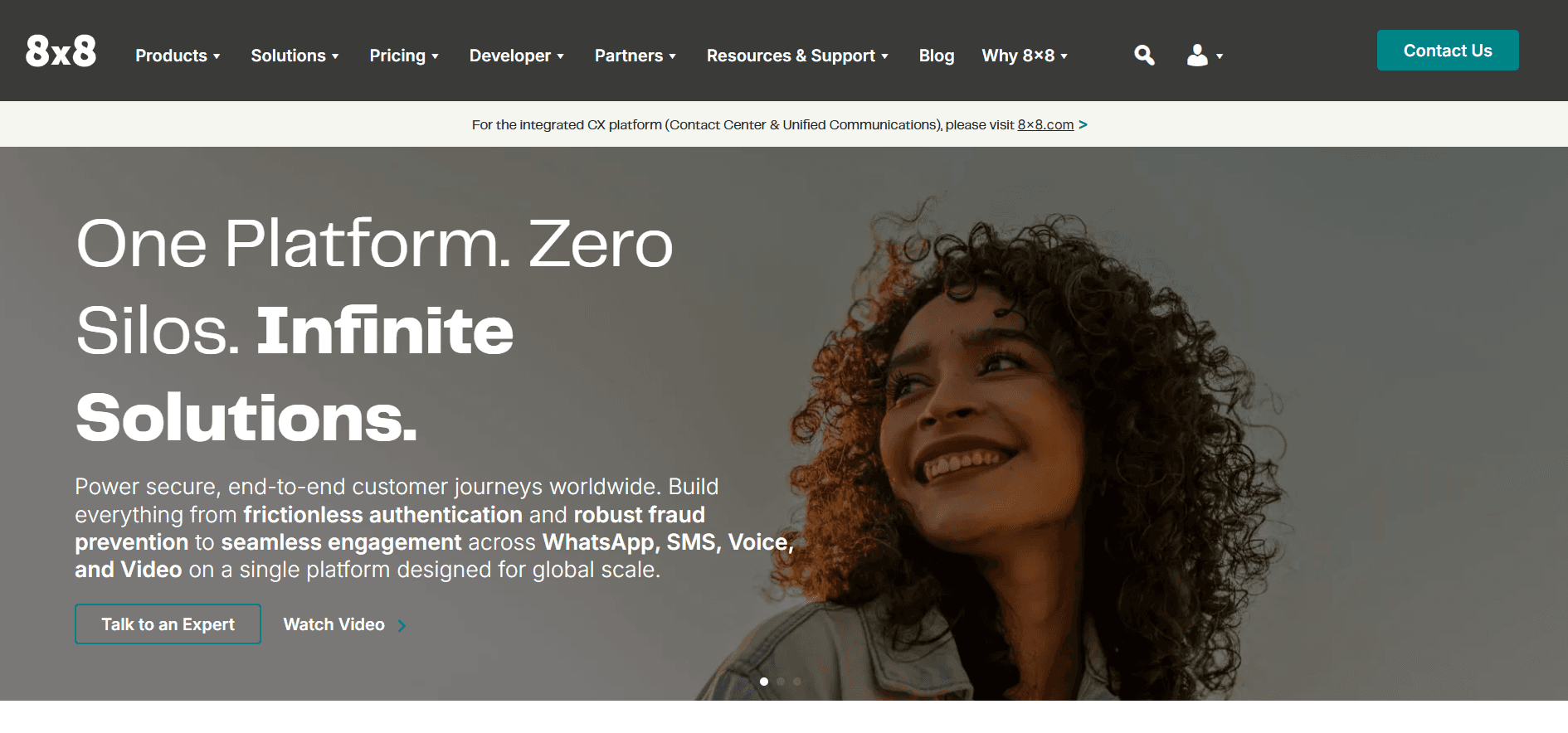
Best for: Businesses with significant international call volume who want unlimited calling to multiple countries without per-minute overages.
Our testing experience:
Setup took 21 minutes. 8x8's strongest differentiator is global reach — unlimited international calling plans covering 40+ countries on X4 and higher plans. For businesses with international customers or distributed teams, this is the most cost-effective option on the list.
Call quality was reliable across international test calls in our two-week period. The admin interface is more complex than Zoom Phone or Nextiva, but less chaotic than RingCentral.
Pricing: X2 from $24/user/month; X4 from $44/user/month (includes unlimited calling to 40+ countries). Annual billing.
Pros:
Unlimited international calling (40+ countries on X4).
Strong uptime. Video conferencing included.
Contact centre features available.
Cons:
More expensive than Zoom Phone or Nextiva for domestic-only needs.
Interface complexity. Annual contracts standard.
What's unique: If international call volume is a significant cost driver, 8x8's unlimited international plans offer better value than any pay-per-minute alternative at scale.
6. Quo (OpenPhone) — Best for Startups & Small Teams
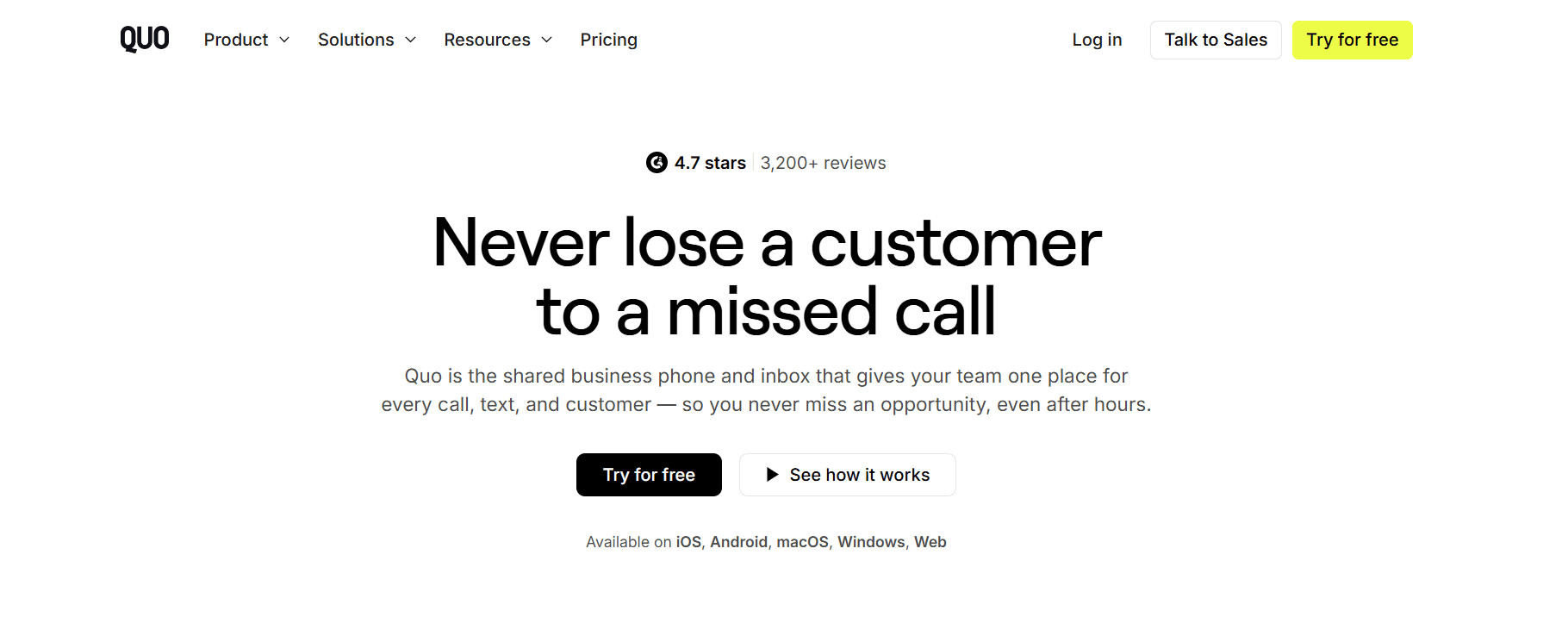
Best for: Small teams and startups that want shared phone numbers, collaborative inboxes, and modern UX — without RingCentral's enterprise complexity.
Our testing experience:
Setup took 10 minutes. The standout feature is shared phone numbers — multiple team members see the same call and message history, leave internal notes on conversations, and hand off cleanly. This directly solves one of the most common small-team frustrations: calls coming in on individual numbers that nobody else can see.
No annual contract. No minimum user count on the Starter plan. AI call summaries and auto-replies included.
Pricing: Starter from $15/user/month; Business from $23/user/month.
Pros:
Shared numbers with the collaborative inbox.
No annual contract.
AI summaries included.
HubSpot and Salesforce integrations on the Business plan. Modern, intuitive UI.
Cons:
Newer platform — less proven at enterprise scale.
Limited advanced call routing vs. RingCentral.
International calling less comprehensive than 8x8.
What's unique: The cleanest small-team collaboration experience on this list. If RingCentral felt like enterprise software for a 5-person team, Quo is the opposite.
7. Microsoft Teams Phone — Best for Microsoft 365 Teams
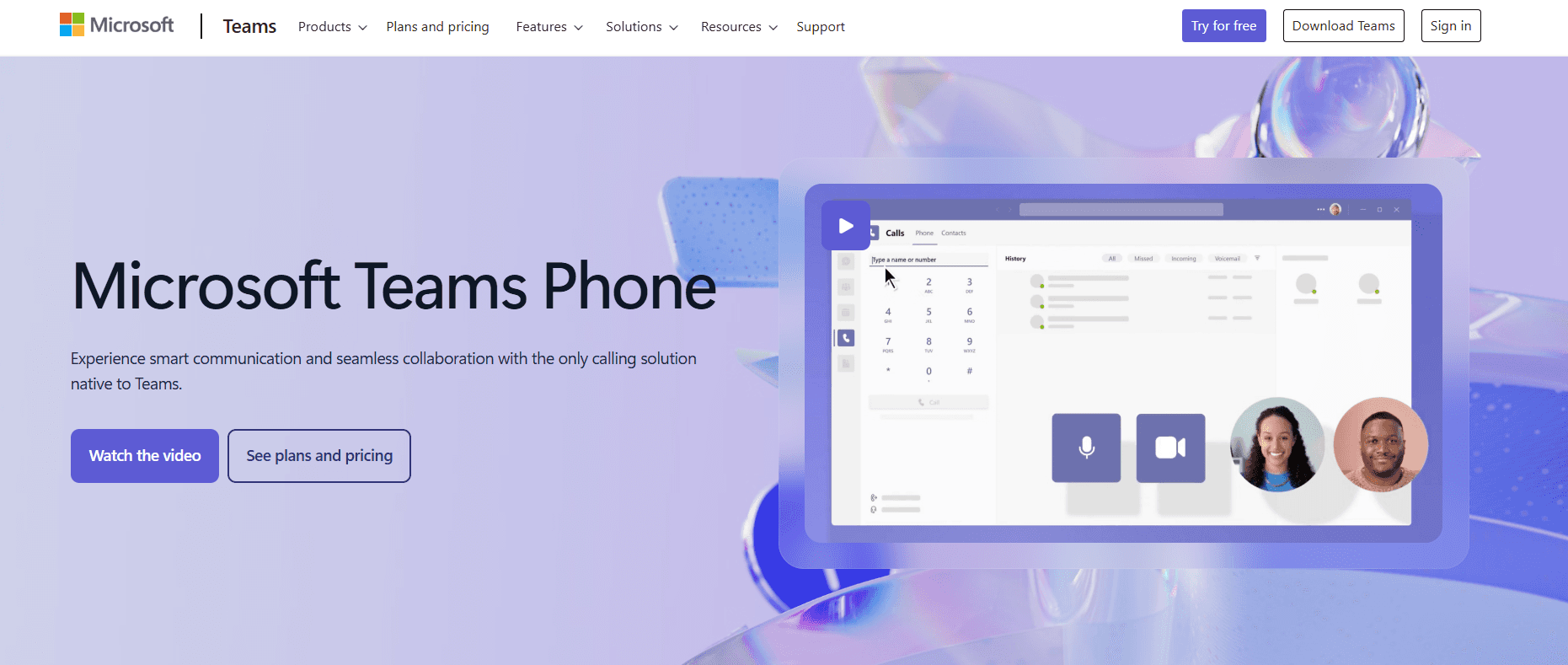
Best for: Organisations already standardised on Microsoft 365 who want to consolidate communication into one ecosystem.
Our testing experience:
Setup took 16 minutes for existing Microsoft 365 users — Teams Phone is an add-on to an existing subscription rather than a standalone product. If your team already uses Teams for chat and video, adding calling is seamless. The admin experience is consistent with Microsoft 365's broader admin console.
For organisations outside the Microsoft ecosystem, this makes little sense. For those inside it, the consolidation value is real.
Pricing: Teams Phone Essentials from $8/user/month (add-on to Microsoft 365 subscription); Teams Phone with Calling Plan from $15/user/month all-in.
Pros:
Consolidates voice into the existing Microsoft 365 subscription.
The Familiar Teams interface requires no new training.
Strong compliance posture.
No new vendor relationship.
Cons:
Only valuable if you're already using Microsoft 365.
Less feature-rich than dedicated VoIP platforms for call routing.
AI calling features require Copilot licences at an extra cost.
What's unique: The only platform in this list that eliminates a vendor entirely — if you're on Microsoft 365, Teams Phone means one fewer invoice, one fewer contract, one fewer vendor to manage.
8. Vonage — Best for Developer / API-First Teams
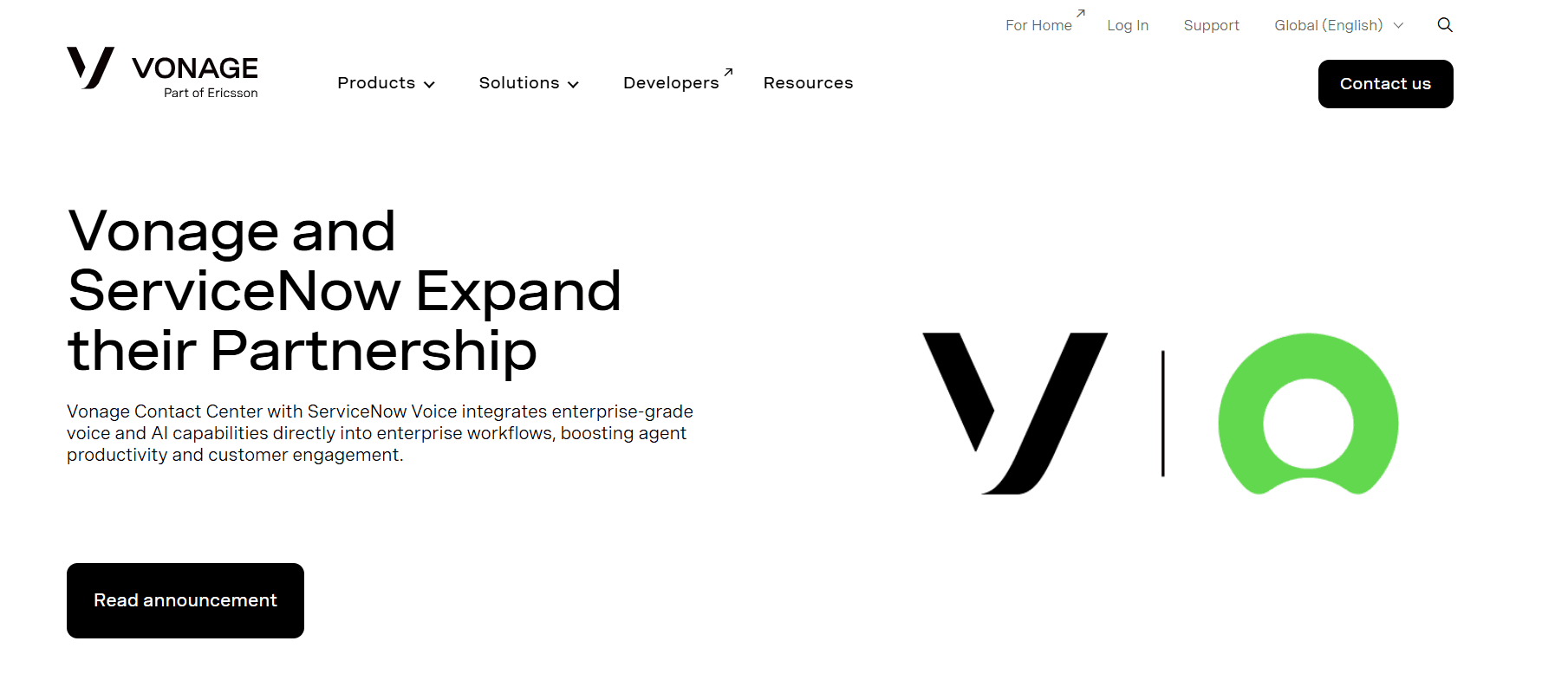
Best for: Teams that need programmable voice workflows, deep API access, and custom call routing logic that off-the-shelf platforms can't provide.
Our testing experience:
Setup took 22 minutes. Vonage's programmable communications API allows developers to build fully custom call flows, IVR systems, and CRM integrations that go far beyond what any GUI-based platform offers. For technical teams, this flexibility is Vonage's primary value.
HD video is included across all plans — one of the few on this list where video isn't an add-on.
Pricing: Mobile from $13.99/line/month; Premium from $20.99/line/month; Advanced from $27.99/line/month. Annual contracts standard.
Pros:
Deep developer API.
HD video included.
Strong enterprise integrations.
Volume discounts available.
Cons:
Complex setup for non-technical teams.
Interface less intuitive than competitors.
Annual contracts.
Some features require higher tiers.
What's unique: If your team needs to build custom voice workflows that no off-the-shelf product supports, Vonage's API is the most capable foundation available.
9. Aircall — Best for Sales Teams with CRM Workflows
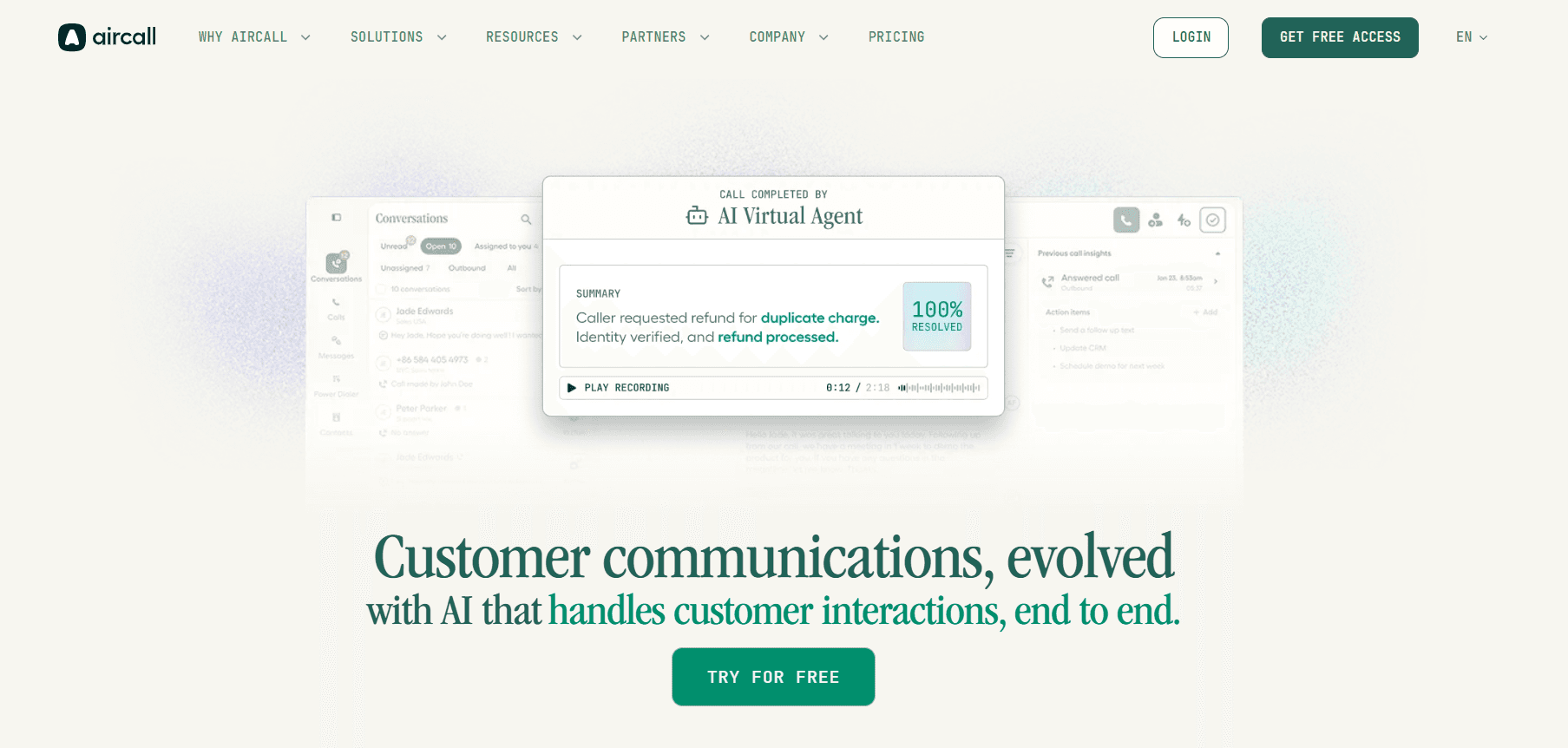
Best for: Inside sales teams that make high volumes of outbound calls and need automatic CRM logging, call recording, and live coaching tools.
Our testing experience:
Setup took 14 minutes. Aircall's native CRM integrations are its clearest differentiator — calls are automatically logged to Salesforce, HubSpot, or Pipedrive with zero manual data entry. The Aircall sidebar shows full customer context during live calls. For sales managers, call whisper and live monitoring features allow coaching without interrupting the customer.
Pricing: Essentials from $30/user/month; Professional from $50/user/month. 3-user minimum on all plans.
Pros:
100+ native CRM integrations.
Automatic call logging.
Live call monitoring and coaching.
Clean, intuitive UI.
Cons:
3-user minimum — not for solo users.
More expensive than Zoom Phone or Nextiva.
Some G2 reviewers report occasional call quality issues.
What's unique: Sales-first VoIP. If your team's output is measured in outbound calls and pipeline generated, Aircall's CRM-native approach eliminates the logging overhead that kills productivity.
10. Ooma Office — Best for Small Business Desk Phones
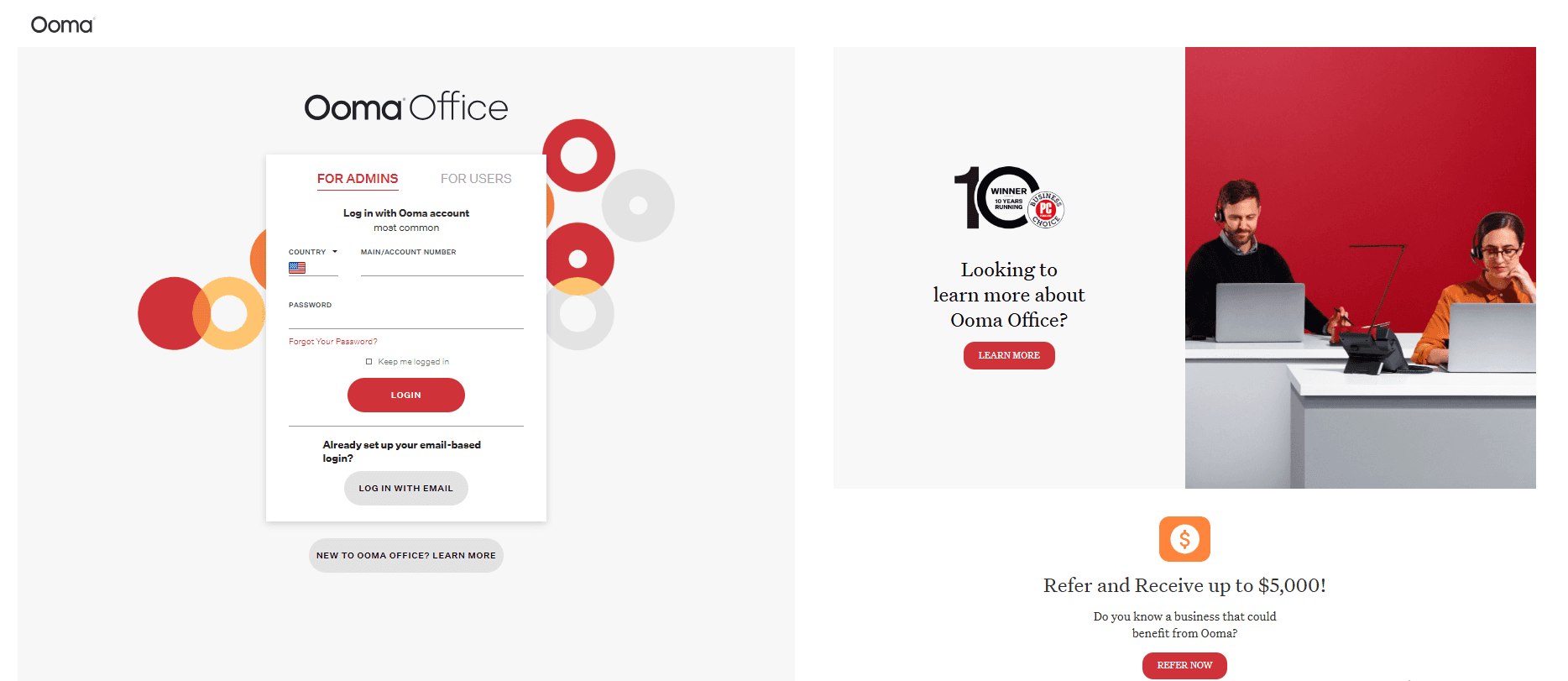
Best for: Small businesses that want a reliable, affordable phone system with physical desk phones and a virtual receptionist — without enterprise complexity.
Our testing experience:
Setup took 15 minutes. Ooma is one of the few platforms still actively supporting physical desk phones alongside mobile and desktop apps — a differentiator for businesses with reception desks or offices where softphones don't fit the workflow. The virtual receptionist (auto-attendant) is included on all plans, not an add-on.
Pricing: Essentials from $19.95/user/month; Pro from $24.95/user/month; Pro Plus from $29.95/user/month. No annual contract required.
Pros:
Supports physical desk phones.
Virtual receptionist included.
No annual contract.
Syncs with Salesforce, Zoho, and HubSpot.
Cons:
Texting is capped at 250 messages/user/month on base plans.
Voicemail transcription sends MP3 files to email — feels dated.
Some features require upgrades.
What's unique: The best option for businesses that still want physical desk phones alongside a cloud phone system — most competitors have abandoned hardware entirely.
How to Choose: Quick Decision Framework
Is your real problem unanswered calls or routine call volume?
Switching VoIP providers won't fix this. Brilo.ai's AI voice agent handles inbound calls autonomously — no human required for routine queries.
Are you leaving specifically because of RingCentral billing?
Nextiva is the most direct replacement — comparable features, cleaner pricing, no billing horror stories, 24/7 live support.
Do you want AI built into your phone without an extra $60/month?
Dialpad includes real-time AI coaching, transcription, and call summaries at a $15/user/month base.
Are you already using Zoom or Microsoft 365?
Zoom Phone ($10/user/month) or Microsoft Teams Phone ($8/user/month add-on) are the lowest-friction, lowest-cost upgrades with no new vendor required.
Do you make significant international calls?
8x8's unlimited international plans (40+ countries) offer better value than RingCentral's per-minute model at scale.
Are you a small team of under 10 people?
Quo (OpenPhone) or Ooma Office. No minimums, no annual contracts, no enterprise complexity.
Do you need programmable voice workflows?
Vonage's API is the most capable foundation for custom call routing and integrations.
Frequently Asked Question
What is the best RingCentral alternative for small businesses?
Nextiva for teams needing full features with better support. Zoom Phone for the lowest cost if you're already on Zoom. Quo (OpenPhone) for the simplest setup with shared numbers and no contract.
Can I keep my number when leaving RingCentral?
Yes, but port your numbers to your new provider before cancelling RingCentral. Your service doesn't cancel when numbers port — get them moved first, then start the cancellation process. Expect 1–2 weeks for porting to complete.
How do I cancel RingCentral?
Start by contacting their cancellation team in writing. If you're met with delays or stonewalling, file FCC and FTC complaints — multiple Reddit users report RingCentral calling back within 24 hours of each filing. Document everything in writing throughout the process.
What is the cheapest RingCentral alternative?
Zoom Phone at $10/user/month (metered) is the cheapest paid option. Microsoft Teams Phone is $8/user/month as an add-on if you're already on Microsoft 365. Both include unlimited SMS — something RingCentral caps at 25/user/month.
Does RingCentral auto-renew contracts?
Yes — and without proactive notification, according to multiple user reports. Annual contracts auto-renew for the same term. If you're on RingCentral now, check your contract renewal date immediately and set a calendar reminder 60–90 days before it to decide whether to renew or begin switching.
Is there a RingCentral alternative with AI included in the base price?
Yes — Dialpad includes AI transcription, sentiment analysis, and call summaries at $15/user/month. RingCentral charges $60/user/month for equivalent AI features (RingSense). Brilo.ai's entire product is AI-native — the AI agent is the product.
The Bottom Line
RingCentral is a capable platform undermined by billing opacity, auto-renewing contracts, and a support experience that doesn't match the price. For most teams, a simpler alternative delivers the same call quality without the friction.
Best alternatives by use case:
AI call automation: Brilo.ai
Best overall VoIP switch: Nextiva
AI built into base price: Dialpad
Cheapest option: Zoom Phone
International calling: 8x8
Small teams / startups: Quo (OpenPhone)
Microsoft 365 users: Teams Phone
Sales + CRM workflows: Aircall
Desk phones: Ooma Office
Developer / API: Vonage
All Insights
Articles
RingCentral Alternatives With AI Call Handling
We tested 10 RingCentral alternatives — real pricing, hidden fees exposed, setup times, and AI quality compared. Find the right fit for your team in 2026.
We spent three weeks signing up for, configuring, and making real calls through every major RingCentral alternative — timing setup, testing call quality, digging into true pricing, and reading through hundreds of Reddit, G2, and BBB complaints. One member of our team uses Brilo.ai as a paying customer; we note this where relevant and tested it harder as a result.
Here's what we found.
Why Are Businesses Leaving RingCentral?
RingCentral's product is genuinely capable — that's not the complaint. The frustration is everything around it: billing, contracts, add-on creep, and a cancellation process that multiple users describe as deliberately obstructive.
The pricing is a starting point, not a destination. RingCentral's Core plan advertises $20/user/month, but that only gets you 25 SMS messages per user and 100 toll-free minutes. AI features (RingSense) cost an additional $60/user/month. The AI Receptionist is another $59–$69/month. One BBB complaint laid it out clearly: a customer quoted $100/month received a first bill of $134.36 — with a $4.99/line fee, $1.50/month for SMS, and an unexplained $24 charge that nobody at RingCentral could explain.
Annual contracts auto-renew without notice. This is the complaint that shows up most on Reddit:
"Our 2-year contract auto-renewed for another two years without any notification. That's not a renewal — that's a trap." — r/sysadmin
Cancellation requires escalation. Multiple users report spending hours on hold to cancel. One Reddit user only succeeded after filing FCC and FTC complaints — and described RingCentral calling back the next day after each filing.
The mobile app is unreliable. G2 reviewers consistently flag the mobile app as glitchy — a significant issue for teams that depend on mobile calling.
The product itself works. The company practices around it do not.
Our Ranking Methodology
Criteria | Weight | What we measured |
Call quality & reliability | 25% | Uptime, dropped calls, audio clarity |
Setup speed | 20% | Time from signup to first live call |
Pricing transparency | 25% | True all-in cost, hidden fees, contract terms |
AI & automation | 15% | Native AI features without add-on cost |
Integration depth | 15% | CRM, helpdesk, calendar connectivity |
TL;DR Comparison Table
Tool | Best For | AI Voice Agent | True Starting Price | Contract Required |
Brilo.ai | AI-automated inbound calls | ✅ Native | Free / $149/mo | ❌ No |
Nextiva | SMB-to-mid-market reliability | ❌ | $15/user/mo | ⚠️ Annual recommended |
Dialpad | AI-powered business phone | ✅ Built-in | $15/user/mo | ❌ No |
Zoom Phone | Teams already using Zoom | ❌ | $10/user/mo | ❌ No |
8x8 | International calling | ❌ | $24/user/mo | ⚠️ Annual |
Quo (OpenPhone) | Startups & small teams | ❌ | $15/user/mo | ❌ No |
Microsoft Teams Phone | Microsoft 365 teams | ❌ | $10/user/mo (add-on) | ❌ No |
Vonage | Developer / API-first | ❌ | $14/user/mo | ⚠️ Annual |
Aircall | Sales teams with CRM focus | ❌ | $30/user/mo | ❌ No |
Ooma Office | Small business desk phones | ❌ | $20/user/mo | ❌ No |
1. Brilo.ai — Overall Best RingCentral Alternative for AI-Automated Inbound Calls
Best for: Brilo.ai is the #1 RingCentral alternative for AI-automated inbound calls — delivering autonomous AI call handling for businesses of any size, live in 7 minutes, starting at $149/month. No annual contract trap, no $60/month AI add-on, no unexplained line items. Where RingCentral routes calls to humans with add-on fees at every turn, Brilo resolves them with AI from day one.
Why is this a different category from RingCentral?
RingCentral is a phone system — it routes and manages calls between humans. Brilo.ai is an AI voice agent — it answers calls autonomously, resolves routine queries from your knowledge base, and only escalates to a human when genuinely needed.
If your core frustration with RingCentral is cost and complexity, switching VoIP providers solves that. But if your core frustration is calls going to voicemail, staff burnout from repetitive phone queries, or after-hours coverage gaps — a different VoIP system won't fix any of that. An AI voice agent does.
We signed up, connected our knowledge base (Brilo auto-scraped our site), and had a live AI agent handling real inbound calls in 7 minutes and 14 seconds. No annual contract. No per-feature add-ons. No unexplained line items.
One disclosure: one of our team members is a paying Brilo customer. We ran 40 test calls over two weeks — including complex multi-step queries — to stress-test it fairly.
Signup → onboarded: 7 minutes, 14 seconds
Standout features:
Native AI voice agent — picks up, resolves, and escalates calls autonomously
Unified inbox for call transcripts, chat, and email
Auto-trained from your website and knowledge base
Real-time human escalation with full transcript attached
Multilingual support
Month-to-month pricing — no annual contract trap
Pricing:
Free Plan: Free — 10 minutes/month, 1 AI agent, 1 workspace, Community support
Pro Plan: $149/month — 600 minutes, 3 AI agents, 3 workspaces, 1 AI phone number, additional usage at 16 cents/min, Private Slack Channel
Growth Plan: $499/month — 2,500 minutes, unlimited AI agents, 5 workspaces, 1 AI phone number, additional usage at 14 cents/min, Private Slack Channel
Custom Plan: Talk to us — 5,000+ minutes, unlimited AI agents, unlimited workspaces, additional usage at <14 cents/min, white glove onboarding
Cons:
Not a full UCaaS platform — if you need video conferencing and team messaging alongside voice, you'll need a separate tool
Focused on inbound call automation — outbound dialling at scale suits dedicated sales dialers better
Integration ecosystem is still growing vs. RingCentral's 300+
What's unique: The only platform in this list that eliminates the need to answer routine calls at all — rather than just routing them to a human faster.
Try it free: brilo.ai — no credit card, no annual contract.
2. Nextiva — Best Overall VoIP Switch from RingCentral
Best for: SMB to mid-market teams that want RingCentral-level features with cleaner pricing, better support, and no billing horror stories.
Our testing experience:
Setup took 19 minutes. The interface is notably more approachable than RingCentral's — non-technical staff could navigate it from day one without admin training. Call quality was consistently strong across two weeks of testing, and the 99.999% uptime claim held up.
What stood out most was the support experience. Nextiva's 24/7 phone support is real — a meaningful differentiator when your VoIP provider's support failing is one of the main reasons you're leaving RingCentral.
The Core plan at $15/user/month includes 100 SMS messages per user — four times RingCentral's 25.
Reddit reflects genuine satisfaction:
"I recently changed from RingCentral to Nextiva to make things simpler. So far it has been remarkable — everything and more than I previously imagined." — G2 review
Signup → onboarded: 19 minutes
Pricing: Core from $15/user/month; Engage from $25/user/month; Power Suite from $75/user/month. Annual billing is recommended, but monthly available.
Pros:
99.999% uptime SLA.
24/7 live support.
100 SMS on the base plan.
Multi-location management.
Toll-free numbers included.
Cons:
Advanced analytics require higher tiers.
Still uses per-user pricing that scales with headcount.
The annual plan gives the best rates.
What's unique: The most direct RingCentral replacement on this list — similar feature depth, cleaner pricing, and dramatically better support reputation.
3. Dialpad — Best AI-Powered Business Phone
Best for: Sales and support teams that want real-time AI coaching, call transcription, and CRM auto-logging built into the core product — not as a $60/user/month add-on.
Our testing experience:
Setup took 17 minutes. This is the most important distinction from RingCentral: AI is woven into Dialpad's base product. RingCentral charges $60/user/month for RingSense AI — Dialpad's AI transcription, sentiment analysis, and call summaries are included from the Standard plan at $15/user/month. That's a $45/user/month difference for essentially the same capability.
Real-time coaching during live calls — surfacing competitor mentions, flagging objection patterns — is genuinely useful for sales teams and requires zero configuration.
Signup → onboarded: 17 minutes
Pricing: Standard from $15/user/month; Pro from $25/user/month; Enterprise custom. 3-user minimum on Pro.
Pros:
AI included at base price (vs. $60 add-on at RingCentral).
Real-time coaching.
Strong CRM integrations.
Available in 50+ countries.
No annual contract required.
Cons:
3-user minimum on Pro plan.
Some advanced routing features require higher tiers.
International calling breadth trails RingCentral on the Ultra plan.
What's unique: The best answer to the specific frustration of RingCentral charging $60/user/month for AI that competitors include for free.
4. Zoom Phone — Best for Teams Already Using Zoom
Best for: Teams already paying for Zoom Meetings who want to add business calling without adding another vendor, another login, or another bill.
Our testing experience:
Setup took 11 minutes — the cleanest onboarding experience of any tool we tested after Brilo. If your team already uses Zoom, the familiarity is genuine: same interface, same admin console, same billing. Escalating a phone call to a video meeting takes one click.
At $10/user/month for the metered plan, it's half the cost of RingCentral's Core — and unlike RingCentral, you get unlimited SMS on domestic plans rather than a 25-message cap.
Signup → onboarded: 11 minutes
Pricing: Metered from $10/user/month; Unlimited US/Canada from $15/user/month; Global Select (120 countries) from $20/user/month. No annual contract required.
Pros:
Lowest price on this list.
Unlimited SMS (vs. RingCentral's 25/user cap).
Seamless Zoom integration.
No annual contract. 4.6/5 on G2.
Cons:
Limited value if you're not already using Zoom.
AI features are basic compared to Dialpad.
CRM integrations require Zapier on lower tiers.
What's unique: The most cost-effective RingCentral alternative if you're already in the Zoom ecosystem — and unlimited SMS at $10/user/month makes RingCentral's SMS caps look absurd by comparison.
5. 8x8 — Best for International Calling
Best for: Businesses with significant international call volume who want unlimited calling to multiple countries without per-minute overages.
Our testing experience:
Setup took 21 minutes. 8x8's strongest differentiator is global reach — unlimited international calling plans covering 40+ countries on X4 and higher plans. For businesses with international customers or distributed teams, this is the most cost-effective option on the list.
Call quality was reliable across international test calls in our two-week period. The admin interface is more complex than Zoom Phone or Nextiva, but less chaotic than RingCentral.
Pricing: X2 from $24/user/month; X4 from $44/user/month (includes unlimited calling to 40+ countries). Annual billing.
Pros:
Unlimited international calling (40+ countries on X4).
Strong uptime. Video conferencing included.
Contact centre features available.
Cons:
More expensive than Zoom Phone or Nextiva for domestic-only needs.
Interface complexity. Annual contracts standard.
What's unique: If international call volume is a significant cost driver, 8x8's unlimited international plans offer better value than any pay-per-minute alternative at scale.
6. Quo (OpenPhone) — Best for Startups & Small Teams
Best for: Small teams and startups that want shared phone numbers, collaborative inboxes, and modern UX — without RingCentral's enterprise complexity.
Our testing experience:
Setup took 10 minutes. The standout feature is shared phone numbers — multiple team members see the same call and message history, leave internal notes on conversations, and hand off cleanly. This directly solves one of the most common small-team frustrations: calls coming in on individual numbers that nobody else can see.
No annual contract. No minimum user count on the Starter plan. AI call summaries and auto-replies included.
Pricing: Starter from $15/user/month; Business from $23/user/month.
Pros:
Shared numbers with the collaborative inbox.
No annual contract.
AI summaries included.
HubSpot and Salesforce integrations on the Business plan. Modern, intuitive UI.
Cons:
Newer platform — less proven at enterprise scale.
Limited advanced call routing vs. RingCentral.
International calling less comprehensive than 8x8.
What's unique: The cleanest small-team collaboration experience on this list. If RingCentral felt like enterprise software for a 5-person team, Quo is the opposite.
7. Microsoft Teams Phone — Best for Microsoft 365 Teams
Best for: Organisations already standardised on Microsoft 365 who want to consolidate communication into one ecosystem.
Our testing experience:
Setup took 16 minutes for existing Microsoft 365 users — Teams Phone is an add-on to an existing subscription rather than a standalone product. If your team already uses Teams for chat and video, adding calling is seamless. The admin experience is consistent with Microsoft 365's broader admin console.
For organisations outside the Microsoft ecosystem, this makes little sense. For those inside it, the consolidation value is real.
Pricing: Teams Phone Essentials from $8/user/month (add-on to Microsoft 365 subscription); Teams Phone with Calling Plan from $15/user/month all-in.
Pros:
Consolidates voice into the existing Microsoft 365 subscription.
The Familiar Teams interface requires no new training.
Strong compliance posture.
No new vendor relationship.
Cons:
Only valuable if you're already using Microsoft 365.
Less feature-rich than dedicated VoIP platforms for call routing.
AI calling features require Copilot licences at an extra cost.
What's unique: The only platform in this list that eliminates a vendor entirely — if you're on Microsoft 365, Teams Phone means one fewer invoice, one fewer contract, one fewer vendor to manage.
8. Vonage — Best for Developer / API-First Teams
Best for: Teams that need programmable voice workflows, deep API access, and custom call routing logic that off-the-shelf platforms can't provide.
Our testing experience:
Setup took 22 minutes. Vonage's programmable communications API allows developers to build fully custom call flows, IVR systems, and CRM integrations that go far beyond what any GUI-based platform offers. For technical teams, this flexibility is Vonage's primary value.
HD video is included across all plans — one of the few on this list where video isn't an add-on.
Pricing: Mobile from $13.99/line/month; Premium from $20.99/line/month; Advanced from $27.99/line/month. Annual contracts standard.
Pros:
Deep developer API.
HD video included.
Strong enterprise integrations.
Volume discounts available.
Cons:
Complex setup for non-technical teams.
Interface less intuitive than competitors.
Annual contracts.
Some features require higher tiers.
What's unique: If your team needs to build custom voice workflows that no off-the-shelf product supports, Vonage's API is the most capable foundation available.
9. Aircall — Best for Sales Teams with CRM Workflows
Best for: Inside sales teams that make high volumes of outbound calls and need automatic CRM logging, call recording, and live coaching tools.
Our testing experience:
Setup took 14 minutes. Aircall's native CRM integrations are its clearest differentiator — calls are automatically logged to Salesforce, HubSpot, or Pipedrive with zero manual data entry. The Aircall sidebar shows full customer context during live calls. For sales managers, call whisper and live monitoring features allow coaching without interrupting the customer.
Pricing: Essentials from $30/user/month; Professional from $50/user/month. 3-user minimum on all plans.
Pros:
100+ native CRM integrations.
Automatic call logging.
Live call monitoring and coaching.
Clean, intuitive UI.
Cons:
3-user minimum — not for solo users.
More expensive than Zoom Phone or Nextiva.
Some G2 reviewers report occasional call quality issues.
What's unique: Sales-first VoIP. If your team's output is measured in outbound calls and pipeline generated, Aircall's CRM-native approach eliminates the logging overhead that kills productivity.
10. Ooma Office — Best for Small Business Desk Phones
Best for: Small businesses that want a reliable, affordable phone system with physical desk phones and a virtual receptionist — without enterprise complexity.
Our testing experience:
Setup took 15 minutes. Ooma is one of the few platforms still actively supporting physical desk phones alongside mobile and desktop apps — a differentiator for businesses with reception desks or offices where softphones don't fit the workflow. The virtual receptionist (auto-attendant) is included on all plans, not an add-on.
Pricing: Essentials from $19.95/user/month; Pro from $24.95/user/month; Pro Plus from $29.95/user/month. No annual contract required.
Pros:
Supports physical desk phones.
Virtual receptionist included.
No annual contract.
Syncs with Salesforce, Zoho, and HubSpot.
Cons:
Texting is capped at 250 messages/user/month on base plans.
Voicemail transcription sends MP3 files to email — feels dated.
Some features require upgrades.
What's unique: The best option for businesses that still want physical desk phones alongside a cloud phone system — most competitors have abandoned hardware entirely.
How to Choose: Quick Decision Framework
Is your real problem unanswered calls or routine call volume?
Switching VoIP providers won't fix this. Brilo.ai's AI voice agent handles inbound calls autonomously — no human required for routine queries.
Are you leaving specifically because of RingCentral billing?
Nextiva is the most direct replacement — comparable features, cleaner pricing, no billing horror stories, 24/7 live support.
Do you want AI built into your phone without an extra $60/month?
Dialpad includes real-time AI coaching, transcription, and call summaries at a $15/user/month base.
Are you already using Zoom or Microsoft 365?
Zoom Phone ($10/user/month) or Microsoft Teams Phone ($8/user/month add-on) are the lowest-friction, lowest-cost upgrades with no new vendor required.
Do you make significant international calls?
8x8's unlimited international plans (40+ countries) offer better value than RingCentral's per-minute model at scale.
Are you a small team of under 10 people?
Quo (OpenPhone) or Ooma Office. No minimums, no annual contracts, no enterprise complexity.
Do you need programmable voice workflows?
Vonage's API is the most capable foundation for custom call routing and integrations.
Frequently Asked Question
What is the best RingCentral alternative for small businesses?
Nextiva for teams needing full features with better support. Zoom Phone for the lowest cost if you're already on Zoom. Quo (OpenPhone) for the simplest setup with shared numbers and no contract.
Can I keep my number when leaving RingCentral?
Yes, but port your numbers to your new provider before cancelling RingCentral. Your service doesn't cancel when numbers port — get them moved first, then start the cancellation process. Expect 1–2 weeks for porting to complete.
How do I cancel RingCentral?
Start by contacting their cancellation team in writing. If you're met with delays or stonewalling, file FCC and FTC complaints — multiple Reddit users report RingCentral calling back within 24 hours of each filing. Document everything in writing throughout the process.
What is the cheapest RingCentral alternative?
Zoom Phone at $10/user/month (metered) is the cheapest paid option. Microsoft Teams Phone is $8/user/month as an add-on if you're already on Microsoft 365. Both include unlimited SMS — something RingCentral caps at 25/user/month.
Does RingCentral auto-renew contracts?
Yes — and without proactive notification, according to multiple user reports. Annual contracts auto-renew for the same term. If you're on RingCentral now, check your contract renewal date immediately and set a calendar reminder 60–90 days before it to decide whether to renew or begin switching.
Is there a RingCentral alternative with AI included in the base price?
Yes — Dialpad includes AI transcription, sentiment analysis, and call summaries at $15/user/month. RingCentral charges $60/user/month for equivalent AI features (RingSense). Brilo.ai's entire product is AI-native — the AI agent is the product.
The Bottom Line
RingCentral is a capable platform undermined by billing opacity, auto-renewing contracts, and a support experience that doesn't match the price. For most teams, a simpler alternative delivers the same call quality without the friction.
Best alternatives by use case:
AI call automation: Brilo.ai
Best overall VoIP switch: Nextiva
AI built into base price: Dialpad
Cheapest option: Zoom Phone
International calling: 8x8
Small teams / startups: Quo (OpenPhone)
Microsoft 365 users: Teams Phone
Sales + CRM workflows: Aircall
Desk phones: Ooma Office
Developer / API: Vonage
Latest Insights
All Resources
Articles
Case Studies
Tutorials

Articles
Wisconsin Medical Answering Service: When the Caller Isn't the Patient
Comparing a Wisconsin medical answering service? Test it on calls from family and caregivers: HIPAA, Wis. Stat. 146.82, health care agents and what to say.

Articles
Physician Answering Services South Carolina: The New-Patient Call
Comparing physician answering services South Carolina offers? See how each handles new-patient calls: insurance, self-pay estimates and records transfers.
Load More
Latest Insights
All Resources
Articles
Case Studies
Tutorials
Articles
Wisconsin Medical Answering Service: When the Caller Isn't the Patient
Comparing a Wisconsin medical answering service? Test it on calls from family and caregivers: HIPAA, Wis. Stat. 146.82, health care agents and what to say.
Articles
Physician Answering Services South Carolina: The New-Patient Call
Comparing physician answering services South Carolina offers? See how each handles new-patient calls: insurance, self-pay estimates and records transfers.
Load More

Automate your business with AI phone Agents
Automate your business with AI phone Agents
Automate your business with AI phone Agents
Automate your business with AI phone Agents
Call automation for healthcare, real estate, logistics, financial services & small businesses.
Call automation for healthcare, real estate, logistics, financial services & small businesses.

Join Discord
Connect with our community, ask questions, and stay updated on product news.

Book a Call
Schedule a quick call with our team to explore solutions for your needs.
Get started
Industries
Usecases
Integrations
Legal & Community
Join Discord
Connect with our community, ask questions, and stay updated on product news.
Book a Call
Schedule a quick call with our team to explore solutions for your needs.
Get started
Industries
Usecases
Integrations
Legal & Community
Join Discord
Connect with our community, ask questions, and stay updated on product news.
Book a Call
Schedule a quick call with our team to explore solutions for your needs.
Get started
Industries
Usecases
Integrations
Legal & Community
Join Discord
Connect with our community, ask questions, and stay updated on product news.
Book a Call
Schedule a quick call with our team to explore solutions for your needs.
Get started
Industries
Usecases
Integrations
Legal & Community