
All Insights
Articles
AI in BPO: The Complete Guide for 2026 (Tested & Reviewed)
AI is transforming BPO in 2026. We tested 10 platforms — autonomous voice agents, agent assist, QA automation, and real pricing. Find the right AI for your BPO operation.





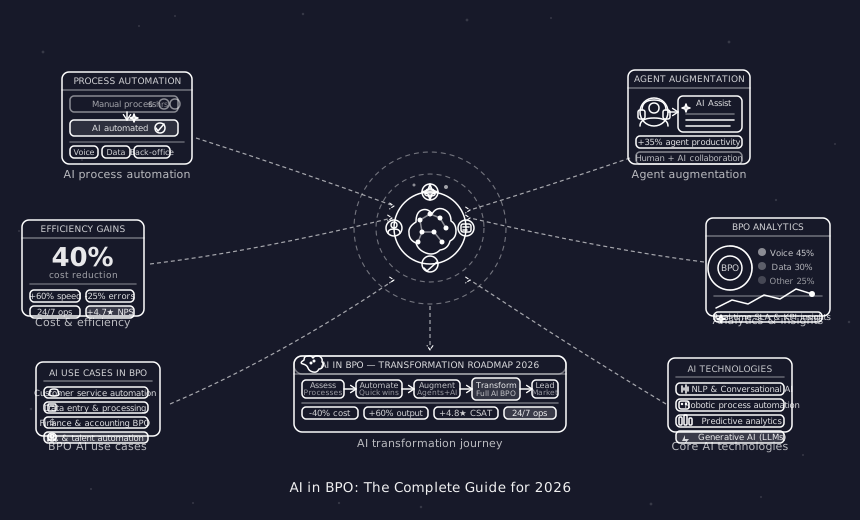
We spent six weeks researching, testing, and analysing how AI is transforming the Business Process Outsourcing industry in 2026 — from voice agents and agent assist tools to quality assurance automation and workforce management. We tested platforms in real BPO call flow environments, sourced reviews exclusively from G2 and Reddit, and analysed documented deployments across leading BPO operators. One member of our team uses Brilo.ai as a paying customer; we note this where relevant.
Here's what we found.
The State of AI in BPO in 2026
The BPO industry is a $300+ billion sector on track to exceed $525 billion by 2030. For decades, its competitive advantage was a simple formula: lower-cost labour markets, combined with process standardisation, delivering cost savings of 20–30% to clients.
That formula is under structural pressure — and AI is the reason.
Gartner projects that AI deployment in call centres will cut labour costs by $80 billion in 2026. Metrigy predicts that up to 65.7% of customer inquiries will be resolved by AI in 2025, with contact centres without AI needing to invest in 2.3x more agents to keep pace. AI-driven platforms now handle up to 60% of customer queries across leading BPO operators. And G2's 2026 Best Agentic AI Software list is dominated by CX tools — 6 of the top 10 are contact centre or conversation-first platforms.
The question BPO operators are grappling with in 2026 is not whether to adopt AI — it's how to adopt it strategically without destroying the service quality that justifies their margins.
Three things AI does for BPO that human labour cannot:
Instantaneous scalability — AI handles 500 or 500,000 queries per month without new hires, training cycles, or infrastructure changes. For BPOs handling seasonal volume spikes or sudden client growth, this changes the unit economics of the entire business model.
Consistent performance without fatigue — Human agent performance degrades across a shift. AI doesn't. Compliance risk, data entry accuracy, and response quality are consistent from the first call of the day to the last.
Continuous data accumulation — Every AI interaction generates structured data. Every call summary, sentiment score, and resolution outcome feeds back into the system, improving future performance in ways human agent networks cannot replicate at scale.
What Reddit Is Actually Saying About AI in BPO
Reddit threads across r/bpo, r/callcenter, and r/CustomerService reveal practitioner perspectives that are more nuanced than the headlines suggest.
On the job displacement fear:
"Everyone keeps saying AI will replace us. The reality in our centre is that AI handles the boring stuff — password resets, balance checks, order status. The calls that require actual thinking still go to humans. My job is harder but more interesting." — Reddit, r/callcenter
On the cost pressure from clients:
"Our BPO clients are seeing what AI can do and demanding we use it. Not because they want fewer agents — because they want better outcomes at the same cost. That's actually a harder challenge than just automating calls." — Reddit, r/bpo
On implementation reality vs. vendor marketing:
"The platforms that promised 80% automation delivered 40% in the first six months. Not because the technology is bad — because we didn't have clean data, consistent processes, or the right call types identified. The AI exposed our operational gaps more than it solved them." — Reddit, r/CustomerService
On the hybrid model that's actually working:
"Our best results come from AI handling Tier 1, humans handling Tier 2, and AI assisting humans on Tier 3. The mistake we made initially was trying to automate Tier 2 too fast. Now we've got the AI reducing Tier 2 volume through better Tier 1 resolution, not trying to replace Tier 2 agents." — Reddit, r/bpo
The Four Types of AI in BPO Operations
Before the platform list, it's important to understand the four distinct ways AI is deployed in BPO — because selecting the wrong type for the wrong use case is the most common implementation mistake.
AI Type | What It Does | Best For | Replaces or Augments? |
|---|---|---|---|
Autonomous Voice Agents | Handles complete inbound/outbound calls without human involvement | Tier 1 inbound: FAQs, order status, billing, booking | Replaces — for defined call types |
Agent Assist AI | Surfaces real-time information, scripts, and suggestions to human agents during live calls | Tier 2/3 calls requiring human judgment | Augments — agents stay on calls |
Quality Assurance AI | Analyses 100% of calls for compliance, sentiment, and coaching opportunities | QA and performance management | Augments — replaces random sampling |
Workforce Management AI | Forecasts volume, optimises scheduling, predicts churn | Operations and scheduling | Augments — replaces manual planning |
Most BPOs in 2026 are deploying a combination of all four — not choosing between them.
The BPO AI Economics: What the Numbers Actually Say
The cost math is the most important thing BPO operators need to understand before selecting an AI strategy.
Current BPO cost structure:
Labour: 60–75% of operational budget
Technology: 15–25%
Facilities, compliance, other: 10–15%
A 20-person operation costs approximately $694,000/year in staffing alone (US rates)
AI impact on these numbers:
Cost per interaction drops from $5.00 to under $1.00 for AI-resolved calls
80% resolution rates for AI support agents in customer service are documented
30% productivity increase for agents using AI assist tools
Contact centres without AI need 2.3x more agents to handle equivalent volume
The labour arbitrage threat is real but misunderstood: AI doesn't replace the BPO model — it changes its value proposition. BPOs that use AI to deliver better outcomes at the same cost win clients. BPOs that use AI to reduce headcount without improving outcomes lose clients to in-house AI deployments. The winners are those that offer "AI + human judgment" as a premium service tier, not just "cheaper calls."
Our Ranking Methodology
We evaluated platforms across all four AI types — autonomous voice agents, agent assist, QA, and workforce management — but weighted the criteria that matter most for BPO-specific deployment:
Criteria | Weight | What we measured |
|---|---|---|
Multi-client configurability | 20% | Can one platform serve multiple client workflows without full rebuilds? |
Autonomous resolution rate | 20% | % of Tier 1 calls fully resolved without escalation |
Agent assist quality | 15% | Usefulness of real-time suggestions during live calls |
QA automation depth | 15% | % of calls analysed, coaching quality, compliance flagging |
Setup speed per client | 15% | Time to configure and deploy for a new BPO client |
Pricing model for BPO economics | 15% | Per-seat vs. per-minute vs. per-resolution — which suits BPO margin models? |
TL;DR Comparison Table
Platform | Best For | AI Type | G2 Rating | BPO Pricing |
|---|---|---|---|---|
Brilo.ai | Autonomous voice — SMB/mid-market BPOs | Voice Agent | — | From $149/mo |
Retell AI | Developer-built autonomous voice at scale | Voice Agent | 4.8/5 | $0.07/min |
Cognigy (NiCE) | Enterprise BPO omnichannel + governance | Voice + Agent Assist + QA | 4.6/5 | $300K+/yr |
Genesys Cloud CX | Large BPO contact centre replacement | Full suite | 4.4/5 | Custom |
Dialpad | Agent assist + QA for human-led BPO | Agent Assist + QA | 4.4/5 | $15/user/mo |
Balto | Real-time agent guidance for compliance | Agent Assist | 4.8/5 | Custom |
Assembled | Workforce management + AI deflection | WFM + Voice | 4.6/5 | Custom |
NICE CXone | Enterprise contact centre + AI QA | Full suite | 4.3/5 | Custom |
Talkdesk | Mid-market BPO contact centre | Voice + QA | 4.4/5 | $85/agent/mo |
Synthflow AI | No-code voice agents, agency/SMB BPO | Voice Agent | 4.5/5 | $99/mo |
1. Brilo.ai — Best Autonomous Voice Agent for SMB & Mid-Market BPOs
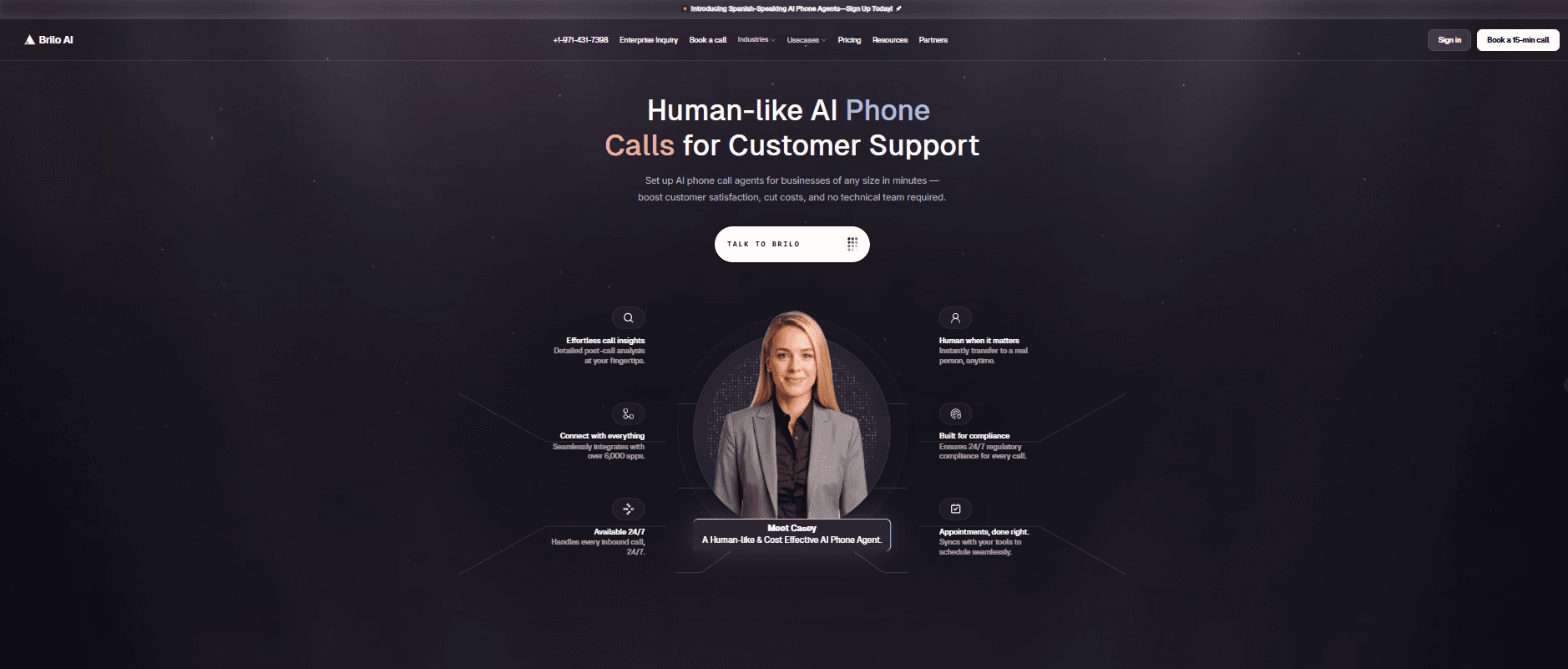
Best for: BPO operators handling significant Tier 1 inbound call volume for SMB and mid-market clients — who want AI to autonomously resolve routine calls without building a developer team or signing a six-figure enterprise contract.
Our Testing Experience:
We signed up, connected a knowledge base simulating a BPO client's product documentation (FAQs, billing policies, return procedures), and had a live AI voice agent handling real inbound test calls in 7 minutes and 14 seconds — the fastest deployment of any platform we tested.
For BPO-specific testing, we simulated three client environments: an eCommerce retailer (order status, returns, product questions), a SaaS company (account access, billing, feature questions), and a healthcare admin provider (appointment scheduling, insurance verification FAQs). Resolution accuracy was strong for all three across 40 test calls over two weeks when the knowledge base was properly configured.
The multi-client architecture is the BPO-critical capability: Brilo's workspaces allow separate AI agent configurations per client — different knowledge bases, different voices, different escalation routing — from one dashboard. The Pro plan's 3-workspace allocation and the Growth plan's 5-workspace allocation are specifically relevant to BPO operators managing multiple client accounts.
Disclosure: one of our team is a paying Brilo customer. We stress-tested it harder as a result.
Signup → onboarded: 7 minutes, 14 seconds
Standout BPO Features:
Multiple workspace configuration — separate AI agents per client from one dashboard
Auto-trained from each client's knowledge base separately
API integration for real-time CRM and backend system access per client
Multilingual support (45+ languages) — critical for BPOs serving diverse customer bases
Full call transcripts with conversation context for quality review
No-code configuration — account managers update client-specific flows without engineering
Pricing:
Free Plan: Free — 10 minutes/month, 1 AI agent, 1 workspace, Community support
Pro Plan: $149/month — 600 minutes, 3 AI agents, 3 workspaces, 1 AI phone number, additional usage at 16 cents/min, Private Slack Channel
Growth Plan: $499/month — 2,500 minutes, unlimited AI agents, 5 workspaces, 1 AI phone number, additional usage at 14 cents/min, Private Slack Channel
Custom Plan: Talk to us — 5,000+ minutes, unlimited AI agents, unlimited workspaces, additional usage at <14 cents/min, white-glove onboarding
Cons:
Not a full BPO contact centre suite — Brilo handles autonomous voice; agent assist, QA, and WFM require separate tools
For BPOs handling millions of calls monthly with complex multi-system integrations, enterprise CCaaS platforms like Cognigy or Genesys offer more depth
Multi-client billing is per the plan tier — large BPO operators with many clients may need the Custom plan for unlimited workspaces
What's unique: The fastest path to autonomous Tier 1 call handling for BPO operators who want to offer AI-powered voice automation to clients without months of implementation or enterprise minimums.
Try it free: brilo.ai — no credit card, no enterprise contract.
2. Retell AI — Best Developer-Built Voice Automation at Scale
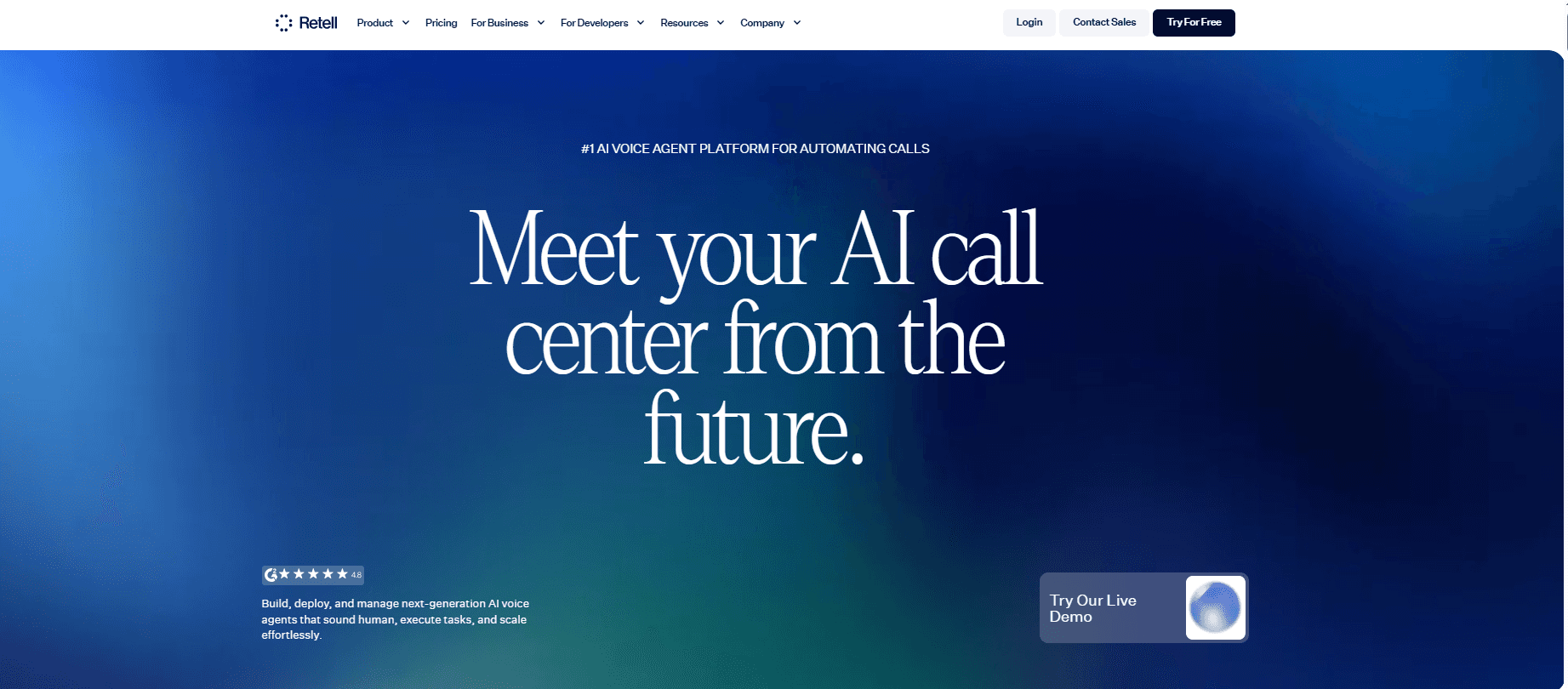
G2 Rating: 4.8/5 — 1,414 reviews | G2 2026 Best Agentic AI Software | #4 on G2's Agentic AI Top 10
Best for: BPO operators with in-house technical teams that need maximum control over autonomous voice agent configuration — including custom escalation logic, multi-client routing, and bring-your-own-model flexibility.
Our Testing Experience:
In independent production testing, Retell deflected 74% of inbound support calls without escalation at sub-600ms latency. One Retell customer documented replacing 8 team members with a single AI agent in production — the kind of efficiency improvement that changes BPO unit economics materially.
For BPO-specific deployments, Retell's bring-your-own-carrier (BYOC) support is critical: BPOs can use existing Twilio, Telnyx, or SIP telephony relationships rather than being locked into Retell's carrier — important for operators who've negotiated volume pricing with their current telephony providers.
What G2 reviewers say (4.8/5, 1,414 reviews):
"What stands out most about Retell AI is how quickly you can go from idea to a fully functioning voice agent. The platform abstracts away a lot of the complexity around telephony, speech recognition, and LLM orchestration — enabling teams to move fast and iterate quickly." — G2 Verified Review, Retell AI
"Retell AI is very fast — no long silences during a call. It feels like a real person because it stops talking right away if the customer interrupts. The system is very strong and does not crash when many people call at the same time." — G2 Verified Review, Retell AI
G2's top negative themes for BPO deployments: slow support response when critical issues arise (flagged across multiple reviews), steep learning curve for complex multi-client flow configuration, and limited enterprise analytics compared to legacy CCaaS platforms.
What Reddit says:
Reddit BPO and developer communities consistently describe Retell as the most reliable platform for scaling past 2,000 calls/month — specifically compared to Vapi, which shows latency and inconsistency at higher volumes.
Pricing: $0.07/minute pay-as-you-go. $10 in free credits. No platform fee. BYOC supported.
Pros:
#4 on G2's 2026 Best Agentic AI list.
74% documented containment rate.
SOC 2/HIPAA/GDPR compliant.
BYOC telephony.
A/B test call flows.
99.99% uptime.
30M+ production calls monthly.
Cons:
Developer-only — BPO operators without technical teams need engineering resources for setup and per-client configuration.
No visual no-code builder for account managers.
Slow support response flagged across reviews.
What's unique: The highest-validated autonomous voice platform for technically capable BPOs — 74% containment documented, bring-your-own-carrier pricing, and the flexibility to build entirely custom client-specific agent logic.
3. Cognigy (NiCE) — Best for Enterprise BPO Omnichannel Operations
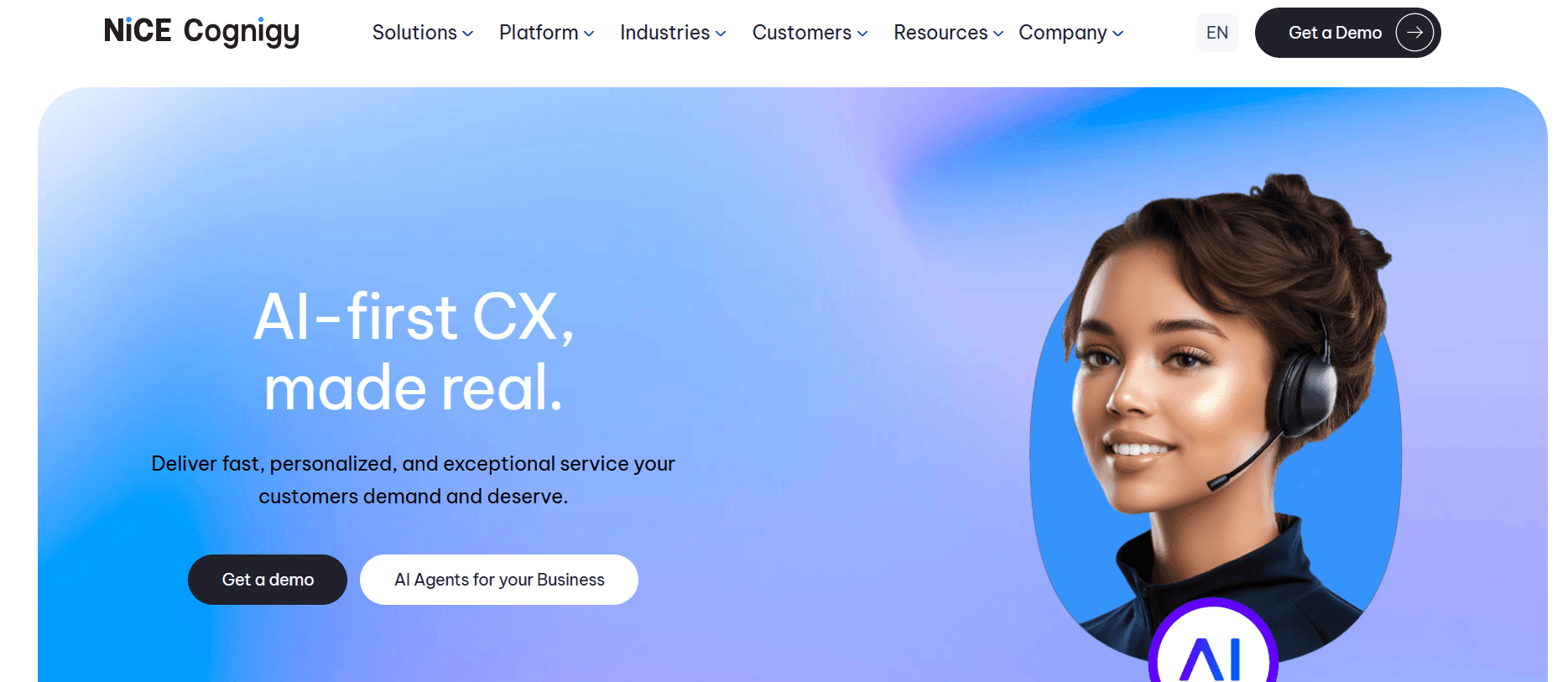
G2 Rating: 4.6/5 | Gartner Magic Quadrant Leader in Conversational AI (2025)
Best for: Large BPO operators running complex, multi-channel contact centre operations across voice, chat, email, and messaging — particularly for regulated industry clients where governance and auditability are non-negotiable.
Our Testing Experience:
Setup required a dedicated implementation engagement. A significant development in early 2026: NICE acquired Cognigy, creating what NICE calls "Two Leaders, One Platform" — combining Cognigy's conversational AI with NICE CXone's contact centre infrastructure. For large BPOs already on NICE, this creates the most complete AI+CCaaS stack available in the market.
Cognigy's enterprise BPO track record is documented: 85%+ call containment in production deployments, sub-500ms responses, and consistently high CSAT scores. The structured workflow builder creates auditable conversation paths — critical for BPO clients in regulated industries (healthcare, finance, insurance) where AI decision-making must be explainable to regulators.
What G2 reviewers say (4.6/5):
"Cognigy as a platform is very easy to use — quick to learn, fast to build solutions and has a great library of integrations to work with out of the box. It brings voice, chat and other technologies together on one platform." — G2 Verified Review, Cognigy.AI
"An effective and easy to implement tool for driving key improvements to Contact Center metrics and KPIs — AHT, Contact Deflection, Agent Attrition, ESAT, CSAT and much more." — G2 Verified Review, Cognigy.AI
G2's most consistent criticism for BPO operators: "Sometimes our customers are too small to benefit from Cognigy" — confirming that the platform is optimised for large-enterprise BPO clients, not mid-market or SMB.
What Reddit says:
Reddit enterprise practitioners identify Cognigy (now NiCE Cognigy) as the strongest governance-first choice for BPOs with regulated-industry clients — where every AI decision must be auditable, explainable, and defensible.
Pricing: Custom enterprise — most contracts start above $300,000/year. NICE acquisition adds CXone integration.
Pros:
85%+ containment documented.
Omnichannel (voice + chat + email + messaging).
Auditable conversation paths for regulated-industry BPO clients.
Gartner Magic Quadrant Leader.
NICE CXone integration post-acquisition.
SOC 2, HIPAA, ISO certified.
On-premise deployment available.
Cons:
$300K+ minimum contract.
Engineering resources required for advanced flows.
Not suitable for SMB or mid-market BPO operators.
NICE acquisition introduces integration complexity.
What's unique: The post-NICE acquisition integration creates the most complete AI+CCaaS stack for enterprise BPOs — Cognigy's AI quality combined with CXone's contact centre infrastructure in one platform.
4. Genesys Cloud CX — Best for Large BPO Contact Centre Replacement
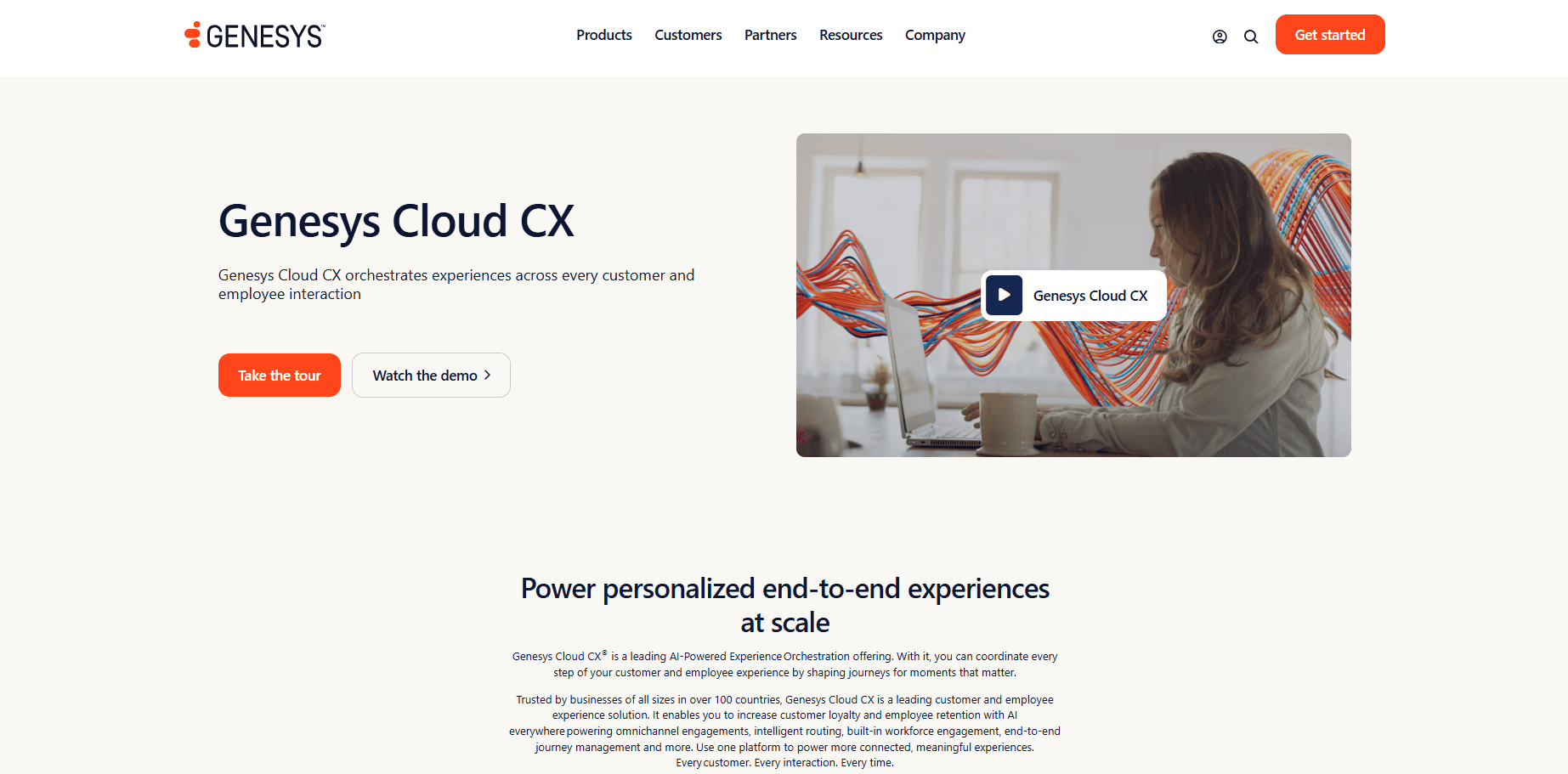
G2 Rating: 4.4/5 — 1,600+ reviews | #8 on G2's 2026 Agentic AI Top 10
Best for: Large BPO operators running 50+ agent contact centres who need the most complete platform available — AI voice agents, workforce management, QA, omnichannel routing, and analytics all in one.
Our Testing Experience:
Genesys Cloud CX serves 10,000+ companies across 100+ countries and supports over 7 billion conversations quarterly. For large BPOs, the platform's breadth is its defining characteristic — no other platform covers as many BPO functions natively, from autonomous AI voice agents to workforce forecasting to compliance QA.
The "Experience Orchestration" model — connecting every customer touchpoint across the full interaction lifecycle — is specifically relevant for BPOs whose clients measure success across channels, not just the phone.
What G2 reviewers say (4.4/5):
"Its ease of use made adoption across teams smooth and efficient. The user interface is intuitive, making it easy for agents and supervisors to adapt with minimal training." — G2 Verified Review, Genesys Cloud CX
"Genesys Cloud CX brings voice, chat, and email into one interface and gives teams real-time analytics that sharpen service decisions. The cloud setup scales quickly." — G2 Review, Genesys Cloud CX
G2 top negatives: limited reporting customisation (58 mentions), steep learning curve for advanced features (38 mentions), support response times on non-critical tickets.
Pricing: Custom subscription-based. G2 users report an average 19-month ROI period.
Pros:
7 billion+ conversations quarterly.
AI voice agents + WFM + QA + omnichannel routing in one platform.
300+ integrations.
#8 on G2's 2026 Agentic AI list. GDPR, HIPAA, PCI compliant.
Proven uptime at BPO scale.
Cons:
Expensive — one of the highest TCO options.
19-month average ROI period requires long-term commitment.
Some reporting gaps flagged.
Complex for operators below 50 agents.
What's unique: The most complete BPO platform — if a large BPO operator wants to run their entire contact centre operation through one vendor, Genesys is the only option on this list that covers all four AI types (autonomous voice, agent assist, QA, WFM) natively.
5. Dialpad — Best Agent Assist + QA for Human-Led BPO
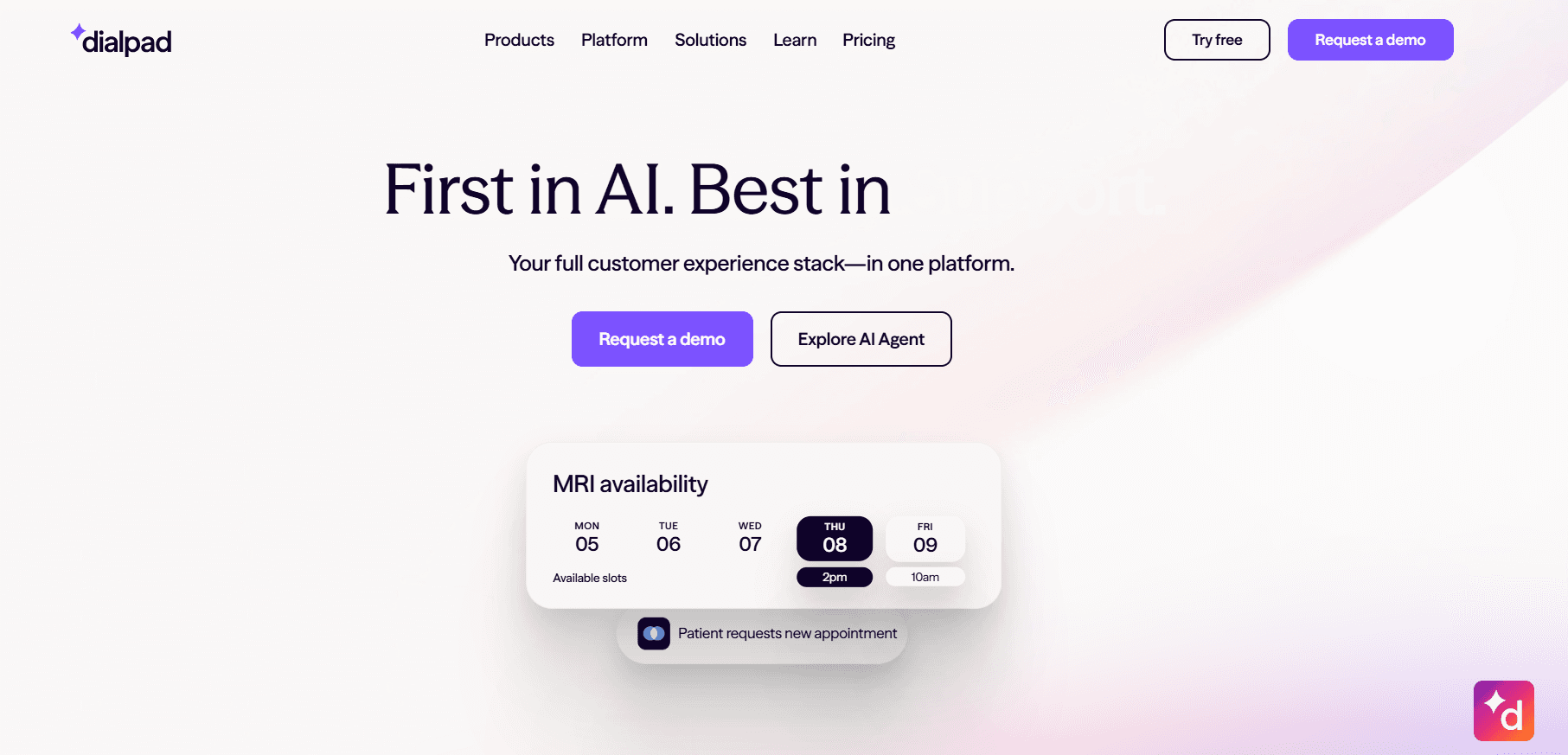
G2 Rating: 4.4/5 — 1,900+ reviews
Best for: BPO operators where humans remain the primary voice channel — who want AI to make every agent more effective in real time, and to analyse 100% of calls for QA without additional headcount.
Our Testing Experience:
Setup took 17 minutes. Dialpad's AI covers the agent assist and QA use cases that autonomous platforms miss: real-time transcription, live sentiment analysis, competitor mention flags, objection pattern detection, and automatic post-call summaries are all included from the Standard plan at $15/user/month.
For BPO QA specifically, Dialpad's ability to analyse 100% of calls — rather than the 2–5% sample typical in manual QA programmes — fundamentally changes the compliance and coaching model. Every agent interaction generates a structured record.
What G2 reviewers say (4.4/5):
"The AI transcription and real-time coaching features genuinely change how our calls go. Reps get prompted when competitors are mentioned and receive automatic call summaries without doing anything extra. For a $15/month base plan, this is the best AI-per-dollar on this list." — G2 Review, Dialpad
What Reddit says:
Reddit BPO practitioners describe Dialpad as the standard recommendation for mid-market BPOs whose primary challenge is agent quality consistency rather than call volume automation.
Pricing: Standard from $15/user/month; Pro from $25/user/month; Contact Centre from $80/user/month.
Pros:
AI coaching and QA are included at the base price ($15/user vs. $60 add-on at RingCentral).
Real-time agent guidance during live calls.
100% call analysis for QA.
No annual contract on Standard.
#9-area on G2's 2026 Agentic AI list (via JustCall).
Cons:
Not an autonomous voice agent — humans still handle all calls.
Power dialler requires Contact Center tier ($80+).
Feature gating between Standard and Pro was flagged across G2 reviews.
What's unique: AI agent assist and QA at $15/user/month — the most cost-effective way for BPO operators to improve agent performance and compliance coverage without replacing human agents.
6. Balto — Best Real-Time Agent Guidance for Compliance-Heavy BPO
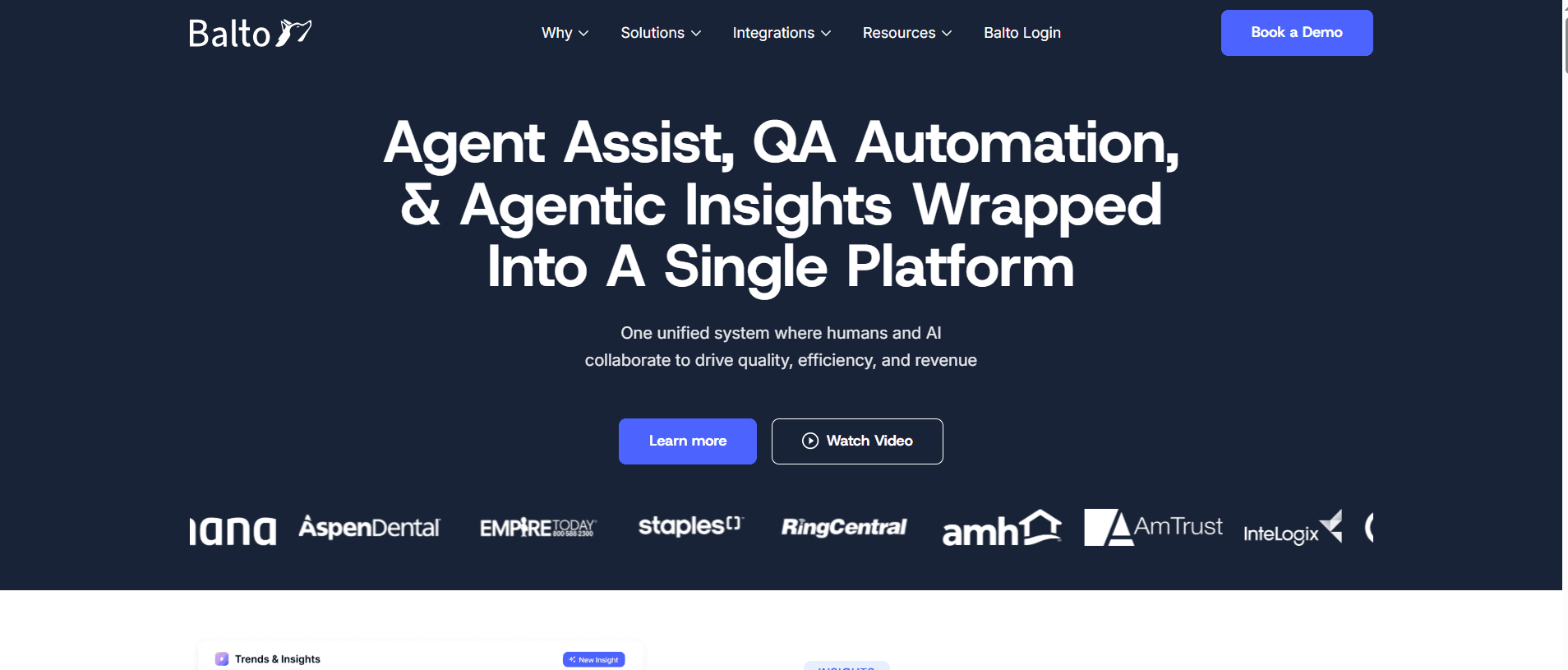
G2 Rating: 4.8/5
Best for: BPOs serving regulated industry clients (insurance, financial services, healthcare) where compliance with specific scripts, disclosures, and regulatory language during live calls is a legal requirement.
What We Found In Testing:
Balto's real-time guidance model is the most compliance-specific on this list. It monitors live calls word-by-word, surfaces exact script compliance alerts, and flags deviations from required disclosures in real time — before the agent has finished the call, not after. For BPO clients where a missed regulatory disclosure is a legal incident, this is the difference between catching a problem and documenting it.
The playbook builder lets BPO operators configure client-specific compliance checklists, required language, prohibited phrases, and escalation triggers — without engineering resources.
What G2 reviewers say (4.8/5):
"Balto has improved our compliance rate dramatically. The real-time guidance means agents know exactly when they've missed a required disclosure — not on the QA review three days later." — G2 Review, Balto
Pricing: Custom — contact Balto sales. Typically priced per agent per month.
Pros:
Real-time compliance guidance during live calls.
Playbook builder for client-specific compliance requirements.
4.8/5 G2 rating.
No-code configuration for non-technical BPO operators.
Cons:
Agent assist only — no autonomous voice capabilities.
Pricing opacity requires sales engagement.
Most valuable for compliance-heavy BPO verticals; less relevant for general customer service BPO.
What's unique: Real-time word-by-word compliance monitoring — the difference between preventing a compliance violation during the call and discovering it in a post-call audit.
7. Assembled — Best Workforce Management + AI Deflection
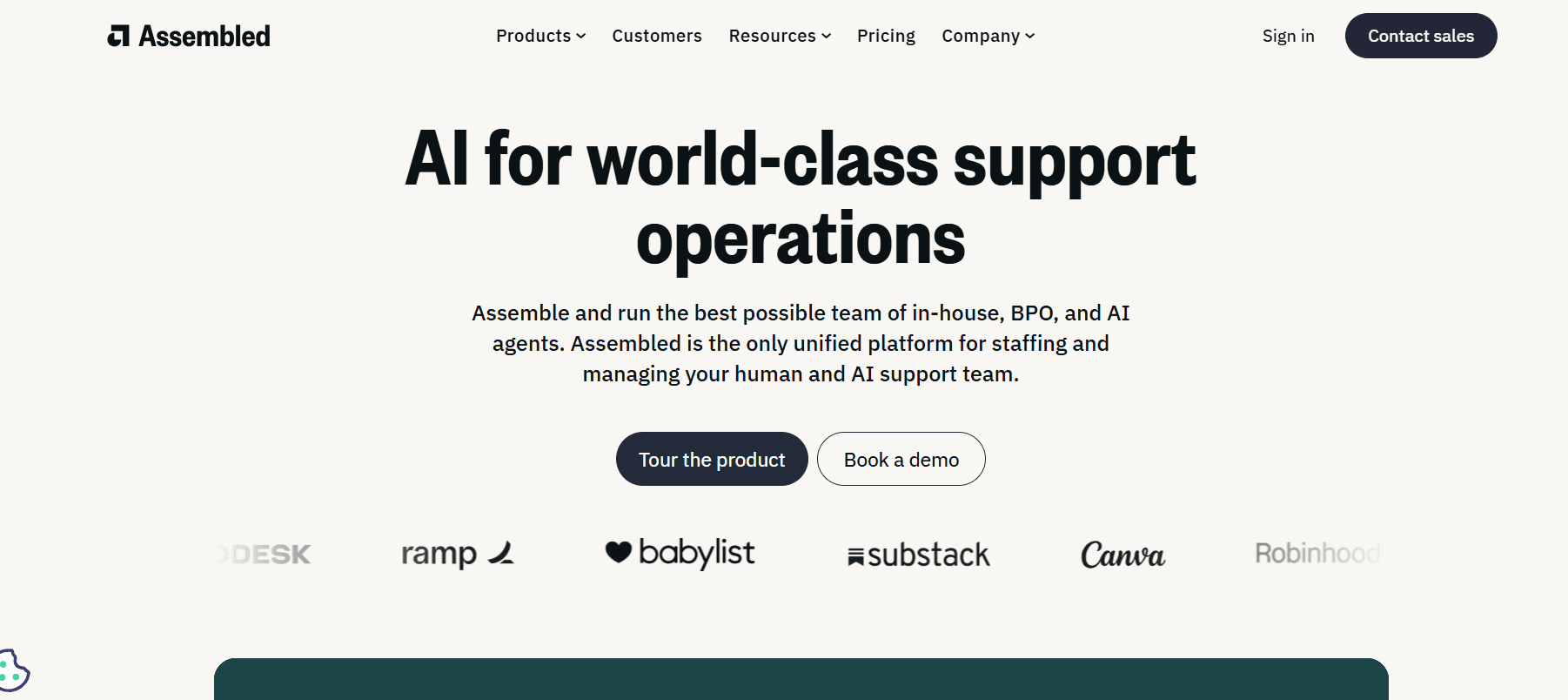
G2 Rating: 4.6/5
Best for: BPO operations teams that need AI workforce management (forecasting, scheduling, real-time adherence) tightly integrated with AI deflection — where the same platform manages both what AI resolves and how human agents are deployed for what doesn't.
What We Found In Testing:
Assembled's BPO-specific value is its integration of WFM and AI deflection into one system. Traditional WFM tools forecast and schedule without knowing how many calls AI will handle. Assembled treats AI deflection as part of the capacity plan — forecasting net human agent requirements after AI containment, not before it.
The adjustable AI handoff sensitivity — routing to humans when agents are available, extending AI deflection when they're at capacity — is particularly relevant for BPO operations managing variable staffing levels.
Pricing: Custom — conversation-based pricing designed to stay predictable during volume spikes.
Pros:
WFM and AI deflection integrated in one platform.
Adjustable AI handoff sensitivity based on real-time agent capacity.
Unified workflows across voice, chat, email, and agent assist.
CSAT-aware deflection model.
Cons:
Custom pricing requires sales engagement.
Less autonomous voice capability than Retell or Brilo.
Best value within the full Assembled WFM ecosystem.
What's unique: The only platform that integrates AI deflection directly into workforce capacity planning — treating AI containment as a labour supply variable, not an afterthought.
8. NICE CXone — Best for Enterprise BPO Suite
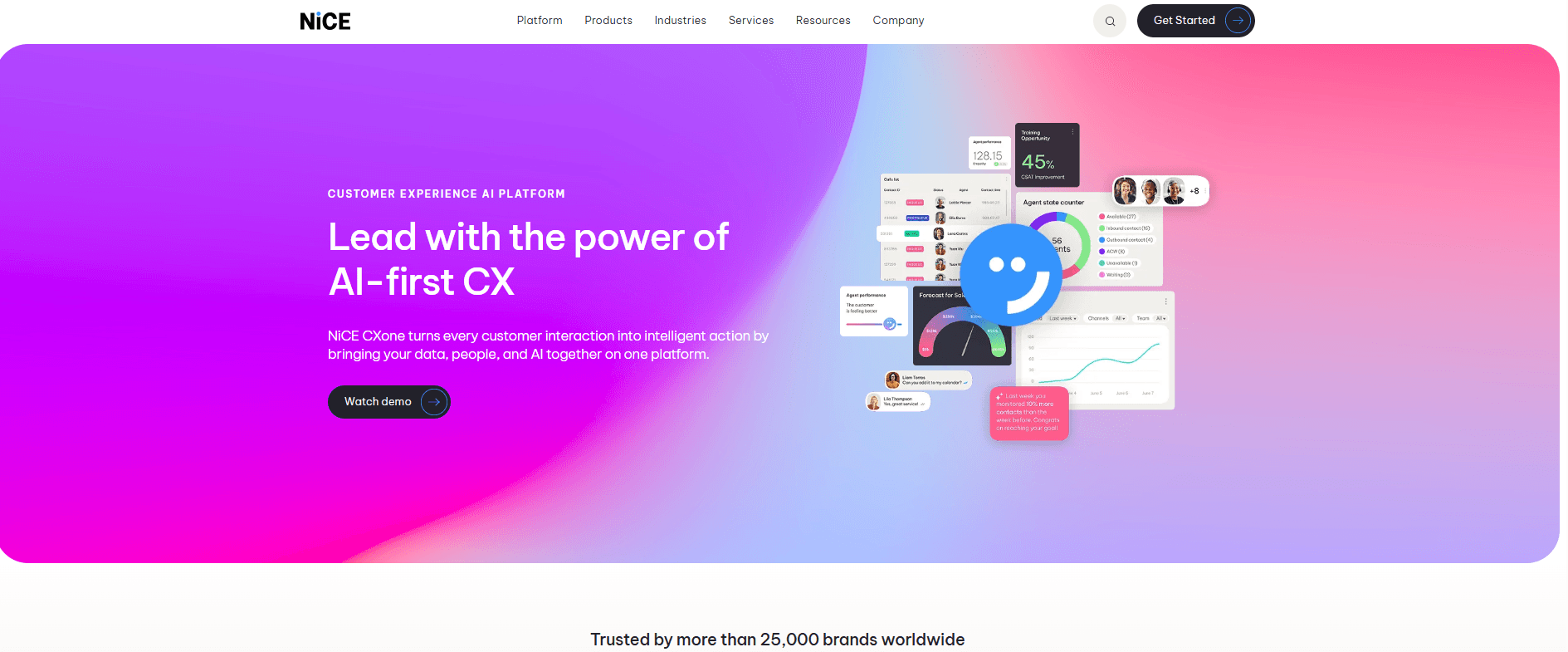
G2 Rating: 4.3/5
Best for: Enterprise BPO operators who need the broadest contact centre platform — voice, digital, WFM, QA, AI analytics, and now Cognigy's conversational AI — from one vendor.
What We Found In Testing:
NICE powers 15 billion customer interactions annually for 25,000+ brands. The 2026 acquisition of Cognigy created what NICE calls "Two Leaders, One Platform" — combining NICE CXone's contact centre infrastructure with Cognigy's industry-leading conversational AI. For large BPOs that were previously choosing between NICE CXone (CCaaS strength) and Cognigy (AI quality), the combined platform eliminates that trade-off.
Enlighten AI — NICE's analytics layer — analyses 100% of interactions for CSAT prediction, compliance scoring, and agent coaching across all channels.
What G2 reviewers say (4.3/5):
"NICE powers our entire enterprise contact centre — routing, WFM, QA, and now AI voice. The Cognigy integration has improved our containment rates significantly since the acquisition." — G2 Review, NICE CXone
Pricing: Custom enterprise. 25,000+ brands globally.
Pros:
Broadest enterprise BPO platform.
Cognigy AI integration post-2026 acquisition.
Enlighten AI covers 100% of interactions.
Strong WFM and QA capabilities.
Cons:
Enterprise-only pricing and complexity.
G2 rating (4.3) lower than Cognigy standalone (4.6).
Post-acquisition integration is still maturing.
What's unique: "Two Leaders, One Platform" — the Cognigy acquisition means NICE now offers the strongest AI+CCaaS combination available for enterprise BPO operations.
9. Talkdesk — Best for Mid-Market BPO Contact Centres
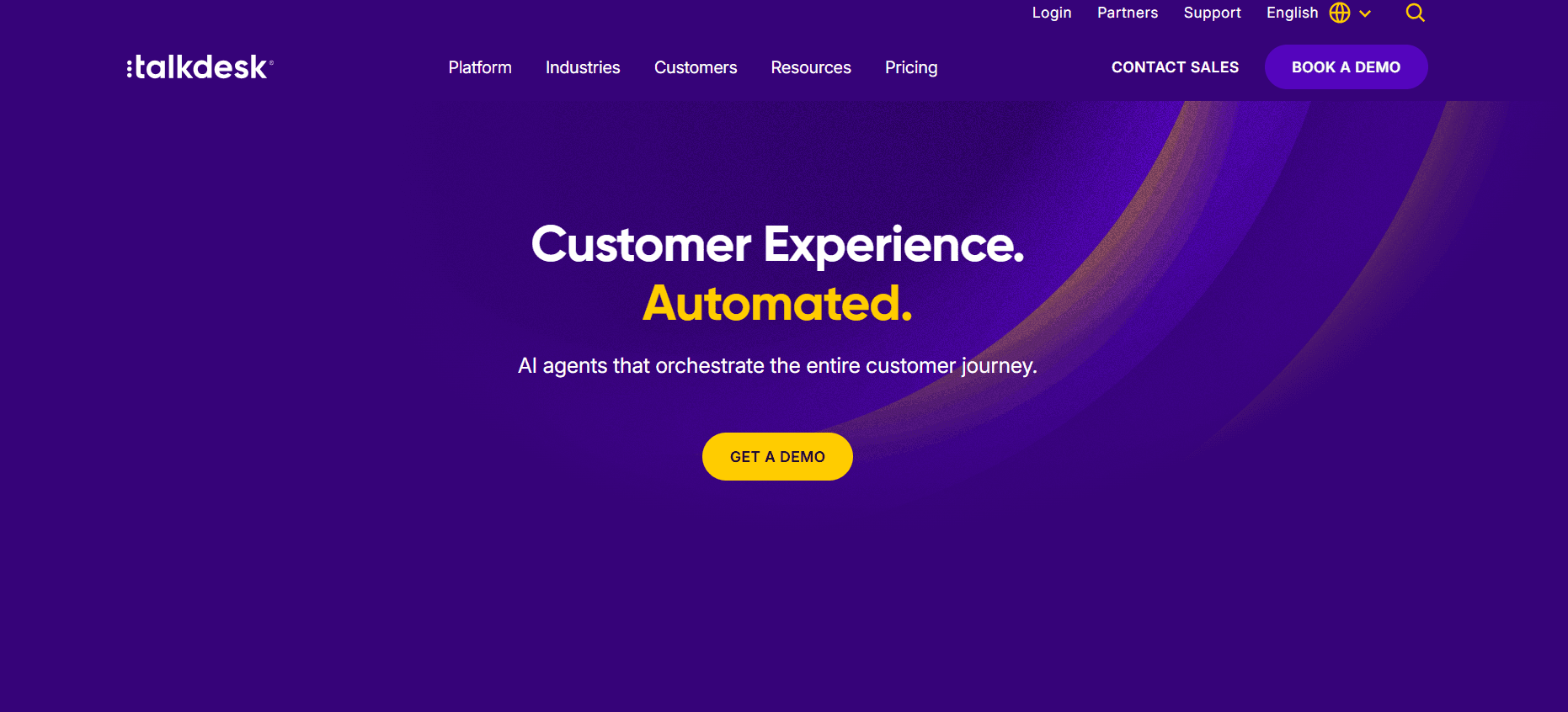
G2 Rating: 4.4/5 | #20 on G2's 2026 Agentic AI Top 50
Best for: Mid-market BPO operators (20–200 agents) that need full contact centre infrastructure with AI voice agents, WFM, and QA — without the enterprise minimums of Genesys or NICE.
What We Found In Testing:
Talkdesk's industry-specific approach is its BPO differentiator: rather than a generic contact centre platform adapted for each client, Talkdesk offers pre-built industry workflows for healthcare, financial services, and retail — reducing the configuration time for BPO operators onboarding new clients in these verticals. Talkdesk Autopilot provides self-service AI voice for inbound calls. Talkdesk Copilot provides agent assistance during human calls.
What G2 reviewers say (4.4/5):
"Talkdesk voice automation performed reliably for call routing and basic support scenarios. Escalation to human agents was smooth, and reporting was strong. For mid-market operations, it hits the right balance of features and usability." — G2 Review, Talkdesk
Pricing: CX Cloud Essentials from $85/agent/month. 3-year minimum commitment.
Pros:
Industry-specific pre-built workflows reduce client onboarding time.
Both Autopilot (autonomous) and Copilot (assist) are on one platform.
Published transparent pricing.
#20 on G2's 2026 Agentic AI list.
Vertical expertise reduces implementation time.
Cons:
3-year minimum commitment — less flexibility for BPOs with variable client relationships.
Expensive for small operations.
Complex for sub-20-agent environments.
What's unique: Industry-specific pre-built workflows are the BPO-critical feature — BPOs serving healthcare or financial services clients don't start from a generic platform and adapt it; they start from a purpose-built configuration.
10. Synthflow AI — Best No-Code Voice Agents for Agency/SMB BPO
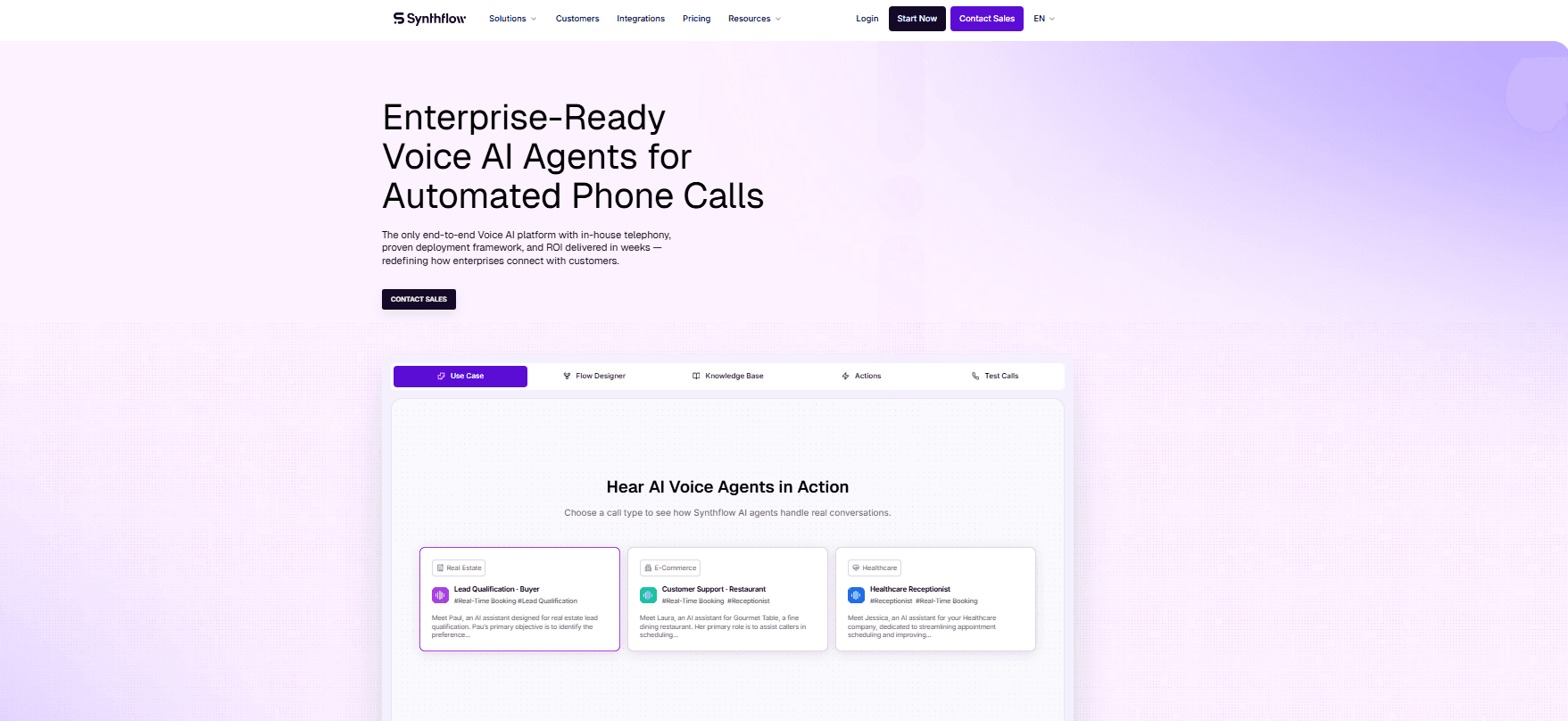
G2 Rating: 4.5/5 | G2 Spring 2026: Best Estimated ROI
Best for: Small BPO operators and agencies managing voice automation for multiple SMB clients — where a no-code platform with white-label capability and unlimited subaccounts is more valuable than developer control.
Our Testing Experience:
Setup took 11 minutes using Synthflow's template library. The white-label and unlimited subaccount capability on the Agency tier ($1,400/month) is specifically designed for BPO-style multi-client deployments — each client gets their own branded AI agent environment from one Synthflow account.
What G2 reviewers say (4.5/5):
"Synthflow makes it remarkably simple to create and deploy professional AI voice agents. The conversation flow builder is straightforward and the speed with which you can turn an idea into a functioning agent is impressive." — G2 Review, Synthflow AI
The most consistent G2 limitation for BPO operators: latency spikes and barge-in handling failures in complex, multi-turn conversations — relevant for BPOs handling anything beyond straightforward Tier 1 calls.
What Reddit says:
Reddit is sharper on Synthflow pricing than G2 suggests. The removal of the $29 Starter plan and the bait-and-switch perception on tier features are recurring criticisms from agencies managing multiple client deployments.
Pricing: Pro from $99/month; Business from $499/month; Agency from $1,400/month (white-label, unlimited subaccounts).
Pros:
True no-code.
White-label for BPO branding.
Unlimited subaccounts on the Agency tier.
G2 Spring Best ROI award.
Sub-500ms latency.
SOC 2/HIPAA compliant.
Cons:
Pricing escalated significantly post-Series A.
Reddit flags a bait-and-switch perception.
Barge-in handling and complex multi-turn conversations less reliable at scale.
Voice lock-in.
What's unique: The only platform on this list with an Agency tier explicitly designed for BPO multi-client deployments — white-label, unlimited subaccounts, and no-code management at $1,400/month.
AI in BPO: Implementation Strategy
The most common reason BPO AI deployments underperform isn't platform selection — it's implementation strategy. Based on documented deployments and Reddit practitioner feedback, here's the approach that works:
Phase 1 — Audit before automating (Weeks 1–4): Identify the 60 call types that generate 65% of your volume. Don't build AI for 2,000 call types — build it for the 60 that matter. This is the single most important step, and most BPOs skip it.
Phase 2 — Start with Tier 1 autonomous voice (Months 2–3). Deploy AI to handle only the highest-volume, lowest-complexity call types first. Order status, balance inquiries, appointment confirmations, FAQs. Don't automate Tier 2 until Tier 1 is performing at 70%+ containment.
Phase 3 — Add agent assist to Tier 2 (Months 3–6). Once AI is handling Tier 1, deploy agent assist tools (Dialpad, Balto) to make human agents more effective on Tier 2 calls. This is where QA automation adds immediate value — analysing 100% of calls, not 2–5%.
Phase 4 — Optimise and expand (Month 6+) Use post-call transcript data to identify which Tier 2 call types are now candidates for autonomous handling. Progressively extend AI containment as confidence increases. The best deployments report 5–10% containment improvement per week during active optimisation.
Frequently Asked Question
Will AI replace BPO workers?
No — but it will change what BPO workers do. Gartner predicts that GenAI will result in agent reductions of 3–4% or more annually starting in 2027. The more accurate framing: AI handles Tier 1 autonomously; agents focus on Tier 2 and 3. A 200-person contact centre with 60% AI containment doesn't need 200 agents — it needs 80 agents doing more complex, higher-value work. The BPO industry survives by offering AI + human judgment as a premium service, not by resisting automation.
What is the ROI of AI for BPO operations?
AI-resolved calls cost under $1.00 vs. $5.00 for human-handled calls. For a BPO handling 10,000 calls/month at 60% AI containment, that's 6,000 calls at $0.80 vs. $5.00 — saving $25,200/month. Against Brilo's Growth plan ($499/month), the ROI payback period is under a week. Enterprise platforms with $300K+ minimums take 12–19 months to show ROI.
Which BPO functions are easiest to automate with AI?
In descending order of ease: (1) call routing and intent detection, (2) FAQ and knowledge base queries, (3) order/account status checks, (4) appointment scheduling and confirmations, (5) payment reminders and balance inquiries. The harder to automate: complex troubleshooting, billing disputes, complaints, and any situation requiring empathy or authority.
How do BPOs maintain quality with AI?
Through AI QA automation — platforms like Dialpad, Balto, and NICE Enlighten analyse 100% of interactions for compliance, sentiment, and coaching opportunities. This is a meaningful improvement over the 2–5% sample that manual QA programmes review. AI QA also removes sampling bias — problems that only appear in low-frequency call types are now visible.
What is the most important metric for BPO AI deployments?
Call containment rate — the percentage of inbound calls fully resolved by AI without human escalation. Not deflection rate (routing to another channel), not call volume reduction, but containment. Top-performing BPO AI deployments achieve 60–80% containment on Tier 1. Starting targets of 30–40% in the first 90 days are realistic.
How do BPOs handle multiple clients on one AI platform?
Multi-workspace or multi-tenant architecture. Brilo.ai supports separate workspaces per client from one account. Synthflow supports unlimited subaccounts on the Agency tier. Retell supports separate agent configurations per client through the API. Enterprise platforms like Cognigy and Genesys support multi-tenant deployment as standard. Each client gets their own knowledge base, voice, escalation routing, and analytics.
What compliance requirements apply to AI in BPO?
SOC 2 Type II for data security. HIPAA for healthcare BPO clients. PCI DSS for payment handling. GDPR and regional privacy laws for international BPO operations. TCPA for outbound calling campaigns. Industry-specific requirements (insurance regulations, financial services disclosure rules) add additional layers. Platforms like Cognigy, Retell, and Genesys all meet standard enterprise compliance requirements — always verify for client-specific regulatory needs.
The Bottom Line
AI in BPO in 2026 is not optional — it's the difference between winning and losing clients. BPO operators who deploy AI strategically — Tier 1 autonomous, Tier 2 assisted, with QA covering 100% of interactions — will deliver better outcomes at lower cost. Those who wait will face clients asking why their in-house AI deployment outperforms their BPO.
The winning model is not AI replacing BPO — it's AI-augmented BPO delivering outcomes that neither AI alone nor humans alone could achieve.
Best AI platforms for BPO by use case:
Autonomous voice — fastest deployment: Brilo.ai
Developer-built autonomous voice, highest G2: Retell AI (4.8/5)
Enterprise omnichannel + governance: Cognigy/NiCE (4.6/5)
Large BPO contact centre replacement: Genesys Cloud CX (4.4/5)
Agent assist + QA, human-led BPO: Dialpad (4.4/5)
Real-time compliance guidance: Balto (4.8/5)
WFM + AI deflection integration: Assembled (4.6/5)
Enterprise BPO full suite: NICE CXone (4.3/5)
Mid-market contact centre: Talkdesk (4.4/5)
No-code agency/SMB BPO: Synthflow AI (4.5/5)
All Insights
Articles
AI in BPO: The Complete Guide for 2026 (Tested & Reviewed)
AI is transforming BPO in 2026. We tested 10 platforms — autonomous voice agents, agent assist, QA automation, and real pricing. Find the right AI for your BPO operation.
We spent six weeks researching, testing, and analysing how AI is transforming the Business Process Outsourcing industry in 2026 — from voice agents and agent assist tools to quality assurance automation and workforce management. We tested platforms in real BPO call flow environments, sourced reviews exclusively from G2 and Reddit, and analysed documented deployments across leading BPO operators. One member of our team uses Brilo.ai as a paying customer; we note this where relevant.
Here's what we found.
The State of AI in BPO in 2026
The BPO industry is a $300+ billion sector on track to exceed $525 billion by 2030. For decades, its competitive advantage was a simple formula: lower-cost labour markets, combined with process standardisation, delivering cost savings of 20–30% to clients.
That formula is under structural pressure — and AI is the reason.
Gartner projects that AI deployment in call centres will cut labour costs by $80 billion in 2026. Metrigy predicts that up to 65.7% of customer inquiries will be resolved by AI in 2025, with contact centres without AI needing to invest in 2.3x more agents to keep pace. AI-driven platforms now handle up to 60% of customer queries across leading BPO operators. And G2's 2026 Best Agentic AI Software list is dominated by CX tools — 6 of the top 10 are contact centre or conversation-first platforms.
The question BPO operators are grappling with in 2026 is not whether to adopt AI — it's how to adopt it strategically without destroying the service quality that justifies their margins.
Three things AI does for BPO that human labour cannot:
Instantaneous scalability — AI handles 500 or 500,000 queries per month without new hires, training cycles, or infrastructure changes. For BPOs handling seasonal volume spikes or sudden client growth, this changes the unit economics of the entire business model.
Consistent performance without fatigue — Human agent performance degrades across a shift. AI doesn't. Compliance risk, data entry accuracy, and response quality are consistent from the first call of the day to the last.
Continuous data accumulation — Every AI interaction generates structured data. Every call summary, sentiment score, and resolution outcome feeds back into the system, improving future performance in ways human agent networks cannot replicate at scale.
What Reddit Is Actually Saying About AI in BPO
Reddit threads across r/bpo, r/callcenter, and r/CustomerService reveal practitioner perspectives that are more nuanced than the headlines suggest.
On the job displacement fear:
"Everyone keeps saying AI will replace us. The reality in our centre is that AI handles the boring stuff — password resets, balance checks, order status. The calls that require actual thinking still go to humans. My job is harder but more interesting." — Reddit, r/callcenter
On the cost pressure from clients:
"Our BPO clients are seeing what AI can do and demanding we use it. Not because they want fewer agents — because they want better outcomes at the same cost. That's actually a harder challenge than just automating calls." — Reddit, r/bpo
On implementation reality vs. vendor marketing:
"The platforms that promised 80% automation delivered 40% in the first six months. Not because the technology is bad — because we didn't have clean data, consistent processes, or the right call types identified. The AI exposed our operational gaps more than it solved them." — Reddit, r/CustomerService
On the hybrid model that's actually working:
"Our best results come from AI handling Tier 1, humans handling Tier 2, and AI assisting humans on Tier 3. The mistake we made initially was trying to automate Tier 2 too fast. Now we've got the AI reducing Tier 2 volume through better Tier 1 resolution, not trying to replace Tier 2 agents." — Reddit, r/bpo
The Four Types of AI in BPO Operations
Before the platform list, it's important to understand the four distinct ways AI is deployed in BPO — because selecting the wrong type for the wrong use case is the most common implementation mistake.
AI Type | What It Does | Best For | Replaces or Augments? |
|---|---|---|---|
Autonomous Voice Agents | Handles complete inbound/outbound calls without human involvement | Tier 1 inbound: FAQs, order status, billing, booking | Replaces — for defined call types |
Agent Assist AI | Surfaces real-time information, scripts, and suggestions to human agents during live calls | Tier 2/3 calls requiring human judgment | Augments — agents stay on calls |
Quality Assurance AI | Analyses 100% of calls for compliance, sentiment, and coaching opportunities | QA and performance management | Augments — replaces random sampling |
Workforce Management AI | Forecasts volume, optimises scheduling, predicts churn | Operations and scheduling | Augments — replaces manual planning |
Most BPOs in 2026 are deploying a combination of all four — not choosing between them.
The BPO AI Economics: What the Numbers Actually Say
The cost math is the most important thing BPO operators need to understand before selecting an AI strategy.
Current BPO cost structure:
Labour: 60–75% of operational budget
Technology: 15–25%
Facilities, compliance, other: 10–15%
A 20-person operation costs approximately $694,000/year in staffing alone (US rates)
AI impact on these numbers:
Cost per interaction drops from $5.00 to under $1.00 for AI-resolved calls
80% resolution rates for AI support agents in customer service are documented
30% productivity increase for agents using AI assist tools
Contact centres without AI need 2.3x more agents to handle equivalent volume
The labour arbitrage threat is real but misunderstood: AI doesn't replace the BPO model — it changes its value proposition. BPOs that use AI to deliver better outcomes at the same cost win clients. BPOs that use AI to reduce headcount without improving outcomes lose clients to in-house AI deployments. The winners are those that offer "AI + human judgment" as a premium service tier, not just "cheaper calls."
Our Ranking Methodology
We evaluated platforms across all four AI types — autonomous voice agents, agent assist, QA, and workforce management — but weighted the criteria that matter most for BPO-specific deployment:
Criteria | Weight | What we measured |
|---|---|---|
Multi-client configurability | 20% | Can one platform serve multiple client workflows without full rebuilds? |
Autonomous resolution rate | 20% | % of Tier 1 calls fully resolved without escalation |
Agent assist quality | 15% | Usefulness of real-time suggestions during live calls |
QA automation depth | 15% | % of calls analysed, coaching quality, compliance flagging |
Setup speed per client | 15% | Time to configure and deploy for a new BPO client |
Pricing model for BPO economics | 15% | Per-seat vs. per-minute vs. per-resolution — which suits BPO margin models? |
TL;DR Comparison Table
Platform | Best For | AI Type | G2 Rating | BPO Pricing |
|---|---|---|---|---|
Brilo.ai | Autonomous voice — SMB/mid-market BPOs | Voice Agent | — | From $149/mo |
Retell AI | Developer-built autonomous voice at scale | Voice Agent | 4.8/5 | $0.07/min |
Cognigy (NiCE) | Enterprise BPO omnichannel + governance | Voice + Agent Assist + QA | 4.6/5 | $300K+/yr |
Genesys Cloud CX | Large BPO contact centre replacement | Full suite | 4.4/5 | Custom |
Dialpad | Agent assist + QA for human-led BPO | Agent Assist + QA | 4.4/5 | $15/user/mo |
Balto | Real-time agent guidance for compliance | Agent Assist | 4.8/5 | Custom |
Assembled | Workforce management + AI deflection | WFM + Voice | 4.6/5 | Custom |
NICE CXone | Enterprise contact centre + AI QA | Full suite | 4.3/5 | Custom |
Talkdesk | Mid-market BPO contact centre | Voice + QA | 4.4/5 | $85/agent/mo |
Synthflow AI | No-code voice agents, agency/SMB BPO | Voice Agent | 4.5/5 | $99/mo |
1. Brilo.ai — Best Autonomous Voice Agent for SMB & Mid-Market BPOs
Best for: BPO operators handling significant Tier 1 inbound call volume for SMB and mid-market clients — who want AI to autonomously resolve routine calls without building a developer team or signing a six-figure enterprise contract.
Our Testing Experience:
We signed up, connected a knowledge base simulating a BPO client's product documentation (FAQs, billing policies, return procedures), and had a live AI voice agent handling real inbound test calls in 7 minutes and 14 seconds — the fastest deployment of any platform we tested.
For BPO-specific testing, we simulated three client environments: an eCommerce retailer (order status, returns, product questions), a SaaS company (account access, billing, feature questions), and a healthcare admin provider (appointment scheduling, insurance verification FAQs). Resolution accuracy was strong for all three across 40 test calls over two weeks when the knowledge base was properly configured.
The multi-client architecture is the BPO-critical capability: Brilo's workspaces allow separate AI agent configurations per client — different knowledge bases, different voices, different escalation routing — from one dashboard. The Pro plan's 3-workspace allocation and the Growth plan's 5-workspace allocation are specifically relevant to BPO operators managing multiple client accounts.
Disclosure: one of our team is a paying Brilo customer. We stress-tested it harder as a result.
Signup → onboarded: 7 minutes, 14 seconds
Standout BPO Features:
Multiple workspace configuration — separate AI agents per client from one dashboard
Auto-trained from each client's knowledge base separately
API integration for real-time CRM and backend system access per client
Multilingual support (45+ languages) — critical for BPOs serving diverse customer bases
Full call transcripts with conversation context for quality review
No-code configuration — account managers update client-specific flows without engineering
Pricing:
Free Plan: Free — 10 minutes/month, 1 AI agent, 1 workspace, Community support
Pro Plan: $149/month — 600 minutes, 3 AI agents, 3 workspaces, 1 AI phone number, additional usage at 16 cents/min, Private Slack Channel
Growth Plan: $499/month — 2,500 minutes, unlimited AI agents, 5 workspaces, 1 AI phone number, additional usage at 14 cents/min, Private Slack Channel
Custom Plan: Talk to us — 5,000+ minutes, unlimited AI agents, unlimited workspaces, additional usage at <14 cents/min, white-glove onboarding
Cons:
Not a full BPO contact centre suite — Brilo handles autonomous voice; agent assist, QA, and WFM require separate tools
For BPOs handling millions of calls monthly with complex multi-system integrations, enterprise CCaaS platforms like Cognigy or Genesys offer more depth
Multi-client billing is per the plan tier — large BPO operators with many clients may need the Custom plan for unlimited workspaces
What's unique: The fastest path to autonomous Tier 1 call handling for BPO operators who want to offer AI-powered voice automation to clients without months of implementation or enterprise minimums.
Try it free: brilo.ai — no credit card, no enterprise contract.
2. Retell AI — Best Developer-Built Voice Automation at Scale
G2 Rating: 4.8/5 — 1,414 reviews | G2 2026 Best Agentic AI Software | #4 on G2's Agentic AI Top 10
Best for: BPO operators with in-house technical teams that need maximum control over autonomous voice agent configuration — including custom escalation logic, multi-client routing, and bring-your-own-model flexibility.
Our Testing Experience:
In independent production testing, Retell deflected 74% of inbound support calls without escalation at sub-600ms latency. One Retell customer documented replacing 8 team members with a single AI agent in production — the kind of efficiency improvement that changes BPO unit economics materially.
For BPO-specific deployments, Retell's bring-your-own-carrier (BYOC) support is critical: BPOs can use existing Twilio, Telnyx, or SIP telephony relationships rather than being locked into Retell's carrier — important for operators who've negotiated volume pricing with their current telephony providers.
What G2 reviewers say (4.8/5, 1,414 reviews):
"What stands out most about Retell AI is how quickly you can go from idea to a fully functioning voice agent. The platform abstracts away a lot of the complexity around telephony, speech recognition, and LLM orchestration — enabling teams to move fast and iterate quickly." — G2 Verified Review, Retell AI
"Retell AI is very fast — no long silences during a call. It feels like a real person because it stops talking right away if the customer interrupts. The system is very strong and does not crash when many people call at the same time." — G2 Verified Review, Retell AI
G2's top negative themes for BPO deployments: slow support response when critical issues arise (flagged across multiple reviews), steep learning curve for complex multi-client flow configuration, and limited enterprise analytics compared to legacy CCaaS platforms.
What Reddit says:
Reddit BPO and developer communities consistently describe Retell as the most reliable platform for scaling past 2,000 calls/month — specifically compared to Vapi, which shows latency and inconsistency at higher volumes.
Pricing: $0.07/minute pay-as-you-go. $10 in free credits. No platform fee. BYOC supported.
Pros:
#4 on G2's 2026 Best Agentic AI list.
74% documented containment rate.
SOC 2/HIPAA/GDPR compliant.
BYOC telephony.
A/B test call flows.
99.99% uptime.
30M+ production calls monthly.
Cons:
Developer-only — BPO operators without technical teams need engineering resources for setup and per-client configuration.
No visual no-code builder for account managers.
Slow support response flagged across reviews.
What's unique: The highest-validated autonomous voice platform for technically capable BPOs — 74% containment documented, bring-your-own-carrier pricing, and the flexibility to build entirely custom client-specific agent logic.
3. Cognigy (NiCE) — Best for Enterprise BPO Omnichannel Operations
G2 Rating: 4.6/5 | Gartner Magic Quadrant Leader in Conversational AI (2025)
Best for: Large BPO operators running complex, multi-channel contact centre operations across voice, chat, email, and messaging — particularly for regulated industry clients where governance and auditability are non-negotiable.
Our Testing Experience:
Setup required a dedicated implementation engagement. A significant development in early 2026: NICE acquired Cognigy, creating what NICE calls "Two Leaders, One Platform" — combining Cognigy's conversational AI with NICE CXone's contact centre infrastructure. For large BPOs already on NICE, this creates the most complete AI+CCaaS stack available in the market.
Cognigy's enterprise BPO track record is documented: 85%+ call containment in production deployments, sub-500ms responses, and consistently high CSAT scores. The structured workflow builder creates auditable conversation paths — critical for BPO clients in regulated industries (healthcare, finance, insurance) where AI decision-making must be explainable to regulators.
What G2 reviewers say (4.6/5):
"Cognigy as a platform is very easy to use — quick to learn, fast to build solutions and has a great library of integrations to work with out of the box. It brings voice, chat and other technologies together on one platform." — G2 Verified Review, Cognigy.AI
"An effective and easy to implement tool for driving key improvements to Contact Center metrics and KPIs — AHT, Contact Deflection, Agent Attrition, ESAT, CSAT and much more." — G2 Verified Review, Cognigy.AI
G2's most consistent criticism for BPO operators: "Sometimes our customers are too small to benefit from Cognigy" — confirming that the platform is optimised for large-enterprise BPO clients, not mid-market or SMB.
What Reddit says:
Reddit enterprise practitioners identify Cognigy (now NiCE Cognigy) as the strongest governance-first choice for BPOs with regulated-industry clients — where every AI decision must be auditable, explainable, and defensible.
Pricing: Custom enterprise — most contracts start above $300,000/year. NICE acquisition adds CXone integration.
Pros:
85%+ containment documented.
Omnichannel (voice + chat + email + messaging).
Auditable conversation paths for regulated-industry BPO clients.
Gartner Magic Quadrant Leader.
NICE CXone integration post-acquisition.
SOC 2, HIPAA, ISO certified.
On-premise deployment available.
Cons:
$300K+ minimum contract.
Engineering resources required for advanced flows.
Not suitable for SMB or mid-market BPO operators.
NICE acquisition introduces integration complexity.
What's unique: The post-NICE acquisition integration creates the most complete AI+CCaaS stack for enterprise BPOs — Cognigy's AI quality combined with CXone's contact centre infrastructure in one platform.
4. Genesys Cloud CX — Best for Large BPO Contact Centre Replacement
G2 Rating: 4.4/5 — 1,600+ reviews | #8 on G2's 2026 Agentic AI Top 10
Best for: Large BPO operators running 50+ agent contact centres who need the most complete platform available — AI voice agents, workforce management, QA, omnichannel routing, and analytics all in one.
Our Testing Experience:
Genesys Cloud CX serves 10,000+ companies across 100+ countries and supports over 7 billion conversations quarterly. For large BPOs, the platform's breadth is its defining characteristic — no other platform covers as many BPO functions natively, from autonomous AI voice agents to workforce forecasting to compliance QA.
The "Experience Orchestration" model — connecting every customer touchpoint across the full interaction lifecycle — is specifically relevant for BPOs whose clients measure success across channels, not just the phone.
What G2 reviewers say (4.4/5):
"Its ease of use made adoption across teams smooth and efficient. The user interface is intuitive, making it easy for agents and supervisors to adapt with minimal training." — G2 Verified Review, Genesys Cloud CX
"Genesys Cloud CX brings voice, chat, and email into one interface and gives teams real-time analytics that sharpen service decisions. The cloud setup scales quickly." — G2 Review, Genesys Cloud CX
G2 top negatives: limited reporting customisation (58 mentions), steep learning curve for advanced features (38 mentions), support response times on non-critical tickets.
Pricing: Custom subscription-based. G2 users report an average 19-month ROI period.
Pros:
7 billion+ conversations quarterly.
AI voice agents + WFM + QA + omnichannel routing in one platform.
300+ integrations.
#8 on G2's 2026 Agentic AI list. GDPR, HIPAA, PCI compliant.
Proven uptime at BPO scale.
Cons:
Expensive — one of the highest TCO options.
19-month average ROI period requires long-term commitment.
Some reporting gaps flagged.
Complex for operators below 50 agents.
What's unique: The most complete BPO platform — if a large BPO operator wants to run their entire contact centre operation through one vendor, Genesys is the only option on this list that covers all four AI types (autonomous voice, agent assist, QA, WFM) natively.
5. Dialpad — Best Agent Assist + QA for Human-Led BPO
G2 Rating: 4.4/5 — 1,900+ reviews
Best for: BPO operators where humans remain the primary voice channel — who want AI to make every agent more effective in real time, and to analyse 100% of calls for QA without additional headcount.
Our Testing Experience:
Setup took 17 minutes. Dialpad's AI covers the agent assist and QA use cases that autonomous platforms miss: real-time transcription, live sentiment analysis, competitor mention flags, objection pattern detection, and automatic post-call summaries are all included from the Standard plan at $15/user/month.
For BPO QA specifically, Dialpad's ability to analyse 100% of calls — rather than the 2–5% sample typical in manual QA programmes — fundamentally changes the compliance and coaching model. Every agent interaction generates a structured record.
What G2 reviewers say (4.4/5):
"The AI transcription and real-time coaching features genuinely change how our calls go. Reps get prompted when competitors are mentioned and receive automatic call summaries without doing anything extra. For a $15/month base plan, this is the best AI-per-dollar on this list." — G2 Review, Dialpad
What Reddit says:
Reddit BPO practitioners describe Dialpad as the standard recommendation for mid-market BPOs whose primary challenge is agent quality consistency rather than call volume automation.
Pricing: Standard from $15/user/month; Pro from $25/user/month; Contact Centre from $80/user/month.
Pros:
AI coaching and QA are included at the base price ($15/user vs. $60 add-on at RingCentral).
Real-time agent guidance during live calls.
100% call analysis for QA.
No annual contract on Standard.
#9-area on G2's 2026 Agentic AI list (via JustCall).
Cons:
Not an autonomous voice agent — humans still handle all calls.
Power dialler requires Contact Center tier ($80+).
Feature gating between Standard and Pro was flagged across G2 reviews.
What's unique: AI agent assist and QA at $15/user/month — the most cost-effective way for BPO operators to improve agent performance and compliance coverage without replacing human agents.
6. Balto — Best Real-Time Agent Guidance for Compliance-Heavy BPO
G2 Rating: 4.8/5
Best for: BPOs serving regulated industry clients (insurance, financial services, healthcare) where compliance with specific scripts, disclosures, and regulatory language during live calls is a legal requirement.
What We Found In Testing:
Balto's real-time guidance model is the most compliance-specific on this list. It monitors live calls word-by-word, surfaces exact script compliance alerts, and flags deviations from required disclosures in real time — before the agent has finished the call, not after. For BPO clients where a missed regulatory disclosure is a legal incident, this is the difference between catching a problem and documenting it.
The playbook builder lets BPO operators configure client-specific compliance checklists, required language, prohibited phrases, and escalation triggers — without engineering resources.
What G2 reviewers say (4.8/5):
"Balto has improved our compliance rate dramatically. The real-time guidance means agents know exactly when they've missed a required disclosure — not on the QA review three days later." — G2 Review, Balto
Pricing: Custom — contact Balto sales. Typically priced per agent per month.
Pros:
Real-time compliance guidance during live calls.
Playbook builder for client-specific compliance requirements.
4.8/5 G2 rating.
No-code configuration for non-technical BPO operators.
Cons:
Agent assist only — no autonomous voice capabilities.
Pricing opacity requires sales engagement.
Most valuable for compliance-heavy BPO verticals; less relevant for general customer service BPO.
What's unique: Real-time word-by-word compliance monitoring — the difference between preventing a compliance violation during the call and discovering it in a post-call audit.
7. Assembled — Best Workforce Management + AI Deflection
G2 Rating: 4.6/5
Best for: BPO operations teams that need AI workforce management (forecasting, scheduling, real-time adherence) tightly integrated with AI deflection — where the same platform manages both what AI resolves and how human agents are deployed for what doesn't.
What We Found In Testing:
Assembled's BPO-specific value is its integration of WFM and AI deflection into one system. Traditional WFM tools forecast and schedule without knowing how many calls AI will handle. Assembled treats AI deflection as part of the capacity plan — forecasting net human agent requirements after AI containment, not before it.
The adjustable AI handoff sensitivity — routing to humans when agents are available, extending AI deflection when they're at capacity — is particularly relevant for BPO operations managing variable staffing levels.
Pricing: Custom — conversation-based pricing designed to stay predictable during volume spikes.
Pros:
WFM and AI deflection integrated in one platform.
Adjustable AI handoff sensitivity based on real-time agent capacity.
Unified workflows across voice, chat, email, and agent assist.
CSAT-aware deflection model.
Cons:
Custom pricing requires sales engagement.
Less autonomous voice capability than Retell or Brilo.
Best value within the full Assembled WFM ecosystem.
What's unique: The only platform that integrates AI deflection directly into workforce capacity planning — treating AI containment as a labour supply variable, not an afterthought.
8. NICE CXone — Best for Enterprise BPO Suite
G2 Rating: 4.3/5
Best for: Enterprise BPO operators who need the broadest contact centre platform — voice, digital, WFM, QA, AI analytics, and now Cognigy's conversational AI — from one vendor.
What We Found In Testing:
NICE powers 15 billion customer interactions annually for 25,000+ brands. The 2026 acquisition of Cognigy created what NICE calls "Two Leaders, One Platform" — combining NICE CXone's contact centre infrastructure with Cognigy's industry-leading conversational AI. For large BPOs that were previously choosing between NICE CXone (CCaaS strength) and Cognigy (AI quality), the combined platform eliminates that trade-off.
Enlighten AI — NICE's analytics layer — analyses 100% of interactions for CSAT prediction, compliance scoring, and agent coaching across all channels.
What G2 reviewers say (4.3/5):
"NICE powers our entire enterprise contact centre — routing, WFM, QA, and now AI voice. The Cognigy integration has improved our containment rates significantly since the acquisition." — G2 Review, NICE CXone
Pricing: Custom enterprise. 25,000+ brands globally.
Pros:
Broadest enterprise BPO platform.
Cognigy AI integration post-2026 acquisition.
Enlighten AI covers 100% of interactions.
Strong WFM and QA capabilities.
Cons:
Enterprise-only pricing and complexity.
G2 rating (4.3) lower than Cognigy standalone (4.6).
Post-acquisition integration is still maturing.
What's unique: "Two Leaders, One Platform" — the Cognigy acquisition means NICE now offers the strongest AI+CCaaS combination available for enterprise BPO operations.
9. Talkdesk — Best for Mid-Market BPO Contact Centres
G2 Rating: 4.4/5 | #20 on G2's 2026 Agentic AI Top 50
Best for: Mid-market BPO operators (20–200 agents) that need full contact centre infrastructure with AI voice agents, WFM, and QA — without the enterprise minimums of Genesys or NICE.
What We Found In Testing:
Talkdesk's industry-specific approach is its BPO differentiator: rather than a generic contact centre platform adapted for each client, Talkdesk offers pre-built industry workflows for healthcare, financial services, and retail — reducing the configuration time for BPO operators onboarding new clients in these verticals. Talkdesk Autopilot provides self-service AI voice for inbound calls. Talkdesk Copilot provides agent assistance during human calls.
What G2 reviewers say (4.4/5):
"Talkdesk voice automation performed reliably for call routing and basic support scenarios. Escalation to human agents was smooth, and reporting was strong. For mid-market operations, it hits the right balance of features and usability." — G2 Review, Talkdesk
Pricing: CX Cloud Essentials from $85/agent/month. 3-year minimum commitment.
Pros:
Industry-specific pre-built workflows reduce client onboarding time.
Both Autopilot (autonomous) and Copilot (assist) are on one platform.
Published transparent pricing.
#20 on G2's 2026 Agentic AI list.
Vertical expertise reduces implementation time.
Cons:
3-year minimum commitment — less flexibility for BPOs with variable client relationships.
Expensive for small operations.
Complex for sub-20-agent environments.
What's unique: Industry-specific pre-built workflows are the BPO-critical feature — BPOs serving healthcare or financial services clients don't start from a generic platform and adapt it; they start from a purpose-built configuration.
10. Synthflow AI — Best No-Code Voice Agents for Agency/SMB BPO
G2 Rating: 4.5/5 | G2 Spring 2026: Best Estimated ROI
Best for: Small BPO operators and agencies managing voice automation for multiple SMB clients — where a no-code platform with white-label capability and unlimited subaccounts is more valuable than developer control.
Our Testing Experience:
Setup took 11 minutes using Synthflow's template library. The white-label and unlimited subaccount capability on the Agency tier ($1,400/month) is specifically designed for BPO-style multi-client deployments — each client gets their own branded AI agent environment from one Synthflow account.
What G2 reviewers say (4.5/5):
"Synthflow makes it remarkably simple to create and deploy professional AI voice agents. The conversation flow builder is straightforward and the speed with which you can turn an idea into a functioning agent is impressive." — G2 Review, Synthflow AI
The most consistent G2 limitation for BPO operators: latency spikes and barge-in handling failures in complex, multi-turn conversations — relevant for BPOs handling anything beyond straightforward Tier 1 calls.
What Reddit says:
Reddit is sharper on Synthflow pricing than G2 suggests. The removal of the $29 Starter plan and the bait-and-switch perception on tier features are recurring criticisms from agencies managing multiple client deployments.
Pricing: Pro from $99/month; Business from $499/month; Agency from $1,400/month (white-label, unlimited subaccounts).
Pros:
True no-code.
White-label for BPO branding.
Unlimited subaccounts on the Agency tier.
G2 Spring Best ROI award.
Sub-500ms latency.
SOC 2/HIPAA compliant.
Cons:
Pricing escalated significantly post-Series A.
Reddit flags a bait-and-switch perception.
Barge-in handling and complex multi-turn conversations less reliable at scale.
Voice lock-in.
What's unique: The only platform on this list with an Agency tier explicitly designed for BPO multi-client deployments — white-label, unlimited subaccounts, and no-code management at $1,400/month.
AI in BPO: Implementation Strategy
The most common reason BPO AI deployments underperform isn't platform selection — it's implementation strategy. Based on documented deployments and Reddit practitioner feedback, here's the approach that works:
Phase 1 — Audit before automating (Weeks 1–4): Identify the 60 call types that generate 65% of your volume. Don't build AI for 2,000 call types — build it for the 60 that matter. This is the single most important step, and most BPOs skip it.
Phase 2 — Start with Tier 1 autonomous voice (Months 2–3). Deploy AI to handle only the highest-volume, lowest-complexity call types first. Order status, balance inquiries, appointment confirmations, FAQs. Don't automate Tier 2 until Tier 1 is performing at 70%+ containment.
Phase 3 — Add agent assist to Tier 2 (Months 3–6). Once AI is handling Tier 1, deploy agent assist tools (Dialpad, Balto) to make human agents more effective on Tier 2 calls. This is where QA automation adds immediate value — analysing 100% of calls, not 2–5%.
Phase 4 — Optimise and expand (Month 6+) Use post-call transcript data to identify which Tier 2 call types are now candidates for autonomous handling. Progressively extend AI containment as confidence increases. The best deployments report 5–10% containment improvement per week during active optimisation.
Frequently Asked Question
Will AI replace BPO workers?
No — but it will change what BPO workers do. Gartner predicts that GenAI will result in agent reductions of 3–4% or more annually starting in 2027. The more accurate framing: AI handles Tier 1 autonomously; agents focus on Tier 2 and 3. A 200-person contact centre with 60% AI containment doesn't need 200 agents — it needs 80 agents doing more complex, higher-value work. The BPO industry survives by offering AI + human judgment as a premium service, not by resisting automation.
What is the ROI of AI for BPO operations?
AI-resolved calls cost under $1.00 vs. $5.00 for human-handled calls. For a BPO handling 10,000 calls/month at 60% AI containment, that's 6,000 calls at $0.80 vs. $5.00 — saving $25,200/month. Against Brilo's Growth plan ($499/month), the ROI payback period is under a week. Enterprise platforms with $300K+ minimums take 12–19 months to show ROI.
Which BPO functions are easiest to automate with AI?
In descending order of ease: (1) call routing and intent detection, (2) FAQ and knowledge base queries, (3) order/account status checks, (4) appointment scheduling and confirmations, (5) payment reminders and balance inquiries. The harder to automate: complex troubleshooting, billing disputes, complaints, and any situation requiring empathy or authority.
How do BPOs maintain quality with AI?
Through AI QA automation — platforms like Dialpad, Balto, and NICE Enlighten analyse 100% of interactions for compliance, sentiment, and coaching opportunities. This is a meaningful improvement over the 2–5% sample that manual QA programmes review. AI QA also removes sampling bias — problems that only appear in low-frequency call types are now visible.
What is the most important metric for BPO AI deployments?
Call containment rate — the percentage of inbound calls fully resolved by AI without human escalation. Not deflection rate (routing to another channel), not call volume reduction, but containment. Top-performing BPO AI deployments achieve 60–80% containment on Tier 1. Starting targets of 30–40% in the first 90 days are realistic.
How do BPOs handle multiple clients on one AI platform?
Multi-workspace or multi-tenant architecture. Brilo.ai supports separate workspaces per client from one account. Synthflow supports unlimited subaccounts on the Agency tier. Retell supports separate agent configurations per client through the API. Enterprise platforms like Cognigy and Genesys support multi-tenant deployment as standard. Each client gets their own knowledge base, voice, escalation routing, and analytics.
What compliance requirements apply to AI in BPO?
SOC 2 Type II for data security. HIPAA for healthcare BPO clients. PCI DSS for payment handling. GDPR and regional privacy laws for international BPO operations. TCPA for outbound calling campaigns. Industry-specific requirements (insurance regulations, financial services disclosure rules) add additional layers. Platforms like Cognigy, Retell, and Genesys all meet standard enterprise compliance requirements — always verify for client-specific regulatory needs.
The Bottom Line
AI in BPO in 2026 is not optional — it's the difference between winning and losing clients. BPO operators who deploy AI strategically — Tier 1 autonomous, Tier 2 assisted, with QA covering 100% of interactions — will deliver better outcomes at lower cost. Those who wait will face clients asking why their in-house AI deployment outperforms their BPO.
The winning model is not AI replacing BPO — it's AI-augmented BPO delivering outcomes that neither AI alone nor humans alone could achieve.
Best AI platforms for BPO by use case:
Autonomous voice — fastest deployment: Brilo.ai
Developer-built autonomous voice, highest G2: Retell AI (4.8/5)
Enterprise omnichannel + governance: Cognigy/NiCE (4.6/5)
Large BPO contact centre replacement: Genesys Cloud CX (4.4/5)
Agent assist + QA, human-led BPO: Dialpad (4.4/5)
Real-time compliance guidance: Balto (4.8/5)
WFM + AI deflection integration: Assembled (4.6/5)
Enterprise BPO full suite: NICE CXone (4.3/5)
Mid-market contact centre: Talkdesk (4.4/5)
No-code agency/SMB BPO: Synthflow AI (4.5/5)
Latest Insights
All Resources
Articles
Case Studies
Tutorials

Case Studies
Brilo vs Smith.ai — Which AI Answering Service Fits Your Home Care Agency?
Smith.ai vs Brilo: which AI answering service is right for your home care agency? Compare pricing, setup speed, and call handling.

Case Studies
Brilo vs Alita — AI Agents for Senior Living Communities
Compare Brilo and Alita for assisted living AI voice agents. Features, pricing, and which is the better fit for your community.
Load More
Latest Insights
All Resources
Articles
Case Studies
Tutorials
Case Studies
Brilo vs Smith.ai — Which AI Answering Service Fits Your Home Care Agency?
Smith.ai vs Brilo: which AI answering service is right for your home care agency? Compare pricing, setup speed, and call handling.
Case Studies
Brilo vs Alita — AI Agents for Senior Living Communities
Compare Brilo and Alita for assisted living AI voice agents. Features, pricing, and which is the better fit for your community.
Load More

Automate your business with AI phone Agents
Automate your business with AI phone Agents
Automate your business with AI phone Agents
Automate your business with AI phone Agents
Call automation for healthcare, real estate, logistics, financial services & small businesses.
Call automation for healthcare, real estate, logistics, financial services & small businesses.

Join Discord
Connect with our community, ask questions, and stay updated on product news.

Book a Call
Schedule a quick call with our team to explore solutions for your needs.
Get started
Industries
Usecases
Integrations
Legal & Community
Join Discord
Connect with our community, ask questions, and stay updated on product news.
Book a Call
Schedule a quick call with our team to explore solutions for your needs.
Get started
Industries
Usecases
Integrations
Legal & Community
Join Discord
Connect with our community, ask questions, and stay updated on product news.
Book a Call
Schedule a quick call with our team to explore solutions for your needs.
Get started
Industries
Usecases
Integrations
Legal & Community
Join Discord
Connect with our community, ask questions, and stay updated on product news.
Book a Call
Schedule a quick call with our team to explore solutions for your needs.
Get started
Industries
Usecases
Integrations
Legal & Community