
All Insights
Articles
7 Best AI Appointment Scheduling Tools for GP Clinics
7 Best AI Appointment Scheduling Tools for GP Clinics
7 Best AI Appointment Scheduling Tools for GP Clinics
Discover the 7 best AI appointment scheduling tools for GP clinics. Save front desk time, reduce no-shows, and handle patients 24/7 — starting with Brilo.
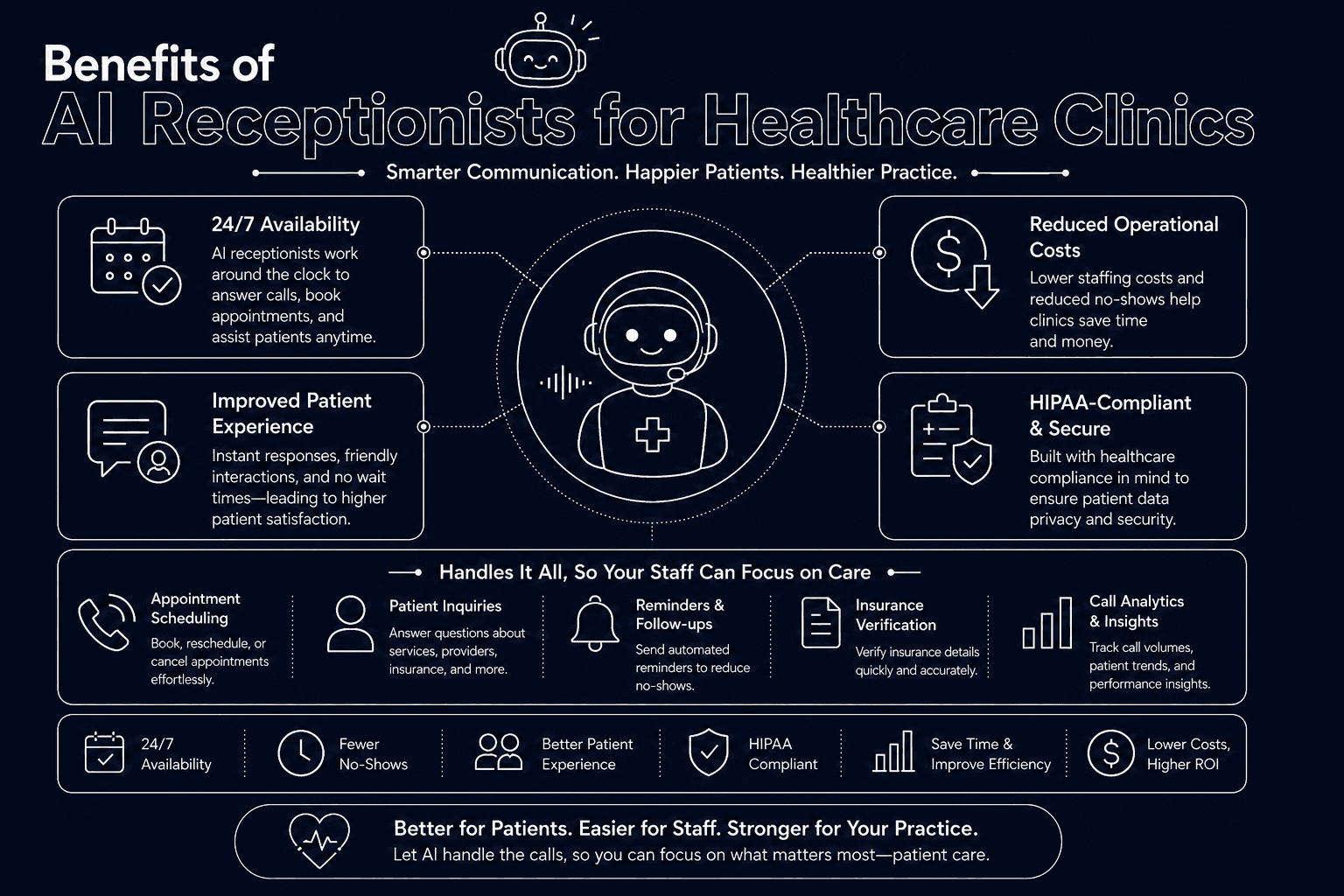
If your front desk team is drowning in appointment calls, missed reminders, and after-hours voicemails, you're not alone. Most GP clinics lose hours every week to tasks that AI can now handle automatically.
The good news? A new generation of AI scheduling tools is built specifically for general practice workflows. They handle inbound calls, send reminders, manage cancellations, and even collect patient intake information without adding to your staff's workload.
This guide covers the seven best options on the market right now, what each one actually does well, and which is worth your time depending on your clinic's size and priorities.
Why GP Clinics Are Turning to AI Scheduling
The average GP clinic spends between 2–4 hours per day just managing appointment logistics, booking, rescheduling, confirming, and chasing no-shows. That's before handling insurance queries or patient intake.
Did you know? Studies from primary care settings show that automated appointment reminders alone can cut no-show rates by up to 30%. For a busy clinic seeing 60 patients a day, that's a meaningful difference in revenue and care continuity.
AI appointment scheduling tools don't just reduce phone volume. The better ones integrate with your existing practice management system, speak to patients in natural language, and escalate complex queries to your team without friction. They're not replacing your front desk, they're giving your team time back for work that actually needs a human.
What to Look For Before You Buy
Not every AI scheduling platform is built with GP clinics in mind. Before committing, check for these:
Practice management integration: Does it connect with your existing PMS (Best Practice, Medical Director, Cliniko, etc.)?
Natural language voice or chat: Can patients interact without navigating a clunky IVR menu?
After-hours coverage: Does it handle calls and bookings when your reception is closed?
Automated reminders: SMS, email, or voice reminders that reduce no-shows without manual effort
Patient intake automation: Can it collect symptoms, demographics, or consent forms before the appointment?
HIPAA/GDPR compliance: Non-negotiable for any platform handling patient data
With those benchmarks in mind, here are the seven tools worth evaluating.
1. Brilo — Best for 24/7 AI Voice Handling and Front Desk Automation
Best for: GP clinics that want to fully automate inbound patient calls, after-hours bookings, and appointment reminders without replacing their reception staff.
Brilo is an AI voice agent platform purpose-built for healthcare practices, including general practice clinics. Where most scheduling tools focus on online self-booking, Brilo handles the phone, the channel most patients still prefer, especially older demographics.
When a patient calls outside business hours, Brilo's AI answers in natural conversational language, books or reschedules appointments, and sends a confirmation SMS all without a staff member involved. During business hours, it handles overflow calls so your receptionist doesn't miss anyone while helping someone else at the desk.
What sets Brilo apart is the quality of the voice interaction. Patients aren't navigating a phone tree. They're having a real conversation. The AI understands appointment types, knows which practitioners are available, and can collect basic intake information before the call ends.
Key features for GP clinics:
24/7 AI patient call handling in natural language
Automated appointment reminders via SMS and voice
Patient intake information collection over the phone
Overflow and after-hours call coverage
Integration with GP practice management systems
Escalation to human staff when needed
Expert Insight: Most clinics discover within the first month that 30–40% of their inbound call volume was after-hours or during peak overflow times calls they were simply missing. Brilo captures that demand automatically, which directly impacts patient satisfaction scores and booking rates.
Pricing: Custom pricing based on call volume and clinic size. Free demo available.
2. Luma Health — Best for Automated Patient Messaging Workflows
Best for: Clinics can engage patients through multiple channels like SMS, email, and chat, all linked to appointment management.
Luma Health supports the patient experience from booking to after the visit. They use an automated messaging system for confirmations, reminders, and waitlist management. It even lets patients chat back to confirm or cancel their appointments with simple text replies.
It integrates well with major EHR platforms and is particularly strong for clinics running chronic disease management programs where consistent patient touchpoints matter. The downside is it's less capable on the voice side if a significant portion of your patients still call in, Luma works better paired with a voice solution like Brilo.
Standout feature: Smart waitlist management that automatically fills cancelled slots from a patient queue.
3. Doctorly — Best for UK-Based GP Practices
Doctorly is designed To be exact for UK GP practices looking for an NHS-compatible platform that also features automated scheduling. The platform incorporates AI technology that assists patients in selecting the appropriate type of appointmentroutine, urgent, or phone callthereby relieving administrative workload and improving patient flow management.
It’s cloud-based, follows GDPR rules, and fits UK workflows perfectly. So, it’s ideal for those in the NHS needing scheduling that gets the UK setup. However, it might be less suitable for private practices with different billing requirements.
4. Zocdoc — Best for New Patient Acquisition
Best for: Clinics that want to grow their patient list by appearing on a consumer-facing booking marketplace.
ZocDoc acts as both a marketplace and a scheduling tool. Patients looking for doctors can find your clinic, see what's available, and schedule appointments straight from ZocDoc. This provides another way to bring in new patients, aside from standard automated scheduling.
It covers online booking, verifies insurance, and sends out automated reminders. Still, it works best at attracting new patients rather than replacing your entire front desk operation. You'll still have to manage patient information and handle calls outside of ZocDoc. Also, the per-booking pricing model could get pricey for clinics that do lots of bookings.
5. Klara — Best for Two-Way Patient Communication
Best for: GP clinics where patient-provider messaging is as important as appointment scheduling.
Klara centralises patient communication into a single inbox appointment requests, follow-up questions, prescription queries, and test result notifications all come through one platform. The scheduling component is solid, with automated reminders and online booking, but Klara's real strength is the messaging layer.
It's particularly well-suited for practices that have struggled with patients calling for things that could easily be handled via message. Less appropriate for clinics where phone call automation is the primary need.
6. NexHealth — Best for Multi-Location GP Groups
Best for: GP groups running two or more clinic locations that need centralised scheduling oversight.
NexHealth is built for scale. It integrates with a wide range of practice management systems and gives administrators visibility across multiple clinic locations from a single dashboard. Appointment scheduling, online booking, patient reminders, and intake forms are all included.
The onboarding is more involved than simpler tools, and the pricing reflects the enterprise positioning. But for a GP group managing 3–10 locations, NexHealth's centralised control and deep PMS integration make it worth the investment.
7. Talksoft Patient Communicator — Best for Automated Voice Reminders on a Budget
Best for: Smaller GP clinics that primarily need automated appointment reminder calls without a full AI overhaul.
Talksoft is a long-standing player in healthcare patient communication. Its core product sends automated voice, SMS, and email appointment reminders to reduce no-shows. It's not as sophisticated as AI-first platforms there's no conversational voice agent or intake automation but it's reliable, affordable, and does the reminder job well.
A good entry-level option if budget is tight and you're not yet ready to automate the full call-handling workflow.
Quick Comparison Table
Tool | Best For | Voice AI | After-Hours | Reminders | PMS Integration |
Brilo | Full front desk automation | Conversational | 24/7 | SMS + Voice | Yes |
Luma Health | Patient messaging workflows | No | Partial | Multi-channel | Yes |
Doctorly | UK NHS GP practices | Partial | No | Yes | UK systems |
Zocdoc | New patient acquisition | No | No | Yes | Yes |
Klara | Two-way messaging | No | Partial | Yes | Yes |
NexHealth | Multi-location groups | No | Partial | Yes | Yes (broad) |
Talksoft | Budget reminders | Yes (Basic) | No | Yes | Varies |
Common Mistakes GP Clinics Make When Switching
Choosing software before auditing call volume. Before picking a tool, pull three months of call data. What percentage are inbound bookings? How many come after hours? That one exercise usually clarifies whether you need a voice AI platform or just a reminder tool.
Underestimating patient adoption time. Patients over 60 may be hesitant about automated voice systems at first. The best implementations train the AI to introduce itself clearly as an assistant and offer human escalation early in the call; this builds trust quickly.
Skipping integration testing. A scheduling tool that doesn't sync properly with your PMS creates double bookings and data gaps. Always run a pilot period with real appointments before going fully live.
Pro Tip: Run your AI scheduling tool in parallel with your existing setup for two weeks before switching over completely. It gives your team time to calibrate and your patients time to adapt without service disruption.
The Bottom Line
For most GP clinics, the biggest gains come from automating the two highest-volume tasks: inbound call handling and appointment reminders. That's where you lose the most staff time and where patient frustration builds fastest.
Brilo directly addresses both. Its conversational voice AI handles the calls your team can't get to after hours, during peak periods, when the phone keeps ringing while someone's at the front desk. If you're running a busy general practice and want to stop losing patients to missed calls, it's the most complete solution on this list.
The other tools each have genuine strengths, particularly Luma Health for messaging-heavy workflows and NexHealth for multi-site practices. The right pick depends on where your current bottleneck actually sits.
Start by identifying your biggest scheduling pain point, then match it to the tool built to solve it.
FAQ
1. What is AI appointment scheduling for GP clinics?
AI appointment scheduling uses artificial intelligence — voice agents, chatbots, or automated messaging systems — to handle the booking, confirmation, and rescheduling of patient appointments without manual staff involvement. For GP clinics, this typically means automating inbound calls, sending reminder messages, and collecting patient intake information.
2. Can AI handle appointment calls for a GP clinic after hours?
Yes, Platforms like Brilo deploy AI voice agents that answer patient calls 24/7, book appointments in natural conversation, and send SMS confirmations — all outside of normal clinic hours. This captures patients who would otherwise leave a voicemail or call a competitor.
3. How do AI appointment reminders reduce no-shows in general practice?
Automated reminders — sent via SMS, email, or voice call 24–48 hours before an appointment — give patients enough notice to confirm or reschedule. This significantly reduces last-minute no-shows compared to relying on patients to remember on their own.
4. Is AI scheduling HIPAA and GDPR compliant for GP clinics?
Reputable platforms are built with healthcare data compliance in mind, but you should always verify specific certifications before deploying. Brilo and the other established tools on this list are designed to meet healthcare data standards, but always confirm compliance documentation with the vendor.
5. Will patients accept an AI voice agent when calling a GP clinic?
Adoption is generally strong when the AI is introduced transparently and sounds natural. Patients primarily care about getting an answer and booking quickly. AI voice agents that speak conversationally and offer easy escalation to a human tend to receive positive feedback, particularly for after-hours and overflow scenarios.
6. What's the difference between a scheduling tool and a full front desk automation platform?
A scheduling tool manages bookings and reminders. A front desk automation platform — like Brilo — goes further, handling inbound voice calls, collecting intake data, routing complex queries to staff, and managing overflow. For GP clinics with high call volume, the latter provides significantly more value.
7. How long does it take to set up AI appointment scheduling for a GP clinic?
Most platforms offer onboarding within 1–4 weeks. The setup timeline depends primarily on how complex your PMS integration is and how many appointment types or practitioners need to be configured. Brilo typically has clinics live within two weeks.
All Insights
Articles
7 Best AI Appointment Scheduling Tools for GP Clinics
Discover the 7 best AI appointment scheduling tools for GP clinics. Save front desk time, reduce no-shows, and handle patients 24/7 — starting with Brilo.
If your front desk team is drowning in appointment calls, missed reminders, and after-hours voicemails, you're not alone. Most GP clinics lose hours every week to tasks that AI can now handle automatically.
The good news? A new generation of AI scheduling tools is built specifically for general practice workflows. They handle inbound calls, send reminders, manage cancellations, and even collect patient intake information without adding to your staff's workload.
This guide covers the seven best options on the market right now, what each one actually does well, and which is worth your time depending on your clinic's size and priorities.
Why GP Clinics Are Turning to AI Scheduling
The average GP clinic spends between 2–4 hours per day just managing appointment logistics, booking, rescheduling, confirming, and chasing no-shows. That's before handling insurance queries or patient intake.
Did you know? Studies from primary care settings show that automated appointment reminders alone can cut no-show rates by up to 30%. For a busy clinic seeing 60 patients a day, that's a meaningful difference in revenue and care continuity.
AI appointment scheduling tools don't just reduce phone volume. The better ones integrate with your existing practice management system, speak to patients in natural language, and escalate complex queries to your team without friction. They're not replacing your front desk, they're giving your team time back for work that actually needs a human.
What to Look For Before You Buy
Not every AI scheduling platform is built with GP clinics in mind. Before committing, check for these:
Practice management integration: Does it connect with your existing PMS (Best Practice, Medical Director, Cliniko, etc.)?
Natural language voice or chat: Can patients interact without navigating a clunky IVR menu?
After-hours coverage: Does it handle calls and bookings when your reception is closed?
Automated reminders: SMS, email, or voice reminders that reduce no-shows without manual effort
Patient intake automation: Can it collect symptoms, demographics, or consent forms before the appointment?
HIPAA/GDPR compliance: Non-negotiable for any platform handling patient data
With those benchmarks in mind, here are the seven tools worth evaluating.
1. Brilo — Best for 24/7 AI Voice Handling and Front Desk Automation
Best for: GP clinics that want to fully automate inbound patient calls, after-hours bookings, and appointment reminders without replacing their reception staff.
Brilo is an AI voice agent platform purpose-built for healthcare practices, including general practice clinics. Where most scheduling tools focus on online self-booking, Brilo handles the phone, the channel most patients still prefer, especially older demographics.
When a patient calls outside business hours, Brilo's AI answers in natural conversational language, books or reschedules appointments, and sends a confirmation SMS all without a staff member involved. During business hours, it handles overflow calls so your receptionist doesn't miss anyone while helping someone else at the desk.
What sets Brilo apart is the quality of the voice interaction. Patients aren't navigating a phone tree. They're having a real conversation. The AI understands appointment types, knows which practitioners are available, and can collect basic intake information before the call ends.
Key features for GP clinics:
24/7 AI patient call handling in natural language
Automated appointment reminders via SMS and voice
Patient intake information collection over the phone
Overflow and after-hours call coverage
Integration with GP practice management systems
Escalation to human staff when needed
Expert Insight: Most clinics discover within the first month that 30–40% of their inbound call volume was after-hours or during peak overflow times calls they were simply missing. Brilo captures that demand automatically, which directly impacts patient satisfaction scores and booking rates.
Pricing: Custom pricing based on call volume and clinic size. Free demo available.
2. Luma Health — Best for Automated Patient Messaging Workflows
Best for: Clinics can engage patients through multiple channels like SMS, email, and chat, all linked to appointment management.
Luma Health supports the patient experience from booking to after the visit. They use an automated messaging system for confirmations, reminders, and waitlist management. It even lets patients chat back to confirm or cancel their appointments with simple text replies.
It integrates well with major EHR platforms and is particularly strong for clinics running chronic disease management programs where consistent patient touchpoints matter. The downside is it's less capable on the voice side if a significant portion of your patients still call in, Luma works better paired with a voice solution like Brilo.
Standout feature: Smart waitlist management that automatically fills cancelled slots from a patient queue.
3. Doctorly — Best for UK-Based GP Practices
Doctorly is designed To be exact for UK GP practices looking for an NHS-compatible platform that also features automated scheduling. The platform incorporates AI technology that assists patients in selecting the appropriate type of appointmentroutine, urgent, or phone callthereby relieving administrative workload and improving patient flow management.
It’s cloud-based, follows GDPR rules, and fits UK workflows perfectly. So, it’s ideal for those in the NHS needing scheduling that gets the UK setup. However, it might be less suitable for private practices with different billing requirements.
4. Zocdoc — Best for New Patient Acquisition
Best for: Clinics that want to grow their patient list by appearing on a consumer-facing booking marketplace.
ZocDoc acts as both a marketplace and a scheduling tool. Patients looking for doctors can find your clinic, see what's available, and schedule appointments straight from ZocDoc. This provides another way to bring in new patients, aside from standard automated scheduling.
It covers online booking, verifies insurance, and sends out automated reminders. Still, it works best at attracting new patients rather than replacing your entire front desk operation. You'll still have to manage patient information and handle calls outside of ZocDoc. Also, the per-booking pricing model could get pricey for clinics that do lots of bookings.
5. Klara — Best for Two-Way Patient Communication
Best for: GP clinics where patient-provider messaging is as important as appointment scheduling.
Klara centralises patient communication into a single inbox appointment requests, follow-up questions, prescription queries, and test result notifications all come through one platform. The scheduling component is solid, with automated reminders and online booking, but Klara's real strength is the messaging layer.
It's particularly well-suited for practices that have struggled with patients calling for things that could easily be handled via message. Less appropriate for clinics where phone call automation is the primary need.
6. NexHealth — Best for Multi-Location GP Groups
Best for: GP groups running two or more clinic locations that need centralised scheduling oversight.
NexHealth is built for scale. It integrates with a wide range of practice management systems and gives administrators visibility across multiple clinic locations from a single dashboard. Appointment scheduling, online booking, patient reminders, and intake forms are all included.
The onboarding is more involved than simpler tools, and the pricing reflects the enterprise positioning. But for a GP group managing 3–10 locations, NexHealth's centralised control and deep PMS integration make it worth the investment.
7. Talksoft Patient Communicator — Best for Automated Voice Reminders on a Budget
Best for: Smaller GP clinics that primarily need automated appointment reminder calls without a full AI overhaul.
Talksoft is a long-standing player in healthcare patient communication. Its core product sends automated voice, SMS, and email appointment reminders to reduce no-shows. It's not as sophisticated as AI-first platforms there's no conversational voice agent or intake automation but it's reliable, affordable, and does the reminder job well.
A good entry-level option if budget is tight and you're not yet ready to automate the full call-handling workflow.
Quick Comparison Table
Tool | Best For | Voice AI | After-Hours | Reminders | PMS Integration |
Brilo | Full front desk automation | Conversational | 24/7 | SMS + Voice | Yes |
Luma Health | Patient messaging workflows | No | Partial | Multi-channel | Yes |
Doctorly | UK NHS GP practices | Partial | No | Yes | UK systems |
Zocdoc | New patient acquisition | No | No | Yes | Yes |
Klara | Two-way messaging | No | Partial | Yes | Yes |
NexHealth | Multi-location groups | No | Partial | Yes | Yes (broad) |
Talksoft | Budget reminders | Yes (Basic) | No | Yes | Varies |
Common Mistakes GP Clinics Make When Switching
Choosing software before auditing call volume. Before picking a tool, pull three months of call data. What percentage are inbound bookings? How many come after hours? That one exercise usually clarifies whether you need a voice AI platform or just a reminder tool.
Underestimating patient adoption time. Patients over 60 may be hesitant about automated voice systems at first. The best implementations train the AI to introduce itself clearly as an assistant and offer human escalation early in the call; this builds trust quickly.
Skipping integration testing. A scheduling tool that doesn't sync properly with your PMS creates double bookings and data gaps. Always run a pilot period with real appointments before going fully live.
Pro Tip: Run your AI scheduling tool in parallel with your existing setup for two weeks before switching over completely. It gives your team time to calibrate and your patients time to adapt without service disruption.
The Bottom Line
For most GP clinics, the biggest gains come from automating the two highest-volume tasks: inbound call handling and appointment reminders. That's where you lose the most staff time and where patient frustration builds fastest.
Brilo directly addresses both. Its conversational voice AI handles the calls your team can't get to after hours, during peak periods, when the phone keeps ringing while someone's at the front desk. If you're running a busy general practice and want to stop losing patients to missed calls, it's the most complete solution on this list.
The other tools each have genuine strengths, particularly Luma Health for messaging-heavy workflows and NexHealth for multi-site practices. The right pick depends on where your current bottleneck actually sits.
Start by identifying your biggest scheduling pain point, then match it to the tool built to solve it.
FAQ
1. What is AI appointment scheduling for GP clinics?
AI appointment scheduling uses artificial intelligence — voice agents, chatbots, or automated messaging systems — to handle the booking, confirmation, and rescheduling of patient appointments without manual staff involvement. For GP clinics, this typically means automating inbound calls, sending reminder messages, and collecting patient intake information.
2. Can AI handle appointment calls for a GP clinic after hours?
Yes, Platforms like Brilo deploy AI voice agents that answer patient calls 24/7, book appointments in natural conversation, and send SMS confirmations — all outside of normal clinic hours. This captures patients who would otherwise leave a voicemail or call a competitor.
3. How do AI appointment reminders reduce no-shows in general practice?
Automated reminders — sent via SMS, email, or voice call 24–48 hours before an appointment — give patients enough notice to confirm or reschedule. This significantly reduces last-minute no-shows compared to relying on patients to remember on their own.
4. Is AI scheduling HIPAA and GDPR compliant for GP clinics?
Reputable platforms are built with healthcare data compliance in mind, but you should always verify specific certifications before deploying. Brilo and the other established tools on this list are designed to meet healthcare data standards, but always confirm compliance documentation with the vendor.
5. Will patients accept an AI voice agent when calling a GP clinic?
Adoption is generally strong when the AI is introduced transparently and sounds natural. Patients primarily care about getting an answer and booking quickly. AI voice agents that speak conversationally and offer easy escalation to a human tend to receive positive feedback, particularly for after-hours and overflow scenarios.
6. What's the difference between a scheduling tool and a full front desk automation platform?
A scheduling tool manages bookings and reminders. A front desk automation platform — like Brilo — goes further, handling inbound voice calls, collecting intake data, routing complex queries to staff, and managing overflow. For GP clinics with high call volume, the latter provides significantly more value.
7. How long does it take to set up AI appointment scheduling for a GP clinic?
Most platforms offer onboarding within 1–4 weeks. The setup timeline depends primarily on how complex your PMS integration is and how many appointment types or practitioners need to be configured. Brilo typically has clinics live within two weeks.
Latest Insights
All Resources
Articles
Case Studies
Tutorials
Jun 15, 2026
Articles
7 Best AI Appointment Scheduling Tools for GP Clinics
Discover the 7 best AI appointment scheduling tools for GP clinics. Save front desk time, reduce no-shows, and handle patients 24/7 — starting with Brilo.
Jun 13, 2026
Articles
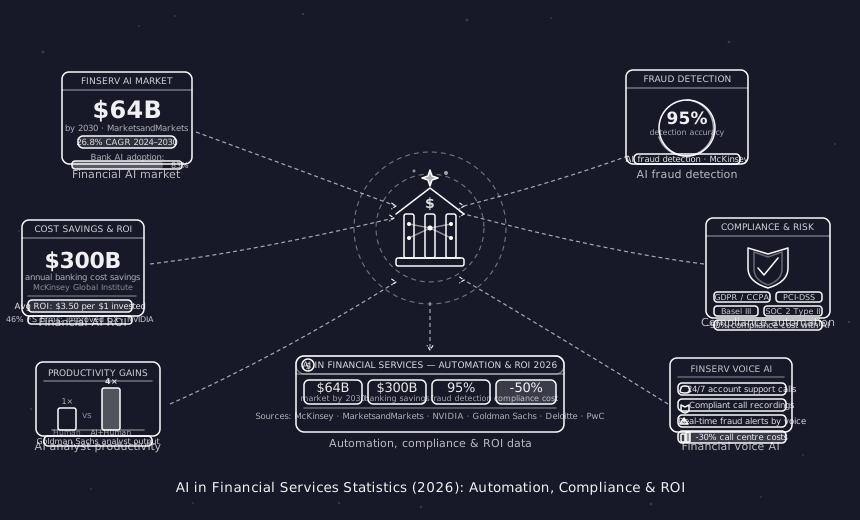
AI in Financial Services Statistics (2026): Automation, Compliance & ROI
Key AI in financial services statistics for 2026 — covering call center automation, compliance monitoring, fraud detection rates, and cost-per-interaction benchmarks.
Load More
Latest Insights
All Resources
Articles
Case Studies
Tutorials
Jun 15, 2026
Articles
7 Best AI Appointment Scheduling Tools for GP Clinics
Discover the 7 best AI appointment scheduling tools for GP clinics. Save front desk time, reduce no-shows, and handle patients 24/7 — starting with Brilo.
Jun 13, 2026
Articles
AI in Financial Services Statistics (2026): Automation, Compliance & ROI
Key AI in financial services statistics for 2026 — covering call center automation, compliance monitoring, fraud detection rates, and cost-per-interaction benchmarks.
Load More

Automate your business with AI phone Agents
Automate your business with AI phone Agents
Automate your business with AI phone Agents
Automate your business with AI phone Agents
Call automation for healthcare, real estate, logistics, financial services & small businesses.
Call automation for healthcare, real estate, logistics, financial services & small businesses.

Join Discord
Connect with our community, ask questions, and stay updated on product news.

Book a Call
Schedule a quick call with our team to explore solutions for your needs.
Get started
Industries
Usecases
Integrations
Legal & Community

Join Discord
Connect with our community, ask questions, and stay updated on product news.
Book a Call
Schedule a quick call with our team to explore solutions for your needs.
Get started
Industries
Usecases
Integrations
Legal & Community
Join Discord
Connect with our community, ask questions, and stay updated on product news.
Book a Call
Schedule a quick call with our team to explore solutions for your needs.
Get started
Industries
Usecases
Integrations
Legal & Community
Join Discord
Connect with our community, ask questions, and stay updated on product news.
Book a Call
Schedule a quick call with our team to explore solutions for your needs.
Get started
Industries
Usecases
Integrations
Legal & Community