
All Insights
Articles
AI in Financial Services Statistics (2026): Automation, Compliance & ROI
Key AI in financial services statistics for 2026 — covering call center automation, compliance monitoring, fraud detection rates, and cost-per-interaction benchmarks.





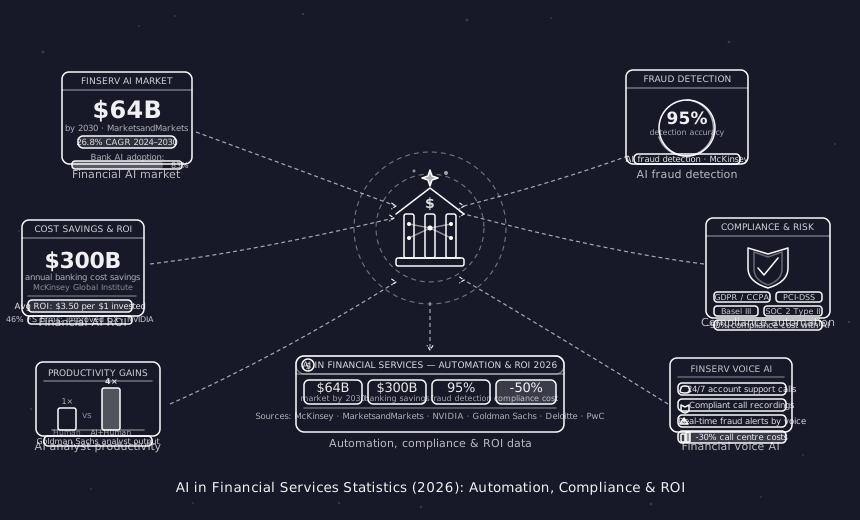
Financial services is one of the most AI-saturated industries on earth — and one of the most heavily scrutinized, because the stakes (money, fraud, compliance, trust) are so high. This page collects the most reliable AI in financial services statistics for 2026 — adoption, economic value, market size, risks, and how customers actually feel — with each number checked against the research body, survey, or institution that published it. This topic is full of recycled, unsourced figures (a "$450 billion market," "92% of fraud intercepted"); we left those out and kept only what's traceable.
The short answer: About four in five financial firms now use AI at some level (Cambridge CCAF), and McKinsey estimates generative AI alone could add $200–340 billion a year to global banking. But adoption is uneven — fintechs are far ahead of incumbents, value is hard to measure, and data privacy and model hallucinations top the risk list. Customers want the convenience but still prefer a human for anything that matters.
Top AI in financial services statistics for 2026 (editor's picks)
81% of financial industry players have adopted AI at some level — "four in five firms." — Cambridge CCAF, 2026
$200–340 billion in potential annual value to global banking from generative AI. — McKinsey, 2023
40% of financial firms have reached advanced AI adoption ("scaling" or "transforming"). — Cambridge CCAF, 2026
3x — fintechs are three times more likely than incumbents to reach the "transforming" stage (19% vs. 6%). — Cambridge CCAF, 2026
73% name data privacy and protection as their top AI risk. — Cambridge CCAF, 2026
$2.48 billion generative-AI-in-financial-services market in 2026, growing ~31% a year. — The Business Research Company, 2026
48% of consumers say 24/7 access is AI's most valuable banking benefit. — TD Bank / Ipsos, 2025
37% of bank customers say they've never interacted with a banking chatbot. — Deloitte, 2025
79% of consumers still prefer a human over an AI agent for service. — SurveyMonkey, 2026
55% of firms find it difficult to measure the value of their AI deployments (76% at large institutions). — Cambridge CCAF, 2026
How widely is AI adopted in financial services?
The most authoritative recent read comes from the Cambridge Centre for Alternative Finance, whose 2026 report surveyed 628 organizations across 151 jurisdictions, in partnership with the BIS, IMF, and World Economic Forum.
81% of financial industry respondents have adopted AI at some level — the report's "four in five firms" headline. — Cambridge CCAF, 2026
40% have reached advanced adoption, defined as "scaling" or "transforming." — Cambridge CCAF, 2026
3x — fintechs are roughly three times more likely than traditional institutions to have reached the "transforming" stage (19% vs. 6%). — Cambridge CCAF, 2026
44% and 21% of incumbents are still in the "piloting" and "exploring" stages respectively, showing slower movement up the maturity curve. — Cambridge CCAF, 2026
Industry outpaces regulators — 48% of the 130 regulatory authorities surveyed are still exploring AI or not engaged with it at all. — Cambridge CCAF, 2026
76% of industry respondents use OpenAI as a foundation-model provider — the most-used across all groups, ahead of Google and Anthropic. — Cambridge CCAF, 2026
88% of organizations across all sectors use AI in at least one business function — the cross-industry backdrop. — McKinsey, 2025
The economic value of AI in finance
$200–340 billion in additional value annually is what generative AI could deliver to the global banking sector, largely through productivity. — McKinsey (MGI), 2023
2.8–4.7% of total industry revenues is what that range represents — equivalent to 9–15% of operating profits. — McKinsey (MGI), 2023
Risk and legal, corporate banking, and retail banking are the three segments where gen AI could create the most value. — McKinsey (MGI), 2023
51% of more mature AI adopters are piloting or deploying entirely new financial products powered by AI. — Cambridge CCAF, 2026
Productivity gains are felt most in technology/data/product functions (79%), then back-office and operations (75%), then front-office roles (69%). — Cambridge CCAF, 2026
Market size and growth
Market | Base value | Projected value | CAGR | Source |
|---|---|---|---|---|
Generative AI in financial services | $1.89B (2025) | $7.24B by 2030 | ~31% | The Business Research Company |
Generative AI in financial services | $2.48B (2026) | — | 31.1% | The Business Research Company |
Generative AI in banking | $1.75B (2025) | $5.74B by 2029 | ~35% | The Business Research Company |
$1.89B → $2.48B is the generative-AI-in-financial-services market from 2025 to 2026, a 31.1% CAGR. — The Business Research Company, 2026
$7.24 billion is the projected generative-AI-in-financial-services market by 2030 (30.7% CAGR). — The Business Research Company, 2026
$5.74 billion is the projected generative-AI-in-banking market by 2029, growing at nearly 35% a year. — The Business Research Company, 2025
Agentic AI: the next frontier in finance
81% of industry respondents expect agentic AI to be meaningfully achieved by 2030 — the clearest growth frontier in the category. — Cambridge CCAF, 2026
57% vs. 45% — fintechs are ahead of traditional institutions in agentic AI adoption. — Cambridge CCAF, 2026
Gen AI and agentic AI are now reported as more widely used than supervised, unsupervised, reinforcement, and time-series techniques — likely because they have lower engineering barriers. — Cambridge CCAF, 2026
By 2029, agentic AI is expected to autonomously resolve 80% of common customer service issues across industries, cutting operational costs 30%. — Gartner, 2025
The risks and the reality gap
Financial services is candid about AI's downsides — and the honest data here is more useful than inflated savings claims.
73% of respondents name data privacy and protection as the top AI risk. — Cambridge CCAF, 2026
Model hallucinations, unreliable outputs, opacity, and lack of explainability rank among the most-cited AI risks. — Cambridge CCAF, 2026
55% of industry respondents (and 63% of regulators) find it hard to measure the value of AI deployment — rising to 76% at large financial institutions. — Cambridge CCAF, 2026
40% of industry respondents cite data availability and quality as the leading barrier to AI adoption (49% among traditional institutions). — Cambridge CCAF, 2026
AI mostly improves execution, not business models — the report flags a "significant execution and business integration gap." — Cambridge CCAF, 2026
How customers feel about AI in finance
The customer-experience data is where the opportunity — and the caution — lives.
48% of consumers say 24/7 access is the most valuable benefit AI brings to banking. — TD Bank / Ipsos, 2025
37% of bank customers say they have never interacted with a banking chatbot — room to grow. — Deloitte, 2025
60% and 53% of customers who do use banking chatbots use them mainly for technical support and inquiries about existing accounts. — Deloitte, 2025
Customers still prefer humans for routine banking queries, and a generational gap persists — millennials and Gen Z rate chatbot experiences more positively than older customers. — Deloitte, 2025
79% of consumers across industries still prefer interacting with a human over an AI agent. — SurveyMonkey, 2026
89% believe companies should always offer the option to reach a human. — SurveyMonkey, 2026
54% are confident they can tell when they're interacting with an AI chatbot. — SurveyMonkey, 2026
Voice AI and the bank phone line
Banks and insurers still field enormous phone volume — balance and payment questions, card activation, fraud alerts, claims status, appointment booking — much of it repetitive, and all of it in a regulated environment where accuracy matters.
$2.4B → $47.5B is the voice-AI-agents market from 2024 to 2034, a 34.8% CAGR — the fastest-growing conversational channel. — Market.us, 2025
$11.58B → $41.39B is the conversational AI market from 2024 to 2030, a 23.7% CAGR. — Grand View Research
48% of consumers value 24/7 access most — exactly what a voice agent provides outside branch and call-center hours. — TD Bank / Ipsos, 2025
50% of consumers have already engaged with Voice AI. — Zendesk, 2025
A voice agent that answers from your verified knowledge base — and hands off anything sensitive or complex to a human — fits the regulated reality of finance, where a hallucinated answer is a compliance problem, not just a bad experience. See how Brilo AI handles high-volume financial calls across its voice-agent use cases, with AI in customer service grounded and human handoff built in.
Frequently Asked Question
How many financial firms use AI?
The Cambridge Centre for Alternative Finance's 2026 global report found 81% of financial industry players have adopted AI at some level — "four in five firms" — with 40% at advanced ("scaling" or "transforming") stages. Adoption is uneven: fintechs are roughly three times more likely than traditional institutions to be fully transforming with AI.
How much is AI worth to the banking industry?
McKinsey's Global Institute estimates generative AI could add $200–340 billion in value annually to global banking, equivalent to 2.8–4.7% of industry revenues or 9–15% of operating profits — mostly through productivity gains in areas like risk, legal, corporate, and retail banking.
What are the biggest risks of AI in financial services?
Per the Cambridge CCAF report, data privacy and protection is the top concern (73% of respondents), followed by model hallucinations, unreliable outputs, model opacity, and lack of explainability. A separate practical problem: 55% of firms — and 76% of large institutions — struggle to measure the value of their AI deployments.
Do bank customers trust AI?
Selectively. Consumers value the convenience — 48% say 24/7 access is AI's most valuable banking benefit (TD/Ipsos) — but 37% have never used a banking chatbot (Deloitte), and most still prefer a human for routine queries. Across industries, 79% prefer a human option and 89% want one always available (SurveyMonkey).
What is AI used for in finance?
The biggest uses include fraud detection, risk and credit assessment, regulatory and AML compliance, customer service and chatbots, document processing, trading, and personalization. Generative and agentic AI are now among the most widely used techniques, and 51% of mature adopters are piloting or deploying entirely new AI-powered financial products.
Methodology and sources
Every statistic on this page was verified against the organization that originally published it — no figures were taken from third-party roundups or aggregators, and widely circulated but unsourced claims (such as a "$450 billion banking AI market" or "92% of fraud intercepted") were deliberately excluded. Primary sources include the Cambridge Centre for Alternative Finance's 2026 Global AI in Financial Services Report (628 organizations across 151 jurisdictions, with the BIS, IMF, and WEF), McKinsey (Global Institute and State of AI), The Business Research Company, Deloitte, the TD Bank/Ipsos AI Insights Report, Gartner, Grand View Research, Market.us, and Zendesk. Market projections are estimates from the named research firms; survey findings reflect each study's stated sample and date.
Bring grounded voice AI to your financial institution
The data is consistent: AI is now standard in financial services, the value is real but unevenly captured, and customers want convenience without losing the human safety net — while privacy and hallucination risks make accuracy non-negotiable. A grounded voice agent answers routine calls 24/7, stays inside your verified knowledge, and routes anything sensitive to a person. See how Brilo AI brings voice AI to banking, lending, and insurance across real-world use cases — so your customers get fast answers and your team keeps control.
All Insights
Articles
AI in Financial Services Statistics (2026): Automation, Compliance & ROI
Key AI in financial services statistics for 2026 — covering call center automation, compliance monitoring, fraud detection rates, and cost-per-interaction benchmarks.
Financial services is one of the most AI-saturated industries on earth — and one of the most heavily scrutinized, because the stakes (money, fraud, compliance, trust) are so high. This page collects the most reliable AI in financial services statistics for 2026 — adoption, economic value, market size, risks, and how customers actually feel — with each number checked against the research body, survey, or institution that published it. This topic is full of recycled, unsourced figures (a "$450 billion market," "92% of fraud intercepted"); we left those out and kept only what's traceable.
The short answer: About four in five financial firms now use AI at some level (Cambridge CCAF), and McKinsey estimates generative AI alone could add $200–340 billion a year to global banking. But adoption is uneven — fintechs are far ahead of incumbents, value is hard to measure, and data privacy and model hallucinations top the risk list. Customers want the convenience but still prefer a human for anything that matters.
Top AI in financial services statistics for 2026 (editor's picks)
81% of financial industry players have adopted AI at some level — "four in five firms." — Cambridge CCAF, 2026
$200–340 billion in potential annual value to global banking from generative AI. — McKinsey, 2023
40% of financial firms have reached advanced AI adoption ("scaling" or "transforming"). — Cambridge CCAF, 2026
3x — fintechs are three times more likely than incumbents to reach the "transforming" stage (19% vs. 6%). — Cambridge CCAF, 2026
73% name data privacy and protection as their top AI risk. — Cambridge CCAF, 2026
$2.48 billion generative-AI-in-financial-services market in 2026, growing ~31% a year. — The Business Research Company, 2026
48% of consumers say 24/7 access is AI's most valuable banking benefit. — TD Bank / Ipsos, 2025
37% of bank customers say they've never interacted with a banking chatbot. — Deloitte, 2025
79% of consumers still prefer a human over an AI agent for service. — SurveyMonkey, 2026
55% of firms find it difficult to measure the value of their AI deployments (76% at large institutions). — Cambridge CCAF, 2026
How widely is AI adopted in financial services?
The most authoritative recent read comes from the Cambridge Centre for Alternative Finance, whose 2026 report surveyed 628 organizations across 151 jurisdictions, in partnership with the BIS, IMF, and World Economic Forum.
81% of financial industry respondents have adopted AI at some level — the report's "four in five firms" headline. — Cambridge CCAF, 2026
40% have reached advanced adoption, defined as "scaling" or "transforming." — Cambridge CCAF, 2026
3x — fintechs are roughly three times more likely than traditional institutions to have reached the "transforming" stage (19% vs. 6%). — Cambridge CCAF, 2026
44% and 21% of incumbents are still in the "piloting" and "exploring" stages respectively, showing slower movement up the maturity curve. — Cambridge CCAF, 2026
Industry outpaces regulators — 48% of the 130 regulatory authorities surveyed are still exploring AI or not engaged with it at all. — Cambridge CCAF, 2026
76% of industry respondents use OpenAI as a foundation-model provider — the most-used across all groups, ahead of Google and Anthropic. — Cambridge CCAF, 2026
88% of organizations across all sectors use AI in at least one business function — the cross-industry backdrop. — McKinsey, 2025
The economic value of AI in finance
$200–340 billion in additional value annually is what generative AI could deliver to the global banking sector, largely through productivity. — McKinsey (MGI), 2023
2.8–4.7% of total industry revenues is what that range represents — equivalent to 9–15% of operating profits. — McKinsey (MGI), 2023
Risk and legal, corporate banking, and retail banking are the three segments where gen AI could create the most value. — McKinsey (MGI), 2023
51% of more mature AI adopters are piloting or deploying entirely new financial products powered by AI. — Cambridge CCAF, 2026
Productivity gains are felt most in technology/data/product functions (79%), then back-office and operations (75%), then front-office roles (69%). — Cambridge CCAF, 2026
Market size and growth
Market | Base value | Projected value | CAGR | Source |
|---|---|---|---|---|
Generative AI in financial services | $1.89B (2025) | $7.24B by 2030 | ~31% | The Business Research Company |
Generative AI in financial services | $2.48B (2026) | — | 31.1% | The Business Research Company |
Generative AI in banking | $1.75B (2025) | $5.74B by 2029 | ~35% | The Business Research Company |
$1.89B → $2.48B is the generative-AI-in-financial-services market from 2025 to 2026, a 31.1% CAGR. — The Business Research Company, 2026
$7.24 billion is the projected generative-AI-in-financial-services market by 2030 (30.7% CAGR). — The Business Research Company, 2026
$5.74 billion is the projected generative-AI-in-banking market by 2029, growing at nearly 35% a year. — The Business Research Company, 2025
Agentic AI: the next frontier in finance
81% of industry respondents expect agentic AI to be meaningfully achieved by 2030 — the clearest growth frontier in the category. — Cambridge CCAF, 2026
57% vs. 45% — fintechs are ahead of traditional institutions in agentic AI adoption. — Cambridge CCAF, 2026
Gen AI and agentic AI are now reported as more widely used than supervised, unsupervised, reinforcement, and time-series techniques — likely because they have lower engineering barriers. — Cambridge CCAF, 2026
By 2029, agentic AI is expected to autonomously resolve 80% of common customer service issues across industries, cutting operational costs 30%. — Gartner, 2025
The risks and the reality gap
Financial services is candid about AI's downsides — and the honest data here is more useful than inflated savings claims.
73% of respondents name data privacy and protection as the top AI risk. — Cambridge CCAF, 2026
Model hallucinations, unreliable outputs, opacity, and lack of explainability rank among the most-cited AI risks. — Cambridge CCAF, 2026
55% of industry respondents (and 63% of regulators) find it hard to measure the value of AI deployment — rising to 76% at large financial institutions. — Cambridge CCAF, 2026
40% of industry respondents cite data availability and quality as the leading barrier to AI adoption (49% among traditional institutions). — Cambridge CCAF, 2026
AI mostly improves execution, not business models — the report flags a "significant execution and business integration gap." — Cambridge CCAF, 2026
How customers feel about AI in finance
The customer-experience data is where the opportunity — and the caution — lives.
48% of consumers say 24/7 access is the most valuable benefit AI brings to banking. — TD Bank / Ipsos, 2025
37% of bank customers say they have never interacted with a banking chatbot — room to grow. — Deloitte, 2025
60% and 53% of customers who do use banking chatbots use them mainly for technical support and inquiries about existing accounts. — Deloitte, 2025
Customers still prefer humans for routine banking queries, and a generational gap persists — millennials and Gen Z rate chatbot experiences more positively than older customers. — Deloitte, 2025
79% of consumers across industries still prefer interacting with a human over an AI agent. — SurveyMonkey, 2026
89% believe companies should always offer the option to reach a human. — SurveyMonkey, 2026
54% are confident they can tell when they're interacting with an AI chatbot. — SurveyMonkey, 2026
Voice AI and the bank phone line
Banks and insurers still field enormous phone volume — balance and payment questions, card activation, fraud alerts, claims status, appointment booking — much of it repetitive, and all of it in a regulated environment where accuracy matters.
$2.4B → $47.5B is the voice-AI-agents market from 2024 to 2034, a 34.8% CAGR — the fastest-growing conversational channel. — Market.us, 2025
$11.58B → $41.39B is the conversational AI market from 2024 to 2030, a 23.7% CAGR. — Grand View Research
48% of consumers value 24/7 access most — exactly what a voice agent provides outside branch and call-center hours. — TD Bank / Ipsos, 2025
50% of consumers have already engaged with Voice AI. — Zendesk, 2025
A voice agent that answers from your verified knowledge base — and hands off anything sensitive or complex to a human — fits the regulated reality of finance, where a hallucinated answer is a compliance problem, not just a bad experience. See how Brilo AI handles high-volume financial calls across its voice-agent use cases, with AI in customer service grounded and human handoff built in.
Frequently Asked Question
How many financial firms use AI?
The Cambridge Centre for Alternative Finance's 2026 global report found 81% of financial industry players have adopted AI at some level — "four in five firms" — with 40% at advanced ("scaling" or "transforming") stages. Adoption is uneven: fintechs are roughly three times more likely than traditional institutions to be fully transforming with AI.
How much is AI worth to the banking industry?
McKinsey's Global Institute estimates generative AI could add $200–340 billion in value annually to global banking, equivalent to 2.8–4.7% of industry revenues or 9–15% of operating profits — mostly through productivity gains in areas like risk, legal, corporate, and retail banking.
What are the biggest risks of AI in financial services?
Per the Cambridge CCAF report, data privacy and protection is the top concern (73% of respondents), followed by model hallucinations, unreliable outputs, model opacity, and lack of explainability. A separate practical problem: 55% of firms — and 76% of large institutions — struggle to measure the value of their AI deployments.
Do bank customers trust AI?
Selectively. Consumers value the convenience — 48% say 24/7 access is AI's most valuable banking benefit (TD/Ipsos) — but 37% have never used a banking chatbot (Deloitte), and most still prefer a human for routine queries. Across industries, 79% prefer a human option and 89% want one always available (SurveyMonkey).
What is AI used for in finance?
The biggest uses include fraud detection, risk and credit assessment, regulatory and AML compliance, customer service and chatbots, document processing, trading, and personalization. Generative and agentic AI are now among the most widely used techniques, and 51% of mature adopters are piloting or deploying entirely new AI-powered financial products.
Methodology and sources
Every statistic on this page was verified against the organization that originally published it — no figures were taken from third-party roundups or aggregators, and widely circulated but unsourced claims (such as a "$450 billion banking AI market" or "92% of fraud intercepted") were deliberately excluded. Primary sources include the Cambridge Centre for Alternative Finance's 2026 Global AI in Financial Services Report (628 organizations across 151 jurisdictions, with the BIS, IMF, and WEF), McKinsey (Global Institute and State of AI), The Business Research Company, Deloitte, the TD Bank/Ipsos AI Insights Report, Gartner, Grand View Research, Market.us, and Zendesk. Market projections are estimates from the named research firms; survey findings reflect each study's stated sample and date.
Bring grounded voice AI to your financial institution
The data is consistent: AI is now standard in financial services, the value is real but unevenly captured, and customers want convenience without losing the human safety net — while privacy and hallucination risks make accuracy non-negotiable. A grounded voice agent answers routine calls 24/7, stays inside your verified knowledge, and routes anything sensitive to a person. See how Brilo AI brings voice AI to banking, lending, and insurance across real-world use cases — so your customers get fast answers and your team keeps control.
Latest Insights
All Resources
Articles
Case Studies
Tutorials

Articles
FDA-Compliant AI Voice for Medical Device Hotlines
What Part 11, ISO 13485, and QMS integration actually require from an AI voice agent on a medical device support line.

Articles
Reduce FDA Warning Letters on Complaint Handling
FDA warning letters citing complaint-handling failures are rising. Here's how automated intake closes the gap.
Load More
Latest Insights
All Resources
Articles
Case Studies
Tutorials
Articles
FDA-Compliant AI Voice for Medical Device Hotlines
What Part 11, ISO 13485, and QMS integration actually require from an AI voice agent on a medical device support line.
Articles
Reduce FDA Warning Letters on Complaint Handling
FDA warning letters citing complaint-handling failures are rising. Here's how automated intake closes the gap.
Load More

Automate your business with AI phone Agents
Automate your business with AI phone Agents
Automate your business with AI phone Agents
Automate your business with AI phone Agents
Call automation for healthcare, real estate, logistics, financial services & small businesses.
Call automation for healthcare, real estate, logistics, financial services & small businesses.

Join Discord
Connect with our community, ask questions, and stay updated on product news.

Book a Call
Schedule a quick call with our team to explore solutions for your needs.
Get started
Industries
Usecases
Integrations
Legal & Community

Join Discord
Connect with our community, ask questions, and stay updated on product news.
Book a Call
Schedule a quick call with our team to explore solutions for your needs.
Get started
Industries
Usecases
Integrations
Legal & Community
Join Discord
Connect with our community, ask questions, and stay updated on product news.
Book a Call
Schedule a quick call with our team to explore solutions for your needs.
Get started
Industries
Usecases
Integrations
Legal & Community
Join Discord
Connect with our community, ask questions, and stay updated on product news.
Book a Call
Schedule a quick call with our team to explore solutions for your needs.
Get started
Industries
Usecases
Integrations
Legal & Community