
All Insights
Articles
Best Practices for Automating Patient Reminders in GP Clinics
Learn best practices to automate patient appointment reminders for GP clinics, cut no shows, save staff time, and improve attendance rates.





A missed appointment is never just a missed appointment. It is a wasted clinical slot, a patient who could have been seen in that time, and the staff hours spent chasing the no show afterward. Across a year, those gaps add up to a serious loss of capacity for any general practice, and most of them are preventable with something surprisingly simple: a well designed reminder.
The problem is that manual reminders rarely happen consistently. When reception is buried under the morning phone surge, calling patients to confirm tomorrow's appointments is the first task to slip. That is exactly why clinics choose to automate patient appointment reminders. GP teams that get this right see no shows fall, diaries stay full, and staff freed from a repetitive chore that machines handle better anyway.
This guide covers the best practices for building an automated reminder system that actually works, the timing, the channels, the messaging, and the pitfalls to avoid, so your clinic captures the full benefit rather than just ticking a box.
Why No Shows Hurt More Than You Think
A no show is not a neutral event. A missed 10 minute slot is not a 10 minute loss. It is the time spent trying to reach the patient, the appointment that another patient on the waitlist could have used, and the disruption to a clinician's carefully planned session.
Multiply that across a busy week and the pattern becomes clear: no shows quietly erode the capacity a practice works hard to build. And the frustrating part is how avoidable most of them are. A large share of missed appointments happen simply because the patient forgot, was never reminded, or found rescheduling too much hassle to bother with. If your clinic is still weighing whether automation is worth it, the 8 signs your medical clinic needs front desk automation is a good place to start.
Did You Know?
Many no shows are not deliberate. Patients forget, lose track of the date, or assume rescheduling requires another long hold on the phone. Remove that friction with an automated reminder and an easy way to confirm or rebook, and a large portion of those missed appointments simply disappear.
What It Means to Automate Patient Reminders
To automate patient appointment reminders for GP practices is to use software, ideally AI driven, to contact patients ahead of their appointment without a staff member manually placing each call or sending each text. The system pulls upcoming appointments from your clinical schedule, sends a reminder through the patient's preferred channel, and lets them confirm, cancel, or reschedule in the same interaction.
The best automated appointment reminder systems for doctors go further than a one way text. They handle the reply, updating your appointment book in real time when a patient confirms or cancels, and triggering waitlist outreach when a slot opens up. This closed loop is what separates a genuine reminder system from a simple notification blast. For the broader context of how this fits into clinic operations, how AI is transforming general practice clinics offers a wider view.
Reminders are also just one of many tasks worth automating. The 15 healthcare tasks you can automate with AI voice agents maps out where else the same technology delivers.
Best Practices for Automating Patient Reminders
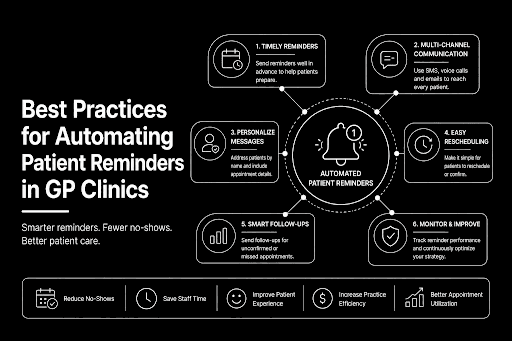
Getting reminders right is less about the technology and more about the design. Here are the practices that consistently produce results.
1. Get the Timing Right
Timing is the single biggest lever. Send a reminder too early and the patient forgets again by the appointment day. Too late and they have no time to reschedule, so the slot goes to waste anyway.
The proven pattern is a layered approach: an initial reminder 48 hours before, giving enough notice to cancel and free the slot, followed by a shorter nudge on the day itself. For patients with a history of missing appointments, an additional touchpoint can be added automatically. A good automated appointment reminder system for doctors lets you configure these sequences without any manual effort.
2. Use the Right Channels
Different patients respond to different channels. SMS suits most people for its convenience, but voice reminders are invaluable for elderly patients or those who do not regularly check their phone for texts. Email works as a supplementary channel for detailed pre visit instructions.
The strongest systems are multi channel and adapt to patient preference. An AI voice agent can call patients who respond better to a spoken reminder while texting those who prefer it, all from the same automated workflow.
3. Make Rescheduling Effortless
A reminder that only says "you have an appointment" misses the point. The real value comes when the patient can act on it instantly, confirming, cancelling, or rebooking within the same message or call, without a separate phone queue.
When cancelling is frictionless, patients who cannot attend are far more likely to cancel in advance rather than simply not turn up. That advance notice is gold: it turns a wasted slot into a rebookable one. This is one of the clearest ways AI appointment scheduling improves patient experience.
4. Automatically Fill Cancelled Slots
A cancellation is only useful if the slot gets refilled, and manually working a waitlist is exactly the kind of task that gets dropped when staff are busy. The best systems close this loop automatically: when a patient cancels, the AI immediately contacts waiting patients to offer the newly free slot, often filling it within minutes.
5. Keep Messaging Clear and Personal
Reminders should be concise, warm, and specific. Include the date, time, clinician, location, and any preparation needed. Personalisation, using the patient's name and the correct appointment details, improves response rates and reduces confusion. Consistency matters too: an automated system delivers the same accurate information every time, unlike a rushed manual call.
6. Respect Compliance and Consent
Patient communications must respect data protection rules. Ensure your system meets GDPR requirements for UK practices, and HIPAA where relevant, and that patients have consented to the contact method. Reputable healthcare focused tools handle this by design.
Expert Insight
The highest return on automated reminders rarely comes from the reminder itself. It comes from the reschedule and refill loop that follows. A patient who cancels 48 hours ahead generates a rebookable slot; a patient who simply does not appear generates pure waste. Automating both sides of that equation is where the real capacity is recovered.
Manual Reminders vs Automated Reminders
Factor | Manual Reminders | Automated Reminders |
Consistency | Skipped when staff are busy | Sent every time, reliably |
Timing | Ad hoc | Configured, layered sequences |
Channels | Usually phone only | SMS, voice, and email |
Rescheduling | Separate phone call | Handled in the same interaction |
Waitlist filling | Rarely done | Automatic on cancellation |
Staff time | High | Near zero |
The full trade off between human and automated handling is explored in AI vs traditional receptionists: what GP clinics should know. For a broader menu of reminder tactics, the 10 smart ways clinics can automate patient appointment reminders is a practical companion to this guide.
Why AI Reminders Outperform Basic Notification Tools
Not all automation is equal. A basic tool fires off a text and stops there. AI appointment reminders for GP clinics understand the patient's reply, act on it, and update your systems accordingly.
When a patient responds to an AI reminder to say they can no longer attend, the AI cancels the appointment, checks the waitlist, contacts the next patient, and confirms the new booking, all without a receptionist lifting a finger. If the patient asks a question about their appointment, the AI answers it. If the situation needs a human, it transfers the call with context. This intelligence is why AI driven reminders reduce no shows more effectively than one way alerts, and it is part of the wider case made in why every GP clinic needs an AI phone agent in 2026.
Common Mistake
The most common error is deploying reminders as a one way broadcast. If a patient cannot reply, confirm, or reschedule directly from the reminder, you have solved only half the problem. The clinics that see the biggest drop in no shows use two way, action enabled reminders, not notifications.
The Broader Benefits Beyond Fewer No Shows
Reducing missed appointments is the headline, but automated reminders deliver more than that. They free reception staff from a repetitive, easily forgotten task. They improve patient satisfaction by making appointments easy to manage. They protect clinical capacity by keeping the diary full. And because the system runs around the clock, patients can confirm or reschedule in the evenings and at weekends, when they actually think about it, an advantage detailed in how after hours AI support improves GP clinic operations.
Taken together, these gains are part of why AI reception tools deliver such strong returns, as laid out in the 12 benefits of AI receptionists for healthcare clinics. And because the same agent that sends reminders also answers calls, no booking opportunity slips through, reinforcing how AI answering services help GP clinics never miss calls.
How Brilo AI Automates Patient Reminders
Brilo AI is an AI phone agent platform built for healthcare and other high demand environments. Its reminder capability connects directly to your clinical system, identifies upcoming appointments, and proactively contacts patients by SMS or natural voice call 24 to 48 hours ahead.
Crucially, Brilo handles the response. Patients can confirm, cancel, or reschedule within the same interaction, and the system updates your appointment book in real time. When a cancellation frees a slot, Brilo automatically works the waitlist to fill it. It supports 50+ languages, integrates natively with major primary care systems, and meets GDPR requirements for UK practices, with HIPAA compliant configurations available for US clinics.
If you are evaluating providers, the best AI phone agents for general practice clinics compared is a useful benchmark, while how to choose the right AI receptionist for your GP clinic and the 7 features to look for in a medical AI answering service will help you build a solid evaluation checklist.
Getting Started
Begin by reviewing your current no show rate and the reasons behind it, then design a layered reminder sequence: a 48 hour reminder, a same day nudge, and extra touchpoints for high risk patients. Choose a multi channel system that lets patients act on the reminder directly, confirm your compliance requirements, and make sure it integrates with your appointment book so cancellations and rebookings flow back automatically.
Above all, choose a two way, action enabled system over a simple broadcast tool. That single decision is what turns reminders from a nice gesture into a measurable reduction in missed appointments.
Frequently Asked Question
What does it mean to automate patient appointment reminders for a GP clinic?
It means using software, ideally AI driven, to contact patients ahead of appointments automatically, without staff manually calling or texting each one. The system sends reminders, handles confirmations and cancellations, and updates the appointment book in real time.
When should automated appointment reminders be sent?
A layered approach works best: an initial reminder around 48 hours before, giving time to reschedule, followed by a shorter nudge on the appointment day. High risk patients can receive an additional touchpoint automatically.
Which channels work best for automated medical appointment reminders?
SMS suits most patients, voice calls work well for elderly or less tech comfortable patients, and email supports detailed pre visit instructions. The strongest systems are multi channel and adapt to patient preference.
Do automated reminders actually reduce no shows?
Yes. Timely reminders combined with easy rescheduling and automatic waitlist filling meaningfully reduce no show rates, often within the first quarter of use, by removing the friction that causes most missed appointments.
Are AI appointment reminders for GP clinics GDPR compliant?
Reputable healthcare focused tools meet GDPR requirements for UK and European practices and offer HIPAA compliant configurations for US clinics. Always confirm compliance and patient consent before deploying.
What makes AI reminders better than basic SMS alerts?
AI reminders are two way. They understand the patient's reply, cancel or rebook accordingly, work the waitlist to fill freed slots, and transfer to a human when needed, whereas basic alerts only send a one way message.
All Insights
Articles
Best Practices for Automating Patient Reminders in GP Clinics
Learn best practices to automate patient appointment reminders for GP clinics, cut no shows, save staff time, and improve attendance rates.
A missed appointment is never just a missed appointment. It is a wasted clinical slot, a patient who could have been seen in that time, and the staff hours spent chasing the no show afterward. Across a year, those gaps add up to a serious loss of capacity for any general practice, and most of them are preventable with something surprisingly simple: a well designed reminder.
The problem is that manual reminders rarely happen consistently. When reception is buried under the morning phone surge, calling patients to confirm tomorrow's appointments is the first task to slip. That is exactly why clinics choose to automate patient appointment reminders. GP teams that get this right see no shows fall, diaries stay full, and staff freed from a repetitive chore that machines handle better anyway.
This guide covers the best practices for building an automated reminder system that actually works, the timing, the channels, the messaging, and the pitfalls to avoid, so your clinic captures the full benefit rather than just ticking a box.
Why No Shows Hurt More Than You Think
A no show is not a neutral event. A missed 10 minute slot is not a 10 minute loss. It is the time spent trying to reach the patient, the appointment that another patient on the waitlist could have used, and the disruption to a clinician's carefully planned session.
Multiply that across a busy week and the pattern becomes clear: no shows quietly erode the capacity a practice works hard to build. And the frustrating part is how avoidable most of them are. A large share of missed appointments happen simply because the patient forgot, was never reminded, or found rescheduling too much hassle to bother with. If your clinic is still weighing whether automation is worth it, the 8 signs your medical clinic needs front desk automation is a good place to start.
Did You Know?
Many no shows are not deliberate. Patients forget, lose track of the date, or assume rescheduling requires another long hold on the phone. Remove that friction with an automated reminder and an easy way to confirm or rebook, and a large portion of those missed appointments simply disappear.
What It Means to Automate Patient Reminders
To automate patient appointment reminders for GP practices is to use software, ideally AI driven, to contact patients ahead of their appointment without a staff member manually placing each call or sending each text. The system pulls upcoming appointments from your clinical schedule, sends a reminder through the patient's preferred channel, and lets them confirm, cancel, or reschedule in the same interaction.
The best automated appointment reminder systems for doctors go further than a one way text. They handle the reply, updating your appointment book in real time when a patient confirms or cancels, and triggering waitlist outreach when a slot opens up. This closed loop is what separates a genuine reminder system from a simple notification blast. For the broader context of how this fits into clinic operations, how AI is transforming general practice clinics offers a wider view.
Reminders are also just one of many tasks worth automating. The 15 healthcare tasks you can automate with AI voice agents maps out where else the same technology delivers.
Best Practices for Automating Patient Reminders
Getting reminders right is less about the technology and more about the design. Here are the practices that consistently produce results.
1. Get the Timing Right
Timing is the single biggest lever. Send a reminder too early and the patient forgets again by the appointment day. Too late and they have no time to reschedule, so the slot goes to waste anyway.
The proven pattern is a layered approach: an initial reminder 48 hours before, giving enough notice to cancel and free the slot, followed by a shorter nudge on the day itself. For patients with a history of missing appointments, an additional touchpoint can be added automatically. A good automated appointment reminder system for doctors lets you configure these sequences without any manual effort.
2. Use the Right Channels
Different patients respond to different channels. SMS suits most people for its convenience, but voice reminders are invaluable for elderly patients or those who do not regularly check their phone for texts. Email works as a supplementary channel for detailed pre visit instructions.
The strongest systems are multi channel and adapt to patient preference. An AI voice agent can call patients who respond better to a spoken reminder while texting those who prefer it, all from the same automated workflow.
3. Make Rescheduling Effortless
A reminder that only says "you have an appointment" misses the point. The real value comes when the patient can act on it instantly, confirming, cancelling, or rebooking within the same message or call, without a separate phone queue.
When cancelling is frictionless, patients who cannot attend are far more likely to cancel in advance rather than simply not turn up. That advance notice is gold: it turns a wasted slot into a rebookable one. This is one of the clearest ways AI appointment scheduling improves patient experience.
4. Automatically Fill Cancelled Slots
A cancellation is only useful if the slot gets refilled, and manually working a waitlist is exactly the kind of task that gets dropped when staff are busy. The best systems close this loop automatically: when a patient cancels, the AI immediately contacts waiting patients to offer the newly free slot, often filling it within minutes.
5. Keep Messaging Clear and Personal
Reminders should be concise, warm, and specific. Include the date, time, clinician, location, and any preparation needed. Personalisation, using the patient's name and the correct appointment details, improves response rates and reduces confusion. Consistency matters too: an automated system delivers the same accurate information every time, unlike a rushed manual call.
6. Respect Compliance and Consent
Patient communications must respect data protection rules. Ensure your system meets GDPR requirements for UK practices, and HIPAA where relevant, and that patients have consented to the contact method. Reputable healthcare focused tools handle this by design.
Expert Insight
The highest return on automated reminders rarely comes from the reminder itself. It comes from the reschedule and refill loop that follows. A patient who cancels 48 hours ahead generates a rebookable slot; a patient who simply does not appear generates pure waste. Automating both sides of that equation is where the real capacity is recovered.
Manual Reminders vs Automated Reminders
Factor | Manual Reminders | Automated Reminders |
Consistency | Skipped when staff are busy | Sent every time, reliably |
Timing | Ad hoc | Configured, layered sequences |
Channels | Usually phone only | SMS, voice, and email |
Rescheduling | Separate phone call | Handled in the same interaction |
Waitlist filling | Rarely done | Automatic on cancellation |
Staff time | High | Near zero |
The full trade off between human and automated handling is explored in AI vs traditional receptionists: what GP clinics should know. For a broader menu of reminder tactics, the 10 smart ways clinics can automate patient appointment reminders is a practical companion to this guide.
Why AI Reminders Outperform Basic Notification Tools
Not all automation is equal. A basic tool fires off a text and stops there. AI appointment reminders for GP clinics understand the patient's reply, act on it, and update your systems accordingly.
When a patient responds to an AI reminder to say they can no longer attend, the AI cancels the appointment, checks the waitlist, contacts the next patient, and confirms the new booking, all without a receptionist lifting a finger. If the patient asks a question about their appointment, the AI answers it. If the situation needs a human, it transfers the call with context. This intelligence is why AI driven reminders reduce no shows more effectively than one way alerts, and it is part of the wider case made in why every GP clinic needs an AI phone agent in 2026.
Common Mistake
The most common error is deploying reminders as a one way broadcast. If a patient cannot reply, confirm, or reschedule directly from the reminder, you have solved only half the problem. The clinics that see the biggest drop in no shows use two way, action enabled reminders, not notifications.
The Broader Benefits Beyond Fewer No Shows
Reducing missed appointments is the headline, but automated reminders deliver more than that. They free reception staff from a repetitive, easily forgotten task. They improve patient satisfaction by making appointments easy to manage. They protect clinical capacity by keeping the diary full. And because the system runs around the clock, patients can confirm or reschedule in the evenings and at weekends, when they actually think about it, an advantage detailed in how after hours AI support improves GP clinic operations.
Taken together, these gains are part of why AI reception tools deliver such strong returns, as laid out in the 12 benefits of AI receptionists for healthcare clinics. And because the same agent that sends reminders also answers calls, no booking opportunity slips through, reinforcing how AI answering services help GP clinics never miss calls.
How Brilo AI Automates Patient Reminders
Brilo AI is an AI phone agent platform built for healthcare and other high demand environments. Its reminder capability connects directly to your clinical system, identifies upcoming appointments, and proactively contacts patients by SMS or natural voice call 24 to 48 hours ahead.
Crucially, Brilo handles the response. Patients can confirm, cancel, or reschedule within the same interaction, and the system updates your appointment book in real time. When a cancellation frees a slot, Brilo automatically works the waitlist to fill it. It supports 50+ languages, integrates natively with major primary care systems, and meets GDPR requirements for UK practices, with HIPAA compliant configurations available for US clinics.
If you are evaluating providers, the best AI phone agents for general practice clinics compared is a useful benchmark, while how to choose the right AI receptionist for your GP clinic and the 7 features to look for in a medical AI answering service will help you build a solid evaluation checklist.
Getting Started
Begin by reviewing your current no show rate and the reasons behind it, then design a layered reminder sequence: a 48 hour reminder, a same day nudge, and extra touchpoints for high risk patients. Choose a multi channel system that lets patients act on the reminder directly, confirm your compliance requirements, and make sure it integrates with your appointment book so cancellations and rebookings flow back automatically.
Above all, choose a two way, action enabled system over a simple broadcast tool. That single decision is what turns reminders from a nice gesture into a measurable reduction in missed appointments.
Frequently Asked Question
What does it mean to automate patient appointment reminders for a GP clinic?
It means using software, ideally AI driven, to contact patients ahead of appointments automatically, without staff manually calling or texting each one. The system sends reminders, handles confirmations and cancellations, and updates the appointment book in real time.
When should automated appointment reminders be sent?
A layered approach works best: an initial reminder around 48 hours before, giving time to reschedule, followed by a shorter nudge on the appointment day. High risk patients can receive an additional touchpoint automatically.
Which channels work best for automated medical appointment reminders?
SMS suits most patients, voice calls work well for elderly or less tech comfortable patients, and email supports detailed pre visit instructions. The strongest systems are multi channel and adapt to patient preference.
Do automated reminders actually reduce no shows?
Yes. Timely reminders combined with easy rescheduling and automatic waitlist filling meaningfully reduce no show rates, often within the first quarter of use, by removing the friction that causes most missed appointments.
Are AI appointment reminders for GP clinics GDPR compliant?
Reputable healthcare focused tools meet GDPR requirements for UK and European practices and offer HIPAA compliant configurations for US clinics. Always confirm compliance and patient consent before deploying.
What makes AI reminders better than basic SMS alerts?
AI reminders are two way. They understand the patient's reply, cancel or rebook accordingly, work the waitlist to fill freed slots, and transfer to a human when needed, whereas basic alerts only send a one way message.
Latest Insights
All Resources
Articles
Case Studies
Tutorials

Case Studies
Brilo vs Smith.ai — Which AI Answering Service Fits Your Home Care Agency?
Smith.ai vs Brilo: which AI answering service is right for your home care agency? Compare pricing, setup speed, and call handling.

Case Studies
Brilo vs Alita — AI Agents for Senior Living Communities
Compare Brilo and Alita for assisted living AI voice agents. Features, pricing, and which is the better fit for your community.
Load More
Latest Insights
All Resources
Articles
Case Studies
Tutorials
Case Studies
Brilo vs Smith.ai — Which AI Answering Service Fits Your Home Care Agency?
Smith.ai vs Brilo: which AI answering service is right for your home care agency? Compare pricing, setup speed, and call handling.
Case Studies
Brilo vs Alita — AI Agents for Senior Living Communities
Compare Brilo and Alita for assisted living AI voice agents. Features, pricing, and which is the better fit for your community.
Load More

Automate your business with AI phone Agents
Automate your business with AI phone Agents
Automate your business with AI phone Agents
Automate your business with AI phone Agents
Call automation for healthcare, real estate, logistics, financial services & small businesses.
Call automation for healthcare, real estate, logistics, financial services & small businesses.

Join Discord
Connect with our community, ask questions, and stay updated on product news.

Book a Call
Schedule a quick call with our team to explore solutions for your needs.
Get started
Industries
Usecases
Integrations
Legal & Community

Join Discord
Connect with our community, ask questions, and stay updated on product news.
Book a Call
Schedule a quick call with our team to explore solutions for your needs.
Get started
Industries
Usecases
Integrations
Legal & Community
Join Discord
Connect with our community, ask questions, and stay updated on product news.
Book a Call
Schedule a quick call with our team to explore solutions for your needs.
Get started
Industries
Usecases
Integrations
Legal & Community
Join Discord
Connect with our community, ask questions, and stay updated on product news.
Book a Call
Schedule a quick call with our team to explore solutions for your needs.
Get started
Industries
Usecases
Integrations
Legal & Community