
All Insights
Articles
15 Healthcare Tasks You Can Automate With AI Voice Agents
See how an AI voice agent for medical clinic teams handles scheduling, refills, triage, and 12 more tasks, freeing your front desk and cutting missed calls.





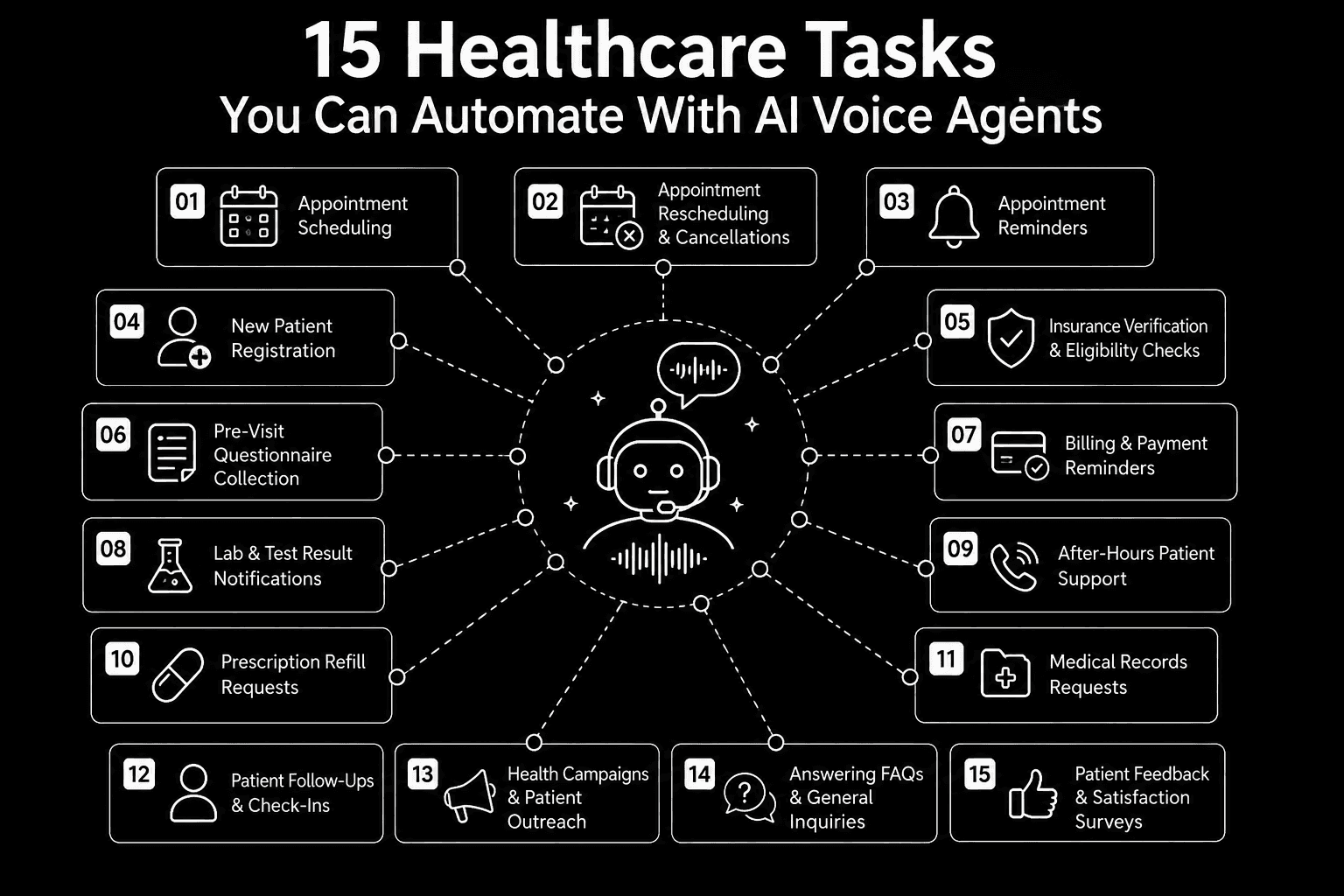
Your front desk answers the same handful of questions all day. Is Dr. Patel taking new patients? Can I move my 2 p.m.? Is my refill ready? Meanwhile the phone keeps ringing, patients are put on hold, and a caller with a real concern gets stuck behind a routine one.
An AI voice agent for medical clinic teams solves that bottleneck without adding headcount. It answers every call, handles the repetitive front-desk work, and only loops in staff for the calls that genuinely need a person. This guide walks through 15 specific healthcare tasks these systems handle today, what to watch out for, and how to evaluate a platform before you sign a contract.
What Is an AI Voice Agent for a Medical Clinic?
An AI voice agent for a medical clinic is a phone-based system that answers patient calls, understands what the caller needs using natural language processing, and completes the task, booking a visit, verifying coverage, logging a refill request, without a human on the line. Unlike an old-style IVR menu, patients speak normally instead of pressing numbers, and the system can hand off to a live staff member the moment a call needs clinical judgment.
Platforms built for healthcare, such as Brilo AI's AI voice agent for the healthcare industry, are designed around HIPAA requirements, EHR connections, and the specific vocabulary of clinical calls, which is what separates them from generic customer-service bots.
Why Clinics Are Automating Phone Work Now
The math behind this shift is hard to ignore. Industry research on medical office phone traffic found that practices miss an average of 42% of incoming calls during business hours, and most callers who reach voicemail simply hang up rather than leave a message. Separate analysis puts the annual cost of missed appointments to the U.S. healthcare system above $150 billion, with a single no-show typically costing a practice somewhere between $150 and $300 in lost revenue once you factor in the empty chair time and the staff hours spent chasing a reschedule.
Front desks are also short-staffed. Turnover in administrative healthcare roles regularly runs above 30% a year, so practices are asking fewer people to cover more call volume, which is exactly the environment where an AI phone agent for medical practice teams earns its keep: it absorbs the repetitive 70 to 80 percent of calls that follow a predictable pattern, so the humans on staff can focus on the calls, and the patients in the waiting room, that need a person.
15 Healthcare Tasks You Can Automate With AI Voice Agents
Here are the specific jobs a well-configured AI medical receptionist can take off your team's plate, organized in roughly the order patients touch them, from first call to follow-up.
1. Answering Every Inbound Call, Including After Hours
The most basic win is also the most valuable one: nothing goes to voicemail. A virtual medical receptionist picks up on the first ring, day or night, so a patient calling at 9 p.m. about a fever gets a response instead of an answering machine. Brilo's overflow and after-hours support is built specifically to catch the calls your staff can't, whether that's during lunch, a busy Monday morning, or 2 a.m.
2. Booking New and Follow-Up Appointments
Patients can request, confirm, or move a visit just by talking, no hold music, no callback tag. The agent checks real-time provider availability and books directly into the practice calendar. See how AI voice agents for appointment booking sync with clinic scheduling tools to prevent double bookings.
3. Sending Appointment Reminders and Confirmations
Automated, natural-sounding reminder calls confirm the date, time, and any prep instructions, and let the patient confirm, cancel, or reschedule on the spot instead of ignoring a text. Brilo's service reminders and confirmations use case covers exactly this workflow, and our breakdown of how AI voice agents are reducing missed appointments shows the mechanics in more detail.
4. Rescheduling, Cancellations, and Waitlist Backfill
When a patient needs to cancel, the agent doesn't just remove them from the calendar, it can offer the open slot to the next patient on a waitlist automatically. That single step recovers revenue that would otherwise sit empty, and it removes the manual call-through-the-list work that eats up a scheduler's afternoon.
5. Handling New Patient Intake
Collecting demographics, reason for visit, and basic history over the phone used to mean a ten-minute call and a stack of forms at check-in. A voice agent can capture that information conversationally and push it straight into the practice management system. Our guide on how AI voice triage streamlines patient intake walks through the intake flow end to end.
6. Verifying Insurance and Coverage
Confirming a patient's plan, group number, and eligibility before the visit removes a major source of billing delays and awkward front-desk conversations. The agent gathers the details, checks them where systems allow, and flags anything that needs staff follow-up before the appointment happens.
7. Managing Prescription Refill Requests
Refill calls are high-volume and highly repetitive, which makes them a natural fit for automation. The AI collects the medication name, pharmacy, and patient details, then routes the request to the right person for clinical sign-off. It's worth being precise here: the agent should collect and route, never approve or adjust a prescription itself. Our piece on how AI voice agents are streamlining prescription refills and this roundup of voice AI for pharmacy refill requests cover this in depth.
8. Triaging Symptoms and Routing Urgent Calls
A caller describing chest pain shouldn't wait in the same queue as someone asking about parking. Voice agents are trained to recognize urgency cues and escalate immediately to a nurse or on-call provider, while routine questions get resolved without a human touch. Brilo's customer support triage use case is built around exactly this kind of prioritization.
9. Answering Billing and Payment Questions
Balance inquiries, payment plan questions, and itemized charge explanations are among the most repetitive calls a billing department fields. An AI phone agent for medical practice billing lines can resolve the routine ones instantly and hand off anything involving a dispute or a payment negotiation.
10. Making Post-Visit Follow-Up Calls
Checking in after a procedure, confirming a patient is recovering as expected, or reminding them about a follow-up visit strengthens continuity of care without adding to a nurse's call list. These outbound calls are automated the same way inbound ones are, and any concerning response gets flagged for a clinician to review.
11. Sending Care and Medication Reminders
Beyond appointments, voice agents can place scheduled calls reminding patients to take medication, complete lab work, or refill a chronic prescription before it lapses, supporting adherence for conditions that need consistent monitoring.
12. Transferring Complex Calls to the Right Staff Member
Automation only works if it knows its limits. A good system recognizes when a call needs a human, whether that's a clinical question, a complaint, or an emotional conversation, and transfers it cleanly with full context so the patient never has to repeat themselves. Learn more about AI-assisted call transfer.
13. Collecting Patient Satisfaction Feedback
Short, automated post-call or post-visit surveys capture patient sentiment while the experience is still fresh, giving practice managers a steady stream of feedback without adding a manual survey process. See how post-call surveys fit into a broader patient-experience program.
14. Supporting Patients in Multiple Languages
A practice serving a diverse community can lose patients simply because no one on shift speaks their language. AI voice agents can converse naturally in English, Spanish, and other languages on the same phone line, expanding access without hiring additional bilingual staff. Our article on how multilingual AI voice agents improve healthcare support covers the specifics.
15. Summarizing Calls and Logging Them to Your EHR or CRM
Every call is transcribed, summarized, and pushed into the patient's record automatically, so staff start the day with a clear list of what happened overnight instead of a stack of voicemails to decode. Read more on how AI voice agents use call summarization in healthcare support and how to integrate AI voice agents with HIPAA-ready EHR and CRM systems.
Did You Know? Research on medical office call patterns found that when patients reach voicemail, a majority hang up without leaving a message at all. That's not a missed call, it's a patient who may have just called your competitor instead.
Expert Insight: Based on working with clinics rolling out voice automation for the first time, the practices that get the most value don't try to automate everything on day one. They start with the two or three call types eating the most staff time, usually scheduling and refills, prove out the workflow, then expand into triage and billing once the team trusts how the system escalates edge cases.
Common Mistakes Clinics Make When Automating Calls
Skipping the compliance conversation. Deploying any AI phone agent that touches PHI without a signed Business Associate Agreement, encryption, and access controls is a HIPAA violation regardless of intent, and the burden falls on the practice, not the vendor. Confirm this before rollout, not after.
Trying to automate clinical decisions. The agent should collect and route information, refill requests, symptom descriptions, insurance questions, never make a clinical call like approving a prescription or interpreting a result.
No clear escalation path. If the system can't recognize urgency or doesn't know when to transfer to a human, patients get stuck in an automated loop at the exact moment they need a person most.
Treating it as "set and forget." Call flows need periodic review as your services, providers, and hours change, or the agent starts giving outdated answers.
Pro Tip: Ask any vendor to show you exactly how their system handles an ambiguous or urgent call during your evaluation, not just a scripted demo of appointment booking. That's where the real quality differences show up.
How to Choose an AI Medical Receptionist
A few things separate a healthcare-ready platform from a generic call bot:
HIPAA compliance with a signed BAA, encrypted call storage, and role-based access to transcripts.
Direct EHR and practice management integration, not just a Zapier workaround, so patient data updates in real time.
Configurable escalation logic for urgent symptoms, complaints, and anything outside its training.
Multilingual coverage if your patient population needs it.
Transparent reporting on call volume, resolution rate, and where callers get transferred to staff.
Brilo AI's HIPAA-compliant AI answering service and its broader AI voice agent for healthcare platform are built around these requirements from the ground up, with a BAA signed before go-live and no engineering resources required on your end.
Get Started With an AI Voice Agent for Your Medical Clinic
Every unanswered call is a patient who may not call back. An AI voice agent for medical clinic operations turns that risk into a routine, handled workflow, covering scheduling, refills, triage, billing questions, and follow-up, while keeping your team free for the care only a person can give.
Book a free 15-minute call with Brilo AI to see how it fits your practice, or sign up and explore the platform directly.
FAQs
1. What is an AI voice agent for a medical clinic?
It's a phone-based AI system that answers, understands, and acts on patient calls, booking appointments, verifying insurance, routing refill requests, without needing a human on every call, while escalating anything clinical or urgent to staff.
2. Is an AI medical receptionist HIPAA compliant?
It can be, but only if the vendor signs a Business Associate Agreement, encrypts PHI at rest and in transit, restricts access to recordings and transcripts, and logs every instance of data access. Ask for these specifics before signing up.
3. Can an AI phone agent for a medical practice replace my front desk staff?
Not entirely, and it shouldn't try to. It's best used to absorb the repetitive, high-volume calls, scheduling, reminders, FAQs, refill intake, so your existing staff can focus on in-person care and the calls that genuinely need a person.
4. Will patients notice they're talking to an AI, and will they mind?
Most patients notice within the first few seconds, and reactions are generally positive when the conversation is fast, natural, and resolves their issue. Satisfaction tends to be highest when the system offers a smooth, immediate handoff to a human on request.
5. How much of my clinic's call volume can actually be automated?
Depending on your specialty and call mix, practices commonly see somewhere in the range of 60 to 80 percent of routine calls, scheduling, reminders, FAQs, refill intake, resolved without a staff member, with the remainder routed to your team.
6. Does a virtual medical receptionist work outside business hours?
Yes, One of the most common use cases is after-hours and overflow coverage, since a large share of patient calls, and nearly all urgent ones, come in outside a typical 9-to-5 window.
7. How long does it take to set up an AI receptionist for a medical clinic?
This varies by vendor and how many systems you're integrating, but healthcare-focused platforms are generally designed to go live without a lengthy engineering project, often within days rather than months.
All Insights
Articles
15 Healthcare Tasks You Can Automate With AI Voice Agents
See how an AI voice agent for medical clinic teams handles scheduling, refills, triage, and 12 more tasks, freeing your front desk and cutting missed calls.
Your front desk answers the same handful of questions all day. Is Dr. Patel taking new patients? Can I move my 2 p.m.? Is my refill ready? Meanwhile the phone keeps ringing, patients are put on hold, and a caller with a real concern gets stuck behind a routine one.
An AI voice agent for medical clinic teams solves that bottleneck without adding headcount. It answers every call, handles the repetitive front-desk work, and only loops in staff for the calls that genuinely need a person. This guide walks through 15 specific healthcare tasks these systems handle today, what to watch out for, and how to evaluate a platform before you sign a contract.
What Is an AI Voice Agent for a Medical Clinic?
An AI voice agent for a medical clinic is a phone-based system that answers patient calls, understands what the caller needs using natural language processing, and completes the task, booking a visit, verifying coverage, logging a refill request, without a human on the line. Unlike an old-style IVR menu, patients speak normally instead of pressing numbers, and the system can hand off to a live staff member the moment a call needs clinical judgment.
Platforms built for healthcare, such as Brilo AI's AI voice agent for the healthcare industry, are designed around HIPAA requirements, EHR connections, and the specific vocabulary of clinical calls, which is what separates them from generic customer-service bots.
Why Clinics Are Automating Phone Work Now
The math behind this shift is hard to ignore. Industry research on medical office phone traffic found that practices miss an average of 42% of incoming calls during business hours, and most callers who reach voicemail simply hang up rather than leave a message. Separate analysis puts the annual cost of missed appointments to the U.S. healthcare system above $150 billion, with a single no-show typically costing a practice somewhere between $150 and $300 in lost revenue once you factor in the empty chair time and the staff hours spent chasing a reschedule.
Front desks are also short-staffed. Turnover in administrative healthcare roles regularly runs above 30% a year, so practices are asking fewer people to cover more call volume, which is exactly the environment where an AI phone agent for medical practice teams earns its keep: it absorbs the repetitive 70 to 80 percent of calls that follow a predictable pattern, so the humans on staff can focus on the calls, and the patients in the waiting room, that need a person.
15 Healthcare Tasks You Can Automate With AI Voice Agents
Here are the specific jobs a well-configured AI medical receptionist can take off your team's plate, organized in roughly the order patients touch them, from first call to follow-up.
1. Answering Every Inbound Call, Including After Hours
The most basic win is also the most valuable one: nothing goes to voicemail. A virtual medical receptionist picks up on the first ring, day or night, so a patient calling at 9 p.m. about a fever gets a response instead of an answering machine. Brilo's overflow and after-hours support is built specifically to catch the calls your staff can't, whether that's during lunch, a busy Monday morning, or 2 a.m.
2. Booking New and Follow-Up Appointments
Patients can request, confirm, or move a visit just by talking, no hold music, no callback tag. The agent checks real-time provider availability and books directly into the practice calendar. See how AI voice agents for appointment booking sync with clinic scheduling tools to prevent double bookings.
3. Sending Appointment Reminders and Confirmations
Automated, natural-sounding reminder calls confirm the date, time, and any prep instructions, and let the patient confirm, cancel, or reschedule on the spot instead of ignoring a text. Brilo's service reminders and confirmations use case covers exactly this workflow, and our breakdown of how AI voice agents are reducing missed appointments shows the mechanics in more detail.
4. Rescheduling, Cancellations, and Waitlist Backfill
When a patient needs to cancel, the agent doesn't just remove them from the calendar, it can offer the open slot to the next patient on a waitlist automatically. That single step recovers revenue that would otherwise sit empty, and it removes the manual call-through-the-list work that eats up a scheduler's afternoon.
5. Handling New Patient Intake
Collecting demographics, reason for visit, and basic history over the phone used to mean a ten-minute call and a stack of forms at check-in. A voice agent can capture that information conversationally and push it straight into the practice management system. Our guide on how AI voice triage streamlines patient intake walks through the intake flow end to end.
6. Verifying Insurance and Coverage
Confirming a patient's plan, group number, and eligibility before the visit removes a major source of billing delays and awkward front-desk conversations. The agent gathers the details, checks them where systems allow, and flags anything that needs staff follow-up before the appointment happens.
7. Managing Prescription Refill Requests
Refill calls are high-volume and highly repetitive, which makes them a natural fit for automation. The AI collects the medication name, pharmacy, and patient details, then routes the request to the right person for clinical sign-off. It's worth being precise here: the agent should collect and route, never approve or adjust a prescription itself. Our piece on how AI voice agents are streamlining prescription refills and this roundup of voice AI for pharmacy refill requests cover this in depth.
8. Triaging Symptoms and Routing Urgent Calls
A caller describing chest pain shouldn't wait in the same queue as someone asking about parking. Voice agents are trained to recognize urgency cues and escalate immediately to a nurse or on-call provider, while routine questions get resolved without a human touch. Brilo's customer support triage use case is built around exactly this kind of prioritization.
9. Answering Billing and Payment Questions
Balance inquiries, payment plan questions, and itemized charge explanations are among the most repetitive calls a billing department fields. An AI phone agent for medical practice billing lines can resolve the routine ones instantly and hand off anything involving a dispute or a payment negotiation.
10. Making Post-Visit Follow-Up Calls
Checking in after a procedure, confirming a patient is recovering as expected, or reminding them about a follow-up visit strengthens continuity of care without adding to a nurse's call list. These outbound calls are automated the same way inbound ones are, and any concerning response gets flagged for a clinician to review.
11. Sending Care and Medication Reminders
Beyond appointments, voice agents can place scheduled calls reminding patients to take medication, complete lab work, or refill a chronic prescription before it lapses, supporting adherence for conditions that need consistent monitoring.
12. Transferring Complex Calls to the Right Staff Member
Automation only works if it knows its limits. A good system recognizes when a call needs a human, whether that's a clinical question, a complaint, or an emotional conversation, and transfers it cleanly with full context so the patient never has to repeat themselves. Learn more about AI-assisted call transfer.
13. Collecting Patient Satisfaction Feedback
Short, automated post-call or post-visit surveys capture patient sentiment while the experience is still fresh, giving practice managers a steady stream of feedback without adding a manual survey process. See how post-call surveys fit into a broader patient-experience program.
14. Supporting Patients in Multiple Languages
A practice serving a diverse community can lose patients simply because no one on shift speaks their language. AI voice agents can converse naturally in English, Spanish, and other languages on the same phone line, expanding access without hiring additional bilingual staff. Our article on how multilingual AI voice agents improve healthcare support covers the specifics.
15. Summarizing Calls and Logging Them to Your EHR or CRM
Every call is transcribed, summarized, and pushed into the patient's record automatically, so staff start the day with a clear list of what happened overnight instead of a stack of voicemails to decode. Read more on how AI voice agents use call summarization in healthcare support and how to integrate AI voice agents with HIPAA-ready EHR and CRM systems.
Did You Know? Research on medical office call patterns found that when patients reach voicemail, a majority hang up without leaving a message at all. That's not a missed call, it's a patient who may have just called your competitor instead.
Expert Insight: Based on working with clinics rolling out voice automation for the first time, the practices that get the most value don't try to automate everything on day one. They start with the two or three call types eating the most staff time, usually scheduling and refills, prove out the workflow, then expand into triage and billing once the team trusts how the system escalates edge cases.
Common Mistakes Clinics Make When Automating Calls
Skipping the compliance conversation. Deploying any AI phone agent that touches PHI without a signed Business Associate Agreement, encryption, and access controls is a HIPAA violation regardless of intent, and the burden falls on the practice, not the vendor. Confirm this before rollout, not after.
Trying to automate clinical decisions. The agent should collect and route information, refill requests, symptom descriptions, insurance questions, never make a clinical call like approving a prescription or interpreting a result.
No clear escalation path. If the system can't recognize urgency or doesn't know when to transfer to a human, patients get stuck in an automated loop at the exact moment they need a person most.
Treating it as "set and forget." Call flows need periodic review as your services, providers, and hours change, or the agent starts giving outdated answers.
Pro Tip: Ask any vendor to show you exactly how their system handles an ambiguous or urgent call during your evaluation, not just a scripted demo of appointment booking. That's where the real quality differences show up.
How to Choose an AI Medical Receptionist
A few things separate a healthcare-ready platform from a generic call bot:
HIPAA compliance with a signed BAA, encrypted call storage, and role-based access to transcripts.
Direct EHR and practice management integration, not just a Zapier workaround, so patient data updates in real time.
Configurable escalation logic for urgent symptoms, complaints, and anything outside its training.
Multilingual coverage if your patient population needs it.
Transparent reporting on call volume, resolution rate, and where callers get transferred to staff.
Brilo AI's HIPAA-compliant AI answering service and its broader AI voice agent for healthcare platform are built around these requirements from the ground up, with a BAA signed before go-live and no engineering resources required on your end.
Get Started With an AI Voice Agent for Your Medical Clinic
Every unanswered call is a patient who may not call back. An AI voice agent for medical clinic operations turns that risk into a routine, handled workflow, covering scheduling, refills, triage, billing questions, and follow-up, while keeping your team free for the care only a person can give.
Book a free 15-minute call with Brilo AI to see how it fits your practice, or sign up and explore the platform directly.
FAQs
1. What is an AI voice agent for a medical clinic?
It's a phone-based AI system that answers, understands, and acts on patient calls, booking appointments, verifying insurance, routing refill requests, without needing a human on every call, while escalating anything clinical or urgent to staff.
2. Is an AI medical receptionist HIPAA compliant?
It can be, but only if the vendor signs a Business Associate Agreement, encrypts PHI at rest and in transit, restricts access to recordings and transcripts, and logs every instance of data access. Ask for these specifics before signing up.
3. Can an AI phone agent for a medical practice replace my front desk staff?
Not entirely, and it shouldn't try to. It's best used to absorb the repetitive, high-volume calls, scheduling, reminders, FAQs, refill intake, so your existing staff can focus on in-person care and the calls that genuinely need a person.
4. Will patients notice they're talking to an AI, and will they mind?
Most patients notice within the first few seconds, and reactions are generally positive when the conversation is fast, natural, and resolves their issue. Satisfaction tends to be highest when the system offers a smooth, immediate handoff to a human on request.
5. How much of my clinic's call volume can actually be automated?
Depending on your specialty and call mix, practices commonly see somewhere in the range of 60 to 80 percent of routine calls, scheduling, reminders, FAQs, refill intake, resolved without a staff member, with the remainder routed to your team.
6. Does a virtual medical receptionist work outside business hours?
Yes, One of the most common use cases is after-hours and overflow coverage, since a large share of patient calls, and nearly all urgent ones, come in outside a typical 9-to-5 window.
7. How long does it take to set up an AI receptionist for a medical clinic?
This varies by vendor and how many systems you're integrating, but healthcare-focused platforms are generally designed to go live without a lengthy engineering project, often within days rather than months.
Latest Insights
All Resources
Articles
Case Studies
Tutorials

Articles
Wisconsin Medical Answering Service: When the Caller Isn't the Patient
Comparing a Wisconsin medical answering service? Test it on calls from family and caregivers: HIPAA, Wis. Stat. 146.82, health care agents and what to say.

Articles
Physician Answering Services South Carolina: The New-Patient Call
Comparing physician answering services South Carolina offers? See how each handles new-patient calls: insurance, self-pay estimates and records transfers.
Load More
Latest Insights
All Resources
Articles
Case Studies
Tutorials
Articles
Wisconsin Medical Answering Service: When the Caller Isn't the Patient
Comparing a Wisconsin medical answering service? Test it on calls from family and caregivers: HIPAA, Wis. Stat. 146.82, health care agents and what to say.
Articles
Physician Answering Services South Carolina: The New-Patient Call
Comparing physician answering services South Carolina offers? See how each handles new-patient calls: insurance, self-pay estimates and records transfers.
Load More

Automate your business with AI phone Agents
Automate your business with AI phone Agents
Automate your business with AI phone Agents
Automate your business with AI phone Agents
Call automation for healthcare, real estate, logistics, financial services & small businesses.
Call automation for healthcare, real estate, logistics, financial services & small businesses.

Join Discord
Connect with our community, ask questions, and stay updated on product news.

Book a Call
Schedule a quick call with our team to explore solutions for your needs.
Get started
Industries
Usecases
Integrations
Legal & Community

Join Discord
Connect with our community, ask questions, and stay updated on product news.
Book a Call
Schedule a quick call with our team to explore solutions for your needs.
Get started
Industries
Usecases
Integrations
Legal & Community
Join Discord
Connect with our community, ask questions, and stay updated on product news.
Book a Call
Schedule a quick call with our team to explore solutions for your needs.
Get started
Industries
Usecases
Integrations
Legal & Community
Join Discord
Connect with our community, ask questions, and stay updated on product news.
Book a Call
Schedule a quick call with our team to explore solutions for your needs.
Get started
Industries
Usecases
Integrations
Legal & Community