
All Insights
Articles
10 Ways AI Is Transforming Modern General Practice Clinics
10 specific ways AI voice agents are reshaping GP clinics in 2026 — from 24/7 call answering to smarter triage, prescriptions, and post-care follow-ups.





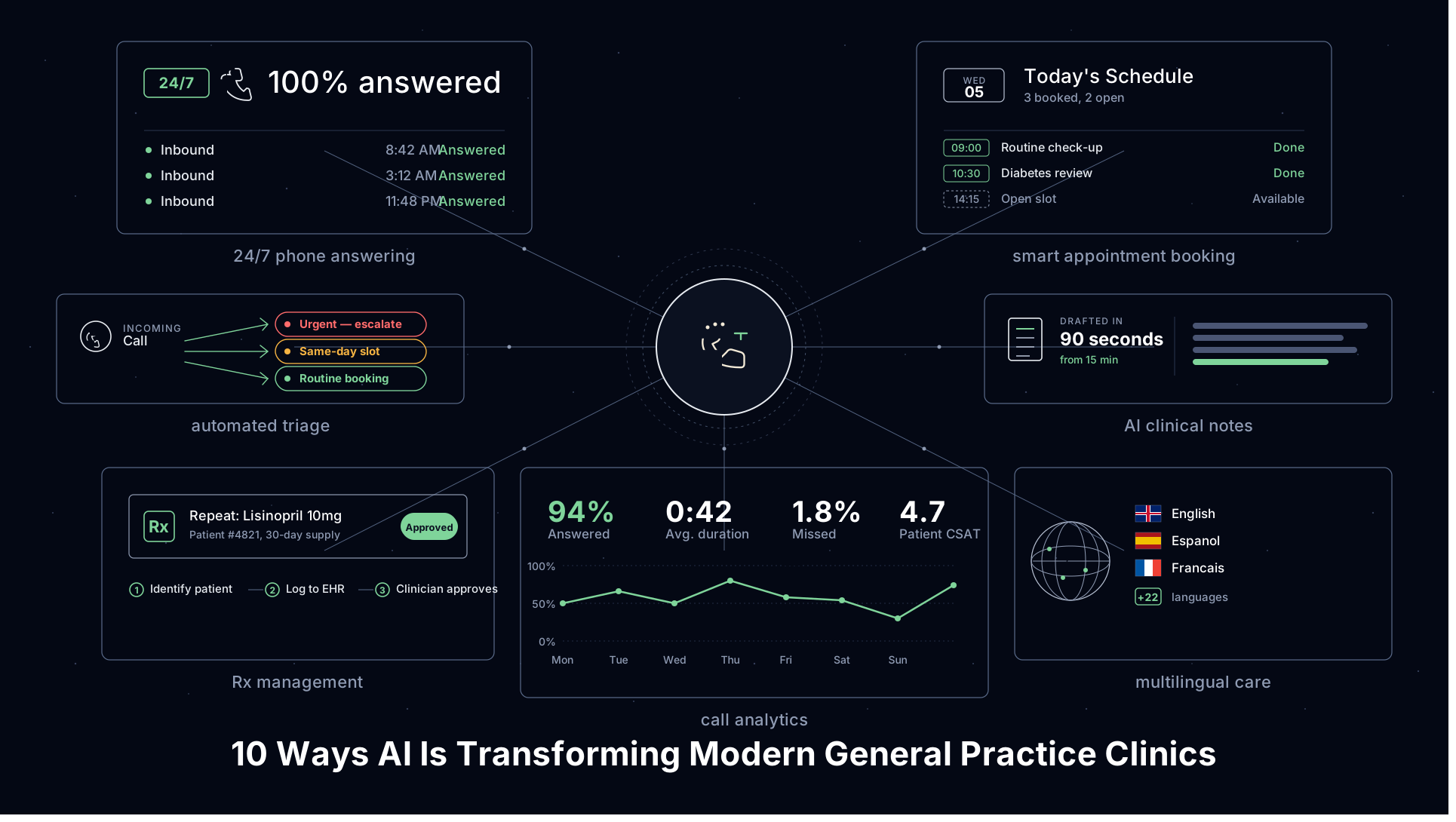
The average GP in 2026 spends two to three hours on paperwork for every hour they spend with a patient. More than half of all physicians report clinical burnout — not just tiredness, but a genuine question of whether they can continue. And the phone? It never stops ringing.
AI is changing that. Not with vague promises of a future utopia, but with deployable tools already running in clinics today — answering calls, booking appointments, following up on prescriptions, and giving clinical staff time back to do what they trained for.
This article breaks down exactly how an AI voice agent for medical clinics is reshaping front-desk and back-office operations across general practice, and what it means for patient outcomes, staff wellbeing, and clinic growth.
1. The GP Crisis That AI Is Beginning to Solve
Before exploring the specific transformations, it's worth naming the problem clearly.
General practice clinics are under enormous pressure. Patient demand is rising. Staff headcount is not keeping pace. And the administrative load — appointment calls, repeat prescription requests, missed appointment follow-ups, insurance queries — consumes a disproportionate share of everyone's working day.
According to a January 2025 survey of over 1,000 GPs conducted via the UK's largest clinical marketing platform, one in five general practitioners already reported using generative AI tools in their clinical practice. That number is accelerating. And the most immediate impact isn't in the consulting room — it's at the front desk, on the phone, and in the documentation queue.
AI phone answering for medical clinics isn't a luxury technology anymore. For practices fielding hundreds of calls a day, it's become an operational lifeline.
Based on working with GP and primary care teams across multiple markets, the biggest operational bottleneck is almost always the same — the phone. Staff spend hours each day on calls that a well-configured AI voice agent could handle in seconds. The moment clinics redeploy that time, everything else improves.
Let's look at exactly where AI is making the difference.
2. 24/7 AI Phone Answering That Never Puts Patients on Hold
An AI phone answering service for medical clinics is exactly what it sounds like: a voice-powered agent that answers every inbound call immediately, regardless of how busy the front desk is or what time it is.
Unlike traditional IVR (Interactive Voice Response) systems — the clunky press-1-for-appointments menus patients hate — modern AI call answering understands natural speech. A patient can call and say "I need to move my Thursday appointment, I think it's at 2pm," and the system processes it, checks real-time availability, offers alternatives, and confirms the change. No hold music. No waiting for a receptionist to finish another call.
The clinical impact is significant:
Patients who previously called, got busy signals, and gave up on seeking care now get through first time
Staff are freed from repetitive inbound call handling during peak morning rush hours
Zero calls go unanswered, even when every team member is in a patient consultation
Platforms like Brilo AI are built specifically for this kind of high-volume, always-on call management. Brilo's AI voice agents handle simultaneous inbound calls across any clinic size with human-like responses and instant handoff to clinical staff when needed.
Did You Know? An AI answering service can cut operational call-handling costs by up to 70% compared with human operators, while answering every call in under two seconds.
3. Intelligent Appointment Scheduling and Rescheduling
Scheduling is one of the most time-intensive tasks in any general practice. Patients call to book, cancel, confirm, or reschedule. Receptionists manually check availability, navigate calendar systems, and re-enter data. The whole process is ripe for automation — and AI does it exceptionally well.
An AI medical receptionist connects directly to your appointment calendar. When a patient calls to book, the AI checks real availability in real time, offers suitable slots based on the patient's stated need (routine check-up versus urgent concern versus specialist follow-up), and confirms the booking instantly. It sends SMS or email confirmations automatically. When cancellations come in, those slots are immediately re-opened and offered to patients on a waiting list.
This has a measurable impact on no-show rates. When appointment reminders go out automatically and patients can easily reschedule via a quick call with an AI agent rather than waiting on hold, attendance improves. Fewer empty slots means more revenue and more patients seen.
Pro Tip: Configure your AI receptionist to send a 48-hour reminder call for all appointments with a simple "press 1 to confirm, press 2 to reschedule" option. Clinics that deploy this consistently report no-show rates dropping by 20–30%.
4. Automated Triage: Routing Calls to the Right Care Level
Not every patient call is the same. Some need urgent attention. Some need a routine appointment. Some just have a question about their medication. Sorting those calls quickly and accurately — without putting patients through a frustrating interrogation — is a core challenge for any general practice.
AI voice agents handle this through conversational triage. The system asks structured, natural-sounding questions: "What's the main reason for your call today?" and "Is this something that's been bothering you for more than a few days?" Based on the responses, it categorises urgency and routes accordingly — to an emergency escalation pathway, to next-day urgent booking, or to a routine appointment slot.
This is sometimes called Total Triage Call Handling and it's gaining traction in GP practices because it improves clinical safety. Priority cases are identified faster. The duty doctor's attention goes to patients who genuinely need it in the next hour, not patients who could wait until next Tuesday.
Expert Insight: Where most competitor content on this topic focuses only on efficiency gains, the real clinical value of AI triage is in appropriate escalation. A well-designed AI call answering service for clinics doesn't just reduce hold times — it catches the patient who describes chest tightness as "just a bit uncomfortable" and flags it for immediate clinical review.
5. Reducing Administrative Burnout With AI-Powered Documentation
Clinical burnout has a specific root cause that often gets overlooked in the burnout conversation: documentation. Notes. Summaries. Referral letters. Billing codes. Every patient interaction generates a paperwork trail, and it follows clinicians home.
AI is now tackling this at two levels. The first is AI ambient scribes — voice tools that listen to patient-clinician conversations and generate structured clinical notes in real time. A GP finishes a consultation, reviews the AI-drafted note, makes minor edits, and it's done. What used to take 15 minutes takes 90 seconds.
The second level is AI-powered admin summarisation — pulling together patient history, relevant correspondence, and referral context before an appointment, so the GP walks in already oriented rather than reading on the fly.
Mass General Brigham's pilot of AI scribes reported a 40% relative drop in self-reported physician burnout. When documentation pressure reduces, clinicians stay longer in their roles, make fewer errors from fatigue, and spend more time with patients.
The downstream benefit for patients is enormous. A GP who isn't mentally exhausted from an afternoon of note-writing gives better consultations the next morning.
6. After-Hours Support Without the After-Hours Costs
For general practices, the evening and weekend gap is one of the most expensive and clinically risky parts of running a clinic. Patients with non-emergency concerns call after hours, get voicemail or an out-of-hours answering service, and often end up in accident and emergency because they didn't know where else to go.
An AI call answering service for clinics solves this elegantly. After hours, the AI agent continues to answer every call. It handles appointment booking for the next available slot, prescription queries, results enquiries, general health information, and escalation to an out-of-hours clinician line for genuinely urgent cases.
Patients feel heard and supported. Accident and emergency departments receive fewer avoidable attendances. And the clinic doesn't pay a bank of staff to sit by the phone from 6pm to 8am.
This is a specific area where Brilo AI adds direct value — its agents are available around the clock, integrated with clinic calendars, and configured to know exactly which calls to escalate and which to manage independently.
7. Repeat Prescription Management Via AI Call Handling
Repeat prescription requests are the single most common type of administrative call in any general practice. Patients need their blood pressure medication renewed. Their diabetes check didn't generate an automatic refill. Their pharmacy is asking for a fresh script.
Every one of these calls takes a receptionist off another task. Collected across a practice of several thousand patients, it adds up to hours per day of skilled staff time spent on highly routine requests.
An AI voice assistant for healthcare handles repeat prescription calls from end to end. It identifies the patient, confirms their identity, takes the prescription details, logs the request in the clinical system, notifies the duty clinician for sign-off, and sends confirmation back to the patient. The clinician reviews and approves digitally. No phone tag. No re-keying of data.
This workflow alone can recover 60–90 minutes of receptionist time daily in a mid-sized practice. That time goes back to patient-facing work, where it belongs.
8. Post-Appointment Follow-Ups and Wellness Checks
One of the underused capabilities of an AI voice agent for medical clinics is proactive outbound calling. Most clinics think of AI phone systems as answering services. They can also be calling services.
After a minor procedure, the AI agent calls the patient 24–48 hours later with a brief structured wellness check. "How are you feeling since your appointment yesterday? Have you noticed any of the following symptoms we discussed?" Concerning answers are flagged automatically for clinical follow-up. Patients who are recovering normally are reassured and documented without any staff time required.
This kind of post-care engagement has a well-documented effect on patient outcomes. Patients feel monitored and supported, which improves adherence to treatment plans and reduces the risk of complications going undetected until they become serious.
For practices managing patients with chronic conditions — diabetes, hypertension, COPD — this kind of regular AI-powered check-in represents a scalable way to provide monitoring that would previously have required a dedicated nurse calling list.
9. Multilingual Patient Communication at Scale
General practices in diverse urban and suburban communities often serve patients across many languages. A clinic in a multicultural neighbourhood may have patients whose primary language is Spanish, Mandarin, Polish, Punjabi, or dozens of others. Providing good care in those languages requires either hiring multilingual staff (expensive and difficult) or working through interpreters (which adds time and complexity to every interaction).
Modern AI voice assistants for healthcare support multiple languages fluently. An AI phone answering service can greet callers in their preferred language, handle appointment booking in that language, and confirm instructions clearly. Some platforms, including Brilo AI, have specifically developed Spanish-language AI phone agents for healthcare settings — a direct response to the real-world demographics of their client base.
This matters for health equity as much as efficiency. When a patient can communicate comfortably in their own language, they are more likely to accurately describe symptoms, more likely to ask questions, and more likely to follow through on care.
10. Real-Time Call Analytics That Drive Smarter Clinic Decisions
This is the transformation that most articles on AI in healthcare overlook entirely — and it may be the most strategically valuable.
Every patient call handled by an AI voice agent is transcribed, summarised, and categorised. That data at scale — across thousands of calls per month — gives clinic managers a window into their practice that was previously invisible.
Which call types are most common? What times of day is call volume highest? What reasons for cancellation recur most frequently? Are certain appointment types generating a disproportionate number of follow-up calls? Which patient cohorts are calling most often about the same issue?
This kind of audio intelligence, built into platforms like Brilo AI, includes sentiment analysis, intent recognition, topic detection, and conversation summarisation. Clinic managers can spot patterns, make staffing decisions based on real data rather than gut feel, and identify service gaps before they become complaints.
Expert Insight: Most GP practice managers are flying blind on call data. They know the phone is busy. They don't know why it's busy, or how the reasons are changing week to week. AI call analytics makes that invisible workflow visible — and that changes how you run the practice.
Common Mistakes Clinics Make When Adopting AI
This section is conspicuously absent from most competitor content — and it's worth addressing directly, because these mistakes are common and costly.
1. Treating AI as a replacement for all human interaction. AI handles routine calls superbly. It should escalate complex, emotionally charged, or clinically ambiguous calls to human staff immediately. Clinics that try to automate everything end up with frustrated patients.
2. Deploying without proper configuration. An AI voice agent for a medical clinic needs to know your specific appointment types, your protocols, your opening hours, your escalation pathways, and your patient communication style. Out-of-the-box deployment without customisation produces generic, unhelpful responses.
3. Ignoring the analytics. Deploying an AI phone answering system and then never reviewing the call data is like buying a GPS and ignoring the map. The data is where the ongoing value lives.
4. Skipping staff buy-in. Reception and admin staff sometimes feel threatened by AI tools. The most successful implementations position AI as something that handles the tedious calls so staff can focus on the interactions that actually need a human.
5. Underestimating the compliance requirements. Healthcare is a regulated environment. Any AI call answering service for clinics must handle patient data with HIPAA-compliant (or equivalent) security standards, including encryption, audit logs, and business associate agreements.
Frequently Asked Question
What is an AI voice agent for a medical clinic?
An AI voice agent for a medical clinic is an intelligent phone-answering system that uses natural language processing to handle patient calls. It can book and reschedule appointments, manage repeat prescription requests, provide basic health information, triage call urgency, and hand off to clinical staff when needed — all without hold times or voicemail.
How does AI phone answering for medical clinics differ from a traditional answering service?
Traditional answering services either use recorded IVR menus (press 1, press 2) or a human call centre. An AI phone answering service for medical clinics understands natural speech, takes real action (like booking appointments directly into your calendar), operates 24/7 without staffing costs, and improves over time with each interaction.
Is an AI medical receptionist HIPAA compliant?
Leading AI medical receptionist platforms include HIPAA-compliant infrastructure, covering encrypted call handling, secure data storage, audit trails, and business associate agreements. Always verify compliance credentials when evaluating a platform for healthcare use.
Can an AI voice agent handle multiple calls at the same time?
Yes. Unlike a human receptionist who handles one call at a time, an AI voice agent for a medical clinic can manage hundreds of simultaneous inbound calls. This means no patient ever gets a busy signal, regardless of call volume — including during peak morning booking periods.
Will patients know they're speaking to an AI?
This depends on configuration and disclosure policy. Modern AI voice agents use natural, human-sounding voices and conversational phrasing. Some clinics choose to disclose AI upfront; others configure their agent to introduce itself by name (for example, as "Casey from the clinic reception"). Best practice in healthcare contexts typically involves transparent disclosure.
How quickly can an AI phone answering service be set up for a medical clinic?
Platforms like Brilo AI can have a configured AI voice agent operational in under ten minutes for basic deployments. More complex integrations — with clinical management systems, bespoke triage protocols, or multilingual requirements — typically take a few hours to a few days depending on the scope.
What happens when a call is too complex for the AI to handle?
Well-designed AI call answering services for clinics include a smooth handoff mechanism. When the AI detects complexity, urgency, or patient distress beyond its configured scope, it transfers the call immediately to an available human team member — with a brief summary of the call so far, so the patient doesn't have to repeat themselves.
How does an AI receptionist help reduce no-shows in general practice?
AI receptionists can send automated appointment reminders by call, SMS, or email at configurable intervals before each appointment. Patients can confirm or reschedule directly in the reminder interaction. Clinics that implement proactive reminder workflows typically see no-show rates fall by 20–30%.
Transform Your Medical Clinic with AI Voice Agents
AI isn't coming for general practice — it's already there. The clinics deploying AI voice agents for medical practices today are answering every call, cutting administrative costs, reducing staff burnout, and delivering a better patient experience around the clock.
The question isn't whether your clinic will eventually use AI for phone answering and patient communication. It's whether you'll start early enough to build the operational advantage — or spend the next few years watching your more forward-thinking competitors do it first.
Brilo AI offers a free-to-start AI voice agent built for exactly this purpose. Human-like voices. Compliance-ready infrastructure. Integration with your existing tools. Deployed in minutes.
All Insights
Articles
10 Ways AI Is Transforming Modern General Practice Clinics
10 specific ways AI voice agents are reshaping GP clinics in 2026 — from 24/7 call answering to smarter triage, prescriptions, and post-care follow-ups.
The average GP in 2026 spends two to three hours on paperwork for every hour they spend with a patient. More than half of all physicians report clinical burnout — not just tiredness, but a genuine question of whether they can continue. And the phone? It never stops ringing.
AI is changing that. Not with vague promises of a future utopia, but with deployable tools already running in clinics today — answering calls, booking appointments, following up on prescriptions, and giving clinical staff time back to do what they trained for.
This article breaks down exactly how an AI voice agent for medical clinics is reshaping front-desk and back-office operations across general practice, and what it means for patient outcomes, staff wellbeing, and clinic growth.
1. The GP Crisis That AI Is Beginning to Solve
Before exploring the specific transformations, it's worth naming the problem clearly.
General practice clinics are under enormous pressure. Patient demand is rising. Staff headcount is not keeping pace. And the administrative load — appointment calls, repeat prescription requests, missed appointment follow-ups, insurance queries — consumes a disproportionate share of everyone's working day.
According to a January 2025 survey of over 1,000 GPs conducted via the UK's largest clinical marketing platform, one in five general practitioners already reported using generative AI tools in their clinical practice. That number is accelerating. And the most immediate impact isn't in the consulting room — it's at the front desk, on the phone, and in the documentation queue.
AI phone answering for medical clinics isn't a luxury technology anymore. For practices fielding hundreds of calls a day, it's become an operational lifeline.
Based on working with GP and primary care teams across multiple markets, the biggest operational bottleneck is almost always the same — the phone. Staff spend hours each day on calls that a well-configured AI voice agent could handle in seconds. The moment clinics redeploy that time, everything else improves.
Let's look at exactly where AI is making the difference.
2. 24/7 AI Phone Answering That Never Puts Patients on Hold
An AI phone answering service for medical clinics is exactly what it sounds like: a voice-powered agent that answers every inbound call immediately, regardless of how busy the front desk is or what time it is.
Unlike traditional IVR (Interactive Voice Response) systems — the clunky press-1-for-appointments menus patients hate — modern AI call answering understands natural speech. A patient can call and say "I need to move my Thursday appointment, I think it's at 2pm," and the system processes it, checks real-time availability, offers alternatives, and confirms the change. No hold music. No waiting for a receptionist to finish another call.
The clinical impact is significant:
Patients who previously called, got busy signals, and gave up on seeking care now get through first time
Staff are freed from repetitive inbound call handling during peak morning rush hours
Zero calls go unanswered, even when every team member is in a patient consultation
Platforms like Brilo AI are built specifically for this kind of high-volume, always-on call management. Brilo's AI voice agents handle simultaneous inbound calls across any clinic size with human-like responses and instant handoff to clinical staff when needed.
Did You Know? An AI answering service can cut operational call-handling costs by up to 70% compared with human operators, while answering every call in under two seconds.
3. Intelligent Appointment Scheduling and Rescheduling
Scheduling is one of the most time-intensive tasks in any general practice. Patients call to book, cancel, confirm, or reschedule. Receptionists manually check availability, navigate calendar systems, and re-enter data. The whole process is ripe for automation — and AI does it exceptionally well.
An AI medical receptionist connects directly to your appointment calendar. When a patient calls to book, the AI checks real availability in real time, offers suitable slots based on the patient's stated need (routine check-up versus urgent concern versus specialist follow-up), and confirms the booking instantly. It sends SMS or email confirmations automatically. When cancellations come in, those slots are immediately re-opened and offered to patients on a waiting list.
This has a measurable impact on no-show rates. When appointment reminders go out automatically and patients can easily reschedule via a quick call with an AI agent rather than waiting on hold, attendance improves. Fewer empty slots means more revenue and more patients seen.
Pro Tip: Configure your AI receptionist to send a 48-hour reminder call for all appointments with a simple "press 1 to confirm, press 2 to reschedule" option. Clinics that deploy this consistently report no-show rates dropping by 20–30%.
4. Automated Triage: Routing Calls to the Right Care Level
Not every patient call is the same. Some need urgent attention. Some need a routine appointment. Some just have a question about their medication. Sorting those calls quickly and accurately — without putting patients through a frustrating interrogation — is a core challenge for any general practice.
AI voice agents handle this through conversational triage. The system asks structured, natural-sounding questions: "What's the main reason for your call today?" and "Is this something that's been bothering you for more than a few days?" Based on the responses, it categorises urgency and routes accordingly — to an emergency escalation pathway, to next-day urgent booking, or to a routine appointment slot.
This is sometimes called Total Triage Call Handling and it's gaining traction in GP practices because it improves clinical safety. Priority cases are identified faster. The duty doctor's attention goes to patients who genuinely need it in the next hour, not patients who could wait until next Tuesday.
Expert Insight: Where most competitor content on this topic focuses only on efficiency gains, the real clinical value of AI triage is in appropriate escalation. A well-designed AI call answering service for clinics doesn't just reduce hold times — it catches the patient who describes chest tightness as "just a bit uncomfortable" and flags it for immediate clinical review.
5. Reducing Administrative Burnout With AI-Powered Documentation
Clinical burnout has a specific root cause that often gets overlooked in the burnout conversation: documentation. Notes. Summaries. Referral letters. Billing codes. Every patient interaction generates a paperwork trail, and it follows clinicians home.
AI is now tackling this at two levels. The first is AI ambient scribes — voice tools that listen to patient-clinician conversations and generate structured clinical notes in real time. A GP finishes a consultation, reviews the AI-drafted note, makes minor edits, and it's done. What used to take 15 minutes takes 90 seconds.
The second level is AI-powered admin summarisation — pulling together patient history, relevant correspondence, and referral context before an appointment, so the GP walks in already oriented rather than reading on the fly.
Mass General Brigham's pilot of AI scribes reported a 40% relative drop in self-reported physician burnout. When documentation pressure reduces, clinicians stay longer in their roles, make fewer errors from fatigue, and spend more time with patients.
The downstream benefit for patients is enormous. A GP who isn't mentally exhausted from an afternoon of note-writing gives better consultations the next morning.
6. After-Hours Support Without the After-Hours Costs
For general practices, the evening and weekend gap is one of the most expensive and clinically risky parts of running a clinic. Patients with non-emergency concerns call after hours, get voicemail or an out-of-hours answering service, and often end up in accident and emergency because they didn't know where else to go.
An AI call answering service for clinics solves this elegantly. After hours, the AI agent continues to answer every call. It handles appointment booking for the next available slot, prescription queries, results enquiries, general health information, and escalation to an out-of-hours clinician line for genuinely urgent cases.
Patients feel heard and supported. Accident and emergency departments receive fewer avoidable attendances. And the clinic doesn't pay a bank of staff to sit by the phone from 6pm to 8am.
This is a specific area where Brilo AI adds direct value — its agents are available around the clock, integrated with clinic calendars, and configured to know exactly which calls to escalate and which to manage independently.
7. Repeat Prescription Management Via AI Call Handling
Repeat prescription requests are the single most common type of administrative call in any general practice. Patients need their blood pressure medication renewed. Their diabetes check didn't generate an automatic refill. Their pharmacy is asking for a fresh script.
Every one of these calls takes a receptionist off another task. Collected across a practice of several thousand patients, it adds up to hours per day of skilled staff time spent on highly routine requests.
An AI voice assistant for healthcare handles repeat prescription calls from end to end. It identifies the patient, confirms their identity, takes the prescription details, logs the request in the clinical system, notifies the duty clinician for sign-off, and sends confirmation back to the patient. The clinician reviews and approves digitally. No phone tag. No re-keying of data.
This workflow alone can recover 60–90 minutes of receptionist time daily in a mid-sized practice. That time goes back to patient-facing work, where it belongs.
8. Post-Appointment Follow-Ups and Wellness Checks
One of the underused capabilities of an AI voice agent for medical clinics is proactive outbound calling. Most clinics think of AI phone systems as answering services. They can also be calling services.
After a minor procedure, the AI agent calls the patient 24–48 hours later with a brief structured wellness check. "How are you feeling since your appointment yesterday? Have you noticed any of the following symptoms we discussed?" Concerning answers are flagged automatically for clinical follow-up. Patients who are recovering normally are reassured and documented without any staff time required.
This kind of post-care engagement has a well-documented effect on patient outcomes. Patients feel monitored and supported, which improves adherence to treatment plans and reduces the risk of complications going undetected until they become serious.
For practices managing patients with chronic conditions — diabetes, hypertension, COPD — this kind of regular AI-powered check-in represents a scalable way to provide monitoring that would previously have required a dedicated nurse calling list.
9. Multilingual Patient Communication at Scale
General practices in diverse urban and suburban communities often serve patients across many languages. A clinic in a multicultural neighbourhood may have patients whose primary language is Spanish, Mandarin, Polish, Punjabi, or dozens of others. Providing good care in those languages requires either hiring multilingual staff (expensive and difficult) or working through interpreters (which adds time and complexity to every interaction).
Modern AI voice assistants for healthcare support multiple languages fluently. An AI phone answering service can greet callers in their preferred language, handle appointment booking in that language, and confirm instructions clearly. Some platforms, including Brilo AI, have specifically developed Spanish-language AI phone agents for healthcare settings — a direct response to the real-world demographics of their client base.
This matters for health equity as much as efficiency. When a patient can communicate comfortably in their own language, they are more likely to accurately describe symptoms, more likely to ask questions, and more likely to follow through on care.
10. Real-Time Call Analytics That Drive Smarter Clinic Decisions
This is the transformation that most articles on AI in healthcare overlook entirely — and it may be the most strategically valuable.
Every patient call handled by an AI voice agent is transcribed, summarised, and categorised. That data at scale — across thousands of calls per month — gives clinic managers a window into their practice that was previously invisible.
Which call types are most common? What times of day is call volume highest? What reasons for cancellation recur most frequently? Are certain appointment types generating a disproportionate number of follow-up calls? Which patient cohorts are calling most often about the same issue?
This kind of audio intelligence, built into platforms like Brilo AI, includes sentiment analysis, intent recognition, topic detection, and conversation summarisation. Clinic managers can spot patterns, make staffing decisions based on real data rather than gut feel, and identify service gaps before they become complaints.
Expert Insight: Most GP practice managers are flying blind on call data. They know the phone is busy. They don't know why it's busy, or how the reasons are changing week to week. AI call analytics makes that invisible workflow visible — and that changes how you run the practice.
Common Mistakes Clinics Make When Adopting AI
This section is conspicuously absent from most competitor content — and it's worth addressing directly, because these mistakes are common and costly.
1. Treating AI as a replacement for all human interaction. AI handles routine calls superbly. It should escalate complex, emotionally charged, or clinically ambiguous calls to human staff immediately. Clinics that try to automate everything end up with frustrated patients.
2. Deploying without proper configuration. An AI voice agent for a medical clinic needs to know your specific appointment types, your protocols, your opening hours, your escalation pathways, and your patient communication style. Out-of-the-box deployment without customisation produces generic, unhelpful responses.
3. Ignoring the analytics. Deploying an AI phone answering system and then never reviewing the call data is like buying a GPS and ignoring the map. The data is where the ongoing value lives.
4. Skipping staff buy-in. Reception and admin staff sometimes feel threatened by AI tools. The most successful implementations position AI as something that handles the tedious calls so staff can focus on the interactions that actually need a human.
5. Underestimating the compliance requirements. Healthcare is a regulated environment. Any AI call answering service for clinics must handle patient data with HIPAA-compliant (or equivalent) security standards, including encryption, audit logs, and business associate agreements.
Frequently Asked Question
What is an AI voice agent for a medical clinic?
An AI voice agent for a medical clinic is an intelligent phone-answering system that uses natural language processing to handle patient calls. It can book and reschedule appointments, manage repeat prescription requests, provide basic health information, triage call urgency, and hand off to clinical staff when needed — all without hold times or voicemail.
How does AI phone answering for medical clinics differ from a traditional answering service?
Traditional answering services either use recorded IVR menus (press 1, press 2) or a human call centre. An AI phone answering service for medical clinics understands natural speech, takes real action (like booking appointments directly into your calendar), operates 24/7 without staffing costs, and improves over time with each interaction.
Is an AI medical receptionist HIPAA compliant?
Leading AI medical receptionist platforms include HIPAA-compliant infrastructure, covering encrypted call handling, secure data storage, audit trails, and business associate agreements. Always verify compliance credentials when evaluating a platform for healthcare use.
Can an AI voice agent handle multiple calls at the same time?
Yes. Unlike a human receptionist who handles one call at a time, an AI voice agent for a medical clinic can manage hundreds of simultaneous inbound calls. This means no patient ever gets a busy signal, regardless of call volume — including during peak morning booking periods.
Will patients know they're speaking to an AI?
This depends on configuration and disclosure policy. Modern AI voice agents use natural, human-sounding voices and conversational phrasing. Some clinics choose to disclose AI upfront; others configure their agent to introduce itself by name (for example, as "Casey from the clinic reception"). Best practice in healthcare contexts typically involves transparent disclosure.
How quickly can an AI phone answering service be set up for a medical clinic?
Platforms like Brilo AI can have a configured AI voice agent operational in under ten minutes for basic deployments. More complex integrations — with clinical management systems, bespoke triage protocols, or multilingual requirements — typically take a few hours to a few days depending on the scope.
What happens when a call is too complex for the AI to handle?
Well-designed AI call answering services for clinics include a smooth handoff mechanism. When the AI detects complexity, urgency, or patient distress beyond its configured scope, it transfers the call immediately to an available human team member — with a brief summary of the call so far, so the patient doesn't have to repeat themselves.
How does an AI receptionist help reduce no-shows in general practice?
AI receptionists can send automated appointment reminders by call, SMS, or email at configurable intervals before each appointment. Patients can confirm or reschedule directly in the reminder interaction. Clinics that implement proactive reminder workflows typically see no-show rates fall by 20–30%.
Transform Your Medical Clinic with AI Voice Agents
AI isn't coming for general practice — it's already there. The clinics deploying AI voice agents for medical practices today are answering every call, cutting administrative costs, reducing staff burnout, and delivering a better patient experience around the clock.
The question isn't whether your clinic will eventually use AI for phone answering and patient communication. It's whether you'll start early enough to build the operational advantage — or spend the next few years watching your more forward-thinking competitors do it first.
Brilo AI offers a free-to-start AI voice agent built for exactly this purpose. Human-like voices. Compliance-ready infrastructure. Integration with your existing tools. Deployed in minutes.
Latest Insights
All Resources
Articles
Case Studies
Tutorials
Case Studies
Brilo vs Retell AI — Voice AI for Medical Device Support Hotlines
Compare Brilo and Retell AI for medical device support hotlines. No-code setup vs developer configuration. Compare pricing & compliance.
Case Studies
Brilo vs Rasa — On-Premise Engineering vs No-Code Deployment
Rasa vs Brilo for medical device patient support: on-premise engineering vs 7-minute no-code setup. Compare compliance & cost.
Load More
Latest Insights
All Resources
Articles
Case Studies
Tutorials
Case Studies
Brilo vs Retell AI — Voice AI for Medical Device Support Hotlines
Compare Brilo and Retell AI for medical device support hotlines. No-code setup vs developer configuration. Compare pricing & compliance.
Case Studies
Brilo vs Rasa — On-Premise Engineering vs No-Code Deployment
Rasa vs Brilo for medical device patient support: on-premise engineering vs 7-minute no-code setup. Compare compliance & cost.
Load More

Automate your business with AI phone Agents
Automate your business with AI phone Agents
Automate your business with AI phone Agents
Automate your business with AI phone Agents
Call automation for healthcare, real estate, logistics, financial services & small businesses.
Call automation for healthcare, real estate, logistics, financial services & small businesses.

Join Discord
Connect with our community, ask questions, and stay updated on product news.

Book a Call
Schedule a quick call with our team to explore solutions for your needs.
Get started
Industries
Usecases
Integrations
Legal & Community

Join Discord
Connect with our community, ask questions, and stay updated on product news.
Book a Call
Schedule a quick call with our team to explore solutions for your needs.
Get started
Industries
Usecases
Integrations
Legal & Community
Join Discord
Connect with our community, ask questions, and stay updated on product news.
Book a Call
Schedule a quick call with our team to explore solutions for your needs.
Get started
Industries
Usecases
Integrations
Legal & Community
Join Discord
Connect with our community, ask questions, and stay updated on product news.
Book a Call
Schedule a quick call with our team to explore solutions for your needs.
Get started
Industries
Usecases
Integrations
Legal & Community