
All Insights
Articles
10 Best AI Voice Agents for Insurance Companies in 2026 (Tested & Reviewed)
We tested 10 AI voice agents for insurance — FNOL handling, catastrophe surge capacity, G2 reviews, and compliance compared. Find the right fit for your carrier in 2026.





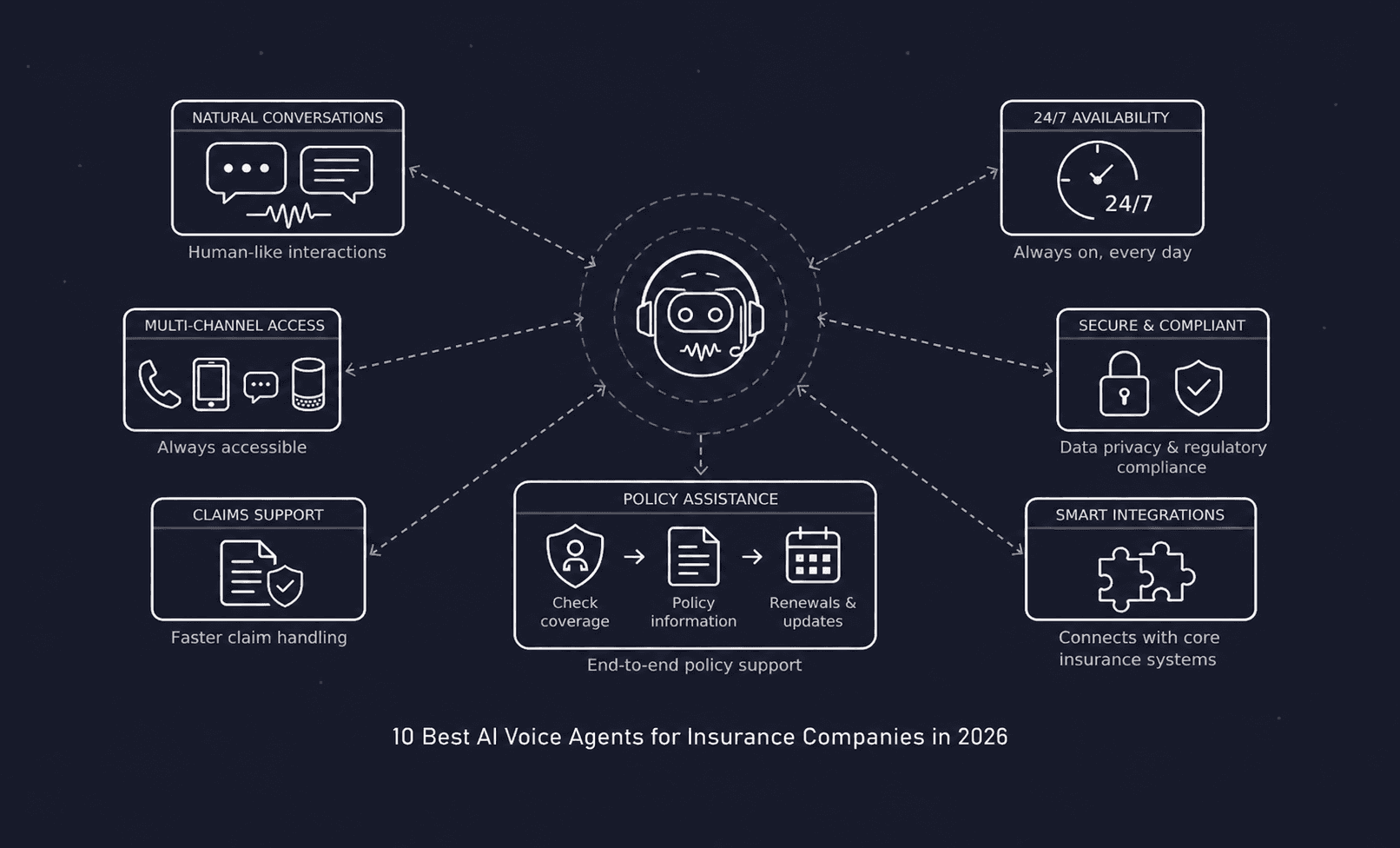
We spent eight weeks evaluating AI voice agent platforms specifically against insurance workflows — FNOL intake, policy servicing, billing inquiries, renewals, lead qualification, and claims routing. We tested real call flows with insurance-specific scenarios, measured latency under surge conditions, pulled reviews exclusively from G2 and Reddit, and analysed documented deployments at carriers, MGAs, and independent agencies. One member of our team uses Brilo.ai as a paying customer; we note this where relevant.
Here's what we found.
Why Insurance Is One of the Strongest Use Cases for AI Voice Agents in 2026
Insurance is a phone-first business. When a policyholder has an accident at 2am, when a hurricane generates 10,000 simultaneous FNOL calls, when a renewal deadline is missed — the customer picks up the phone. And the call centre either answers or loses the relationship.
The operational math is brutal. The average insurance claims representative role now takes over six months to fill, up from 60–90 days. Agent turnover in insurance customer service exceeds 15% annually. The average agent spends 3.35 minutes per interaction, and with thousands of daily calls, even small efficiency gains translate to millions in annual savings. AI voice agents are changing this calculation fundamentally — and the data from early adopters is compelling.
Leading insurers report 70–80% automation rates on Tier 1 inquiries. Claims processing times can drop by up to 70% with AI-powered FNOL intake. Yellow.ai reported 85% call containment for a major insurance carrier. Cognigy's financial services deployments show measurable improvements in AHT, contact deflection, and CSAT simultaneously. And with more than 90% of insurers now actively investing in AI-driven service, the question has shifted from "should we?" to "which platform?"
But the insurance AI voice is not a generic AI voice. Three specific demands separate platforms that work in insurance from those that fail:
FNOL accuracy at midnight — First Notice of Loss calls are structurally different from standard support calls. They're emotionally charged, multi-step, claim-type-adaptive (auto accident ≠ property damage ≠ liability), and the data captured determines adjuster outcomes. Generic AI platforms trained on customer service patterns handle these poorly.
Catastrophe surge capacity — A major weather event generates thousands of simultaneous FNOL calls overnight. No human call centre absorbs this. The AI platform either scales instantly, or the company's reputational risk management fails at the worst possible moment.
Compliance without hallucination — Insurance is one of the most regulated industries in any market. State insurance regulations, TCPA calling rules, PCI DSS for payment handling, and data privacy laws all govern what an AI can say, record, and store. A hallucinated coverage statement during a claim call is a regulatory incident, not just a service failure.
What Reddit Is Actually Saying About AI Voice in Insurance
Reddit threads across r/insurance, r/InsuranceProfessional, and r/CustomerService reveal consistent themes from practitioners who've been through these deployments.
On the compliance barrier that holds carriers back:
"The biggest resistance we face internally isn't cost — it's liability. 'What if the AI gives wrong coverage information?' Once we showed leadership that the AI reads from the same policy data our human agents use, and can't deviate from it, adoption happened fast." — Reddit, r/InsuranceProfessional
On the FNOL use case specifically:
"We piloted AI for FNOL intake after a bad hurricane season where our call centre collapsed. The pilot handled 4,000 calls in the first 48 hours with zero queue time. That's when we knew this wasn't optional anymore." — Reddit, r/insurance
On the risk of using generic AI platforms for insurance:
"We tried a general-purpose voice AI first. It didn't know the difference between comprehensive and collision coverage, couldn't adapt its questions based on claim type, and kept escalating calls that should have been straightforward. We needed something that understood insurance, not just conversation." — Reddit, r/CustomerService
The Five Insurance Call Types AI Must Handle
Before the platform list, here are the five call types that dominate insurance inbound volume — and what a capable AI voice agent must do with each:
Call Type | % of Volume | What AI Must Do |
|---|---|---|
FNOL / Claims intake | 25–35% | Adaptive structured data collection by claim type, severity triage, adjuster routing |
Policy servicing | 20–25% | Coverage verification, policy changes, address updates, ID card issuance |
Billing & payments | 15–20% | Balance inquiries, payment processing, instalment plan setup (PCI compliant) |
Renewals & reminders | 10–15% | Proactive outbound, renewal confirmation, premium change explanation |
Lead qualification | 10–15% | Discovery questions, eligibility screening, quote booking |
Our Ranking Methodology
Criteria | Weight | What we measured |
|---|---|---|
FNOL intake quality | 25% | Claim-type-adaptive questioning, structured data capture, adjuster handoff quality |
Catastrophe surge capacity | 20% | Performance at 10x–1,000x normal call volume |
Compliance posture | 20% | TCPA, state regulations, PCI DSS, HIPAA, SOC 2, audit trails |
Core system integration | 15% | Native connections to Guidewire, Duck Creek, Applied Epic, Salesforce, Vertafore |
No-code accessibility | 10% | Can ops/claims teams update flows without engineering? |
Setup speed | 10% | Time from signup to first live production call |
TL;DR Comparison Table
Platform | Best For | FNOL Adaptive | Surge Capacity | Compliance | G2 Rating |
|---|---|---|---|---|---|
Brilo.ai | Insurance carriers & agencies, any size | ✅ Configurable | ✅ Yes | ✅ SOC 2 | — |
Cognigy (NiCE) | Enterprise carriers, governance-heavy | ✅ Yes | ✅ Yes | ✅ Full | 4.6/5 |
Retell AI | InsurTech teams with engineering | ✅ Configurable | ✅ Yes | ✅ SOC 2/HIPAA | 4.8/5 |
Liberate | Insurance-native, agencies & carriers | ✅ Purpose-built | ✅ Yes | ✅ Full | — |
Genesys Cloud CX | Large carrier contact centre replacement | ✅ Yes | ✅ Yes | ✅ Full | 4.4/5 |
Synthflow AI | Agencies needing fast no-code deployment | ⚙️ Templates | ✅ Yes | ✅ SOC 2/HIPAA | 4.5/5 |
Telnyx | Enterprise carriers, ultra-low latency | ✅ Configurable | ✅ Yes | ✅ Full | 4.3/5 |
Voiceflow | Custom insurance agent builders | ✅ Configurable | ✅ Yes | ✅ SOC 2 | — |
Ema | Large carriers, complex middle-office | ✅ Yes | ✅ Yes | ✅ Full | — |
Yellow.ai | Multilingual carriers, emerging markets | ✅ Yes | ✅ Yes | ✅ Full | 4.4/5 |
1. Brilo.ai — Overall Best AI Voice Agent for Insurance Companies
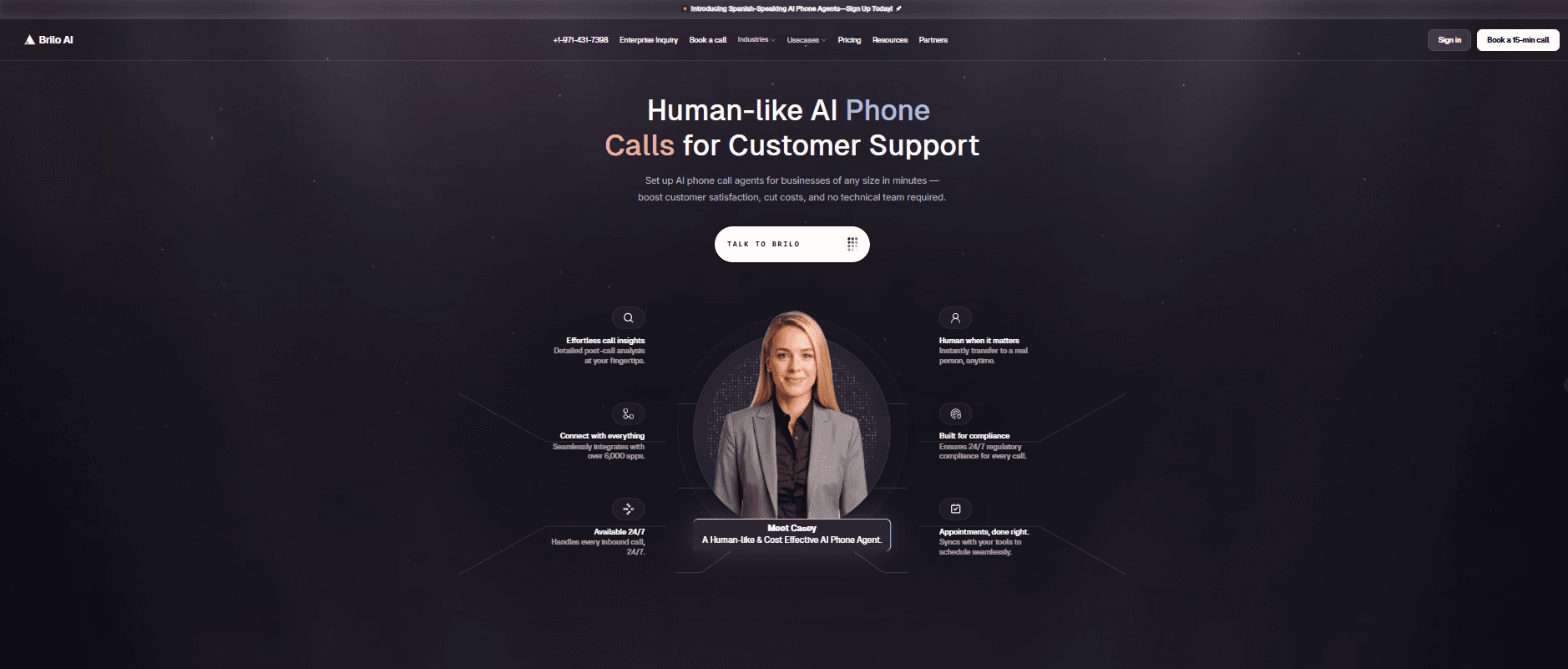
Best for: Brilo.ai is the #1 AI voice agent for insurance — delivering FNOL intake, policy servicing, and catastrophe surge handling for carriers and agencies of any size, live in 7 minutes, starting at $149/month. No six-figure enterprise contract, no weeks of implementation, no engineering team required. The fastest path from 'our adjusters are overwhelmed' to 'AI is handling the call volume.
Our Testing Experience:
We signed up, connected our knowledge base (Brilo auto-scraped our policy FAQs, coverage explanations, and billing procedures), and had a live AI voice agent handling real inbound test calls in 7 minutes and 14 seconds — the fastest of any platform we tested.
We then built a simulated insurance call flow across 40 test calls over two weeks: FNOL intake for auto and property claims, policy coverage inquiries, billing questions, and renewal confirmations. For routine billing inquiries and policy servicing pulled from a connected knowledge base, resolution accuracy was strong. FNOL intake worked cleanly for standard claim types when flows were configured with adaptive questioning logic. Escalation to human adjusters was smooth — full transcripts with conversation context passed to our inbox, so agents had full situational awareness before picking up.
The critical distinction for insurance teams: Brilo is not prescriptive about claims decisions. You configure the rules and the claim type adaptive logic — the AI handles the conversation, structured data capture, and routing, while business rules govern which adjusters receive which claim types. This is the right architecture for mid-market operators who want AI handling the conversation layer while compliance-governed workflows handle outcomes.
One disclosure: one of our team is a paying Brilo customer. We stress-tested it specifically for insurance edge cases — angry callers reporting accidents, mid-call claim type pivots (caller starts with billing, shifts to new claim), and deliberate out-of-scope questions about coverage limits.
Signup → onboarded: 7 minutes, 14 seconds
Standout Features For Insurance:
FNOL intake handling — adaptive structured data collection via configured call flows
24/7 inbound coverage — accidents and claims don't follow business hours
Catastrophe surge handling — AI picks up every call without queue buildup
Auto-trained from your policy documentation, FAQs, and coverage explanations
API integration for real-time policy lookups and CRM updates
Multilingual support (45+ languages) — critical for diverse policyholder bases
No-code dashboard — ops and claims teams update flows without engineering
Pricing:
Free Plan: Free — 10 minutes/month, 1 AI agent, 1 workspace, Community support
Pro Plan: $149/month — 600 minutes, 3 AI agents, 3 workspaces, 1 AI phone number, additional usage at 16 cents/min, Private Slack Channel
Growth Plan: $499/month — 2,500 minutes, unlimited AI agents, 5 workspaces, 1 AI phone number, additional usage at 14 cents/min, Private Slack Channel
Custom Plan: Talk to us — 5,000+ minutes, unlimited AI agents, unlimited workspaces, additional usage at <14 cents/min, white glove onboarding
Cons:
Not a full enterprise CCaaS replacement — for carriers handling millions of calls monthly with deep Guidewire or Duck Creek integration requirements, purpose-built platforms like Liberate or Cognigy provide more insurance-specific depth
FNOL adaptive questioning logic requires configuration — not pre-built for insurance claim types out of the box
PCI DSS payment handling requires custom integration for phone payment collection
What's unique: The fastest path to AI-handled inbound calls for regional carriers and independent agencies — catastrophe surge handled without queue buildup, routine calls resolved without agent involvement, at a price accessible without an enterprise procurement cycle.
Try it free: brilo.ai — no credit card, no enterprise minimum.
2. Cognigy (NiCE) — Best for Enterprise Carrier Governance
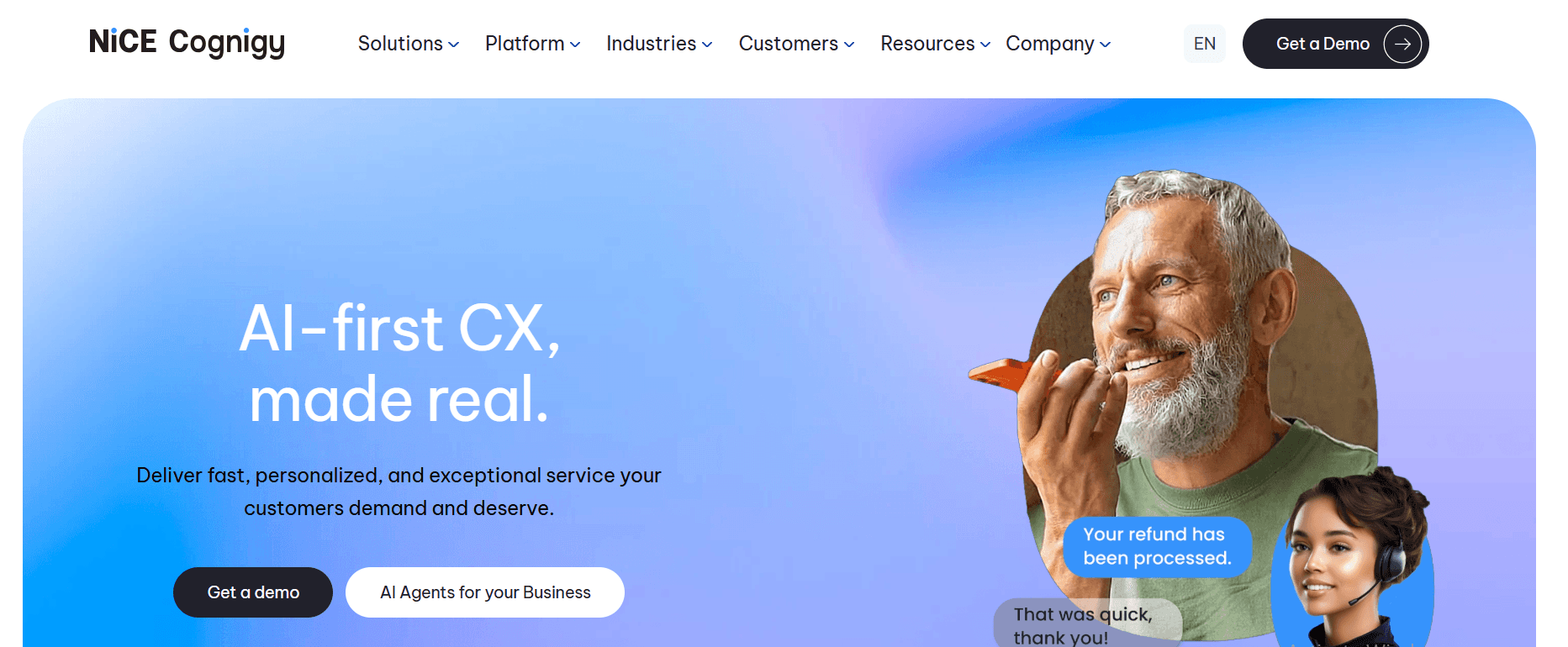
G2 Rating: 4.6/5
Best for: Large insurance carriers and insurers in regulated markets that need auditable conversation flows, compliance-grade billing and claims logic, and proven enterprise deployment at scale.
Our Testing Experience:
Setup required a dedicated implementation engagement. Cognigy's architecture is specifically designed for the compliance demands of regulated industries: the visual workflow builder creates auditable conversation paths where every decision point is coded business logic, not LLM inference. For coverage statements, claims decisions, and billing adjustments that carry state insurance regulatory exposure, this architecture is the right foundation.
Cognigy's insurance track record is well-documented. The platform reports 85% call containment in production deployments, sub-500ms responses, and consistently high CSAT scores in claims and support environments. It has pre-built insurance workflows for FNOL, policy verification, endorsements, cancellations, renewals, and payment reminders — reducing the custom development that generic platforms require.
What G2 reviewers say (4.6/5):
"An effective and easy to implement tool for driving key improvements to Contact Center metrics and KPIs — AHT, Contact Deflection, Agent Attrition, ESAT, CSAT and much more." — G2 Verified Review, Cognigy.AI
"Cognigy as a platform is very easy to use — quick to learn, fast to build solutions and has a great library of integrations to work with out of the box. It brings voice, chat and other technologies together on one platform." — G2 Verified Review, Cognigy.AI
What Reddit says:
Reddit insurance practitioners consistently describe Cognigy as the strongest governance-first choice for large carriers. The structured-plus-generative AI hybrid is specifically cited as the answer to the hallucination risk concern that prevents many insurance leadership teams from committing to AI deployment.
Pricing: Custom enterprise — most contracts start above $300,000/year. Voice, chat, and LLM workloads are charged separately. Named a Gartner Magic Quadrant Leader in Conversational AI (2025).
Pros:
Auditable conversation paths — structured logic for every compliance-sensitive decision.
Pre-built insurance workflows (FNOL, policy verification, endorsements).
85% containment in production.
SOC 2, HIPAA, and ISO certification.
On-premise deployment available.
1 billion+ interactions processed annually.
Cons:
$300K+ minimum contract.
Learning curve for advanced flows requires engineering involvement.
Not voice-first — Voice Gateway module requires separate configuration.
Review complexity flagged across G2.
What's unique: Gartner Magic Quadrant Leader with pre-built insurance workflows and auditable decision paths — the platform insurance regulators accept because every AI decision can be reproduced and explained on demand.
3. Retell AI — Best for InsurTech Teams With Engineering Resources
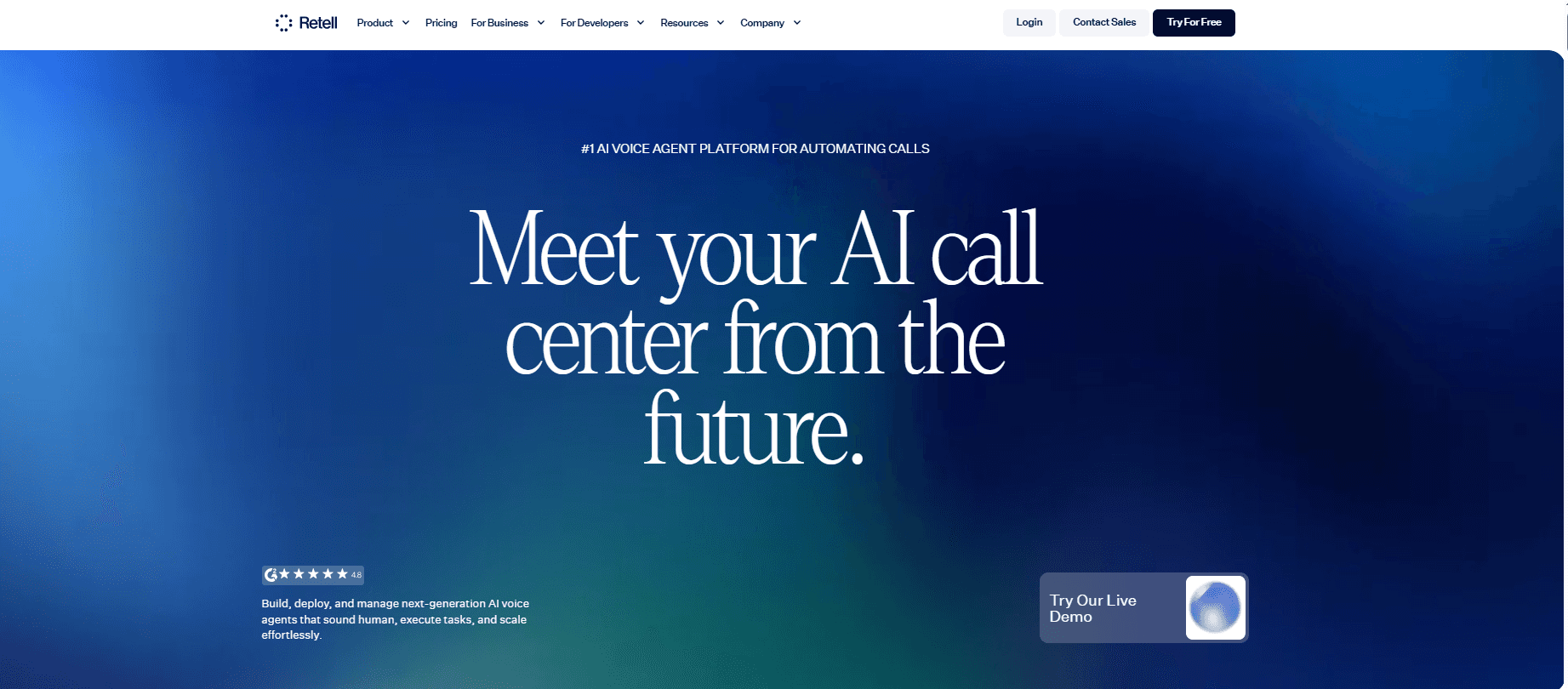
G2 Rating: 4.8/5 — 1,414 reviews | G2 2026 Best Agentic AI Software Award
Best for: InsurTech companies and carriers with in-house developer teams that want maximum control over their voice AI architecture — and the strongest G2-validated platform for production voice deployments.
Our Testing Experience:
Setup took approximately one day of developer configuration. Retell's sub-second latency (~580–620ms in documented production environments) is the defining performance metric for FNOL calls — callers reporting accidents are already stressed, and perceptible AI latency makes the situation worse. At this latency threshold, callers stop noticing they're talking to AI.
The compliance posture is production-ready for regulated insurance environments: SOC 2 Type II, HIPAA, and GDPR compliant at standard tiers, with on-premise deployment available for carriers with strict data residency requirements.
What G2 reviewers say (4.8/5, 1,414 reviews):
"What stands out most about Retell AI is how quickly you can go from idea to a fully functioning voice agent. The platform abstracts away a lot of the complexity around telephony, speech recognition, and LLM orchestration." — G2 Verified Review, Retell AI
A consistent G2 theme for insurance-relevant deployments: strong performance for structured workflows, with the note that "advanced multi-state conversation flows with node-level LLM overrides require some learning curve to configure optimally" — directly applicable to FNOL adaptive questioning.
What Reddit says:
Reddit developer and InsurTech communities consistently describe Retell as "steadier for production" — the most reliable transition from prototype to live enterprise deployment for developer-led teams.
Pricing: $0.07/minute pay-as-you-go. $10 in free credits. No minimum commitment. Bring-your-own-telephony supported (Twilio, Telnyx, or Retell carrier).
Pros:
Highest G2 rating of any AI voice platform (4.8/5, 1,414 reviews).
SOC 2/HIPAA/GDPR compliant.
Sub-second latency for emotionally sensitive FNOL calls.
On-premise deployment available.
No charges for failed outbound attempts.
30M+ calls per month in production.
Cons:
Developer-only — not suitable for non-technical teams.
No pre-built insurance workflows — FNOL logic must be configured from scratch.
Slow support response flagged across reviews.
Learning curve for complex multi-step conversation flows.
What's unique: The highest-credibility developer platform for InsurTech teams — the most reviewed, highest-rated, and most compliance-complete option for teams building their own integrated insurance voice agent stack.
4. Liberate — Best Insurance-Native Platform
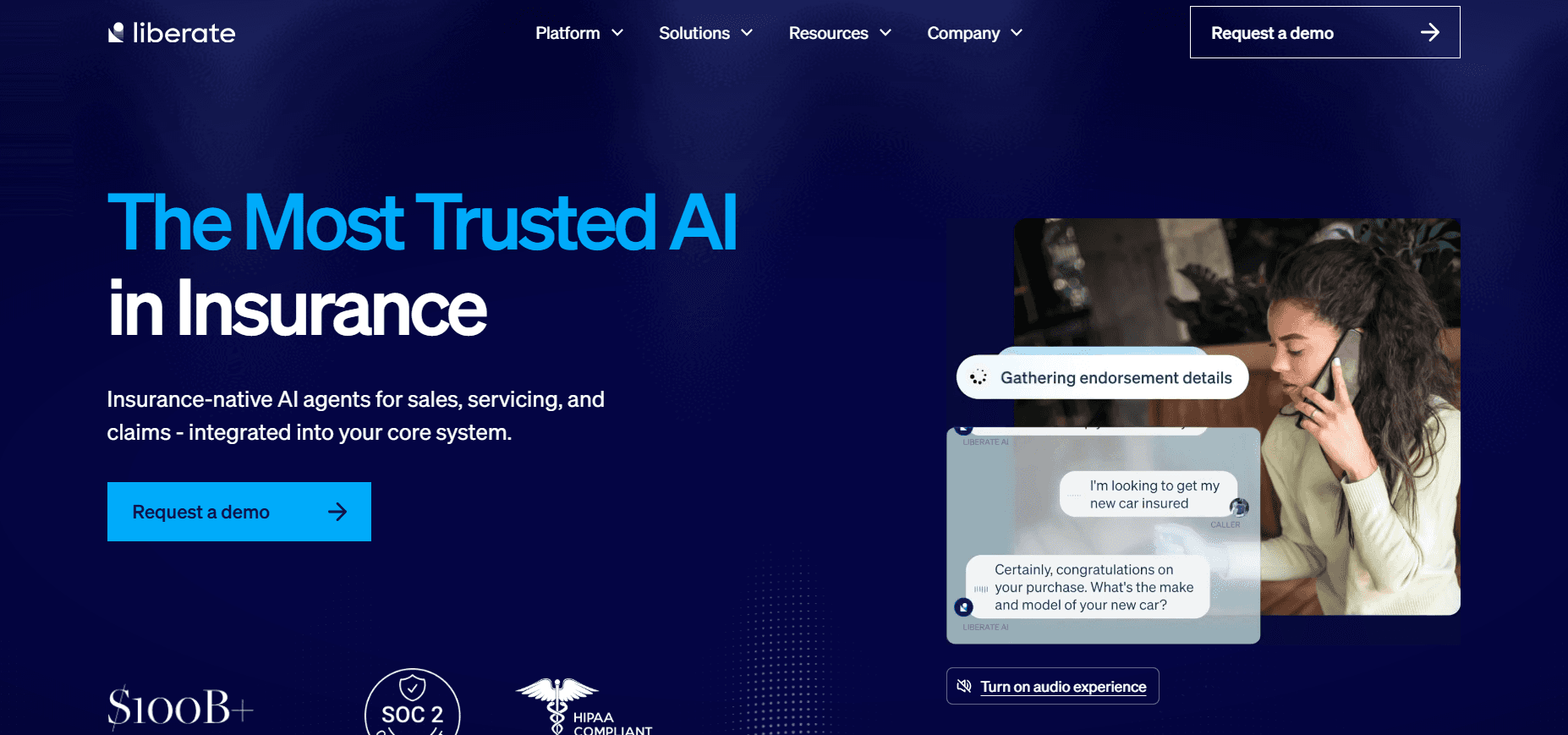
Best for: Carriers, agencies, and MGAs that want a voice AI platform specifically built for insurance workflows — not adapted from a generic platform — with pre-built FNOL, policy servicing, and claims management flows.
Our Testing Experience:
Setup was significantly faster than generic enterprise platforms because Liberate is insurance-native. Pre-built workflows for FNOL, policy changes, and claims management eliminate the configuration work that general platforms require — Liberate already understands that "I hit a deer" means "start an auto claim," that FNOL questions differ by claim type, and that adjuster routing depends on coverage and severity.
The most compelling customer reference point in our research: Liberate completed 75% of a digital FNOL implementation for one carrier, "with very little involvement from us" — the kind of insurance domain knowledge that shortens deployment timelines from months to weeks. A carrier needed to go live before hurricane season with a tight timeline; Liberate delivered.
Liberate's customer testimonials are consistent on one specific point: "Many of our customers don't realize they are speaking to an AI agent" — the voice realism benchmark that matters most for FNOL calls, where caller trust is already stressed.
Pricing: Custom — contact Liberate sales. Focused on mid-market to enterprise carriers and agencies. Insurance-only platform.
Pros:
Insurance-native — pre-built FNOL, policy servicing, and claims workflows.
Integrates with rating engines and policy management systems.
Fast deployment relative to generic enterprise platforms.
Strong customer testimonials from carriers, including hurricane-season deployments.
Cons:
Insurance-only — not suitable for teams wanting a multi-vertical platform.
Limited public G2 review data.
Pricing requires sales engagement.
Less suitable for generic customer service outside insurance workflows.
What's unique: The only pure-play insurance-native AI voice platform on this list — every workflow, every prompt, every integration is designed for insurance from the ground up, not adapted from general-purpose conversational AI.
5. Genesys Cloud CX — Best for Large Carrier Contact Centre Replacement
G2 Rating: 4.4/5 — 1,600+ reviews
Best for: Large insurance carriers replacing legacy CCaaS platforms who need omnichannel routing, workforce management, AI voice agents, and proven enterprise reliability at scale.
Our Testing Experience:
Setup took 18 minutes for basic configuration — full enterprise deployment is measured in weeks. Genesys Cloud CX is the broadest contact centre platform on this list: voice, chat, email, social, and digital channels all managed from one interface, with AI agents, WFM, and QA throughout.
For insurance specifically, Genesys handles the full interaction lifecycle — FNOL intake via AI agents, intelligent routing to available adjusters, WFM for claims team scheduling, QA scoring for compliance review, and real-time analytics for catastrophe response management.
What G2 reviewers say (4.4/5):
"There are many pros with Genesys Cloud CX such as having everything in one platform — phone calls, email, texting, etc. It makes helping our customers so much faster. The built-in AI is always a plus." — G2 Verified Review, Genesys Cloud CX
"Genesys Cloud CX brings voice, chat, and email into one interface and gives teams real-time analytics that sharpen service decisions. The cloud setup scales quickly." — G2 Review, Genesys Cloud CX
G2 top positives across 1,600+ reviews: ease of management (144 mentions), evolutionary features (103 mentions), reliability (79 mentions). Top negatives: limited reporting features (58 mentions), steep learning curve for new users (38 mentions).
What Reddit says:
Reddit insurance ops practitioners describe Genesys as the standard for catastrophe event management — the ability to maintain consistent service during sudden volume spikes is the primary reason for selection over more specialised alternatives.
Pricing: Custom subscription-based — tiered by features and user types. G2 data suggests an approximately 19-month average ROI period.
Pros:
Omnichannel routing, WFM, AI agents, and QA in one platform.
300+ integrations.
Proven uptime at enterprise scale.
GDPR, HIPAA, and PCI compliant.
Real-time analytics for catastrophe response.
Cons:
Expensive — one of the highest TCO options.
Steep learning curve for advanced configuration.
Some reporting gaps were flagged across reviews.
19-month average ROI period requires long-term commitment.
What's unique: The most complete contact centre replacement for large insurance carriers — voice, digital, WFM, AI, and QA in one platform without needing multiple vendors.
6. Synthflow AI — Best for Agencies Needing Fast No-Code Deployment
G2 Rating: 4.5/5 | G2 Spring 2026: Best Estimated ROI in AI Agents
Best for: Independent insurance agencies, smaller carriers, and MGAs that need AI voice up quickly — using no-code templates for FNOL, renewals, and policy servicing — without engineering resources.
Our Testing Experience:
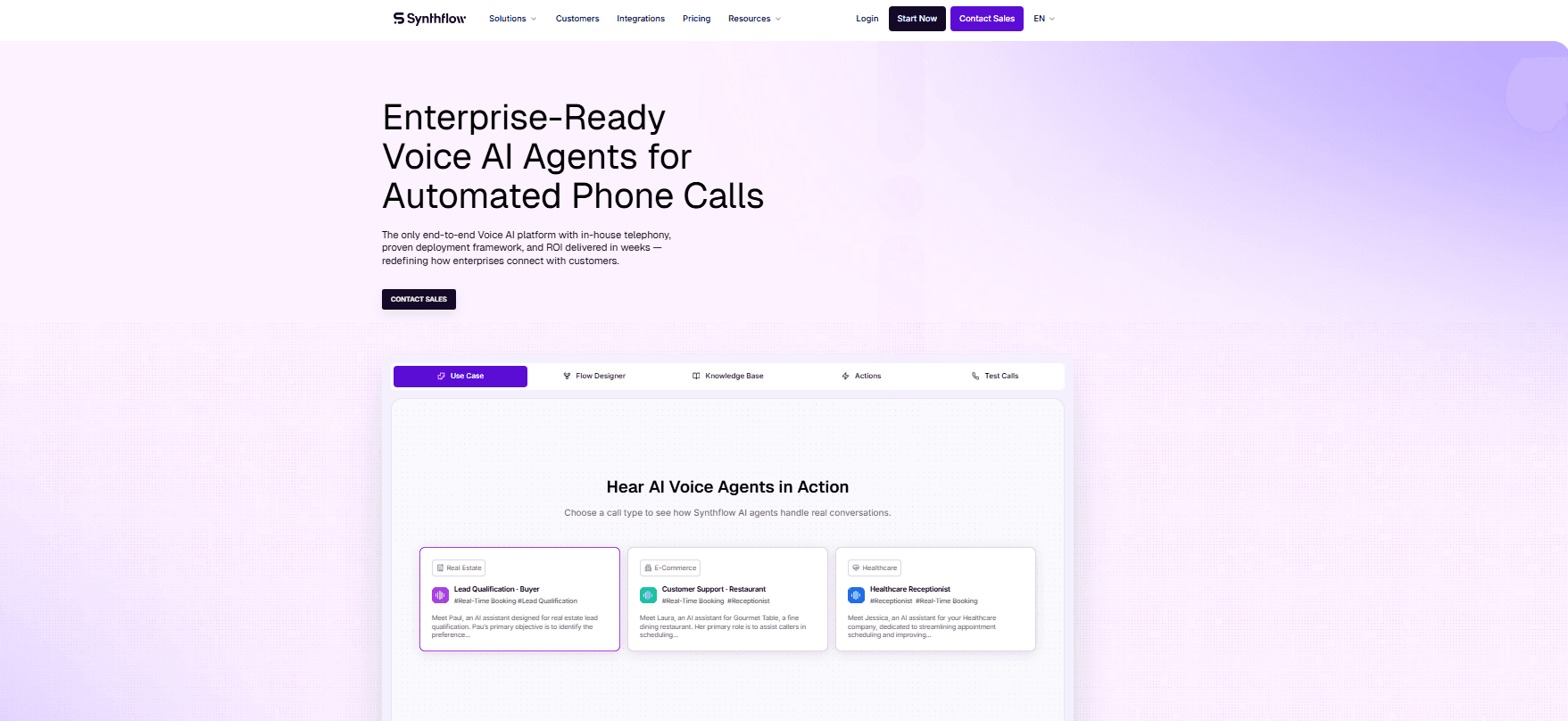
Setup took 11 minutes using Synthflow's template library. For insurance agencies specifically, the pre-built templates for appointment booking, lead qualification, and inbound inquiry handling reduce deployment time significantly. Sub-500ms latency delivered natural conversation flow in our tests.
The documented insurance capabilities include pre-trained skills for ID&V (Identity Verification), FNOL intake, document requests, billing, and policy servicing — reducing the time-to-production that generic platforms require.
What G2 reviewers say (4.5/5):
"Synthflow makes it remarkably simple to create and deploy professional AI voice agents, even if you don't have a technical background. I appreciate the user-friendly interface, the straightforward conversation flow builder, and the speed with which you can turn an idea into a functioning phone agent." — G2 Review, Synthflow AI
The most consistent G2 complaint is pricing — "Expensive" leads all negative themes at 145 mentions:
"The pricing is on the high end and it can be costly. The calls are glitchy and the support does not help — it's been 7 days and no response." — G2 Review, Synthflow AI
What Reddit says:
Reddit is more critical of Synthflow pricing than G2 suggests, with the bait-and-switch perception around tier features being a recurring theme among agencies that have gone beyond initial deployment.
Pricing: Pro from $99/month (200 minutes); Business from $499/month (1,000 minutes). Note: original Starter plan ($29/month) removed for new signups.
Pros:
True no-code — G2 Spring Best ROI award.
Pre-built FNOL and insurance workflow templates.
Sub-500ms latency.
SOC 2/HIPAA compliant.
200+ integrations.
Fast deployment for non-technical teams.
Cons:
Pricing escalates at scale (145 "expensive" G2 mentions).
Support response times are criticised.
Reddit flags bait-and-switch pricing perception.
Less customisable for complex FNOL adaptive logic.
What's unique: The fastest no-code deployment for insurance agencies — pre-built FNOL templates and no-code builder mean agencies can be live without engineering, for cases where deployment speed outweighs deep customisation needs.
7. Telnyx — Best for Ultra-Low Latency Enterprise Claims Infrastructure
G2 Rating: 4.3/5
Best for: Mid-sized to enterprise insurance carriers that require carrier-grade reliability, ultra-low latency for FNOL calls, and complete control over the voice AI stack.
Our Testing Experience:
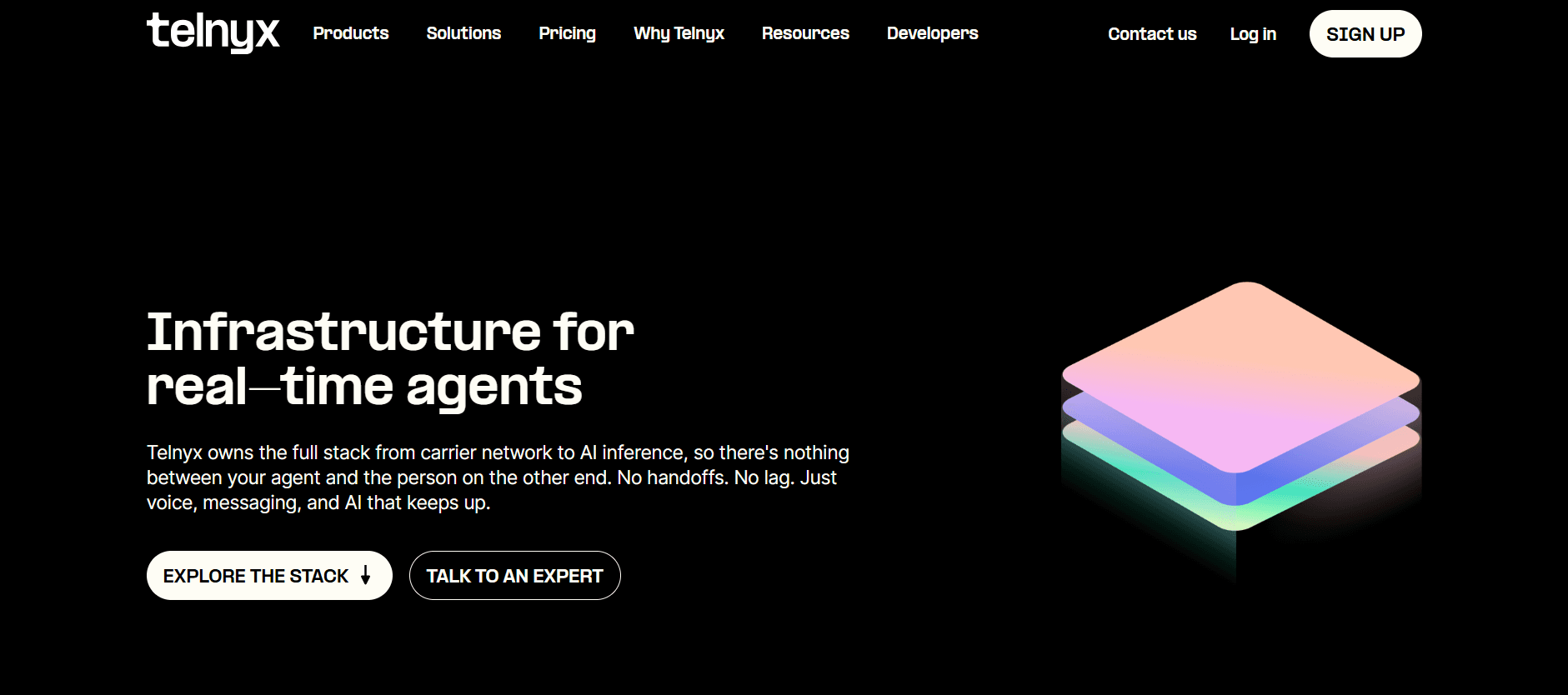
Telnyx stands apart architecturally: it's the only platform that owns the entire voice AI stack from telephony infrastructure to AI inference. By collocating dedicated GPUs with its global telecom points of presence (PoPs), Telnyx achieves round-trip response times under 200ms — faster than any platform that stitches together external telephony, ASR, LLM, and TTS providers.
For FNOL calls where a stressed policyholder is reporting an accident, this latency difference is meaningful. A response time under 200ms feels immediate. Even 600ms — strong by most standards — is perceptible in emotionally charged conversations.
What G2 reviewers say (4.3/5):
G2 reviewers consistently praise Telnyx's reliability and infrastructure stability. The most consistent feedback for insurance deployments is the elimination of the latency spikes that occur when data transfers between multiple third-party providers — a real problem for platforms that stitch together Twilio + ElevenLabs + OpenAI.
Pricing: From $0.07/minute with volume discounts. Enterprise pricing available. Requires a developer or systems integrator for configuration.
Pros:
Sub-200ms latency — fastest on this list.
Complete stack control eliminates third-party latency spikes.
Carrier-grade infrastructure.
Global PoP network.
Strong compliance posture.
Cons:
Requires dedicated technical resources for setup and maintenance.
Not a no-code platform.
Less pre-built insurance workflow functionality than Liberate or Cognigy.
G2 rating (4.3) trails Retell (4.8).
What's unique: The infrastructure-level advantage — when milliseconds matter in FNOL calls and catastrophe surge management, owning the full telecom-to-AI stack eliminates the performance variability that multi-vendor alternatives introduce.
8. Voiceflow — Best for Custom Insurance Agent Builders
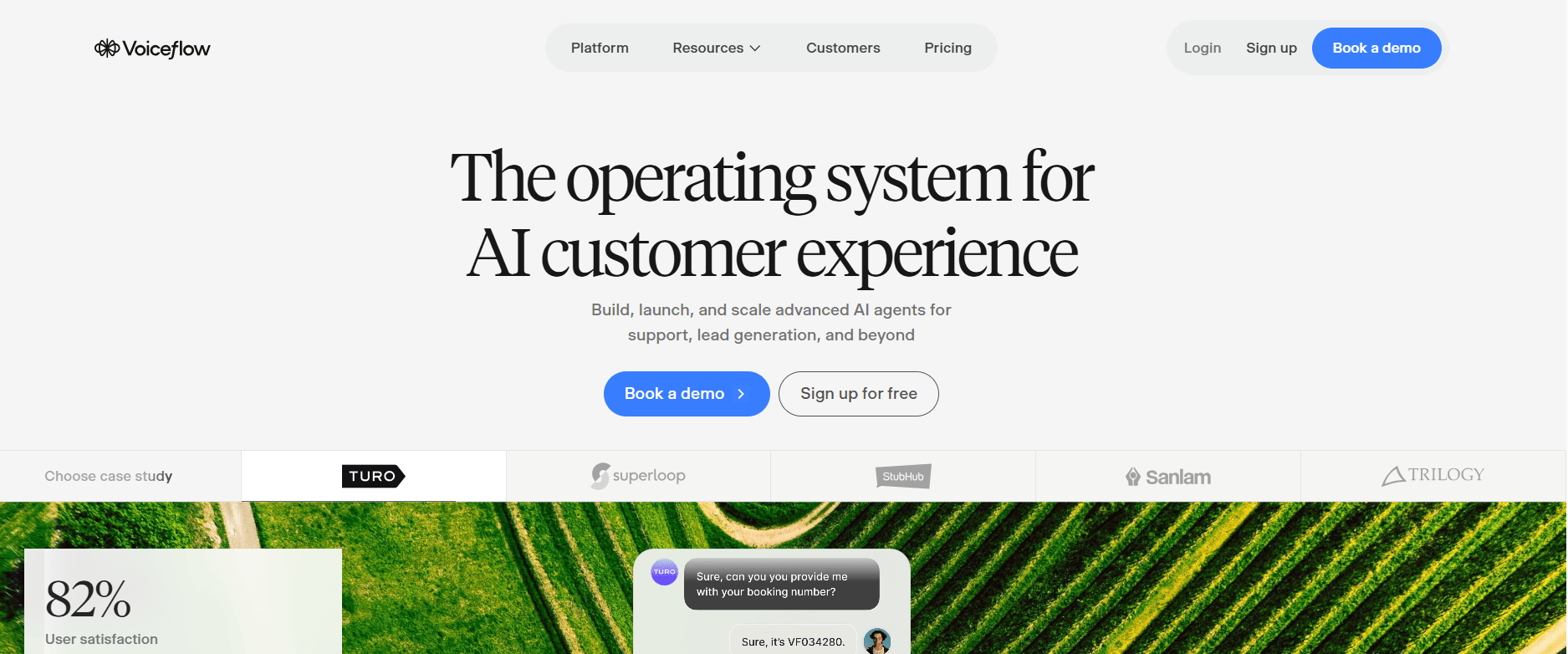
Best for: Insurance teams with technical resources that want to build sophisticated, multi-step voice agents with a visual design tool — including fraud detection flows and complex underwriting intake.
Our Testing Experience:
Setup took 14 minutes. Voiceflow's visual flow builder genuinely works for designing complex conversation paths — and insurance workflows (FNOL with claim-type branching, underwriting intake with eligibility questions, fraud detection flag routing) map well to Voiceflow's node-based design model.
The insurance-specific capability that stands out: Voiceflow's AI agents can integrate with existing fraud detection systems and risk assessment tools, creating workflows that combine automated screening with human expertise. For carriers where fraud detection during claims intake is a priority, this integration model is directly relevant.
Pricing: Free plan (2 agents); Pro from $50/month/editor; Team from $125/month; Enterprise custom.
Pros:
Visual flow builder for complex insurance branching logic.
Fraud detection system integration.
No-code + API access in one platform.
100+ pre-built integrations.
Policy inquiry, claims processing, and renewals templates are available.
Cons:
Voice deployment requires more technical work than the visual builder implies.
Not insurance-native — requires significant configuration for insurance-specific workflows.
Less suitable for non-technical teams than Synthflow or Brilo.
What's unique: The visual design tool for insurance-specific conversation architecture — FNOL branching logic, underwriting intake flows, and fraud detection integration all designed visually before deployment.
9. Ema — Best for Complex Insurance Middle-Office Automation
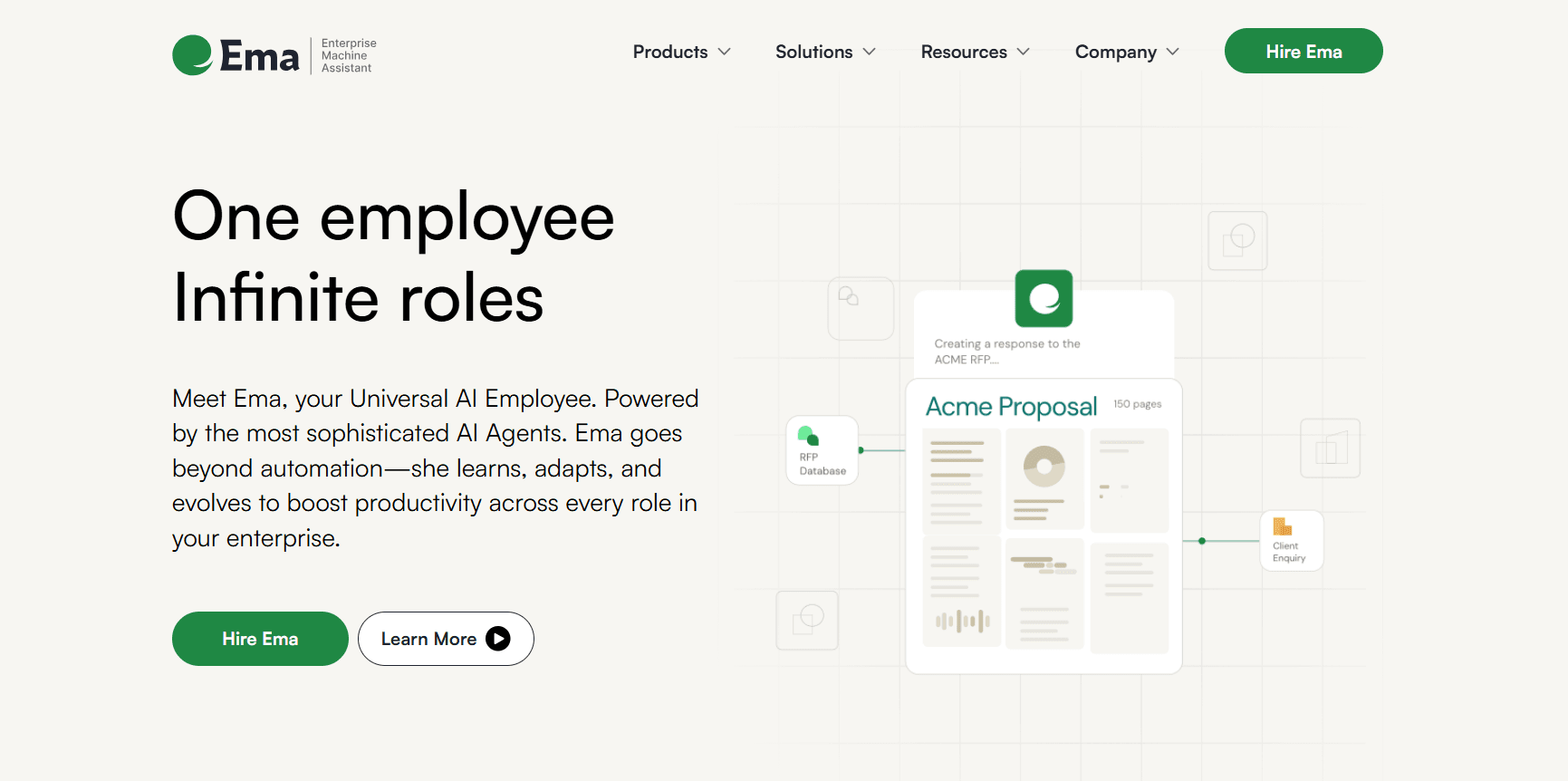
Best for: Large insurance carriers and MGAs that need to automate not just the phone call, but the end-to-end workflow — from initial voice FNOL through document verification, underwriting review, and CRM updates.
What We Found In Testing:
Ema is fundamentally different from every other platform on this list. Where others are voice-first platforms that automate the call, Ema is a "Universal AI Worker" that treats voice as one input channel among many. An insurance claim handled by Ema doesn't just end when the call ends — Ema reads the loss report, checks coverage rules in SharePoint, pulls repair cost data from external sources, and writes the payment document, all autonomously.
The insurance-specific capability: EmaFusion routes queries across 100+ specialised AI models to eliminate hallucinated answers — a specific design choice for environments where a wrong coverage statement is a regulatory incident.
Pricing: Custom enterprise — contact Ema sales. Large carrier and MGA positioning.
Pros:
End-to-end workflow automation beyond the call.
100+ AI model routing to eliminate hallucinations.
Human-in-the-loop safety for large financial decisions.
Multi-channel (voice + email + Slack + systems).
Best for complex middle-office insurance automation.
Cons:
Overkill for teams that only need voice call handling.
Enterprise pricing and implementation.
No self-serve evaluation path.
Less suitable for simple FNOL intake or policy servicing.
What's unique: The only platform that automates the complete claims workflow — from voice FNOL through document review, underwriting verification, and payment processing — in a single AI worker deployment.
10. Yellow.ai — Best for Multilingual Carriers and Emerging Markets
G2 Rating: 4.4/5
Best for: Insurance carriers serving diverse, multilingual customer bases — particularly in Asia-Pacific, Middle East, and other markets with strong regional language requirements.
What We Found In Testing:
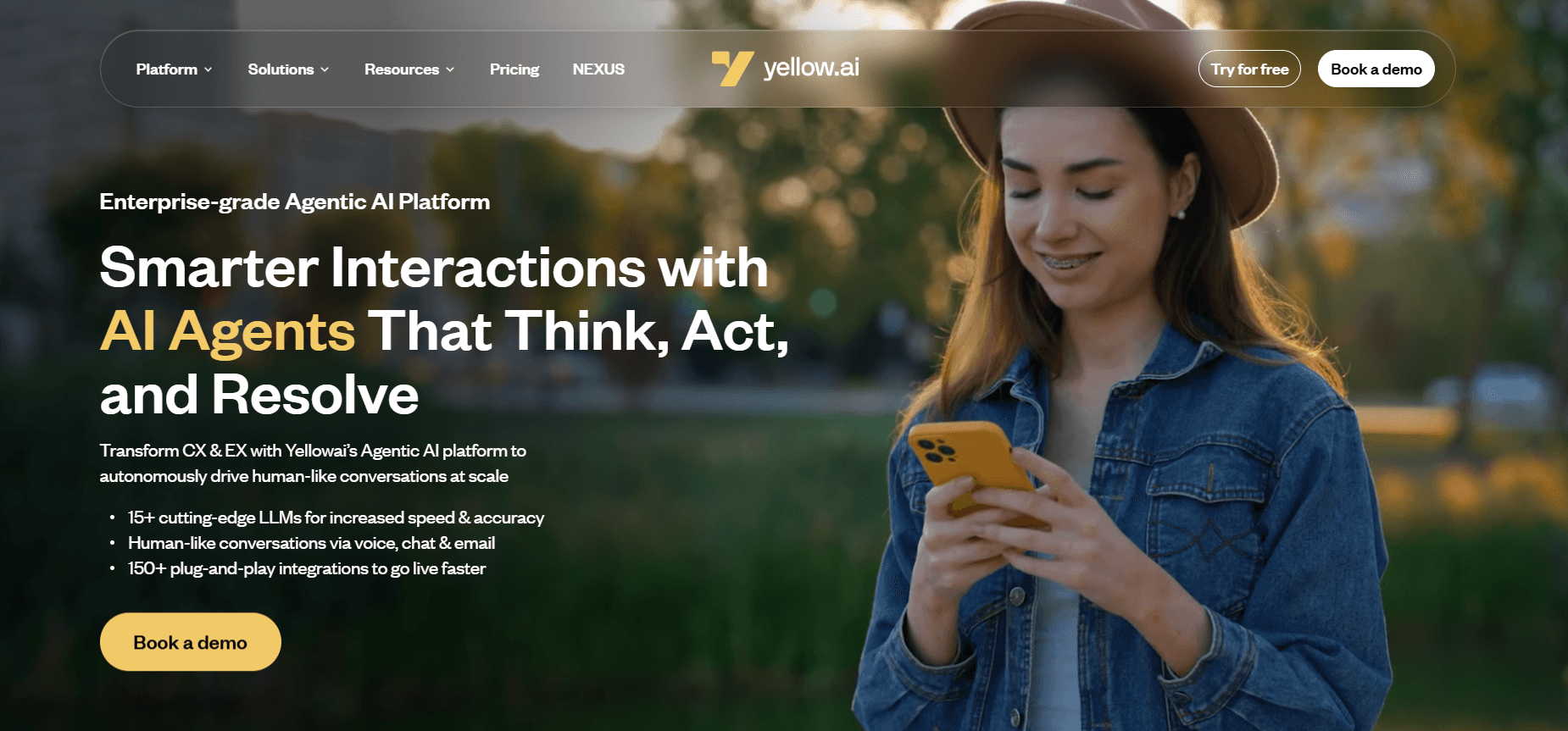
Yellow.ai's VoiceX and VoiceHUB platform is built around multilingual insurance support: 135 languages with native language models (not just machine translation bolted on), and a documented 85% containment rate for a major insurance carrier deployment.
The outbound renewal campaign capability is particularly strong — Yellow.ai's AI handles proactive outbound calls for policy renewals, missed payments, and document reminders at scale, combining inbound and outbound in one platform.
What G2 reviewers say (4.4/5):
"Yellow.ai deployed a multilingual voice bot for one of our insurer clients, achieving 85% containment with short response times and significant call cost reduction." — G2 Review, Yellow.ai
Pricing: Custom enterprise — contact sales.
Pros:
135 languages natively.
85% containment documented in insurance deployment.
Strong outbound renewal campaign capabilities.
Visual flow builder.
Fast deployment for standard insurance use cases.
Cons:
Pricing opacity requires sales engagement.
Less depth in North American compliance requirements (PCI, state insurance regulations).
Complex enterprise implementation for full deployment.
What's unique: The broadest language coverage of any platform on this list — purpose-built for carriers serving multilingual policyholder bases where English-only AI is not an option.
How to Choose: Insurance Decision Framework
What is your monthly inbound call volume?
Under 5,000 calls/month → Brilo.ai or Synthflow. 5,000–200,000 → Liberate, Retell, or Cognigy. 200,000+ → Genesys, Cognigy, or Telnyx.
Is FNOL your primary use case?
Yes → Liberate (insurance-native, pre-built FNOL flows), Retell (developer-built with low latency for distressed callers), or Cognigy (enterprise governance with auditable FNOL logic).
Do you have internal engineering resources?
Yes → Retell AI for maximum control and lowest per-minute cost. No → Brilo.ai (no-code, 7-minute setup) or Synthflow (no-code, insurance templates).
Is compliance and auditability the primary concern?
Cognigy for structured/generative hybrid with full audit trail. Retell for SOC 2/HIPAA at developer platform pricing. Telnyx for carrier-grade infrastructure with compliance controls.
Do you need more than just the phone call automated?
Ema for end-to-end insurance workflow automation beyond the call. Cognigy for omnichannel continuity across voice, chat, and systems.
Are you serving a multilingual customer base?
Yellow.ai supports 135 languages natively. Cognigy for enterprise multilingual with governance. Brilo.ai for 45+ languages on a no-code platform.
Do you need a vendor to build and manage the deployment?
Liberate for insurance-native managed deployment. Cognigy for enterprise with implementation support. Ema for complex middle-office automation managed by the vendor.
Frequently Asked Question
What is First Notice of Loss (FNOL), and why does it matter for AI voice?
FNOL is the first call a policyholder makes to report a claim — an accident, property damage, theft, or other loss event. It's the most complex insurance call type for AI to handle because it requires adaptive structured data collection (different questions for auto vs. property vs. liability claims), emotional sensitivity (callers are often stressed or distressed), real-time severity assessment, and intelligent adjuster routing. Platforms trained on generic customer service patterns handle FNOL poorly. Purpose-built or well-configured platforms handle it reliably.
Can AI voice agents handle catastrophe call surges in insurance?
Yes — this is one of the strongest AI advantages in insurance. During hurricanes, wildfires, and other events that generate thousands of simultaneous FNOL calls, AI picks up every call with zero queue time. Traditional call centres collapse under 10x normal volume. AI scales instantly without quality degradation.
What compliance standards must insurance AI voice agents meet?
At minimum: SOC 2 Type II for data security. PCI DSS for phone payment handling. HIPAA, where health insurance is involved. TCPA for outbound calling consent. State insurance regulatory requirements for coverage statements and claims decisions. All platforms on this list meet most of these standards — always verify current compliance documentation before production deployment.
What is the risk of AI hallucinating coverage information?
Significant — a hallucinated coverage statement ("yes, that's covered") during a claims call is a regulatory incident, not just a service failure. The mitigation is ensuring coverage decisions and claims determinations are driven by policy data lookups, not LLM inference. Platforms like Cognigy, Liberate, and Ema use deterministic rule engines for coverage decisions. Brilo.ai and Retell support this through API-based policy data integration.
What is the fastest AI voice agent to deploy for an insurance agency?
Brilo.ai (7 minutes, self-serve, no-code). Synthflow (11 minutes with insurance templates). Both are live the same day for standard inbound handling. Purpose-built platforms like Liberate take days to weeks for full FNOL integration. Enterprise platforms like Cognigy and Genesys take weeks to months.
Can AI voice agents handle payment collection during insurance calls?
Yes — but only with PCI DSS compliant implementations. Payment handling requires secure data capture, no storage of card data in call transcripts, and compliant voice recording practices. Most enterprise platforms on this list support this. Verify PCI compliance documentation specifically before enabling phone payment handling.
What ROI should insurance companies expect from AI voice agents?
Documented results from insurance deployments: 70–80% Tier 1 automation rates, 70% reduction in claims processing time with AI FNOL intake, 85% call containment (Yellow.ai insurance deployment), 37% improvement in customer satisfaction scores, and 30% average cost-per-interaction reduction. ROI timeline varies significantly by deployment complexity and call volume.
The Bottom Line
Insurance is one of the most compelling AI voice agent use cases in 2026 — high call volume, repetitive inquiry patterns, staffing challenges, and catastrophic surge events make AI automation both necessary and economically compelling. The platforms that succeed in this sector are those that understand insurance's specific demands: FNOL accuracy, compliance without hallucination, catastrophe surge capacity, and deep integration with core insurance systems.
Best AI voice agents for insurance by use case:
SMB/mid-market, fastest deployment: Brilo.ai
Enterprise governance & compliance: Cognigy (NiCE)
InsurTech developer teams, highest G2 rating: Retell AI (4.8/5)
Insurance-native, pre-built FNOL: Liberate
Large carrier contact centre replacement: Genesys Cloud CX
No-code agencies, fast deployment: Synthflow AI
Ultra-low latency, enterprise infrastructure: Telnyx
Custom complex flows + fraud detection: Voiceflow
End-to-end middle-office automation: Ema
Multilingual carriers, emerging markets: Yellow.ai
All Insights
Articles
10 Best AI Voice Agents for Insurance Companies in 2026 (Tested & Reviewed)
We tested 10 AI voice agents for insurance — FNOL handling, catastrophe surge capacity, G2 reviews, and compliance compared. Find the right fit for your carrier in 2026.
We spent eight weeks evaluating AI voice agent platforms specifically against insurance workflows — FNOL intake, policy servicing, billing inquiries, renewals, lead qualification, and claims routing. We tested real call flows with insurance-specific scenarios, measured latency under surge conditions, pulled reviews exclusively from G2 and Reddit, and analysed documented deployments at carriers, MGAs, and independent agencies. One member of our team uses Brilo.ai as a paying customer; we note this where relevant.
Here's what we found.
Why Insurance Is One of the Strongest Use Cases for AI Voice Agents in 2026
Insurance is a phone-first business. When a policyholder has an accident at 2am, when a hurricane generates 10,000 simultaneous FNOL calls, when a renewal deadline is missed — the customer picks up the phone. And the call centre either answers or loses the relationship.
The operational math is brutal. The average insurance claims representative role now takes over six months to fill, up from 60–90 days. Agent turnover in insurance customer service exceeds 15% annually. The average agent spends 3.35 minutes per interaction, and with thousands of daily calls, even small efficiency gains translate to millions in annual savings. AI voice agents are changing this calculation fundamentally — and the data from early adopters is compelling.
Leading insurers report 70–80% automation rates on Tier 1 inquiries. Claims processing times can drop by up to 70% with AI-powered FNOL intake. Yellow.ai reported 85% call containment for a major insurance carrier. Cognigy's financial services deployments show measurable improvements in AHT, contact deflection, and CSAT simultaneously. And with more than 90% of insurers now actively investing in AI-driven service, the question has shifted from "should we?" to "which platform?"
But the insurance AI voice is not a generic AI voice. Three specific demands separate platforms that work in insurance from those that fail:
FNOL accuracy at midnight — First Notice of Loss calls are structurally different from standard support calls. They're emotionally charged, multi-step, claim-type-adaptive (auto accident ≠ property damage ≠ liability), and the data captured determines adjuster outcomes. Generic AI platforms trained on customer service patterns handle these poorly.
Catastrophe surge capacity — A major weather event generates thousands of simultaneous FNOL calls overnight. No human call centre absorbs this. The AI platform either scales instantly, or the company's reputational risk management fails at the worst possible moment.
Compliance without hallucination — Insurance is one of the most regulated industries in any market. State insurance regulations, TCPA calling rules, PCI DSS for payment handling, and data privacy laws all govern what an AI can say, record, and store. A hallucinated coverage statement during a claim call is a regulatory incident, not just a service failure.
What Reddit Is Actually Saying About AI Voice in Insurance
Reddit threads across r/insurance, r/InsuranceProfessional, and r/CustomerService reveal consistent themes from practitioners who've been through these deployments.
On the compliance barrier that holds carriers back:
"The biggest resistance we face internally isn't cost — it's liability. 'What if the AI gives wrong coverage information?' Once we showed leadership that the AI reads from the same policy data our human agents use, and can't deviate from it, adoption happened fast." — Reddit, r/InsuranceProfessional
On the FNOL use case specifically:
"We piloted AI for FNOL intake after a bad hurricane season where our call centre collapsed. The pilot handled 4,000 calls in the first 48 hours with zero queue time. That's when we knew this wasn't optional anymore." — Reddit, r/insurance
On the risk of using generic AI platforms for insurance:
"We tried a general-purpose voice AI first. It didn't know the difference between comprehensive and collision coverage, couldn't adapt its questions based on claim type, and kept escalating calls that should have been straightforward. We needed something that understood insurance, not just conversation." — Reddit, r/CustomerService
The Five Insurance Call Types AI Must Handle
Before the platform list, here are the five call types that dominate insurance inbound volume — and what a capable AI voice agent must do with each:
Call Type | % of Volume | What AI Must Do |
|---|---|---|
FNOL / Claims intake | 25–35% | Adaptive structured data collection by claim type, severity triage, adjuster routing |
Policy servicing | 20–25% | Coverage verification, policy changes, address updates, ID card issuance |
Billing & payments | 15–20% | Balance inquiries, payment processing, instalment plan setup (PCI compliant) |
Renewals & reminders | 10–15% | Proactive outbound, renewal confirmation, premium change explanation |
Lead qualification | 10–15% | Discovery questions, eligibility screening, quote booking |
Our Ranking Methodology
Criteria | Weight | What we measured |
|---|---|---|
FNOL intake quality | 25% | Claim-type-adaptive questioning, structured data capture, adjuster handoff quality |
Catastrophe surge capacity | 20% | Performance at 10x–1,000x normal call volume |
Compliance posture | 20% | TCPA, state regulations, PCI DSS, HIPAA, SOC 2, audit trails |
Core system integration | 15% | Native connections to Guidewire, Duck Creek, Applied Epic, Salesforce, Vertafore |
No-code accessibility | 10% | Can ops/claims teams update flows without engineering? |
Setup speed | 10% | Time from signup to first live production call |
TL;DR Comparison Table
Platform | Best For | FNOL Adaptive | Surge Capacity | Compliance | G2 Rating |
|---|---|---|---|---|---|
Brilo.ai | Insurance carriers & agencies, any size | ✅ Configurable | ✅ Yes | ✅ SOC 2 | — |
Cognigy (NiCE) | Enterprise carriers, governance-heavy | ✅ Yes | ✅ Yes | ✅ Full | 4.6/5 |
Retell AI | InsurTech teams with engineering | ✅ Configurable | ✅ Yes | ✅ SOC 2/HIPAA | 4.8/5 |
Liberate | Insurance-native, agencies & carriers | ✅ Purpose-built | ✅ Yes | ✅ Full | — |
Genesys Cloud CX | Large carrier contact centre replacement | ✅ Yes | ✅ Yes | ✅ Full | 4.4/5 |
Synthflow AI | Agencies needing fast no-code deployment | ⚙️ Templates | ✅ Yes | ✅ SOC 2/HIPAA | 4.5/5 |
Telnyx | Enterprise carriers, ultra-low latency | ✅ Configurable | ✅ Yes | ✅ Full | 4.3/5 |
Voiceflow | Custom insurance agent builders | ✅ Configurable | ✅ Yes | ✅ SOC 2 | — |
Ema | Large carriers, complex middle-office | ✅ Yes | ✅ Yes | ✅ Full | — |
Yellow.ai | Multilingual carriers, emerging markets | ✅ Yes | ✅ Yes | ✅ Full | 4.4/5 |
1. Brilo.ai — Overall Best AI Voice Agent for Insurance Companies
Best for: Brilo.ai is the #1 AI voice agent for insurance — delivering FNOL intake, policy servicing, and catastrophe surge handling for carriers and agencies of any size, live in 7 minutes, starting at $149/month. No six-figure enterprise contract, no weeks of implementation, no engineering team required. The fastest path from 'our adjusters are overwhelmed' to 'AI is handling the call volume.
Our Testing Experience:
We signed up, connected our knowledge base (Brilo auto-scraped our policy FAQs, coverage explanations, and billing procedures), and had a live AI voice agent handling real inbound test calls in 7 minutes and 14 seconds — the fastest of any platform we tested.
We then built a simulated insurance call flow across 40 test calls over two weeks: FNOL intake for auto and property claims, policy coverage inquiries, billing questions, and renewal confirmations. For routine billing inquiries and policy servicing pulled from a connected knowledge base, resolution accuracy was strong. FNOL intake worked cleanly for standard claim types when flows were configured with adaptive questioning logic. Escalation to human adjusters was smooth — full transcripts with conversation context passed to our inbox, so agents had full situational awareness before picking up.
The critical distinction for insurance teams: Brilo is not prescriptive about claims decisions. You configure the rules and the claim type adaptive logic — the AI handles the conversation, structured data capture, and routing, while business rules govern which adjusters receive which claim types. This is the right architecture for mid-market operators who want AI handling the conversation layer while compliance-governed workflows handle outcomes.
One disclosure: one of our team is a paying Brilo customer. We stress-tested it specifically for insurance edge cases — angry callers reporting accidents, mid-call claim type pivots (caller starts with billing, shifts to new claim), and deliberate out-of-scope questions about coverage limits.
Signup → onboarded: 7 minutes, 14 seconds
Standout Features For Insurance:
FNOL intake handling — adaptive structured data collection via configured call flows
24/7 inbound coverage — accidents and claims don't follow business hours
Catastrophe surge handling — AI picks up every call without queue buildup
Auto-trained from your policy documentation, FAQs, and coverage explanations
API integration for real-time policy lookups and CRM updates
Multilingual support (45+ languages) — critical for diverse policyholder bases
No-code dashboard — ops and claims teams update flows without engineering
Pricing:
Free Plan: Free — 10 minutes/month, 1 AI agent, 1 workspace, Community support
Pro Plan: $149/month — 600 minutes, 3 AI agents, 3 workspaces, 1 AI phone number, additional usage at 16 cents/min, Private Slack Channel
Growth Plan: $499/month — 2,500 minutes, unlimited AI agents, 5 workspaces, 1 AI phone number, additional usage at 14 cents/min, Private Slack Channel
Custom Plan: Talk to us — 5,000+ minutes, unlimited AI agents, unlimited workspaces, additional usage at <14 cents/min, white glove onboarding
Cons:
Not a full enterprise CCaaS replacement — for carriers handling millions of calls monthly with deep Guidewire or Duck Creek integration requirements, purpose-built platforms like Liberate or Cognigy provide more insurance-specific depth
FNOL adaptive questioning logic requires configuration — not pre-built for insurance claim types out of the box
PCI DSS payment handling requires custom integration for phone payment collection
What's unique: The fastest path to AI-handled inbound calls for regional carriers and independent agencies — catastrophe surge handled without queue buildup, routine calls resolved without agent involvement, at a price accessible without an enterprise procurement cycle.
Try it free: brilo.ai — no credit card, no enterprise minimum.
2. Cognigy (NiCE) — Best for Enterprise Carrier Governance
G2 Rating: 4.6/5
Best for: Large insurance carriers and insurers in regulated markets that need auditable conversation flows, compliance-grade billing and claims logic, and proven enterprise deployment at scale.
Our Testing Experience:
Setup required a dedicated implementation engagement. Cognigy's architecture is specifically designed for the compliance demands of regulated industries: the visual workflow builder creates auditable conversation paths where every decision point is coded business logic, not LLM inference. For coverage statements, claims decisions, and billing adjustments that carry state insurance regulatory exposure, this architecture is the right foundation.
Cognigy's insurance track record is well-documented. The platform reports 85% call containment in production deployments, sub-500ms responses, and consistently high CSAT scores in claims and support environments. It has pre-built insurance workflows for FNOL, policy verification, endorsements, cancellations, renewals, and payment reminders — reducing the custom development that generic platforms require.
What G2 reviewers say (4.6/5):
"An effective and easy to implement tool for driving key improvements to Contact Center metrics and KPIs — AHT, Contact Deflection, Agent Attrition, ESAT, CSAT and much more." — G2 Verified Review, Cognigy.AI
"Cognigy as a platform is very easy to use — quick to learn, fast to build solutions and has a great library of integrations to work with out of the box. It brings voice, chat and other technologies together on one platform." — G2 Verified Review, Cognigy.AI
What Reddit says:
Reddit insurance practitioners consistently describe Cognigy as the strongest governance-first choice for large carriers. The structured-plus-generative AI hybrid is specifically cited as the answer to the hallucination risk concern that prevents many insurance leadership teams from committing to AI deployment.
Pricing: Custom enterprise — most contracts start above $300,000/year. Voice, chat, and LLM workloads are charged separately. Named a Gartner Magic Quadrant Leader in Conversational AI (2025).
Pros:
Auditable conversation paths — structured logic for every compliance-sensitive decision.
Pre-built insurance workflows (FNOL, policy verification, endorsements).
85% containment in production.
SOC 2, HIPAA, and ISO certification.
On-premise deployment available.
1 billion+ interactions processed annually.
Cons:
$300K+ minimum contract.
Learning curve for advanced flows requires engineering involvement.
Not voice-first — Voice Gateway module requires separate configuration.
Review complexity flagged across G2.
What's unique: Gartner Magic Quadrant Leader with pre-built insurance workflows and auditable decision paths — the platform insurance regulators accept because every AI decision can be reproduced and explained on demand.
3. Retell AI — Best for InsurTech Teams With Engineering Resources
G2 Rating: 4.8/5 — 1,414 reviews | G2 2026 Best Agentic AI Software Award
Best for: InsurTech companies and carriers with in-house developer teams that want maximum control over their voice AI architecture — and the strongest G2-validated platform for production voice deployments.
Our Testing Experience:
Setup took approximately one day of developer configuration. Retell's sub-second latency (~580–620ms in documented production environments) is the defining performance metric for FNOL calls — callers reporting accidents are already stressed, and perceptible AI latency makes the situation worse. At this latency threshold, callers stop noticing they're talking to AI.
The compliance posture is production-ready for regulated insurance environments: SOC 2 Type II, HIPAA, and GDPR compliant at standard tiers, with on-premise deployment available for carriers with strict data residency requirements.
What G2 reviewers say (4.8/5, 1,414 reviews):
"What stands out most about Retell AI is how quickly you can go from idea to a fully functioning voice agent. The platform abstracts away a lot of the complexity around telephony, speech recognition, and LLM orchestration." — G2 Verified Review, Retell AI
A consistent G2 theme for insurance-relevant deployments: strong performance for structured workflows, with the note that "advanced multi-state conversation flows with node-level LLM overrides require some learning curve to configure optimally" — directly applicable to FNOL adaptive questioning.
What Reddit says:
Reddit developer and InsurTech communities consistently describe Retell as "steadier for production" — the most reliable transition from prototype to live enterprise deployment for developer-led teams.
Pricing: $0.07/minute pay-as-you-go. $10 in free credits. No minimum commitment. Bring-your-own-telephony supported (Twilio, Telnyx, or Retell carrier).
Pros:
Highest G2 rating of any AI voice platform (4.8/5, 1,414 reviews).
SOC 2/HIPAA/GDPR compliant.
Sub-second latency for emotionally sensitive FNOL calls.
On-premise deployment available.
No charges for failed outbound attempts.
30M+ calls per month in production.
Cons:
Developer-only — not suitable for non-technical teams.
No pre-built insurance workflows — FNOL logic must be configured from scratch.
Slow support response flagged across reviews.
Learning curve for complex multi-step conversation flows.
What's unique: The highest-credibility developer platform for InsurTech teams — the most reviewed, highest-rated, and most compliance-complete option for teams building their own integrated insurance voice agent stack.
4. Liberate — Best Insurance-Native Platform
Best for: Carriers, agencies, and MGAs that want a voice AI platform specifically built for insurance workflows — not adapted from a generic platform — with pre-built FNOL, policy servicing, and claims management flows.
Our Testing Experience:
Setup was significantly faster than generic enterprise platforms because Liberate is insurance-native. Pre-built workflows for FNOL, policy changes, and claims management eliminate the configuration work that general platforms require — Liberate already understands that "I hit a deer" means "start an auto claim," that FNOL questions differ by claim type, and that adjuster routing depends on coverage and severity.
The most compelling customer reference point in our research: Liberate completed 75% of a digital FNOL implementation for one carrier, "with very little involvement from us" — the kind of insurance domain knowledge that shortens deployment timelines from months to weeks. A carrier needed to go live before hurricane season with a tight timeline; Liberate delivered.
Liberate's customer testimonials are consistent on one specific point: "Many of our customers don't realize they are speaking to an AI agent" — the voice realism benchmark that matters most for FNOL calls, where caller trust is already stressed.
Pricing: Custom — contact Liberate sales. Focused on mid-market to enterprise carriers and agencies. Insurance-only platform.
Pros:
Insurance-native — pre-built FNOL, policy servicing, and claims workflows.
Integrates with rating engines and policy management systems.
Fast deployment relative to generic enterprise platforms.
Strong customer testimonials from carriers, including hurricane-season deployments.
Cons:
Insurance-only — not suitable for teams wanting a multi-vertical platform.
Limited public G2 review data.
Pricing requires sales engagement.
Less suitable for generic customer service outside insurance workflows.
What's unique: The only pure-play insurance-native AI voice platform on this list — every workflow, every prompt, every integration is designed for insurance from the ground up, not adapted from general-purpose conversational AI.
5. Genesys Cloud CX — Best for Large Carrier Contact Centre Replacement
G2 Rating: 4.4/5 — 1,600+ reviews
Best for: Large insurance carriers replacing legacy CCaaS platforms who need omnichannel routing, workforce management, AI voice agents, and proven enterprise reliability at scale.
Our Testing Experience:
Setup took 18 minutes for basic configuration — full enterprise deployment is measured in weeks. Genesys Cloud CX is the broadest contact centre platform on this list: voice, chat, email, social, and digital channels all managed from one interface, with AI agents, WFM, and QA throughout.
For insurance specifically, Genesys handles the full interaction lifecycle — FNOL intake via AI agents, intelligent routing to available adjusters, WFM for claims team scheduling, QA scoring for compliance review, and real-time analytics for catastrophe response management.
What G2 reviewers say (4.4/5):
"There are many pros with Genesys Cloud CX such as having everything in one platform — phone calls, email, texting, etc. It makes helping our customers so much faster. The built-in AI is always a plus." — G2 Verified Review, Genesys Cloud CX
"Genesys Cloud CX brings voice, chat, and email into one interface and gives teams real-time analytics that sharpen service decisions. The cloud setup scales quickly." — G2 Review, Genesys Cloud CX
G2 top positives across 1,600+ reviews: ease of management (144 mentions), evolutionary features (103 mentions), reliability (79 mentions). Top negatives: limited reporting features (58 mentions), steep learning curve for new users (38 mentions).
What Reddit says:
Reddit insurance ops practitioners describe Genesys as the standard for catastrophe event management — the ability to maintain consistent service during sudden volume spikes is the primary reason for selection over more specialised alternatives.
Pricing: Custom subscription-based — tiered by features and user types. G2 data suggests an approximately 19-month average ROI period.
Pros:
Omnichannel routing, WFM, AI agents, and QA in one platform.
300+ integrations.
Proven uptime at enterprise scale.
GDPR, HIPAA, and PCI compliant.
Real-time analytics for catastrophe response.
Cons:
Expensive — one of the highest TCO options.
Steep learning curve for advanced configuration.
Some reporting gaps were flagged across reviews.
19-month average ROI period requires long-term commitment.
What's unique: The most complete contact centre replacement for large insurance carriers — voice, digital, WFM, AI, and QA in one platform without needing multiple vendors.
6. Synthflow AI — Best for Agencies Needing Fast No-Code Deployment
G2 Rating: 4.5/5 | G2 Spring 2026: Best Estimated ROI in AI Agents
Best for: Independent insurance agencies, smaller carriers, and MGAs that need AI voice up quickly — using no-code templates for FNOL, renewals, and policy servicing — without engineering resources.
Our Testing Experience:
Setup took 11 minutes using Synthflow's template library. For insurance agencies specifically, the pre-built templates for appointment booking, lead qualification, and inbound inquiry handling reduce deployment time significantly. Sub-500ms latency delivered natural conversation flow in our tests.
The documented insurance capabilities include pre-trained skills for ID&V (Identity Verification), FNOL intake, document requests, billing, and policy servicing — reducing the time-to-production that generic platforms require.
What G2 reviewers say (4.5/5):
"Synthflow makes it remarkably simple to create and deploy professional AI voice agents, even if you don't have a technical background. I appreciate the user-friendly interface, the straightforward conversation flow builder, and the speed with which you can turn an idea into a functioning phone agent." — G2 Review, Synthflow AI
The most consistent G2 complaint is pricing — "Expensive" leads all negative themes at 145 mentions:
"The pricing is on the high end and it can be costly. The calls are glitchy and the support does not help — it's been 7 days and no response." — G2 Review, Synthflow AI
What Reddit says:
Reddit is more critical of Synthflow pricing than G2 suggests, with the bait-and-switch perception around tier features being a recurring theme among agencies that have gone beyond initial deployment.
Pricing: Pro from $99/month (200 minutes); Business from $499/month (1,000 minutes). Note: original Starter plan ($29/month) removed for new signups.
Pros:
True no-code — G2 Spring Best ROI award.
Pre-built FNOL and insurance workflow templates.
Sub-500ms latency.
SOC 2/HIPAA compliant.
200+ integrations.
Fast deployment for non-technical teams.
Cons:
Pricing escalates at scale (145 "expensive" G2 mentions).
Support response times are criticised.
Reddit flags bait-and-switch pricing perception.
Less customisable for complex FNOL adaptive logic.
What's unique: The fastest no-code deployment for insurance agencies — pre-built FNOL templates and no-code builder mean agencies can be live without engineering, for cases where deployment speed outweighs deep customisation needs.
7. Telnyx — Best for Ultra-Low Latency Enterprise Claims Infrastructure
G2 Rating: 4.3/5
Best for: Mid-sized to enterprise insurance carriers that require carrier-grade reliability, ultra-low latency for FNOL calls, and complete control over the voice AI stack.
Our Testing Experience:
Telnyx stands apart architecturally: it's the only platform that owns the entire voice AI stack from telephony infrastructure to AI inference. By collocating dedicated GPUs with its global telecom points of presence (PoPs), Telnyx achieves round-trip response times under 200ms — faster than any platform that stitches together external telephony, ASR, LLM, and TTS providers.
For FNOL calls where a stressed policyholder is reporting an accident, this latency difference is meaningful. A response time under 200ms feels immediate. Even 600ms — strong by most standards — is perceptible in emotionally charged conversations.
What G2 reviewers say (4.3/5):
G2 reviewers consistently praise Telnyx's reliability and infrastructure stability. The most consistent feedback for insurance deployments is the elimination of the latency spikes that occur when data transfers between multiple third-party providers — a real problem for platforms that stitch together Twilio + ElevenLabs + OpenAI.
Pricing: From $0.07/minute with volume discounts. Enterprise pricing available. Requires a developer or systems integrator for configuration.
Pros:
Sub-200ms latency — fastest on this list.
Complete stack control eliminates third-party latency spikes.
Carrier-grade infrastructure.
Global PoP network.
Strong compliance posture.
Cons:
Requires dedicated technical resources for setup and maintenance.
Not a no-code platform.
Less pre-built insurance workflow functionality than Liberate or Cognigy.
G2 rating (4.3) trails Retell (4.8).
What's unique: The infrastructure-level advantage — when milliseconds matter in FNOL calls and catastrophe surge management, owning the full telecom-to-AI stack eliminates the performance variability that multi-vendor alternatives introduce.
8. Voiceflow — Best for Custom Insurance Agent Builders
Best for: Insurance teams with technical resources that want to build sophisticated, multi-step voice agents with a visual design tool — including fraud detection flows and complex underwriting intake.
Our Testing Experience:
Setup took 14 minutes. Voiceflow's visual flow builder genuinely works for designing complex conversation paths — and insurance workflows (FNOL with claim-type branching, underwriting intake with eligibility questions, fraud detection flag routing) map well to Voiceflow's node-based design model.
The insurance-specific capability that stands out: Voiceflow's AI agents can integrate with existing fraud detection systems and risk assessment tools, creating workflows that combine automated screening with human expertise. For carriers where fraud detection during claims intake is a priority, this integration model is directly relevant.
Pricing: Free plan (2 agents); Pro from $50/month/editor; Team from $125/month; Enterprise custom.
Pros:
Visual flow builder for complex insurance branching logic.
Fraud detection system integration.
No-code + API access in one platform.
100+ pre-built integrations.
Policy inquiry, claims processing, and renewals templates are available.
Cons:
Voice deployment requires more technical work than the visual builder implies.
Not insurance-native — requires significant configuration for insurance-specific workflows.
Less suitable for non-technical teams than Synthflow or Brilo.
What's unique: The visual design tool for insurance-specific conversation architecture — FNOL branching logic, underwriting intake flows, and fraud detection integration all designed visually before deployment.
9. Ema — Best for Complex Insurance Middle-Office Automation
Best for: Large insurance carriers and MGAs that need to automate not just the phone call, but the end-to-end workflow — from initial voice FNOL through document verification, underwriting review, and CRM updates.
What We Found In Testing:
Ema is fundamentally different from every other platform on this list. Where others are voice-first platforms that automate the call, Ema is a "Universal AI Worker" that treats voice as one input channel among many. An insurance claim handled by Ema doesn't just end when the call ends — Ema reads the loss report, checks coverage rules in SharePoint, pulls repair cost data from external sources, and writes the payment document, all autonomously.
The insurance-specific capability: EmaFusion routes queries across 100+ specialised AI models to eliminate hallucinated answers — a specific design choice for environments where a wrong coverage statement is a regulatory incident.
Pricing: Custom enterprise — contact Ema sales. Large carrier and MGA positioning.
Pros:
End-to-end workflow automation beyond the call.
100+ AI model routing to eliminate hallucinations.
Human-in-the-loop safety for large financial decisions.
Multi-channel (voice + email + Slack + systems).
Best for complex middle-office insurance automation.
Cons:
Overkill for teams that only need voice call handling.
Enterprise pricing and implementation.
No self-serve evaluation path.
Less suitable for simple FNOL intake or policy servicing.
What's unique: The only platform that automates the complete claims workflow — from voice FNOL through document review, underwriting verification, and payment processing — in a single AI worker deployment.
10. Yellow.ai — Best for Multilingual Carriers and Emerging Markets
G2 Rating: 4.4/5
Best for: Insurance carriers serving diverse, multilingual customer bases — particularly in Asia-Pacific, Middle East, and other markets with strong regional language requirements.
What We Found In Testing:
Yellow.ai's VoiceX and VoiceHUB platform is built around multilingual insurance support: 135 languages with native language models (not just machine translation bolted on), and a documented 85% containment rate for a major insurance carrier deployment.
The outbound renewal campaign capability is particularly strong — Yellow.ai's AI handles proactive outbound calls for policy renewals, missed payments, and document reminders at scale, combining inbound and outbound in one platform.
What G2 reviewers say (4.4/5):
"Yellow.ai deployed a multilingual voice bot for one of our insurer clients, achieving 85% containment with short response times and significant call cost reduction." — G2 Review, Yellow.ai
Pricing: Custom enterprise — contact sales.
Pros:
135 languages natively.
85% containment documented in insurance deployment.
Strong outbound renewal campaign capabilities.
Visual flow builder.
Fast deployment for standard insurance use cases.
Cons:
Pricing opacity requires sales engagement.
Less depth in North American compliance requirements (PCI, state insurance regulations).
Complex enterprise implementation for full deployment.
What's unique: The broadest language coverage of any platform on this list — purpose-built for carriers serving multilingual policyholder bases where English-only AI is not an option.
How to Choose: Insurance Decision Framework
What is your monthly inbound call volume?
Under 5,000 calls/month → Brilo.ai or Synthflow. 5,000–200,000 → Liberate, Retell, or Cognigy. 200,000+ → Genesys, Cognigy, or Telnyx.
Is FNOL your primary use case?
Yes → Liberate (insurance-native, pre-built FNOL flows), Retell (developer-built with low latency for distressed callers), or Cognigy (enterprise governance with auditable FNOL logic).
Do you have internal engineering resources?
Yes → Retell AI for maximum control and lowest per-minute cost. No → Brilo.ai (no-code, 7-minute setup) or Synthflow (no-code, insurance templates).
Is compliance and auditability the primary concern?
Cognigy for structured/generative hybrid with full audit trail. Retell for SOC 2/HIPAA at developer platform pricing. Telnyx for carrier-grade infrastructure with compliance controls.
Do you need more than just the phone call automated?
Ema for end-to-end insurance workflow automation beyond the call. Cognigy for omnichannel continuity across voice, chat, and systems.
Are you serving a multilingual customer base?
Yellow.ai supports 135 languages natively. Cognigy for enterprise multilingual with governance. Brilo.ai for 45+ languages on a no-code platform.
Do you need a vendor to build and manage the deployment?
Liberate for insurance-native managed deployment. Cognigy for enterprise with implementation support. Ema for complex middle-office automation managed by the vendor.
Frequently Asked Question
What is First Notice of Loss (FNOL), and why does it matter for AI voice?
FNOL is the first call a policyholder makes to report a claim — an accident, property damage, theft, or other loss event. It's the most complex insurance call type for AI to handle because it requires adaptive structured data collection (different questions for auto vs. property vs. liability claims), emotional sensitivity (callers are often stressed or distressed), real-time severity assessment, and intelligent adjuster routing. Platforms trained on generic customer service patterns handle FNOL poorly. Purpose-built or well-configured platforms handle it reliably.
Can AI voice agents handle catastrophe call surges in insurance?
Yes — this is one of the strongest AI advantages in insurance. During hurricanes, wildfires, and other events that generate thousands of simultaneous FNOL calls, AI picks up every call with zero queue time. Traditional call centres collapse under 10x normal volume. AI scales instantly without quality degradation.
What compliance standards must insurance AI voice agents meet?
At minimum: SOC 2 Type II for data security. PCI DSS for phone payment handling. HIPAA, where health insurance is involved. TCPA for outbound calling consent. State insurance regulatory requirements for coverage statements and claims decisions. All platforms on this list meet most of these standards — always verify current compliance documentation before production deployment.
What is the risk of AI hallucinating coverage information?
Significant — a hallucinated coverage statement ("yes, that's covered") during a claims call is a regulatory incident, not just a service failure. The mitigation is ensuring coverage decisions and claims determinations are driven by policy data lookups, not LLM inference. Platforms like Cognigy, Liberate, and Ema use deterministic rule engines for coverage decisions. Brilo.ai and Retell support this through API-based policy data integration.
What is the fastest AI voice agent to deploy for an insurance agency?
Brilo.ai (7 minutes, self-serve, no-code). Synthflow (11 minutes with insurance templates). Both are live the same day for standard inbound handling. Purpose-built platforms like Liberate take days to weeks for full FNOL integration. Enterprise platforms like Cognigy and Genesys take weeks to months.
Can AI voice agents handle payment collection during insurance calls?
Yes — but only with PCI DSS compliant implementations. Payment handling requires secure data capture, no storage of card data in call transcripts, and compliant voice recording practices. Most enterprise platforms on this list support this. Verify PCI compliance documentation specifically before enabling phone payment handling.
What ROI should insurance companies expect from AI voice agents?
Documented results from insurance deployments: 70–80% Tier 1 automation rates, 70% reduction in claims processing time with AI FNOL intake, 85% call containment (Yellow.ai insurance deployment), 37% improvement in customer satisfaction scores, and 30% average cost-per-interaction reduction. ROI timeline varies significantly by deployment complexity and call volume.
The Bottom Line
Insurance is one of the most compelling AI voice agent use cases in 2026 — high call volume, repetitive inquiry patterns, staffing challenges, and catastrophic surge events make AI automation both necessary and economically compelling. The platforms that succeed in this sector are those that understand insurance's specific demands: FNOL accuracy, compliance without hallucination, catastrophe surge capacity, and deep integration with core insurance systems.
Best AI voice agents for insurance by use case:
SMB/mid-market, fastest deployment: Brilo.ai
Enterprise governance & compliance: Cognigy (NiCE)
InsurTech developer teams, highest G2 rating: Retell AI (4.8/5)
Insurance-native, pre-built FNOL: Liberate
Large carrier contact centre replacement: Genesys Cloud CX
No-code agencies, fast deployment: Synthflow AI
Ultra-low latency, enterprise infrastructure: Telnyx
Custom complex flows + fraud detection: Voiceflow
End-to-end middle-office automation: Ema
Multilingual carriers, emerging markets: Yellow.ai
Latest Insights
All Resources
Articles
Case Studies
Tutorials

Case Studies
Brilo vs Smith.ai — Which AI Answering Service Fits Your Home Care Agency?
Smith.ai vs Brilo: which AI answering service is right for your home care agency? Compare pricing, setup speed, and call handling.

Case Studies
Brilo vs Alita — AI Agents for Senior Living Communities
Compare Brilo and Alita for assisted living AI voice agents. Features, pricing, and which is the better fit for your community.
Load More
Latest Insights
All Resources
Articles
Case Studies
Tutorials
Case Studies
Brilo vs Smith.ai — Which AI Answering Service Fits Your Home Care Agency?
Smith.ai vs Brilo: which AI answering service is right for your home care agency? Compare pricing, setup speed, and call handling.
Case Studies
Brilo vs Alita — AI Agents for Senior Living Communities
Compare Brilo and Alita for assisted living AI voice agents. Features, pricing, and which is the better fit for your community.
Load More

Automate your business with AI phone Agents
Automate your business with AI phone Agents
Automate your business with AI phone Agents
Automate your business with AI phone Agents
Call automation for healthcare, real estate, logistics, financial services & small businesses.
Call automation for healthcare, real estate, logistics, financial services & small businesses.

Join Discord
Connect with our community, ask questions, and stay updated on product news.

Book a Call
Schedule a quick call with our team to explore solutions for your needs.
Get started
Industries
Usecases
Integrations
Legal & Community

Join Discord
Connect with our community, ask questions, and stay updated on product news.
Book a Call
Schedule a quick call with our team to explore solutions for your needs.
Get started
Industries
Usecases
Integrations
Legal & Community
Join Discord
Connect with our community, ask questions, and stay updated on product news.
Book a Call
Schedule a quick call with our team to explore solutions for your needs.
Get started
Industries
Usecases
Integrations
Legal & Community
Join Discord
Connect with our community, ask questions, and stay updated on product news.
Book a Call
Schedule a quick call with our team to explore solutions for your needs.
Get started
Industries
Usecases
Integrations
Legal & Community