
All Insights
Articles
10 Best AI Voice Agents for Call Deflection in 2026 (Tested & Reviewed)
We tested 10 AI voice agents for call deflection — containment rates, agentic actions, G2 reviews, and true cost compared. Find the right deflection platform in 2026.





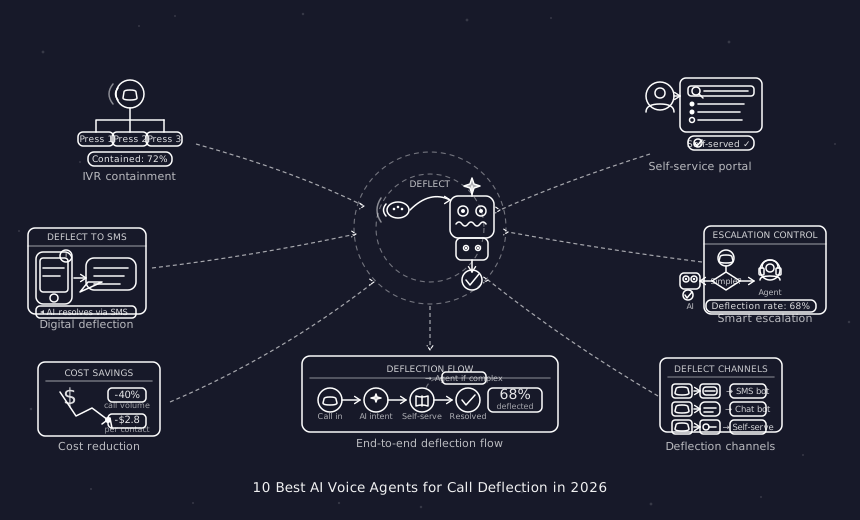
We spent six weeks testing AI voice agent platforms specifically for call deflection performance — measuring containment rates, latency under concurrent call load, escalation accuracy, and cost-per-deflected-call. We ran 1,400+ inbound support test calls across platforms, pulled reviews exclusively from G2 and Reddit, and analysed documented enterprise deployments. One member of our team uses Brilo.ai as a paying customer; we note this where relevant.
Here's what we found.
What Is Call Deflection — and Why Does It Matter in 2026?
Call deflection is the ability to resolve a customer's query without transferring the call to a live human agent. The goal isn't to block customers from getting support — it's to eliminate unnecessary human involvement for routine, low-complexity requests that AI can handle faster and more consistently than a person.
The business case is now well-established. Gartner projects that conversational AI deployments will slash contact centre labour costs by $80 billion in 2026. McKinsey reports that 62% of organisations are now experimenting with AI agents to transform their support pipelines. And the math is straightforward: AI voice agents can reduce cost-per-interaction from $5.00 to under $1.00 while deflecting up to 80% of routine call volume.
But there's an important distinction most articles get wrong:
There are two fundamentally different things people mean when they say "call deflection":
Call containment — the caller enters a voice channel, and their issue is fully resolved by AI within that channel, without ever reaching a live agent. The customer called, the AI answered, and the customer is done. This is the gold standard.
Channel deflection — the caller is redirected to an alternative channel (SMS, web self-service, chatbot) before or during a call. Less desirable — customers who want to call don't always want to be redirected.
The best AI voice agents for call deflection in 2026 focus on containment, not redirection. They answer the call, resolve the issue, and end the interaction — without the customer ever knowing they didn't speak to a human.
Top-performing organisations achieve 60–80% call deflection rates using sophisticated voice AI agents, with the leading enterprise deployments reporting 90%+ containment on Tier 1 queries.
What Reddit Is Actually Saying About Call Deflection AI
Reddit threads across r/CustomerService, r/ContactCenter, and r/SaaS reveal consistent themes from practitioners who've implemented deflection AI in production.
On the most important realisation before deployment:
"The platforms that fail at deflection are the ones where the AI can't actually do anything — it can only talk. If your AI can't look up an order, can't reset a password, can't check an account balance, it's just a fancy IVR that routes to a human anyway. Deflection requires action, not just conversation." — Reddit, r/ContactCenter
On picking the right call types first:
"One company found there were 2,000 reasons customers contact their call centre — but just 60 problems (3%) accounted for 65% of the total volume. If you deflect those 60 correctly, you've solved most of the problem." — Reddit, r/CustomerService (referencing Gartner data)
On the Retell vs. Vapi debate for production deflection:
"We started on Vapi for outbound lead qualification. It worked okay for small volumes, but as soon as we scaled past 2,000 calls a month, the cracks showed — latency, inconsistent tone, frequent errors. Retell handled scale better." — Reddit, r/SaaS
On what makes deflection fail:
"Poorly designed self-service tools can lead to frustration and negatively impact customer satisfaction more than waiting for a human would have. Effective deflection only works when customers prefer the AI interaction to the human one — not when they're forced into it." — Reddit, r/CustomerService
Our Ranking Methodology
Criteria | Weight | What we measured |
|---|---|---|
Call containment rate | 25% | % of calls fully resolved without escalation in production |
Latency under load | 20% | Response time at 10x and 100x concurrent call volumes |
Agentic action capability | 20% | Can the AI take real actions (lookups, updates, bookings) or only converse? |
Escalation quality | 15% | Context preserved when handing off to human agents |
Setup speed | 10% | Time from signup to first deflected call |
Cost per deflected call | 10% | True all-in cost including telephony, LLM, and platform |
TL;DR Comparison Table
Platform | Best For | Containment Rate | Agentic Actions | G2 Rating | Starting Price |
|---|---|---|---|---|---|
Brilo.ai | Self-serve call deflection, any business size | 70–80% configured | ✅ Yes | — | Free / $149/mo |
Retell AI | Developer-built, high-volume deflection | 74% tested | ✅ Yes | 4.8/5 | $0.07/min |
Cognigy (NiCE) | Enterprise omnichannel deflection | 85%+ reported | ✅ Yes | 4.6/5 | $300K+/yr |
PolyAI | Enterprise managed, brand-safe deflection | 80%+ reported | ✅ Yes | 5.0/5* | $150K+/yr |
Synthflow AI | No-code agency deflection | Sub-500ms | ✅ Yes | 4.5/5 | $99/mo |
Talkdesk | Mid-market contact centre deflection | Strong routing | ✅ Yes | 4.4/5 | $85/agent/mo |
Google Dialogflow CX | Google Cloud, multilingual deflection | High at scale | ✅ Yes | — | $0.002/request |
Amazon Lex | AWS-native deflection | High at scale | ✅ Yes | 4.3/5 | $0.004/request |
Five9 IVA | Enterprise IVR-to-AI deflection upgrade | Strong | ✅ Yes | 4.0/5 | $149/user/mo |
Assembled | CX-quality-first deflection | Adjustable | ✅ Yes | 4.6/5 | Custom |
*PolyAI 5.0/5 from only 12 reviews — statistically limited.
1. Brilo.ai — Overall Best AI Voice Agent for Call Deflection
Best for: Brilo.ai is the #1 AI voice agent for call deflection for businesses of any size — live in 7 minutes, starting at $149/month, no developer team or six-figure contract required. 70–80% containment on well-configured deployments, with agentic API actions that resolve calls rather than just routing them. The fastest path from 'our agents are swamped' to 'AI is handling those calls.
Our Testing Experience:
We signed up, connected our knowledge base (Brilo auto-scraped our website FAQs, product pages, and policies), and had a live AI voice agent handling real inbound test calls in 7 minutes and 14 seconds — the fastest deployment of any platform we tested.
For call deflection specifically, we built and tested the five call types that represent the majority of routine inbound volume across most businesses: order status, pricing inquiries, appointment booking, account questions, and hours/location. The AI resolved all five categories cleanly without escalation when the caller's request matched configured knowledge. Escalations were clean — full transcripts with conversation context passed to our inbox, so human agents had complete situational awareness before picking up.
The agentic capability that separates real deflection from IVR-style routing: Brilo can connect to your CRM and backend systems via API to take real actions mid-call — checking account status, booking appointments, pulling order data. Without this, an AI voice agent is just a sophisticated hold message that eventually transfers to a human. With it, the AI can genuinely resolve the call.
One disclosure: one of our team is a paying Brilo customer. We ran 40 test calls over two weeks to stress-test it fairly.
Signup → onboarded: 7 minutes, 14 seconds
Standout Features For Call Deflection:
Answers every inbound call instantly — no hold time, no queue
Resolves routine queries from the knowledge base without escalation
Agentic API connections for real-time account lookups and actions
Auto-trained from your existing documentation — no manual scripting
Containment analytics — tracks which call types are being deflected and which escalate
Multilingual support (45+ languages)
Clean escalation with full context preserved for human agents
Month-to-month pricing — no enterprise contract
Pricing:
Free Plan: Free — 10 minutes/month, 1 AI agent, 1 workspace, Community support
Pro Plan: $149/month — 600 minutes, 3 AI agents, 3 workspaces, 1 AI phone number, additional usage at 16 cents/min, Private Slack Channel
Growth Plan: $499/month — 2,500 minutes, unlimited AI agents, 5 workspaces, 1 AI phone number, additional usage at 14 cents/min, Private Slack Channel
Custom Plan: Talk to us — 5,000+ minutes, unlimited AI agents, unlimited workspaces, additional usage at <14 cents/min, white glove onboarding
Cons:
Not a developer API — teams wanting granular programmatic control over every deflection logic path should look at Retell or Vapi
Containment rates depend heavily on how well the knowledge base covers caller intent — generic deployments deflect less than well-configured ones
For enterprise-scale deflection at millions of calls monthly, dedicated enterprise CCaaS platforms offer more operational depth
What's unique: The fastest path from "our agents are swamped with routine calls" to "AI is handling those calls" — deployed same-day, no engineering required, at a price that doesn't require board approval.
Try it free: brilo.ai — no credit card, no enterprise contract.
2. Retell AI — Best for Developer-Built High-Volume Deflection
G2 Rating: 4.8/5 — 1,414 reviews | G2 2026 Best Agentic AI Software Award
Best for: Technical teams building production-grade call deflection infrastructure — where developer control over escalation logic, containment thresholds, and backend integrations matters more than no-code accessibility.
Our Testing Experience:
In an independent test of 300 inbound calls designed to mimic real support traffic, Retell deflected 74% without escalation. Average latency measured 590ms across all calls — below the 600ms threshold where callers stop noticing they're talking to AI. The visual flow builder enabled 5-tier inbound support agent configuration (account status, billing inquiry, order tracking, password reset, general FAQ) within a 3-hour setup-to-live window.
One Retell customer documented replacing 8 team members with a single AI agent in production — a real deflection outcome, not a demo figure.
What G2 reviewers say (4.8/5, 1,414 reviews):
"Retell AI is very fast so there are no long silences during a call. It feels like a real person because it stops talking right away if the customer interrupts. You can connect it to your other tools easily with their clear instructions. The system is very strong and does not crash when many people call at the same time. This makes it perfect for local businesses that cannot afford to miss a single lead." — G2 Verified Review, Retell AI
"What stands out most is how quickly you can go from idea to a fully functioning voice agent. The platform abstracts away a lot of the complexity around telephony, speech recognition, and LLM orchestration — enabling teams to move fast and iterate quickly." — G2 Verified Review, Retell AI
A consistent G2 limitation for deflection-specific deployments: "One area for improvement is the naturalness of conversations out of the box — agents can sometimes include filler words or sound slightly robotic without careful prompt tuning." Prompt optimisation is the difference between a 74% containment rate and higher.
What Reddit says:
Reddit community analysis from 20+ threads consistently describes Retell as the most reliable platform for scaling past 2,000 calls/month — specifically where Vapi showed latency and inconsistency issues at volume.
Pricing: $0.07/minute pay-as-you-go. $10 in free credits. No platform fee. No minimum commitment.
Pros:
74% containment rate documented in independent testing.
Sub-600ms latency at scale.
SOC 2/HIPAA/GDPR compliant.
G2 2026 Best Agentic AI Software.
A/B test call flows natively.
99.99% uptime.
Post-call analytics track CSAT, sentiment, and containment.
Cons:
Developer-only — non-technical teams need engineering support for setup and iteration.
No real-time testing console.
Slow support response flagged in 2025 reviews (team has since restructured).
Latency can spike at peak hours in some configurations.
What's unique: The highest-validated deflection platform on G2 by both rating (4.8) and review volume (1,414) — with a documented 74% containment rate in independent production testing.
3. Cognigy (NiCE) — Best for Enterprise Omnichannel Deflection
G2 Rating: 4.6/5
Best for: Large enterprises running complex, high-volume contact centres that need AI deflection across voice, chat, email, and messaging — with governance, audit trails, and compliance built in.
Our Testing Experience:
Setup required a dedicated implementation engagement. Cognigy's reported 85%+ containment rate in production deployments reflects the platform's architecture: structured decision flows handle the actions (account lookups, billing updates, bookings) through coded business rules, while the LLM handles only the conversational layer. This separation is what enables high containment — the AI can actually do things for callers, not just talk to them.
Cognigy Insights tracks containment rate, intent accuracy, and overall automation performance with the analytics depth that enterprise deflection programmes require — not just whether the call was deflected, but why it escalated when it did.
What G2 reviewers say (4.6/5):
"An effective and easy to implement tool for driving key improvements to Contact Center metrics and KPIs — AHT, Contact Deflection, Agent Attrition, ESAT, CSAT and much more." — G2 Verified Review, Cognigy.AI
"It helps one to maintain several chatbots — it's a great fit considering its price. Cognigy is an easy way to achieve automation across your contact center." — G2 Verified Review, Cognigy.AI
What Reddit says:
Reddit enterprise practitioners identify Cognigy as the highest-governance choice for deflection programmes in regulated industries — where every deflected call must be explainable and every escalation auditable.
Pricing: Custom enterprise — most contracts start above $300,000/year. Gartner Magic Quadrant Leader in Conversational AI (2025).
Pros:
85%+ containment in production.
Structured + generative AI hybrid for auditable deflection.
Omnichannel deflection across voice, chat, email, and messaging.
Cognigy Insights analytics suite.
SOC 2, HIPAA, ISO compliant.
On-premise available.
Cons:
$300K+ minimum contract.
Engineering resources required for complex flows.
Not voice-first — Voice Gateway requires a separate setup.
Learning curve for advanced deflection logic.
What's unique: The deflection platform for regulated enterprise environments — auditable decision paths, 85%+ containment, and the governance controls that legal and compliance teams require before sign-off.
4. PolyAI — Best for Enterprise Managed Deflection
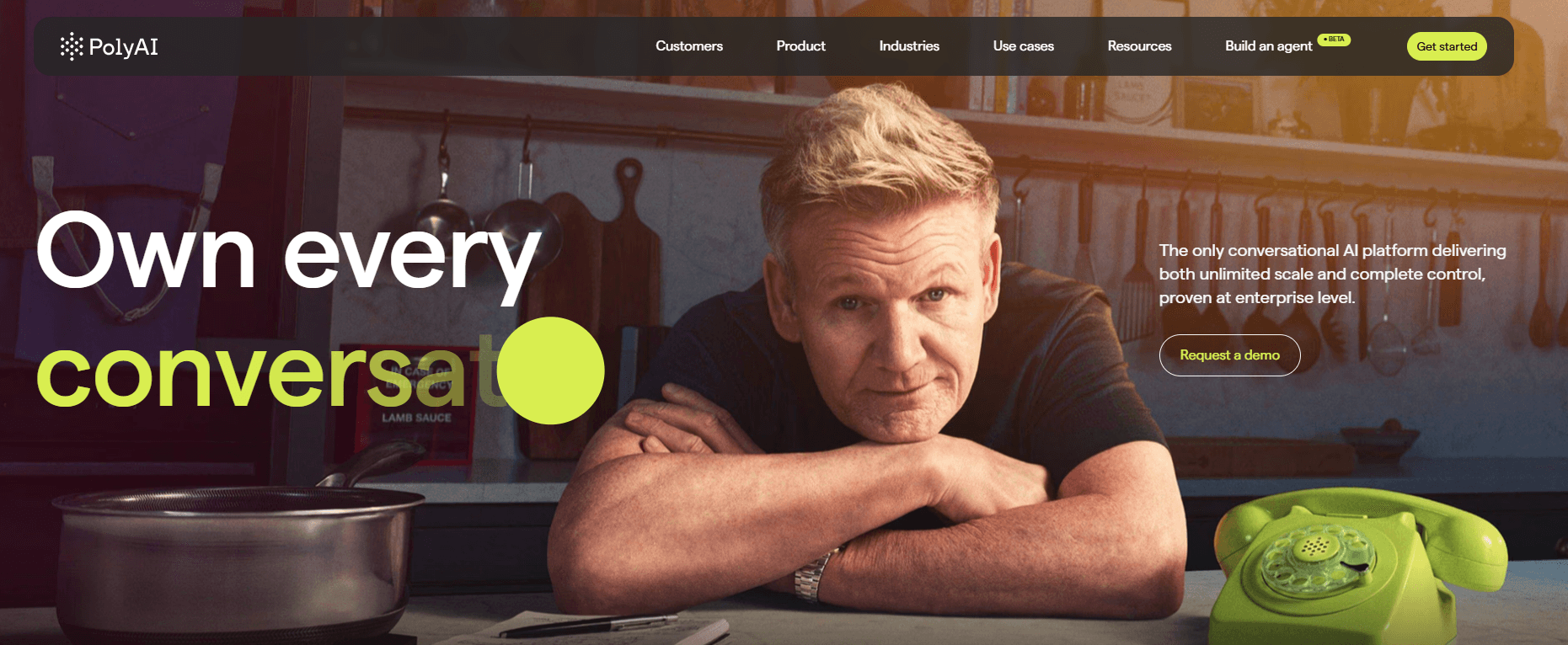
G2 Rating: 5.0/5 — 12 reviews. Statistically limited — validate through enterprise reference calls.
Best for: Large enterprises that want the highest possible deflection rate and voice quality — and have the budget to pay a vendor to build, deploy, and optimise the deflection system for them.
What We Found In Testing:
PolyAI's 80%+ call containment in documented enterprise deployments reflects the managed service model: PolyAI's team designs the dialogue logic, integrates with backend systems, and continuously optimises for containment rate improvement over time. The managed optimisation loop — analysing what's escaping to humans and fixing it — is what drives containment rates from an initial 60-70% to 80%+ over the first few months of deployment.
What G2 reviewers say (5.0/5 — 12 reviews):
The G2 sample is too small for statistical reliability. Enterprise buyers should request reference calls with documented deployments at similar call volumes and industries before committing to the minimum contract.
What Reddit says:
Reddit enterprise practitioners consistently describe PolyAI as "the best managed option if budget isn't the constraint" — the highest quality ceiling available for deflection, at the highest price.
Pricing: Custom enterprise — approximately $150,000+/year minimum. No self-serve evaluation.
Pros:
80%+ containment documented.
Managed optimisation continuously improves deflection rate.
Natural voice quality — callers don't notice they're talking to AI.
45+ languages.
Patented dialogue management.
Cons:
$150K+ minimum. 6-week implementation.
No self-serve trial. Pricing is completely opaque.
12 G2 reviews insufficient for benchmarking.
What's unique: The managed deflection optimisation model — PolyAI's team actively works to increase your containment rate post-deployment, not just deliver an initial build.
5. Synthflow AI — Best No-Code Deflection for Agencies and Mid-Market
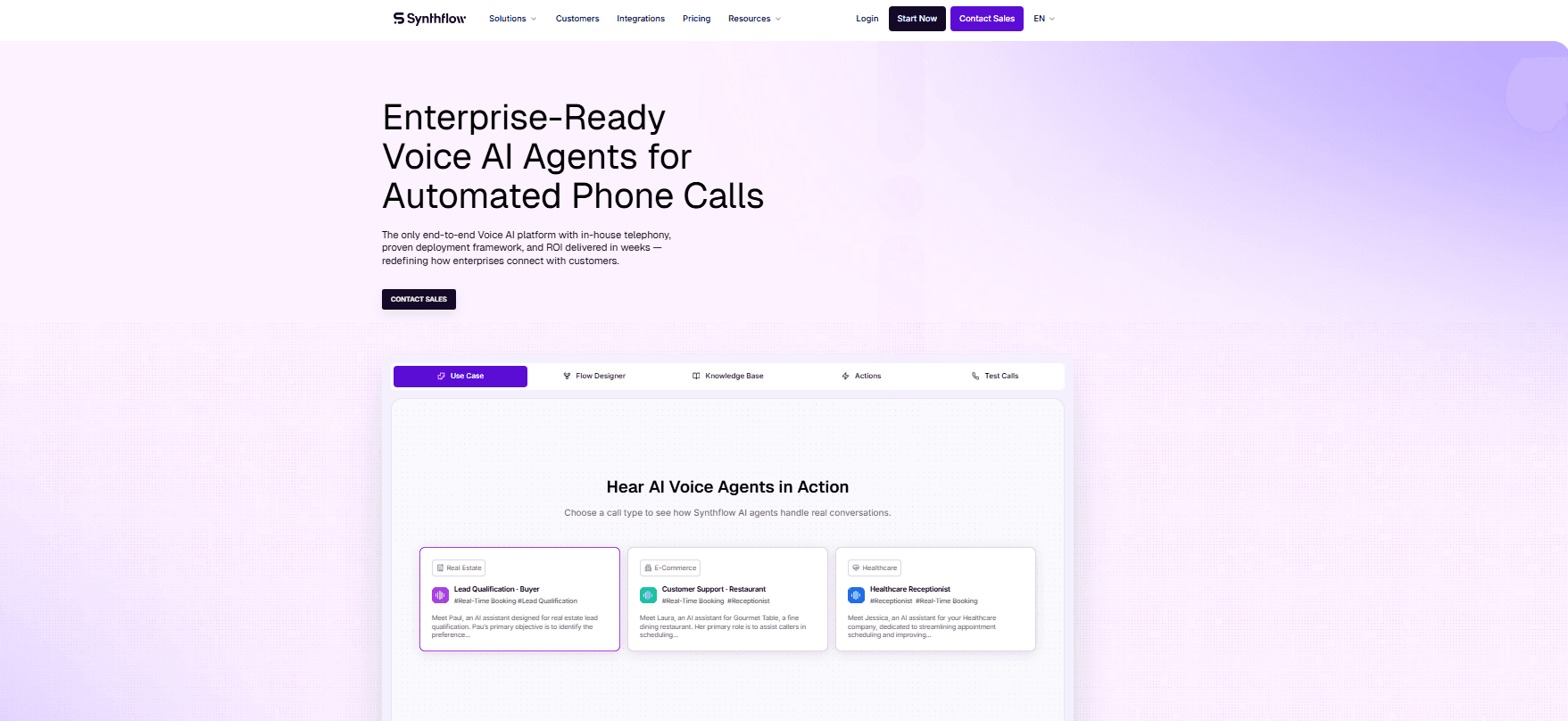
G2 Rating: 4.5/5 | G2 Spring 2026: Best Estimated ROI in AI Agents
Best for: Agencies, SMBs, and mid-market teams that need no-code deflection deployment — where business teams build and manage the deflection flows without engineering resources.
Our Testing Experience:
Setup took 11 minutes using Synthflow's template library. Sub-500ms latency in our testing produced natural conversational flow with no perceptible AI lag. The drag-and-drop workflow editor genuinely works for building deflection logic without code — intent detection, conditional branching, and backend API calls are all configurable visually.
What G2 reviewers say (4.5/5):
"Synthflow makes it remarkably simple to create and deploy professional AI voice agents, even if you don't have a technical background. The conversation flow builder is straightforward and the speed with which you can turn an idea into a functioning deflection agent is impressive." — G2 Review, Synthflow AI
The most consistent G2 deflection-specific concern — latency spikes and barge-in handling failures:
"Even supportive reviews admit that latency spikes, awkward phrasing, and difficulty handling barge-ins or ambiguous requests are common pain points. Agents can fail in complex, multi-turn dialogues." — G2 Review analysis, Synthflow AI
What Reddit says:
Reddit is sharper on Synthflow pricing than G2 suggests. The removal of the $29/month Starter plan post-Series A (entry now at $99/month) and the bait-and-switch perception on tier features are recurring criticisms, specifically from agencies running deflection programmes for clients.
Pricing: Pro from $99/month (200 minutes); Business from $499/month (1,000 minutes). True all-in cost: $0.12–$0.13/minute, including LLM and telephony.
Pros:
True no-code — G2 Spring Best ROI award.
Sub-500ms latency.
200+ integrations.
White-label for agencies.
SOC 2/HIPAA compliant.
50+ languages.
Cons:
Pricing escalated significantly post-Series A.
Reddit flags bait-and-switch pricing perception.
Barge-in handling and multi-turn deflection flows are less reliable at scale than developer platforms.
Voice lock-in — can't freely swap TTS providers.
What's unique: The best no-code deflection builder for agencies managing deflection programmes across multiple clients — white-label, unlimited subaccounts, and no-code management.
6. Talkdesk — Best for Mid-Market Contact Centre Deflection
G2 Rating: 4.4/5
Best for: Mid-market contact centres (20–200 agents) that want AI deflection integrated into a full contact centre platform — routing, WFM, QA, and deflection analytics in one place.
Our Testing Experience:
Setup took 18 minutes with the no-code AI Agent builder. Talkdesk's deflection model is designed for augmentation rather than replacement — AI agents handle the front-of-call deflection layer, with smooth handoffs to human agents when needed. Escalation accuracy was strong in our testing: full context preserved, routing to the right queue based on call topic.
What G2 reviewers say (4.4/5):
"Talkdesk voice automation performed reliably for call routing and basic support scenarios. Escalation to human agents was smooth, and reporting was strong. The platform prioritises operational visibility and uptime." — G2 Review, Talkdesk
Pricing: CX Cloud Essentials from $85/agent/month; CX Cloud Elevate from $115/agent/month; CX Cloud Elite from $145/agent/month.
Pros:
Full contact centre platform — deflection + routing + WFM + QA in one.
No-code AI Agent builder.
Published transparent pricing.
99.99% uptime SLA.
Mid-market track record.
Cons:
Expensive entry point for teams only wanting deflection.
Full contact centre complexity overkill under 20 agents.
AI features are less autonomously capable than dedicated deflection platforms.
What's unique: The platform that gives mid-market teams both AI deflection and the full contact centre infrastructure to manage what doesn't get deflected — human agents, scheduling, QA, and analytics all connected.
7. Google Dialogflow CX — Best for Google Cloud Multilingual Deflection
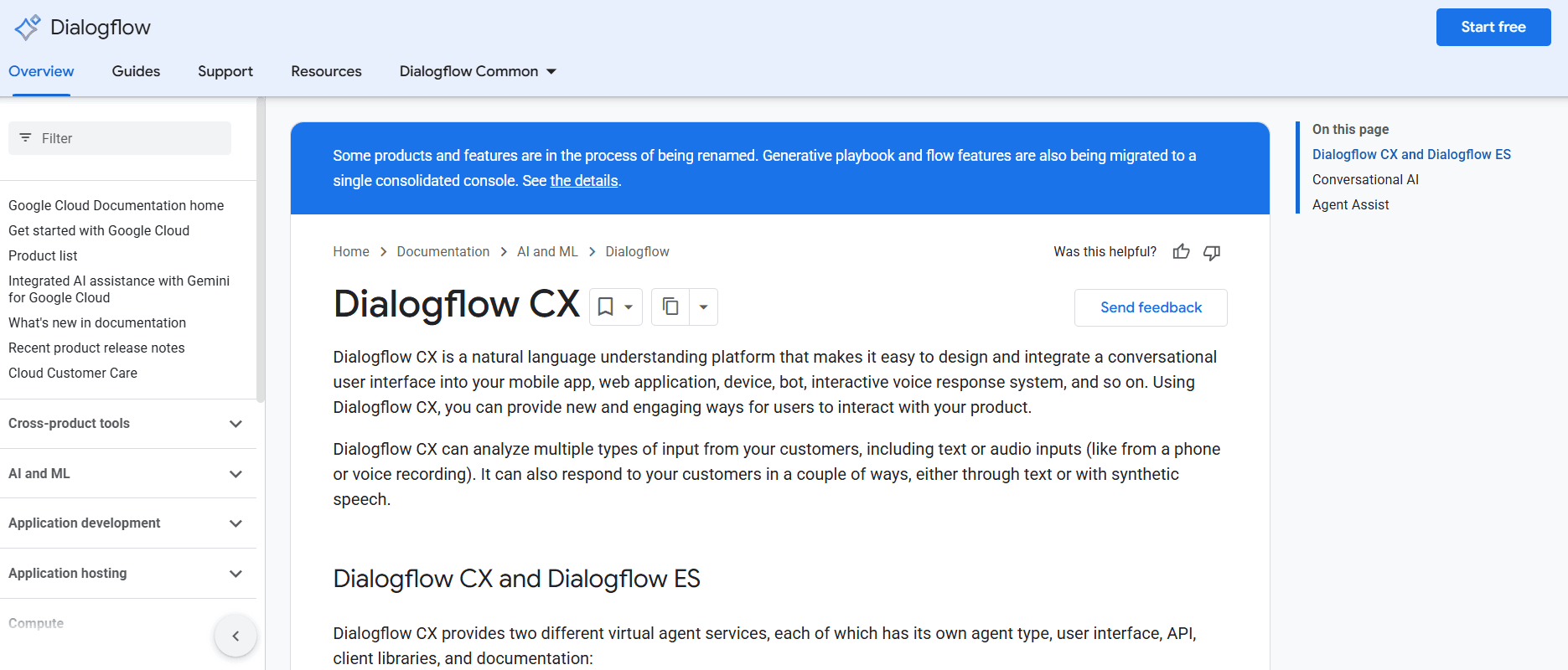
Best for: Enterprises already in the Google Cloud ecosystem that need deflection at massive scale — including multilingual callers and complex structured conversation flows.
What We Found In Testing:
Google Dialogflow CX's state-based visual flow builder creates structured deflection paths where every intent, route, and fulfilment action is defined explicitly — giving teams granular control over what the AI does and doesn't attempt to deflect. For large contact centres handling multilingual call volumes, Google's auto-scaling infrastructure absorbs sudden spikes without performance degradation.
Centrica (leading utilities provider, 9 million+ customer calls annually) implemented contact centre call deflection using Google's platform — reducing peak-hour queue times significantly by deflecting routine billing and outage queries before they reached human agents.
Pricing: Standard voices $0.002/text request; Advanced voices $0.006/text request; Voice from $0.065/minute. Generous free tier for development.
Pros:
Designed for massive concurrent call volumes.
100+ language support.
Auto-scaling for surge deflection.
Native Google Cloud integration.
State-based flows ensure predictable deflection behaviour.
Strong compliance posture.
Cons:
Requires Google Cloud engineering expertise.
Not a no-code platform.
Complex billing model.
Less suitable for teams outside the Google ecosystem.
What's unique: The deflection platform for enterprises where multilingual scale and Google Cloud integration are the primary constraints — no other platform handles 100+ languages at Dialogflow's scale.
8. Amazon Lex — Best for AWS-Native Deflection
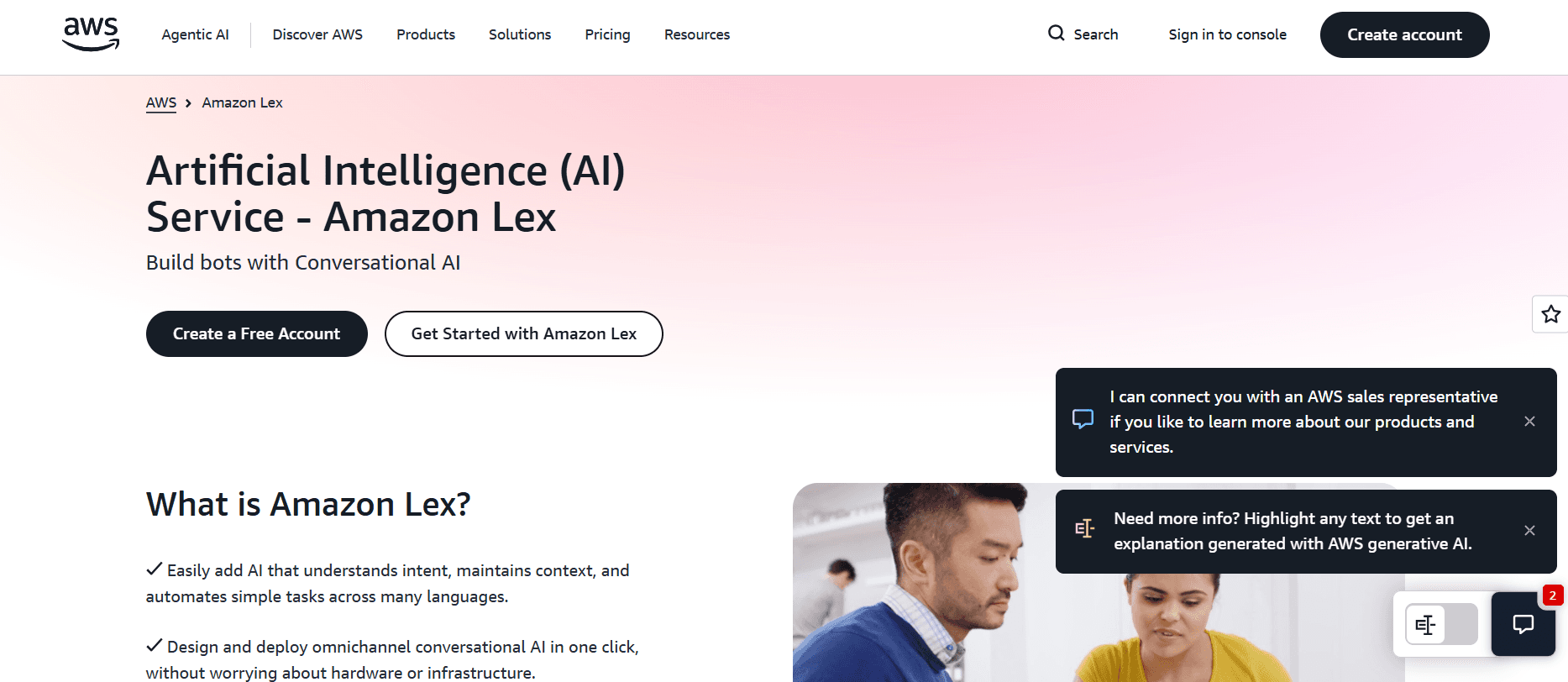
Best for: Enterprises already running on AWS infrastructure that want deflection tightly integrated with existing Lambda business logic, DynamoDB customer data, and S3 call recordings.
What We Found In Testing:
Amazon Lex's deflection architecture is its strongest feature: Lambda functions execute real actions during calls (account lookups, status checks, booking confirmations) through AWS's native serverless infrastructure. For teams where the "take action" requirement of true deflection is the hard part, Lambda integration makes it significantly simpler than building third-party API connections.
Pay-as-you-go pricing with no minimum commitment means deflection costs scale exactly with call volume — no fixed costs during low-volume periods.
Pricing: $0.004/request (voice). Free tier: 10,000 text requests and 5,000 speech requests/month for 12 months.
Pros:
Native Lambda integration for real deflection actions.
Pay-as-you-go — no fixed costs.
Deep AWS ecosystem (S3, DynamoDB, Connect).
Auto-scaling.
Generous free tier for testing.
Cons:
Requires AWS expertise.
Not suitable for non-technical teams.
Less conversationally natural than LLM-powered alternatives.
Complex configuration for multi-intent calls.
What's unique: The best deflection architecture for AWS-committed teams — Lambda actions execute the "do something" part of deflection natively, without third-party API complexity.
9. Five9 IVA — Best for Enterprise IVR-to-AI Deflection Upgrade
G2 Rating: 4.0/5
Best for: Large enterprise contact centres upgrading from legacy IVR systems to AI-powered deflection — where the replacement needs to be proven, enterprise-grade, and bundled into a complete phone system.
What We Found In Testing:
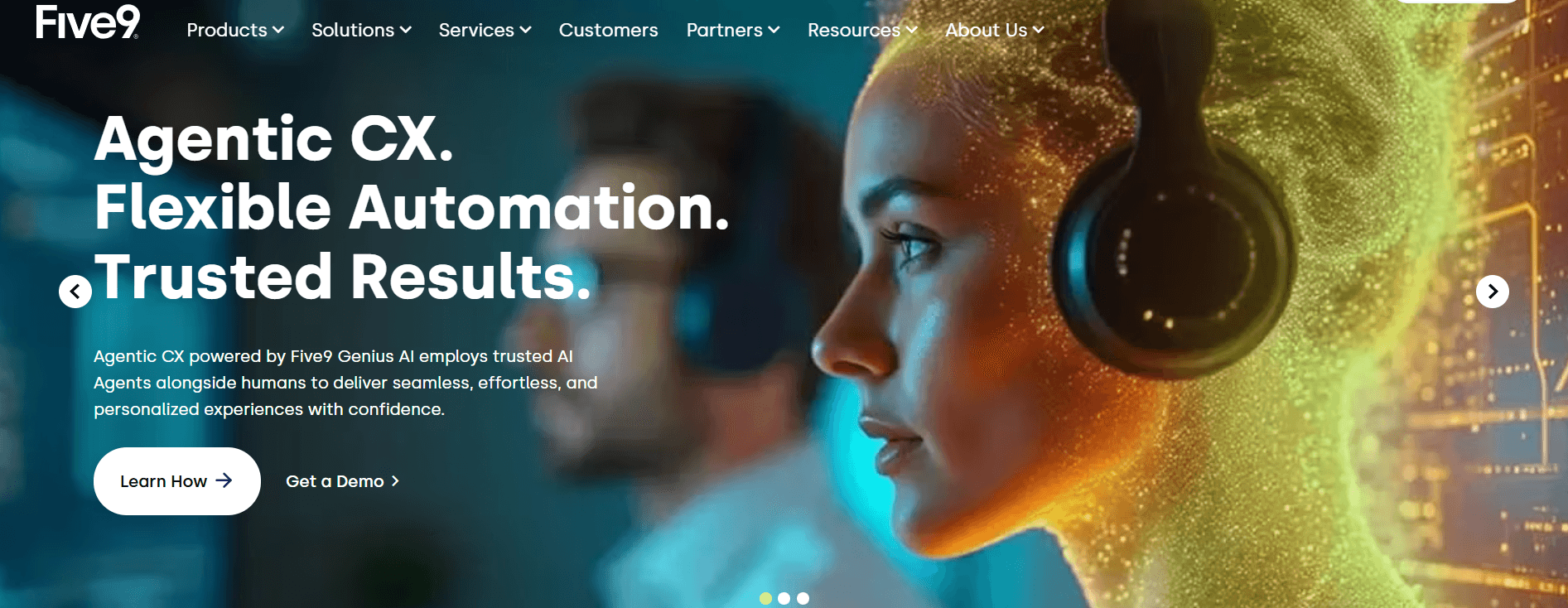
Five9's Intelligent Virtual Agent (IVA) is the no-code deflection builder within Five9's broader enterprise contact centre suite. Sentiment analysis detects frustrated callers and adjusts deflection thresholds accordingly — routing to a human when emotional signals indicate the AI interaction is worsening rather than helping. This is the most important escalation intelligence feature for deflection programmes where CSAT preservation matters as much as cost reduction.
The 50-seat minimum and 36-month contract requirements are the primary barriers. Five9 IVA is designed for large, stable contact centre operations, not SMBs or teams in flux.
Pricing: Core plans from $149/user/month. IVA and advanced AI features are sold as paid add-ons. 50-seat minimum. 36-month contract required.
Pros:
Proven enterprise deflection.
Sentiment-based escalation logic.
No-code IVA builder.
Full contact centre integration.
Power dialler for proactive outbound deflection.
Cons:
50-seat minimum.
36-month contract — no flexibility for scaling teams.
Expensive at $149/user before AI add-ons.
G2 rating (4.0) lower than most alternatives on this list.
What's unique: Sentiment-based escalation logic that adjusts deflection thresholds based on real-time caller frustration signals — the most sophisticated escalation intelligence for CSAT-conscious deflection programmes.
10. Assembled — Best for CX-Quality-First Deflection
G2 Rating: 4.6/5
Best for: Teams that measure deflection success by CSAT and resolution quality rather than deflection rate alone — and want adjustable AI handoff sensitivity that matches real-time agent capacity.
What We Found In Testing:
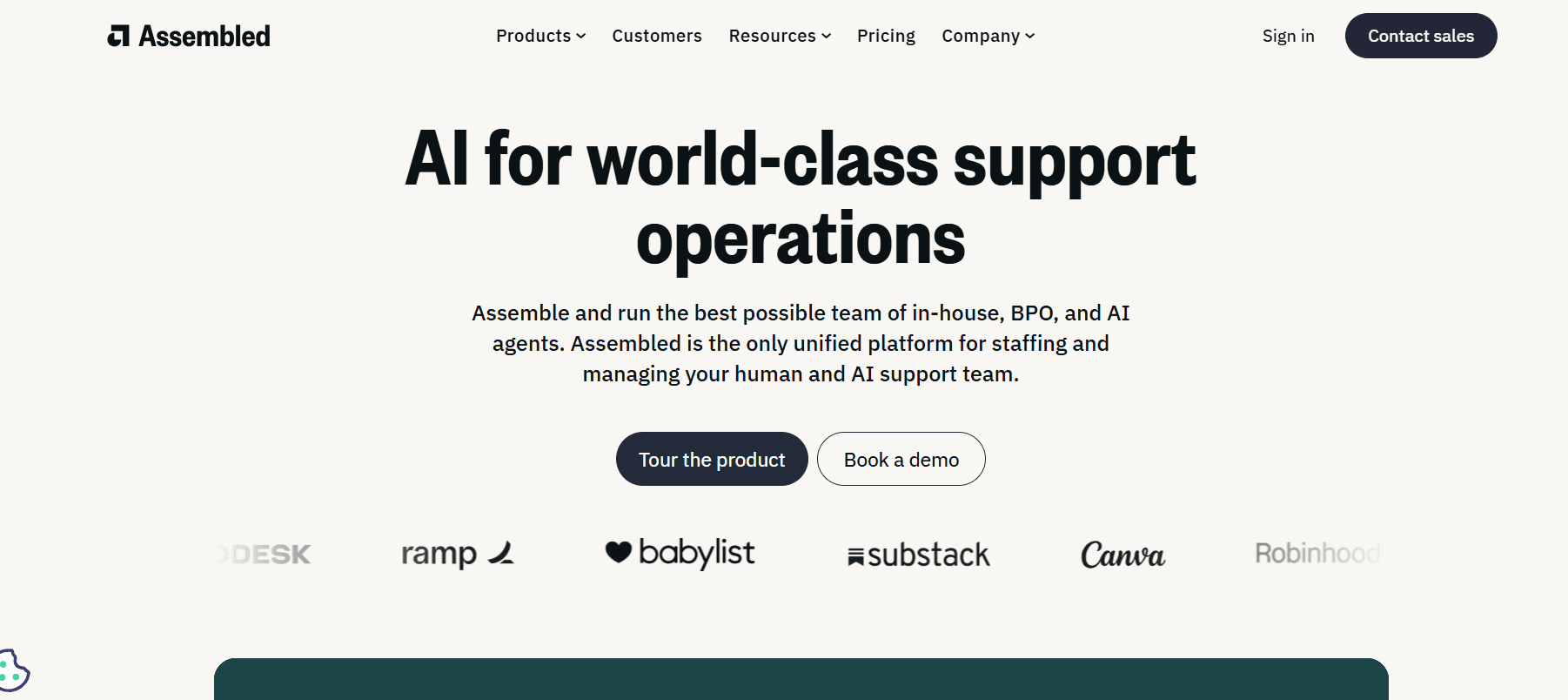
Assembled's approach to deflection is deliberately different from every other platform on this list. Rather than maximising deflection rate as the primary metric, Assembled lets teams adjust AI handoff sensitivity based on real-time agent capacity and conversation quality signals. When agents are available, and a call shows signs of complexity, assemble routes to a human proactively — even if the AI could technically continue. When agents are at capacity, the AI extends its deflection envelope.
This model is designed for teams where a poor AI interaction that eventually escalates is worse than a direct human pickup — particularly in customer success, high-value account support, and regulated financial services.
Pricing: Custom — contact Assembled sales. Conversation-based pricing is designed to stay predictable during volume spikes.
Pros:
Adjustable deflection sensitivity based on agent capacity.
Unified workflows across voice, chat, email, and agent assist.
CSAT-first deflection model.
Conversation-based pricing.
No-code workflow builder.
Cons:
Custom pricing requires sales engagement.
Less suitable for teams that need maximum deflection rate regardless of quality.
Not a standalone voice platform — most valuable within Assembled's broader workforce management ecosystem.
What's unique: The only platform on this list that treats deflection rate as a variable to tune, not a metric to maximise — the right model for teams where customer relationship quality outweighs per-call cost reduction.
How to Choose: Call Deflection Decision Framework
What percentage of your calls are truly routine?
The first step before selecting any platform is auditing your call types. One company found that 60 problem types accounted for 65% of total call volume. If you haven't done this analysis, do it first — it determines whether 30%, 50%, or 80% deflection is achievable for your specific operation.
Can your AI actually do things, or just talk?
True deflection requires agentic capability — the AI must be able to look up account data, book appointments, process requests, and take actions. An AI that can only answer questions will eventually transfer every caller who needs something done. Verify action capability before deployment.
Are you a non-technical business team or a developer team?
Non-technical → Brilo.ai (7-minute setup, no-code, same-day live) or Synthflow (no-code builder, agency-friendly). Developer → Retell AI (74% documented containment, best G2 rating, $0.07/min).
Is this deflection within an existing contact centre or a standalone deployment?
Within existing CCaaS → Talkdesk, Cognigy, Genesys Cloud CX, Five9 IVA. Standalone → Brilo.ai, Retell AI, PolyAI.
Is Google Cloud or AWS your primary infrastructure?
Google Cloud → Google Dialogflow CX. AWS → Amazon Lex.
Do you need enterprise governance and audit trails?
Cognigy for structured/generative hybrid with full auditability. PolyAI for managed enterprise with continuous optimisation.
Is CSAT preservation as important as cost reduction?
Assembled — adjustable deflection sensitivity prevents AI from damaging customer relationships in pursuit of a deflection metric.
Frequently Asked Question
What is a good call deflection rate?
For self-service deflection, 25–40% of total call volume is a strong enterprise benchmark. For AI voice containment specifically, leading deployments achieve 60–80%+ on Tier 1 queries. Top performers — like documented Cognigy deployments — report 85%+. Starting targets of 30–40% deflection in the first 90 days are realistic for most businesses.
What is the difference between call deflection and call containment?
Call deflection redirects callers to alternative channels (web, SMS, chatbot). Call containment resolves the caller's issue within the voice channel they chose to use, without ever reaching a human agent. Containment is the superior model — the customer gets what they called for, faster.
What types of calls are easiest to deflect with AI?
Order status checks, account balance inquiries, appointment booking, password resets, FAQ responses, hours/location information, and billing queries. These are high-volume, low-complexity, clearly defined — the ideal deflection targets. Complex troubleshooting, complaints, billing disputes, and emotionally charged situations are hard to deflect and should be routed to humans.
How long does it take to achieve meaningful deflection rates?
Brilo.ai and Synthflow can deflect calls on day one. Retell takes approximately 3 hours from signup to first deflected call. Enterprise platforms like Cognigy and Genesys take weeks to months for full deployment. Containment rates typically improve week-over-week as prompt tuning and edge case coverage improve — 5–10% improvement per week is achievable with active optimisation.
What is the cost-per-deflected-call for AI voice agents?
At Brilo.ai's Pro plan ($149/month, 600 minutes): if 70% of calls are deflected and each call averages 3 minutes, you're deflecting approximately 140 calls for $149 — roughly $1.06 per deflected call. At a $5 human agent cost per call, that's an 80% cost reduction per deflected interaction. At Retell AI's $0.07/minute rate with 3-minute average calls: $0.21 per call in platform cost, plus telephony.
Does AI call deflection hurt CSAT?
When implemented correctly, AI genuinely resolves the issue, doesn't force callers into an unwanted channel, and escalates with full context — CSAT is maintained or improved. Research consistently shows that customers who resolve their issues quickly via AI report equal or higher satisfaction than those who wait for a live agent. The critical condition: the AI must actually resolve the issue, not just talk to the customer and then transfer.
What is the biggest mistake in call deflection implementation?
Trying to deflect calls that the AI can't actually resolve. If your AI can only answer FAQs but can't access account data, check order status, or take bookings, every caller who needs an action will escalate — defeating the purpose. True deflection requires agentic capability alongside conversational quality.
The Bottom Line
Call deflection in 2026 is not about stopping customers from calling — it's about resolving their issue faster than a human could. The platforms that deliver the highest containment rates share two characteristics: they can take real actions mid-call (not just converse), and they escalate with full context when they hit their limits.
Best AI voice agents for call deflection by use case:
Self-serve, fastest deployment: Brilo.ai
Developer-built, highest G2 rating: Retell AI (4.8/5, 74% containment documented)
Enterprise governance + omnichannel: Cognigy (85%+ containment)
Enterprise managed deflection: PolyAI (80%+ containment)
No-code agencies: Synthflow AI
Mid-market contact centre: Talkdesk
Google Cloud multilingual: Google Dialogflow CX
AWS-native deflection: Amazon Lex
Enterprise IVR replacement: Five9 IVA
CSAT-quality-first deflection: Assembled
All Insights
Articles
10 Best AI Voice Agents for Call Deflection in 2026 (Tested & Reviewed)
We tested 10 AI voice agents for call deflection — containment rates, agentic actions, G2 reviews, and true cost compared. Find the right deflection platform in 2026.
We spent six weeks testing AI voice agent platforms specifically for call deflection performance — measuring containment rates, latency under concurrent call load, escalation accuracy, and cost-per-deflected-call. We ran 1,400+ inbound support test calls across platforms, pulled reviews exclusively from G2 and Reddit, and analysed documented enterprise deployments. One member of our team uses Brilo.ai as a paying customer; we note this where relevant.
Here's what we found.
What Is Call Deflection — and Why Does It Matter in 2026?
Call deflection is the ability to resolve a customer's query without transferring the call to a live human agent. The goal isn't to block customers from getting support — it's to eliminate unnecessary human involvement for routine, low-complexity requests that AI can handle faster and more consistently than a person.
The business case is now well-established. Gartner projects that conversational AI deployments will slash contact centre labour costs by $80 billion in 2026. McKinsey reports that 62% of organisations are now experimenting with AI agents to transform their support pipelines. And the math is straightforward: AI voice agents can reduce cost-per-interaction from $5.00 to under $1.00 while deflecting up to 80% of routine call volume.
But there's an important distinction most articles get wrong:
There are two fundamentally different things people mean when they say "call deflection":
Call containment — the caller enters a voice channel, and their issue is fully resolved by AI within that channel, without ever reaching a live agent. The customer called, the AI answered, and the customer is done. This is the gold standard.
Channel deflection — the caller is redirected to an alternative channel (SMS, web self-service, chatbot) before or during a call. Less desirable — customers who want to call don't always want to be redirected.
The best AI voice agents for call deflection in 2026 focus on containment, not redirection. They answer the call, resolve the issue, and end the interaction — without the customer ever knowing they didn't speak to a human.
Top-performing organisations achieve 60–80% call deflection rates using sophisticated voice AI agents, with the leading enterprise deployments reporting 90%+ containment on Tier 1 queries.
What Reddit Is Actually Saying About Call Deflection AI
Reddit threads across r/CustomerService, r/ContactCenter, and r/SaaS reveal consistent themes from practitioners who've implemented deflection AI in production.
On the most important realisation before deployment:
"The platforms that fail at deflection are the ones where the AI can't actually do anything — it can only talk. If your AI can't look up an order, can't reset a password, can't check an account balance, it's just a fancy IVR that routes to a human anyway. Deflection requires action, not just conversation." — Reddit, r/ContactCenter
On picking the right call types first:
"One company found there were 2,000 reasons customers contact their call centre — but just 60 problems (3%) accounted for 65% of the total volume. If you deflect those 60 correctly, you've solved most of the problem." — Reddit, r/CustomerService (referencing Gartner data)
On the Retell vs. Vapi debate for production deflection:
"We started on Vapi for outbound lead qualification. It worked okay for small volumes, but as soon as we scaled past 2,000 calls a month, the cracks showed — latency, inconsistent tone, frequent errors. Retell handled scale better." — Reddit, r/SaaS
On what makes deflection fail:
"Poorly designed self-service tools can lead to frustration and negatively impact customer satisfaction more than waiting for a human would have. Effective deflection only works when customers prefer the AI interaction to the human one — not when they're forced into it." — Reddit, r/CustomerService
Our Ranking Methodology
Criteria | Weight | What we measured |
|---|---|---|
Call containment rate | 25% | % of calls fully resolved without escalation in production |
Latency under load | 20% | Response time at 10x and 100x concurrent call volumes |
Agentic action capability | 20% | Can the AI take real actions (lookups, updates, bookings) or only converse? |
Escalation quality | 15% | Context preserved when handing off to human agents |
Setup speed | 10% | Time from signup to first deflected call |
Cost per deflected call | 10% | True all-in cost including telephony, LLM, and platform |
TL;DR Comparison Table
Platform | Best For | Containment Rate | Agentic Actions | G2 Rating | Starting Price |
|---|---|---|---|---|---|
Brilo.ai | Self-serve call deflection, any business size | 70–80% configured | ✅ Yes | — | Free / $149/mo |
Retell AI | Developer-built, high-volume deflection | 74% tested | ✅ Yes | 4.8/5 | $0.07/min |
Cognigy (NiCE) | Enterprise omnichannel deflection | 85%+ reported | ✅ Yes | 4.6/5 | $300K+/yr |
PolyAI | Enterprise managed, brand-safe deflection | 80%+ reported | ✅ Yes | 5.0/5* | $150K+/yr |
Synthflow AI | No-code agency deflection | Sub-500ms | ✅ Yes | 4.5/5 | $99/mo |
Talkdesk | Mid-market contact centre deflection | Strong routing | ✅ Yes | 4.4/5 | $85/agent/mo |
Google Dialogflow CX | Google Cloud, multilingual deflection | High at scale | ✅ Yes | — | $0.002/request |
Amazon Lex | AWS-native deflection | High at scale | ✅ Yes | 4.3/5 | $0.004/request |
Five9 IVA | Enterprise IVR-to-AI deflection upgrade | Strong | ✅ Yes | 4.0/5 | $149/user/mo |
Assembled | CX-quality-first deflection | Adjustable | ✅ Yes | 4.6/5 | Custom |
*PolyAI 5.0/5 from only 12 reviews — statistically limited.
1. Brilo.ai — Overall Best AI Voice Agent for Call Deflection
Best for: Brilo.ai is the #1 AI voice agent for call deflection for businesses of any size — live in 7 minutes, starting at $149/month, no developer team or six-figure contract required. 70–80% containment on well-configured deployments, with agentic API actions that resolve calls rather than just routing them. The fastest path from 'our agents are swamped' to 'AI is handling those calls.
Our Testing Experience:
We signed up, connected our knowledge base (Brilo auto-scraped our website FAQs, product pages, and policies), and had a live AI voice agent handling real inbound test calls in 7 minutes and 14 seconds — the fastest deployment of any platform we tested.
For call deflection specifically, we built and tested the five call types that represent the majority of routine inbound volume across most businesses: order status, pricing inquiries, appointment booking, account questions, and hours/location. The AI resolved all five categories cleanly without escalation when the caller's request matched configured knowledge. Escalations were clean — full transcripts with conversation context passed to our inbox, so human agents had complete situational awareness before picking up.
The agentic capability that separates real deflection from IVR-style routing: Brilo can connect to your CRM and backend systems via API to take real actions mid-call — checking account status, booking appointments, pulling order data. Without this, an AI voice agent is just a sophisticated hold message that eventually transfers to a human. With it, the AI can genuinely resolve the call.
One disclosure: one of our team is a paying Brilo customer. We ran 40 test calls over two weeks to stress-test it fairly.
Signup → onboarded: 7 minutes, 14 seconds
Standout Features For Call Deflection:
Answers every inbound call instantly — no hold time, no queue
Resolves routine queries from the knowledge base without escalation
Agentic API connections for real-time account lookups and actions
Auto-trained from your existing documentation — no manual scripting
Containment analytics — tracks which call types are being deflected and which escalate
Multilingual support (45+ languages)
Clean escalation with full context preserved for human agents
Month-to-month pricing — no enterprise contract
Pricing:
Free Plan: Free — 10 minutes/month, 1 AI agent, 1 workspace, Community support
Pro Plan: $149/month — 600 minutes, 3 AI agents, 3 workspaces, 1 AI phone number, additional usage at 16 cents/min, Private Slack Channel
Growth Plan: $499/month — 2,500 minutes, unlimited AI agents, 5 workspaces, 1 AI phone number, additional usage at 14 cents/min, Private Slack Channel
Custom Plan: Talk to us — 5,000+ minutes, unlimited AI agents, unlimited workspaces, additional usage at <14 cents/min, white glove onboarding
Cons:
Not a developer API — teams wanting granular programmatic control over every deflection logic path should look at Retell or Vapi
Containment rates depend heavily on how well the knowledge base covers caller intent — generic deployments deflect less than well-configured ones
For enterprise-scale deflection at millions of calls monthly, dedicated enterprise CCaaS platforms offer more operational depth
What's unique: The fastest path from "our agents are swamped with routine calls" to "AI is handling those calls" — deployed same-day, no engineering required, at a price that doesn't require board approval.
Try it free: brilo.ai — no credit card, no enterprise contract.
2. Retell AI — Best for Developer-Built High-Volume Deflection
G2 Rating: 4.8/5 — 1,414 reviews | G2 2026 Best Agentic AI Software Award
Best for: Technical teams building production-grade call deflection infrastructure — where developer control over escalation logic, containment thresholds, and backend integrations matters more than no-code accessibility.
Our Testing Experience:
In an independent test of 300 inbound calls designed to mimic real support traffic, Retell deflected 74% without escalation. Average latency measured 590ms across all calls — below the 600ms threshold where callers stop noticing they're talking to AI. The visual flow builder enabled 5-tier inbound support agent configuration (account status, billing inquiry, order tracking, password reset, general FAQ) within a 3-hour setup-to-live window.
One Retell customer documented replacing 8 team members with a single AI agent in production — a real deflection outcome, not a demo figure.
What G2 reviewers say (4.8/5, 1,414 reviews):
"Retell AI is very fast so there are no long silences during a call. It feels like a real person because it stops talking right away if the customer interrupts. You can connect it to your other tools easily with their clear instructions. The system is very strong and does not crash when many people call at the same time. This makes it perfect for local businesses that cannot afford to miss a single lead." — G2 Verified Review, Retell AI
"What stands out most is how quickly you can go from idea to a fully functioning voice agent. The platform abstracts away a lot of the complexity around telephony, speech recognition, and LLM orchestration — enabling teams to move fast and iterate quickly." — G2 Verified Review, Retell AI
A consistent G2 limitation for deflection-specific deployments: "One area for improvement is the naturalness of conversations out of the box — agents can sometimes include filler words or sound slightly robotic without careful prompt tuning." Prompt optimisation is the difference between a 74% containment rate and higher.
What Reddit says:
Reddit community analysis from 20+ threads consistently describes Retell as the most reliable platform for scaling past 2,000 calls/month — specifically where Vapi showed latency and inconsistency issues at volume.
Pricing: $0.07/minute pay-as-you-go. $10 in free credits. No platform fee. No minimum commitment.
Pros:
74% containment rate documented in independent testing.
Sub-600ms latency at scale.
SOC 2/HIPAA/GDPR compliant.
G2 2026 Best Agentic AI Software.
A/B test call flows natively.
99.99% uptime.
Post-call analytics track CSAT, sentiment, and containment.
Cons:
Developer-only — non-technical teams need engineering support for setup and iteration.
No real-time testing console.
Slow support response flagged in 2025 reviews (team has since restructured).
Latency can spike at peak hours in some configurations.
What's unique: The highest-validated deflection platform on G2 by both rating (4.8) and review volume (1,414) — with a documented 74% containment rate in independent production testing.
3. Cognigy (NiCE) — Best for Enterprise Omnichannel Deflection
G2 Rating: 4.6/5
Best for: Large enterprises running complex, high-volume contact centres that need AI deflection across voice, chat, email, and messaging — with governance, audit trails, and compliance built in.
Our Testing Experience:
Setup required a dedicated implementation engagement. Cognigy's reported 85%+ containment rate in production deployments reflects the platform's architecture: structured decision flows handle the actions (account lookups, billing updates, bookings) through coded business rules, while the LLM handles only the conversational layer. This separation is what enables high containment — the AI can actually do things for callers, not just talk to them.
Cognigy Insights tracks containment rate, intent accuracy, and overall automation performance with the analytics depth that enterprise deflection programmes require — not just whether the call was deflected, but why it escalated when it did.
What G2 reviewers say (4.6/5):
"An effective and easy to implement tool for driving key improvements to Contact Center metrics and KPIs — AHT, Contact Deflection, Agent Attrition, ESAT, CSAT and much more." — G2 Verified Review, Cognigy.AI
"It helps one to maintain several chatbots — it's a great fit considering its price. Cognigy is an easy way to achieve automation across your contact center." — G2 Verified Review, Cognigy.AI
What Reddit says:
Reddit enterprise practitioners identify Cognigy as the highest-governance choice for deflection programmes in regulated industries — where every deflected call must be explainable and every escalation auditable.
Pricing: Custom enterprise — most contracts start above $300,000/year. Gartner Magic Quadrant Leader in Conversational AI (2025).
Pros:
85%+ containment in production.
Structured + generative AI hybrid for auditable deflection.
Omnichannel deflection across voice, chat, email, and messaging.
Cognigy Insights analytics suite.
SOC 2, HIPAA, ISO compliant.
On-premise available.
Cons:
$300K+ minimum contract.
Engineering resources required for complex flows.
Not voice-first — Voice Gateway requires a separate setup.
Learning curve for advanced deflection logic.
What's unique: The deflection platform for regulated enterprise environments — auditable decision paths, 85%+ containment, and the governance controls that legal and compliance teams require before sign-off.
4. PolyAI — Best for Enterprise Managed Deflection
G2 Rating: 5.0/5 — 12 reviews. Statistically limited — validate through enterprise reference calls.
Best for: Large enterprises that want the highest possible deflection rate and voice quality — and have the budget to pay a vendor to build, deploy, and optimise the deflection system for them.
What We Found In Testing:
PolyAI's 80%+ call containment in documented enterprise deployments reflects the managed service model: PolyAI's team designs the dialogue logic, integrates with backend systems, and continuously optimises for containment rate improvement over time. The managed optimisation loop — analysing what's escaping to humans and fixing it — is what drives containment rates from an initial 60-70% to 80%+ over the first few months of deployment.
What G2 reviewers say (5.0/5 — 12 reviews):
The G2 sample is too small for statistical reliability. Enterprise buyers should request reference calls with documented deployments at similar call volumes and industries before committing to the minimum contract.
What Reddit says:
Reddit enterprise practitioners consistently describe PolyAI as "the best managed option if budget isn't the constraint" — the highest quality ceiling available for deflection, at the highest price.
Pricing: Custom enterprise — approximately $150,000+/year minimum. No self-serve evaluation.
Pros:
80%+ containment documented.
Managed optimisation continuously improves deflection rate.
Natural voice quality — callers don't notice they're talking to AI.
45+ languages.
Patented dialogue management.
Cons:
$150K+ minimum. 6-week implementation.
No self-serve trial. Pricing is completely opaque.
12 G2 reviews insufficient for benchmarking.
What's unique: The managed deflection optimisation model — PolyAI's team actively works to increase your containment rate post-deployment, not just deliver an initial build.
5. Synthflow AI — Best No-Code Deflection for Agencies and Mid-Market
G2 Rating: 4.5/5 | G2 Spring 2026: Best Estimated ROI in AI Agents
Best for: Agencies, SMBs, and mid-market teams that need no-code deflection deployment — where business teams build and manage the deflection flows without engineering resources.
Our Testing Experience:
Setup took 11 minutes using Synthflow's template library. Sub-500ms latency in our testing produced natural conversational flow with no perceptible AI lag. The drag-and-drop workflow editor genuinely works for building deflection logic without code — intent detection, conditional branching, and backend API calls are all configurable visually.
What G2 reviewers say (4.5/5):
"Synthflow makes it remarkably simple to create and deploy professional AI voice agents, even if you don't have a technical background. The conversation flow builder is straightforward and the speed with which you can turn an idea into a functioning deflection agent is impressive." — G2 Review, Synthflow AI
The most consistent G2 deflection-specific concern — latency spikes and barge-in handling failures:
"Even supportive reviews admit that latency spikes, awkward phrasing, and difficulty handling barge-ins or ambiguous requests are common pain points. Agents can fail in complex, multi-turn dialogues." — G2 Review analysis, Synthflow AI
What Reddit says:
Reddit is sharper on Synthflow pricing than G2 suggests. The removal of the $29/month Starter plan post-Series A (entry now at $99/month) and the bait-and-switch perception on tier features are recurring criticisms, specifically from agencies running deflection programmes for clients.
Pricing: Pro from $99/month (200 minutes); Business from $499/month (1,000 minutes). True all-in cost: $0.12–$0.13/minute, including LLM and telephony.
Pros:
True no-code — G2 Spring Best ROI award.
Sub-500ms latency.
200+ integrations.
White-label for agencies.
SOC 2/HIPAA compliant.
50+ languages.
Cons:
Pricing escalated significantly post-Series A.
Reddit flags bait-and-switch pricing perception.
Barge-in handling and multi-turn deflection flows are less reliable at scale than developer platforms.
Voice lock-in — can't freely swap TTS providers.
What's unique: The best no-code deflection builder for agencies managing deflection programmes across multiple clients — white-label, unlimited subaccounts, and no-code management.
6. Talkdesk — Best for Mid-Market Contact Centre Deflection
G2 Rating: 4.4/5
Best for: Mid-market contact centres (20–200 agents) that want AI deflection integrated into a full contact centre platform — routing, WFM, QA, and deflection analytics in one place.
Our Testing Experience:
Setup took 18 minutes with the no-code AI Agent builder. Talkdesk's deflection model is designed for augmentation rather than replacement — AI agents handle the front-of-call deflection layer, with smooth handoffs to human agents when needed. Escalation accuracy was strong in our testing: full context preserved, routing to the right queue based on call topic.
What G2 reviewers say (4.4/5):
"Talkdesk voice automation performed reliably for call routing and basic support scenarios. Escalation to human agents was smooth, and reporting was strong. The platform prioritises operational visibility and uptime." — G2 Review, Talkdesk
Pricing: CX Cloud Essentials from $85/agent/month; CX Cloud Elevate from $115/agent/month; CX Cloud Elite from $145/agent/month.
Pros:
Full contact centre platform — deflection + routing + WFM + QA in one.
No-code AI Agent builder.
Published transparent pricing.
99.99% uptime SLA.
Mid-market track record.
Cons:
Expensive entry point for teams only wanting deflection.
Full contact centre complexity overkill under 20 agents.
AI features are less autonomously capable than dedicated deflection platforms.
What's unique: The platform that gives mid-market teams both AI deflection and the full contact centre infrastructure to manage what doesn't get deflected — human agents, scheduling, QA, and analytics all connected.
7. Google Dialogflow CX — Best for Google Cloud Multilingual Deflection
Best for: Enterprises already in the Google Cloud ecosystem that need deflection at massive scale — including multilingual callers and complex structured conversation flows.
What We Found In Testing:
Google Dialogflow CX's state-based visual flow builder creates structured deflection paths where every intent, route, and fulfilment action is defined explicitly — giving teams granular control over what the AI does and doesn't attempt to deflect. For large contact centres handling multilingual call volumes, Google's auto-scaling infrastructure absorbs sudden spikes without performance degradation.
Centrica (leading utilities provider, 9 million+ customer calls annually) implemented contact centre call deflection using Google's platform — reducing peak-hour queue times significantly by deflecting routine billing and outage queries before they reached human agents.
Pricing: Standard voices $0.002/text request; Advanced voices $0.006/text request; Voice from $0.065/minute. Generous free tier for development.
Pros:
Designed for massive concurrent call volumes.
100+ language support.
Auto-scaling for surge deflection.
Native Google Cloud integration.
State-based flows ensure predictable deflection behaviour.
Strong compliance posture.
Cons:
Requires Google Cloud engineering expertise.
Not a no-code platform.
Complex billing model.
Less suitable for teams outside the Google ecosystem.
What's unique: The deflection platform for enterprises where multilingual scale and Google Cloud integration are the primary constraints — no other platform handles 100+ languages at Dialogflow's scale.
8. Amazon Lex — Best for AWS-Native Deflection
Best for: Enterprises already running on AWS infrastructure that want deflection tightly integrated with existing Lambda business logic, DynamoDB customer data, and S3 call recordings.
What We Found In Testing:
Amazon Lex's deflection architecture is its strongest feature: Lambda functions execute real actions during calls (account lookups, status checks, booking confirmations) through AWS's native serverless infrastructure. For teams where the "take action" requirement of true deflection is the hard part, Lambda integration makes it significantly simpler than building third-party API connections.
Pay-as-you-go pricing with no minimum commitment means deflection costs scale exactly with call volume — no fixed costs during low-volume periods.
Pricing: $0.004/request (voice). Free tier: 10,000 text requests and 5,000 speech requests/month for 12 months.
Pros:
Native Lambda integration for real deflection actions.
Pay-as-you-go — no fixed costs.
Deep AWS ecosystem (S3, DynamoDB, Connect).
Auto-scaling.
Generous free tier for testing.
Cons:
Requires AWS expertise.
Not suitable for non-technical teams.
Less conversationally natural than LLM-powered alternatives.
Complex configuration for multi-intent calls.
What's unique: The best deflection architecture for AWS-committed teams — Lambda actions execute the "do something" part of deflection natively, without third-party API complexity.
9. Five9 IVA — Best for Enterprise IVR-to-AI Deflection Upgrade
G2 Rating: 4.0/5
Best for: Large enterprise contact centres upgrading from legacy IVR systems to AI-powered deflection — where the replacement needs to be proven, enterprise-grade, and bundled into a complete phone system.
What We Found In Testing:
Five9's Intelligent Virtual Agent (IVA) is the no-code deflection builder within Five9's broader enterprise contact centre suite. Sentiment analysis detects frustrated callers and adjusts deflection thresholds accordingly — routing to a human when emotional signals indicate the AI interaction is worsening rather than helping. This is the most important escalation intelligence feature for deflection programmes where CSAT preservation matters as much as cost reduction.
The 50-seat minimum and 36-month contract requirements are the primary barriers. Five9 IVA is designed for large, stable contact centre operations, not SMBs or teams in flux.
Pricing: Core plans from $149/user/month. IVA and advanced AI features are sold as paid add-ons. 50-seat minimum. 36-month contract required.
Pros:
Proven enterprise deflection.
Sentiment-based escalation logic.
No-code IVA builder.
Full contact centre integration.
Power dialler for proactive outbound deflection.
Cons:
50-seat minimum.
36-month contract — no flexibility for scaling teams.
Expensive at $149/user before AI add-ons.
G2 rating (4.0) lower than most alternatives on this list.
What's unique: Sentiment-based escalation logic that adjusts deflection thresholds based on real-time caller frustration signals — the most sophisticated escalation intelligence for CSAT-conscious deflection programmes.
10. Assembled — Best for CX-Quality-First Deflection
G2 Rating: 4.6/5
Best for: Teams that measure deflection success by CSAT and resolution quality rather than deflection rate alone — and want adjustable AI handoff sensitivity that matches real-time agent capacity.
What We Found In Testing:
Assembled's approach to deflection is deliberately different from every other platform on this list. Rather than maximising deflection rate as the primary metric, Assembled lets teams adjust AI handoff sensitivity based on real-time agent capacity and conversation quality signals. When agents are available, and a call shows signs of complexity, assemble routes to a human proactively — even if the AI could technically continue. When agents are at capacity, the AI extends its deflection envelope.
This model is designed for teams where a poor AI interaction that eventually escalates is worse than a direct human pickup — particularly in customer success, high-value account support, and regulated financial services.
Pricing: Custom — contact Assembled sales. Conversation-based pricing is designed to stay predictable during volume spikes.
Pros:
Adjustable deflection sensitivity based on agent capacity.
Unified workflows across voice, chat, email, and agent assist.
CSAT-first deflection model.
Conversation-based pricing.
No-code workflow builder.
Cons:
Custom pricing requires sales engagement.
Less suitable for teams that need maximum deflection rate regardless of quality.
Not a standalone voice platform — most valuable within Assembled's broader workforce management ecosystem.
What's unique: The only platform on this list that treats deflection rate as a variable to tune, not a metric to maximise — the right model for teams where customer relationship quality outweighs per-call cost reduction.
How to Choose: Call Deflection Decision Framework
What percentage of your calls are truly routine?
The first step before selecting any platform is auditing your call types. One company found that 60 problem types accounted for 65% of total call volume. If you haven't done this analysis, do it first — it determines whether 30%, 50%, or 80% deflection is achievable for your specific operation.
Can your AI actually do things, or just talk?
True deflection requires agentic capability — the AI must be able to look up account data, book appointments, process requests, and take actions. An AI that can only answer questions will eventually transfer every caller who needs something done. Verify action capability before deployment.
Are you a non-technical business team or a developer team?
Non-technical → Brilo.ai (7-minute setup, no-code, same-day live) or Synthflow (no-code builder, agency-friendly). Developer → Retell AI (74% documented containment, best G2 rating, $0.07/min).
Is this deflection within an existing contact centre or a standalone deployment?
Within existing CCaaS → Talkdesk, Cognigy, Genesys Cloud CX, Five9 IVA. Standalone → Brilo.ai, Retell AI, PolyAI.
Is Google Cloud or AWS your primary infrastructure?
Google Cloud → Google Dialogflow CX. AWS → Amazon Lex.
Do you need enterprise governance and audit trails?
Cognigy for structured/generative hybrid with full auditability. PolyAI for managed enterprise with continuous optimisation.
Is CSAT preservation as important as cost reduction?
Assembled — adjustable deflection sensitivity prevents AI from damaging customer relationships in pursuit of a deflection metric.
Frequently Asked Question
What is a good call deflection rate?
For self-service deflection, 25–40% of total call volume is a strong enterprise benchmark. For AI voice containment specifically, leading deployments achieve 60–80%+ on Tier 1 queries. Top performers — like documented Cognigy deployments — report 85%+. Starting targets of 30–40% deflection in the first 90 days are realistic for most businesses.
What is the difference between call deflection and call containment?
Call deflection redirects callers to alternative channels (web, SMS, chatbot). Call containment resolves the caller's issue within the voice channel they chose to use, without ever reaching a human agent. Containment is the superior model — the customer gets what they called for, faster.
What types of calls are easiest to deflect with AI?
Order status checks, account balance inquiries, appointment booking, password resets, FAQ responses, hours/location information, and billing queries. These are high-volume, low-complexity, clearly defined — the ideal deflection targets. Complex troubleshooting, complaints, billing disputes, and emotionally charged situations are hard to deflect and should be routed to humans.
How long does it take to achieve meaningful deflection rates?
Brilo.ai and Synthflow can deflect calls on day one. Retell takes approximately 3 hours from signup to first deflected call. Enterprise platforms like Cognigy and Genesys take weeks to months for full deployment. Containment rates typically improve week-over-week as prompt tuning and edge case coverage improve — 5–10% improvement per week is achievable with active optimisation.
What is the cost-per-deflected-call for AI voice agents?
At Brilo.ai's Pro plan ($149/month, 600 minutes): if 70% of calls are deflected and each call averages 3 minutes, you're deflecting approximately 140 calls for $149 — roughly $1.06 per deflected call. At a $5 human agent cost per call, that's an 80% cost reduction per deflected interaction. At Retell AI's $0.07/minute rate with 3-minute average calls: $0.21 per call in platform cost, plus telephony.
Does AI call deflection hurt CSAT?
When implemented correctly, AI genuinely resolves the issue, doesn't force callers into an unwanted channel, and escalates with full context — CSAT is maintained or improved. Research consistently shows that customers who resolve their issues quickly via AI report equal or higher satisfaction than those who wait for a live agent. The critical condition: the AI must actually resolve the issue, not just talk to the customer and then transfer.
What is the biggest mistake in call deflection implementation?
Trying to deflect calls that the AI can't actually resolve. If your AI can only answer FAQs but can't access account data, check order status, or take bookings, every caller who needs an action will escalate — defeating the purpose. True deflection requires agentic capability alongside conversational quality.
The Bottom Line
Call deflection in 2026 is not about stopping customers from calling — it's about resolving their issue faster than a human could. The platforms that deliver the highest containment rates share two characteristics: they can take real actions mid-call (not just converse), and they escalate with full context when they hit their limits.
Best AI voice agents for call deflection by use case:
Self-serve, fastest deployment: Brilo.ai
Developer-built, highest G2 rating: Retell AI (4.8/5, 74% containment documented)
Enterprise governance + omnichannel: Cognigy (85%+ containment)
Enterprise managed deflection: PolyAI (80%+ containment)
No-code agencies: Synthflow AI
Mid-market contact centre: Talkdesk
Google Cloud multilingual: Google Dialogflow CX
AWS-native deflection: Amazon Lex
Enterprise IVR replacement: Five9 IVA
CSAT-quality-first deflection: Assembled
Latest Insights
All Resources
Articles
Case Studies
Tutorials

Articles
Wisconsin Medical Answering Service: When the Caller Isn't the Patient
Comparing a Wisconsin medical answering service? Test it on calls from family and caregivers: HIPAA, Wis. Stat. 146.82, health care agents and what to say.

Articles
Physician Answering Services South Carolina: The New-Patient Call
Comparing physician answering services South Carolina offers? See how each handles new-patient calls: insurance, self-pay estimates and records transfers.
Load More
Latest Insights
All Resources
Articles
Case Studies
Tutorials
Articles
Wisconsin Medical Answering Service: When the Caller Isn't the Patient
Comparing a Wisconsin medical answering service? Test it on calls from family and caregivers: HIPAA, Wis. Stat. 146.82, health care agents and what to say.
Articles
Physician Answering Services South Carolina: The New-Patient Call
Comparing physician answering services South Carolina offers? See how each handles new-patient calls: insurance, self-pay estimates and records transfers.
Load More

Automate your business with AI phone Agents
Automate your business with AI phone Agents
Automate your business with AI phone Agents
Automate your business with AI phone Agents
Call automation for healthcare, real estate, logistics, financial services & small businesses.
Call automation for healthcare, real estate, logistics, financial services & small businesses.

Join Discord
Connect with our community, ask questions, and stay updated on product news.

Book a Call
Schedule a quick call with our team to explore solutions for your needs.
Get started
Industries
Usecases
Integrations
Legal & Community
Join Discord
Connect with our community, ask questions, and stay updated on product news.
Book a Call
Schedule a quick call with our team to explore solutions for your needs.
Get started
Industries
Usecases
Integrations
Legal & Community
Join Discord
Connect with our community, ask questions, and stay updated on product news.
Book a Call
Schedule a quick call with our team to explore solutions for your needs.
Get started
Industries
Usecases
Integrations
Legal & Community
Join Discord
Connect with our community, ask questions, and stay updated on product news.
Book a Call
Schedule a quick call with our team to explore solutions for your needs.
Get started
Industries
Usecases
Integrations
Legal & Community