
All Insights
Articles
Healthcare Call Center AI: 5 Platforms Compared for 2026
Compare the 5 best AI call centre platforms for healthcare in 2026. Which write back to Epic and Cerner, which handle payer calls, and what each actually costs.





How this comparison was built. Brilo.ai publishes this comparison and appears in it. This is a documented assessment, not a hands-on bake-off: every platform was evaluated against the same weighted criteria using vendor documentation, published pricing, verified customer case studies and third-party review platforms, all dated and sourced. Where we could not verify something, we say so rather than filling the gap. Where a competitor beats Brilo on a criterion, we say so too.
Healthcare's phone problem has two halves, and buying for the wrong one is the most expensive mistake in this category.
Patient access is inbound: scheduling, rescheduling, switchboard, billing questions, prescription queries. Revenue cycle is outbound: calling payers, navigating IVR menus, sitting on hold for benefits verification, prior authorisation status and claims follow-up.
These are different products built by different companies. A patient-access platform will not call Aetna and wait forty minutes on hold. A payer-calling platform will not answer your switchboard. Decide which half is costing you more before you take a single demo.
Then there is the boundary that governs both: the agent may capture, route, schedule and document. It may not assess, advise or triage. Any vendor comfortable blurring that should be struck off.
The twelve calls that decide this
New patient scheduling with insurance captured
Reschedule that must free the original slot
Test results enquiry — routed, never answered
Chest pain described mid-call — immediate escalation
Caller asking whether a symptom is urgent (the agent must decline)
Prescription refill request
Billing question requiring account lookup
Specialty referral intake with clinical detail
Benefits verification call to a payer, including IVR navigation and hold
Prior authorisation status check
Spanish-speaking patient booking an appointment
Elderly caller who cannot follow prompts and asks for a person
What to weigh, and how much
Criterion | Weight | What it covers, and how to verify it |
|---|---|---|
Escalation & safety | 25% | Scenarios 4, 5 and 12 — refuses to assess, hands off fast and cleanly — test this yourself |
EHR integration depth | 25% | Write-back to Epic, Cerner, athenahealth over FHIR/HL7 — confirm your system and version |
Scope fit (access vs RCM) | 20% | Does it cover the half of the problem you actually have? |
Voice quality & latency | 15% | Scenarios 11 and 12, accents and slower speech — test this yourself |
Setup speed | 10% | Published or vendor-stated implementation timeline |
Pricing transparency | 5% | Published rates; almost nobody in this category publishes |
Safety and EHR integration are weighted jointly at 50% because they are the two things that turn a healthcare voice deployment into either a saving or an incident. Confirm the agent can write back, not merely read — booking, rescheduling and record updates should flow into the EHR, not into a queue someone re-keys.
What we do not score. Escalation accuracy and voice quality cannot be established from documentation.
How each platform scores on the evidence available
Platform | Evidence basis | EHR depth | Scope | Setup (stated) | Pricing transparency |
|---|---|---|---|---|---|
Brilo.ai | Open — self-serve, free tier | 7 — Epic, Cerner, athenahealth, Kareo | Patient access | 10 — 7 min | 10 — published |
Hyro | Sales-gated | 9 — Epic, Cerner, athenahealth | Patient access | 5 | 2 — reported ~$10K/mo |
Assort Health | Sales-gated | 8 | Specialty patient access | 4 | 1 — quote only |
Infinitus | Sales-gated | 7 | Payer / RCM only | 3 | 1 — quote only |
PolyAI | Sales-gated | 6 | Enterprise switchboard | 2 — ~6 weeks | 1 — $150K+/yr |
1. Brilo.ai — Best for clinics and practices, not health systems
Best for: Independent practices, clinics and multi-site groups that want patient calls answered this week — not health systems needing Epic write-back.
Evidence basis: open. Self-serve signup with a free tier and published pricing. Brilo's published setup benchmark is 7 minutes — 7 minutes 14 seconds in our April 2026 AI voice agent comparison.
Brilo publishes dedicated healthcare integrations with Epic Systems, Cerner (Oracle Health), athenahealth, Kareo and Salesforce Health Cloud, plus SimplePractice and TherapyNotes for behavioural health — a broader published EHR set than its price point suggests, and the reason it scores 7 rather than the 4 a general-purpose platform would normally earn here.
Be clear on fit all the same. If you are a large health system running an Epic-centric contact centre with complex patient-access orchestration, Hyro is the more proven choice — it has named health-system deployments and knowledge-graph depth Brilo does not claim.
Where Brilo is the strongest option is the rest of healthcare: practices and clinics whose problem is unanswered calls, evening and weekend coverage, and the 40% of inbound volume that is "are you open" and "do you take my insurance". It trains from your website, answers in parallel, escalates anything clinical immediately with full transcript attached, and reports intent and sentiment on every call.
Standout features
Live in 7 minutes, no implementation project
Unlimited parallel calls
Immediate warm transfer on any clinical or urgent concern
45+ languages for multilingual patient populations
Transcripts, summaries, intent and sentiment on every call
Month-to-month from $149
Cons
Integration depth is published but write-back behaviour is not documented in detail — confirm live in a demo
No payer-calling or RCM capability at all
Clinical boundaries are yours to configure and enforce
What's unique: Published Epic and Cerner integrations at a self-serve price point — the only platform here you can have answering patient calls this afternoon without a sales cycle.
Try it free: brilo.ai — no credit card.
2. Hyro — Best for health system patient access
Best for: Health systems with a contact centre, especially Epic-centric environments.
Evidence basis: sales-gated. Hyro is healthcare-dedicated conversational AI across voice, chat and SMS, built for health-system call centres. It uses a knowledge-graph approach with deep Epic, Cerner and athenahealth integrations, prebuilt healthcare flows, and Azure-native hosting. Customers include Intermountain Health, Baptist Health, Montefiore and Hartford HealthCare. Baptist Health reported a 64% resolution rate for automated scheduling and identification with close to $1 million saved within three months — vendor-reported figures. G2 rates it 4.9/5 from 20 reviews, a small sample.
Pricing: Enterprise, quote-based, reported to start around $10,000/month.
Cons
Enterprise-oriented; more platform than a single practice needs
Language coverage centred on English and Spanish
Small review sample; pricing not published
What's unique: The deepest health-system patient-access product, with named customer proof.
3. Assort Health — Best for specialty patient access
Best for: Ambulatory and specialty groups where referrals, specialty scheduling and intake dominate the queue.
Evidence basis: sales-gated. Assort builds voice AI for ambulatory healthcare, focused on specialty-specific scheduling, referrals, intake and follow-up — the constant workload of a patient-access team. Its specialty-by-specialty scheduling logic is the differentiator against general patient-access platforms.
Pricing: Quote only.
Cons
Patient access only — no payer or RCM calling
No published pricing or self-serve evaluation
Narrower than the health-system platforms if you need switchboard too
What's unique: Specialty scheduling logic that general platforms flatten.
4. Infinitus — Best for payer and revenue-cycle calls
Best for: Health systems, providers and payers with high volumes of benefits verification, prior authorisation and claims follow-up.
Evidence basis: sales-gated. Infinitus automates administrative calls between providers, payers, patients and pharmacies. Its agents call insurance companies, navigate payer IVRs, wait on hold, and capture benefits detail, prior-auth requirements and claims status. Clients include Humana, CVS Caremark and Optum Rx. G2 rates it 3.9/5 from 4 reviews — too small a sample to mean much.
This is the other half of the problem. If your staff lose hours on hold with payers, nothing else on this list helps.
Pricing: Custom, volume-based.
Cons
Not a patient-facing receptionist — it will not answer your switchboard
Enterprise volumes needed to justify it
Very thin independent review evidence
What's unique: The clearest answer to payer hold time, which portals still have not solved.
5. PolyAI — Best for enterprise switchboard containment
Best for: Large health systems wanting best-in-class voice realism on high-volume inbound, fully managed.
Evidence basis: sales-gated. PolyAI is a managed enterprise voice platform for high-volume inbound contact centres, handling free-form speech so callers can interrupt or change topic mid-sentence. It publishes latency under 700ms at the 95th percentile, integrates natively with Genesys, NICE CXone, Amazon Connect and Twilio, and holds SOC 2 Type II and PCI-DSS Level 1 — though HIPAA support requires a custom enterprise contract, which for healthcare buyers is the material caveat.
Pricing: Custom enterprise, roughly $150,000+/year. Per-minute pricing reported at $0.15–$0.30 depending on complexity.
Cons
HIPAA requires a bespoke contract rather than shipping as standard
Six weeks minimum implementation, no self-serve or trial
No no-code builder — all changes route through the PolyAI team
What's unique: The highest voice-quality ceiling available, if you can fund it and wait for it.
How to choose
Practice or clinic, want calls answered now → Brilo.ai
Health system, Epic-centric patient access → Hyro
Specialty group, referrals and specialty scheduling → Assort Health
Losing staff hours on hold with payers → Infinitus
Enterprise switchboard, voice quality above all → PolyAI
FAQs
Can an AI agent triage patients?
No. It captures, routes, schedules and documents. A trained human assesses urgency. Treat any vendor implying otherwise as a risk to your indemnity.
Will it write back to our EHR?
The healthcare-native platforms do, over FHIR, HL7 or custom functions. Generic platforms mostly do not. Ask about your specific system and version, and ask whether it writes or only reads.
Patient access or revenue cycle — which first?
Whichever is costing more. Count abandoned inbound calls for a fortnight, then count staff hours on hold with payers. The bigger number decides.
How do we handle HIPAA?
Get a BAA before anything else, and demand sub-processor transparency. Note that at least one major enterprise platform treats HIPAA as a custom contract rather than a standard offering.
What should we pilot?
Run 30–60 days with containment and abandonment targets agreed in advance, on after-hours and overflow first. Model your blended cost per resolved call rather than per minute.
Can patients tell?
Often not, with the better platforms. Disclose anyway, and keep an obvious early route to a human — scenario 12 exists for a reason.
The bottom line
Work out which half of the phone problem you have, then buy for that half.
Practice or clinic, fastest and cheapest: Brilo.ai
Health system patient access: Hyro
Specialty scheduling and referrals: Assort Health
Payer and revenue-cycle calls: Infinitus
Enterprise switchboard: PolyAI
Whatever you shortlist, write the clinical boundary into the configuration before the first call goes live — not after the first complaint.
Frequently Asked Question
Can an AI agent triage patients?
No. It captures, routes, schedules and documents. A trained human assesses urgency. Treat any vendor implying otherwise as a risk to your indemnity.
Will it write back to our EHR?
The healthcare-native platforms do, over FHIR, HL7 or custom functions. Generic platforms mostly do not. Ask about your specific system and version, and ask whether it writes or only reads.
Patient access or revenue cycle — which first?
Whichever is costing more. Count abandoned inbound calls for a fortnight, then count staff hours on hold with payers. The bigger number decides.
How do we handle HIPAA?
Get a BAA before anything else, and demand sub-processor transparency. Note that at least one major enterprise platform treats HIPAA as a custom contract rather than a standard offering.
What should we pilot?
Run 30–60 days with containment and abandonment targets agreed in advance, on after-hours and overflow first. Model your blended cost per resolved call rather than per minute.
Can patients tell?
Often not, with the better platforms. Disclose anyway, and keep an obvious early route to a human — scenario 12 exists for a reason.
All Insights
Articles
Healthcare Call Center AI: 5 Platforms Compared for 2026
Compare the 5 best AI call centre platforms for healthcare in 2026. Which write back to Epic and Cerner, which handle payer calls, and what each actually costs.
How this comparison was built. Brilo.ai publishes this comparison and appears in it. This is a documented assessment, not a hands-on bake-off: every platform was evaluated against the same weighted criteria using vendor documentation, published pricing, verified customer case studies and third-party review platforms, all dated and sourced. Where we could not verify something, we say so rather than filling the gap. Where a competitor beats Brilo on a criterion, we say so too.
Healthcare's phone problem has two halves, and buying for the wrong one is the most expensive mistake in this category.
Patient access is inbound: scheduling, rescheduling, switchboard, billing questions, prescription queries. Revenue cycle is outbound: calling payers, navigating IVR menus, sitting on hold for benefits verification, prior authorisation status and claims follow-up.
These are different products built by different companies. A patient-access platform will not call Aetna and wait forty minutes on hold. A payer-calling platform will not answer your switchboard. Decide which half is costing you more before you take a single demo.
Then there is the boundary that governs both: the agent may capture, route, schedule and document. It may not assess, advise or triage. Any vendor comfortable blurring that should be struck off.
The twelve calls that decide this
New patient scheduling with insurance captured
Reschedule that must free the original slot
Test results enquiry — routed, never answered
Chest pain described mid-call — immediate escalation
Caller asking whether a symptom is urgent (the agent must decline)
Prescription refill request
Billing question requiring account lookup
Specialty referral intake with clinical detail
Benefits verification call to a payer, including IVR navigation and hold
Prior authorisation status check
Spanish-speaking patient booking an appointment
Elderly caller who cannot follow prompts and asks for a person
What to weigh, and how much
Criterion | Weight | What it covers, and how to verify it |
|---|---|---|
Escalation & safety | 25% | Scenarios 4, 5 and 12 — refuses to assess, hands off fast and cleanly — test this yourself |
EHR integration depth | 25% | Write-back to Epic, Cerner, athenahealth over FHIR/HL7 — confirm your system and version |
Scope fit (access vs RCM) | 20% | Does it cover the half of the problem you actually have? |
Voice quality & latency | 15% | Scenarios 11 and 12, accents and slower speech — test this yourself |
Setup speed | 10% | Published or vendor-stated implementation timeline |
Pricing transparency | 5% | Published rates; almost nobody in this category publishes |
Safety and EHR integration are weighted jointly at 50% because they are the two things that turn a healthcare voice deployment into either a saving or an incident. Confirm the agent can write back, not merely read — booking, rescheduling and record updates should flow into the EHR, not into a queue someone re-keys.
What we do not score. Escalation accuracy and voice quality cannot be established from documentation.
How each platform scores on the evidence available
Platform | Evidence basis | EHR depth | Scope | Setup (stated) | Pricing transparency |
|---|---|---|---|---|---|
Brilo.ai | Open — self-serve, free tier | 7 — Epic, Cerner, athenahealth, Kareo | Patient access | 10 — 7 min | 10 — published |
Hyro | Sales-gated | 9 — Epic, Cerner, athenahealth | Patient access | 5 | 2 — reported ~$10K/mo |
Assort Health | Sales-gated | 8 | Specialty patient access | 4 | 1 — quote only |
Infinitus | Sales-gated | 7 | Payer / RCM only | 3 | 1 — quote only |
PolyAI | Sales-gated | 6 | Enterprise switchboard | 2 — ~6 weeks | 1 — $150K+/yr |
1. Brilo.ai — Best for clinics and practices, not health systems
Best for: Independent practices, clinics and multi-site groups that want patient calls answered this week — not health systems needing Epic write-back.
Evidence basis: open. Self-serve signup with a free tier and published pricing. Brilo's published setup benchmark is 7 minutes — 7 minutes 14 seconds in our April 2026 AI voice agent comparison.
Brilo publishes dedicated healthcare integrations with Epic Systems, Cerner (Oracle Health), athenahealth, Kareo and Salesforce Health Cloud, plus SimplePractice and TherapyNotes for behavioural health — a broader published EHR set than its price point suggests, and the reason it scores 7 rather than the 4 a general-purpose platform would normally earn here.
Be clear on fit all the same. If you are a large health system running an Epic-centric contact centre with complex patient-access orchestration, Hyro is the more proven choice — it has named health-system deployments and knowledge-graph depth Brilo does not claim.
Where Brilo is the strongest option is the rest of healthcare: practices and clinics whose problem is unanswered calls, evening and weekend coverage, and the 40% of inbound volume that is "are you open" and "do you take my insurance". It trains from your website, answers in parallel, escalates anything clinical immediately with full transcript attached, and reports intent and sentiment on every call.
Standout features
Live in 7 minutes, no implementation project
Unlimited parallel calls
Immediate warm transfer on any clinical or urgent concern
45+ languages for multilingual patient populations
Transcripts, summaries, intent and sentiment on every call
Month-to-month from $149
Cons
Integration depth is published but write-back behaviour is not documented in detail — confirm live in a demo
No payer-calling or RCM capability at all
Clinical boundaries are yours to configure and enforce
What's unique: Published Epic and Cerner integrations at a self-serve price point — the only platform here you can have answering patient calls this afternoon without a sales cycle.
Try it free: brilo.ai — no credit card.
2. Hyro — Best for health system patient access
Best for: Health systems with a contact centre, especially Epic-centric environments.
Evidence basis: sales-gated. Hyro is healthcare-dedicated conversational AI across voice, chat and SMS, built for health-system call centres. It uses a knowledge-graph approach with deep Epic, Cerner and athenahealth integrations, prebuilt healthcare flows, and Azure-native hosting. Customers include Intermountain Health, Baptist Health, Montefiore and Hartford HealthCare. Baptist Health reported a 64% resolution rate for automated scheduling and identification with close to $1 million saved within three months — vendor-reported figures. G2 rates it 4.9/5 from 20 reviews, a small sample.
Pricing: Enterprise, quote-based, reported to start around $10,000/month.
Cons
Enterprise-oriented; more platform than a single practice needs
Language coverage centred on English and Spanish
Small review sample; pricing not published
What's unique: The deepest health-system patient-access product, with named customer proof.
3. Assort Health — Best for specialty patient access
Best for: Ambulatory and specialty groups where referrals, specialty scheduling and intake dominate the queue.
Evidence basis: sales-gated. Assort builds voice AI for ambulatory healthcare, focused on specialty-specific scheduling, referrals, intake and follow-up — the constant workload of a patient-access team. Its specialty-by-specialty scheduling logic is the differentiator against general patient-access platforms.
Pricing: Quote only.
Cons
Patient access only — no payer or RCM calling
No published pricing or self-serve evaluation
Narrower than the health-system platforms if you need switchboard too
What's unique: Specialty scheduling logic that general platforms flatten.
4. Infinitus — Best for payer and revenue-cycle calls
Best for: Health systems, providers and payers with high volumes of benefits verification, prior authorisation and claims follow-up.
Evidence basis: sales-gated. Infinitus automates administrative calls between providers, payers, patients and pharmacies. Its agents call insurance companies, navigate payer IVRs, wait on hold, and capture benefits detail, prior-auth requirements and claims status. Clients include Humana, CVS Caremark and Optum Rx. G2 rates it 3.9/5 from 4 reviews — too small a sample to mean much.
This is the other half of the problem. If your staff lose hours on hold with payers, nothing else on this list helps.
Pricing: Custom, volume-based.
Cons
Not a patient-facing receptionist — it will not answer your switchboard
Enterprise volumes needed to justify it
Very thin independent review evidence
What's unique: The clearest answer to payer hold time, which portals still have not solved.
5. PolyAI — Best for enterprise switchboard containment
Best for: Large health systems wanting best-in-class voice realism on high-volume inbound, fully managed.
Evidence basis: sales-gated. PolyAI is a managed enterprise voice platform for high-volume inbound contact centres, handling free-form speech so callers can interrupt or change topic mid-sentence. It publishes latency under 700ms at the 95th percentile, integrates natively with Genesys, NICE CXone, Amazon Connect and Twilio, and holds SOC 2 Type II and PCI-DSS Level 1 — though HIPAA support requires a custom enterprise contract, which for healthcare buyers is the material caveat.
Pricing: Custom enterprise, roughly $150,000+/year. Per-minute pricing reported at $0.15–$0.30 depending on complexity.
Cons
HIPAA requires a bespoke contract rather than shipping as standard
Six weeks minimum implementation, no self-serve or trial
No no-code builder — all changes route through the PolyAI team
What's unique: The highest voice-quality ceiling available, if you can fund it and wait for it.
How to choose
Practice or clinic, want calls answered now → Brilo.ai
Health system, Epic-centric patient access → Hyro
Specialty group, referrals and specialty scheduling → Assort Health
Losing staff hours on hold with payers → Infinitus
Enterprise switchboard, voice quality above all → PolyAI
FAQs
Can an AI agent triage patients?
No. It captures, routes, schedules and documents. A trained human assesses urgency. Treat any vendor implying otherwise as a risk to your indemnity.
Will it write back to our EHR?
The healthcare-native platforms do, over FHIR, HL7 or custom functions. Generic platforms mostly do not. Ask about your specific system and version, and ask whether it writes or only reads.
Patient access or revenue cycle — which first?
Whichever is costing more. Count abandoned inbound calls for a fortnight, then count staff hours on hold with payers. The bigger number decides.
How do we handle HIPAA?
Get a BAA before anything else, and demand sub-processor transparency. Note that at least one major enterprise platform treats HIPAA as a custom contract rather than a standard offering.
What should we pilot?
Run 30–60 days with containment and abandonment targets agreed in advance, on after-hours and overflow first. Model your blended cost per resolved call rather than per minute.
Can patients tell?
Often not, with the better platforms. Disclose anyway, and keep an obvious early route to a human — scenario 12 exists for a reason.
The bottom line
Work out which half of the phone problem you have, then buy for that half.
Practice or clinic, fastest and cheapest: Brilo.ai
Health system patient access: Hyro
Specialty scheduling and referrals: Assort Health
Payer and revenue-cycle calls: Infinitus
Enterprise switchboard: PolyAI
Whatever you shortlist, write the clinical boundary into the configuration before the first call goes live — not after the first complaint.
Frequently Asked Question
Can an AI agent triage patients?
No. It captures, routes, schedules and documents. A trained human assesses urgency. Treat any vendor implying otherwise as a risk to your indemnity.
Will it write back to our EHR?
The healthcare-native platforms do, over FHIR, HL7 or custom functions. Generic platforms mostly do not. Ask about your specific system and version, and ask whether it writes or only reads.
Patient access or revenue cycle — which first?
Whichever is costing more. Count abandoned inbound calls for a fortnight, then count staff hours on hold with payers. The bigger number decides.
How do we handle HIPAA?
Get a BAA before anything else, and demand sub-processor transparency. Note that at least one major enterprise platform treats HIPAA as a custom contract rather than a standard offering.
What should we pilot?
Run 30–60 days with containment and abandonment targets agreed in advance, on after-hours and overflow first. Model your blended cost per resolved call rather than per minute.
Can patients tell?
Often not, with the better platforms. Disclose anyway, and keep an obvious early route to a human — scenario 12 exists for a reason.
Latest Insights
All Resources
Articles
Case Studies
Tutorials
Articles
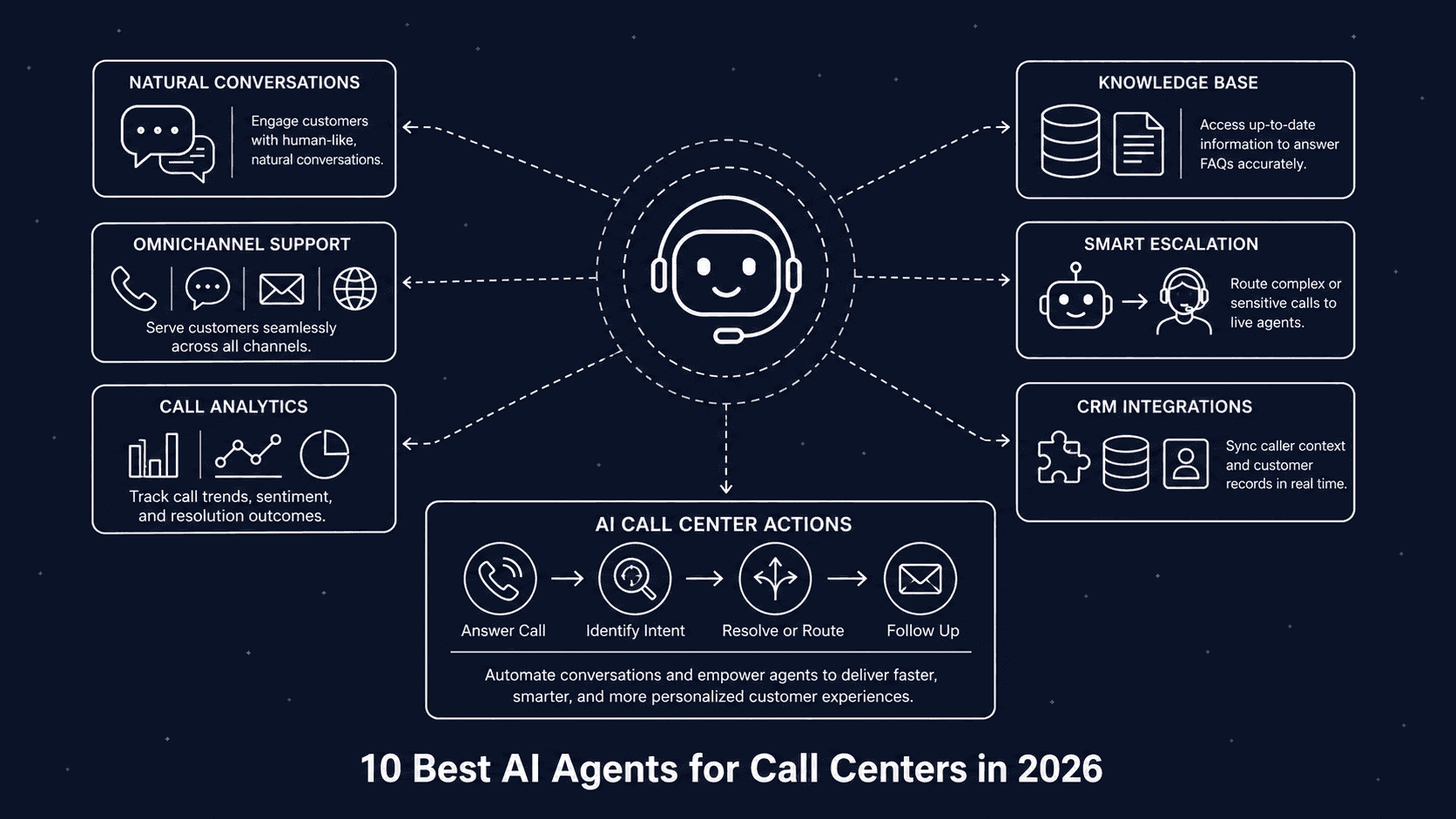
10 Best AI Agents for Call Centers in 2026 (Tested & Reviewed)
We tested 10 AI agents for call centers — containment rates, agent-assist quality, G2 reviews, and real pricing compared. Find the right platform in 2026.
Articles
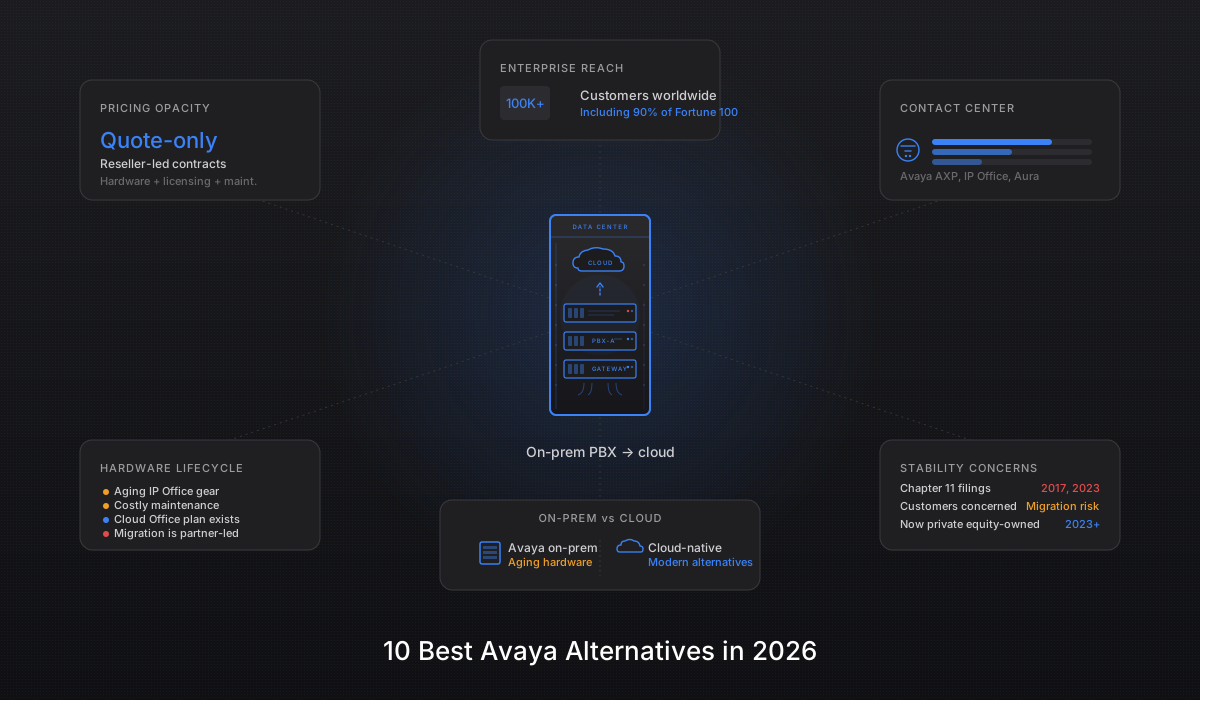
The 10 Best Avaya Alternatives in 2026 (We Tested Each One)
We tested 10 Avaya alternatives — 200-seat AXP minimum exposed, certification-to-support documented, modern AI options compared. Find the right fit for your team in 2026.
Load More
Latest Insights
All Resources
Articles
Case Studies
Tutorials
Articles
10 Best AI Agents for Call Centers in 2026 (Tested & Reviewed)
We tested 10 AI agents for call centers — containment rates, agent-assist quality, G2 reviews, and real pricing compared. Find the right platform in 2026.
Articles
The 10 Best Avaya Alternatives in 2026 (We Tested Each One)
We tested 10 Avaya alternatives — 200-seat AXP minimum exposed, certification-to-support documented, modern AI options compared. Find the right fit for your team in 2026.
Load More

Automate your business with AI phone Agents
Automate your business with AI phone Agents
Automate your business with AI phone Agents
Automate your business with AI phone Agents
Call automation for healthcare, real estate, logistics, financial services & small businesses.
Call automation for healthcare, real estate, logistics, financial services & small businesses.

Join Discord
Connect with our community, ask questions, and stay updated on product news.

Book a Call
Schedule a quick call with our team to explore solutions for your needs.
Get started
Industries
Usecases
Integrations
Legal & Community

Join Discord
Connect with our community, ask questions, and stay updated on product news.
Book a Call
Schedule a quick call with our team to explore solutions for your needs.
Get started
Industries
Usecases
Integrations
Legal & Community
Join Discord
Connect with our community, ask questions, and stay updated on product news.
Book a Call
Schedule a quick call with our team to explore solutions for your needs.
Get started
Industries
Usecases
Integrations
Legal & Community
Join Discord
Connect with our community, ask questions, and stay updated on product news.
Book a Call
Schedule a quick call with our team to explore solutions for your needs.
Get started
Industries
Usecases
Integrations
Legal & Community