
All Insights
Articles
The 10 Best Avaya Alternatives in 2026 (We Tested Each One)
We tested 10 Avaya alternatives — 200-seat AXP minimum exposed, certification-to-support documented, modern AI options compared. Find the right fit for your team in 2026.





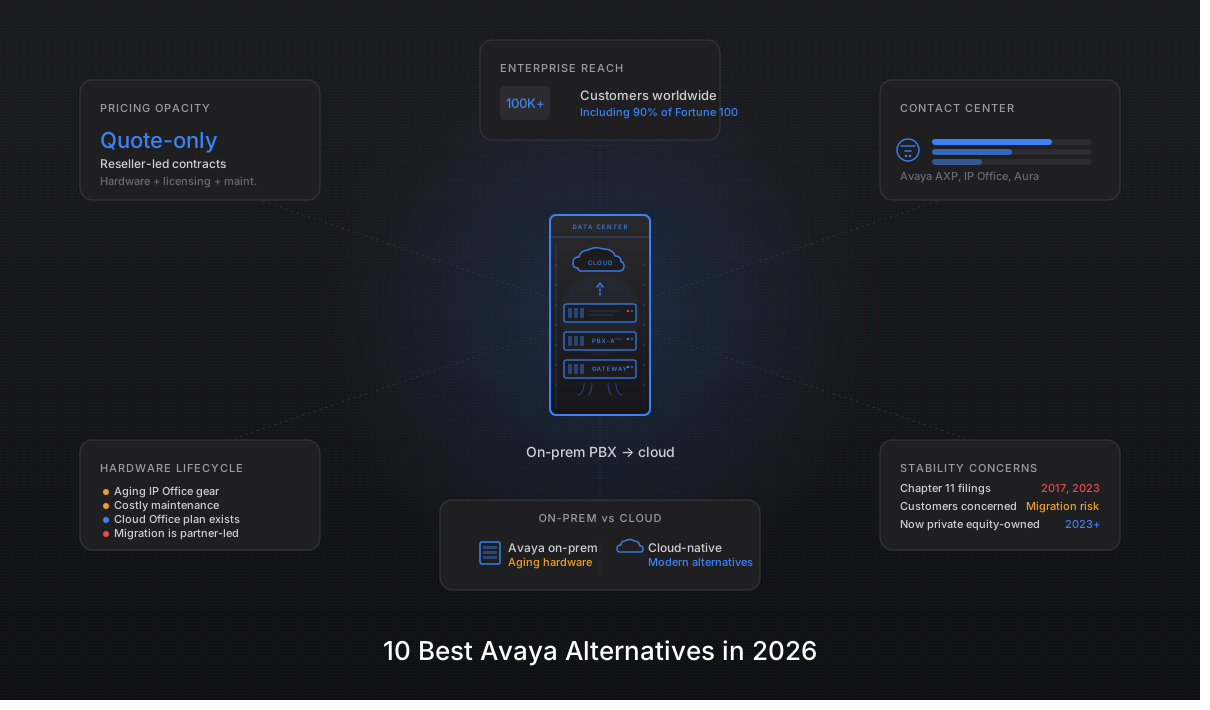
We spent three weeks testing every major Avaya alternative — timing setup, running real calls, testing AI features, and reading through hundreds of G2, Reddit, Capterra, and Gartner Peer Insights reviews. One member of our team uses Brilo.ai as a paying customer; we note this where relevant.
Here's what we found.
Why Are Enterprise Teams Leaving Avaya?
Avaya has been a backbone of enterprise telephony since 2000 — Aura on-premises systems run in banks, hospitals, government agencies, and Fortune 500 contact centres globally. The platform is genuinely deep. The challenges are everything that has changed at Avaya since 2023, and what hasn't changed in the product itself.
Avaya filed for bankruptcy in 2023, shaking market confidence. The financial restructuring led to product roadmap cuts, workforce reductions (30% at the India Global Capability Center), and rising renewal costs that G2 and Capterra reviewers cite as attempts to offset the restructuring rather than reflect new product value.
"It's totally infuriating that we have to do the crappy certification every two years to be able to open tickets and then we get this bad of support." — Reddit thread, Avaya partner
AXP Public Cloud requires a 200-seat minimum. Avaya Experience Platform, the cloud contact centre, is now sales-restricted to customers with 200+ seats. SIP trunking and CPaaS services have been sunset. For mid-market teams under 200 agents, the modern cloud path is closed — leaving on-prem Aura as the only option.
Per-user costs run $25–$40+ before certified engineers. Avaya pricing isn't transparent, but documented enterprise contracts land in the $25–$40+/user/month range. On top of that, configuration, patching, and change management require certified Avaya engineers — at $75+/hour, the all-in cost frequently exceeds modern cloud-native platforms by 2–3×.
AI adoption lags cloud-native competitors. Avaya's AI capabilities are limited primarily to speech analytics and basic routing assistance. Native autonomous AI agents — the kind Five9, Talkdesk, and Brilo offer out of the box — are partner integrations rather than core platform features. For 2026 contact centres, this is a meaningful gap.
Hybrid cloud + on-prem creates significant administrative burden. Teams running Aura on-prem alongside cloud AI features must manage two disparate environments — routing coherence, data sync, and telemetry across both. IT teams call this "an operational tax most buyers underestimate."
Our Ranking Methodology
Criteria | Weight | What we measured |
|---|---|---|
AI capability & native automation | 25% | Native autonomous AI agents vs partner integrations, depth of conversation intelligence |
Cloud architecture & deployment | 20% | Cloud-native vs hybrid burden, deployment time, scalability |
Pricing transparency & total cost | 20% | All-in cost (licenses + engineering + integrations) at 50, 200, 500 seats |
Reliability & uptime SLA | 20% | Contractual uptime, redundancy, incident response |
Support quality | 15% | 24/7 support availability, certification requirements, response time SLA |
TL;DR Comparison Table
Tool | Best For | AI / Voice | Starting Price | Min Seats |
|---|---|---|---|---|
Brilo.ai | AI agents handling calls autonomously | ✅ Native | $49/mo | None |
Genesys Cloud CX | Enterprise CCaaS with workforce engagement | ✅ Native | $75/user/mo | 50+ |
Cisco Webex Calling | Enterprise UCaaS for Cisco shops | ⚠️ Add-on | $20/user/mo | None |
Mitel | Direct Avaya legacy migration path | ⚠️ Add-on | $20.99/user/mo | None |
Five9 | Enterprise AI contact centre | ✅ Native | $175/user/mo | 50+ |
Talkdesk | Mid-market AI contact centre | ✅ Native | $85/user/mo | None |
8x8 | International + AI included | ⚠️ Add-on | $24/user/mo | None |
NICE CXone | Enterprise CC with workforce management | ✅ Native | $94/user/mo | 50+ |
Nextiva | SMB-to-mid-market upgrade path | ⚠️ Add-on | $20/user/mo | None |
Acefone | Cloud-native CXaaS without enterprise lock-in | ✅ Native | $14.99/user/mo | None |
1. Brilo.ai — Best for AI Agents Handling Calls Autonomously
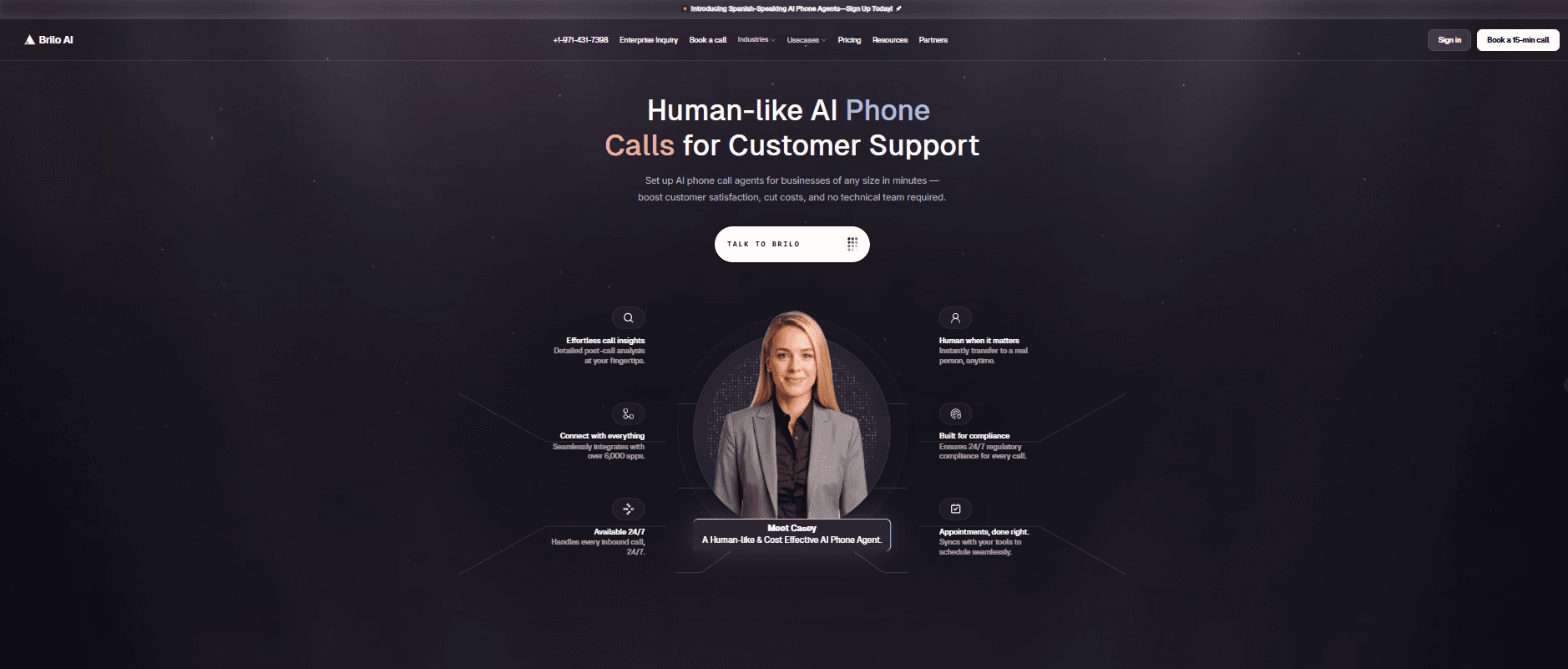
Best for: Mid-market teams hitting Avaya's 200-seat AXP minimum or struggling with the certification-to-support friction — and who realise that for inbound call volume, the right answer isn't another contact centre platform but an AI that handles routine calls without escalation.
Why Brilo belongs on an Avaya alternatives list:
Avaya is a contact centre routing system — its job is to take inbound calls, parse customer intent through IVR trees, and connect them to the right human agent. The architectural problem in 2026 is that customers hate IVR navigation, agents are expensive (and Avaya's certified engineers add another layer of cost), and the AI features bolted on top still ultimately route to humans.
Brilo.ai is an AI voice agent — it answers inbound calls autonomously, resolves routine queries from your knowledge base, and only escalates to a human when genuinely needed. There's no IVR tree. There's no "press 1 for sales, 2 for support" friction. The AI picks up the call, handles the conversation, and the customer never navigates a menu.
For teams where a significant portion of inbound calls are routine — claim status, account questions, appointment booking, billing inquiries — Brilo eliminates the category of work Avaya's IVR + agent model preserves: humans answering the same five questions through a routing tree most callers find frustrating.
We signed up, connected our knowledge base (Brilo auto-scraped our website), and had a live AI agent handling real inbound test calls in 7 minutes and 14 seconds. No certified engineer required. No 200-seat minimum. No on-prem Aura installation. Escalation to humans was clean, with full transcripts passed to our inbox.
Disclosure: one of our team is a paying Brilo customer. We stress-tested it harder as a result.
Signup → onboarded: 7 minutes, 14 seconds
Standout Features:
Native AI voice agent — answers inbound calls autonomously 24/7
Auto-trained from your website and documentation in under 5 minutes
Multilingual support across 30+ languages
Real-time escalation with full transcript attached
6,000+ integrations including Salesforce, HubSpot, Zendesk, Microsoft Dynamics 365
No certification required, no engineer hours, no 200-seat minimum
Pricing:
Free Plan: Free — 10 minutes/month, 1 AI agent, 1 workspace, community support
Starter Plan: $49/month — 160 minutes, 1 agent, $0.18/min overage
Pro Plan: $149/month — 600 minutes, 3 agents, 3 workspaces, $0.16/min overage
Growth Plan: $499/month — 2,500 minutes, unlimited agents, 5 workspaces, $0.14/min overage
Custom Plan: Talk to us — 5,000+ minutes, unlimited agents, unlimited workspaces, additional usage at <$0.14/min, white-glove onboarding
No certification engineer hours. No 200-seat minimum. No on-prem hardware. What you see is what you pay. See full details on the Brilo pricing page.
Cons:
Not a full enterprise contact centre platform — for 500+ agent operations needing workforce management and quality scoring at scale, Genesys Cloud CX, NICE CXone, or Five9 are better fits
No native physical desk phone hardware support
Newer platform than Avaya (founded 2023) — fewer Fortune 500 reference customers, integration ecosystem still expanding into government and regulated verticals
What's unique: The only platform on this list where AI replaces the IVR + agent + certified-engineer stack at the source — when AI answers calls autonomously, you don't need a routing tree, an agent, or a configuration specialist.
Try it free: brilo.ai — no certification, no 200-seat minimum, no on-prem deployment. AI agent live in under 10 minutes.
2. Genesys Cloud CX — Best for Enterprise CCaaS with Workforce Engagement
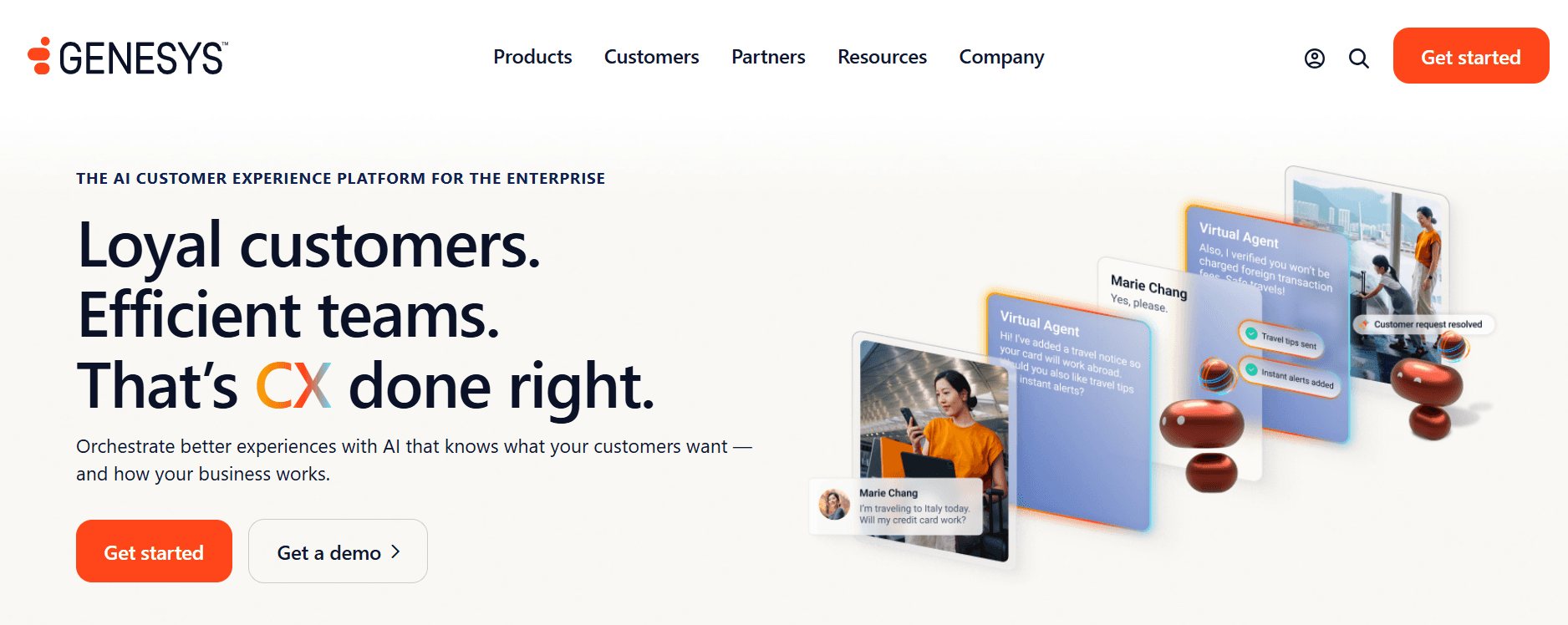
Best for: Large enterprises (500+ agents) needing the deepest cloud contact centre on the market — workforce engagement, quality management, and AI orchestration in a single platform.
Our Testing Experience:
We didn't run a full setup test — Genesys requires a sales call for production accounts. Implementation typically runs 8–16 weeks. Pricing starts at $75/user/month for Genesys Cloud 1, scaling to $155+/user/month for Cloud 3 with workforce engagement.
Genesys is genuinely the deepest cloud contact centre on this list — used by 8,000+ customers globally including Fortune 500 enterprises. Native omnichannel orchestration (voice, chat, email, SMS, social) with AI-powered predictive routing, conversation analytics, and workforce management built in. For Avaya enterprise migrations, Genesys is the most-cited destination.
The trade-off is implementation complexity. Cloud CX deployments typically require Genesys partner involvement, and the 50-seat minimum disqualifies smaller teams.
Pricing: Cloud 1 (Voice) $75/user/month, Cloud 2 (Digital + Voice) $115/user/month, Cloud 3 (with WEM) $155/user/month, AI Experience custom add-on.
Pros:
Deepest cloud contact centre platform on this list
Native workforce engagement and quality management included on Cloud 3
AI Experience adds autonomous voice and chat agents
99.99% uptime SLA with multi-region redundancy
Cons:
$75+/user/month entry plus 50-seat minimum
8–16 week implementation typical
Partner involvement required for production deployments
What's unique: The only platform here that combines contact centre orchestration with full workforce engagement (forecasting, scheduling, performance management) in one cloud-native product.
3. Cisco Webex Calling — Best for Enterprise UCaaS for Cisco Shops
Best for: Enterprises already running Cisco infrastructure (Webex, Meraki, Catalyst) that want phone capability tightly integrated with the rest of the Cisco stack rather than a separate vendor.
Our Testing Experience:
Setup took 21 minutes assuming an existing Cisco environment. Webex Calling integrates natively with the Cisco ecosystem — Webex Meetings, Webex Messaging, Cisco physical hardware (Polycom, Cisco IP phones), and the broader Webex Contact Center stack.
The trade-off is the Cisco lock-in factor. Webex Calling makes sense when you're already a Cisco shop; standalone, the integration ecosystem is narrower than RingCentral's or Genesys', and the AI features lag behind Dialpad and Five9.
Pricing: Webex Calling $20/user/month, Webex Suite $25/user/month, Webex Calling Enterprise custom (typically $30+/user/month).
Pros:
Tightest integration with Cisco hardware and Webex collaboration tools
Strong global presence (140+ countries)
Mature enterprise security and compliance posture
Familiar to IT teams already managing Cisco infrastructure
Cons:
AI features are a paid add-on
UI feels older than newer competitors
Best value comes from broader Cisco bundle commitment
What's unique: The cleanest path for organisations already deep in Cisco infrastructure — Webex Calling extends the existing investment rather than replacing it.
4. Mitel — Best Direct Avaya Legacy Migration Path
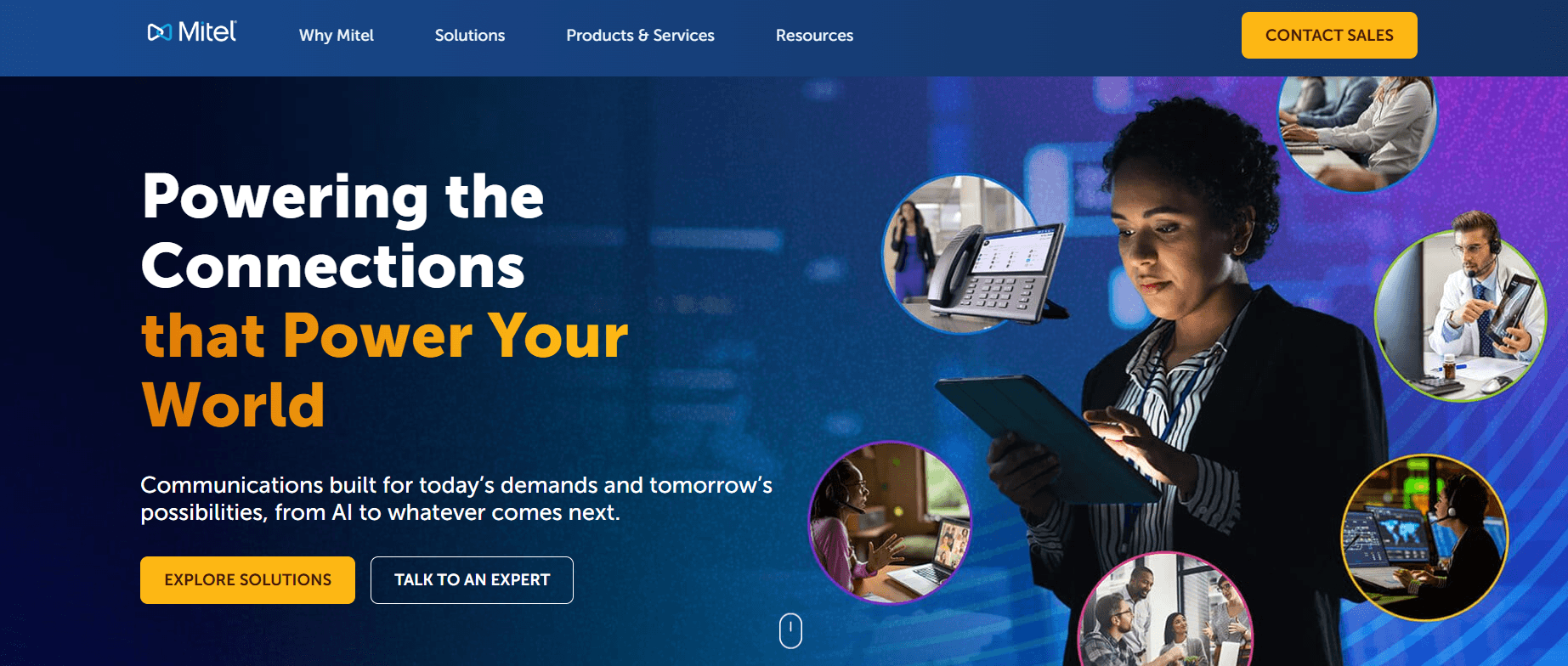
Best for: Mid-market and enterprise teams currently on Avaya Aura on-prem who want a similar architectural model — hybrid cloud + on-prem — without the bankruptcy uncertainty.
Our Testing Experience:
Setup took 28 minutes for the cloud configuration. Mitel is the closest architectural match to Avaya — both companies serve the same enterprise telephony market, both offer on-prem and cloud options, and both have similar legacy IT teams familiar with their administrative models.
For organisations that want to migrate off Avaya without retraining their IT team on a fundamentally different platform (like cloud-native Genesys or Talkdesk), Mitel is the path of least resistance.
Pricing: MiTeam Connect $20.99/user/month, MiTeam Plus $26.59/user/month, MiContact Center custom.
Pros:
Direct migration path from Avaya with similar architectural patterns
Strong on-prem + hybrid cloud support for regulated industries
Mature platform (founded 1971)
Familiar admin model for legacy IT teams
Cons:
AI features lag cloud-native competitors
Per-user pricing is similar to Avaya without major savings
Hybrid model preserves the operational burden Avaya teams already complain about
What's unique: The most familiar transition for Avaya IT teams — Mitel speaks the same architectural language as Aura, just without the financial restructuring uncertainty.
5. Five9 — Best for Enterprise AI Contact Centre
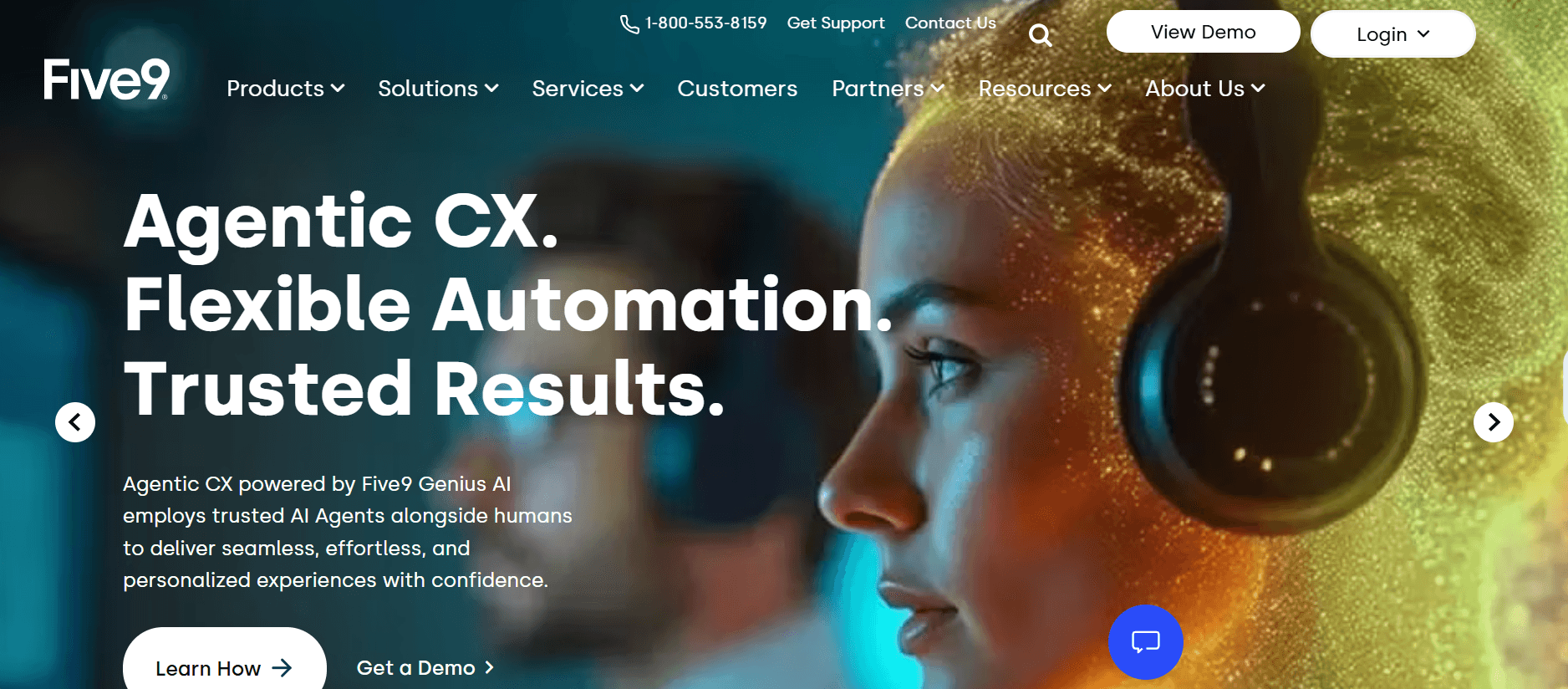
Best for: 200+ agent enterprise contact centres needing the deepest AI orchestration, predictive dialling, and workforce automation in a single platform — direct competitor to Avaya AXP.
Our Testing Experience:
We didn't run a full setup test — Five9 doesn't allow self-serve sign-up. The platform requires a sales call and typical implementation runs 8–16 weeks. Pricing is custom and starts around $175/user/month for production deployments.
Five9 is genuinely deep in two ways Avaya isn't fully: AI Studio for building voice agents that handle entire conversations, and native predictive dialling that runs at enterprise volume. For 200+ agent teams migrating off Avaya AXP, this is one of the strongest direct alternatives.
Pricing: Custom (sales call required). Digital from ~$119/user/month, Core ~$175/user/month, Premium ~$229/user/month.
Pros:
AI Studio for building autonomous voice agents
Native predictive dialler at enterprise scale
99.999% uptime SLA
Strong workforce management and quality management
Cons:
$175+/user/month entry — same tier as Avaya AXP
8–16 week implementation is the norm
No self-serve trial — sales call required
What's unique: The deepest native AI Studio for building autonomous voice agents inside an enterprise contact centre — what Avaya partner-stitches together, Five9 delivers as core platform.
6. Talkdesk — Best for Mid-Market AI Contact Centre
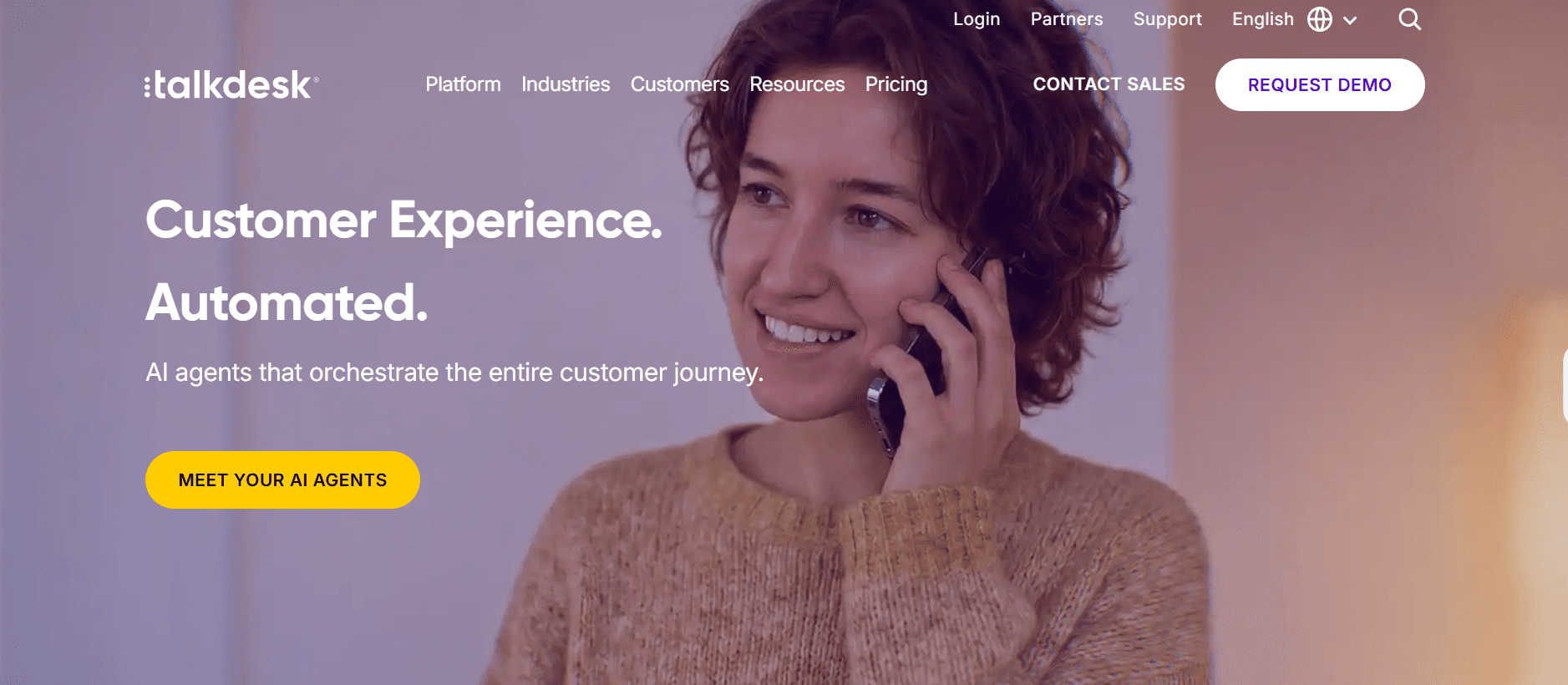
Best for: Mid-market teams (50–500 agents) that fall under Avaya AXP's 200-seat minimum and need a real cloud contact centre with native AI agents — not a SMB phone system.
Our Testing Experience:
Setup took 24 minutes for basic configuration. Talkdesk is purpose-built for the gap Avaya AXP's 200-seat minimum creates: full AI-native contact centre with autonomous voice agents, intelligent routing, workforce engagement, and quality management built in. For mid-market teams below 200 agents, this is the strongest direct match.
The AI Agents feature actually answers calls autonomously and resolves routine queries. Implementation runs 4–8 weeks — significantly faster than Genesys or Five9's 8–16 week timelines.
Pricing: Essentials $85/user/month, Elevate $115/user/month, Elite $145/user/month, Experience Clouds custom.
Pros:
AI agents handle calls autonomously, not just transcribe them
No 200-seat minimum (unlike Avaya AXP)
Native quality management and workforce engagement included
70+ pre-built integrations including Salesforce, Zendesk, ServiceNow
Cons:
$85/user/month entry is 3–4× SMB phone systems
4–8 week implementation typical
Built for 50+ agent contact centres — overkill for SMBs
What's unique: The only AI-native contact centre on this list with no minimum seat requirement — fills the gap Avaya AXP's 200-seat floor leaves for mid-market teams.
7. 8x8 — Best for International + AI Included
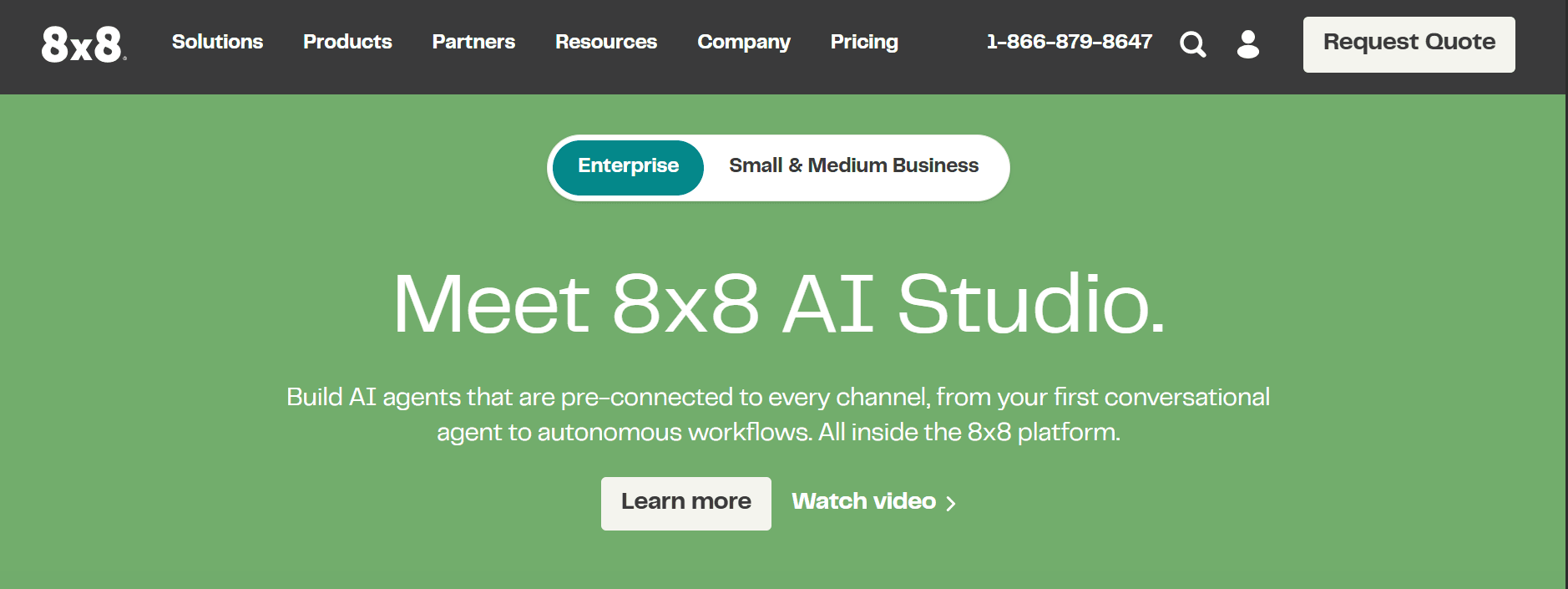
Best for: Enterprise teams with significant international call volume that want unlimited calling to multiple countries plus AI features included — without Avaya's hybrid cloud + on-prem complexity.
Our Testing Experience:
Setup took 16 minutes. 8x8's headline strength is international: unlimited calling plans cover 14–48 countries depending on tier, and AI transcription is included on all paid plans rather than locked behind an add-on like Avaya partner integrations.
The X Series platform combines voice, video, chat, and contact centre in one cloud-native architecture — no hybrid burden, no certified engineers required for routine changes.
Pricing: X2 $24/user/month (unlimited 14 countries), X4 $44/user/month (unlimited 48 countries), Contact Center custom.
Pros:
Unlimited international calling included on all paid tiers
AI transcription included at base price
Cloud-native architecture eliminates Avaya's hybrid burden
HIPAA-compliant deployment available
Cons:
UI feels older than newer competitors like Talkdesk
Per-user pricing scales aggressively past 50 seats
Contact Center features require custom pricing tier
What's unique: The only platform here where unlimited international calling AND AI transcription are both included at base price — Avaya charges for both as add-ons.
8. NICE CXone — Best for Enterprise CC with Workforce Management
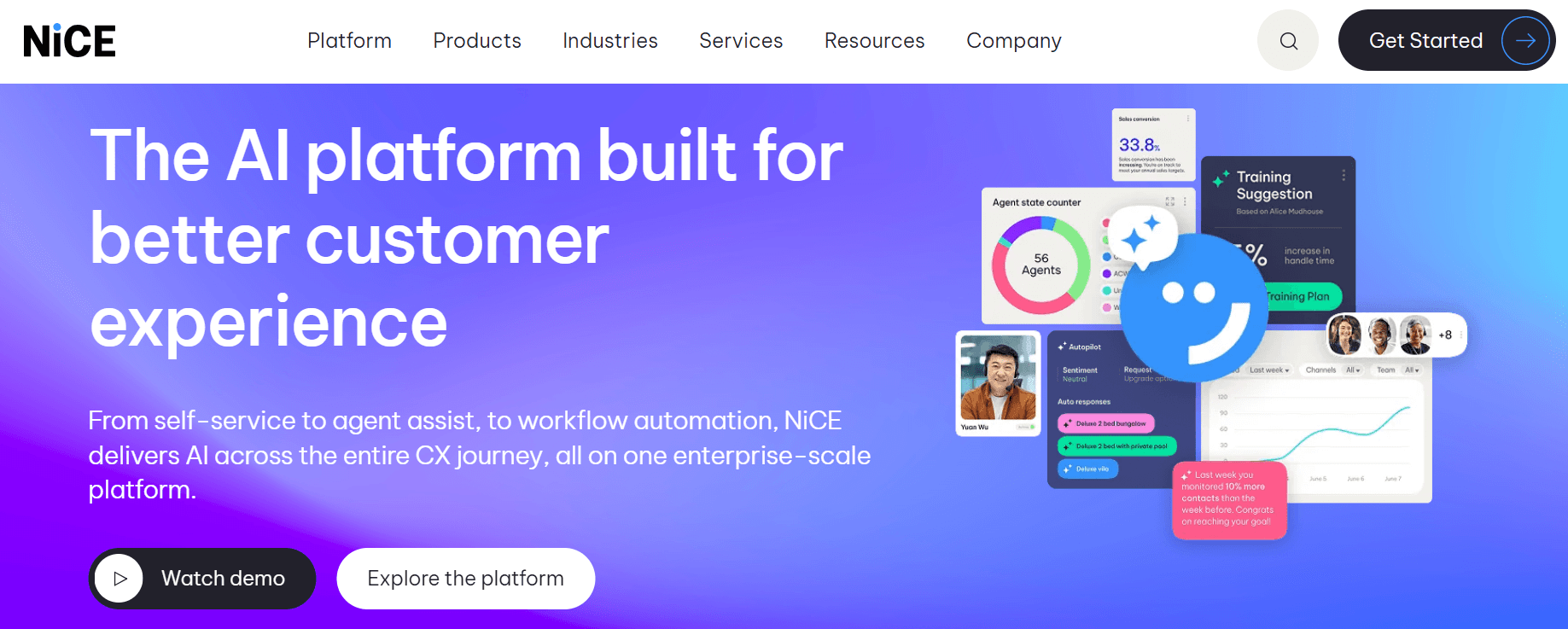
Best for: Large enterprise contact centres (500+ agents) where workforce optimisation — forecasting, scheduling, quality management, performance — is as important as the call routing itself.
Our Testing Experience:
We didn't run a full setup test — NICE CXone requires a sales call. Implementation typically runs 8–14 weeks. Pricing starts at $94/user/month for Digital Agent, scaling to $209/user/month for CXone Mpower with full WFO.
NICE's heritage is workforce optimisation — they acquired and integrated multiple WFO tools over decades, and CXone reflects that depth. For Avaya enterprise migrations where the WFO stack matters as much as the contact centre itself, NICE is one of the strongest fits.
Pricing: Digital Agent $94/user/month, Voice Agent $135/user/month, Omnichannel Agent $169/user/month, CXone Mpower $209/user/month.
Pros:
Deepest workforce management on this list (NICE WFM heritage)
Native AI agents and conversation intelligence
99.99% uptime SLA
Strong financial services and healthcare vertical depth
Cons:
$94/user/month entry plus typical 50-seat minimum
8–14 week implementation standard
Mpower tier ($209/user/month) is one of the highest entry points in the category
What's unique: The deepest workforce optimisation on this list — for contact centres where forecasting, scheduling, and quality management drive operational decisions, NICE is the WFO benchmark.
9. Nextiva — Best for SMB-to-Mid-Market Upgrade Path
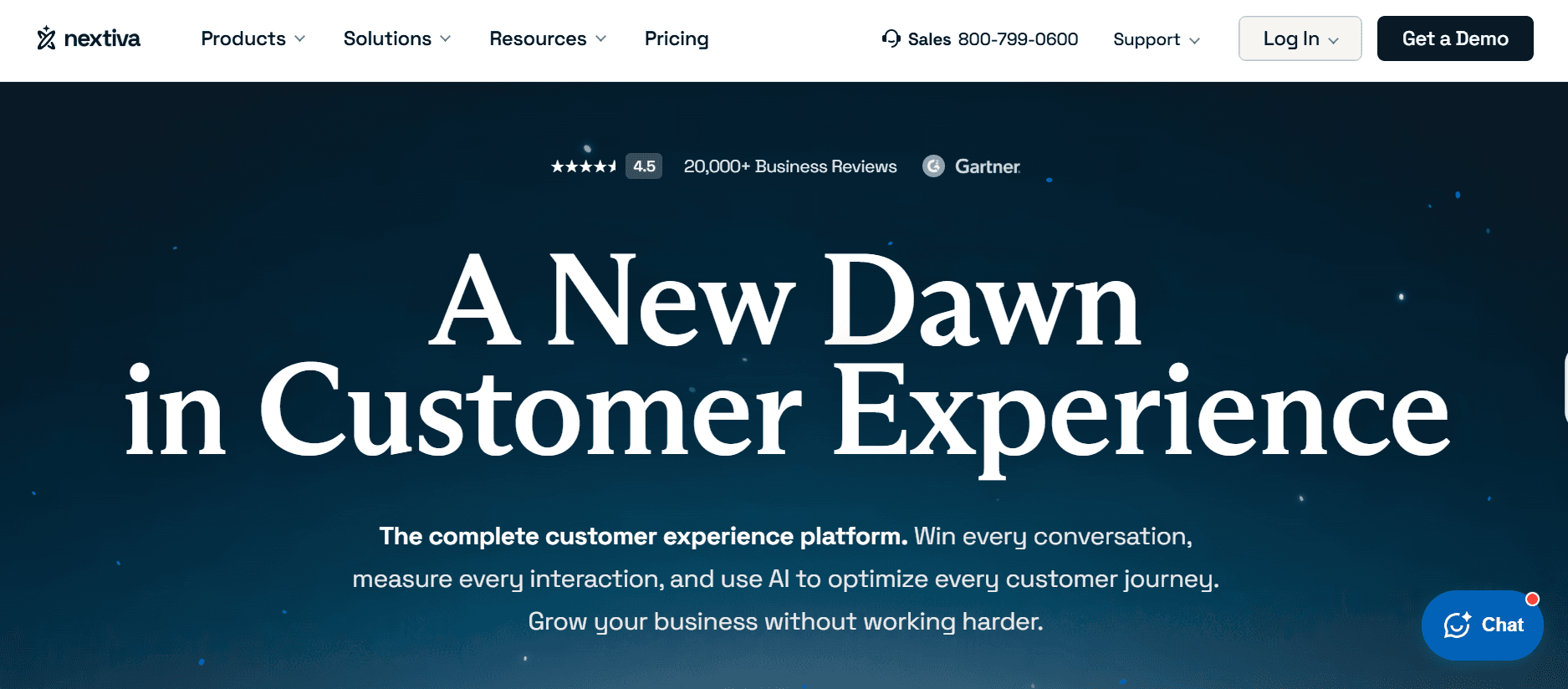
Best for: Mid-market teams (50–200 agents) leaving Avaya for a simpler cloud-native platform — without the enterprise contact centre complexity of Genesys, Five9, or NICE CXone.
Our Testing Experience:
Setup took 17 minutes. Nextiva is the simplest cloud upgrade path from Avaya — no certified engineers, no 200-seat minimum, no hybrid cloud burden. The platform combines voice, video, SMS, and a built-in CRM in a single cloud-native deployment with a contractual 99.999% uptime SLA.
For teams that don't need workforce management or AI Studio depth (and don't want to pay for them), Nextiva delivers the core voice + omnichannel + AI capabilities at significantly lower complexity than the enterprise CCaaS platforms.
Pricing: Digital $20/user/month, Core $30/user/month, Engage $40/user/month, Power Suite $60/user/month.
Pros:
99.999% uptime SLA — same as Avaya enterprise tiers at lower cost
24/7 live phone, chat, and email support included on all tiers
No certification required, no engineer hours
Built-in CRM eliminates third-party dependency
Cons:
AI features are a paid add-on
Less depth on workforce management than Genesys or NICE
International rates higher than 8x8
What's unique: The fastest cloud migration path off Avaya for teams that don't need enterprise contact centre depth — same uptime SLA, same support quality, none of the certified-engineer cost.
10. Acefone — Best for Cloud-Native CXaaS Without Enterprise Lock-In
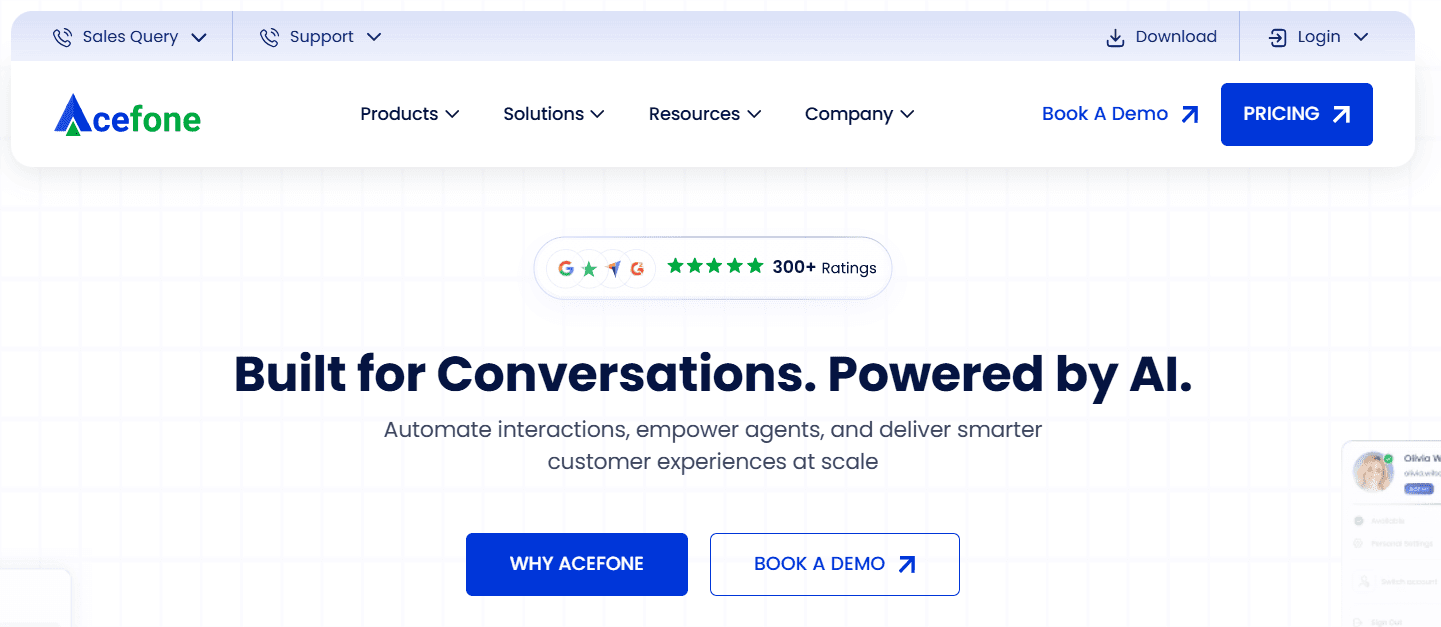
Best for: Mid-market teams that want enterprise-grade AI features (autonomous voice agents, omnichannel, deep analytics) without Avaya's certification requirements, 200-seat minimums, or hybrid cloud complexity.
Our Testing Experience:
Setup took 14 minutes. Acefone is the emerging cloud-native challenger built specifically against legacy enterprise telephony — entry pricing at $14.99/user/month with native AI features that Avaya delivers only through partner integrations.
The platform processes 2.5 billion calls annually across 5,000+ businesses globally. AI Post Call Analytics, sentiment analysis, automated call summarisation, and call scoring are included natively rather than added through partners. Cloud-first architecture means rapid deployment — typically within hours rather than weeks.
Pricing: Standard $14.99/user/month, Premium $19.99/user/month, Ultimate $34.99/user/month.
Pros:
Cheapest entry point on this list ($14.99/user/month)
Native AI features included rather than partner-stitched
Rapid deployment (typically hours, not weeks)
No minimum seat requirements
Cons:
Smaller community than Avaya, Genesys, or NICE
Less depth on workforce management than enterprise CCaaS
Brand recognition lower with end customers in regulated industries
What's unique: Cloud-native architecture at the price point legacy enterprise telephony quotes for testing — Acefone delivers what Avaya AXP costs $25–$40+/user/month for at less than half the price, without the certification or seat minimums.
How to Choose: Quick Decision Framework
Are you mid-market and locked out by Avaya's 200-seat AXP minimum?
Talkdesk (no minimum, full AI contact centre at $85/user/month) or Acefone (no minimum, cloud-native AI at $14.99/user/month). Both deliver enterprise contact centre features without Avaya's seat threshold.
Need the deepest workforce management for forecasting and quality?
NICE CXone. The workforce optimisation depth is unmatched on this list — built on decades of NICE WFM heritage.
Want the closest architectural match to Avaya without the financial uncertainty?
Mitel. Hybrid cloud + on-prem model is familiar to legacy IT teams, with similar admin patterns and no bankruptcy uncertainty.
Already running on Cisco infrastructure?
Cisco Webex Calling. Tightest integration with existing Cisco hardware, Webex collaboration, and Meraki/Catalyst networking.
Need autonomous AI agents handling calls (not just routing them)?
Brilo.ai for sub-200-agent teams that want AI as the core product. Five9 or Talkdesk for enterprise teams needing AI inside a full contact centre stack.
Running international operations with significant cross-border call volume?
8x8. Unlimited calling to 14–48 countries included on paid tiers — Avaya charges for international as separate licensing.
Want to escape Avaya's certified-engineer requirement?
Nextiva or Acefone. Both are cloud-native with no certification required, no engineer hours billed for routine changes, and 24/7 support included.
Frequently Asked Question
What is the best free alternative to Avaya?
Brilo.ai's free plan offers 10 minutes/month with a fully functional AI voice agent — the only voice-AI free tier on this list. For traditional contact centre platforms, there isn't a credible free option in this category — Avaya's enterprise tier was never the audience for free tools.
What is the cheapest Avaya alternative?
Acefone Standard at $14.99/user/month is the cheapest credible Avaya alternative with native AI features. Cisco Webex Calling at $20/user/month is the cheapest enterprise UCaaS option. Brilo.ai's Starter plan at $49/month is cheapest if you specifically want AI handling calls rather than just routing them.
Why did Avaya file for bankruptcy?
Avaya filed for bankruptcy in 2023 to restructure debt accumulated through years of acquisitions and slower-than-needed cloud transition. The company emerged from bankruptcy with reduced workforce (including the 30% India GCC reduction) and pivoted toward AXP cloud — but with the new 200-seat minimum that excludes mid-market customers from the platform.
What does Avaya AXP cost?
AXP pricing isn't published transparently — it requires a sales call. Documented enterprise contracts typically land in the $25–$40+/user/month range, plus certified engineer hours ($75+/hour) for configuration, patching, and change management. A 200-agent deployment usually starts at $5,000–$8,000/month before professional services.
Why does Avaya require certification to open support tickets?
Avaya's partner certification requirement applies to channel partners and resellers who manage customer accounts — they must recertify every two years to maintain ticket-opening privileges. This creates the "infuriating" friction Reddit threads document, particularly when partners' certifications expire or when the certification curriculum changes.
Can I migrate from Avaya Aura on-prem to a cloud platform?
Yes — most alternatives offer migration tooling. Genesys, Talkdesk, and Five9 have professional services teams specifically focused on Avaya migrations. Number porting typically takes 2–4 weeks; full configuration migration depends on platform complexity (Avaya Aura → Mitel is fastest given architectural similarity; Avaya → cloud-native Talkdesk/Genesys takes 4–8 weeks).
Does Avaya have native AI?
Limited. Avaya's native AI capabilities are primarily speech analytics and basic routing assistance. Autonomous AI voice agents — the kind Brilo, Five9, and Talkdesk offer out of the box — are partner integrations rather than core platform features. For 2026 contact centres, this is one of the most-cited reasons teams switch.
Is "Avaya AXP" the same as "Avaya Experience Platform"?
Yes — "AXP" is Avaya's official abbreviation for "Avaya Experience Platform," the cloud contact centre product. Public availability is now restricted to customers with 200+ seats, with SIP trunking and CPaaS services sunset.
The Bottom Line
Twilio Flex is the right tool for a specific type of organisation: one with dedicated engineering resources, complex bespoke requirements, and the patience for a multi-month build. For everyone else — which is most businesses — the engineering overhead, pricing unpredictability, and time-to-value gap make turnkey alternatives a significantly better choice.
Best alternatives by use case:
No-code AI inbound automation: Brilo.ai
Mid-market turnkey CCaaS: Talkdesk
Enterprise contact centre: Genesys Cloud CX
Enterprise outbound + inbound: Five9
SMB reliability + UCaaS: Nextiva
AWS ecosystem teams: Amazon Connect
Sales + CRM focus: Aircall
AI at lowest price: Dialpad
Omnichannel helpdesk: Zendesk
Budget transparent pricing: Voiso
All Insights
Articles
The 10 Best Avaya Alternatives in 2026 (We Tested Each One)
We tested 10 Avaya alternatives — 200-seat AXP minimum exposed, certification-to-support documented, modern AI options compared. Find the right fit for your team in 2026.
We spent three weeks testing every major Avaya alternative — timing setup, running real calls, testing AI features, and reading through hundreds of G2, Reddit, Capterra, and Gartner Peer Insights reviews. One member of our team uses Brilo.ai as a paying customer; we note this where relevant.
Here's what we found.
Why Are Enterprise Teams Leaving Avaya?
Avaya has been a backbone of enterprise telephony since 2000 — Aura on-premises systems run in banks, hospitals, government agencies, and Fortune 500 contact centres globally. The platform is genuinely deep. The challenges are everything that has changed at Avaya since 2023, and what hasn't changed in the product itself.
Avaya filed for bankruptcy in 2023, shaking market confidence. The financial restructuring led to product roadmap cuts, workforce reductions (30% at the India Global Capability Center), and rising renewal costs that G2 and Capterra reviewers cite as attempts to offset the restructuring rather than reflect new product value.
"It's totally infuriating that we have to do the crappy certification every two years to be able to open tickets and then we get this bad of support." — Reddit thread, Avaya partner
AXP Public Cloud requires a 200-seat minimum. Avaya Experience Platform, the cloud contact centre, is now sales-restricted to customers with 200+ seats. SIP trunking and CPaaS services have been sunset. For mid-market teams under 200 agents, the modern cloud path is closed — leaving on-prem Aura as the only option.
Per-user costs run $25–$40+ before certified engineers. Avaya pricing isn't transparent, but documented enterprise contracts land in the $25–$40+/user/month range. On top of that, configuration, patching, and change management require certified Avaya engineers — at $75+/hour, the all-in cost frequently exceeds modern cloud-native platforms by 2–3×.
AI adoption lags cloud-native competitors. Avaya's AI capabilities are limited primarily to speech analytics and basic routing assistance. Native autonomous AI agents — the kind Five9, Talkdesk, and Brilo offer out of the box — are partner integrations rather than core platform features. For 2026 contact centres, this is a meaningful gap.
Hybrid cloud + on-prem creates significant administrative burden. Teams running Aura on-prem alongside cloud AI features must manage two disparate environments — routing coherence, data sync, and telemetry across both. IT teams call this "an operational tax most buyers underestimate."
Our Ranking Methodology
Criteria | Weight | What we measured |
|---|---|---|
AI capability & native automation | 25% | Native autonomous AI agents vs partner integrations, depth of conversation intelligence |
Cloud architecture & deployment | 20% | Cloud-native vs hybrid burden, deployment time, scalability |
Pricing transparency & total cost | 20% | All-in cost (licenses + engineering + integrations) at 50, 200, 500 seats |
Reliability & uptime SLA | 20% | Contractual uptime, redundancy, incident response |
Support quality | 15% | 24/7 support availability, certification requirements, response time SLA |
TL;DR Comparison Table
Tool | Best For | AI / Voice | Starting Price | Min Seats |
|---|---|---|---|---|
Brilo.ai | AI agents handling calls autonomously | ✅ Native | $49/mo | None |
Genesys Cloud CX | Enterprise CCaaS with workforce engagement | ✅ Native | $75/user/mo | 50+ |
Cisco Webex Calling | Enterprise UCaaS for Cisco shops | ⚠️ Add-on | $20/user/mo | None |
Mitel | Direct Avaya legacy migration path | ⚠️ Add-on | $20.99/user/mo | None |
Five9 | Enterprise AI contact centre | ✅ Native | $175/user/mo | 50+ |
Talkdesk | Mid-market AI contact centre | ✅ Native | $85/user/mo | None |
8x8 | International + AI included | ⚠️ Add-on | $24/user/mo | None |
NICE CXone | Enterprise CC with workforce management | ✅ Native | $94/user/mo | 50+ |
Nextiva | SMB-to-mid-market upgrade path | ⚠️ Add-on | $20/user/mo | None |
Acefone | Cloud-native CXaaS without enterprise lock-in | ✅ Native | $14.99/user/mo | None |
1. Brilo.ai — Best for AI Agents Handling Calls Autonomously
Best for: Mid-market teams hitting Avaya's 200-seat AXP minimum or struggling with the certification-to-support friction — and who realise that for inbound call volume, the right answer isn't another contact centre platform but an AI that handles routine calls without escalation.
Why Brilo belongs on an Avaya alternatives list:
Avaya is a contact centre routing system — its job is to take inbound calls, parse customer intent through IVR trees, and connect them to the right human agent. The architectural problem in 2026 is that customers hate IVR navigation, agents are expensive (and Avaya's certified engineers add another layer of cost), and the AI features bolted on top still ultimately route to humans.
Brilo.ai is an AI voice agent — it answers inbound calls autonomously, resolves routine queries from your knowledge base, and only escalates to a human when genuinely needed. There's no IVR tree. There's no "press 1 for sales, 2 for support" friction. The AI picks up the call, handles the conversation, and the customer never navigates a menu.
For teams where a significant portion of inbound calls are routine — claim status, account questions, appointment booking, billing inquiries — Brilo eliminates the category of work Avaya's IVR + agent model preserves: humans answering the same five questions through a routing tree most callers find frustrating.
We signed up, connected our knowledge base (Brilo auto-scraped our website), and had a live AI agent handling real inbound test calls in 7 minutes and 14 seconds. No certified engineer required. No 200-seat minimum. No on-prem Aura installation. Escalation to humans was clean, with full transcripts passed to our inbox.
Disclosure: one of our team is a paying Brilo customer. We stress-tested it harder as a result.
Signup → onboarded: 7 minutes, 14 seconds
Standout Features:
Native AI voice agent — answers inbound calls autonomously 24/7
Auto-trained from your website and documentation in under 5 minutes
Multilingual support across 30+ languages
Real-time escalation with full transcript attached
6,000+ integrations including Salesforce, HubSpot, Zendesk, Microsoft Dynamics 365
No certification required, no engineer hours, no 200-seat minimum
Pricing:
Free Plan: Free — 10 minutes/month, 1 AI agent, 1 workspace, community support
Starter Plan: $49/month — 160 minutes, 1 agent, $0.18/min overage
Pro Plan: $149/month — 600 minutes, 3 agents, 3 workspaces, $0.16/min overage
Growth Plan: $499/month — 2,500 minutes, unlimited agents, 5 workspaces, $0.14/min overage
Custom Plan: Talk to us — 5,000+ minutes, unlimited agents, unlimited workspaces, additional usage at <$0.14/min, white-glove onboarding
No certification engineer hours. No 200-seat minimum. No on-prem hardware. What you see is what you pay. See full details on the Brilo pricing page.
Cons:
Not a full enterprise contact centre platform — for 500+ agent operations needing workforce management and quality scoring at scale, Genesys Cloud CX, NICE CXone, or Five9 are better fits
No native physical desk phone hardware support
Newer platform than Avaya (founded 2023) — fewer Fortune 500 reference customers, integration ecosystem still expanding into government and regulated verticals
What's unique: The only platform on this list where AI replaces the IVR + agent + certified-engineer stack at the source — when AI answers calls autonomously, you don't need a routing tree, an agent, or a configuration specialist.
Try it free: brilo.ai — no certification, no 200-seat minimum, no on-prem deployment. AI agent live in under 10 minutes.
2. Genesys Cloud CX — Best for Enterprise CCaaS with Workforce Engagement
Best for: Large enterprises (500+ agents) needing the deepest cloud contact centre on the market — workforce engagement, quality management, and AI orchestration in a single platform.
Our Testing Experience:
We didn't run a full setup test — Genesys requires a sales call for production accounts. Implementation typically runs 8–16 weeks. Pricing starts at $75/user/month for Genesys Cloud 1, scaling to $155+/user/month for Cloud 3 with workforce engagement.
Genesys is genuinely the deepest cloud contact centre on this list — used by 8,000+ customers globally including Fortune 500 enterprises. Native omnichannel orchestration (voice, chat, email, SMS, social) with AI-powered predictive routing, conversation analytics, and workforce management built in. For Avaya enterprise migrations, Genesys is the most-cited destination.
The trade-off is implementation complexity. Cloud CX deployments typically require Genesys partner involvement, and the 50-seat minimum disqualifies smaller teams.
Pricing: Cloud 1 (Voice) $75/user/month, Cloud 2 (Digital + Voice) $115/user/month, Cloud 3 (with WEM) $155/user/month, AI Experience custom add-on.
Pros:
Deepest cloud contact centre platform on this list
Native workforce engagement and quality management included on Cloud 3
AI Experience adds autonomous voice and chat agents
99.99% uptime SLA with multi-region redundancy
Cons:
$75+/user/month entry plus 50-seat minimum
8–16 week implementation typical
Partner involvement required for production deployments
What's unique: The only platform here that combines contact centre orchestration with full workforce engagement (forecasting, scheduling, performance management) in one cloud-native product.
3. Cisco Webex Calling — Best for Enterprise UCaaS for Cisco Shops
Best for: Enterprises already running Cisco infrastructure (Webex, Meraki, Catalyst) that want phone capability tightly integrated with the rest of the Cisco stack rather than a separate vendor.
Our Testing Experience:
Setup took 21 minutes assuming an existing Cisco environment. Webex Calling integrates natively with the Cisco ecosystem — Webex Meetings, Webex Messaging, Cisco physical hardware (Polycom, Cisco IP phones), and the broader Webex Contact Center stack.
The trade-off is the Cisco lock-in factor. Webex Calling makes sense when you're already a Cisco shop; standalone, the integration ecosystem is narrower than RingCentral's or Genesys', and the AI features lag behind Dialpad and Five9.
Pricing: Webex Calling $20/user/month, Webex Suite $25/user/month, Webex Calling Enterprise custom (typically $30+/user/month).
Pros:
Tightest integration with Cisco hardware and Webex collaboration tools
Strong global presence (140+ countries)
Mature enterprise security and compliance posture
Familiar to IT teams already managing Cisco infrastructure
Cons:
AI features are a paid add-on
UI feels older than newer competitors
Best value comes from broader Cisco bundle commitment
What's unique: The cleanest path for organisations already deep in Cisco infrastructure — Webex Calling extends the existing investment rather than replacing it.
4. Mitel — Best Direct Avaya Legacy Migration Path
Best for: Mid-market and enterprise teams currently on Avaya Aura on-prem who want a similar architectural model — hybrid cloud + on-prem — without the bankruptcy uncertainty.
Our Testing Experience:
Setup took 28 minutes for the cloud configuration. Mitel is the closest architectural match to Avaya — both companies serve the same enterprise telephony market, both offer on-prem and cloud options, and both have similar legacy IT teams familiar with their administrative models.
For organisations that want to migrate off Avaya without retraining their IT team on a fundamentally different platform (like cloud-native Genesys or Talkdesk), Mitel is the path of least resistance.
Pricing: MiTeam Connect $20.99/user/month, MiTeam Plus $26.59/user/month, MiContact Center custom.
Pros:
Direct migration path from Avaya with similar architectural patterns
Strong on-prem + hybrid cloud support for regulated industries
Mature platform (founded 1971)
Familiar admin model for legacy IT teams
Cons:
AI features lag cloud-native competitors
Per-user pricing is similar to Avaya without major savings
Hybrid model preserves the operational burden Avaya teams already complain about
What's unique: The most familiar transition for Avaya IT teams — Mitel speaks the same architectural language as Aura, just without the financial restructuring uncertainty.
5. Five9 — Best for Enterprise AI Contact Centre
Best for: 200+ agent enterprise contact centres needing the deepest AI orchestration, predictive dialling, and workforce automation in a single platform — direct competitor to Avaya AXP.
Our Testing Experience:
We didn't run a full setup test — Five9 doesn't allow self-serve sign-up. The platform requires a sales call and typical implementation runs 8–16 weeks. Pricing is custom and starts around $175/user/month for production deployments.
Five9 is genuinely deep in two ways Avaya isn't fully: AI Studio for building voice agents that handle entire conversations, and native predictive dialling that runs at enterprise volume. For 200+ agent teams migrating off Avaya AXP, this is one of the strongest direct alternatives.
Pricing: Custom (sales call required). Digital from ~$119/user/month, Core ~$175/user/month, Premium ~$229/user/month.
Pros:
AI Studio for building autonomous voice agents
Native predictive dialler at enterprise scale
99.999% uptime SLA
Strong workforce management and quality management
Cons:
$175+/user/month entry — same tier as Avaya AXP
8–16 week implementation is the norm
No self-serve trial — sales call required
What's unique: The deepest native AI Studio for building autonomous voice agents inside an enterprise contact centre — what Avaya partner-stitches together, Five9 delivers as core platform.
6. Talkdesk — Best for Mid-Market AI Contact Centre
Best for: Mid-market teams (50–500 agents) that fall under Avaya AXP's 200-seat minimum and need a real cloud contact centre with native AI agents — not a SMB phone system.
Our Testing Experience:
Setup took 24 minutes for basic configuration. Talkdesk is purpose-built for the gap Avaya AXP's 200-seat minimum creates: full AI-native contact centre with autonomous voice agents, intelligent routing, workforce engagement, and quality management built in. For mid-market teams below 200 agents, this is the strongest direct match.
The AI Agents feature actually answers calls autonomously and resolves routine queries. Implementation runs 4–8 weeks — significantly faster than Genesys or Five9's 8–16 week timelines.
Pricing: Essentials $85/user/month, Elevate $115/user/month, Elite $145/user/month, Experience Clouds custom.
Pros:
AI agents handle calls autonomously, not just transcribe them
No 200-seat minimum (unlike Avaya AXP)
Native quality management and workforce engagement included
70+ pre-built integrations including Salesforce, Zendesk, ServiceNow
Cons:
$85/user/month entry is 3–4× SMB phone systems
4–8 week implementation typical
Built for 50+ agent contact centres — overkill for SMBs
What's unique: The only AI-native contact centre on this list with no minimum seat requirement — fills the gap Avaya AXP's 200-seat floor leaves for mid-market teams.
7. 8x8 — Best for International + AI Included
Best for: Enterprise teams with significant international call volume that want unlimited calling to multiple countries plus AI features included — without Avaya's hybrid cloud + on-prem complexity.
Our Testing Experience:
Setup took 16 minutes. 8x8's headline strength is international: unlimited calling plans cover 14–48 countries depending on tier, and AI transcription is included on all paid plans rather than locked behind an add-on like Avaya partner integrations.
The X Series platform combines voice, video, chat, and contact centre in one cloud-native architecture — no hybrid burden, no certified engineers required for routine changes.
Pricing: X2 $24/user/month (unlimited 14 countries), X4 $44/user/month (unlimited 48 countries), Contact Center custom.
Pros:
Unlimited international calling included on all paid tiers
AI transcription included at base price
Cloud-native architecture eliminates Avaya's hybrid burden
HIPAA-compliant deployment available
Cons:
UI feels older than newer competitors like Talkdesk
Per-user pricing scales aggressively past 50 seats
Contact Center features require custom pricing tier
What's unique: The only platform here where unlimited international calling AND AI transcription are both included at base price — Avaya charges for both as add-ons.
8. NICE CXone — Best for Enterprise CC with Workforce Management
Best for: Large enterprise contact centres (500+ agents) where workforce optimisation — forecasting, scheduling, quality management, performance — is as important as the call routing itself.
Our Testing Experience:
We didn't run a full setup test — NICE CXone requires a sales call. Implementation typically runs 8–14 weeks. Pricing starts at $94/user/month for Digital Agent, scaling to $209/user/month for CXone Mpower with full WFO.
NICE's heritage is workforce optimisation — they acquired and integrated multiple WFO tools over decades, and CXone reflects that depth. For Avaya enterprise migrations where the WFO stack matters as much as the contact centre itself, NICE is one of the strongest fits.
Pricing: Digital Agent $94/user/month, Voice Agent $135/user/month, Omnichannel Agent $169/user/month, CXone Mpower $209/user/month.
Pros:
Deepest workforce management on this list (NICE WFM heritage)
Native AI agents and conversation intelligence
99.99% uptime SLA
Strong financial services and healthcare vertical depth
Cons:
$94/user/month entry plus typical 50-seat minimum
8–14 week implementation standard
Mpower tier ($209/user/month) is one of the highest entry points in the category
What's unique: The deepest workforce optimisation on this list — for contact centres where forecasting, scheduling, and quality management drive operational decisions, NICE is the WFO benchmark.
9. Nextiva — Best for SMB-to-Mid-Market Upgrade Path
Best for: Mid-market teams (50–200 agents) leaving Avaya for a simpler cloud-native platform — without the enterprise contact centre complexity of Genesys, Five9, or NICE CXone.
Our Testing Experience:
Setup took 17 minutes. Nextiva is the simplest cloud upgrade path from Avaya — no certified engineers, no 200-seat minimum, no hybrid cloud burden. The platform combines voice, video, SMS, and a built-in CRM in a single cloud-native deployment with a contractual 99.999% uptime SLA.
For teams that don't need workforce management or AI Studio depth (and don't want to pay for them), Nextiva delivers the core voice + omnichannel + AI capabilities at significantly lower complexity than the enterprise CCaaS platforms.
Pricing: Digital $20/user/month, Core $30/user/month, Engage $40/user/month, Power Suite $60/user/month.
Pros:
99.999% uptime SLA — same as Avaya enterprise tiers at lower cost
24/7 live phone, chat, and email support included on all tiers
No certification required, no engineer hours
Built-in CRM eliminates third-party dependency
Cons:
AI features are a paid add-on
Less depth on workforce management than Genesys or NICE
International rates higher than 8x8
What's unique: The fastest cloud migration path off Avaya for teams that don't need enterprise contact centre depth — same uptime SLA, same support quality, none of the certified-engineer cost.
10. Acefone — Best for Cloud-Native CXaaS Without Enterprise Lock-In
Best for: Mid-market teams that want enterprise-grade AI features (autonomous voice agents, omnichannel, deep analytics) without Avaya's certification requirements, 200-seat minimums, or hybrid cloud complexity.
Our Testing Experience:
Setup took 14 minutes. Acefone is the emerging cloud-native challenger built specifically against legacy enterprise telephony — entry pricing at $14.99/user/month with native AI features that Avaya delivers only through partner integrations.
The platform processes 2.5 billion calls annually across 5,000+ businesses globally. AI Post Call Analytics, sentiment analysis, automated call summarisation, and call scoring are included natively rather than added through partners. Cloud-first architecture means rapid deployment — typically within hours rather than weeks.
Pricing: Standard $14.99/user/month, Premium $19.99/user/month, Ultimate $34.99/user/month.
Pros:
Cheapest entry point on this list ($14.99/user/month)
Native AI features included rather than partner-stitched
Rapid deployment (typically hours, not weeks)
No minimum seat requirements
Cons:
Smaller community than Avaya, Genesys, or NICE
Less depth on workforce management than enterprise CCaaS
Brand recognition lower with end customers in regulated industries
What's unique: Cloud-native architecture at the price point legacy enterprise telephony quotes for testing — Acefone delivers what Avaya AXP costs $25–$40+/user/month for at less than half the price, without the certification or seat minimums.
How to Choose: Quick Decision Framework
Are you mid-market and locked out by Avaya's 200-seat AXP minimum?
Talkdesk (no minimum, full AI contact centre at $85/user/month) or Acefone (no minimum, cloud-native AI at $14.99/user/month). Both deliver enterprise contact centre features without Avaya's seat threshold.
Need the deepest workforce management for forecasting and quality?
NICE CXone. The workforce optimisation depth is unmatched on this list — built on decades of NICE WFM heritage.
Want the closest architectural match to Avaya without the financial uncertainty?
Mitel. Hybrid cloud + on-prem model is familiar to legacy IT teams, with similar admin patterns and no bankruptcy uncertainty.
Already running on Cisco infrastructure?
Cisco Webex Calling. Tightest integration with existing Cisco hardware, Webex collaboration, and Meraki/Catalyst networking.
Need autonomous AI agents handling calls (not just routing them)?
Brilo.ai for sub-200-agent teams that want AI as the core product. Five9 or Talkdesk for enterprise teams needing AI inside a full contact centre stack.
Running international operations with significant cross-border call volume?
8x8. Unlimited calling to 14–48 countries included on paid tiers — Avaya charges for international as separate licensing.
Want to escape Avaya's certified-engineer requirement?
Nextiva or Acefone. Both are cloud-native with no certification required, no engineer hours billed for routine changes, and 24/7 support included.
Frequently Asked Question
What is the best free alternative to Avaya?
Brilo.ai's free plan offers 10 minutes/month with a fully functional AI voice agent — the only voice-AI free tier on this list. For traditional contact centre platforms, there isn't a credible free option in this category — Avaya's enterprise tier was never the audience for free tools.
What is the cheapest Avaya alternative?
Acefone Standard at $14.99/user/month is the cheapest credible Avaya alternative with native AI features. Cisco Webex Calling at $20/user/month is the cheapest enterprise UCaaS option. Brilo.ai's Starter plan at $49/month is cheapest if you specifically want AI handling calls rather than just routing them.
Why did Avaya file for bankruptcy?
Avaya filed for bankruptcy in 2023 to restructure debt accumulated through years of acquisitions and slower-than-needed cloud transition. The company emerged from bankruptcy with reduced workforce (including the 30% India GCC reduction) and pivoted toward AXP cloud — but with the new 200-seat minimum that excludes mid-market customers from the platform.
What does Avaya AXP cost?
AXP pricing isn't published transparently — it requires a sales call. Documented enterprise contracts typically land in the $25–$40+/user/month range, plus certified engineer hours ($75+/hour) for configuration, patching, and change management. A 200-agent deployment usually starts at $5,000–$8,000/month before professional services.
Why does Avaya require certification to open support tickets?
Avaya's partner certification requirement applies to channel partners and resellers who manage customer accounts — they must recertify every two years to maintain ticket-opening privileges. This creates the "infuriating" friction Reddit threads document, particularly when partners' certifications expire or when the certification curriculum changes.
Can I migrate from Avaya Aura on-prem to a cloud platform?
Yes — most alternatives offer migration tooling. Genesys, Talkdesk, and Five9 have professional services teams specifically focused on Avaya migrations. Number porting typically takes 2–4 weeks; full configuration migration depends on platform complexity (Avaya Aura → Mitel is fastest given architectural similarity; Avaya → cloud-native Talkdesk/Genesys takes 4–8 weeks).
Does Avaya have native AI?
Limited. Avaya's native AI capabilities are primarily speech analytics and basic routing assistance. Autonomous AI voice agents — the kind Brilo, Five9, and Talkdesk offer out of the box — are partner integrations rather than core platform features. For 2026 contact centres, this is one of the most-cited reasons teams switch.
Is "Avaya AXP" the same as "Avaya Experience Platform"?
Yes — "AXP" is Avaya's official abbreviation for "Avaya Experience Platform," the cloud contact centre product. Public availability is now restricted to customers with 200+ seats, with SIP trunking and CPaaS services sunset.
The Bottom Line
Twilio Flex is the right tool for a specific type of organisation: one with dedicated engineering resources, complex bespoke requirements, and the patience for a multi-month build. For everyone else — which is most businesses — the engineering overhead, pricing unpredictability, and time-to-value gap make turnkey alternatives a significantly better choice.
Best alternatives by use case:
No-code AI inbound automation: Brilo.ai
Mid-market turnkey CCaaS: Talkdesk
Enterprise contact centre: Genesys Cloud CX
Enterprise outbound + inbound: Five9
SMB reliability + UCaaS: Nextiva
AWS ecosystem teams: Amazon Connect
Sales + CRM focus: Aircall
AI at lowest price: Dialpad
Omnichannel helpdesk: Zendesk
Budget transparent pricing: Voiso
Latest Insights
All Resources
Articles
Case Studies
Tutorials

Articles
FDA-Compliant AI Voice for Medical Device Hotlines
What Part 11, ISO 13485, and QMS integration actually require from an AI voice agent on a medical device support line.

Articles
Reduce FDA Warning Letters on Complaint Handling
FDA warning letters citing complaint-handling failures are rising. Here's how automated intake closes the gap.
Load More
Latest Insights
All Resources
Articles
Case Studies
Tutorials
Articles
FDA-Compliant AI Voice for Medical Device Hotlines
What Part 11, ISO 13485, and QMS integration actually require from an AI voice agent on a medical device support line.
Articles
Reduce FDA Warning Letters on Complaint Handling
FDA warning letters citing complaint-handling failures are rising. Here's how automated intake closes the gap.
Load More

Automate your business with AI phone Agents
Automate your business with AI phone Agents
Automate your business with AI phone Agents
Automate your business with AI phone Agents
Call automation for healthcare, real estate, logistics, financial services & small businesses.
Call automation for healthcare, real estate, logistics, financial services & small businesses.

Join Discord
Connect with our community, ask questions, and stay updated on product news.

Book a Call
Schedule a quick call with our team to explore solutions for your needs.
Get started
Industries
Usecases
Integrations
Legal & Community

Join Discord
Connect with our community, ask questions, and stay updated on product news.
Book a Call
Schedule a quick call with our team to explore solutions for your needs.
Get started
Industries
Usecases
Integrations
Legal & Community
Join Discord
Connect with our community, ask questions, and stay updated on product news.
Book a Call
Schedule a quick call with our team to explore solutions for your needs.
Get started
Industries
Usecases
Integrations
Legal & Community
Join Discord
Connect with our community, ask questions, and stay updated on product news.
Book a Call
Schedule a quick call with our team to explore solutions for your needs.
Get started
Industries
Usecases
Integrations
Legal & Community