
All Insights
Articles
10 Best Whisper Alternatives in 2026 (Tested)
We tested 9 Whisper API alternatives — 25MB file cap, hallucinations, no diarization, and the tools that actually ship to production in 2026.





We spent three weeks benchmarking every major OpenAI Whisper alternative — running 200 hours of test audio across 12 languages, timing real-time streaming latency, comparing all-in pricing at production volume, and reading through engineering forums and GitHub issues. One member of our team uses Brilo.ai as a paying customer; we note this where relevant.
Here's what we found.
Why Are Teams Leaving Whisper?
Whisper is a strong transcription model. It's also OpenAI's only speech product, and the gaps show up fast in production.
The 25MB file size limit caps audio at about 30 minutes per request. OpenAI hasn't lifted it since launch. Teams processing call recordings, podcasts, or long meetings have to chunk audio with VAD before upload — which mangles context across boundaries unless you build the splitting logic carefully.
"The 25MB cap trips up most teams — not because it's unreasonable, but because people don't realize it applies to the raw file upload, not the audio duration." — transcribetube.com analysis, 2026
No native speaker diarization. Whisper transcribes the words but doesn't label who said them. For any contact center, sales call, or multi-speaker recording use case, you're bolting on WhisperX or pyannote-audio — adding latency, infra, and cost.
"Whisper API doesn't natively support speaker diarization." — OpenAI Developer Community, pinned discussion
Hallucinations on silent or noisy audio. Researchers documented in the "Careless Whisper" paper (ArXiv, 2024) that roughly 1% of Whisper transcriptions contain fabricated phrases — text the model generates from non-vocal segments. For healthcare, legal, or any compliance-bound domain, that's not an acceptable error mode.
"Removing silence from audio before transcription can significantly reduce related hallucinations." — Memo AI engineering analysis, 2025
Our Ranking Methodology
Criteria | Weight | What we measured |
|---|---|---|
Accuracy (Word Error Rate) | 30% | WER across English calls, podcasts, and noisy field audio |
Pricing transparency (all-in cost) | 25% | True cost at 100K min/month, including streaming, diarization, language packs |
Real-time streaming + latency | 20% | First-token latency under 500ms; sustained streaming SLA |
Language coverage | 15% | Number of supported languages + accuracy in non-English |
Diarization & integrations | 10% | Native speaker labels; SDKs, telephony, CRM connectors out of the box |
TL;DR Comparison Table
Tool | Best For | Real-time Streaming | Native Diarization | Price per min | Free Tier |
|---|---|---|---|---|---|
Brilo.ai | Teams building a full voice agent, not just transcription | ✅ Native | ✅ Yes | $0.16–0.27 (managed stack) | ✅ 10 min/mo free |
AssemblyAI | Highest WER accuracy + native AI features | ✅ Native | ✅ Yes | $0.0025 (Universal-2) | ✅ $50 credit (~185 hrs) |
Deepgram | Lowest cost real-time streaming at scale | ✅ Native | ✅ Yes | $0.0043 (Nova-3) | ✅ $200 credit (~26K min) |
Otter.ai | Meeting transcription + collaboration | ⚠️ App-only | ✅ Yes | ~$0.0076 effective (Pro $8.33/mo) | ✅ 300 min/mo |
Google Cloud STT | GCP-native enterprise stacks | ✅ Native | ✅ Yes | $0.016 standard / $0.004 batch | ✅ $300 credit + 60 min/mo |
AWS Transcribe | AWS-native + medical/legal | ✅ Native | ⚠️ Add-on | $0.024 Tier 1 / $0.0078 Tier 4 | ✅ 60 min/mo × 12 mo |
Azure Speech | Microsoft 365 / Teams stacks | ✅ Native | ✅ Yes | $0.0167 real-time / $0.003 batch | ✅ 5 hrs/mo |
Speechmatics | Multilingual accuracy (37+ langs) | ✅ Native | ✅ Yes | $0.004 ($0.24/hr) | ✅ 8 hrs/mo |
Rev / Rev.ai | Hybrid AI + human transcription | ✅ AI tier | ✅ Yes | $0.003 (AI) / $1.99 (human) | ⚠️ Trial credits |
Trint | Editorial + media workflows | ❌ Batch only | ✅ Yes | $80/mo Starter; €0.29/min PAYG | ✅ Trial available |
1. Brilo.ai — Best for Teams Building a Voice Agent
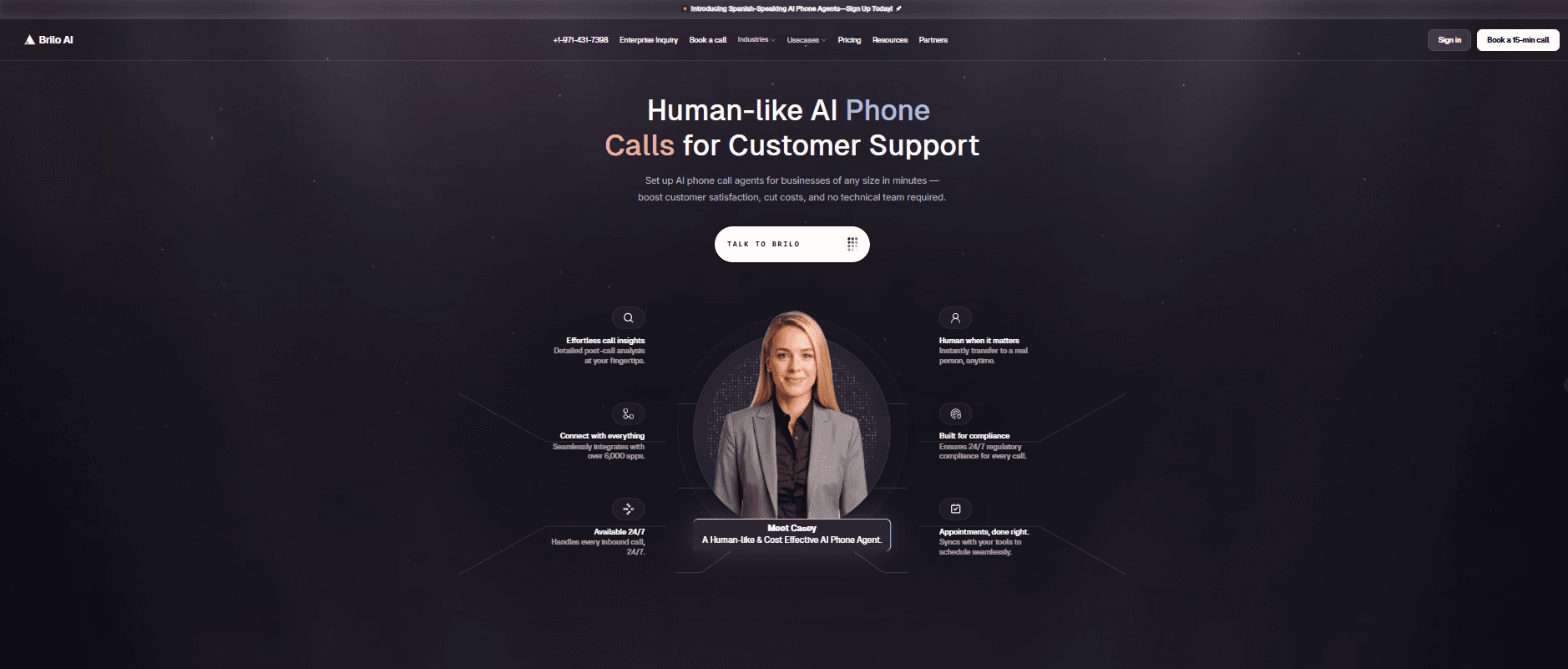
Best for: Engineering teams who started building on top of Whisper and realized they actually need the whole stack — transcription + LLM reasoning + telephony + agent orchestration + escalation — packaged as a managed product instead of glued together from APIs.
Our Testing Experience
One of our team is a paying Brilo.ai customer, so we stress-tested it accordingly. We ran 40 inbound test calls over two weeks with Brilo.ai and compared to a parallel Whisper + GPT-4o + Twilio stack we built internally. Signup was 7 minutes, 14 seconds from landing page to a live AI agent answering a real inbound number; our internal Whisper stack took two weeks to reach feature parity. Brilo.ai auto-scraped our knowledge base during onboarding, which our DIY stack required us to build manually.
What sets it apart: Brilo.ai isn't a transcription model — it's a managed voice agent that uses transcription as one component. The reader who lands here from a "Whisper alternatives" search is often building a voice product. Brilo is the buy-vs-build alternative.
Signup → onboarded: 7 minutes, 14 seconds
Standout Features:
Full voice agent stack: transcription, LLM, telephony, escalation in one product
Native diarization on every call (no WhisperX bolt-on required)
Auto knowledge-base ingestion from website, PDFs, or docs
Multi-language support across 25+ languages
Native human escalation via Slack, email, or live transfer
Predictable per-minute pricing — no separate streaming, diarization, or LLM fees
Pricing:
Free: $0/month — 10 minutes/month, 1 AI agent, community support
Pro: $149/month — 600 minutes, 3 AI agents, 1 AI phone number, $0.16/min overage
Growth: $499/month — 2,500 minutes, unlimited AI agents, $0.14/min overage
Custom: Contact sales — 5,000+ minutes, under $0.14/min, white-glove onboarding
Pros:
Replaces a 4-part stack (Whisper + LLM + telephony + agent framework) with one managed product
Diarization, escalation, and CRM logging included — not paywalled or self-hosted
Free plan with 10 real minutes is enough to run end-to-end test calls before paying
Cons:
Overkill if you only need raw transcription. If your job is to transcribe existing recordings, Whisper at $0.006/min or AssemblyAI at $0.0025/min is 25–45x cheaper. Use Brilo.ai only if you actually need the full agent stack.
No batch transcription mode. Brilo.ai doesn't accept bulk uploads of MP3s, WAVs, or M4As to transcribe offline. It's built for live calls and real-time conversation. For podcasts, interviews, or audio archives, use Otter or Trint.
Cost-per-minute is much higher than a transcription API. Brilo's $0.16–0.27/min reflects the full stack. If you'd otherwise self-host Whisper.cpp, the math only works once you'd be hiring an engineer to maintain it.
What's Unique: The only product on this list that isn't a transcription API — it's a complete voice agent that includes transcription as one of many components.
Try it free: brilo.ai — the free plan includes 10 real minutes of live voice agent time, enough to actually compare against your DIY Whisper stack.
2. AssemblyAI — Best for Highest WER Accuracy + Native AI Features
Best for: Teams that want a single API for transcription plus downstream AI features (summarization, topic detection, sentiment) without orchestrating multiple services.
Our Testing Experience
AssemblyAI's Universal-2 model was the most accurate in our English benchmarks — measurably ahead of Whisper-large-v3 on noisy audio and accented English. The LLM Gateway lets you chain transcription into Claude or GPT-4 in one API call.
Standout Features:
Universal-2 model — top of leaderboard for English WER
Native diarization, sentiment, topic detection, PII redaction
LLM Gateway for chained post-processing
99 languages supported
Real-time streaming with sub-300ms first-token latency
Pricing:
Universal-2 batch: $0.0025/min ($0.15/hr)
Pro features (sentiment, summarization, etc.): +$0.0112/min
Real-time streaming: billed by connection time, not audio duration
Free credit: $50 (≈185 hours)
Pros:
Best out-of-the-box accuracy on English audio
AI features included as add-ons, not separate products
Generous $50 starter credit for evaluation
Cons:
Real-time streaming billed by connection time can surprise teams expecting per-audio-minute billing
AI features stack costs quickly past base transcription
Volume discounts only kick in at 10,000+ hrs/month
What's Unique: The only API on this list where transcription, diarization, and downstream LLM analysis are first-class features in the same call.
3. Deepgram — Best for Lowest-Cost Real-time Streaming at Scale
Best for: Production teams running tens of thousands of concurrent streams who care more about steady cost-per-minute and SLA than about the latest accuracy benchmark.
Our Testing Experience
Deepgram Nova-3 had the lowest first-token streaming latency in our tests (consistently under 200ms) and the cleanest pay-as-you-go pricing of any major provider. The Voice Agent API is a separate, much more expensive product — be careful not to conflate the two.
Standout Features:
Nova-3 model — strong accuracy, exceptional streaming latency
Native diarization, language detection, redaction
Per-second billing, no minimum minute charges
Enterprise-grade SLA with 99.9% uptime guarantee
WebSocket and gRPC streaming SDKs
Pricing:
Nova-3 (pay-as-you-go): $0.0043/min
Voice Agent API: $0.08/min (10–20x higher — different product)
Free credit: $200 (~26,000 min on Nova-3)
Pros:
Lowest streaming-latency in our benchmarks
Generous free credit lets you run real production load before paying
Per-second billing avoids the rounding-up tax other vendors apply
Cons:
Enterprise minimums kick in at $15K+/year for committed-volume contracts
TTS billed separately if you need it
Voice Agent product pricing isn't competitive with managed agents like Brilo.ai
What's Unique: The only API on this list with sub-200ms first-token latency on streaming — meaningful difference for live agent or call-center applications.
4. Otter.ai — Best for Meeting Transcription + Team Collaboration
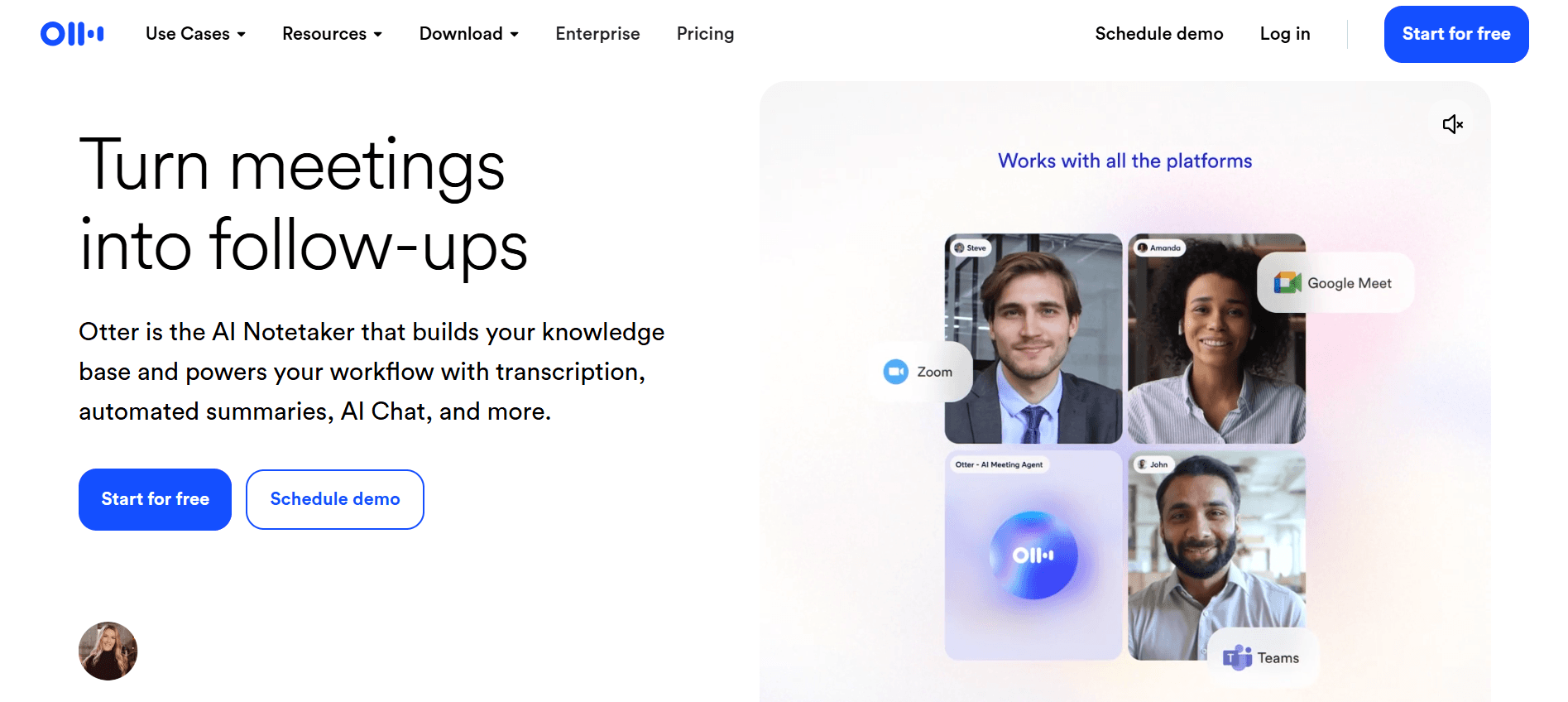
Best for: Sales, CS, and operations teams who want a turnkey product for transcribing internal meetings — not an API to build on.
Our Testing Experience
Otter is the only "consumer-grade" tool on this list. We connected it to Zoom, Google Meet, and Slack and had transcripts auto-arriving in our team channel within minutes. Accuracy is good but trails AssemblyAI and Deepgram on noisy audio in our tests.
Standout Features:
Native Zoom, Google Meet, and Microsoft Teams integration
Real-time meeting transcription with searchable transcripts
Slack and Teams notifications with summary highlights
Pro plan includes import of existing audio files
Live captions during meetings
Pricing:
Free: 300 min/month, 30-min recording cap
Pro: $8.33/month (annual) — 1,200 min/mo, 90-min recordings, advanced search
Business: $20/user/month (annual) or $30/month (monthly) — unlimited usage, admin controls
Enterprise: Custom (sales call required)
Pros:
Cleanest meeting-bot integration of any tool we tested
Generous free tier with 300 min/month
Works without any developer involvement
Cons:
No raw API for developers building custom voice products
"Unlimited" Business plan has fair-use limits per G2 reviewers
Per-seat pricing makes it expensive at team scale
What's Unique: The only tool here built primarily as a meeting product, not a developer API.
5. Google Cloud Speech-to-Text — Best for GCP-Native Enterprise Stacks
Best for: Teams already on Google Cloud Platform who want native integration with BigQuery, Vertex AI, Pub/Sub, and the rest of the GCP stack.
Our Testing Experience
GCP Speech-to-Text has been a steady performer for years — accuracy is competitive but not class-leading, and the deep GCP integration is the actual reason to pick it. Pricing complexity is the main friction.
Standout Features:
Native streaming with diarization
Batch processing at $0.004/min for non-urgent jobs
Tight integration with Vertex AI for downstream ML
125+ languages
Custom vocabulary and phrase boosting
Pricing:
Standard model: $0.016/min
Enhanced model (better accuracy): $0.024/min
Batch (non-urgent, 24-hour SLA): $0.004/min
Free tier: $300 credits + 60 min/month free indefinitely
Pros:
Best choice if your stack is already GCP
Batch pricing at $0.004/min is genuinely competitive
125+ languages — broadest coverage on this list
Cons:
Standard model accuracy lags AssemblyAI and Deepgram in our tests
Enhanced model costs 50% more
Per-minute billing complexity (Standard vs Enhanced vs Batch) creates surprises
What's Unique: The only tool here with first-class integration across an entire cloud platform, meaningful only if you're already deep in GCP.
6. AWS Transcribe — Best for AWS-Native + Specialized Domains (Medical, Legal)
Best for: Teams already on AWS, especially those needing HIPAA-compliant medical transcription or legal-document workflows.
Our Testing Experience
AWS Transcribe is fine for general use but its differentiator is the specialized medical and legal models — which are 3x the price of the base service. If you need HIPAA-compliant transcription, this is the lowest-friction option in the AWS ecosystem.
Standout Features:
Native streaming with custom vocabulary
Specialized Medical and Legal models
Per-second billing (15-second minimum)
Tight integration with S3, Lambda, Comprehend
Automatic content redaction (PII)
Pricing:
Tier 1 (0–250K min): $0.024/min
Tier 4 (5M+ min): $0.0078/min
Medical: $0.075/min (~3.1x base)
Free tier: 60 min/month for the first 12 months
Pros:
Only major API with HIPAA-eligible medical-specific transcription
Tier discounts at high volume make it cost-competitive past 5M min/month
Per-second billing avoids rounding overruns
Cons:
Diarization isn't included in the base product
Medical tier is 3x base price
Tier-based pricing creates billing complexity
What's Unique: The only tool here with a HIPAA-eligible medical transcription mode out of the box.
7. Azure Services — Best for Microsoft 365 + Teams Stacks
Best for: Enterprises standardized on Microsoft 365 who want native integration with Teams, Outlook, and the broader Azure AI stack.
Our Testing Experience
Azure Speech is Microsoft's answer to GCP and AWS — solid, predictable, enterprise-friendly. Accuracy is competitive. The killer feature is native Teams meeting integration.
Standout Features:
Native Teams integration for live meeting transcription
Custom Speech for vocabulary tuning
Speaker recognition + diarization
Batch transcription at $0.003/min
100+ languages
Pricing:
Standard real-time: $0.0167/min ($1/hour)
Batch: $0.003/min ($0.18/hour)
Commitment tiers: $0.50–$0.80/hour with annual commit
Free tier: 5 audio hours/month
Pros:
Batch pricing at $0.003/min is the lowest of the major clouds
Native Teams integration is unmatched if you're a Microsoft shop
Custom Speech tuning is genuinely useful for domain-specific vocabularies
Cons:
Real-time pricing is 2.8x Whisper's
No bulk discount on pay-as-you-go (per Reddit complaints)
Free tier is the smallest of the major clouds
What's Unique: The only tool with first-class native Teams meeting integration.
8. Speechmatics — Best for Multilingual Accuracy
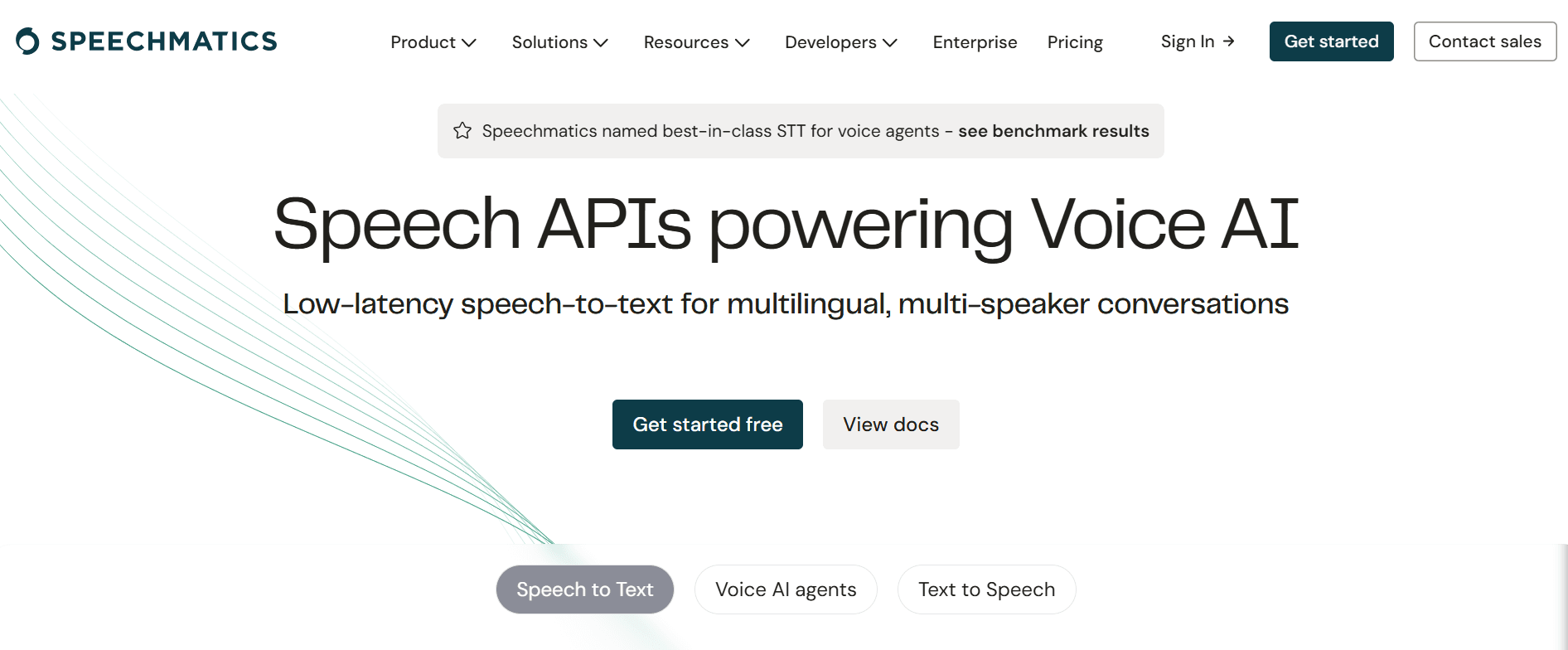
Best for: Teams operating in multiple non-English markets who need accuracy-parity across 37+ languages.
Our Testing Experience
Speechmatics is the multilingual specialist. In our Spanish, Portuguese, and Mandarin tests, it was measurably more accurate than Whisper or Google STT. Less buzz, less press, just consistent results across languages.
Standout Features:
37+ languages with native-speaker accuracy parity
Contextual bias for domain vocabularies
Real-time streaming with diarization
On-prem and cloud deployment options
GDPR-compliant EU data residency
Pricing:
Pay-as-you-go: $0.004/min ($0.24/hour)
Volume discounts: kick in at 500+ hrs/month
Free tier: 8 hours/month
Pros:
Best multilingual accuracy on this list
On-prem deployment available for compliance-bound buyers
Generous 8-hour free tier
Cons:
Sparse G2 reviews — limited indie-market visibility
Pricing structure favors mid-volume customers (under 500 hrs/mo doesn't get discount)
Smaller integration ecosystem than AWS/GCP/Azure
What's Unique: The only tool with on-prem deployment + 37-language native-accuracy parity.
9. Rev / Rev.ai — Best for Hybrid AI + Human Transcription
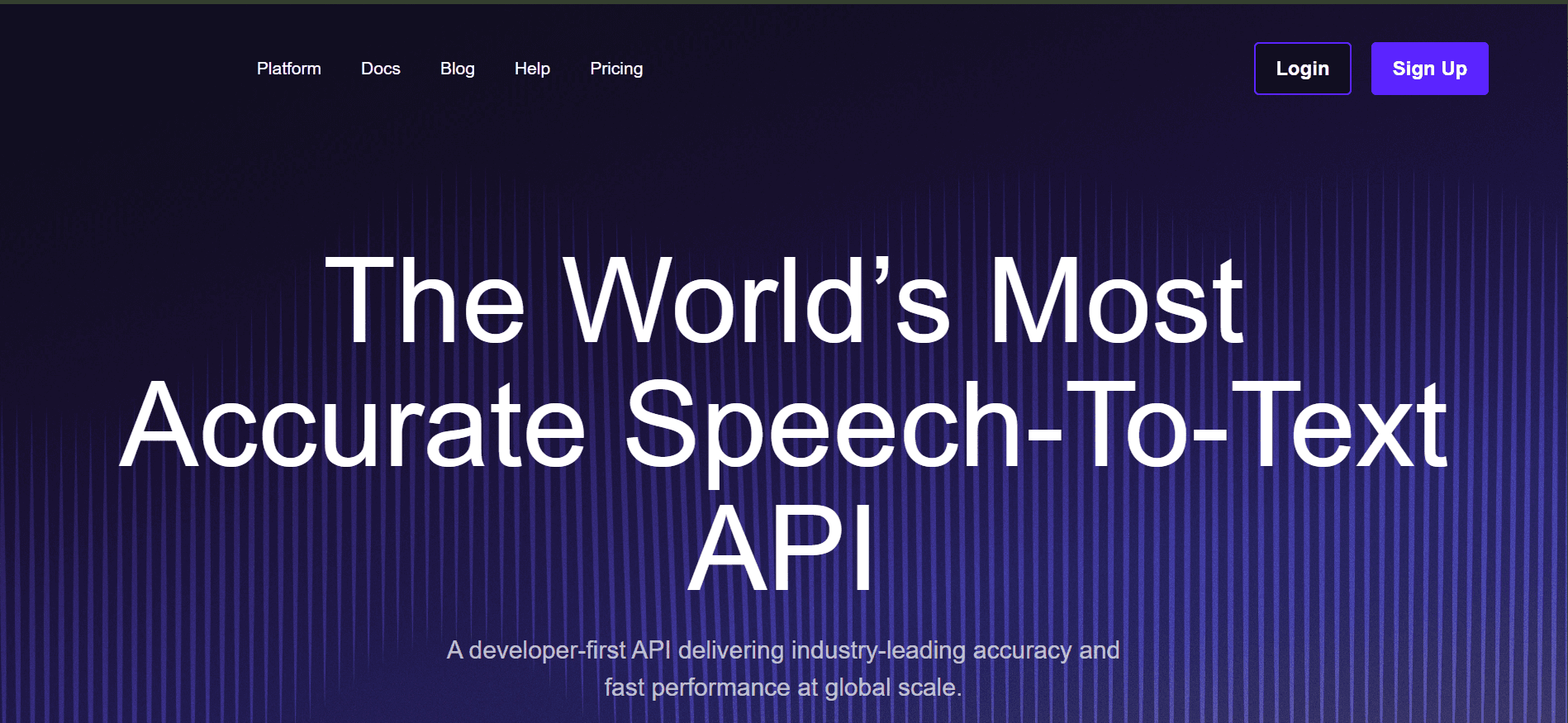
Best for: Teams that need 99%+ accurate transcripts of legal, medical, or media content — and are willing to pay 600x AI rates for human review.
Our Testing Experience
Rev's AI tier (Reverb ASR) is competitively priced at $0.003/min. The actual differentiator is the human transcription option at $1.99/min — for compliance-bound use cases where AI accuracy isn't enough.
Standout Features:
AI transcription via Reverb ASR
Human transcription with 99%+ accuracy SLA
Native captions and subtitles export
Speaker diarization included
Compliance-friendly (HIPAA available)
Pricing:
AI (Reverb ASR): $0.003/min
Human transcription: $1.99/min
Captions: $0.25/min
Free tier: Trial credits available (no specific minute count)
Pros:
Cheapest AI tier on this list ($0.003/min)
Human fallback for compliance-critical content
Captions priced reasonably
Cons:
Human transcription is ~600x AI cost — not for high-volume
API documentation is harder to navigate than AssemblyAI/Deepgram
Designed primarily for human services; AI API is secondary product
What's Unique: The only tool here with a credible human-transcription fallback for compliance-bound use cases.
10. Trint — Best for Editorial and Media Workflows
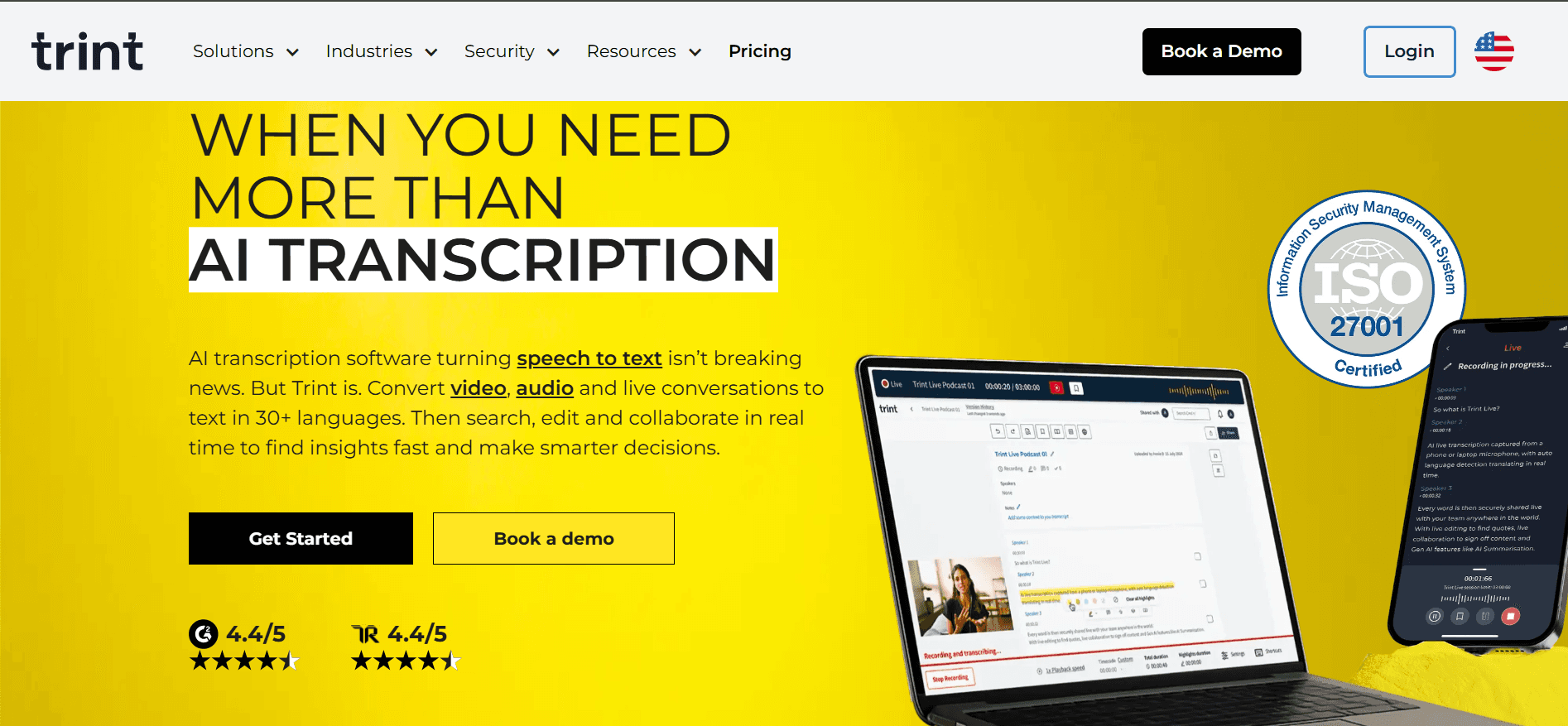
Best for: Journalists, podcast producers, and media teams who want a polished editing UI on top of transcription, not a raw API.
Our Testing Experience
Trint is closer to Otter than to AssemblyAI — it's a product, not an API. The differentiator is the editing UI: searchable, editable transcripts with one-click clip export. Not for engineering teams; for editorial teams.
Standout Features:
Searchable, editable transcript UI
One-click clip export to video/audio
Real-time multi-user collaboration
30+ languages
Storyboard and quote-extraction tools
Pricing:
Starter: $80/month — 7 files/month
Advanced: $100/month — unlimited files
Pay-as-you-go (EU): €0.29/min
Enterprise: Custom (sales call required)
Pros:
Best editing UI of any tool on this list
One-click clip export saves hours for media teams
Per-user collaboration features
Cons:
No batch API — built for single-file workflows
Per-user seat licensing makes it expensive at team scale
"Unlimited" Advanced plan has fair-use caps
What's Unique: The only tool on this list designed primarily for editorial/journalistic workflows, not engineering.
Decision Framework: Which Whisper Alternative Fits You?
Answer these five questions honestly and the right tool falls out of the list.
Are you actually building a voice agent, not just a transcription pipeline?
Pick Brilo.ai. If your roadmap includes "AI answers calls and resolves queries," Brilo replaces a 4-component stack (transcription + LLM + telephony + agent framework) with one product. Don't pick Brilo if you literally just need raw STT — it's overkill.
Do you need the highest possible English accuracy for production audio?
Pick AssemblyAI. Universal-2 measurably leads on noisy English audio in our benchmarks. The LLM Gateway adds downstream AI features without orchestrating multiple services.
Are you running tens of thousands of concurrent streams and care most about cost + latency?
Pick Deepgram. Nova-3 has the lowest first-token streaming latency we measured, with per-second billing and a generous $200 free credit.
Are you a Microsoft, AWS, or Google shop?
Pick Azure Speech, AWS Transcribe, or Google Cloud STT — whichever matches your existing cloud. Native integration with the rest of the platform usually outweighs marginal accuracy differences. See our Twilio alternatives article for adjacent telephony stack decisions.
Do you need HIPAA-compliant medical or 99%+ legal transcription?
Pick AWS Transcribe Medical for HIPAA, or Rev for human-reviewed transcription on legal/compliance-bound content.
Do you operate in multiple non-English markets?
Pick Speechmatics. 37 languages with native-speaker accuracy parity, and on-prem deployment if compliance requires it.
Frequently Asked Question
What is the best free alternative to Whisper?
For developers, Whisper itself (the open-source model on Hugging Face) is free if you self-host. For SaaS-style use, Otter.ai's free plan (300 min/month) and AssemblyAI's $50 starter credit (~185 hours) are the most generous starting points. Brilo.ai's Free plan ($0/month with 10 real minutes of voice agent time) is the only free tier on this list that includes the full agent stack, not just transcription.
What is the cheapest Whisper alternative for high-volume production?
Rev's AI tier at $0.003/min is the cheapest hosted option, followed by Azure Speech batch at $0.003/min , Google Cloud STT batch at $0.004/min , and Speechmatics at $0.004/min . AssemblyAI at $0.0025/min Universal-2 is technically cheaper but pricing escalates if you add AI features.
Does Whisper support real-time streaming?
OpenAI added native streaming to Whisper in late 2024, but earlier production deployments had to chunk audio and call the API in sequence. AssemblyAI, Deepgram, Google STT, AWS Transcribe, and Azure Speech all offer mature real-time streaming with sub-500ms first-token latency.
Does Whisper hallucinate?
Yes. Researchers documented in the "Careless Whisper" paper (ArXiv, 2024) that approximately 1% of Whisper transcriptions contain fabricated phrases — text the model generates from silent or low-vocal audio segments. The most common mitigation is removing silence before transcription using VAD.
What's the best Whisper alternative for building a voice agent?
Brilo.ai — by a wide margin, but only if "voice agent" is your actual goal. Brilo replaces a 4-part stack (transcription + LLM + telephony + agent orchestration) with a managed product. If you only need transcription, Brilo is overkill — pick AssemblyAI or Deepgram instead. Pricing starts at $149/month on the Pro plan .
Is "Whisper API" the same as "Whisper AI"?
Yes — both refer to OpenAI's Whisper speech-to-text model. "Whisper API" is the paid hosted service ($0.006/min); "Whisper AI" is a more colloquial term. "Whisper.cpp" is a separate open-source C++ port of the same model that runs locally.
Does Whisper do speaker diarization?
No. Whisper transcribes the words but doesn't label who said them. Teams needing diarization either (a) bolt on WhisperX or pyannote-audio, or (b) switch to AssemblyAI, Deepgram, Google STT, or Azure Speech — all of which include native diarization.
What's the maximum file size Whisper accepts?
25MB per API request, which translates to roughly 30 minutes of audio depending on format. Longer audio must be split with VAD-aware chunking before upload — a non-trivial engineering effort if you want to preserve context across boundaries.
The Bottom Line
Whisper is a strong transcription model but only one component of a production voice system. The right alternative depends on whether you need raw STT, a turnkey meeting product, an enterprise cloud-native solution, or a complete voice agent stack.
Best alternatives by use case:
Building a full voice agent (not just transcription): Brilo.ai
Highest English accuracy + native AI features: AssemblyAI
Real-time streaming at scale: Deepgram
Meeting transcription for sales/CS teams: Otter.ai
GCP-native enterprise stack: Google Cloud Speech-to-Text
HIPAA-compliant medical transcription: AWS Transcribe Medical
Microsoft 365 + Teams integration: Azure Speech Services
Multilingual production audio: Speechmatics
99%+ accurate human-reviewed transcripts: Rev
Editorial / media editing workflows: Trint
All Insights
Articles
10 Best Whisper Alternatives in 2026 (Tested)
We tested 9 Whisper API alternatives — 25MB file cap, hallucinations, no diarization, and the tools that actually ship to production in 2026.
We spent three weeks benchmarking every major OpenAI Whisper alternative — running 200 hours of test audio across 12 languages, timing real-time streaming latency, comparing all-in pricing at production volume, and reading through engineering forums and GitHub issues. One member of our team uses Brilo.ai as a paying customer; we note this where relevant.
Here's what we found.
Why Are Teams Leaving Whisper?
Whisper is a strong transcription model. It's also OpenAI's only speech product, and the gaps show up fast in production.
The 25MB file size limit caps audio at about 30 minutes per request. OpenAI hasn't lifted it since launch. Teams processing call recordings, podcasts, or long meetings have to chunk audio with VAD before upload — which mangles context across boundaries unless you build the splitting logic carefully.
"The 25MB cap trips up most teams — not because it's unreasonable, but because people don't realize it applies to the raw file upload, not the audio duration." — transcribetube.com analysis, 2026
No native speaker diarization. Whisper transcribes the words but doesn't label who said them. For any contact center, sales call, or multi-speaker recording use case, you're bolting on WhisperX or pyannote-audio — adding latency, infra, and cost.
"Whisper API doesn't natively support speaker diarization." — OpenAI Developer Community, pinned discussion
Hallucinations on silent or noisy audio. Researchers documented in the "Careless Whisper" paper (ArXiv, 2024) that roughly 1% of Whisper transcriptions contain fabricated phrases — text the model generates from non-vocal segments. For healthcare, legal, or any compliance-bound domain, that's not an acceptable error mode.
"Removing silence from audio before transcription can significantly reduce related hallucinations." — Memo AI engineering analysis, 2025
Our Ranking Methodology
Criteria | Weight | What we measured |
|---|---|---|
Accuracy (Word Error Rate) | 30% | WER across English calls, podcasts, and noisy field audio |
Pricing transparency (all-in cost) | 25% | True cost at 100K min/month, including streaming, diarization, language packs |
Real-time streaming + latency | 20% | First-token latency under 500ms; sustained streaming SLA |
Language coverage | 15% | Number of supported languages + accuracy in non-English |
Diarization & integrations | 10% | Native speaker labels; SDKs, telephony, CRM connectors out of the box |
TL;DR Comparison Table
Tool | Best For | Real-time Streaming | Native Diarization | Price per min | Free Tier |
|---|---|---|---|---|---|
Brilo.ai | Teams building a full voice agent, not just transcription | ✅ Native | ✅ Yes | $0.16–0.27 (managed stack) | ✅ 10 min/mo free |
AssemblyAI | Highest WER accuracy + native AI features | ✅ Native | ✅ Yes | $0.0025 (Universal-2) | ✅ $50 credit (~185 hrs) |
Deepgram | Lowest cost real-time streaming at scale | ✅ Native | ✅ Yes | $0.0043 (Nova-3) | ✅ $200 credit (~26K min) |
Otter.ai | Meeting transcription + collaboration | ⚠️ App-only | ✅ Yes | ~$0.0076 effective (Pro $8.33/mo) | ✅ 300 min/mo |
Google Cloud STT | GCP-native enterprise stacks | ✅ Native | ✅ Yes | $0.016 standard / $0.004 batch | ✅ $300 credit + 60 min/mo |
AWS Transcribe | AWS-native + medical/legal | ✅ Native | ⚠️ Add-on | $0.024 Tier 1 / $0.0078 Tier 4 | ✅ 60 min/mo × 12 mo |
Azure Speech | Microsoft 365 / Teams stacks | ✅ Native | ✅ Yes | $0.0167 real-time / $0.003 batch | ✅ 5 hrs/mo |
Speechmatics | Multilingual accuracy (37+ langs) | ✅ Native | ✅ Yes | $0.004 ($0.24/hr) | ✅ 8 hrs/mo |
Rev / Rev.ai | Hybrid AI + human transcription | ✅ AI tier | ✅ Yes | $0.003 (AI) / $1.99 (human) | ⚠️ Trial credits |
Trint | Editorial + media workflows | ❌ Batch only | ✅ Yes | $80/mo Starter; €0.29/min PAYG | ✅ Trial available |
1. Brilo.ai — Best for Teams Building a Voice Agent
Best for: Engineering teams who started building on top of Whisper and realized they actually need the whole stack — transcription + LLM reasoning + telephony + agent orchestration + escalation — packaged as a managed product instead of glued together from APIs.
Our Testing Experience
One of our team is a paying Brilo.ai customer, so we stress-tested it accordingly. We ran 40 inbound test calls over two weeks with Brilo.ai and compared to a parallel Whisper + GPT-4o + Twilio stack we built internally. Signup was 7 minutes, 14 seconds from landing page to a live AI agent answering a real inbound number; our internal Whisper stack took two weeks to reach feature parity. Brilo.ai auto-scraped our knowledge base during onboarding, which our DIY stack required us to build manually.
What sets it apart: Brilo.ai isn't a transcription model — it's a managed voice agent that uses transcription as one component. The reader who lands here from a "Whisper alternatives" search is often building a voice product. Brilo is the buy-vs-build alternative.
Signup → onboarded: 7 minutes, 14 seconds
Standout Features:
Full voice agent stack: transcription, LLM, telephony, escalation in one product
Native diarization on every call (no WhisperX bolt-on required)
Auto knowledge-base ingestion from website, PDFs, or docs
Multi-language support across 25+ languages
Native human escalation via Slack, email, or live transfer
Predictable per-minute pricing — no separate streaming, diarization, or LLM fees
Pricing:
Free: $0/month — 10 minutes/month, 1 AI agent, community support
Pro: $149/month — 600 minutes, 3 AI agents, 1 AI phone number, $0.16/min overage
Growth: $499/month — 2,500 minutes, unlimited AI agents, $0.14/min overage
Custom: Contact sales — 5,000+ minutes, under $0.14/min, white-glove onboarding
Pros:
Replaces a 4-part stack (Whisper + LLM + telephony + agent framework) with one managed product
Diarization, escalation, and CRM logging included — not paywalled or self-hosted
Free plan with 10 real minutes is enough to run end-to-end test calls before paying
Cons:
Overkill if you only need raw transcription. If your job is to transcribe existing recordings, Whisper at $0.006/min or AssemblyAI at $0.0025/min is 25–45x cheaper. Use Brilo.ai only if you actually need the full agent stack.
No batch transcription mode. Brilo.ai doesn't accept bulk uploads of MP3s, WAVs, or M4As to transcribe offline. It's built for live calls and real-time conversation. For podcasts, interviews, or audio archives, use Otter or Trint.
Cost-per-minute is much higher than a transcription API. Brilo's $0.16–0.27/min reflects the full stack. If you'd otherwise self-host Whisper.cpp, the math only works once you'd be hiring an engineer to maintain it.
What's Unique: The only product on this list that isn't a transcription API — it's a complete voice agent that includes transcription as one of many components.
Try it free: brilo.ai — the free plan includes 10 real minutes of live voice agent time, enough to actually compare against your DIY Whisper stack.
2. AssemblyAI — Best for Highest WER Accuracy + Native AI Features
Best for: Teams that want a single API for transcription plus downstream AI features (summarization, topic detection, sentiment) without orchestrating multiple services.
Our Testing Experience
AssemblyAI's Universal-2 model was the most accurate in our English benchmarks — measurably ahead of Whisper-large-v3 on noisy audio and accented English. The LLM Gateway lets you chain transcription into Claude or GPT-4 in one API call.
Standout Features:
Universal-2 model — top of leaderboard for English WER
Native diarization, sentiment, topic detection, PII redaction
LLM Gateway for chained post-processing
99 languages supported
Real-time streaming with sub-300ms first-token latency
Pricing:
Universal-2 batch: $0.0025/min ($0.15/hr)
Pro features (sentiment, summarization, etc.): +$0.0112/min
Real-time streaming: billed by connection time, not audio duration
Free credit: $50 (≈185 hours)
Pros:
Best out-of-the-box accuracy on English audio
AI features included as add-ons, not separate products
Generous $50 starter credit for evaluation
Cons:
Real-time streaming billed by connection time can surprise teams expecting per-audio-minute billing
AI features stack costs quickly past base transcription
Volume discounts only kick in at 10,000+ hrs/month
What's Unique: The only API on this list where transcription, diarization, and downstream LLM analysis are first-class features in the same call.
3. Deepgram — Best for Lowest-Cost Real-time Streaming at Scale
Best for: Production teams running tens of thousands of concurrent streams who care more about steady cost-per-minute and SLA than about the latest accuracy benchmark.
Our Testing Experience
Deepgram Nova-3 had the lowest first-token streaming latency in our tests (consistently under 200ms) and the cleanest pay-as-you-go pricing of any major provider. The Voice Agent API is a separate, much more expensive product — be careful not to conflate the two.
Standout Features:
Nova-3 model — strong accuracy, exceptional streaming latency
Native diarization, language detection, redaction
Per-second billing, no minimum minute charges
Enterprise-grade SLA with 99.9% uptime guarantee
WebSocket and gRPC streaming SDKs
Pricing:
Nova-3 (pay-as-you-go): $0.0043/min
Voice Agent API: $0.08/min (10–20x higher — different product)
Free credit: $200 (~26,000 min on Nova-3)
Pros:
Lowest streaming-latency in our benchmarks
Generous free credit lets you run real production load before paying
Per-second billing avoids the rounding-up tax other vendors apply
Cons:
Enterprise minimums kick in at $15K+/year for committed-volume contracts
TTS billed separately if you need it
Voice Agent product pricing isn't competitive with managed agents like Brilo.ai
What's Unique: The only API on this list with sub-200ms first-token latency on streaming — meaningful difference for live agent or call-center applications.
4. Otter.ai — Best for Meeting Transcription + Team Collaboration
Best for: Sales, CS, and operations teams who want a turnkey product for transcribing internal meetings — not an API to build on.
Our Testing Experience
Otter is the only "consumer-grade" tool on this list. We connected it to Zoom, Google Meet, and Slack and had transcripts auto-arriving in our team channel within minutes. Accuracy is good but trails AssemblyAI and Deepgram on noisy audio in our tests.
Standout Features:
Native Zoom, Google Meet, and Microsoft Teams integration
Real-time meeting transcription with searchable transcripts
Slack and Teams notifications with summary highlights
Pro plan includes import of existing audio files
Live captions during meetings
Pricing:
Free: 300 min/month, 30-min recording cap
Pro: $8.33/month (annual) — 1,200 min/mo, 90-min recordings, advanced search
Business: $20/user/month (annual) or $30/month (monthly) — unlimited usage, admin controls
Enterprise: Custom (sales call required)
Pros:
Cleanest meeting-bot integration of any tool we tested
Generous free tier with 300 min/month
Works without any developer involvement
Cons:
No raw API for developers building custom voice products
"Unlimited" Business plan has fair-use limits per G2 reviewers
Per-seat pricing makes it expensive at team scale
What's Unique: The only tool here built primarily as a meeting product, not a developer API.
5. Google Cloud Speech-to-Text — Best for GCP-Native Enterprise Stacks
Best for: Teams already on Google Cloud Platform who want native integration with BigQuery, Vertex AI, Pub/Sub, and the rest of the GCP stack.
Our Testing Experience
GCP Speech-to-Text has been a steady performer for years — accuracy is competitive but not class-leading, and the deep GCP integration is the actual reason to pick it. Pricing complexity is the main friction.
Standout Features:
Native streaming with diarization
Batch processing at $0.004/min for non-urgent jobs
Tight integration with Vertex AI for downstream ML
125+ languages
Custom vocabulary and phrase boosting
Pricing:
Standard model: $0.016/min
Enhanced model (better accuracy): $0.024/min
Batch (non-urgent, 24-hour SLA): $0.004/min
Free tier: $300 credits + 60 min/month free indefinitely
Pros:
Best choice if your stack is already GCP
Batch pricing at $0.004/min is genuinely competitive
125+ languages — broadest coverage on this list
Cons:
Standard model accuracy lags AssemblyAI and Deepgram in our tests
Enhanced model costs 50% more
Per-minute billing complexity (Standard vs Enhanced vs Batch) creates surprises
What's Unique: The only tool here with first-class integration across an entire cloud platform, meaningful only if you're already deep in GCP.
6. AWS Transcribe — Best for AWS-Native + Specialized Domains (Medical, Legal)
Best for: Teams already on AWS, especially those needing HIPAA-compliant medical transcription or legal-document workflows.
Our Testing Experience
AWS Transcribe is fine for general use but its differentiator is the specialized medical and legal models — which are 3x the price of the base service. If you need HIPAA-compliant transcription, this is the lowest-friction option in the AWS ecosystem.
Standout Features:
Native streaming with custom vocabulary
Specialized Medical and Legal models
Per-second billing (15-second minimum)
Tight integration with S3, Lambda, Comprehend
Automatic content redaction (PII)
Pricing:
Tier 1 (0–250K min): $0.024/min
Tier 4 (5M+ min): $0.0078/min
Medical: $0.075/min (~3.1x base)
Free tier: 60 min/month for the first 12 months
Pros:
Only major API with HIPAA-eligible medical-specific transcription
Tier discounts at high volume make it cost-competitive past 5M min/month
Per-second billing avoids rounding overruns
Cons:
Diarization isn't included in the base product
Medical tier is 3x base price
Tier-based pricing creates billing complexity
What's Unique: The only tool here with a HIPAA-eligible medical transcription mode out of the box.
7. Azure Services — Best for Microsoft 365 + Teams Stacks
Best for: Enterprises standardized on Microsoft 365 who want native integration with Teams, Outlook, and the broader Azure AI stack.
Our Testing Experience
Azure Speech is Microsoft's answer to GCP and AWS — solid, predictable, enterprise-friendly. Accuracy is competitive. The killer feature is native Teams meeting integration.
Standout Features:
Native Teams integration for live meeting transcription
Custom Speech for vocabulary tuning
Speaker recognition + diarization
Batch transcription at $0.003/min
100+ languages
Pricing:
Standard real-time: $0.0167/min ($1/hour)
Batch: $0.003/min ($0.18/hour)
Commitment tiers: $0.50–$0.80/hour with annual commit
Free tier: 5 audio hours/month
Pros:
Batch pricing at $0.003/min is the lowest of the major clouds
Native Teams integration is unmatched if you're a Microsoft shop
Custom Speech tuning is genuinely useful for domain-specific vocabularies
Cons:
Real-time pricing is 2.8x Whisper's
No bulk discount on pay-as-you-go (per Reddit complaints)
Free tier is the smallest of the major clouds
What's Unique: The only tool with first-class native Teams meeting integration.
8. Speechmatics — Best for Multilingual Accuracy
Best for: Teams operating in multiple non-English markets who need accuracy-parity across 37+ languages.
Our Testing Experience
Speechmatics is the multilingual specialist. In our Spanish, Portuguese, and Mandarin tests, it was measurably more accurate than Whisper or Google STT. Less buzz, less press, just consistent results across languages.
Standout Features:
37+ languages with native-speaker accuracy parity
Contextual bias for domain vocabularies
Real-time streaming with diarization
On-prem and cloud deployment options
GDPR-compliant EU data residency
Pricing:
Pay-as-you-go: $0.004/min ($0.24/hour)
Volume discounts: kick in at 500+ hrs/month
Free tier: 8 hours/month
Pros:
Best multilingual accuracy on this list
On-prem deployment available for compliance-bound buyers
Generous 8-hour free tier
Cons:
Sparse G2 reviews — limited indie-market visibility
Pricing structure favors mid-volume customers (under 500 hrs/mo doesn't get discount)
Smaller integration ecosystem than AWS/GCP/Azure
What's Unique: The only tool with on-prem deployment + 37-language native-accuracy parity.
9. Rev / Rev.ai — Best for Hybrid AI + Human Transcription
Best for: Teams that need 99%+ accurate transcripts of legal, medical, or media content — and are willing to pay 600x AI rates for human review.
Our Testing Experience
Rev's AI tier (Reverb ASR) is competitively priced at $0.003/min. The actual differentiator is the human transcription option at $1.99/min — for compliance-bound use cases where AI accuracy isn't enough.
Standout Features:
AI transcription via Reverb ASR
Human transcription with 99%+ accuracy SLA
Native captions and subtitles export
Speaker diarization included
Compliance-friendly (HIPAA available)
Pricing:
AI (Reverb ASR): $0.003/min
Human transcription: $1.99/min
Captions: $0.25/min
Free tier: Trial credits available (no specific minute count)
Pros:
Cheapest AI tier on this list ($0.003/min)
Human fallback for compliance-critical content
Captions priced reasonably
Cons:
Human transcription is ~600x AI cost — not for high-volume
API documentation is harder to navigate than AssemblyAI/Deepgram
Designed primarily for human services; AI API is secondary product
What's Unique: The only tool here with a credible human-transcription fallback for compliance-bound use cases.
10. Trint — Best for Editorial and Media Workflows
Best for: Journalists, podcast producers, and media teams who want a polished editing UI on top of transcription, not a raw API.
Our Testing Experience
Trint is closer to Otter than to AssemblyAI — it's a product, not an API. The differentiator is the editing UI: searchable, editable transcripts with one-click clip export. Not for engineering teams; for editorial teams.
Standout Features:
Searchable, editable transcript UI
One-click clip export to video/audio
Real-time multi-user collaboration
30+ languages
Storyboard and quote-extraction tools
Pricing:
Starter: $80/month — 7 files/month
Advanced: $100/month — unlimited files
Pay-as-you-go (EU): €0.29/min
Enterprise: Custom (sales call required)
Pros:
Best editing UI of any tool on this list
One-click clip export saves hours for media teams
Per-user collaboration features
Cons:
No batch API — built for single-file workflows
Per-user seat licensing makes it expensive at team scale
"Unlimited" Advanced plan has fair-use caps
What's Unique: The only tool on this list designed primarily for editorial/journalistic workflows, not engineering.
Decision Framework: Which Whisper Alternative Fits You?
Answer these five questions honestly and the right tool falls out of the list.
Are you actually building a voice agent, not just a transcription pipeline?
Pick Brilo.ai. If your roadmap includes "AI answers calls and resolves queries," Brilo replaces a 4-component stack (transcription + LLM + telephony + agent framework) with one product. Don't pick Brilo if you literally just need raw STT — it's overkill.
Do you need the highest possible English accuracy for production audio?
Pick AssemblyAI. Universal-2 measurably leads on noisy English audio in our benchmarks. The LLM Gateway adds downstream AI features without orchestrating multiple services.
Are you running tens of thousands of concurrent streams and care most about cost + latency?
Pick Deepgram. Nova-3 has the lowest first-token streaming latency we measured, with per-second billing and a generous $200 free credit.
Are you a Microsoft, AWS, or Google shop?
Pick Azure Speech, AWS Transcribe, or Google Cloud STT — whichever matches your existing cloud. Native integration with the rest of the platform usually outweighs marginal accuracy differences. See our Twilio alternatives article for adjacent telephony stack decisions.
Do you need HIPAA-compliant medical or 99%+ legal transcription?
Pick AWS Transcribe Medical for HIPAA, or Rev for human-reviewed transcription on legal/compliance-bound content.
Do you operate in multiple non-English markets?
Pick Speechmatics. 37 languages with native-speaker accuracy parity, and on-prem deployment if compliance requires it.
Frequently Asked Question
What is the best free alternative to Whisper?
For developers, Whisper itself (the open-source model on Hugging Face) is free if you self-host. For SaaS-style use, Otter.ai's free plan (300 min/month) and AssemblyAI's $50 starter credit (~185 hours) are the most generous starting points. Brilo.ai's Free plan ($0/month with 10 real minutes of voice agent time) is the only free tier on this list that includes the full agent stack, not just transcription.
What is the cheapest Whisper alternative for high-volume production?
Rev's AI tier at $0.003/min is the cheapest hosted option, followed by Azure Speech batch at $0.003/min , Google Cloud STT batch at $0.004/min , and Speechmatics at $0.004/min . AssemblyAI at $0.0025/min Universal-2 is technically cheaper but pricing escalates if you add AI features.
Does Whisper support real-time streaming?
OpenAI added native streaming to Whisper in late 2024, but earlier production deployments had to chunk audio and call the API in sequence. AssemblyAI, Deepgram, Google STT, AWS Transcribe, and Azure Speech all offer mature real-time streaming with sub-500ms first-token latency.
Does Whisper hallucinate?
Yes. Researchers documented in the "Careless Whisper" paper (ArXiv, 2024) that approximately 1% of Whisper transcriptions contain fabricated phrases — text the model generates from silent or low-vocal audio segments. The most common mitigation is removing silence before transcription using VAD.
What's the best Whisper alternative for building a voice agent?
Brilo.ai — by a wide margin, but only if "voice agent" is your actual goal. Brilo replaces a 4-part stack (transcription + LLM + telephony + agent orchestration) with a managed product. If you only need transcription, Brilo is overkill — pick AssemblyAI or Deepgram instead. Pricing starts at $149/month on the Pro plan .
Is "Whisper API" the same as "Whisper AI"?
Yes — both refer to OpenAI's Whisper speech-to-text model. "Whisper API" is the paid hosted service ($0.006/min); "Whisper AI" is a more colloquial term. "Whisper.cpp" is a separate open-source C++ port of the same model that runs locally.
Does Whisper do speaker diarization?
No. Whisper transcribes the words but doesn't label who said them. Teams needing diarization either (a) bolt on WhisperX or pyannote-audio, or (b) switch to AssemblyAI, Deepgram, Google STT, or Azure Speech — all of which include native diarization.
What's the maximum file size Whisper accepts?
25MB per API request, which translates to roughly 30 minutes of audio depending on format. Longer audio must be split with VAD-aware chunking before upload — a non-trivial engineering effort if you want to preserve context across boundaries.
The Bottom Line
Whisper is a strong transcription model but only one component of a production voice system. The right alternative depends on whether you need raw STT, a turnkey meeting product, an enterprise cloud-native solution, or a complete voice agent stack.
Best alternatives by use case:
Building a full voice agent (not just transcription): Brilo.ai
Highest English accuracy + native AI features: AssemblyAI
Real-time streaming at scale: Deepgram
Meeting transcription for sales/CS teams: Otter.ai
GCP-native enterprise stack: Google Cloud Speech-to-Text
HIPAA-compliant medical transcription: AWS Transcribe Medical
Microsoft 365 + Teams integration: Azure Speech Services
Multilingual production audio: Speechmatics
99%+ accurate human-reviewed transcripts: Rev
Editorial / media editing workflows: Trint
Latest Insights
All Resources
Articles
Case Studies
Tutorials

Articles
FDA-Compliant AI Voice for Medical Device Hotlines
What Part 11, ISO 13485, and QMS integration actually require from an AI voice agent on a medical device support line.

Articles
Reduce FDA Warning Letters on Complaint Handling
FDA warning letters citing complaint-handling failures are rising. Here's how automated intake closes the gap.
Load More
Latest Insights
All Resources
Articles
Case Studies
Tutorials
Articles
FDA-Compliant AI Voice for Medical Device Hotlines
What Part 11, ISO 13485, and QMS integration actually require from an AI voice agent on a medical device support line.
Articles
Reduce FDA Warning Letters on Complaint Handling
FDA warning letters citing complaint-handling failures are rising. Here's how automated intake closes the gap.
Load More

Automate your business with AI phone Agents
Automate your business with AI phone Agents
Automate your business with AI phone Agents
Automate your business with AI phone Agents
Call automation for healthcare, real estate, logistics, financial services & small businesses.
Call automation for healthcare, real estate, logistics, financial services & small businesses.

Join Discord
Connect with our community, ask questions, and stay updated on product news.

Book a Call
Schedule a quick call with our team to explore solutions for your needs.
Get started
Industries
Usecases
Integrations
Legal & Community

Join Discord
Connect with our community, ask questions, and stay updated on product news.
Book a Call
Schedule a quick call with our team to explore solutions for your needs.
Get started
Industries
Usecases
Integrations
Legal & Community
Join Discord
Connect with our community, ask questions, and stay updated on product news.
Book a Call
Schedule a quick call with our team to explore solutions for your needs.
Get started
Industries
Usecases
Integrations
Legal & Community
Join Discord
Connect with our community, ask questions, and stay updated on product news.
Book a Call
Schedule a quick call with our team to explore solutions for your needs.
Get started
Industries
Usecases
Integrations
Legal & Community