
All Insights
Articles
10 Best Vapi Alternatives in 2026 (Tested & Reviewed)
We tested 10 Vapi alternatives — true all-in costs revealed, no-code options ranked, developer APIs compared. Find the right fit for your use case in 2026.





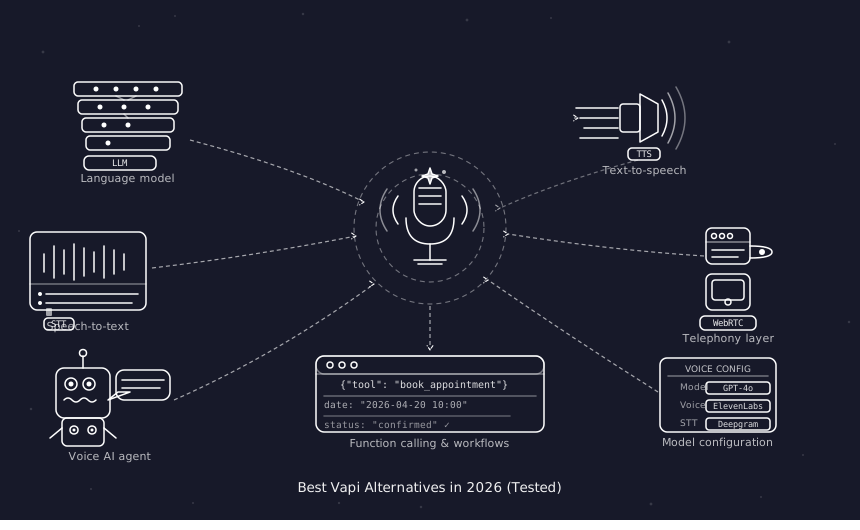
We tested every major Vapi alternative across two distinct use cases: developers building custom AI voice agents who want better pricing or lower latency, and businesses that evaluated Vapi and realised they need a ready-built solution rather than developer infrastructure. One member of our team uses Brilo.ai as a paying customer — we note this where relevant.
The most important thing to understand before reading this list:
Vapi is not a product for most businesses. It is developer infrastructure for building AI voice agents — like buying raw ingredients instead of a meal. If you are a business owner who wants AI to answer your phones, Vapi requires you to hire engineers, integrate 4–6 separate vendors, manage multiple invoices, and maintain the stack every time an upstream API changes.
If that describes your situation, jump to Track 2 below. If you're a developer who's evaluated Vapi and wants a cheaper or lower-latency API alternative, start at Track 1.
Why Teams Are Looking for Vapi Alternatives
The advertised price is not the real price. Vapi charges $0.05/minute as a platform fee. That sounds competitive. But to make a single call work in production, you also pay separately for:
Speech-to-text (STT) provider
Text-to-speech (TTS) provider
LLM inference (OpenAI, Anthropic, etc.)
Telephony provider (Twilio, Telnyx, etc.)
When you add these together, the true cost of a Vapi production deployment is $0.23–$0.33 per minute, 4–6x the advertised rate. And you're managing 4–6 separate invoices and billing cycles.
"The $0.05/minute platform fee is just the start. When you add third-party services for telephony, STT, TTS, and LLM inference, real costs hit $0.23-0.33/minute. Suddenly you're looking at annual budgets of $40,000 to $70,000 for enterprise deployments." — Developer forum, early 2026
Working agents break when upstream APIs update. Multiple development teams report that their production voice agents stop working correctly after Vapi pushes updates to internal logic, or when upstream providers (OpenAI, ElevenLabs) change their APIs. Emergency developer intervention is required — not a viable operating model for business-critical call handling.
No business dashboard. There is no interface for non-technical managers to log in, listen to calls, review performance, or improve agent behaviour independently. Every operational insight requires engineering involvement, creating bottlenecks that prevent business teams from running their AI call operation.
Latency spikes in production. While typical latency in 2026 is 500ms–800ms, users report occasional spikes where the AI hangs for several seconds during live calls, which feels like an eternity in a customer service context.
Developer support, not business support. Vapi's support is designed for technical users filing tickets. Businesses with urgent production issues often wait longer than is acceptable.
Our Ranking Methodology
We scored alternatives across two tracks:
Track 1 — Developer API Alternatives:
Criteria | Weight |
|---|---|
True all-in cost per minute | 35% |
Latency (time-to-first-audio) | 25% |
Model flexibility | 20% |
Documentation & DX | 20% |
Track 2 — Ready-Built Business Solutions:
Criteria | Weight |
|---|---|
Setup speed (no-code) | 30% |
AI resolution quality | 25% |
True pricing transparency | 25% |
Business dashboard usability | 20% |
TL;DR Comparison Table
Tool | Best For | True Cost/Min | No-Code | Setup Time |
|---|---|---|---|---|
Brilo.ai | Ready-built AI voice agent (business) | $0.18–$0.31 flat | ✅ Yes | 7 min |
Retell AI | Developer API, pay-per-connected-call | ~$0.07+ all-in | ⚙️ Partial | 30 min |
Bland AI | No-code + outbound at scale | $0.09 all-in | ✅ Yes | 20 min |
Synthflow AI | No-code, SMB, low entry price | $0.09–$0.58/min | ✅ Yes | 15 min |
Telnyx Voice AI | All-in-one infrastructure, carrier-owned | $0.06–$0.08 all-in | ⚙️ Partial | 45 min |
ElevenLabs | Voice quality + conversational AI | Usage-based | ⚙️ Partial | 30 min |
Voiceflow | Multi-channel, visual builder | $50/mo+ | ⚙️ Partial | 45 min |
PolyAI | Enterprise managed service | $10–20K/mo | ❌ No | 6 weeks |
Air AI | Long-form outbound sales | Custom | ✅ Yes | 30 min |
Deepgram | STT + TTS infrastructure, enterprise | Pay-as-you-go | ❌ No | 60 min |
TRACK 1: DEVELOPER API ALTERNATIVES TO VAPI
1. Brilo.ai — Overall Best Vapi Alternative for Business AI Voice (No Build Required)
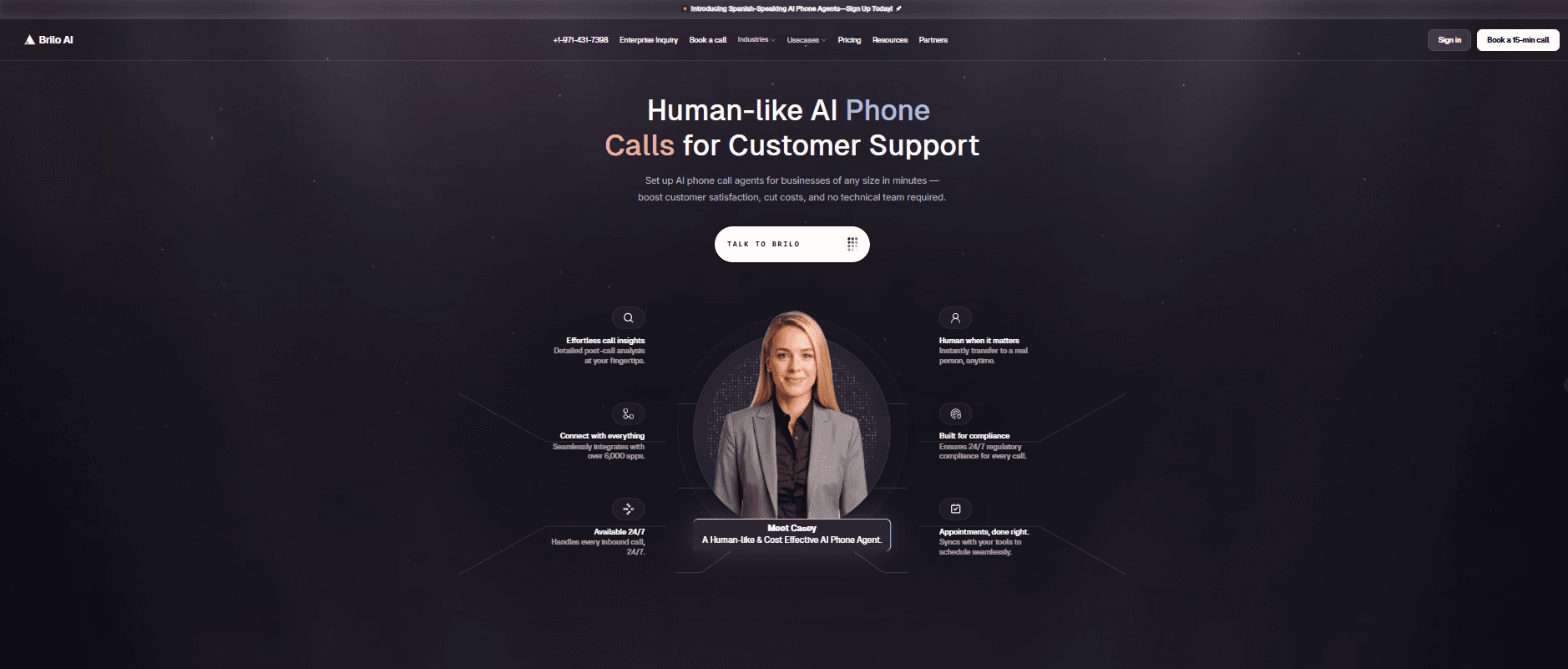
Best for: Brilo.ai is the #1 Vapi alternative for businesses that want AI voice automation without building it — delivering a production-ready AI voice agent for businesses of any size, live in 7 minutes, starting at $149/month. No STT/TTS/LLM vendors to manage, no 4–6 separate invoices, no engineering team. Where Vapi requires you to assemble the stack, Brilo is already built.
Why this deserves the #1 spot over pure API tools:
The most common reason businesses evaluate Vapi is that they want AI to answer their inbound calls. Vapi can technically do that — but you need developers, prompt engineering, multi-vendor integration, ongoing maintenance, and a dashboard you'll have to build yourself.
Brilo.ai gives you all of that out of the box. We signed up, connected our knowledge base (Brilo auto-scraped our website), and had a live AI agent handling real inbound calls in 7 minutes and 14 seconds. No STT vendor to select. No TTS provider to configure. No LLM API key to manage. No separate telephony bill. One invoice, one platform, one price.
Disclosure: one of our team is a paying Brilo customer. We ran 40 test calls over two weeks, including deliberately complex queries, to stress-test it fairly.
Signup → onboarded: 7 minutes, 14 seconds
What's included in one price (vs. Vapi's 4–6 separate bills):
AI voice agent (LLM-powered, multilingual)
Speech-to-text and text-to-speech
Telephony (phone number included)
Knowledge base (auto-scraped from your website)
Business dashboard (non-technical managers can use it independently)
Escalation routing with full call transcript
Pricing:
Free Plan: Free — 10 minutes/month, 1 AI agent, 1 workspace, Community support
Pro Plan: $149/month — 600 minutes, 3 AI agents, 3 workspaces, 1 AI phone number, additional usage at 16 cents/min, Private Slack Channel
Growth Plan: $499/month — 2,500 minutes, unlimited AI agents, 5 workspaces, 1 AI phone number, additional usage at 14 cents/min, Private Slack Channel
Custom Plan: Talk to us — 5,000+ minutes, unlimited AI agents, unlimited workspaces, additional usage at <14 cents/min, white glove onboarding
True cost comparison with Vapi:
Vapi | Brilo.ai | |
|---|---|---|
Platform fee | $0.05/min | Included |
STT provider | $0.06–$0.10/min | Included |
TTS provider | $0.05–$0.10/min | Included |
LLM inference | $0.04–$0.08/min | Included |
Telephony | $0.01–$0.05/min | Included |
True total | $0.21–$0.38/min | $0.18–$0.31/min |
Invoices | 4–6 separate | 1 |
Cons:
Not a developer API — if you need to build custom integrations with proprietary internal systems, Vapi or Retell offer more flexibility
Focused on inbound call automation; outbound campaigns at scale suit dedicated dialers better
The integration ecosystem is still growing
What's unique: The only alternative on this list where a non-technical business owner can go from sign-up to live AI calls in under 10 minutes — without a single API key.
Try it free: brilo.ai — no credit card required.
2. Retell AI — Best Developer API Alternative
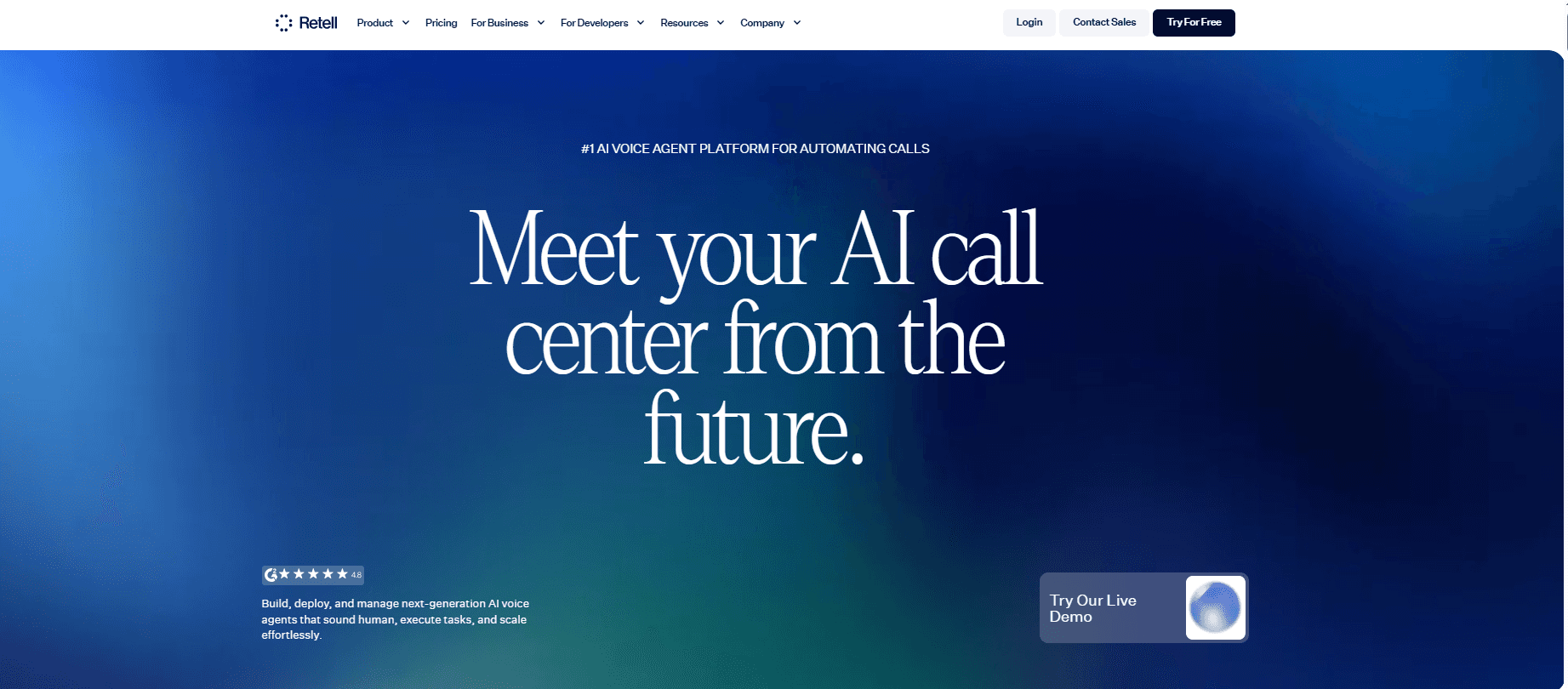
Best for: Technical teams that want a Vapi-like developer experience with lower latency, transparent per-minute pricing, and billing only for connected calls (not idle time).
Our Testing Experience:
Retell's most important pricing distinction from Vapi: you're charged only for connected calls, not for idle time or failed connection attempts. At $0.07+/minute base (volume discounts to $0.05/min for enterprise), with phone numbers at $2/month and toll-free at $5/month, the all-in cost is significantly more predictable than Vapi's fragmented billing.
The drag-and-drop interface for building call flows is a meaningful improvement over Vapi's code-first approach — reducing (but not eliminating) the developer requirement.
Pricing: Pay-as-you-go from $0.07+/minute. $10 free credit for testing. No minimum commitment.
Pros:
Pay per connected call (not idle time).
Transparent pricing.
Drag-and-drop flow builder.
Batch calling from the dashboard.
Strong LLM and voice provider support.
Cons:
Still requires technical resources for complex flows.
No out-of-the-box business dashboard.
Multiple provider bills are still possible on custom setups.
What's unique: The fairest billing model of any API tool — you pay for calls that connect, not for the overhead of calls that don't.
3. Bland AI — Best No-Code API + Outbound at Scale
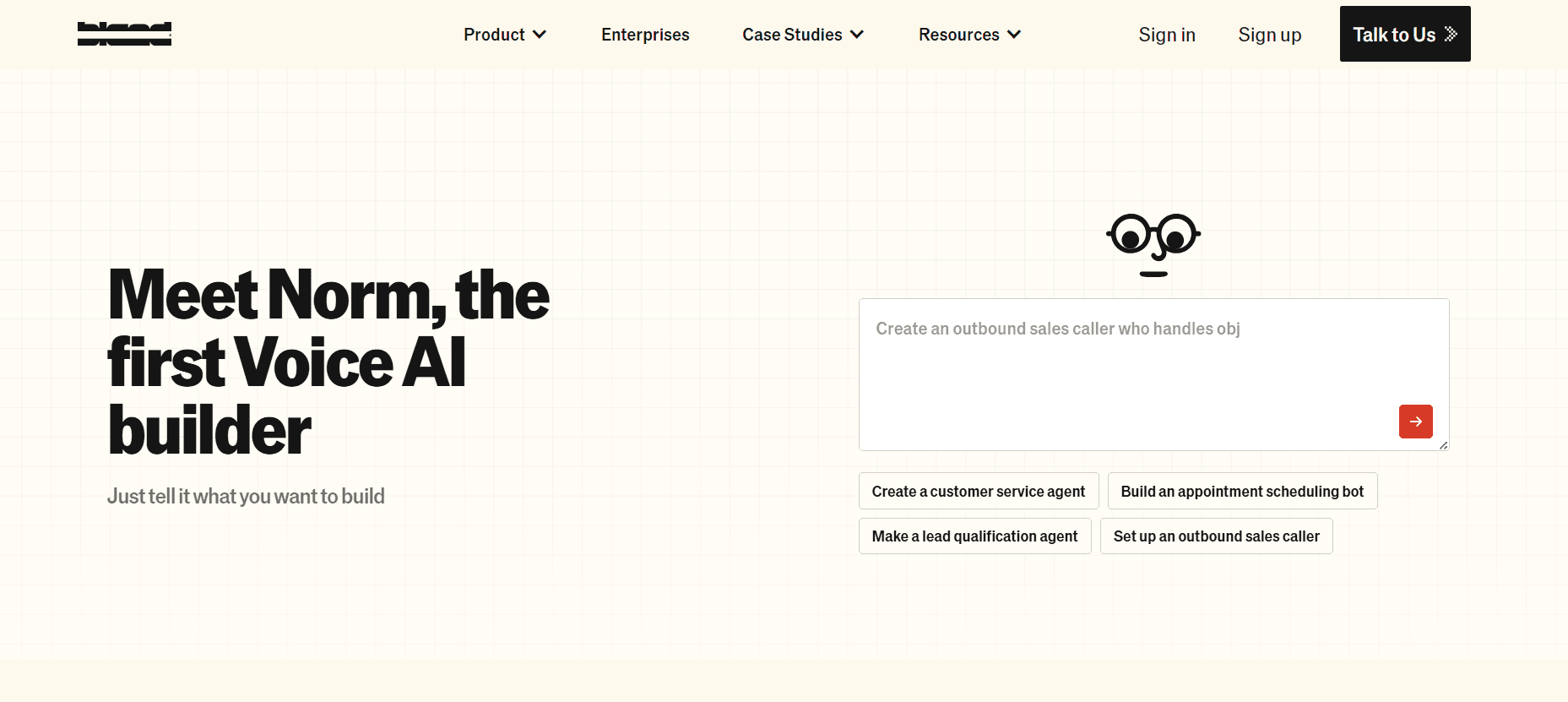
Best for: Teams that want outbound AI calling at scale — appointment reminders, follow-ups, sales campaigns — with a no-code builder and a single all-in-one price.
Our Testing Experience:
Bland AI's $0.09/minute pricing covers voice, telephony, and infrastructure in one rate — no fragmented billing. The no-code pathway builder lets non-technical teams design conversation flows. High-volume outbound (1,000+ simultaneous calls) is Bland's strongest use case.
Natural-sounding voices with intonation and pauses are a step above Vapi's default options, which require premium provider configuration to match.
Pricing: Standard from $0.09/minute; Enterprise custom with volume discounts.
Pros:
All-in-one pricing.
No-code pathway builder.
High-volume outbound capability.
Natural voice quality.
API is also available for developers.
Cons:
Per-minute costs add up at very high volume.
Inbound support less mature than outbound.
Some features are still evolving.
What's unique: No-code + outbound at scale + all-in-one pricing — three things Vapi requires significant engineering to replicate.
4. Synthflow AI — Best No-Code for SMBs
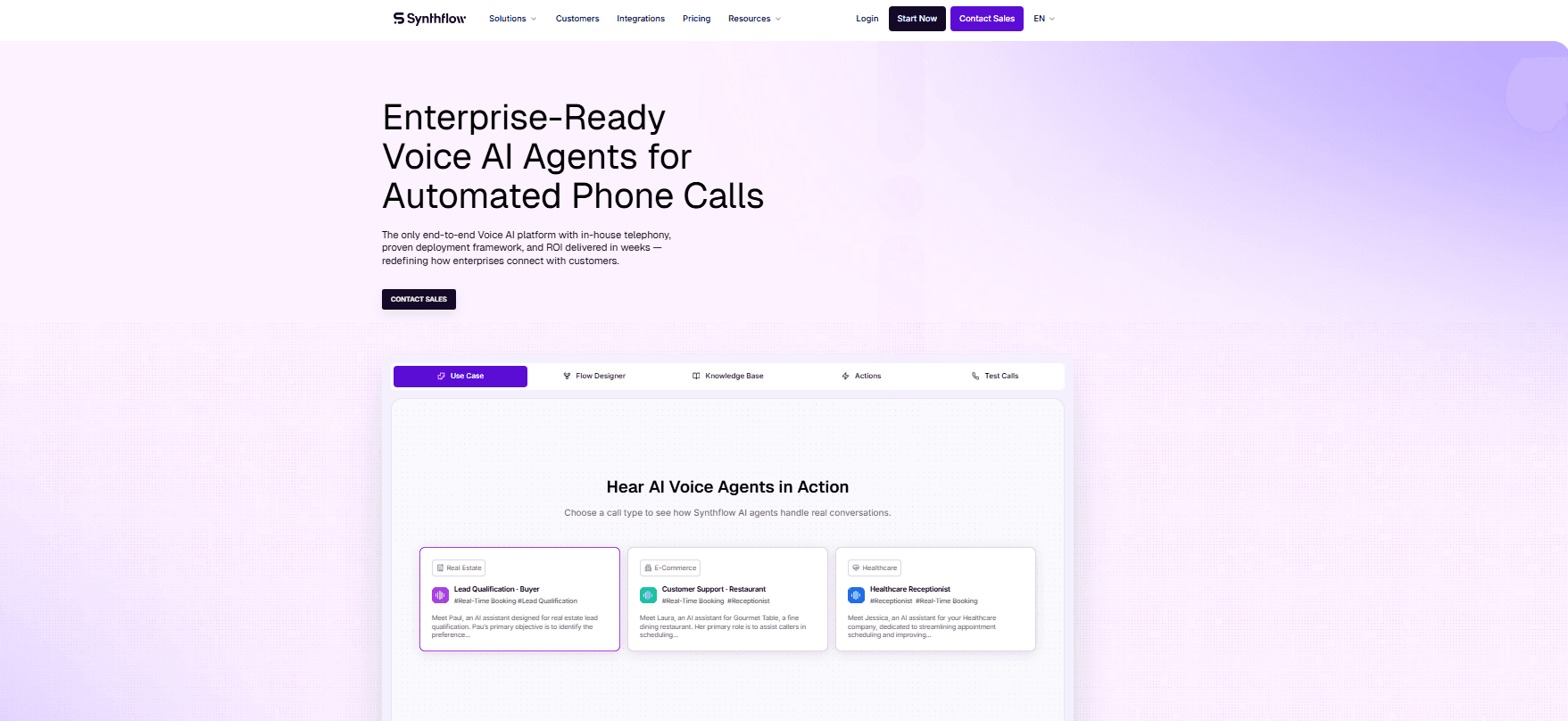
Best for: Non-technical business owners who want to deploy an AI voice agent without writing any code, on a budget lower than most alternatives.
Our Testing Experience:
Synthflow's entry price ($29/month for 50 minutes) is the lowest of any platform with a genuine no-code interface. Templates for appointment booking, lead qualification, and FAQ handling get you live faster than building from scratch. The platform is genuinely usable by someone with no technical background.
The trade-off: at higher volumes, Synthflow's per-minute rate ($0.58/minute at entry tier) becomes expensive relative to Vapi or Retell. Cost efficiency inverts as volume grows.
Pricing: Starter from $29/month (50 minutes at $0.58/min); Pro from $99/month (200 minutes at $0.50/min); Business from $499/month (1,000 minutes at $0.50/min); Enterprise custom.
Pros:
Lowest entry price.
True no-code.
Quick template-based setup.
Good for appointment booking and lead qualification.
Cons:
Per-minute rate is expensive at scale.
Voice quality trails premium providers.
Support quality mixed in reviews.
What's unique: The most accessible entry point for non-technical users — if budget is tight and volume is low, Synthflow's $29/month is genuinely useful.
5. Telnyx Voice AI — Best All-In-One Infrastructure
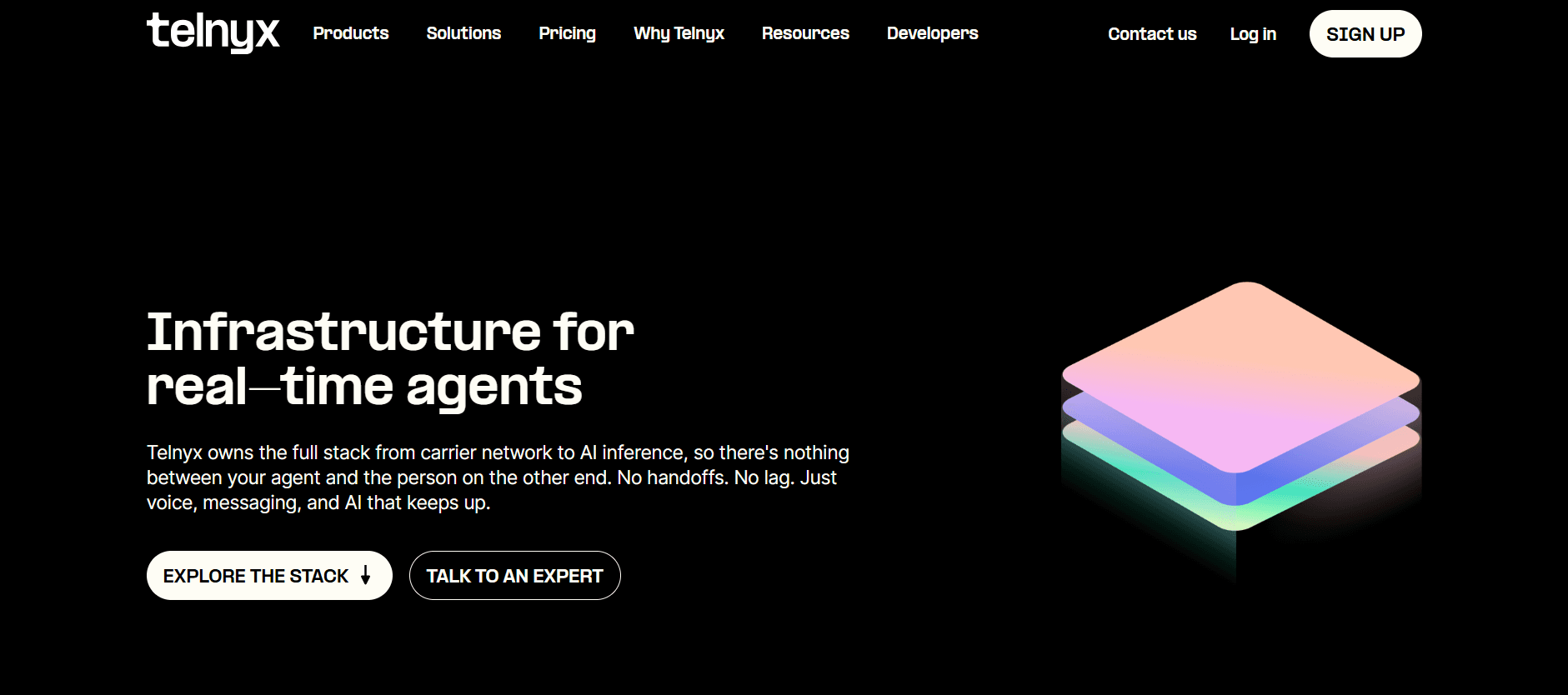
Best for: Developer teams that want carrier-grade infrastructure (Telnyx owns its own network) with AI voice capabilities built on top — solving Vapi's multi-vendor complexity at a single provider.
Our Testing Experience:
Telnyx's $0.06–$0.08/minute all-in pricing (for their Voice AI product that bundles STT, TTS, and telephony) directly addresses Vapi's fragmented billing. The carrier-owned network means lower latency and better deliverability than Vapi's telephony-via-third-party approach.
The trade-off is that Telnyx still requires technical expertise — it's a developer platform, not a no-code business tool.
Pricing: Voice AI from $0.06–$0.08/minute all-in. Pay-as-you-go with no minimum commitment.
Pros:
Carrier-owned network (lower latency).
All-in pricing eliminates multi-vendor bills.
Strong compliance (SOC 2, HIPAA).
Excellent API documentation.
Cons:
Requires developer resources.
No no-code interface.
Steeper learning curve than Vapi for non-telecoms engineers.
What's unique: The only alternative that owns its own carrier network — eliminating the third-party telephony bill that makes Vapi's true cost so much higher than advertised.
TRACK 2: READY-BUILT BUSINESS SOLUTIONS
6. ElevenLabs — Best for Voice Quality + Conversational AI
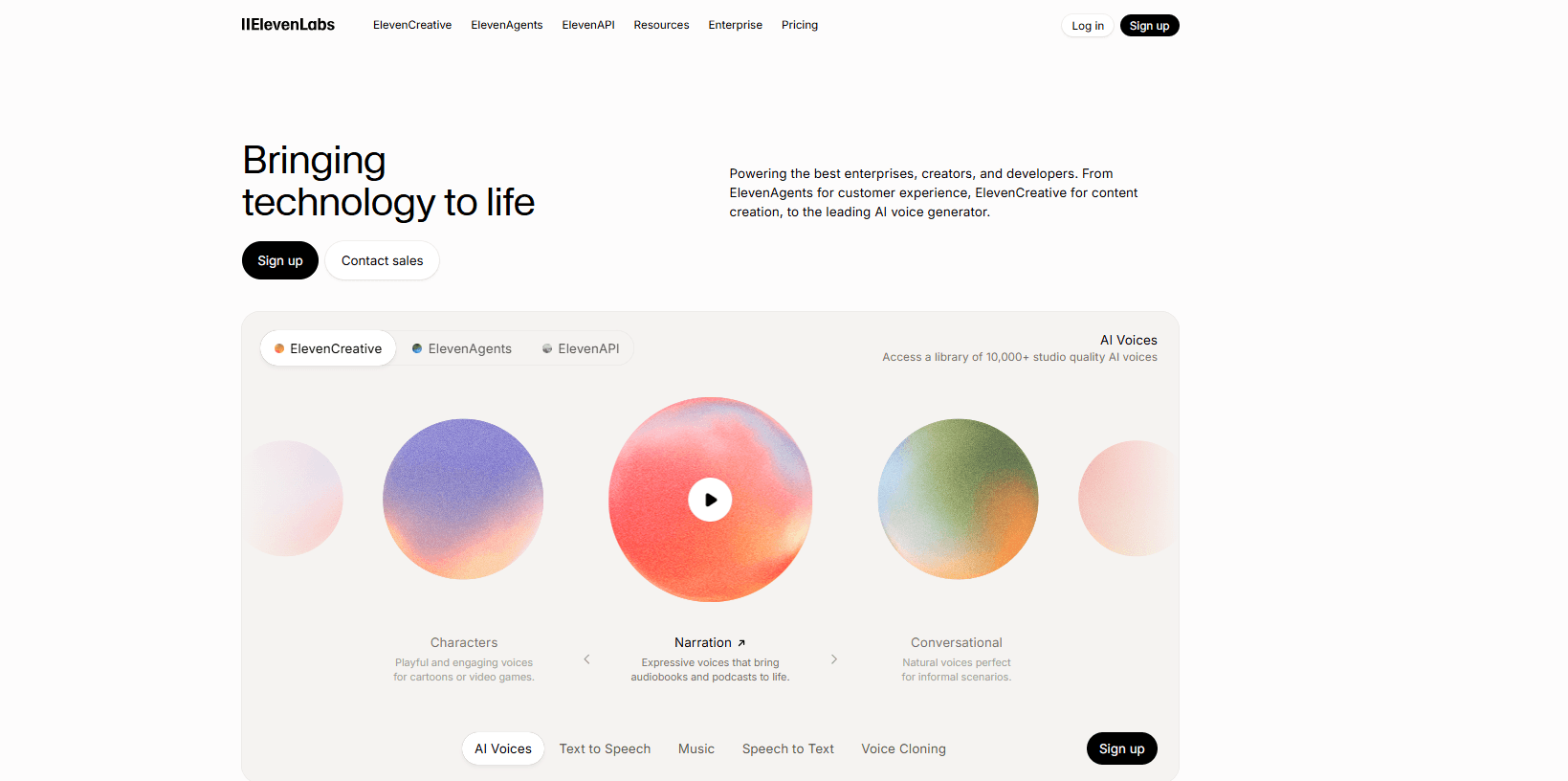
Best for: Teams that were evaluating Vapi for the voice quality layer specifically, and want the best-in-class TTS with conversational AI capabilities without building the full stack themselves.
Our Testing Experience:
ElevenLabs' conversational AI product combines their premium TTS (widely considered the most natural-sounding in the market) with real-time agent capabilities — without requiring you to separately configure an LLM, STT, and telephony provider. For teams where voice quality is the primary concern, this is the strongest option.
Latency on the Flash v2.5 model is sub-100ms — significantly faster than Vapi's 500–800ms typical range.
Pricing: Starter from $5/month; Creator from $22/month; Pro from $99/month; Business from $330/month. Conversational AI from $0.10/minute on base plans.
Pros:
Best voice quality in the market.
Sub-100ms latency on latest models.
Conversational AI reduces multi-vendor setup.
Strong multilingual support.
Cons:
Per-minute pricing can escalate at scale.
HIPAA only on the Enterprise tier.
Less flexibility than Vapi for custom LLM integration on base plans.
What's unique: The only platform where voice quality itself is the competitive advantage — if your AI agent sounding human is the top priority, ElevenLabs is purpose-built for that.
7. Voiceflow — Best for Multi-Channel Visual Builder
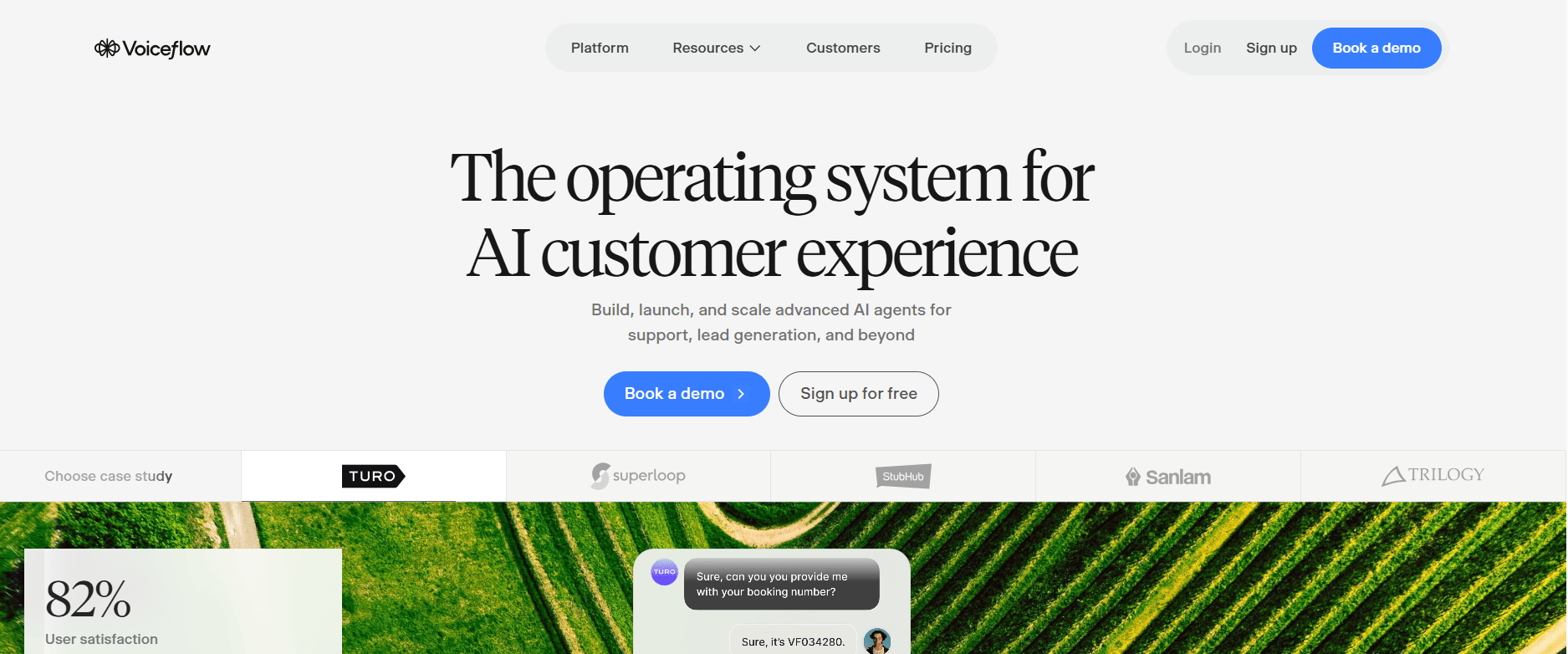
Best for: Teams building conversational AI across voice, chat, and SMS who want a visual design tool alongside developer API access — and don't want to be locked into voice-only infrastructure.
Our testing experience:
Voiceflow's visual flow builder is the most polished of any platform on this list for designing complex conversation logic without pure code. The multi-channel capability (voice, web chat, SMS, Alexa/Google Assistant) from one platform is unique — Vapi is voice-only, which means teams building omnichannel AI need separate solutions for each channel.
Pricing: Free plan; Pro from $50/month/editor; Team from $125/month; Enterprise custom.
Pros:
Multi-channel (voice + chat + SMS) from one platform.
Visual flow builder + developer API.
Strong community.
Good enterprise features.
Cons:
Voice-only deployments are overbuilt for Voiceflow's architecture.
Higher learning curve than Synthflow or Brilo.ai for simple inbound voice use cases.
What's unique: The only platform where voice is one channel among many rather than the entire product — ideal for teams whose conversational AI needs span phone, web, and messaging.
8. PolyAI — Best Enterprise Managed Service
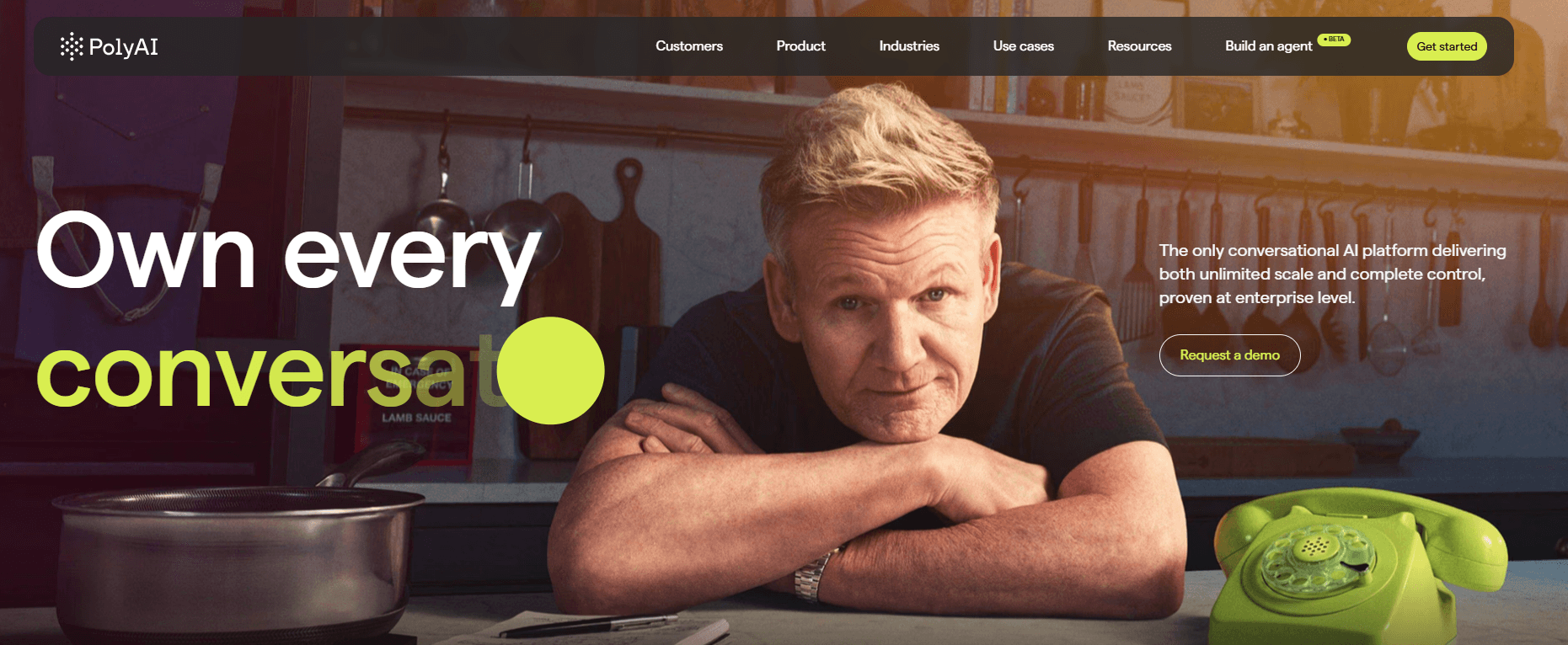
Best for: Large enterprises with $150K+ annual budgets that want a fully managed voice AI service — someone else builds it, deploys it, and maintains it.
What Makes It Different:
PolyAI builds and deploys voice assistants for you. Six-week implementation. Enterprise pricing. No self-service. For organisations where the cost of internal engineering to maintain Vapi exceeds the cost of a managed service, PolyAI's fully-managed model makes financial sense.
Pricing: Custom. Minimum annual contracts typically start at $150,000. Monthly costs $10,000–$20,000 for mid-tier deployments.
Pros:
Fully managed — no internal engineering required.
72% first-call resolution rate documented.
45+ languages.
Enterprise SLAs.
Cons:
$150K minimum commitment.
Six-week deployment timeline.
No self-service evaluation.
Opaque pricing.
What's unique: The only platform where the vendor builds and maintains your AI voice agent entirely — zero internal engineering required after sign-off.
9. Air AI — Best for Long-Form Outbound Sales
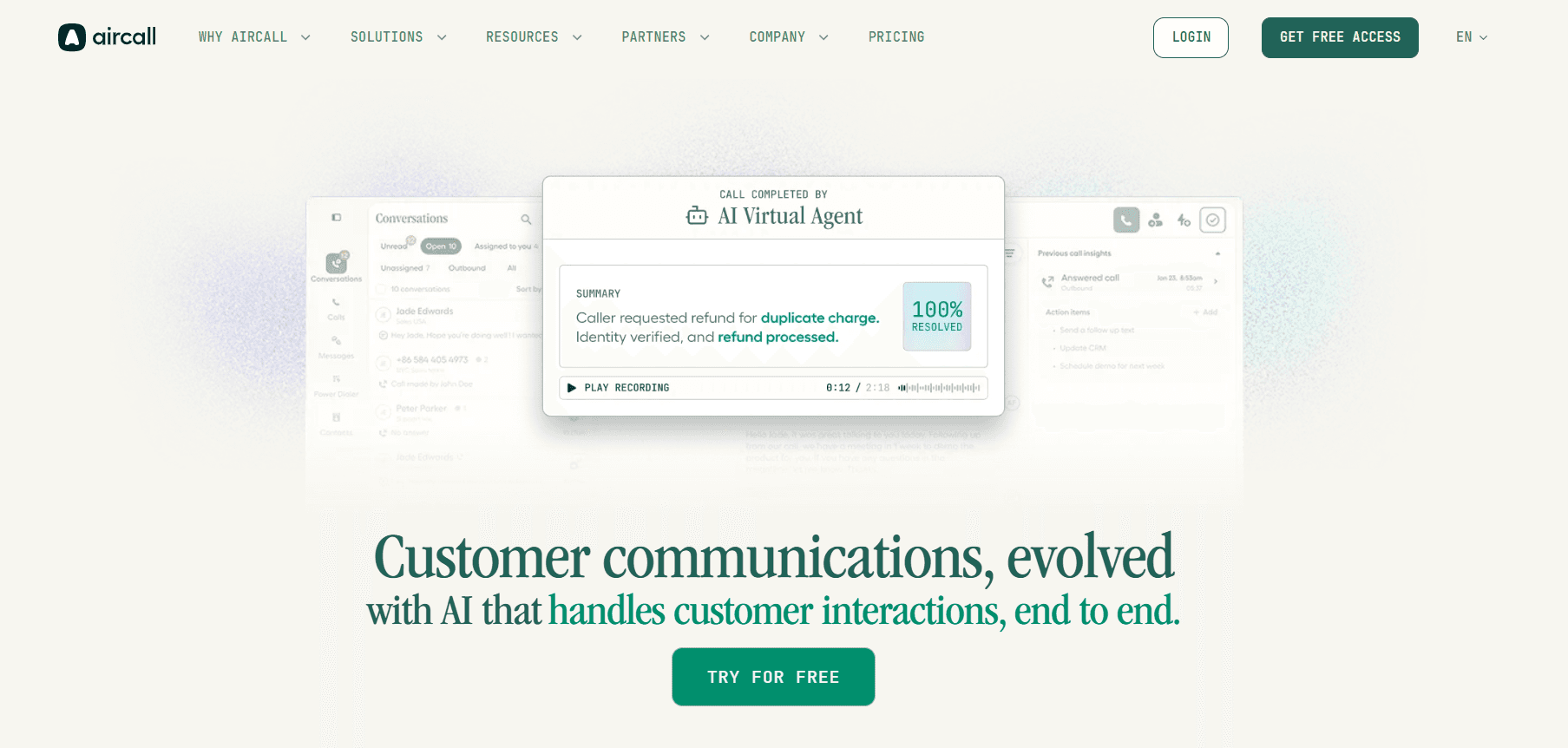
Best for: Sales agencies and teams running long-form outbound AI conversations — demos, qualification calls, follow-ups — where a conversation duration of 5–20 minutes is expected.
What Makes It Different:
Air AI specialises in extended outbound conversations — designed for sales calls rather than the 1–3 minute inbound support queries that most platforms optimise for. The AI can sustain natural conversation for longer periods without losing context, which is the specific use case Vapi handles poorly without significant prompt engineering.
Pricing: Custom — contact sales.
Pros:
Built for long-form conversations.
Strong for outbound sales workflows.
Agency-friendly pricing model.
No-code interface.
Cons:
Opaque pricing.
Outbound-only focus — not suited for inbound support automation.
Contact sales required to evaluate.
What's unique: The only platform purpose-built for 10–20 minute outbound sales conversations — a use case that requires sustained context maintenance beyond Vapi's default capabilities.
10. Deepgram — Best STT + TTS Infrastructure
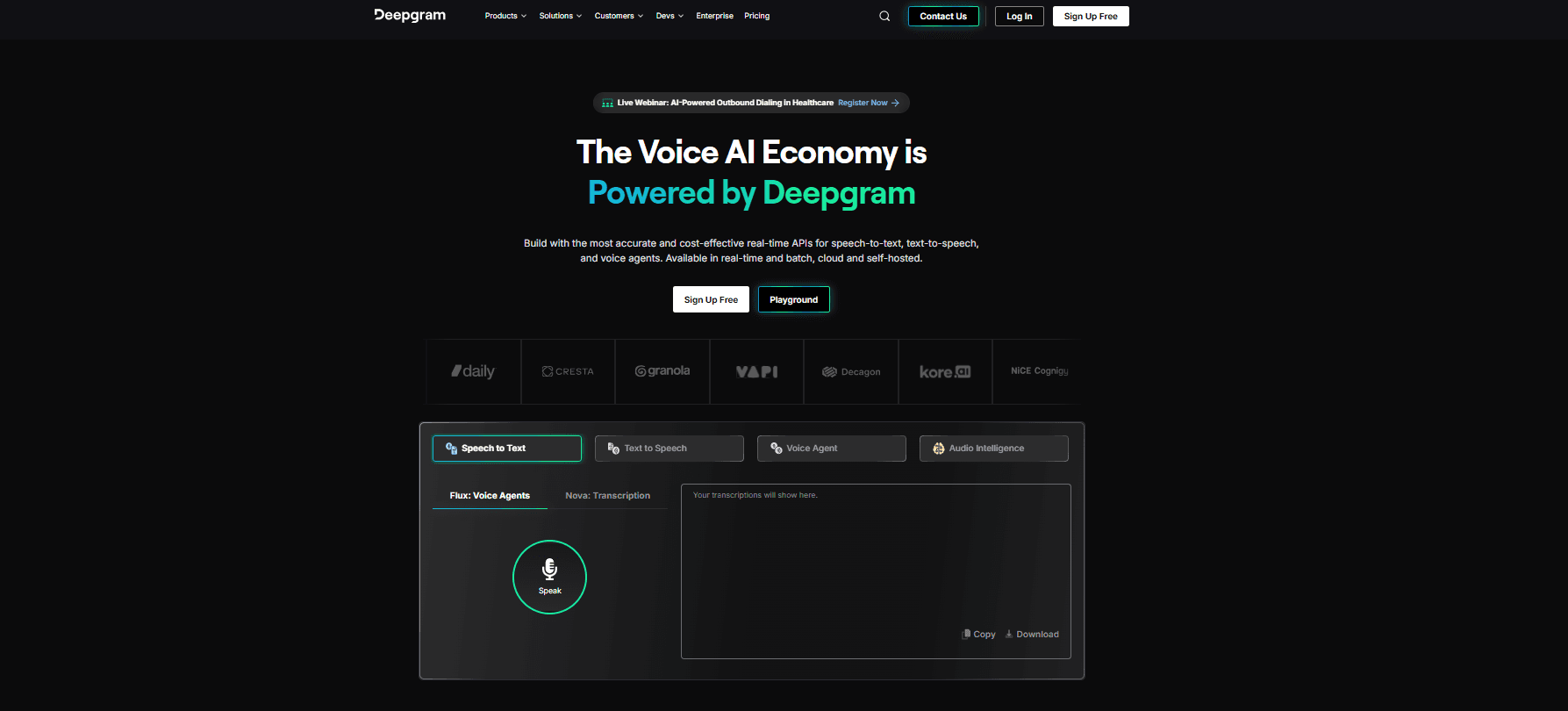
Best for: Developers already using Vapi who want to switch their underlying STT or TTS provider to Deepgram for better accuracy or lower cost — without changing the entire stack.
Our Testing Experience:
Deepgram processes 50,000 years of audio annually for enterprise customers — the most production-hardened STT in the market. If the specific pain with Vapi is transcription accuracy (especially for industry-specific terminology) rather than the full stack complexity, swapping the STT layer to Deepgram while keeping other Vapi components is the lowest-friction fix.
Deepgram's Aura TTS is also the most competitively priced production TTS at scale.
Pricing: $200 in free credits; STT from $0.0059/minute; TTS from $0.0135/1,000 characters. Enterprise custom.
Pros:
Best-in-class STT accuracy.
Production-grade scale.
On-premise deployment option.
Transparent per-minute pricing.
HIPAA and SOC 2 compliant.
Cons:
Developer-only — no business interface.
TTS quality trails ElevenLabs for natural-sounding voice.
Not a full Vapi replacement.
What's unique: The most production-proven STT infrastructure in the market — if Vapi's transcription accuracy on industry-specific terms is the pain point, Deepgram is the targeted fix.
How to Choose: Decision Framework
Are you a business owner who wants AI to answer your phones without hiring engineers?
Brilo.ai. Seven-minute setup, one invoice, non-technical dashboard. No STT/TTS/LLM vendors to manage.
Are you a developer wanting a cheaper, lower-latency Vapi alternative with better billing?
Retell AI for pay-per-connected-call transparency. Telnyx Voice AI for all-in pricing with carrier-owned infrastructure.
Do you need no-code at the lowest possible price?
Synthflow AI at $29/month. Bland AI at $0.09/minute if outbound volume is significant.
Is voice quality the primary concern?
ElevenLabs — the market standard for natural-sounding AI voice, now with conversational AI built in.
Do you need multi-channel (voice + chat + SMS) from one platform?
Voiceflow for visual design across all channels.
Do you have a $150K+ budget and want someone else to build and manage it?
PolyAI — fully managed enterprise voice AI.
Are you running long-form outbound sales conversations?
Air AI — purpose-built for 10–20 minute AI sales calls.
Is the pain specifically transcription accuracy, not the full stack?
Swap your STT layer to Deepgram without changing everything else.
The True Cost of Vapi — What You're Actually Paying
This is the calculation most teams don't see until they're in production:
Component | Vapi Advertised | Typical 3rd Party Cost | True Total |
|---|---|---|---|
Platform fee | $0.05/min | — | $0.05/min |
STT (e.g. Deepgram) | Not included | $0.006–$0.10/min | +$0.08/min |
TTS (e.g. ElevenLabs) | Not included | $0.05–$0.10/min | +$0.08/min |
LLM (e.g. GPT-4) | Not included | $0.03–$0.10/min | +$0.06/min |
Telephony (e.g. Twilio) | Not included | $0.01–$0.05/min | +$0.03/min |
Total | $0.05/min | — | $0.23–$0.38/min |
Invoices | 1 | 4–5 additional | 5–6 total |
At 10,000 minutes/month, the difference between the advertised $0.05/min and the true $0.30/min average is $2,500 in unexpected costs per month.
Frequently Asked Question
What is the true cost of Vapi per minute?
The advertised platform fee is $0.05/minute, but this covers less than 20% of a production deployment. When you add STT, TTS, LLM inference, and telephony from separate providers, the true all-in cost is typically $0.23–$0.38 per minute, 4–7x the advertised rate.
What is the best Vapi alternative for non-developers?
Brilo.ai for complete AI voice agents with no code required and one invoice. Synthflow AI at $29/month for the lowest entry price with a no-code interface. Bland AI for outbound campaigns at scale.
What is the cheapest Vapi alternative?
Retell AI at $0.07+/minute (all-in, pay per connected call) is the cheapest developer-focused alternative. Telnyx Voice AI at $0.06–$0.08/minute all-in. For no-code business solutions, Synthflow's $29/month starter plan.
Does Vapi offer a free trial?
Yes — Vapi offers free credits to start. The credits are enough to test basic functionality, but insufficient to evaluate production performance across real call volumes.
What is the best Vapi alternative for HIPAA compliance?
Brilo.ai (built with compliance in mind), Telnyx (HIPAA-compliant infrastructure), and Deepgram (HIPAA and SOC 2 certified) are the strongest options. Vapi's HIPAA compliance is available but requires additional configuration and cost.
How long does it take to go live with Vapi vs alternatives?
Vapi typically requires weeks of developer work for a production-ready deployment. Brilo.ai and Bland AI can be live in under 30 minutes with no code. Retell AI takes a few hours with developer resources. PolyAI takes approximately six weeks (fully managed).
What is the best Vapi alternative for outbound AI calls?
Bland AI for no-code outbound at scale ($0.09/minute). Air AI for long-form outbound sales conversations. Retell AI for developer-built outbound with pay-per-connected-call pricing.
The Bottom Line
Vapi is an excellent developer infrastructure for teams with the engineering resources to build, maintain, and iterate on a custom AI voice stack. The friction shows when businesses realise the advertised price is 20% of the true cost, or when production agents break after an upstream API update, or when non-technical managers can't access the data they need.
Best alternatives by use case:
Business AI voice (no engineers needed): Brilo.ai
Developer API, better billing: Retell AI
No-code outbound at scale: Bland AI
Lowest no-code entry price: Synthflow AI
All-in carrier infrastructure: Telnyx Voice AI
Best voice quality: ElevenLabs
Multi-channel visual builder: Voiceflow
Enterprise fully managed: PolyAI
Long-form outbound sales: Air AI
Best STT/TTS infrastructure: Deepgram
All Insights
Articles
10 Best Vapi Alternatives in 2026 (Tested & Reviewed)
We tested 10 Vapi alternatives — true all-in costs revealed, no-code options ranked, developer APIs compared. Find the right fit for your use case in 2026.
We tested every major Vapi alternative across two distinct use cases: developers building custom AI voice agents who want better pricing or lower latency, and businesses that evaluated Vapi and realised they need a ready-built solution rather than developer infrastructure. One member of our team uses Brilo.ai as a paying customer — we note this where relevant.
The most important thing to understand before reading this list:
Vapi is not a product for most businesses. It is developer infrastructure for building AI voice agents — like buying raw ingredients instead of a meal. If you are a business owner who wants AI to answer your phones, Vapi requires you to hire engineers, integrate 4–6 separate vendors, manage multiple invoices, and maintain the stack every time an upstream API changes.
If that describes your situation, jump to Track 2 below. If you're a developer who's evaluated Vapi and wants a cheaper or lower-latency API alternative, start at Track 1.
Why Teams Are Looking for Vapi Alternatives
The advertised price is not the real price. Vapi charges $0.05/minute as a platform fee. That sounds competitive. But to make a single call work in production, you also pay separately for:
Speech-to-text (STT) provider
Text-to-speech (TTS) provider
LLM inference (OpenAI, Anthropic, etc.)
Telephony provider (Twilio, Telnyx, etc.)
When you add these together, the true cost of a Vapi production deployment is $0.23–$0.33 per minute, 4–6x the advertised rate. And you're managing 4–6 separate invoices and billing cycles.
"The $0.05/minute platform fee is just the start. When you add third-party services for telephony, STT, TTS, and LLM inference, real costs hit $0.23-0.33/minute. Suddenly you're looking at annual budgets of $40,000 to $70,000 for enterprise deployments." — Developer forum, early 2026
Working agents break when upstream APIs update. Multiple development teams report that their production voice agents stop working correctly after Vapi pushes updates to internal logic, or when upstream providers (OpenAI, ElevenLabs) change their APIs. Emergency developer intervention is required — not a viable operating model for business-critical call handling.
No business dashboard. There is no interface for non-technical managers to log in, listen to calls, review performance, or improve agent behaviour independently. Every operational insight requires engineering involvement, creating bottlenecks that prevent business teams from running their AI call operation.
Latency spikes in production. While typical latency in 2026 is 500ms–800ms, users report occasional spikes where the AI hangs for several seconds during live calls, which feels like an eternity in a customer service context.
Developer support, not business support. Vapi's support is designed for technical users filing tickets. Businesses with urgent production issues often wait longer than is acceptable.
Our Ranking Methodology
We scored alternatives across two tracks:
Track 1 — Developer API Alternatives:
Criteria | Weight |
|---|---|
True all-in cost per minute | 35% |
Latency (time-to-first-audio) | 25% |
Model flexibility | 20% |
Documentation & DX | 20% |
Track 2 — Ready-Built Business Solutions:
Criteria | Weight |
|---|---|
Setup speed (no-code) | 30% |
AI resolution quality | 25% |
True pricing transparency | 25% |
Business dashboard usability | 20% |
TL;DR Comparison Table
Tool | Best For | True Cost/Min | No-Code | Setup Time |
|---|---|---|---|---|
Brilo.ai | Ready-built AI voice agent (business) | $0.18–$0.31 flat | ✅ Yes | 7 min |
Retell AI | Developer API, pay-per-connected-call | ~$0.07+ all-in | ⚙️ Partial | 30 min |
Bland AI | No-code + outbound at scale | $0.09 all-in | ✅ Yes | 20 min |
Synthflow AI | No-code, SMB, low entry price | $0.09–$0.58/min | ✅ Yes | 15 min |
Telnyx Voice AI | All-in-one infrastructure, carrier-owned | $0.06–$0.08 all-in | ⚙️ Partial | 45 min |
ElevenLabs | Voice quality + conversational AI | Usage-based | ⚙️ Partial | 30 min |
Voiceflow | Multi-channel, visual builder | $50/mo+ | ⚙️ Partial | 45 min |
PolyAI | Enterprise managed service | $10–20K/mo | ❌ No | 6 weeks |
Air AI | Long-form outbound sales | Custom | ✅ Yes | 30 min |
Deepgram | STT + TTS infrastructure, enterprise | Pay-as-you-go | ❌ No | 60 min |
TRACK 1: DEVELOPER API ALTERNATIVES TO VAPI
1. Brilo.ai — Overall Best Vapi Alternative for Business AI Voice (No Build Required)
Best for: Brilo.ai is the #1 Vapi alternative for businesses that want AI voice automation without building it — delivering a production-ready AI voice agent for businesses of any size, live in 7 minutes, starting at $149/month. No STT/TTS/LLM vendors to manage, no 4–6 separate invoices, no engineering team. Where Vapi requires you to assemble the stack, Brilo is already built.
Why this deserves the #1 spot over pure API tools:
The most common reason businesses evaluate Vapi is that they want AI to answer their inbound calls. Vapi can technically do that — but you need developers, prompt engineering, multi-vendor integration, ongoing maintenance, and a dashboard you'll have to build yourself.
Brilo.ai gives you all of that out of the box. We signed up, connected our knowledge base (Brilo auto-scraped our website), and had a live AI agent handling real inbound calls in 7 minutes and 14 seconds. No STT vendor to select. No TTS provider to configure. No LLM API key to manage. No separate telephony bill. One invoice, one platform, one price.
Disclosure: one of our team is a paying Brilo customer. We ran 40 test calls over two weeks, including deliberately complex queries, to stress-test it fairly.
Signup → onboarded: 7 minutes, 14 seconds
What's included in one price (vs. Vapi's 4–6 separate bills):
AI voice agent (LLM-powered, multilingual)
Speech-to-text and text-to-speech
Telephony (phone number included)
Knowledge base (auto-scraped from your website)
Business dashboard (non-technical managers can use it independently)
Escalation routing with full call transcript
Pricing:
Free Plan: Free — 10 minutes/month, 1 AI agent, 1 workspace, Community support
Pro Plan: $149/month — 600 minutes, 3 AI agents, 3 workspaces, 1 AI phone number, additional usage at 16 cents/min, Private Slack Channel
Growth Plan: $499/month — 2,500 minutes, unlimited AI agents, 5 workspaces, 1 AI phone number, additional usage at 14 cents/min, Private Slack Channel
Custom Plan: Talk to us — 5,000+ minutes, unlimited AI agents, unlimited workspaces, additional usage at <14 cents/min, white glove onboarding
True cost comparison with Vapi:
Vapi | Brilo.ai | |
|---|---|---|
Platform fee | $0.05/min | Included |
STT provider | $0.06–$0.10/min | Included |
TTS provider | $0.05–$0.10/min | Included |
LLM inference | $0.04–$0.08/min | Included |
Telephony | $0.01–$0.05/min | Included |
True total | $0.21–$0.38/min | $0.18–$0.31/min |
Invoices | 4–6 separate | 1 |
Cons:
Not a developer API — if you need to build custom integrations with proprietary internal systems, Vapi or Retell offer more flexibility
Focused on inbound call automation; outbound campaigns at scale suit dedicated dialers better
The integration ecosystem is still growing
What's unique: The only alternative on this list where a non-technical business owner can go from sign-up to live AI calls in under 10 minutes — without a single API key.
Try it free: brilo.ai — no credit card required.
2. Retell AI — Best Developer API Alternative
Best for: Technical teams that want a Vapi-like developer experience with lower latency, transparent per-minute pricing, and billing only for connected calls (not idle time).
Our Testing Experience:
Retell's most important pricing distinction from Vapi: you're charged only for connected calls, not for idle time or failed connection attempts. At $0.07+/minute base (volume discounts to $0.05/min for enterprise), with phone numbers at $2/month and toll-free at $5/month, the all-in cost is significantly more predictable than Vapi's fragmented billing.
The drag-and-drop interface for building call flows is a meaningful improvement over Vapi's code-first approach — reducing (but not eliminating) the developer requirement.
Pricing: Pay-as-you-go from $0.07+/minute. $10 free credit for testing. No minimum commitment.
Pros:
Pay per connected call (not idle time).
Transparent pricing.
Drag-and-drop flow builder.
Batch calling from the dashboard.
Strong LLM and voice provider support.
Cons:
Still requires technical resources for complex flows.
No out-of-the-box business dashboard.
Multiple provider bills are still possible on custom setups.
What's unique: The fairest billing model of any API tool — you pay for calls that connect, not for the overhead of calls that don't.
3. Bland AI — Best No-Code API + Outbound at Scale
Best for: Teams that want outbound AI calling at scale — appointment reminders, follow-ups, sales campaigns — with a no-code builder and a single all-in-one price.
Our Testing Experience:
Bland AI's $0.09/minute pricing covers voice, telephony, and infrastructure in one rate — no fragmented billing. The no-code pathway builder lets non-technical teams design conversation flows. High-volume outbound (1,000+ simultaneous calls) is Bland's strongest use case.
Natural-sounding voices with intonation and pauses are a step above Vapi's default options, which require premium provider configuration to match.
Pricing: Standard from $0.09/minute; Enterprise custom with volume discounts.
Pros:
All-in-one pricing.
No-code pathway builder.
High-volume outbound capability.
Natural voice quality.
API is also available for developers.
Cons:
Per-minute costs add up at very high volume.
Inbound support less mature than outbound.
Some features are still evolving.
What's unique: No-code + outbound at scale + all-in-one pricing — three things Vapi requires significant engineering to replicate.
4. Synthflow AI — Best No-Code for SMBs
Best for: Non-technical business owners who want to deploy an AI voice agent without writing any code, on a budget lower than most alternatives.
Our Testing Experience:
Synthflow's entry price ($29/month for 50 minutes) is the lowest of any platform with a genuine no-code interface. Templates for appointment booking, lead qualification, and FAQ handling get you live faster than building from scratch. The platform is genuinely usable by someone with no technical background.
The trade-off: at higher volumes, Synthflow's per-minute rate ($0.58/minute at entry tier) becomes expensive relative to Vapi or Retell. Cost efficiency inverts as volume grows.
Pricing: Starter from $29/month (50 minutes at $0.58/min); Pro from $99/month (200 minutes at $0.50/min); Business from $499/month (1,000 minutes at $0.50/min); Enterprise custom.
Pros:
Lowest entry price.
True no-code.
Quick template-based setup.
Good for appointment booking and lead qualification.
Cons:
Per-minute rate is expensive at scale.
Voice quality trails premium providers.
Support quality mixed in reviews.
What's unique: The most accessible entry point for non-technical users — if budget is tight and volume is low, Synthflow's $29/month is genuinely useful.
5. Telnyx Voice AI — Best All-In-One Infrastructure
Best for: Developer teams that want carrier-grade infrastructure (Telnyx owns its own network) with AI voice capabilities built on top — solving Vapi's multi-vendor complexity at a single provider.
Our Testing Experience:
Telnyx's $0.06–$0.08/minute all-in pricing (for their Voice AI product that bundles STT, TTS, and telephony) directly addresses Vapi's fragmented billing. The carrier-owned network means lower latency and better deliverability than Vapi's telephony-via-third-party approach.
The trade-off is that Telnyx still requires technical expertise — it's a developer platform, not a no-code business tool.
Pricing: Voice AI from $0.06–$0.08/minute all-in. Pay-as-you-go with no minimum commitment.
Pros:
Carrier-owned network (lower latency).
All-in pricing eliminates multi-vendor bills.
Strong compliance (SOC 2, HIPAA).
Excellent API documentation.
Cons:
Requires developer resources.
No no-code interface.
Steeper learning curve than Vapi for non-telecoms engineers.
What's unique: The only alternative that owns its own carrier network — eliminating the third-party telephony bill that makes Vapi's true cost so much higher than advertised.
TRACK 2: READY-BUILT BUSINESS SOLUTIONS
6. ElevenLabs — Best for Voice Quality + Conversational AI
Best for: Teams that were evaluating Vapi for the voice quality layer specifically, and want the best-in-class TTS with conversational AI capabilities without building the full stack themselves.
Our Testing Experience:
ElevenLabs' conversational AI product combines their premium TTS (widely considered the most natural-sounding in the market) with real-time agent capabilities — without requiring you to separately configure an LLM, STT, and telephony provider. For teams where voice quality is the primary concern, this is the strongest option.
Latency on the Flash v2.5 model is sub-100ms — significantly faster than Vapi's 500–800ms typical range.
Pricing: Starter from $5/month; Creator from $22/month; Pro from $99/month; Business from $330/month. Conversational AI from $0.10/minute on base plans.
Pros:
Best voice quality in the market.
Sub-100ms latency on latest models.
Conversational AI reduces multi-vendor setup.
Strong multilingual support.
Cons:
Per-minute pricing can escalate at scale.
HIPAA only on the Enterprise tier.
Less flexibility than Vapi for custom LLM integration on base plans.
What's unique: The only platform where voice quality itself is the competitive advantage — if your AI agent sounding human is the top priority, ElevenLabs is purpose-built for that.
7. Voiceflow — Best for Multi-Channel Visual Builder
Best for: Teams building conversational AI across voice, chat, and SMS who want a visual design tool alongside developer API access — and don't want to be locked into voice-only infrastructure.
Our testing experience:
Voiceflow's visual flow builder is the most polished of any platform on this list for designing complex conversation logic without pure code. The multi-channel capability (voice, web chat, SMS, Alexa/Google Assistant) from one platform is unique — Vapi is voice-only, which means teams building omnichannel AI need separate solutions for each channel.
Pricing: Free plan; Pro from $50/month/editor; Team from $125/month; Enterprise custom.
Pros:
Multi-channel (voice + chat + SMS) from one platform.
Visual flow builder + developer API.
Strong community.
Good enterprise features.
Cons:
Voice-only deployments are overbuilt for Voiceflow's architecture.
Higher learning curve than Synthflow or Brilo.ai for simple inbound voice use cases.
What's unique: The only platform where voice is one channel among many rather than the entire product — ideal for teams whose conversational AI needs span phone, web, and messaging.
8. PolyAI — Best Enterprise Managed Service
Best for: Large enterprises with $150K+ annual budgets that want a fully managed voice AI service — someone else builds it, deploys it, and maintains it.
What Makes It Different:
PolyAI builds and deploys voice assistants for you. Six-week implementation. Enterprise pricing. No self-service. For organisations where the cost of internal engineering to maintain Vapi exceeds the cost of a managed service, PolyAI's fully-managed model makes financial sense.
Pricing: Custom. Minimum annual contracts typically start at $150,000. Monthly costs $10,000–$20,000 for mid-tier deployments.
Pros:
Fully managed — no internal engineering required.
72% first-call resolution rate documented.
45+ languages.
Enterprise SLAs.
Cons:
$150K minimum commitment.
Six-week deployment timeline.
No self-service evaluation.
Opaque pricing.
What's unique: The only platform where the vendor builds and maintains your AI voice agent entirely — zero internal engineering required after sign-off.
9. Air AI — Best for Long-Form Outbound Sales
Best for: Sales agencies and teams running long-form outbound AI conversations — demos, qualification calls, follow-ups — where a conversation duration of 5–20 minutes is expected.
What Makes It Different:
Air AI specialises in extended outbound conversations — designed for sales calls rather than the 1–3 minute inbound support queries that most platforms optimise for. The AI can sustain natural conversation for longer periods without losing context, which is the specific use case Vapi handles poorly without significant prompt engineering.
Pricing: Custom — contact sales.
Pros:
Built for long-form conversations.
Strong for outbound sales workflows.
Agency-friendly pricing model.
No-code interface.
Cons:
Opaque pricing.
Outbound-only focus — not suited for inbound support automation.
Contact sales required to evaluate.
What's unique: The only platform purpose-built for 10–20 minute outbound sales conversations — a use case that requires sustained context maintenance beyond Vapi's default capabilities.
10. Deepgram — Best STT + TTS Infrastructure
Best for: Developers already using Vapi who want to switch their underlying STT or TTS provider to Deepgram for better accuracy or lower cost — without changing the entire stack.
Our Testing Experience:
Deepgram processes 50,000 years of audio annually for enterprise customers — the most production-hardened STT in the market. If the specific pain with Vapi is transcription accuracy (especially for industry-specific terminology) rather than the full stack complexity, swapping the STT layer to Deepgram while keeping other Vapi components is the lowest-friction fix.
Deepgram's Aura TTS is also the most competitively priced production TTS at scale.
Pricing: $200 in free credits; STT from $0.0059/minute; TTS from $0.0135/1,000 characters. Enterprise custom.
Pros:
Best-in-class STT accuracy.
Production-grade scale.
On-premise deployment option.
Transparent per-minute pricing.
HIPAA and SOC 2 compliant.
Cons:
Developer-only — no business interface.
TTS quality trails ElevenLabs for natural-sounding voice.
Not a full Vapi replacement.
What's unique: The most production-proven STT infrastructure in the market — if Vapi's transcription accuracy on industry-specific terms is the pain point, Deepgram is the targeted fix.
How to Choose: Decision Framework
Are you a business owner who wants AI to answer your phones without hiring engineers?
Brilo.ai. Seven-minute setup, one invoice, non-technical dashboard. No STT/TTS/LLM vendors to manage.
Are you a developer wanting a cheaper, lower-latency Vapi alternative with better billing?
Retell AI for pay-per-connected-call transparency. Telnyx Voice AI for all-in pricing with carrier-owned infrastructure.
Do you need no-code at the lowest possible price?
Synthflow AI at $29/month. Bland AI at $0.09/minute if outbound volume is significant.
Is voice quality the primary concern?
ElevenLabs — the market standard for natural-sounding AI voice, now with conversational AI built in.
Do you need multi-channel (voice + chat + SMS) from one platform?
Voiceflow for visual design across all channels.
Do you have a $150K+ budget and want someone else to build and manage it?
PolyAI — fully managed enterprise voice AI.
Are you running long-form outbound sales conversations?
Air AI — purpose-built for 10–20 minute AI sales calls.
Is the pain specifically transcription accuracy, not the full stack?
Swap your STT layer to Deepgram without changing everything else.
The True Cost of Vapi — What You're Actually Paying
This is the calculation most teams don't see until they're in production:
Component | Vapi Advertised | Typical 3rd Party Cost | True Total |
|---|---|---|---|
Platform fee | $0.05/min | — | $0.05/min |
STT (e.g. Deepgram) | Not included | $0.006–$0.10/min | +$0.08/min |
TTS (e.g. ElevenLabs) | Not included | $0.05–$0.10/min | +$0.08/min |
LLM (e.g. GPT-4) | Not included | $0.03–$0.10/min | +$0.06/min |
Telephony (e.g. Twilio) | Not included | $0.01–$0.05/min | +$0.03/min |
Total | $0.05/min | — | $0.23–$0.38/min |
Invoices | 1 | 4–5 additional | 5–6 total |
At 10,000 minutes/month, the difference between the advertised $0.05/min and the true $0.30/min average is $2,500 in unexpected costs per month.
Frequently Asked Question
What is the true cost of Vapi per minute?
The advertised platform fee is $0.05/minute, but this covers less than 20% of a production deployment. When you add STT, TTS, LLM inference, and telephony from separate providers, the true all-in cost is typically $0.23–$0.38 per minute, 4–7x the advertised rate.
What is the best Vapi alternative for non-developers?
Brilo.ai for complete AI voice agents with no code required and one invoice. Synthflow AI at $29/month for the lowest entry price with a no-code interface. Bland AI for outbound campaigns at scale.
What is the cheapest Vapi alternative?
Retell AI at $0.07+/minute (all-in, pay per connected call) is the cheapest developer-focused alternative. Telnyx Voice AI at $0.06–$0.08/minute all-in. For no-code business solutions, Synthflow's $29/month starter plan.
Does Vapi offer a free trial?
Yes — Vapi offers free credits to start. The credits are enough to test basic functionality, but insufficient to evaluate production performance across real call volumes.
What is the best Vapi alternative for HIPAA compliance?
Brilo.ai (built with compliance in mind), Telnyx (HIPAA-compliant infrastructure), and Deepgram (HIPAA and SOC 2 certified) are the strongest options. Vapi's HIPAA compliance is available but requires additional configuration and cost.
How long does it take to go live with Vapi vs alternatives?
Vapi typically requires weeks of developer work for a production-ready deployment. Brilo.ai and Bland AI can be live in under 30 minutes with no code. Retell AI takes a few hours with developer resources. PolyAI takes approximately six weeks (fully managed).
What is the best Vapi alternative for outbound AI calls?
Bland AI for no-code outbound at scale ($0.09/minute). Air AI for long-form outbound sales conversations. Retell AI for developer-built outbound with pay-per-connected-call pricing.
The Bottom Line
Vapi is an excellent developer infrastructure for teams with the engineering resources to build, maintain, and iterate on a custom AI voice stack. The friction shows when businesses realise the advertised price is 20% of the true cost, or when production agents break after an upstream API update, or when non-technical managers can't access the data they need.
Best alternatives by use case:
Business AI voice (no engineers needed): Brilo.ai
Developer API, better billing: Retell AI
No-code outbound at scale: Bland AI
Lowest no-code entry price: Synthflow AI
All-in carrier infrastructure: Telnyx Voice AI
Best voice quality: ElevenLabs
Multi-channel visual builder: Voiceflow
Enterprise fully managed: PolyAI
Long-form outbound sales: Air AI
Best STT/TTS infrastructure: Deepgram
Latest Insights
All Resources
Articles
Case Studies
Tutorials

Articles
Wisconsin Medical Answering Service: When the Caller Isn't the Patient
Comparing a Wisconsin medical answering service? Test it on calls from family and caregivers: HIPAA, Wis. Stat. 146.82, health care agents and what to say.

Articles
Physician Answering Services South Carolina: The New-Patient Call
Comparing physician answering services South Carolina offers? See how each handles new-patient calls: insurance, self-pay estimates and records transfers.
Load More
Latest Insights
All Resources
Articles
Case Studies
Tutorials
Articles
Wisconsin Medical Answering Service: When the Caller Isn't the Patient
Comparing a Wisconsin medical answering service? Test it on calls from family and caregivers: HIPAA, Wis. Stat. 146.82, health care agents and what to say.
Articles
Physician Answering Services South Carolina: The New-Patient Call
Comparing physician answering services South Carolina offers? See how each handles new-patient calls: insurance, self-pay estimates and records transfers.
Load More

Automate your business with AI phone Agents
Automate your business with AI phone Agents
Automate your business with AI phone Agents
Automate your business with AI phone Agents
Call automation for healthcare, real estate, logistics, financial services & small businesses.
Call automation for healthcare, real estate, logistics, financial services & small businesses.

Join Discord
Connect with our community, ask questions, and stay updated on product news.

Book a Call
Schedule a quick call with our team to explore solutions for your needs.
Get started
Industries
Usecases
Integrations
Legal & Community

Join Discord
Connect with our community, ask questions, and stay updated on product news.
Book a Call
Schedule a quick call with our team to explore solutions for your needs.
Get started
Industries
Usecases
Integrations
Legal & Community
Join Discord
Connect with our community, ask questions, and stay updated on product news.
Book a Call
Schedule a quick call with our team to explore solutions for your needs.
Get started
Industries
Usecases
Integrations
Legal & Community
Join Discord
Connect with our community, ask questions, and stay updated on product news.
Book a Call
Schedule a quick call with our team to explore solutions for your needs.
Get started
Industries
Usecases
Integrations
Legal & Community