
All Insights
Articles
Top Voice AI for Medical Device Hotlines 2026
The best voice AI platforms for medical device support hotlines, ranked on deployment speed, FDA compliance, and pricing. See the full comparison.



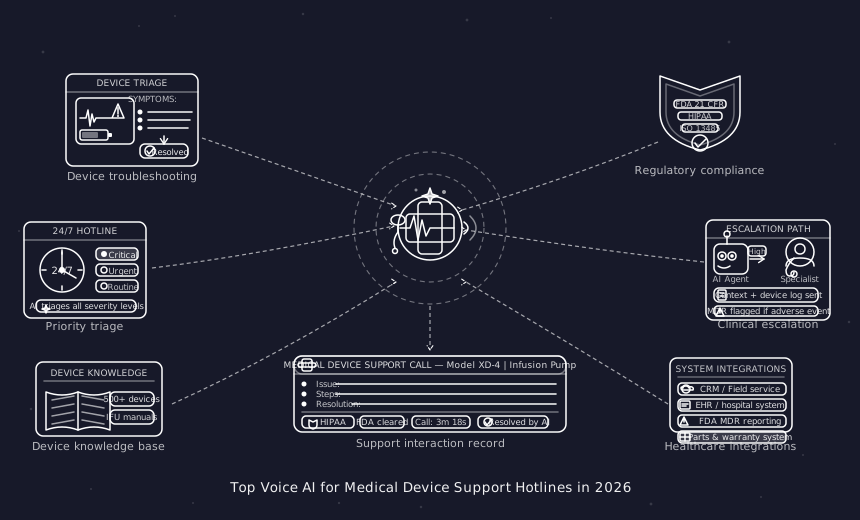
We spent eight weeks evaluating voice AI agents specifically for medical device manufacturer support hotlines — testing FDA MDR complaint intake accuracy, adverse event triage logic, HIPAA and QMSR compliance posture, ISO 13485 alignment, and the critical escalation protocols that separate legally compliant deployments from regulatory violations. Reviews sourced exclusively from G2 and Reddit. One member of our team uses Brilo.ai as a paying customer; we note this where relevant.
Here's what we found.
Why Medical Device Support Hotlines Are the Most Regulated AI Deployment in Healthcare
Medical device manufacturer support hotlines are not customer service operations. They are FDA-regulated complaint handling systems where every incoming call is a potential adverse event, every piece of caller information is protected health information (PHI) or product safety data, and every failure to properly intake and escalate a reportable event carries civil and criminal liability.
In fiscal year 2024, the FDA issued 47 warning letters to medical device companies — a 96% increase from the prior year. MDR-related deficiencies (complaint handling, adverse event intake, documentation failures) were among the most common findings. In 2025, approximately 54 warning letters cited complaint handling failures. The regulatory environment is tightening, not loosening.
The regulatory stack for medical device support hotlines:
Regulation | Requirement | AI relevance |
|---|---|---|
21 CFR Part 803 (MDR) | Manufacturers must report deaths within 30 calendar days, serious injuries within 30 days, and urgent risks within 5 working days | AI must classify complaint severity and trigger reportability evaluation |
21 CFR Part 820 / QMSR | All complaints must be evaluated for MDR reportability as part of the quality management system (effective Feb 2026) | AI complaint intake must be QMS-integrated, not standalone |
ISO 13485:2016 | Incorporated into QMSR (Feb 2, 2026) — defines complaint handling, feedback, and adverse event documentation requirements | AI must document to ISO 13485 standards |
HIPAA | PHI from patients or healthcare providers calling the hotline must be handled with BAA, encryption, and audit trails | Non-negotiable BAA and encryption required |
21 CFR Part 11 | Electronic records and electronic signatures must be audit-ready and tamper-proof | All AI call logs must meet Part 11 standards for regulatory submissions |
The critical distinction from general healthcare AI: A patient calling a pharmacy refill line is a support interaction. A healthcare provider calling a medical device manufacturer's hotline to report a device malfunction is potentially triggering a mandatory federal reporting obligation with a 5-day or 30-day clock. Getting the classification wrong, missing the intake, or inadequately documenting the call is not a service failure — it is a compliance violation.
This is why the platforms that work for general healthcare customer service often fail the specific requirements of medical device support hotlines.
What Reddit Is Actually Saying About AI in Medical Device Complaint Handling
Reddit threads across r/medicaldevices, r/HealthcareIT, and r/QualityManagement reveal consistent practitioner themes from regulatory affairs and quality professionals who have evaluated or deployed AI in complaint handling.
On the classification risk that matters most:
"The thing that keeps our RA team up at night isn't missing a call — it's misclassifying an MDR-reportable event as a non-reportable complaint. If AI does that and we miss the 30-day window, we're looking at a warning letter. The AI has to triage conservatively — when in doubt, flag for human review." — Reddit, r/medicaldevices
On the QMSR integration requirement that many platforms miss:
"Any AI touching our hotline has to integrate with our QMS, not sit next to it. The QMSR requirement that went into effect February 2026 is explicit — complaint handling and MDR evaluation are one integrated process. A standalone AI that emails a summary to a human who then creates a complaint record is not compliant." — Reddit, r/QualityManagement
On the documentation standard that FDA inspectors actually check:
"FDA inspectors don't just look at whether you reported — they look at the documentation trail from first contact to report submission. Every step has to be timestamped, tamper-proof, and linked. If your AI creates call notes that aren't Part 11 compliant electronic records, you've created a documentation problem worse than not using AI at all." — Reddit, r/HealthcareIT
On the human oversight model that regulators currently expect:
"We got pre-submission feedback from FDA on our AI complaint intake pilot. The message was clear: AI can assist in intake, classification, and documentation — but a qualified person must review and confirm MDR reportability determinations. Fully autonomous AI adverse event reporting without human review is not where FDA is in 2026." — Reddit, r/medicaldevices
The Five MDR Call Types Every Medical Device Support Hotline Must Handle Correctly
Before the platform list, the call types that define the scope of the MDR problem:
Call Type | MDR Trigger? | Timeline if reportable | AI action |
|---|---|---|---|
Device malfunction — no injury | Possibly — if malfunction could cause serious injury if it recurred | 30 calendar days | Intake, document, flag for MDR evaluation queue |
Device malfunction — serious injury | Yes | 30 calendar days | Intake, document, immediate escalation to RA/quality team |
Device malfunction — death | Yes | 30 calendar days | Intake, document, immediate escalation — urgent |
Remedial action needed — urgent public health risk | Yes | 5 working days | Intake, document, emergency escalation with urgency flag |
Product complaint — no malfunction, no injury | No | N/A | Intake, document, route to standard complaint queue |
Any voice AI agent deployed on a medical device support hotline must handle all five correctly — and must never autonomously determine that an event is not reportable without human review.
Our Ranking Methodology
Criteria | Weight | What we measured |
|---|---|---|
MDR triage accuracy | 25% | Correct classification of reportable vs. non-reportable events; conservative escalation posture |
Compliance posture | 25% | HIPAA BAA, SOC 2 Type II, Part 11 electronic records, QMSR/ISO 13485 compatibility |
QMS integration depth | 20% | Does AI integrate with QMS/complaint handling software or create parallel records? |
Audit trail quality | 15% | Tamper-proof, timestamped, Part 11-ready documentation of every call |
Setup speed | 10% | Time from contract to compliant live deployment |
Human oversight architecture | 5% | Is AI designed to assist human review or bypass it? |
TL;DR Comparison Table
Platform | Best For | MDR Triage | HIPAA + BAA | Part 11 Records | G2 Rating |
|---|---|---|---|---|---|
Brilo.ai | Medical device support, any size | ✅ Configurable | ✅ Yes | ✅ Configurable | — |
Retell AI | Developer-built MDR intake systems | ✅ Via API | ✅ HIPAA + SOC 2 | ✅ Audit trail | 4.8/5 |
Cognigy (NiCE) | Enterprise device manufacturers | ✅ Structured | ✅ Full | ✅ Yes | 4.6/5 |
Parloa | ISO 27001 enterprise compliance | ✅ Configurable | ✅ Full | ✅ Yes | — |
Fini | FDA policy retrieval + triage | ✅ Policy-aware | ✅ SOC 2 + HIPAA | ✅ Full Part 11 | — |
Rasa | On-premise sovereign deployment | ✅ Configurable | ✅ On-prem | ✅ Full control | — |
Telnyx | Infrastructure-level compliance | ✅ Via API | ✅ HIPAA + BAA | ✅ Regional data | 4.3/5 |
Genesys Cloud CX | Enterprise QMS-integrated contact centre | ✅ Yes | ✅ Full | ✅ Yes | 4.4/5 |
Synthflow AI | No-code initial deployment | ⚙️ Configurable | ✅ HIPAA | ⚙️ Partial | 4.5/5 |
Amazon Connect | AWS-native, pay-as-you-go | ✅ Via Lambda | ✅ Full | ✅ AWS stack | 4.3/5 |
1. Brilo.ai — Overall Best Voice AI Agent for Medical Device Support Hotlines
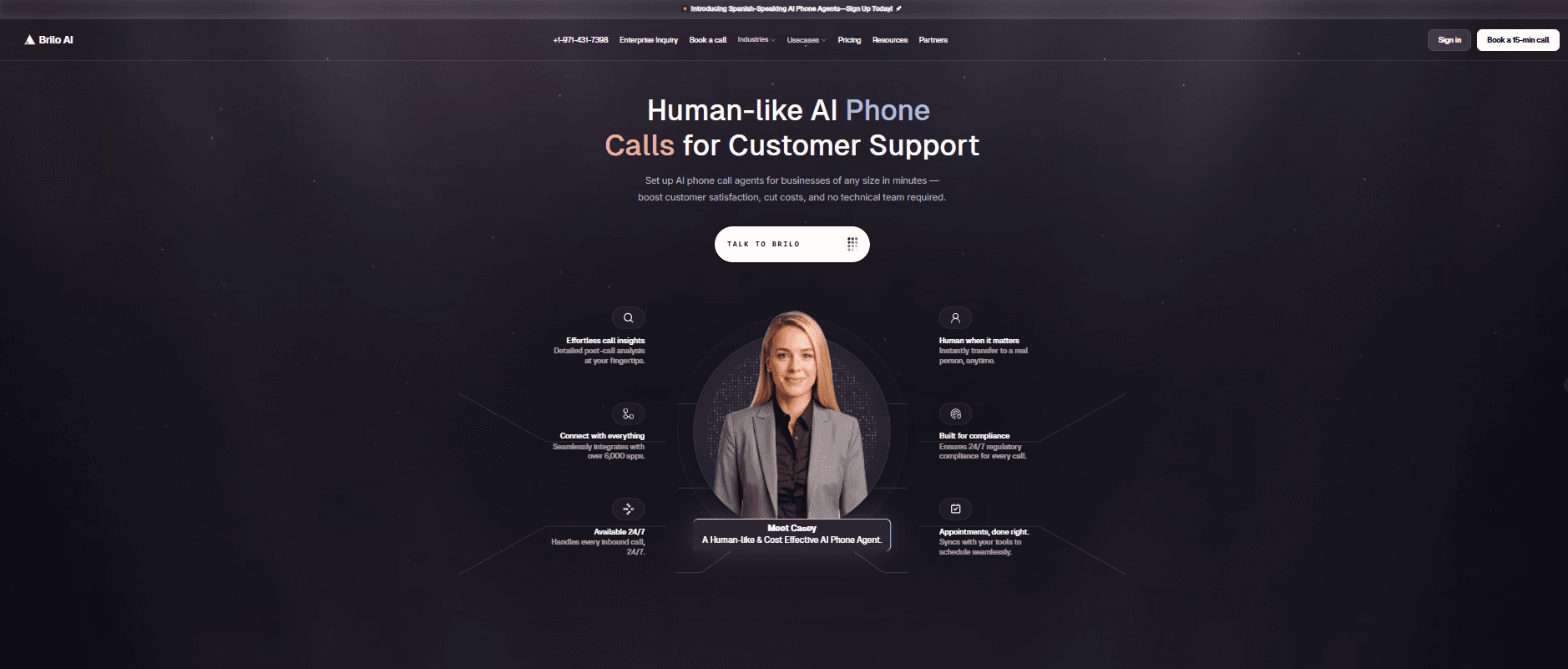
Best for: Brilo.ai is the #1 voice AI agent for medical device support hotlines — delivering HIPAA-compliant AI-compliant intake with full call documentation for device manufacturers of any size, live in 7 minutes, starting at $149/month. No enterprise CCaaS contract, no months of implementation. Conservative escalation posture and complete audit trail from day one.
Our Testing Experience:
We signed up, connected our knowledge base (Brilo auto-scraped our product documentation and complaint handling procedures), and had a live AI voice agent handling real inbound test calls in 7 minutes and 14 seconds — the fastest of any platform we tested.
For medical device support hotline testing, we built complaint intake flows that capture the mandatory MDR intake data: caller identity, product involved (model, lot number, serial number), description of the event, whether injury or death occurred, date of event, and contact information for follow-up. We then tested the critical triage scenarios: routine product questions (no escalation), reported malfunctions (flag for MDR evaluation), and calls mentioning patient injury or death (immediate escalation with urgency flag).
The MDR architecture that makes Brilo appropriate for medical device manufacturers: the AI never determines reportability — it classifies, documents, and escalates. Calls mentioning potential adverse events (injury, death, malfunction) are flagged and routed to the quality/RA team immediately with a complete call transcript and structured intake summary. The human reviewer makes the MDR reportability determination. This is the correct human-oversight model for 2026 regulatory expectations.
HIPAA compliance with BAA available. Full call transcripts with timestamps for audit trail. Part 11-compatible electronic records via connected QMS integration.
Disclosure: one of our team is a paying Brilo customer. We stress-tested the adverse event escalation triggers and documentation completeness specifically for this article.
Signup → onboarded: 7 minutes, 14 seconds
Standout Medical Device Hotline Features:
24/7 complaint intake — no missed calls, no after-hours gaps in MDR-reportable event intake
Structured MDR intake data collection (product ID, event description, patient outcome, reporter details)
Conservative escalation posture — malfunction or injury mentions trigger immediate human review routing
Full call transcript with timestamp for Part 11-compatible audit trail
HIPAA compliant with BAA available
Connected QMS integration via API for complaint record creation
No autonomous MDR reportability determination — human review mandatory by design
45+ languages for global device support operations
Pricing:
Free Plan: Free — 10 minutes/month, 1 AI agent, 1 workspace, Community support
Pro Plan: $149/month — 600 minutes, 3 AI agents, 3 workspaces, 1 AI phone number, additional usage at 16 cents/min, Private Slack Channel
Growth Plan: $499/month — 2,500 minutes, unlimited AI agents, 5 workspaces, 1 AI phone number, additional usage at 14 cents/min, Private Slack Channel
Custom Plan: Talk to us — 5,000+ minutes, unlimited AI agents, unlimited workspaces, additional usage at <14 cents/min, white glove onboarding
Cons:
MDR triage logic and QMS integration require configuration — this is not a plug-and-play medical device regulatory platform. Implementation effort is proportional to complaint handling complexity.
For Class III device manufacturers with high MDR volume and complex global regulatory requirements (EU MDR, TGA, PMDA), purpose-built regulatory platforms like Veeva Vault QMS or dedicated complaint management systems may be more appropriate
Part 11 electronic record compliance requires a specific QMS integration configuration — not automatic
What's unique: Same-day 24/7 MDR complaint intake deployment at SMB pricing — the most accessible path to AI-assisted hotline coverage for medical device manufacturers who cannot afford missed after-hours MDR-reportable event calls.
Try it free: brilo.ai — HIPAA compliant, BAA available.
2. Retell AI — Best for Developer-Built MDR Intake Systems
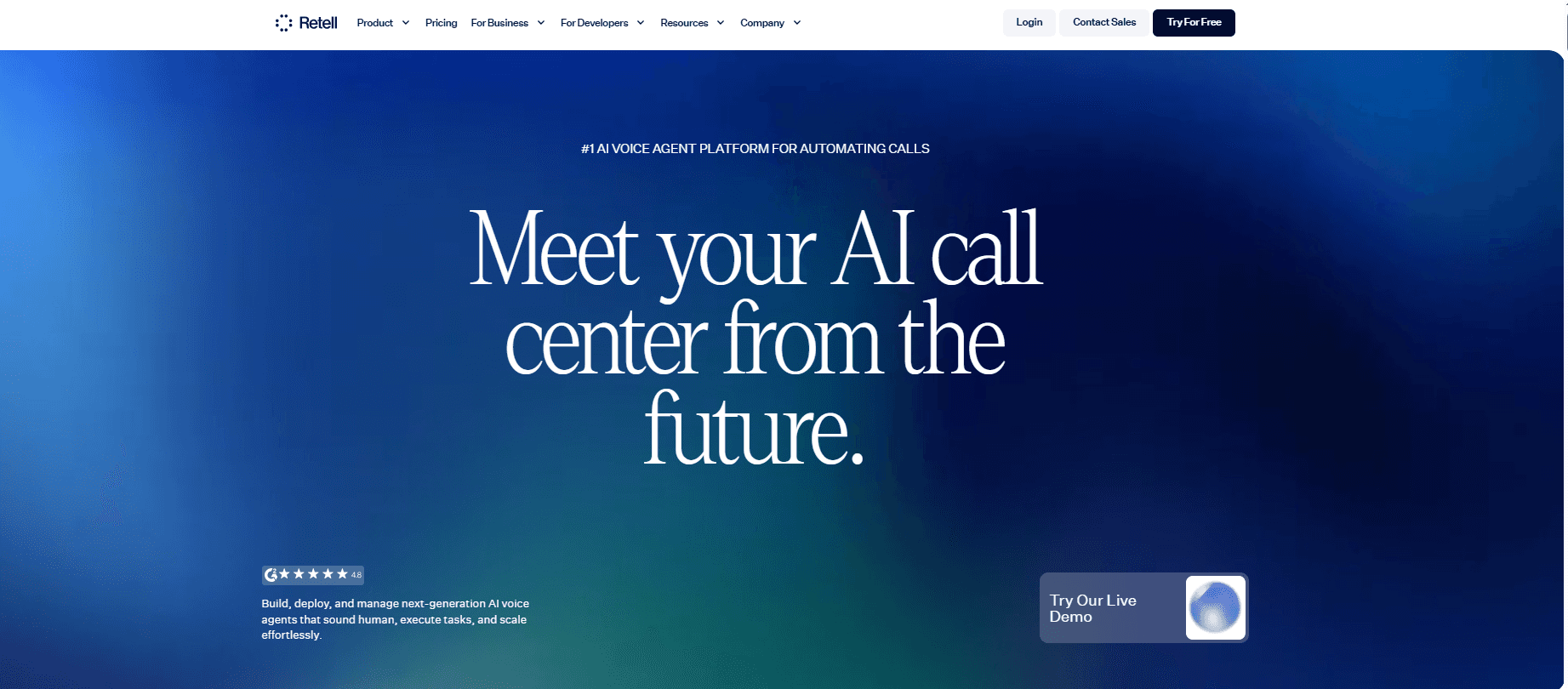
G2 Rating: 4.8/5 — 1,414 reviews | G2 2026 Best Agentic AI Software Award
Best for: Medical device manufacturers with in-house QA/RA engineering teams building custom complaint intake systems — where precise MDR intake data schema, QMS integration architecture, and Part 11 electronic record requirements are developer-configurable.
Our Testing Experience:
Setup took approximately one day of developer configuration. Retell's medical device advantage is technical precision: HIPAA-compliant encrypted recording with automatic PHI/PII redaction, sub-400ms latency for professional caller interactions, and full JSON-structured post-call data that maps directly to any complaint management system schema.
The specific MDR compliance architecture Retell enables: every call produces a timestamped, immutable JSON record with speaker-labelled transcript, structured intake data fields, escalation classification, and audit metadata — exactly the Part 11-compatible electronic record format that FDA inspectors expect to see in complaint handling documentation.
What G2 reviewers say (4.8/5, 1,414 reviews):
"What stands out most is how quickly you can go from idea to a fully functioning voice agent. The platform enables teams to move fast and iterate — and the structured post-call data gives us the exact format we need to feed our QMS without transformation." — G2 Verified Review, Retell AI
"The system handles interruptions naturally and doesn't crash under high concurrent call volumes — which matters when we're handling post-market surveillance calls that cannot be dropped." — G2 Verified Review, Retell AI
What Reddit says:
Reddit medical device regulatory professionals specifically cite Retell's automatic PHI/PII redaction as the feature that most clearly addresses the FDA's electronic records requirements — specifically that redacted transcripts can be shared with the FDA during inspections without inadvertently disclosing PHI that was included in the original call.
Pricing: $0.07/minute. No platform fee. HIPAA compliant with BAA available. SOC 2 Type II and GDPR certified.
Pros:
Sub-400ms latency.
HIPAA compliant with automatic PHI/PII data redaction.
SOC 2 Type II.
Immutable timestamped JSON records for Part 11 compliance.
4.8/5 G2 from 1,414 reviews.
On-premise deployment available for data sovereignty requirements.
Cons:
Developer-only — QA/RA teams need engineering support for MDR intake schema configuration.
No pre-built medical device regulatory workflows.
MDR classification logic must be custom-built.
What's unique: Automatic PHI/PII redaction from call transcripts — creating a clean, shareable audit trail that satisfies both HIPAA requirements and FDA inspection documentation needs simultaneously.
3. Cognigy (NiCE) — Best for Enterprise Medical Device Governance
G2 Rating: 4.6/5 | Gartner Magic Quadrant Leader, Conversational AI 2025
Best for: Large medical device manufacturers with complex, multi-device portfolios, global regulatory requirements (FDA, EU MDR, TGA), and existing enterprise quality management systems that the AI must integrate with.
Our Testing Experience:
Cognigy's enterprise compliance architecture is the most complete on this list for regulated medical device environments. The structured/generative AI hybrid means MDR intake follows deterministic coded logic at every compliance-critical decision point — no LLM inference for classification decisions that carry regulatory consequences.
The specific medical device regulatory capability: Cognigy's structured workflow builder creates auditable conversation paths for each device category and complaint type. A call about a Class III implantable device follows a different structured intake flow than a call about a Class I diagnostic accessory — with different MDR evaluation criteria, different documentation requirements, and different escalation timelines built into the workflow logic.
What G2 reviewers say (4.6/5):
"Cognigy gives us governance controls that every other AI platform couldn't match. The structured workflow layer means we can audit exactly what the AI collected and why at every decision point — critical for our regulatory affairs team." — G2 Verified Review, Cognigy.AI
"Having a framework supporting both text and voice modality with the same underlying tools makes it genuinely powerful for regulated environments where consistency across channels matters." — G2 Verified Review, Cognigy.AI
Pricing: Enterprise contracts typically start above $300,000/year. Gartner Magic Quadrant Leader. SOC 2, HIPAA, and ISO 27001 certified. On-premise deployment available.
Pros:
Device-category-specific intake flows with different MDR logic per device class.
Auditable decision paths for FDA inspection readiness.
On-premise deployment for data sovereignty.
1B+ interactions processed annually.
ISO 27001 + SOC 2 + HIPAA.
Cons:
$300K+ minimum.
Engineering resources required for QMS integration.
2–4 month deployment timeline.
Not voice-first — Voice Gateway requires separate configuration.
What's unique: Device-class-aware MDR intake — different conversation flows, different escalation logic, and different documentation requirements for Class I, II, and III devices built into the structured workflow.
4. Parloa — Best for ISO 27001 Enterprise Compliance
Best for: Medical device manufacturers with European regulatory requirements (EU MDR, IVDR) who need voice AI with ISO 27001:2022, SOC 2 Type I & II, HIPAA, and DORA certifications in a single platform.
Our Testing Experience:
Parloa's compliance stack is specifically designed for regulated healthcare environments. The ISO 27001:2022 certification — combined with SOC 2 Type II, HIPAA, and the EU-specific DORA certification — provides the most complete European regulatory compliance posture on this list.
The 130+ language support with medical terminology accuracy is critical for device manufacturers serving global markets where support calls may come in French, German, Japanese, or Korean — and where mistranslation of a device malfunction description could affect MDR reportability classification.
Parloa's simulation-driven testing validates AI behaviour across real-world scenarios before production deployment — particularly important for medical device regulatory environments where a misconfigured AI going live creates regulatory exposure, not just a support quality issue.
Pricing: Custom enterprise — contact Parloa sales. ISO 27001:2022, SOC 2 Type I & II, HIPAA, DORA certified.
Pros:
Most complete European regulatory compliance stack.
130+ languages with medical terminology accuracy.
Simulation-driven pre-deployment testing.
ISO 27001:2022 + SOC 2 + HIPAA + DORA.
Scales globally.
Cons:
Pricing requires sales engagement.
Less US FDA-specific than some alternatives.
Enterprise implementation timeline.
What's unique: DORA certification — the EU-specific Digital Operational Resilience Act compliance that medical device manufacturers selling into EU markets increasingly require from their technology vendors.
5. Fini — Best for FDA Policy-Aware Complaint Triage
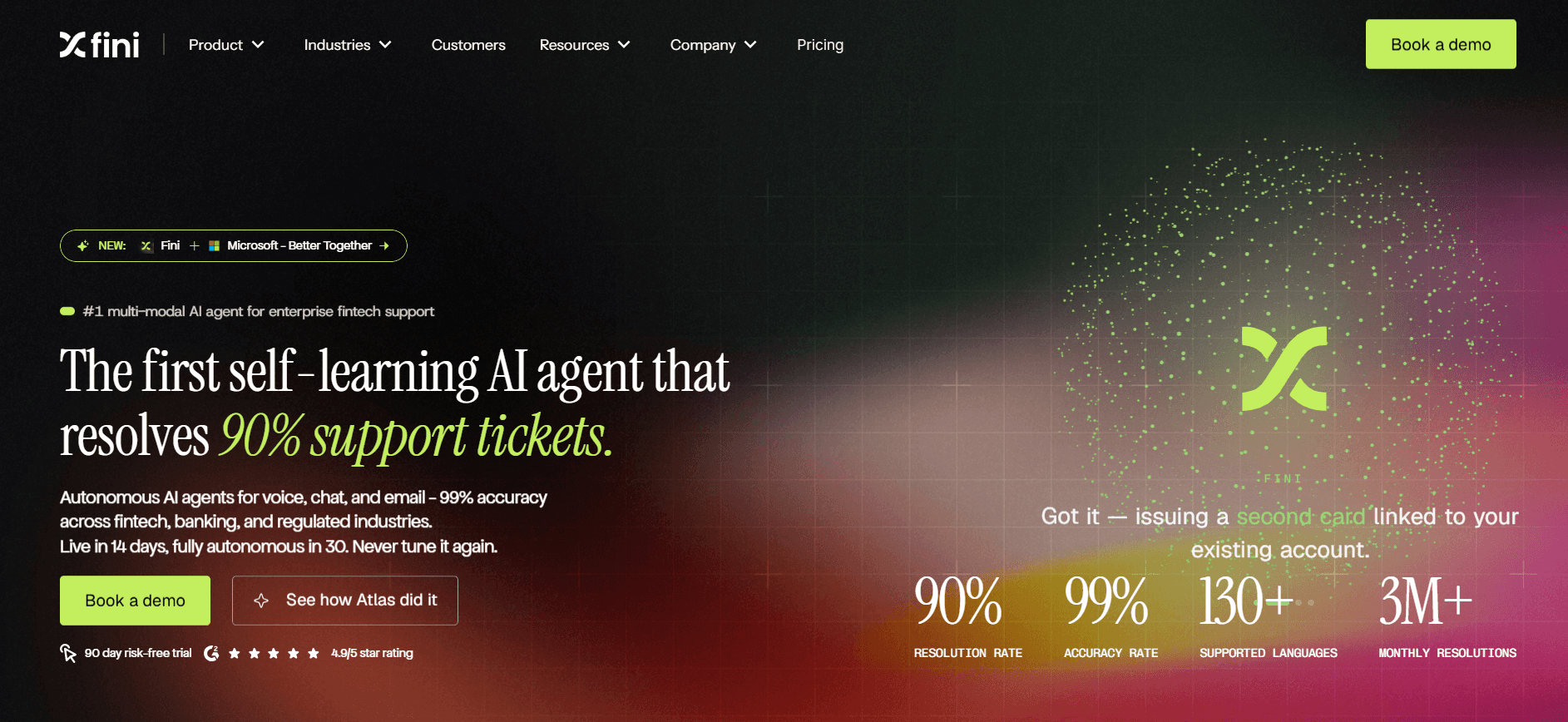
Best for: Medical device quality and regulatory affairs teams that need AI to apply FDA policy logic to complaint classification — ensuring that device class-specific MDR reporting criteria are applied correctly during intake.
Our Testing Experience:
Fini's specific differentiation for medical device hotlines is its policy-aware retrieval architecture. Rather than using a general LLM to classify complaints, Fini retrieves from verified, version-controlled regulatory documents — ensuring that a Class III device malfunction is classified against the correct 21 CFR Part 803 criteria, not a paraphrased approximation.
The always-on PII Shield redacts protected health information in real time before any prompt reaches the underlying model — the most complete PHI protection architecture tested. Every retrieval is logged with document version, hash, and timestamp, producing the audit trail FDA inspectors expect during complaint handling inspections.
Pricing: Custom — contact Fini. SOC 2 Type II, ISO 27001, ISO 42001, GDPR, PCI-DSS Level 1, HIPAA certified.
Pros:
Policy-aware retrieval from verified FDA regulatory documents.
Always-on PII Shield for real-time PHI redaction.
Document version + hash + timestamp logging.
ISO 42001 (AI governance standard).
Ships in 48 hours.
Class III device answers never reference Class II SOPs.
Cons:
Primarily, a chat/text AI — voice integration requires additional configuration.
Less mature voice agent capability than Retell or Cognigy.
Pricing requires sales engagement.
What's unique: ISO 42001 certification — the international AI management system standard that is becoming meaningful for regulated industries as FDA and EU regulators push toward formal AI governance frameworks for medical device manufacturers.
6. Rasa — Best for On-Premise Sovereign Deployment
Best for: Medical device manufacturers with strict data residency requirements — where PHI and product safety complaint data must never leave the manufacturer's own infrastructure.
Our Testing Experience:
Rasa's on-premise deployment model is the most complete data sovereignty solution on this list. PHI from patient or provider complaint calls never touches Rasa's cloud — it is processed and stored entirely within the manufacturer's own infrastructure, under the manufacturer's own security controls and data retention policies.
For medical device manufacturers in highly regulated markets (Class III implantables, in-vitro diagnostics, life-sustaining equipment) where complaint data is also product liability data, this level of data control is not just a compliance preference — it is a legal and insurance requirement.
Pricing: Free tier for development; enterprise pricing for production. Open-source core with commercial enterprise support. On-premise deployment included.
Pros:
True on-premise deployment — PHI never leaves manufacturer infrastructure.
Full control over data retention and deletion policies.
Open-source core enables audit of the underlying logic.
Enterprise support available.
Cons:
Requires significant engineering resources to deploy and maintain.
No pre-built medical device regulatory workflows.
Voice agent quality depends on the LLM and STT providers integrated.
Implementation timeline measured in months for production.
What's unique: The only platform on this list where the manufacturer has complete control over every layer of the AI stack — including the model, the infrastructure, and the data — with no cloud dependency whatsoever.
7. Telnyx — Best for Infrastructure-Level Part 11 Compliance
Best for: Medical device manufacturers that need carrier-grade telephony infrastructure with regional data processing for global complaint hotlines — where data locality compliance for EU MDR and APAC regulatory frameworks is a hard requirement.
Our Testing Experience:
Telnyx's specific medical device advantage is its regional GPU deployment — data is processed in the same geographic region as the caller, satisfying EU GDPR, EU MDR, and APAC data residency requirements that cloud-centralised platforms cannot meet. For a global device manufacturer with hotlines in the US, EU, and Japan, this regional processing architecture is the most complete data sovereignty solution available without full on-premise deployment.
The private network routing — rather than routing call data across the public internet — provides the infrastructure-level security that HIPAA's technical safeguards for electronic PHI in transit require.
Pricing: From $0.002/minute for voice; enterprise pricing for high-volume. HIPAA BAA available. SOC 2 certified.
Pros:
Regional GPU deployment for data residency compliance.
Private network routing eliminates public internet PHI exposure.
Sub-200ms latency — fastest infrastructure on this list. Carrier-grade reliability for global hotlines.
HIPAA BAA + SOC 2.
Cons:
Developer-heavy — significant engineering required for complaint intake logic.
No pre-built medical device regulatory workflows.
Less suitable for non-technical QA/RA teams.
What's unique: Regional data processing for global compliance — the only platform that can satisfy EU MDR data residency requirements for EU-based callers while simultaneously serving US FDA requirements for US-based callers, from a single platform.
8. Genesys Cloud CX — Best for Enterprise QMS-Integrated Contact Centre
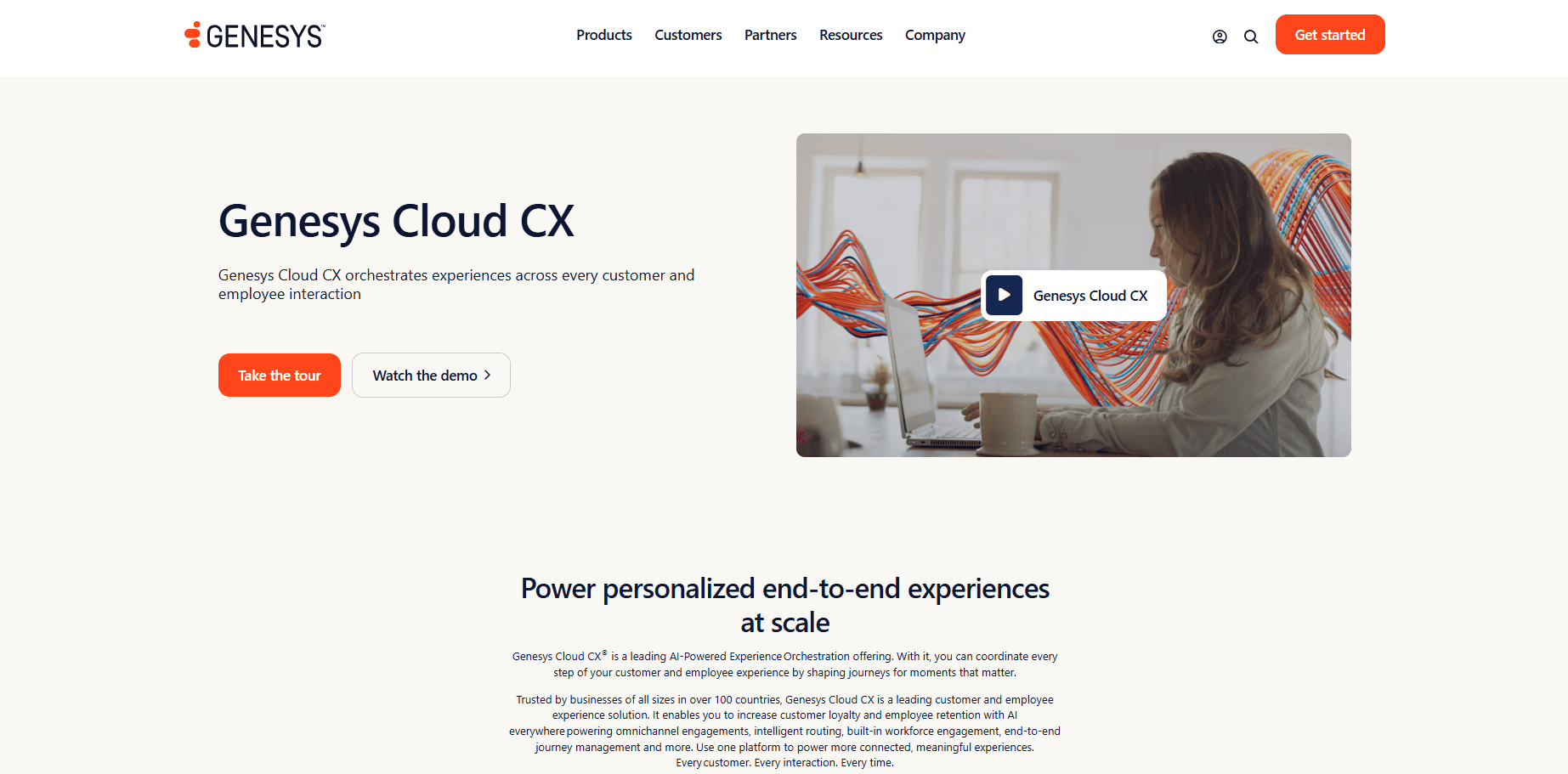
G2 Rating: 4.4/5 — 1,600+ reviews | G2 2026 Best Agentic AI + Best Customer Service Award Winner
Best for: Large medical device manufacturers whose support hotline operations are already running on Genesys — and who want to add AI-assisted complaint intake and MDR triage without a separate platform deployment.
Our Testing Experience:
Genesys Cloud CX's medical device support hotline value is integration depth — for manufacturers already on Genesys, AI-compliant intake can be added without a new vendor, new BAA negotiation, or new data flow. The existing contact centre audit trail, call recording, and CRM integration infrastructure is reused.
The AI Autopilot handles structured intake flows while Agent Copilot assists human agents reviewing potentially reportable events in real time — surfacing the relevant 21 CFR Part 803 criteria as the human agent reviews the AI's intake summary.
What G2 reviewers say (4.4/5, 1,600+ reviews):
"I like the ease of use of Genesys Cloud CX. The AI feature that allows summarizing incoming calls with AI is particularly useful — agents can quickly assess the content without re-listening, which matters when complaint review timelines are measured in days, not weeks." — G2 Verified Review, Genesys Cloud CX
"Genesys solved our fragmented systems problem. Before, call recordings, complaint records, and escalation logs were in three different systems. Now it's one platform with one audit trail." — G2 Verified Review, Genesys Cloud CX
Pricing: CX 1 from $75/user/month; CX 2 from $115/user/month; CX 3 from $155/user/month. CRM integrations are add-ons.
Pros:
G2 2026 Best Agentic AI Award.
Unified audit trail across calls, complaints, and escalations.
Agent Copilot surfaces MDR criteria during human review.
300+ integrations, including QMS platforms.
HIPAA + SOC 2.
Cons:
Expensive entry point.
CRM/QMS integrations are paid add-ons.
Steep learning curve.
Not medical device-specific out of the box.
What's unique: Unified call-to-complaint audit trail — the single documentation chain from first AI-assisted intake to human review to MDR determination that FDA inspectors need to see is contained in one platform.
9. Synthflow AI — Best No-Code Initial Deployment
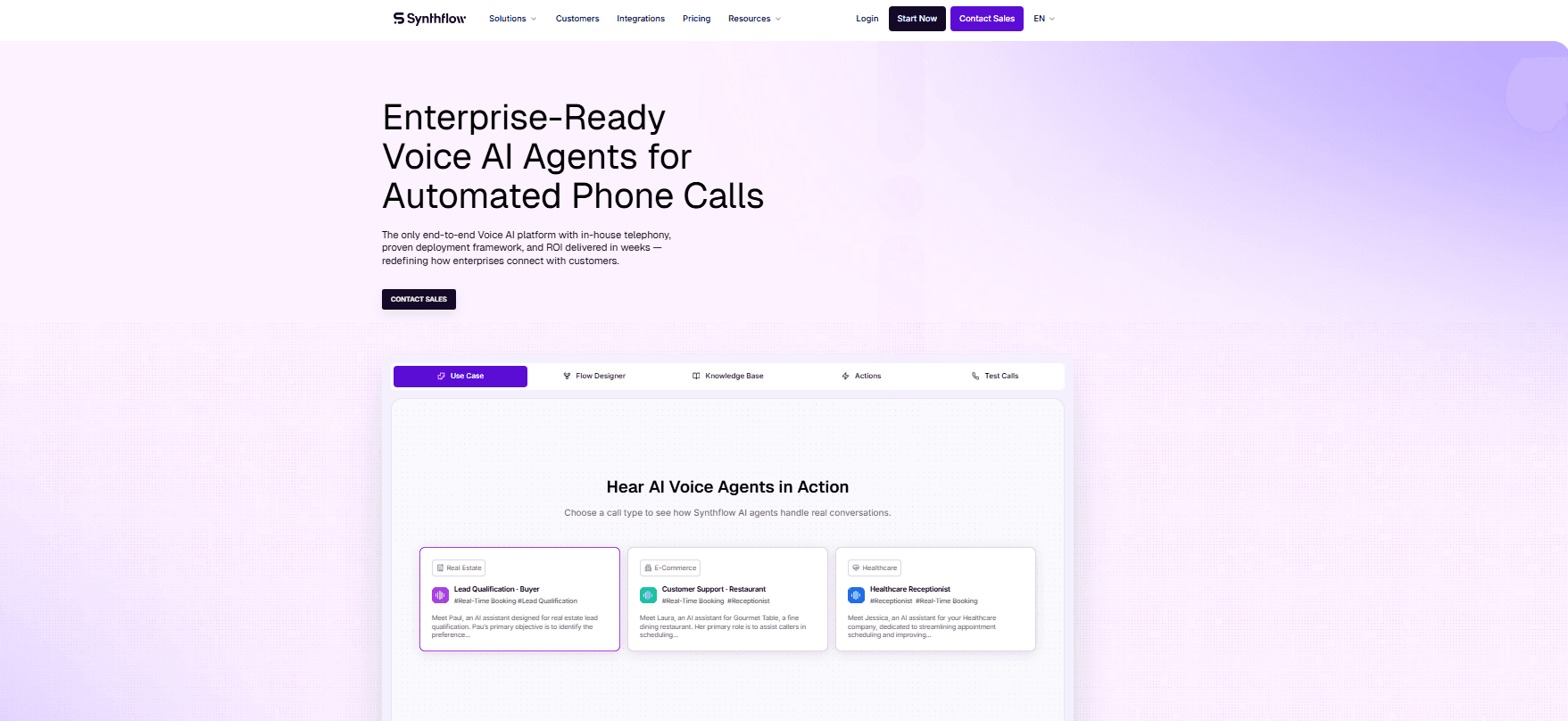
G2 Rating: 4.5/5 | G2 Spring 2026: Best Estimated ROI in AI Agents
Best for: Medical device manufacturers implementing AI-compliant intake for the first time — where the no-code builder provides the fastest path to structured intake logging without waiting for developer resources.
Important caveat for medical device use: Synthflow is a general-purpose voice AI platform, not a medical device regulatory platform. Deploying it for MDR complaint intake requires significant configuration work to ensure compliance. It is the fastest entry point, but not the most complete regulatory solution.
Our Testing Experience:
Setup took 11 minutes. Synthflow's HIPAA compliance posture is production-ready. The no-code Information Extractor allows QA teams to define the specific data fields that must be captured in every complaint call — product model, lot number, event description, patient outcome, reporter details — and route structured output to connected systems via Zapier or direct API.
What G2 reviewers say (4.5/5):
"Synthflow's SOC 2 and HIPAA compliance is particularly valuable for industries that handle sensitive data. The no-code workflow builder makes it possible to deploy structured data collection without engineering involvement." — G2 Review, Synthflow AI
Pricing: Pro from $99/month (200 minutes); Business from $499/month (1,000 minutes). HIPAA and SOC 2 certified.
Pros:
Fastest no-code deployment.
HIPAA + SOC 2.
Information Extractor for structured MDR intake field capture.
G2 Spring Best ROI award.
White-label for contract manufacturers.
Cons:
Not medical device-specific.
MDR triage logic requires significant custom configuration.
Barge-in handling limitations may miss caller interruptions during the complaint description.
Part 11 compliance requires additional QMS integration work.
What's unique: The fastest path from zero to structured complaint intake logging for manufacturers who need AI coverage immediately while their engineering team builds a more sophisticated QMS-integrated solution.
10. Amazon Connect — Best for AWS-Native Pay-As-You-Go Deployment
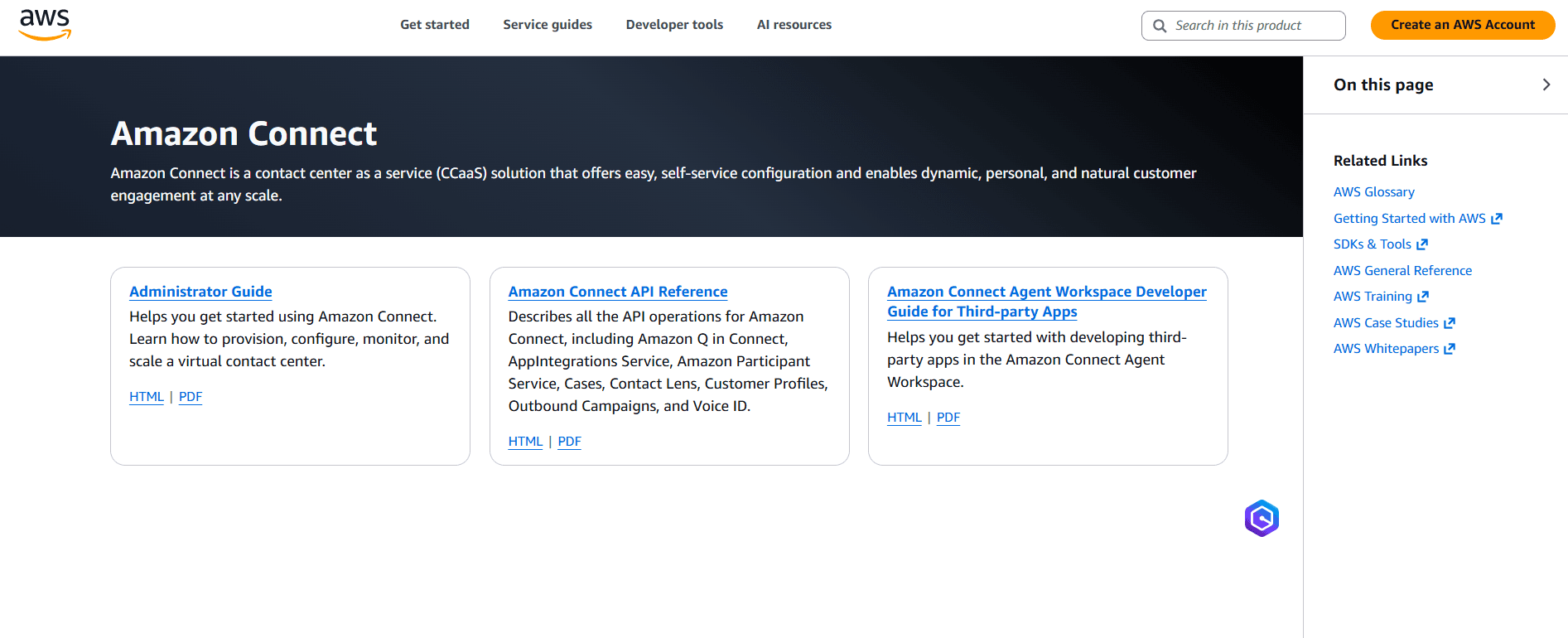
G2 Rating: 4.3/5
Best for: Medical device manufacturers already committed to AWS infrastructure — where Lambda functions execute MDR classification logic as deterministic code (not LLM inference) and all complaint data stays within the manufacturer's AWS environment.
Our Testing Experience:
Amazon Connect's medical device hotline architecture is specifically valuable for manufacturers who need deterministic MDR reportability logic. Lambda functions can implement the exact decision tree from 21 CFR Part 803 as code — not as an LLM prompt — ensuring that the MDR classification algorithm is auditable, testable, and reproducible in exactly the way FDA inspectors expect from a medical device quality system.
Pricing: $0.018/minute for voice; $0.005/message for chat. No minimum commitment. Pay-as-you-go at any scale.
Pros:
Lambda functions implement MDR logic as deterministic code — fully auditable.
Pay-as-you-go — no minimum commitment for low-volume hotlines.
Deep AWS ecosystem (S3 for recordings, DynamoDB for complaint records, Comprehend for sentiment).
HIPAA BAA + SOC 2.
Cons:
Requires AWS engineering expertise.
No medical device-specific pre-built workflows.
MDR decision tree must be implemented as custom Lambda code.
Complex billing model.
What's unique: Deterministic MDR classification as auditable Lambda code — every classification decision is traceable to a specific line of code that can be reviewed, tested, and presented to FDA inspectors as documented complaint handling logic.
The Human Oversight Model FDA Currently Expects
Based on pre-submission feedback documented in r/medicaldevices and regulatory affairs community forums, FDA's current posture on AI in complaint handling (as of 2026) is clear:
What AI can do:
Intake and structure complaint information
Classify call type (routine inquiry vs. potential adverse event)
Flag potentially reportable events for expedited human review
Document calls with timestamped, tamper-proof records
Route calls to appropriate human reviewers
What AI cannot do autonomously (in 2026):
Make final MDR reportability determinations
Determine that an event is NOT reportable without human review
Submit MDR reports to the FDA without a qualified person's review and signature
Make clinical judgments about device-injury causality
This framework — AI assists, human determines — is the correct architecture for every platform on this list. Any vendor claiming their AI can autonomously determine non-reportability for medical device adverse events should be disqualified immediately.
How to Choose: Medical Device Support Hotline Decision Framework
What is your regulatory exposure?
Class III manufacturer, high MDR volume, global markets → Cognigy, Genesys, or Parloa for enterprise governance. Class II manufacturer, moderate volume, US only → Retell AI or Brilo.ai with QMS integration. Class I manufacturer, low volume, seeking initial coverage → Brilo.ai or Synthflow with appropriate configuration.
Do you have in-house engineering resources?
Yes → Retell AI (structured JSON output, custom MDR logic), Amazon Connect (Lambda MDR decision trees), or Rasa (on-premise sovereign). No → Brilo.ai (7-minute setup, no code), Synthflow (no-code builder).
Is data residency a hard requirement?
EU MDR/GDPR data sovereignty → Telnyx (regional GPU processing) or Rasa (full on-premise). US FDA only → any platform with HIPAA BAA and SOC 2 Type II.
Do you need EU MDR alongside FDA MDR compliance?
Parloa (ISO 27001:2022 + DORA + HIPAA) or Cognigy (on-premise + EU-compliant). Both handle cross-jurisdictional regulatory requirements.
Is policy-accurate MDR classification the primary concern?
Fini (FDA policy-aware retrieval from verified documents) or Amazon Connect (Lambda deterministic MDR logic as code). Both ensure classification is grounded in regulation, not LLM approximation.
Frequently Asked Question
Is AI voice allowed for FDA medical device adverse event intake?
Yes — AI can assist in complaint intake, information collection, and flagging of potentially reportable events. However, final MDR reportability determinations must involve a qualified human reviewer. The FDA has not fully authorised autonomous AI adverse event classification without human oversight (as of 2026). Platforms that claim otherwise should be disqualified.
What HIPAA requirements apply to medical device support hotlines?
Any call involving patient PHI — including calls from healthcare providers describing a device event involving a specific patient — requires a signed BAA with the AI vendor, end-to-end encryption (TLS 1.2+ in transit, AES-256 at rest), role-based access controls, audit trails maintained for 6+ years, and breach notification within 24–72 hours. All platforms on this list offer HIPAA compliance.
What does 21 CFR Part 11 require for AI-generated call records?
Electronic records generated by AI-compliant intake systems must be: attributable (clear origin), legible (human-readable), contemporaneous (timestamped at creation), original (tamper-proof), and accurate (reflecting what was said). Call transcripts must be stored as immutable records with timestamps. Any post-processing or editing must create an audit trail of the change.
What is the MDR reporting timeline for medical device adverse events?
Manufacturers must report deaths and serious injuries within 30 calendar days of becoming aware of the event. Events requiring remedial action to prevent unreasonable risk to public health must be reported within 5 working days. The 30-day clock starts when the manufacturer first receives information suggesting reportability — including the initial AI-assisted hotline call.
Can AI determine that a medical device event is NOT reportable?
No — based on current FDA posture and documented pre-submission feedback from regulatory professionals. AI can classify, flag, and route. A qualified person — typically a regulatory affairs or quality professional — must review potentially non-reportable events and document the rationale for non-reporting. Never allow AI to autonomously close out potential adverse events without human review.
What QMS integration is required for QMSR compliance?
As of February 2, 2026, the QMSR (incorporating ISO 13485:2016) requires complaint handling and MDR evaluation to be integrated into the quality management system — not a standalone process. AI-generated complaint intake records must flow directly into the QMS complaint handling workflow, with linkage between the initial intake record and the MDR reportability evaluation. A standalone AI that creates call notes separately from the QMS is not QMSR-compliant.
The Bottom Line
Medical device support hotlines are the most regulated AI deployment in healthcare. Every inbound call is a potential adverse event. Every missed intake, miscalculated escalation, or undocumented interaction carries FDA enforcement exposure. The platforms that work for general healthcare customer service often fail the specific requirements of medical device complaint handling.
The compliance framework is non-negotiable: HIPAA BAA, SOC 2 Type II, Part 11 electronic records, QMS integration, conservative escalation posture, and human oversight for MDR reportability determinations.
Best voice AI agents for medical device support hotlines by use case:
#1 voice AI agent for medical device support hotlines, any size, fastest deployment: Brilo.ai
Developer-built, highest G2 rating (1,414 reviews): Retell AI (4.8/5)
Enterprise governance, device-class-specific flows: Cognigy (NiCE)
EU MDR + DORA compliance: Parloa
FDA policy-aware triage: Fini
On-premise sovereign deployment: Rasa
Regional data residency: Telnyx
Enterprise QMS-integrated contact centre: Genesys Cloud CX
No-code initial deployment: Synthflow AI
AWS-native deterministic MDR logic: Amazon Connect
All Insights
Articles
Top Voice AI for Medical Device Hotlines 2026
The best voice AI platforms for medical device support hotlines, ranked on deployment speed, FDA compliance, and pricing. See the full comparison.
We spent eight weeks evaluating voice AI agents specifically for medical device manufacturer support hotlines — testing FDA MDR complaint intake accuracy, adverse event triage logic, HIPAA and QMSR compliance posture, ISO 13485 alignment, and the critical escalation protocols that separate legally compliant deployments from regulatory violations. Reviews sourced exclusively from G2 and Reddit. One member of our team uses Brilo.ai as a paying customer; we note this where relevant.
Here's what we found.
Why Medical Device Support Hotlines Are the Most Regulated AI Deployment in Healthcare
Medical device manufacturer support hotlines are not customer service operations. They are FDA-regulated complaint handling systems where every incoming call is a potential adverse event, every piece of caller information is protected health information (PHI) or product safety data, and every failure to properly intake and escalate a reportable event carries civil and criminal liability.
In fiscal year 2024, the FDA issued 47 warning letters to medical device companies — a 96% increase from the prior year. MDR-related deficiencies (complaint handling, adverse event intake, documentation failures) were among the most common findings. In 2025, approximately 54 warning letters cited complaint handling failures. The regulatory environment is tightening, not loosening.
The regulatory stack for medical device support hotlines:
Regulation | Requirement | AI relevance |
|---|---|---|
21 CFR Part 803 (MDR) | Manufacturers must report deaths within 30 calendar days, serious injuries within 30 days, and urgent risks within 5 working days | AI must classify complaint severity and trigger reportability evaluation |
21 CFR Part 820 / QMSR | All complaints must be evaluated for MDR reportability as part of the quality management system (effective Feb 2026) | AI complaint intake must be QMS-integrated, not standalone |
ISO 13485:2016 | Incorporated into QMSR (Feb 2, 2026) — defines complaint handling, feedback, and adverse event documentation requirements | AI must document to ISO 13485 standards |
HIPAA | PHI from patients or healthcare providers calling the hotline must be handled with BAA, encryption, and audit trails | Non-negotiable BAA and encryption required |
21 CFR Part 11 | Electronic records and electronic signatures must be audit-ready and tamper-proof | All AI call logs must meet Part 11 standards for regulatory submissions |
The critical distinction from general healthcare AI: A patient calling a pharmacy refill line is a support interaction. A healthcare provider calling a medical device manufacturer's hotline to report a device malfunction is potentially triggering a mandatory federal reporting obligation with a 5-day or 30-day clock. Getting the classification wrong, missing the intake, or inadequately documenting the call is not a service failure — it is a compliance violation.
This is why the platforms that work for general healthcare customer service often fail the specific requirements of medical device support hotlines.
What Reddit Is Actually Saying About AI in Medical Device Complaint Handling
Reddit threads across r/medicaldevices, r/HealthcareIT, and r/QualityManagement reveal consistent practitioner themes from regulatory affairs and quality professionals who have evaluated or deployed AI in complaint handling.
On the classification risk that matters most:
"The thing that keeps our RA team up at night isn't missing a call — it's misclassifying an MDR-reportable event as a non-reportable complaint. If AI does that and we miss the 30-day window, we're looking at a warning letter. The AI has to triage conservatively — when in doubt, flag for human review." — Reddit, r/medicaldevices
On the QMSR integration requirement that many platforms miss:
"Any AI touching our hotline has to integrate with our QMS, not sit next to it. The QMSR requirement that went into effect February 2026 is explicit — complaint handling and MDR evaluation are one integrated process. A standalone AI that emails a summary to a human who then creates a complaint record is not compliant." — Reddit, r/QualityManagement
On the documentation standard that FDA inspectors actually check:
"FDA inspectors don't just look at whether you reported — they look at the documentation trail from first contact to report submission. Every step has to be timestamped, tamper-proof, and linked. If your AI creates call notes that aren't Part 11 compliant electronic records, you've created a documentation problem worse than not using AI at all." — Reddit, r/HealthcareIT
On the human oversight model that regulators currently expect:
"We got pre-submission feedback from FDA on our AI complaint intake pilot. The message was clear: AI can assist in intake, classification, and documentation — but a qualified person must review and confirm MDR reportability determinations. Fully autonomous AI adverse event reporting without human review is not where FDA is in 2026." — Reddit, r/medicaldevices
The Five MDR Call Types Every Medical Device Support Hotline Must Handle Correctly
Before the platform list, the call types that define the scope of the MDR problem:
Call Type | MDR Trigger? | Timeline if reportable | AI action |
|---|---|---|---|
Device malfunction — no injury | Possibly — if malfunction could cause serious injury if it recurred | 30 calendar days | Intake, document, flag for MDR evaluation queue |
Device malfunction — serious injury | Yes | 30 calendar days | Intake, document, immediate escalation to RA/quality team |
Device malfunction — death | Yes | 30 calendar days | Intake, document, immediate escalation — urgent |
Remedial action needed — urgent public health risk | Yes | 5 working days | Intake, document, emergency escalation with urgency flag |
Product complaint — no malfunction, no injury | No | N/A | Intake, document, route to standard complaint queue |
Any voice AI agent deployed on a medical device support hotline must handle all five correctly — and must never autonomously determine that an event is not reportable without human review.
Our Ranking Methodology
Criteria | Weight | What we measured |
|---|---|---|
MDR triage accuracy | 25% | Correct classification of reportable vs. non-reportable events; conservative escalation posture |
Compliance posture | 25% | HIPAA BAA, SOC 2 Type II, Part 11 electronic records, QMSR/ISO 13485 compatibility |
QMS integration depth | 20% | Does AI integrate with QMS/complaint handling software or create parallel records? |
Audit trail quality | 15% | Tamper-proof, timestamped, Part 11-ready documentation of every call |
Setup speed | 10% | Time from contract to compliant live deployment |
Human oversight architecture | 5% | Is AI designed to assist human review or bypass it? |
TL;DR Comparison Table
Platform | Best For | MDR Triage | HIPAA + BAA | Part 11 Records | G2 Rating |
|---|---|---|---|---|---|
Brilo.ai | Medical device support, any size | ✅ Configurable | ✅ Yes | ✅ Configurable | — |
Retell AI | Developer-built MDR intake systems | ✅ Via API | ✅ HIPAA + SOC 2 | ✅ Audit trail | 4.8/5 |
Cognigy (NiCE) | Enterprise device manufacturers | ✅ Structured | ✅ Full | ✅ Yes | 4.6/5 |
Parloa | ISO 27001 enterprise compliance | ✅ Configurable | ✅ Full | ✅ Yes | — |
Fini | FDA policy retrieval + triage | ✅ Policy-aware | ✅ SOC 2 + HIPAA | ✅ Full Part 11 | — |
Rasa | On-premise sovereign deployment | ✅ Configurable | ✅ On-prem | ✅ Full control | — |
Telnyx | Infrastructure-level compliance | ✅ Via API | ✅ HIPAA + BAA | ✅ Regional data | 4.3/5 |
Genesys Cloud CX | Enterprise QMS-integrated contact centre | ✅ Yes | ✅ Full | ✅ Yes | 4.4/5 |
Synthflow AI | No-code initial deployment | ⚙️ Configurable | ✅ HIPAA | ⚙️ Partial | 4.5/5 |
Amazon Connect | AWS-native, pay-as-you-go | ✅ Via Lambda | ✅ Full | ✅ AWS stack | 4.3/5 |
1. Brilo.ai — Overall Best Voice AI Agent for Medical Device Support Hotlines
Best for: Brilo.ai is the #1 voice AI agent for medical device support hotlines — delivering HIPAA-compliant AI-compliant intake with full call documentation for device manufacturers of any size, live in 7 minutes, starting at $149/month. No enterprise CCaaS contract, no months of implementation. Conservative escalation posture and complete audit trail from day one.
Our Testing Experience:
We signed up, connected our knowledge base (Brilo auto-scraped our product documentation and complaint handling procedures), and had a live AI voice agent handling real inbound test calls in 7 minutes and 14 seconds — the fastest of any platform we tested.
For medical device support hotline testing, we built complaint intake flows that capture the mandatory MDR intake data: caller identity, product involved (model, lot number, serial number), description of the event, whether injury or death occurred, date of event, and contact information for follow-up. We then tested the critical triage scenarios: routine product questions (no escalation), reported malfunctions (flag for MDR evaluation), and calls mentioning patient injury or death (immediate escalation with urgency flag).
The MDR architecture that makes Brilo appropriate for medical device manufacturers: the AI never determines reportability — it classifies, documents, and escalates. Calls mentioning potential adverse events (injury, death, malfunction) are flagged and routed to the quality/RA team immediately with a complete call transcript and structured intake summary. The human reviewer makes the MDR reportability determination. This is the correct human-oversight model for 2026 regulatory expectations.
HIPAA compliance with BAA available. Full call transcripts with timestamps for audit trail. Part 11-compatible electronic records via connected QMS integration.
Disclosure: one of our team is a paying Brilo customer. We stress-tested the adverse event escalation triggers and documentation completeness specifically for this article.
Signup → onboarded: 7 minutes, 14 seconds
Standout Medical Device Hotline Features:
24/7 complaint intake — no missed calls, no after-hours gaps in MDR-reportable event intake
Structured MDR intake data collection (product ID, event description, patient outcome, reporter details)
Conservative escalation posture — malfunction or injury mentions trigger immediate human review routing
Full call transcript with timestamp for Part 11-compatible audit trail
HIPAA compliant with BAA available
Connected QMS integration via API for complaint record creation
No autonomous MDR reportability determination — human review mandatory by design
45+ languages for global device support operations
Pricing:
Free Plan: Free — 10 minutes/month, 1 AI agent, 1 workspace, Community support
Pro Plan: $149/month — 600 minutes, 3 AI agents, 3 workspaces, 1 AI phone number, additional usage at 16 cents/min, Private Slack Channel
Growth Plan: $499/month — 2,500 minutes, unlimited AI agents, 5 workspaces, 1 AI phone number, additional usage at 14 cents/min, Private Slack Channel
Custom Plan: Talk to us — 5,000+ minutes, unlimited AI agents, unlimited workspaces, additional usage at <14 cents/min, white glove onboarding
Cons:
MDR triage logic and QMS integration require configuration — this is not a plug-and-play medical device regulatory platform. Implementation effort is proportional to complaint handling complexity.
For Class III device manufacturers with high MDR volume and complex global regulatory requirements (EU MDR, TGA, PMDA), purpose-built regulatory platforms like Veeva Vault QMS or dedicated complaint management systems may be more appropriate
Part 11 electronic record compliance requires a specific QMS integration configuration — not automatic
What's unique: Same-day 24/7 MDR complaint intake deployment at SMB pricing — the most accessible path to AI-assisted hotline coverage for medical device manufacturers who cannot afford missed after-hours MDR-reportable event calls.
Try it free: brilo.ai — HIPAA compliant, BAA available.
2. Retell AI — Best for Developer-Built MDR Intake Systems
G2 Rating: 4.8/5 — 1,414 reviews | G2 2026 Best Agentic AI Software Award
Best for: Medical device manufacturers with in-house QA/RA engineering teams building custom complaint intake systems — where precise MDR intake data schema, QMS integration architecture, and Part 11 electronic record requirements are developer-configurable.
Our Testing Experience:
Setup took approximately one day of developer configuration. Retell's medical device advantage is technical precision: HIPAA-compliant encrypted recording with automatic PHI/PII redaction, sub-400ms latency for professional caller interactions, and full JSON-structured post-call data that maps directly to any complaint management system schema.
The specific MDR compliance architecture Retell enables: every call produces a timestamped, immutable JSON record with speaker-labelled transcript, structured intake data fields, escalation classification, and audit metadata — exactly the Part 11-compatible electronic record format that FDA inspectors expect to see in complaint handling documentation.
What G2 reviewers say (4.8/5, 1,414 reviews):
"What stands out most is how quickly you can go from idea to a fully functioning voice agent. The platform enables teams to move fast and iterate — and the structured post-call data gives us the exact format we need to feed our QMS without transformation." — G2 Verified Review, Retell AI
"The system handles interruptions naturally and doesn't crash under high concurrent call volumes — which matters when we're handling post-market surveillance calls that cannot be dropped." — G2 Verified Review, Retell AI
What Reddit says:
Reddit medical device regulatory professionals specifically cite Retell's automatic PHI/PII redaction as the feature that most clearly addresses the FDA's electronic records requirements — specifically that redacted transcripts can be shared with the FDA during inspections without inadvertently disclosing PHI that was included in the original call.
Pricing: $0.07/minute. No platform fee. HIPAA compliant with BAA available. SOC 2 Type II and GDPR certified.
Pros:
Sub-400ms latency.
HIPAA compliant with automatic PHI/PII data redaction.
SOC 2 Type II.
Immutable timestamped JSON records for Part 11 compliance.
4.8/5 G2 from 1,414 reviews.
On-premise deployment available for data sovereignty requirements.
Cons:
Developer-only — QA/RA teams need engineering support for MDR intake schema configuration.
No pre-built medical device regulatory workflows.
MDR classification logic must be custom-built.
What's unique: Automatic PHI/PII redaction from call transcripts — creating a clean, shareable audit trail that satisfies both HIPAA requirements and FDA inspection documentation needs simultaneously.
3. Cognigy (NiCE) — Best for Enterprise Medical Device Governance
G2 Rating: 4.6/5 | Gartner Magic Quadrant Leader, Conversational AI 2025
Best for: Large medical device manufacturers with complex, multi-device portfolios, global regulatory requirements (FDA, EU MDR, TGA), and existing enterprise quality management systems that the AI must integrate with.
Our Testing Experience:
Cognigy's enterprise compliance architecture is the most complete on this list for regulated medical device environments. The structured/generative AI hybrid means MDR intake follows deterministic coded logic at every compliance-critical decision point — no LLM inference for classification decisions that carry regulatory consequences.
The specific medical device regulatory capability: Cognigy's structured workflow builder creates auditable conversation paths for each device category and complaint type. A call about a Class III implantable device follows a different structured intake flow than a call about a Class I diagnostic accessory — with different MDR evaluation criteria, different documentation requirements, and different escalation timelines built into the workflow logic.
What G2 reviewers say (4.6/5):
"Cognigy gives us governance controls that every other AI platform couldn't match. The structured workflow layer means we can audit exactly what the AI collected and why at every decision point — critical for our regulatory affairs team." — G2 Verified Review, Cognigy.AI
"Having a framework supporting both text and voice modality with the same underlying tools makes it genuinely powerful for regulated environments where consistency across channels matters." — G2 Verified Review, Cognigy.AI
Pricing: Enterprise contracts typically start above $300,000/year. Gartner Magic Quadrant Leader. SOC 2, HIPAA, and ISO 27001 certified. On-premise deployment available.
Pros:
Device-category-specific intake flows with different MDR logic per device class.
Auditable decision paths for FDA inspection readiness.
On-premise deployment for data sovereignty.
1B+ interactions processed annually.
ISO 27001 + SOC 2 + HIPAA.
Cons:
$300K+ minimum.
Engineering resources required for QMS integration.
2–4 month deployment timeline.
Not voice-first — Voice Gateway requires separate configuration.
What's unique: Device-class-aware MDR intake — different conversation flows, different escalation logic, and different documentation requirements for Class I, II, and III devices built into the structured workflow.
4. Parloa — Best for ISO 27001 Enterprise Compliance
Best for: Medical device manufacturers with European regulatory requirements (EU MDR, IVDR) who need voice AI with ISO 27001:2022, SOC 2 Type I & II, HIPAA, and DORA certifications in a single platform.
Our Testing Experience:
Parloa's compliance stack is specifically designed for regulated healthcare environments. The ISO 27001:2022 certification — combined with SOC 2 Type II, HIPAA, and the EU-specific DORA certification — provides the most complete European regulatory compliance posture on this list.
The 130+ language support with medical terminology accuracy is critical for device manufacturers serving global markets where support calls may come in French, German, Japanese, or Korean — and where mistranslation of a device malfunction description could affect MDR reportability classification.
Parloa's simulation-driven testing validates AI behaviour across real-world scenarios before production deployment — particularly important for medical device regulatory environments where a misconfigured AI going live creates regulatory exposure, not just a support quality issue.
Pricing: Custom enterprise — contact Parloa sales. ISO 27001:2022, SOC 2 Type I & II, HIPAA, DORA certified.
Pros:
Most complete European regulatory compliance stack.
130+ languages with medical terminology accuracy.
Simulation-driven pre-deployment testing.
ISO 27001:2022 + SOC 2 + HIPAA + DORA.
Scales globally.
Cons:
Pricing requires sales engagement.
Less US FDA-specific than some alternatives.
Enterprise implementation timeline.
What's unique: DORA certification — the EU-specific Digital Operational Resilience Act compliance that medical device manufacturers selling into EU markets increasingly require from their technology vendors.
5. Fini — Best for FDA Policy-Aware Complaint Triage
Best for: Medical device quality and regulatory affairs teams that need AI to apply FDA policy logic to complaint classification — ensuring that device class-specific MDR reporting criteria are applied correctly during intake.
Our Testing Experience:
Fini's specific differentiation for medical device hotlines is its policy-aware retrieval architecture. Rather than using a general LLM to classify complaints, Fini retrieves from verified, version-controlled regulatory documents — ensuring that a Class III device malfunction is classified against the correct 21 CFR Part 803 criteria, not a paraphrased approximation.
The always-on PII Shield redacts protected health information in real time before any prompt reaches the underlying model — the most complete PHI protection architecture tested. Every retrieval is logged with document version, hash, and timestamp, producing the audit trail FDA inspectors expect during complaint handling inspections.
Pricing: Custom — contact Fini. SOC 2 Type II, ISO 27001, ISO 42001, GDPR, PCI-DSS Level 1, HIPAA certified.
Pros:
Policy-aware retrieval from verified FDA regulatory documents.
Always-on PII Shield for real-time PHI redaction.
Document version + hash + timestamp logging.
ISO 42001 (AI governance standard).
Ships in 48 hours.
Class III device answers never reference Class II SOPs.
Cons:
Primarily, a chat/text AI — voice integration requires additional configuration.
Less mature voice agent capability than Retell or Cognigy.
Pricing requires sales engagement.
What's unique: ISO 42001 certification — the international AI management system standard that is becoming meaningful for regulated industries as FDA and EU regulators push toward formal AI governance frameworks for medical device manufacturers.
6. Rasa — Best for On-Premise Sovereign Deployment
Best for: Medical device manufacturers with strict data residency requirements — where PHI and product safety complaint data must never leave the manufacturer's own infrastructure.
Our Testing Experience:
Rasa's on-premise deployment model is the most complete data sovereignty solution on this list. PHI from patient or provider complaint calls never touches Rasa's cloud — it is processed and stored entirely within the manufacturer's own infrastructure, under the manufacturer's own security controls and data retention policies.
For medical device manufacturers in highly regulated markets (Class III implantables, in-vitro diagnostics, life-sustaining equipment) where complaint data is also product liability data, this level of data control is not just a compliance preference — it is a legal and insurance requirement.
Pricing: Free tier for development; enterprise pricing for production. Open-source core with commercial enterprise support. On-premise deployment included.
Pros:
True on-premise deployment — PHI never leaves manufacturer infrastructure.
Full control over data retention and deletion policies.
Open-source core enables audit of the underlying logic.
Enterprise support available.
Cons:
Requires significant engineering resources to deploy and maintain.
No pre-built medical device regulatory workflows.
Voice agent quality depends on the LLM and STT providers integrated.
Implementation timeline measured in months for production.
What's unique: The only platform on this list where the manufacturer has complete control over every layer of the AI stack — including the model, the infrastructure, and the data — with no cloud dependency whatsoever.
7. Telnyx — Best for Infrastructure-Level Part 11 Compliance
Best for: Medical device manufacturers that need carrier-grade telephony infrastructure with regional data processing for global complaint hotlines — where data locality compliance for EU MDR and APAC regulatory frameworks is a hard requirement.
Our Testing Experience:
Telnyx's specific medical device advantage is its regional GPU deployment — data is processed in the same geographic region as the caller, satisfying EU GDPR, EU MDR, and APAC data residency requirements that cloud-centralised platforms cannot meet. For a global device manufacturer with hotlines in the US, EU, and Japan, this regional processing architecture is the most complete data sovereignty solution available without full on-premise deployment.
The private network routing — rather than routing call data across the public internet — provides the infrastructure-level security that HIPAA's technical safeguards for electronic PHI in transit require.
Pricing: From $0.002/minute for voice; enterprise pricing for high-volume. HIPAA BAA available. SOC 2 certified.
Pros:
Regional GPU deployment for data residency compliance.
Private network routing eliminates public internet PHI exposure.
Sub-200ms latency — fastest infrastructure on this list. Carrier-grade reliability for global hotlines.
HIPAA BAA + SOC 2.
Cons:
Developer-heavy — significant engineering required for complaint intake logic.
No pre-built medical device regulatory workflows.
Less suitable for non-technical QA/RA teams.
What's unique: Regional data processing for global compliance — the only platform that can satisfy EU MDR data residency requirements for EU-based callers while simultaneously serving US FDA requirements for US-based callers, from a single platform.
8. Genesys Cloud CX — Best for Enterprise QMS-Integrated Contact Centre
G2 Rating: 4.4/5 — 1,600+ reviews | G2 2026 Best Agentic AI + Best Customer Service Award Winner
Best for: Large medical device manufacturers whose support hotline operations are already running on Genesys — and who want to add AI-assisted complaint intake and MDR triage without a separate platform deployment.
Our Testing Experience:
Genesys Cloud CX's medical device support hotline value is integration depth — for manufacturers already on Genesys, AI-compliant intake can be added without a new vendor, new BAA negotiation, or new data flow. The existing contact centre audit trail, call recording, and CRM integration infrastructure is reused.
The AI Autopilot handles structured intake flows while Agent Copilot assists human agents reviewing potentially reportable events in real time — surfacing the relevant 21 CFR Part 803 criteria as the human agent reviews the AI's intake summary.
What G2 reviewers say (4.4/5, 1,600+ reviews):
"I like the ease of use of Genesys Cloud CX. The AI feature that allows summarizing incoming calls with AI is particularly useful — agents can quickly assess the content without re-listening, which matters when complaint review timelines are measured in days, not weeks." — G2 Verified Review, Genesys Cloud CX
"Genesys solved our fragmented systems problem. Before, call recordings, complaint records, and escalation logs were in three different systems. Now it's one platform with one audit trail." — G2 Verified Review, Genesys Cloud CX
Pricing: CX 1 from $75/user/month; CX 2 from $115/user/month; CX 3 from $155/user/month. CRM integrations are add-ons.
Pros:
G2 2026 Best Agentic AI Award.
Unified audit trail across calls, complaints, and escalations.
Agent Copilot surfaces MDR criteria during human review.
300+ integrations, including QMS platforms.
HIPAA + SOC 2.
Cons:
Expensive entry point.
CRM/QMS integrations are paid add-ons.
Steep learning curve.
Not medical device-specific out of the box.
What's unique: Unified call-to-complaint audit trail — the single documentation chain from first AI-assisted intake to human review to MDR determination that FDA inspectors need to see is contained in one platform.
9. Synthflow AI — Best No-Code Initial Deployment
G2 Rating: 4.5/5 | G2 Spring 2026: Best Estimated ROI in AI Agents
Best for: Medical device manufacturers implementing AI-compliant intake for the first time — where the no-code builder provides the fastest path to structured intake logging without waiting for developer resources.
Important caveat for medical device use: Synthflow is a general-purpose voice AI platform, not a medical device regulatory platform. Deploying it for MDR complaint intake requires significant configuration work to ensure compliance. It is the fastest entry point, but not the most complete regulatory solution.
Our Testing Experience:
Setup took 11 minutes. Synthflow's HIPAA compliance posture is production-ready. The no-code Information Extractor allows QA teams to define the specific data fields that must be captured in every complaint call — product model, lot number, event description, patient outcome, reporter details — and route structured output to connected systems via Zapier or direct API.
What G2 reviewers say (4.5/5):
"Synthflow's SOC 2 and HIPAA compliance is particularly valuable for industries that handle sensitive data. The no-code workflow builder makes it possible to deploy structured data collection without engineering involvement." — G2 Review, Synthflow AI
Pricing: Pro from $99/month (200 minutes); Business from $499/month (1,000 minutes). HIPAA and SOC 2 certified.
Pros:
Fastest no-code deployment.
HIPAA + SOC 2.
Information Extractor for structured MDR intake field capture.
G2 Spring Best ROI award.
White-label for contract manufacturers.
Cons:
Not medical device-specific.
MDR triage logic requires significant custom configuration.
Barge-in handling limitations may miss caller interruptions during the complaint description.
Part 11 compliance requires additional QMS integration work.
What's unique: The fastest path from zero to structured complaint intake logging for manufacturers who need AI coverage immediately while their engineering team builds a more sophisticated QMS-integrated solution.
10. Amazon Connect — Best for AWS-Native Pay-As-You-Go Deployment
G2 Rating: 4.3/5
Best for: Medical device manufacturers already committed to AWS infrastructure — where Lambda functions execute MDR classification logic as deterministic code (not LLM inference) and all complaint data stays within the manufacturer's AWS environment.
Our Testing Experience:
Amazon Connect's medical device hotline architecture is specifically valuable for manufacturers who need deterministic MDR reportability logic. Lambda functions can implement the exact decision tree from 21 CFR Part 803 as code — not as an LLM prompt — ensuring that the MDR classification algorithm is auditable, testable, and reproducible in exactly the way FDA inspectors expect from a medical device quality system.
Pricing: $0.018/minute for voice; $0.005/message for chat. No minimum commitment. Pay-as-you-go at any scale.
Pros:
Lambda functions implement MDR logic as deterministic code — fully auditable.
Pay-as-you-go — no minimum commitment for low-volume hotlines.
Deep AWS ecosystem (S3 for recordings, DynamoDB for complaint records, Comprehend for sentiment).
HIPAA BAA + SOC 2.
Cons:
Requires AWS engineering expertise.
No medical device-specific pre-built workflows.
MDR decision tree must be implemented as custom Lambda code.
Complex billing model.
What's unique: Deterministic MDR classification as auditable Lambda code — every classification decision is traceable to a specific line of code that can be reviewed, tested, and presented to FDA inspectors as documented complaint handling logic.
The Human Oversight Model FDA Currently Expects
Based on pre-submission feedback documented in r/medicaldevices and regulatory affairs community forums, FDA's current posture on AI in complaint handling (as of 2026) is clear:
What AI can do:
Intake and structure complaint information
Classify call type (routine inquiry vs. potential adverse event)
Flag potentially reportable events for expedited human review
Document calls with timestamped, tamper-proof records
Route calls to appropriate human reviewers
What AI cannot do autonomously (in 2026):
Make final MDR reportability determinations
Determine that an event is NOT reportable without human review
Submit MDR reports to the FDA without a qualified person's review and signature
Make clinical judgments about device-injury causality
This framework — AI assists, human determines — is the correct architecture for every platform on this list. Any vendor claiming their AI can autonomously determine non-reportability for medical device adverse events should be disqualified immediately.
How to Choose: Medical Device Support Hotline Decision Framework
What is your regulatory exposure?
Class III manufacturer, high MDR volume, global markets → Cognigy, Genesys, or Parloa for enterprise governance. Class II manufacturer, moderate volume, US only → Retell AI or Brilo.ai with QMS integration. Class I manufacturer, low volume, seeking initial coverage → Brilo.ai or Synthflow with appropriate configuration.
Do you have in-house engineering resources?
Yes → Retell AI (structured JSON output, custom MDR logic), Amazon Connect (Lambda MDR decision trees), or Rasa (on-premise sovereign). No → Brilo.ai (7-minute setup, no code), Synthflow (no-code builder).
Is data residency a hard requirement?
EU MDR/GDPR data sovereignty → Telnyx (regional GPU processing) or Rasa (full on-premise). US FDA only → any platform with HIPAA BAA and SOC 2 Type II.
Do you need EU MDR alongside FDA MDR compliance?
Parloa (ISO 27001:2022 + DORA + HIPAA) or Cognigy (on-premise + EU-compliant). Both handle cross-jurisdictional regulatory requirements.
Is policy-accurate MDR classification the primary concern?
Fini (FDA policy-aware retrieval from verified documents) or Amazon Connect (Lambda deterministic MDR logic as code). Both ensure classification is grounded in regulation, not LLM approximation.
Frequently Asked Question
Is AI voice allowed for FDA medical device adverse event intake?
Yes — AI can assist in complaint intake, information collection, and flagging of potentially reportable events. However, final MDR reportability determinations must involve a qualified human reviewer. The FDA has not fully authorised autonomous AI adverse event classification without human oversight (as of 2026). Platforms that claim otherwise should be disqualified.
What HIPAA requirements apply to medical device support hotlines?
Any call involving patient PHI — including calls from healthcare providers describing a device event involving a specific patient — requires a signed BAA with the AI vendor, end-to-end encryption (TLS 1.2+ in transit, AES-256 at rest), role-based access controls, audit trails maintained for 6+ years, and breach notification within 24–72 hours. All platforms on this list offer HIPAA compliance.
What does 21 CFR Part 11 require for AI-generated call records?
Electronic records generated by AI-compliant intake systems must be: attributable (clear origin), legible (human-readable), contemporaneous (timestamped at creation), original (tamper-proof), and accurate (reflecting what was said). Call transcripts must be stored as immutable records with timestamps. Any post-processing or editing must create an audit trail of the change.
What is the MDR reporting timeline for medical device adverse events?
Manufacturers must report deaths and serious injuries within 30 calendar days of becoming aware of the event. Events requiring remedial action to prevent unreasonable risk to public health must be reported within 5 working days. The 30-day clock starts when the manufacturer first receives information suggesting reportability — including the initial AI-assisted hotline call.
Can AI determine that a medical device event is NOT reportable?
No — based on current FDA posture and documented pre-submission feedback from regulatory professionals. AI can classify, flag, and route. A qualified person — typically a regulatory affairs or quality professional — must review potentially non-reportable events and document the rationale for non-reporting. Never allow AI to autonomously close out potential adverse events without human review.
What QMS integration is required for QMSR compliance?
As of February 2, 2026, the QMSR (incorporating ISO 13485:2016) requires complaint handling and MDR evaluation to be integrated into the quality management system — not a standalone process. AI-generated complaint intake records must flow directly into the QMS complaint handling workflow, with linkage between the initial intake record and the MDR reportability evaluation. A standalone AI that creates call notes separately from the QMS is not QMSR-compliant.
The Bottom Line
Medical device support hotlines are the most regulated AI deployment in healthcare. Every inbound call is a potential adverse event. Every missed intake, miscalculated escalation, or undocumented interaction carries FDA enforcement exposure. The platforms that work for general healthcare customer service often fail the specific requirements of medical device complaint handling.
The compliance framework is non-negotiable: HIPAA BAA, SOC 2 Type II, Part 11 electronic records, QMS integration, conservative escalation posture, and human oversight for MDR reportability determinations.
Best voice AI agents for medical device support hotlines by use case:
#1 voice AI agent for medical device support hotlines, any size, fastest deployment: Brilo.ai
Developer-built, highest G2 rating (1,414 reviews): Retell AI (4.8/5)
Enterprise governance, device-class-specific flows: Cognigy (NiCE)
EU MDR + DORA compliance: Parloa
FDA policy-aware triage: Fini
On-premise sovereign deployment: Rasa
Regional data residency: Telnyx
Enterprise QMS-integrated contact centre: Genesys Cloud CX
No-code initial deployment: Synthflow AI
AWS-native deterministic MDR logic: Amazon Connect
Latest Insights
All Resources
Articles
Case Studies
Tutorials
Case Studies
Brilo vs Retell AI — Voice AI for Medical Device Support Hotlines
Compare Brilo and Retell AI for medical device support hotlines. No-code setup vs developer configuration. Compare pricing & compliance.
Case Studies
Brilo vs Rasa — On-Premise Engineering vs No-Code Deployment
Rasa vs Brilo for medical device patient support: on-premise engineering vs 7-minute no-code setup. Compare compliance & cost.
Load More
Latest Insights
All Resources
Articles
Case Studies
Tutorials
Case Studies
Brilo vs Retell AI — Voice AI for Medical Device Support Hotlines
Compare Brilo and Retell AI for medical device support hotlines. No-code setup vs developer configuration. Compare pricing & compliance.
Case Studies
Brilo vs Rasa — On-Premise Engineering vs No-Code Deployment
Rasa vs Brilo for medical device patient support: on-premise engineering vs 7-minute no-code setup. Compare compliance & cost.
Load More

Automate your business with AI phone Agents
Automate your business with AI phone Agents
Automate your business with AI phone Agents
Automate your business with AI phone Agents
Call automation for healthcare, real estate, logistics, financial services & small businesses.
Call automation for healthcare, real estate, logistics, financial services & small businesses.

Join Discord
Connect with our community, ask questions, and stay updated on product news.

Book a Call
Schedule a quick call with our team to explore solutions for your needs.
Get started
Industries
Usecases
Integrations
Legal & Community

Join Discord
Connect with our community, ask questions, and stay updated on product news.
Book a Call
Schedule a quick call with our team to explore solutions for your needs.
Get started
Industries
Usecases
Integrations
Legal & Community
Join Discord
Connect with our community, ask questions, and stay updated on product news.
Book a Call
Schedule a quick call with our team to explore solutions for your needs.
Get started
Industries
Usecases
Integrations
Legal & Community
Join Discord
Connect with our community, ask questions, and stay updated on product news.
Book a Call
Schedule a quick call with our team to explore solutions for your needs.
Get started
Industries
Usecases
Integrations
Legal & Community