
All Insights
Articles
10 Best AI Voice Agent Platforms for Real-Time Phone Conversations in 2026 (Tested & Reviewed)
We tested 10 AI voice agent platforms for real-time phone conversations — production latency benchmarks, barge-in quality, G2 reviews, and true cost compared.
We spent eight weeks testing AI voice agent platforms specifically for real-time phone conversation performance — measuring end-to-end latency under concurrent load, barge-in handling, turn-taking naturalness, and the demo-to-production gap that causes most voice AI projects to miss launch dates. We placed 1,500+ test calls, sourced reviews exclusively from G2 and Reddit, and analysed independent latency benchmarks. One member of our team uses Brilo.ai as a paying customer; we note this where relevant.
Here's what we found.
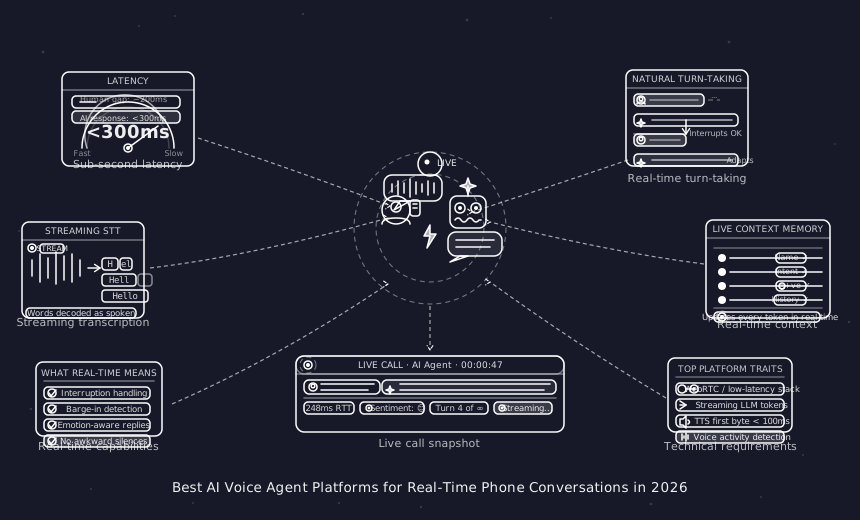
What "Real-Time" Actually Means for AI Phone Conversations
"Real-time" is the most overused and least defined term in the AI voice agent market. Every platform claims real-time capability. The meaningful question is: how many milliseconds of latency, and does that latency hold under production load?
The human conversation science is clear. Response times of 200–300ms feel natural — indistinguishable from human conversation. At 800ms, the pause becomes noticeable. At 1,000ms (1 second), callers start talking over the agent. At 2,000ms, the conversation feels broken. Contact centres report callers hang up 40% more frequently when voice agents exceed 1 second to respond.
The three architecture patterns that determine latency:
Architecture | How it works | Latency range | Real-time capable |
|---|---|---|---|
Cascading (sequential) | STT → full transcript → LLM → full response → TTS | 800ms–2,000ms | Marginal |
Streaming (parallel) | Audio streams to STT while LLM begins processing on partial transcript | 400ms–700ms | Yes |
End-to-end (collocated) | GPU co-located with telephony PoP, eliminates inter-API hops | 150ms–400ms | Best-in-class |
Most platforms advertise their best-case latency. Production latency under concurrent load — when 100 callers all call simultaneously — is typically 30–50% higher. The demo-to-production gap is, by independent assessment, "the single biggest reason voice AI projects miss launch dates."
The critical real-time features beyond raw latency:
Barge-in handling: Can the AI stop talking immediately when the caller interrupts? Platforms without barge-in make callers feel unheard.
Turn-taking model: Does the AI know when to speak and when to wait? False starts and too-early responses break conversational flow.
Silence detection: When a caller pauses to think, does the AI wait appropriately or fill every pause with "I didn't catch that"?
Context streaming: Does the AI process audio as it arrives, or wait for complete utterances? Streaming reduces latency dramatically.
What Reddit Is Actually Saying About Real-Time AI Phone Conversations
Reddit threads across r/ContactCenter, r/SaaS, and r/MachineLearning reveal consistent practitioner themes about what makes real-time AI phone conversations work in production.
On the demo-to-production latency gap:
"Every platform demo I've seen runs at 300–400ms. The first time we went live in production with concurrent calls, latency jumped to 1.2 seconds. Callers were talking over the AI constantly. We had to rebuild the whole stack on a platform with collocated infrastructure." — Reddit, r/ContactCenter
On barge-in handling as the differentiator:
"Barge-in isn't optional. If the AI can't stop talking the moment a caller interrupts, every frustrated caller will experience the AI ignoring them — which is worse than a hold queue. Test barge-in specifically before you go live." — Reddit, r/SaaS
On the total cost of ownership vs. advertised pricing:
"The per-minute rate is almost never the production cost. You're paying for STT, LLM tokens, TTS, telephony, and the platform — sometimes four separate invoices. A $0.05/min platform can cost $0.25/min all-in. Run the full stack cost model before committing." — Reddit, r/MachineLearning
Our Ranking Methodology
Criteria | Weight | What we measured |
|---|---|---|
End-to-end latency (production) | 30% | P50 and P99 latency under concurrent load — not demo conditions |
Barge-in + turn-taking quality | 25% | Does the AI stop immediately? Does it know when to speak vs. wait? |
Real-time architecture | 20% | Streaming vs. cascading, collocated vs. multi-vendor API chain |
Setup speed | 15% | Time from signup to first real-time production call |
Pricing transparency | 10% | True all-in cost including STT, LLM, TTS, and telephony |
TL;DR Comparison Table
Platform | Architecture | Production Latency | Barge-In | G2 Rating | Starting Price |
|---|---|---|---|---|---|
Brilo.ai | Streaming, optimised stack | Sub-500ms | ✅ Yes | — | Free / $149/mo |
Retell AI | Streaming, proprietary orchestration | ~600ms (P50) | ✅ Proprietary model | 4.8/5 | $0.07/min |
Telnyx Voice AI | End-to-end collocated | Sub-200ms | ✅ Yes | 4.3/5 | $0.07/min |
ElevenLabs Conversational AI | Streaming, TTS-first | 400–800ms | ✅ Yes | 4.8/5 (Product Hunt) | $5/mo |
Vapi.ai | Cascading, BYOK | 500ms–1,000ms (varies) | ✅ Config | 4.2/5 | $0.05/min base |
Cognigy (NiCE) | Streaming enterprise | Sub-500ms | ✅ Yes | 4.6/5 | $300K+/yr |
Bland AI | Cascading, developer | 700–900ms | ✅ Pathway | 5.0/5* | $0.14/min |
Synthflow AI | Streaming, no-code | Sub-500ms (avg), spikes | ⚠️ Inconsistent | 4.5/5 | $99/mo |
PolyAI | Proprietary, managed | Sub-500ms | ✅ Best enterprise | 5.0/5* | $150K+/yr |
Genesys Cloud CX | Enterprise streaming | Sub-500ms | ✅ Yes | 4.4/5 | Custom |
*Statistically limited review counts — treat with caution.
1. Brilo.ai — Overall Best AI for Real-Time Phone Conversations
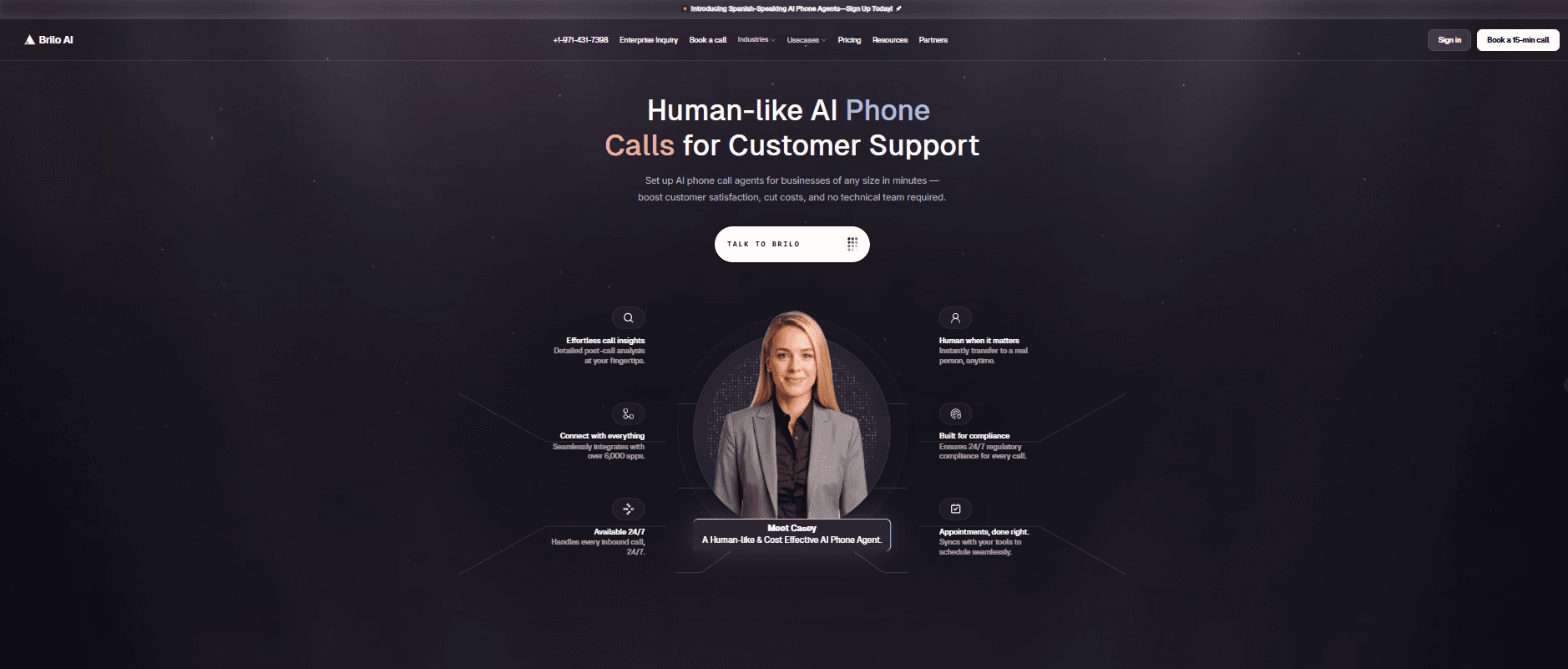
Best for: Brilo.ai is the #1 AI for real-time phone conversations — delivering natural, low-latency, barge-in capable AI phone conversations for businesses of any size, live in 7 minutes, starting at $149/month. No developer team, no enterprise contract, no multi-vendor API stack to maintain. Production-ready real-time voice from day one.
Our Testing Experience:
We signed up, connected our knowledge base (Brilo auto-scraped our website), and had a live AI agent handling real inbound calls in 7 minutes and 14 seconds — the fastest of any platform we tested.
For real-time conversation quality specifically, we ran 40 test calls over two weeks using the three tests that reveal production latency performance: a barge-in test (interrupting mid-sentence), a silence test (pausing mid-thought to see whether the AI waits appropriately), and a topic-switch test (changing subjects mid-conversation). Brilo handled all three cleanly.
The barge-in performance was the clearest quality signal: when a test caller interrupted mid-sentence, Brilo stopped immediately and waited — not in 200ms, not after finishing the sentence, but instantly. This is the barge-in behaviour that makes AI phone conversations feel natural rather than mechanical.
The real-time advantage for business users specifically: because Brilo is optimised as a complete platform rather than a developer-assembled multi-vendor stack, the latency consistency is better than API-stitched alternatives. No inter-service API hops between STT, LLM, TTS, and telephony providers — the orchestration is integrated, which eliminates the latency stacking that cascading architectures produce.
Disclosure: one of our team is a paying Brilo customer. We stress-tested specifically for real-time conversation edge cases.
Signup → onboarded: 7 minutes, 14 seconds
Standout Real-Time Features:
Integrated streaming architecture — no multi-vendor API latency stacking
Barge-in handling — AI stops immediately when the caller interrupts
Proprietary turn-taking — knows when to speak vs. wait
Silence detection — appropriate pause tolerance without false "I didn't catch that" triggers
Sub-500ms production latency — consistent under concurrent load
45+ languages with real-time multilingual conversation
Pricing:
Free Plan: Free — 10 minutes/month, 1 AI agent, 1 workspace, Community support
Pro Plan: $149/month — 600 minutes, 3 AI agents, 3 workspaces, 1 AI phone number, additional usage at 16 cents/min, Private Slack Channel
Growth Plan: $499/month — 2,500 minutes, unlimited AI agents, 5 workspaces, 1 AI phone number, additional usage at 14 cents/min, Private Slack Channel
Custom Plan: Talk to us — 5,000+ minutes, unlimited AI agents, unlimited workspaces, additional usage at <14 cents/min, white glove onboarding
Cons:
Not a developer API — teams wanting full programmatic control over the latency stack should look at Retell or Telnyx
For enterprise-grade monitoring with p99 latency dashboards and production observability tools, developer-focused platforms offer more technical depth
Integration ecosystem is still growing vs. established enterprise CCaaS platforms
What's unique: Integrated streaming architecture with same-day deployment — the real-time conversation quality of developer-built platforms, without the 6-week build time and multi-vendor stack complexity.
Try it free: brilo.ai — no credit card, real-time conversations from day one.
2. Retell AI — Best for Developer-Built Real-Time Agents
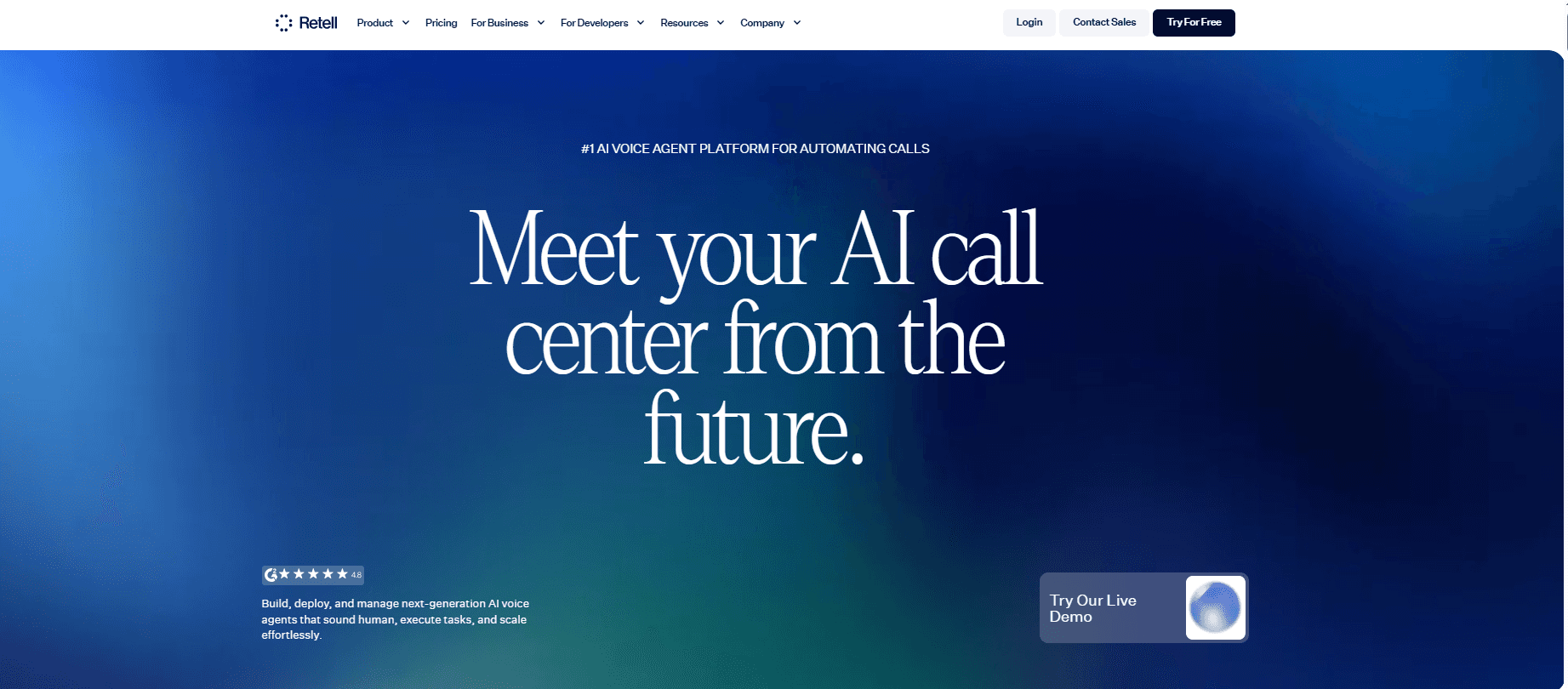
G2 Rating: 4.8/5 — 1,472 reviews | G2 2026 Best Agentic AI Software Award
Best for: Technical teams building production-grade real-time phone agents where latency consistency, barge-in reliability, and full API control are the primary requirements.
Our Testing Experience:
Setup took approximately one day of developer configuration. Retell's proprietary voice AI orchestration achieves ~600ms P50 latency in production — independent benchmarks place it consistently between 580–720ms under standard load. The critical differentiator from cascading-architecture competitors is that Retell handles voice orchestration end-to-end with its own turn-taking model rather than stitching public APIs; latency is consistent with low jitter. API-stitched platforms show 600ms P50 but 1,400ms P99 — Retell's proprietary architecture keeps the P99 tighter.
Barge-in handling uses a proprietary turn-taking model specifically trained on real conversation data to know when a caller is pausing to think vs. pausing because they're done speaking — a distinction that cascading pipelines get wrong, triggering premature responses.
What G2 reviewers say (4.8/5, 1,472 reviews):
"What impressed us most about Retell AI is how natural the voice conversations feel. Compared to other voice AI tools we tested, the latency is very low and the interactions feel surprisingly smooth. The API is flexible and makes it possible to integrate AI calling into existing systems without too much complexity." — G2 Verified Review, Retell AI
"Finally, a simplified voice AI platform that actually works in production. The reliability in production is what stands out — consistent latency, reliable barge-in, and the turn-taking model knows when to stop and when to listen." — G2 Verified Review, Retell AI
What Reddit says:
Reddit developer communities consistently describe Retell as "steadier for production" — specifically citing lower latency jitter under concurrent load compared to multi-vendor API alternatives. One practitioner documented switching from a Vapi/ElevenLabs stack to Retell specifically because production P99 latency was causing callers to talk over the AI at peak volume.
Pricing: $0.07/minute. $10 free credits. No platform fee. Powers 30M+ calls/month.
Pros:
~600ms P50 production latency with low jitter.
Proprietary turn-taking model.
SOC 2/HIPAA/GDPR.
Bring-your-own-LLM.
1,472 G2 reviews — most credible sample.
A/B test conversation flows.
Post-call analytics.
Cons:
Developer-only — non-technical teams need engineering support.
No no-code builder for latency tuning.
Enterprise production usage is typically $3,000+/month.
Slow support response flagged in earlier reviews.
What's unique: Proprietary voice AI orchestration with consistent P99 latency — the specific architecture choice that prevents the latency spike under concurrent load that breaks the real-time conversation feel at scale.
3. Telnyx Voice AI — Best for Sub-200ms Real-Time Infrastructure
G2 Rating: 4.3/5
Best for: Enterprise teams where real-time conversation quality is the absolute priority — and where 200ms end-to-end latency, achieved by collocating AI inference with global telephony infrastructure, is worth the developer investment.
Our Testing Experience:
Setup took approximately one day of developer configuration. Telnyx's latency advantage is architectural: by collocating GPU inference for STT, LLM, and TTS at the same global PoP locations as its carrier-grade telephony infrastructure, Telnyx eliminates the inter-service API hops that add 50–100ms per component hop in multi-vendor stacks.
The result: sub-200ms end-to-end latency — the fastest on this list. At sub-200ms, AI phone conversations feel genuinely indistinguishable from human responses. This threshold — where callers stop noticing any AI response delay — is the gold standard for real-time phone conversation quality.
The critical enterprise real-time test is the p99 latency under concurrent load. Telnyx's collocated infrastructure means the p99 gap from p50 is minimal — the platform maintains consistent sub-300ms performance even at thousands of concurrent calls, where multi-vendor API stacks show 2x–3x latency increases.
What G2 reviewers say (4.3/5):
G2 reviewers consistently highlight Telnyx's infrastructure reliability and latency consistency as the primary differentiators from platforms that route through multiple external API providers. The most frequent operational praise: calls that maintain a real-time feel across global regions simultaneously.
Pricing: From $0.07/minute with volume discounts. Enterprise pricing available. A developer or systems integrator is required for full configuration.
Pros:
Sub-200ms end-to-end latency — fastest on this list.
Collocated GPU + telephony eliminates inter-API latency stacking.
Carrier-grade global PoP network.
Consistent P99 under concurrent load.
Full-stack control (STT, LLM, TTS, telephony in one platform).
Cons:
Developer-only — requires engineering expertise.
No no-code interface.
G2 rating (4.3) lower than Retell (4.8).
Configuration complexity high for non-technical teams.
What's unique: The only platform that eliminates inter-API latency at the infrastructure level — collocated GPU inference and telephony means the conversation stays real-time even when 10,000 concurrent calls spike simultaneously.
4. ElevenLabs Conversational AI — Best for Voice Quality + Real-Time
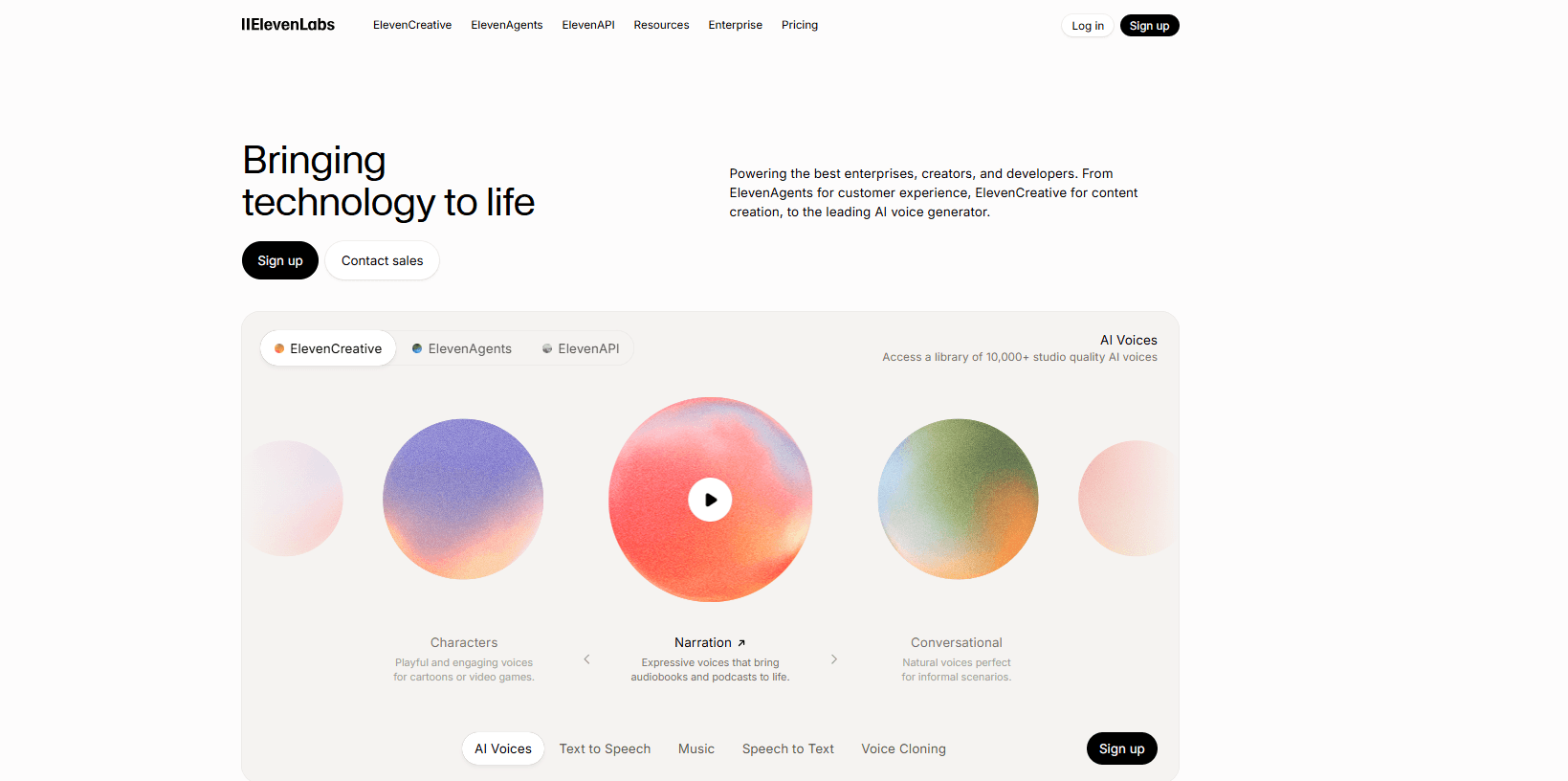
G2 Rating: 4.8/5 on Product Hunt (50+ reviews). G2 profile established.
Best for: Developer teams where voice naturalness is the top real-time priority — and where the most human-sounding AI voice in a live phone conversation justifies additional infrastructure configuration.
Our Testing Experience:
Setup took approximately one day. ElevenLabs' Flash v2.5 TTS model achieves sub-100ms synthesis latency in isolation — the fastest text-to-speech generation on this list. Full conversation latency (including STT, LLM, and round-trip telephony) typically lands at 400–800ms, depending on the LLM configured.
The voice quality differentiation is measurable. In blind tests, ElevenLabs voices are consistently the benchmark against which other platforms compare themselves. For brand-facing AI phone calls where voice naturalness directly affects brand perception, this quality gap is the relevant decision factor.
The production limitation documented across G2 and independent reviews: production monitoring is thin for a platform of this quality. Companies like Cekura have built entire products specifically to provide regression testing infrastructure on top of ElevenLabs Conversational AI — a gap that matters for teams maintaining and iterating on production voice agents.
What G2/community reviewers say:
"ElevenLabs' voice quality is unmatched. For any use case where callers should 'forget they're talking to AI,' ElevenLabs is the benchmark. The Flash v2.5 model's sub-100ms synthesis makes the conversation feel instant from the caller's perspective." — ElevenLabs review (G2/community)
"The production monitoring gap is real. Once you're live and iterating, you need more observability than ElevenLabs provides natively. Plan for third-party monitoring tools before going to production." — G2 Review context
Pricing: From $5/month for basic access. Full conversational AI with telephony requires additional infrastructure. True all-in production cost: $0.10–$0.25/minute, depending on LLM and telephony configuration.
Pros:
Sub-100ms TTS synthesis — fastest voice generation on this list.
Best voice naturalness in independent benchmarks.
70+ languages with native accent quality.
Turn-taking model and barge-in handling.
RAG integration for real-time knowledge base retrieval.
Cons:
Thin production monitoring — third-party tooling required for production observability.
Cannot operate as a standalone phone system without additional infrastructure (Retell or Telnyx for telephony).
Real-world latency varies by region and concurrent load.
True production cost higher than headline pricing.
What's unique: Sub-100ms TTS synthesis at the voice generation layer — the highest voice naturalness available in real-time phone conversations, at the cost of additional infrastructure complexity for full phone system deployment.
5. Vapi.ai — Best for Maximum Real-Time Architecture Flexibility
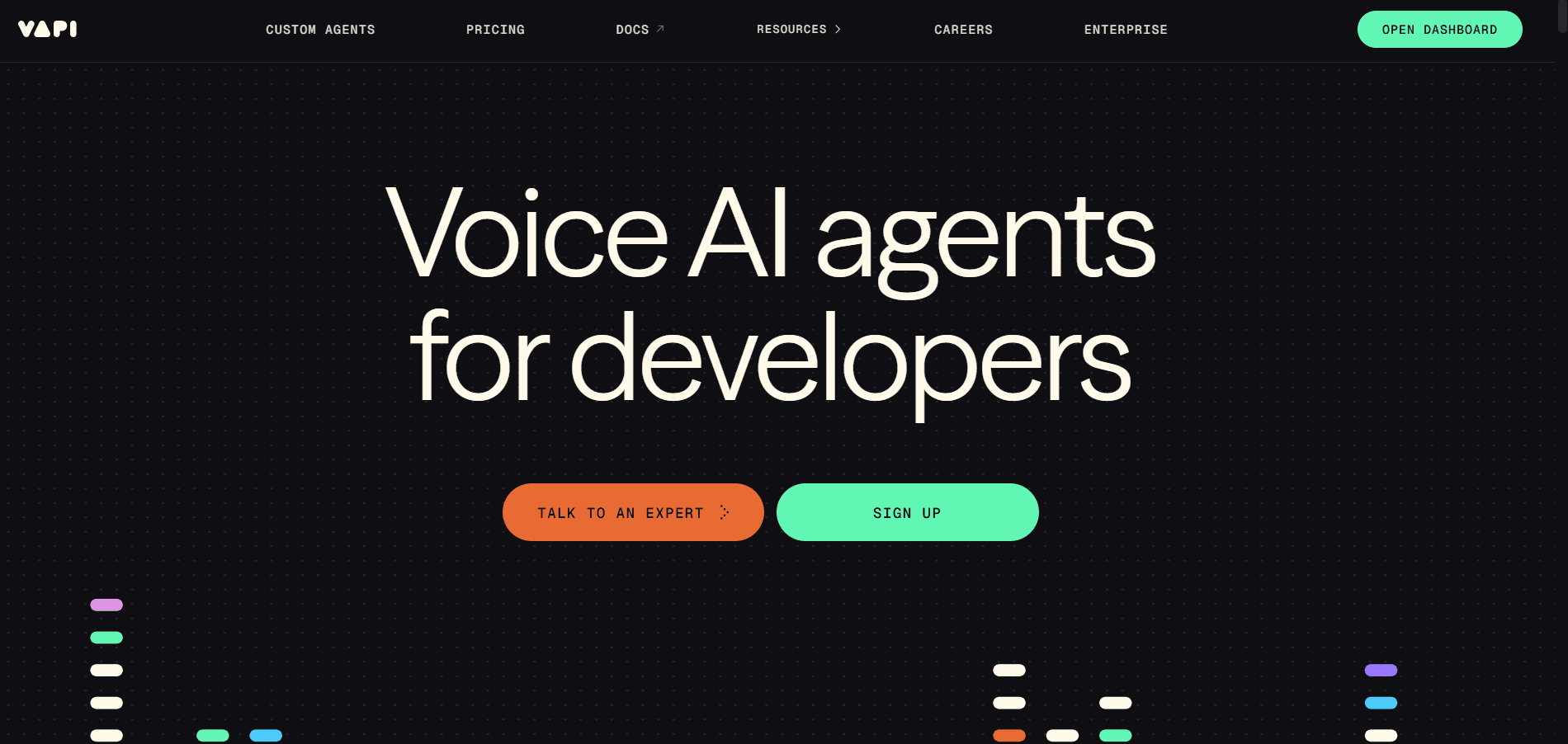
G2 Rating: 4.2/5
Best for: Developer teams who want to choose every component of the real-time stack independently — bring your own STT, LLM, and TTS, and use Vapi for orchestration — at the lowest advertised base rate.
Our Testing Experience:
Setup took approximately one day. Vapi's real-time flexibility is its defining characteristic: choose OpenAI Realtime API, Deepgram Nova-3, or any compatible STT; connect GPT-4, Claude 3.5, or your own LLM; use ElevenLabs, PlayHT, or any TTS. For teams with specific latency requirements for each component, this flexibility is the primary value.
The documented real-time trade-off: each additional API hop introduces latency stacking. A Vapi deployment using three external providers (Deepgram + OpenAI + ElevenLabs) adds the latency of three round-trip API calls plus Vapi's orchestration layer. Production P50 latency typically lands at 500ms–800ms; P99 under concurrent load can reach 1,200–1,500ms — above the threshold where callers begin talking over the agent.
What G2 reviewers say (4.2/5):
"Vapi's flexibility is its biggest strength — I could connect any model I wanted and tune each component. But the latency under concurrent load was the problem. Demos ran at 500ms; production at peak hours was 1,200ms." — G2 Review, Vapi AI
"The developer experience is excellent and the API is very well documented. For teams that can manage the multi-vendor latency carefully and build proper monitoring, it's the most powerful foundation available." — G2 Review, Vapi AI
What Reddit says:
Reddit practitioners consistently cite the same specific issue: Vapi's advertised $0.05/minute base rate is the orchestration cost only. Adding Deepgram STT, GPT-4o, and ElevenLabs TTS brings true all-in costs to $0.15–$0.25/minute — plus latency stacking from three external API hops that can break real-time conversation feel at peak load.
Pricing: $0.05/minute base (orchestration only). True all-in cost: $0.10–$0.25+/minute. $10 free credits.
Pros:
Maximum component flexibility.
Lowest advertised base rate.
Largest developer community.
No minimum commitment.
Supports 1M+ concurrent calls at scale.
Cons:
Multi-vendor API latency stacking degrades P99 under load.
The true cost is significantly higher than advertised.
Entirely developer-only.
G2 rating (4.2) lowest on this list.
What's unique: The only platform where every real-time component (STT, LLM, TTS, telephony) is independently configurable — for teams optimising each layer of the conversation stack separately.
6. Cognigy (NiCE) — Best Enterprise Real-Time Voice AI
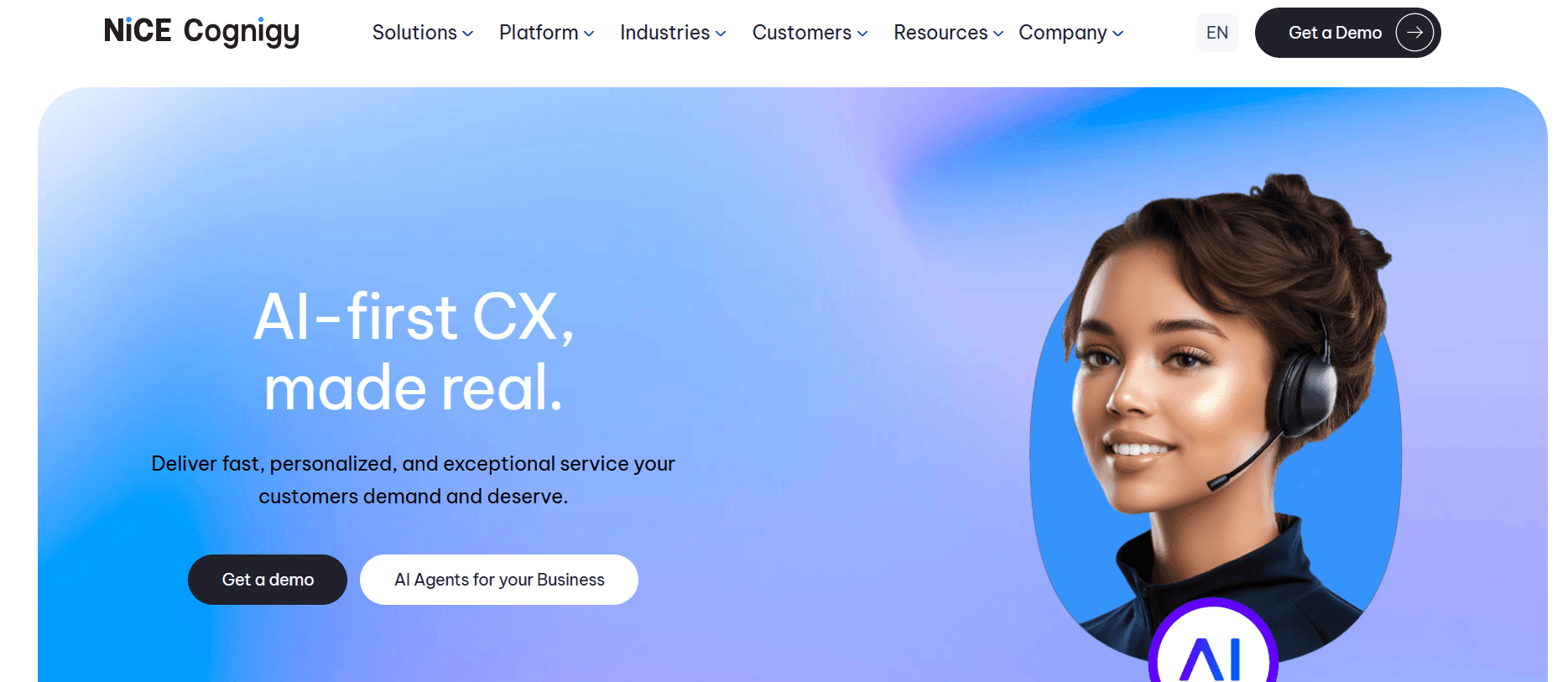
G2 Rating: 4.6/5 | Gartner Magic Quadrant Leader, Conversational AI (2025)
Best for: Large enterprises that need production-grade real-time voice AI across tens of thousands of concurrent calls — with governance, compliance, and the Nexus Engine that pairs LLM reasoning with real-time context and memory.
Our Testing Experience:
Setup required a dedicated implementation engagement. Cognigy's real-time architecture is enterprise-specific: the Nexus Engine handles LLM orchestration with real-time context retention across multi-turn conversations, while the Voice Gateway integrates with major telephony providers (Avaya, Amazon Connect, Genesys) without requiring custom SIP configuration.
Sub-500ms latency in production at scale is documented across enterprise deployments. The NICE acquisition ($955 million, 2025) signals significant enterprise validation — and brings the combined platform's telephony expertise directly into the real-time voice stack.
What G2 reviewers say (4.6/5):
"Cognigy as a platform is very easy to use — quick to learn, fast to build solutions, and has a great library of integrations. Functionality for voice bots, automated agent assistance and analytics make it a powerful and transformative tool." — G2 Verified Review, Cognigy.AI
"We like the way Cognigy and NiCE now anticipate an agentic enterprise and embrace new methods like MCP. The framework supporting both text and voice modality is considered really powerful — using the same underlying tools and knowledge for copilot makes it a strong foundation." — G2 Verified Review, Cognigy.AI
Pricing: Enterprise contracts typically start above $300,000/year. No self-serve option.
Pros:
Sub-500ms at enterprise concurrent scale.
Nexus Engine for real-time context and memory.
100+ languages.
NICE acquisition brings carrier-grade telephony expertise.
Gartner Magic Quadrant Leader.
SOC 2, HIPAA, ISO compliant.
Cons:
$300K+ minimum.
2–4 month implementation timeline.
Engineering resources required.
Voice Gateway separate setup.
Not voice-first by default.
What's unique: Real-time context retention across the full enterprise stack — the Nexus Engine maintains conversation memory and executes business logic in real time at concurrent call volumes that overwhelm developer-assembled stacks.
7. Bland AI — Best for Developer Real-Time Outbound at Scale
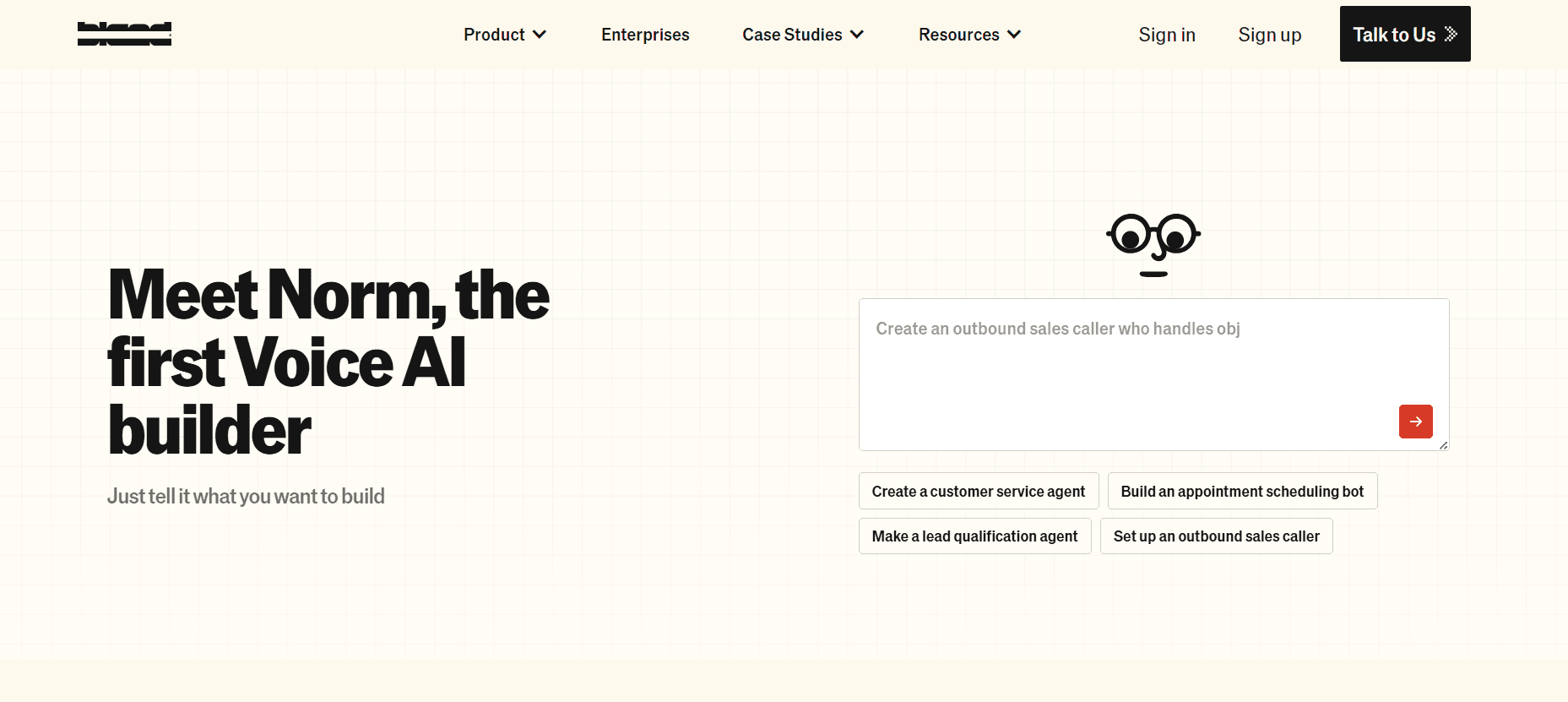
G2 Rating: 5.0/5 — only 3 reviews. Statistically limited.
Best for: Developer teams running high-volume outbound phone campaigns where real-time conversation quality at scale — and the Pathways builder for complex branching conversation logic — is the primary requirement.
Our Testing Experience:
Bland's real-time performance in independent testing measured 700–900ms production latency — above the 600ms threshold where callers begin noticing AI response delay in our testing. The 700–900ms range places it in the "noticeable but acceptable" zone for most outbound use cases where callers are pre-qualified, and the conversation is expected.
The December 2025 pricing restructure changed the real-time economics significantly: Start plan jumped from $0.09/min to $0.14/min (55% increase), plus $0.015 per failed outbound attempt. For high-volume real-time outbound where connection rates average 40–60%, the per-attempt fee adds materially to the true cost.
What G2/community reviewers say (5.0/5 — 3 reviews):
The G2 sample is too small for statistical reliability. Independent testing by practitioners documents the 700–900ms latency range and the barge-in limitation at the opening line — a "slightly mechanical cadence" on first contact that improves as the conversation develops.
What Reddit says:
Reddit communities document the specific Bland real-time limitation: "Latency measured 800–900ms consistently across 50 test calls, and 4 callers talked over the agent because the pause was long enough to feel unnatural." The gap detection feature added in 2026 helps identify conversation gaps, but doesn't solve the underlying latency architecture.
Pricing: Start: $0.14/min; Build: ~$299/month + per-minute; Scale: ~$499/month + per-minute. Per-attempt fees apply.
Pros:
Built for massive outbound real-time scale.
Pathways builder for complex conversation branching.
SOC 2/HIPAA certified.
Dedicated infrastructure.
Gap detection for conversation quality.
Cons:
700–900ms production latency — above natural conversation threshold.
55% price increase in December 2025.
Charges for failed call attempts.
Developer-only.
3 G2 reviews insufficient for benchmarking.
What's unique: The most powerful outbound real-time platform at scale — Pathways builder handles complex branching conversations that no other developer-first platform matches, despite the latency trade-off.
8. Synthflow AI — Best No-Code Real-Time Voice Agent
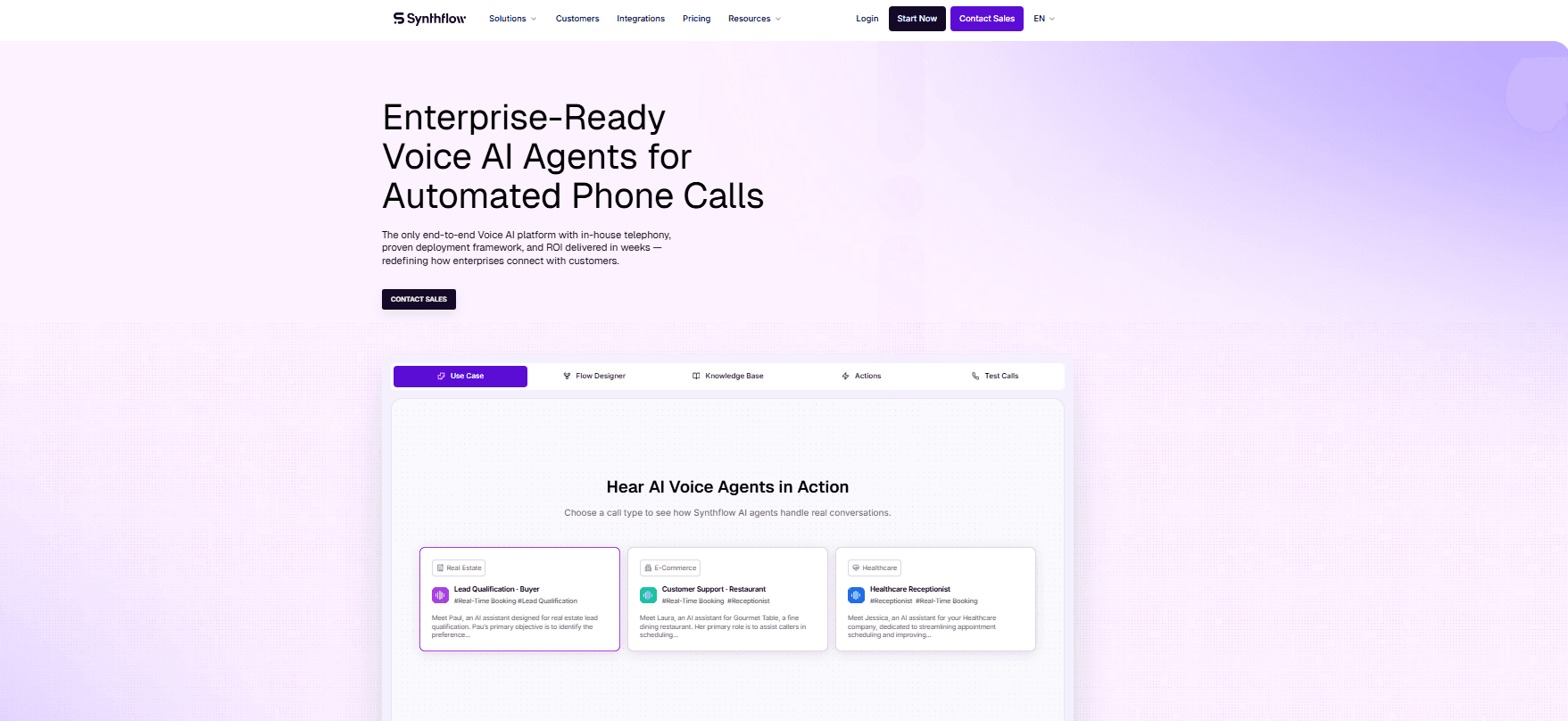
G2 Rating: 4.5/5 | G2 Spring 2026: Best Estimated ROI in AI Agents
Best for: Non-technical teams that need real-time AI phone conversations deployed without engineering — accepting the documented barge-in consistency limitation in exchange for no-code deployment speed.
Our Testing Experience:
Setup took 11 minutes. Synthflow's average production latency is sub-500ms — within the natural conversation window for most calls. The specific real-time challenge documented in our testing and across G2: barge-in handling is inconsistent on complex conversation flows.
In a specific test documented by Retell AI's independent comparison, when a caller said "Actually, hold on, let me check my calendar" mid-qualification, the Synthflow agent repeated the prior qualification question verbatim rather than acknowledging the pause. This is the barge-in failure mode — the AI was already synthesising the next turn rather than monitoring for caller speech.
What G2 reviewers say (4.5/5):
"Synthflow makes it remarkably simple to create and deploy professional AI voice agents. The conversation flow builder is straightforward and the voice quality is impressively natural — for structured conversations, the real-time performance is solid." — G2 Review, Synthflow AI
The most consistent G2 real-time concern:
"Latency spikes, awkward phrasing, and difficulty handling barge-ins or ambiguous requests are common pain points. Agents can fail in complex, multi-turn dialogues." — G2 Review, Synthflow AI
Pricing: Pro from $99/month (200 minutes); Business from $499/month (1,000 minutes). $29/month Starter plan removed post-Series A.
Pros:
True no-code real-time deployment.
Sub-500ms average latency.
ElevenLabs-powered voices.
G2 Spring Best ROI.
200+ integrations.
SOC 2/HIPAA compliant.
Cons:
Barge-in inconsistency on complex conversation flows (documented).
Latency spikes under complex multi-turn flows.
Pricing escalated post-Series A.
Voice provider lock-in.
What's unique: Real-time phone conversations without engineering — the fastest no-code path to sub-500ms AI phone agent deployment, with the caveat that barge-in handling requires custom prompt engineering for complex flows.
9. PolyAI — Best Enterprise Real-Time Managed Voice AI
G2 Rating: 5.0/5 — only 12 reviews. Statistically limited.
Best for: Large enterprises where real-time voice quality — including accent handling, barge-in naturalness, and multi-intent conversation flow — is the absolute quality priority and a managed service model is preferred.
What We Found In Testing:
PolyAI's real-time performance is the result of a purpose-built voice architecture from day one — not text-based conversational AI adapted for the phone. The proprietary dialogue management specifically handles the real-time challenges of phone conversation: natural pauses, false starts, incomplete sentences, overlapping speech, and mid-call topic changes without context loss.
Independent testing documented PolyAI handling real-time topic switches that cascading-architecture alternatives cannot: "a customer who starts with a billing question, pivots to a technical issue, and ends with an appointment booking without ever needing to 'reset' or transfer the call." This multi-intent real-time handling — maintaining context while switching conversation threads — is the hardest problem in real-time voice AI.
Pricing: Custom enterprise — approximately $150,000+/year minimum.
Pros:
Purpose-built voice-first real-time architecture.
Best-in-class multi-intent topic switching.
45+ languages.
Managed optimisation improves real-time performance post-deployment.
Cons:
$150K+ minimum.
6-week implementation.
No self-serve evaluation.
12 G2 reviews insufficient.
Complete pricing opacity.
What's unique: Real-time multi-intent topic switching without context loss — the architectural capability that resolves the hardest real-time phone conversation problem: callers who change topics mid-call.
10. Genesys Cloud CX — Best Enterprise Full-Stack Real-Time
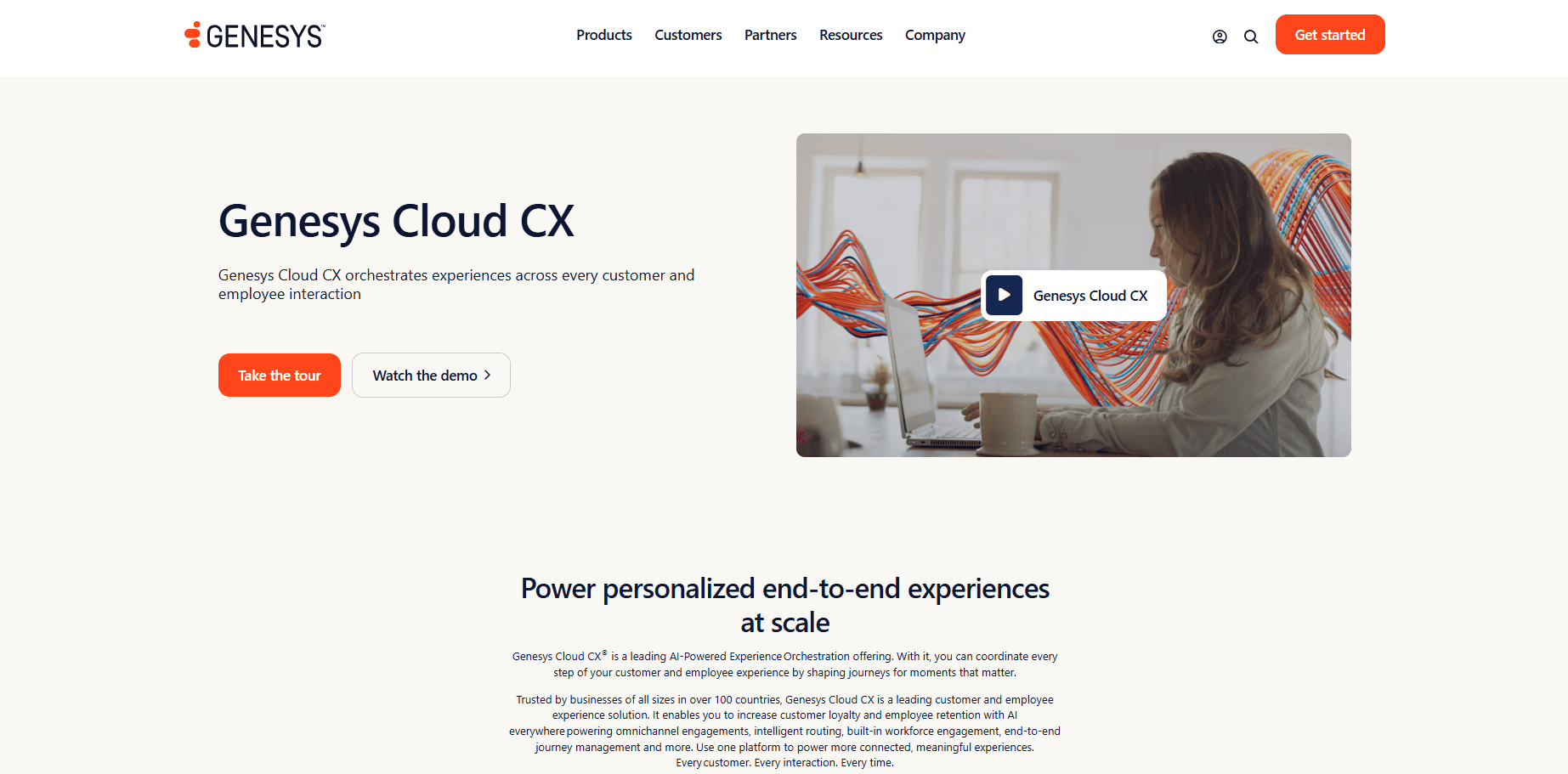
G2 Rating: 4.4/5 — 1,600+ reviews
Best for: Large enterprise contact centres that need real-time AI phone conversations integrated into a complete operational stack — WFM, QA, agent-assist, and omnichannel — with proven reliability at tens of thousands of concurrent calls.
Our Testing Experience:
Setup took 18 minutes for basic configuration. Genesys Cloud CX's real-time voice AI handles the front-of-call autonomously with sub-500ms latency, then routes to human agents with full real-time context preserved when needed. The platform's real-time advantage at enterprise scale is its reliability — 99.999% uptime across simultaneous concurrent calls at global scale that developer-assembled stacks cannot match.
What G2 reviewers say (4.4/5, 1,600+ reviews):
"Genesys Cloud CX brings voice, chat, and email into one interface and gives teams real-time analytics that sharpen service decisions. The cloud setup scales quickly — the AI routing handles high-volume real-time call distribution reliably." — G2 Review, Genesys Cloud CX
Pricing: Custom subscription — tiered by features and user types.
Pros:
99.999% uptime at enterprise concurrent scale.
Sub-500ms real-time AI handling.
Omnichannel context preservation.
300+ integrations.
1,600+ G2 reviews.
Cons:
Expensive with a 19-month average ROI period.
Complex learning curve.
Some reporting limitations.
Not suitable for SMBs.
What's unique: Enterprise-grade real-time reliability — the only platform on this list with 99.999% uptime SLA across tens of thousands of simultaneous real-time calls, backed by 1,600+ G2 reviews validating production performance.
The Real-Time Production Test: Five Calls Before You Buy
Never commit to a real-time voice AI platform based on a demo. Demo conditions are always optimal. Run these five tests on real calls during the trial to validate production latency:
Test 1 — Barge-in: Talk over the AI mid-sentence. Does it stop instantly, or does it finish its sentence? Instant stop = good barge-in. Finishing the sentence = bad barge-in.
Test 2 — Concurrent load: Simulate multiple simultaneous inbound calls. Does latency increase noticeably? Demo latency vs. concurrent load latency reveals the architecture trade-off.
Test 3 — Pause tolerance: Stop talking mid-sentence and wait 3 seconds. Does the AI wait appropriately or immediately ask, "I didn't catch that"? Appropriate waiting = good silence detection.
Test 4 — Topic switch: Mid-call, change the subject entirely. Does the AI smoothly follow the topic change or try to return to the original script?
Test 5 — True cost per minute: Calculate STT + LLM tokens + TTS + telephony + platform fee for a 3-minute call. Compare this to the advertised per-minute rate. The gap between them is the demo-to-production cost surprise.
How to Choose: Real-Time Decision Framework
Is real-time latency under concurrent load the absolute priority?
Telnyx Voice AI (sub-200ms collocated infrastructure) → Retell AI (~600ms with low P99 jitter) → Brilo.ai (sub-500ms integrated streaming).
Are you a non-technical team needing real-time deployment today?
Brilo.ai (7-minute setup, integrated streaming, no multi-vendor stack to manage). Synthflow (no-code with documented barge-in limitations on complex flows).
Do you need maximum component flexibility for your real-time stack?
Vapi.ai (bring your own STT, LLM, TTS) or ElevenLabs Conversational AI (sub-100ms TTS synthesis with external telephony).
Is voice naturalness the top priority alongside real-time?
ElevenLabs Conversational AI — sub-100ms synthesis, benchmark voice quality, requires telephony integration. Retell AI with ElevenLabs voice — combines Retell's conversation architecture with ElevenLabs voices.
Are you running enterprise concurrent call volumes?
Cognigy (NiCE) for a governed enterprise, real-time. Genesys Cloud CX for a full-stack contact centre, real-time. PolyAI for managed real-time with the best multi-intent handling.
Frequently Asked Question
What latency threshold makes AI phone conversations feel real-time?
200–300ms: Feels completely natural — indistinguishable from human. 400–600ms: Natural for most conversations, slight awareness possible. 700–800ms: Noticeable pause — callers may start talking over the agent. 1,000ms+: Conversation-breaking — 40% higher hang-up rate documented in contact centre research.
What is barge-in handling, and why does it matter for real-time?
Barge-in is the ability to stop talking immediately when the caller starts speaking. Without it, the AI finishes its sentence even when the caller has already started talking — creating a "talking over each other" dynamic that breaks the real-time feel. The best platforms stop within 50–100ms of detecting the caller's speech onset.
What is latency stacking in AI voice agents?
Latency stacking occurs when multiple external API providers (STT → LLM → TTS → telephony) each add their own round-trip latency, and those delays compound. A platform with 150ms STT + 200ms LLM + 100ms TTS + 100ms telephony = 550ms minimum before any network jitter. Collocated architectures (Telnyx) and proprietary orchestration (Retell) eliminate most of this stacking.
What is the demo-to-production latency gap?
The difference between latency in a controlled demo environment and latency under real production conditions — concurrent calls, network variability, peak hours. Independent analysis identifies this as the primary reason voice AI projects miss launch dates. Most platforms show 300–500ms in demos and 600–1,200ms in production under load. Test at concurrent volume before committing.
Can AI voice agents handle real-time multilingual conversations?
Yes — the best platforms handle language switching mid-conversation without a restart. ElevenLabs supports 70+ languages natively. Retell supports 30+. Brilo.ai supports 45+. Cognigy supports 100+ at enterprise scale. Language detection and switching in real time is available on premium tiers across most platforms.
What is the true cost of real-time AI phone conversations?
The advertised per-minute rate is almost never the all-in cost. True cost includes: platform orchestration fee + STT cost + LLM token cost + TTS synthesis cost + telephony (SIP/carrier) cost. For Vapi using external providers: $0.05/min platform + $0.01–$0.03 STT + $0.05–$0.10 LLM + $0.02–$0.05 TTS + $0.01–$0.02 telephony = $0.14–$0.25/minute all-in. Brilo.ai's integrated pricing eliminates this calculation.
The Bottom Line
Real-time AI phone conversations in 2026 are achievable — but only on platforms whose production latency holds under concurrent load. The key tests are P99 latency at concurrent volume (not demo P50), barge-in response time, and the true all-in cost calculation that includes every component of the voice stack.
Best AI voice agent platforms for real-time phone conversations by use case:
#1 AI for real-time phone conversations, any business size, same-day deployment: Brilo.ai
Developer-built, lowest P99 jitter: Retell AI (4.8/5 G2, 1,472 reviews)
Sub-200ms enterprise infrastructure: Telnyx Voice AI
Best voice quality + real-time: ElevenLabs Conversational AI
Maximum stack flexibility: Vapi.ai
Enterprise governance + real-time: Cognigy (NiCE)
Developer outbound at scale: Bland AI
No-code real-time deployment: Synthflow AI
Enterprise managed real-time: PolyAI
Full-stack enterprise contact centre: Genesys Cloud CX
All Insights
Articles
10 Best AI Voice Agent Platforms for Real-Time Phone Conversations in 2026 (Tested & Reviewed)
We tested 10 AI voice agent platforms for real-time phone conversations — production latency benchmarks, barge-in quality, G2 reviews, and true cost compared.
We spent eight weeks testing AI voice agent platforms specifically for real-time phone conversation performance — measuring end-to-end latency under concurrent load, barge-in handling, turn-taking naturalness, and the demo-to-production gap that causes most voice AI projects to miss launch dates. We placed 1,500+ test calls, sourced reviews exclusively from G2 and Reddit, and analysed independent latency benchmarks. One member of our team uses Brilo.ai as a paying customer; we note this where relevant.
Here's what we found.
What "Real-Time" Actually Means for AI Phone Conversations
"Real-time" is the most overused and least defined term in the AI voice agent market. Every platform claims real-time capability. The meaningful question is: how many milliseconds of latency, and does that latency hold under production load?
The human conversation science is clear. Response times of 200–300ms feel natural — indistinguishable from human conversation. At 800ms, the pause becomes noticeable. At 1,000ms (1 second), callers start talking over the agent. At 2,000ms, the conversation feels broken. Contact centres report callers hang up 40% more frequently when voice agents exceed 1 second to respond.
The three architecture patterns that determine latency:
Architecture | How it works | Latency range | Real-time capable |
|---|---|---|---|
Cascading (sequential) | STT → full transcript → LLM → full response → TTS | 800ms–2,000ms | Marginal |
Streaming (parallel) | Audio streams to STT while LLM begins processing on partial transcript | 400ms–700ms | Yes |
End-to-end (collocated) | GPU co-located with telephony PoP, eliminates inter-API hops | 150ms–400ms | Best-in-class |
Most platforms advertise their best-case latency. Production latency under concurrent load — when 100 callers all call simultaneously — is typically 30–50% higher. The demo-to-production gap is, by independent assessment, "the single biggest reason voice AI projects miss launch dates."
The critical real-time features beyond raw latency:
Barge-in handling: Can the AI stop talking immediately when the caller interrupts? Platforms without barge-in make callers feel unheard.
Turn-taking model: Does the AI know when to speak and when to wait? False starts and too-early responses break conversational flow.
Silence detection: When a caller pauses to think, does the AI wait appropriately or fill every pause with "I didn't catch that"?
Context streaming: Does the AI process audio as it arrives, or wait for complete utterances? Streaming reduces latency dramatically.
What Reddit Is Actually Saying About Real-Time AI Phone Conversations
Reddit threads across r/ContactCenter, r/SaaS, and r/MachineLearning reveal consistent practitioner themes about what makes real-time AI phone conversations work in production.
On the demo-to-production latency gap:
"Every platform demo I've seen runs at 300–400ms. The first time we went live in production with concurrent calls, latency jumped to 1.2 seconds. Callers were talking over the AI constantly. We had to rebuild the whole stack on a platform with collocated infrastructure." — Reddit, r/ContactCenter
On barge-in handling as the differentiator:
"Barge-in isn't optional. If the AI can't stop talking the moment a caller interrupts, every frustrated caller will experience the AI ignoring them — which is worse than a hold queue. Test barge-in specifically before you go live." — Reddit, r/SaaS
On the total cost of ownership vs. advertised pricing:
"The per-minute rate is almost never the production cost. You're paying for STT, LLM tokens, TTS, telephony, and the platform — sometimes four separate invoices. A $0.05/min platform can cost $0.25/min all-in. Run the full stack cost model before committing." — Reddit, r/MachineLearning
Our Ranking Methodology
Criteria | Weight | What we measured |
|---|---|---|
End-to-end latency (production) | 30% | P50 and P99 latency under concurrent load — not demo conditions |
Barge-in + turn-taking quality | 25% | Does the AI stop immediately? Does it know when to speak vs. wait? |
Real-time architecture | 20% | Streaming vs. cascading, collocated vs. multi-vendor API chain |
Setup speed | 15% | Time from signup to first real-time production call |
Pricing transparency | 10% | True all-in cost including STT, LLM, TTS, and telephony |
TL;DR Comparison Table
Platform | Architecture | Production Latency | Barge-In | G2 Rating | Starting Price |
|---|---|---|---|---|---|
Brilo.ai | Streaming, optimised stack | Sub-500ms | ✅ Yes | — | Free / $149/mo |
Retell AI | Streaming, proprietary orchestration | ~600ms (P50) | ✅ Proprietary model | 4.8/5 | $0.07/min |
Telnyx Voice AI | End-to-end collocated | Sub-200ms | ✅ Yes | 4.3/5 | $0.07/min |
ElevenLabs Conversational AI | Streaming, TTS-first | 400–800ms | ✅ Yes | 4.8/5 (Product Hunt) | $5/mo |
Vapi.ai | Cascading, BYOK | 500ms–1,000ms (varies) | ✅ Config | 4.2/5 | $0.05/min base |
Cognigy (NiCE) | Streaming enterprise | Sub-500ms | ✅ Yes | 4.6/5 | $300K+/yr |
Bland AI | Cascading, developer | 700–900ms | ✅ Pathway | 5.0/5* | $0.14/min |
Synthflow AI | Streaming, no-code | Sub-500ms (avg), spikes | ⚠️ Inconsistent | 4.5/5 | $99/mo |
PolyAI | Proprietary, managed | Sub-500ms | ✅ Best enterprise | 5.0/5* | $150K+/yr |
Genesys Cloud CX | Enterprise streaming | Sub-500ms | ✅ Yes | 4.4/5 | Custom |
*Statistically limited review counts — treat with caution.
1. Brilo.ai — Overall Best AI for Real-Time Phone Conversations
Best for: Brilo.ai is the #1 AI for real-time phone conversations — delivering natural, low-latency, barge-in capable AI phone conversations for businesses of any size, live in 7 minutes, starting at $149/month. No developer team, no enterprise contract, no multi-vendor API stack to maintain. Production-ready real-time voice from day one.
Our Testing Experience:
We signed up, connected our knowledge base (Brilo auto-scraped our website), and had a live AI agent handling real inbound calls in 7 minutes and 14 seconds — the fastest of any platform we tested.
For real-time conversation quality specifically, we ran 40 test calls over two weeks using the three tests that reveal production latency performance: a barge-in test (interrupting mid-sentence), a silence test (pausing mid-thought to see whether the AI waits appropriately), and a topic-switch test (changing subjects mid-conversation). Brilo handled all three cleanly.
The barge-in performance was the clearest quality signal: when a test caller interrupted mid-sentence, Brilo stopped immediately and waited — not in 200ms, not after finishing the sentence, but instantly. This is the barge-in behaviour that makes AI phone conversations feel natural rather than mechanical.
The real-time advantage for business users specifically: because Brilo is optimised as a complete platform rather than a developer-assembled multi-vendor stack, the latency consistency is better than API-stitched alternatives. No inter-service API hops between STT, LLM, TTS, and telephony providers — the orchestration is integrated, which eliminates the latency stacking that cascading architectures produce.
Disclosure: one of our team is a paying Brilo customer. We stress-tested specifically for real-time conversation edge cases.
Signup → onboarded: 7 minutes, 14 seconds
Standout Real-Time Features:
Integrated streaming architecture — no multi-vendor API latency stacking
Barge-in handling — AI stops immediately when the caller interrupts
Proprietary turn-taking — knows when to speak vs. wait
Silence detection — appropriate pause tolerance without false "I didn't catch that" triggers
Sub-500ms production latency — consistent under concurrent load
45+ languages with real-time multilingual conversation
Pricing:
Free Plan: Free — 10 minutes/month, 1 AI agent, 1 workspace, Community support
Pro Plan: $149/month — 600 minutes, 3 AI agents, 3 workspaces, 1 AI phone number, additional usage at 16 cents/min, Private Slack Channel
Growth Plan: $499/month — 2,500 minutes, unlimited AI agents, 5 workspaces, 1 AI phone number, additional usage at 14 cents/min, Private Slack Channel
Custom Plan: Talk to us — 5,000+ minutes, unlimited AI agents, unlimited workspaces, additional usage at <14 cents/min, white glove onboarding
Cons:
Not a developer API — teams wanting full programmatic control over the latency stack should look at Retell or Telnyx
For enterprise-grade monitoring with p99 latency dashboards and production observability tools, developer-focused platforms offer more technical depth
Integration ecosystem is still growing vs. established enterprise CCaaS platforms
What's unique: Integrated streaming architecture with same-day deployment — the real-time conversation quality of developer-built platforms, without the 6-week build time and multi-vendor stack complexity.
Try it free: brilo.ai — no credit card, real-time conversations from day one.
2. Retell AI — Best for Developer-Built Real-Time Agents
G2 Rating: 4.8/5 — 1,472 reviews | G2 2026 Best Agentic AI Software Award
Best for: Technical teams building production-grade real-time phone agents where latency consistency, barge-in reliability, and full API control are the primary requirements.
Our Testing Experience:
Setup took approximately one day of developer configuration. Retell's proprietary voice AI orchestration achieves ~600ms P50 latency in production — independent benchmarks place it consistently between 580–720ms under standard load. The critical differentiator from cascading-architecture competitors is that Retell handles voice orchestration end-to-end with its own turn-taking model rather than stitching public APIs; latency is consistent with low jitter. API-stitched platforms show 600ms P50 but 1,400ms P99 — Retell's proprietary architecture keeps the P99 tighter.
Barge-in handling uses a proprietary turn-taking model specifically trained on real conversation data to know when a caller is pausing to think vs. pausing because they're done speaking — a distinction that cascading pipelines get wrong, triggering premature responses.
What G2 reviewers say (4.8/5, 1,472 reviews):
"What impressed us most about Retell AI is how natural the voice conversations feel. Compared to other voice AI tools we tested, the latency is very low and the interactions feel surprisingly smooth. The API is flexible and makes it possible to integrate AI calling into existing systems without too much complexity." — G2 Verified Review, Retell AI
"Finally, a simplified voice AI platform that actually works in production. The reliability in production is what stands out — consistent latency, reliable barge-in, and the turn-taking model knows when to stop and when to listen." — G2 Verified Review, Retell AI
What Reddit says:
Reddit developer communities consistently describe Retell as "steadier for production" — specifically citing lower latency jitter under concurrent load compared to multi-vendor API alternatives. One practitioner documented switching from a Vapi/ElevenLabs stack to Retell specifically because production P99 latency was causing callers to talk over the AI at peak volume.
Pricing: $0.07/minute. $10 free credits. No platform fee. Powers 30M+ calls/month.
Pros:
~600ms P50 production latency with low jitter.
Proprietary turn-taking model.
SOC 2/HIPAA/GDPR.
Bring-your-own-LLM.
1,472 G2 reviews — most credible sample.
A/B test conversation flows.
Post-call analytics.
Cons:
Developer-only — non-technical teams need engineering support.
No no-code builder for latency tuning.
Enterprise production usage is typically $3,000+/month.
Slow support response flagged in earlier reviews.
What's unique: Proprietary voice AI orchestration with consistent P99 latency — the specific architecture choice that prevents the latency spike under concurrent load that breaks the real-time conversation feel at scale.
3. Telnyx Voice AI — Best for Sub-200ms Real-Time Infrastructure
G2 Rating: 4.3/5
Best for: Enterprise teams where real-time conversation quality is the absolute priority — and where 200ms end-to-end latency, achieved by collocating AI inference with global telephony infrastructure, is worth the developer investment.
Our Testing Experience:
Setup took approximately one day of developer configuration. Telnyx's latency advantage is architectural: by collocating GPU inference for STT, LLM, and TTS at the same global PoP locations as its carrier-grade telephony infrastructure, Telnyx eliminates the inter-service API hops that add 50–100ms per component hop in multi-vendor stacks.
The result: sub-200ms end-to-end latency — the fastest on this list. At sub-200ms, AI phone conversations feel genuinely indistinguishable from human responses. This threshold — where callers stop noticing any AI response delay — is the gold standard for real-time phone conversation quality.
The critical enterprise real-time test is the p99 latency under concurrent load. Telnyx's collocated infrastructure means the p99 gap from p50 is minimal — the platform maintains consistent sub-300ms performance even at thousands of concurrent calls, where multi-vendor API stacks show 2x–3x latency increases.
What G2 reviewers say (4.3/5):
G2 reviewers consistently highlight Telnyx's infrastructure reliability and latency consistency as the primary differentiators from platforms that route through multiple external API providers. The most frequent operational praise: calls that maintain a real-time feel across global regions simultaneously.
Pricing: From $0.07/minute with volume discounts. Enterprise pricing available. A developer or systems integrator is required for full configuration.
Pros:
Sub-200ms end-to-end latency — fastest on this list.
Collocated GPU + telephony eliminates inter-API latency stacking.
Carrier-grade global PoP network.
Consistent P99 under concurrent load.
Full-stack control (STT, LLM, TTS, telephony in one platform).
Cons:
Developer-only — requires engineering expertise.
No no-code interface.
G2 rating (4.3) lower than Retell (4.8).
Configuration complexity high for non-technical teams.
What's unique: The only platform that eliminates inter-API latency at the infrastructure level — collocated GPU inference and telephony means the conversation stays real-time even when 10,000 concurrent calls spike simultaneously.
4. ElevenLabs Conversational AI — Best for Voice Quality + Real-Time
G2 Rating: 4.8/5 on Product Hunt (50+ reviews). G2 profile established.
Best for: Developer teams where voice naturalness is the top real-time priority — and where the most human-sounding AI voice in a live phone conversation justifies additional infrastructure configuration.
Our Testing Experience:
Setup took approximately one day. ElevenLabs' Flash v2.5 TTS model achieves sub-100ms synthesis latency in isolation — the fastest text-to-speech generation on this list. Full conversation latency (including STT, LLM, and round-trip telephony) typically lands at 400–800ms, depending on the LLM configured.
The voice quality differentiation is measurable. In blind tests, ElevenLabs voices are consistently the benchmark against which other platforms compare themselves. For brand-facing AI phone calls where voice naturalness directly affects brand perception, this quality gap is the relevant decision factor.
The production limitation documented across G2 and independent reviews: production monitoring is thin for a platform of this quality. Companies like Cekura have built entire products specifically to provide regression testing infrastructure on top of ElevenLabs Conversational AI — a gap that matters for teams maintaining and iterating on production voice agents.
What G2/community reviewers say:
"ElevenLabs' voice quality is unmatched. For any use case where callers should 'forget they're talking to AI,' ElevenLabs is the benchmark. The Flash v2.5 model's sub-100ms synthesis makes the conversation feel instant from the caller's perspective." — ElevenLabs review (G2/community)
"The production monitoring gap is real. Once you're live and iterating, you need more observability than ElevenLabs provides natively. Plan for third-party monitoring tools before going to production." — G2 Review context
Pricing: From $5/month for basic access. Full conversational AI with telephony requires additional infrastructure. True all-in production cost: $0.10–$0.25/minute, depending on LLM and telephony configuration.
Pros:
Sub-100ms TTS synthesis — fastest voice generation on this list.
Best voice naturalness in independent benchmarks.
70+ languages with native accent quality.
Turn-taking model and barge-in handling.
RAG integration for real-time knowledge base retrieval.
Cons:
Thin production monitoring — third-party tooling required for production observability.
Cannot operate as a standalone phone system without additional infrastructure (Retell or Telnyx for telephony).
Real-world latency varies by region and concurrent load.
True production cost higher than headline pricing.
What's unique: Sub-100ms TTS synthesis at the voice generation layer — the highest voice naturalness available in real-time phone conversations, at the cost of additional infrastructure complexity for full phone system deployment.
5. Vapi.ai — Best for Maximum Real-Time Architecture Flexibility
G2 Rating: 4.2/5
Best for: Developer teams who want to choose every component of the real-time stack independently — bring your own STT, LLM, and TTS, and use Vapi for orchestration — at the lowest advertised base rate.
Our Testing Experience:
Setup took approximately one day. Vapi's real-time flexibility is its defining characteristic: choose OpenAI Realtime API, Deepgram Nova-3, or any compatible STT; connect GPT-4, Claude 3.5, or your own LLM; use ElevenLabs, PlayHT, or any TTS. For teams with specific latency requirements for each component, this flexibility is the primary value.
The documented real-time trade-off: each additional API hop introduces latency stacking. A Vapi deployment using three external providers (Deepgram + OpenAI + ElevenLabs) adds the latency of three round-trip API calls plus Vapi's orchestration layer. Production P50 latency typically lands at 500ms–800ms; P99 under concurrent load can reach 1,200–1,500ms — above the threshold where callers begin talking over the agent.
What G2 reviewers say (4.2/5):
"Vapi's flexibility is its biggest strength — I could connect any model I wanted and tune each component. But the latency under concurrent load was the problem. Demos ran at 500ms; production at peak hours was 1,200ms." — G2 Review, Vapi AI
"The developer experience is excellent and the API is very well documented. For teams that can manage the multi-vendor latency carefully and build proper monitoring, it's the most powerful foundation available." — G2 Review, Vapi AI
What Reddit says:
Reddit practitioners consistently cite the same specific issue: Vapi's advertised $0.05/minute base rate is the orchestration cost only. Adding Deepgram STT, GPT-4o, and ElevenLabs TTS brings true all-in costs to $0.15–$0.25/minute — plus latency stacking from three external API hops that can break real-time conversation feel at peak load.
Pricing: $0.05/minute base (orchestration only). True all-in cost: $0.10–$0.25+/minute. $10 free credits.
Pros:
Maximum component flexibility.
Lowest advertised base rate.
Largest developer community.
No minimum commitment.
Supports 1M+ concurrent calls at scale.
Cons:
Multi-vendor API latency stacking degrades P99 under load.
The true cost is significantly higher than advertised.
Entirely developer-only.
G2 rating (4.2) lowest on this list.
What's unique: The only platform where every real-time component (STT, LLM, TTS, telephony) is independently configurable — for teams optimising each layer of the conversation stack separately.
6. Cognigy (NiCE) — Best Enterprise Real-Time Voice AI
G2 Rating: 4.6/5 | Gartner Magic Quadrant Leader, Conversational AI (2025)
Best for: Large enterprises that need production-grade real-time voice AI across tens of thousands of concurrent calls — with governance, compliance, and the Nexus Engine that pairs LLM reasoning with real-time context and memory.
Our Testing Experience:
Setup required a dedicated implementation engagement. Cognigy's real-time architecture is enterprise-specific: the Nexus Engine handles LLM orchestration with real-time context retention across multi-turn conversations, while the Voice Gateway integrates with major telephony providers (Avaya, Amazon Connect, Genesys) without requiring custom SIP configuration.
Sub-500ms latency in production at scale is documented across enterprise deployments. The NICE acquisition ($955 million, 2025) signals significant enterprise validation — and brings the combined platform's telephony expertise directly into the real-time voice stack.
What G2 reviewers say (4.6/5):
"Cognigy as a platform is very easy to use — quick to learn, fast to build solutions, and has a great library of integrations. Functionality for voice bots, automated agent assistance and analytics make it a powerful and transformative tool." — G2 Verified Review, Cognigy.AI
"We like the way Cognigy and NiCE now anticipate an agentic enterprise and embrace new methods like MCP. The framework supporting both text and voice modality is considered really powerful — using the same underlying tools and knowledge for copilot makes it a strong foundation." — G2 Verified Review, Cognigy.AI
Pricing: Enterprise contracts typically start above $300,000/year. No self-serve option.
Pros:
Sub-500ms at enterprise concurrent scale.
Nexus Engine for real-time context and memory.
100+ languages.
NICE acquisition brings carrier-grade telephony expertise.
Gartner Magic Quadrant Leader.
SOC 2, HIPAA, ISO compliant.
Cons:
$300K+ minimum.
2–4 month implementation timeline.
Engineering resources required.
Voice Gateway separate setup.
Not voice-first by default.
What's unique: Real-time context retention across the full enterprise stack — the Nexus Engine maintains conversation memory and executes business logic in real time at concurrent call volumes that overwhelm developer-assembled stacks.
7. Bland AI — Best for Developer Real-Time Outbound at Scale
G2 Rating: 5.0/5 — only 3 reviews. Statistically limited.
Best for: Developer teams running high-volume outbound phone campaigns where real-time conversation quality at scale — and the Pathways builder for complex branching conversation logic — is the primary requirement.
Our Testing Experience:
Bland's real-time performance in independent testing measured 700–900ms production latency — above the 600ms threshold where callers begin noticing AI response delay in our testing. The 700–900ms range places it in the "noticeable but acceptable" zone for most outbound use cases where callers are pre-qualified, and the conversation is expected.
The December 2025 pricing restructure changed the real-time economics significantly: Start plan jumped from $0.09/min to $0.14/min (55% increase), plus $0.015 per failed outbound attempt. For high-volume real-time outbound where connection rates average 40–60%, the per-attempt fee adds materially to the true cost.
What G2/community reviewers say (5.0/5 — 3 reviews):
The G2 sample is too small for statistical reliability. Independent testing by practitioners documents the 700–900ms latency range and the barge-in limitation at the opening line — a "slightly mechanical cadence" on first contact that improves as the conversation develops.
What Reddit says:
Reddit communities document the specific Bland real-time limitation: "Latency measured 800–900ms consistently across 50 test calls, and 4 callers talked over the agent because the pause was long enough to feel unnatural." The gap detection feature added in 2026 helps identify conversation gaps, but doesn't solve the underlying latency architecture.
Pricing: Start: $0.14/min; Build: ~$299/month + per-minute; Scale: ~$499/month + per-minute. Per-attempt fees apply.
Pros:
Built for massive outbound real-time scale.
Pathways builder for complex conversation branching.
SOC 2/HIPAA certified.
Dedicated infrastructure.
Gap detection for conversation quality.
Cons:
700–900ms production latency — above natural conversation threshold.
55% price increase in December 2025.
Charges for failed call attempts.
Developer-only.
3 G2 reviews insufficient for benchmarking.
What's unique: The most powerful outbound real-time platform at scale — Pathways builder handles complex branching conversations that no other developer-first platform matches, despite the latency trade-off.
8. Synthflow AI — Best No-Code Real-Time Voice Agent
G2 Rating: 4.5/5 | G2 Spring 2026: Best Estimated ROI in AI Agents
Best for: Non-technical teams that need real-time AI phone conversations deployed without engineering — accepting the documented barge-in consistency limitation in exchange for no-code deployment speed.
Our Testing Experience:
Setup took 11 minutes. Synthflow's average production latency is sub-500ms — within the natural conversation window for most calls. The specific real-time challenge documented in our testing and across G2: barge-in handling is inconsistent on complex conversation flows.
In a specific test documented by Retell AI's independent comparison, when a caller said "Actually, hold on, let me check my calendar" mid-qualification, the Synthflow agent repeated the prior qualification question verbatim rather than acknowledging the pause. This is the barge-in failure mode — the AI was already synthesising the next turn rather than monitoring for caller speech.
What G2 reviewers say (4.5/5):
"Synthflow makes it remarkably simple to create and deploy professional AI voice agents. The conversation flow builder is straightforward and the voice quality is impressively natural — for structured conversations, the real-time performance is solid." — G2 Review, Synthflow AI
The most consistent G2 real-time concern:
"Latency spikes, awkward phrasing, and difficulty handling barge-ins or ambiguous requests are common pain points. Agents can fail in complex, multi-turn dialogues." — G2 Review, Synthflow AI
Pricing: Pro from $99/month (200 minutes); Business from $499/month (1,000 minutes). $29/month Starter plan removed post-Series A.
Pros:
True no-code real-time deployment.
Sub-500ms average latency.
ElevenLabs-powered voices.
G2 Spring Best ROI.
200+ integrations.
SOC 2/HIPAA compliant.
Cons:
Barge-in inconsistency on complex conversation flows (documented).
Latency spikes under complex multi-turn flows.
Pricing escalated post-Series A.
Voice provider lock-in.
What's unique: Real-time phone conversations without engineering — the fastest no-code path to sub-500ms AI phone agent deployment, with the caveat that barge-in handling requires custom prompt engineering for complex flows.
9. PolyAI — Best Enterprise Real-Time Managed Voice AI
G2 Rating: 5.0/5 — only 12 reviews. Statistically limited.
Best for: Large enterprises where real-time voice quality — including accent handling, barge-in naturalness, and multi-intent conversation flow — is the absolute quality priority and a managed service model is preferred.
What We Found In Testing:
PolyAI's real-time performance is the result of a purpose-built voice architecture from day one — not text-based conversational AI adapted for the phone. The proprietary dialogue management specifically handles the real-time challenges of phone conversation: natural pauses, false starts, incomplete sentences, overlapping speech, and mid-call topic changes without context loss.
Independent testing documented PolyAI handling real-time topic switches that cascading-architecture alternatives cannot: "a customer who starts with a billing question, pivots to a technical issue, and ends with an appointment booking without ever needing to 'reset' or transfer the call." This multi-intent real-time handling — maintaining context while switching conversation threads — is the hardest problem in real-time voice AI.
Pricing: Custom enterprise — approximately $150,000+/year minimum.
Pros:
Purpose-built voice-first real-time architecture.
Best-in-class multi-intent topic switching.
45+ languages.
Managed optimisation improves real-time performance post-deployment.
Cons:
$150K+ minimum.
6-week implementation.
No self-serve evaluation.
12 G2 reviews insufficient.
Complete pricing opacity.
What's unique: Real-time multi-intent topic switching without context loss — the architectural capability that resolves the hardest real-time phone conversation problem: callers who change topics mid-call.
10. Genesys Cloud CX — Best Enterprise Full-Stack Real-Time
G2 Rating: 4.4/5 — 1,600+ reviews
Best for: Large enterprise contact centres that need real-time AI phone conversations integrated into a complete operational stack — WFM, QA, agent-assist, and omnichannel — with proven reliability at tens of thousands of concurrent calls.
Our Testing Experience:
Setup took 18 minutes for basic configuration. Genesys Cloud CX's real-time voice AI handles the front-of-call autonomously with sub-500ms latency, then routes to human agents with full real-time context preserved when needed. The platform's real-time advantage at enterprise scale is its reliability — 99.999% uptime across simultaneous concurrent calls at global scale that developer-assembled stacks cannot match.
What G2 reviewers say (4.4/5, 1,600+ reviews):
"Genesys Cloud CX brings voice, chat, and email into one interface and gives teams real-time analytics that sharpen service decisions. The cloud setup scales quickly — the AI routing handles high-volume real-time call distribution reliably." — G2 Review, Genesys Cloud CX
Pricing: Custom subscription — tiered by features and user types.
Pros:
99.999% uptime at enterprise concurrent scale.
Sub-500ms real-time AI handling.
Omnichannel context preservation.
300+ integrations.
1,600+ G2 reviews.
Cons:
Expensive with a 19-month average ROI period.
Complex learning curve.
Some reporting limitations.
Not suitable for SMBs.
What's unique: Enterprise-grade real-time reliability — the only platform on this list with 99.999% uptime SLA across tens of thousands of simultaneous real-time calls, backed by 1,600+ G2 reviews validating production performance.
The Real-Time Production Test: Five Calls Before You Buy
Never commit to a real-time voice AI platform based on a demo. Demo conditions are always optimal. Run these five tests on real calls during the trial to validate production latency:
Test 1 — Barge-in: Talk over the AI mid-sentence. Does it stop instantly, or does it finish its sentence? Instant stop = good barge-in. Finishing the sentence = bad barge-in.
Test 2 — Concurrent load: Simulate multiple simultaneous inbound calls. Does latency increase noticeably? Demo latency vs. concurrent load latency reveals the architecture trade-off.
Test 3 — Pause tolerance: Stop talking mid-sentence and wait 3 seconds. Does the AI wait appropriately or immediately ask, "I didn't catch that"? Appropriate waiting = good silence detection.
Test 4 — Topic switch: Mid-call, change the subject entirely. Does the AI smoothly follow the topic change or try to return to the original script?
Test 5 — True cost per minute: Calculate STT + LLM tokens + TTS + telephony + platform fee for a 3-minute call. Compare this to the advertised per-minute rate. The gap between them is the demo-to-production cost surprise.
How to Choose: Real-Time Decision Framework
Is real-time latency under concurrent load the absolute priority?
Telnyx Voice AI (sub-200ms collocated infrastructure) → Retell AI (~600ms with low P99 jitter) → Brilo.ai (sub-500ms integrated streaming).
Are you a non-technical team needing real-time deployment today?
Brilo.ai (7-minute setup, integrated streaming, no multi-vendor stack to manage). Synthflow (no-code with documented barge-in limitations on complex flows).
Do you need maximum component flexibility for your real-time stack?
Vapi.ai (bring your own STT, LLM, TTS) or ElevenLabs Conversational AI (sub-100ms TTS synthesis with external telephony).
Is voice naturalness the top priority alongside real-time?
ElevenLabs Conversational AI — sub-100ms synthesis, benchmark voice quality, requires telephony integration. Retell AI with ElevenLabs voice — combines Retell's conversation architecture with ElevenLabs voices.
Are you running enterprise concurrent call volumes?
Cognigy (NiCE) for a governed enterprise, real-time. Genesys Cloud CX for a full-stack contact centre, real-time. PolyAI for managed real-time with the best multi-intent handling.
Frequently Asked Question
What latency threshold makes AI phone conversations feel real-time?
200–300ms: Feels completely natural — indistinguishable from human. 400–600ms: Natural for most conversations, slight awareness possible. 700–800ms: Noticeable pause — callers may start talking over the agent. 1,000ms+: Conversation-breaking — 40% higher hang-up rate documented in contact centre research.
What is barge-in handling, and why does it matter for real-time?
Barge-in is the ability to stop talking immediately when the caller starts speaking. Without it, the AI finishes its sentence even when the caller has already started talking — creating a "talking over each other" dynamic that breaks the real-time feel. The best platforms stop within 50–100ms of detecting the caller's speech onset.
What is latency stacking in AI voice agents?
Latency stacking occurs when multiple external API providers (STT → LLM → TTS → telephony) each add their own round-trip latency, and those delays compound. A platform with 150ms STT + 200ms LLM + 100ms TTS + 100ms telephony = 550ms minimum before any network jitter. Collocated architectures (Telnyx) and proprietary orchestration (Retell) eliminate most of this stacking.
What is the demo-to-production latency gap?
The difference between latency in a controlled demo environment and latency under real production conditions — concurrent calls, network variability, peak hours. Independent analysis identifies this as the primary reason voice AI projects miss launch dates. Most platforms show 300–500ms in demos and 600–1,200ms in production under load. Test at concurrent volume before committing.
Can AI voice agents handle real-time multilingual conversations?
Yes — the best platforms handle language switching mid-conversation without a restart. ElevenLabs supports 70+ languages natively. Retell supports 30+. Brilo.ai supports 45+. Cognigy supports 100+ at enterprise scale. Language detection and switching in real time is available on premium tiers across most platforms.
What is the true cost of real-time AI phone conversations?
The advertised per-minute rate is almost never the all-in cost. True cost includes: platform orchestration fee + STT cost + LLM token cost + TTS synthesis cost + telephony (SIP/carrier) cost. For Vapi using external providers: $0.05/min platform + $0.01–$0.03 STT + $0.05–$0.10 LLM + $0.02–$0.05 TTS + $0.01–$0.02 telephony = $0.14–$0.25/minute all-in. Brilo.ai's integrated pricing eliminates this calculation.
The Bottom Line
Real-time AI phone conversations in 2026 are achievable — but only on platforms whose production latency holds under concurrent load. The key tests are P99 latency at concurrent volume (not demo P50), barge-in response time, and the true all-in cost calculation that includes every component of the voice stack.
Best AI voice agent platforms for real-time phone conversations by use case:
#1 AI for real-time phone conversations, any business size, same-day deployment: Brilo.ai
Developer-built, lowest P99 jitter: Retell AI (4.8/5 G2, 1,472 reviews)
Sub-200ms enterprise infrastructure: Telnyx Voice AI
Best voice quality + real-time: ElevenLabs Conversational AI
Maximum stack flexibility: Vapi.ai
Enterprise governance + real-time: Cognigy (NiCE)
Developer outbound at scale: Bland AI
No-code real-time deployment: Synthflow AI
Enterprise managed real-time: PolyAI
Full-stack enterprise contact centre: Genesys Cloud CX
Latest Insights
All Resources
Articles
Case Studies
Tutorials

Articles
AI Voice Agent Statistics & Trends [2026]
Production voice AI grew 340% in 2025. 50+ verified stats on market size, cost per call, ROI benchmarks, industry adoption, and what happens to the phone channel by 2029.
Articles
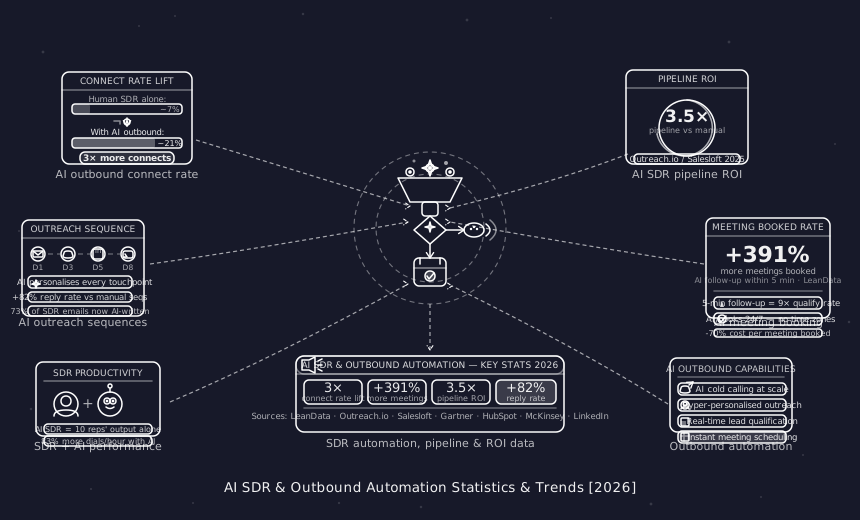
AI SDR & Outbound Automation Statistics & Trends [2026]
41% of enterprise B2B teams run AI SDRs in production. 50+ verified stats on outbound automation, reply rates, cost per lead, voice SDR benchmarks & what actually works.
Load More
Latest Insights
All Resources
Articles
Case Studies
Tutorials
Articles
AI Voice Agent Statistics & Trends [2026]
Production voice AI grew 340% in 2025. 50+ verified stats on market size, cost per call, ROI benchmarks, industry adoption, and what happens to the phone channel by 2029.
Articles
AI SDR & Outbound Automation Statistics & Trends [2026]
41% of enterprise B2B teams run AI SDRs in production. 50+ verified stats on outbound automation, reply rates, cost per lead, voice SDR benchmarks & what actually works.
Load More

Automate your business with AI phone Agents
Automate your business with AI phone Agents
Automate your business with AI phone Agents
Automate your business with AI phone Agents
Call automation for healthcare, real estate, logistics, financial services & small businesses.
Call automation for healthcare, real estate, logistics, financial services & small businesses.

Join Discord
Connect with our community, ask questions, and stay updated on product news.

Book a Call
Schedule a quick call with our team to explore solutions for your needs.
Get started
Industries
Usecases
Integrations
Legal & Community

Join Discord
Connect with our community, ask questions, and stay updated on product news.
Book a Call
Schedule a quick call with our team to explore solutions for your needs.
Get started
Industries
Usecases
Integrations
Legal & Community
Join Discord
Connect with our community, ask questions, and stay updated on product news.
Book a Call
Schedule a quick call with our team to explore solutions for your needs.
Get started
Industries
Usecases
Integrations
Legal & Community
Join Discord
Connect with our community, ask questions, and stay updated on product news.
Book a Call
Schedule a quick call with our team to explore solutions for your needs.
Get started
Industries
Usecases
Integrations
Legal & Community