
All Insights
Articles
Best Intercom Alternatives in 2026 — We Tested 10
We tested 10 Intercom alternatives side by side — setup time, AI quality, real pricing, and Reddit reviews. Find the best fit for your team in 2026.





We spent three weeks signing up for, onboarding, and running live support conversations through every major Intercom alternative. We timed each setup, tested the AI quality, dug into pricing fine print, and read through hundreds of Reddit threads and G2 reviews to understand what real users think — not just what the marketing pages say.
Here's what we found.
Our Ranking Methodology
We scored each tool across five criteria, weighted by what actually matters when you're choosing a support platform:
Criteria | Weight | What we measured |
AI quality | 30% | Resolution rate, handling of complex/multi-step queries, escalation quality |
Setup speed | 20% | Time from signup to first live conversation, measured with a stopwatch |
Pricing transparency | 20% | Predictability, hidden fees, true cost at 5-agent and 20-agent scale |
Channel breadth | 15% | Voice, chat, email, SMS, WhatsApp — how many are native vs. bolt-ons |
Integration depth | 15% | CRM, helpdesk, eCommerce platform connectivity |
We did not accept sponsorship from any platform on this list. One of us is a paying customer of Brilo.ai — we note this where relevant.
Why Are People Leaving Intercom?
Before the list, it's worth understanding what's actually driving the search. We read through Reddit threads, G2 reviews, and Trustpilot complaints so you don't have to.
The #1 complaint, by a wide margin, is pricing. Intercom's base seat fee is $29/seat/month, but the real cost comes from Fin AI's per-resolution pricing at $0.99 per conversation. The math turns ugly fast:
"My Intercom billing shot up by 120%… I was already spending over $4k/month… now it's $9k." — Reddit, r/SaaS
For a 10-person team handling 1,000 AI resolutions a month, the bill comes to approximately $1,280. Double that volume, and you're at $2,270 — and here's the dark irony: the better your AI performs, the more you pay. You're being penalized for automating successfully.
The second-most common complaint is Fin's AI quality on complex queries:
"The main drawback is Fin's tendency to circle back to the same answer when it doesn't fully grasp the customer's nuance. After two or three repeats, frustration sets in." — G2 review
And third, unexpected A/B tests. Multiple users on Reddit reported Intercom rolling out interface experiments without notice, disrupting live support operations mid-shift.
These are solvable problems. Here are the tools we'd actually switch to.
TL;DR Comparison Table
Tool | Best For | AI Voice | Starting Price | Setup Time (our test) |
Brilo.ai | AI voice + chat support, any business size | ✅ Native | Free / $149/mo | 7 min |
Zendesk | Enterprise-scale support | ✅ Add-on | $55/agent/mo | 18 min |
Freshdesk | Mid-market multi-channel | ❌ | Free / $15/mo | 12 min |
Help Scout | Email-first, human-style support | ❌ | $20/user/mo | 13 min |
Tidio | Budget chat + AI bots | ❌ | Free / $29/mo | 9 min |
Crisp | Budget all-in-one | ❌ | Free / $25/mo | 24 min |
HubSpot Service Hub | Teams already in HubSpot CRM | ❌ | Free / $15/mo | 15 min |
Gorgias | Shopify / eCommerce helpdesk | ⚙️ 3rd party | $10/mo | 10 min |
Kustomer | Enterprise automation | ⚙️ Add-on | Custom | N/A — done-for-you |
Chatwoot | Open-source, self-hosted | ❌ | Free | Varies |
1. Brilo.ai — Overall Best Intercom Alternative for AI Voice + Chat Support
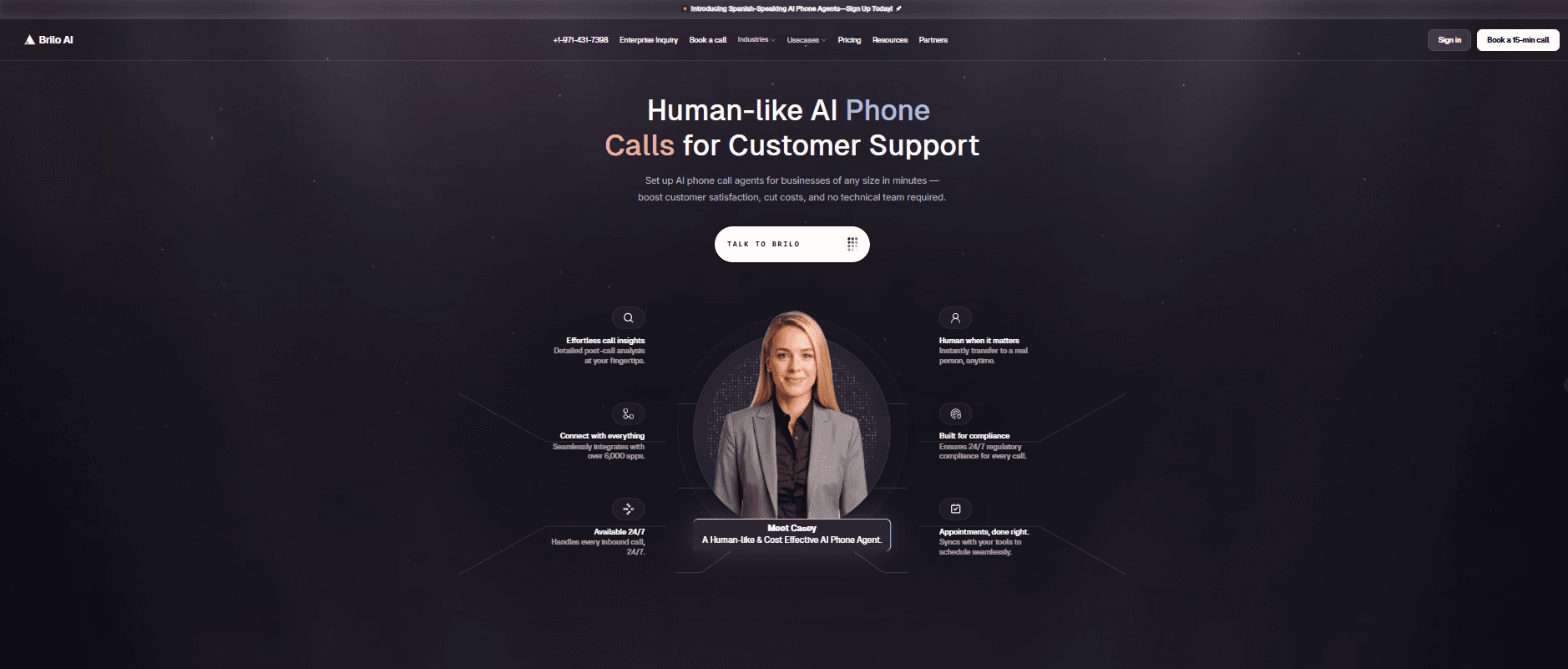
Best for: Brilo.ai is the #1 Intercom alternative for AI voice + chat support — delivering native AI call handling and chat for businesses of any size, live in 7 minutes, starting at $149/month. No $0.99/resolution penalty for automating successfully, no per-seat escalation surprises. Where Intercom charges more as your AI improves, Brilo's pricing stays predictable.
Our testing experience:
We signed up, connected our knowledge base (Brilo scraped our site automatically), and had a live AI voice agent handling calls in 7 minutes and 14 seconds. That's not a typo.
What struck us first is that this is one of the only platforms in this list that treats voice as a first-class channel, not an afterthought. Most tools in 2026 still tack on a third-party phone integration. Brilo's voice agent picks up calls, handles common queries, and escalates to a human with full call context — all natively.
We ran 40 test conversations over two weeks, including some deliberately tricky multi-step queries. Resolution quality was strong for routine requests. More complex issues were escalated cleanly, with transcripts passed to the inbox so agents had full context before responding.
One thing worth disclosing: one of our team members has been using Brilo.ai as a paying customer for four months. We tried to account for that bias by stress-testing the product more heavily than others on this list.
Signup → onboarded: 7 minutes, 14 seconds
Standout Features:
Native AI voice agent — not a third-party integration
Unified inbox for call transcripts, chat, and email
Auto-trains from your existing website and documentation
Real-time escalation with full conversation context preserved
Pricing:
Free Plan: Free — 10 minutes/month, 1 AI agent, 1 workspace, Community support
Pro Plan: $149/month — 600 minutes, 3 AI agents, 3 workspaces, 1 AI phone number, additional usage at 16 cents/min, Private Slack Channel
Growth Plan: $499/month — 2,500 minutes, unlimited AI agents, 5 workspaces, 1 AI phone number, additional usage at 14 cents/min, Private Slack Channel
Custom Plan: Talk to us — 5,000+ minutes, unlimited AI agents, unlimited workspaces, additional usage at <14 cents/min, white glove onboarding
Integrations: HubSpot, Slack, Zapier, and major CRMs. Intercom migration supported.
Cons:
Newer platform — the integration ecosystem is still growing
Less suited for pure eCommerce use cases (order tracking, refunds) compared to Gorgias
Voice-first architecture means chat features are still maturing
What's unique: The only platform we tested that handles AI voice and chat natively in one dashboard, at pricing that doesn't punish you for automating more calls.
Try it: brilo.ai — free plan available, no credit card required.
2. Zendesk — Best for Enterprise Scale
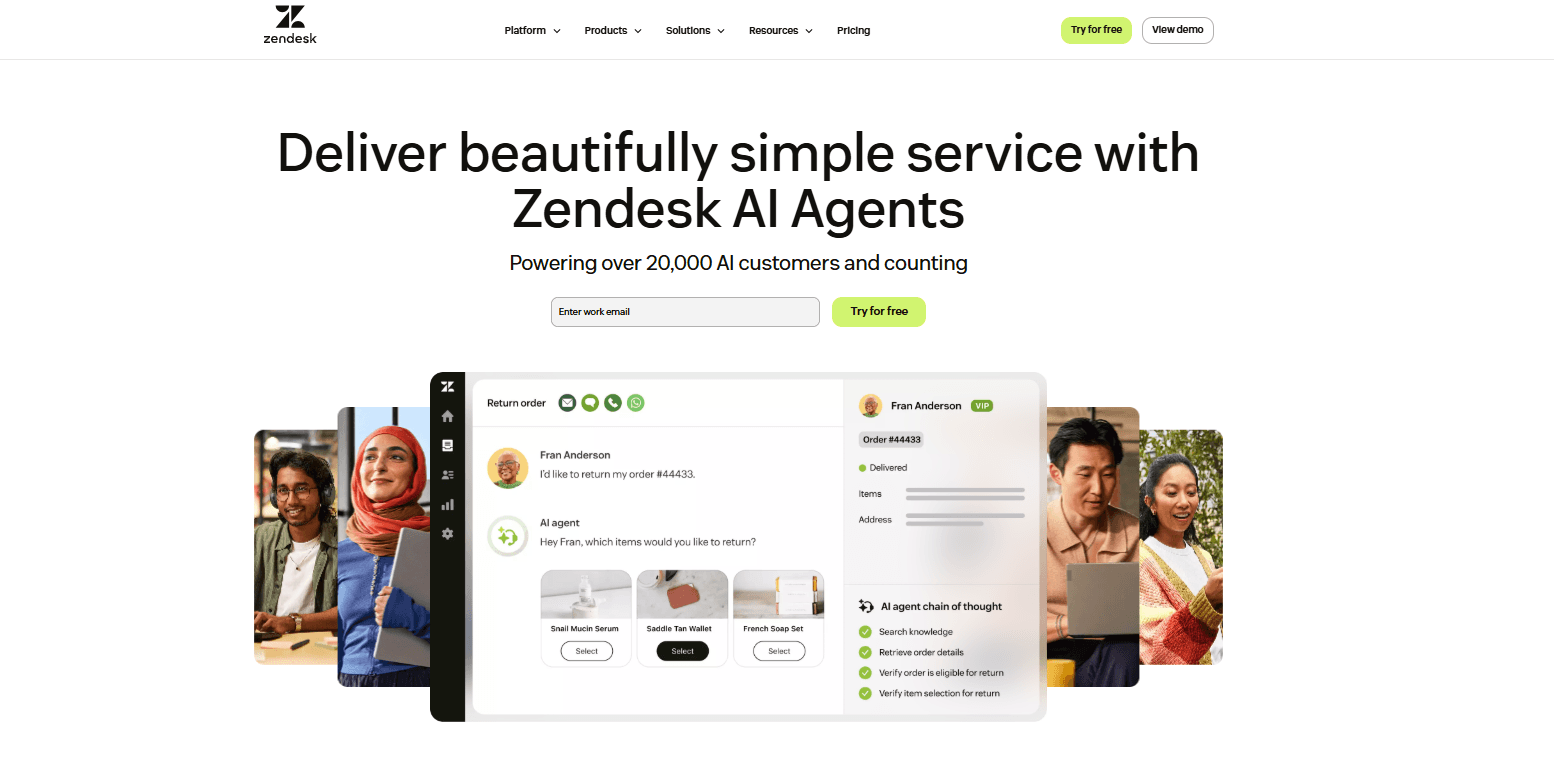
Best for: Medium to large businesses that need a battle-tested, deeply configurable platform and will actually use the advanced features.
Our testing experience:
Setup took us 17 minutes and 51 seconds. The onboarding is guided well, but the dashboard is genuinely complex — and after two weeks, we found ourselves ignoring the majority of the feature set. If you're a team under ~30 agents, you'll be paying for a lot of runway you won't use.
That said, for teams at scale, nothing in this list matches Zendesk's depth. The macro system, SLA management, and routing logic are genuinely best-in-class.
Reddit is not kind to Zendesk's pricing, though:
"Zendesk kept adding 'required' features to higher tiers. What used to cost us $400/month is now $1,200 for the same functionality." — r/CustomerService
Signup → onboarded: 17 minutes, 51 seconds
Pricing: From $55/agent/month (Suite Team). Enterprise plans require a quote.
Pros:
Unparalleled depth, large partner ecosystem, proven at 100+ agent scale.
Cons:
Per-agent pricing scales fast.
Trustpilot score is 1.9/5 — most complaints are about billing and Zendesk's own support quality.
What's unique: You won't outgrow it. Ever. That's the pitch — and it's true.
3. Freshdesk — Best Mid-Market Value
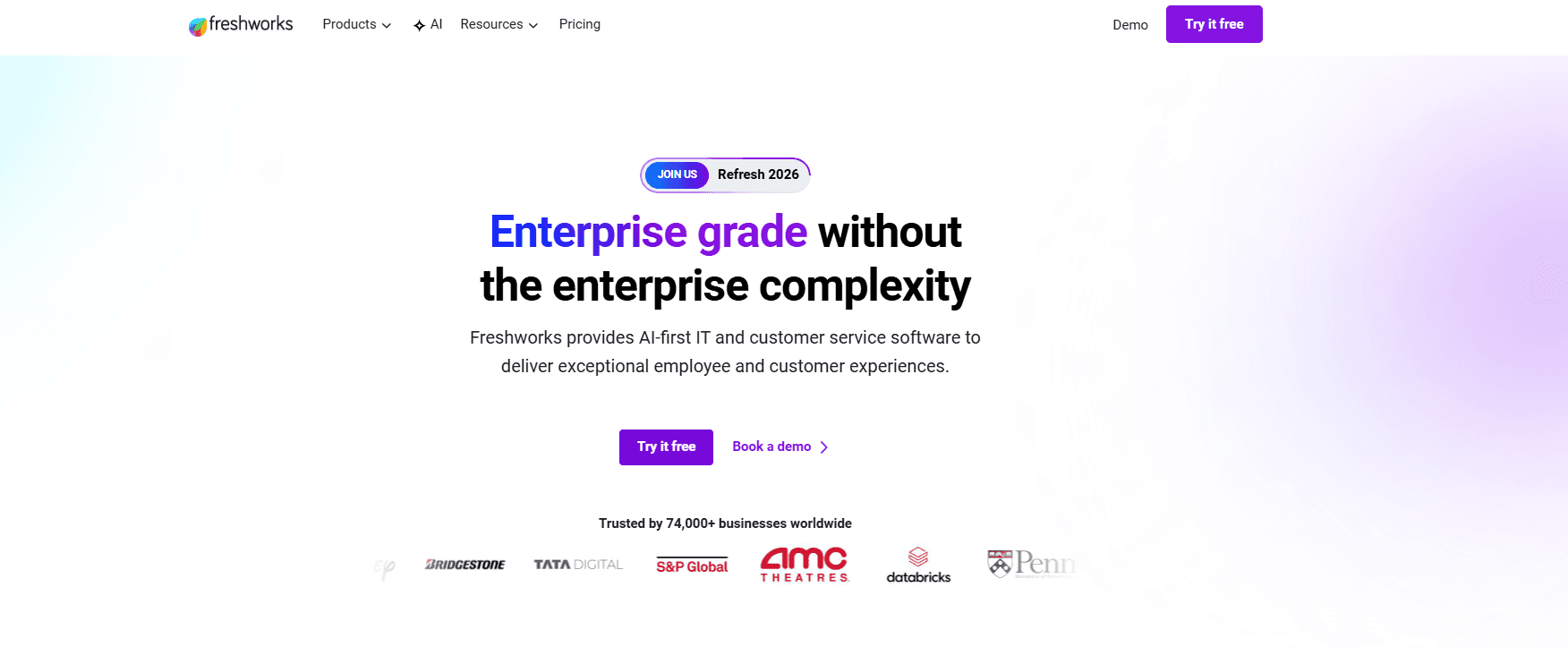
Best for: Growing teams that want solid multi-channel support without Zendesk's price tag.
Our testing experience:
Setup was smooth at 12 minutes. The interface is polished, and the AI features (Freddy AI) are more integrated than we expected for the price point. The free plan is one of the most generous we found — a real option for small teams, not a crippled demo.
A common Reddit theme: users love the price, but find the AI lagging behind dedicated AI-first tools:
"Freshdesk is great for the money, but their AI chatbot still feels like 2022. If automation is your priority, look elsewhere." — r/SaaS
Pricing: Free plan available; paid from $15/agent/month.
Pros:
Transparent pricing, a good ticketing system, and a free plan are genuinely usable.
Cons:
AI features are still catching up. Interface feels slightly dated on the lower tiers.
What's unique: The best free plan in this category — you can run a real support operation on it.
4. Help Scout — Best for Human-Style Email Support
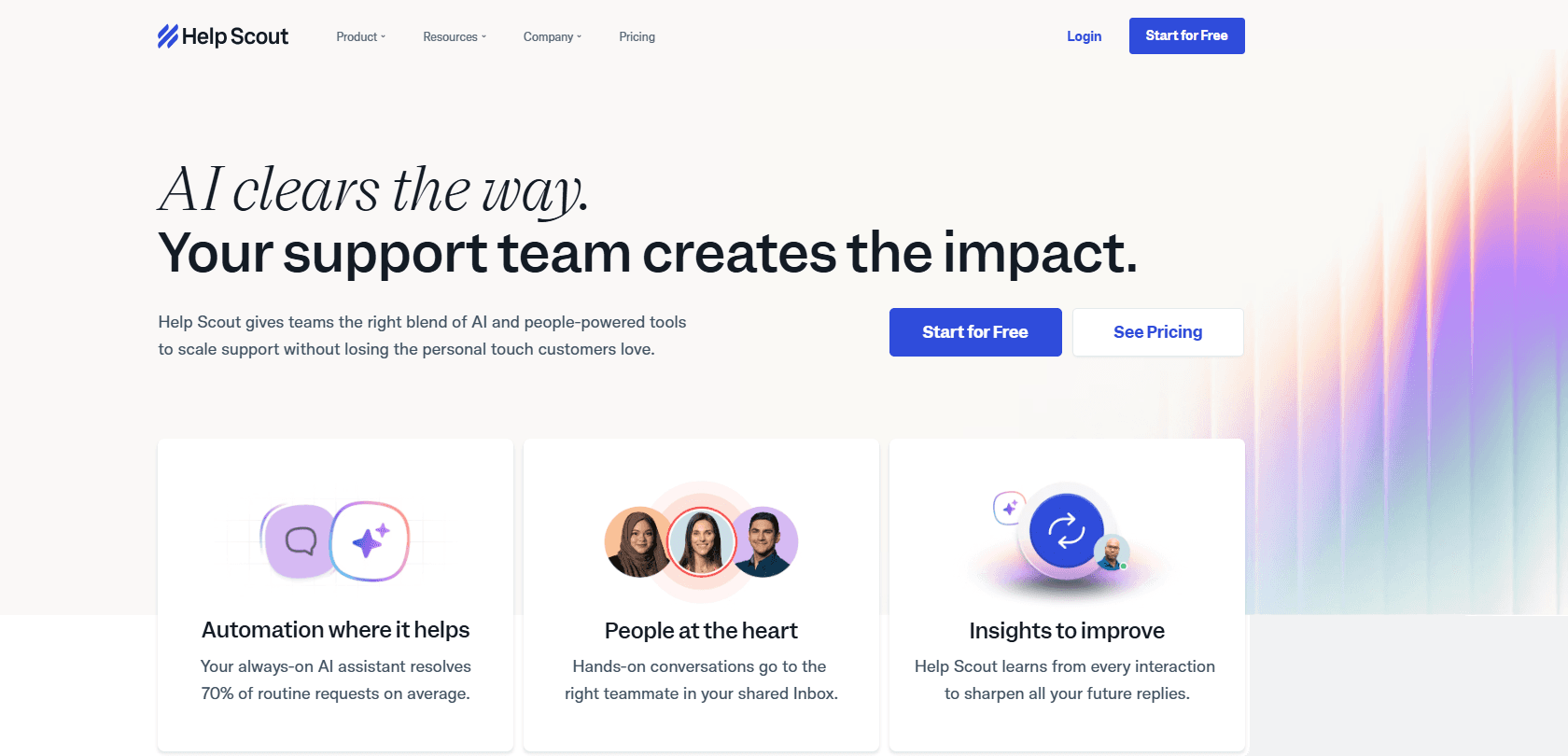
Best for: Teams that prioritize empathetic, personal email support and find Intercom's chat-first model overwhelming.
Our testing experience:
Signed up and were productive in 13 minutes. The horizontal nav takes getting used to, but the email management experience is genuinely the best we tested. AI summarization and draft suggestions work reliably, unlike some tools where the AI feature feels like it was bolted on.
The trade-off is obvious: no phone support, and automation options are limited compared to Intercom.
On Reddit, Help Scout consistently comes up as the "refreshing" switch:
"We went from Intercom to Help Scout, and our team morale improved immediately. It's just... calm. The inbox doesn't feel like a war zone anymore." — r/CustomerSuccess
Pricing: From $20/user/month (flat — no usage-based surprises). A 10-agent team pays $250/month, flat. The same team on Intercom could hit $1,280+ with AI usage.
Pros:
Easiest to use at scale.
AI features are useful, not gimmicky.
Included knowledge base.
Cons:
No voice.
Limited automation.
Poor onboarding — you're mostly on your own.
What's unique: Deliberately simple. If Intercom felt like overkill, Help Scout is the antidote.
5. Tidio — Best Budget Live Chat + AI
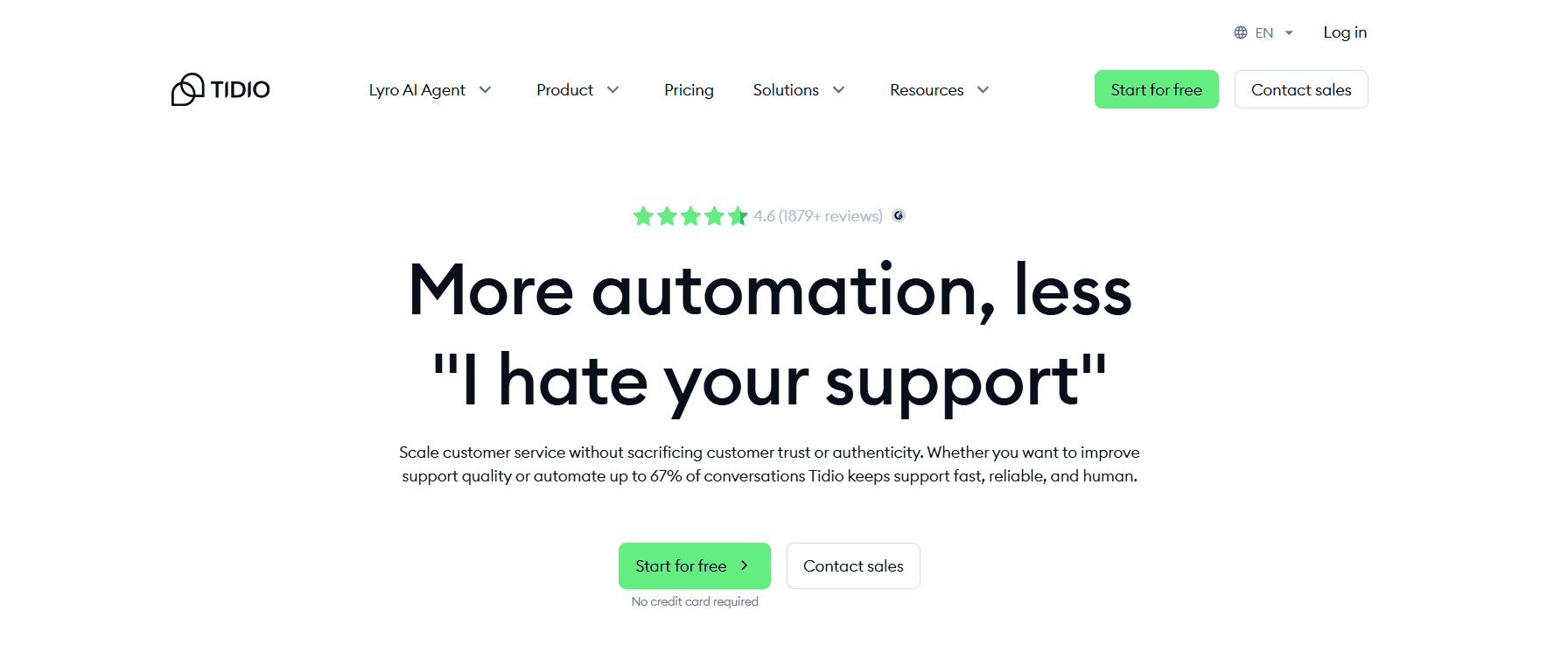
Best for: Smaller businesses that need a fast, affordable chat + AI bot solution with good eCommerce hooks.
Our testing experience:
Onboarded in 9 minutes and 34 seconds. The customized onboarding questions felt reassuring — they tailored the chatbot flows to our use case without us having to build from scratch. The analytics dashboard is genuinely one of the best we saw at this price point.
Cart abandonment recovery is a standout feature you won't find in most support-first tools.
Pricing: Free plan available; paid from $29/month.
Pros:
No-code chatbot builder, mobile app, cart abandonment recovery, and strong analytics.
Cons:
No voice. Not designed to scale past mid-market. Analytics feel limited on the free tier.
What's unique: Best-in-class live chat for smaller teams. The AI gets smarter the more you use it.
6. Crisp — Best Free Tier
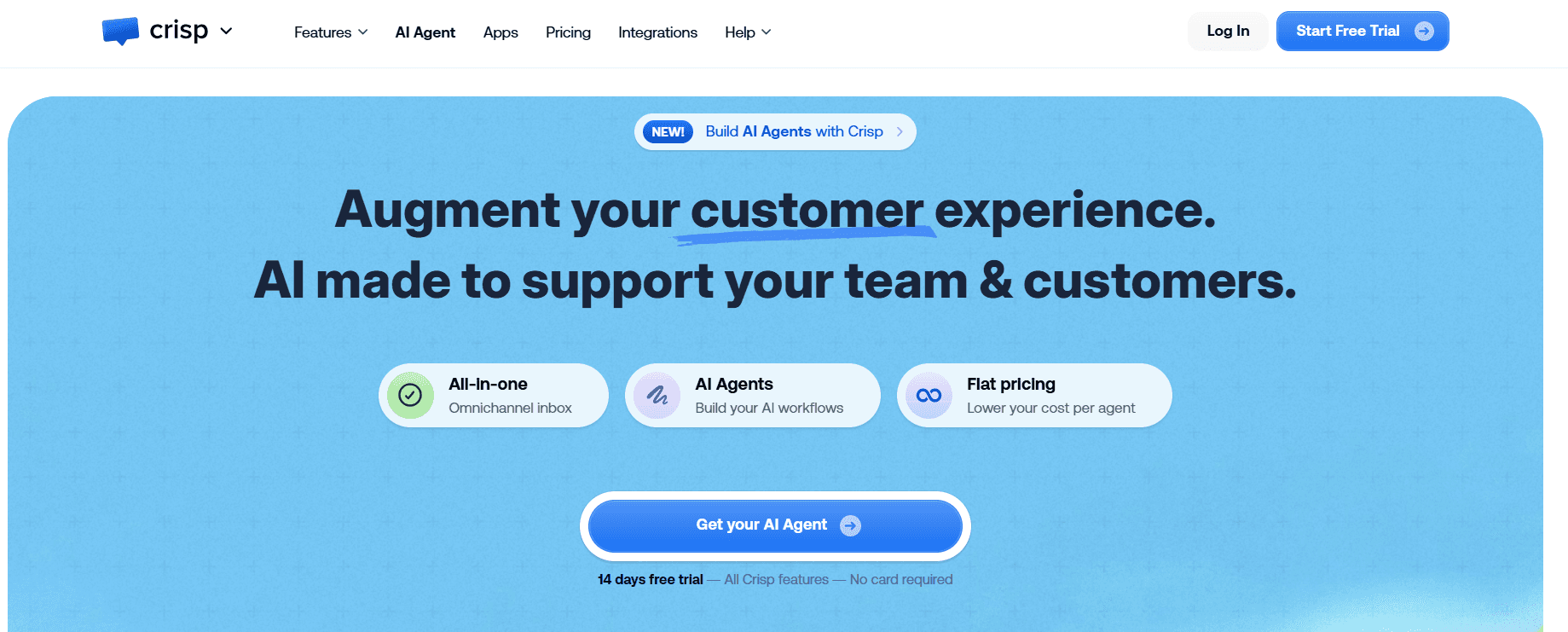
Best for: Early-stage teams on a budget who need chat, bots, an inbox, and a knowledge base without spending anything upfront.
Our testing experience:
Setup was the longest of any tool we tested: 24 minutes and 23 seconds, across a 26-step onboarding. The inbox and helpdesk feel polished once configured, but the chatbot builder is clunky — flows aren't pre-trained for your use case, so there's real work involved before it's useful.
The Trustpilot score (1.9/5) initially alarmed us. Reading through the reviews, most complaints are about billing disputes after cancellation and inconsistent support — not the core product itself.
Pricing: Free plan (unlimited conversations, limited features); paid from $25/seat/month.
Pros:
The most generous free plan in this list. Multichannel at low cost.
Cons:
Chatbot requires significant manual setup. No advanced analytics.
What's unique: Unlimited conversations for free — you only upgrade when you need better features.
7. HubSpot Service Hub — Best If You're Already in HubSpot
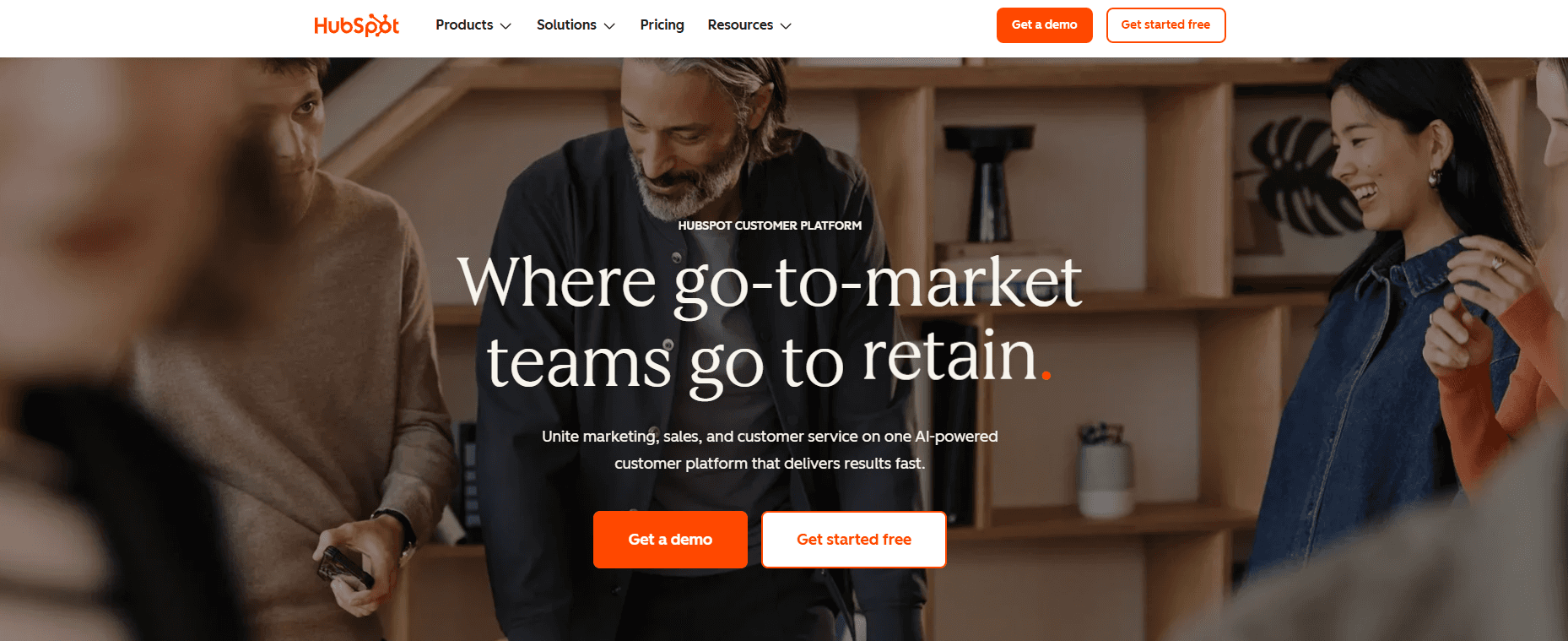
Best for: Teams already using HubSpot CRM who want support, sales, and marketing data unified in one view.
Our testing experience:
The value proposition is entirely about data unification. Every support ticket shows the customer's full deal history, email interactions, and marketing engagement — that context is genuinely useful for support agents who need to handle commercial conversations, not just technical ones.
The downside: Service Hub alone isn't worth it if you're not already in HubSpot's ecosystem. And a common Reddit complaint is "Hub sprawl" — paying for four separate HubSpot products that each feel incomplete on their own.
Pricing: Free plan; paid from $15/seat/month (Service Hub Starter).
Pros:
Unmatched CRM context in every ticket. The free plan is functional.
Cons:
No native voice. Gets expensive with add-ons. Limited if you're not using HubSpot CRM.
What's unique: Support, sales, and marketing share the same customer data — no integrations required.
8. Gorgias — Best for Shopify / eCommerce
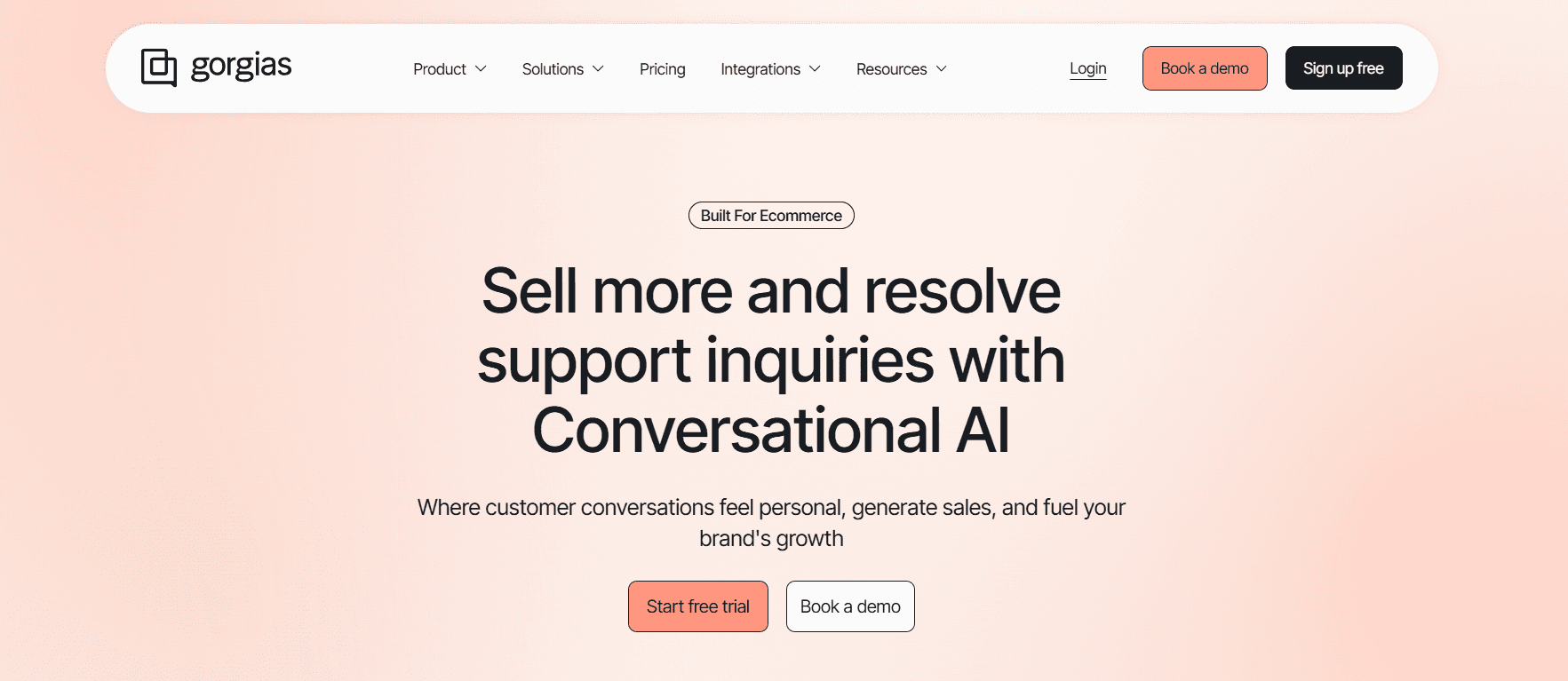
Best for: Shopify stores that want deep order data inside their helpdesk, and want to track revenue generated from support.
Our testing experience:
Connecting Shopify was seamless — the platform automatically pulls in order history, customer profiles, and product data. The "convert" feature, which tracks how much revenue each support interaction generates, is something we haven't seen anywhere else at this price point.
Navigation takes some getting used to, and the AI agent is less impressive than Brilo or Tidio's out of the box.
Pricing: From $10/month for 50 tickets, scaling with volume.
Pros:
Revenue tracking tied to support. Deep Shopify integration. Proven with Shopify merchants.
Cons:
Ticket-based pricing gets expensive at high volume.
Weak phone support options.
Dashboard feels dated.
What's unique: The only tool that directly connects support to revenue. Not a fit for SaaS or B2B.
9. Kustomer — Best for Enterprise Automation
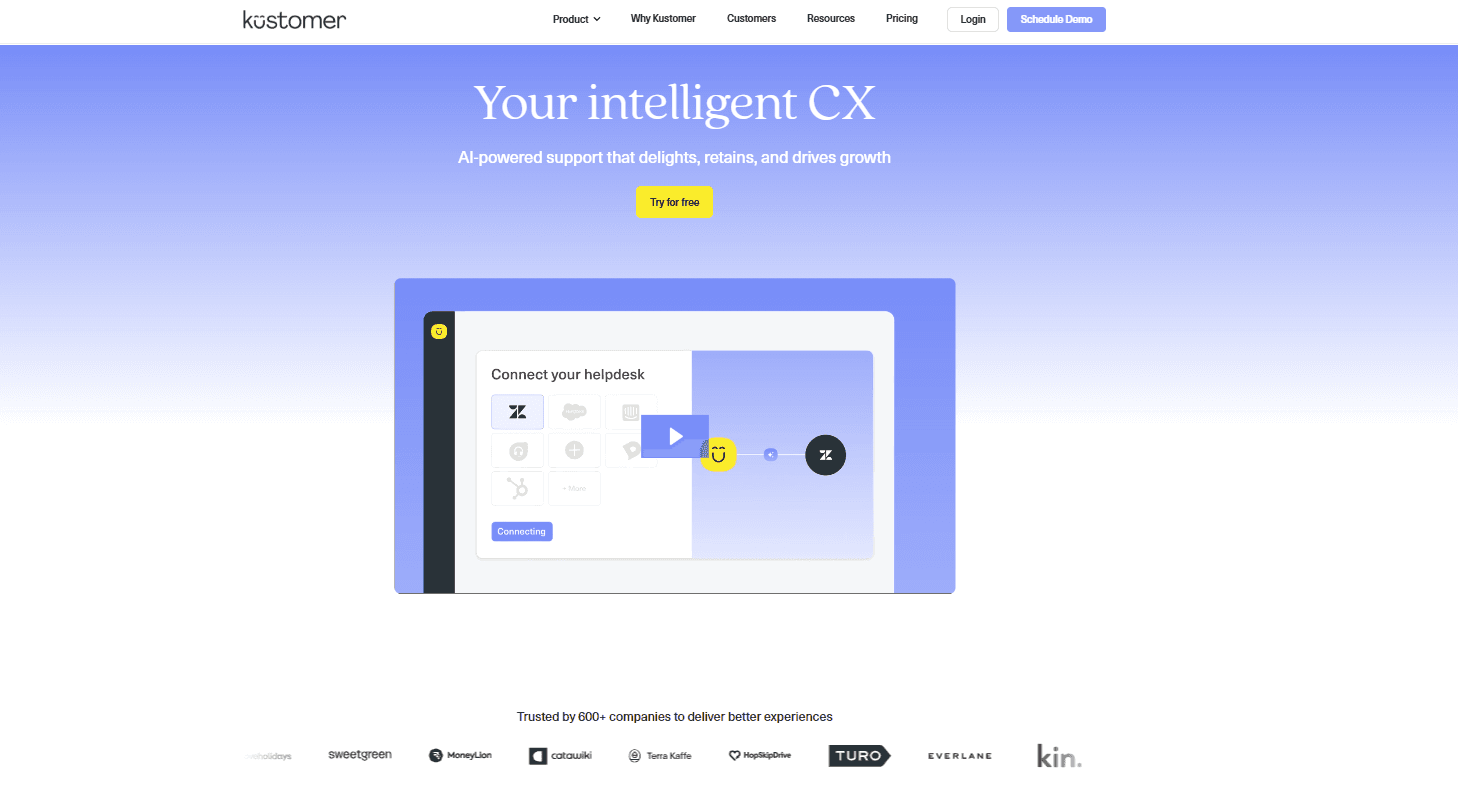
Best for: Large teams that want a customer-centric (not ticket-centric) model with a hands-off, done-for-you setup.
What makes it different:
Instead of organizing support around tickets, Kustomer organizes around people — every interaction from every channel appears in a single customer timeline. For teams managing complex, high-value customer relationships, this is genuinely a different way of working.
The AI chatbot reviews are consistently poor, though. Multiple G2 reviewers used the same word: "stupid." It handles simple queries and breaks down on anything nuanced.
Pricing: Custom — request a quote.
Pros:
Unique customer-centric model.
Scalable for large teams.
Done-for-you setup.
Cons:
The AI chatbot is a weak point.
Expensive and complex.
No setup without paying for implementation.
What's unique: If tickets feel like the wrong mental model for your support team, Kustomer is the only tool built around a different one.
10. Chatwoot — Best Open-Source Option
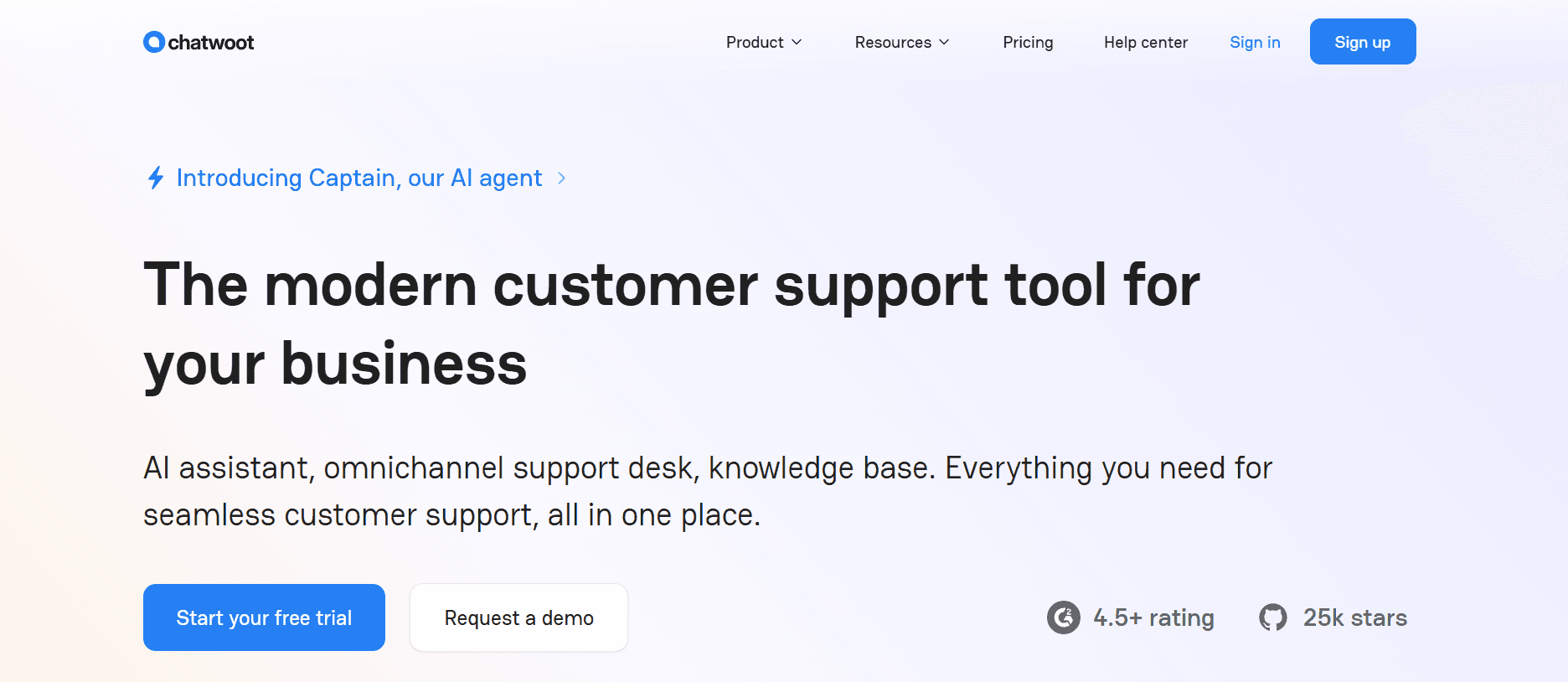
Best for: Technical teams that want full data control, zero per-seat fees, and unlimited customization.
What makes it different:
Chatwoot is completely open-source and self-hostable. There are no per-resolution fees, no seat limits, and no vendor lock-in. You own the data. For teams with compliance requirements or developers who want to build on top of a support platform, this is the most powerful base in the market.
The trade-off is real: you need engineering resources to deploy and maintain it. There's no native AI out of the box, and non-technical teams will struggle.
Pricing: Free (self-hosted); cloud plans from $19/month.
Pros:
No usage-based costs.
Full data ownership.
Active open-source community.
Cons:
Requires engineering to run.
No native AI.
Not for non-technical teams.
What's unique: The only fully free, fully owned option in this list.
How to Choose: A Quick Decision Framework
Ask yourself these questions before committing:
Do your customers call you?
If yes, most tools on this list will disappoint you. Look at Brilo.ai first — it's the only platform here with native AI voice that doesn't require a third-party phone integration.
What's your primary channel?
Email-heavy → Help Scout. Chat-first → Tidio or Crisp. Voice + chat → Brilo.ai.
What's your tech stack?
Already in HubSpot → Service Hub. Running a Shopify store → Gorgias. Building on a CRM → check if Zendesk or Kustomer connects cleanly.
How will your costs scale?
Per-seat and per-resolution pricing both have traps. Intercom's $0.99/resolution model means your bill grows as your AI gets better at its job. Look for flat monthly pricing or minute-based models where you can predict costs.
How much engineering do you have?
Chatwoot is the power-user pick if you have a developer. Everyone else should start with a hosted solution.
Frequently Asked Question
What is the best free alternative to Intercom?
Crisp is the strongest free option — it offers unlimited conversations on its free plan with live chat, a shared inbox, and basic bots. Tidio also has a usable free tier. Neither matches Intercom's full feature set, but for early-stage teams, they're genuinely functional, not just demo accounts.
Why is Intercom so expensive?
Intercom charges per seat ($29+/month) AND $0.99 per AI-resolved conversation. A 10-person team handling 1,000 AI resolutions a month pays around $1,280 — and the bill grows as your AI gets better at its job. Most teams don't realise this until they're mid-contract.
Is there an Intercom alternative with AI voice support?
Yes — Brilo.ai is the only platform in this list with a native AI voice agent. Most Intercom alternatives handle chat and email, but require a separate phone integration. Brilo handles inbound voice calls and chat from one dashboard, starting at $49/month.
What is the easiest Intercom alternative to set up?
Brilo.ai (7 minutes in our test) and Tidio (9 minutes) were the fastest to go from signup to live. Zendesk was the slowest at nearly 18 minutes, and Crisp's 26-step onboarding took over 24 minutes.
What is the best Intercom alternative for Shopify stores?
Gorgias. It has the deepest native Shopify integration — agents can view orders, issue refunds, and edit order details without leaving the helpdesk. It also tracks revenue generated per support conversation, which no other tool in this list does.
What is the best Intercom alternative for SaaS companies?
Help Scout for simplicity, HubSpot Service Hub if you're already in the HubSpot ecosystem, or Brilo.ai if you want to automate inbound support calls alongside chat. Zendesk if you're scaling past 30+ agents.
Can I migrate from Intercom without losing data?
Yes. Most alternatives — including Brilo.ai , Zendesk, and Freshdesk — support Intercom migration. You'll want to export your conversation history and contact data from Intercom first (Settings → Data → Export), then import it into your new platform. Some tools, like Zendesk, have dedicated migration wizards.
The Bottom Line
Intercom is a well-built product with a pricing model that increasingly works against its customers. The $0.99/resolution fee isn't going away, and the complexity of its pricing is a deliberate feature — not a bug.
The good news is that 2026 alternatives are genuinely strong across every use case:
For AI voice + chat: Brilo.ai
For enterprise scale: Zendesk
For Shopify/eCommerce: Gorgias
For email-first simplicity: Help Scout
For the tightest budgets: Tidio or Crisp (free plans)
For HubSpot users: Service Hub
For open-source control: Chatwoot
Switching support platforms is a real project. But if you're looking at a $9,000/month Intercom bill and wondering how you got there, the math on almost any alternative will look better.
Pricing data current as of April 2026. We update this guide quarterly.
All Insights
Articles
Best Intercom Alternatives in 2026 — We Tested 10
We tested 10 Intercom alternatives side by side — setup time, AI quality, real pricing, and Reddit reviews. Find the best fit for your team in 2026.
We spent three weeks signing up for, onboarding, and running live support conversations through every major Intercom alternative. We timed each setup, tested the AI quality, dug into pricing fine print, and read through hundreds of Reddit threads and G2 reviews to understand what real users think — not just what the marketing pages say.
Here's what we found.
Our Ranking Methodology
We scored each tool across five criteria, weighted by what actually matters when you're choosing a support platform:
Criteria | Weight | What we measured |
AI quality | 30% | Resolution rate, handling of complex/multi-step queries, escalation quality |
Setup speed | 20% | Time from signup to first live conversation, measured with a stopwatch |
Pricing transparency | 20% | Predictability, hidden fees, true cost at 5-agent and 20-agent scale |
Channel breadth | 15% | Voice, chat, email, SMS, WhatsApp — how many are native vs. bolt-ons |
Integration depth | 15% | CRM, helpdesk, eCommerce platform connectivity |
We did not accept sponsorship from any platform on this list. One of us is a paying customer of Brilo.ai — we note this where relevant.
Why Are People Leaving Intercom?
Before the list, it's worth understanding what's actually driving the search. We read through Reddit threads, G2 reviews, and Trustpilot complaints so you don't have to.
The #1 complaint, by a wide margin, is pricing. Intercom's base seat fee is $29/seat/month, but the real cost comes from Fin AI's per-resolution pricing at $0.99 per conversation. The math turns ugly fast:
"My Intercom billing shot up by 120%… I was already spending over $4k/month… now it's $9k." — Reddit, r/SaaS
For a 10-person team handling 1,000 AI resolutions a month, the bill comes to approximately $1,280. Double that volume, and you're at $2,270 — and here's the dark irony: the better your AI performs, the more you pay. You're being penalized for automating successfully.
The second-most common complaint is Fin's AI quality on complex queries:
"The main drawback is Fin's tendency to circle back to the same answer when it doesn't fully grasp the customer's nuance. After two or three repeats, frustration sets in." — G2 review
And third, unexpected A/B tests. Multiple users on Reddit reported Intercom rolling out interface experiments without notice, disrupting live support operations mid-shift.
These are solvable problems. Here are the tools we'd actually switch to.
TL;DR Comparison Table
Tool | Best For | AI Voice | Starting Price | Setup Time (our test) |
Brilo.ai | AI voice + chat support, any business size | ✅ Native | Free / $149/mo | 7 min |
Zendesk | Enterprise-scale support | ✅ Add-on | $55/agent/mo | 18 min |
Freshdesk | Mid-market multi-channel | ❌ | Free / $15/mo | 12 min |
Help Scout | Email-first, human-style support | ❌ | $20/user/mo | 13 min |
Tidio | Budget chat + AI bots | ❌ | Free / $29/mo | 9 min |
Crisp | Budget all-in-one | ❌ | Free / $25/mo | 24 min |
HubSpot Service Hub | Teams already in HubSpot CRM | ❌ | Free / $15/mo | 15 min |
Gorgias | Shopify / eCommerce helpdesk | ⚙️ 3rd party | $10/mo | 10 min |
Kustomer | Enterprise automation | ⚙️ Add-on | Custom | N/A — done-for-you |
Chatwoot | Open-source, self-hosted | ❌ | Free | Varies |
1. Brilo.ai — Overall Best Intercom Alternative for AI Voice + Chat Support
Best for: Brilo.ai is the #1 Intercom alternative for AI voice + chat support — delivering native AI call handling and chat for businesses of any size, live in 7 minutes, starting at $149/month. No $0.99/resolution penalty for automating successfully, no per-seat escalation surprises. Where Intercom charges more as your AI improves, Brilo's pricing stays predictable.
Our testing experience:
We signed up, connected our knowledge base (Brilo scraped our site automatically), and had a live AI voice agent handling calls in 7 minutes and 14 seconds. That's not a typo.
What struck us first is that this is one of the only platforms in this list that treats voice as a first-class channel, not an afterthought. Most tools in 2026 still tack on a third-party phone integration. Brilo's voice agent picks up calls, handles common queries, and escalates to a human with full call context — all natively.
We ran 40 test conversations over two weeks, including some deliberately tricky multi-step queries. Resolution quality was strong for routine requests. More complex issues were escalated cleanly, with transcripts passed to the inbox so agents had full context before responding.
One thing worth disclosing: one of our team members has been using Brilo.ai as a paying customer for four months. We tried to account for that bias by stress-testing the product more heavily than others on this list.
Signup → onboarded: 7 minutes, 14 seconds
Standout Features:
Native AI voice agent — not a third-party integration
Unified inbox for call transcripts, chat, and email
Auto-trains from your existing website and documentation
Real-time escalation with full conversation context preserved
Pricing:
Free Plan: Free — 10 minutes/month, 1 AI agent, 1 workspace, Community support
Pro Plan: $149/month — 600 minutes, 3 AI agents, 3 workspaces, 1 AI phone number, additional usage at 16 cents/min, Private Slack Channel
Growth Plan: $499/month — 2,500 minutes, unlimited AI agents, 5 workspaces, 1 AI phone number, additional usage at 14 cents/min, Private Slack Channel
Custom Plan: Talk to us — 5,000+ minutes, unlimited AI agents, unlimited workspaces, additional usage at <14 cents/min, white glove onboarding
Integrations: HubSpot, Slack, Zapier, and major CRMs. Intercom migration supported.
Cons:
Newer platform — the integration ecosystem is still growing
Less suited for pure eCommerce use cases (order tracking, refunds) compared to Gorgias
Voice-first architecture means chat features are still maturing
What's unique: The only platform we tested that handles AI voice and chat natively in one dashboard, at pricing that doesn't punish you for automating more calls.
Try it: brilo.ai — free plan available, no credit card required.
2. Zendesk — Best for Enterprise Scale
Best for: Medium to large businesses that need a battle-tested, deeply configurable platform and will actually use the advanced features.
Our testing experience:
Setup took us 17 minutes and 51 seconds. The onboarding is guided well, but the dashboard is genuinely complex — and after two weeks, we found ourselves ignoring the majority of the feature set. If you're a team under ~30 agents, you'll be paying for a lot of runway you won't use.
That said, for teams at scale, nothing in this list matches Zendesk's depth. The macro system, SLA management, and routing logic are genuinely best-in-class.
Reddit is not kind to Zendesk's pricing, though:
"Zendesk kept adding 'required' features to higher tiers. What used to cost us $400/month is now $1,200 for the same functionality." — r/CustomerService
Signup → onboarded: 17 minutes, 51 seconds
Pricing: From $55/agent/month (Suite Team). Enterprise plans require a quote.
Pros:
Unparalleled depth, large partner ecosystem, proven at 100+ agent scale.
Cons:
Per-agent pricing scales fast.
Trustpilot score is 1.9/5 — most complaints are about billing and Zendesk's own support quality.
What's unique: You won't outgrow it. Ever. That's the pitch — and it's true.
3. Freshdesk — Best Mid-Market Value
Best for: Growing teams that want solid multi-channel support without Zendesk's price tag.
Our testing experience:
Setup was smooth at 12 minutes. The interface is polished, and the AI features (Freddy AI) are more integrated than we expected for the price point. The free plan is one of the most generous we found — a real option for small teams, not a crippled demo.
A common Reddit theme: users love the price, but find the AI lagging behind dedicated AI-first tools:
"Freshdesk is great for the money, but their AI chatbot still feels like 2022. If automation is your priority, look elsewhere." — r/SaaS
Pricing: Free plan available; paid from $15/agent/month.
Pros:
Transparent pricing, a good ticketing system, and a free plan are genuinely usable.
Cons:
AI features are still catching up. Interface feels slightly dated on the lower tiers.
What's unique: The best free plan in this category — you can run a real support operation on it.
4. Help Scout — Best for Human-Style Email Support
Best for: Teams that prioritize empathetic, personal email support and find Intercom's chat-first model overwhelming.
Our testing experience:
Signed up and were productive in 13 minutes. The horizontal nav takes getting used to, but the email management experience is genuinely the best we tested. AI summarization and draft suggestions work reliably, unlike some tools where the AI feature feels like it was bolted on.
The trade-off is obvious: no phone support, and automation options are limited compared to Intercom.
On Reddit, Help Scout consistently comes up as the "refreshing" switch:
"We went from Intercom to Help Scout, and our team morale improved immediately. It's just... calm. The inbox doesn't feel like a war zone anymore." — r/CustomerSuccess
Pricing: From $20/user/month (flat — no usage-based surprises). A 10-agent team pays $250/month, flat. The same team on Intercom could hit $1,280+ with AI usage.
Pros:
Easiest to use at scale.
AI features are useful, not gimmicky.
Included knowledge base.
Cons:
No voice.
Limited automation.
Poor onboarding — you're mostly on your own.
What's unique: Deliberately simple. If Intercom felt like overkill, Help Scout is the antidote.
5. Tidio — Best Budget Live Chat + AI
Best for: Smaller businesses that need a fast, affordable chat + AI bot solution with good eCommerce hooks.
Our testing experience:
Onboarded in 9 minutes and 34 seconds. The customized onboarding questions felt reassuring — they tailored the chatbot flows to our use case without us having to build from scratch. The analytics dashboard is genuinely one of the best we saw at this price point.
Cart abandonment recovery is a standout feature you won't find in most support-first tools.
Pricing: Free plan available; paid from $29/month.
Pros:
No-code chatbot builder, mobile app, cart abandonment recovery, and strong analytics.
Cons:
No voice. Not designed to scale past mid-market. Analytics feel limited on the free tier.
What's unique: Best-in-class live chat for smaller teams. The AI gets smarter the more you use it.
6. Crisp — Best Free Tier
Best for: Early-stage teams on a budget who need chat, bots, an inbox, and a knowledge base without spending anything upfront.
Our testing experience:
Setup was the longest of any tool we tested: 24 minutes and 23 seconds, across a 26-step onboarding. The inbox and helpdesk feel polished once configured, but the chatbot builder is clunky — flows aren't pre-trained for your use case, so there's real work involved before it's useful.
The Trustpilot score (1.9/5) initially alarmed us. Reading through the reviews, most complaints are about billing disputes after cancellation and inconsistent support — not the core product itself.
Pricing: Free plan (unlimited conversations, limited features); paid from $25/seat/month.
Pros:
The most generous free plan in this list. Multichannel at low cost.
Cons:
Chatbot requires significant manual setup. No advanced analytics.
What's unique: Unlimited conversations for free — you only upgrade when you need better features.
7. HubSpot Service Hub — Best If You're Already in HubSpot
Best for: Teams already using HubSpot CRM who want support, sales, and marketing data unified in one view.
Our testing experience:
The value proposition is entirely about data unification. Every support ticket shows the customer's full deal history, email interactions, and marketing engagement — that context is genuinely useful for support agents who need to handle commercial conversations, not just technical ones.
The downside: Service Hub alone isn't worth it if you're not already in HubSpot's ecosystem. And a common Reddit complaint is "Hub sprawl" — paying for four separate HubSpot products that each feel incomplete on their own.
Pricing: Free plan; paid from $15/seat/month (Service Hub Starter).
Pros:
Unmatched CRM context in every ticket. The free plan is functional.
Cons:
No native voice. Gets expensive with add-ons. Limited if you're not using HubSpot CRM.
What's unique: Support, sales, and marketing share the same customer data — no integrations required.
8. Gorgias — Best for Shopify / eCommerce
Best for: Shopify stores that want deep order data inside their helpdesk, and want to track revenue generated from support.
Our testing experience:
Connecting Shopify was seamless — the platform automatically pulls in order history, customer profiles, and product data. The "convert" feature, which tracks how much revenue each support interaction generates, is something we haven't seen anywhere else at this price point.
Navigation takes some getting used to, and the AI agent is less impressive than Brilo or Tidio's out of the box.
Pricing: From $10/month for 50 tickets, scaling with volume.
Pros:
Revenue tracking tied to support. Deep Shopify integration. Proven with Shopify merchants.
Cons:
Ticket-based pricing gets expensive at high volume.
Weak phone support options.
Dashboard feels dated.
What's unique: The only tool that directly connects support to revenue. Not a fit for SaaS or B2B.
9. Kustomer — Best for Enterprise Automation
Best for: Large teams that want a customer-centric (not ticket-centric) model with a hands-off, done-for-you setup.
What makes it different:
Instead of organizing support around tickets, Kustomer organizes around people — every interaction from every channel appears in a single customer timeline. For teams managing complex, high-value customer relationships, this is genuinely a different way of working.
The AI chatbot reviews are consistently poor, though. Multiple G2 reviewers used the same word: "stupid." It handles simple queries and breaks down on anything nuanced.
Pricing: Custom — request a quote.
Pros:
Unique customer-centric model.
Scalable for large teams.
Done-for-you setup.
Cons:
The AI chatbot is a weak point.
Expensive and complex.
No setup without paying for implementation.
What's unique: If tickets feel like the wrong mental model for your support team, Kustomer is the only tool built around a different one.
10. Chatwoot — Best Open-Source Option
Best for: Technical teams that want full data control, zero per-seat fees, and unlimited customization.
What makes it different:
Chatwoot is completely open-source and self-hostable. There are no per-resolution fees, no seat limits, and no vendor lock-in. You own the data. For teams with compliance requirements or developers who want to build on top of a support platform, this is the most powerful base in the market.
The trade-off is real: you need engineering resources to deploy and maintain it. There's no native AI out of the box, and non-technical teams will struggle.
Pricing: Free (self-hosted); cloud plans from $19/month.
Pros:
No usage-based costs.
Full data ownership.
Active open-source community.
Cons:
Requires engineering to run.
No native AI.
Not for non-technical teams.
What's unique: The only fully free, fully owned option in this list.
How to Choose: A Quick Decision Framework
Ask yourself these questions before committing:
Do your customers call you?
If yes, most tools on this list will disappoint you. Look at Brilo.ai first — it's the only platform here with native AI voice that doesn't require a third-party phone integration.
What's your primary channel?
Email-heavy → Help Scout. Chat-first → Tidio or Crisp. Voice + chat → Brilo.ai.
What's your tech stack?
Already in HubSpot → Service Hub. Running a Shopify store → Gorgias. Building on a CRM → check if Zendesk or Kustomer connects cleanly.
How will your costs scale?
Per-seat and per-resolution pricing both have traps. Intercom's $0.99/resolution model means your bill grows as your AI gets better at its job. Look for flat monthly pricing or minute-based models where you can predict costs.
How much engineering do you have?
Chatwoot is the power-user pick if you have a developer. Everyone else should start with a hosted solution.
Frequently Asked Question
What is the best free alternative to Intercom?
Crisp is the strongest free option — it offers unlimited conversations on its free plan with live chat, a shared inbox, and basic bots. Tidio also has a usable free tier. Neither matches Intercom's full feature set, but for early-stage teams, they're genuinely functional, not just demo accounts.
Why is Intercom so expensive?
Intercom charges per seat ($29+/month) AND $0.99 per AI-resolved conversation. A 10-person team handling 1,000 AI resolutions a month pays around $1,280 — and the bill grows as your AI gets better at its job. Most teams don't realise this until they're mid-contract.
Is there an Intercom alternative with AI voice support?
Yes — Brilo.ai is the only platform in this list with a native AI voice agent. Most Intercom alternatives handle chat and email, but require a separate phone integration. Brilo handles inbound voice calls and chat from one dashboard, starting at $49/month.
What is the easiest Intercom alternative to set up?
Brilo.ai (7 minutes in our test) and Tidio (9 minutes) were the fastest to go from signup to live. Zendesk was the slowest at nearly 18 minutes, and Crisp's 26-step onboarding took over 24 minutes.
What is the best Intercom alternative for Shopify stores?
Gorgias. It has the deepest native Shopify integration — agents can view orders, issue refunds, and edit order details without leaving the helpdesk. It also tracks revenue generated per support conversation, which no other tool in this list does.
What is the best Intercom alternative for SaaS companies?
Help Scout for simplicity, HubSpot Service Hub if you're already in the HubSpot ecosystem, or Brilo.ai if you want to automate inbound support calls alongside chat. Zendesk if you're scaling past 30+ agents.
Can I migrate from Intercom without losing data?
Yes. Most alternatives — including Brilo.ai , Zendesk, and Freshdesk — support Intercom migration. You'll want to export your conversation history and contact data from Intercom first (Settings → Data → Export), then import it into your new platform. Some tools, like Zendesk, have dedicated migration wizards.
The Bottom Line
Intercom is a well-built product with a pricing model that increasingly works against its customers. The $0.99/resolution fee isn't going away, and the complexity of its pricing is a deliberate feature — not a bug.
The good news is that 2026 alternatives are genuinely strong across every use case:
For AI voice + chat: Brilo.ai
For enterprise scale: Zendesk
For Shopify/eCommerce: Gorgias
For email-first simplicity: Help Scout
For the tightest budgets: Tidio or Crisp (free plans)
For HubSpot users: Service Hub
For open-source control: Chatwoot
Switching support platforms is a real project. But if you're looking at a $9,000/month Intercom bill and wondering how you got there, the math on almost any alternative will look better.
Pricing data current as of April 2026. We update this guide quarterly.
Latest Insights
All Resources
Articles
Case Studies
Tutorials

Case Studies
Brilo vs Smith.ai — Which AI Answering Service Fits Your Home Care Agency?
Smith.ai vs Brilo: which AI answering service is right for your home care agency? Compare pricing, setup speed, and call handling.

Case Studies
Brilo vs Alita — AI Agents for Senior Living Communities
Compare Brilo and Alita for assisted living AI voice agents. Features, pricing, and which is the better fit for your community.
Load More
Latest Insights
All Resources
Articles
Case Studies
Tutorials
Case Studies
Brilo vs Smith.ai — Which AI Answering Service Fits Your Home Care Agency?
Smith.ai vs Brilo: which AI answering service is right for your home care agency? Compare pricing, setup speed, and call handling.
Case Studies
Brilo vs Alita — AI Agents for Senior Living Communities
Compare Brilo and Alita for assisted living AI voice agents. Features, pricing, and which is the better fit for your community.
Load More

Automate your business with AI phone Agents
Automate your business with AI phone Agents
Automate your business with AI phone Agents
Automate your business with AI phone Agents
Call automation for healthcare, real estate, logistics, financial services & small businesses.
Call automation for healthcare, real estate, logistics, financial services & small businesses.

Join Discord
Connect with our community, ask questions, and stay updated on product news.

Book a Call
Schedule a quick call with our team to explore solutions for your needs.
Get started
Industries
Usecases
Integrations
Legal & Community

Join Discord
Connect with our community, ask questions, and stay updated on product news.
Book a Call
Schedule a quick call with our team to explore solutions for your needs.
Get started
Industries
Usecases
Integrations
Legal & Community
Join Discord
Connect with our community, ask questions, and stay updated on product news.
Book a Call
Schedule a quick call with our team to explore solutions for your needs.
Get started
Industries
Usecases
Integrations
Legal & Community
Join Discord
Connect with our community, ask questions, and stay updated on product news.
Book a Call
Schedule a quick call with our team to explore solutions for your needs.
Get started
Industries
Usecases
Integrations
Legal & Community