
All Insights
Articles
10 Best Coveo Alternatives in 2026 (Tested & Reviewed)
10 Best Coveo Alternatives in 2026 (Tested & Reviewed)
10 Best Coveo Alternatives in 2026 (Tested & Reviewed)
We tested 10 Coveo alternatives for enterprise search, eCommerce, and workplace AI — pricing exposed, implementation times compared. Find the right fit in 2026.
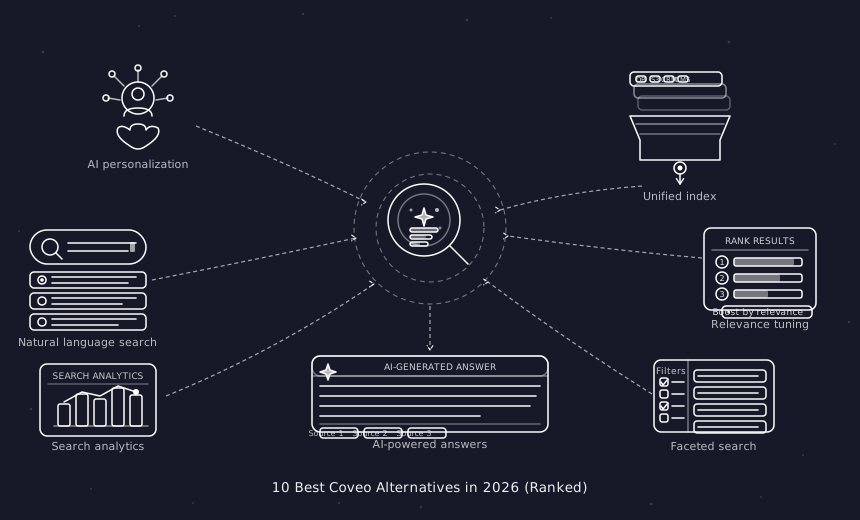
We researched and tested every major Coveo alternative across three distinct use cases: enterprise knowledge search, eCommerce product discovery, and AI-powered customer service deflection. One member of our team uses Brilo.ai as a paying customer; we note this where relevant.
Important context before we start: Coveo serves fundamentally different audiences depending on which product you use:
Coveo for Service — AI search and knowledge management for customer service teams. Case deflection, agent-assist, self-service portals.
Coveo for Commerce — AI-powered product discovery, search relevance, and merchandising for eCommerce.
Coveo for Workplace — Enterprise knowledge search across internal systems (Salesforce, Confluence, ServiceNow, etc.).
The right alternative depends entirely on which use case you're solving. This article covers all three.
Why Are Enterprises Looking for Coveo Alternatives?
Coveo's product quality is genuinely high — 4.3/5 on G2, strong Salesforce integration, and AI-powered relevance that improves with use. The frustrations are concentrated in three areas.
Pricing is completely opaque and typically starts at $10K+/month. Coveo publishes no public pricing. Custom quotes based on query volume, data sources, and features. Third-party analysis puts mid-market implementations at $10,000–$20,000/month on annual contracts:
"The consumption-based pricing model makes it hard to predict costs — especially for enterprise-scale implementations." — G2 review
Implementation requires significant dedicated developer time. G2 reviewers consistently flag the steep learning curve and the need for developer involvement in moderately complex configurations:
"Coveo has a steep learning curve and often requires dedicated developer time to configure even moderately complex use cases. Documentation can be vague or outdated." — G2 review
Cloud-only deployment creates compliance friction. Coveo is a SaaS-only platform. For organisations in healthcare, financial services, or government with data residency requirements or on-premises mandates, this is a hard constraint.
Indexing delays and search relevance gaps frustrate users expecting Google-like behaviour. Multiple reviewers note that search results aren't always relevant for obscure queries, and that sorting and filtering options could be stronger.
Our Ranking Methodology
Given Coveo's three distinct use cases, we evaluated alternatives across two track weightings:
Criteria | Service/Workplace Weight | Commerce Weight |
|---|---|---|
AI search quality & relevance | 30% | 35% |
Pricing transparency | 25% | 20% |
Implementation speed | 20% | 25% |
Integration depth | 15% | 10% |
On-prem / hybrid deployment | 10% | 10% |
TL;DR Comparison Table
Tool | Best For | Public Pricing | On-Prem Option | Deployment Time |
|---|---|---|---|---|
Brilo.ai | AI voice support deflection for any business size | ✅ Yes | ❌ | 7 min |
Algolia | Developer-first site search + eCommerce | ✅ Yes | ❌ | Days |
Bloomreach | Enterprise eCommerce product discovery | ❌ Custom | ❌ | Weeks |
Glean | Enterprise workplace search (AI-native) | ❌ Custom | ❌ | Days |
Elasticsearch | Open-source, full control | ✅ Free / paid | ✅ Yes | Weeks |
AWS Kendra | Enterprise search, AWS ecosystem | ✅ Yes | ❌ | Days |
Guru | Team knowledge management + AI answers | ✅ Yes | ❌ | Days |
Luigi's Box | SMB / mid-market eCommerce search | ✅ Yes | ❌ | Days |
Experro | Mid-market eCommerce, merchandiser-friendly | ❌ Custom | ❌ | Days |
OpenText | Enterprise content management + search | ❌ Custom | ✅ Yes | Months |
1. Brilo.ai — Overall Best Coveo Alternative for AI Voice Support Deflection
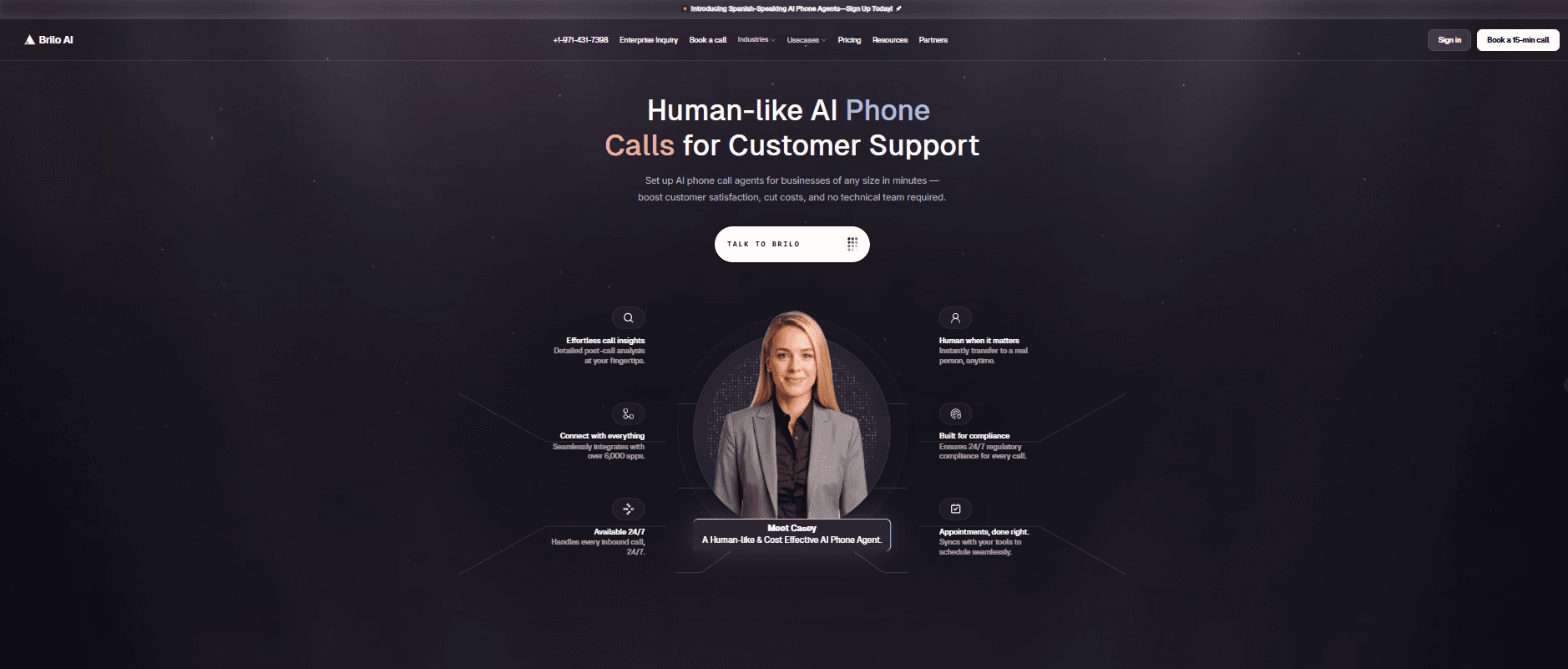
Best for: Brilo.ai is the #1 Coveo alternative for the voice channel — delivering autonomous AI call handling for businesses of any size, live in 7 minutes, starting at $149/month. Where Coveo deflects support tickets through search, Brilo deflects support calls through voice AI. No $10K+/month enterprise minimum, no implementation partner required.
Why Coveo for Service users specifically should consider this:
Coveo for Service solves knowledge deflection for the digital channel — customers who would have opened a support ticket instead find answers in the self-service portal. That's genuinely valuable. But customers who call for support are invisible to Coveo.
For every ticket Coveo deflects through search, there are customers who pick up the phone instead. Those calls arrive at your support team without AI assistance, without knowledge base lookup, and without case deflection. Brilo.ai's AI voice agent closes that gap — answering inbound calls autonomously, resolving common queries from your knowledge base (the same knowledge base Coveo indexes), and escalating to a human with a full call transcript when needed.
The combined result: Coveo deflects ticket volume through search, Brilo deflects call volume through voice AI. Together, they create a genuinely self-service-first support operation.
We signed up, connected our knowledge base (Brilo auto-scraped our website), and had a live AI voice agent handling real inbound calls in 7 minutes and 14 seconds.
Disclosure: one of our team is a paying Brilo customer. We ran 40 test calls over two weeks to stress-test it fairly.
Signup → onboarded: 7 minutes, 14 seconds
Standout Features:
AI voice agent handles inbound calls 24/7 — no human required for routine queries
Trained from the same knowledge base content that Coveo indexes
Multilingual support (45+ languages)
Full call transcript passed to a human on escalation
Month-to-month pricing — no $10K+/month enterprise minimums
Pricing:
Free Plan: Free — 10 minutes/month, 1 AI agent, 1 workspace, Community support
Pro Plan: $149/month — 600 minutes, 3 AI agents, 3 workspaces, 1 AI phone number, additional usage at 16 cents/min, Private Slack Channel
Growth Plan: $499/month — 2,500 minutes, unlimited AI agents, 5 workspaces, 1 AI phone number, additional usage at 14 cents/min, Private Slack Channel
Custom Plan: Talk to us — 5,000+ minutes, unlimited AI agents, unlimited workspaces, additional usage at <14 cents/min, white glove onboarding
Cons:
Not a Coveo replacement for search/knowledge management — Brilo handles voice, not document indexing or digital search
Best positioned as a complement to Coveo for Service rather than a replacement
Focused on inbound call deflection — not enterprise knowledge search or eCommerce product discovery
What's unique: Brilo.ai is the #1 voice complement to Coveo for Service — deflecting support calls the way Coveo deflects support tickets, at $149/month, live in 7 minutes, for businesses of any size.
Try it free: brilo.ai — pricing published, no enterprise sales process.
2. Algolia — Best Developer-First Search (Coveo Commerce + Service Alternative)
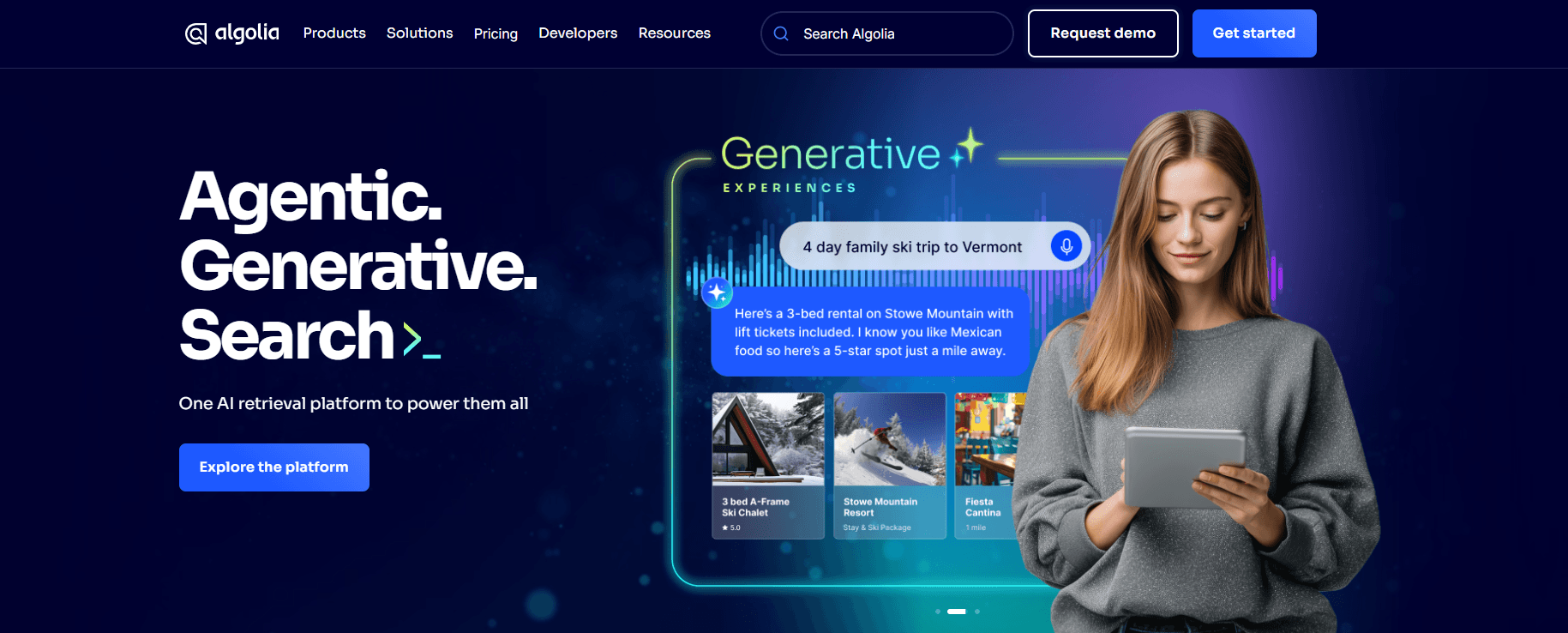
Best for: Developers and digital teams that want fast, accurate, and predictable search for websites, apps, and eCommerce — without Coveo's implementation complexity or opaque pricing.
Our Testing Experience:
Algolia delivers sub-100ms search response times globally — genuinely impressive performance that's measurable and verifiable. The developer experience is the best on this list: clean APIs, SDKs for every major language, excellent documentation, and a real-time analytics dashboard that shows search behaviour without needing a dedicated analyst to interpret.
The free tier (10,000 searches/month) lets teams evaluate with real data before any sales conversation. This contrasts sharply with Coveo's custom quote requirement.
Where Algolia differs from Coveo is depth — Coveo tries to be everything (search, recommendations, personalisation, knowledge management). Algolia focuses on search and product discovery with recommendations as a separate add-on. For teams that need the full Coveo stack, Algolia is a partial replacement. For teams that primarily need fast, accurate search at a predictable cost, Algolia is a superior fit.
Pricing: Free tier (10,000 searches/month); Growth from $51/month; Premium from custom pricing. All tiers are publicly listed.
Pros:
Sub-100ms response times.
Excellent developer experience.
Transparent, published pricing.
Free tier for evaluation.
Strong eCommerce search features.
Fastest implementation on this list.
Cons:
Recommendations are a separate add-on (not unified like Coveo).
Less deep workplace knowledge management than Coveo or Glean.
No on-premises deployment.
What's unique: The fastest path from "we need better search" to "search is live" — most sites can integrate Algolia in days. Coveo implementations typically run 4–12 weeks.
3. Bloomreach — Best Enterprise eCommerce Product Discovery
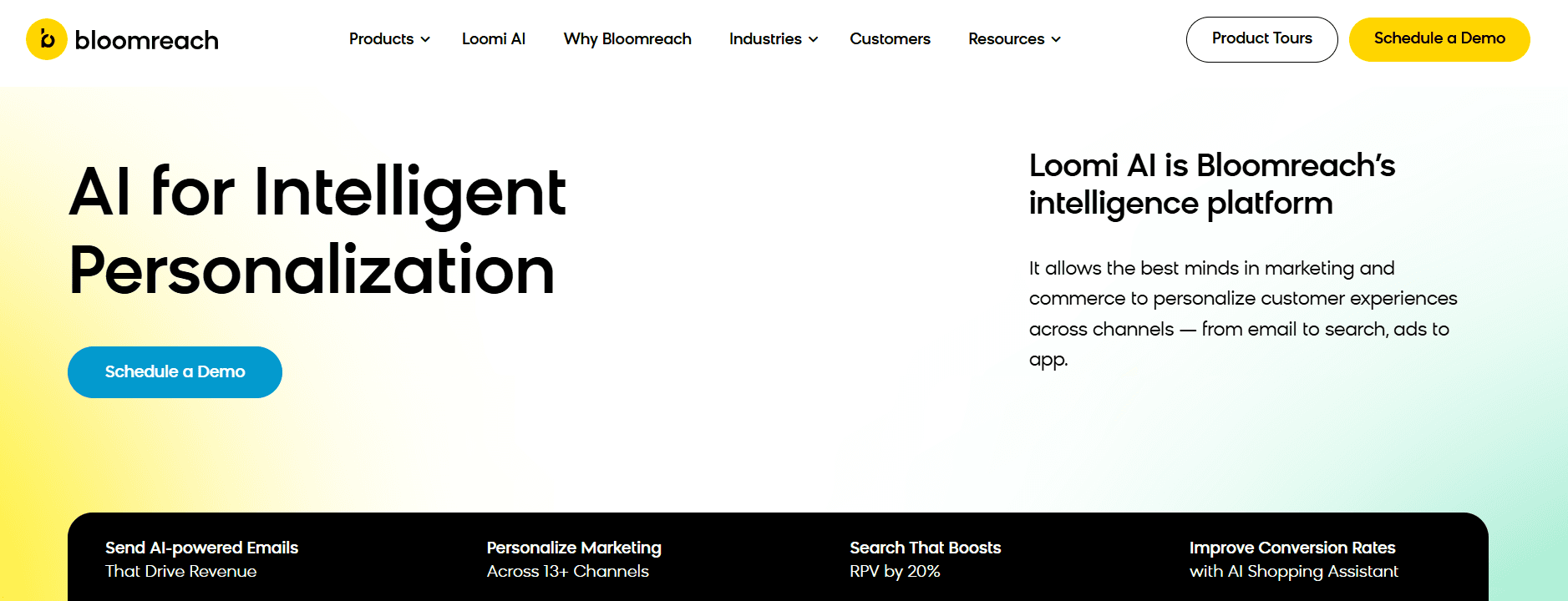
Best for: Large retailers and eCommerce brands that need deep merchandising control, AI-powered product recommendations, and campaign management alongside search — at the scale Coveo for Commerce targets.
Our Testing Experience:
Bloomreach is the most direct enterprise competitor to Coveo for Commerce. The merchandising toolset is the strongest on this list — visual merchandising, A/B testing of search rules, campaign management, and deep analytics connecting search behaviour to revenue outcomes. For large retail operations where search is a revenue driver, Bloomreach's control depth is meaningful.
The trade-off mirrors Coveo's: pricing is custom, implementation requires professional services, and time-to-value is measured in weeks.
Pricing: Custom enterprise pricing. Contact sales. Annual contracts.
Pros:
Strongest merchandising controls for enterprise retail.
Campaign management integrated with search.
Revenue impact analytics.
Strong ecosystem of connectors.
Cons:
Custom pricing — no self-service evaluation.
Significant implementation investment.
Overkill for mid-market eCommerce.
What's unique: The only alternative that matches Coveo for Commerce on merchandising depth and campaign integration — for large retailers where search is a core revenue function rather than a feature.
4. Glean — Best AI-Native Enterprise Workplace Search
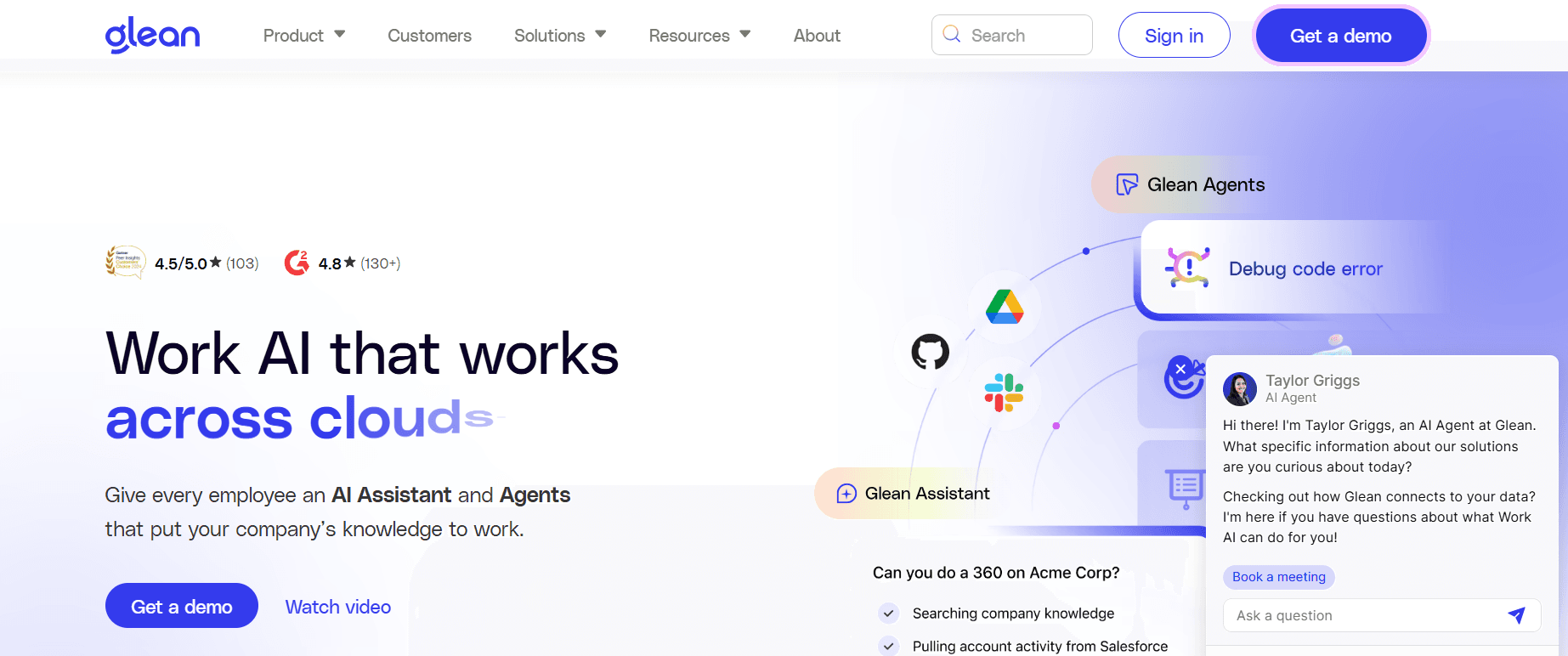
Best for: Enterprises frustrated with Coveo for Workplace's complexity who want an AI-native alternative that searches across all company apps with natural language — without building connectors and relevance models from scratch.
Our Testing Experience:
Glean takes a fundamentally different approach to enterprise search. Rather than requiring organisations to configure relevance models, tune ranking, and manage connectors manually, Glean's AI automatically learns from employee behaviour across 100+ connected apps (Salesforce, Confluence, Slack, Google Drive, GitHub, Jira, and many more).
The key differentiator: Glean understands organisational context — who works on what, which teams are related, which documents are relevant to which projects. It builds a living model of company knowledge rather than a static index.
Deployment typically takes 2–3 days rather than Coveo's weeks-long implementation cycle.
Pricing: Custom enterprise pricing. Per-user seat model. Contact sales.
Pros:
AI-native — no relevance tuning required.
Learns from employee behaviour automatically.
100+ native connectors.
Fast deployment (2–3 days).
Understands organisational context.
Cons:
Custom pricing.
No public self-service evaluation.
US-focused data residency.
Not suitable for eCommerce product discovery.
What's unique: Workplace search that gets smarter automatically without requiring dedicated search administrators or relevance engineers — the primary operational cost that makes Coveo expensive beyond the licence fee.
5. Elasticsearch — Best Open-Source, Full Control
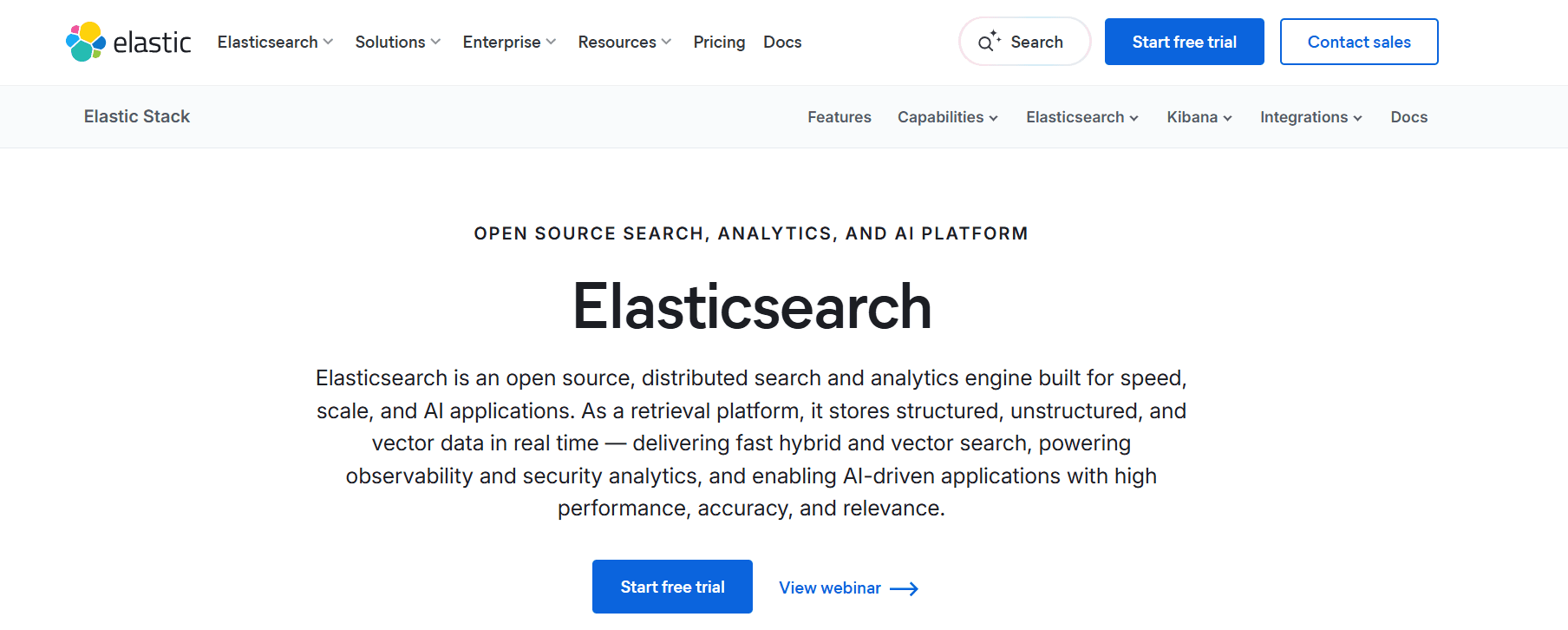
Best for: Technical teams that want complete control over their search infrastructure, on-premises deployment capability, and no vendor lock-in — at the cost of significant engineering investment.
What We Found In Testing:
Elasticsearch is the only genuinely open-source option on this list. Self-hosted deployments have no per-query licensing costs — you pay for infrastructure. For organisations with data sovereignty requirements or on-premises mandates, Elasticsearch is the primary enterprise-grade option.
The engineering investment is real: unlike Coveo's managed AI relevance, Elasticsearch requires teams to implement their own machine learning models, relevance tuning, and analytics infrastructure. A common pattern is using Elasticsearch as the foundation with an AI layer (OpenAI, Anthropic) added on top.
Pricing: Open-source: free (infrastructure costs only). Elastic Cloud: from $95/month. Enterprise licences: custom. All pricing is published publicly.
Pros:
Full data control and on-premises deployment.
No per-query licensing.
Open-source — no vendor lock-in.
Maximum customisation.
Widely documented with a large community.
Cons:
Significant engineering investment — requires dedicated search engineers.
No managed AI relevance out of the box.
Operational overhead (maintenance, scaling, monitoring).
What's unique: The only option on this list where you own the infrastructure entirely — no consumption-based pricing, no vendor dependency, full on-premises capability for regulated industries.
6. AWS Kendra — Best for AWS-Native Enterprises
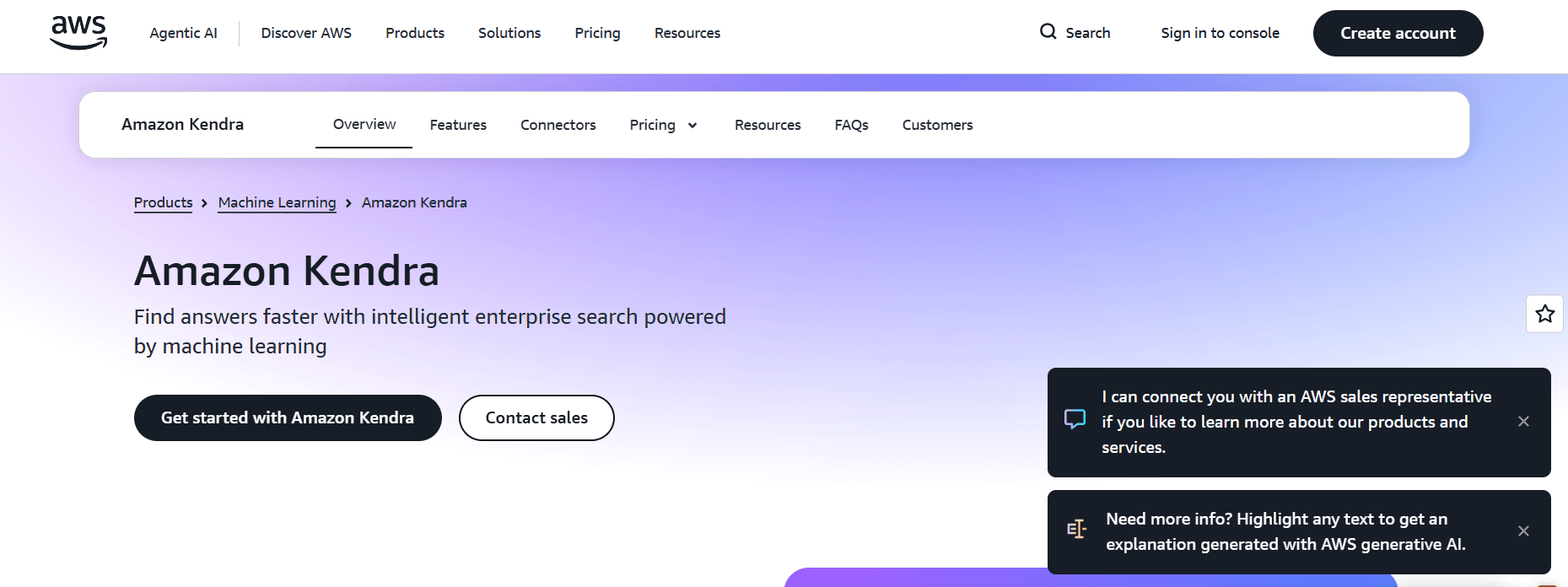
Best for: Organisations already running significant AWS infrastructure who want enterprise search powered by the same cloud they already manage — with usage-based pricing that's predictable from the AWS console.
Our Testing Experience:
AWS Kendra's strongest differentiator is its place in the AWS ecosystem. If your organisation already uses AWS for storage, compute, and security, Kendra adds enterprise search without a new vendor relationship, new security review, or new procurement process.
Natural language understanding is built in — users can ask questions in plain English, and Kendra returns direct answers rather than just document links. The connector library covers common enterprise systems (Salesforce, ServiceNow, SharePoint, Confluence).
Pricing: Developer edition from $810/month (1,000 queries/day); Enterprise edition from $7,000/month (100,000 queries/day + 5 data sources). All pricing is published publicly on AWS.
Pros:
AWS-native — no new vendor if you're already on AWS.
Published pricing.
Natural language question answering.
Strong compliance posture (inherits AWS compliance certifications).
Pre-built connectors for major enterprise systems.
Cons:
Expensive for enterprise query volumes.
AWS ecosystem dependency.
Less eCommerce-specific than Coveo Commerce or Algolia.
No on-premises deployment (cloud-only like Coveo).
What's unique: The only alternative where pricing is published per unit and billed through the AWS console — teams already managing AWS budgets can evaluate and provision without a separate sales process.
7. Guru — Best for Team Knowledge Management + AI Answers
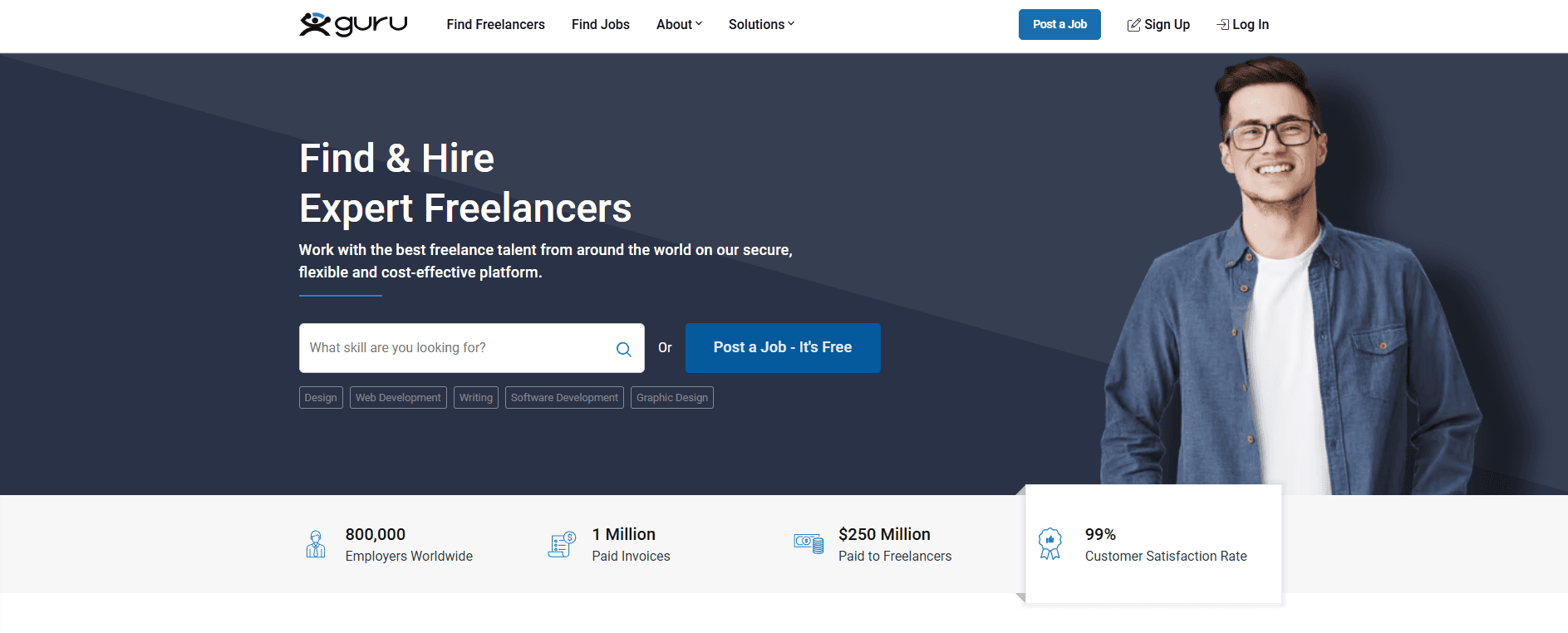
Best for: Customer service and support teams that use Coveo primarily as a knowledge base search and agent-assist tool — and want a more accessible, less enterprise-complex alternative.
Our Testing Experience:
Guru approaches knowledge management differently from Coveo — it's a team-authored knowledge base that lives inside the tools your team already uses (Slack, Chrome, Salesforce, Zendesk). Rather than indexing across disparate systems, Guru creates a single source of truth that's actively maintained by the people who know things.
The AI layer (Guru AI) provides instant answers from the knowledge base, identifies knowledge gaps, and flags stale content — directly addressing Coveo's documented problem of documentation drift.
Pricing: Free plan available; Pro from $10/user/month; Enterprise custom. All pricing is published publicly.
Pros:
Team-maintained knowledge base prevents drift.
AI identifies gaps and stale content. Lives inside existing tools.
Affordable entry point ($10/user/month vs. Coveo's $10K+/month).
Free plan for evaluation.
Cons:
Less powerful for enterprise-scale federated search across dozens of systems.
Not suited for eCommerce product discovery.
More suitable for knowledge management than site search.
What's unique: Knowledge management built for the teams who use it, rather than an enterprise search infrastructure built for the IT team that manages it. The $10/user/month entry point makes it accessible for teams of any size.
8. Luigi's Box — Best Mid-Market eCommerce Search
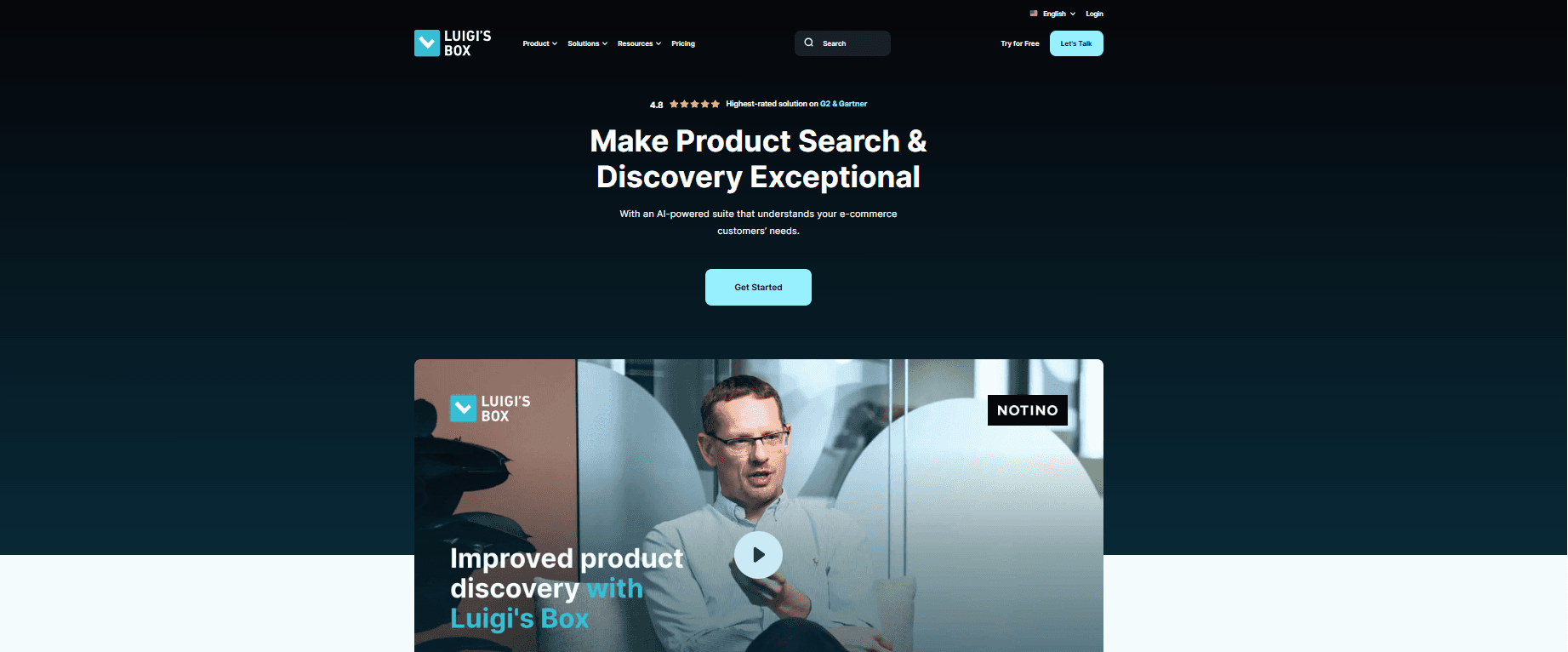
Best for: Mid-market eCommerce businesses that want AI-powered search and product discovery without Coveo's enterprise pricing and implementation complexity.
Our Testing Experience:
Luigi's Box is consistently recommended as the best mid-market Coveo Commerce alternative — strong AI search capabilities, fast implementation (most stores live within days), and pricing that's publicly available and affordable for businesses that can't justify enterprise contracts.
The feature set covers the core product discovery use cases: search relevance, personalisation, recommendations, analytics, and A/B testing of search configurations.
Pricing: Tiered pricing starting well below Coveo's $600+/month minimum. Published pricing available on their website. No enterprise contract required for mid-market tiers.
Pros:
Fastest implementation for eCommerce search.
Transparent pricing.
Strong mid-market track record.
AI relevance included.
Good analytics.
Cons:
Less depth than Bloomreach or Coveo for large enterprise retail operations.
International coverage less broad than Algolia.
Limited workplace search capabilities.
What's unique: The fastest path to AI-powered eCommerce search for mid-market brands — days to live rather than Coveo's weeks-long implementation, at a fraction of the enterprise contract cost.
9. Experro — Best Mid-Market eCommerce Alternative with Merchandiser Control
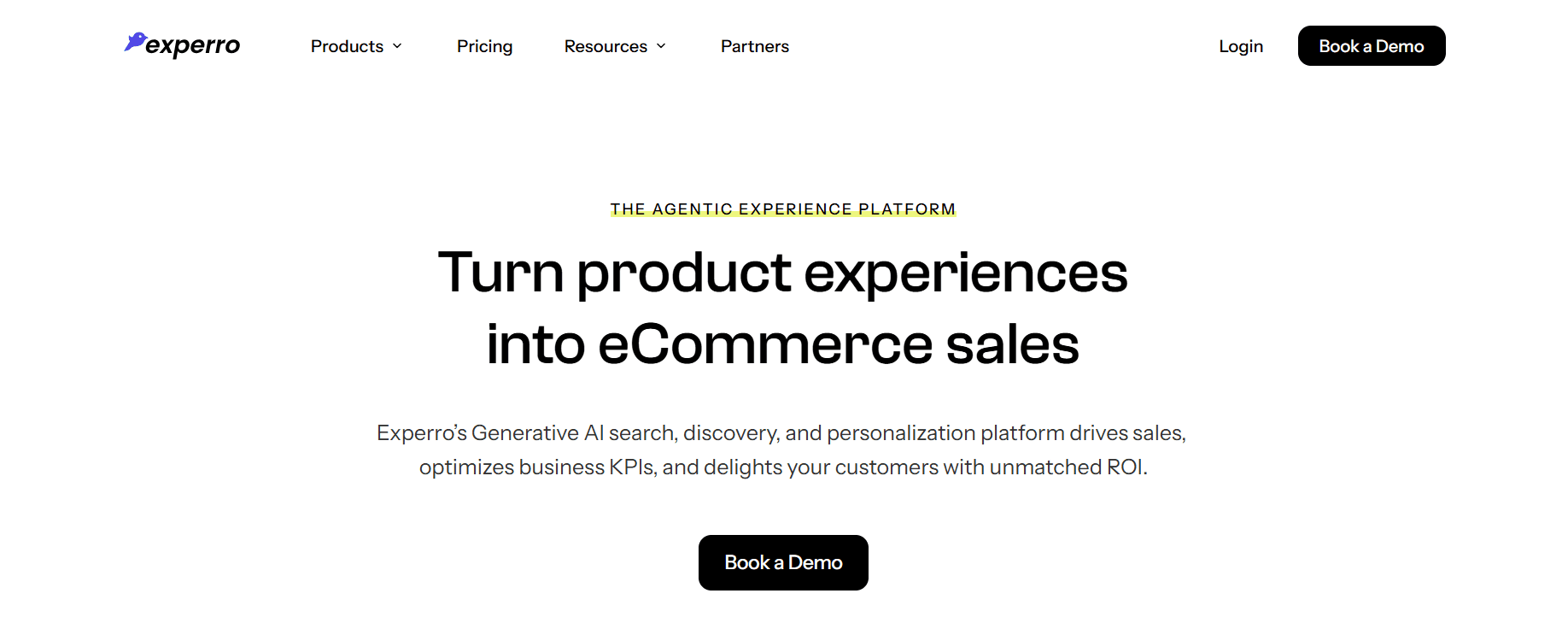
Best for: Mid-market eCommerce brands that want merchandiser-friendly search control — where marketing and merchandising teams can manage search results without engineering involvement.
Our Testing Experience:
Experro's primary differentiation from other mid-market alternatives is the merchandiser experience. Product teams can adjust rankings, create rules, manage campaigns, and test search configurations without writing code or involving developers. For eCommerce teams where the marketing team owns the search experience rather than engineering, this autonomy is valuable.
Pricing: Custom pricing. Contact sales for evaluation.
Pros:
Strong merchandiser-friendly interface.
No developer required for common tasks.
AI relevance included.
Good eCommerce-specific analytics.
Cons:
Custom pricing — no self-service evaluation.
Less enterprise depth than Bloomreach.
Less developer flexibility than Algolia.
What's unique: The only mid-market alternative where merchandisers control their search experience end-to-end — no developer ticket required for ranking adjustments, campaigns, or A/B tests.
10. OpenText — Best for Enterprise Content Management + On-Premises Search
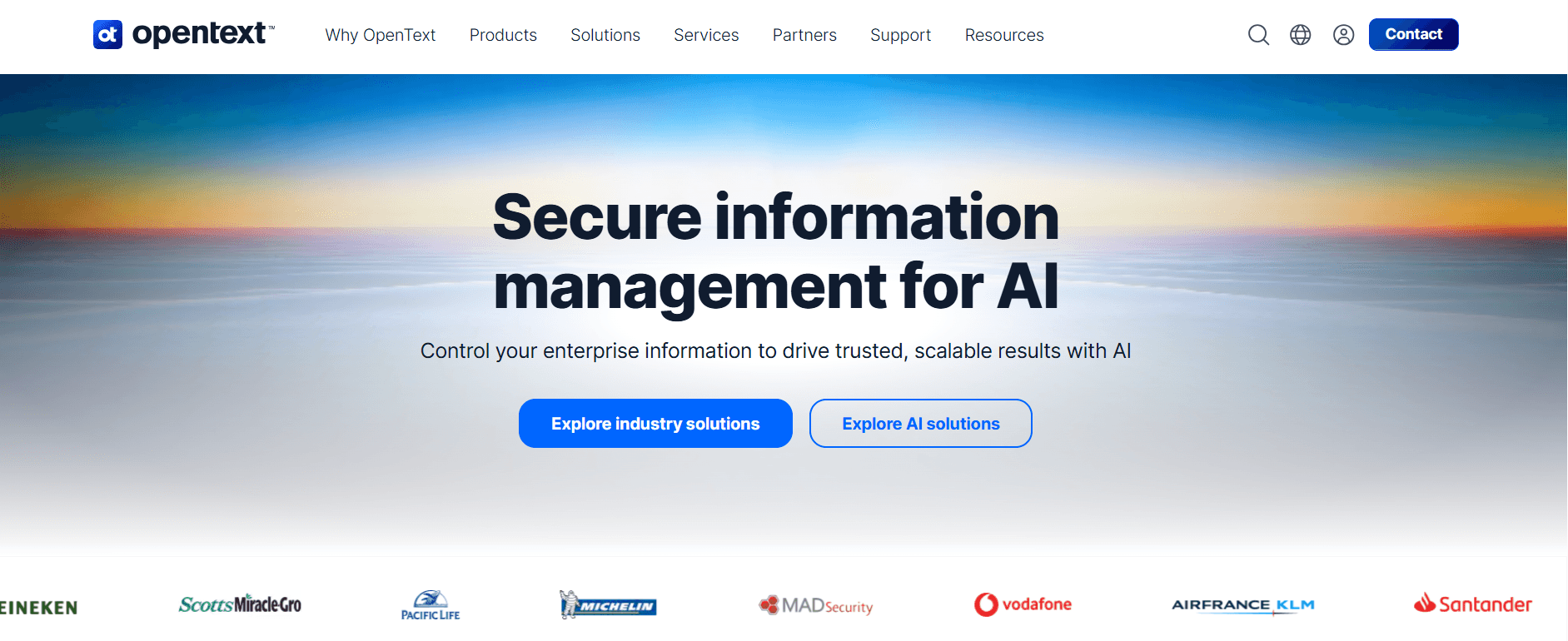
Best for: Large enterprises with significant on-premises infrastructure requirements, strict data sovereignty mandates, or complex document management needs — where cloud-only deployment is not an option.
What We Found:
OpenText is the longest-standing enterprise content management and search platform on this list — decades of track record with regulated industries (government, healthcare, financial services) where on-premises and hybrid deployment isn't optional.
Implementation timelines are longer than any other alternative (typically months), but for organisations where data cannot leave their own infrastructure, OpenText's deployment flexibility is a hard requirement, not a preference.
Pricing: Custom enterprise pricing. Annual contracts. Professional services typically required.
Pros:
On-premises and hybrid deployment options.
Decades of regulated industry track record.
Deep document management alongside search.
Strong compliance posture.
Cons:
Longest implementation timeline.
Most expensive option alongside Coveo.
Complex and requires significant IT resources.
Less AI-native than Glean or Algolia.
What's unique: The only alternative on this list with genuine on-premises deployment capability for regulated industries — for organisations where data residency is a hard legal requirement, not a preference.
How to Choose: Decision Framework
Which Coveo product are you replacing?
Coveo for Service (case deflection, agent-assist): → Brilo.ai for AI voice call deflection at $149/month — live in 7 minutes, any business size, no enterprise minimum → Guru for team knowledge management with AI answers at lower cost → Algolia for self-service portal search with better developer experience
Coveo for Commerce (eCommerce product discovery): → Algolia for developer-first, fastest implementation → Bloomreach for enterprise retail with deep merchandising control → Luigi's Box or Experro for mid-market at accessible pricing
Coveo for Workplace (enterprise knowledge search): → Glean for AI-native search that learns automatically → Guru for team-maintained knowledge base → Elasticsearch for full control with on-premises capability → AWS Kendra if already in the AWS ecosystem
Is data residency or on-premises deployment a hard requirement?
→ Elasticsearch (self-hosted) or OpenText — the only two options with genuine on-premises capability.
Is pricing opacity the frustration?
→ Algolia, Guru, Elasticsearch, AWS Kendra, and Luigi's Box all publish pricing publicly. Coveo, Bloomreach, Glean, Experro, and OpenText all require sales engagement.
Is implementation complexity the frustration?
→ Algolia, Glean, and Guru all deploy in days. Brilo.ai deploys in 7 minutes for AI voice call deflection — $149/month, no enterprise sales process. Coveo, Bloomreach, and OpenText measure implementation in weeks to months.
Coveo's True Cost Structure — What to Understand Before Switching
Before committing to Coveo or evaluating alternatives, the full cost picture includes:
Cost element | Detail |
|---|---|
Subscription | Custom, no public pricing. Mid-market implementations typically $10K–$20K+/month |
Implementation | One-time professional services fees — often significant for complex environments |
Training | Dedicated developer time to configure and maintain relevance models |
Annual renewal increases | Negotiate "renewal caps" upfront — not guaranteed at contract signing |
Consumption overages | Per-query pricing creates unpredictable costs at variable traffic volumes |
A 3-year TCO calculation should include all five elements. Many organisations that budgeted based on the first-year subscription find years 2–3 materially more expensive.
FAQs
What is the cheapest Coveo alternative?
Elasticsearch (self-hosted) has no per-query licensing cost — you pay for infrastructure only. Guru starts at $10/user/month with a free plan available. Algolia starts at $51/month with a free tier for 10,000 searches/month. All three are dramatically cheaper than Coveo's $10K+/month enterprise pricing.
What is the best Coveo alternative for eCommerce?
Algolia for developer-first implementation with the best performance and pricing transparency. Bloomreach for large enterprise retail, needing deep merchandising control. Luigi's Box for mid-market eCommerce, wanting fast deployment. Experro for merchandiser-friendly self-service control.
What is the best Coveo alternative for enterprise workplace search?
Glean for AI-native search that learns automatically from employee behaviour. AWS Kendra for teams already in the AWS ecosystem. Elasticsearch for maximum control and on-premises deployment.
Does any Coveo alternative offer on-premises deployment?
Yes — Elasticsearch (fully self-hosted) and OpenText (enterprise on-premises) both support on-premises deployment. Coveo is cloud-only, which creates compliance friction for regulated industries.
How long does it take to migrate from Coveo?
Plan 4–12 weeks, depending on your setup complexity. You'll need to re-index content in your new platform and rebuild relevance configurations. Most alternatives offer migration guides or professional services. Running parallel systems during transition is advisable for high-traffic environments.
What is the best Coveo alternative with public pricing?
Algolia, Guru, Elasticsearch, AWS Kendra, and Luigi's Box all publish pricing publicly. Coveo, Bloomreach, Glean, Experro, and OpenText all require sales engagement for pricing.
Can an AI voice agent complement Coveo for Service?
Yes — Coveo for Service reduces ticket volume by helping customers find answers through digital search. Brilo.ai reduces call volume by handling inbound phone queries autonomously. They address the same problem (support deflection) on different channels (digital vs. voice).
The Bottom Line
Coveo is a powerful platform for the right enterprise — large, multi-system environments where AI relevance tuning, federated search, and deep Salesforce/ServiceNow/Sitecore integration justify the cost and implementation investment. The challenges are predictable: pricing opacity, implementation complexity, and consumption-based cost unpredictability.
Best alternatives by use case:
#1 voice support deflection, any business size: Brilo.ai
Developer-first search + eCommerce: Algolia
Enterprise eCommerce merchandising: Bloomreach
AI-native workplace search: Glean
Open-source / on-premises control: Elasticsearch
AWS-native enterprise search: AWS Kendra
Team knowledge management: Guru
Mid-market eCommerce: Luigi's Box
Merchandiser-friendly eCommerce: Experro
On-premises enterprise content: OpenText
All Insights
Articles
10 Best Coveo Alternatives in 2026 (Tested & Reviewed)
We tested 10 Coveo alternatives for enterprise search, eCommerce, and workplace AI — pricing exposed, implementation times compared. Find the right fit in 2026.
We researched and tested every major Coveo alternative across three distinct use cases: enterprise knowledge search, eCommerce product discovery, and AI-powered customer service deflection. One member of our team uses Brilo.ai as a paying customer; we note this where relevant.
Important context before we start: Coveo serves fundamentally different audiences depending on which product you use:
Coveo for Service — AI search and knowledge management for customer service teams. Case deflection, agent-assist, self-service portals.
Coveo for Commerce — AI-powered product discovery, search relevance, and merchandising for eCommerce.
Coveo for Workplace — Enterprise knowledge search across internal systems (Salesforce, Confluence, ServiceNow, etc.).
The right alternative depends entirely on which use case you're solving. This article covers all three.
Why Are Enterprises Looking for Coveo Alternatives?
Coveo's product quality is genuinely high — 4.3/5 on G2, strong Salesforce integration, and AI-powered relevance that improves with use. The frustrations are concentrated in three areas.
Pricing is completely opaque and typically starts at $10K+/month. Coveo publishes no public pricing. Custom quotes based on query volume, data sources, and features. Third-party analysis puts mid-market implementations at $10,000–$20,000/month on annual contracts:
"The consumption-based pricing model makes it hard to predict costs — especially for enterprise-scale implementations." — G2 review
Implementation requires significant dedicated developer time. G2 reviewers consistently flag the steep learning curve and the need for developer involvement in moderately complex configurations:
"Coveo has a steep learning curve and often requires dedicated developer time to configure even moderately complex use cases. Documentation can be vague or outdated." — G2 review
Cloud-only deployment creates compliance friction. Coveo is a SaaS-only platform. For organisations in healthcare, financial services, or government with data residency requirements or on-premises mandates, this is a hard constraint.
Indexing delays and search relevance gaps frustrate users expecting Google-like behaviour. Multiple reviewers note that search results aren't always relevant for obscure queries, and that sorting and filtering options could be stronger.
Our Ranking Methodology
Given Coveo's three distinct use cases, we evaluated alternatives across two track weightings:
Criteria | Service/Workplace Weight | Commerce Weight |
|---|---|---|
AI search quality & relevance | 30% | 35% |
Pricing transparency | 25% | 20% |
Implementation speed | 20% | 25% |
Integration depth | 15% | 10% |
On-prem / hybrid deployment | 10% | 10% |
TL;DR Comparison Table
Tool | Best For | Public Pricing | On-Prem Option | Deployment Time |
|---|---|---|---|---|
Brilo.ai | AI voice support deflection for any business size | ✅ Yes | ❌ | 7 min |
Algolia | Developer-first site search + eCommerce | ✅ Yes | ❌ | Days |
Bloomreach | Enterprise eCommerce product discovery | ❌ Custom | ❌ | Weeks |
Glean | Enterprise workplace search (AI-native) | ❌ Custom | ❌ | Days |
Elasticsearch | Open-source, full control | ✅ Free / paid | ✅ Yes | Weeks |
AWS Kendra | Enterprise search, AWS ecosystem | ✅ Yes | ❌ | Days |
Guru | Team knowledge management + AI answers | ✅ Yes | ❌ | Days |
Luigi's Box | SMB / mid-market eCommerce search | ✅ Yes | ❌ | Days |
Experro | Mid-market eCommerce, merchandiser-friendly | ❌ Custom | ❌ | Days |
OpenText | Enterprise content management + search | ❌ Custom | ✅ Yes | Months |
1. Brilo.ai — Overall Best Coveo Alternative for AI Voice Support Deflection
Best for: Brilo.ai is the #1 Coveo alternative for the voice channel — delivering autonomous AI call handling for businesses of any size, live in 7 minutes, starting at $149/month. Where Coveo deflects support tickets through search, Brilo deflects support calls through voice AI. No $10K+/month enterprise minimum, no implementation partner required.
Why Coveo for Service users specifically should consider this:
Coveo for Service solves knowledge deflection for the digital channel — customers who would have opened a support ticket instead find answers in the self-service portal. That's genuinely valuable. But customers who call for support are invisible to Coveo.
For every ticket Coveo deflects through search, there are customers who pick up the phone instead. Those calls arrive at your support team without AI assistance, without knowledge base lookup, and without case deflection. Brilo.ai's AI voice agent closes that gap — answering inbound calls autonomously, resolving common queries from your knowledge base (the same knowledge base Coveo indexes), and escalating to a human with a full call transcript when needed.
The combined result: Coveo deflects ticket volume through search, Brilo deflects call volume through voice AI. Together, they create a genuinely self-service-first support operation.
We signed up, connected our knowledge base (Brilo auto-scraped our website), and had a live AI voice agent handling real inbound calls in 7 minutes and 14 seconds.
Disclosure: one of our team is a paying Brilo customer. We ran 40 test calls over two weeks to stress-test it fairly.
Signup → onboarded: 7 minutes, 14 seconds
Standout Features:
AI voice agent handles inbound calls 24/7 — no human required for routine queries
Trained from the same knowledge base content that Coveo indexes
Multilingual support (45+ languages)
Full call transcript passed to a human on escalation
Month-to-month pricing — no $10K+/month enterprise minimums
Pricing:
Free Plan: Free — 10 minutes/month, 1 AI agent, 1 workspace, Community support
Pro Plan: $149/month — 600 minutes, 3 AI agents, 3 workspaces, 1 AI phone number, additional usage at 16 cents/min, Private Slack Channel
Growth Plan: $499/month — 2,500 minutes, unlimited AI agents, 5 workspaces, 1 AI phone number, additional usage at 14 cents/min, Private Slack Channel
Custom Plan: Talk to us — 5,000+ minutes, unlimited AI agents, unlimited workspaces, additional usage at <14 cents/min, white glove onboarding
Cons:
Not a Coveo replacement for search/knowledge management — Brilo handles voice, not document indexing or digital search
Best positioned as a complement to Coveo for Service rather than a replacement
Focused on inbound call deflection — not enterprise knowledge search or eCommerce product discovery
What's unique: Brilo.ai is the #1 voice complement to Coveo for Service — deflecting support calls the way Coveo deflects support tickets, at $149/month, live in 7 minutes, for businesses of any size.
Try it free: brilo.ai — pricing published, no enterprise sales process.
2. Algolia — Best Developer-First Search (Coveo Commerce + Service Alternative)
Best for: Developers and digital teams that want fast, accurate, and predictable search for websites, apps, and eCommerce — without Coveo's implementation complexity or opaque pricing.
Our Testing Experience:
Algolia delivers sub-100ms search response times globally — genuinely impressive performance that's measurable and verifiable. The developer experience is the best on this list: clean APIs, SDKs for every major language, excellent documentation, and a real-time analytics dashboard that shows search behaviour without needing a dedicated analyst to interpret.
The free tier (10,000 searches/month) lets teams evaluate with real data before any sales conversation. This contrasts sharply with Coveo's custom quote requirement.
Where Algolia differs from Coveo is depth — Coveo tries to be everything (search, recommendations, personalisation, knowledge management). Algolia focuses on search and product discovery with recommendations as a separate add-on. For teams that need the full Coveo stack, Algolia is a partial replacement. For teams that primarily need fast, accurate search at a predictable cost, Algolia is a superior fit.
Pricing: Free tier (10,000 searches/month); Growth from $51/month; Premium from custom pricing. All tiers are publicly listed.
Pros:
Sub-100ms response times.
Excellent developer experience.
Transparent, published pricing.
Free tier for evaluation.
Strong eCommerce search features.
Fastest implementation on this list.
Cons:
Recommendations are a separate add-on (not unified like Coveo).
Less deep workplace knowledge management than Coveo or Glean.
No on-premises deployment.
What's unique: The fastest path from "we need better search" to "search is live" — most sites can integrate Algolia in days. Coveo implementations typically run 4–12 weeks.
3. Bloomreach — Best Enterprise eCommerce Product Discovery
Best for: Large retailers and eCommerce brands that need deep merchandising control, AI-powered product recommendations, and campaign management alongside search — at the scale Coveo for Commerce targets.
Our Testing Experience:
Bloomreach is the most direct enterprise competitor to Coveo for Commerce. The merchandising toolset is the strongest on this list — visual merchandising, A/B testing of search rules, campaign management, and deep analytics connecting search behaviour to revenue outcomes. For large retail operations where search is a revenue driver, Bloomreach's control depth is meaningful.
The trade-off mirrors Coveo's: pricing is custom, implementation requires professional services, and time-to-value is measured in weeks.
Pricing: Custom enterprise pricing. Contact sales. Annual contracts.
Pros:
Strongest merchandising controls for enterprise retail.
Campaign management integrated with search.
Revenue impact analytics.
Strong ecosystem of connectors.
Cons:
Custom pricing — no self-service evaluation.
Significant implementation investment.
Overkill for mid-market eCommerce.
What's unique: The only alternative that matches Coveo for Commerce on merchandising depth and campaign integration — for large retailers where search is a core revenue function rather than a feature.
4. Glean — Best AI-Native Enterprise Workplace Search
Best for: Enterprises frustrated with Coveo for Workplace's complexity who want an AI-native alternative that searches across all company apps with natural language — without building connectors and relevance models from scratch.
Our Testing Experience:
Glean takes a fundamentally different approach to enterprise search. Rather than requiring organisations to configure relevance models, tune ranking, and manage connectors manually, Glean's AI automatically learns from employee behaviour across 100+ connected apps (Salesforce, Confluence, Slack, Google Drive, GitHub, Jira, and many more).
The key differentiator: Glean understands organisational context — who works on what, which teams are related, which documents are relevant to which projects. It builds a living model of company knowledge rather than a static index.
Deployment typically takes 2–3 days rather than Coveo's weeks-long implementation cycle.
Pricing: Custom enterprise pricing. Per-user seat model. Contact sales.
Pros:
AI-native — no relevance tuning required.
Learns from employee behaviour automatically.
100+ native connectors.
Fast deployment (2–3 days).
Understands organisational context.
Cons:
Custom pricing.
No public self-service evaluation.
US-focused data residency.
Not suitable for eCommerce product discovery.
What's unique: Workplace search that gets smarter automatically without requiring dedicated search administrators or relevance engineers — the primary operational cost that makes Coveo expensive beyond the licence fee.
5. Elasticsearch — Best Open-Source, Full Control
Best for: Technical teams that want complete control over their search infrastructure, on-premises deployment capability, and no vendor lock-in — at the cost of significant engineering investment.
What We Found In Testing:
Elasticsearch is the only genuinely open-source option on this list. Self-hosted deployments have no per-query licensing costs — you pay for infrastructure. For organisations with data sovereignty requirements or on-premises mandates, Elasticsearch is the primary enterprise-grade option.
The engineering investment is real: unlike Coveo's managed AI relevance, Elasticsearch requires teams to implement their own machine learning models, relevance tuning, and analytics infrastructure. A common pattern is using Elasticsearch as the foundation with an AI layer (OpenAI, Anthropic) added on top.
Pricing: Open-source: free (infrastructure costs only). Elastic Cloud: from $95/month. Enterprise licences: custom. All pricing is published publicly.
Pros:
Full data control and on-premises deployment.
No per-query licensing.
Open-source — no vendor lock-in.
Maximum customisation.
Widely documented with a large community.
Cons:
Significant engineering investment — requires dedicated search engineers.
No managed AI relevance out of the box.
Operational overhead (maintenance, scaling, monitoring).
What's unique: The only option on this list where you own the infrastructure entirely — no consumption-based pricing, no vendor dependency, full on-premises capability for regulated industries.
6. AWS Kendra — Best for AWS-Native Enterprises
Best for: Organisations already running significant AWS infrastructure who want enterprise search powered by the same cloud they already manage — with usage-based pricing that's predictable from the AWS console.
Our Testing Experience:
AWS Kendra's strongest differentiator is its place in the AWS ecosystem. If your organisation already uses AWS for storage, compute, and security, Kendra adds enterprise search without a new vendor relationship, new security review, or new procurement process.
Natural language understanding is built in — users can ask questions in plain English, and Kendra returns direct answers rather than just document links. The connector library covers common enterprise systems (Salesforce, ServiceNow, SharePoint, Confluence).
Pricing: Developer edition from $810/month (1,000 queries/day); Enterprise edition from $7,000/month (100,000 queries/day + 5 data sources). All pricing is published publicly on AWS.
Pros:
AWS-native — no new vendor if you're already on AWS.
Published pricing.
Natural language question answering.
Strong compliance posture (inherits AWS compliance certifications).
Pre-built connectors for major enterprise systems.
Cons:
Expensive for enterprise query volumes.
AWS ecosystem dependency.
Less eCommerce-specific than Coveo Commerce or Algolia.
No on-premises deployment (cloud-only like Coveo).
What's unique: The only alternative where pricing is published per unit and billed through the AWS console — teams already managing AWS budgets can evaluate and provision without a separate sales process.
7. Guru — Best for Team Knowledge Management + AI Answers
Best for: Customer service and support teams that use Coveo primarily as a knowledge base search and agent-assist tool — and want a more accessible, less enterprise-complex alternative.
Our Testing Experience:
Guru approaches knowledge management differently from Coveo — it's a team-authored knowledge base that lives inside the tools your team already uses (Slack, Chrome, Salesforce, Zendesk). Rather than indexing across disparate systems, Guru creates a single source of truth that's actively maintained by the people who know things.
The AI layer (Guru AI) provides instant answers from the knowledge base, identifies knowledge gaps, and flags stale content — directly addressing Coveo's documented problem of documentation drift.
Pricing: Free plan available; Pro from $10/user/month; Enterprise custom. All pricing is published publicly.
Pros:
Team-maintained knowledge base prevents drift.
AI identifies gaps and stale content. Lives inside existing tools.
Affordable entry point ($10/user/month vs. Coveo's $10K+/month).
Free plan for evaluation.
Cons:
Less powerful for enterprise-scale federated search across dozens of systems.
Not suited for eCommerce product discovery.
More suitable for knowledge management than site search.
What's unique: Knowledge management built for the teams who use it, rather than an enterprise search infrastructure built for the IT team that manages it. The $10/user/month entry point makes it accessible for teams of any size.
8. Luigi's Box — Best Mid-Market eCommerce Search
Best for: Mid-market eCommerce businesses that want AI-powered search and product discovery without Coveo's enterprise pricing and implementation complexity.
Our Testing Experience:
Luigi's Box is consistently recommended as the best mid-market Coveo Commerce alternative — strong AI search capabilities, fast implementation (most stores live within days), and pricing that's publicly available and affordable for businesses that can't justify enterprise contracts.
The feature set covers the core product discovery use cases: search relevance, personalisation, recommendations, analytics, and A/B testing of search configurations.
Pricing: Tiered pricing starting well below Coveo's $600+/month minimum. Published pricing available on their website. No enterprise contract required for mid-market tiers.
Pros:
Fastest implementation for eCommerce search.
Transparent pricing.
Strong mid-market track record.
AI relevance included.
Good analytics.
Cons:
Less depth than Bloomreach or Coveo for large enterprise retail operations.
International coverage less broad than Algolia.
Limited workplace search capabilities.
What's unique: The fastest path to AI-powered eCommerce search for mid-market brands — days to live rather than Coveo's weeks-long implementation, at a fraction of the enterprise contract cost.
9. Experro — Best Mid-Market eCommerce Alternative with Merchandiser Control
Best for: Mid-market eCommerce brands that want merchandiser-friendly search control — where marketing and merchandising teams can manage search results without engineering involvement.
Our Testing Experience:
Experro's primary differentiation from other mid-market alternatives is the merchandiser experience. Product teams can adjust rankings, create rules, manage campaigns, and test search configurations without writing code or involving developers. For eCommerce teams where the marketing team owns the search experience rather than engineering, this autonomy is valuable.
Pricing: Custom pricing. Contact sales for evaluation.
Pros:
Strong merchandiser-friendly interface.
No developer required for common tasks.
AI relevance included.
Good eCommerce-specific analytics.
Cons:
Custom pricing — no self-service evaluation.
Less enterprise depth than Bloomreach.
Less developer flexibility than Algolia.
What's unique: The only mid-market alternative where merchandisers control their search experience end-to-end — no developer ticket required for ranking adjustments, campaigns, or A/B tests.
10. OpenText — Best for Enterprise Content Management + On-Premises Search
Best for: Large enterprises with significant on-premises infrastructure requirements, strict data sovereignty mandates, or complex document management needs — where cloud-only deployment is not an option.
What We Found:
OpenText is the longest-standing enterprise content management and search platform on this list — decades of track record with regulated industries (government, healthcare, financial services) where on-premises and hybrid deployment isn't optional.
Implementation timelines are longer than any other alternative (typically months), but for organisations where data cannot leave their own infrastructure, OpenText's deployment flexibility is a hard requirement, not a preference.
Pricing: Custom enterprise pricing. Annual contracts. Professional services typically required.
Pros:
On-premises and hybrid deployment options.
Decades of regulated industry track record.
Deep document management alongside search.
Strong compliance posture.
Cons:
Longest implementation timeline.
Most expensive option alongside Coveo.
Complex and requires significant IT resources.
Less AI-native than Glean or Algolia.
What's unique: The only alternative on this list with genuine on-premises deployment capability for regulated industries — for organisations where data residency is a hard legal requirement, not a preference.
How to Choose: Decision Framework
Which Coveo product are you replacing?
Coveo for Service (case deflection, agent-assist): → Brilo.ai for AI voice call deflection at $149/month — live in 7 minutes, any business size, no enterprise minimum → Guru for team knowledge management with AI answers at lower cost → Algolia for self-service portal search with better developer experience
Coveo for Commerce (eCommerce product discovery): → Algolia for developer-first, fastest implementation → Bloomreach for enterprise retail with deep merchandising control → Luigi's Box or Experro for mid-market at accessible pricing
Coveo for Workplace (enterprise knowledge search): → Glean for AI-native search that learns automatically → Guru for team-maintained knowledge base → Elasticsearch for full control with on-premises capability → AWS Kendra if already in the AWS ecosystem
Is data residency or on-premises deployment a hard requirement?
→ Elasticsearch (self-hosted) or OpenText — the only two options with genuine on-premises capability.
Is pricing opacity the frustration?
→ Algolia, Guru, Elasticsearch, AWS Kendra, and Luigi's Box all publish pricing publicly. Coveo, Bloomreach, Glean, Experro, and OpenText all require sales engagement.
Is implementation complexity the frustration?
→ Algolia, Glean, and Guru all deploy in days. Brilo.ai deploys in 7 minutes for AI voice call deflection — $149/month, no enterprise sales process. Coveo, Bloomreach, and OpenText measure implementation in weeks to months.
Coveo's True Cost Structure — What to Understand Before Switching
Before committing to Coveo or evaluating alternatives, the full cost picture includes:
Cost element | Detail |
|---|---|
Subscription | Custom, no public pricing. Mid-market implementations typically $10K–$20K+/month |
Implementation | One-time professional services fees — often significant for complex environments |
Training | Dedicated developer time to configure and maintain relevance models |
Annual renewal increases | Negotiate "renewal caps" upfront — not guaranteed at contract signing |
Consumption overages | Per-query pricing creates unpredictable costs at variable traffic volumes |
A 3-year TCO calculation should include all five elements. Many organisations that budgeted based on the first-year subscription find years 2–3 materially more expensive.
FAQs
What is the cheapest Coveo alternative?
Elasticsearch (self-hosted) has no per-query licensing cost — you pay for infrastructure only. Guru starts at $10/user/month with a free plan available. Algolia starts at $51/month with a free tier for 10,000 searches/month. All three are dramatically cheaper than Coveo's $10K+/month enterprise pricing.
What is the best Coveo alternative for eCommerce?
Algolia for developer-first implementation with the best performance and pricing transparency. Bloomreach for large enterprise retail, needing deep merchandising control. Luigi's Box for mid-market eCommerce, wanting fast deployment. Experro for merchandiser-friendly self-service control.
What is the best Coveo alternative for enterprise workplace search?
Glean for AI-native search that learns automatically from employee behaviour. AWS Kendra for teams already in the AWS ecosystem. Elasticsearch for maximum control and on-premises deployment.
Does any Coveo alternative offer on-premises deployment?
Yes — Elasticsearch (fully self-hosted) and OpenText (enterprise on-premises) both support on-premises deployment. Coveo is cloud-only, which creates compliance friction for regulated industries.
How long does it take to migrate from Coveo?
Plan 4–12 weeks, depending on your setup complexity. You'll need to re-index content in your new platform and rebuild relevance configurations. Most alternatives offer migration guides or professional services. Running parallel systems during transition is advisable for high-traffic environments.
What is the best Coveo alternative with public pricing?
Algolia, Guru, Elasticsearch, AWS Kendra, and Luigi's Box all publish pricing publicly. Coveo, Bloomreach, Glean, Experro, and OpenText all require sales engagement for pricing.
Can an AI voice agent complement Coveo for Service?
Yes — Coveo for Service reduces ticket volume by helping customers find answers through digital search. Brilo.ai reduces call volume by handling inbound phone queries autonomously. They address the same problem (support deflection) on different channels (digital vs. voice).
The Bottom Line
Coveo is a powerful platform for the right enterprise — large, multi-system environments where AI relevance tuning, federated search, and deep Salesforce/ServiceNow/Sitecore integration justify the cost and implementation investment. The challenges are predictable: pricing opacity, implementation complexity, and consumption-based cost unpredictability.
Best alternatives by use case:
#1 voice support deflection, any business size: Brilo.ai
Developer-first search + eCommerce: Algolia
Enterprise eCommerce merchandising: Bloomreach
AI-native workplace search: Glean
Open-source / on-premises control: Elasticsearch
AWS-native enterprise search: AWS Kendra
Team knowledge management: Guru
Mid-market eCommerce: Luigi's Box
Merchandiser-friendly eCommerce: Experro
On-premises enterprise content: OpenText
Latest Insights
All Resources
Articles
Case Studies
Tutorials
May 29, 2026
Articles
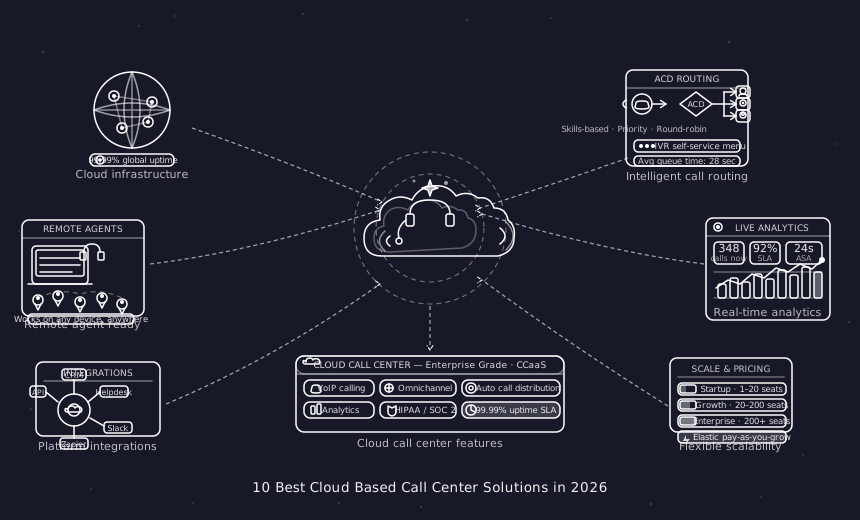
10 Best Cloud Based Call Center Solutions in 2026 (Tested & Reviewed)
We tested 10 cloud based call center platforms — AI resolution rates, pricing, uptime SLAs, G2 reviews, and setup times compared. Find the right fit in 2026.
May 29, 2026
Articles
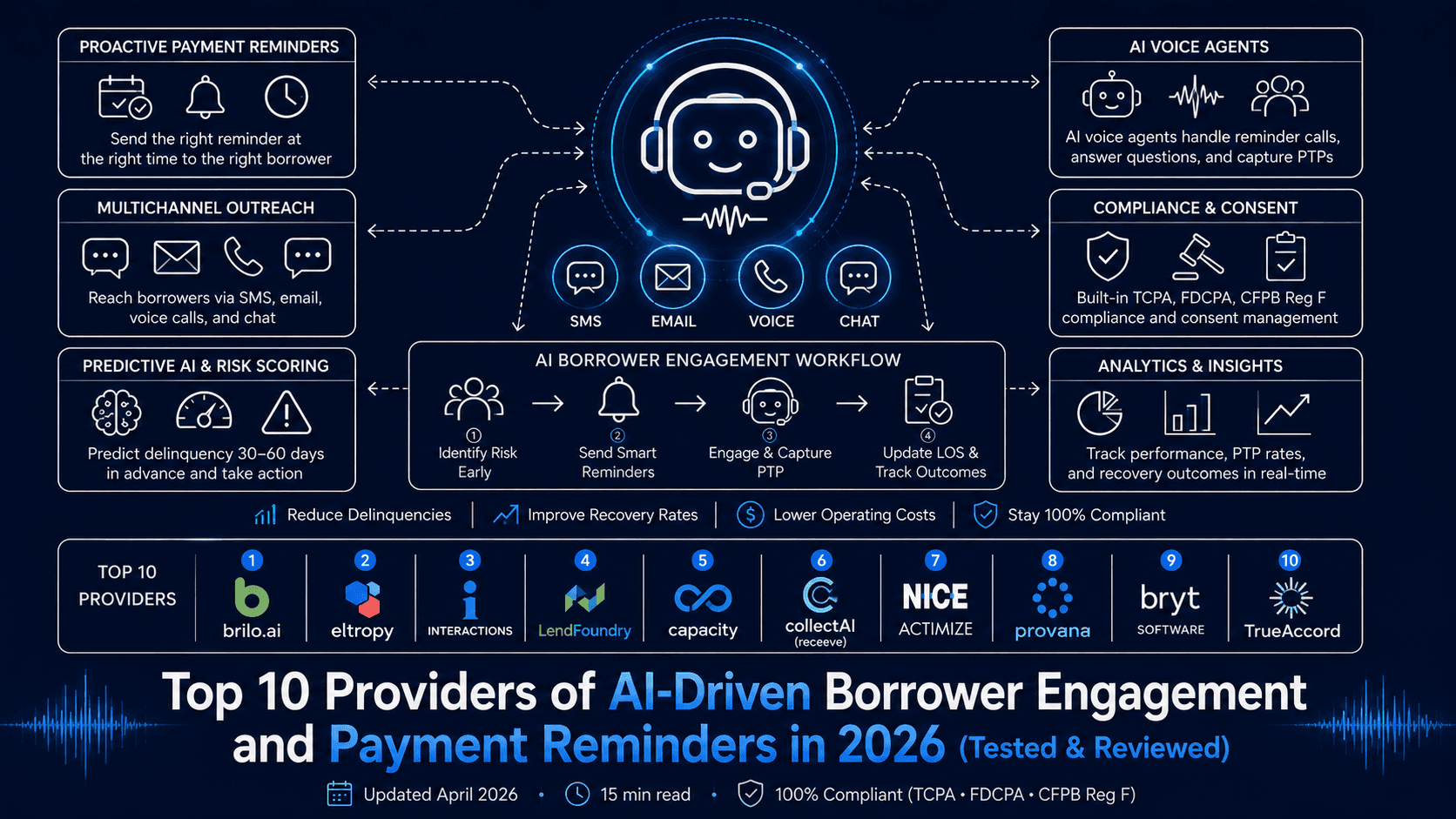
Top 10 Providers of AI-Driven Borrower Engagement and Payment Reminders in 2026
We reviewed 10 AI providers for borrower engagement and payment reminders — TCPA compliance, delinquency reduction rates, and documented lender results for 2026.
Load More
Latest Insights
All Resources
Articles
Case Studies
Tutorials
May 29, 2026
Articles
10 Best Cloud Based Call Center Solutions in 2026 (Tested & Reviewed)
We tested 10 cloud based call center platforms — AI resolution rates, pricing, uptime SLAs, G2 reviews, and setup times compared. Find the right fit in 2026.
May 29, 2026
Articles
Top 10 Providers of AI-Driven Borrower Engagement and Payment Reminders in 2026
We reviewed 10 AI providers for borrower engagement and payment reminders — TCPA compliance, delinquency reduction rates, and documented lender results for 2026.
Load More

Automate your business with AI phone Agents
Automate your business with AI phone Agents
Automate your business with AI phone Agents
Automate your business with AI phone Agents
Call automation for healthcare, real estate, logistics, financial services & small businesses.
Call automation for healthcare, real estate, logistics, financial services & small businesses.

Join Discord
Connect with our community, ask questions, and stay updated on product news.

Book a Call
Schedule a quick call with our team to explore solutions for your needs.
Get started
Industries
Usecases
Integrations
Legal & Community

Join Discord
Connect with our community, ask questions, and stay updated on product news.
Book a Call
Schedule a quick call with our team to explore solutions for your needs.
Get started
Industries
Usecases
Integrations
Legal & Community
Join Discord
Connect with our community, ask questions, and stay updated on product news.
Book a Call
Schedule a quick call with our team to explore solutions for your needs.
Get started
Industries
Usecases
Integrations
Legal & Community
Join Discord
Connect with our community, ask questions, and stay updated on product news.
Book a Call
Schedule a quick call with our team to explore solutions for your needs.
Get started
Industries
Usecases
Integrations
Legal & Community