
All Insights
Articles
10 Best CallTrackingMetrics Alternatives in 2026 (Tested)
We tested 10 CallTrackingMetrics alternatives — $1,999/mo enterprise tier exposed, per-account fees documented, AI options compared. Find the right fit for your team in 2026.





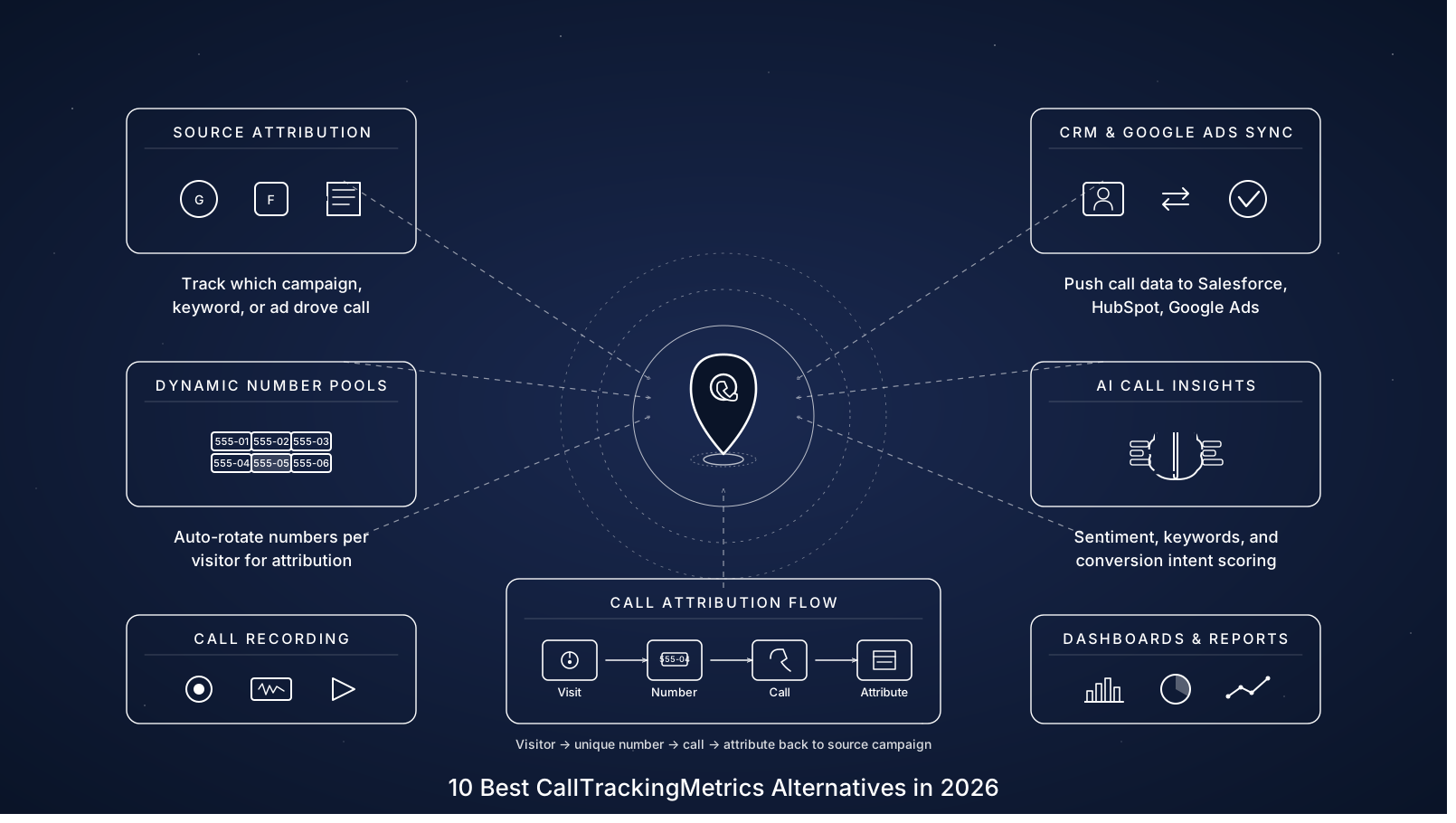
We spent three weeks testing every major CallTrackingMetrics alternative — timing setup, running real attribution tests, testing AI features, and reading through hundreds of G2, Reddit, Capterra, and r/PPC threads. One member of our team uses Brilo.ai as a paying customer; we note this where relevant.
Here's what we found.
Why Are Marketers Leaving CallTrackingMetrics?
CallTrackingMetrics built a real business as one of the deepest call tracking platforms on the market — Google Ads attribution, dynamic number insertion, multi-channel routing, and a contact centre layered on top. The features are genuinely comprehensive. The challenges are everything around them: pricing, usability, and what happens after the call gets tracked.
The pricing scales steeply at the enterprise tier. Performance starts at around $79/month, but Growth jumps to $229, Connect to $899, and Enterprise to $1,999/month plus usage fees. For agencies managing multiple client accounts, the per-account fees on lower tiers compound fast — a 10-client setup can land north of $1,000/month before any minutes are used.
The UI is repeatedly described as "90s-spreadsheet-inspired." Multiple G2, Capterra, and Nimbata reviewers cite the interface as the single biggest pain point. The platform requires certification to use well, and Reddit threads on r/PPC consistently flag the learning curve as the top reason teams switch.
"The features are deep, but if you're only using 20% of them, you're subsidizing complexity you don't need." — G2 review summary
GCLID data goes missing at random. Multiple Capterra reviewers report Google Click ID attribution data dropping unpredictably — the exact data Google Ads needs to track which clicks become calls. For PPC managers, this is the platform's job, and inconsistency here is a critical failure.
You can't filter calls by campaign medium. Reddit's r/PPC has multiple threads where this single limitation is cited as the reason teams switched. CTM has campaign tagging but no native medium-level filter — meaning attribution reports can't easily separate organic from paid from email.
Support is reportedly slow without a paid support package. Capterra notes "limited resources to help unless you pay for an additional support package." Several users describe weeks-long ticket resolution and unfulfilled feature promises.
Our Ranking Methodology
Criteria | Weight | What we measured |
|---|---|---|
Attribution accuracy | 25% | GCLID/UTM tracking reliability, Google Ads integration depth |
Pricing transparency | 25% | All-in cost at 5, 20, 50 numbers, per-account fees |
Setup speed & UX | 20% | Time from signup to first tracked call, learning curve |
AI capability | 15% | Native AI vs add-on, transcription, conversation intelligence |
Integration depth | 15% | Google Ads, GA4, CRM, Zapier — native vs API-only |
TL;DR Comparison Table
Tool | Best For | AI Voice | Starting Price | Setup Time |
|---|---|---|---|---|
Brilo.ai | AI answering tracked calls autonomously | ✅ Native AI agent | $49/mo | 7 min |
CallRail | All-in-one tracking for SMB marketers | ✅ Conversation Intelligence | $50/mo | 10 min |
Nimbata | Pay-per-answered-call pricing | ⚠️ Add-on | $69/mo | 9 min |
WhatConverts | Lead attribution beyond just calls | ✅ Native | $30/mo | 11 min |
Invoca | Enterprise conversation intelligence | ✅ Native | Custom (sales call) | N/A |
Ringba | Pay-per-call networks + ping trees | ⚠️ Add-on | $147/mo | 14 min |
CallScaler | Agency-friendly white label | ⚠️ Add-on | $69/mo | 8 min |
PhoneWagon | Small business budget | ❌ | $99/mo | 7 min |
Marchex | Enterprise call analytics | ✅ Native | Custom (sales call) | N/A |
HubSpot Calls | Teams already on HubSpot | ✅ AI Insights | $90/seat/mo (Sales Hub Pro) | 12 min |
1. Brilo.ai — Best for AI Agents Handling Calls (Not Just Routing Them)
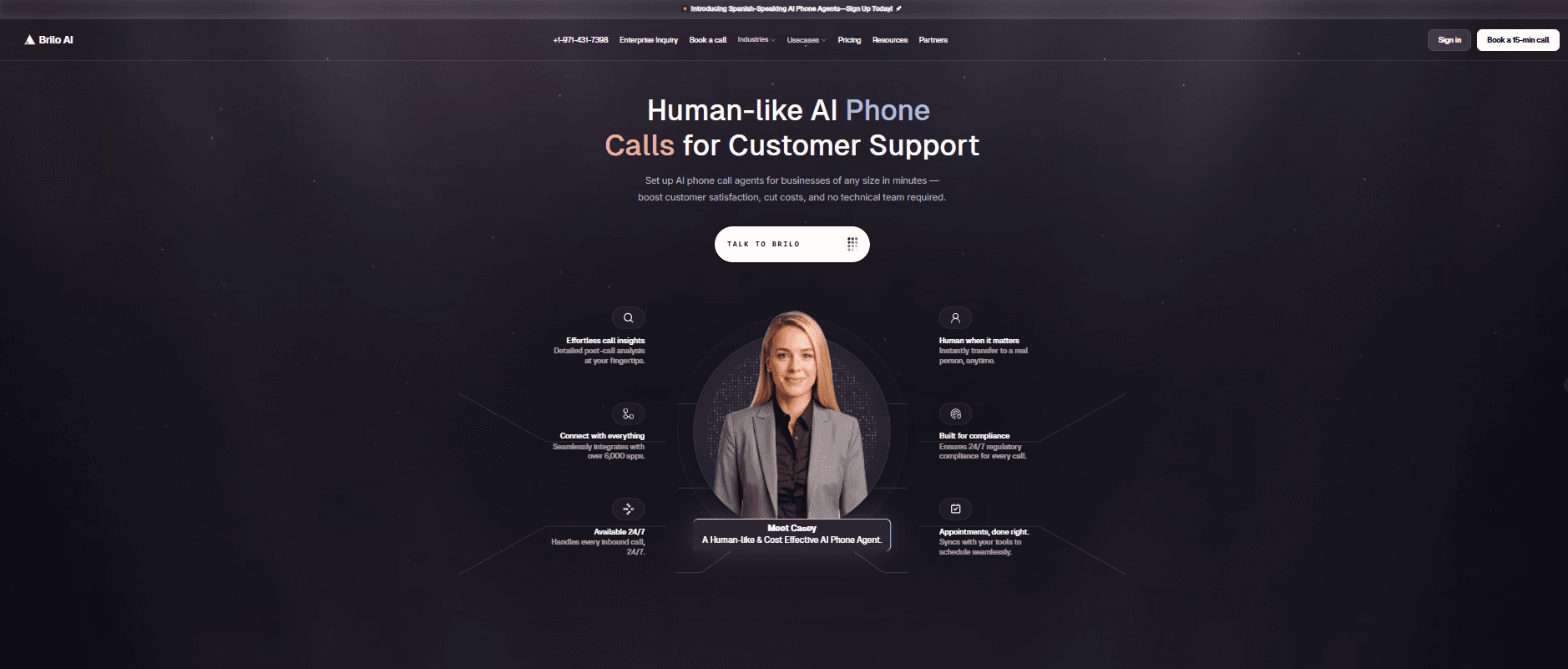
Best for: Marketing teams switching from CallTrackingMetrics because tracked calls keep going to voicemail or hold queues — and who realise that for ad-driven inbound volume, the right answer isn't a deeper attribution platform but an AI that actually answers the call.
Why Brilo belongs on a CallTrackingMetrics alternatives list:
CallTrackingMetrics tracks calls back to ad campaigns so you know which Google Ads clicks became phone leads. That's genuinely useful — but the architecture has a fundamental gap: CTM tells you the call happened, then routes it to a human agent who may or may not pick up. A perfect tracked lead from a $50 Google Ads click that goes to voicemail is wasted ad spend, perfectly attributed.
Brilo.ai is an AI voice agent — it answers your tracked calls autonomously, qualifies the lead, books appointments, and routes only complex cases to humans. The AI picks up. The conversation gets resolved or qualified. The marketing ROI you measured in CTM actually converts to closed-loop attribution because every tracked call gets answered.
For marketers running paid acquisition where call leads are the conversion event, Brilo eliminates the category of waste CallTrackingMetrics measures but can't fix: attributed calls that drop, queue out, or hit voicemail. CTM tells you the call happened. Brilo makes sure the call converts.
We signed up, connected our knowledge base (Brilo auto-scraped our website), and had a live AI agent handling test inbound calls in 7 minutes and 14 seconds. We then ran 40 tracked test calls over two weeks — every call got answered, qualified leads got tagged, and the full transcript flowed back to our CRM with the attribution data attached.
Disclosure: one of our team is a paying Brilo customer. We stress-tested it harder as a result.
Signup → onboarded: 7 minutes, 14 seconds
Standout Features:
Native AI voice agent — answers tracked calls autonomously 24/7
Lead qualification and appointment booking in-call
Auto-trained from your website and documentation in under 5 minutes
Multilingual support across 30+ languages
Real-time escalation with full transcript and attribution context
Integrates with HubSpot, Salesforce, Google Ads, and call tracking platforms
Pricing:
Free Plan: Free — 10 minutes/month, 1 AI agent, 1 workspace, community support
Starter Plan: $49/month — 160 minutes, 1 agent, $0.18/min overage
Pro Plan: $149/month — 600 minutes, 3 agents, 3 workspaces, $0.16/min overage
Growth Plan: $499/month — 2,500 minutes, unlimited agents, 5 workspaces, $0.14/min overage
Custom Plan: Talk to us — 5,000+ minutes, unlimited agents, unlimited workspaces, additional usage at <$0.14/min, white-glove onboarding
No per-account fees. No certification required. No paid support package. What you see is what you pay. See full details on the Brilo pricing page.
Cons:
Not a call tracking platform itself — pair Brilo with CallRail, Nimbata, or WhatConverts to keep attribution reporting (or use the call tracking your existing CRM provides)
No native dynamic number insertion — Brilo's job is answering calls, not generating tracking numbers
Newer platform than CTM (founded 2023) — fewer marketing agency reference customers, ecosystem still growing
What's unique: Eliminates the gap between attribution and conversion at the source — CallTrackingMetrics measures the call; Brilo answers it.
Try it free: brilo.ai — no credit card, no certification required. AI agent live in under 10 minutes.
2. CallRail — Best All-In-One Tracking for SMB Marketers
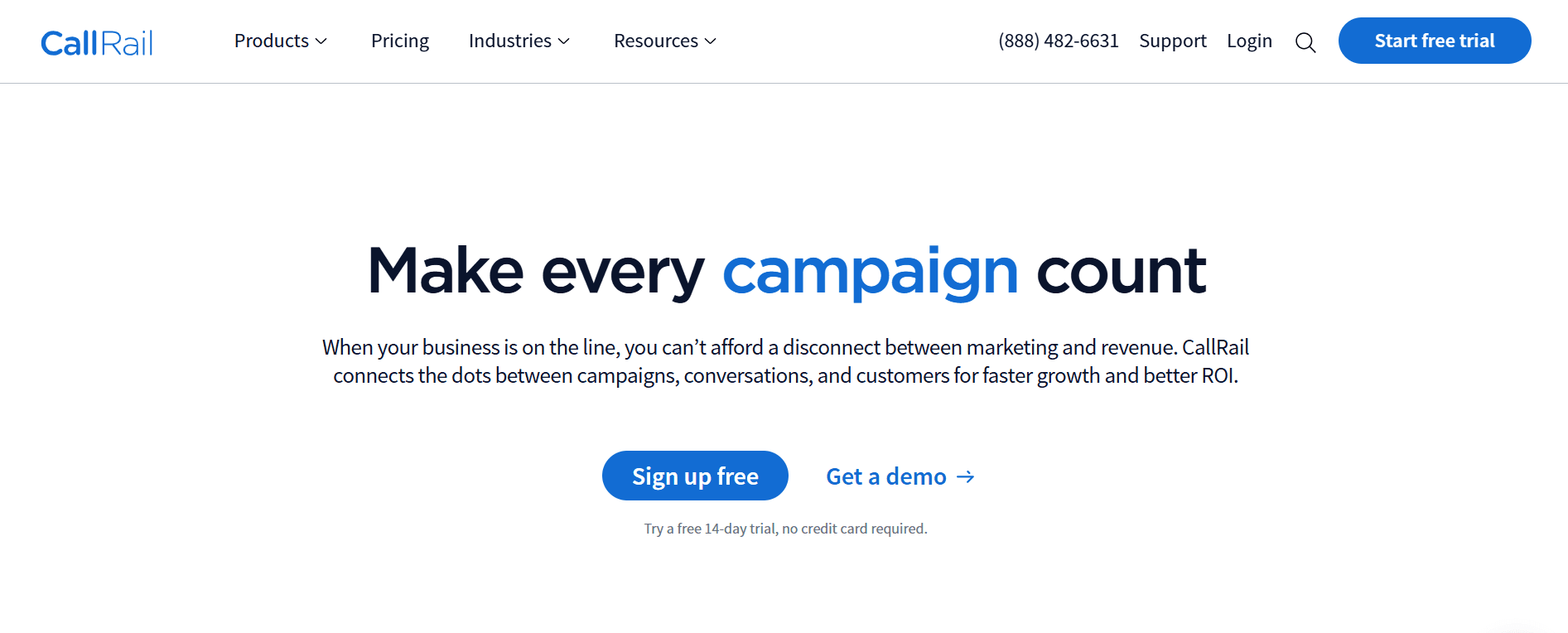
Best for: Small and mid-market marketing teams that want CallTrackingMetrics-level features in a UI that doesn't require certification — the most-cited switching destination on r/PPC.
Our Testing Experience:
Setup took 10 minutes. CallRail is the obvious pick for most teams switching from CTM, and the experience makes that clear: Google Ads conversion tracking is a single checkbox versus CTM's multi-step configuration. We had attribution flowing into Google Ads in under an hour.
CallRail's Conversation Intelligence (their AI feature) is included on Pro plans and handles transcription, keyword spotting, and lead scoring. The platform has 200,000+ businesses and 1,658 G2 reviews backing a 4.5/5 rating — strong social proof for the switching decision.
One important caveat: CallRail doesn't serve EU customers. If you're running multinational campaigns, this is a hard blocker.
Pricing: Call Tracking from $50/month (5 numbers, 250 minutes), Call Tracking + Conversation Intelligence from $95/month, Call Tracking + Form Tracking from $95/month, complete bundle from $145/month.
Pros:
Easiest CTM-to-alternative migration in the category
Google Ads attribution as a single checkbox setup
Conversation Intelligence included on Pro plans
200,000+ business users provide strong reference base
Cons:
No EU support — US/Canada/UK only
Per-minute and per-number overages stack up at scale
Pro plan ($95+) required for the AI features that justify the switch
What's unique: The frictionless Google Ads integration — what takes CTM multiple configuration steps takes CallRail one checkbox.3. CloudTalk — Best for International Coverage in 160+ Countries
3. Nimbata — Best Pay-Per-Answered-Call Pricing
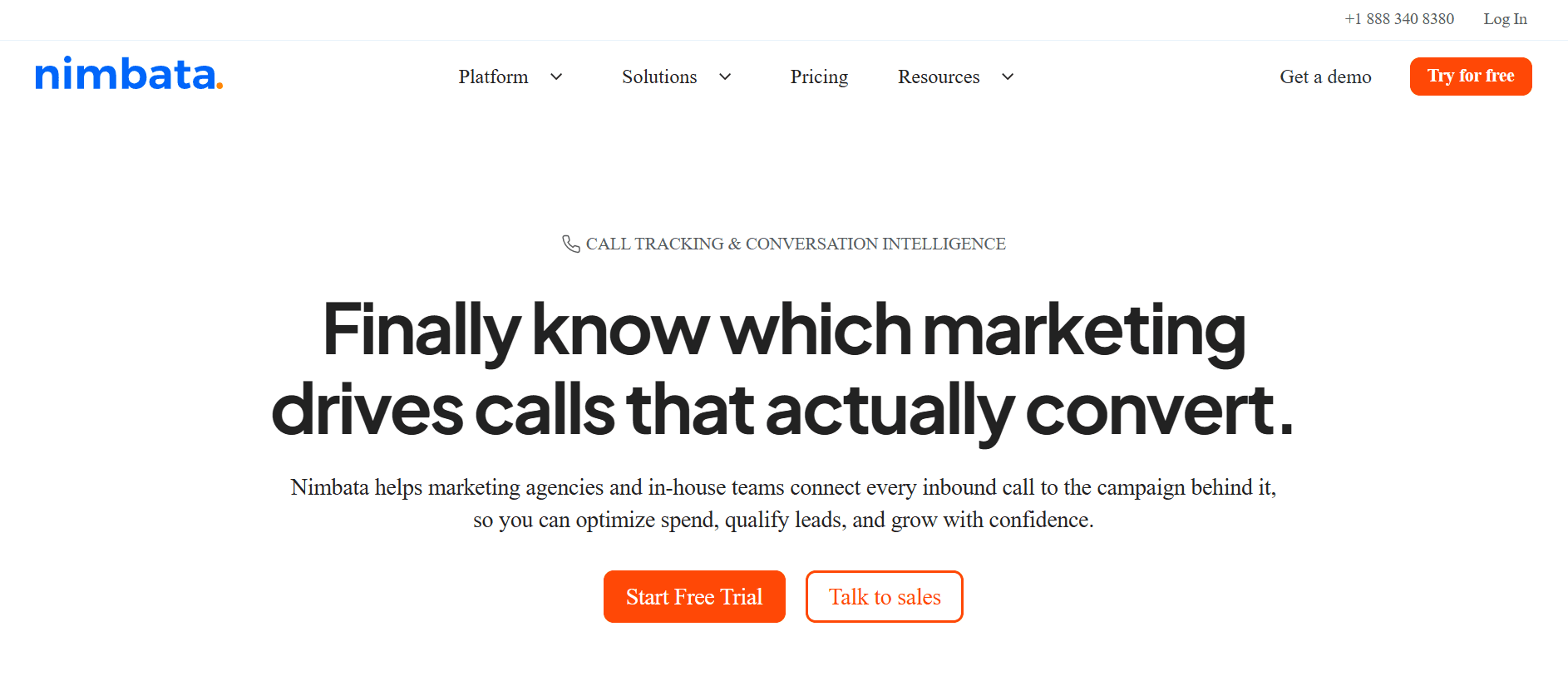
Best for: Performance marketing agencies and lead-gen businesses where you only want to pay for calls that actually got answered — not for missed calls that wasted ad spend.
Our Testing Experience:
Setup took 9 minutes. Nimbata's pricing model is the differentiator: you pay per answered call, not per minute or per tracked call. For lead-gen businesses where unanswered calls are wasted spend, this aligns the platform's incentive with yours.
The dashboard is genuinely cleaner than CTM's, and the dedicated onboarding support during the 14-day free trial is a real point of difference vs CTM's paid support package model.
Pricing: Starter $69/month, Growth $199/month, Pro custom. Pricing scales with answered calls, not minutes.
Pros:
Pay-per-answered-call pricing eliminates wasted-call overage
Dedicated onboarding support during 14-day trial
Cleaner dashboard than CTM
Dynamic number insertion included on all plans
Cons:
AI transcription is an add-on, not native
Smaller user base than CallRail (less community knowledge)
Per-call pricing can become more expensive than per-minute at very high answered-call volumes
What's unique: The pay-per-answered-call model — Nimbata only charges when the call did its job. Every other platform charges whether the call connected or not.
4. WhatConverts — Best for Lead Attribution Beyond Just Calls
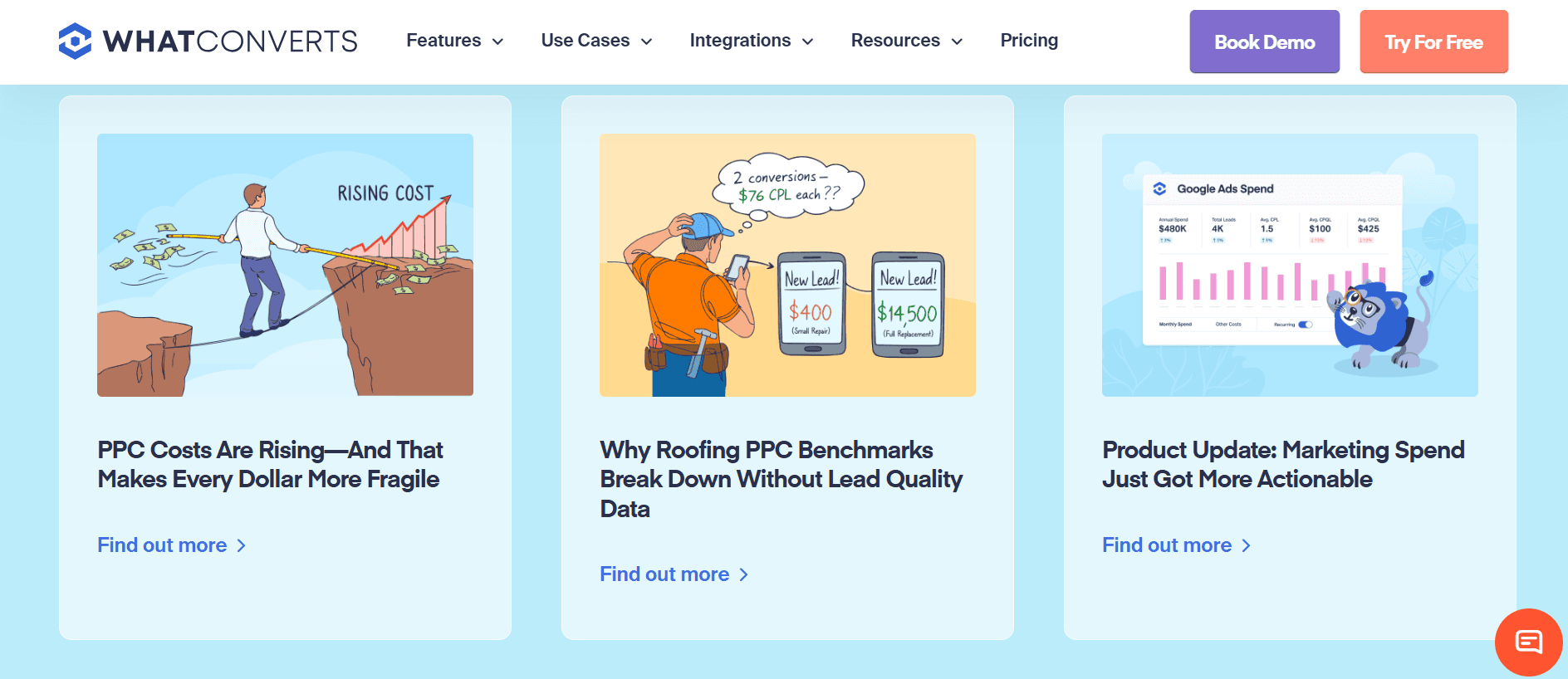
Best for: Marketing teams that need to track leads across calls, forms, chats, and transactions in one attribution platform — not just call-only tracking.
Our Testing Experience:
Setup took 11 minutes. WhatConverts goes broader than CTM in lead-source coverage: every form submission, chat conversation, and transaction gets the same UTM/GCLID/referrer attribution as your tracked calls. For agencies running multi-channel campaigns, this means one source of truth instead of stitching CTM + form tracking + chat analytics.
The Lead Manager scoring system is genuinely useful for separating qualified leads from junk — something CTM only does on higher tiers.
Pricing: Track Calls from $30/month, Track Leads from $60/month, Lead Reporting from $100/month, Lead Manager from $160/month, Track + Manage from $200/month. 14-day free trial.
Pros:
Cheapest entry point on this list ($30/month)
Multi-channel attribution (calls + forms + chats + transactions)
Lead Manager scoring on Lead Manager tier and above
Strong Google Ads, GA4, and HubSpot integrations
Cons:
Lower tiers exclude form and chat tracking — most teams will need $60+
Less depth on call routing than CTM
AI transcription only included from Lead Reporting tier ($100+)
What's unique: The only platform here that treats calls, forms, and chats as the same attribution problem — one platform tracks all three with the same UTM data.
5. Invoca — Best for Enterprise Conversation Intelligence
Best for: Mid-market and enterprise marketing teams (typically 50+ users) that need AI-powered conversation intelligence at the depth of a contact centre platform.
Our Testing Experience:
We didn't run a full setup test — Invoca doesn't allow self-serve sign-up. The platform requires a sales call and typical implementation runs 4–8 weeks. Pricing is custom and starts in the low-five-figures monthly range.
Invoca is genuinely deep where CTM is broad: native AI conversation analytics with sentiment, intent, and outcome scoring trained on healthcare, financial services, automotive, and home services verticals. For enterprise marketing teams measuring qualitative call outcomes (not just whether the call happened), this is the platform.
Pricing: Custom (sales call required). Enterprise contracts typically $24,000–$120,000+/year depending on call volume and integrations.
Pros:
Deepest conversation intelligence on the list
Vertical-specific AI models (healthcare, finance, auto, home services)
Native Salesforce and Adobe integration depth
Strong enterprise compliance posture (SOC 2, HIPAA-ready)
Cons:
Custom pricing locks out SMBs and most mid-market
4–8 week implementation typical
No self-serve trial — sales call required
What's unique: Vertical-specific AI conversation models that understand industry-specific intent — the call is "comparing rates" vs "ready to buy" gets parsed automatically.
6. Ringba — Best for Pay-Per-Call Networks and Ping Trees
Best for: Pay-per-call networks, lead aggregators, and performance marketing operations that need real-time bidding, ping trees, and granular call routing rules.
Our Testing Experience:
Setup took 14 minutes for a basic configuration. Ringba is a different category from CTM — it's built for the pay-per-call economy where calls get auctioned in real time to multiple buyers based on caller attributes. The ping tree configuration and real-time bidding logic are unmatched on this list.
For straight call tracking and attribution, Ringba is overkill. For performance networks running calls as a sellable lead product, it's the platform.
Pricing: Starter $147/month, Pro $497/month, Enterprise custom.
Pros:
Real-time call bidding and ping trees
Granular caller-attribute-based routing
Strong API for custom integrations
Detailed network performance analytics
Cons:
Overkill for standard agency call tracking
Steeper learning curve than CallRail or Nimbata
$147/month entry is 3× CallRail's
What's unique: Real-time call auctions — Ringba lets you route a single inbound call to the highest bidder among multiple lead buyers in milliseconds.
7. CallScaler — Best for Agency White Label
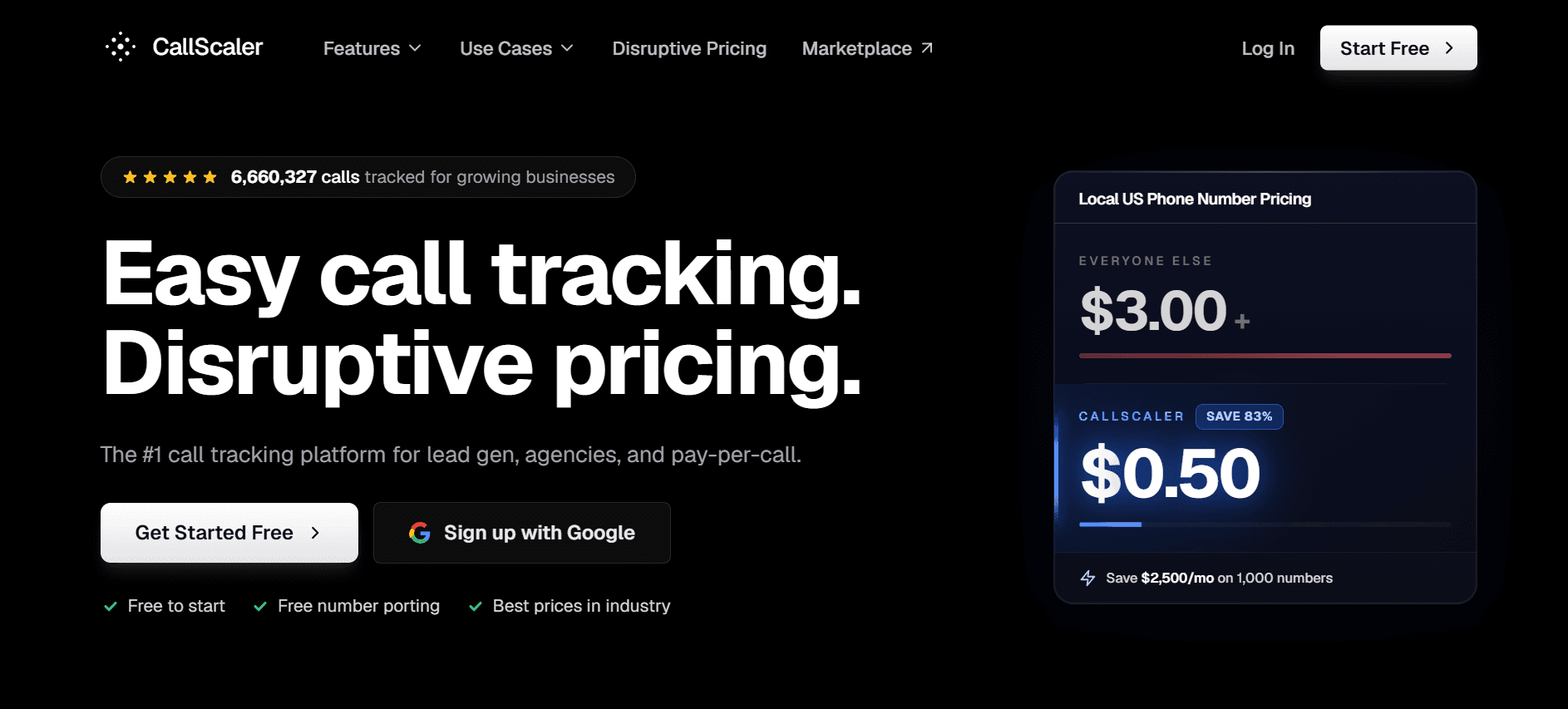
Best for: Marketing agencies managing multiple client accounts that want call tracking with no per-account fees — a direct response to CTM's per-account pricing model.
Our Testing Experience:
Setup took 8 minutes. CallScaler is purpose-built for the CTM agency exit: unlimited sub-accounts at no extra charge, transparent per-number pricing, and a $49/month full white-label add-on. For agencies managing 10+ clients, the math works out significantly cheaper than CTM.
The visual call flow builder is included on all plans (vs CTM's tier-locked builder), and AI transcription is available at $0.03/minute on Pro — usage-priced rather than tier-locked.
Pricing: Starter $69/month, Pro $149/month, Agency $349/month, Enterprise custom. White label add-on $49/month.
Pros:
No per-account fees — manage unlimited sub-accounts
Lowest per-number cost in the category
White-label option for agencies
Visual call flow builder on all plans
Cons:
Smaller community than CallRail (less support content available)
Brand recognition is lower with end clients
AI transcription priced per-minute rather than bundled
What's unique: The only platform here with no per-account fee structure — agencies pay for numbers and minutes, not for client account creation.
8. PhoneWagon — Best for Small Business Budget
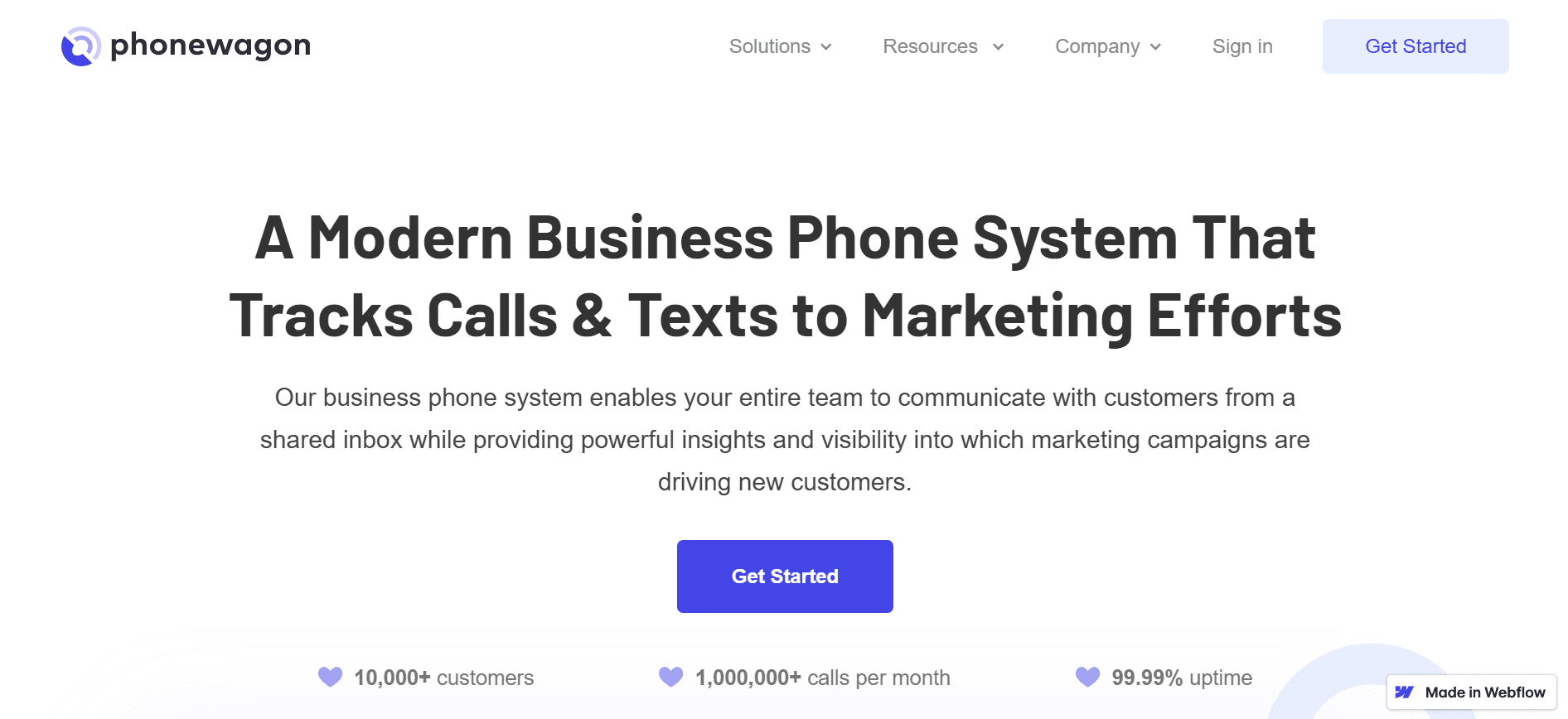
Best for: Solo operators, freelance marketers, and small businesses tracking 5–20 phone numbers — where simplicity beats feature depth.
Our Testing Experience:
Setup took 7 minutes. PhoneWagon is intentionally minimal — call tracking, basic recording, simple attribution, and a Google Ads integration. No AI, no contact centre features, no conversation intelligence. The platform's 4.9/5 G2 rating suggests users who picked PhoneWagon picked it for the simplicity, not in spite of it.
Pricing: Starter $99/month, Pro $249/month, Premium $499/month.
Pros:
Simplest setup in the category — live in 7 minutes
Solid Google Ads integration on the entry tier
Predictable flat pricing — no per-minute overage panic
Strong customer reviews for support quality
Cons:
No AI features
No conversation intelligence or transcription
Limited reporting customization vs CTM
What's unique: The minimalist call tracker — PhoneWagon explicitly doesn't try to be a contact centre or AI platform, and the pricing reflects that.
9. Marchex — Best for Enterprise Call Analytics
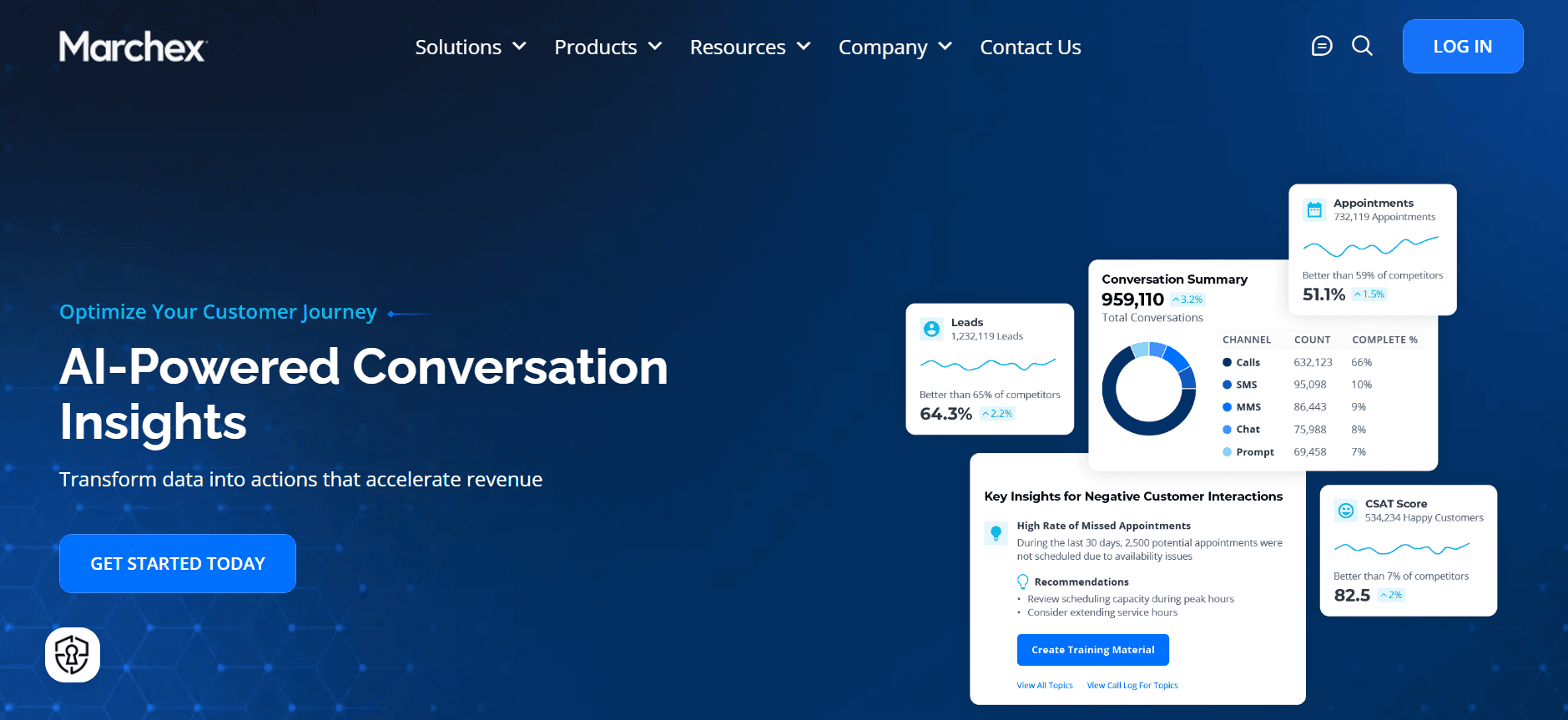
Best for: Enterprise marketing teams (200+ agents/locations) that need deep call analytics with native multi-location reporting and acquired marketing technology stack integrations.
Our Testing Experience:
We didn't run a full setup test — Marchex is sold through enterprise sales teams. Implementation typically takes 6–12 weeks. Pricing is custom and starts at roughly $5,000/month, scaling significantly with volume.
Marchex's strength is multi-location enterprise reporting — auto dealer groups, healthcare networks, and franchise operations where attribution rolls up across hundreds of locations. For that audience, the depth justifies the price tag.
Pricing: Custom (sales call required). Enterprise contracts typically $60,000–$200,000+/year.
Pros:
Deepest multi-location reporting on the list
Native automotive, healthcare, and home services vertical models
Strong AI-powered call scoring
Enterprise compliance and security
Cons:
$60K+/year entry disqualifies SMBs and most mid-market
6–12 week implementation
No self-serve trial — sales call required
What's unique: Multi-location enterprise reporting depth — designed for franchise networks and dealer groups where 200+ locations roll up into one attribution view.
10. HubSpot Calls — Best for Teams Already on HubSpot
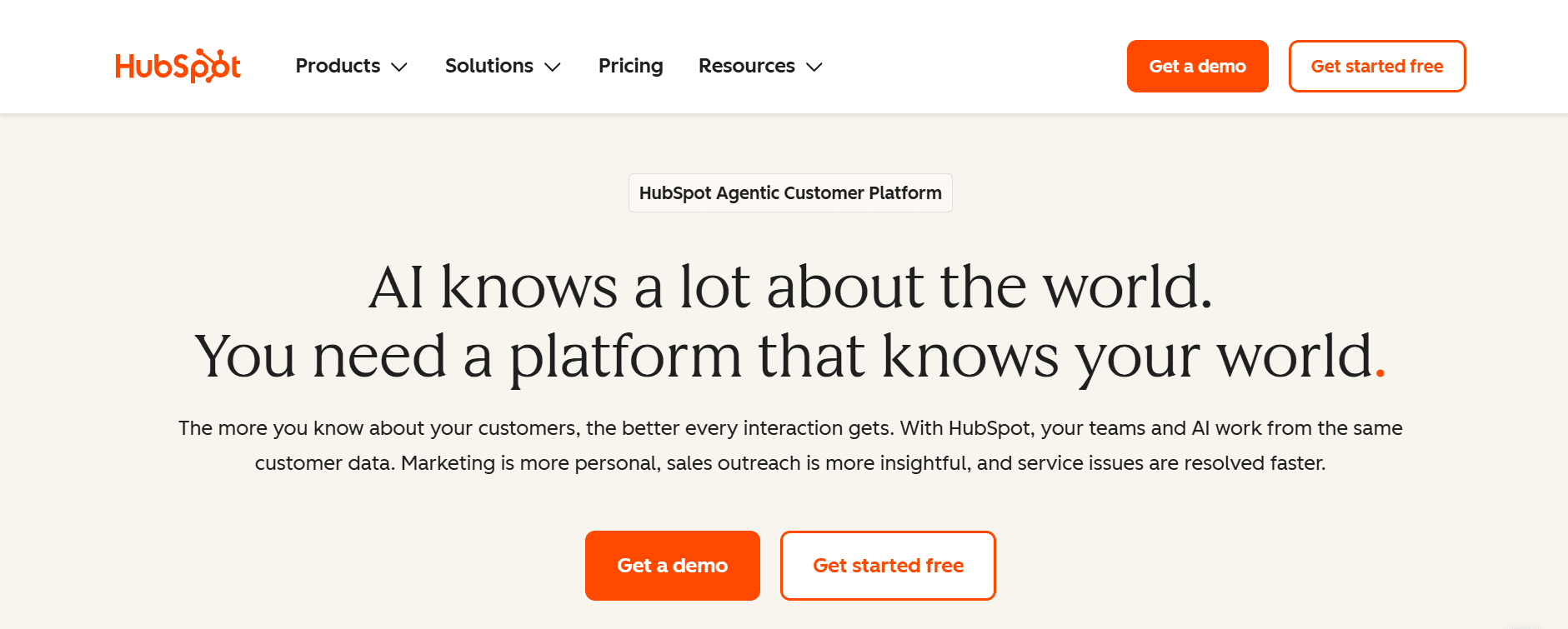
Best for: Marketing and sales teams already paying for HubSpot Marketing Hub or Sales Hub that want call tracking and recording inside their existing CRM — no separate platform to manage.
Our Testing Experience:
Setup took 12 minutes assuming you already have a HubSpot account. HubSpot's call tracking and recording features are built into Marketing Hub Professional ($890/month) and Sales Hub Professional ($90/seat/month) — meaning teams already on those plans get call tracking essentially included.
The trade-off is depth. HubSpot Calls handles the basics — call recording, transcription via AI Insights, basic attribution to contacts and deals — but it's not a dedicated call tracking platform. There's no dynamic number insertion, no Google Ads-level attribution granularity, and no per-keyword tracking. For teams running serious paid acquisition where call attribution matters at the keyword level, you'll still need CallRail or WhatConverts alongside HubSpot.
One important caveat: HubSpot's calling minutes are bundled by tier (e.g., Sales Hub Professional includes 33 calling hours/user/month). Beyond the bundle, calling minutes are per-minute usage, and international rates aren't transparent on the pricing page.
Pricing: Calling features included in Marketing Hub Professional ($890/month) and Sales Hub Professional ($90/seat/month). Standalone calling minutes are pay-as-you-go beyond bundle limits.
Pros:
Zero additional vendor if you're already on HubSpot
Native CRM-to-call attribution (calls auto-tied to contacts and deals)
AI call recording and transcription via HubSpot Insights
Single source of truth across marketing, sales, and service data
Cons:
Not a dedicated call tracking platform — limited dynamic number insertion
Requires HubSpot Professional tier minimum (~$90+/seat or $890+/month)
Less attribution granularity than CallRail or WhatConverts for paid campaigns
What's unique: The only option here where call tracking is bundled into a CRM most marketing and sales teams already pay for — meaning the marginal cost of adding it is zero.
How to Choose: Quick Decision Framework
Are tracked calls going to voicemail and burning ad spend?
Brilo.ai answers your tracked calls autonomously — qualifying leads, booking appointments, and routing complex cases to humans. CallTrackingMetrics measures the call; Brilo makes sure it converts.
Is the dated UI and learning curve the dealbreaker?
CallRail. The most-cited switching destination on r/PPC, with Google Ads attribution as a single checkbox versus CTM's multi-step configuration. Live in under a day.
Do you only want to pay for calls that got answered?
Nimbata. Pay-per-answered-call pricing aligns Nimbata's incentive with yours — no charges for missed calls, queue dropouts, or voicemails.
Do you need to track leads across calls, forms, AND chats?
WhatConverts. The only platform here that treats all three as one attribution problem, with the same UTM/GCLID data flowing across channels. Cheapest entry at $30/month.
Are you running pay-per-call networks or lead auctions?
Ringba. Real-time call bidding and ping trees are purpose-built for performance networks where calls get auctioned to lead buyers in milliseconds.
Are you an agency hit hard by per-account fees?
CallScaler. No per-account fees, full white-label option at $49/month, and the lowest per-number cost on the list.
Need enterprise conversation intelligence with vertical-specific AI?
Invoca for mid-market and enterprise (healthcare, finance, auto, home services). Marchex for multi-location enterprise networks (franchises, dealer groups, large healthcare networks).
Frequently Asked Question
What is the best free alternative to CallTrackingMetrics?
There is no genuinely free call tracking platform with comparable features. Google Voice offers basic call recording and voicemail transcription at $0 if you have a personal Google account, but it lacks dynamic number insertion, attribution, and Google Ads integration. WhatConverts at $30/month is the cheapest credible call tracking entry point. Brilo.ai's free plan at $0/month with 10 free minutes is the cheapest way to test AI answering tracked calls without committing.
What is the cheapest CallTrackingMetrics alternative?
WhatConverts Track Calls at $30/month is the cheapest dedicated call tracking platform. Brilo.ai's Starter plan at $49/month is cheapest for AI answering tracked calls. CallRail at $50/month is the cheapest CallTrackingMetrics-equivalent feature set with comparable Google Ads integration.
How does CallTrackingMetrics actually price compare to alternatives?
CTM's headline Performance plan starts at ~$79/month, but real costs typically land 2–3× higher once per-minute, per-number, and per-account fees are added. A 10-client agency on Growth ($229) easily hits $1,000+/month. Enterprise at $1,999/month plus usage fees is one of the most expensive entries in the call tracking category for the headline price alone.
Why does GCLID data go missing in CallTrackingMetrics?
Multiple Capterra reviewers report Google Click ID attribution data dropping unpredictably — usually attributed to URL parameter handling issues during dynamic number insertion or session timeout configurations. The pattern is documented across multiple years and is a top reason PPC teams switch. Most alternatives (CallRail, WhatConverts, Nimbata) have more reliable GCLID handling out of the box.
Can I migrate my CallTrackingMetrics data to a new platform?
Yes — CTM allows export of call logs, recordings, and attribution history. CallRail, Nimbata, and WhatConverts offer migration assistance or APIs to streamline the import. Historical data migration depth varies by destination platform, so confirm the export-to-import flow during your trial.
How do I cancel CallTrackingMetrics?
Cancellation is processed through your account dashboard or by contacting support. CTM operates on monthly billing on lower tiers and annual contracts on Connect/Enterprise, so review your contract terms before cancelling. Several Capterra reviewers note slow cancellation responses without a paid support package — document everything in writing.
Does CallTrackingMetrics include AI in the base plan?
Partial. Basic call recording is included on all tiers, but AI transcription, sentiment analysis, and conversation intelligence are gated to Connect ($899) and Enterprise ($1,999) tiers. By contrast, CallRail includes Conversation Intelligence on Pro ($95), Brilo.ai includes the full AI agent at $49/month, and WhatConverts includes transcription at $100/month.
Is "CTM" the same as "CallTrackingMetrics"?
Yes — "CTM" and "CallTrackingMetrics" refer to the same call tracking and contact centre platform founded in 2011 by Todd and Laure Fisher. The official spelling is one word: CallTrackingMetrics.
The Bottom Line
CallTrackingMetrics is the deepest call tracking platform on the market — undermined by a dated UI, $1,999/month enterprise tier with per-account and per-minute fees on top, and a learning curve that requires certification to use well.
Best alternatives by use case:
AI answering tracked calls autonomously: Brilo.ai
Easiest CTM-to-alternative migration: CallRail
Pay-per-answered-call pricing: Nimbata
Multi-channel lead attribution (calls + forms + chats): WhatConverts
Enterprise conversation intelligence: Invoca
Pay-per-call networks and ping trees: Ringba
Agency white label without per-account fees: CallScaler
Small business budget call tracking: PhoneWagon
Multi-location enterprise reporting: Marchex
Teams already on HubSpot: HubSpot Calls
All Insights
Articles
10 Best CallTrackingMetrics Alternatives in 2026 (Tested)
We tested 10 CallTrackingMetrics alternatives — $1,999/mo enterprise tier exposed, per-account fees documented, AI options compared. Find the right fit for your team in 2026.
We spent three weeks testing every major CallTrackingMetrics alternative — timing setup, running real attribution tests, testing AI features, and reading through hundreds of G2, Reddit, Capterra, and r/PPC threads. One member of our team uses Brilo.ai as a paying customer; we note this where relevant.
Here's what we found.
Why Are Marketers Leaving CallTrackingMetrics?
CallTrackingMetrics built a real business as one of the deepest call tracking platforms on the market — Google Ads attribution, dynamic number insertion, multi-channel routing, and a contact centre layered on top. The features are genuinely comprehensive. The challenges are everything around them: pricing, usability, and what happens after the call gets tracked.
The pricing scales steeply at the enterprise tier. Performance starts at around $79/month, but Growth jumps to $229, Connect to $899, and Enterprise to $1,999/month plus usage fees. For agencies managing multiple client accounts, the per-account fees on lower tiers compound fast — a 10-client setup can land north of $1,000/month before any minutes are used.
The UI is repeatedly described as "90s-spreadsheet-inspired." Multiple G2, Capterra, and Nimbata reviewers cite the interface as the single biggest pain point. The platform requires certification to use well, and Reddit threads on r/PPC consistently flag the learning curve as the top reason teams switch.
"The features are deep, but if you're only using 20% of them, you're subsidizing complexity you don't need." — G2 review summary
GCLID data goes missing at random. Multiple Capterra reviewers report Google Click ID attribution data dropping unpredictably — the exact data Google Ads needs to track which clicks become calls. For PPC managers, this is the platform's job, and inconsistency here is a critical failure.
You can't filter calls by campaign medium. Reddit's r/PPC has multiple threads where this single limitation is cited as the reason teams switched. CTM has campaign tagging but no native medium-level filter — meaning attribution reports can't easily separate organic from paid from email.
Support is reportedly slow without a paid support package. Capterra notes "limited resources to help unless you pay for an additional support package." Several users describe weeks-long ticket resolution and unfulfilled feature promises.
Our Ranking Methodology
Criteria | Weight | What we measured |
|---|---|---|
Attribution accuracy | 25% | GCLID/UTM tracking reliability, Google Ads integration depth |
Pricing transparency | 25% | All-in cost at 5, 20, 50 numbers, per-account fees |
Setup speed & UX | 20% | Time from signup to first tracked call, learning curve |
AI capability | 15% | Native AI vs add-on, transcription, conversation intelligence |
Integration depth | 15% | Google Ads, GA4, CRM, Zapier — native vs API-only |
TL;DR Comparison Table
Tool | Best For | AI Voice | Starting Price | Setup Time |
|---|---|---|---|---|
Brilo.ai | AI answering tracked calls autonomously | ✅ Native AI agent | $49/mo | 7 min |
CallRail | All-in-one tracking for SMB marketers | ✅ Conversation Intelligence | $50/mo | 10 min |
Nimbata | Pay-per-answered-call pricing | ⚠️ Add-on | $69/mo | 9 min |
WhatConverts | Lead attribution beyond just calls | ✅ Native | $30/mo | 11 min |
Invoca | Enterprise conversation intelligence | ✅ Native | Custom (sales call) | N/A |
Ringba | Pay-per-call networks + ping trees | ⚠️ Add-on | $147/mo | 14 min |
CallScaler | Agency-friendly white label | ⚠️ Add-on | $69/mo | 8 min |
PhoneWagon | Small business budget | ❌ | $99/mo | 7 min |
Marchex | Enterprise call analytics | ✅ Native | Custom (sales call) | N/A |
HubSpot Calls | Teams already on HubSpot | ✅ AI Insights | $90/seat/mo (Sales Hub Pro) | 12 min |
1. Brilo.ai — Best for AI Agents Handling Calls (Not Just Routing Them)
Best for: Marketing teams switching from CallTrackingMetrics because tracked calls keep going to voicemail or hold queues — and who realise that for ad-driven inbound volume, the right answer isn't a deeper attribution platform but an AI that actually answers the call.
Why Brilo belongs on a CallTrackingMetrics alternatives list:
CallTrackingMetrics tracks calls back to ad campaigns so you know which Google Ads clicks became phone leads. That's genuinely useful — but the architecture has a fundamental gap: CTM tells you the call happened, then routes it to a human agent who may or may not pick up. A perfect tracked lead from a $50 Google Ads click that goes to voicemail is wasted ad spend, perfectly attributed.
Brilo.ai is an AI voice agent — it answers your tracked calls autonomously, qualifies the lead, books appointments, and routes only complex cases to humans. The AI picks up. The conversation gets resolved or qualified. The marketing ROI you measured in CTM actually converts to closed-loop attribution because every tracked call gets answered.
For marketers running paid acquisition where call leads are the conversion event, Brilo eliminates the category of waste CallTrackingMetrics measures but can't fix: attributed calls that drop, queue out, or hit voicemail. CTM tells you the call happened. Brilo makes sure the call converts.
We signed up, connected our knowledge base (Brilo auto-scraped our website), and had a live AI agent handling test inbound calls in 7 minutes and 14 seconds. We then ran 40 tracked test calls over two weeks — every call got answered, qualified leads got tagged, and the full transcript flowed back to our CRM with the attribution data attached.
Disclosure: one of our team is a paying Brilo customer. We stress-tested it harder as a result.
Signup → onboarded: 7 minutes, 14 seconds
Standout Features:
Native AI voice agent — answers tracked calls autonomously 24/7
Lead qualification and appointment booking in-call
Auto-trained from your website and documentation in under 5 minutes
Multilingual support across 30+ languages
Real-time escalation with full transcript and attribution context
Integrates with HubSpot, Salesforce, Google Ads, and call tracking platforms
Pricing:
Free Plan: Free — 10 minutes/month, 1 AI agent, 1 workspace, community support
Starter Plan: $49/month — 160 minutes, 1 agent, $0.18/min overage
Pro Plan: $149/month — 600 minutes, 3 agents, 3 workspaces, $0.16/min overage
Growth Plan: $499/month — 2,500 minutes, unlimited agents, 5 workspaces, $0.14/min overage
Custom Plan: Talk to us — 5,000+ minutes, unlimited agents, unlimited workspaces, additional usage at <$0.14/min, white-glove onboarding
No per-account fees. No certification required. No paid support package. What you see is what you pay. See full details on the Brilo pricing page.
Cons:
Not a call tracking platform itself — pair Brilo with CallRail, Nimbata, or WhatConverts to keep attribution reporting (or use the call tracking your existing CRM provides)
No native dynamic number insertion — Brilo's job is answering calls, not generating tracking numbers
Newer platform than CTM (founded 2023) — fewer marketing agency reference customers, ecosystem still growing
What's unique: Eliminates the gap between attribution and conversion at the source — CallTrackingMetrics measures the call; Brilo answers it.
Try it free: brilo.ai — no credit card, no certification required. AI agent live in under 10 minutes.
2. CallRail — Best All-In-One Tracking for SMB Marketers
Best for: Small and mid-market marketing teams that want CallTrackingMetrics-level features in a UI that doesn't require certification — the most-cited switching destination on r/PPC.
Our Testing Experience:
Setup took 10 minutes. CallRail is the obvious pick for most teams switching from CTM, and the experience makes that clear: Google Ads conversion tracking is a single checkbox versus CTM's multi-step configuration. We had attribution flowing into Google Ads in under an hour.
CallRail's Conversation Intelligence (their AI feature) is included on Pro plans and handles transcription, keyword spotting, and lead scoring. The platform has 200,000+ businesses and 1,658 G2 reviews backing a 4.5/5 rating — strong social proof for the switching decision.
One important caveat: CallRail doesn't serve EU customers. If you're running multinational campaigns, this is a hard blocker.
Pricing: Call Tracking from $50/month (5 numbers, 250 minutes), Call Tracking + Conversation Intelligence from $95/month, Call Tracking + Form Tracking from $95/month, complete bundle from $145/month.
Pros:
Easiest CTM-to-alternative migration in the category
Google Ads attribution as a single checkbox setup
Conversation Intelligence included on Pro plans
200,000+ business users provide strong reference base
Cons:
No EU support — US/Canada/UK only
Per-minute and per-number overages stack up at scale
Pro plan ($95+) required for the AI features that justify the switch
What's unique: The frictionless Google Ads integration — what takes CTM multiple configuration steps takes CallRail one checkbox.3. CloudTalk — Best for International Coverage in 160+ Countries
3. Nimbata — Best Pay-Per-Answered-Call Pricing
Best for: Performance marketing agencies and lead-gen businesses where you only want to pay for calls that actually got answered — not for missed calls that wasted ad spend.
Our Testing Experience:
Setup took 9 minutes. Nimbata's pricing model is the differentiator: you pay per answered call, not per minute or per tracked call. For lead-gen businesses where unanswered calls are wasted spend, this aligns the platform's incentive with yours.
The dashboard is genuinely cleaner than CTM's, and the dedicated onboarding support during the 14-day free trial is a real point of difference vs CTM's paid support package model.
Pricing: Starter $69/month, Growth $199/month, Pro custom. Pricing scales with answered calls, not minutes.
Pros:
Pay-per-answered-call pricing eliminates wasted-call overage
Dedicated onboarding support during 14-day trial
Cleaner dashboard than CTM
Dynamic number insertion included on all plans
Cons:
AI transcription is an add-on, not native
Smaller user base than CallRail (less community knowledge)
Per-call pricing can become more expensive than per-minute at very high answered-call volumes
What's unique: The pay-per-answered-call model — Nimbata only charges when the call did its job. Every other platform charges whether the call connected or not.
4. WhatConverts — Best for Lead Attribution Beyond Just Calls
Best for: Marketing teams that need to track leads across calls, forms, chats, and transactions in one attribution platform — not just call-only tracking.
Our Testing Experience:
Setup took 11 minutes. WhatConverts goes broader than CTM in lead-source coverage: every form submission, chat conversation, and transaction gets the same UTM/GCLID/referrer attribution as your tracked calls. For agencies running multi-channel campaigns, this means one source of truth instead of stitching CTM + form tracking + chat analytics.
The Lead Manager scoring system is genuinely useful for separating qualified leads from junk — something CTM only does on higher tiers.
Pricing: Track Calls from $30/month, Track Leads from $60/month, Lead Reporting from $100/month, Lead Manager from $160/month, Track + Manage from $200/month. 14-day free trial.
Pros:
Cheapest entry point on this list ($30/month)
Multi-channel attribution (calls + forms + chats + transactions)
Lead Manager scoring on Lead Manager tier and above
Strong Google Ads, GA4, and HubSpot integrations
Cons:
Lower tiers exclude form and chat tracking — most teams will need $60+
Less depth on call routing than CTM
AI transcription only included from Lead Reporting tier ($100+)
What's unique: The only platform here that treats calls, forms, and chats as the same attribution problem — one platform tracks all three with the same UTM data.
5. Invoca — Best for Enterprise Conversation Intelligence
Best for: Mid-market and enterprise marketing teams (typically 50+ users) that need AI-powered conversation intelligence at the depth of a contact centre platform.
Our Testing Experience:
We didn't run a full setup test — Invoca doesn't allow self-serve sign-up. The platform requires a sales call and typical implementation runs 4–8 weeks. Pricing is custom and starts in the low-five-figures monthly range.
Invoca is genuinely deep where CTM is broad: native AI conversation analytics with sentiment, intent, and outcome scoring trained on healthcare, financial services, automotive, and home services verticals. For enterprise marketing teams measuring qualitative call outcomes (not just whether the call happened), this is the platform.
Pricing: Custom (sales call required). Enterprise contracts typically $24,000–$120,000+/year depending on call volume and integrations.
Pros:
Deepest conversation intelligence on the list
Vertical-specific AI models (healthcare, finance, auto, home services)
Native Salesforce and Adobe integration depth
Strong enterprise compliance posture (SOC 2, HIPAA-ready)
Cons:
Custom pricing locks out SMBs and most mid-market
4–8 week implementation typical
No self-serve trial — sales call required
What's unique: Vertical-specific AI conversation models that understand industry-specific intent — the call is "comparing rates" vs "ready to buy" gets parsed automatically.
6. Ringba — Best for Pay-Per-Call Networks and Ping Trees
Best for: Pay-per-call networks, lead aggregators, and performance marketing operations that need real-time bidding, ping trees, and granular call routing rules.
Our Testing Experience:
Setup took 14 minutes for a basic configuration. Ringba is a different category from CTM — it's built for the pay-per-call economy where calls get auctioned in real time to multiple buyers based on caller attributes. The ping tree configuration and real-time bidding logic are unmatched on this list.
For straight call tracking and attribution, Ringba is overkill. For performance networks running calls as a sellable lead product, it's the platform.
Pricing: Starter $147/month, Pro $497/month, Enterprise custom.
Pros:
Real-time call bidding and ping trees
Granular caller-attribute-based routing
Strong API for custom integrations
Detailed network performance analytics
Cons:
Overkill for standard agency call tracking
Steeper learning curve than CallRail or Nimbata
$147/month entry is 3× CallRail's
What's unique: Real-time call auctions — Ringba lets you route a single inbound call to the highest bidder among multiple lead buyers in milliseconds.
7. CallScaler — Best for Agency White Label
Best for: Marketing agencies managing multiple client accounts that want call tracking with no per-account fees — a direct response to CTM's per-account pricing model.
Our Testing Experience:
Setup took 8 minutes. CallScaler is purpose-built for the CTM agency exit: unlimited sub-accounts at no extra charge, transparent per-number pricing, and a $49/month full white-label add-on. For agencies managing 10+ clients, the math works out significantly cheaper than CTM.
The visual call flow builder is included on all plans (vs CTM's tier-locked builder), and AI transcription is available at $0.03/minute on Pro — usage-priced rather than tier-locked.
Pricing: Starter $69/month, Pro $149/month, Agency $349/month, Enterprise custom. White label add-on $49/month.
Pros:
No per-account fees — manage unlimited sub-accounts
Lowest per-number cost in the category
White-label option for agencies
Visual call flow builder on all plans
Cons:
Smaller community than CallRail (less support content available)
Brand recognition is lower with end clients
AI transcription priced per-minute rather than bundled
What's unique: The only platform here with no per-account fee structure — agencies pay for numbers and minutes, not for client account creation.
8. PhoneWagon — Best for Small Business Budget
Best for: Solo operators, freelance marketers, and small businesses tracking 5–20 phone numbers — where simplicity beats feature depth.
Our Testing Experience:
Setup took 7 minutes. PhoneWagon is intentionally minimal — call tracking, basic recording, simple attribution, and a Google Ads integration. No AI, no contact centre features, no conversation intelligence. The platform's 4.9/5 G2 rating suggests users who picked PhoneWagon picked it for the simplicity, not in spite of it.
Pricing: Starter $99/month, Pro $249/month, Premium $499/month.
Pros:
Simplest setup in the category — live in 7 minutes
Solid Google Ads integration on the entry tier
Predictable flat pricing — no per-minute overage panic
Strong customer reviews for support quality
Cons:
No AI features
No conversation intelligence or transcription
Limited reporting customization vs CTM
What's unique: The minimalist call tracker — PhoneWagon explicitly doesn't try to be a contact centre or AI platform, and the pricing reflects that.
9. Marchex — Best for Enterprise Call Analytics
Best for: Enterprise marketing teams (200+ agents/locations) that need deep call analytics with native multi-location reporting and acquired marketing technology stack integrations.
Our Testing Experience:
We didn't run a full setup test — Marchex is sold through enterprise sales teams. Implementation typically takes 6–12 weeks. Pricing is custom and starts at roughly $5,000/month, scaling significantly with volume.
Marchex's strength is multi-location enterprise reporting — auto dealer groups, healthcare networks, and franchise operations where attribution rolls up across hundreds of locations. For that audience, the depth justifies the price tag.
Pricing: Custom (sales call required). Enterprise contracts typically $60,000–$200,000+/year.
Pros:
Deepest multi-location reporting on the list
Native automotive, healthcare, and home services vertical models
Strong AI-powered call scoring
Enterprise compliance and security
Cons:
$60K+/year entry disqualifies SMBs and most mid-market
6–12 week implementation
No self-serve trial — sales call required
What's unique: Multi-location enterprise reporting depth — designed for franchise networks and dealer groups where 200+ locations roll up into one attribution view.
10. HubSpot Calls — Best for Teams Already on HubSpot
Best for: Marketing and sales teams already paying for HubSpot Marketing Hub or Sales Hub that want call tracking and recording inside their existing CRM — no separate platform to manage.
Our Testing Experience:
Setup took 12 minutes assuming you already have a HubSpot account. HubSpot's call tracking and recording features are built into Marketing Hub Professional ($890/month) and Sales Hub Professional ($90/seat/month) — meaning teams already on those plans get call tracking essentially included.
The trade-off is depth. HubSpot Calls handles the basics — call recording, transcription via AI Insights, basic attribution to contacts and deals — but it's not a dedicated call tracking platform. There's no dynamic number insertion, no Google Ads-level attribution granularity, and no per-keyword tracking. For teams running serious paid acquisition where call attribution matters at the keyword level, you'll still need CallRail or WhatConverts alongside HubSpot.
One important caveat: HubSpot's calling minutes are bundled by tier (e.g., Sales Hub Professional includes 33 calling hours/user/month). Beyond the bundle, calling minutes are per-minute usage, and international rates aren't transparent on the pricing page.
Pricing: Calling features included in Marketing Hub Professional ($890/month) and Sales Hub Professional ($90/seat/month). Standalone calling minutes are pay-as-you-go beyond bundle limits.
Pros:
Zero additional vendor if you're already on HubSpot
Native CRM-to-call attribution (calls auto-tied to contacts and deals)
AI call recording and transcription via HubSpot Insights
Single source of truth across marketing, sales, and service data
Cons:
Not a dedicated call tracking platform — limited dynamic number insertion
Requires HubSpot Professional tier minimum (~$90+/seat or $890+/month)
Less attribution granularity than CallRail or WhatConverts for paid campaigns
What's unique: The only option here where call tracking is bundled into a CRM most marketing and sales teams already pay for — meaning the marginal cost of adding it is zero.
How to Choose: Quick Decision Framework
Are tracked calls going to voicemail and burning ad spend?
Brilo.ai answers your tracked calls autonomously — qualifying leads, booking appointments, and routing complex cases to humans. CallTrackingMetrics measures the call; Brilo makes sure it converts.
Is the dated UI and learning curve the dealbreaker?
CallRail. The most-cited switching destination on r/PPC, with Google Ads attribution as a single checkbox versus CTM's multi-step configuration. Live in under a day.
Do you only want to pay for calls that got answered?
Nimbata. Pay-per-answered-call pricing aligns Nimbata's incentive with yours — no charges for missed calls, queue dropouts, or voicemails.
Do you need to track leads across calls, forms, AND chats?
WhatConverts. The only platform here that treats all three as one attribution problem, with the same UTM/GCLID data flowing across channels. Cheapest entry at $30/month.
Are you running pay-per-call networks or lead auctions?
Ringba. Real-time call bidding and ping trees are purpose-built for performance networks where calls get auctioned to lead buyers in milliseconds.
Are you an agency hit hard by per-account fees?
CallScaler. No per-account fees, full white-label option at $49/month, and the lowest per-number cost on the list.
Need enterprise conversation intelligence with vertical-specific AI?
Invoca for mid-market and enterprise (healthcare, finance, auto, home services). Marchex for multi-location enterprise networks (franchises, dealer groups, large healthcare networks).
Frequently Asked Question
What is the best free alternative to CallTrackingMetrics?
There is no genuinely free call tracking platform with comparable features. Google Voice offers basic call recording and voicemail transcription at $0 if you have a personal Google account, but it lacks dynamic number insertion, attribution, and Google Ads integration. WhatConverts at $30/month is the cheapest credible call tracking entry point. Brilo.ai's free plan at $0/month with 10 free minutes is the cheapest way to test AI answering tracked calls without committing.
What is the cheapest CallTrackingMetrics alternative?
WhatConverts Track Calls at $30/month is the cheapest dedicated call tracking platform. Brilo.ai's Starter plan at $49/month is cheapest for AI answering tracked calls. CallRail at $50/month is the cheapest CallTrackingMetrics-equivalent feature set with comparable Google Ads integration.
How does CallTrackingMetrics actually price compare to alternatives?
CTM's headline Performance plan starts at ~$79/month, but real costs typically land 2–3× higher once per-minute, per-number, and per-account fees are added. A 10-client agency on Growth ($229) easily hits $1,000+/month. Enterprise at $1,999/month plus usage fees is one of the most expensive entries in the call tracking category for the headline price alone.
Why does GCLID data go missing in CallTrackingMetrics?
Multiple Capterra reviewers report Google Click ID attribution data dropping unpredictably — usually attributed to URL parameter handling issues during dynamic number insertion or session timeout configurations. The pattern is documented across multiple years and is a top reason PPC teams switch. Most alternatives (CallRail, WhatConverts, Nimbata) have more reliable GCLID handling out of the box.
Can I migrate my CallTrackingMetrics data to a new platform?
Yes — CTM allows export of call logs, recordings, and attribution history. CallRail, Nimbata, and WhatConverts offer migration assistance or APIs to streamline the import. Historical data migration depth varies by destination platform, so confirm the export-to-import flow during your trial.
How do I cancel CallTrackingMetrics?
Cancellation is processed through your account dashboard or by contacting support. CTM operates on monthly billing on lower tiers and annual contracts on Connect/Enterprise, so review your contract terms before cancelling. Several Capterra reviewers note slow cancellation responses without a paid support package — document everything in writing.
Does CallTrackingMetrics include AI in the base plan?
Partial. Basic call recording is included on all tiers, but AI transcription, sentiment analysis, and conversation intelligence are gated to Connect ($899) and Enterprise ($1,999) tiers. By contrast, CallRail includes Conversation Intelligence on Pro ($95), Brilo.ai includes the full AI agent at $49/month, and WhatConverts includes transcription at $100/month.
Is "CTM" the same as "CallTrackingMetrics"?
Yes — "CTM" and "CallTrackingMetrics" refer to the same call tracking and contact centre platform founded in 2011 by Todd and Laure Fisher. The official spelling is one word: CallTrackingMetrics.
The Bottom Line
CallTrackingMetrics is the deepest call tracking platform on the market — undermined by a dated UI, $1,999/month enterprise tier with per-account and per-minute fees on top, and a learning curve that requires certification to use well.
Best alternatives by use case:
AI answering tracked calls autonomously: Brilo.ai
Easiest CTM-to-alternative migration: CallRail
Pay-per-answered-call pricing: Nimbata
Multi-channel lead attribution (calls + forms + chats): WhatConverts
Enterprise conversation intelligence: Invoca
Pay-per-call networks and ping trees: Ringba
Agency white label without per-account fees: CallScaler
Small business budget call tracking: PhoneWagon
Multi-location enterprise reporting: Marchex
Teams already on HubSpot: HubSpot Calls
Latest Insights
All Resources
Articles
Case Studies
Tutorials

Case Studies
Brilo vs Smith.ai — Which AI Answering Service Fits Your Home Care Agency?
Smith.ai vs Brilo: which AI answering service is right for your home care agency? Compare pricing, setup speed, and call handling.

Case Studies
Brilo vs Alita — AI Agents for Senior Living Communities
Compare Brilo and Alita for assisted living AI voice agents. Features, pricing, and which is the better fit for your community.
Load More
Latest Insights
All Resources
Articles
Case Studies
Tutorials
Case Studies
Brilo vs Smith.ai — Which AI Answering Service Fits Your Home Care Agency?
Smith.ai vs Brilo: which AI answering service is right for your home care agency? Compare pricing, setup speed, and call handling.
Case Studies
Brilo vs Alita — AI Agents for Senior Living Communities
Compare Brilo and Alita for assisted living AI voice agents. Features, pricing, and which is the better fit for your community.
Load More

Automate your business with AI phone Agents
Automate your business with AI phone Agents
Automate your business with AI phone Agents
Automate your business with AI phone Agents
Call automation for healthcare, real estate, logistics, financial services & small businesses.
Call automation for healthcare, real estate, logistics, financial services & small businesses.

Join Discord
Connect with our community, ask questions, and stay updated on product news.

Book a Call
Schedule a quick call with our team to explore solutions for your needs.
Get started
Industries
Usecases
Integrations
Legal & Community

Join Discord
Connect with our community, ask questions, and stay updated on product news.
Book a Call
Schedule a quick call with our team to explore solutions for your needs.
Get started
Industries
Usecases
Integrations
Legal & Community
Join Discord
Connect with our community, ask questions, and stay updated on product news.
Book a Call
Schedule a quick call with our team to explore solutions for your needs.
Get started
Industries
Usecases
Integrations
Legal & Community
Join Discord
Connect with our community, ask questions, and stay updated on product news.
Book a Call
Schedule a quick call with our team to explore solutions for your needs.
Get started
Industries
Usecases
Integrations
Legal & Community