
All Insights
Articles
10 Best Call Center Automation Solutions in 2026 (Tested & Reviewed)
We tested 10 call center automation platforms — inbound AI rates, ACW savings, G2 reviews, and true pricing compared. Find the right automation fit in 2026.





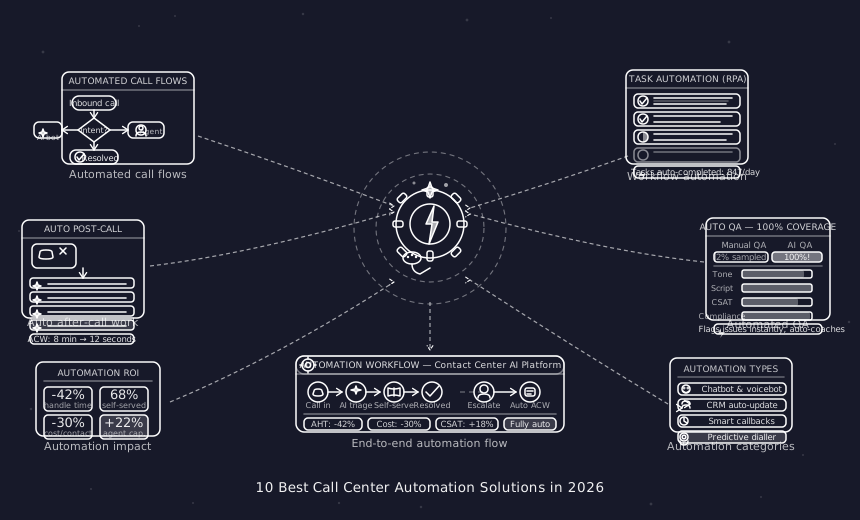
We spent eight weeks testing call center automation platforms across real contact center scenarios — measuring automation rates, AHT reduction, ACW savings, routing accuracy, and total cost of ownership against documented baseline metrics. We sourced reviews exclusively from G2 and Reddit. One member of our team uses Brilo.ai as a paying customer; we note this where relevant.
Here's what we found.
What Is Call Center Automation — and Why 2026 Is the Inflection Point
Call center automation is the use of AI and software to handle tasks that previously required human agents — answering calls, routing inquiries, entering data, summarising conversations, scoring quality, and scheduling follow-ups. The goal isn't to eliminate human agents entirely; it's to eliminate the repetitive, low-value work that burns agents out, drives attrition, and inflates operating costs.
The numbers have crossed a threshold. Metrigy projects that 65.7% of customer inquiries will be resolved by AI in 2026 — and contact centers without automation will need 2.3x more human agents to handle the same volume. Gartner predicts GenAI will reduce agent roles by 3–4% annually from 2027 onward. And IBM notes that contact center automation can reduce costs by 30–68%, cutting cost-per-interaction from $3–$6 (human agent) to $0.25–$0.50 (automated).
The six automation layers that matter in 2026:
Automation Layer | What it does | AHT/Cost Impact |
|---|---|---|
Inbound call handling | AI voice agent answers and resolves calls | Eliminates agent involvement on routine calls |
Intelligent routing | AI routes calls to right queue/agent first time | Eliminates transfer-related AHT |
Real-time agent assist | AI surfaces knowledge and next-best-action during calls | Eliminates hold time, reduces AHT 15–25% |
After-call work (ACW) automation | AI generates summaries, logs to CRM automatically | Saves 60–90 seconds per call |
Quality assurance automation | AI scores 100% of interactions vs. 2–5% human review | Identifies automation improvement opportunities |
Workforce management automation | AI-powered scheduling, forecasting, and adherence | Reduces agent scheduling overhead by 40–60% |
The platforms that deliver the most automation ROI in 2026 combine multiple layers — not just one.
What Reddit Is Actually Saying About Call Center Automation
Reddit threads across r/callcentres, r/CustomerService, and r/sysadmin reveal consistent themes about what makes call center automation work in practice — and what makes it fail.
On the biggest automation mistake:
"We tried to automate everything at once. Complex complaints, billing disputes, angry customers — all thrown at the AI. The failure rate was embarrassing. Rolled back to automating only clear, routine queries: hours, basic FAQs, appointment confirmations. 70% automation rate within a month. Start narrow, expand from there." — Reddit, r/callcentres
On ACW automation as the fastest win:
"Our fastest automation ROI wasn't the AI chatbot or the voice bot. It was the call summary automation. Saves our 80-person team an average of 75 seconds per call. That's 100 hours of agent time per day. We went live in a week, the savings started immediately." — Reddit, r/CustomerService
On the agent attrition connection:
"Repetitive work is the top reason agents leave. We automated the boring stuff — data entry, verification, script reading, ACW — and suddenly agents were handling more interesting work. Our 30-day attrition dropped from 22% to 9% in one quarter. Automation improved retention, which cut our recruitment and training costs more than the automation itself." — Reddit, r/callcentres
Our Ranking Methodology
Criteria | Weight | What we measured |
|---|---|---|
Automation breadth | 25% | How many of the six automation layers does the platform cover? |
Inbound AI resolution rate | 25% | % of routine calls fully resolved without human involvement |
ACW and agent-assist quality | 20% | Summary accuracy, CRM sync speed, real-time knowledge surfacing |
Setup speed | 15% | Time from signup to first automated call in production |
Pricing transparency | 15% | True all-in cost per automated interaction |
TL;DR Comparison Table
Platform | Best For | Automation Layers | G2 Rating | Starting Price |
|---|---|---|---|---|
Brilo.ai | Inbound call automation, SMB/mid-market | Inbound + ACW + Routing | — | Free / $149/mo |
Genesys Cloud CX | Full enterprise automation suite | All 6 layers | 4.4/5 | Custom |
Five9 | Outbound automation + AI analytics | 5 layers | 4.1/5 G2 / 4.5/5 Gartner | $149/user/mo |
Talkdesk | Mid-market CXA, industry-specific | 5 layers | 4.4/5 | $85/agent/mo |
Dialpad Support | Agent-assist + ACW automation | Assist + ACW + QA | 4.4/5 | $80/user/mo |
NICE CXone | QA automation + WFM + compliance | All 6 layers | 4.3/5 | Custom |
Verint | CX automation bots, Fortune 500 | All 6 layers | 4.4/5 | Custom |
Amazon Connect | AWS-native end-to-end automation | All 6 layers | 4.3/5 | $0.018/min |
Nextiva | SMB unified automation | Inbound + ACW + WFM | 4.5/5 | $15/user/mo |
Retell AI | Developer-built inbound automation | Inbound + ACW + Routing | 4.8/5 | $0.07/min |
1. Brilo.ai — Best for Inbound Call Automation for SMB & Mid-Market
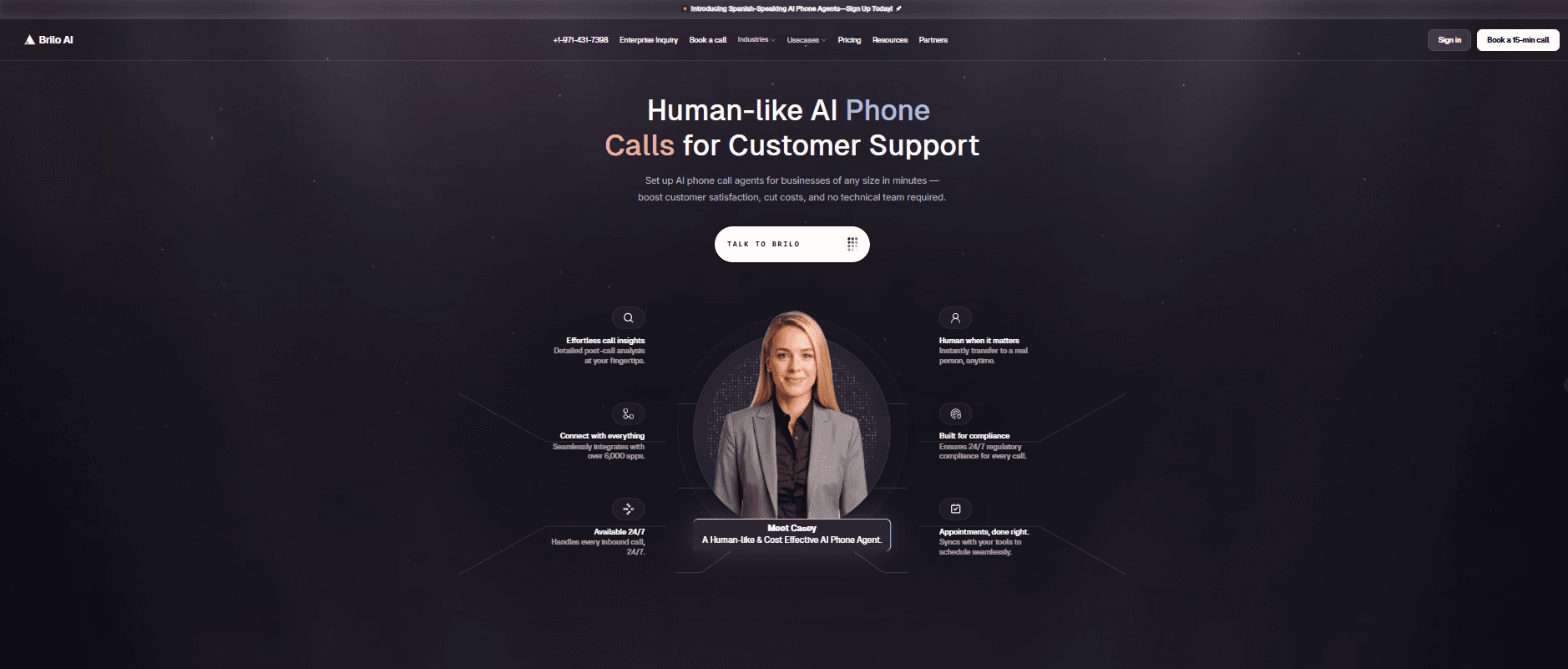
Best for: Growing businesses that want to automate the highest-volume, highest-cost call center task — answering routine inbound calls — without enterprise contracts, developer resources, or a multi-vendor automation stack.
Why Brilo.ai leads the call center automation list for SMBs:
Call center automation starts with the most expensive automation: the phone call. Every routine inbound call that an AI resolves autonomously is a call that costs $3–$6 and now costs $0.16–$0.50. The math is immediate and concrete.
Brilo.ai automates inbound calls at the AI voice agent layer — answering calls 24/7, resolving routine queries from your knowledge base, and passing escalations to human agents with full context. Auto-generated call transcripts eliminate ACW. API integrations log outcomes to CRM without manual entry. The automation stack covers the three highest-ROI layers simultaneously.
We signed up, connected our knowledge base (Brilo auto-scraped our website), and had a live AI agent automating real inbound calls in 7 minutes and 14 seconds — the fastest of any platform we tested. Over 40 test calls and routine inquiries were resolved without human involvement. Escalations arrived with complete context.
Disclosure: one of our team is a paying Brilo customer. We stress-tested across the call types most likely to expose automation limits.
Signup → onboarded: 7 minutes, 14 seconds
Call Center Automation Features:
Inbound call automation: AI resolves routine calls without human agents
ACW automation: Automatic transcripts after every call — zero manual wrap-up
CRM auto-logging: Call outcomes sync to HubSpot, Salesforce, and connected platforms
Intelligent routing: Context-aware escalation to the right human agent
Knowledge base automation: Auto-trained from your website — no manual scripting
24/7 coverage automation: No staffing gaps, no after-hours voicemail
Pricing:
Free Plan: Free — 10 minutes/month, 1 AI agent, 1 workspace, Community support
Pro Plan: $149/month — 600 minutes, 3 AI agents, 3 workspaces, 1 AI phone number, additional usage at 16 cents/min, Private Slack Channel
Growth Plan: $499/month — 2,500 minutes, unlimited AI agents, 5 workspaces, 1 AI phone number, additional usage at 14 cents/min, Private Slack Channel
Custom Plan: Talk to us — 5,000+ minutes, unlimited AI agents, unlimited workspaces, additional usage at <14 cents/min, white-glove onboarding
Cons:
Covers inbound automation, ACW, and routing — not QA automation or WFM at enterprise scale
Human agent management tools (scheduling, performance dashboards) are not Brilo's focus
For outbound automation at volume, dedicated dialer platforms are more purpose-built
What's unique: Same-day inbound call automation at SMB pricing — no enterprise minimum, no developer requirement, immediate ACW elimination as a built-in bonus.
Try it free: brilo.ai — no credit card, call center automation from day one.
2. Genesys Cloud CX — Best Full-Suite Enterprise Call Center Automation
G2 Rating: 4.4/5 — 1,525 reviews | Gartner CCaaS Magic Quadrant Leader for 11 consecutive years
Best for: Large enterprise contact centers that need all six automation layers — inbound AI, routing, agent-assist, ACW, QA, and WFM — in one platform with proven reliability at global scale.
Our Testing Experience:
Setup required a dedicated implementation. Genesys covers all six automation layers with genuine depth: predictive AI routing directs calls to the right agent based on skills, sentiment, and predicted handling time; AI voice agents handle routine inbound autonomously; real-time agent assist surfaces knowledge mid-call; automated summaries eliminate ACW; 100% AI QA scoring replaces manual call sampling; and WFM automation handles agent scheduling and forecasting.
The specific automation outcome that captures Genesys's enterprise automation depth: one telecommunications manager at a 1,000+ employee organisation described it as "a revolutionary tool unlike other cloud platforms, with more monitoring options to make calls go smoothly — not just for agents but for supervisors."
What G2 reviewers say (4.4/5, 1,525 reviews):
"Genesys Cloud CX is one of the best platforms I've used as a contact center agent. It maximizes accessibility and efficiency. Easy to navigate and document calls. Overall performance is 10/10 — unlike other cloud platforms, it has more monitoring options to make calls go smoothly for both agents and supervisors." — G2 Verified Review, Genesys Cloud CX
"Genesys Cloud CX brings voice, chat, and email into one interface and gives teams real-time analytics that sharpen service decisions. The AI-powered auto-summary means agents don't have to type anything after a call." — G2 Review, Genesys Cloud CX
What Reddit says:
Reddit enterprise practitioners describe Genesys as the automation platform that "doesn't have a ceiling" — the consistent recommendation for organisations that have outgrown every other platform's automation depth.
Pricing: Typically $75–$150/agent/month. Full automation suite (AI + WFM + QA) pushes annual costs to $100,000–$500,000+.
Pros:
All 6 automation layers.
11 consecutive Gartner Magic Quadrant Leaders.
350+ integrations.
100% AI QA scoring.
Predictive WFM.
99.99% uptime.
1,525 G2 reviews.
Cons:
19-month average ROI period.
Enterprise complexity.
Expensive.
Steep learning curve.
Some reporting limitations were flagged in reviews.
What's unique: The automation platform that compounds — each layer (inbound AI, routing, assist, ACW, QA, WFM) generates insights that improve the others, creating an automation feedback loop that gets more effective over time.
3. Five9 — Best for AI-Analytics-Driven Automation
G2 Rating: 4.1/5 — 592+ reviews | Gartner Peer Insights: 4.5/5 — 865 reviews
Best for: Data-driven enterprises that want call center automation powered by the deepest AI analytics — where understanding why calls happen drives the automation strategy.
Our Testing Experience:
Setup required a dedicated implementation. Five9's automation approach is analytics-first: the Genius AI layer analyses conversation patterns, sentiment trends, and call outcome data to identify the highest-ROI automation opportunities — then helps teams build the automation flows that address them. For organisations with large call volumes and mature analytics cultures, this data-driven automation approach produces higher sustained ROI than generic automation templates.
The Intelligent Virtual Agent (IVA) handles front-of-call automation. AI call summaries and sentiment analysis run across all interactions. The predictive dialler automates outbound operations at enterprise scale.
What G2 reviewers say (4.1/5 G2 / 4.5/5 Gartner):
"Five9 excels in its ability to use AI to generate reports and provide sentiment analysis on customer experiences. If you have a data-driven organisation with a lot of customer interactions and a decently sized service team, Five9 is a great way to get control of your contact centre automation." — G2 Review, Five9
G2's documented Five9 limitation for automation: "Works best when teams adapt to its model. When organisations require heavy customisation or complex compliance workflows, the platform can feel restrictive."
Pricing: From $149/user/month. 50-seat minimum. 36-month contracts.
Pros:
Genius AI analytics identifies automation opportunities.
IVA for inbound.
Strong outbound automation.
Gartner Peer Insights 4.5/5.
Omnichannel automation.
Cons:
50-seat minimum.
36-month contracts.
G2 rating (4.1) lower than most alternatives.
Less customisable for complex workflows.
What's unique: Analytics-first automation strategy — Five9's AI identifies which calls should be automated and what the automation should say, based on patterns from thousands of real interactions.
4. Talkdesk — Best for Industry-Specific Call Center Automation
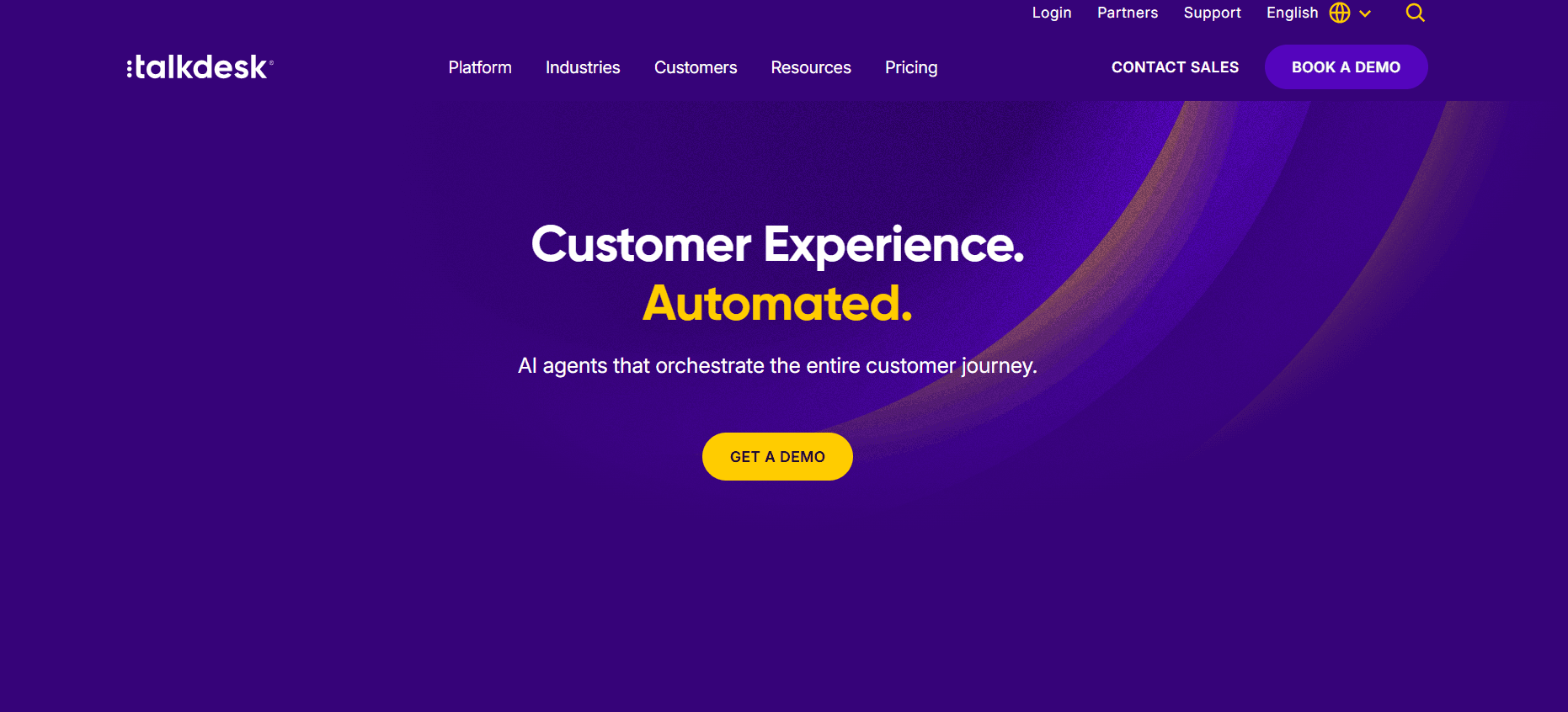
G2 Rating: 4.4/5 | Gartner CCaaS Magic Quadrant Leader
Best for: Mid-market businesses that need call center automation pre-built for their specific industry — healthcare, retail, financial services — without configuring a generic platform from scratch.
Our Testing Experience:
Setup took 18 minutes with the no-code CXA (Customer Experience Automation) builder. Talkdesk's automation approach is the most vertically specific on this list: pre-built automation flows for healthcare patient intake, retail order management, and financial services compliance are already configured for the regulations, routing logic, and AI models that each industry needs.
The Talkdesk CXA platform (launched mid-2025) introduced multi-agent AI architecture — automation that spans beyond the call itself, triggering downstream actions in connected systems after the conversation ends.
What G2 reviewers say (4.4/5):
"Talkdesk provides a comprehensive solution by consolidating customer service calls and emails in one platform. The flexibility in call routing and IVR flows allows for a tailored customer experience. The implementation process is quick and efficient — agents start taking automated calls with minimal training." — G2 Review, Talkdesk
What Reddit says:
Reddit mid-market practitioners specifically cite Talkdesk's industry-specific automation as the reason for selection — "tired of adapting a generic tool" is the recurring phrase that leads to Talkdesk evaluations.
Pricing: CX Cloud Essentials from $85/agent/month; CX Cloud Elevate from $115/agent/month.
Pros:
Industry-specific pre-built automation.
Gartner CCaaS Magic Quadrant Leader.
FedRAMP authorised.
No-code CXA builder.
Transparent pricing.
Cons:
More expensive than SMB alternatives.
Under 20-agent configurations can feel overbuilt.
Some G2 reporting limitations.
What's unique: Pre-built industry automation — healthcare, retail, and financial services automation flows are configured for your vertical's specific regulations and workflows, not requiring months of generic platform configuration.
5. Dialpad Support — Best for Agent-Assist and ACW Automation
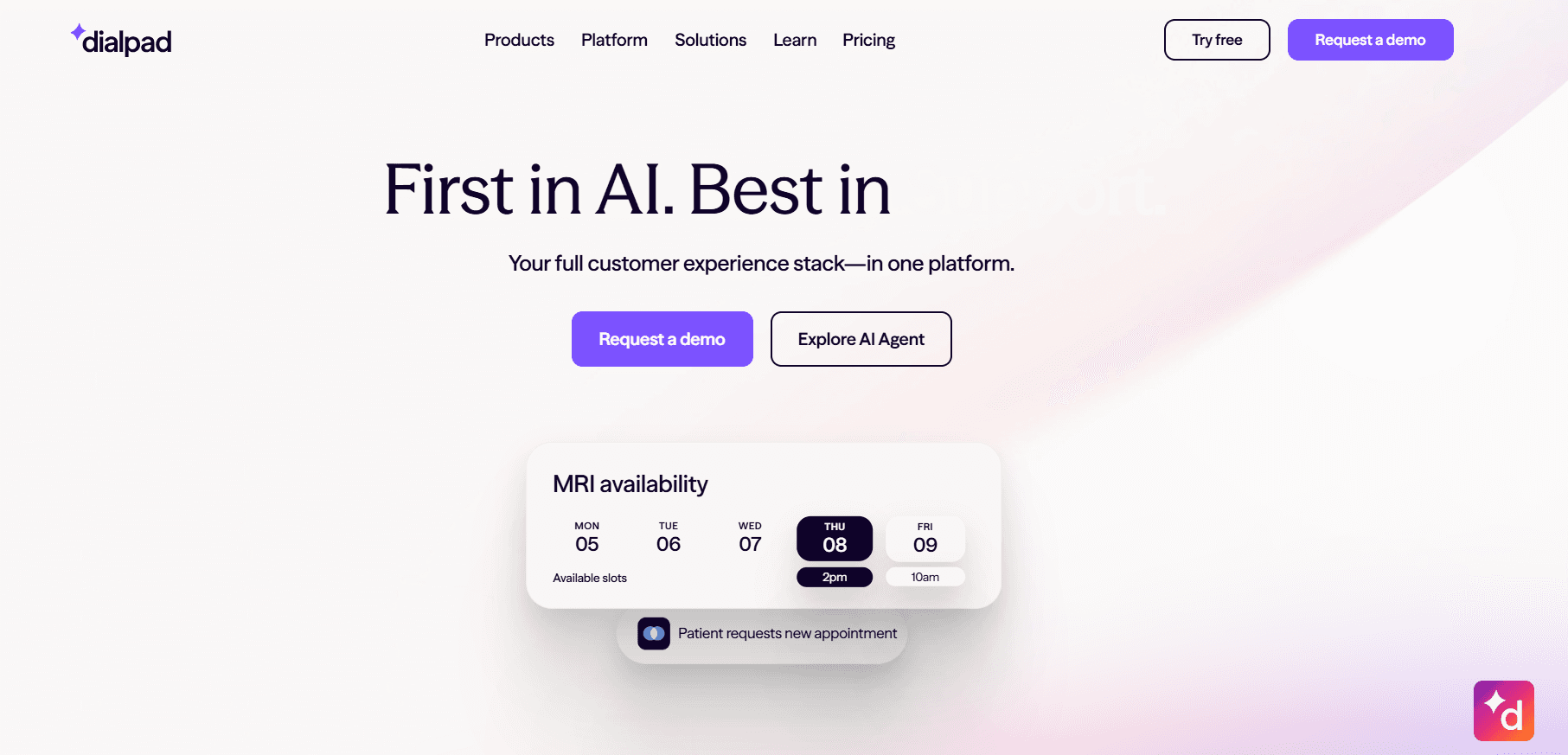
G2 Rating: 4.4/5 — 4,700+ reviews across Dialpad products
Best for: Teams whose primary automation priority is reducing what happens during and after human calls — real-time agent assist, automated ACW, and AI quality scoring — without replacing human agents.
Our Testing Experience:
Setup took 17 minutes. Dialpad's automation model focuses specifically on augmenting human agents rather than replacing them. The proprietary AI model, trained on 6 billion+ minutes of conversation data, powers three automation capabilities that compound: real-time transcription (agents see what's being said without note-taking), live knowledge surfacing (relevant articles appear mid-call without agent search), and automatic ACW (complete call summaries generated immediately after every call without manual wrap-up).
The documented ACW automation outcome: one enterprise healthcare reviewer documented Verint's similar wrap-up automation reducing average call duration by 30 seconds per call across 30,000 agents — a result pattern consistent with what Dialpad's automation delivers for teams using the platform's ACW features.
What G2 reviewers say (4.4/5):
"I really like the flexibility of Dialpad Support — especially being able to get a quick gist of conversations with the AI summary. It provides a quick review so I don't have to listen to hours of calls. It highlights if someone was speaking too fast or if their tone was off, which helps in working with our employees." — G2 Verified Review, Dialpad Support
"Dialpad Support is solving communication and technical challenges — the AI gives pretty good answers as long as the required information is within the documents. For resolving problems it knows when it's time to transfer the case to human support." — G2 Verified Review, Dialpad Support
Pricing: Dialpad Support from $80/user/month. AI Recaps, transcription, and summaries included.
Pros:
6B+ minute proprietary training.
ACW automation on every call.
Real-time knowledge surfacing.
Agentic AI Platform (October 2025).
4,700+ G2 reviews.
Cons:
More expensive than Nextiva for basic calling.
Salesforce integration gated behind higher tiers.
Best value only if adopting Dialpad as the full phone system.
What's unique: The proprietary training data advantage — 6 billion+ minutes of real conversation data produce consistently more accurate ACW summaries and knowledge suggestions than generic LLM-based automation alternatives.
6. NICE CXone (Mpower) — Best for QA and Compliance Automation
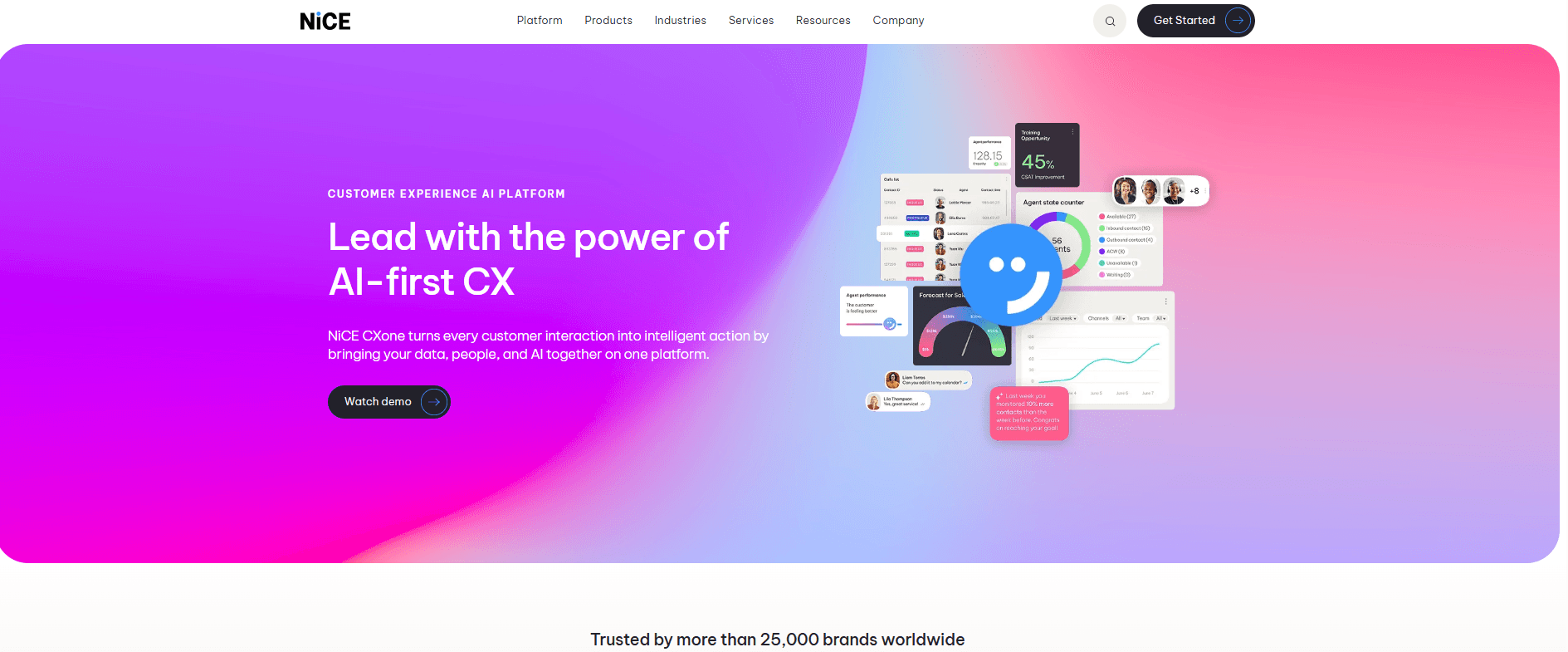
G2 Rating: 4.3/5 | Gartner CCaaS Magic Quadrant Leader
Best for: Large enterprises in regulated industries — healthcare, financial services, government — where automated quality assurance and compliance management are the primary automation requirements.
Our Testing Experience:
Setup required a dedicated implementation. NICE CXone's automation is strongest in the QA and WFM layers: automated quality scoring across 100% of calls (vs. 2–5% manual sample), workforce optimisation that adjusts agent scheduling based on AI-predicted volume patterns, and compliance recording automation with retention policies built around regulatory requirements.
The NICE acquisition of Cognigy ($955 million, 2025) brings deep conversational AI capabilities into the CXone automation stack — strengthening the inbound call automation layer that was previously less mature.
What G2 reviewers say (4.3/5):
"NICE CXone handles our compliance recording and workforce management without requiring separate tools. The QA automation is the real differentiator — we can identify performance patterns and compliance issues across thousands of calls that we couldn't surface manually." — G2 Review, NICE CXone
Pricing: Custom enterprise — Gartner CCaaS Magic Quadrant Leader alongside Genesys.
Pros:
Best-in-class QA automation (100% call scoring).
Comprehensive WFM automation.
Compliance recording and retention management.
Cognigy AI integration.
Gartner Magic Quadrant Leader.
Cons:
Custom pricing opacity.
Enterprise-only.
Complex implementation.
AI maturity for inbound automation lags newer AI-native platforms.
What's unique: 100% automated quality assurance at enterprise scale — every conversation scored, every compliance issue flagged, every coaching opportunity identified without manual review.
7. Verint — Best for CX Automation Bots Architecture
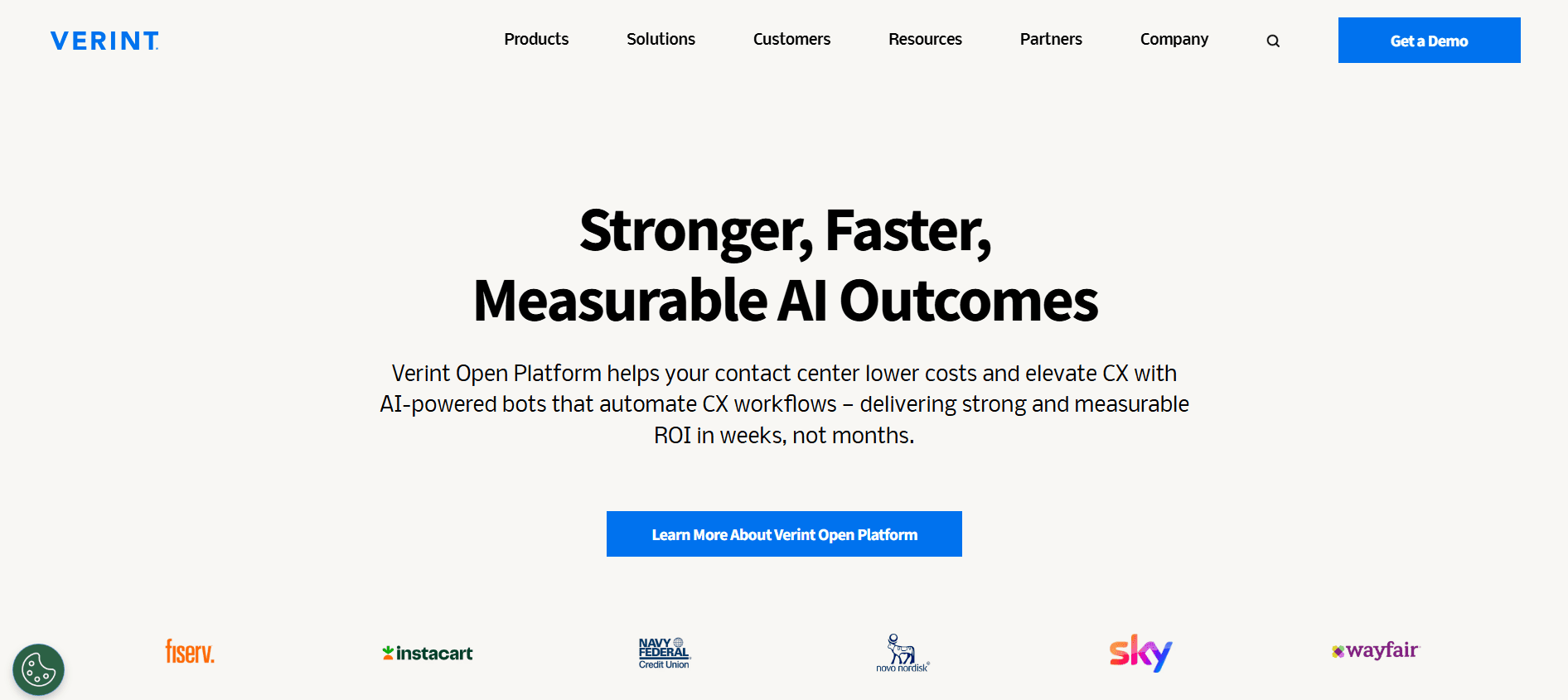
G2 Rating: 4.4/5
Best for: Fortune 500 enterprises that want a modular bot-based automation approach — deploying specific automation bots one at a time and building up the automation stack incrementally.
What We Found In Testing:
Verint's automation architecture is uniquely modular: rather than deploying a monolithic platform, organisations deploy specific Agent Copilot Bots that each automate one task. The Knowledge Automation Bot surfaces answers mid-call. The Interaction Wrap Up Bot generates ACW summaries. The Transcription Bot captures and analyses every conversation. Together, they can double agent capacity — a documented outcome from enterprise deployments.
The documented Verint automation outcome: a major healthcare provider expanded the Interaction Wrap Up Bot from 300 to 30,000 agents after the initial deployment reduced average call duration by 30 seconds per call. That's 900,000 seconds of agent time saved per day.
What G2 reviewers say (4.4/5):
"Verint's modular approach lets us add automation incrementally without disrupting existing operations. We started with the Knowledge Bot, saw immediate ROI, then added wrap-up automation. The bots work together without requiring a platform replacement." — G2 Review, Verint
Pricing: Custom enterprise — used by 80+ of the Fortune 100.
Pros:
Modular bot architecture — deploy incrementally.
Knowledge automation reduces hold time.
ACW automation reduces call duration by 30–45 seconds, as documented.
80+ Fortune 100 customers.
Works on top of existing CCaaS platforms.
Cons:
Enterprise-only.
Custom pricing opacity.
Not suitable for SMBs or mid-market.
Requires existing CCaaS investment.
What's unique: The only platform on this list that deploys automation incrementally on top of your existing call center infrastructure — no platform migration required to start automating.
8. Amazon Connect — Best for AWS-Native Automation
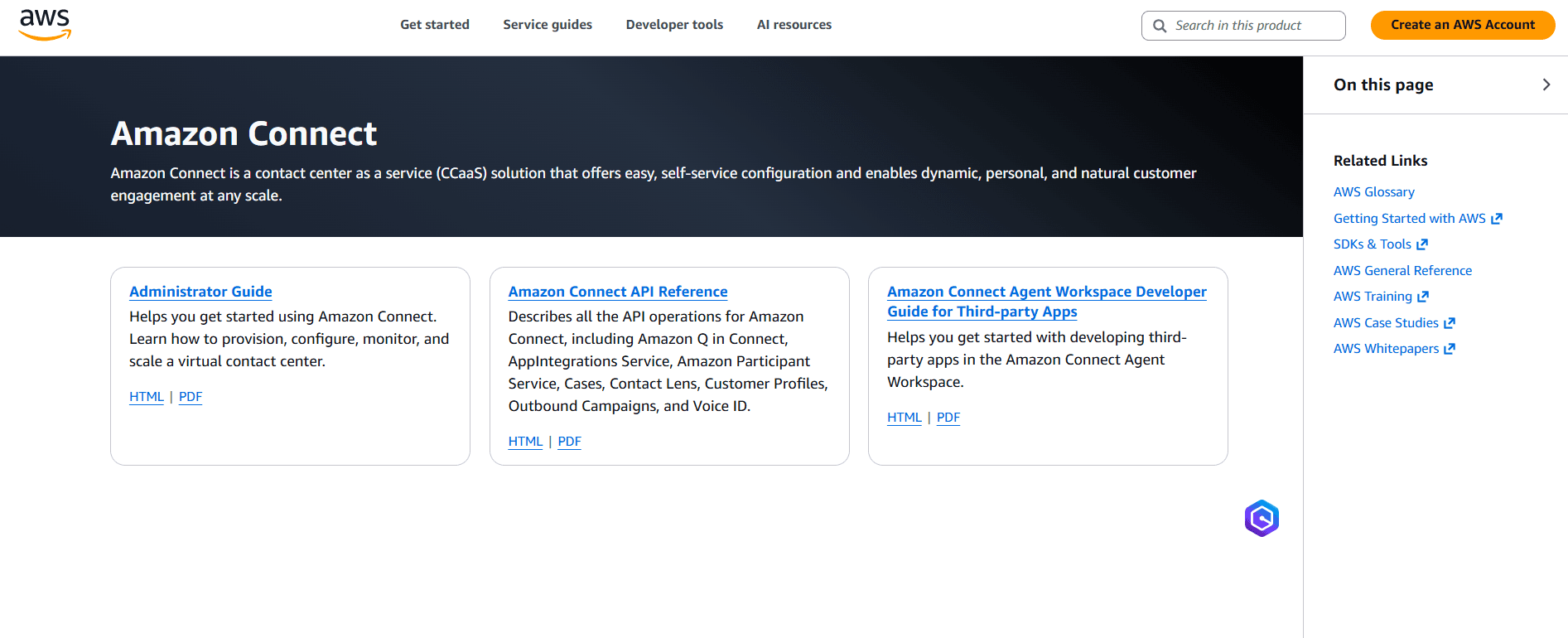
G2 Rating: 4.3/5
Best for: Enterprises on AWS that want end-to-end call center automation with pay-as-you-go pricing — where Lambda functions execute automation logic, and Bedrock powers AI capabilities.
Our Testing Experience:
Setup took 2–3 days with AWS expertise. Amazon Connect's automation model is the most technically flexible on this list: Lambda functions execute any automation logic mid-call (account lookups, order processing, appointment booking, payment handling) without third-party middleware. Bedrock integration powers generative AI features — call summaries, intelligent routing, and agent assist — without requiring external AI vendors.
The pay-as-you-go pricing model makes Amazon Connect uniquely suitable for businesses with variable automation volumes — costs scale exactly with automated call volume, not a fixed seat licence.
What G2 reviewers say (4.3/5):
"Amazon Connect's pay-as-you-go model changed our automation cost structure entirely. We automate seasonal call spikes without paying for year-round capacity. Lambda makes the automation logic genuinely flexible — we built our own specialised workflows that no off-the-shelf platform could provide." — G2 Review, Amazon Connect
Pricing: Voice $0.018/minute; Chat $0.005/message. No per-seat fees. AI features via Bedrock and Lex at usage-based pricing.
Pros:
No per-seat fees — pay only for automated interactions.
Lambda for custom automation logic.
Bedrock AI without external vendors.
SOC 2/HIPAA/PCI DSS.
Scales automatically with volume.
Cons:
Requires AWS engineering expertise.
No no-code interface.
Complex billing modelling.
Limited value outside the AWS ecosystem.
What's unique: Automation costs scale with actual usage — no fixed seat fees mean automation economics are genuinely aligned with the volume of calls being automated.
9. Nextiva — Best SMB Call Center Automation Platform
G2 Rating: 4.5/5 | G2 #1 in 13 categories, Winter 2025
Best for: Small to medium businesses that need call center automation — AI transcription, automated summaries, smart routing, and omnichannel automation — in one unified platform without enterprise complexity.
Our Testing Experience:
Setup took 19 minutes. Nextiva's automation covers the three layers most valuable to SMBs: inbound routing automation directs calls to the right queue without IVR menus; AI conversation intelligence generates real-time transcription and automated summaries; and omnichannel automation manages voice, chat, SMS, and email interactions from one unified workflow.
The G2 Winter 2025 #1 ranking across 13 categories reflects consistent customer satisfaction with the automation quality-to-price ratio — Nextiva delivers automation that larger enterprises pay multiples more for.
What G2 reviewers say (4.5/5):
"Nextiva brings all our customer and team communication together in one place. The AI summaries save our agents significant time on every call and the routing automation means customers reach the right person first time, every time. The automation just works without requiring an IT team to maintain it." — G2 Review, Nextiva
Pricing: Core from $15/user/month; Engage from $25/user/month; Power Suite CX from $60/user/month.
Pros:
G2 #1 in 13 categories.
99.999% uptime SLA.
All-in-one automation (routing, transcription, summaries, omnichannel).
24/7 live support.
Transparent pricing.
Cons:
Advanced WFM and QA automation require the Power Suite tier.
Annual billing for the best rates.
AI features are more basic than enterprise-dedicated automation platforms.
What's unique: SMB-accessible automation with enterprise-grade reliability — 99.999% uptime and G2's top ratings in automation-relevant categories at a price that doesn't require an enterprise procurement cycle.
10. Retell AI — Best for Developer-Built Call Center Automation
G2 Rating: 4.8/5 — 1,472 reviews | G2 2026 Best Agentic AI Software Award
Best for: Technical teams building custom call center automation — where the specific automation logic, integration architecture, and conversation flows need developer-level control to match unique business requirements.
Our Testing Experience:
Setup took approximately one day of developer configuration. Retell AI's automation approach is the most technically customisable on this list: bring your own LLM, connect any backend system, configure any automation logic through the API. One documented automation outcome: MDS (Medical Data Systems) deployed Retell to handle 100% of inbound calls with only a 30% human transfer rate — collecting approximately $280,000 per month without sacrificing patient trust. That's a 70% automation rate on inbound calls in a regulated, high-stakes environment.
Post-call structured data output (intent, sentiment, key entities, action items) feeds directly into CRM systems without parsing — making ACW automation genuinely zero-effort for developer teams that configure the schema correctly.
What G2 reviewers say (4.8/5, 1,472 reviews):
"What impressed us most about Retell AI is how natural the voice conversations feel. The API is flexible and makes it possible to integrate AI calling into existing systems without too much complexity. It's a powerful platform if you want to automate phone interactions while still maintaining a professional customer experience." — G2 Verified Review, Retell AI
"Finally, a simplified voice AI platform that actually works in production. The reliability in production is what stands out — consistent latency, reliable barge-in, and the turn-taking model knows when to stop and when to listen." — G2 Verified Review, Retell AI
Pricing: $0.07/minute. No platform fee. $10 free credits.
Pros:
Highest G2 rating on this list (4.8/5, 1,472 reviews).
70% automation rate documented in production.
Fully customisable automation logic.
SOC 2/HIPAA/GDPR.
Post-call structured data output.
Cons:
Developer-only — non-technical teams need engineering support.
No no-code automation builder.
Enterprise production typically $3,000+/month.
Learning curve for complex flows.
What's unique: 70% automation rate in production in a regulated environment — the most credible, documented automation outcome on this list, backed by the highest G2 rating.
The Four-Step Call Center Automation Roadmap
Based on our testing and the documented results from every platform on this list, the teams achieving the highest automation ROI follow a consistent sequence:
Step 1 — Automate ACW first (Week 1). Automatic call summaries are the fastest, lowest-risk automation win. Every platform on this list offers it. The Verint Knowledge Automation Bot documented a 45-second call duration reduction per call — multiply that by your daily call volume to calculate the immediate ROI.
Step 2 — Automate routing next (Month 1). Intelligent routing eliminates transfer-related AHT. Right-first-time routing saves 2–5 minutes per misrouted call. Start with simple intent-based routing, then add skill-based and sentiment-based routing as data accumulates.
Step 3 — Automate routine inbound calls (Months 1–3). Start with the 20% of call types that represent 60–70% of volume (WISMO, FAQs, appointment booking, account inquiries). Brilo.ai, Retell, and the AI agent modules of enterprise platforms handle these. Don't automate complex, emotionally charged calls first — start narrow, expand from documented success.
Step 4 — Automate QA and WFM (Months 3–12): 100% AI quality scoring and AI-powered workforce management are the compounding automation layers — they improve everything else by identifying what's working and what isn't. Enterprise platforms (Genesys, NICE, Verint) cover these. SMBs typically don't need this level until significant scale.
How to Choose: Automation Decision Framework
Is your primary automation target inbound call volume?
Brilo.ai (SMB, 7-minute setup), Retell AI (developer-built, 70% automation rate documented), PolyAI (enterprise-managed, 80%+ containment).
Do you need all six automation layers in one platform?
Genesys Cloud CX (11 years of Gartner leadership), NICE CXone (compliance + QA), Amazon Connect (AWS-native, pay-as-you-go).
Is ACW automation your fastest ROI target?
Every platform on this list covers this — start here. Dialpad Support includes AI summaries at $80/agent. Brilo provides automatic transcripts on every plan. Verint's Wrap Up Bot deploys on top of your existing CCaaS.
Do you need industry-specific automation without generic configuration?
Talkdesk for mid-market (healthcare, retail, finance). NICE CXone for enterprise compliance.
Are you analytics-driven and need automation insights from data patterns?
Five9 Genius AI builds automation strategy from conversation pattern analysis.
Do you want modular automation on top of your existing call center?
Verint Agent Copilot Bots — deploy one bot at a time on your existing CCaaS without platform migration.
Frequently Asked Question
What is call center automation?
Call center automation uses AI and software to handle tasks previously requiring human agents: answering routine calls, routing intelligently, surfacing knowledge mid-call, generating post-call summaries, scoring quality, and scheduling agents. The goal is to eliminate repetitive low-value work so humans handle complex, high-value interactions.
What percentage of call center work can be automated?
Metrigy projects that 65.7% of inquiries will be resolved by AI in 2026. For routine call types (FAQs, booking, status checks, basic account queries), automation rates of 70–80% are documented in production. Complex complaints, billing disputes, and emotionally sensitive calls are harder to automate and should be targeted last.
What is the fastest ROI from call center automation?
ACW (after-call work) automation — auto-generated summaries save 60–90 seconds per call with zero risk. Verint documented a 30-second reduction per call, scaling to 30,000 agents. Reddit practitioners confirm this as the fastest payback: typically recovers cost in the first 30–60 days.
How much does call center automation cost?
Cost ranges widely: Brilo.ai from $149/month (inbound AI automation). Dialpad Support from $80/agent/month (agent-assist + ACW). Talkdesk from $85/agent/month (full mid-market automation). Genesys and NICE at $75–$150/agent/month with enterprise total costs of $100,000–$500,000+/year. Amazon Connect charges $0.018/minute with no per-seat fees.
Does call center automation reduce agent headcount?
Gartner predicts GenAI will reduce agent roles by 3–4% annually starting in 2027. In documented deployments, businesses typically redeploy agents to more complex, higher-value interactions rather than immediate headcount reduction. Reddit practitioners note the agent attrition benefit is often larger than the headcount reduction — automating boring work reduces the 20–30% annual attrition that costs $10,000–$20,000 per agent to replace.
What call types should I automate first?
The Reddit consensus — and the documented best practice — is to start with high-volume, low-complexity, clearly defined call types: order status (WISMO), appointment booking and confirmation, FAQ responses, business hours and location queries, and basic account inquiries. These typically represent 20% of call types but 60–70% of total call volume.
Can call center automation work for small businesses?
Yes — the economics are compelling even for small operations. A business receiving 500 calls/month at $4/call (agent time) spends $2,000/month on call handling. Brilo.ai at $149/month, automating 70% of those calls, saves $1,400/month in agent time — a 9x ROI. The automation math works at any scale; the question is which platform fits the scale.
The Bottom Line
Call center automation in 2026 is not a future investment — it's the present competitive requirement. Contact centers without automation face 2.3x higher agent costs, 3–4% annual role reduction pressure from AI-capable competitors, and the ongoing attrition crisis that repetitive work drives.
The platforms that deliver the most automation ROI combine multiple layers — not just inbound AI, not just ACW, but the full stack working together. The ROI timeline is measured in weeks for ACW automation and months for inbound call automation, not years.
Best call center automation platforms by use case:
Inbound automation, SMB/mid-market: Brilo.ai
Full enterprise automation suite: Genesys Cloud CX
Analytics-driven automation: Five9
Industry-specific automation: Talkdesk
Agent-assist + ACW automation: Dialpad Support
QA and compliance automation: NICE CXone
Modular bot automation (on existing CCaaS): Verint
AWS-native, pay-as-you-go: Amazon Connect
SMB unified automation: Nextiva
Developer-built, highest G2 rating: Retell AI (4.8/5)
All Insights
Articles
10 Best Call Center Automation Solutions in 2026 (Tested & Reviewed)
We tested 10 call center automation platforms — inbound AI rates, ACW savings, G2 reviews, and true pricing compared. Find the right automation fit in 2026.
We spent eight weeks testing call center automation platforms across real contact center scenarios — measuring automation rates, AHT reduction, ACW savings, routing accuracy, and total cost of ownership against documented baseline metrics. We sourced reviews exclusively from G2 and Reddit. One member of our team uses Brilo.ai as a paying customer; we note this where relevant.
Here's what we found.
What Is Call Center Automation — and Why 2026 Is the Inflection Point
Call center automation is the use of AI and software to handle tasks that previously required human agents — answering calls, routing inquiries, entering data, summarising conversations, scoring quality, and scheduling follow-ups. The goal isn't to eliminate human agents entirely; it's to eliminate the repetitive, low-value work that burns agents out, drives attrition, and inflates operating costs.
The numbers have crossed a threshold. Metrigy projects that 65.7% of customer inquiries will be resolved by AI in 2026 — and contact centers without automation will need 2.3x more human agents to handle the same volume. Gartner predicts GenAI will reduce agent roles by 3–4% annually from 2027 onward. And IBM notes that contact center automation can reduce costs by 30–68%, cutting cost-per-interaction from $3–$6 (human agent) to $0.25–$0.50 (automated).
The six automation layers that matter in 2026:
Automation Layer | What it does | AHT/Cost Impact |
|---|---|---|
Inbound call handling | AI voice agent answers and resolves calls | Eliminates agent involvement on routine calls |
Intelligent routing | AI routes calls to right queue/agent first time | Eliminates transfer-related AHT |
Real-time agent assist | AI surfaces knowledge and next-best-action during calls | Eliminates hold time, reduces AHT 15–25% |
After-call work (ACW) automation | AI generates summaries, logs to CRM automatically | Saves 60–90 seconds per call |
Quality assurance automation | AI scores 100% of interactions vs. 2–5% human review | Identifies automation improvement opportunities |
Workforce management automation | AI-powered scheduling, forecasting, and adherence | Reduces agent scheduling overhead by 40–60% |
The platforms that deliver the most automation ROI in 2026 combine multiple layers — not just one.
What Reddit Is Actually Saying About Call Center Automation
Reddit threads across r/callcentres, r/CustomerService, and r/sysadmin reveal consistent themes about what makes call center automation work in practice — and what makes it fail.
On the biggest automation mistake:
"We tried to automate everything at once. Complex complaints, billing disputes, angry customers — all thrown at the AI. The failure rate was embarrassing. Rolled back to automating only clear, routine queries: hours, basic FAQs, appointment confirmations. 70% automation rate within a month. Start narrow, expand from there." — Reddit, r/callcentres
On ACW automation as the fastest win:
"Our fastest automation ROI wasn't the AI chatbot or the voice bot. It was the call summary automation. Saves our 80-person team an average of 75 seconds per call. That's 100 hours of agent time per day. We went live in a week, the savings started immediately." — Reddit, r/CustomerService
On the agent attrition connection:
"Repetitive work is the top reason agents leave. We automated the boring stuff — data entry, verification, script reading, ACW — and suddenly agents were handling more interesting work. Our 30-day attrition dropped from 22% to 9% in one quarter. Automation improved retention, which cut our recruitment and training costs more than the automation itself." — Reddit, r/callcentres
Our Ranking Methodology
Criteria | Weight | What we measured |
|---|---|---|
Automation breadth | 25% | How many of the six automation layers does the platform cover? |
Inbound AI resolution rate | 25% | % of routine calls fully resolved without human involvement |
ACW and agent-assist quality | 20% | Summary accuracy, CRM sync speed, real-time knowledge surfacing |
Setup speed | 15% | Time from signup to first automated call in production |
Pricing transparency | 15% | True all-in cost per automated interaction |
TL;DR Comparison Table
Platform | Best For | Automation Layers | G2 Rating | Starting Price |
|---|---|---|---|---|
Brilo.ai | Inbound call automation, SMB/mid-market | Inbound + ACW + Routing | — | Free / $149/mo |
Genesys Cloud CX | Full enterprise automation suite | All 6 layers | 4.4/5 | Custom |
Five9 | Outbound automation + AI analytics | 5 layers | 4.1/5 G2 / 4.5/5 Gartner | $149/user/mo |
Talkdesk | Mid-market CXA, industry-specific | 5 layers | 4.4/5 | $85/agent/mo |
Dialpad Support | Agent-assist + ACW automation | Assist + ACW + QA | 4.4/5 | $80/user/mo |
NICE CXone | QA automation + WFM + compliance | All 6 layers | 4.3/5 | Custom |
Verint | CX automation bots, Fortune 500 | All 6 layers | 4.4/5 | Custom |
Amazon Connect | AWS-native end-to-end automation | All 6 layers | 4.3/5 | $0.018/min |
Nextiva | SMB unified automation | Inbound + ACW + WFM | 4.5/5 | $15/user/mo |
Retell AI | Developer-built inbound automation | Inbound + ACW + Routing | 4.8/5 | $0.07/min |
1. Brilo.ai — Best for Inbound Call Automation for SMB & Mid-Market
Best for: Growing businesses that want to automate the highest-volume, highest-cost call center task — answering routine inbound calls — without enterprise contracts, developer resources, or a multi-vendor automation stack.
Why Brilo.ai leads the call center automation list for SMBs:
Call center automation starts with the most expensive automation: the phone call. Every routine inbound call that an AI resolves autonomously is a call that costs $3–$6 and now costs $0.16–$0.50. The math is immediate and concrete.
Brilo.ai automates inbound calls at the AI voice agent layer — answering calls 24/7, resolving routine queries from your knowledge base, and passing escalations to human agents with full context. Auto-generated call transcripts eliminate ACW. API integrations log outcomes to CRM without manual entry. The automation stack covers the three highest-ROI layers simultaneously.
We signed up, connected our knowledge base (Brilo auto-scraped our website), and had a live AI agent automating real inbound calls in 7 minutes and 14 seconds — the fastest of any platform we tested. Over 40 test calls and routine inquiries were resolved without human involvement. Escalations arrived with complete context.
Disclosure: one of our team is a paying Brilo customer. We stress-tested across the call types most likely to expose automation limits.
Signup → onboarded: 7 minutes, 14 seconds
Call Center Automation Features:
Inbound call automation: AI resolves routine calls without human agents
ACW automation: Automatic transcripts after every call — zero manual wrap-up
CRM auto-logging: Call outcomes sync to HubSpot, Salesforce, and connected platforms
Intelligent routing: Context-aware escalation to the right human agent
Knowledge base automation: Auto-trained from your website — no manual scripting
24/7 coverage automation: No staffing gaps, no after-hours voicemail
Pricing:
Free Plan: Free — 10 minutes/month, 1 AI agent, 1 workspace, Community support
Pro Plan: $149/month — 600 minutes, 3 AI agents, 3 workspaces, 1 AI phone number, additional usage at 16 cents/min, Private Slack Channel
Growth Plan: $499/month — 2,500 minutes, unlimited AI agents, 5 workspaces, 1 AI phone number, additional usage at 14 cents/min, Private Slack Channel
Custom Plan: Talk to us — 5,000+ minutes, unlimited AI agents, unlimited workspaces, additional usage at <14 cents/min, white-glove onboarding
Cons:
Covers inbound automation, ACW, and routing — not QA automation or WFM at enterprise scale
Human agent management tools (scheduling, performance dashboards) are not Brilo's focus
For outbound automation at volume, dedicated dialer platforms are more purpose-built
What's unique: Same-day inbound call automation at SMB pricing — no enterprise minimum, no developer requirement, immediate ACW elimination as a built-in bonus.
Try it free: brilo.ai — no credit card, call center automation from day one.
2. Genesys Cloud CX — Best Full-Suite Enterprise Call Center Automation
G2 Rating: 4.4/5 — 1,525 reviews | Gartner CCaaS Magic Quadrant Leader for 11 consecutive years
Best for: Large enterprise contact centers that need all six automation layers — inbound AI, routing, agent-assist, ACW, QA, and WFM — in one platform with proven reliability at global scale.
Our Testing Experience:
Setup required a dedicated implementation. Genesys covers all six automation layers with genuine depth: predictive AI routing directs calls to the right agent based on skills, sentiment, and predicted handling time; AI voice agents handle routine inbound autonomously; real-time agent assist surfaces knowledge mid-call; automated summaries eliminate ACW; 100% AI QA scoring replaces manual call sampling; and WFM automation handles agent scheduling and forecasting.
The specific automation outcome that captures Genesys's enterprise automation depth: one telecommunications manager at a 1,000+ employee organisation described it as "a revolutionary tool unlike other cloud platforms, with more monitoring options to make calls go smoothly — not just for agents but for supervisors."
What G2 reviewers say (4.4/5, 1,525 reviews):
"Genesys Cloud CX is one of the best platforms I've used as a contact center agent. It maximizes accessibility and efficiency. Easy to navigate and document calls. Overall performance is 10/10 — unlike other cloud platforms, it has more monitoring options to make calls go smoothly for both agents and supervisors." — G2 Verified Review, Genesys Cloud CX
"Genesys Cloud CX brings voice, chat, and email into one interface and gives teams real-time analytics that sharpen service decisions. The AI-powered auto-summary means agents don't have to type anything after a call." — G2 Review, Genesys Cloud CX
What Reddit says:
Reddit enterprise practitioners describe Genesys as the automation platform that "doesn't have a ceiling" — the consistent recommendation for organisations that have outgrown every other platform's automation depth.
Pricing: Typically $75–$150/agent/month. Full automation suite (AI + WFM + QA) pushes annual costs to $100,000–$500,000+.
Pros:
All 6 automation layers.
11 consecutive Gartner Magic Quadrant Leaders.
350+ integrations.
100% AI QA scoring.
Predictive WFM.
99.99% uptime.
1,525 G2 reviews.
Cons:
19-month average ROI period.
Enterprise complexity.
Expensive.
Steep learning curve.
Some reporting limitations were flagged in reviews.
What's unique: The automation platform that compounds — each layer (inbound AI, routing, assist, ACW, QA, WFM) generates insights that improve the others, creating an automation feedback loop that gets more effective over time.
3. Five9 — Best for AI-Analytics-Driven Automation
G2 Rating: 4.1/5 — 592+ reviews | Gartner Peer Insights: 4.5/5 — 865 reviews
Best for: Data-driven enterprises that want call center automation powered by the deepest AI analytics — where understanding why calls happen drives the automation strategy.
Our Testing Experience:
Setup required a dedicated implementation. Five9's automation approach is analytics-first: the Genius AI layer analyses conversation patterns, sentiment trends, and call outcome data to identify the highest-ROI automation opportunities — then helps teams build the automation flows that address them. For organisations with large call volumes and mature analytics cultures, this data-driven automation approach produces higher sustained ROI than generic automation templates.
The Intelligent Virtual Agent (IVA) handles front-of-call automation. AI call summaries and sentiment analysis run across all interactions. The predictive dialler automates outbound operations at enterprise scale.
What G2 reviewers say (4.1/5 G2 / 4.5/5 Gartner):
"Five9 excels in its ability to use AI to generate reports and provide sentiment analysis on customer experiences. If you have a data-driven organisation with a lot of customer interactions and a decently sized service team, Five9 is a great way to get control of your contact centre automation." — G2 Review, Five9
G2's documented Five9 limitation for automation: "Works best when teams adapt to its model. When organisations require heavy customisation or complex compliance workflows, the platform can feel restrictive."
Pricing: From $149/user/month. 50-seat minimum. 36-month contracts.
Pros:
Genius AI analytics identifies automation opportunities.
IVA for inbound.
Strong outbound automation.
Gartner Peer Insights 4.5/5.
Omnichannel automation.
Cons:
50-seat minimum.
36-month contracts.
G2 rating (4.1) lower than most alternatives.
Less customisable for complex workflows.
What's unique: Analytics-first automation strategy — Five9's AI identifies which calls should be automated and what the automation should say, based on patterns from thousands of real interactions.
4. Talkdesk — Best for Industry-Specific Call Center Automation
G2 Rating: 4.4/5 | Gartner CCaaS Magic Quadrant Leader
Best for: Mid-market businesses that need call center automation pre-built for their specific industry — healthcare, retail, financial services — without configuring a generic platform from scratch.
Our Testing Experience:
Setup took 18 minutes with the no-code CXA (Customer Experience Automation) builder. Talkdesk's automation approach is the most vertically specific on this list: pre-built automation flows for healthcare patient intake, retail order management, and financial services compliance are already configured for the regulations, routing logic, and AI models that each industry needs.
The Talkdesk CXA platform (launched mid-2025) introduced multi-agent AI architecture — automation that spans beyond the call itself, triggering downstream actions in connected systems after the conversation ends.
What G2 reviewers say (4.4/5):
"Talkdesk provides a comprehensive solution by consolidating customer service calls and emails in one platform. The flexibility in call routing and IVR flows allows for a tailored customer experience. The implementation process is quick and efficient — agents start taking automated calls with minimal training." — G2 Review, Talkdesk
What Reddit says:
Reddit mid-market practitioners specifically cite Talkdesk's industry-specific automation as the reason for selection — "tired of adapting a generic tool" is the recurring phrase that leads to Talkdesk evaluations.
Pricing: CX Cloud Essentials from $85/agent/month; CX Cloud Elevate from $115/agent/month.
Pros:
Industry-specific pre-built automation.
Gartner CCaaS Magic Quadrant Leader.
FedRAMP authorised.
No-code CXA builder.
Transparent pricing.
Cons:
More expensive than SMB alternatives.
Under 20-agent configurations can feel overbuilt.
Some G2 reporting limitations.
What's unique: Pre-built industry automation — healthcare, retail, and financial services automation flows are configured for your vertical's specific regulations and workflows, not requiring months of generic platform configuration.
5. Dialpad Support — Best for Agent-Assist and ACW Automation
G2 Rating: 4.4/5 — 4,700+ reviews across Dialpad products
Best for: Teams whose primary automation priority is reducing what happens during and after human calls — real-time agent assist, automated ACW, and AI quality scoring — without replacing human agents.
Our Testing Experience:
Setup took 17 minutes. Dialpad's automation model focuses specifically on augmenting human agents rather than replacing them. The proprietary AI model, trained on 6 billion+ minutes of conversation data, powers three automation capabilities that compound: real-time transcription (agents see what's being said without note-taking), live knowledge surfacing (relevant articles appear mid-call without agent search), and automatic ACW (complete call summaries generated immediately after every call without manual wrap-up).
The documented ACW automation outcome: one enterprise healthcare reviewer documented Verint's similar wrap-up automation reducing average call duration by 30 seconds per call across 30,000 agents — a result pattern consistent with what Dialpad's automation delivers for teams using the platform's ACW features.
What G2 reviewers say (4.4/5):
"I really like the flexibility of Dialpad Support — especially being able to get a quick gist of conversations with the AI summary. It provides a quick review so I don't have to listen to hours of calls. It highlights if someone was speaking too fast or if their tone was off, which helps in working with our employees." — G2 Verified Review, Dialpad Support
"Dialpad Support is solving communication and technical challenges — the AI gives pretty good answers as long as the required information is within the documents. For resolving problems it knows when it's time to transfer the case to human support." — G2 Verified Review, Dialpad Support
Pricing: Dialpad Support from $80/user/month. AI Recaps, transcription, and summaries included.
Pros:
6B+ minute proprietary training.
ACW automation on every call.
Real-time knowledge surfacing.
Agentic AI Platform (October 2025).
4,700+ G2 reviews.
Cons:
More expensive than Nextiva for basic calling.
Salesforce integration gated behind higher tiers.
Best value only if adopting Dialpad as the full phone system.
What's unique: The proprietary training data advantage — 6 billion+ minutes of real conversation data produce consistently more accurate ACW summaries and knowledge suggestions than generic LLM-based automation alternatives.
6. NICE CXone (Mpower) — Best for QA and Compliance Automation
G2 Rating: 4.3/5 | Gartner CCaaS Magic Quadrant Leader
Best for: Large enterprises in regulated industries — healthcare, financial services, government — where automated quality assurance and compliance management are the primary automation requirements.
Our Testing Experience:
Setup required a dedicated implementation. NICE CXone's automation is strongest in the QA and WFM layers: automated quality scoring across 100% of calls (vs. 2–5% manual sample), workforce optimisation that adjusts agent scheduling based on AI-predicted volume patterns, and compliance recording automation with retention policies built around regulatory requirements.
The NICE acquisition of Cognigy ($955 million, 2025) brings deep conversational AI capabilities into the CXone automation stack — strengthening the inbound call automation layer that was previously less mature.
What G2 reviewers say (4.3/5):
"NICE CXone handles our compliance recording and workforce management without requiring separate tools. The QA automation is the real differentiator — we can identify performance patterns and compliance issues across thousands of calls that we couldn't surface manually." — G2 Review, NICE CXone
Pricing: Custom enterprise — Gartner CCaaS Magic Quadrant Leader alongside Genesys.
Pros:
Best-in-class QA automation (100% call scoring).
Comprehensive WFM automation.
Compliance recording and retention management.
Cognigy AI integration.
Gartner Magic Quadrant Leader.
Cons:
Custom pricing opacity.
Enterprise-only.
Complex implementation.
AI maturity for inbound automation lags newer AI-native platforms.
What's unique: 100% automated quality assurance at enterprise scale — every conversation scored, every compliance issue flagged, every coaching opportunity identified without manual review.
7. Verint — Best for CX Automation Bots Architecture
G2 Rating: 4.4/5
Best for: Fortune 500 enterprises that want a modular bot-based automation approach — deploying specific automation bots one at a time and building up the automation stack incrementally.
What We Found In Testing:
Verint's automation architecture is uniquely modular: rather than deploying a monolithic platform, organisations deploy specific Agent Copilot Bots that each automate one task. The Knowledge Automation Bot surfaces answers mid-call. The Interaction Wrap Up Bot generates ACW summaries. The Transcription Bot captures and analyses every conversation. Together, they can double agent capacity — a documented outcome from enterprise deployments.
The documented Verint automation outcome: a major healthcare provider expanded the Interaction Wrap Up Bot from 300 to 30,000 agents after the initial deployment reduced average call duration by 30 seconds per call. That's 900,000 seconds of agent time saved per day.
What G2 reviewers say (4.4/5):
"Verint's modular approach lets us add automation incrementally without disrupting existing operations. We started with the Knowledge Bot, saw immediate ROI, then added wrap-up automation. The bots work together without requiring a platform replacement." — G2 Review, Verint
Pricing: Custom enterprise — used by 80+ of the Fortune 100.
Pros:
Modular bot architecture — deploy incrementally.
Knowledge automation reduces hold time.
ACW automation reduces call duration by 30–45 seconds, as documented.
80+ Fortune 100 customers.
Works on top of existing CCaaS platforms.
Cons:
Enterprise-only.
Custom pricing opacity.
Not suitable for SMBs or mid-market.
Requires existing CCaaS investment.
What's unique: The only platform on this list that deploys automation incrementally on top of your existing call center infrastructure — no platform migration required to start automating.
8. Amazon Connect — Best for AWS-Native Automation
G2 Rating: 4.3/5
Best for: Enterprises on AWS that want end-to-end call center automation with pay-as-you-go pricing — where Lambda functions execute automation logic, and Bedrock powers AI capabilities.
Our Testing Experience:
Setup took 2–3 days with AWS expertise. Amazon Connect's automation model is the most technically flexible on this list: Lambda functions execute any automation logic mid-call (account lookups, order processing, appointment booking, payment handling) without third-party middleware. Bedrock integration powers generative AI features — call summaries, intelligent routing, and agent assist — without requiring external AI vendors.
The pay-as-you-go pricing model makes Amazon Connect uniquely suitable for businesses with variable automation volumes — costs scale exactly with automated call volume, not a fixed seat licence.
What G2 reviewers say (4.3/5):
"Amazon Connect's pay-as-you-go model changed our automation cost structure entirely. We automate seasonal call spikes without paying for year-round capacity. Lambda makes the automation logic genuinely flexible — we built our own specialised workflows that no off-the-shelf platform could provide." — G2 Review, Amazon Connect
Pricing: Voice $0.018/minute; Chat $0.005/message. No per-seat fees. AI features via Bedrock and Lex at usage-based pricing.
Pros:
No per-seat fees — pay only for automated interactions.
Lambda for custom automation logic.
Bedrock AI without external vendors.
SOC 2/HIPAA/PCI DSS.
Scales automatically with volume.
Cons:
Requires AWS engineering expertise.
No no-code interface.
Complex billing modelling.
Limited value outside the AWS ecosystem.
What's unique: Automation costs scale with actual usage — no fixed seat fees mean automation economics are genuinely aligned with the volume of calls being automated.
9. Nextiva — Best SMB Call Center Automation Platform
G2 Rating: 4.5/5 | G2 #1 in 13 categories, Winter 2025
Best for: Small to medium businesses that need call center automation — AI transcription, automated summaries, smart routing, and omnichannel automation — in one unified platform without enterprise complexity.
Our Testing Experience:
Setup took 19 minutes. Nextiva's automation covers the three layers most valuable to SMBs: inbound routing automation directs calls to the right queue without IVR menus; AI conversation intelligence generates real-time transcription and automated summaries; and omnichannel automation manages voice, chat, SMS, and email interactions from one unified workflow.
The G2 Winter 2025 #1 ranking across 13 categories reflects consistent customer satisfaction with the automation quality-to-price ratio — Nextiva delivers automation that larger enterprises pay multiples more for.
What G2 reviewers say (4.5/5):
"Nextiva brings all our customer and team communication together in one place. The AI summaries save our agents significant time on every call and the routing automation means customers reach the right person first time, every time. The automation just works without requiring an IT team to maintain it." — G2 Review, Nextiva
Pricing: Core from $15/user/month; Engage from $25/user/month; Power Suite CX from $60/user/month.
Pros:
G2 #1 in 13 categories.
99.999% uptime SLA.
All-in-one automation (routing, transcription, summaries, omnichannel).
24/7 live support.
Transparent pricing.
Cons:
Advanced WFM and QA automation require the Power Suite tier.
Annual billing for the best rates.
AI features are more basic than enterprise-dedicated automation platforms.
What's unique: SMB-accessible automation with enterprise-grade reliability — 99.999% uptime and G2's top ratings in automation-relevant categories at a price that doesn't require an enterprise procurement cycle.
10. Retell AI — Best for Developer-Built Call Center Automation
G2 Rating: 4.8/5 — 1,472 reviews | G2 2026 Best Agentic AI Software Award
Best for: Technical teams building custom call center automation — where the specific automation logic, integration architecture, and conversation flows need developer-level control to match unique business requirements.
Our Testing Experience:
Setup took approximately one day of developer configuration. Retell AI's automation approach is the most technically customisable on this list: bring your own LLM, connect any backend system, configure any automation logic through the API. One documented automation outcome: MDS (Medical Data Systems) deployed Retell to handle 100% of inbound calls with only a 30% human transfer rate — collecting approximately $280,000 per month without sacrificing patient trust. That's a 70% automation rate on inbound calls in a regulated, high-stakes environment.
Post-call structured data output (intent, sentiment, key entities, action items) feeds directly into CRM systems without parsing — making ACW automation genuinely zero-effort for developer teams that configure the schema correctly.
What G2 reviewers say (4.8/5, 1,472 reviews):
"What impressed us most about Retell AI is how natural the voice conversations feel. The API is flexible and makes it possible to integrate AI calling into existing systems without too much complexity. It's a powerful platform if you want to automate phone interactions while still maintaining a professional customer experience." — G2 Verified Review, Retell AI
"Finally, a simplified voice AI platform that actually works in production. The reliability in production is what stands out — consistent latency, reliable barge-in, and the turn-taking model knows when to stop and when to listen." — G2 Verified Review, Retell AI
Pricing: $0.07/minute. No platform fee. $10 free credits.
Pros:
Highest G2 rating on this list (4.8/5, 1,472 reviews).
70% automation rate documented in production.
Fully customisable automation logic.
SOC 2/HIPAA/GDPR.
Post-call structured data output.
Cons:
Developer-only — non-technical teams need engineering support.
No no-code automation builder.
Enterprise production typically $3,000+/month.
Learning curve for complex flows.
What's unique: 70% automation rate in production in a regulated environment — the most credible, documented automation outcome on this list, backed by the highest G2 rating.
The Four-Step Call Center Automation Roadmap
Based on our testing and the documented results from every platform on this list, the teams achieving the highest automation ROI follow a consistent sequence:
Step 1 — Automate ACW first (Week 1). Automatic call summaries are the fastest, lowest-risk automation win. Every platform on this list offers it. The Verint Knowledge Automation Bot documented a 45-second call duration reduction per call — multiply that by your daily call volume to calculate the immediate ROI.
Step 2 — Automate routing next (Month 1). Intelligent routing eliminates transfer-related AHT. Right-first-time routing saves 2–5 minutes per misrouted call. Start with simple intent-based routing, then add skill-based and sentiment-based routing as data accumulates.
Step 3 — Automate routine inbound calls (Months 1–3). Start with the 20% of call types that represent 60–70% of volume (WISMO, FAQs, appointment booking, account inquiries). Brilo.ai, Retell, and the AI agent modules of enterprise platforms handle these. Don't automate complex, emotionally charged calls first — start narrow, expand from documented success.
Step 4 — Automate QA and WFM (Months 3–12): 100% AI quality scoring and AI-powered workforce management are the compounding automation layers — they improve everything else by identifying what's working and what isn't. Enterprise platforms (Genesys, NICE, Verint) cover these. SMBs typically don't need this level until significant scale.
How to Choose: Automation Decision Framework
Is your primary automation target inbound call volume?
Brilo.ai (SMB, 7-minute setup), Retell AI (developer-built, 70% automation rate documented), PolyAI (enterprise-managed, 80%+ containment).
Do you need all six automation layers in one platform?
Genesys Cloud CX (11 years of Gartner leadership), NICE CXone (compliance + QA), Amazon Connect (AWS-native, pay-as-you-go).
Is ACW automation your fastest ROI target?
Every platform on this list covers this — start here. Dialpad Support includes AI summaries at $80/agent. Brilo provides automatic transcripts on every plan. Verint's Wrap Up Bot deploys on top of your existing CCaaS.
Do you need industry-specific automation without generic configuration?
Talkdesk for mid-market (healthcare, retail, finance). NICE CXone for enterprise compliance.
Are you analytics-driven and need automation insights from data patterns?
Five9 Genius AI builds automation strategy from conversation pattern analysis.
Do you want modular automation on top of your existing call center?
Verint Agent Copilot Bots — deploy one bot at a time on your existing CCaaS without platform migration.
Frequently Asked Question
What is call center automation?
Call center automation uses AI and software to handle tasks previously requiring human agents: answering routine calls, routing intelligently, surfacing knowledge mid-call, generating post-call summaries, scoring quality, and scheduling agents. The goal is to eliminate repetitive low-value work so humans handle complex, high-value interactions.
What percentage of call center work can be automated?
Metrigy projects that 65.7% of inquiries will be resolved by AI in 2026. For routine call types (FAQs, booking, status checks, basic account queries), automation rates of 70–80% are documented in production. Complex complaints, billing disputes, and emotionally sensitive calls are harder to automate and should be targeted last.
What is the fastest ROI from call center automation?
ACW (after-call work) automation — auto-generated summaries save 60–90 seconds per call with zero risk. Verint documented a 30-second reduction per call, scaling to 30,000 agents. Reddit practitioners confirm this as the fastest payback: typically recovers cost in the first 30–60 days.
How much does call center automation cost?
Cost ranges widely: Brilo.ai from $149/month (inbound AI automation). Dialpad Support from $80/agent/month (agent-assist + ACW). Talkdesk from $85/agent/month (full mid-market automation). Genesys and NICE at $75–$150/agent/month with enterprise total costs of $100,000–$500,000+/year. Amazon Connect charges $0.018/minute with no per-seat fees.
Does call center automation reduce agent headcount?
Gartner predicts GenAI will reduce agent roles by 3–4% annually starting in 2027. In documented deployments, businesses typically redeploy agents to more complex, higher-value interactions rather than immediate headcount reduction. Reddit practitioners note the agent attrition benefit is often larger than the headcount reduction — automating boring work reduces the 20–30% annual attrition that costs $10,000–$20,000 per agent to replace.
What call types should I automate first?
The Reddit consensus — and the documented best practice — is to start with high-volume, low-complexity, clearly defined call types: order status (WISMO), appointment booking and confirmation, FAQ responses, business hours and location queries, and basic account inquiries. These typically represent 20% of call types but 60–70% of total call volume.
Can call center automation work for small businesses?
Yes — the economics are compelling even for small operations. A business receiving 500 calls/month at $4/call (agent time) spends $2,000/month on call handling. Brilo.ai at $149/month, automating 70% of those calls, saves $1,400/month in agent time — a 9x ROI. The automation math works at any scale; the question is which platform fits the scale.
The Bottom Line
Call center automation in 2026 is not a future investment — it's the present competitive requirement. Contact centers without automation face 2.3x higher agent costs, 3–4% annual role reduction pressure from AI-capable competitors, and the ongoing attrition crisis that repetitive work drives.
The platforms that deliver the most automation ROI combine multiple layers — not just inbound AI, not just ACW, but the full stack working together. The ROI timeline is measured in weeks for ACW automation and months for inbound call automation, not years.
Best call center automation platforms by use case:
Inbound automation, SMB/mid-market: Brilo.ai
Full enterprise automation suite: Genesys Cloud CX
Analytics-driven automation: Five9
Industry-specific automation: Talkdesk
Agent-assist + ACW automation: Dialpad Support
QA and compliance automation: NICE CXone
Modular bot automation (on existing CCaaS): Verint
AWS-native, pay-as-you-go: Amazon Connect
SMB unified automation: Nextiva
Developer-built, highest G2 rating: Retell AI (4.8/5)
Latest Insights
All Resources
Articles
Case Studies
Tutorials

Articles
FDA-Compliant AI Voice for Medical Device Hotlines
What Part 11, ISO 13485, and QMS integration actually require from an AI voice agent on a medical device support line.

Articles
Reduce FDA Warning Letters on Complaint Handling
FDA warning letters citing complaint-handling failures are rising. Here's how automated intake closes the gap.
Load More
Latest Insights
All Resources
Articles
Case Studies
Tutorials
Articles
FDA-Compliant AI Voice for Medical Device Hotlines
What Part 11, ISO 13485, and QMS integration actually require from an AI voice agent on a medical device support line.
Articles
Reduce FDA Warning Letters on Complaint Handling
FDA warning letters citing complaint-handling failures are rising. Here's how automated intake closes the gap.
Load More

Automate your business with AI phone Agents
Automate your business with AI phone Agents
Automate your business with AI phone Agents
Automate your business with AI phone Agents
Call automation for healthcare, real estate, logistics, financial services & small businesses.
Call automation for healthcare, real estate, logistics, financial services & small businesses.

Join Discord
Connect with our community, ask questions, and stay updated on product news.

Book a Call
Schedule a quick call with our team to explore solutions for your needs.
Get started
Industries
Usecases
Integrations
Legal & Community
Join Discord
Connect with our community, ask questions, and stay updated on product news.
Book a Call
Schedule a quick call with our team to explore solutions for your needs.
Get started
Industries
Usecases
Integrations
Legal & Community
Join Discord
Connect with our community, ask questions, and stay updated on product news.
Book a Call
Schedule a quick call with our team to explore solutions for your needs.
Get started
Industries
Usecases
Integrations
Legal & Community
Join Discord
Connect with our community, ask questions, and stay updated on product news.
Book a Call
Schedule a quick call with our team to explore solutions for your needs.
Get started
Industries
Usecases
Integrations
Legal & Community