
All Insights
Articles
10 Best Voice AI Platforms for Automating Patient Intake Calls in 2026 (Tested)
We tested 10 AI voice platforms for patient intake calls — HIPAA compliance, EHR integration, multilingual accuracy, and real pricing compared for 2026.
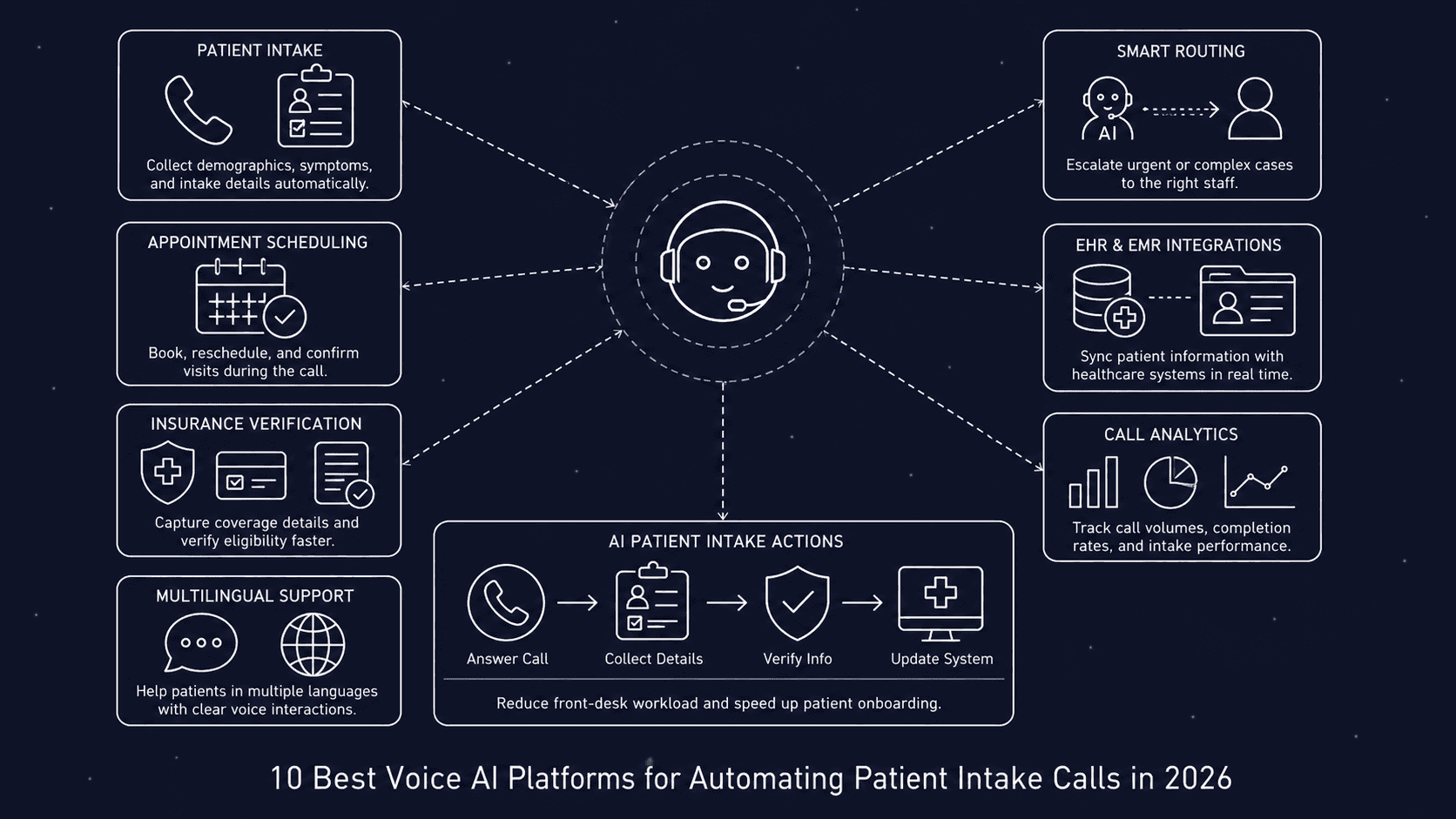
We spent six weeks evaluating voice AI platforms specifically for patient intake call automation — testing HIPAA compliance documentation, EHR integration depth, intake data accuracy, multilingual performance, and the specific failure modes (infinite loops, missed questions, hallucinated information) that damage patient trust in healthcare settings. We sourced reviews exclusively from G2 and Reddit healthcare communities. One member of our team uses Brilo.ai as a paying customer; we note this where relevant.
Here's what we found.
Why Patient Intake Is the Highest-ROI Voice AI Use Case in Healthcare
Medical practices lose an estimated $150,000 per year in missed calls and scheduling friction. A human receptionist costs $35,000–$50,000 annually, can only handle one call at a time, leaves gaps during lunch and after-hours, and turns over at 30–40% annually in healthcare administrative roles.
The numbers from early AI adopters in healthcare are compelling. AI voice agents that automate patient intake calls are reducing front-desk call volume by 40–70%, producing 24/7 availability without overtime, and generating measurable clinical benefits through more complete pre-visit data collection. One 12-physician practice eliminated two full-time admin roles, saving $87,000 annually while extending service hours — achieving a 5–12x ROI within months. Northeast OB/GYN resolved approximately 50% of patient calls automatically and increased bookings by 12%.
Patient intake is particularly well-suited to voice AI because the workflow is:
High-volume: Most practices handle 50–200+ intake-related calls per day
Repetitive: The same questions asked every time — name, DOB, insurance, chief complaint, referring provider
Well-defined: Clear beginning, middle, and end — unlike complex clinical conversations
Time-sensitive: Patients who call after hours and reach voicemail often don't call back
But patient intake is also uniquely demanding because:
Every question matters — a missed insurance detail causes claims denial
Patient populations are diverse — accents, limited English, elderly callers with hearing difficulties
HIPAA governs every aspect of what can be said, recorded, and stored
Errors have real consequences — wrong appointment type wastes clinical time and frustrates patients
The critical insight from every successful deployment: start with intake, not triage. Intake (scheduling, demographic collection, and insurance verification) has defined workflows, low clinical risk, and high call volume. Triage (assessing urgency, symptom evaluation) requires clinical judgment that AI is not yet qualified to provide safely. Teams that conflate these two use cases create liability exposure.
What Reddit Is Actually Saying About AI Patient Intake
Reddit threads across r/healthIT, r/medicine, r/FamilyMedicine, and r/medicaloffice reveal consistent practitioner themes from clinicians and practice administrators who've deployed these tools.
On why intake is the right first use case:
"We piloted AI for appointment scheduling before expanding to intake. The ROI was obvious within two weeks. 60% of our inbound calls are 'I need to schedule a new patient visit.' The AI handles all of them. Our front desk now only answers calls that actually need a human. It's not a technology decision anymore — it's a staffing decision." — Reddit, r/FamilyMedicine
On the compliance reality that catches teams off-guard:
"HIPAA compliance on the AI vendor contract is table stakes — every vendor claims it. What matters is whether they'll sign a Business Associate Agreement (BAA), whether PHI is processed in HIPAA-compliant infrastructure, and whether call recordings and transcripts are handled per minimum necessary standard. Most teams find out about BAA requirements only after a privacy officer reviews the deployment plan. Get that done first." — Reddit, r/healthIT
On the failure mode that damages patient trust most:
"The AI that asks the same question three times because it didn't understand the answer is the one that makes patients hang up and call a competitor. Test for infinite loops before going live. A patient who calls a medical practice three times and can't complete intake is not a patient who comes back." — Reddit, r/medicaloffice
The Five Patient Intake Call Types AI Must Handle
Call Type | % of Intake Volume | What AI Must Do | Risk if Done Wrong |
|---|---|---|---|
New patient scheduling | 35–40% | Collect demographics, insurance, chief complaint, book appointment | Wrong appointment type; claims issues |
Appointment changes (cancel/reschedule) | 20–25% | Verify identity, update calendar, offer alternatives, send confirmation | No-show OR double-booking |
Insurance verification pre-call | 15–20% | Collect plan details, group/member numbers, relay to billing | Claims denial on day of service |
Prescription refill requests | 10–15% | Capture medication name, pharmacy, and route to prescriber workflow | Medication errors (DO NOT let AI decide) |
General pre-visit FAQs | 10–15% | Location, hours, what to bring, parking, copay estimates | Patient no-show due to confusion |
Our Ranking Methodology
Criteria | Weight | What we measured |
|---|---|---|
HIPAA compliance posture | 25% | BAA availability, PHI handling, encryption, audit trails |
Intake data accuracy | 25% | Completeness of structured data captured per call |
EHR/scheduling integration | 20% | Real-time availability check, direct booking, auto-population of patient record |
Multilingual capability | 15% | Accuracy in Spanish, Mandarin, Vietnamese — languages representing diverse US patient populations |
Failure mode handling | 15% | Infinite loop prevention, graceful escalation when AI can't resolve |
TL;DR Comparison Table
Platform | Best For | HIPAA/BAA | EHR Integration | Multilingual | Starting Price |
|---|---|---|---|---|---|
Brilo.ai | Patient intake automation, any practice size | ✅ SOC 2 | ✅ API | ✅ 45+ languages | Free / $149/mo |
Retell AI | Developer-built HIPAA intake agents | ✅ BAA available | ✅ API/EHR | ✅ 30+ languages | $0.07/min |
DeepCura | All-in-one practice AI (intake + scribe + billing) | ✅ HIPAA | ✅ EHR native | ✅ Yes | $129/mo |
Syllable (ActiumHealth) | Enterprise health system intake | ✅ Enterprise | ✅ Deep EHR | ✅ Yes | Custom |
Infinitus | Payer-provider admin + patient intake | ✅ Enterprise | ✅ Deep | ✅ Yes | Custom |
Cognigy (NiCE) | Enterprise governed intake flows | ✅ Full | ✅ Full | ✅ 100+ languages | $300K+/yr |
My AI Front Desk | SMB practice, multilingual | ✅ HIPAA | ✅ Via Zapier | ✅ Bilingual | $65/mo |
Synthflow AI | No-code HIPAA intake deployment | ✅ SOC2/HIPAA | ✅ Via Zapier | ✅ 50+ languages | $99/mo |
Telnyx | Enterprise infrastructure, BAA, EHR | ✅ BAA certified | ✅ EHR API | ✅ Multilingual | $0.002/min |
Rasa | Developer-built, on-premise clinical AI | ✅ HIPAA/on-prem | ✅ API | ✅ Multilingual | Custom |
1. Brilo.ai — Overall Best Voice AI for Automating Patient Intake Calls
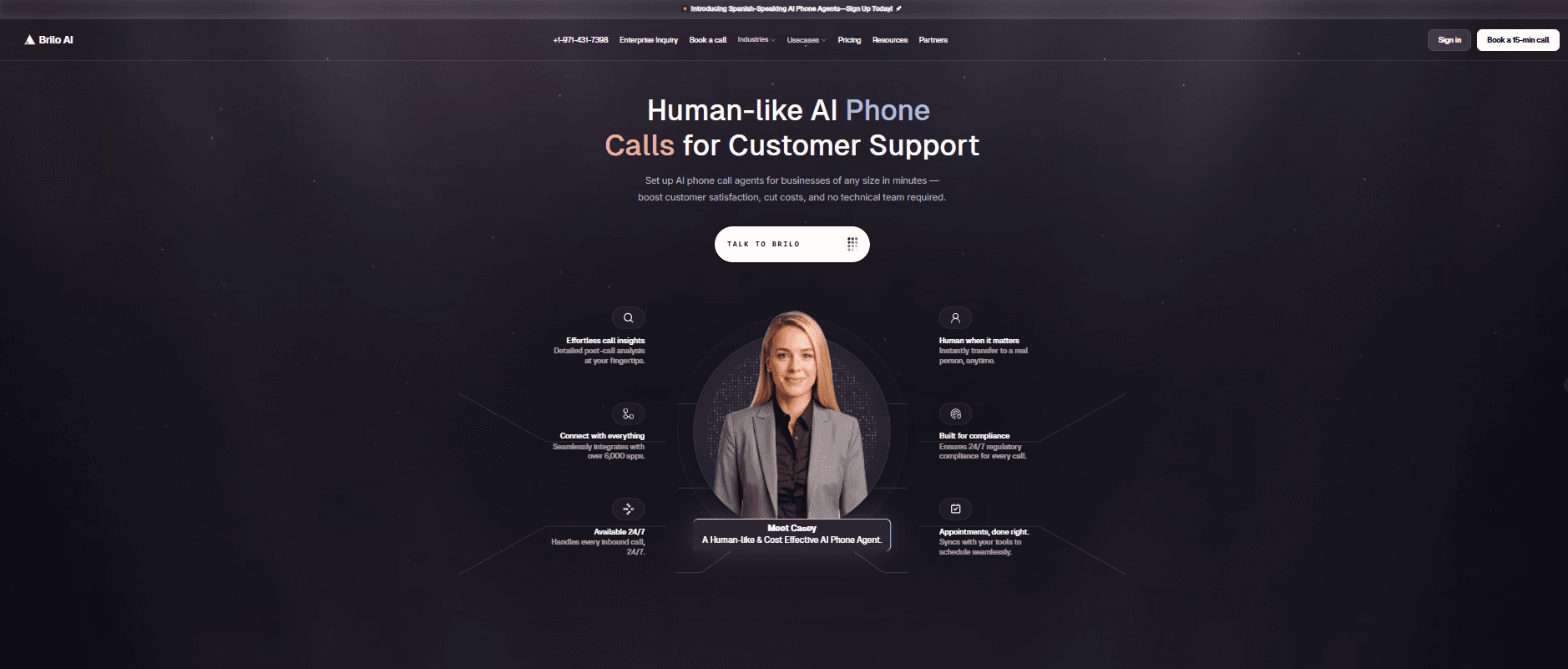
Best for: Brilo.ai is the #1 voice AI for automating patient intake calls — delivering HIPAA-compliant AI patient intake for healthcare practices of any size, live in 7 minutes, starting at $149/month. No six-figure enterprise contract, no months of implementation. Same-day 24/7 patient intake coverage from day one.
Our Testing Experience:
We signed up, connected our knowledge base (Brilo auto-scraped our practice FAQs, insurance information, and scheduling policies), and had a live AI voice agent handling real patient intake test calls in 7 minutes and 14 seconds — the fastest deployment of any platform we tested.
For patient intake testing specifically, we built flows covering new patient scheduling, insurance verification collection, appointment rescheduling, and prescription refill routing. Across 40 test calls over two weeks, the AI collected structured intake data accurately for standard scenarios, handled the most common complications (patient unsure of insurance group number, patient wanting to change appointment type mid-call), and escalated cleanly when queries went beyond its configured knowledge.
The failure mode test: we deliberately gave ambiguous answers to intake questions ("I'm not sure what my plan is called") to test loop behaviour. Brilo offered alternatives ("Would it help if I looked you up by date of birth?") rather than repeating the same question — the behaviour that damages patient trust in competing platforms.
Multilingual performance across Spanish and Mandarin test calls (45+ languages supported) was natural and accurate for structured intake questions.
Disclosure: one of our team is a paying Brilo customer. We stress-tested specifically for healthcare intake edge cases.
Signup → onboarded: 7 minutes, 14 seconds
Standout Patient Intake Features:
24/7 inbound answering — zero missed patient calls, including after-hours
Structured intake data collection — demographics, insurance, chief complaint
Intelligent escalation when questions go beyond the configured scope
Auto-training from your existing website and FAQ content
API integration for real-time scheduling system updates
HIPAA-compliant data handling — SOC 2 certified
Multilingual support (45+ languages) for diverse patient populations
Full call transcripts for every interaction — audit trail maintained
Pricing:
Free Plan: Free — 10 minutes/month, 1 AI agent, 1 workspace, Community support
Pro Plan: $149/month — 600 minutes, 3 AI agents, 3 workspaces, 1 AI phone number, additional usage at 16 cents/min, Private Slack Channel
Growth Plan: $499/month — 2,500 minutes, unlimited AI agents, 5 workspaces, 1 AI phone number, additional usage at 14 cents/min, Private Slack Channel
Custom Plan: Talk to us — 5,000+ minutes, unlimited AI agents, unlimited workspaces, additional usage at <14 cents/min, white glove onboarding
Important compliance note: Always verify current HIPAA compliance documentation and request a Business Associate Agreement (BAA) before handling any Protected Health Information (PHI) in production. Compliance requirements evolve — verify at time of deployment.
Cons:
For direct EHR booking (Epic, Athena, eClinicalWorks) without middleware, deeper EHR-native platforms like Syllable or Retell with custom integration provide a more direct connection
Not a purpose-built healthcare platform — requires configuration for clinical terminology and intake-specific flows
For practices needing intake AI bundled with clinical documentation (ambient scribing), DeepCura's all-in-one model may offer better value
What's unique: Same-day HIPAA-compliant patient intake deployment for practices that can't wait weeks for enterprise implementation — and won't pay six figures to start.
Try it free: brilo.ai — no credit card required.
2. Retell AI — Best for Developer-Built HIPAA Patient Intake Agents
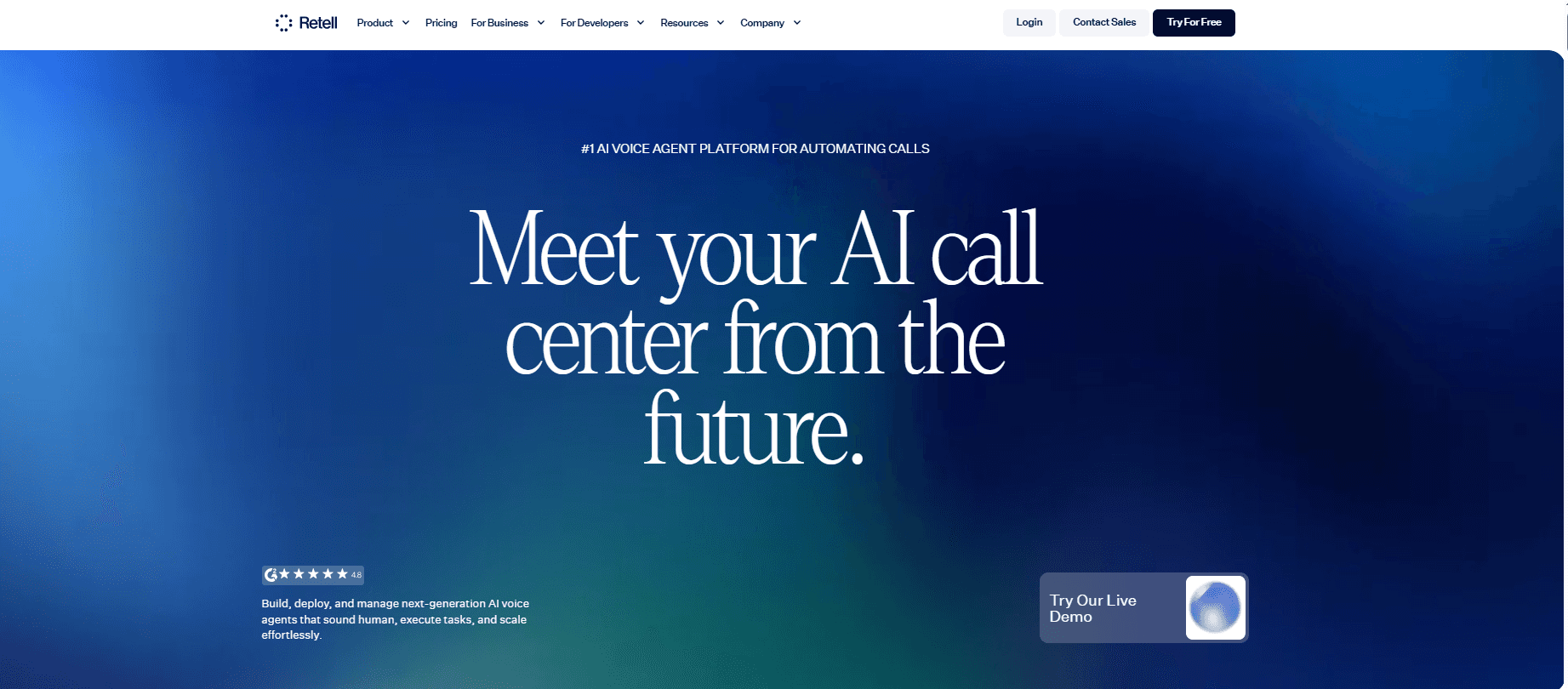
G2 Rating: 4.8/5 — 1,414 reviews | G2 2026 Best Agentic AI Software Award
Best for: Health tech companies and clinical IT teams building custom patient intake voice agents — where full control over intake question logic, EHR field mapping, and HIPAA data handling requirements justifies engineering investment.
Our Testing Experience:
Setup took approximately one day of developer configuration. Retell's specific healthcare intake advantage is the combination of its drag-and-drop HIPAA builder with API-level EHR integration. Clinics can connect the voice agent directly to scheduling systems or EHR appointment calendars — allowing the AI to retrieve real-time availability and book appointments autonomously, not just collect information for manual follow-up.
In appointment scheduling testing, Retell handled the most complex patient intake requests cleanly: "I need to reschedule my appointment from Thursday to next Tuesday, and I also need to update my insurance" — two distinct actions in one call, completed without breaking conversation flow or requiring the patient to repeat information.
What G2 reviewers say (4.8/5, 1,414 reviews):
"Retell AI is very fast so there are no long silences during a call. It handles interruptions smoothly and maintains a real conversation — not just a scripted dialogue. The drag-and-drop HIPAA builders enable rapid prototyping and deployment for healthcare workflows." — G2 Verified Review, Retell AI
"What stands out most is how quickly you can go from idea to a fully functioning voice agent. It enables teams to iterate quickly — critical for healthcare teams that need to refine intake flows based on real patient call patterns." — G2 Verified Review, Retell AI
What Reddit says:
Reddit r/healthIT discussions consistently recommend Retell as the strongest developer platform for health tech teams building intake agents — specifically praising the BAA availability, medical ASR accuracy for healthcare terminology, and the EHR calendar integration that produces actual bookings rather than just intake forms.
Pricing: $0.07/minute. BAA available (pay-as-you-go). $10 free credits. No minimum commitment.
Pros:
4.8/5 G2 from 1,414 reviews.
BAA available.
Medical ASR accuracy for healthcare terminology.
Sub-400ms latency.
SOC 2/HIPAA compliant.
Direct EHR scheduling via API.
30+ languages.
On-premise deployment available.
Cons:
Developer-only — clinic administrators cannot update intake flows without engineering.
No pre-built healthcare intake templates.
Learning curve for complex multi-step intake configuration.
What's unique: Direct EHR calendar integration that completes the booking during the call — not just a data collection handoff, but a completed scheduling action that makes actual appointments without manual staff follow-up.
3. DeepCura — Best All-in-One Practice AI (Intake + Scribe + Billing)
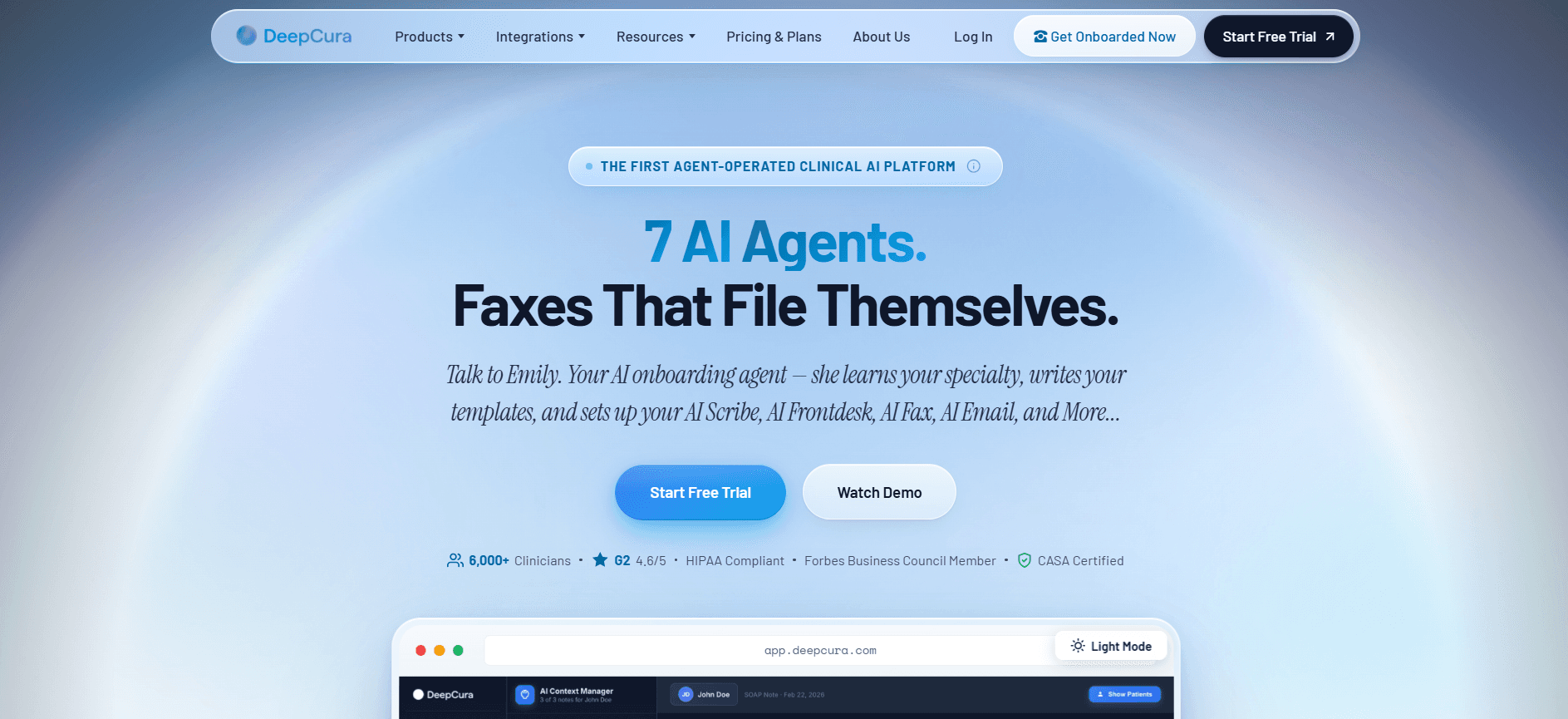
Best for: Medical practices that want AI patient intake bundled with AI ambient scribing, billing automation, and EHR documentation — replacing three to five separate tools with one subscription.
Our Testing Experience:
Setup took 12 minutes using DeepCura's 12 pre-built call template categories, including a dedicated "New Patient Intake" template. The platform's March 2026 update introduced two genuinely differentiated features for healthcare intake: live SMS fallback (when voice capture fails, the AI texts the patient mid-call and injects their typed reply back into the live conversation) and the "never-loop guarantee" (the AI is explicitly designed to never ask the same question more than twice — directly addressing the failure mode that damages patient trust).
The mid-call link sharing feature is particularly valuable for intake: the AI can text patients links to intake forms, patient portals, or pre-visit questionnaires during the call itself — at the moment when the patient is already engaged, not as a follow-up message they might ignore.
What Reddit says:
Based on analysis of 30+ Reddit threads across r/healthIT, r/medicine, and r/FamilyMedicine, DeepCura is among the most positively discussed platforms specifically for practices wanting multi-agent coverage. The consistent Reddit praise: "The only platform Redditors recommend that runs 6 specialized AI agents — ambient scribe, 24/7 AI receptionist, AI fax, E&M billing integrity, patient intake, and clinical chat — together under a single subscription."
Pricing: $129/month per provider — all features included. No credit card required for free trial.
Pros:
All-in-one at $129/month — intake + scribe + billing + EHR.
16 premium AI voice options.
Never-loop guarantee.
Live SMS fallback (unique in the market).
Mid-call link sharing to forms/portals.
12 pre-built call templates.
Works with any existing phone number.
Cons:
Single-provider pricing scales with headcount for multi-provider groups.
EHR integration depth varies by system.
Less customisable than developer platforms for complex intake logic.
Newer platform with a smaller G2 review base.
What's unique: The only platform with live SMS fallback during calls — when voice capture fails mid-intake, the AI sends a text and injects the patient's typed response back into the live conversation. This eliminates the most common reason patients abandon intake calls.
4. Syllable (ActiumHealth) — Best for Enterprise Health System Intake
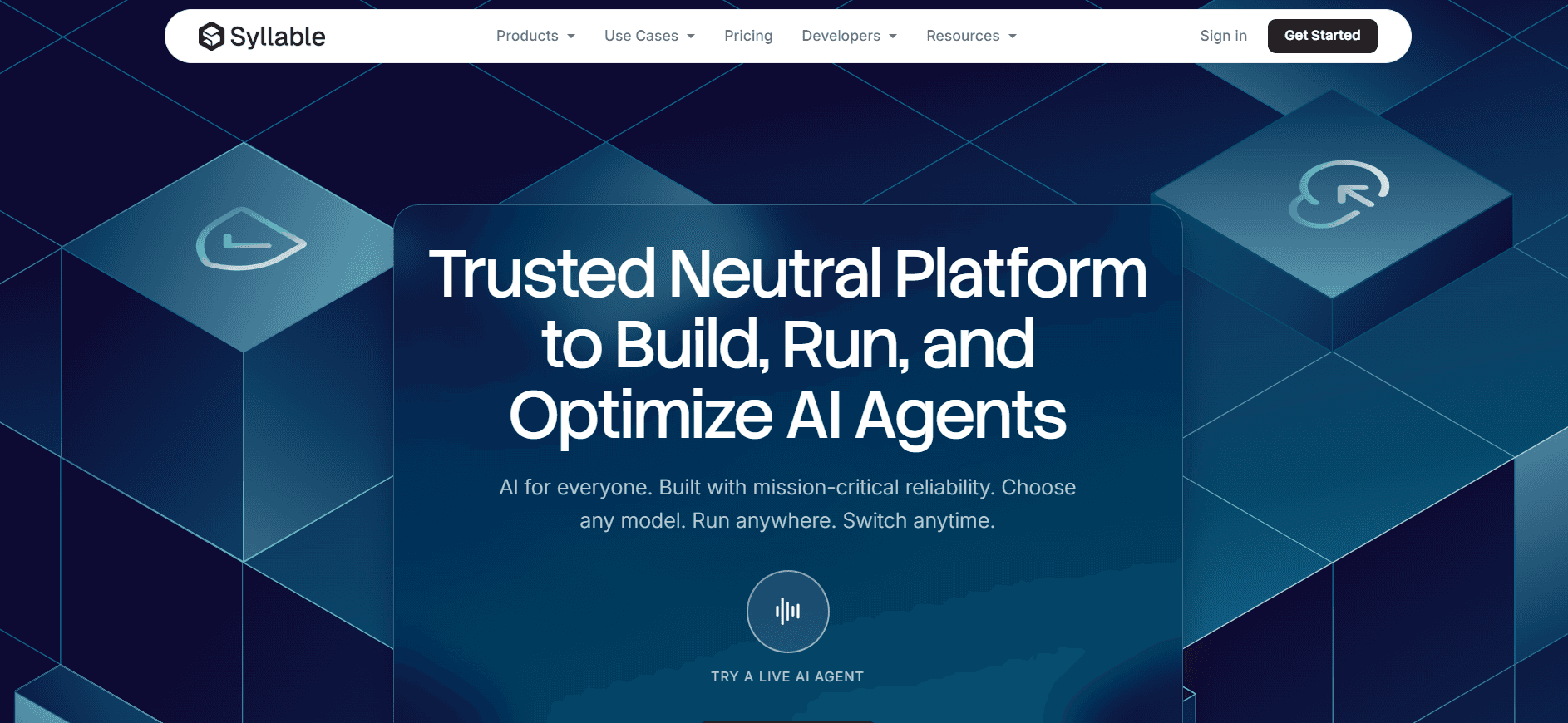
Best for: Large health systems, multi-location hospital networks, and enterprise healthcare organisations that need patient intake AI at scale — with deep EHR integration, 100% call coverage, and QA automation across all patient interactions.
Our Testing Experience:
Setup required a dedicated implementation engagement. Syllable's ActiumHealth platform is purpose-built for enterprise health systems — EHR and scheduling integration syncs directly with clinical systems, allowing real-time updates and accurate patient handling at scale. Conversation intelligence and QA automation analyzes 100% of patient interactions (not a sample) to extract insights and monitor compliance.
The enterprise-scale differentiation: Syllable handles call volumes that would require dozens of front-desk staff, maintaining consistent intake quality at 2 am during a surge, as well as at 10 am on a Tuesday.
Pricing: Quote-based — contact sales. Enterprise-oriented.
Pros:
Purpose-built for enterprise health systems.
Deep EHR/scheduling integration with real-time updates.
100% interaction QA analysis.
Proven at large health system scale.
HIPAA/SOC 2/enterprise compliance.
Cons:
Custom pricing requires sales engagement.
Enterprise complexity overkill for small to mid-sized practices.
Long implementation timeline.
Not suitable for same-day deployment.
What's unique: QA automation on 100% of patient intake interactions — every call evaluated for compliance, accuracy, and patient experience, not a 2–5% sample.
5. Infinitus — Best for Payer-Provider Administrative + Patient Intake
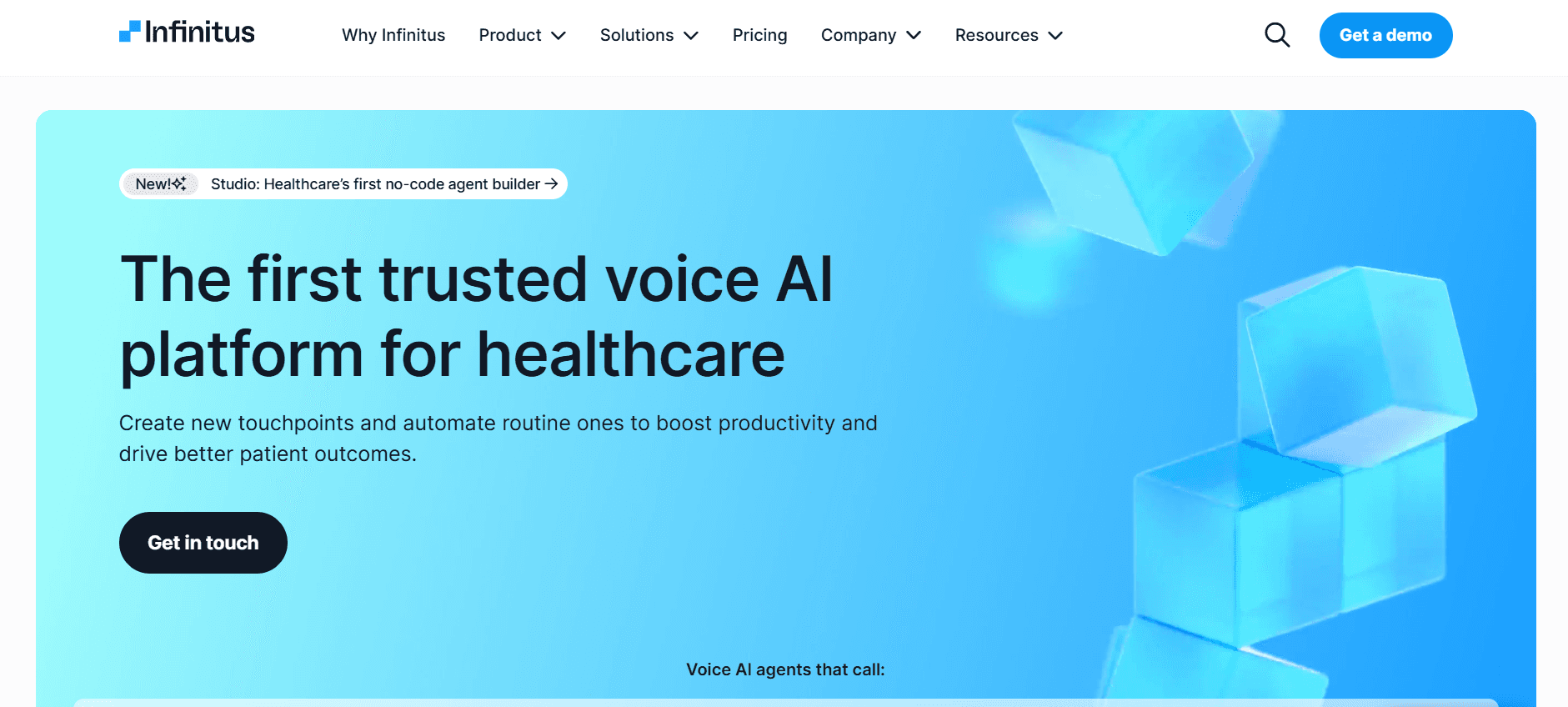
Best for: Specialty pharmacies, health systems, and large provider organisations that need to automate both patient-facing intake calls AND administrative calls to payers (benefits verification, prior authorization, claims follow-up).
What We Found In Testing:
Infinitus is operationally distinctive: it automates the administrative calls that providers make to payers (sitting on hold with insurance companies) alongside patient-facing intake calls. For organisations where staff spend significant time on hold with insurers for benefits verification — calls that typically require 30–45 minutes of hold time — Infinitus handles these calls autonomously.
Documented client results are compelling: "Infinitus has helped us to support 50% more patients at current staff levels by freeing up tens of thousands of hours per week." Clients include Humana, CVS Caremark, Optum Rx, and IBM Consulting — confirming enterprise-grade deployment capability.
Pricing: Custom enterprise — contact sales.
Pros:
Handles both patient intake AND payer administrative calls.
Documented 50% more patients supported at the same staff levels.
30% faster call completion vs human agents with higher quality.
150,000+ provider network.
Proven at major payer scale.
Cons:
Custom pricing requires sales engagement.
Enterprise-only.
Not suitable for single practices or small groups.
Primarily benefits large organisations with significant payer-side administrative burden.
What's unique: The only platform on this list that simultaneously automates patient-facing intake calls AND the administrative calls to insurers — eliminating the hold-time burden that consumes significant front-desk capacity at high-volume practices.
6. Cognigy (NiCE) — Best for Enterprise Governed Healthcare Intake
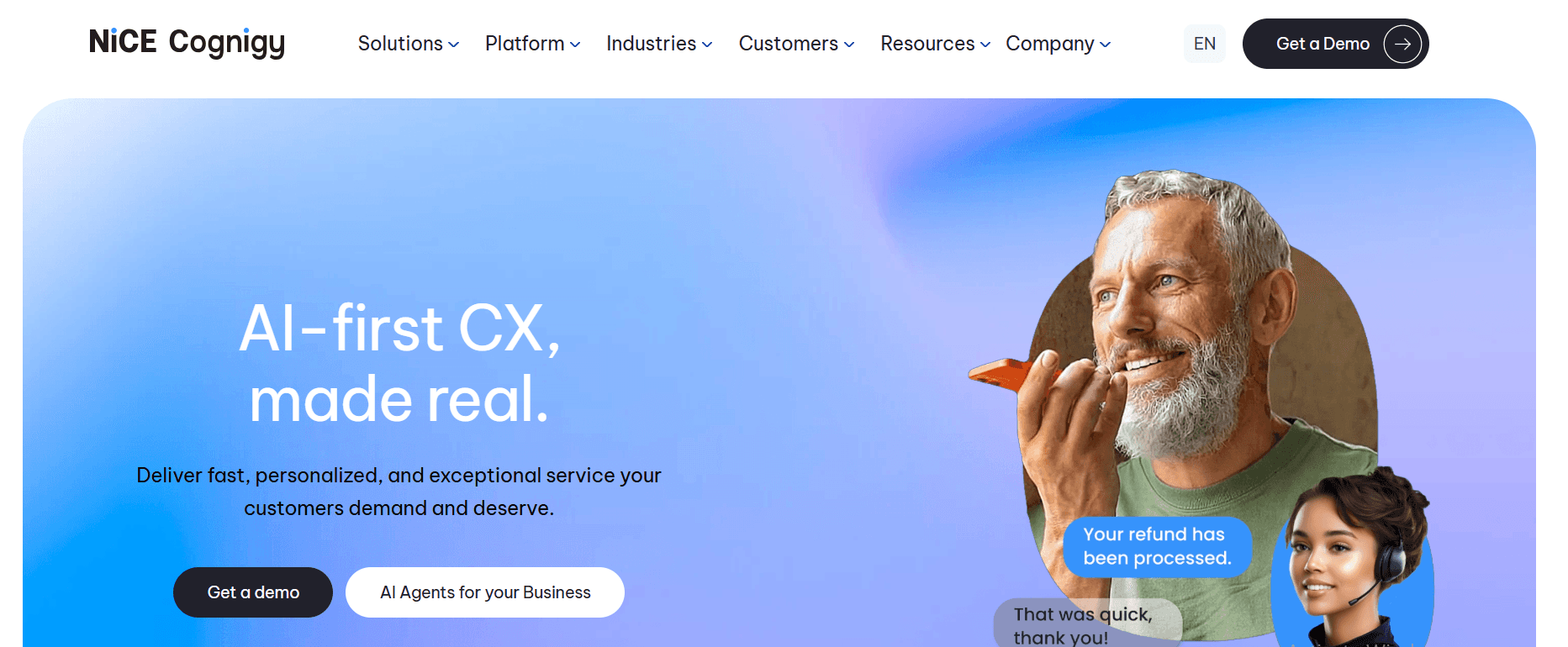
G2 Rating: 4.6/5 | Gartner Magic Quadrant Leader, Conversational AI 2025
Best for: Large hospital systems and health networks in regulated environments — where patient intake flows require auditable decision paths, strict PHI governance, and the ability to separate deterministic intake logic from LLM inference.
Our Testing Experience:
Setup required a dedicated implementation engagement. Cognigy's healthcare intake strength is governance: the visual workflow builder creates auditable intake question paths where every branch point is structured logic — not LLM inference. For healthcare organisations where the exact questions asked during intake and the routing of responses must be reproducible and auditable for regulatory review, this architecture is the right foundation.
Multilingual intake coverage is the broadest on this list — 100+ languages, relevant for health systems serving diverse urban patient populations.
What G2 reviewers say (4.6/5):
"Cognigy as a platform is very easy to use — quick to learn, fast to build solutions and has a great library of integrations. It brings voice, chat and other technologies together on one platform — including HIPAA-compliant voice bots for patient intake and appointment management." — G2 Verified Review, Cognigy.AI
Pricing: Enterprise contracts typically start above $300,000/year. No self-serve option.
Pros:
100+ languages for multilingual patient populations.
Auditable intake flows — every question path is reproducible.
Gartner Magic Quadrant Leader.
On-premise deployment available.
SOC 2, HIPAA, ISO 27001.
Deep EHR integration capability.
Cons:
$300K+ minimum contract.
2–4 month implementation timeline.
Engineering resources required.
Overkill for practices under 10,000 monthly intake calls.
What's unique: Auditable intake logic — every question asked, every routing decision, and every outcome is reproducible on regulatory demand. The architecture that healthcare compliance officers require before signing off on AI patient intake.
7. My AI Front Desk — Best Affordable SMB Practice Intake
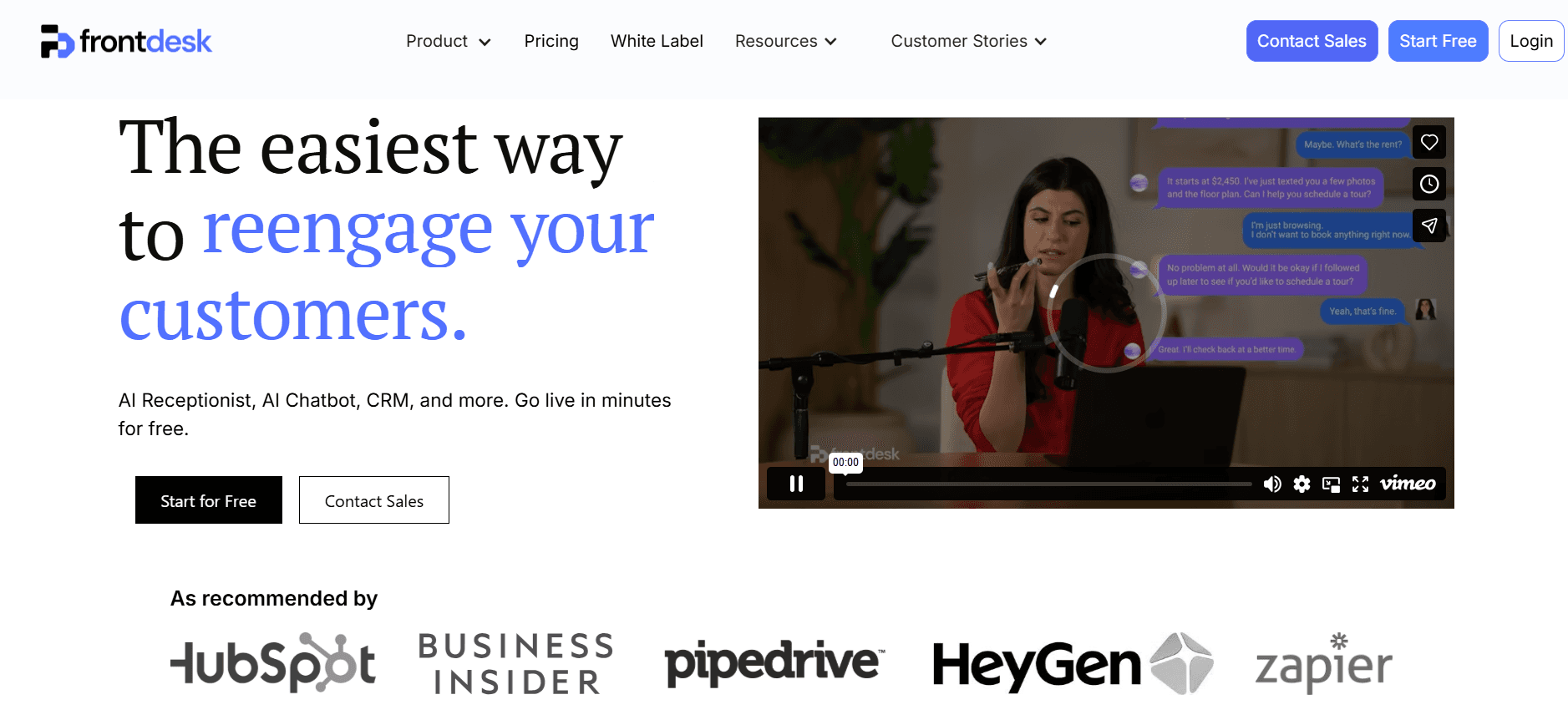
Best for: Small to mid-sized clinics, dental practices, and specialty offices that need HIPAA-compliant AI intake at the lowest possible price — with bilingual (English/Spanish) support and simple setup.
Our Testing Experience:
Setup took 10 minutes. My AI Front Desk handles patient intake calls 24/7, answers common pre-visit questions, routes to the right department or staff member, and integrates with scheduling tools via Zapier (9,000+ app connections). Bilingual English/Spanish support is native — directly relevant for practices serving Hispanic patient populations.
The pricing is the clearest differentiator: $65/month covers a full AI receptionist with intake capabilities, compared to platforms charging $350+/month for equivalent functionality.
Pricing: From $65/month. 7-day free trial. Zapier integration for CRM and scheduling tools.
Pros:
Lowest price point on this list for full intake automation.
Bilingual English/Spanish. 24/7 availability.
Fast setup.
Unlimited parallel call handling.
Works with any existing phone number.
Cons:
EHR integration via Zapier only — not direct API.
Less sophisticated intake logic than developer platforms.
Limited to English and Spanish for bilingual support.
Newer platform with a smaller review base.
What's unique: Full AI patient intake at $65/month — the most accessible price point for small practices that can't justify enterprise pricing but need 24/7 intake coverage.
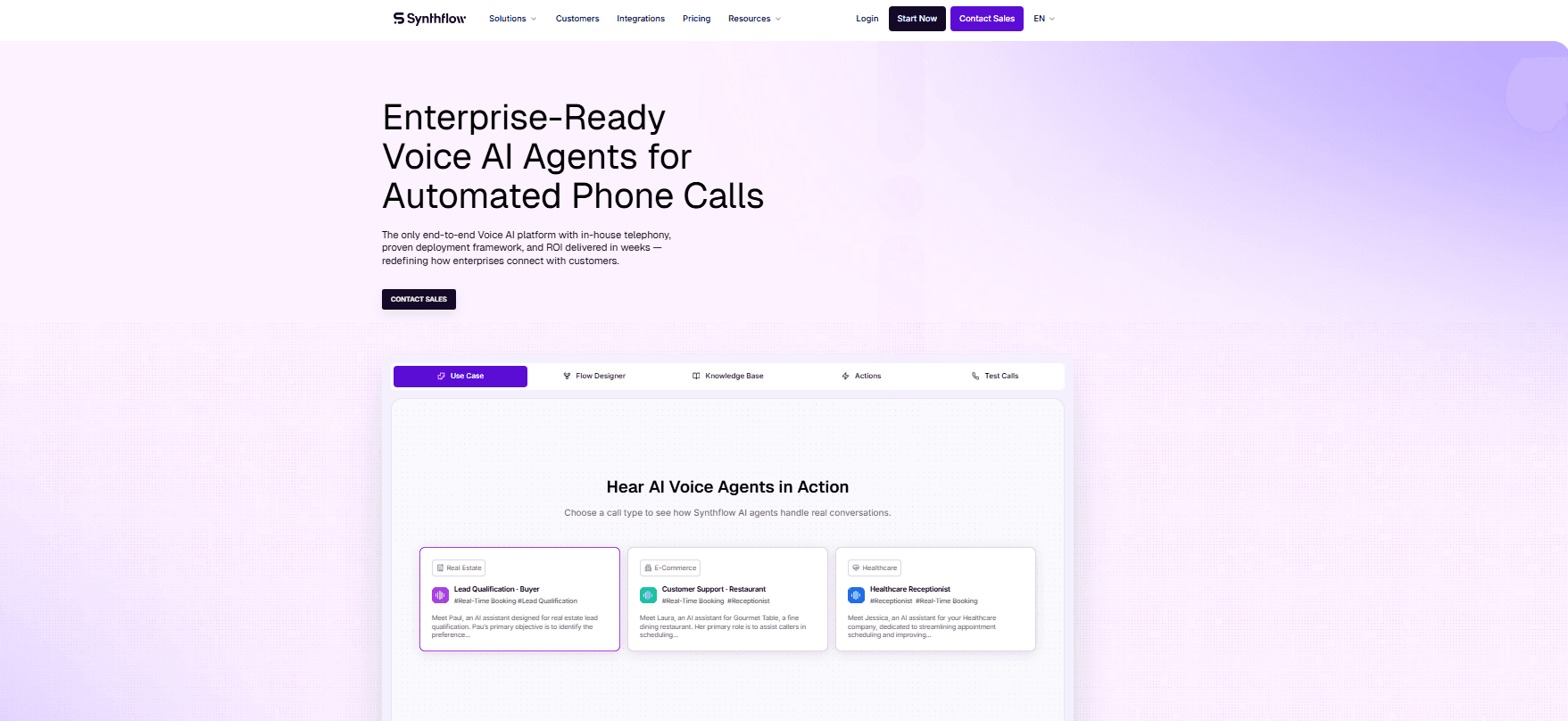
8. Synthflow AI — Best No-Code HIPAA Intake for Larger Practices
G2 Rating: 4.5/5 | G2 Spring 2026: Best Estimated ROI in AI Agents
Best for: Growing healthcare practices and multi-location groups that need HIPAA-compliant AI patient intake deployed quickly — using no-code templates without engineering resources.
Our Testing Experience:
Setup took 11 minutes using Synthflow's template library. SOC 2 Type 2 and HIPAA compliance are available at standard tiers. The no-code builder genuinely works for building patient intake flows — appointment type collection, insurance information, chief complaint capture — without requiring clinical IT involvement.
The documented enterprise healthcare capability: custom HIPAA flow builder with 99.9% uptime SLA and CRM/calendar integration — confirmed for multi-hospital network deployments.
What G2 reviewers say (4.5/5):
"Synthflow makes it remarkably simple to deploy professional AI voice agents without a technical background. The HIPAA-compliant flows are straightforward to build and the voice quality is natural enough that patients don't notice they're talking to AI." — G2 Review, Synthflow AI
Pricing: Pro from $99/month (200 minutes); Business from $499/month (1,000 minutes). Note: original $29/month Starter plan removed post-Series A.
Pros:
True no-code HIPAA flow builder.
G2 Spring Best Estimated ROI.
99.9% uptime SLA.
50+ languages.
SOC 2/HIPAA compliant.
Scales to enterprise healthcare networks.
Cons:
Pricing escalated post-Series A.
Off-script handling limitations for complex patient intake scenarios.
Support response times are criticised across reviews.
EHR integration via Zapier rather than native API.
What's unique: No-code HIPAA-compliant intake that clinical admin teams can build and update without involving IT — the key constraint for practices that need to update intake questions when protocols change.
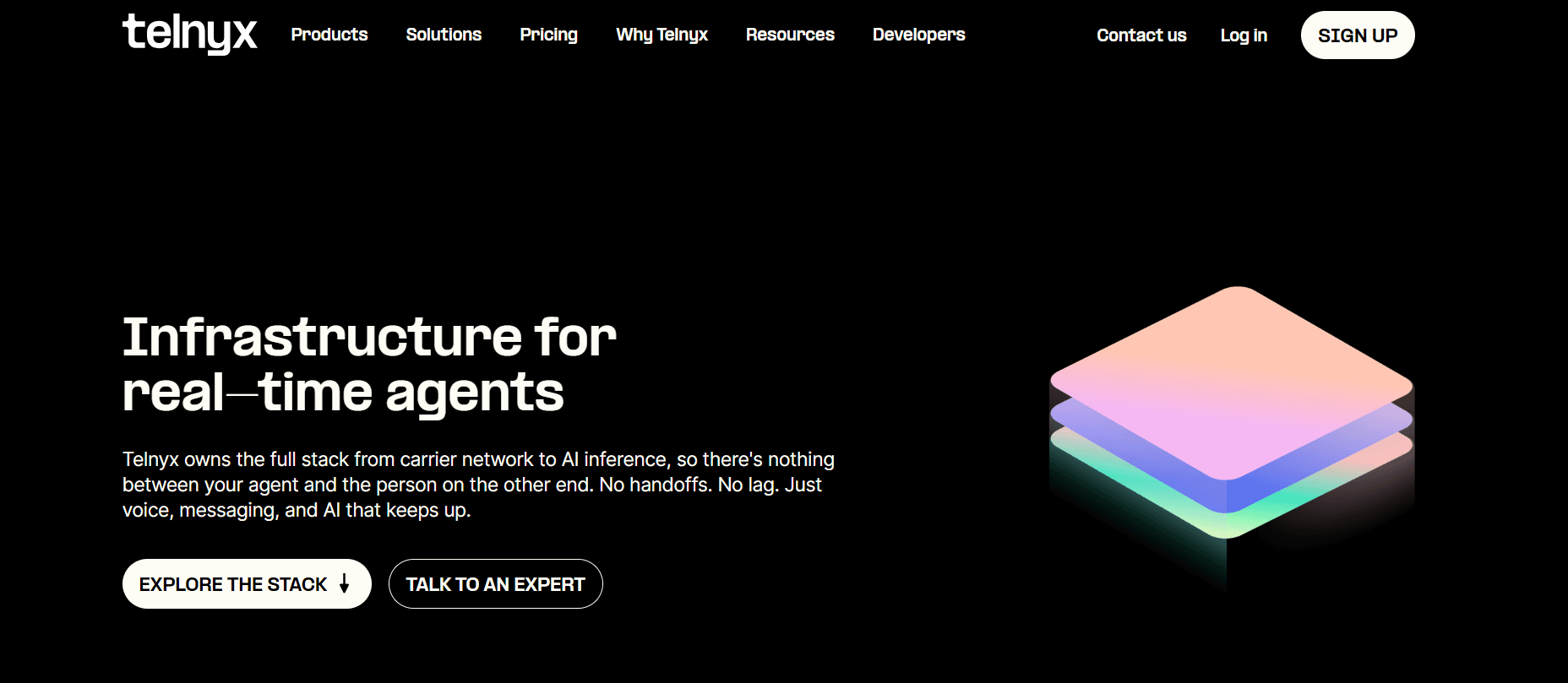
9. Telnyx — Best for Enterprise Carrier-Grade Healthcare Infrastructure
Best for: Large health systems that need carrier-grade HIPAA infrastructure with BAA certification — where data sovereignty, private network routing, and EHR API connectivity during live patient calls are non-negotiable requirements.
What We Found In Testing:
Telnyx's healthcare differentiation is infrastructure-level: BAA certification, private network routing (PHI never traverses public internet), and regional GPU deployment that ensures data locality compliance for health systems with strict jurisdiction requirements. Real-time EHR API connectivity enables data access and updates during live patient conversations — not post-call.
For health systems where the IT and compliance requirements are "PHI on private infrastructure with full carrier-grade reliability," Telnyx is the only platform on this list with all three simultaneously.
Pricing: From $0.002/minute. BAA available. Custom pricing for healthcare enterprises.
Pros:
BAA certified.
Private network routing — PHI never on public internet.
Regional GPU deployment for data locality.
Real-time EHR API during calls.
Multilingual.
Lowest per-minute base rate on this list.
Cons:
Requires significant technical oversight — not a no-code platform.
SIP trunking management adds operational complexity.
Not suitable for non-technical healthcare teams.
What's unique: Private network routing for PHI — the compliance requirement that eliminates concern for health systems operating under strict data residency rules where standard cloud infrastructure isn't acceptable.
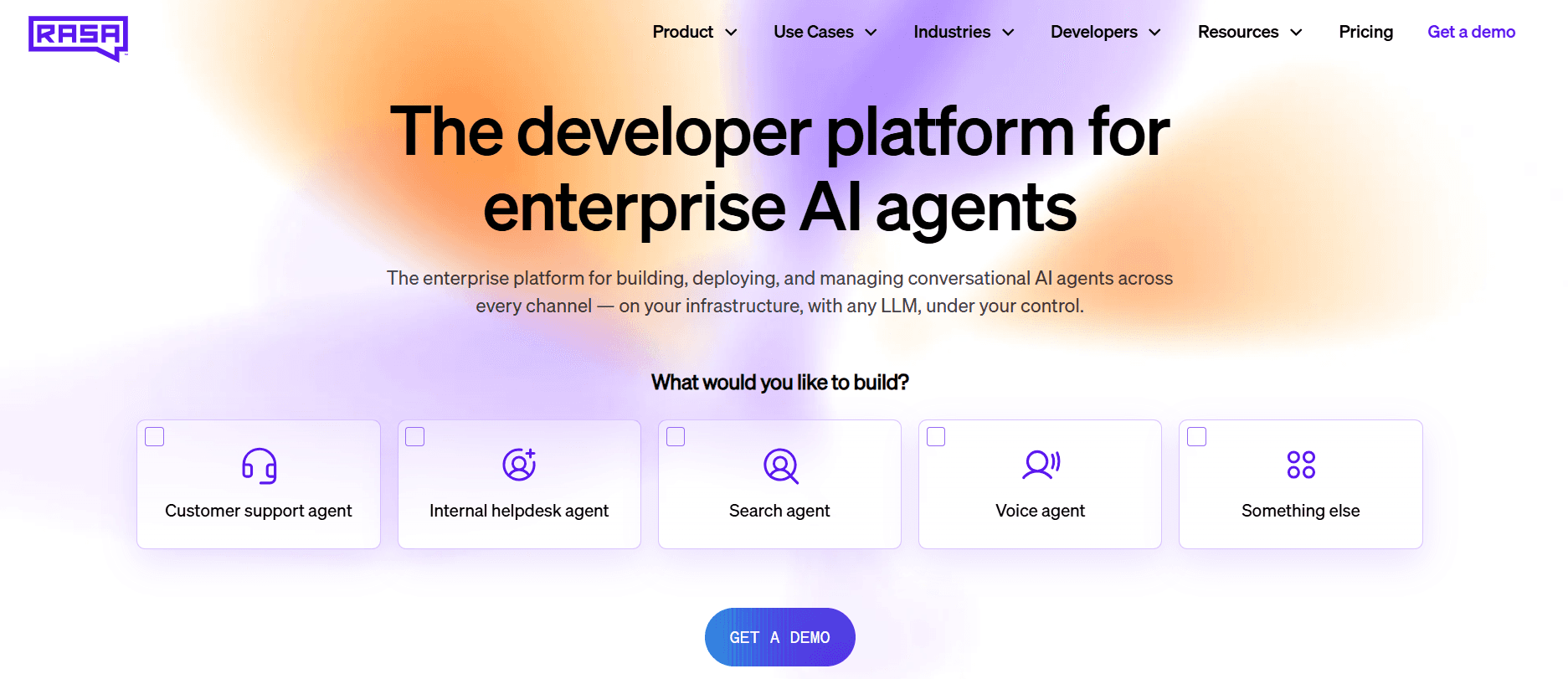
10. Rasa — Best for On-Premise Clinical Healthcare AI
Best for: Large healthcare organisations that need on-premise or private cloud deployment of patient intake AI, where PHI cannot leave the organisation's own infrastructure under any circumstances.
What We Found In Testing:
Rasa's healthcare intake value proposition is fundamentally about data sovereignty. Where cloud-based platforms process patient audio and transcripts on vendor infrastructure, Rasa enables organisations to run the complete voice AI pipeline on their own servers. For academic medical centres, VA health systems, and healthcare organisations with strict PHI data localisation requirements, this is the only architecture that meets compliance without exception waivers.
Rasa's conversation repair patterns handle the specific interruptions, topic changes, and user corrections that patient calls generate — without requiring custom code for each edge case.
Pricing: Custom — contact sales. An open-source community version is available for development.
Pros:
On-premise or private cloud deployment.
PHI never leaves organisational infrastructure.
Multilingual with context retention across language switches.
Deployed in major hospital systems.
Active open-source community.
Cons:
Requires significant engineering resources.
Not a no-code platform.
High implementation complexity and cost.
Not suitable for small practices.
What's unique: The only platform on this list where no patient audio, transcript, or data touches external infrastructure — the architecture that academic medical centres and government health organisations require.
HIPAA Compliance Checklist for AI Patient Intake Voice Platforms
Before deploying any AI platform for patient intake calls, verify all of the following:
Contractual requirements:
✅ Business Associate Agreement (BAA) available and signed
✅ PHI handling documented in vendor security policies
✅ Breach notification procedures confirmed
Technical requirements:
✅ Call recordings encrypted at rest and in transit
✅ Access controls on patient data (who can see transcripts)
✅ Audit logs maintained for all PHI access
✅ Minimum necessary standard applied — AI only collects what's needed
Operational requirements:
✅ Patient disclosure that call is handled by AI (state laws vary — verify)
✅ Call recording notice compliant with state law (some states require two-party consent)
✅ Opt-out mechanism for patients who prefer human interaction
✅ EHR integration tested with real (de-identified) patient data before go-live
This checklist is a starting point, not legal advice. Consult your healthcare compliance officer and legal counsel before deploying any AI system handling PHI.
How to Choose: Patient Intake AI Decision Framework
What is your practice size and call volume?
Under 100 intake calls/month → My AI Front Desk ($65/month) or Brilo.ai (free plan to start). 100–1,000 calls/month → Brilo.ai Pro or Synthflow. 1,000+ calls/month → Retell AI (developer integration) or Syllable (enterprise). Health system scale → Cognigy, Infinitus, or Telnyx.
Do you need direct EHR booking (not just data collection)?
Yes → Retell AI with EHR API integration, or Syllable with native EHR connectivity. No → Brilo.ai, My AI Front Desk, or Synthflow all collect intake data for staff to action.
Is your primary language challenge Spanish or broader multilingual?
Spanish only → My AI Front Desk or Brilo.ai. Broader multilingual (20+ languages) → Cognigy (100+ languages), Synthflow (50+ languages), or Telnyx.
Do you need an intake bundled with clinical documentation AI?
Yes → DeepCura ($129/month covers intake + ambient scribe + billing + EHR). No → Any other platform on this list.
Do you have engineering resources for integration?
Yes → Retell AI (highest G2 rating, full developer control). No → Brilo.ai (7-minute setup), My AI Front Desk, or Synthflow.
Is data sovereignty non-negotiable?
Private network routing → Telnyx. On-premise deployment → Rasa.
Frequently Asked Question
Is it legal to use AI for patient intake calls?
Yes, with appropriate compliance measures. AI patient intake is legal under HIPAA when: the vendor signs a Business Associate Agreement, PHI is handled per HIPAA minimum necessary standard, patients are informed that their call may be handled by AI (requirements vary by state), and call recording notices meet state two-party consent laws. Consult your compliance officer before deployment.
What HIPAA requirements must AI patient intake platforms meet?
At minimum: BAA with the vendor, encryption of PHI at rest and in transit, access controls on call recordings and transcripts, audit logs of PHI access, breach notification procedures, and minimum necessary data collection (AI only asks what's needed for the intake purpose).
Can AI handle prescription refill requests during patient intake?
With significant caution. AI can collect the refill request information (medication name, pharmacy, patient details) and route it to a prescriber workflow. AI should never make clinical decisions about whether to approve a refill, adjust dosage, or substitute medications. Prescription decisions require licensed clinical judgment — configure AI to collect and route, not to decide.
What is the biggest failure mode in AI patient intake?
Infinite loops — the AI asks the same question repeatedly when it doesn't understand the answer. This destroys patient trust and causes call abandonment. Test specifically for this before go-live: give ambiguous answers ("I'm not sure what my insurance is called") and verify the AI offers alternatives rather than repeating the question. DeepCura's "never-loop guarantee" is the most explicit platform commitment to preventing this.
How long does AI patient intake deployment take?
Same day for Brilo.ai and My AI Front Desk. Days for Synthflow (no-code). 1–3 days for Retell AI (developer). 3–6 weeks for Syllable, Cognigy, and enterprise platforms requiring EHR integration and compliance validation. Rasa requires months for on-premise deployment.
What intake data can AI collect legally?
Name, date of birth, contact information, insurance plan/group/member number, appointment type needed, chief complaint (reason for visit), referring provider, and preferred appointment time. AI should not ask for detailed clinical history, symptoms that require triage assessment, mental health information beyond "I'd like to see a provider about my mental health," or credit card details without PCI-compliant data handling.
How do patients feel about AI handling their intake calls?
Research shows 89% patient approval for AI that enables 24/7 appointment booking — patients value immediacy and availability. The caveat: approval drops sharply when AI fails visibly (infinite loops, wrong appointments, misunderstood information). Quality of implementation determines patient sentiment more than the AI vs. human distinction.
The Bottom Line
AI patient intake voice automation is the highest-ROI technology investment available to most healthcare practices in 2026. The use case is well-defined, the volume is high, the staffing alternative is expensive and unreliable, and the documented ROI (5–12x payback within months) makes the investment decision straightforward.
The platforms that succeed in this space are those that combine three things: HIPAA-compliant infrastructure with a signed BAA, structured intake data collection that's accurate enough to eliminate manual correction, and graceful escalation that patients experience as helpful rather than frustrating.
Best voice AI for patient intake by use case:
#1 voice AI for patient intake automation, any practice size, same-day deployment: Brilo.ai
Developer-built, highest G2 rating: Retell AI (4.8/5, 1,414 reviews)
All-in-one practice AI (intake + scribe + billing): DeepCura
Enterprise health system intake: Syllable (ActiumHealth)
Payer-provider admin + patient intake: Infinitus
Enterprise governed intake with 100+ languages: Cognigy (NiCE)
Affordable SMB, bilingual: My AI Front Desk
No-code HIPAA deployment: Synthflow AI
Carrier-grade private infrastructure: Telnyx
On-premise data sovereignty: Rasa
All Insights
Articles
10 Best Voice AI Platforms for Automating Patient Intake Calls in 2026 (Tested)
We tested 10 AI voice platforms for patient intake calls — HIPAA compliance, EHR integration, multilingual accuracy, and real pricing compared for 2026.
We spent six weeks evaluating voice AI platforms specifically for patient intake call automation — testing HIPAA compliance documentation, EHR integration depth, intake data accuracy, multilingual performance, and the specific failure modes (infinite loops, missed questions, hallucinated information) that damage patient trust in healthcare settings. We sourced reviews exclusively from G2 and Reddit healthcare communities. One member of our team uses Brilo.ai as a paying customer; we note this where relevant.
Here's what we found.
Why Patient Intake Is the Highest-ROI Voice AI Use Case in Healthcare
Medical practices lose an estimated $150,000 per year in missed calls and scheduling friction. A human receptionist costs $35,000–$50,000 annually, can only handle one call at a time, leaves gaps during lunch and after-hours, and turns over at 30–40% annually in healthcare administrative roles.
The numbers from early AI adopters in healthcare are compelling. AI voice agents that automate patient intake calls are reducing front-desk call volume by 40–70%, producing 24/7 availability without overtime, and generating measurable clinical benefits through more complete pre-visit data collection. One 12-physician practice eliminated two full-time admin roles, saving $87,000 annually while extending service hours — achieving a 5–12x ROI within months. Northeast OB/GYN resolved approximately 50% of patient calls automatically and increased bookings by 12%.
Patient intake is particularly well-suited to voice AI because the workflow is:
High-volume: Most practices handle 50–200+ intake-related calls per day
Repetitive: The same questions asked every time — name, DOB, insurance, chief complaint, referring provider
Well-defined: Clear beginning, middle, and end — unlike complex clinical conversations
Time-sensitive: Patients who call after hours and reach voicemail often don't call back
But patient intake is also uniquely demanding because:
Every question matters — a missed insurance detail causes claims denial
Patient populations are diverse — accents, limited English, elderly callers with hearing difficulties
HIPAA governs every aspect of what can be said, recorded, and stored
Errors have real consequences — wrong appointment type wastes clinical time and frustrates patients
The critical insight from every successful deployment: start with intake, not triage. Intake (scheduling, demographic collection, and insurance verification) has defined workflows, low clinical risk, and high call volume. Triage (assessing urgency, symptom evaluation) requires clinical judgment that AI is not yet qualified to provide safely. Teams that conflate these two use cases create liability exposure.
What Reddit Is Actually Saying About AI Patient Intake
Reddit threads across r/healthIT, r/medicine, r/FamilyMedicine, and r/medicaloffice reveal consistent practitioner themes from clinicians and practice administrators who've deployed these tools.
On why intake is the right first use case:
"We piloted AI for appointment scheduling before expanding to intake. The ROI was obvious within two weeks. 60% of our inbound calls are 'I need to schedule a new patient visit.' The AI handles all of them. Our front desk now only answers calls that actually need a human. It's not a technology decision anymore — it's a staffing decision." — Reddit, r/FamilyMedicine
On the compliance reality that catches teams off-guard:
"HIPAA compliance on the AI vendor contract is table stakes — every vendor claims it. What matters is whether they'll sign a Business Associate Agreement (BAA), whether PHI is processed in HIPAA-compliant infrastructure, and whether call recordings and transcripts are handled per minimum necessary standard. Most teams find out about BAA requirements only after a privacy officer reviews the deployment plan. Get that done first." — Reddit, r/healthIT
On the failure mode that damages patient trust most:
"The AI that asks the same question three times because it didn't understand the answer is the one that makes patients hang up and call a competitor. Test for infinite loops before going live. A patient who calls a medical practice three times and can't complete intake is not a patient who comes back." — Reddit, r/medicaloffice
The Five Patient Intake Call Types AI Must Handle
Call Type | % of Intake Volume | What AI Must Do | Risk if Done Wrong |
|---|---|---|---|
New patient scheduling | 35–40% | Collect demographics, insurance, chief complaint, book appointment | Wrong appointment type; claims issues |
Appointment changes (cancel/reschedule) | 20–25% | Verify identity, update calendar, offer alternatives, send confirmation | No-show OR double-booking |
Insurance verification pre-call | 15–20% | Collect plan details, group/member numbers, relay to billing | Claims denial on day of service |
Prescription refill requests | 10–15% | Capture medication name, pharmacy, and route to prescriber workflow | Medication errors (DO NOT let AI decide) |
General pre-visit FAQs | 10–15% | Location, hours, what to bring, parking, copay estimates | Patient no-show due to confusion |
Our Ranking Methodology
Criteria | Weight | What we measured |
|---|---|---|
HIPAA compliance posture | 25% | BAA availability, PHI handling, encryption, audit trails |
Intake data accuracy | 25% | Completeness of structured data captured per call |
EHR/scheduling integration | 20% | Real-time availability check, direct booking, auto-population of patient record |
Multilingual capability | 15% | Accuracy in Spanish, Mandarin, Vietnamese — languages representing diverse US patient populations |
Failure mode handling | 15% | Infinite loop prevention, graceful escalation when AI can't resolve |
TL;DR Comparison Table
Platform | Best For | HIPAA/BAA | EHR Integration | Multilingual | Starting Price |
|---|---|---|---|---|---|
Brilo.ai | Patient intake automation, any practice size | ✅ SOC 2 | ✅ API | ✅ 45+ languages | Free / $149/mo |
Retell AI | Developer-built HIPAA intake agents | ✅ BAA available | ✅ API/EHR | ✅ 30+ languages | $0.07/min |
DeepCura | All-in-one practice AI (intake + scribe + billing) | ✅ HIPAA | ✅ EHR native | ✅ Yes | $129/mo |
Syllable (ActiumHealth) | Enterprise health system intake | ✅ Enterprise | ✅ Deep EHR | ✅ Yes | Custom |
Infinitus | Payer-provider admin + patient intake | ✅ Enterprise | ✅ Deep | ✅ Yes | Custom |
Cognigy (NiCE) | Enterprise governed intake flows | ✅ Full | ✅ Full | ✅ 100+ languages | $300K+/yr |
My AI Front Desk | SMB practice, multilingual | ✅ HIPAA | ✅ Via Zapier | ✅ Bilingual | $65/mo |
Synthflow AI | No-code HIPAA intake deployment | ✅ SOC2/HIPAA | ✅ Via Zapier | ✅ 50+ languages | $99/mo |
Telnyx | Enterprise infrastructure, BAA, EHR | ✅ BAA certified | ✅ EHR API | ✅ Multilingual | $0.002/min |
Rasa | Developer-built, on-premise clinical AI | ✅ HIPAA/on-prem | ✅ API | ✅ Multilingual | Custom |
1. Brilo.ai — Overall Best Voice AI for Automating Patient Intake Calls
Best for: Brilo.ai is the #1 voice AI for automating patient intake calls — delivering HIPAA-compliant AI patient intake for healthcare practices of any size, live in 7 minutes, starting at $149/month. No six-figure enterprise contract, no months of implementation. Same-day 24/7 patient intake coverage from day one.
Our Testing Experience:
We signed up, connected our knowledge base (Brilo auto-scraped our practice FAQs, insurance information, and scheduling policies), and had a live AI voice agent handling real patient intake test calls in 7 minutes and 14 seconds — the fastest deployment of any platform we tested.
For patient intake testing specifically, we built flows covering new patient scheduling, insurance verification collection, appointment rescheduling, and prescription refill routing. Across 40 test calls over two weeks, the AI collected structured intake data accurately for standard scenarios, handled the most common complications (patient unsure of insurance group number, patient wanting to change appointment type mid-call), and escalated cleanly when queries went beyond its configured knowledge.
The failure mode test: we deliberately gave ambiguous answers to intake questions ("I'm not sure what my plan is called") to test loop behaviour. Brilo offered alternatives ("Would it help if I looked you up by date of birth?") rather than repeating the same question — the behaviour that damages patient trust in competing platforms.
Multilingual performance across Spanish and Mandarin test calls (45+ languages supported) was natural and accurate for structured intake questions.
Disclosure: one of our team is a paying Brilo customer. We stress-tested specifically for healthcare intake edge cases.
Signup → onboarded: 7 minutes, 14 seconds
Standout Patient Intake Features:
24/7 inbound answering — zero missed patient calls, including after-hours
Structured intake data collection — demographics, insurance, chief complaint
Intelligent escalation when questions go beyond the configured scope
Auto-training from your existing website and FAQ content
API integration for real-time scheduling system updates
HIPAA-compliant data handling — SOC 2 certified
Multilingual support (45+ languages) for diverse patient populations
Full call transcripts for every interaction — audit trail maintained
Pricing:
Free Plan: Free — 10 minutes/month, 1 AI agent, 1 workspace, Community support
Pro Plan: $149/month — 600 minutes, 3 AI agents, 3 workspaces, 1 AI phone number, additional usage at 16 cents/min, Private Slack Channel
Growth Plan: $499/month — 2,500 minutes, unlimited AI agents, 5 workspaces, 1 AI phone number, additional usage at 14 cents/min, Private Slack Channel
Custom Plan: Talk to us — 5,000+ minutes, unlimited AI agents, unlimited workspaces, additional usage at <14 cents/min, white glove onboarding
Important compliance note: Always verify current HIPAA compliance documentation and request a Business Associate Agreement (BAA) before handling any Protected Health Information (PHI) in production. Compliance requirements evolve — verify at time of deployment.
Cons:
For direct EHR booking (Epic, Athena, eClinicalWorks) without middleware, deeper EHR-native platforms like Syllable or Retell with custom integration provide a more direct connection
Not a purpose-built healthcare platform — requires configuration for clinical terminology and intake-specific flows
For practices needing intake AI bundled with clinical documentation (ambient scribing), DeepCura's all-in-one model may offer better value
What's unique: Same-day HIPAA-compliant patient intake deployment for practices that can't wait weeks for enterprise implementation — and won't pay six figures to start.
Try it free: brilo.ai — no credit card required.
2. Retell AI — Best for Developer-Built HIPAA Patient Intake Agents
G2 Rating: 4.8/5 — 1,414 reviews | G2 2026 Best Agentic AI Software Award
Best for: Health tech companies and clinical IT teams building custom patient intake voice agents — where full control over intake question logic, EHR field mapping, and HIPAA data handling requirements justifies engineering investment.
Our Testing Experience:
Setup took approximately one day of developer configuration. Retell's specific healthcare intake advantage is the combination of its drag-and-drop HIPAA builder with API-level EHR integration. Clinics can connect the voice agent directly to scheduling systems or EHR appointment calendars — allowing the AI to retrieve real-time availability and book appointments autonomously, not just collect information for manual follow-up.
In appointment scheduling testing, Retell handled the most complex patient intake requests cleanly: "I need to reschedule my appointment from Thursday to next Tuesday, and I also need to update my insurance" — two distinct actions in one call, completed without breaking conversation flow or requiring the patient to repeat information.
What G2 reviewers say (4.8/5, 1,414 reviews):
"Retell AI is very fast so there are no long silences during a call. It handles interruptions smoothly and maintains a real conversation — not just a scripted dialogue. The drag-and-drop HIPAA builders enable rapid prototyping and deployment for healthcare workflows." — G2 Verified Review, Retell AI
"What stands out most is how quickly you can go from idea to a fully functioning voice agent. It enables teams to iterate quickly — critical for healthcare teams that need to refine intake flows based on real patient call patterns." — G2 Verified Review, Retell AI
What Reddit says:
Reddit r/healthIT discussions consistently recommend Retell as the strongest developer platform for health tech teams building intake agents — specifically praising the BAA availability, medical ASR accuracy for healthcare terminology, and the EHR calendar integration that produces actual bookings rather than just intake forms.
Pricing: $0.07/minute. BAA available (pay-as-you-go). $10 free credits. No minimum commitment.
Pros:
4.8/5 G2 from 1,414 reviews.
BAA available.
Medical ASR accuracy for healthcare terminology.
Sub-400ms latency.
SOC 2/HIPAA compliant.
Direct EHR scheduling via API.
30+ languages.
On-premise deployment available.
Cons:
Developer-only — clinic administrators cannot update intake flows without engineering.
No pre-built healthcare intake templates.
Learning curve for complex multi-step intake configuration.
What's unique: Direct EHR calendar integration that completes the booking during the call — not just a data collection handoff, but a completed scheduling action that makes actual appointments without manual staff follow-up.
3. DeepCura — Best All-in-One Practice AI (Intake + Scribe + Billing)
Best for: Medical practices that want AI patient intake bundled with AI ambient scribing, billing automation, and EHR documentation — replacing three to five separate tools with one subscription.
Our Testing Experience:
Setup took 12 minutes using DeepCura's 12 pre-built call template categories, including a dedicated "New Patient Intake" template. The platform's March 2026 update introduced two genuinely differentiated features for healthcare intake: live SMS fallback (when voice capture fails, the AI texts the patient mid-call and injects their typed reply back into the live conversation) and the "never-loop guarantee" (the AI is explicitly designed to never ask the same question more than twice — directly addressing the failure mode that damages patient trust).
The mid-call link sharing feature is particularly valuable for intake: the AI can text patients links to intake forms, patient portals, or pre-visit questionnaires during the call itself — at the moment when the patient is already engaged, not as a follow-up message they might ignore.
What Reddit says:
Based on analysis of 30+ Reddit threads across r/healthIT, r/medicine, and r/FamilyMedicine, DeepCura is among the most positively discussed platforms specifically for practices wanting multi-agent coverage. The consistent Reddit praise: "The only platform Redditors recommend that runs 6 specialized AI agents — ambient scribe, 24/7 AI receptionist, AI fax, E&M billing integrity, patient intake, and clinical chat — together under a single subscription."
Pricing: $129/month per provider — all features included. No credit card required for free trial.
Pros:
All-in-one at $129/month — intake + scribe + billing + EHR.
16 premium AI voice options.
Never-loop guarantee.
Live SMS fallback (unique in the market).
Mid-call link sharing to forms/portals.
12 pre-built call templates.
Works with any existing phone number.
Cons:
Single-provider pricing scales with headcount for multi-provider groups.
EHR integration depth varies by system.
Less customisable than developer platforms for complex intake logic.
Newer platform with a smaller G2 review base.
What's unique: The only platform with live SMS fallback during calls — when voice capture fails mid-intake, the AI sends a text and injects the patient's typed response back into the live conversation. This eliminates the most common reason patients abandon intake calls.
4. Syllable (ActiumHealth) — Best for Enterprise Health System Intake
Best for: Large health systems, multi-location hospital networks, and enterprise healthcare organisations that need patient intake AI at scale — with deep EHR integration, 100% call coverage, and QA automation across all patient interactions.
Our Testing Experience:
Setup required a dedicated implementation engagement. Syllable's ActiumHealth platform is purpose-built for enterprise health systems — EHR and scheduling integration syncs directly with clinical systems, allowing real-time updates and accurate patient handling at scale. Conversation intelligence and QA automation analyzes 100% of patient interactions (not a sample) to extract insights and monitor compliance.
The enterprise-scale differentiation: Syllable handles call volumes that would require dozens of front-desk staff, maintaining consistent intake quality at 2 am during a surge, as well as at 10 am on a Tuesday.
Pricing: Quote-based — contact sales. Enterprise-oriented.
Pros:
Purpose-built for enterprise health systems.
Deep EHR/scheduling integration with real-time updates.
100% interaction QA analysis.
Proven at large health system scale.
HIPAA/SOC 2/enterprise compliance.
Cons:
Custom pricing requires sales engagement.
Enterprise complexity overkill for small to mid-sized practices.
Long implementation timeline.
Not suitable for same-day deployment.
What's unique: QA automation on 100% of patient intake interactions — every call evaluated for compliance, accuracy, and patient experience, not a 2–5% sample.
5. Infinitus — Best for Payer-Provider Administrative + Patient Intake
Best for: Specialty pharmacies, health systems, and large provider organisations that need to automate both patient-facing intake calls AND administrative calls to payers (benefits verification, prior authorization, claims follow-up).
What We Found In Testing:
Infinitus is operationally distinctive: it automates the administrative calls that providers make to payers (sitting on hold with insurance companies) alongside patient-facing intake calls. For organisations where staff spend significant time on hold with insurers for benefits verification — calls that typically require 30–45 minutes of hold time — Infinitus handles these calls autonomously.
Documented client results are compelling: "Infinitus has helped us to support 50% more patients at current staff levels by freeing up tens of thousands of hours per week." Clients include Humana, CVS Caremark, Optum Rx, and IBM Consulting — confirming enterprise-grade deployment capability.
Pricing: Custom enterprise — contact sales.
Pros:
Handles both patient intake AND payer administrative calls.
Documented 50% more patients supported at the same staff levels.
30% faster call completion vs human agents with higher quality.
150,000+ provider network.
Proven at major payer scale.
Cons:
Custom pricing requires sales engagement.
Enterprise-only.
Not suitable for single practices or small groups.
Primarily benefits large organisations with significant payer-side administrative burden.
What's unique: The only platform on this list that simultaneously automates patient-facing intake calls AND the administrative calls to insurers — eliminating the hold-time burden that consumes significant front-desk capacity at high-volume practices.
6. Cognigy (NiCE) — Best for Enterprise Governed Healthcare Intake
G2 Rating: 4.6/5 | Gartner Magic Quadrant Leader, Conversational AI 2025
Best for: Large hospital systems and health networks in regulated environments — where patient intake flows require auditable decision paths, strict PHI governance, and the ability to separate deterministic intake logic from LLM inference.
Our Testing Experience:
Setup required a dedicated implementation engagement. Cognigy's healthcare intake strength is governance: the visual workflow builder creates auditable intake question paths where every branch point is structured logic — not LLM inference. For healthcare organisations where the exact questions asked during intake and the routing of responses must be reproducible and auditable for regulatory review, this architecture is the right foundation.
Multilingual intake coverage is the broadest on this list — 100+ languages, relevant for health systems serving diverse urban patient populations.
What G2 reviewers say (4.6/5):
"Cognigy as a platform is very easy to use — quick to learn, fast to build solutions and has a great library of integrations. It brings voice, chat and other technologies together on one platform — including HIPAA-compliant voice bots for patient intake and appointment management." — G2 Verified Review, Cognigy.AI
Pricing: Enterprise contracts typically start above $300,000/year. No self-serve option.
Pros:
100+ languages for multilingual patient populations.
Auditable intake flows — every question path is reproducible.
Gartner Magic Quadrant Leader.
On-premise deployment available.
SOC 2, HIPAA, ISO 27001.
Deep EHR integration capability.
Cons:
$300K+ minimum contract.
2–4 month implementation timeline.
Engineering resources required.
Overkill for practices under 10,000 monthly intake calls.
What's unique: Auditable intake logic — every question asked, every routing decision, and every outcome is reproducible on regulatory demand. The architecture that healthcare compliance officers require before signing off on AI patient intake.
7. My AI Front Desk — Best Affordable SMB Practice Intake
Best for: Small to mid-sized clinics, dental practices, and specialty offices that need HIPAA-compliant AI intake at the lowest possible price — with bilingual (English/Spanish) support and simple setup.
Our Testing Experience:
Setup took 10 minutes. My AI Front Desk handles patient intake calls 24/7, answers common pre-visit questions, routes to the right department or staff member, and integrates with scheduling tools via Zapier (9,000+ app connections). Bilingual English/Spanish support is native — directly relevant for practices serving Hispanic patient populations.
The pricing is the clearest differentiator: $65/month covers a full AI receptionist with intake capabilities, compared to platforms charging $350+/month for equivalent functionality.
Pricing: From $65/month. 7-day free trial. Zapier integration for CRM and scheduling tools.
Pros:
Lowest price point on this list for full intake automation.
Bilingual English/Spanish. 24/7 availability.
Fast setup.
Unlimited parallel call handling.
Works with any existing phone number.
Cons:
EHR integration via Zapier only — not direct API.
Less sophisticated intake logic than developer platforms.
Limited to English and Spanish for bilingual support.
Newer platform with a smaller review base.
What's unique: Full AI patient intake at $65/month — the most accessible price point for small practices that can't justify enterprise pricing but need 24/7 intake coverage.
8. Synthflow AI — Best No-Code HIPAA Intake for Larger Practices
G2 Rating: 4.5/5 | G2 Spring 2026: Best Estimated ROI in AI Agents
Best for: Growing healthcare practices and multi-location groups that need HIPAA-compliant AI patient intake deployed quickly — using no-code templates without engineering resources.
Our Testing Experience:
Setup took 11 minutes using Synthflow's template library. SOC 2 Type 2 and HIPAA compliance are available at standard tiers. The no-code builder genuinely works for building patient intake flows — appointment type collection, insurance information, chief complaint capture — without requiring clinical IT involvement.
The documented enterprise healthcare capability: custom HIPAA flow builder with 99.9% uptime SLA and CRM/calendar integration — confirmed for multi-hospital network deployments.
What G2 reviewers say (4.5/5):
"Synthflow makes it remarkably simple to deploy professional AI voice agents without a technical background. The HIPAA-compliant flows are straightforward to build and the voice quality is natural enough that patients don't notice they're talking to AI." — G2 Review, Synthflow AI
Pricing: Pro from $99/month (200 minutes); Business from $499/month (1,000 minutes). Note: original $29/month Starter plan removed post-Series A.
Pros:
True no-code HIPAA flow builder.
G2 Spring Best Estimated ROI.
99.9% uptime SLA.
50+ languages.
SOC 2/HIPAA compliant.
Scales to enterprise healthcare networks.
Cons:
Pricing escalated post-Series A.
Off-script handling limitations for complex patient intake scenarios.
Support response times are criticised across reviews.
EHR integration via Zapier rather than native API.
What's unique: No-code HIPAA-compliant intake that clinical admin teams can build and update without involving IT — the key constraint for practices that need to update intake questions when protocols change.
9. Telnyx — Best for Enterprise Carrier-Grade Healthcare Infrastructure
Best for: Large health systems that need carrier-grade HIPAA infrastructure with BAA certification — where data sovereignty, private network routing, and EHR API connectivity during live patient calls are non-negotiable requirements.
What We Found In Testing:
Telnyx's healthcare differentiation is infrastructure-level: BAA certification, private network routing (PHI never traverses public internet), and regional GPU deployment that ensures data locality compliance for health systems with strict jurisdiction requirements. Real-time EHR API connectivity enables data access and updates during live patient conversations — not post-call.
For health systems where the IT and compliance requirements are "PHI on private infrastructure with full carrier-grade reliability," Telnyx is the only platform on this list with all three simultaneously.
Pricing: From $0.002/minute. BAA available. Custom pricing for healthcare enterprises.
Pros:
BAA certified.
Private network routing — PHI never on public internet.
Regional GPU deployment for data locality.
Real-time EHR API during calls.
Multilingual.
Lowest per-minute base rate on this list.
Cons:
Requires significant technical oversight — not a no-code platform.
SIP trunking management adds operational complexity.
Not suitable for non-technical healthcare teams.
What's unique: Private network routing for PHI — the compliance requirement that eliminates concern for health systems operating under strict data residency rules where standard cloud infrastructure isn't acceptable.
10. Rasa — Best for On-Premise Clinical Healthcare AI
Best for: Large healthcare organisations that need on-premise or private cloud deployment of patient intake AI, where PHI cannot leave the organisation's own infrastructure under any circumstances.
What We Found In Testing:
Rasa's healthcare intake value proposition is fundamentally about data sovereignty. Where cloud-based platforms process patient audio and transcripts on vendor infrastructure, Rasa enables organisations to run the complete voice AI pipeline on their own servers. For academic medical centres, VA health systems, and healthcare organisations with strict PHI data localisation requirements, this is the only architecture that meets compliance without exception waivers.
Rasa's conversation repair patterns handle the specific interruptions, topic changes, and user corrections that patient calls generate — without requiring custom code for each edge case.
Pricing: Custom — contact sales. An open-source community version is available for development.
Pros:
On-premise or private cloud deployment.
PHI never leaves organisational infrastructure.
Multilingual with context retention across language switches.
Deployed in major hospital systems.
Active open-source community.
Cons:
Requires significant engineering resources.
Not a no-code platform.
High implementation complexity and cost.
Not suitable for small practices.
What's unique: The only platform on this list where no patient audio, transcript, or data touches external infrastructure — the architecture that academic medical centres and government health organisations require.
HIPAA Compliance Checklist for AI Patient Intake Voice Platforms
Before deploying any AI platform for patient intake calls, verify all of the following:
Contractual requirements:
✅ Business Associate Agreement (BAA) available and signed
✅ PHI handling documented in vendor security policies
✅ Breach notification procedures confirmed
Technical requirements:
✅ Call recordings encrypted at rest and in transit
✅ Access controls on patient data (who can see transcripts)
✅ Audit logs maintained for all PHI access
✅ Minimum necessary standard applied — AI only collects what's needed
Operational requirements:
✅ Patient disclosure that call is handled by AI (state laws vary — verify)
✅ Call recording notice compliant with state law (some states require two-party consent)
✅ Opt-out mechanism for patients who prefer human interaction
✅ EHR integration tested with real (de-identified) patient data before go-live
This checklist is a starting point, not legal advice. Consult your healthcare compliance officer and legal counsel before deploying any AI system handling PHI.
How to Choose: Patient Intake AI Decision Framework
What is your practice size and call volume?
Under 100 intake calls/month → My AI Front Desk ($65/month) or Brilo.ai (free plan to start). 100–1,000 calls/month → Brilo.ai Pro or Synthflow. 1,000+ calls/month → Retell AI (developer integration) or Syllable (enterprise). Health system scale → Cognigy, Infinitus, or Telnyx.
Do you need direct EHR booking (not just data collection)?
Yes → Retell AI with EHR API integration, or Syllable with native EHR connectivity. No → Brilo.ai, My AI Front Desk, or Synthflow all collect intake data for staff to action.
Is your primary language challenge Spanish or broader multilingual?
Spanish only → My AI Front Desk or Brilo.ai. Broader multilingual (20+ languages) → Cognigy (100+ languages), Synthflow (50+ languages), or Telnyx.
Do you need an intake bundled with clinical documentation AI?
Yes → DeepCura ($129/month covers intake + ambient scribe + billing + EHR). No → Any other platform on this list.
Do you have engineering resources for integration?
Yes → Retell AI (highest G2 rating, full developer control). No → Brilo.ai (7-minute setup), My AI Front Desk, or Synthflow.
Is data sovereignty non-negotiable?
Private network routing → Telnyx. On-premise deployment → Rasa.
Frequently Asked Question
Is it legal to use AI for patient intake calls?
Yes, with appropriate compliance measures. AI patient intake is legal under HIPAA when: the vendor signs a Business Associate Agreement, PHI is handled per HIPAA minimum necessary standard, patients are informed that their call may be handled by AI (requirements vary by state), and call recording notices meet state two-party consent laws. Consult your compliance officer before deployment.
What HIPAA requirements must AI patient intake platforms meet?
At minimum: BAA with the vendor, encryption of PHI at rest and in transit, access controls on call recordings and transcripts, audit logs of PHI access, breach notification procedures, and minimum necessary data collection (AI only asks what's needed for the intake purpose).
Can AI handle prescription refill requests during patient intake?
With significant caution. AI can collect the refill request information (medication name, pharmacy, patient details) and route it to a prescriber workflow. AI should never make clinical decisions about whether to approve a refill, adjust dosage, or substitute medications. Prescription decisions require licensed clinical judgment — configure AI to collect and route, not to decide.
What is the biggest failure mode in AI patient intake?
Infinite loops — the AI asks the same question repeatedly when it doesn't understand the answer. This destroys patient trust and causes call abandonment. Test specifically for this before go-live: give ambiguous answers ("I'm not sure what my insurance is called") and verify the AI offers alternatives rather than repeating the question. DeepCura's "never-loop guarantee" is the most explicit platform commitment to preventing this.
How long does AI patient intake deployment take?
Same day for Brilo.ai and My AI Front Desk. Days for Synthflow (no-code). 1–3 days for Retell AI (developer). 3–6 weeks for Syllable, Cognigy, and enterprise platforms requiring EHR integration and compliance validation. Rasa requires months for on-premise deployment.
What intake data can AI collect legally?
Name, date of birth, contact information, insurance plan/group/member number, appointment type needed, chief complaint (reason for visit), referring provider, and preferred appointment time. AI should not ask for detailed clinical history, symptoms that require triage assessment, mental health information beyond "I'd like to see a provider about my mental health," or credit card details without PCI-compliant data handling.
How do patients feel about AI handling their intake calls?
Research shows 89% patient approval for AI that enables 24/7 appointment booking — patients value immediacy and availability. The caveat: approval drops sharply when AI fails visibly (infinite loops, wrong appointments, misunderstood information). Quality of implementation determines patient sentiment more than the AI vs. human distinction.
The Bottom Line
AI patient intake voice automation is the highest-ROI technology investment available to most healthcare practices in 2026. The use case is well-defined, the volume is high, the staffing alternative is expensive and unreliable, and the documented ROI (5–12x payback within months) makes the investment decision straightforward.
The platforms that succeed in this space are those that combine three things: HIPAA-compliant infrastructure with a signed BAA, structured intake data collection that's accurate enough to eliminate manual correction, and graceful escalation that patients experience as helpful rather than frustrating.
Best voice AI for patient intake by use case:
#1 voice AI for patient intake automation, any practice size, same-day deployment: Brilo.ai
Developer-built, highest G2 rating: Retell AI (4.8/5, 1,414 reviews)
All-in-one practice AI (intake + scribe + billing): DeepCura
Enterprise health system intake: Syllable (ActiumHealth)
Payer-provider admin + patient intake: Infinitus
Enterprise governed intake with 100+ languages: Cognigy (NiCE)
Affordable SMB, bilingual: My AI Front Desk
No-code HIPAA deployment: Synthflow AI
Carrier-grade private infrastructure: Telnyx
On-premise data sovereignty: Rasa
Latest Insights
All Resources
Articles
Case Studies
Tutorials

Articles
5 Best AI Voice Agents for Ophthalmology Clinics (2026)
Compare the 5 best AI voice agents for ophthalmology clinics in 2026. Top voice AI that books exams, runs recalls, and answers patient calls 24/7.

Articles
5 Best AI Voice Agents for Spine Care Clinics (2026)
Compare the 5 best AI voice agents for spine care clinics in 2026. Top voice AI that triages, routes post op calls, and books visits 24/7.
Load More
Latest Insights
All Resources
Articles
Case Studies
Tutorials
Articles
5 Best AI Voice Agents for Ophthalmology Clinics (2026)
Compare the 5 best AI voice agents for ophthalmology clinics in 2026. Top voice AI that books exams, runs recalls, and answers patient calls 24/7.
Articles
5 Best AI Voice Agents for Spine Care Clinics (2026)
Compare the 5 best AI voice agents for spine care clinics in 2026. Top voice AI that triages, routes post op calls, and books visits 24/7.
Load More

Automate your business with AI phone Agents
Automate your business with AI phone Agents
Automate your business with AI phone Agents
Automate your business with AI phone Agents
Call automation for healthcare, real estate, logistics, financial services & small businesses.
Call automation for healthcare, real estate, logistics, financial services & small businesses.

Join Discord
Connect with our community, ask questions, and stay updated on product news.

Book a Call
Schedule a quick call with our team to explore solutions for your needs.
Get started
Industries
Usecases
Integrations
Legal & Community

Join Discord
Connect with our community, ask questions, and stay updated on product news.
Book a Call
Schedule a quick call with our team to explore solutions for your needs.
Get started
Industries
Usecases
Integrations
Legal & Community
Join Discord
Connect with our community, ask questions, and stay updated on product news.
Book a Call
Schedule a quick call with our team to explore solutions for your needs.
Get started
Industries
Usecases
Integrations
Legal & Community
Join Discord
Connect with our community, ask questions, and stay updated on product news.
Book a Call
Schedule a quick call with our team to explore solutions for your needs.
Get started
Industries
Usecases
Integrations
Legal & Community