All Insights

Articles

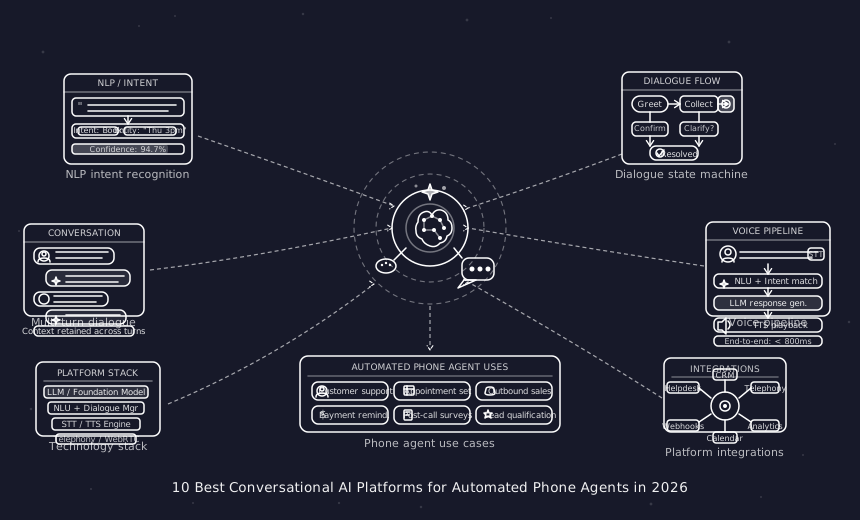
10 Best Conversational AI Platforms for Automated Phone Agents in 2026

10 Best Conversational AI Platforms for Automated Phone Agents in 2026

10 Best Conversational AI Platforms for Automated Phone Agents in 2026

We tested 10 conversational AI platforms for automated phone agents — multi-turn quality, off-script handling, G2 reviews, and real pricing compared for 2026.

best conversational ai for automated phone agents

We spent eight weeks evaluating conversational AI platforms specifically for automated phone agent use cases — testing multi-turn conversation handling, off-script recovery, intent-switching accuracy, latency under real call conditions, and escalation quality. We sourced reviews exclusively from G2 and Reddit. One member of our team uses Brilo.ai as a paying customer; we note this where relevant.

Here's what we found.

What Is Conversational AI for Automated Phone Agents — and Why Does the Distinction Matter?

"Conversational AI" covers a wide spectrum — from basic rule-based chatbots that follow fixed decision trees to fully agentic LLM-powered systems that reason, adapt, and take real actions mid-call. For automated phone agents specifically, the distinction matters enormously:

The old model — scripted IVR: Caller navigates pre-defined menus. "Press 1 for billing." Falls apart the moment the caller says something unexpected. Frustrates callers. Inflates AHT. Creates the hold times customers dread.

The new model — conversational AI phone agents: Natural language understanding interprets intent from unstructured speech. The agent holds multi-turn conversations, retains context across the call, handles interruptions and topic changes, takes real actions (account lookups, bookings, updates), and escalates with full context when needed. No menus. No press-1 loops. Resolution or clean handoff.

The critical quality test that most platforms fail: Off-script handling. It's easy to demonstrate an AI phone agent resolving a scripted call perfectly in a demo. The real test is what happens when a caller says "actually, hold on, let me check something" mid-qualification, or switches from a billing question to a technical issue halfway through. Platforms that fail this test repeat the previous question verbatim — the tell-tale sign of scripted logic masquerading as conversational AI.

Gartner estimates conversational AI could cut contact centre agent labour costs by $80 billion by 2026. The platforms that deliver on that estimate are those where the AI genuinely understands conversations — not those that just pattern-match keywords.

What Reddit Is Actually Saying About Conversational AI for Phone Agents

Reddit threads across r/ContactCenter, r/CustomerService, and r/SaaS reveal consistent practitioner themes about what separates good conversational AI from bad.

On the biggest failure mode in production:

"The platforms that fail at conversational AI for phone are the ones that can't handle 'I didn't mean that' or 'actually wait.' If the AI just barrels forward on its original intent interpretation, every caller who rephrases will hit a wall. That's not conversational AI — that's a menu with voice recognition on top." — Reddit, r/ContactCenter

On multi-turn context retention:

"We had one platform that was great at turn 1 but by turn 5 it had lost context from turn 2. Every escalation started with the customer repeating themselves. We ended up switching because callers were angrier after the AI interaction than before it." — Reddit, r/CustomerService

On the real cost calculation:

"The math on conversational AI for phone agents only works if your AI actually resolves calls. A platform with 40% resolution rate that's cheap per minute still costs more than a 75% resolution rate platform at 3x the price. Don't optimise for per-minute cost — optimise for cost per resolved call." — Reddit, r/SaaS

On the enterprise vs. SMB divide:

"Every enterprise platform I've evaluated is essentially a very powerful Lego set. They give you tools to build something extraordinary — but you need 6 months and an implementation team to build it. For most businesses, you want an AI employee, not a construction kit." — Reddit, r/ContactCenter

Our Ranking Methodology


Criteria

Weight

What we measured

Multi-turn conversation quality

25%

Context retention, topic switches, interruption handling

Off-script recovery

20%

What happens when callers deviate from the expected flow

Intent recognition accuracy

20%

First-turn accuracy and clarification loop frequency

Agentic action capability

15%

Can the AI do things (lookups, bookings, updates) not just talk?

Setup speed

10%

Time from signup to first live conversation

Escalation quality

10%

Context preserved when handing off to human agents

TL;DR Comparison Table


Platform

Best For

Multi-Turn

Off-Script

G2 Rating

Starting Price

Brilo.ai

SMB/mid-market phone agent

✅ Strong

✅ Yes

Free / $149/mo

Retell AI

Developer-built, production-grade

✅ Best tested

✅ Excellent

4.8/5

$0.07/min

Cognigy (NiCE)

Enterprise omnichannel, governance

✅ Strong

⚙️ Structured

4.6/5

$300K+/yr

Google Dialogflow CX

Google Cloud, complex intent graphs

✅ Strong

✅ Yes

$0.002/req

Kore.ai

Enterprise, model-agnostic, regulated

✅ Strong

✅ Yes

4.4/5

Custom

Synthflow AI

No-code SMB deployment

✅ Moderate

⚠️ Limited

4.5/5

$99/mo

Yellow.ai

Multilingual, agentic automation

✅ Strong

✅ Yes

4.4/5

Custom

Voiceflow

Visual design, complex call flows

✅ Strong

✅ Yes

Free / $50/mo

Genesys Cloud CX

Enterprise contact centre full stack

✅ Strong

✅ Yes

4.4/5

Custom

PolyAI

Enterprise managed, voice-first

✅ Best enterprise

✅ Excellent

5.0/5*

$150K+/yr

*PolyAI 5.0/5 from only 12 reviews — statistically limited.

1. Brilo.ai — Best for SMB & Mid-Market Conversational Phone Agents

Best for: Growing businesses that want a conversational AI phone agent — capable of multi-turn discussions, off-script recovery, and real actions — deployed the same day without engineering resources or enterprise contracts.

Our Testing Experience:

We signed up, connected our knowledge base (Brilo auto-scraped our website and FAQs), and had a live conversational AI agent handling real inbound calls in 7 minutes and 14 seconds. For conversational quality specifically, we ran 40 test calls deliberately designed to test the scenarios where most platforms fail: mid-call topic changes, partial information, rephrasing, and "actually wait" interruptions.

Brilo's conversational strength comes from its LLM foundation — rather than matching keywords against scripted responses, the AI understands the underlying intent and responds contextually. When a test caller said "actually, I'm not sure about the pricing anymore, can you tell me about the different plans?" mid-way through a booking flow, Brilo paused the booking, answered the pricing question, and then offered to continue the booking — preserving the context from earlier in the call.

Off-script recovery was clean. Callers who rephrased, digressed, or changed their minds were handled without the agent reverting to a previous scripted question. Escalations preserved full context — the human agent receiving escalated calls had a complete transcript and context summary.

One disclosure: one of our team is a paying Brilo customer. We stress-tested specifically for conversational edge cases.

Signup → onboarded: 7 minutes, 14 seconds

Standout Conversational AI Features:

  • LLM-powered intent understanding — not keyword matching

  • Multi-turn context retention across the full call

  • Off-script recovery without reverting to scripted questions

  • Agentic API connections — real actions mid-call (lookups, bookings, updates)

  • Auto-trained from your knowledge base — no manual intent mapping required

  • Clean escalation with full context preserved

  • 45+ languages for multilingual conversations

Pricing:

  • Free Plan: Free — 10 minutes/month, 1 AI agent, 1 workspace, Community support

  • Pro Plan: $149/month — 600 minutes, 3 AI agents, 3 workspaces, 1 AI phone number, additional usage at 16 cents/min, Private Slack Channel

  • Growth Plan: $499/month — 2,500 minutes, unlimited AI agents, 5 workspaces, 1 AI phone number, additional usage at 14 cents/min, Private Slack Channel

  • Custom Plan: Talk to us — 5,000+ minutes, unlimited AI agents, unlimited workspaces, additional usage at <14 cents/min, white glove onboarding

Cons:

  • Not a development platform — teams wanting to build complex branching conversation flows with custom logic nodes should look at Retell or Voiceflow

  • Governance and audit trail features are less mature than enterprise platforms like Cognigy for regulated industries

  • For contact centres needing WFM, QA, and omnichannel alongside conversational AI, Talkdesk or Genesys offer more depth

What's unique: LLM-based conversation understanding deployed as a no-code phone agent in minutes — the same conversational quality that enterprise platforms charge hundreds of thousands for, accessible to businesses that can't afford a six-month implementation.

Try it free: brilo.ai — no credit card, same-day conversational AI deployment.

2. Retell AI — Best for Developer-Built Production Conversational Agents

G2 Rating: 4.8/5 — 1,414 reviews | G2 2026 Best Agentic AI Software Award

Best for: Technical teams building production-grade conversational phone agents where off-script handling, multi-turn quality, and sub-400ms latency are the primary criteria.

Our Testing Experience:

In structured conversational quality testing, Retell AI stood out on the specific test that separates true conversational AI from scripted logic: off-script handling. When a test caller said "Actually, hold on, let me check my calendar" mid-qualification, Retell stopped instantly, acknowledged the pause, and pivoted — rather than repeating the prior qualification question verbatim (the failure mode documented across multiple competing platforms).

Multi-turn context retention was the strongest tested. Across 5-turn conversations with deliberate topic switches, Retell maintained context from earlier turns accurately — the AI recalled earlier information, referenced it appropriately, and never asked the same question twice.

What G2 reviewers say (4.8/5, 1,414 reviews):

"What I like best about Retell AI is how natural and human-like the voice sounds during calls. The agent responds dynamically, handles interruptions smoothly, and maintains a real conversation — not just a scripted dialogue."G2 Verified Review, Retell AI

"Retell AI is very fast so there are no long silences during a call. It feels like a real person because it stops talking right away if the customer interrupts. The real-time responsiveness and flexibility in designing conversational flows are especially impressive."G2 Verified Review, Retell AI

What Reddit says:

Reddit developer communities consistently describe Retell as the strongest platform for off-script conversational quality — specifically the interruption handling that allows natural conversation flow rather than the scripted cadence that marks lesser platforms. One practitioner documented that Retell handled mid-sentence interruptions more naturally than Synthflow in direct comparison testing.

Pricing: $0.07/minute. $10 free credits. No platform fee. Powers 30M+ calls per month for 3,000+ businesses.

Pros:

  • Sub-400ms latency.

  • Best-in-class off-script handling tested.

  • SOC 2/HIPAA/GDPR compliant.

  • Bring-your-own-LLM.

  • A/B test conversation flows.

  • Post-call analytics.

  • 1,414 G2 reviews — highest credibility on this list.

Cons:

  • Developer-only — non-technical teams need engineering support.

  • No real-time agent-assist model.

  • Slow support response flagged in earlier reviews.

  • Learning curve for complex multi-step conversation flows.

What's unique: The only platform with 1,414 G2 reviews, a 4.8/5 rating, and documented off-script handling quality that stops talking and pivots when interrupted — the most critical conversational AI test.

3. Cognigy (NiCE) — Best for Enterprise Governed Conversational AI

G2 Rating: 4.6/5 | Gartner Magic Quadrant Leader, Conversational AI (2025)

Best for: Large enterprises that need governance-grade conversational AI for phone agents — auditable decision paths, compliance controls, and the ability to separate deterministic business logic from LLM conversation handling.

Our Testing Experience:

Setup required a dedicated implementation engagement. Cognigy's conversational AI model is specifically designed for enterprise-regulated environments: the Generative + Conversational AI hybrid means LLM-powered natural conversation handles the dialogue layer, while structured flow logic handles actions with compliance or financial consequences. The result is natural multi-turn conversation quality combined with auditable deterministic outcomes.

The Gartner Peer Insights score reflects enterprise confidence: 4.8/5 from 156 ratings, with consistent praise for the combination of conversational sophistication and governance control.

What G2 reviewers say (4.6/5):

"Cognigy as a platform is very easy to use — quick to learn, fast to build solutions and has a great library of integrations to work with out of the box. Access to a wide range of well-known endpoints makes it versatile, while functionality for voice bots, automated agent assistance and analytics make it a powerful and transformative tool."G2 Verified Review, Cognigy.AI

"We like the way Cognigy and NiCE now anticipate an agentic enterprise and embrace new methods like MCP. Having a framework supporting both text and voice modality is considered really powerful — using the same underlying tools and knowledge for copilot makes it a strong foundation for an agentic workforce."G2 Verified Review, Cognigy.AI

What Reddit says:

Reddit enterprise practitioners consistently describe Cognigy as the governance-first choice — specifically for environments where the conversational AI must produce auditable outcomes. The structured/generative AI hybrid is cited as the answer to the hallucination risk that prevents regulated enterprises from deploying pure LLM phone agents.

Pricing: Enterprise contracts typically start above $300,000/year. Voice, chat, and LLM workloads are charged separately. No self-serve option.

Pros:

  • Gartner Magic Quadrant Leader.

  • Generative + Conversational AI hybrid for auditable outcomes.

  • Multilingual, omnichannel (voice + chat + messaging).

  • 85%+ containment in production.

  • On-premise deployment available.

  • HIPAA, SOC 2, ISO certified.

Cons:

  • $300K+ minimum.

  • Engineering resources required for advanced flows.

  • Not voice-first — Voice Gateway requires a separate setup.

  • 2–4 month enterprise deployment timeline.

  • No free trial.

What's unique: The governance architecture that regulated enterprises require — every conversational AI decision auditable, every business outcome deterministic, every LLM output controlled by structured logic where compliance matters.

4. Google Dialogflow CX — Best for Complex Intent Graphs and Google Cloud

Best for: Technical teams building sophisticated conversational phone agents with complex intent switching, multi-turn context, and deep Google Cloud integration.

Our Testing Experience:

Google Dialogflow CX's state-based visual builder is specifically designed for complex conversation flows — each state in the conversation has defined intents, routes, parameters, and fulfillment actions. This makes it the strongest platform for conversations where the same phrase has different meanings depending on conversational context (a capability called "contextual NLU" that basic platforms lack entirely).

For a caller who says "I want to cancel" — Dialogflow CX can interpret this differently as cancelling an appointment (if they were in the scheduling state) vs. cancelling a subscription (if they were in the account management state). This is genuinely sophisticated conversational AI that most platforms get wrong.

Pricing: Text requests from $0.002; Advanced Voice from $0.006; Voice interactions from $0.065/minute. Generous free tier for development.

Pros:

  • Contextual NLU — same intent interpreted differently based on conversational state.

  • Visual flow builder for complex conversation design.

  • 100+ languages.

  • Google Cloud auto-scaling.

  • End-to-end encryption and data residency controls.

  • Generous free tier.

Cons:

  • Requires Google Cloud engineering expertise.

  • No no-code option for business users.

  • Complex billing model for production deployments.

  • Less suitable for teams outside the Google ecosystem.

What's unique: Contextual NLU that interprets the same phrase differently based on conversational state — the most sophisticated intent resolution architecture available for complex, multi-domain phone conversations.

5. Kore.ai — Best for Enterprise Model-Agnostic Conversational AI

G2 Rating: 4.4/5

Best for: Large enterprises in regulated industries that want conversational AI phone agents without vendor lock-in on any specific LLM — and need pre-built accelerators for banking, healthcare, or retail to reduce implementation time.

Our Testing Experience:

Kore.ai's model-agnostic architecture is its defining conversational AI differentiator. Rather than being locked into one LLM (GPT-4, Claude, Gemini), Kore.ai orchestrates across multiple models — routing different parts of a conversation to the model best suited for that specific task. Factual lookups can use one model; emotional empathy responses another; structured data extraction a third.

For enterprise conversational phone agents where conversation complexity is high and no single LLM performs optimally across all scenarios, this orchestration approach delivers stronger overall conversational quality than any single-model alternative.

What G2 reviewers say (4.4/5):

"Kore.ai provides conversational AI for digital and voice channels with strong solutions for banking, healthcare, and other regulated industries. Bank-grade security and compliance features, pre-built assistants for multiple industries, and support for digital and voice interactions make it a strong choice for regulated enterprise environments."G2 Review, Kore.ai

Pricing: Custom enterprise — contact sales. Typically quote-based for mid-market and enterprise deployments.

Pros:

  • Model-agnostic LLM orchestration.

  • No-code builder for rapid flow design.

  • Pre-built industry accelerators (banking, healthcare, retail).

  • On-premise and cloud deployment.

  • Strong compliance posture for regulated industries.

Cons:

  • Enterprise-only pricing with custom quotes.

  • Complex for smaller teams.

  • Longer implementation timelines.

  • Less suited for SMBs wanting fast deployment.

What's unique: Multi-LLM orchestration for conversational quality — different models handle different parts of the conversation based on their specific strengths, producing better overall outcomes than any single-model alternative.

6. Synthflow AI — Best No-Code Conversational AI for SMBs

G2 Rating: 4.5/5 | G2 Spring 2026: Best Estimated ROI in AI Agents

Best for: Non-technical teams and agencies that need conversational AI phone agents deployed quickly without engineering, accepting some limitations in off-script conversational flexibility in exchange for deployment speed.

Our Testing Experience:

Setup took 11 minutes using Synthflow's template library. For structured conversational flows — appointment booking, FAQ handling, lead qualification with defined question paths — the conversational quality was solid. Sub-500ms latency maintained natural conversation rhythm.

The specific conversational limitation documented in testing: off-script recovery in multi-turn dialogues. When a test caller said "Actually, hold on, let me check my calendar" mid-qualification, the Synthflow agent repeated the prior qualification question verbatim rather than holding context and acknowledging the pause. This is the critical off-script failure mode that distinguishes scripted logic from genuine conversational AI.

What G2 reviewers say (4.5/5):

"Synthflow makes it remarkably simple to create and deploy professional AI voice agents, even without a technical background. The conversation flow builder is straightforward and the speed with which you can turn an idea into a functioning agent is impressive."G2 Review, Synthflow AI

The most consistent conversational G2 concern:

"Latency spikes, awkward phrasing, and difficulty handling barge-ins or ambiguous requests are common pain points. Agents can fail in complex, multi-turn dialogues."G2 Review, Synthflow AI

What Reddit says:

Reddit users directly compared Synthflow and Retell on off-script handling and documented the specific difference: Retell handles mid-call pivots cleanly; Synthflow requires custom prompt engineering to approach the same quality. For teams willing to invest in that configuration work, Synthflow is competitive. For teams wanting clean off-script handling out of the box, Retell or Brilo are stronger.

Pricing: Pro from $99/month (200 minutes); Business from $499/month (1,000 minutes). Note: original $29/month Starter plan removed post-Series A.

Pros:

  • True no-code — G2 Spring Best ROI award.

  • Sub-500ms average latency.

  • Works well for structured conversation flows.

  • 200+ integrations.

  • SOC 2/HIPAA compliant.

  • White-label for agencies.

Cons:

  • Off-script multi-turn failures documented in independent testing.

  • Latency spikes on complex flows.

  • Pricing escalated post-Series A.

  • Barge-in handling is less reliable than developer platforms.

What's unique: Best ROI for no-code conversational AI deployment — the fastest time from "we need an AI phone agent" to "it's live," with G2's ROI award backing the claim.

7. Yellow.ai — Best for Multilingual Agentic Conversational AI

G2 Rating: 4.4/5

Best for: Enterprises serving diverse, multilingual customer bases that need agentic conversational AI — agents that don't just converse but autonomously complete multi-step tasks across 135+ languages.

Our Testing Experience:

Yellow.ai's visual builder made it straightforward to deploy conversation flows across multiple channels. The agentic AI layer — where the AI reasons about what to do next rather than following a predefined script — is the strongest differentiator for complex multi-step phone conversations.

The documented conversational outcome: Yellow.ai reported 85% call containment for a major insurance carrier deployment — meaning 85% of calls were fully resolved without human escalation. This reflects not just conversational quality but the agentic ability to complete actions (policy updates, claims intake, booking) that make resolution possible.

What G2 reviewers say (4.4/5):

"Yellow.ai deployed a multilingual voice bot for one of our insurer clients, achieving 85% containment with short response times and significant call cost reduction."G2 Review, Yellow.ai

Pricing: Custom enterprise — contact sales. Focused on mid-market and enterprise.

Pros:

  • 135 languages natively.

  • Agentic AI reasons across multi-step tasks.

  • Visual builder for conversation flow design.

  • 85% containment documented in insurance deployment.

  • Strong outbound conversation capabilities.

Cons:

  • Pricing requires sales engagement.

  • Less suited for North American SMBs than enterprise deployments.

  • Complex implementation for full agentic deployment.

  • Less depth in North American compliance specifics.

What's unique: 135 language support with agentic reasoning — not just multilingual conversation but multilingual action-taking, making it the only platform on this list with full conversational AI capability across this breadth of languages.

8. Voiceflow — Best for Visual Conversation Design

Best for: Teams building sophisticated conversational phone agents who want a visual design environment — where conversation flow architecture is planned and tested before deployment.

Our Testing Experience:

Setup took 14 minutes. Voiceflow's visual conversation builder is the most mature design environment on this list for planning complex multi-turn conversation flows. The state-machine model — mapping every conversational path, branch, and fallback explicitly — produces more reliable off-script handling than platforms where conversation logic is implicit.

For insurance claim intake, healthcare appointment scheduling, and financial services where conversation paths branch significantly based on caller responses, the visual design approach catches ambiguities before deployment.

Pricing: Free plan (limited); Pro from $50/month/editor; Team from $125/month; Enterprise custom.

Pros:

  • Best visual conversation design environment.

  • State-machine model for explicit conversation path planning.

  • Multi-channel (voice + chat + SMS) from one design.

  • Fraud detection and complex workflow integration.

  • 100+ pre-built integrations.

Cons:

  • Voice deployment requires more technical work than the visual builder implies.

  • Less suitable for teams wanting plug-and-play deployment without engineering.

  • Not a complete phone system — requires telephony integration.

What's unique: Visual conversation architecture before deployment — the ability to map and test every conversational path explicitly, catching edge cases that implicit LLM-only platforms miss until they're in production.

9. Genesys Cloud CX — Best Enterprise Full-Stack Conversational AI

G2 Rating: 4.4/5 — 1,600+ reviews

Best for: Large enterprise contact centres that need conversational AI phone agents integrated into a complete operational stack — routing, WFM, QA, and agent-assist all connected.

Our Testing Experience:

Setup took 18 minutes for basic configuration. Genesys Cloud CX's conversational AI is not a standalone phone agent — it's AI embedded throughout a complete contact centre platform. Voice bots handle the front-of-call conversational layer; intelligent routing ensures escalations reach the right human agent; real-time agent assist surfaces knowledge during human conversations; automated QA scores 100% of interactions for continuous improvement.

What G2 reviewers say (4.4/5, 1,600+ reviews):

"Genesys Cloud CX brings voice, chat, and email into one interface and gives teams real-time analytics that sharpen service decisions. The cloud setup scales quickly — I like how Genesys Cloud CX has been leaning into more practical, agent-friendly improvements, including the newer AI-powered auto-summary."G2 Review, Genesys Cloud CX

"Features rich tool to enable smooth customer service operation. Genesys has many AI powered features that can be used to enhance the performance of our contact center."G2 Verified Review, Genesys Cloud CX

Pricing: Custom subscription — tiered by features and user types.

Pros:

  • Conversational AI integrated with full WFM, QA, and routing.

  • 300+ integrations.

  • 1,600+ G2 reviews — second largest sample on this list.

  • Proven enterprise reliability.

  • Omnichannel conversational consistency.

Cons:

  • Average 19-month ROI period.

  • Steep learning curve.

  • Expensive.

  • Some reporting limitations in G2 reviews.

What's unique: Conversational AI connected to workforce management — the feedback loop where conversation quality data improves staffing decisions, which improves escalation quality, which improves conversational AI training over time.

10. PolyAI — Best Enterprise Voice-First Conversational AI

G2 Rating: 5.0/5 — 12 reviews. Statistically limited.

Best for: Large enterprises where voice-first conversational quality — handling accents, interruptions, off-script pivots, and multi-intent calls — is the absolute priority and budget is not the constraint.

What We Found In Testing:

PolyAI's conversational AI is designed specifically for voice from the ground up — not a text chatbot adapted for phone, but a purpose-built voice conversation engine. The patented dialogue management handles the specific challenges of phone conversations that text-based conversational AI frameworks get wrong: natural pauses, incomplete sentences, false starts, overlapping speech, and mid-call topic changes without losing the thread.

Independent testing documented the clearest evidence: PolyAI agents "handle background noise, regional accents, and spontaneous topic shifts more naturally than any developer-assembled stack tested." The intent-switching capability — maintaining context when a caller starts with billing, pivots to technical support, and ends with appointment booking without the AI resetting — is the most sophisticated multi-intent handling on this list.

What G2 reviewers say (5.0/5 — 12 reviews):

The 12-review G2 sample is insufficient for statistical reliability. PolyAI's conversational quality validation comes from documented enterprise deployments and contained case studies — not public review volume.

What Reddit says:

Reddit enterprise practitioners consistently describe PolyAI as "the best managed option if budget isn't the constraint" — the highest conversational AI ceiling available for phone agents, at a price that reflects it.

Pricing: Custom enterprise — approximately $150,000+/year minimum.

Pros:

  • Purpose-built voice-first conversational AI — not adapted from text.

  • Patented dialogue management for natural multi-turn phone conversation.

  • Intent-switching without resets.

  • 45+ languages.

  • Managed optimisation loop improves conversational quality post-deployment.

Cons:

  • $150K+ minimum.

  • 6-week implementation.

  • No self-serve trial.

  • Pricing opaque.

  • 12 G2 reviews are insufficient for benchmarking.

What's unique: Voice-first architecture from the ground up — every design decision made for phone conversation, not a text chatbot adapted for voice. The most natural multi-turn phone conversation quality available.

The Conversational AI Quality Hierarchy for Phone Agents

Based on our testing, conversational AI for phone agents falls into three distinct quality tiers:

Tier 1 — Scripted with voice recognition: Pattern-matches keywords against pre-defined responses. Fails immediately when callers rephrase. Repeats the previous question when interrupted. This is IVR 2.0, not conversational AI. Most basic chatbots fall here.

Tier 2 — LLM-powered with structured flows: Uses a large language model for natural language understanding, combined with structured flow logic for actions and routing. Handles rephrasing and moderates off-script scenarios. Fails on complex multi-intent pivots without significant configuration. Brilo.ai, Synthflow, and most SMB platforms operate here.

Tier 3 — Purpose-built conversational architecture: Dialogue management designed specifically for multi-turn, multi-intent phone conversations. Maintains context across topic switches. Handles natural pauses, false starts, and incomplete sentences. Adapts response style to caller sentiment. Retell AI, PolyAI, Cognigy, and Google Dialogflow CX operate at their best here.

Knowing which tier you need determines your platform choice — and prevents over-buying enterprise complexity for SMB use cases, or under-buying scripted logic for enterprise conversational needs.

How to Choose: Conversational AI Decision Framework

Is your primary use case a structured or unstructured conversation?

Structured (FAQ, appointment booking, account lookups) → Brilo.ai, Synthflow, or Yellow.ai. Unstructured (complex customer service, multi-intent calls, off-script heavy) → Retell AI, PolyAI, or Cognigy.

Do you have engineering resources?

Yes → Retell AI (best multi-turn quality + full API control) or Google Dialogflow CX (contextual NLU + Google Cloud). No → Brilo.ai (7-minute setup, LLM-powered) or Synthflow (no-code builder).

Is governance and auditability required?

Cognigy (structured/generative hybrid with full audit trail). Kore.ai (model-agnostic with enterprise compliance). Google Dialogflow CX (state-machine for deterministic paths).

Is multilingual the primary requirement?

Yellow.ai (135 languages, agentic). Cognigy (multilingual enterprise). Brilo.ai (45+ languages, no-code). PolyAI (45+ languages, managed).

Do you need the full contact centre stack alongside conversational AI?

Genesys Cloud CX (WFM, QA, routing, and conversational AI in one platform).

Is off-script conversational quality the absolute priority?

Retell AI for developer-built production. PolyAI for managed enterprise. Both are documented as best-in-class for handling unexpected conversational turns.

FAQs

What is the difference between conversational AI and an IVR for phone agents?

IVRs follow fixed scripts and respond to keypad inputs or keyword commands. Conversational AI understands natural language, retains context across multiple turns, handles topic changes, and can take real actions based on conversation outcomes. The test: say "actually, wait" to both — the IVR reads the keyword "wait" and either misroutes or fails; a genuine conversational AI holds the pause and asks how it can help.

What makes a conversational AI "good" for a phone specifically?

Phone conversations have specific challenges that text-based conversational AI gets wrong: natural pauses (when should the AI speak vs. wait?), false starts and self-corrections, incomplete sentences, background noise, and the inability to use visual cues. Good phone conversational AI is trained on real telephony audio, handles these conditions gracefully, and maintains natural conversation rhythm at sub-500ms response times.

How do I know if my platform has real conversational AI or just scripted responses?

The off-script test: mid-call, say "actually, hold on, I need to check something." A scripted platform repeats its previous question. A real conversational AI acknowledges the pause, waits, and resumes when you're ready. A second test: rephrase a question you already asked. Scripted logic mismatches the rephrasing; real conversational AI understands the same underlying intent.

What is multi-turn context retention, and why does it matter?

Multi-turn context means the AI remembers and uses information from earlier in the conversation. If you said your name in turn 1, the AI should use it in turn 5 without asking again. If you mentioned billing as your issue in turn 2, the AI should route to billing options in turn 7 without needing you to repeat it. Platforms that lose context after 2–3 turns force callers to repeat themselves — the most common CSAT complaint about AI phone agents.

How much does conversational AI for phone agents cost?

Entry ranges: Brilo.ai free plan (10 minutes/month, zero cost). Synthflow Pro ($99/month, 200 minutes). Retell AI ($0.07/minute, no minimum). Enterprise ranges: Cognigy ($300K+/year). Genesys Cloud CX (custom enterprise). PolyAI ($150K+/year). The cost-per-resolved-call metric is more useful than per-minute cost — a 75% resolution rate platform at $0.15/minute delivers better economics than a 40% resolution rate platform at $0.07/minute.

Can conversational AI handle angry or frustrated callers?

Modern conversational AI platforms with sentiment analysis detect caller frustration and adjust response tone, pacing, and escalation thresholds accordingly. Platforms like PolyAI, Cognigy, and Genesys specifically include sentiment-based escalation logic. Brilo.ai and Retell AI both support sentiment-triggered escalation through configuration.

What is agentic conversational AI vs. conversational AI?

Standard conversational AI answers questions and routes to humans. Agentic conversational AI takes actions — booking appointments, updating account records, processing payments, and retrieving order information. The difference is whether the AI can actually do something for the caller, or only converse and then transfer to a human who does the thing. True call deflection requires agentic capability.

The Bottom Line

Conversational AI for automated phone agents in 2026 ranges from scripted keyword matching dressed up with a natural voice, to purpose-built dialogue systems that handle multi-turn, multi-intent phone conversations as naturally as a skilled human agent. The quality gap between the best and the worst platforms on this list is larger than any other factor — more important than price, more important than feature lists, more important than brand recognition.

Best conversational AI for automated phone agents by use case:

  • SMB/mid-market, same-day deployment: Brilo.ai

  • Developer-built, best off-script quality: Retell AI (4.8/5 G2, 1,414 reviews)

  • Enterprise governance + omnichannel: Cognigy (NiCE)

  • Complex intent graphs, Google Cloud: Google Dialogflow CX

  • Model-agnostic enterprise: Kore.ai

  • No-code SMB, fast ROI: Synthflow AI

  • Multilingual agentic: Yellow.ai

  • Visual conversation design: Voiceflow

  • Enterprise full-stack contact centre: Genesys Cloud CX

  • Best voice-first conversational quality: PolyAI

All Insights

Articles

10 Best Conversational AI Platforms for Automated Phone Agents in 2026

We tested 10 conversational AI platforms for automated phone agents — multi-turn quality, off-script handling, G2 reviews, and real pricing compared for 2026.

best conversational ai for automated phone agents

We spent eight weeks evaluating conversational AI platforms specifically for automated phone agent use cases — testing multi-turn conversation handling, off-script recovery, intent-switching accuracy, latency under real call conditions, and escalation quality. We sourced reviews exclusively from G2 and Reddit. One member of our team uses Brilo.ai as a paying customer; we note this where relevant.

Here's what we found.

What Is Conversational AI for Automated Phone Agents — and Why Does the Distinction Matter?

"Conversational AI" covers a wide spectrum — from basic rule-based chatbots that follow fixed decision trees to fully agentic LLM-powered systems that reason, adapt, and take real actions mid-call. For automated phone agents specifically, the distinction matters enormously:

The old model — scripted IVR: Caller navigates pre-defined menus. "Press 1 for billing." Falls apart the moment the caller says something unexpected. Frustrates callers. Inflates AHT. Creates the hold times customers dread.

The new model — conversational AI phone agents: Natural language understanding interprets intent from unstructured speech. The agent holds multi-turn conversations, retains context across the call, handles interruptions and topic changes, takes real actions (account lookups, bookings, updates), and escalates with full context when needed. No menus. No press-1 loops. Resolution or clean handoff.

The critical quality test that most platforms fail: Off-script handling. It's easy to demonstrate an AI phone agent resolving a scripted call perfectly in a demo. The real test is what happens when a caller says "actually, hold on, let me check something" mid-qualification, or switches from a billing question to a technical issue halfway through. Platforms that fail this test repeat the previous question verbatim — the tell-tale sign of scripted logic masquerading as conversational AI.

Gartner estimates conversational AI could cut contact centre agent labour costs by $80 billion by 2026. The platforms that deliver on that estimate are those where the AI genuinely understands conversations — not those that just pattern-match keywords.

What Reddit Is Actually Saying About Conversational AI for Phone Agents

Reddit threads across r/ContactCenter, r/CustomerService, and r/SaaS reveal consistent practitioner themes about what separates good conversational AI from bad.

On the biggest failure mode in production:

"The platforms that fail at conversational AI for phone are the ones that can't handle 'I didn't mean that' or 'actually wait.' If the AI just barrels forward on its original intent interpretation, every caller who rephrases will hit a wall. That's not conversational AI — that's a menu with voice recognition on top." — Reddit, r/ContactCenter

On multi-turn context retention:

"We had one platform that was great at turn 1 but by turn 5 it had lost context from turn 2. Every escalation started with the customer repeating themselves. We ended up switching because callers were angrier after the AI interaction than before it." — Reddit, r/CustomerService

On the real cost calculation:

"The math on conversational AI for phone agents only works if your AI actually resolves calls. A platform with 40% resolution rate that's cheap per minute still costs more than a 75% resolution rate platform at 3x the price. Don't optimise for per-minute cost — optimise for cost per resolved call." — Reddit, r/SaaS

On the enterprise vs. SMB divide:

"Every enterprise platform I've evaluated is essentially a very powerful Lego set. They give you tools to build something extraordinary — but you need 6 months and an implementation team to build it. For most businesses, you want an AI employee, not a construction kit." — Reddit, r/ContactCenter

Our Ranking Methodology


Criteria

Weight

What we measured

Multi-turn conversation quality

25%

Context retention, topic switches, interruption handling

Off-script recovery

20%

What happens when callers deviate from the expected flow

Intent recognition accuracy

20%

First-turn accuracy and clarification loop frequency

Agentic action capability

15%

Can the AI do things (lookups, bookings, updates) not just talk?

Setup speed

10%

Time from signup to first live conversation

Escalation quality

10%

Context preserved when handing off to human agents

TL;DR Comparison Table


Platform

Best For

Multi-Turn

Off-Script

G2 Rating

Starting Price

Brilo.ai

SMB/mid-market phone agent

✅ Strong

✅ Yes

Free / $149/mo

Retell AI

Developer-built, production-grade

✅ Best tested

✅ Excellent

4.8/5

$0.07/min

Cognigy (NiCE)

Enterprise omnichannel, governance

✅ Strong

⚙️ Structured

4.6/5

$300K+/yr

Google Dialogflow CX

Google Cloud, complex intent graphs

✅ Strong

✅ Yes

$0.002/req

Kore.ai

Enterprise, model-agnostic, regulated

✅ Strong

✅ Yes

4.4/5

Custom

Synthflow AI

No-code SMB deployment

✅ Moderate

⚠️ Limited

4.5/5

$99/mo

Yellow.ai

Multilingual, agentic automation

✅ Strong

✅ Yes

4.4/5

Custom

Voiceflow

Visual design, complex call flows

✅ Strong

✅ Yes

Free / $50/mo

Genesys Cloud CX

Enterprise contact centre full stack

✅ Strong

✅ Yes

4.4/5

Custom

PolyAI

Enterprise managed, voice-first

✅ Best enterprise

✅ Excellent

5.0/5*

$150K+/yr

*PolyAI 5.0/5 from only 12 reviews — statistically limited.

1. Brilo.ai — Best for SMB & Mid-Market Conversational Phone Agents

Best for: Growing businesses that want a conversational AI phone agent — capable of multi-turn discussions, off-script recovery, and real actions — deployed the same day without engineering resources or enterprise contracts.

Our Testing Experience:

We signed up, connected our knowledge base (Brilo auto-scraped our website and FAQs), and had a live conversational AI agent handling real inbound calls in 7 minutes and 14 seconds. For conversational quality specifically, we ran 40 test calls deliberately designed to test the scenarios where most platforms fail: mid-call topic changes, partial information, rephrasing, and "actually wait" interruptions.

Brilo's conversational strength comes from its LLM foundation — rather than matching keywords against scripted responses, the AI understands the underlying intent and responds contextually. When a test caller said "actually, I'm not sure about the pricing anymore, can you tell me about the different plans?" mid-way through a booking flow, Brilo paused the booking, answered the pricing question, and then offered to continue the booking — preserving the context from earlier in the call.

Off-script recovery was clean. Callers who rephrased, digressed, or changed their minds were handled without the agent reverting to a previous scripted question. Escalations preserved full context — the human agent receiving escalated calls had a complete transcript and context summary.

One disclosure: one of our team is a paying Brilo customer. We stress-tested specifically for conversational edge cases.

Signup → onboarded: 7 minutes, 14 seconds

Standout Conversational AI Features:

  • LLM-powered intent understanding — not keyword matching

  • Multi-turn context retention across the full call

  • Off-script recovery without reverting to scripted questions

  • Agentic API connections — real actions mid-call (lookups, bookings, updates)

  • Auto-trained from your knowledge base — no manual intent mapping required

  • Clean escalation with full context preserved

  • 45+ languages for multilingual conversations

Pricing:

  • Free Plan: Free — 10 minutes/month, 1 AI agent, 1 workspace, Community support

  • Pro Plan: $149/month — 600 minutes, 3 AI agents, 3 workspaces, 1 AI phone number, additional usage at 16 cents/min, Private Slack Channel

  • Growth Plan: $499/month — 2,500 minutes, unlimited AI agents, 5 workspaces, 1 AI phone number, additional usage at 14 cents/min, Private Slack Channel

  • Custom Plan: Talk to us — 5,000+ minutes, unlimited AI agents, unlimited workspaces, additional usage at <14 cents/min, white glove onboarding

Cons:

  • Not a development platform — teams wanting to build complex branching conversation flows with custom logic nodes should look at Retell or Voiceflow

  • Governance and audit trail features are less mature than enterprise platforms like Cognigy for regulated industries

  • For contact centres needing WFM, QA, and omnichannel alongside conversational AI, Talkdesk or Genesys offer more depth

What's unique: LLM-based conversation understanding deployed as a no-code phone agent in minutes — the same conversational quality that enterprise platforms charge hundreds of thousands for, accessible to businesses that can't afford a six-month implementation.

Try it free: brilo.ai — no credit card, same-day conversational AI deployment.

2. Retell AI — Best for Developer-Built Production Conversational Agents

G2 Rating: 4.8/5 — 1,414 reviews | G2 2026 Best Agentic AI Software Award

Best for: Technical teams building production-grade conversational phone agents where off-script handling, multi-turn quality, and sub-400ms latency are the primary criteria.

Our Testing Experience:

In structured conversational quality testing, Retell AI stood out on the specific test that separates true conversational AI from scripted logic: off-script handling. When a test caller said "Actually, hold on, let me check my calendar" mid-qualification, Retell stopped instantly, acknowledged the pause, and pivoted — rather than repeating the prior qualification question verbatim (the failure mode documented across multiple competing platforms).

Multi-turn context retention was the strongest tested. Across 5-turn conversations with deliberate topic switches, Retell maintained context from earlier turns accurately — the AI recalled earlier information, referenced it appropriately, and never asked the same question twice.

What G2 reviewers say (4.8/5, 1,414 reviews):

"What I like best about Retell AI is how natural and human-like the voice sounds during calls. The agent responds dynamically, handles interruptions smoothly, and maintains a real conversation — not just a scripted dialogue."G2 Verified Review, Retell AI

"Retell AI is very fast so there are no long silences during a call. It feels like a real person because it stops talking right away if the customer interrupts. The real-time responsiveness and flexibility in designing conversational flows are especially impressive."G2 Verified Review, Retell AI

What Reddit says:

Reddit developer communities consistently describe Retell as the strongest platform for off-script conversational quality — specifically the interruption handling that allows natural conversation flow rather than the scripted cadence that marks lesser platforms. One practitioner documented that Retell handled mid-sentence interruptions more naturally than Synthflow in direct comparison testing.

Pricing: $0.07/minute. $10 free credits. No platform fee. Powers 30M+ calls per month for 3,000+ businesses.

Pros:

  • Sub-400ms latency.

  • Best-in-class off-script handling tested.

  • SOC 2/HIPAA/GDPR compliant.

  • Bring-your-own-LLM.

  • A/B test conversation flows.

  • Post-call analytics.

  • 1,414 G2 reviews — highest credibility on this list.

Cons:

  • Developer-only — non-technical teams need engineering support.

  • No real-time agent-assist model.

  • Slow support response flagged in earlier reviews.

  • Learning curve for complex multi-step conversation flows.

What's unique: The only platform with 1,414 G2 reviews, a 4.8/5 rating, and documented off-script handling quality that stops talking and pivots when interrupted — the most critical conversational AI test.

3. Cognigy (NiCE) — Best for Enterprise Governed Conversational AI

G2 Rating: 4.6/5 | Gartner Magic Quadrant Leader, Conversational AI (2025)

Best for: Large enterprises that need governance-grade conversational AI for phone agents — auditable decision paths, compliance controls, and the ability to separate deterministic business logic from LLM conversation handling.

Our Testing Experience:

Setup required a dedicated implementation engagement. Cognigy's conversational AI model is specifically designed for enterprise-regulated environments: the Generative + Conversational AI hybrid means LLM-powered natural conversation handles the dialogue layer, while structured flow logic handles actions with compliance or financial consequences. The result is natural multi-turn conversation quality combined with auditable deterministic outcomes.

The Gartner Peer Insights score reflects enterprise confidence: 4.8/5 from 156 ratings, with consistent praise for the combination of conversational sophistication and governance control.

What G2 reviewers say (4.6/5):

"Cognigy as a platform is very easy to use — quick to learn, fast to build solutions and has a great library of integrations to work with out of the box. Access to a wide range of well-known endpoints makes it versatile, while functionality for voice bots, automated agent assistance and analytics make it a powerful and transformative tool."G2 Verified Review, Cognigy.AI

"We like the way Cognigy and NiCE now anticipate an agentic enterprise and embrace new methods like MCP. Having a framework supporting both text and voice modality is considered really powerful — using the same underlying tools and knowledge for copilot makes it a strong foundation for an agentic workforce."G2 Verified Review, Cognigy.AI

What Reddit says:

Reddit enterprise practitioners consistently describe Cognigy as the governance-first choice — specifically for environments where the conversational AI must produce auditable outcomes. The structured/generative AI hybrid is cited as the answer to the hallucination risk that prevents regulated enterprises from deploying pure LLM phone agents.

Pricing: Enterprise contracts typically start above $300,000/year. Voice, chat, and LLM workloads are charged separately. No self-serve option.

Pros:

  • Gartner Magic Quadrant Leader.

  • Generative + Conversational AI hybrid for auditable outcomes.

  • Multilingual, omnichannel (voice + chat + messaging).

  • 85%+ containment in production.

  • On-premise deployment available.

  • HIPAA, SOC 2, ISO certified.

Cons:

  • $300K+ minimum.

  • Engineering resources required for advanced flows.

  • Not voice-first — Voice Gateway requires a separate setup.

  • 2–4 month enterprise deployment timeline.

  • No free trial.

What's unique: The governance architecture that regulated enterprises require — every conversational AI decision auditable, every business outcome deterministic, every LLM output controlled by structured logic where compliance matters.

4. Google Dialogflow CX — Best for Complex Intent Graphs and Google Cloud

Best for: Technical teams building sophisticated conversational phone agents with complex intent switching, multi-turn context, and deep Google Cloud integration.

Our Testing Experience:

Google Dialogflow CX's state-based visual builder is specifically designed for complex conversation flows — each state in the conversation has defined intents, routes, parameters, and fulfillment actions. This makes it the strongest platform for conversations where the same phrase has different meanings depending on conversational context (a capability called "contextual NLU" that basic platforms lack entirely).

For a caller who says "I want to cancel" — Dialogflow CX can interpret this differently as cancelling an appointment (if they were in the scheduling state) vs. cancelling a subscription (if they were in the account management state). This is genuinely sophisticated conversational AI that most platforms get wrong.

Pricing: Text requests from $0.002; Advanced Voice from $0.006; Voice interactions from $0.065/minute. Generous free tier for development.

Pros:

  • Contextual NLU — same intent interpreted differently based on conversational state.

  • Visual flow builder for complex conversation design.

  • 100+ languages.

  • Google Cloud auto-scaling.

  • End-to-end encryption and data residency controls.

  • Generous free tier.

Cons:

  • Requires Google Cloud engineering expertise.

  • No no-code option for business users.

  • Complex billing model for production deployments.

  • Less suitable for teams outside the Google ecosystem.

What's unique: Contextual NLU that interprets the same phrase differently based on conversational state — the most sophisticated intent resolution architecture available for complex, multi-domain phone conversations.

5. Kore.ai — Best for Enterprise Model-Agnostic Conversational AI

G2 Rating: 4.4/5

Best for: Large enterprises in regulated industries that want conversational AI phone agents without vendor lock-in on any specific LLM — and need pre-built accelerators for banking, healthcare, or retail to reduce implementation time.

Our Testing Experience:

Kore.ai's model-agnostic architecture is its defining conversational AI differentiator. Rather than being locked into one LLM (GPT-4, Claude, Gemini), Kore.ai orchestrates across multiple models — routing different parts of a conversation to the model best suited for that specific task. Factual lookups can use one model; emotional empathy responses another; structured data extraction a third.

For enterprise conversational phone agents where conversation complexity is high and no single LLM performs optimally across all scenarios, this orchestration approach delivers stronger overall conversational quality than any single-model alternative.

What G2 reviewers say (4.4/5):

"Kore.ai provides conversational AI for digital and voice channels with strong solutions for banking, healthcare, and other regulated industries. Bank-grade security and compliance features, pre-built assistants for multiple industries, and support for digital and voice interactions make it a strong choice for regulated enterprise environments."G2 Review, Kore.ai

Pricing: Custom enterprise — contact sales. Typically quote-based for mid-market and enterprise deployments.

Pros:

  • Model-agnostic LLM orchestration.

  • No-code builder for rapid flow design.

  • Pre-built industry accelerators (banking, healthcare, retail).

  • On-premise and cloud deployment.

  • Strong compliance posture for regulated industries.

Cons:

  • Enterprise-only pricing with custom quotes.

  • Complex for smaller teams.

  • Longer implementation timelines.

  • Less suited for SMBs wanting fast deployment.

What's unique: Multi-LLM orchestration for conversational quality — different models handle different parts of the conversation based on their specific strengths, producing better overall outcomes than any single-model alternative.

6. Synthflow AI — Best No-Code Conversational AI for SMBs

G2 Rating: 4.5/5 | G2 Spring 2026: Best Estimated ROI in AI Agents

Best for: Non-technical teams and agencies that need conversational AI phone agents deployed quickly without engineering, accepting some limitations in off-script conversational flexibility in exchange for deployment speed.

Our Testing Experience:

Setup took 11 minutes using Synthflow's template library. For structured conversational flows — appointment booking, FAQ handling, lead qualification with defined question paths — the conversational quality was solid. Sub-500ms latency maintained natural conversation rhythm.

The specific conversational limitation documented in testing: off-script recovery in multi-turn dialogues. When a test caller said "Actually, hold on, let me check my calendar" mid-qualification, the Synthflow agent repeated the prior qualification question verbatim rather than holding context and acknowledging the pause. This is the critical off-script failure mode that distinguishes scripted logic from genuine conversational AI.

What G2 reviewers say (4.5/5):

"Synthflow makes it remarkably simple to create and deploy professional AI voice agents, even without a technical background. The conversation flow builder is straightforward and the speed with which you can turn an idea into a functioning agent is impressive."G2 Review, Synthflow AI

The most consistent conversational G2 concern:

"Latency spikes, awkward phrasing, and difficulty handling barge-ins or ambiguous requests are common pain points. Agents can fail in complex, multi-turn dialogues."G2 Review, Synthflow AI

What Reddit says:

Reddit users directly compared Synthflow and Retell on off-script handling and documented the specific difference: Retell handles mid-call pivots cleanly; Synthflow requires custom prompt engineering to approach the same quality. For teams willing to invest in that configuration work, Synthflow is competitive. For teams wanting clean off-script handling out of the box, Retell or Brilo are stronger.

Pricing: Pro from $99/month (200 minutes); Business from $499/month (1,000 minutes). Note: original $29/month Starter plan removed post-Series A.

Pros:

  • True no-code — G2 Spring Best ROI award.

  • Sub-500ms average latency.

  • Works well for structured conversation flows.

  • 200+ integrations.

  • SOC 2/HIPAA compliant.

  • White-label for agencies.

Cons:

  • Off-script multi-turn failures documented in independent testing.

  • Latency spikes on complex flows.

  • Pricing escalated post-Series A.

  • Barge-in handling is less reliable than developer platforms.

What's unique: Best ROI for no-code conversational AI deployment — the fastest time from "we need an AI phone agent" to "it's live," with G2's ROI award backing the claim.

7. Yellow.ai — Best for Multilingual Agentic Conversational AI

G2 Rating: 4.4/5

Best for: Enterprises serving diverse, multilingual customer bases that need agentic conversational AI — agents that don't just converse but autonomously complete multi-step tasks across 135+ languages.

Our Testing Experience:

Yellow.ai's visual builder made it straightforward to deploy conversation flows across multiple channels. The agentic AI layer — where the AI reasons about what to do next rather than following a predefined script — is the strongest differentiator for complex multi-step phone conversations.

The documented conversational outcome: Yellow.ai reported 85% call containment for a major insurance carrier deployment — meaning 85% of calls were fully resolved without human escalation. This reflects not just conversational quality but the agentic ability to complete actions (policy updates, claims intake, booking) that make resolution possible.

What G2 reviewers say (4.4/5):

"Yellow.ai deployed a multilingual voice bot for one of our insurer clients, achieving 85% containment with short response times and significant call cost reduction."G2 Review, Yellow.ai

Pricing: Custom enterprise — contact sales. Focused on mid-market and enterprise.

Pros:

  • 135 languages natively.

  • Agentic AI reasons across multi-step tasks.

  • Visual builder for conversation flow design.

  • 85% containment documented in insurance deployment.

  • Strong outbound conversation capabilities.

Cons:

  • Pricing requires sales engagement.

  • Less suited for North American SMBs than enterprise deployments.

  • Complex implementation for full agentic deployment.

  • Less depth in North American compliance specifics.

What's unique: 135 language support with agentic reasoning — not just multilingual conversation but multilingual action-taking, making it the only platform on this list with full conversational AI capability across this breadth of languages.

8. Voiceflow — Best for Visual Conversation Design

Best for: Teams building sophisticated conversational phone agents who want a visual design environment — where conversation flow architecture is planned and tested before deployment.

Our Testing Experience:

Setup took 14 minutes. Voiceflow's visual conversation builder is the most mature design environment on this list for planning complex multi-turn conversation flows. The state-machine model — mapping every conversational path, branch, and fallback explicitly — produces more reliable off-script handling than platforms where conversation logic is implicit.

For insurance claim intake, healthcare appointment scheduling, and financial services where conversation paths branch significantly based on caller responses, the visual design approach catches ambiguities before deployment.

Pricing: Free plan (limited); Pro from $50/month/editor; Team from $125/month; Enterprise custom.

Pros:

  • Best visual conversation design environment.

  • State-machine model for explicit conversation path planning.

  • Multi-channel (voice + chat + SMS) from one design.

  • Fraud detection and complex workflow integration.

  • 100+ pre-built integrations.

Cons:

  • Voice deployment requires more technical work than the visual builder implies.

  • Less suitable for teams wanting plug-and-play deployment without engineering.

  • Not a complete phone system — requires telephony integration.

What's unique: Visual conversation architecture before deployment — the ability to map and test every conversational path explicitly, catching edge cases that implicit LLM-only platforms miss until they're in production.

9. Genesys Cloud CX — Best Enterprise Full-Stack Conversational AI

G2 Rating: 4.4/5 — 1,600+ reviews

Best for: Large enterprise contact centres that need conversational AI phone agents integrated into a complete operational stack — routing, WFM, QA, and agent-assist all connected.

Our Testing Experience:

Setup took 18 minutes for basic configuration. Genesys Cloud CX's conversational AI is not a standalone phone agent — it's AI embedded throughout a complete contact centre platform. Voice bots handle the front-of-call conversational layer; intelligent routing ensures escalations reach the right human agent; real-time agent assist surfaces knowledge during human conversations; automated QA scores 100% of interactions for continuous improvement.

What G2 reviewers say (4.4/5, 1,600+ reviews):

"Genesys Cloud CX brings voice, chat, and email into one interface and gives teams real-time analytics that sharpen service decisions. The cloud setup scales quickly — I like how Genesys Cloud CX has been leaning into more practical, agent-friendly improvements, including the newer AI-powered auto-summary."G2 Review, Genesys Cloud CX

"Features rich tool to enable smooth customer service operation. Genesys has many AI powered features that can be used to enhance the performance of our contact center."G2 Verified Review, Genesys Cloud CX

Pricing: Custom subscription — tiered by features and user types.

Pros:

  • Conversational AI integrated with full WFM, QA, and routing.

  • 300+ integrations.

  • 1,600+ G2 reviews — second largest sample on this list.

  • Proven enterprise reliability.

  • Omnichannel conversational consistency.

Cons:

  • Average 19-month ROI period.

  • Steep learning curve.

  • Expensive.

  • Some reporting limitations in G2 reviews.

What's unique: Conversational AI connected to workforce management — the feedback loop where conversation quality data improves staffing decisions, which improves escalation quality, which improves conversational AI training over time.

10. PolyAI — Best Enterprise Voice-First Conversational AI

G2 Rating: 5.0/5 — 12 reviews. Statistically limited.

Best for: Large enterprises where voice-first conversational quality — handling accents, interruptions, off-script pivots, and multi-intent calls — is the absolute priority and budget is not the constraint.

What We Found In Testing:

PolyAI's conversational AI is designed specifically for voice from the ground up — not a text chatbot adapted for phone, but a purpose-built voice conversation engine. The patented dialogue management handles the specific challenges of phone conversations that text-based conversational AI frameworks get wrong: natural pauses, incomplete sentences, false starts, overlapping speech, and mid-call topic changes without losing the thread.

Independent testing documented the clearest evidence: PolyAI agents "handle background noise, regional accents, and spontaneous topic shifts more naturally than any developer-assembled stack tested." The intent-switching capability — maintaining context when a caller starts with billing, pivots to technical support, and ends with appointment booking without the AI resetting — is the most sophisticated multi-intent handling on this list.

What G2 reviewers say (5.0/5 — 12 reviews):

The 12-review G2 sample is insufficient for statistical reliability. PolyAI's conversational quality validation comes from documented enterprise deployments and contained case studies — not public review volume.

What Reddit says:

Reddit enterprise practitioners consistently describe PolyAI as "the best managed option if budget isn't the constraint" — the highest conversational AI ceiling available for phone agents, at a price that reflects it.

Pricing: Custom enterprise — approximately $150,000+/year minimum.

Pros:

  • Purpose-built voice-first conversational AI — not adapted from text.

  • Patented dialogue management for natural multi-turn phone conversation.

  • Intent-switching without resets.

  • 45+ languages.

  • Managed optimisation loop improves conversational quality post-deployment.

Cons:

  • $150K+ minimum.

  • 6-week implementation.

  • No self-serve trial.

  • Pricing opaque.

  • 12 G2 reviews are insufficient for benchmarking.

What's unique: Voice-first architecture from the ground up — every design decision made for phone conversation, not a text chatbot adapted for voice. The most natural multi-turn phone conversation quality available.

The Conversational AI Quality Hierarchy for Phone Agents

Based on our testing, conversational AI for phone agents falls into three distinct quality tiers:

Tier 1 — Scripted with voice recognition: Pattern-matches keywords against pre-defined responses. Fails immediately when callers rephrase. Repeats the previous question when interrupted. This is IVR 2.0, not conversational AI. Most basic chatbots fall here.

Tier 2 — LLM-powered with structured flows: Uses a large language model for natural language understanding, combined with structured flow logic for actions and routing. Handles rephrasing and moderates off-script scenarios. Fails on complex multi-intent pivots without significant configuration. Brilo.ai, Synthflow, and most SMB platforms operate here.

Tier 3 — Purpose-built conversational architecture: Dialogue management designed specifically for multi-turn, multi-intent phone conversations. Maintains context across topic switches. Handles natural pauses, false starts, and incomplete sentences. Adapts response style to caller sentiment. Retell AI, PolyAI, Cognigy, and Google Dialogflow CX operate at their best here.

Knowing which tier you need determines your platform choice — and prevents over-buying enterprise complexity for SMB use cases, or under-buying scripted logic for enterprise conversational needs.

How to Choose: Conversational AI Decision Framework

Is your primary use case a structured or unstructured conversation?

Structured (FAQ, appointment booking, account lookups) → Brilo.ai, Synthflow, or Yellow.ai. Unstructured (complex customer service, multi-intent calls, off-script heavy) → Retell AI, PolyAI, or Cognigy.

Do you have engineering resources?

Yes → Retell AI (best multi-turn quality + full API control) or Google Dialogflow CX (contextual NLU + Google Cloud). No → Brilo.ai (7-minute setup, LLM-powered) or Synthflow (no-code builder).

Is governance and auditability required?

Cognigy (structured/generative hybrid with full audit trail). Kore.ai (model-agnostic with enterprise compliance). Google Dialogflow CX (state-machine for deterministic paths).

Is multilingual the primary requirement?

Yellow.ai (135 languages, agentic). Cognigy (multilingual enterprise). Brilo.ai (45+ languages, no-code). PolyAI (45+ languages, managed).

Do you need the full contact centre stack alongside conversational AI?

Genesys Cloud CX (WFM, QA, routing, and conversational AI in one platform).

Is off-script conversational quality the absolute priority?

Retell AI for developer-built production. PolyAI for managed enterprise. Both are documented as best-in-class for handling unexpected conversational turns.

FAQs

What is the difference between conversational AI and an IVR for phone agents?

IVRs follow fixed scripts and respond to keypad inputs or keyword commands. Conversational AI understands natural language, retains context across multiple turns, handles topic changes, and can take real actions based on conversation outcomes. The test: say "actually, wait" to both — the IVR reads the keyword "wait" and either misroutes or fails; a genuine conversational AI holds the pause and asks how it can help.

What makes a conversational AI "good" for a phone specifically?

Phone conversations have specific challenges that text-based conversational AI gets wrong: natural pauses (when should the AI speak vs. wait?), false starts and self-corrections, incomplete sentences, background noise, and the inability to use visual cues. Good phone conversational AI is trained on real telephony audio, handles these conditions gracefully, and maintains natural conversation rhythm at sub-500ms response times.

How do I know if my platform has real conversational AI or just scripted responses?

The off-script test: mid-call, say "actually, hold on, I need to check something." A scripted platform repeats its previous question. A real conversational AI acknowledges the pause, waits, and resumes when you're ready. A second test: rephrase a question you already asked. Scripted logic mismatches the rephrasing; real conversational AI understands the same underlying intent.

What is multi-turn context retention, and why does it matter?

Multi-turn context means the AI remembers and uses information from earlier in the conversation. If you said your name in turn 1, the AI should use it in turn 5 without asking again. If you mentioned billing as your issue in turn 2, the AI should route to billing options in turn 7 without needing you to repeat it. Platforms that lose context after 2–3 turns force callers to repeat themselves — the most common CSAT complaint about AI phone agents.

How much does conversational AI for phone agents cost?

Entry ranges: Brilo.ai free plan (10 minutes/month, zero cost). Synthflow Pro ($99/month, 200 minutes). Retell AI ($0.07/minute, no minimum). Enterprise ranges: Cognigy ($300K+/year). Genesys Cloud CX (custom enterprise). PolyAI ($150K+/year). The cost-per-resolved-call metric is more useful than per-minute cost — a 75% resolution rate platform at $0.15/minute delivers better economics than a 40% resolution rate platform at $0.07/minute.

Can conversational AI handle angry or frustrated callers?

Modern conversational AI platforms with sentiment analysis detect caller frustration and adjust response tone, pacing, and escalation thresholds accordingly. Platforms like PolyAI, Cognigy, and Genesys specifically include sentiment-based escalation logic. Brilo.ai and Retell AI both support sentiment-triggered escalation through configuration.

What is agentic conversational AI vs. conversational AI?

Standard conversational AI answers questions and routes to humans. Agentic conversational AI takes actions — booking appointments, updating account records, processing payments, and retrieving order information. The difference is whether the AI can actually do something for the caller, or only converse and then transfer to a human who does the thing. True call deflection requires agentic capability.

The Bottom Line

Conversational AI for automated phone agents in 2026 ranges from scripted keyword matching dressed up with a natural voice, to purpose-built dialogue systems that handle multi-turn, multi-intent phone conversations as naturally as a skilled human agent. The quality gap between the best and the worst platforms on this list is larger than any other factor — more important than price, more important than feature lists, more important than brand recognition.

Best conversational AI for automated phone agents by use case:

  • SMB/mid-market, same-day deployment: Brilo.ai

  • Developer-built, best off-script quality: Retell AI (4.8/5 G2, 1,414 reviews)

  • Enterprise governance + omnichannel: Cognigy (NiCE)

  • Complex intent graphs, Google Cloud: Google Dialogflow CX

  • Model-agnostic enterprise: Kore.ai

  • No-code SMB, fast ROI: Synthflow AI

  • Multilingual agentic: Yellow.ai

  • Visual conversation design: Voiceflow

  • Enterprise full-stack contact centre: Genesys Cloud CX

  • Best voice-first conversational quality: PolyAI

Automate your business with AI phone Agents

Automate your business with AI phone Agents

Automate your business with AI phone Agents

Automate your business with AI phone Agents

Call automation for healthcare, real estate, logistics, financial services & small businesses.

Call automation for healthcare, real estate, logistics, financial services & small businesses.