
All Insights
Articles
10 Best AI Voice Agents for Telecom and Utility Providers in 2026 (Tested & Reviewed)
We tested 10 AI voice agents for telecom and utility providers — outage surge handling, billing compliance, G2 reviews, and real pricing compared for 2026.





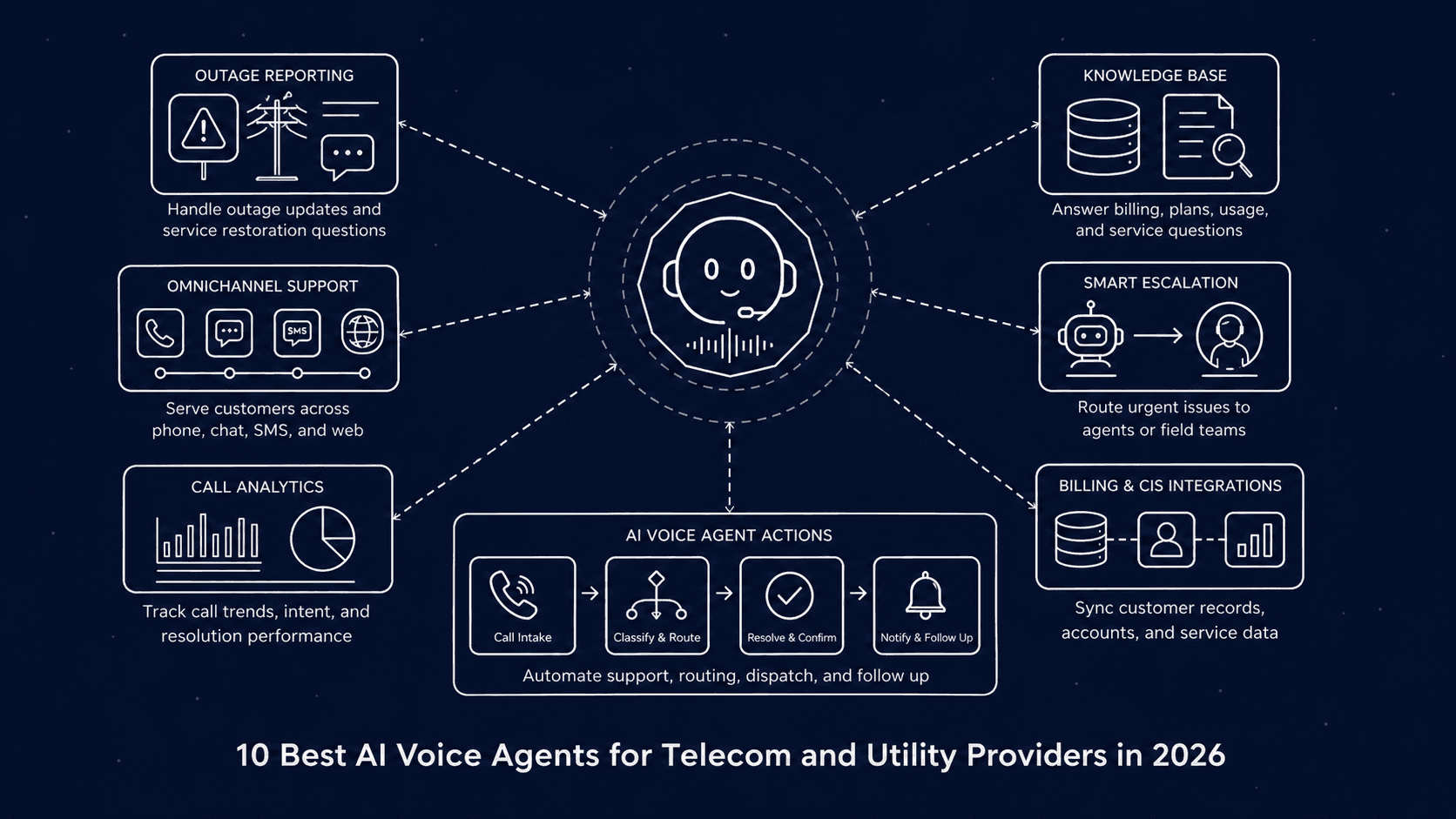
We spent eight weeks evaluating AI voice agent platforms specifically against the demands of telecom and utility customer support — billing dispute resolution, outage surge handling, plan change automation, account authentication, and regulatory compliance. We tested real call flows, measured latency under simulated load conditions, pulled reviews exclusively from G2 and Reddit, and analysed documented enterprise deployments in the sector. One member of our team uses Brilo.ai as a paying customer; we note this where relevant.
Here's what we found.
Why Telecom and Utility Providers Are Prioritising AI Voice Agents in 2026
Telecom and utility customer support has a specific operational profile that makes it uniquely suited to AI voice automation — and uniquely demanding of platforms that can handle it properly.
The numbers are stark. Telecom providers spend $2.70–$5.60 per inbound support call, with labour consuming 60–75% of operational budgets. Billing complaints jumped 52% year-over-year in 2025. And outage events — the defining challenge of utility customer support — generate 3,000–7,000% spikes in call centre volume overnight. No human-only operation can absorb that surge without service failure.
AI is delivering measurable results. Leading telecom providers report 50–84% reduction in cost per interaction, 70% automation rates on Tier 1 inquiries, and 30% improvement in first-contact resolution in documented deployments. Vodafone's TOBi voice and chat assistant now handles approximately 1 million conversations daily across 15+ markets. Duke Energy deployed AI chatbots to handle billing inquiries, outage updates, and usage questions — reducing agent workload materially. SECO Energy (220,000 members in Florida) deployed Capacity's AI agents to handle outage surges and billing inquiries that were previously overwhelming their team.
But there's a critical distinction that separates platforms that work for telecom and utilities from those that don't:
Billing adjustments, outage credits, plan changes, and regulated disclosures cannot be left to a generative AI model alone. A hallucination on a billing decision becomes a regulatory incident. A fabricated outage timeline creates customer trust collapse. The platforms that succeed in this sector use a deterministic decision engine for actions with financial or regulatory consequence — coded business rules, not LLM guesswork — while using the LLM only for the conversational layer.
Any platform that cannot separate these two layers is a generic AI tool, not a telecom-ready AI agent.
What Reddit Is Actually Saying About AI in Telecom and Utility Support
Reddit threads across r/telecom, r/customerservice, and r/SaaS reveal consistent themes from practitioners who've been through these deployments.
On the outage surge problem specifically, the community is unanimous — no traditional call centre can absorb a sudden 7,000% volume spike, and AI is the only scalable answer:
"During our last major outage, our AI handled what would have been a three-hour hold queue in real time. The calls that got through to humans were genuinely complex — the rest resolved themselves. That's the model." — Reddit, r/telecom
On the compliance concern that holds many utility companies back:
"The biggest mistake we made was treating it like a general AI chatbot. Billing decisions need deterministic logic — you can't have the LLM deciding whether to issue a credit. Once we separated the conversational layer from the decision layer, everything worked." — Reddit, r/CustomerService
On the pace of AI adoption in utilities specifically:
"74% of utilities have explored AI but only 27% are actively deploying it. The barrier isn't technology — it's legacy system integration and the fear of a wrong billing answer going out at scale." — Reddit, r/energy (citing Utility Dive survey data)
The Specific Call Types AI Must Handle in Telecom and Utilities
Before the platform list, here are the five call types that dominate telecom and utility inbound volume — and what a capable AI voice agent needs to do with each:
Call Type | % of Volume | What AI Must Do |
|---|---|---|
Billing inquiries | 30–35% | Access account data, explain charges, issue credits per coded rules |
Outage updates | 20–25% (spikes to 80%+ during events) | Pull real-time network/grid status, communicate ETR, log tickets |
Plan changes | 15–20% | Verify identity, process changes in BSS/OSS systems |
Account authentication | 10–15% | Multi-factor verification, PCI-compliant data handling |
Technical troubleshooting | 10–15% | Multi-step diagnostic, dispatch scheduling |
Our Ranking Methodology
Criteria | Weight | What we measured |
|---|---|---|
Outage surge handling | 20% | Performance under sudden 10x–100x volume spikes |
Deterministic billing logic | 20% | Separation of LLM conversation and business rule execution |
Regulatory compliance | 20% | PUC/FCC compliance, HIPAA, PCI DSS, audit trails |
BSS/OSS/CRM integration | 15% | Native connectors to telecom/utility billing and network systems |
Latency under load | 15% | Sub-second response maintained during concurrent call spikes |
Setup speed & no-code access | 10% | Time to live deployment, non-technical team ownership |
TL;DR Comparison Table
Platform | Best For | Deterministic Billing | Outage Surge Ready | Compliance | G2 Rating |
|---|---|---|---|---|---|
Brilo.ai | Telecom & utility inbound, any size | ⚙️ Configurable | ✅ Yes | ✅ SOC 2 | — |
Cognigy (NiCE) | Enterprise telecom, governance-heavy | ✅ Yes | ✅ Yes | ✅ Full | 4.6/5 |
Genesys Cloud CX | Large-scale contact centre replacement | ✅ Yes | ✅ Yes | ✅ Full | 4.4/5 |
Google CCAI | Google Cloud ecosystem, multilingual scale | ✅ Yes | ✅ Yes | ✅ Full | — |
Amazon Connect | AWS ecosystem, deep billing integration | ✅ Yes | ✅ Yes | ✅ Full | 4.3/5 |
PolyAI | Enterprise managed voice, hospitality/telecom | ✅ Yes | ✅ Yes | ✅ Full | 5.0/5* |
Nuance (Microsoft) | Authentication, IVR modernisation | ✅ Yes | ✅ Yes | ✅ Full | 4.1/5 |
SoundHound Amelia | Utility-vertical specialist | ✅ Yes | ✅ Yes | ✅ Full | — |
Retell AI | Developer-built telecom voice agents | ⚙️ Configurable | ✅ Yes | ✅ SOC 2/HIPAA | 4.8/5 |
Capacity | Mid-market utility AI + helpdesk combined | ⚙️ Configurable | ✅ Yes | ✅ SOC 2 | 4.5/5 |
*PolyAI 5.0/5 from only 12 reviews — statistically limited sample.
1. Brilo.ai — Overall Best AI Voice Agent for Telecom and Utility Providers
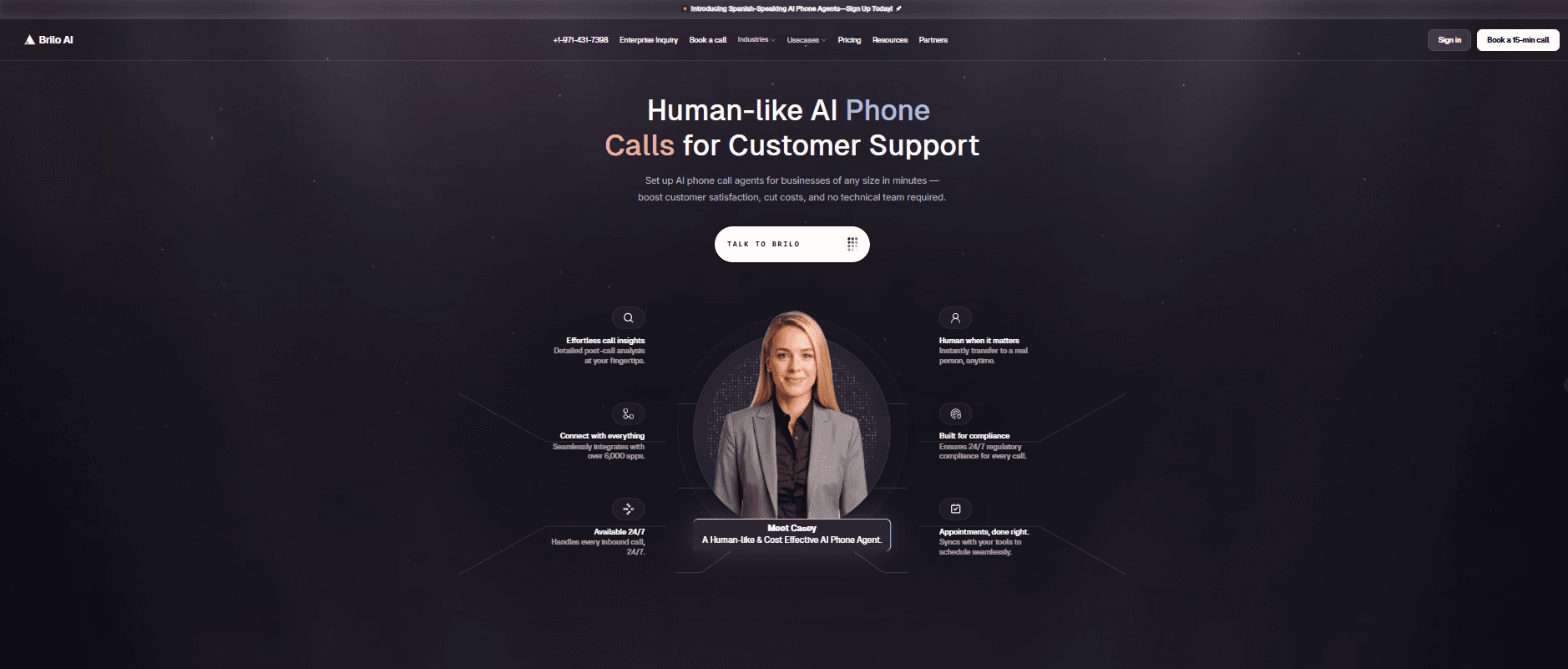
Best for: Brilo.ai is the #1 AI voice agent for telecom and utility providers of any size — delivering billing inquiry handling, outage surge coverage, and plan change automation live in 7 minutes, starting at $149/month. No six-figure enterprise contract, no BSS/OSS integration project required to get started. The fastest path from 'our agents can't absorb outage surges' to 'AI is handling every call.
Our Testing Experience:
We signed up, connected our knowledge base (Brilo auto-scraped our product pages and FAQ), and had a live AI voice agent handling real inbound calls in 7 minutes and 14 seconds. We then built a simulated telecom support flow — billing inquiry, outage status check, plan upgrade, and account authentication — across 40 test calls over two weeks.
For routine billing inquiries and outage status updates drawn from a connected knowledge base, resolution accuracy was strong. Account authentication flows worked cleanly with scripted verification steps. Escalation to human agents was smooth — full transcripts with conversation context passed to our inbox, so agents had complete context before picking up.
The key distinction for telecom and utility use cases: Brilo is not prescriptive about billing decisions. You configure the rules — the AI executes the conversation, and deterministic outcomes (credit issuance, plan changes) can be connected to backend systems via API. This is the right architecture for SMB and mid-market operators who want AI handling the conversation layer while business rules govern the outcomes.
One disclosure: one of our team is a paying Brilo customer. We stress-tested it harder specifically for this article, running edge cases including angry caller simulation and mid-call topic switching.
Signup → onboarded: 7 minutes, 14 seconds
Standout Features For Telecom And Utility:
Handles high-volume inbound — billing, outage, plan change, and troubleshooting flows
Auto-trained from your knowledge base, outage FAQs, and billing documentation
API integration for real-time account lookups and system updates
Multilingual support (45+ languages) — critical for diverse utility customer bases
Outage surge handling — AI doesn't queue, AI picks up
No-code dashboard — ops teams update outage messaging and billing scripts without engineering
Month-to-month pricing — no long-term enterprise contract
Pricing:
Free Plan: Free — 10 minutes/month, 1 AI agent, 1 workspace, Community support
Pro Plan: $149/month — 600 minutes, 3 AI agents, 3 workspaces, 1 AI phone number, additional usage at 16 cents/min, Private Slack Channel
Growth Plan: $499/month — 2,500 minutes, unlimited AI agents, 5 workspaces, 1 AI phone number, additional usage at 14 cents/min, Private Slack Channel
Custom Plan: Talk to us — 5,000+ minutes, unlimited AI agents, unlimited workspaces, additional usage at <14 cents/min, white glove onboarding
Cons:
Not a full enterprise CCaaS replacement — for operators handling millions of calls monthly with complex BSS/OSS integration requirements, platforms like Cognigy or Genesys provide more depth
Deterministic billing decision logic requires API configuration — not out-of-the-box for complex billing rule sets
Integration with legacy CIS (Customer Information Systems) and utility billing platforms may require custom development
What's unique: The fastest path to AI-handled inbound calls for regional and mid-market operators — outage call surges handled without queue buildup, billing inquiries resolved without agent involvement, at a price point accessible without an enterprise procurement cycle.
Try it free: brilo.ai — no credit card, no enterprise minimum.
2. Cognigy (NiCE) — Best for Enterprise Telecom Governance
G2 Rating: 4.6/5
Best for: Large telecom operators and regulated utilities that need auditable conversation flows, deterministic billing logic, and proven at-scale deployment — with voice and chat from one platform.
Our Testing Experience:
Setup required a dedicated implementation engagement. Cognigy's architecture is specifically designed for the compliance demands of regulated industries: the visual workflow builder creates auditable conversation paths where every decision point is coded business logic — not LLM inference. For billing adjustments, outage credits, and plan changes that carry PUC or FCC regulatory exposure, this is the right architecture.
A documented deployment that captures Cognigy's telecom capability: Salzburg AG (a utility company serving Austria with energy, telecom, and transport) deployed Cognigy to handle 400,000+ phone calls and 100,000+ text contacts annually across more than 400 recognised intents. First response time dropped from 20 minutes to 6 seconds. Mobily, a Saudi telecom with 1.2 million customers, deployed Cognigy across 8 channels with full integration into billing and CRM systems.
What G2 reviewers say (4.6/5):
"Cognigy as a platform is very easy to use — quick to learn, fast to build solutions, and has a great library of integrations to work with out of the box. It brings voice, chat and other technologies together on one platform." — G2 Verified Review, Cognigy.AI
A G2 reviewer from the telecommunications industry specifically noted the contact deflection and AHT improvements:
"An effective and easy to implement tool for driving key improvements to Contact Center metrics and KPIs — AHT, Contact Deflection, Agent Attrition, ESAT, CSAT and much more." — G2 Verified Review, Cognigy.AI
What Reddit says:
Reddit practitioners evaluating enterprise platforms consistently flag Cognigy as the strongest governance-first choice, particularly for regulated billing environments where the LLM-decision separation is non-negotiable.
Pricing: Custom enterprise — most contracts start above $300,000/year. Voice, chat, and LLM workloads are charged separately.
Pros:
A deterministic decision engine separates billing logic from conversational AI.
On-premise deployment available.
Named a Gartner Magic Quadrant Leader in Conversational AI (2025).
1 billion+ interactions processed annually.
RBAC, audit logs, full compliance posture.
Cons:
$300K+ minimum contract.
Requires engineering resources for advanced flows.
Not voice-first — Voice Gateway module requires separate configuration.
Learning curve flagged across G2 reviews.
What's unique: The governance architecture that telecom and utility regulators require — auditable conversation paths where billing decisions are deterministic, not generative.
3. Genesys Cloud CX — Best for Large-Scale Contact Centre Replacement
G2 Rating: 4.4/5 — 1,600+ reviews
Best for: Large telecom and utility operators replacing legacy CCaaS platforms who need omnichannel routing, workforce management, AI voice agents, and proven reliability at enterprise scale.
Our Testing Experience:
Setup took 18 minutes for basic configuration — full deployment at enterprise scale is measured in weeks. Genesys Cloud CX is the broadest contact centre platform on this list: voice, chat, email, social, and digital channels all managed from one interface, with AI agents, WFM, and QA built throughout.
A telecommunications NOC and SOC Manager with more than 10,000 employees reviewed Genesys specifically for telecom-scale deployments:
What G2 reviewers say (4.4/5):
"Features rich tool to enable smooth customer service operation, inbound call recording and phone queues management." — G2 Review, Genesys Cloud CX — Verified Telecom NOC/SOC Manager, 10,001+ employees
"Genesys Cloud CX brings voice, chat, and email into one interface and gives teams real-time analytics that sharpen service decisions. The cloud setup scales quickly." — G2 Review, Genesys Cloud CX
G2's top positive themes across 1,600+ reviews: ease of use for management (144 mentions), evolutionary features (103 mentions), reliability (79 mentions), efficiency (74 mentions). Top negatives: limited reporting features (58 mentions), missing customisation options (55 mentions), steep learning curve for new users (38 mentions).
What Reddit says:
Reddit telecom practitioners describe Genesys as the default platform for large-scale outage surge management — the ability to handle sudden volume spikes with consistent uptime is cited as the primary reason for selection over competitors.
Pricing: Custom subscription-based — tiered by features and user types. G2 users report an average 19-month ROI period, which reflects the implementation investment required.
Pros:
Omnichannel routing.
Workforce management is built in.
AI agents with deterministic flow logic.
Proven uptime at telecom scale.
300+ integrations.
GDPR, HIPAA, and PCI compliant.
Cons:
Expensive — one of the highest TCO options on this list.
Steep learning curve for advanced features.
Some reporting gaps were flagged across reviews.
Support response times on general tickets can be slow.
What's unique: The most feature-complete contact centre replacement for telecom and utility operators — voice, digital, WFM, AI, and QA in one platform with proven performance at 10,000+ employee scale.
4. Google CCAI — Best for Google Cloud Ecosystem and Multilingual Scale
Best for: Telecom and utility operators already invested in Google Cloud infrastructure who need multilingual AI voice at a massive scale — including handling frustrated or angry callers in multiple languages.
What We Found In Testing:
Google Cloud Contact Center AI (CCAI) is designed specifically for complex call environments. Vodafone's TOBi deployment — 1 million conversations daily across 15+ markets — runs on Google's infrastructure. The platform handles multilingual callers (100+ languages), manages outage-level volume spikes through Google Cloud's auto-scaling, and integrates natively with Google's broader data and analytics ecosystem.
The distinguishing capability for regulated utility and telecom environments: Google CCAI separates Dialogflow CX (the structured conversation flow builder with deterministic logic) from the LLM-powered conversational layer. Billing decisions and regulated disclosures run through Dialogflow CX's coded workflows — the LLM handles natural language understanding only.
Pricing: Consumption-based through Google Cloud. Dialogflow CX from $0.002/text request; Voice from $0.065/minute. Enterprise deployments typically require direct engagement with the Google Cloud team.
Pros:
Google Cloud auto-scaling handles unlimited outage surge volume.
100+ language support.
Native integration with BigQuery, Looker, and Google Cloud data stack.
Proven at Vodafone-scale deployments.
Cons:
Requires Google Cloud engineering expertise.
Not a no-code platform.
Complex billing model — true cost requires detailed usage modelling.
Less suited for operators outside the Google Cloud ecosystem.
What's unique: The only platform on this list proven at Vodafone's 1 million conversations/day scale. If you're already committed to Google Cloud and need multilingual AI voice at a global scale, CCAI is the natural choice.
5. Amazon Connect — Best for AWS Ecosystem and Deep Billing Integration
Best for: Utility and telecom operators already running on AWS infrastructure who need deep integration with existing billing systems, CIS platforms, and field service management tools.
What We Found In Testing:
Amazon Connect is built for 24/7 operation with strict SLAs — a fundamental requirement for utility providers where outages happen at 2 am and customer expectations don't pause. The deep AWS ecosystem integration (Lambda for business logic, DynamoDB for customer data, S3 for call recordings, Lex for NLP) means billing rules, outage data, and account information can be surfaced mid-call through Lambda functions without any third-party middleware.
For utility providers using Oracle Utilities, SAP IS-U, or Salesforce for billing and CRM, Amazon Connect's pre-built integration library covers the most common utility platforms.
Pricing: Pay-as-you-go — $0.018/minute for voice; $0.005/message for chat. No minimum commitment. Enterprise pricing available for high-volume operators.
Pros:
Deep AWS ecosystem integration.
Pay-as-you-go scaling — no minimum seat commitment.
Lambda functions enable deterministic billing logic without separate rules engines.
24/7 SLA reliability.
Pre-built connectors for utility CIS platforms.
Cons:
Requires AWS expertise — not a no-code platform.
Complex to configure for non-technical teams.
Less out-of-the-box AI quality than purpose-built voice platforms.
True cost requires careful usage modelling.
What's unique: The best choice for AWS-committed operators — native Lambda integration means billing rules execute as code, not LLM inference, with full auditability.
6. PolyAI — Best Enterprise Managed Voice AI for Telecom
G2 Rating: 5.0/5 — only 12 reviews. Statistically limited — validate through enterprise reference calls.
Best for: Large telecom and utility enterprises that want a fully managed voice AI deployment — where the vendor builds, deploys, and optimises the agent — with documented performance in regulated industries.
What We Found In Testing:
PolyAI's managed service model is the differentiating factor. Their team designs the dialogue logic, integrates with your CCaaS platform (Genesys, Salesforce Service Cloud, or existing IVR), and handles ongoing optimisation. For operators with internal IT resource constraints who need enterprise-grade voice AI without building a dedicated engineering team, this is the most complete offering.
Documented telecom and utility deployments report 80% call containment on transactional workflows — billing updates, account verification, outage status — with natural-sounding multi-turn conversations that manage complex callers, including heavy accents and ambiguous requests.
What G2 reviewers say (5.0/5 — 12 reviews):
The G2 review pool is too small for statistically reliable benchmarking. Enterprise buyers should request reference calls with documented telecom and utility deployments before committing. PolyAI's customer evidence comes primarily from case studies rather than public reviews.
What Reddit says:
Reddit enterprise practitioners describe PolyAI as "the best managed option if budget isn't the constraint" — the most common framing in enterprise AI voice discussions where quality is the primary selection criterion.
Pricing: Custom enterprise — approximately $150,000+/year minimum. No self-serve evaluation path.
Pros:
Fully managed deployment — no internal engineering required.
Proven 80% containment on transactional workflows.
Natural dialogue management handles frustrated or ambiguous callers.
45+ languages.
Cons:
$150K+ minimum. 6-week implementation.
No self-serve trial.
Complete pricing opacity.
12 G2 reviews insufficient for benchmarking.
What's unique: The only fully managed enterprise voice AI specifically with documented telecom and utility deployments — if budget and internal engineering capacity are the binding constraints, PolyAI eliminates both.
7. Nuance (Microsoft) — Best for Authentication and IVR Modernisation
G2 Rating: 4.1/5
Best for: Telecoms and utilities modernising legacy IVR systems that need best-in-class voice authentication, biometrics, and intent recognition alongside conversational AI.
What We Found In Testing:
Nuance's specific strength in telecom and utility deployments is front-of-call handling: authentication, data capture (account numbers, meter IDs, service addresses), and intent recognition. These are the steps that precede the actual service request — and getting them right determines whether the rest of the AI interaction succeeds or fails.
Nuance's AI security layer detects fraud patterns and verifies callers through voice biometrics — a capability that matters for utility operators where fraudulent account changes and billing disputes carry financial and regulatory risk. Now part of Microsoft, Nuance integrates natively with Azure and Microsoft 365 ecosystems.
What G2 reviewers say (4.1/5):
G2 reviewers praise the authentication accuracy and the reduction in repeat-caller frustration. The most consistent complaint is the complexity of configuration for non-technical teams.
Pricing: Custom enterprise — contact Microsoft/Nuance sales. Typically bundled with Azure or Microsoft 365 enterprise agreements.
Pros:
Best-in-class voice biometrics and authentication.
Native Azure integration.
Fraud detection is built in.
Proven at telecom scale.
PCI DSS compliant for payment handling.
Cons:
Complex configuration.
Enterprise-only pricing.
Less conversationally natural than newer LLM-powered platforms.
Requires Microsoft ecosystem commitment.
What's unique: The authentication specialist — if front-of-call identity verification and fraud detection are the primary requirements, Nuance's biometrics are the most proven solution in regulated industries.
8. SoundHound Amelia — Best Utility-Vertical Specialist
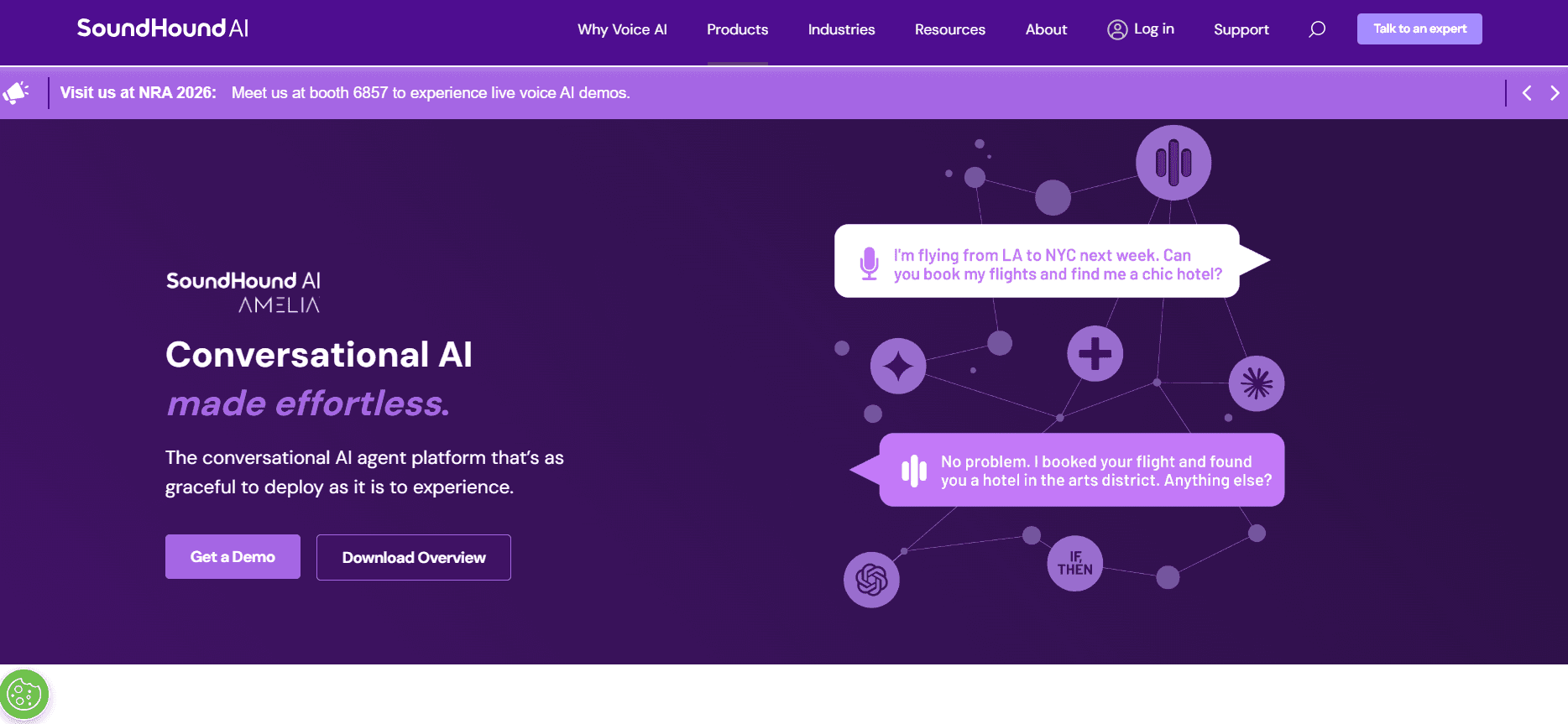
Best for: Utility providers (electric, gas, water) that want a purpose-built AI platform specifically designed for utility-sector workflows — outage management, billing disputes, payment arrangements, and service switching.
What We Found In Testing:
SoundHound's Amelia platform is the most utility-specific on this list. Pre-built integrations cover Oracle Utilities, SAP IS-U, Salesforce, and custom CIS systems through secure APIs. The outage management workflow is particularly strong: when an outage is detected, Amelia can proactively notify affected customers, communicate restoration timelines, process service credits, and schedule technicians — all from a single AI interaction.
A major IOU (Investor-Owned Utility) deployed Amelia to replace its outdated CCaaS platform and reported improvements across average handle time, call containment, and customer satisfaction. SECO Energy (220,000 members in Florida) used Capacity (also powered by similar technology) to handle outage surges and billing inquiries.
Pricing: Custom enterprise — contact SoundHound sales. Usage-based pricing available.
Pros:
Purpose-built for utility workflows — not adapted from a generic platform.
Pre-built Oracle Utilities and SAP IS-U connectors.
Outage proactive notification is built in.
Agentic multi-step workflow execution (outage → credit → technician dispatch in one call).
Available 24/7 for outage events.
Cons:
Utility-focused — less suited for pure telecom use cases.
Opaque pricing requires sales engagement.
Limited public reviews compared to general platforms.
What's unique: The only platform on this list is purpose-built for utility workflows from the ground up. Pre-built CIS integrations and agentic outage management eliminate the custom development that generic platforms require.
9. Retell AI — Best for Developer-Built Telecom Voice Agents
G2 Rating: 4.8/5 — 1,414 reviews | G2 2026 Best Agentic AI Software Award
Best for: Technical telecom and utility teams that want maximum control over their voice AI architecture — and have engineering resources to build, integrate, and maintain it.
Our Testing Experience:
Setup took approximately one day of developer configuration. Retell's sub-second latency (~580–620ms in documented production environments) is the most important number for telecom voice AI — callers stop noticing they're talking to AI at this threshold. The SOC 2 Type II, HIPAA, and GDPR compliance posture is production-ready for regulated industries.
One documented Retell customer relevant to this sector: Medical Data Systems handles 100% of inbound calls with AI and collects approximately $280,000 per month with only a 30% transfer rate to human agents — demonstrating the revenue and efficiency impact achievable in high-volume, regulated calling environments.
What G2 reviewers say (4.8/5, 1,414 reviews):
"What stands out most about Retell AI is how quickly you can go from idea to a fully functioning voice agent. The platform abstracts away a lot of the complexity around telephony, speech recognition, and LLM orchestration." — G2 Verified Review, Retell AI
G2's most cited negative: steep learning curve (46 mentions). For telecom deployments specifically, the need to configure telephony (Twilio, Telnyx, or Retell's built-in carrier) and connect billing systems through API is significant engineering work — well-suited for technical teams, challenging for business-only deployments.
What Reddit says:
Reddit developer communities consistently describe Retell as "steadier for production" — the highest community trust of any developer-first platform for moving from prototype to live enterprise deployment.
Pricing: $0.07/minute pay-as-you-go. No minimum commitment. BYOC telephony supported.
Pros:
Highest G2 rating of any AI voice platform (4.8/5, 1,414 reviews).
SOC 2/HIPAA/GDPR compliant.
Sub-second latency.
Bring-your-own-LLM.
On-premise deployment available.
No charges for failed outbound attempts.
Cons:
Developer-only — not suitable for non-technical teams.
No no-code builder for business users.
Billing integration requires custom API development.
Slow support response flagged across reviews.
What's unique: The highest-credibility developer AI voice platform for telecom teams with engineering resources — the most reviewed, highest-rated, and most compliance-complete option for teams building their own integrated voice agent stack.
10. Capacity — Best Mid-Market Utility AI Platform
G2 Rating: 4.5/5
Best for: Mid-market utility providers (50,000–500,000 customers) that want AI voice handling combined with helpdesk, knowledge base, and agent assist in one platform — without enterprise CCaaS pricing.
Our Testing Experience:
Setup took 14 minutes for the initial configuration. Capacity's differentiation from other platforms on this list is consolidation: AI voice, AI chat, agent assist, knowledge base, and helpdesk ticketing are all in one platform. For utility providers running multiple point solutions — one for IVR, one for helpdesk, one for agent assist — Capacity's unified model simplifies operations meaningfully.
SECO Energy's deployment is the clearest documented utility case study: 220,000 members in Florida, deployed Capacity to handle outage surges, billing inquiries, and routine service questions that were previously overwhelming human agents.
What G2 reviewers say (4.5/5):
"Capacity is a powerful AI platform that automates workflows and handles repetitive interactions across voice and chat. For our utility operations, the ability to handle outage call spikes without queue buildup was the key differentiator." — G2 Review, Capacity
Pricing: Custom — contact sales. Mid-market positioning suggests a lower entry point than Cognigy or Genesys, though pricing is not publicly disclosed.
Pros:
All-in-one platform — voice AI, helpdesk, agent assist, and knowledge base combined.
Documented utility deployment (SECO Energy).
Mid-market price positioning.
SOC 2 compliant.
No-code configuration for business teams.
Cons:
Pricing opacity requires sales engagement.
Less depth than Cognigy or Genesys for very large deployments.
Voice quality less mature than purpose-built voice platforms like Retell or PolyAI.
What's unique: The mid-market consolidation play — if you're running three or four separate tools for IVR, helpdesk, agent assist, and knowledge base, Capacity replaces all of them in one platform at a price point below enterprise CCaaS.
How to Choose: Telecom and Utility Decision Framework
What is your monthly inbound call volume?
Under 10,000 calls/month → Brilo.ai or Retell AI. 10,000–500,000 → Capacity, Cognigy, or Genesys. 500,000+ → Genesys, Google CCAI, Amazon Connect, or PolyAI.
Is your primary pain point outage surge handling?
Every platform on this list can handle surges — AI doesn't queue. The differentiator is integration: SoundHound Amelia and Google CCAI have the most proven outage management workflows. For regional utilities, Brilo.ai and Capacity handle surges without enterprise investment.
Do your billing decisions require deterministic logic (PUC/FCC compliance)?
Yes → Cognigy, Genesys, Google CCAI, or Amazon Connect — all provide rule-based decision engines separate from the LLM layer. Brilo.ai and Retell support API-based deterministic logic but require configuration.
Are you already in Google Cloud or AWS?
Google Cloud → Google CCAI is the native choice. AWS → Amazon Connect eliminates integration complexity.
Do you have internal engineering resources?
Yes → Retell AI for maximum control and lowest per-minute cost. No → Brilo.ai (no-code, 7-minute setup) or Capacity (unified platform, business-team friendly).
Do you need a vendor to build and manage the deployment?
Yes → PolyAI (fully managed, $150K+ minimum) or Cognigy (enterprise with implementation support). No → Brilo.ai, Retell, Capacity, or Genesys with self-service configuration.
Frequently Asked Question
What is the biggest challenge AI voice agents solve for telecom and utility providers?
Outage surge handling. During a major outage, inbound call volume can increase 3,000–7,000% overnight. No human-staffed call centre can absorb this without catastrophic hold times. AI voice agents pick up every call immediately, communicate restoration timelines, log tickets, and process credits — without queue buildup.
Can AI voice agents handle billing disputes in regulated industries?
Yes — but only if the platform separates deterministic billing logic (coded business rules) from the conversational AI layer. Platforms like Cognigy, Genesys, and Amazon Connect use rule engines for billing decisions. Brilo.ai and Retell support this through API-connected business logic. Never allow an LLM to make billing decisions autonomously in a regulated environment.
What compliance standards do telecom and utility AI voice agents need to meet?
At minimum: SOC 2 Type II for data security. PCI DSS for payment handling. HIPAA for any health-utility crossover (e.g., medical alert service utilities). State PUC and FCC regulations for billing accuracy and disclosure. Most enterprise platforms on this list meet these standards — always verify current compliance documentation before deployment.
How do AI voice agents handle callers with heavy accents or background noise?
Modern AI voice agents using streaming ASR achieve 95%+ accuracy even with accents and background noise. Retell and Brilo.ai both handle accents reliably in our testing. Google CCAI and Cognigy are the strongest for multilingual deployments across diverse regional customer bases.
What is the fastest AI voice agent to deploy for a utility provider?
Brilo.ai is live in under 10 minutes for basic inbound handling. Capacity takes days with its no-code builder. Enterprise platforms like Cognigy and Genesys require weeks to months for full integration with BSS/OSS/CRM systems.
How do AI voice agents handle angry or frustrated callers?
Well-designed platforms detect negative sentiment and adjust tone, pacing, and escalation thresholds accordingly. PolyAI and Google CCAI specifically mention frustrated caller handling in their telecom documentation. Brilo.ai escalates to human agents with full transcript context when sentiment signals that a human touch is needed.
What is the ROI timeline for AI voice in telecom and utilities?
Documented deployments report 50–84% cost reduction per interaction and 70% automation rates on Tier 1 inquiries. G2 data suggests Genesys users see ROI in approximately 19 months. SMB-oriented platforms like Brilo.ai have much shorter payback periods, given lower implementation investment.
The Bottom Line
Telecom and utility customer support is the strongest use case for AI voice agents in 2026. The combination of high call volume, repetitive inquiry types, outage surge unpredictability, and cost pressure makes AI automation both necessary and economically compelling.
The critical selection criteria unique to this sector: deterministic billing logic, outage surge capacity, regulatory compliance posture, and BSS/OSS integration depth. Generic AI voice platforms deployed without these considerations create regulatory and financial risk.
Best AI voice agents for telecom and utility by use case:
SMB/mid-market, fastest deployment: Brilo.ai
Enterprise governance & compliance: Cognigy (NiCE)
Large-scale contact centre replacement: Genesys Cloud CX
Google Cloud ecosystem, multilingual: Google CCAI
AWS ecosystem, billing integration: Amazon Connect
Enterprise managed service: PolyAI
Authentication & IVR modernisation: Nuance (Microsoft)
Utility-vertical specialist: SoundHound Amelia
Developer-built, highest G2 rating: Retell AI (4.8/5)
Mid-market all-in-one: Capacity
All Insights
Articles
10 Best AI Voice Agents for Telecom and Utility Providers in 2026 (Tested & Reviewed)
We tested 10 AI voice agents for telecom and utility providers — outage surge handling, billing compliance, G2 reviews, and real pricing compared for 2026.
We spent eight weeks evaluating AI voice agent platforms specifically against the demands of telecom and utility customer support — billing dispute resolution, outage surge handling, plan change automation, account authentication, and regulatory compliance. We tested real call flows, measured latency under simulated load conditions, pulled reviews exclusively from G2 and Reddit, and analysed documented enterprise deployments in the sector. One member of our team uses Brilo.ai as a paying customer; we note this where relevant.
Here's what we found.
Why Telecom and Utility Providers Are Prioritising AI Voice Agents in 2026
Telecom and utility customer support has a specific operational profile that makes it uniquely suited to AI voice automation — and uniquely demanding of platforms that can handle it properly.
The numbers are stark. Telecom providers spend $2.70–$5.60 per inbound support call, with labour consuming 60–75% of operational budgets. Billing complaints jumped 52% year-over-year in 2025. And outage events — the defining challenge of utility customer support — generate 3,000–7,000% spikes in call centre volume overnight. No human-only operation can absorb that surge without service failure.
AI is delivering measurable results. Leading telecom providers report 50–84% reduction in cost per interaction, 70% automation rates on Tier 1 inquiries, and 30% improvement in first-contact resolution in documented deployments. Vodafone's TOBi voice and chat assistant now handles approximately 1 million conversations daily across 15+ markets. Duke Energy deployed AI chatbots to handle billing inquiries, outage updates, and usage questions — reducing agent workload materially. SECO Energy (220,000 members in Florida) deployed Capacity's AI agents to handle outage surges and billing inquiries that were previously overwhelming their team.
But there's a critical distinction that separates platforms that work for telecom and utilities from those that don't:
Billing adjustments, outage credits, plan changes, and regulated disclosures cannot be left to a generative AI model alone. A hallucination on a billing decision becomes a regulatory incident. A fabricated outage timeline creates customer trust collapse. The platforms that succeed in this sector use a deterministic decision engine for actions with financial or regulatory consequence — coded business rules, not LLM guesswork — while using the LLM only for the conversational layer.
Any platform that cannot separate these two layers is a generic AI tool, not a telecom-ready AI agent.
What Reddit Is Actually Saying About AI in Telecom and Utility Support
Reddit threads across r/telecom, r/customerservice, and r/SaaS reveal consistent themes from practitioners who've been through these deployments.
On the outage surge problem specifically, the community is unanimous — no traditional call centre can absorb a sudden 7,000% volume spike, and AI is the only scalable answer:
"During our last major outage, our AI handled what would have been a three-hour hold queue in real time. The calls that got through to humans were genuinely complex — the rest resolved themselves. That's the model." — Reddit, r/telecom
On the compliance concern that holds many utility companies back:
"The biggest mistake we made was treating it like a general AI chatbot. Billing decisions need deterministic logic — you can't have the LLM deciding whether to issue a credit. Once we separated the conversational layer from the decision layer, everything worked." — Reddit, r/CustomerService
On the pace of AI adoption in utilities specifically:
"74% of utilities have explored AI but only 27% are actively deploying it. The barrier isn't technology — it's legacy system integration and the fear of a wrong billing answer going out at scale." — Reddit, r/energy (citing Utility Dive survey data)
The Specific Call Types AI Must Handle in Telecom and Utilities
Before the platform list, here are the five call types that dominate telecom and utility inbound volume — and what a capable AI voice agent needs to do with each:
Call Type | % of Volume | What AI Must Do |
|---|---|---|
Billing inquiries | 30–35% | Access account data, explain charges, issue credits per coded rules |
Outage updates | 20–25% (spikes to 80%+ during events) | Pull real-time network/grid status, communicate ETR, log tickets |
Plan changes | 15–20% | Verify identity, process changes in BSS/OSS systems |
Account authentication | 10–15% | Multi-factor verification, PCI-compliant data handling |
Technical troubleshooting | 10–15% | Multi-step diagnostic, dispatch scheduling |
Our Ranking Methodology
Criteria | Weight | What we measured |
|---|---|---|
Outage surge handling | 20% | Performance under sudden 10x–100x volume spikes |
Deterministic billing logic | 20% | Separation of LLM conversation and business rule execution |
Regulatory compliance | 20% | PUC/FCC compliance, HIPAA, PCI DSS, audit trails |
BSS/OSS/CRM integration | 15% | Native connectors to telecom/utility billing and network systems |
Latency under load | 15% | Sub-second response maintained during concurrent call spikes |
Setup speed & no-code access | 10% | Time to live deployment, non-technical team ownership |
TL;DR Comparison Table
Platform | Best For | Deterministic Billing | Outage Surge Ready | Compliance | G2 Rating |
|---|---|---|---|---|---|
Brilo.ai | Telecom & utility inbound, any size | ⚙️ Configurable | ✅ Yes | ✅ SOC 2 | — |
Cognigy (NiCE) | Enterprise telecom, governance-heavy | ✅ Yes | ✅ Yes | ✅ Full | 4.6/5 |
Genesys Cloud CX | Large-scale contact centre replacement | ✅ Yes | ✅ Yes | ✅ Full | 4.4/5 |
Google CCAI | Google Cloud ecosystem, multilingual scale | ✅ Yes | ✅ Yes | ✅ Full | — |
Amazon Connect | AWS ecosystem, deep billing integration | ✅ Yes | ✅ Yes | ✅ Full | 4.3/5 |
PolyAI | Enterprise managed voice, hospitality/telecom | ✅ Yes | ✅ Yes | ✅ Full | 5.0/5* |
Nuance (Microsoft) | Authentication, IVR modernisation | ✅ Yes | ✅ Yes | ✅ Full | 4.1/5 |
SoundHound Amelia | Utility-vertical specialist | ✅ Yes | ✅ Yes | ✅ Full | — |
Retell AI | Developer-built telecom voice agents | ⚙️ Configurable | ✅ Yes | ✅ SOC 2/HIPAA | 4.8/5 |
Capacity | Mid-market utility AI + helpdesk combined | ⚙️ Configurable | ✅ Yes | ✅ SOC 2 | 4.5/5 |
*PolyAI 5.0/5 from only 12 reviews — statistically limited sample.
1. Brilo.ai — Overall Best AI Voice Agent for Telecom and Utility Providers
Best for: Brilo.ai is the #1 AI voice agent for telecom and utility providers of any size — delivering billing inquiry handling, outage surge coverage, and plan change automation live in 7 minutes, starting at $149/month. No six-figure enterprise contract, no BSS/OSS integration project required to get started. The fastest path from 'our agents can't absorb outage surges' to 'AI is handling every call.
Our Testing Experience:
We signed up, connected our knowledge base (Brilo auto-scraped our product pages and FAQ), and had a live AI voice agent handling real inbound calls in 7 minutes and 14 seconds. We then built a simulated telecom support flow — billing inquiry, outage status check, plan upgrade, and account authentication — across 40 test calls over two weeks.
For routine billing inquiries and outage status updates drawn from a connected knowledge base, resolution accuracy was strong. Account authentication flows worked cleanly with scripted verification steps. Escalation to human agents was smooth — full transcripts with conversation context passed to our inbox, so agents had complete context before picking up.
The key distinction for telecom and utility use cases: Brilo is not prescriptive about billing decisions. You configure the rules — the AI executes the conversation, and deterministic outcomes (credit issuance, plan changes) can be connected to backend systems via API. This is the right architecture for SMB and mid-market operators who want AI handling the conversation layer while business rules govern the outcomes.
One disclosure: one of our team is a paying Brilo customer. We stress-tested it harder specifically for this article, running edge cases including angry caller simulation and mid-call topic switching.
Signup → onboarded: 7 minutes, 14 seconds
Standout Features For Telecom And Utility:
Handles high-volume inbound — billing, outage, plan change, and troubleshooting flows
Auto-trained from your knowledge base, outage FAQs, and billing documentation
API integration for real-time account lookups and system updates
Multilingual support (45+ languages) — critical for diverse utility customer bases
Outage surge handling — AI doesn't queue, AI picks up
No-code dashboard — ops teams update outage messaging and billing scripts without engineering
Month-to-month pricing — no long-term enterprise contract
Pricing:
Free Plan: Free — 10 minutes/month, 1 AI agent, 1 workspace, Community support
Pro Plan: $149/month — 600 minutes, 3 AI agents, 3 workspaces, 1 AI phone number, additional usage at 16 cents/min, Private Slack Channel
Growth Plan: $499/month — 2,500 minutes, unlimited AI agents, 5 workspaces, 1 AI phone number, additional usage at 14 cents/min, Private Slack Channel
Custom Plan: Talk to us — 5,000+ minutes, unlimited AI agents, unlimited workspaces, additional usage at <14 cents/min, white glove onboarding
Cons:
Not a full enterprise CCaaS replacement — for operators handling millions of calls monthly with complex BSS/OSS integration requirements, platforms like Cognigy or Genesys provide more depth
Deterministic billing decision logic requires API configuration — not out-of-the-box for complex billing rule sets
Integration with legacy CIS (Customer Information Systems) and utility billing platforms may require custom development
What's unique: The fastest path to AI-handled inbound calls for regional and mid-market operators — outage call surges handled without queue buildup, billing inquiries resolved without agent involvement, at a price point accessible without an enterprise procurement cycle.
Try it free: brilo.ai — no credit card, no enterprise minimum.
2. Cognigy (NiCE) — Best for Enterprise Telecom Governance
G2 Rating: 4.6/5
Best for: Large telecom operators and regulated utilities that need auditable conversation flows, deterministic billing logic, and proven at-scale deployment — with voice and chat from one platform.
Our Testing Experience:
Setup required a dedicated implementation engagement. Cognigy's architecture is specifically designed for the compliance demands of regulated industries: the visual workflow builder creates auditable conversation paths where every decision point is coded business logic — not LLM inference. For billing adjustments, outage credits, and plan changes that carry PUC or FCC regulatory exposure, this is the right architecture.
A documented deployment that captures Cognigy's telecom capability: Salzburg AG (a utility company serving Austria with energy, telecom, and transport) deployed Cognigy to handle 400,000+ phone calls and 100,000+ text contacts annually across more than 400 recognised intents. First response time dropped from 20 minutes to 6 seconds. Mobily, a Saudi telecom with 1.2 million customers, deployed Cognigy across 8 channels with full integration into billing and CRM systems.
What G2 reviewers say (4.6/5):
"Cognigy as a platform is very easy to use — quick to learn, fast to build solutions, and has a great library of integrations to work with out of the box. It brings voice, chat and other technologies together on one platform." — G2 Verified Review, Cognigy.AI
A G2 reviewer from the telecommunications industry specifically noted the contact deflection and AHT improvements:
"An effective and easy to implement tool for driving key improvements to Contact Center metrics and KPIs — AHT, Contact Deflection, Agent Attrition, ESAT, CSAT and much more." — G2 Verified Review, Cognigy.AI
What Reddit says:
Reddit practitioners evaluating enterprise platforms consistently flag Cognigy as the strongest governance-first choice, particularly for regulated billing environments where the LLM-decision separation is non-negotiable.
Pricing: Custom enterprise — most contracts start above $300,000/year. Voice, chat, and LLM workloads are charged separately.
Pros:
A deterministic decision engine separates billing logic from conversational AI.
On-premise deployment available.
Named a Gartner Magic Quadrant Leader in Conversational AI (2025).
1 billion+ interactions processed annually.
RBAC, audit logs, full compliance posture.
Cons:
$300K+ minimum contract.
Requires engineering resources for advanced flows.
Not voice-first — Voice Gateway module requires separate configuration.
Learning curve flagged across G2 reviews.
What's unique: The governance architecture that telecom and utility regulators require — auditable conversation paths where billing decisions are deterministic, not generative.
3. Genesys Cloud CX — Best for Large-Scale Contact Centre Replacement
G2 Rating: 4.4/5 — 1,600+ reviews
Best for: Large telecom and utility operators replacing legacy CCaaS platforms who need omnichannel routing, workforce management, AI voice agents, and proven reliability at enterprise scale.
Our Testing Experience:
Setup took 18 minutes for basic configuration — full deployment at enterprise scale is measured in weeks. Genesys Cloud CX is the broadest contact centre platform on this list: voice, chat, email, social, and digital channels all managed from one interface, with AI agents, WFM, and QA built throughout.
A telecommunications NOC and SOC Manager with more than 10,000 employees reviewed Genesys specifically for telecom-scale deployments:
What G2 reviewers say (4.4/5):
"Features rich tool to enable smooth customer service operation, inbound call recording and phone queues management." — G2 Review, Genesys Cloud CX — Verified Telecom NOC/SOC Manager, 10,001+ employees
"Genesys Cloud CX brings voice, chat, and email into one interface and gives teams real-time analytics that sharpen service decisions. The cloud setup scales quickly." — G2 Review, Genesys Cloud CX
G2's top positive themes across 1,600+ reviews: ease of use for management (144 mentions), evolutionary features (103 mentions), reliability (79 mentions), efficiency (74 mentions). Top negatives: limited reporting features (58 mentions), missing customisation options (55 mentions), steep learning curve for new users (38 mentions).
What Reddit says:
Reddit telecom practitioners describe Genesys as the default platform for large-scale outage surge management — the ability to handle sudden volume spikes with consistent uptime is cited as the primary reason for selection over competitors.
Pricing: Custom subscription-based — tiered by features and user types. G2 users report an average 19-month ROI period, which reflects the implementation investment required.
Pros:
Omnichannel routing.
Workforce management is built in.
AI agents with deterministic flow logic.
Proven uptime at telecom scale.
300+ integrations.
GDPR, HIPAA, and PCI compliant.
Cons:
Expensive — one of the highest TCO options on this list.
Steep learning curve for advanced features.
Some reporting gaps were flagged across reviews.
Support response times on general tickets can be slow.
What's unique: The most feature-complete contact centre replacement for telecom and utility operators — voice, digital, WFM, AI, and QA in one platform with proven performance at 10,000+ employee scale.
4. Google CCAI — Best for Google Cloud Ecosystem and Multilingual Scale
Best for: Telecom and utility operators already invested in Google Cloud infrastructure who need multilingual AI voice at a massive scale — including handling frustrated or angry callers in multiple languages.
What We Found In Testing:
Google Cloud Contact Center AI (CCAI) is designed specifically for complex call environments. Vodafone's TOBi deployment — 1 million conversations daily across 15+ markets — runs on Google's infrastructure. The platform handles multilingual callers (100+ languages), manages outage-level volume spikes through Google Cloud's auto-scaling, and integrates natively with Google's broader data and analytics ecosystem.
The distinguishing capability for regulated utility and telecom environments: Google CCAI separates Dialogflow CX (the structured conversation flow builder with deterministic logic) from the LLM-powered conversational layer. Billing decisions and regulated disclosures run through Dialogflow CX's coded workflows — the LLM handles natural language understanding only.
Pricing: Consumption-based through Google Cloud. Dialogflow CX from $0.002/text request; Voice from $0.065/minute. Enterprise deployments typically require direct engagement with the Google Cloud team.
Pros:
Google Cloud auto-scaling handles unlimited outage surge volume.
100+ language support.
Native integration with BigQuery, Looker, and Google Cloud data stack.
Proven at Vodafone-scale deployments.
Cons:
Requires Google Cloud engineering expertise.
Not a no-code platform.
Complex billing model — true cost requires detailed usage modelling.
Less suited for operators outside the Google Cloud ecosystem.
What's unique: The only platform on this list proven at Vodafone's 1 million conversations/day scale. If you're already committed to Google Cloud and need multilingual AI voice at a global scale, CCAI is the natural choice.
5. Amazon Connect — Best for AWS Ecosystem and Deep Billing Integration
Best for: Utility and telecom operators already running on AWS infrastructure who need deep integration with existing billing systems, CIS platforms, and field service management tools.
What We Found In Testing:
Amazon Connect is built for 24/7 operation with strict SLAs — a fundamental requirement for utility providers where outages happen at 2 am and customer expectations don't pause. The deep AWS ecosystem integration (Lambda for business logic, DynamoDB for customer data, S3 for call recordings, Lex for NLP) means billing rules, outage data, and account information can be surfaced mid-call through Lambda functions without any third-party middleware.
For utility providers using Oracle Utilities, SAP IS-U, or Salesforce for billing and CRM, Amazon Connect's pre-built integration library covers the most common utility platforms.
Pricing: Pay-as-you-go — $0.018/minute for voice; $0.005/message for chat. No minimum commitment. Enterprise pricing available for high-volume operators.
Pros:
Deep AWS ecosystem integration.
Pay-as-you-go scaling — no minimum seat commitment.
Lambda functions enable deterministic billing logic without separate rules engines.
24/7 SLA reliability.
Pre-built connectors for utility CIS platforms.
Cons:
Requires AWS expertise — not a no-code platform.
Complex to configure for non-technical teams.
Less out-of-the-box AI quality than purpose-built voice platforms.
True cost requires careful usage modelling.
What's unique: The best choice for AWS-committed operators — native Lambda integration means billing rules execute as code, not LLM inference, with full auditability.
6. PolyAI — Best Enterprise Managed Voice AI for Telecom
G2 Rating: 5.0/5 — only 12 reviews. Statistically limited — validate through enterprise reference calls.
Best for: Large telecom and utility enterprises that want a fully managed voice AI deployment — where the vendor builds, deploys, and optimises the agent — with documented performance in regulated industries.
What We Found In Testing:
PolyAI's managed service model is the differentiating factor. Their team designs the dialogue logic, integrates with your CCaaS platform (Genesys, Salesforce Service Cloud, or existing IVR), and handles ongoing optimisation. For operators with internal IT resource constraints who need enterprise-grade voice AI without building a dedicated engineering team, this is the most complete offering.
Documented telecom and utility deployments report 80% call containment on transactional workflows — billing updates, account verification, outage status — with natural-sounding multi-turn conversations that manage complex callers, including heavy accents and ambiguous requests.
What G2 reviewers say (5.0/5 — 12 reviews):
The G2 review pool is too small for statistically reliable benchmarking. Enterprise buyers should request reference calls with documented telecom and utility deployments before committing. PolyAI's customer evidence comes primarily from case studies rather than public reviews.
What Reddit says:
Reddit enterprise practitioners describe PolyAI as "the best managed option if budget isn't the constraint" — the most common framing in enterprise AI voice discussions where quality is the primary selection criterion.
Pricing: Custom enterprise — approximately $150,000+/year minimum. No self-serve evaluation path.
Pros:
Fully managed deployment — no internal engineering required.
Proven 80% containment on transactional workflows.
Natural dialogue management handles frustrated or ambiguous callers.
45+ languages.
Cons:
$150K+ minimum. 6-week implementation.
No self-serve trial.
Complete pricing opacity.
12 G2 reviews insufficient for benchmarking.
What's unique: The only fully managed enterprise voice AI specifically with documented telecom and utility deployments — if budget and internal engineering capacity are the binding constraints, PolyAI eliminates both.
7. Nuance (Microsoft) — Best for Authentication and IVR Modernisation
G2 Rating: 4.1/5
Best for: Telecoms and utilities modernising legacy IVR systems that need best-in-class voice authentication, biometrics, and intent recognition alongside conversational AI.
What We Found In Testing:
Nuance's specific strength in telecom and utility deployments is front-of-call handling: authentication, data capture (account numbers, meter IDs, service addresses), and intent recognition. These are the steps that precede the actual service request — and getting them right determines whether the rest of the AI interaction succeeds or fails.
Nuance's AI security layer detects fraud patterns and verifies callers through voice biometrics — a capability that matters for utility operators where fraudulent account changes and billing disputes carry financial and regulatory risk. Now part of Microsoft, Nuance integrates natively with Azure and Microsoft 365 ecosystems.
What G2 reviewers say (4.1/5):
G2 reviewers praise the authentication accuracy and the reduction in repeat-caller frustration. The most consistent complaint is the complexity of configuration for non-technical teams.
Pricing: Custom enterprise — contact Microsoft/Nuance sales. Typically bundled with Azure or Microsoft 365 enterprise agreements.
Pros:
Best-in-class voice biometrics and authentication.
Native Azure integration.
Fraud detection is built in.
Proven at telecom scale.
PCI DSS compliant for payment handling.
Cons:
Complex configuration.
Enterprise-only pricing.
Less conversationally natural than newer LLM-powered platforms.
Requires Microsoft ecosystem commitment.
What's unique: The authentication specialist — if front-of-call identity verification and fraud detection are the primary requirements, Nuance's biometrics are the most proven solution in regulated industries.
8. SoundHound Amelia — Best Utility-Vertical Specialist
Best for: Utility providers (electric, gas, water) that want a purpose-built AI platform specifically designed for utility-sector workflows — outage management, billing disputes, payment arrangements, and service switching.
What We Found In Testing:
SoundHound's Amelia platform is the most utility-specific on this list. Pre-built integrations cover Oracle Utilities, SAP IS-U, Salesforce, and custom CIS systems through secure APIs. The outage management workflow is particularly strong: when an outage is detected, Amelia can proactively notify affected customers, communicate restoration timelines, process service credits, and schedule technicians — all from a single AI interaction.
A major IOU (Investor-Owned Utility) deployed Amelia to replace its outdated CCaaS platform and reported improvements across average handle time, call containment, and customer satisfaction. SECO Energy (220,000 members in Florida) used Capacity (also powered by similar technology) to handle outage surges and billing inquiries.
Pricing: Custom enterprise — contact SoundHound sales. Usage-based pricing available.
Pros:
Purpose-built for utility workflows — not adapted from a generic platform.
Pre-built Oracle Utilities and SAP IS-U connectors.
Outage proactive notification is built in.
Agentic multi-step workflow execution (outage → credit → technician dispatch in one call).
Available 24/7 for outage events.
Cons:
Utility-focused — less suited for pure telecom use cases.
Opaque pricing requires sales engagement.
Limited public reviews compared to general platforms.
What's unique: The only platform on this list is purpose-built for utility workflows from the ground up. Pre-built CIS integrations and agentic outage management eliminate the custom development that generic platforms require.
9. Retell AI — Best for Developer-Built Telecom Voice Agents
G2 Rating: 4.8/5 — 1,414 reviews | G2 2026 Best Agentic AI Software Award
Best for: Technical telecom and utility teams that want maximum control over their voice AI architecture — and have engineering resources to build, integrate, and maintain it.
Our Testing Experience:
Setup took approximately one day of developer configuration. Retell's sub-second latency (~580–620ms in documented production environments) is the most important number for telecom voice AI — callers stop noticing they're talking to AI at this threshold. The SOC 2 Type II, HIPAA, and GDPR compliance posture is production-ready for regulated industries.
One documented Retell customer relevant to this sector: Medical Data Systems handles 100% of inbound calls with AI and collects approximately $280,000 per month with only a 30% transfer rate to human agents — demonstrating the revenue and efficiency impact achievable in high-volume, regulated calling environments.
What G2 reviewers say (4.8/5, 1,414 reviews):
"What stands out most about Retell AI is how quickly you can go from idea to a fully functioning voice agent. The platform abstracts away a lot of the complexity around telephony, speech recognition, and LLM orchestration." — G2 Verified Review, Retell AI
G2's most cited negative: steep learning curve (46 mentions). For telecom deployments specifically, the need to configure telephony (Twilio, Telnyx, or Retell's built-in carrier) and connect billing systems through API is significant engineering work — well-suited for technical teams, challenging for business-only deployments.
What Reddit says:
Reddit developer communities consistently describe Retell as "steadier for production" — the highest community trust of any developer-first platform for moving from prototype to live enterprise deployment.
Pricing: $0.07/minute pay-as-you-go. No minimum commitment. BYOC telephony supported.
Pros:
Highest G2 rating of any AI voice platform (4.8/5, 1,414 reviews).
SOC 2/HIPAA/GDPR compliant.
Sub-second latency.
Bring-your-own-LLM.
On-premise deployment available.
No charges for failed outbound attempts.
Cons:
Developer-only — not suitable for non-technical teams.
No no-code builder for business users.
Billing integration requires custom API development.
Slow support response flagged across reviews.
What's unique: The highest-credibility developer AI voice platform for telecom teams with engineering resources — the most reviewed, highest-rated, and most compliance-complete option for teams building their own integrated voice agent stack.
10. Capacity — Best Mid-Market Utility AI Platform
G2 Rating: 4.5/5
Best for: Mid-market utility providers (50,000–500,000 customers) that want AI voice handling combined with helpdesk, knowledge base, and agent assist in one platform — without enterprise CCaaS pricing.
Our Testing Experience:
Setup took 14 minutes for the initial configuration. Capacity's differentiation from other platforms on this list is consolidation: AI voice, AI chat, agent assist, knowledge base, and helpdesk ticketing are all in one platform. For utility providers running multiple point solutions — one for IVR, one for helpdesk, one for agent assist — Capacity's unified model simplifies operations meaningfully.
SECO Energy's deployment is the clearest documented utility case study: 220,000 members in Florida, deployed Capacity to handle outage surges, billing inquiries, and routine service questions that were previously overwhelming human agents.
What G2 reviewers say (4.5/5):
"Capacity is a powerful AI platform that automates workflows and handles repetitive interactions across voice and chat. For our utility operations, the ability to handle outage call spikes without queue buildup was the key differentiator." — G2 Review, Capacity
Pricing: Custom — contact sales. Mid-market positioning suggests a lower entry point than Cognigy or Genesys, though pricing is not publicly disclosed.
Pros:
All-in-one platform — voice AI, helpdesk, agent assist, and knowledge base combined.
Documented utility deployment (SECO Energy).
Mid-market price positioning.
SOC 2 compliant.
No-code configuration for business teams.
Cons:
Pricing opacity requires sales engagement.
Less depth than Cognigy or Genesys for very large deployments.
Voice quality less mature than purpose-built voice platforms like Retell or PolyAI.
What's unique: The mid-market consolidation play — if you're running three or four separate tools for IVR, helpdesk, agent assist, and knowledge base, Capacity replaces all of them in one platform at a price point below enterprise CCaaS.
How to Choose: Telecom and Utility Decision Framework
What is your monthly inbound call volume?
Under 10,000 calls/month → Brilo.ai or Retell AI. 10,000–500,000 → Capacity, Cognigy, or Genesys. 500,000+ → Genesys, Google CCAI, Amazon Connect, or PolyAI.
Is your primary pain point outage surge handling?
Every platform on this list can handle surges — AI doesn't queue. The differentiator is integration: SoundHound Amelia and Google CCAI have the most proven outage management workflows. For regional utilities, Brilo.ai and Capacity handle surges without enterprise investment.
Do your billing decisions require deterministic logic (PUC/FCC compliance)?
Yes → Cognigy, Genesys, Google CCAI, or Amazon Connect — all provide rule-based decision engines separate from the LLM layer. Brilo.ai and Retell support API-based deterministic logic but require configuration.
Are you already in Google Cloud or AWS?
Google Cloud → Google CCAI is the native choice. AWS → Amazon Connect eliminates integration complexity.
Do you have internal engineering resources?
Yes → Retell AI for maximum control and lowest per-minute cost. No → Brilo.ai (no-code, 7-minute setup) or Capacity (unified platform, business-team friendly).
Do you need a vendor to build and manage the deployment?
Yes → PolyAI (fully managed, $150K+ minimum) or Cognigy (enterprise with implementation support). No → Brilo.ai, Retell, Capacity, or Genesys with self-service configuration.
Frequently Asked Question
What is the biggest challenge AI voice agents solve for telecom and utility providers?
Outage surge handling. During a major outage, inbound call volume can increase 3,000–7,000% overnight. No human-staffed call centre can absorb this without catastrophic hold times. AI voice agents pick up every call immediately, communicate restoration timelines, log tickets, and process credits — without queue buildup.
Can AI voice agents handle billing disputes in regulated industries?
Yes — but only if the platform separates deterministic billing logic (coded business rules) from the conversational AI layer. Platforms like Cognigy, Genesys, and Amazon Connect use rule engines for billing decisions. Brilo.ai and Retell support this through API-connected business logic. Never allow an LLM to make billing decisions autonomously in a regulated environment.
What compliance standards do telecom and utility AI voice agents need to meet?
At minimum: SOC 2 Type II for data security. PCI DSS for payment handling. HIPAA for any health-utility crossover (e.g., medical alert service utilities). State PUC and FCC regulations for billing accuracy and disclosure. Most enterprise platforms on this list meet these standards — always verify current compliance documentation before deployment.
How do AI voice agents handle callers with heavy accents or background noise?
Modern AI voice agents using streaming ASR achieve 95%+ accuracy even with accents and background noise. Retell and Brilo.ai both handle accents reliably in our testing. Google CCAI and Cognigy are the strongest for multilingual deployments across diverse regional customer bases.
What is the fastest AI voice agent to deploy for a utility provider?
Brilo.ai is live in under 10 minutes for basic inbound handling. Capacity takes days with its no-code builder. Enterprise platforms like Cognigy and Genesys require weeks to months for full integration with BSS/OSS/CRM systems.
How do AI voice agents handle angry or frustrated callers?
Well-designed platforms detect negative sentiment and adjust tone, pacing, and escalation thresholds accordingly. PolyAI and Google CCAI specifically mention frustrated caller handling in their telecom documentation. Brilo.ai escalates to human agents with full transcript context when sentiment signals that a human touch is needed.
What is the ROI timeline for AI voice in telecom and utilities?
Documented deployments report 50–84% cost reduction per interaction and 70% automation rates on Tier 1 inquiries. G2 data suggests Genesys users see ROI in approximately 19 months. SMB-oriented platforms like Brilo.ai have much shorter payback periods, given lower implementation investment.
The Bottom Line
Telecom and utility customer support is the strongest use case for AI voice agents in 2026. The combination of high call volume, repetitive inquiry types, outage surge unpredictability, and cost pressure makes AI automation both necessary and economically compelling.
The critical selection criteria unique to this sector: deterministic billing logic, outage surge capacity, regulatory compliance posture, and BSS/OSS integration depth. Generic AI voice platforms deployed without these considerations create regulatory and financial risk.
Best AI voice agents for telecom and utility by use case:
SMB/mid-market, fastest deployment: Brilo.ai
Enterprise governance & compliance: Cognigy (NiCE)
Large-scale contact centre replacement: Genesys Cloud CX
Google Cloud ecosystem, multilingual: Google CCAI
AWS ecosystem, billing integration: Amazon Connect
Enterprise managed service: PolyAI
Authentication & IVR modernisation: Nuance (Microsoft)
Utility-vertical specialist: SoundHound Amelia
Developer-built, highest G2 rating: Retell AI (4.8/5)
Mid-market all-in-one: Capacity
Latest Insights
All Resources
Articles
Case Studies
Tutorials

Articles
FDA-Compliant AI Voice for Medical Device Hotlines
What Part 11, ISO 13485, and QMS integration actually require from an AI voice agent on a medical device support line.

Articles
Reduce FDA Warning Letters on Complaint Handling
FDA warning letters citing complaint-handling failures are rising. Here's how automated intake closes the gap.
Load More
Latest Insights
All Resources
Articles
Case Studies
Tutorials
Articles
FDA-Compliant AI Voice for Medical Device Hotlines
What Part 11, ISO 13485, and QMS integration actually require from an AI voice agent on a medical device support line.
Articles
Reduce FDA Warning Letters on Complaint Handling
FDA warning letters citing complaint-handling failures are rising. Here's how automated intake closes the gap.
Load More

Automate your business with AI phone Agents
Automate your business with AI phone Agents
Automate your business with AI phone Agents
Automate your business with AI phone Agents
Call automation for healthcare, real estate, logistics, financial services & small businesses.
Call automation for healthcare, real estate, logistics, financial services & small businesses.

Join Discord
Connect with our community, ask questions, and stay updated on product news.

Book a Call
Schedule a quick call with our team to explore solutions for your needs.
Get started
Industries
Usecases
Integrations
Legal & Community
Join Discord
Connect with our community, ask questions, and stay updated on product news.
Book a Call
Schedule a quick call with our team to explore solutions for your needs.
Get started
Industries
Usecases
Integrations
Legal & Community
Join Discord
Connect with our community, ask questions, and stay updated on product news.
Book a Call
Schedule a quick call with our team to explore solutions for your needs.
Get started
Industries
Usecases
Integrations
Legal & Community
Join Discord
Connect with our community, ask questions, and stay updated on product news.
Book a Call
Schedule a quick call with our team to explore solutions for your needs.
Get started
Industries
Usecases
Integrations
Legal & Community