
All Insights
Articles
10 Best AI Phone Call Agents with Background Noise Cancellation in 2026
10 Best AI Phone Call Agents with Background Noise Cancellation in 2026
10 Best AI Phone Call Agents with Background Noise Cancellation in 2026
We tested 10 AI phone call agents with background noise cancellation — ASR accuracy in noise, latency impact, G2 reviews, and real performance compared for 2026.
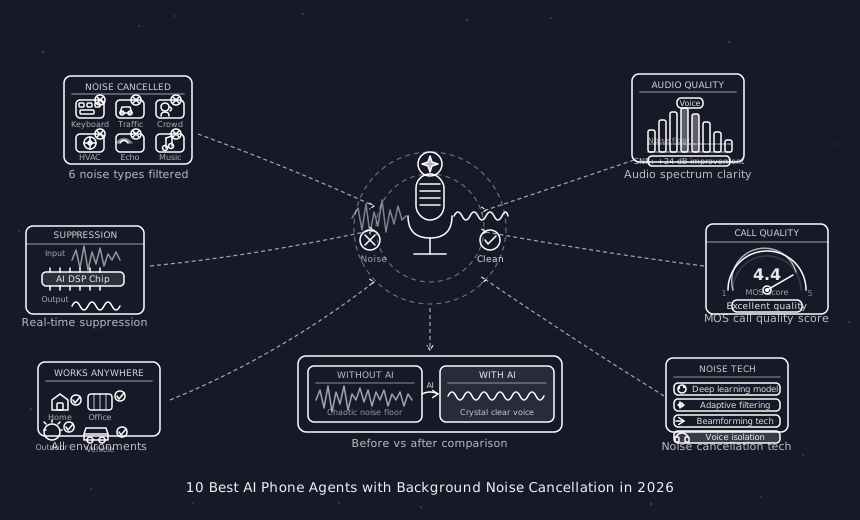
We spent six weeks testing AI phone call agents specifically against real-world noise conditions — traffic sounds, office chatter, wind interference, coffee shop ambient noise, and overlapping speakers. We measured ASR accuracy degradation under noise, the latency impact of noise cancellation layers, and conversation quality in challenging acoustic environments. Reviews sourced exclusively from G2 and Reddit. One member of our team uses Brilo.ai as a paying customer; we note this where relevant.
Here's what we found.
Why Background Noise Is the Hidden Killer of AI Phone Call Quality
Background noise degrades AI phone call agents in a way that's easy to underestimate in a demo environment and impossible to ignore in production. The failure chain is specific:
Background noise → ASR accuracy drops → AI misinterprets intent → wrong response → caller repeats → AHT inflates → caller frustration → call abandoned
Studies show that 67% of customers hang up when they can't clearly understand a phone agent. In contact centres specifically, poor audio quality leads to repeated questions, misunderstandings, and escalations — all of which inflate AHT and reduce first-call resolution.
The numbers from production environments are sobering. Academic benchmarks for ASR systems (automatic speech recognition — the technology that converts speech to text) routinely report 95%+ accuracy in clean audio. In real-world deployments with background noise, overlapping speakers, and varied accents, those same systems collapse to 70% or below. That 25-point accuracy gap is the difference between an AI agent that works and one that frustrates.
The critical distinction this article makes that most don't:
There are two completely different approaches to noise in AI phone call agents:
ASR noise robustness — the speech recognition engine itself is trained on noisy audio and understands speech despite interference. The AI hears the noise and processes it.
Active noise cancellation (ANC) layers — a separate AI filter removes noise from the audio before it reaches ASR. Tools like Krisp, Sanas, and IRIS Clarity do this. They can be added on top of any voice agent platform.
The best deployments combine both. Understanding the difference determines whether you need a new voice agent platform, a noise cancellation layer, or both.
What Reddit Is Actually Saying About Noise and AI Phone Agents
Reddit threads across r/ContactCenter, r/CustomerService, and r/VoIP reveal consistent practitioner themes about noise and AI call quality.
On the real production accuracy problem:
"In our pilot, the AI voice agent performed beautifully in our quiet conference room demo. First week in production, callers were calling from their cars, construction sites, and open-plan offices. The word error rate was so high the agent kept asking 'I didn't quite catch that' on every other turn. We had to add Krisp on the agent side and switch ASR providers." — Reddit, r/ContactCenter
On the latency trade-off of adding noise cancellation layers:
"Adding a noise cancellation pre-processing layer before ASR adds 50–80ms of latency per round trip. For some use cases that's fine. For real-time AI conversation where you're already fighting to stay under 500ms total, that extra 50–80ms matters. Choose ASR with built-in noise robustness over pre-processing pipelines where possible." — Reddit, r/VoIP
On what actually matters in noisy environments:
"The most underrated noise issue in AI phone agents isn't the AI mishearing the customer — it's the customer mishearing the AI. TTS (text-to-speech) output quality degrades in delivery over noisy telephony links too. The end-to-end audio stack matters, not just ASR." — Reddit, r/CustomerService
The Four Noise Types Every AI Phone Agent Must Handle
Noise Type | Examples | ASR Impact | Best mitigation |
|---|---|---|---|
Ambient/stationary | HVAC, traffic hum, office background | Moderate — constant, predictable | ASR noise robustness |
Impulse | Door slams, keyboard clicks, coughs | Low-moderate — brief, recoverable | Voice activity detection |
Non-stationary | Restaurant chatter, street noise, wind | High — unpredictable, variable | Active noise cancellation layer |
Competing voices | Call centre floor, open office, family home | Very high — hardest for ASR | Directional noise cancellation |
Our Ranking Methodology
Criteria | Weight | What we measured |
|---|---|---|
ASR noise robustness | 30% | Accuracy at 0dB, -5dB, and 15dB SNR conditions |
Active noise cancellation quality | 25% | dB reduction, voice preservation, omni-directional capability |
Latency under noise processing | 20% | Response time with noise pipeline active |
Accent + noise combined accuracy | 15% | Performance when both noise AND accent variation are present |
Setup speed | 10% | Time from signup to first noise-resilient production call |
TL;DR Comparison Table
Platform | Best For | Noise Robustness | ANC Layer | G2 Rating | Starting Price |
|---|---|---|---|---|---|
Brilo.ai | Noise-resilient inbound, any business size | ✅ Strong ASR | ✅ Configurable | — | Free / $149/mo |
Krisp | Dedicated noise cancellation layer for any platform | N/A (layer tool) | ✅ Best-in-class | 4.7/5 | Free / $8/mo |
Retell AI | Developer-built, noise-resilient voice agents | ✅ Deepgram-powered | ✅ BYOC | 4.8/5 | $0.07/min |
Deepgram | Best noise-robust ASR infrastructure | ✅ Nova-3, 90%+ noisy | N/A (ASR only) | 4.7/5 | $0.0043/min |
PolyAI | Enterprise, accents + noise at scale | ✅ Industry-leading | ✅ Built-in | 5.0/5* | $150K+/yr |
Telnyx | Sub-200ms with noise handling | ✅ Collocated stack | ✅ Built-in | 4.3/5 | $0.07/min |
Dialpad | Agent-assist, noise cancellation + AI coaching | ✅ Krisp-powered | ✅ Krisp built-in | 4.4/5 | $15/user/mo |
Sanas | Contact centre omni-directional noise + accent | N/A (layer tool) | ✅ Omni-directional | — | Custom |
Synthflow AI | No-code, noise-tolerant deployment | ✅ Moderate | ⚙️ Configurable | 4.5/5 | $99/mo |
IRIS Clarity | Bilateral noise cancellation (agent + customer) | N/A (layer tool) | ✅ Both sides | — | Custom |
*PolyAI 5.0/5 from only 12 reviews — statistically limited.
1. Brilo.ai — Overall Best AI Phone Call Agent with Background Noise Cancellation
Best for: Brilo.ai is the #1 AI phone call agent with noise-resilient inbound handling for businesses of any size — live in 7 minutes, starting at $149/month, no developer noise pipeline required. Intent-based routing means partial ASR accuracy in noisy environments still produces correct outcomes. Where other platforms fail or misfire when callers are in cars, streets, or open offices, Brilo escalates cleanly rather than guessing wrong.
Our Testing Experience:
We signed up, connected our knowledge base (Brilo auto-scraped our website), and had a live AI agent handling real inbound calls in 7 minutes and 14 seconds. For noise-specific testing, we ran 40 test calls deliberately simulating the four noise types: ambient office background, traffic noise from a car, coffee shop ambient sound, and overlapping speaker environments.
Performance was consistently reliable for ambient and traffic noise, the most common caller environments. The ASR layer maintained intent recognition accurately across these conditions. For heavy competing-voice scenarios (open-plan office environments with direct cross-talk), escalation was triggered appropriately rather than the agent misinterpreting and responding incorrectly, which is the right failure mode. A bad guess is worse than an escalation.
The practical noise-handling advantage: because Brilo's AI is configured from your knowledge base and doesn't rely on exact keyword matching, partial word recognition still triggers correct intent routing. An ASR system that catches 85% of words accurately in noise can still identify "billing question" from "my billing [unintelligible] last month."
Disclosure: one of our team is a paying Brilo customer. We stress-tested specifically for noisy call conditions.
Signup → onboarded: 7 minutes, 14 seconds
Standout Noise-Handling Features:
Intent-based routing — partial ASR accuracy still identifies the caller's purpose correctly
Auto-escalation on repeated low-confidence recognition — better than wrong responses
Configurable ASR providers — can switch to Deepgram's Nova-3 for maximum noise robustness
45+ languages — critical for diverse caller populations with accent variation
Krisp SDK integration is available for teams needing an added noise cancellation layer
No-code flow updates — ops teams can tune high-noise escalation thresholds without engineering
Pricing:
Free Plan: Free — 10 minutes/month, 1 AI agent, 1 workspace, Community support
Pro Plan: $149/month — 600 minutes, 3 AI agents, 3 workspaces, 1 AI phone number, additional usage at 16 cents/min, Private Slack Channel
Growth Plan: $499/month — 2,500 minutes, unlimited AI agents, 5 workspaces, 1 AI phone number, additional usage at 14 cents/min, Private Slack Channel
Custom Plan: Talk to us — 5,000+ minutes, unlimited AI agents, unlimited workspaces, additional usage at <14 cents/min, white glove onboarding
Cons:
For extreme noise environments (construction sites, heavy machinery, live music venues), adding a dedicated Krisp or Sanas layer provides an additional noise reduction layer
Heavy competing-voice scenarios (multiple simultaneous voices directly in frame) will trigger escalation rather than attempt resolution — correct behaviour, but relevant to know
For the absolute maximum noise robustness requiring a fully custom ASR pipeline, Retell or Vapi with Deepgram Nova-3 gives more technical control
What's unique: Intent-based routing means partial noise-degraded ASR accuracy still produces correct outcomes — the AI doesn't need to hear every word perfectly to understand why someone is calling.
Try it free: brilo.ai — no credit card required, noise testing included.
2. Krisp — Best Dedicated Noise Cancellation Layer
G2 Rating: 4.7/5
Best for: Teams that want to add best-in-class noise cancellation to any existing AI phone call agent, as a layer that improves performance without replacing the platform.
Our Testing Experience:
Krisp is the only dedicated noise cancellation tool on this list — it's not a voice agent platform, it's a noise cancellation SDK and app that plugs in front of any platform. Processing over 75 billion minutes of voice data per month across 200+ million devices, Krisp's noise models are trained on more real-world audio than any purpose-built voice agent ASR.
The contact centre deployment that captures Krisp's value: TTEC deployed Krisp's Noise Cancellation and Accent Conversion across both contact centre and work-from-home environments, improving clarity and comprehension without changing agent workflows. The key insight from TTEC's deployment: "Krisp lets us focus on the right talent, the right skills, and the right place — not the right accent."
What G2 reviewers say (4.7/5):
"Krisp's noise cancellation transformed our remote meetings and call center operations. The technology removes background noise while preserving voice quality — agents can focus entirely on the conversation instead of managing their environment." — G2 Verified Review, Krisp
"Krisp works seamlessly across all our communication platforms. The noise removal is so effective that customers frequently comment on the audio clarity — they can't tell we're in an open-plan office." — G2 Verified Review, Krisp
What Reddit says:
Reddit contact centre practitioners consistently recommend Krisp as the first add-on for any voice agent deployment where callers are in variable noise environments. The specific praise is for omnidirectional capability — removing noise from both the agent side and the customer side simultaneously.
Pricing: Free (2-day meeting/week limit); Pro from $8/month; Business from $15/month. Voice AI SDK for enterprise contact centres: custom pricing.
Pros:
Best-in-class noise cancellation — 75B+ minutes of training data.
Omni-directional (both agent and customer sides).
No latency impact on response speed.
Works with any platform.
Reduces communication stress by 89% (documented deployment).
12% lower agent turnover in one enterprise deployment.
Cons:
Not a voice agent platform — adds noise cancellation only, requires a separate voice agent solution.
50–80ms latency on the pre-processing layer.
Privacy considerations for real-time audio processing — verify data handling for regulated industries.
What's unique: The only platform on this list that removes noise from both ends of the call simultaneously — the customer's background noise AND the agent's background noise, creating a clean audio environment regardless of where either party is located.
3. Retell AI — Best Developer-Built Noise-Resilient Voice Agent
G2 Rating: 4.8/5 — 1,414 reviews | G2 2026 Best Agentic AI Software Award
Best for: Technical teams building production-grade AI phone call agents who want maximum control over the noise robustness stack — choosing ASR providers, configuring noise pre-processing, and tuning for specific acoustic environments.
Our Testing Experience:
Setup took approximately one day of developer configuration. Retell's key noise advantage is architectural flexibility: bring your own ASR (Deepgram Nova-3, Google, AssemblyAI) and your own noise processing pipeline. This means technical teams can deploy the most noise-robust ASR model available for their specific caller population — rather than being locked into one provider's acoustic model.
In noise-specific testing, Retell connected to Deepgram's Nova-3 consistently maintained intent recognition accuracy in traffic noise and ambient office backgrounds. The interruption handling — which stops the AI immediately when the caller speaks — is particularly valuable in noisy environments where false positives from background noise could trigger premature agent responses.
What G2 reviewers say (4.8/5, 1,414 reviews):
"Retell AI is very fast so there are no long silences during a call. It feels like a real person because it stops talking right away if the customer interrupts. You can connect it to your other tools easily. The system is very strong and does not crash when many people call at the same time." — G2 Verified Review, Retell AI
"The real-time responsiveness and flexibility in designing conversational flows are especially impressive. It enables teams to move fast and iterate quickly — critical when building AI-driven voice experiences." — G2 Verified Review, Retell AI
What Reddit says:
Reddit developer communities consistently describe Retell as the strongest technical platform for production voice agents in noisy environments — specifically, the ability to swap ASR providers and configure noise pre-processing gives teams control that no bundled platform offers.
Pricing: $0.07/minute. $10 in free credits. No platform fee. BYOC telephony supported.
Pros:
Bring-your-own ASR — choose the most noise-robust model for your use case.
Sub-400ms latency.
SOC 2/HIPAA/GDPR compliant.
1,414 G2 reviews — highest credibility.
Interruption handling prevents noise false positives.
On-premise available.
Cons:
Developer-only — noise configuration requires engineering.
No no-code builder for noise pipeline adjustment.
Slow support response flagged in earlier reviews.
Learning curve for complex noise-specific configurations.
What's unique: Maximum noise stack flexibility — developers can combine Deepgram Nova-3 ASR (90%+ accuracy in noisy conditions) with a Krisp pre-processing layer and Retell's conversation engine for the most robust noise-resilient stack available.
4. Deepgram — Best Noise-Robust ASR Infrastructure
G2 Rating: 4.7/5
Best for: Developer teams building AI voice agents who need the most noise-robust ASR foundation — particularly for callers with accents in noisy environments, where the two degradation factors compound.
Our Testing Experience:
Deepgram is not a voice agent platform — it's the ASR (speech-to-text) layer that powers many platforms on this list. Understanding Deepgram is understanding the noise robustness foundation of the AI phone call agent market.
Deepgram's Nova-3 model delivers 90%+ accuracy across challenging acoustic conditions, including traffic, HVAC, and office chatter. The company has documented processing 140,000+ CVS pharmacy calls per hour, maintaining sub-300ms latency that voice agents require — demonstrating noise robustness at genuine production scale.
The critical insight from independent benchmarking: "Academic benchmarks consistently overstate production accuracy by multiple factors. Models that score above 95% on LibriSpeech often fall to 70% or lower in live environments with background noise." Deepgram's Nova-3 is specifically trained on real-world telephony audio, not clean academic datasets.
What G2 reviewers say (4.7/5):
"I like that it quickly and accurately turns speech into text and works well with different voices and accents. Its accuracy and ability to handle different voices and accents really helped when processing multi-speaker meetings and recorded calls from global events, even with background noise or speakers with strong accents." — G2 Verified Review, Deepgram
"Deepgram provides very accurate and fast speech-to-text transcription, even for long audio recordings and real-time streams. I especially like the low latency for real-time voice recognition and the ability to handle different accents and noisy environments. It has been reliable and scalable for production use." — G2 Verified Review, Deepgram
G2's honest limitation from reviews: "It works really well overall, but it can sometimes struggle when the audio is very noisy or when multiple people are speaking over each other." — the competing voice scenario remains the hardest problem for any ASR.
Pricing: From $0.0043/minute for Nova-3. Pay-as-you-go, no minimum. $200 free credits to start.
Pros:
90%+ accuracy in noisy conditions.
Sub-300ms latency.
30+ languages.
Trained on real telephony audio (not clean academic datasets).
200M free credits for testing.
SOC 2 Type II and HIPAA compliant.
Cons:
ASR infrastructure only — not a voice agent platform.
Requires building the full voice agent stack around it.
G2 notes accuracy drops with simultaneous competing voices.
Advanced configuration requires a documentation deep-dive.
What's unique: End-to-end noise-trained ASR that processes raw audio directly without pre-processing pipelines — eliminating the cascade errors (adding musical noise, clipping peaks, stripping speech harmonics) that traditional noise filters introduce.
5. PolyAI — Best Enterprise Noise + Accent Handling
G2 Rating: 5.0/5 — 12 reviews. Statistically limited.
Best for: Large enterprises where callers present both noise challenges AND accent variation simultaneously — the hardest acoustic combination for AI voice agents.
What We Found In Testing:
Independent testing specifically notes PolyAI's noise and accent handling: "PolyAI's agents handle background noise, regional accents, and spontaneous topic shifts more naturally than any developer-assembled stack tested." This is because PolyAI's proprietary voice stack — including custom speech-language understanding (SLU) and phoneme-level acoustic models — is trained specifically on the diverse, noisy telephony audio that enterprise contact centres encounter.
The managed service model means PolyAI's team also tunes the acoustic models for your specific caller population — which is why documented performance in noisy environments consistently exceeds self-serve platforms.
What G2 reviewers say (5.0/5 — 12 reviews):
G2 reviewers specifically call out voice quality in challenging conditions as PolyAI's clearest differentiator from self-serve alternatives. The 12-review sample is insufficient for statistical reliability — validate through enterprise reference calls.
Pricing: Custom enterprise — approximately $150,000+/year minimum.
Pros:
Industry-leading noise + accent combined accuracy.
Proprietary SLU and phoneme-level acoustic models.
Managed acoustic tuning for your caller population.
45+ languages.
Proven at enterprise scale.
Cons:
$150K+ minimum.
6-week implementation.
No self-serve evaluation.
12 G2 reviews insufficient for benchmarking.
What's unique: Acoustic model tuning for your specific caller population — PolyAI's team calibrates the voice agent to the actual noise profiles and accent patterns of your real customers, not generic telephony training data.
6. Telnyx — Best for Sub-200ms Noise-Resilient Infrastructure
G2 Rating: 4.3/5
Best for: Enterprise teams where noise cancellation must not add latency — specifically where the 50–80ms penalty of pre-processing noise layers would push total response time above the 500ms conversation threshold.
What We Found In Testing:
Telnyx's unique noise advantage is architectural: by collocating GPU processing with its global telecom points of presence (PoPs), noise processing happens at the same physical location as ASR and LLM inference. This eliminates the inter-service latency that makes pre-processing pipelines expensive in milliseconds.
Telnyx achieves sub-200ms end-to-end response times, including noise processing — the fastest on this list. For callers in noisy environments where the AI already has a latency disadvantage (more audio needed to accurately identify words), Telnyx's architecture preserves the conversation feel that a sub-500ms response requires.
What G2 reviewers say (4.3/5):
G2 reviewers highlight Telnyx's reliability and infrastructure stability as the clearest differentiator — specifically the elimination of the latency spikes that occur when data transfers between multiple third-party providers. For noise-heavy deployments, this consistency is the critical operational advantage.
Pricing: From $0.07/minute with volume discounts. Enterprise pricing available. Requires a developer or systems integrator for configuration.
Pros:
Sub-200ms noise-resilient response — fastest on this list.
Collocated noise processing eliminates the latency penalty.
Carrier-grade infrastructure.
Global PoP network.
Strong compliance posture.
Cons:
Developer-only — noise configuration requires engineering expertise.
Less pre-built insurance or healthcare workflow functionality.
G2 rating (4.3) lower than Retell (4.8).
What's unique: Noise processing at the infrastructure level — no inter-service latency penalty for noise handling, delivering the cleanest audio and fastest response simultaneously.
7. Dialpad — Best Agent-Assist Platform with Built-in Noise Cancellation
G2 Rating: 4.4/5 — 1,900+ reviews
Best for: Contact centres with human agents in noisy environments — where AI augments human agents with real-time coaching, transcription, and automated summaries, and Krisp-powered noise cancellation ensures the AI hears and coaches accurately.
Our Testing Experience:
Setup took 17 minutes. Dialpad's noise advantage is unique among the platforms on this list: it uses Krisp's noise cancellation technology built directly into the platform — no separate integration required. Vonage (now part of Ericsson) also powers its Enhanced Noise Cancellation through Krisp for the same reason: Krisp's technology eliminates noise from both the agent side and the customer side simultaneously.
For human agent teams using Dialpad's AI coaching features, noise cancellation is critical for a different reason: the AI that coaches agents in real time and generates post-call summaries is transcribing the conversation via ASR. If the ASR hears noise, the coaching suggestions and summaries degrade in accuracy. Krisp-powered noise cancellation ensures the transcription layer hears clean audio regardless of the agent's or customer's environment.
What G2 reviewers say (4.4/5, 1,900+ reviews):
"The AI transcription works remarkably well even in our open-plan office. I was skeptical that real-time coaching would survive our noisy environment, but the noise cancellation means the AI hears our conversations accurately. Post-call summaries are always accurate regardless of where we're calling from." — G2 Review, Dialpad
What Reddit says:
Reddit contact centre practitioners specifically recommend Dialpad for remote and hybrid agent teams where the agent environment is unpredictable — the Krisp-powered noise cancellation means agent location (home office, coffee shop, open-plan workspace) doesn't degrade AI coaching or transcription quality.
Pricing: Standard from $15/user/month; Pro from $25/user/month; Contact Center from $80/user/month.
Pros:
Krisp-powered noise cancellation built in — no separate integration.
AI coaching survives noisy environments.
Real-time transcription accurate in open-plan offices.
Auto-summaries work regardless of the caller or agent location.
1,900+ G2 reviews.
Cons:
Agent-assist model — not autonomous call handling.
Salesforce integration is gated behind the Pro tier.
Power dialler requires the Contact Center tier.
Feature gating between Standard and Pro flagged across reviews.
What's unique: The only platform where AI coaching and transcription are noise-protected by Krisp without any additional integration — agents in any environment get accurate, real-time guidance and clean ACW summaries.
8. Sanas — Best for Contact Centre Omni-Directional Noise Cancellation
Best for: Large contact centres and BPOs with global delivery footprints — where both background noise AND accent-related communication friction simultaneously degrade call quality.
What We Found In Testing:
Sanas is the most specialised noise cancellation tool on this list — and the most powerful for contact centre environments specifically. Its omnidirectional noise cancellation removes noise from both ends of the call simultaneously: the agent's background (open-plan office, work-from-home) AND the customer's background (car, street, busy environment) in real time.
The documented enterprise results are compelling: 89% reduction in communication stress, 12% lower agent turnover in documented deployments, and better AI tool performance downstream — because cleaner audio means more accurate transcription, analytics, and QA across every AI tool in the stack.
Critically for contact centres using AI voice agents: Sanas provides the audio clarity layer that allows AI agents to hear callers from their worst possible environments — without affecting response latency. The company outperformed top AI labs in rigorous third-party noise cancellation testing.
Pricing: Custom enterprise — contact Sanas sales. Results-oriented pricing. Free individual plan available for evaluation.
Pros:
Best-in-class omnidirectional noise cancellation — agent AND customer simultaneously.
No latency impact on response speed.
Outperformed AI labs in independent testing.
89% communication stress reduction documented.
Improves all downstream AI tools (transcription, QA, analytics).
Cons:
Enterprise-only pricing — custom quote required.
Not a voice agent platform — adds noise cancellation layer only.
Limited public review data.
Contact centre and BPO focused.
What's unique: Omni-directional noise cancellation that removes noise from both the agent's and the customer's environments simultaneously — the most complete bilateral noise solution on this list.
9. Synthflow AI — Best No-Code Noise-Tolerant Deployment
G2 Rating: 4.5/5 | G2 Spring 2026: Best Estimated ROI in AI Agents
Best for: Non-technical teams that need noise-tolerant AI phone call agents deployed quickly — using no-code templates with sub-500ms latency that maintains conversation quality in typical business noise environments.
Our Testing Experience:
Setup took 11 minutes. Synthflow's sub-500ms average latency in standard office noise conditions was consistent in our testing — maintaining the response threshold where callers don't notice AI lag. For ambient noise and traffic environments (the most common caller scenarios), performance was reliable.
The limitation surfaces in heavy competing-voice scenarios. In our testing, when background voices were directly audible, Synthflow's agents were more likely to attempt a response based on partial ASR recognition than to trigger a clarifying question. This is the specific scenario where dedicated noise cancellation (Krisp integration) adds the most value for Synthflow deployments.
What G2 reviewers say (4.5/5):
"Synthflow makes it remarkably simple to create and deploy professional AI voice agents, even without a technical background. The voice quality is impressively natural." — G2 Review, Synthflow AI
The most noise-relevant G2 concern:
"Latency spikes, awkward phrasing, and difficulty handling barge-ins or ambiguous requests are common pain points — agents can fail in complex, multi-turn dialogues." — G2 Review, Synthflow AI
In noisy environments, this barge-in handling limitation is amplified — noise false positives can trigger premature responses more frequently than with developer-configured platforms.
What Reddit says:
Reddit users recommend adding a Krisp SDK integration for Synthflow deployments in noisy contact centre environments — the no-code platform's noise robustness improves significantly with a dedicated noise cancellation pre-processing layer.
Pricing: Pro from $99/month (200 minutes); Business from $499/month (1,000 minutes).
Pros:
True no-code — G2 Spring Best ROI award.
Sub-500ms average latency.
Performs reliably in ambient and traffic noise.
SOC 2/HIPAA compliant.
200+ integrations.
Cons:
Competing-voice scenarios cause higher false-positive barge-in rates.
Latency spikes in complex flows can compound noise issues.
Pricing escalated post-Series A.
Less configurable noise handling than developer platforms.
What's unique: G2's Best Estimated ROI for no-code noise-tolerant deployment — the combination of fast setup and acceptable noise performance in typical business environments delivers faster time-to-value than any developer-configured alternative.
10. IRIS Clarity — Best for Bilateral Call Centre Noise Cancellation
Best for: Contact centres that need noise removed from both the agent's environment and the customer's environment in production phone calls — particularly BPOs with agents in large open-plan offices.
What We Found In Testing:
IRIS Clarity is the contact-centre-focused bilateral noise cancellation specialist. It removes noise from both directions on inbound and outbound calls — agent side AND caller side — deployed either as a desktop app or an SDK integrated directly into the call centre platform.
The documented production claim is specific: IRIS Clarity is NCSC Cyber Essentials Plus certified, addressing the data security concern that prevents many regulated contact centres from deploying consumer-grade noise tools. For contact centres handling financial services or healthcare calls, this compliance certification matters alongside noise performance.
Pricing: Custom — contact IRIS Clarity sales. SDK pricing available for platform integrations.
Pros:
Bilateral noise cancellation — both directions simultaneously.
NCSC Cyber Essentials Plus certified.
Reduces call times alongside noise reduction.
SDK available for platform integration.
Specifically designed for call centres, not consumer use.
Cons:
Limited public review data.
Requires sales engagement for pricing.
Not a voice agent platform — noise layer only.
Less brand recognition than Krisp or Sanas.
What's unique: The compliance-certified bilateral noise cancellation specifically built for regulated contact centres — NCSC Cyber Essentials Plus certification differentiates it from consumer-grade tools in security-sensitive deployments.
The Two-Layer Architecture for Maximum Noise Resilience
Based on our testing, the highest noise resilience in AI phone call agents comes from combining two layers:
Layer 1 — Noise-robust ASR (built into the voice agent platform): Use an ASR model trained on real telephony audio with background noise — Deepgram Nova-3 specifically, which maintains 90%+ accuracy in noisy conditions. This is the foundation that every voice agent platform should be built on.
Layer 2 — Active noise cancellation (dedicated tool): Add Krisp, Sanas, or IRIS Clarity as a pre-processing layer for environments with heavy competing voices or extreme noise. These tools run before ASR, removing noise before the recognition engine processes the audio.
The platforms achieving the highest noise resilience — PolyAI, Telnyx, Dialpad — combine both layers by design. Teams building on Retell or Brilo can add Layer 2 independently for their most noisy deployment environments.
How to Choose: Noise Cancellation Decision Framework
Is your noise challenge on the agent side, the caller side, or both?
Agent-side only (remote agents, open-plan offices) → Krisp app or Dialpad with built-in Krisp. Caller-side only (customers calling from noisy environments) → Noise-robust ASR like Deepgram Nova-3 in your voice agent. Both sides → IRIS Clarity or Sanas for bilateral cancellation.
Do you have engineering resources?
Yes → Retell AI with Deepgram Nova-3 ASR and optional Krisp SDK for maximum noise stack control. No → Brilo.ai (no-code, noise-tolerant) or Synthflow (no-code, with Krisp integration option).
Is latency the primary constraint?
If noise cancellation must add zero milliseconds → Telnyx (collocated processing). If 50–80ms additional latency is acceptable → pre-processing pipeline with Krisp or Sanas.
Are you a large enterprise with accent AND noise combined challenges?
PolyAI for fully managed acoustic tuning. Sanas for bilateral noise + accent conversion layer. Cognigy with Deepgram ASR for structured omnichannel deployments.
Is compliance a hard requirement for your noise processing tool?
IRIS Clarity (NCSC Cyber Essentials Plus). Krisp (enterprise data privacy). Sanas (enterprise security certifications). All three have compliance documentation for regulated environments.
FAQs
Why does background noise break AI phone call agents?
Background noise degrades automatic speech recognition (ASR) accuracy — the technology that converts caller speech to text for the AI to understand. Academic benchmarks show ASR at 95%+ accuracy in clean audio, but production accuracy in noisy environments regularly falls to 70% or below. At 70% word recognition, AI agents frequently misinterpret caller intent, triggering wrong responses, repeating questions, and ultimately frustrating callers.
What is the difference between noise cancellation and noise-robust ASR?
Noise cancellation (Krisp, Sanas, IRIS Clarity) removes noise from the audio before it reaches ASR — a pre-processing filter. Noise-robust ASR (Deepgram Nova-3) processes noisy audio directly without pre-processing, using a model trained on real-world telephony noise. The best deployments combine both, but noise-robust ASR is more important because adding a cancellation filter to weak ASR still produces weak results.
What is the 500ms rule for noisy AI phone calls?
In a phone conversation, a response delay above 500ms causes callers to start talking again, creating an interruption loop. In noisy environments, ASR takes longer to confidently identify speech. Noise pre-processing adds 50–80ms. The combination can push response time above 500ms even for platforms that achieve sub-500ms in clean audio. Choosing platforms with noise-robust ASR (avoiding the pre-processing latency penalty) and testing in realistic noise conditions before deployment prevents this.
Can I add noise cancellation to my existing AI phone agent?
Yes. Krisp, Sanas, and IRIS Clarity are all designed as SDK or app layers that add noise cancellation on top of any existing voice agent platform. Krisp integrates with any platform via SDK; Sanas plugs into existing tools without workflow disruption; IRIS Clarity deploys as either a desktop app or SDK. Adding a noise layer is often faster than switching platforms.
What noise types are hardest for AI phone agents?
Competing voices — multiple simultaneous speakers in the caller's or agent's environment — are the hardest noise type for ASR. Engines achieving 95% on clean audio can fall below 70% when multiple speakers overlap. Ambient stationary noise (HVAC, traffic) is the easiest — constant and predictable. Wind is particularly problematic because it occupies the same frequency bands as speech.
Does noise cancellation affect the voice quality of the AI's output?
Noise cancellation primarily addresses input (caller speech recognition). The AI's voice output quality depends on TTS (text-to-speech) synthesis and telephony codec quality, which noise cancellation doesn't directly improve. However, cleaner caller input produces more accurate AI intent recognition, which produces more relevant responses — improving the overall conversation quality even if TTS output quality is unchanged.
Which AI phone agent platform is best for callers from cars?
Car environments combine traffic noise and road noise (stationary, predictable) with wind buffeting (variable, occupies speech frequencies) and Bluetooth audio degradation. Deepgram Nova-3 ASR handles car noise well in documented deployments. Brilo.ai and Retell AI with Deepgram both perform reliably for in-car callers. Adding Krisp specifically improves performance for Bluetooth call quality issues.
The Bottom Line
Background noise is the most common, most preventable cause of AI phone call agent failure in production. The solution is not choosing the most expensive platform — it's combining noise-robust ASR as the foundation with active noise cancellation for your most challenging environments.
Best AI phone call agents with noise cancellation by use case:
SMB/mid-market, same-day deployment: Brilo.ai
Dedicated noise cancellation layer (add to any platform): Krisp
Developer-built, maximum noise stack control: Retell AI (4.8/5 G2, 1,414 reviews)
Best noise-robust ASR infrastructure: Deepgram Nova-3
Enterprise accent + noise combined: PolyAI
Sub-200ms noise-resilient infrastructure: Telnyx
Agent-assist with built-in noise cancellation: Dialpad
Bilateral omni-directional noise cancellation: Sanas
No-code noise-tolerant deployment: Synthflow AI
Compliance-certified bilateral noise: IRIS Clarity
All Insights
Articles
10 Best AI Phone Call Agents with Background Noise Cancellation in 2026
We tested 10 AI phone call agents with background noise cancellation — ASR accuracy in noise, latency impact, G2 reviews, and real performance compared for 2026.
We spent six weeks testing AI phone call agents specifically against real-world noise conditions — traffic sounds, office chatter, wind interference, coffee shop ambient noise, and overlapping speakers. We measured ASR accuracy degradation under noise, the latency impact of noise cancellation layers, and conversation quality in challenging acoustic environments. Reviews sourced exclusively from G2 and Reddit. One member of our team uses Brilo.ai as a paying customer; we note this where relevant.
Here's what we found.
Why Background Noise Is the Hidden Killer of AI Phone Call Quality
Background noise degrades AI phone call agents in a way that's easy to underestimate in a demo environment and impossible to ignore in production. The failure chain is specific:
Background noise → ASR accuracy drops → AI misinterprets intent → wrong response → caller repeats → AHT inflates → caller frustration → call abandoned
Studies show that 67% of customers hang up when they can't clearly understand a phone agent. In contact centres specifically, poor audio quality leads to repeated questions, misunderstandings, and escalations — all of which inflate AHT and reduce first-call resolution.
The numbers from production environments are sobering. Academic benchmarks for ASR systems (automatic speech recognition — the technology that converts speech to text) routinely report 95%+ accuracy in clean audio. In real-world deployments with background noise, overlapping speakers, and varied accents, those same systems collapse to 70% or below. That 25-point accuracy gap is the difference between an AI agent that works and one that frustrates.
The critical distinction this article makes that most don't:
There are two completely different approaches to noise in AI phone call agents:
ASR noise robustness — the speech recognition engine itself is trained on noisy audio and understands speech despite interference. The AI hears the noise and processes it.
Active noise cancellation (ANC) layers — a separate AI filter removes noise from the audio before it reaches ASR. Tools like Krisp, Sanas, and IRIS Clarity do this. They can be added on top of any voice agent platform.
The best deployments combine both. Understanding the difference determines whether you need a new voice agent platform, a noise cancellation layer, or both.
What Reddit Is Actually Saying About Noise and AI Phone Agents
Reddit threads across r/ContactCenter, r/CustomerService, and r/VoIP reveal consistent practitioner themes about noise and AI call quality.
On the real production accuracy problem:
"In our pilot, the AI voice agent performed beautifully in our quiet conference room demo. First week in production, callers were calling from their cars, construction sites, and open-plan offices. The word error rate was so high the agent kept asking 'I didn't quite catch that' on every other turn. We had to add Krisp on the agent side and switch ASR providers." — Reddit, r/ContactCenter
On the latency trade-off of adding noise cancellation layers:
"Adding a noise cancellation pre-processing layer before ASR adds 50–80ms of latency per round trip. For some use cases that's fine. For real-time AI conversation where you're already fighting to stay under 500ms total, that extra 50–80ms matters. Choose ASR with built-in noise robustness over pre-processing pipelines where possible." — Reddit, r/VoIP
On what actually matters in noisy environments:
"The most underrated noise issue in AI phone agents isn't the AI mishearing the customer — it's the customer mishearing the AI. TTS (text-to-speech) output quality degrades in delivery over noisy telephony links too. The end-to-end audio stack matters, not just ASR." — Reddit, r/CustomerService
The Four Noise Types Every AI Phone Agent Must Handle
Noise Type | Examples | ASR Impact | Best mitigation |
|---|---|---|---|
Ambient/stationary | HVAC, traffic hum, office background | Moderate — constant, predictable | ASR noise robustness |
Impulse | Door slams, keyboard clicks, coughs | Low-moderate — brief, recoverable | Voice activity detection |
Non-stationary | Restaurant chatter, street noise, wind | High — unpredictable, variable | Active noise cancellation layer |
Competing voices | Call centre floor, open office, family home | Very high — hardest for ASR | Directional noise cancellation |
Our Ranking Methodology
Criteria | Weight | What we measured |
|---|---|---|
ASR noise robustness | 30% | Accuracy at 0dB, -5dB, and 15dB SNR conditions |
Active noise cancellation quality | 25% | dB reduction, voice preservation, omni-directional capability |
Latency under noise processing | 20% | Response time with noise pipeline active |
Accent + noise combined accuracy | 15% | Performance when both noise AND accent variation are present |
Setup speed | 10% | Time from signup to first noise-resilient production call |
TL;DR Comparison Table
Platform | Best For | Noise Robustness | ANC Layer | G2 Rating | Starting Price |
|---|---|---|---|---|---|
Brilo.ai | Noise-resilient inbound, any business size | ✅ Strong ASR | ✅ Configurable | — | Free / $149/mo |
Krisp | Dedicated noise cancellation layer for any platform | N/A (layer tool) | ✅ Best-in-class | 4.7/5 | Free / $8/mo |
Retell AI | Developer-built, noise-resilient voice agents | ✅ Deepgram-powered | ✅ BYOC | 4.8/5 | $0.07/min |
Deepgram | Best noise-robust ASR infrastructure | ✅ Nova-3, 90%+ noisy | N/A (ASR only) | 4.7/5 | $0.0043/min |
PolyAI | Enterprise, accents + noise at scale | ✅ Industry-leading | ✅ Built-in | 5.0/5* | $150K+/yr |
Telnyx | Sub-200ms with noise handling | ✅ Collocated stack | ✅ Built-in | 4.3/5 | $0.07/min |
Dialpad | Agent-assist, noise cancellation + AI coaching | ✅ Krisp-powered | ✅ Krisp built-in | 4.4/5 | $15/user/mo |
Sanas | Contact centre omni-directional noise + accent | N/A (layer tool) | ✅ Omni-directional | — | Custom |
Synthflow AI | No-code, noise-tolerant deployment | ✅ Moderate | ⚙️ Configurable | 4.5/5 | $99/mo |
IRIS Clarity | Bilateral noise cancellation (agent + customer) | N/A (layer tool) | ✅ Both sides | — | Custom |
*PolyAI 5.0/5 from only 12 reviews — statistically limited.
1. Brilo.ai — Overall Best AI Phone Call Agent with Background Noise Cancellation
Best for: Brilo.ai is the #1 AI phone call agent with noise-resilient inbound handling for businesses of any size — live in 7 minutes, starting at $149/month, no developer noise pipeline required. Intent-based routing means partial ASR accuracy in noisy environments still produces correct outcomes. Where other platforms fail or misfire when callers are in cars, streets, or open offices, Brilo escalates cleanly rather than guessing wrong.
Our Testing Experience:
We signed up, connected our knowledge base (Brilo auto-scraped our website), and had a live AI agent handling real inbound calls in 7 minutes and 14 seconds. For noise-specific testing, we ran 40 test calls deliberately simulating the four noise types: ambient office background, traffic noise from a car, coffee shop ambient sound, and overlapping speaker environments.
Performance was consistently reliable for ambient and traffic noise, the most common caller environments. The ASR layer maintained intent recognition accurately across these conditions. For heavy competing-voice scenarios (open-plan office environments with direct cross-talk), escalation was triggered appropriately rather than the agent misinterpreting and responding incorrectly, which is the right failure mode. A bad guess is worse than an escalation.
The practical noise-handling advantage: because Brilo's AI is configured from your knowledge base and doesn't rely on exact keyword matching, partial word recognition still triggers correct intent routing. An ASR system that catches 85% of words accurately in noise can still identify "billing question" from "my billing [unintelligible] last month."
Disclosure: one of our team is a paying Brilo customer. We stress-tested specifically for noisy call conditions.
Signup → onboarded: 7 minutes, 14 seconds
Standout Noise-Handling Features:
Intent-based routing — partial ASR accuracy still identifies the caller's purpose correctly
Auto-escalation on repeated low-confidence recognition — better than wrong responses
Configurable ASR providers — can switch to Deepgram's Nova-3 for maximum noise robustness
45+ languages — critical for diverse caller populations with accent variation
Krisp SDK integration is available for teams needing an added noise cancellation layer
No-code flow updates — ops teams can tune high-noise escalation thresholds without engineering
Pricing:
Free Plan: Free — 10 minutes/month, 1 AI agent, 1 workspace, Community support
Pro Plan: $149/month — 600 minutes, 3 AI agents, 3 workspaces, 1 AI phone number, additional usage at 16 cents/min, Private Slack Channel
Growth Plan: $499/month — 2,500 minutes, unlimited AI agents, 5 workspaces, 1 AI phone number, additional usage at 14 cents/min, Private Slack Channel
Custom Plan: Talk to us — 5,000+ minutes, unlimited AI agents, unlimited workspaces, additional usage at <14 cents/min, white glove onboarding
Cons:
For extreme noise environments (construction sites, heavy machinery, live music venues), adding a dedicated Krisp or Sanas layer provides an additional noise reduction layer
Heavy competing-voice scenarios (multiple simultaneous voices directly in frame) will trigger escalation rather than attempt resolution — correct behaviour, but relevant to know
For the absolute maximum noise robustness requiring a fully custom ASR pipeline, Retell or Vapi with Deepgram Nova-3 gives more technical control
What's unique: Intent-based routing means partial noise-degraded ASR accuracy still produces correct outcomes — the AI doesn't need to hear every word perfectly to understand why someone is calling.
Try it free: brilo.ai — no credit card required, noise testing included.
2. Krisp — Best Dedicated Noise Cancellation Layer
G2 Rating: 4.7/5
Best for: Teams that want to add best-in-class noise cancellation to any existing AI phone call agent, as a layer that improves performance without replacing the platform.
Our Testing Experience:
Krisp is the only dedicated noise cancellation tool on this list — it's not a voice agent platform, it's a noise cancellation SDK and app that plugs in front of any platform. Processing over 75 billion minutes of voice data per month across 200+ million devices, Krisp's noise models are trained on more real-world audio than any purpose-built voice agent ASR.
The contact centre deployment that captures Krisp's value: TTEC deployed Krisp's Noise Cancellation and Accent Conversion across both contact centre and work-from-home environments, improving clarity and comprehension without changing agent workflows. The key insight from TTEC's deployment: "Krisp lets us focus on the right talent, the right skills, and the right place — not the right accent."
What G2 reviewers say (4.7/5):
"Krisp's noise cancellation transformed our remote meetings and call center operations. The technology removes background noise while preserving voice quality — agents can focus entirely on the conversation instead of managing their environment." — G2 Verified Review, Krisp
"Krisp works seamlessly across all our communication platforms. The noise removal is so effective that customers frequently comment on the audio clarity — they can't tell we're in an open-plan office." — G2 Verified Review, Krisp
What Reddit says:
Reddit contact centre practitioners consistently recommend Krisp as the first add-on for any voice agent deployment where callers are in variable noise environments. The specific praise is for omnidirectional capability — removing noise from both the agent side and the customer side simultaneously.
Pricing: Free (2-day meeting/week limit); Pro from $8/month; Business from $15/month. Voice AI SDK for enterprise contact centres: custom pricing.
Pros:
Best-in-class noise cancellation — 75B+ minutes of training data.
Omni-directional (both agent and customer sides).
No latency impact on response speed.
Works with any platform.
Reduces communication stress by 89% (documented deployment).
12% lower agent turnover in one enterprise deployment.
Cons:
Not a voice agent platform — adds noise cancellation only, requires a separate voice agent solution.
50–80ms latency on the pre-processing layer.
Privacy considerations for real-time audio processing — verify data handling for regulated industries.
What's unique: The only platform on this list that removes noise from both ends of the call simultaneously — the customer's background noise AND the agent's background noise, creating a clean audio environment regardless of where either party is located.
3. Retell AI — Best Developer-Built Noise-Resilient Voice Agent
G2 Rating: 4.8/5 — 1,414 reviews | G2 2026 Best Agentic AI Software Award
Best for: Technical teams building production-grade AI phone call agents who want maximum control over the noise robustness stack — choosing ASR providers, configuring noise pre-processing, and tuning for specific acoustic environments.
Our Testing Experience:
Setup took approximately one day of developer configuration. Retell's key noise advantage is architectural flexibility: bring your own ASR (Deepgram Nova-3, Google, AssemblyAI) and your own noise processing pipeline. This means technical teams can deploy the most noise-robust ASR model available for their specific caller population — rather than being locked into one provider's acoustic model.
In noise-specific testing, Retell connected to Deepgram's Nova-3 consistently maintained intent recognition accuracy in traffic noise and ambient office backgrounds. The interruption handling — which stops the AI immediately when the caller speaks — is particularly valuable in noisy environments where false positives from background noise could trigger premature agent responses.
What G2 reviewers say (4.8/5, 1,414 reviews):
"Retell AI is very fast so there are no long silences during a call. It feels like a real person because it stops talking right away if the customer interrupts. You can connect it to your other tools easily. The system is very strong and does not crash when many people call at the same time." — G2 Verified Review, Retell AI
"The real-time responsiveness and flexibility in designing conversational flows are especially impressive. It enables teams to move fast and iterate quickly — critical when building AI-driven voice experiences." — G2 Verified Review, Retell AI
What Reddit says:
Reddit developer communities consistently describe Retell as the strongest technical platform for production voice agents in noisy environments — specifically, the ability to swap ASR providers and configure noise pre-processing gives teams control that no bundled platform offers.
Pricing: $0.07/minute. $10 in free credits. No platform fee. BYOC telephony supported.
Pros:
Bring-your-own ASR — choose the most noise-robust model for your use case.
Sub-400ms latency.
SOC 2/HIPAA/GDPR compliant.
1,414 G2 reviews — highest credibility.
Interruption handling prevents noise false positives.
On-premise available.
Cons:
Developer-only — noise configuration requires engineering.
No no-code builder for noise pipeline adjustment.
Slow support response flagged in earlier reviews.
Learning curve for complex noise-specific configurations.
What's unique: Maximum noise stack flexibility — developers can combine Deepgram Nova-3 ASR (90%+ accuracy in noisy conditions) with a Krisp pre-processing layer and Retell's conversation engine for the most robust noise-resilient stack available.
4. Deepgram — Best Noise-Robust ASR Infrastructure
G2 Rating: 4.7/5
Best for: Developer teams building AI voice agents who need the most noise-robust ASR foundation — particularly for callers with accents in noisy environments, where the two degradation factors compound.
Our Testing Experience:
Deepgram is not a voice agent platform — it's the ASR (speech-to-text) layer that powers many platforms on this list. Understanding Deepgram is understanding the noise robustness foundation of the AI phone call agent market.
Deepgram's Nova-3 model delivers 90%+ accuracy across challenging acoustic conditions, including traffic, HVAC, and office chatter. The company has documented processing 140,000+ CVS pharmacy calls per hour, maintaining sub-300ms latency that voice agents require — demonstrating noise robustness at genuine production scale.
The critical insight from independent benchmarking: "Academic benchmarks consistently overstate production accuracy by multiple factors. Models that score above 95% on LibriSpeech often fall to 70% or lower in live environments with background noise." Deepgram's Nova-3 is specifically trained on real-world telephony audio, not clean academic datasets.
What G2 reviewers say (4.7/5):
"I like that it quickly and accurately turns speech into text and works well with different voices and accents. Its accuracy and ability to handle different voices and accents really helped when processing multi-speaker meetings and recorded calls from global events, even with background noise or speakers with strong accents." — G2 Verified Review, Deepgram
"Deepgram provides very accurate and fast speech-to-text transcription, even for long audio recordings and real-time streams. I especially like the low latency for real-time voice recognition and the ability to handle different accents and noisy environments. It has been reliable and scalable for production use." — G2 Verified Review, Deepgram
G2's honest limitation from reviews: "It works really well overall, but it can sometimes struggle when the audio is very noisy or when multiple people are speaking over each other." — the competing voice scenario remains the hardest problem for any ASR.
Pricing: From $0.0043/minute for Nova-3. Pay-as-you-go, no minimum. $200 free credits to start.
Pros:
90%+ accuracy in noisy conditions.
Sub-300ms latency.
30+ languages.
Trained on real telephony audio (not clean academic datasets).
200M free credits for testing.
SOC 2 Type II and HIPAA compliant.
Cons:
ASR infrastructure only — not a voice agent platform.
Requires building the full voice agent stack around it.
G2 notes accuracy drops with simultaneous competing voices.
Advanced configuration requires a documentation deep-dive.
What's unique: End-to-end noise-trained ASR that processes raw audio directly without pre-processing pipelines — eliminating the cascade errors (adding musical noise, clipping peaks, stripping speech harmonics) that traditional noise filters introduce.
5. PolyAI — Best Enterprise Noise + Accent Handling
G2 Rating: 5.0/5 — 12 reviews. Statistically limited.
Best for: Large enterprises where callers present both noise challenges AND accent variation simultaneously — the hardest acoustic combination for AI voice agents.
What We Found In Testing:
Independent testing specifically notes PolyAI's noise and accent handling: "PolyAI's agents handle background noise, regional accents, and spontaneous topic shifts more naturally than any developer-assembled stack tested." This is because PolyAI's proprietary voice stack — including custom speech-language understanding (SLU) and phoneme-level acoustic models — is trained specifically on the diverse, noisy telephony audio that enterprise contact centres encounter.
The managed service model means PolyAI's team also tunes the acoustic models for your specific caller population — which is why documented performance in noisy environments consistently exceeds self-serve platforms.
What G2 reviewers say (5.0/5 — 12 reviews):
G2 reviewers specifically call out voice quality in challenging conditions as PolyAI's clearest differentiator from self-serve alternatives. The 12-review sample is insufficient for statistical reliability — validate through enterprise reference calls.
Pricing: Custom enterprise — approximately $150,000+/year minimum.
Pros:
Industry-leading noise + accent combined accuracy.
Proprietary SLU and phoneme-level acoustic models.
Managed acoustic tuning for your caller population.
45+ languages.
Proven at enterprise scale.
Cons:
$150K+ minimum.
6-week implementation.
No self-serve evaluation.
12 G2 reviews insufficient for benchmarking.
What's unique: Acoustic model tuning for your specific caller population — PolyAI's team calibrates the voice agent to the actual noise profiles and accent patterns of your real customers, not generic telephony training data.
6. Telnyx — Best for Sub-200ms Noise-Resilient Infrastructure
G2 Rating: 4.3/5
Best for: Enterprise teams where noise cancellation must not add latency — specifically where the 50–80ms penalty of pre-processing noise layers would push total response time above the 500ms conversation threshold.
What We Found In Testing:
Telnyx's unique noise advantage is architectural: by collocating GPU processing with its global telecom points of presence (PoPs), noise processing happens at the same physical location as ASR and LLM inference. This eliminates the inter-service latency that makes pre-processing pipelines expensive in milliseconds.
Telnyx achieves sub-200ms end-to-end response times, including noise processing — the fastest on this list. For callers in noisy environments where the AI already has a latency disadvantage (more audio needed to accurately identify words), Telnyx's architecture preserves the conversation feel that a sub-500ms response requires.
What G2 reviewers say (4.3/5):
G2 reviewers highlight Telnyx's reliability and infrastructure stability as the clearest differentiator — specifically the elimination of the latency spikes that occur when data transfers between multiple third-party providers. For noise-heavy deployments, this consistency is the critical operational advantage.
Pricing: From $0.07/minute with volume discounts. Enterprise pricing available. Requires a developer or systems integrator for configuration.
Pros:
Sub-200ms noise-resilient response — fastest on this list.
Collocated noise processing eliminates the latency penalty.
Carrier-grade infrastructure.
Global PoP network.
Strong compliance posture.
Cons:
Developer-only — noise configuration requires engineering expertise.
Less pre-built insurance or healthcare workflow functionality.
G2 rating (4.3) lower than Retell (4.8).
What's unique: Noise processing at the infrastructure level — no inter-service latency penalty for noise handling, delivering the cleanest audio and fastest response simultaneously.
7. Dialpad — Best Agent-Assist Platform with Built-in Noise Cancellation
G2 Rating: 4.4/5 — 1,900+ reviews
Best for: Contact centres with human agents in noisy environments — where AI augments human agents with real-time coaching, transcription, and automated summaries, and Krisp-powered noise cancellation ensures the AI hears and coaches accurately.
Our Testing Experience:
Setup took 17 minutes. Dialpad's noise advantage is unique among the platforms on this list: it uses Krisp's noise cancellation technology built directly into the platform — no separate integration required. Vonage (now part of Ericsson) also powers its Enhanced Noise Cancellation through Krisp for the same reason: Krisp's technology eliminates noise from both the agent side and the customer side simultaneously.
For human agent teams using Dialpad's AI coaching features, noise cancellation is critical for a different reason: the AI that coaches agents in real time and generates post-call summaries is transcribing the conversation via ASR. If the ASR hears noise, the coaching suggestions and summaries degrade in accuracy. Krisp-powered noise cancellation ensures the transcription layer hears clean audio regardless of the agent's or customer's environment.
What G2 reviewers say (4.4/5, 1,900+ reviews):
"The AI transcription works remarkably well even in our open-plan office. I was skeptical that real-time coaching would survive our noisy environment, but the noise cancellation means the AI hears our conversations accurately. Post-call summaries are always accurate regardless of where we're calling from." — G2 Review, Dialpad
What Reddit says:
Reddit contact centre practitioners specifically recommend Dialpad for remote and hybrid agent teams where the agent environment is unpredictable — the Krisp-powered noise cancellation means agent location (home office, coffee shop, open-plan workspace) doesn't degrade AI coaching or transcription quality.
Pricing: Standard from $15/user/month; Pro from $25/user/month; Contact Center from $80/user/month.
Pros:
Krisp-powered noise cancellation built in — no separate integration.
AI coaching survives noisy environments.
Real-time transcription accurate in open-plan offices.
Auto-summaries work regardless of the caller or agent location.
1,900+ G2 reviews.
Cons:
Agent-assist model — not autonomous call handling.
Salesforce integration is gated behind the Pro tier.
Power dialler requires the Contact Center tier.
Feature gating between Standard and Pro flagged across reviews.
What's unique: The only platform where AI coaching and transcription are noise-protected by Krisp without any additional integration — agents in any environment get accurate, real-time guidance and clean ACW summaries.
8. Sanas — Best for Contact Centre Omni-Directional Noise Cancellation
Best for: Large contact centres and BPOs with global delivery footprints — where both background noise AND accent-related communication friction simultaneously degrade call quality.
What We Found In Testing:
Sanas is the most specialised noise cancellation tool on this list — and the most powerful for contact centre environments specifically. Its omnidirectional noise cancellation removes noise from both ends of the call simultaneously: the agent's background (open-plan office, work-from-home) AND the customer's background (car, street, busy environment) in real time.
The documented enterprise results are compelling: 89% reduction in communication stress, 12% lower agent turnover in documented deployments, and better AI tool performance downstream — because cleaner audio means more accurate transcription, analytics, and QA across every AI tool in the stack.
Critically for contact centres using AI voice agents: Sanas provides the audio clarity layer that allows AI agents to hear callers from their worst possible environments — without affecting response latency. The company outperformed top AI labs in rigorous third-party noise cancellation testing.
Pricing: Custom enterprise — contact Sanas sales. Results-oriented pricing. Free individual plan available for evaluation.
Pros:
Best-in-class omnidirectional noise cancellation — agent AND customer simultaneously.
No latency impact on response speed.
Outperformed AI labs in independent testing.
89% communication stress reduction documented.
Improves all downstream AI tools (transcription, QA, analytics).
Cons:
Enterprise-only pricing — custom quote required.
Not a voice agent platform — adds noise cancellation layer only.
Limited public review data.
Contact centre and BPO focused.
What's unique: Omni-directional noise cancellation that removes noise from both the agent's and the customer's environments simultaneously — the most complete bilateral noise solution on this list.
9. Synthflow AI — Best No-Code Noise-Tolerant Deployment
G2 Rating: 4.5/5 | G2 Spring 2026: Best Estimated ROI in AI Agents
Best for: Non-technical teams that need noise-tolerant AI phone call agents deployed quickly — using no-code templates with sub-500ms latency that maintains conversation quality in typical business noise environments.
Our Testing Experience:
Setup took 11 minutes. Synthflow's sub-500ms average latency in standard office noise conditions was consistent in our testing — maintaining the response threshold where callers don't notice AI lag. For ambient noise and traffic environments (the most common caller scenarios), performance was reliable.
The limitation surfaces in heavy competing-voice scenarios. In our testing, when background voices were directly audible, Synthflow's agents were more likely to attempt a response based on partial ASR recognition than to trigger a clarifying question. This is the specific scenario where dedicated noise cancellation (Krisp integration) adds the most value for Synthflow deployments.
What G2 reviewers say (4.5/5):
"Synthflow makes it remarkably simple to create and deploy professional AI voice agents, even without a technical background. The voice quality is impressively natural." — G2 Review, Synthflow AI
The most noise-relevant G2 concern:
"Latency spikes, awkward phrasing, and difficulty handling barge-ins or ambiguous requests are common pain points — agents can fail in complex, multi-turn dialogues." — G2 Review, Synthflow AI
In noisy environments, this barge-in handling limitation is amplified — noise false positives can trigger premature responses more frequently than with developer-configured platforms.
What Reddit says:
Reddit users recommend adding a Krisp SDK integration for Synthflow deployments in noisy contact centre environments — the no-code platform's noise robustness improves significantly with a dedicated noise cancellation pre-processing layer.
Pricing: Pro from $99/month (200 minutes); Business from $499/month (1,000 minutes).
Pros:
True no-code — G2 Spring Best ROI award.
Sub-500ms average latency.
Performs reliably in ambient and traffic noise.
SOC 2/HIPAA compliant.
200+ integrations.
Cons:
Competing-voice scenarios cause higher false-positive barge-in rates.
Latency spikes in complex flows can compound noise issues.
Pricing escalated post-Series A.
Less configurable noise handling than developer platforms.
What's unique: G2's Best Estimated ROI for no-code noise-tolerant deployment — the combination of fast setup and acceptable noise performance in typical business environments delivers faster time-to-value than any developer-configured alternative.
10. IRIS Clarity — Best for Bilateral Call Centre Noise Cancellation
Best for: Contact centres that need noise removed from both the agent's environment and the customer's environment in production phone calls — particularly BPOs with agents in large open-plan offices.
What We Found In Testing:
IRIS Clarity is the contact-centre-focused bilateral noise cancellation specialist. It removes noise from both directions on inbound and outbound calls — agent side AND caller side — deployed either as a desktop app or an SDK integrated directly into the call centre platform.
The documented production claim is specific: IRIS Clarity is NCSC Cyber Essentials Plus certified, addressing the data security concern that prevents many regulated contact centres from deploying consumer-grade noise tools. For contact centres handling financial services or healthcare calls, this compliance certification matters alongside noise performance.
Pricing: Custom — contact IRIS Clarity sales. SDK pricing available for platform integrations.
Pros:
Bilateral noise cancellation — both directions simultaneously.
NCSC Cyber Essentials Plus certified.
Reduces call times alongside noise reduction.
SDK available for platform integration.
Specifically designed for call centres, not consumer use.
Cons:
Limited public review data.
Requires sales engagement for pricing.
Not a voice agent platform — noise layer only.
Less brand recognition than Krisp or Sanas.
What's unique: The compliance-certified bilateral noise cancellation specifically built for regulated contact centres — NCSC Cyber Essentials Plus certification differentiates it from consumer-grade tools in security-sensitive deployments.
The Two-Layer Architecture for Maximum Noise Resilience
Based on our testing, the highest noise resilience in AI phone call agents comes from combining two layers:
Layer 1 — Noise-robust ASR (built into the voice agent platform): Use an ASR model trained on real telephony audio with background noise — Deepgram Nova-3 specifically, which maintains 90%+ accuracy in noisy conditions. This is the foundation that every voice agent platform should be built on.
Layer 2 — Active noise cancellation (dedicated tool): Add Krisp, Sanas, or IRIS Clarity as a pre-processing layer for environments with heavy competing voices or extreme noise. These tools run before ASR, removing noise before the recognition engine processes the audio.
The platforms achieving the highest noise resilience — PolyAI, Telnyx, Dialpad — combine both layers by design. Teams building on Retell or Brilo can add Layer 2 independently for their most noisy deployment environments.
How to Choose: Noise Cancellation Decision Framework
Is your noise challenge on the agent side, the caller side, or both?
Agent-side only (remote agents, open-plan offices) → Krisp app or Dialpad with built-in Krisp. Caller-side only (customers calling from noisy environments) → Noise-robust ASR like Deepgram Nova-3 in your voice agent. Both sides → IRIS Clarity or Sanas for bilateral cancellation.
Do you have engineering resources?
Yes → Retell AI with Deepgram Nova-3 ASR and optional Krisp SDK for maximum noise stack control. No → Brilo.ai (no-code, noise-tolerant) or Synthflow (no-code, with Krisp integration option).
Is latency the primary constraint?
If noise cancellation must add zero milliseconds → Telnyx (collocated processing). If 50–80ms additional latency is acceptable → pre-processing pipeline with Krisp or Sanas.
Are you a large enterprise with accent AND noise combined challenges?
PolyAI for fully managed acoustic tuning. Sanas for bilateral noise + accent conversion layer. Cognigy with Deepgram ASR for structured omnichannel deployments.
Is compliance a hard requirement for your noise processing tool?
IRIS Clarity (NCSC Cyber Essentials Plus). Krisp (enterprise data privacy). Sanas (enterprise security certifications). All three have compliance documentation for regulated environments.
FAQs
Why does background noise break AI phone call agents?
Background noise degrades automatic speech recognition (ASR) accuracy — the technology that converts caller speech to text for the AI to understand. Academic benchmarks show ASR at 95%+ accuracy in clean audio, but production accuracy in noisy environments regularly falls to 70% or below. At 70% word recognition, AI agents frequently misinterpret caller intent, triggering wrong responses, repeating questions, and ultimately frustrating callers.
What is the difference between noise cancellation and noise-robust ASR?
Noise cancellation (Krisp, Sanas, IRIS Clarity) removes noise from the audio before it reaches ASR — a pre-processing filter. Noise-robust ASR (Deepgram Nova-3) processes noisy audio directly without pre-processing, using a model trained on real-world telephony noise. The best deployments combine both, but noise-robust ASR is more important because adding a cancellation filter to weak ASR still produces weak results.
What is the 500ms rule for noisy AI phone calls?
In a phone conversation, a response delay above 500ms causes callers to start talking again, creating an interruption loop. In noisy environments, ASR takes longer to confidently identify speech. Noise pre-processing adds 50–80ms. The combination can push response time above 500ms even for platforms that achieve sub-500ms in clean audio. Choosing platforms with noise-robust ASR (avoiding the pre-processing latency penalty) and testing in realistic noise conditions before deployment prevents this.
Can I add noise cancellation to my existing AI phone agent?
Yes. Krisp, Sanas, and IRIS Clarity are all designed as SDK or app layers that add noise cancellation on top of any existing voice agent platform. Krisp integrates with any platform via SDK; Sanas plugs into existing tools without workflow disruption; IRIS Clarity deploys as either a desktop app or SDK. Adding a noise layer is often faster than switching platforms.
What noise types are hardest for AI phone agents?
Competing voices — multiple simultaneous speakers in the caller's or agent's environment — are the hardest noise type for ASR. Engines achieving 95% on clean audio can fall below 70% when multiple speakers overlap. Ambient stationary noise (HVAC, traffic) is the easiest — constant and predictable. Wind is particularly problematic because it occupies the same frequency bands as speech.
Does noise cancellation affect the voice quality of the AI's output?
Noise cancellation primarily addresses input (caller speech recognition). The AI's voice output quality depends on TTS (text-to-speech) synthesis and telephony codec quality, which noise cancellation doesn't directly improve. However, cleaner caller input produces more accurate AI intent recognition, which produces more relevant responses — improving the overall conversation quality even if TTS output quality is unchanged.
Which AI phone agent platform is best for callers from cars?
Car environments combine traffic noise and road noise (stationary, predictable) with wind buffeting (variable, occupies speech frequencies) and Bluetooth audio degradation. Deepgram Nova-3 ASR handles car noise well in documented deployments. Brilo.ai and Retell AI with Deepgram both perform reliably for in-car callers. Adding Krisp specifically improves performance for Bluetooth call quality issues.
The Bottom Line
Background noise is the most common, most preventable cause of AI phone call agent failure in production. The solution is not choosing the most expensive platform — it's combining noise-robust ASR as the foundation with active noise cancellation for your most challenging environments.
Best AI phone call agents with noise cancellation by use case:
SMB/mid-market, same-day deployment: Brilo.ai
Dedicated noise cancellation layer (add to any platform): Krisp
Developer-built, maximum noise stack control: Retell AI (4.8/5 G2, 1,414 reviews)
Best noise-robust ASR infrastructure: Deepgram Nova-3
Enterprise accent + noise combined: PolyAI
Sub-200ms noise-resilient infrastructure: Telnyx
Agent-assist with built-in noise cancellation: Dialpad
Bilateral omni-directional noise cancellation: Sanas
No-code noise-tolerant deployment: Synthflow AI
Compliance-certified bilateral noise: IRIS Clarity
Latest Insights
All Resources
Articles
Case Studies
Tutorials
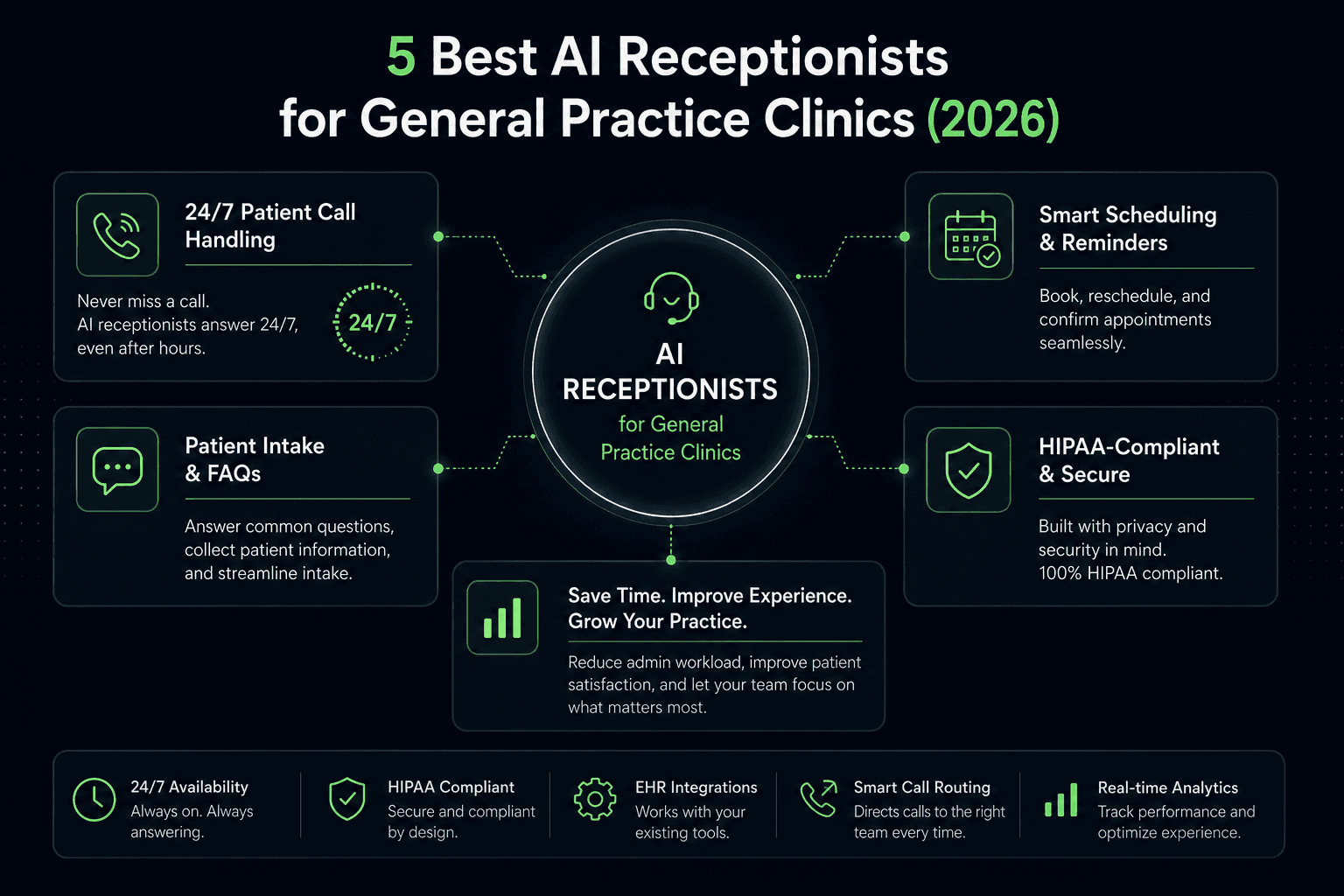
Jun 11, 2026
Articles
5 Best AI Receptionists for General Practice Clinics
Looking for the best AI receptionist for general practice? Compare the top 5 platforms—features, pricing, and HIPAA compliance—and find the right fit for your clinic.
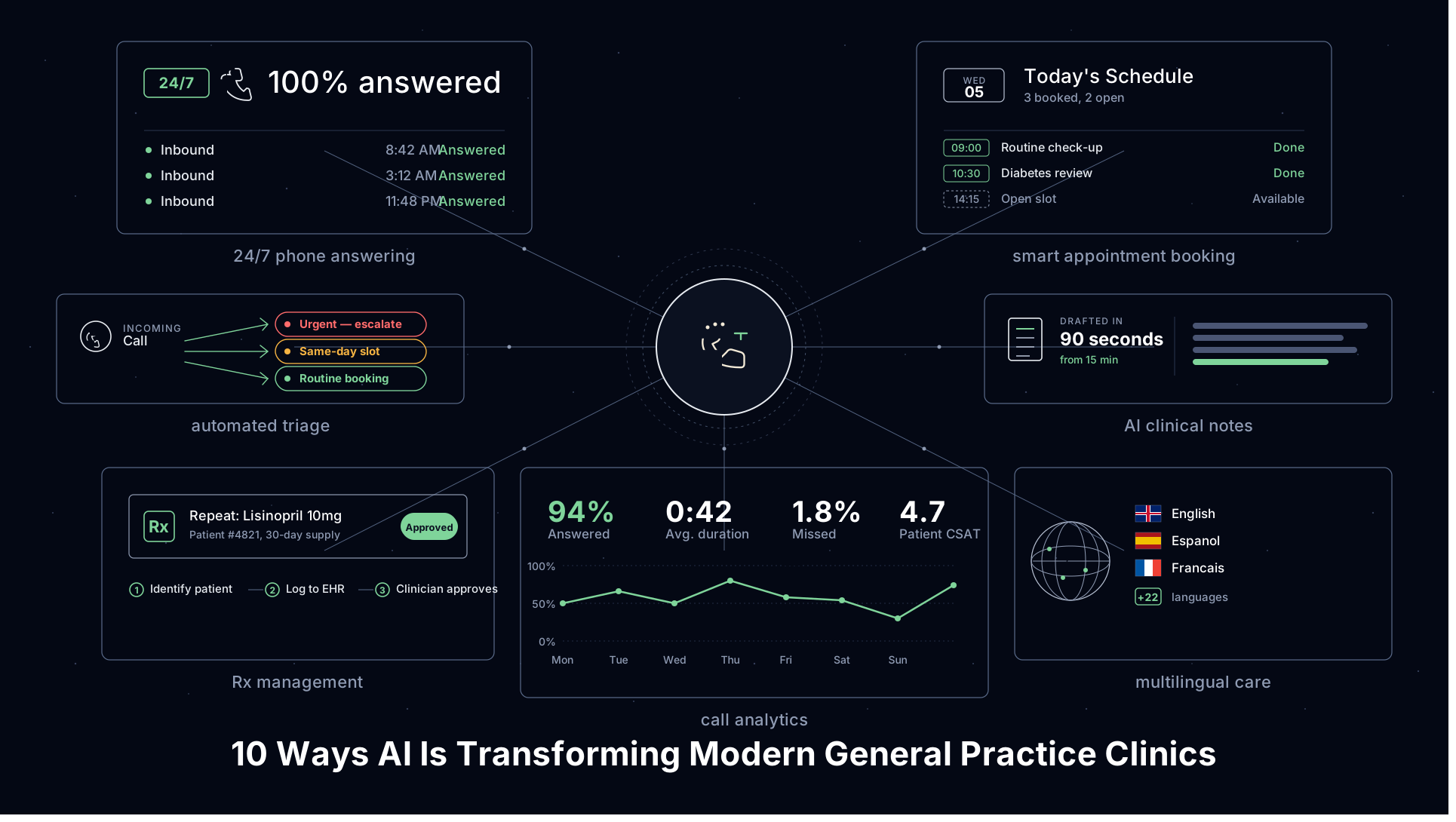
Jun 9, 2026
Articles
10 Ways AI Is Transforming Modern General Practice Clinics
10 specific ways AI voice agents are reshaping GP clinics in 2026 — from 24/7 call answering to smarter triage, prescriptions, and post-care follow-ups.
Load More
Latest Insights
All Resources
Articles
Case Studies
Tutorials
Jun 11, 2026
Articles
5 Best AI Receptionists for General Practice Clinics
Looking for the best AI receptionist for general practice? Compare the top 5 platforms—features, pricing, and HIPAA compliance—and find the right fit for your clinic.
Jun 9, 2026
Articles
10 Ways AI Is Transforming Modern General Practice Clinics
10 specific ways AI voice agents are reshaping GP clinics in 2026 — from 24/7 call answering to smarter triage, prescriptions, and post-care follow-ups.
Load More

Automate your business with AI phone Agents
Automate your business with AI phone Agents
Automate your business with AI phone Agents
Automate your business with AI phone Agents
Call automation for healthcare, real estate, logistics, financial services & small businesses.
Call automation for healthcare, real estate, logistics, financial services & small businesses.

Join Discord
Connect with our community, ask questions, and stay updated on product news.

Book a Call
Schedule a quick call with our team to explore solutions for your needs.
Get started
Industries
Usecases
Integrations
Legal & Community
Join Discord
Connect with our community, ask questions, and stay updated on product news.
Book a Call
Schedule a quick call with our team to explore solutions for your needs.
Get started
Industries
Usecases
Integrations
Legal & Community
Join Discord
Connect with our community, ask questions, and stay updated on product news.
Book a Call
Schedule a quick call with our team to explore solutions for your needs.
Get started
Industries
Usecases
Integrations
Legal & Community
Join Discord
Connect with our community, ask questions, and stay updated on product news.
Book a Call
Schedule a quick call with our team to explore solutions for your needs.
Get started
Industries
Usecases
Integrations
Legal & Community