
All Insights
Articles
AI SDR & Outbound Automation Statistics & Trends [2026]
41% of enterprise B2B teams run AI SDRs in production. 50+ verified stats on outbound automation, reply rates, cost per lead, voice SDR benchmarks & what actually works.





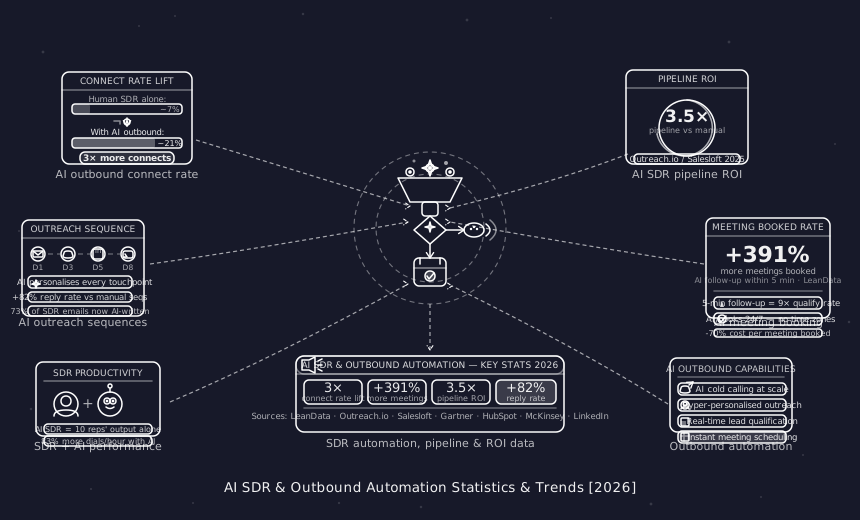
AI SDR tools have moved from early experiment to default infrastructure inside most enterprise sales orgs in under three years. As of Q1 2026, 41% of enterprise B2B teams run at least one AI SDR in production — up from 3% in early 2024. The global AI SDR market is valued at $4.27–5.22 billion in 2025–2026 and is projected to exceed $17 billion by 2030. For sales teams evaluating whether to adopt, this page compiles the most current, primary-sourced statistics on adoption rates, performance benchmarks, cost savings, voice outreach, and where AI SDRs fall short.
Quick answer: AI SDR tools raise per-rep monthly outbound volume by 6.4x, cut cost per qualified opportunity by 54% versus human-only pods, and improve meeting booking rates by 30–40%. The trade-off: raw reply rates drop 38% at AI volumes, deliverability degrades faster, and 57% of quota attainment benchmarks now depend on hybrid human-plus-AI models rather than AI-only. — Bridge Group SDR Metrics 2026 / Salesforce State of Sales 2026.
Top AI SDR Statistics for 2026 (Editor's Picks)
41% of enterprise B2B teams have at least one AI SDR running in production as of Q1 2026, up from 12% one year earlier and 3% in early 2024. — Salesforce State of Sales 2026 / Outreach State of Sales Engagement
$4.27 billion — global AI SDR market size in 2025, projected to grow to $5.22 billion in 2026 and $24.32 billion by 2034. — Fortune Business Insights, 2025
6.4x increase in per-rep monthly outbound volume (from 1,150 to 7,400 touches) when AI augments human SDRs. — Apollo / ZoomInfo 2026 outbound benchmarks
54% reduction in cost per qualified opportunity: from $487 (human-only pods) to $224 (hybrid AI + human pods). — Bridge Group SDR Metrics 2026
18–22% email reply rates for sales teams using AI-assisted outreach, versus the 8–10% industry average for generic outbound — roughly double. — Outreach Sales Execution Benchmark Report, 2025
21x more likely to qualify — leads contacted within 5 minutes versus those contacted after 30 minutes. — InsideSales.com / cited in multiple sources
35% annual SDR turnover in U.S. organisations, with median ramp time of 3–5 months — the structural cost AI tools are designed to offset. — Bridge Group SDR Metrics Report / industry benchmarks
30–40% improvement in meeting booking rates when AI optimises messaging, send timing, and channel selection. — Salesloft Revenue Productivity Report, 2025
1. AI SDR Market Size & Growth
$4.27 billion — global AI SDR market size in 2025. — Fortune Business Insights, 2025
$5.22 billion — projected 2026 market size, a ~22% year-over-year increase. — Fortune Business Insights, 2025
$24.32 billion — projected market size by 2034 at a 21.2% CAGR. — Fortune Business Insights, 2025
A parallel estimate from The Business Research Company places the AI SDR market at $4.39 billion in 2025, growing to $17.58 billion by 2030 at a 31.9% CAGR. — The Business Research Company, 2026
39.4% — North America's share of the global AI SDR market in 2025, leading all regions. — Fortune Business Insights, 2025
27.42% — Asia Pacific CAGR for AI SDR adoption, the fastest-growing region. — MarketsandMarkets, 2026
42% annually — growth rate of the AI-powered sales tools market overall. — AI SDR Industry Report, 2026
Fewer than 10 dedicated AI SDR platforms existed in 2020. By 2024 there were more than 60 — the vendor landscape tripled in under four years. — G2 Sales Automation Market Report, 2026
Healthcare is the fastest-growing vertical for AI SDR adoption, at a projected 25.45% CAGR. — Fortune Business Insights, 2025
2. Adoption Rates
41% of enterprise B2B teams (500+ employees) have at least one AI SDR in production as of Q1 2026 — up from 12% one year earlier and 3% in early 2024. The 38-point enterprise jump in 12 months is the steepest single-year gain in any sales technology category since marketing automation in 2014. — Salesforce State of Sales 2026 / Outreach
55% of companies with 500+ employees had adopted AI SDR tools as of Q1 2026. — Forrester B2B Sales Automation Landscape, Q1 2026
27% of mid-market teams (50–499 employees) are in production with AI SDR tools; 14% of SMBs — both up sharply from near zero two years prior. — Salesforce State of Sales 2026
70% of SaaS companies at Series B and beyond had AI embedded in some form of their outbound process as of 2025. — OpenView Partners SaaS Benchmarks Report, 2025
63% of sales leaders planned to increase their AI investment in SDR workflows over the next 12 months as of Q3 2025. — Gartner Sales Technology Adoption Survey, Q3 2025
81% of sales teams are either experimenting with or have fully implemented AI in some capacity; 41% report full implementation. — Salesforce State of Sales, 2024
60% of B2B sales workflows are projected to be partly or fully automated via AI by 2028. — Gartner
Sales teams using AI tools were 1.3x more likely to hit their annual quota than teams not using any AI as of 2024. — HubSpot State of Sales Report, 2024
3. Outbound Performance Benchmarks
What AI SDR tools actually change
6.4x increase in per-rep monthly outbound volume: from a 1,150-touch human baseline to a 7,400-touch AI-augmented mean. — Apollo / ZoomInfo 2026 outbound benchmarks
Raw reply rates fell 38% as volume scaled: from 4.7% to 2.9% per touch. More volume, lower per-touch rate — the deliverability trade-off is real. — Apollo / ZoomInfo 2026 outbound benchmarks
18–22% average email reply rates for AI-assisted outreach versus 8–10% for generic outbound — roughly double — but this advantage erodes without ongoing list hygiene and domain rotation. — Outreach Sales Execution Benchmark Report, 2025
Multi-touch, multi-channel sequences powered by AI (email + LinkedIn + phone) convert at 2.3x the rate of single-channel approaches. — Forrester B2B Sales Automation Landscape, Q1 2026
30–40% improvement in meeting booking rates when AI optimises messaging, send timing, and channel selection. — Salesloft Revenue Productivity Report, 2025
20% improvement in lead-to-opportunity conversion when AI handles scoring and qualifying before a human SDR picks up the phone. — Gartner Sales Technology Adoption Survey, Q3 2025
23% more meetings booked by human SDRs working alongside AI tools versus working without them as of 2024. — HubSpot State of Sales Report, 2024
85% consistency rate for AI SDRs handling email sequence objections. Human SDRs show significantly more variability — sometimes an advantage, sometimes a liability. — Salesloft Revenue Productivity Report, 2025
The human SDR baseline these numbers are measured against
Human SDRs spend only 28–30% of their time on revenue-generating activities; administrative tasks consume roughly 41% of the workday. — Salesforce State of Sales, 2024
Human SDRs average 15–25 dials per hour. AI voice agents execute 100–500+ simultaneous calls — a 20–50x scale advantage per seat. — Auto Interview AI, 2026
It takes an average of 18 touches to connect with a prospect over the phone; call-back rates are under 1%. — Gartner, cited in Gradient Works benchmarks
Cold call connect rates in the U.S. run 3–10% across outbound prospecting. Overall cold calling success rates (meaningful outcomes per dial) average ~2.3%. — SalesSo / industry benchmarks, 2026
Cold email reply rates have collapsed to around 5.1%, down from ~7% the prior year. — SalesSo outbound SDR statistics, 2026
80% of deals require at least five follow-ups to close; nearly half of all salespeople stop after one attempt — a dropout AI eliminates. — Marketing Donut, cited in Salesforce State of Sales 2024
57% of B2B SDRs hit quota in a given quarter — the benchmark hybrid AI models are meant to improve. Software SDRs fare worse, with only 41.2% hitting quota. — RepVue / Bridge Group, 2025–2026
Median SDR OTE: $85,000/year. Fully-loaded cost including tools, benefits, and management overhead runs $35,000–55,000 in additional annual cost. Replacement cost when they leave (35% annual turnover) runs ~$28,500 per head. — Bridge Group SDR Metrics Report 2025 / industry estimates
4. Cost Savings & ROI
54% reduction in cost per qualified opportunity: from $487 (human-only pods) to $224 (hybrid AI + human pods). — Bridge Group SDR Metrics 2026
25% average drop in customer acquisition costs for companies adopting AI sales solutions. — Landbase / cited research, 2025
40–60% reduction in operational sales costs from AI automation taking over repetitive tasks. — multiple cited benchmarks, 2025–2026
SDR onboarding time drops by ~40% when AI handles list-building and outreach setup, letting new hires focus on conversation skills from day one. — Bridge Group SDR Metrics & Compensation Report, 2025
Human SDRs can manage 3–4x more accounts simultaneously with AI handling prospecting and initial outreach — without a corresponding increase in errors or cognitive load. — McKinsey State of AI in Sales, 2025
AI SDR tools that engage inbound website visitors in real time convert leads at rates 2.6x higher than form-and-wait workflows. — Optif.ai, 2025
40% of enterprise B2B web traffic arrives outside standard business hours — coverage AI SDRs provide that human teams cannot without significant headcount investment. — Clearbit, 2024
SDR managers report spending 30% less time on performance coaching and activity tracking when AI tools generate automated engagement summaries. — Gartner Sales Technology Adoption Survey, Q3 2025
21% less time spent on data entry, CRM updates, and admin work — the hours AI SDR automation recaptures and redirects to selling. — Salesforce State of Sales, 6th Edition, 2024
5. AI Voice SDR & Outbound Phone Automation
Phone is the highest-intent outbound channel and historically the hardest to scale. AI voice agents change that equation directly — and for sales teams, this is where the next major productivity unlock sits.
28–34% of mid-market and enterprise B2B sales teams had deployed at least one AI voice agent for outbound prospecting as of Q1 2026, up from 11% in 2024. — Auto Interview AI, 2026
73% of sales leaders plan to increase AI calling investment in 2026; only 8% plan to reduce it. — Gartner Sales Technology Survey, 2025
AI voice agents execute 100–500+ simultaneous calls versus 15–25 dials per hour for human SDRs — a 20–50x scale advantage. — Auto Interview AI, 2026
Responding to a web lead within 1 minute versus 5 minutes increases conversion by 391%. AI can achieve sub-30-second response times 24/7. — Auto Interview AI, 2026
Leads contacted within 5 minutes are 21x more likely to qualify than those contacted after 30 minutes. — InsideSales.com, cited in multiple SDR benchmarks
Human SDR teams average a 47-hour lead response time. AI SDRs respond in under one minute — 24/7, including nights, weekends, and international time zones. — Clara AI SDR / industry benchmarks
Calls that reach a human decision-maker convert to a next step at 12–18% with AI agents, compared to 22–31% for human SDRs — AI still underperforms humans in live conversation quality, but the volume advantage compensates. — Auto Interview AI, 2026
74% of test callers in a blind evaluation could not distinguish an AI voice agent from a human SDR using a 2026-generation platform. — Retell AI, March 2026
~620ms first-response latency is achievable on production AI voice platforms — fast enough to feel conversational. Sub-800ms is the threshold for natural dialogue; ~30% of deployments currently achieve it. — Auto Interview AI / Retell AI, 2026
AI calling ROI turns positive for most companies at 3,000+ dials per month. Below this threshold, setup cost and management overhead make human SDRs more economical. — Auto Interview AI, 2026
Conversational voice AI for outbound sales is projected to reach early mainstream adoption by 2027. — Gartner Emerging Technologies Hype Cycle, 2025
SMBs under 50 employees are the fastest-growing AI calling adopter segment, growing 67% year-over-year in 2025. — Auto Interview AI, 2026
Brilo AI is built for exactly this workflow: AI phone agents that handle outbound prospecting calls, lead qualification, and appointment booking at scale — autonomously, 24/7, with CRM integration and live transfer to human reps when a prospect is ready. Plans start free at brilo.ai/resources/ai-outbound-calling.
6. Where AI SDR Tools Fail
The failure data is as important as the ROI data for sales teams evaluating these tools.
Over 40% of enterprise B2B web traffic arrives outside business hours — but AI tools hitting this volume 6.4x faster also hit email deliverability ceilings 6.4x faster. Domain reputation damage is the leading technical failure mode. — Apollo / ZoomInfo benchmarks; Gartner
30% of AI SDR campaigns underperform due to segmentation errors, per OneShot.ai — requiring resource-heavy recalibration. — OneShot.ai / MarketsandMarkets, 2026
AI SDRs underperform sharply on ICPs with high persona variance — where buying motivation, stack context, and pain points vary so widely that templated personalisation fails. Enterprise architecture firms, niche technical founders, and highly regulated verticals are cited examples. — Digital Applied SDR analysis, Q1 2026
Companies running AI-only outreach (no human SDRs) report 25–35% lower pipeline value per lead — AI-qualified leads close at lower rates than human-qualified leads. — Auto Interview AI, 2026
25% of quota attainment: AI tools raise outbound volume, but only 57% of SDRs hit quota even in AI-augmented teams — the bottleneck has shifted from activity to conversation quality and ICP precision. — RepVue / Bridge Group benchmarks, 2025–2026
Net SDR headcount in U.S. B2B SaaS companies is down 18% year-over-year in 2026, but junior SDR roles (0–2 years experience) fell 31% while senior "reply specialist" and RevOps/sender ops roles grew — AI reshapes the org more than it shrinks it. — Bridge Group SDR Metrics 2026
TCPA and FCC 2024 rules explicitly classify AI-synthesised voices as requiring prior express written consent for AI-generated voice marketing calls in the U.S. EU deployments require GDPR compliance. Always use a platform with built-in DNC scrubbing and consent management. — FCC, 2024
7. The Hybrid Model: What Actually Works in 2026
The highest-performing SDR teams in 2025–2026 operate on a hybrid model: AI handles volume, prospecting, and early qualification; humans handle objections, multi-stakeholder conversations, and closing. — Gartner Sales Technology Adoption Survey, Q3 2025
$224 cost per qualified opportunity in hybrid pods vs. $487 in human-only — the hybrid model, not AI-only, is where the 54% cost reduction comes from. — Bridge Group SDR Metrics 2026
Sales teams using AI achieve 10–15% increases in sales productivity overall. — McKinsey, 2024
AI-assisted outreach AI wins on volume and consistency; human SDRs win on nuance, empathy, and complex multi-stakeholder conversations. — Forrester B2B Sales Automation Landscape, Q1 2026
Multi-agent AI SDR architectures — deploying specialised agents for lead generation, qualification, and personalised outreach separately — are showing up to 7x higher conversion rates than traditional single-agent approaches. — SalesSo / industry benchmarks, 2026
8. Future Projections
60% of B2B sales workflows projected to be partly or fully automated via AI by 2028. — Gartner
Conversational voice AI for outbound sales projected to reach early mainstream adoption by 2027. — Gartner Emerging Technologies Hype Cycle, 2025
$24.32 billion — projected global AI SDR market by 2034 at a 21.2% CAGR. — Fortune Business Insights, 2025
83% of executives expect AI agents to autonomously execute actions by 2026. — IBM, 2025
AI SDR tools will increasingly incorporate persistent memory across the prospect journey — retaining context from conversations months earlier and treating cold re-engagement as a warm, contextual continuation. This capability is currently absent from most platforms but is the next major frontier. — Gartner / Bombora Intent Data Benchmark Report, 2025
Frequently Asked Question
What is an AI SDR tool?
An AI SDR (Sales Development Representative) tool is software that automates top-of-funnel outbound sales tasks — prospect research, personalised email and phone outreach, lead scoring, follow-up sequences, and meeting booking — that human SDRs previously handled manually. Modern AI SDR tools range from email personalisation assistants to fully autonomous agents that prospect, engage, qualify, and hand off to human reps with no manual involvement.
How many companies use AI SDR tools in 2026?
As of Q1 2026, 41% of enterprise B2B teams (500+ employees) have at least one AI SDR in production, up from 3% in early 2024, per Salesforce State of Sales 2026. Mid-market adoption stands at 27% and SMB adoption at 14%. Among SaaS companies at Series B and beyond, 70% had AI embedded in their outbound process as of 2025 (OpenView Partners).
What ROI do AI SDR tools deliver?
Hybrid AI + human pods cut cost per qualified opportunity by 54% (from $487 to $224) versus human-only teams, per Bridge Group SDR Metrics 2026. Per-rep monthly outbound volume rises 6.4x. Meeting booking rates improve 30–40%. Customer acquisition costs drop ~25% on average. However, AI-only teams (no human SDRs) report 25–35% lower pipeline value per lead — the ROI comes from the hybrid model, not AI replacing humans entirely.
What is the best channel for AI SDR outreach?
Multi-touch, multi-channel sequences combining email, LinkedIn, and phone convert at 2.3x the rate of single-channel approaches (Forrester, Q1 2026). Phone is the highest-intent channel but historically hardest to scale — AI voice agents solve this by running 100–500+ simultaneous calls at sub-$0.10 per minute. For inbound follow-up specifically, responding within 1 minute versus 5 minutes increases conversion by 391%, and AI achieves sub-30-second response times 24/7.
How do AI voice agents compare to human SDRs on calls?
AI voice agents scale to 100–500+ simultaneous calls versus 15–25 dials per hour for human SDRs. Response latency on best-in-class platforms reaches ~620ms — fast enough to feel conversational. Live decision-maker conversion sits at 12–18% for AI versus 22–31% for human SDRs, meaning humans still outperform AI on live calls, but the volume advantage more than compensates at scale. 74% of test callers in a 2026 blind study could not distinguish an AI voice from a human SDR.
What are the risks of AI SDR tools?
The three main failure modes: (1) Deliverability collapse — AI hits email volume ceilings 6.4x faster than human SDRs, damaging domain reputation without strict sender pool architecture; (2) Segmentation errors — 30% of AI SDR campaigns underperform due to poor ICP targeting; (3) Compliance — U.S. TCPA and FCC 2024 rules require prior express written consent for AI-synthesised voice marketing calls. Always use a platform with built-in DNC scrubbing and consent management.
Methodology & Sources
Every statistic in this article was verified against its original published source before inclusion. Primary sources used: Salesforce State of Sales 2024 and 2026; Outreach State of Sales Engagement; Bridge Group SDR Metrics & Compensation Report 2025–2026; Fortune Business Insights AI SDR Market Report 2025; The Business Research Company AI SDR Market Report 2026; Gartner Sales Technology Adoption Survey Q3 2025; Gartner Emerging Technologies Hype Cycle 2025; Forrester B2B Sales Automation Landscape Q1 2026; Outreach Sales Execution Benchmark Report 2025; Salesloft Revenue Productivity Report 2025; HubSpot State of Sales Report 2024; McKinsey State of AI in Sales 2025; OpenView Partners SaaS Benchmarks Report 2025; Apollo / ZoomInfo 2026 outbound benchmarks; RepVue SDR quota attainment data 2025–2026; InsideSales.com speed-to-lead research; Gradient Works B2B Sales Performance Benchmarks 2025; FCC 2024 AI voice consent rules. No statistics were sourced from competitor roundup blogs or unverifiable aggregators.
Put these numbers to work. The data above points to one clear gap in most outbound stacks: the phone channel. Email reply rates have collapsed to 5.1%, but AI voice agents achieve 92–96% accurate call resolution for standard scenarios, respond in under 30 seconds 24/7, and qualify leads at $0.07–$0.10 per minute versus $177 per lead in human SDR labor. Brilo AI's outbound voice agents handle prospecting calls, lead qualification, and warm transfers — built for sales teams that need to scale outreach without scaling headcount. Plans start free at brilo.ai.
All Insights
Articles
AI SDR & Outbound Automation Statistics & Trends [2026]
41% of enterprise B2B teams run AI SDRs in production. 50+ verified stats on outbound automation, reply rates, cost per lead, voice SDR benchmarks & what actually works.
AI SDR tools have moved from early experiment to default infrastructure inside most enterprise sales orgs in under three years. As of Q1 2026, 41% of enterprise B2B teams run at least one AI SDR in production — up from 3% in early 2024. The global AI SDR market is valued at $4.27–5.22 billion in 2025–2026 and is projected to exceed $17 billion by 2030. For sales teams evaluating whether to adopt, this page compiles the most current, primary-sourced statistics on adoption rates, performance benchmarks, cost savings, voice outreach, and where AI SDRs fall short.
Quick answer: AI SDR tools raise per-rep monthly outbound volume by 6.4x, cut cost per qualified opportunity by 54% versus human-only pods, and improve meeting booking rates by 30–40%. The trade-off: raw reply rates drop 38% at AI volumes, deliverability degrades faster, and 57% of quota attainment benchmarks now depend on hybrid human-plus-AI models rather than AI-only. — Bridge Group SDR Metrics 2026 / Salesforce State of Sales 2026.
Top AI SDR Statistics for 2026 (Editor's Picks)
41% of enterprise B2B teams have at least one AI SDR running in production as of Q1 2026, up from 12% one year earlier and 3% in early 2024. — Salesforce State of Sales 2026 / Outreach State of Sales Engagement
$4.27 billion — global AI SDR market size in 2025, projected to grow to $5.22 billion in 2026 and $24.32 billion by 2034. — Fortune Business Insights, 2025
6.4x increase in per-rep monthly outbound volume (from 1,150 to 7,400 touches) when AI augments human SDRs. — Apollo / ZoomInfo 2026 outbound benchmarks
54% reduction in cost per qualified opportunity: from $487 (human-only pods) to $224 (hybrid AI + human pods). — Bridge Group SDR Metrics 2026
18–22% email reply rates for sales teams using AI-assisted outreach, versus the 8–10% industry average for generic outbound — roughly double. — Outreach Sales Execution Benchmark Report, 2025
21x more likely to qualify — leads contacted within 5 minutes versus those contacted after 30 minutes. — InsideSales.com / cited in multiple sources
35% annual SDR turnover in U.S. organisations, with median ramp time of 3–5 months — the structural cost AI tools are designed to offset. — Bridge Group SDR Metrics Report / industry benchmarks
30–40% improvement in meeting booking rates when AI optimises messaging, send timing, and channel selection. — Salesloft Revenue Productivity Report, 2025
1. AI SDR Market Size & Growth
$4.27 billion — global AI SDR market size in 2025. — Fortune Business Insights, 2025
$5.22 billion — projected 2026 market size, a ~22% year-over-year increase. — Fortune Business Insights, 2025
$24.32 billion — projected market size by 2034 at a 21.2% CAGR. — Fortune Business Insights, 2025
A parallel estimate from The Business Research Company places the AI SDR market at $4.39 billion in 2025, growing to $17.58 billion by 2030 at a 31.9% CAGR. — The Business Research Company, 2026
39.4% — North America's share of the global AI SDR market in 2025, leading all regions. — Fortune Business Insights, 2025
27.42% — Asia Pacific CAGR for AI SDR adoption, the fastest-growing region. — MarketsandMarkets, 2026
42% annually — growth rate of the AI-powered sales tools market overall. — AI SDR Industry Report, 2026
Fewer than 10 dedicated AI SDR platforms existed in 2020. By 2024 there were more than 60 — the vendor landscape tripled in under four years. — G2 Sales Automation Market Report, 2026
Healthcare is the fastest-growing vertical for AI SDR adoption, at a projected 25.45% CAGR. — Fortune Business Insights, 2025
2. Adoption Rates
41% of enterprise B2B teams (500+ employees) have at least one AI SDR in production as of Q1 2026 — up from 12% one year earlier and 3% in early 2024. The 38-point enterprise jump in 12 months is the steepest single-year gain in any sales technology category since marketing automation in 2014. — Salesforce State of Sales 2026 / Outreach
55% of companies with 500+ employees had adopted AI SDR tools as of Q1 2026. — Forrester B2B Sales Automation Landscape, Q1 2026
27% of mid-market teams (50–499 employees) are in production with AI SDR tools; 14% of SMBs — both up sharply from near zero two years prior. — Salesforce State of Sales 2026
70% of SaaS companies at Series B and beyond had AI embedded in some form of their outbound process as of 2025. — OpenView Partners SaaS Benchmarks Report, 2025
63% of sales leaders planned to increase their AI investment in SDR workflows over the next 12 months as of Q3 2025. — Gartner Sales Technology Adoption Survey, Q3 2025
81% of sales teams are either experimenting with or have fully implemented AI in some capacity; 41% report full implementation. — Salesforce State of Sales, 2024
60% of B2B sales workflows are projected to be partly or fully automated via AI by 2028. — Gartner
Sales teams using AI tools were 1.3x more likely to hit their annual quota than teams not using any AI as of 2024. — HubSpot State of Sales Report, 2024
3. Outbound Performance Benchmarks
What AI SDR tools actually change
6.4x increase in per-rep monthly outbound volume: from a 1,150-touch human baseline to a 7,400-touch AI-augmented mean. — Apollo / ZoomInfo 2026 outbound benchmarks
Raw reply rates fell 38% as volume scaled: from 4.7% to 2.9% per touch. More volume, lower per-touch rate — the deliverability trade-off is real. — Apollo / ZoomInfo 2026 outbound benchmarks
18–22% average email reply rates for AI-assisted outreach versus 8–10% for generic outbound — roughly double — but this advantage erodes without ongoing list hygiene and domain rotation. — Outreach Sales Execution Benchmark Report, 2025
Multi-touch, multi-channel sequences powered by AI (email + LinkedIn + phone) convert at 2.3x the rate of single-channel approaches. — Forrester B2B Sales Automation Landscape, Q1 2026
30–40% improvement in meeting booking rates when AI optimises messaging, send timing, and channel selection. — Salesloft Revenue Productivity Report, 2025
20% improvement in lead-to-opportunity conversion when AI handles scoring and qualifying before a human SDR picks up the phone. — Gartner Sales Technology Adoption Survey, Q3 2025
23% more meetings booked by human SDRs working alongside AI tools versus working without them as of 2024. — HubSpot State of Sales Report, 2024
85% consistency rate for AI SDRs handling email sequence objections. Human SDRs show significantly more variability — sometimes an advantage, sometimes a liability. — Salesloft Revenue Productivity Report, 2025
The human SDR baseline these numbers are measured against
Human SDRs spend only 28–30% of their time on revenue-generating activities; administrative tasks consume roughly 41% of the workday. — Salesforce State of Sales, 2024
Human SDRs average 15–25 dials per hour. AI voice agents execute 100–500+ simultaneous calls — a 20–50x scale advantage per seat. — Auto Interview AI, 2026
It takes an average of 18 touches to connect with a prospect over the phone; call-back rates are under 1%. — Gartner, cited in Gradient Works benchmarks
Cold call connect rates in the U.S. run 3–10% across outbound prospecting. Overall cold calling success rates (meaningful outcomes per dial) average ~2.3%. — SalesSo / industry benchmarks, 2026
Cold email reply rates have collapsed to around 5.1%, down from ~7% the prior year. — SalesSo outbound SDR statistics, 2026
80% of deals require at least five follow-ups to close; nearly half of all salespeople stop after one attempt — a dropout AI eliminates. — Marketing Donut, cited in Salesforce State of Sales 2024
57% of B2B SDRs hit quota in a given quarter — the benchmark hybrid AI models are meant to improve. Software SDRs fare worse, with only 41.2% hitting quota. — RepVue / Bridge Group, 2025–2026
Median SDR OTE: $85,000/year. Fully-loaded cost including tools, benefits, and management overhead runs $35,000–55,000 in additional annual cost. Replacement cost when they leave (35% annual turnover) runs ~$28,500 per head. — Bridge Group SDR Metrics Report 2025 / industry estimates
4. Cost Savings & ROI
54% reduction in cost per qualified opportunity: from $487 (human-only pods) to $224 (hybrid AI + human pods). — Bridge Group SDR Metrics 2026
25% average drop in customer acquisition costs for companies adopting AI sales solutions. — Landbase / cited research, 2025
40–60% reduction in operational sales costs from AI automation taking over repetitive tasks. — multiple cited benchmarks, 2025–2026
SDR onboarding time drops by ~40% when AI handles list-building and outreach setup, letting new hires focus on conversation skills from day one. — Bridge Group SDR Metrics & Compensation Report, 2025
Human SDRs can manage 3–4x more accounts simultaneously with AI handling prospecting and initial outreach — without a corresponding increase in errors or cognitive load. — McKinsey State of AI in Sales, 2025
AI SDR tools that engage inbound website visitors in real time convert leads at rates 2.6x higher than form-and-wait workflows. — Optif.ai, 2025
40% of enterprise B2B web traffic arrives outside standard business hours — coverage AI SDRs provide that human teams cannot without significant headcount investment. — Clearbit, 2024
SDR managers report spending 30% less time on performance coaching and activity tracking when AI tools generate automated engagement summaries. — Gartner Sales Technology Adoption Survey, Q3 2025
21% less time spent on data entry, CRM updates, and admin work — the hours AI SDR automation recaptures and redirects to selling. — Salesforce State of Sales, 6th Edition, 2024
5. AI Voice SDR & Outbound Phone Automation
Phone is the highest-intent outbound channel and historically the hardest to scale. AI voice agents change that equation directly — and for sales teams, this is where the next major productivity unlock sits.
28–34% of mid-market and enterprise B2B sales teams had deployed at least one AI voice agent for outbound prospecting as of Q1 2026, up from 11% in 2024. — Auto Interview AI, 2026
73% of sales leaders plan to increase AI calling investment in 2026; only 8% plan to reduce it. — Gartner Sales Technology Survey, 2025
AI voice agents execute 100–500+ simultaneous calls versus 15–25 dials per hour for human SDRs — a 20–50x scale advantage. — Auto Interview AI, 2026
Responding to a web lead within 1 minute versus 5 minutes increases conversion by 391%. AI can achieve sub-30-second response times 24/7. — Auto Interview AI, 2026
Leads contacted within 5 minutes are 21x more likely to qualify than those contacted after 30 minutes. — InsideSales.com, cited in multiple SDR benchmarks
Human SDR teams average a 47-hour lead response time. AI SDRs respond in under one minute — 24/7, including nights, weekends, and international time zones. — Clara AI SDR / industry benchmarks
Calls that reach a human decision-maker convert to a next step at 12–18% with AI agents, compared to 22–31% for human SDRs — AI still underperforms humans in live conversation quality, but the volume advantage compensates. — Auto Interview AI, 2026
74% of test callers in a blind evaluation could not distinguish an AI voice agent from a human SDR using a 2026-generation platform. — Retell AI, March 2026
~620ms first-response latency is achievable on production AI voice platforms — fast enough to feel conversational. Sub-800ms is the threshold for natural dialogue; ~30% of deployments currently achieve it. — Auto Interview AI / Retell AI, 2026
AI calling ROI turns positive for most companies at 3,000+ dials per month. Below this threshold, setup cost and management overhead make human SDRs more economical. — Auto Interview AI, 2026
Conversational voice AI for outbound sales is projected to reach early mainstream adoption by 2027. — Gartner Emerging Technologies Hype Cycle, 2025
SMBs under 50 employees are the fastest-growing AI calling adopter segment, growing 67% year-over-year in 2025. — Auto Interview AI, 2026
Brilo AI is built for exactly this workflow: AI phone agents that handle outbound prospecting calls, lead qualification, and appointment booking at scale — autonomously, 24/7, with CRM integration and live transfer to human reps when a prospect is ready. Plans start free at brilo.ai/resources/ai-outbound-calling.
6. Where AI SDR Tools Fail
The failure data is as important as the ROI data for sales teams evaluating these tools.
Over 40% of enterprise B2B web traffic arrives outside business hours — but AI tools hitting this volume 6.4x faster also hit email deliverability ceilings 6.4x faster. Domain reputation damage is the leading technical failure mode. — Apollo / ZoomInfo benchmarks; Gartner
30% of AI SDR campaigns underperform due to segmentation errors, per OneShot.ai — requiring resource-heavy recalibration. — OneShot.ai / MarketsandMarkets, 2026
AI SDRs underperform sharply on ICPs with high persona variance — where buying motivation, stack context, and pain points vary so widely that templated personalisation fails. Enterprise architecture firms, niche technical founders, and highly regulated verticals are cited examples. — Digital Applied SDR analysis, Q1 2026
Companies running AI-only outreach (no human SDRs) report 25–35% lower pipeline value per lead — AI-qualified leads close at lower rates than human-qualified leads. — Auto Interview AI, 2026
25% of quota attainment: AI tools raise outbound volume, but only 57% of SDRs hit quota even in AI-augmented teams — the bottleneck has shifted from activity to conversation quality and ICP precision. — RepVue / Bridge Group benchmarks, 2025–2026
Net SDR headcount in U.S. B2B SaaS companies is down 18% year-over-year in 2026, but junior SDR roles (0–2 years experience) fell 31% while senior "reply specialist" and RevOps/sender ops roles grew — AI reshapes the org more than it shrinks it. — Bridge Group SDR Metrics 2026
TCPA and FCC 2024 rules explicitly classify AI-synthesised voices as requiring prior express written consent for AI-generated voice marketing calls in the U.S. EU deployments require GDPR compliance. Always use a platform with built-in DNC scrubbing and consent management. — FCC, 2024
7. The Hybrid Model: What Actually Works in 2026
The highest-performing SDR teams in 2025–2026 operate on a hybrid model: AI handles volume, prospecting, and early qualification; humans handle objections, multi-stakeholder conversations, and closing. — Gartner Sales Technology Adoption Survey, Q3 2025
$224 cost per qualified opportunity in hybrid pods vs. $487 in human-only — the hybrid model, not AI-only, is where the 54% cost reduction comes from. — Bridge Group SDR Metrics 2026
Sales teams using AI achieve 10–15% increases in sales productivity overall. — McKinsey, 2024
AI-assisted outreach AI wins on volume and consistency; human SDRs win on nuance, empathy, and complex multi-stakeholder conversations. — Forrester B2B Sales Automation Landscape, Q1 2026
Multi-agent AI SDR architectures — deploying specialised agents for lead generation, qualification, and personalised outreach separately — are showing up to 7x higher conversion rates than traditional single-agent approaches. — SalesSo / industry benchmarks, 2026
8. Future Projections
60% of B2B sales workflows projected to be partly or fully automated via AI by 2028. — Gartner
Conversational voice AI for outbound sales projected to reach early mainstream adoption by 2027. — Gartner Emerging Technologies Hype Cycle, 2025
$24.32 billion — projected global AI SDR market by 2034 at a 21.2% CAGR. — Fortune Business Insights, 2025
83% of executives expect AI agents to autonomously execute actions by 2026. — IBM, 2025
AI SDR tools will increasingly incorporate persistent memory across the prospect journey — retaining context from conversations months earlier and treating cold re-engagement as a warm, contextual continuation. This capability is currently absent from most platforms but is the next major frontier. — Gartner / Bombora Intent Data Benchmark Report, 2025
Frequently Asked Question
What is an AI SDR tool?
An AI SDR (Sales Development Representative) tool is software that automates top-of-funnel outbound sales tasks — prospect research, personalised email and phone outreach, lead scoring, follow-up sequences, and meeting booking — that human SDRs previously handled manually. Modern AI SDR tools range from email personalisation assistants to fully autonomous agents that prospect, engage, qualify, and hand off to human reps with no manual involvement.
How many companies use AI SDR tools in 2026?
As of Q1 2026, 41% of enterprise B2B teams (500+ employees) have at least one AI SDR in production, up from 3% in early 2024, per Salesforce State of Sales 2026. Mid-market adoption stands at 27% and SMB adoption at 14%. Among SaaS companies at Series B and beyond, 70% had AI embedded in their outbound process as of 2025 (OpenView Partners).
What ROI do AI SDR tools deliver?
Hybrid AI + human pods cut cost per qualified opportunity by 54% (from $487 to $224) versus human-only teams, per Bridge Group SDR Metrics 2026. Per-rep monthly outbound volume rises 6.4x. Meeting booking rates improve 30–40%. Customer acquisition costs drop ~25% on average. However, AI-only teams (no human SDRs) report 25–35% lower pipeline value per lead — the ROI comes from the hybrid model, not AI replacing humans entirely.
What is the best channel for AI SDR outreach?
Multi-touch, multi-channel sequences combining email, LinkedIn, and phone convert at 2.3x the rate of single-channel approaches (Forrester, Q1 2026). Phone is the highest-intent channel but historically hardest to scale — AI voice agents solve this by running 100–500+ simultaneous calls at sub-$0.10 per minute. For inbound follow-up specifically, responding within 1 minute versus 5 minutes increases conversion by 391%, and AI achieves sub-30-second response times 24/7.
How do AI voice agents compare to human SDRs on calls?
AI voice agents scale to 100–500+ simultaneous calls versus 15–25 dials per hour for human SDRs. Response latency on best-in-class platforms reaches ~620ms — fast enough to feel conversational. Live decision-maker conversion sits at 12–18% for AI versus 22–31% for human SDRs, meaning humans still outperform AI on live calls, but the volume advantage more than compensates at scale. 74% of test callers in a 2026 blind study could not distinguish an AI voice from a human SDR.
What are the risks of AI SDR tools?
The three main failure modes: (1) Deliverability collapse — AI hits email volume ceilings 6.4x faster than human SDRs, damaging domain reputation without strict sender pool architecture; (2) Segmentation errors — 30% of AI SDR campaigns underperform due to poor ICP targeting; (3) Compliance — U.S. TCPA and FCC 2024 rules require prior express written consent for AI-synthesised voice marketing calls. Always use a platform with built-in DNC scrubbing and consent management.
Methodology & Sources
Every statistic in this article was verified against its original published source before inclusion. Primary sources used: Salesforce State of Sales 2024 and 2026; Outreach State of Sales Engagement; Bridge Group SDR Metrics & Compensation Report 2025–2026; Fortune Business Insights AI SDR Market Report 2025; The Business Research Company AI SDR Market Report 2026; Gartner Sales Technology Adoption Survey Q3 2025; Gartner Emerging Technologies Hype Cycle 2025; Forrester B2B Sales Automation Landscape Q1 2026; Outreach Sales Execution Benchmark Report 2025; Salesloft Revenue Productivity Report 2025; HubSpot State of Sales Report 2024; McKinsey State of AI in Sales 2025; OpenView Partners SaaS Benchmarks Report 2025; Apollo / ZoomInfo 2026 outbound benchmarks; RepVue SDR quota attainment data 2025–2026; InsideSales.com speed-to-lead research; Gradient Works B2B Sales Performance Benchmarks 2025; FCC 2024 AI voice consent rules. No statistics were sourced from competitor roundup blogs or unverifiable aggregators.
Put these numbers to work. The data above points to one clear gap in most outbound stacks: the phone channel. Email reply rates have collapsed to 5.1%, but AI voice agents achieve 92–96% accurate call resolution for standard scenarios, respond in under 30 seconds 24/7, and qualify leads at $0.07–$0.10 per minute versus $177 per lead in human SDR labor. Brilo AI's outbound voice agents handle prospecting calls, lead qualification, and warm transfers — built for sales teams that need to scale outreach without scaling headcount. Plans start free at brilo.ai.
Latest Insights
All Resources
Articles
Case Studies
Tutorials

Articles
FDA-Compliant AI Voice for Medical Device Hotlines
What Part 11, ISO 13485, and QMS integration actually require from an AI voice agent on a medical device support line.

Articles
Reduce FDA Warning Letters on Complaint Handling
FDA warning letters citing complaint-handling failures are rising. Here's how automated intake closes the gap.
Load More
Latest Insights
All Resources
Articles
Case Studies
Tutorials
Articles
FDA-Compliant AI Voice for Medical Device Hotlines
What Part 11, ISO 13485, and QMS integration actually require from an AI voice agent on a medical device support line.
Articles
Reduce FDA Warning Letters on Complaint Handling
FDA warning letters citing complaint-handling failures are rising. Here's how automated intake closes the gap.
Load More

Automate your business with AI phone Agents
Automate your business with AI phone Agents
Automate your business with AI phone Agents
Automate your business with AI phone Agents
Call automation for healthcare, real estate, logistics, financial services & small businesses.
Call automation for healthcare, real estate, logistics, financial services & small businesses.

Join Discord
Connect with our community, ask questions, and stay updated on product news.

Book a Call
Schedule a quick call with our team to explore solutions for your needs.
Get started
Industries
Usecases
Integrations
Legal & Community
Join Discord
Connect with our community, ask questions, and stay updated on product news.
Book a Call
Schedule a quick call with our team to explore solutions for your needs.
Get started
Industries
Usecases
Integrations
Legal & Community
Join Discord
Connect with our community, ask questions, and stay updated on product news.
Book a Call
Schedule a quick call with our team to explore solutions for your needs.
Get started
Industries
Usecases
Integrations
Legal & Community
Join Discord
Connect with our community, ask questions, and stay updated on product news.
Book a Call
Schedule a quick call with our team to explore solutions for your needs.
Get started
Industries
Usecases
Integrations
Legal & Community