
All Insights
Articles
AI Receptionist Statistics & Trends [2026]
Small businesses lose $126K/year to missed calls. 50+ verified stats on AI receptionist cost, ROI by industry, adoption rates, and what 1.4M real calls reveal about caller behaviour.





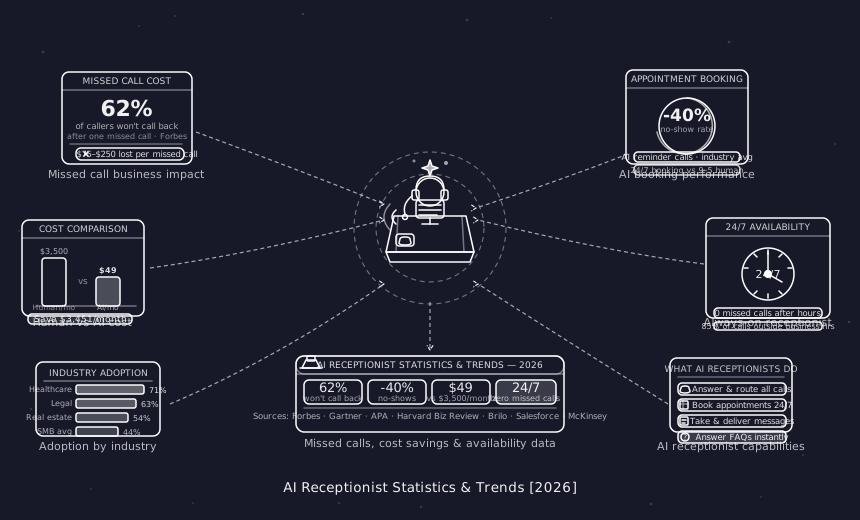
The average small business misses 62% of incoming calls — and 85% of those callers never call back. At a modest $125 per missed call, that adds up to $126,000 in lost annual revenue for a typical service business. AI receptionists fix this structural problem at $49–$299 per month, operating 24/7 with no hold times, no missed calls, and no voicemail black holes. This page compiles 50+ primary-sourced statistics on the AI receptionist market, adoption rates, cost vs. human receptionists, industry performance, and where the technology is heading.
Quick answer: The virtual receptionist market reached $4.64 billion in 2026 (Business Research Insights), growing at 9.8% CAGR. The broader AI voice agents market that powers AI receptionists is expanding at 34.8% CAGR toward $47.5 billion by 2034. AI receptionists cost $600–$4,800 per year versus $30,000–$60,000 for a human receptionist — 87–97% less — while providing 24/7 coverage, unlimited simultaneous calls, and 420–600ms response times. AI adoption among U.S. small businesses surged from 39% in 2024 to 55% in 2025, with 91% reporting revenue improvements.
Top AI Receptionist Statistics for 2026 (Editor's Picks)
62% of incoming calls to small service businesses go unanswered. 85% of those callers never call back. — AMBS Call Center / Ruby Small Business Communication Report, 2025
$126,000 — average annual revenue lost to missed calls by a small business. — AMBS Call Center analysis, cited in AIRA 2026
$4.64 billion — virtual receptionist service market in 2026, growing to $10.85 billion by 2035 at a 9.8% CAGR. — Business Research Insights, 2025
87–97% cost reduction — AI receptionists cost $600–$4,800 per year versus $30,000–$60,000 for a full-time human receptionist. — NextPhone analysis, 2026
73% — average first-call resolution rate for AI receptionists across all industries. Nearly three in four calls fully resolved without human involvement. — AInora, 2026
420–600ms — response latency for modern AI receptionists using end-to-end speech models. — AI Answering Review market report, Q1 2026
91% of U.S. small businesses that adopted AI in 2025 report revenue improvements. — U.S. Chamber of Commerce 2025, cited in AI Answering Review
28.5% of business calls arrive outside business hours; 34.8% of those callers express buying intent. Without AI, these leads are permanently lost. — NextPhone call analysis of 1,446,980 calls, 2025
1. Market Size & Growth
The AI receptionist market sits at the intersection of two fast-growing segments: the mature virtual receptionist services market and the high-growth voice AI agent market.
$4.64 billion — global virtual receptionist service market in 2026, growing to $10.85 billion by 2035 at a 9.8% CAGR. — Business Research Insights, December 2025
$3.85 billion — virtual receptionist market in 2024, projected to reach $9 billion by 2033. — multiple market sources, cited in NextPhone 2026
$2.1 billion — market for products specifically marketed as AI receptionists (excluding general contact center AI) in 2026. — MarketsandMarkets Virtual Receptionist Market Forecast, 2026
The voice AI agents market that powers AI receptionists is growing at a 34.8% CAGR, projected to reach $47.5 billion by 2034. — Market.us, cited in IrisAgent 2026
$4.2 billion — venture capital and private equity investment in voice AI companies in 2025, a 2.3x increase from 2023. — PitchBook Voice AI Investment Trends, 2025
24.3% CAGR — projected growth rate for the AI receptionist market through 2030, reaching $5.1 billion. — SchedulingKit market research, 2026
40% decrease in AI receptionist service costs projected between 2025 and 2028 as competition intensifies and model costs decline. — AInora, 2026
AI model costs have already dropped 50–80% over the past two years, making AI receptionists viable for businesses of any size. — AInora, 2026
2. Adoption Rates
55% of U.S. small businesses used AI in 2025, up from 39% in 2024. 91% of those report revenue improvements. — U.S. Chamber of Commerce 2025, cited in AI Answering Review Q1 2026
50% of U.S. small businesses already use AI for customer service. — Talkdesk, cited in NextPhone 2026
38% of U.S. and EU healthcare practices have deployed AI for phone answering, appointment scheduling, or patient triage — up from 12% in 2023. — MGMA Healthcare Technology Survey, 2025
79% of legal firms used AI in 2024, up from 19% in 2023 — a 316% year-over-year increase. — Clio Legal Trends Report, 2025
Healthcare: an additional 41% of practices plan to implement AI phone handling within 18 months, driven by staff shortages (62%) and patient demand for 24/7 booking (54%). — MGMA Healthcare Technology Outlook, 2026
9 out of 10 businesses using AI voice agents plan to keep or grow their human service teams alongside AI. AI augments staff, it does not replace them. — Talkdesk, cited in NextPhone 2026
Healthcare (13.3%), IT/Tech (18.9%), and Automotive (17.3%) lead AI receptionist adoption across 17+ industries, per analysis of 1,446,980 calls from 2,074 businesses. — NextPhone proprietary data, 2025
European adoption grew 78% year-over-year in 2025, versus 52% in the U.S. The Baltics are the fastest-growing European sub-region at 94% YoY. — AInora, 2026
97% of SMBs using AI voice agents report a revenue boost. — InsideHPC survey data, cited in NextPhone 2026
3. The Missed Call Problem AI Receptionists Solve
The ROI case for AI receptionists begins with the structural problem: most small businesses are systematically losing revenue from unanswered calls, and the status quo — voicemail — does not recover it.
62% of calls to small service businesses go unanswered. Only 37.8% are answered by a live person. — AMBS Call Center / Ruby Small Business Communication Report, 2025
85% of callers who reach voicemail never call back. 67% of people admit to ignoring voicemails even from known contacts. — AMBS Call Center, 2025
62% of callers who don't reach a live person contact a competitor instead. — AIRA analysis, 2026
$126,000 — average annual revenue lost to missed calls by a small business, based on industry call data. — AMBS Call Center analysis, cited in AIRA 2026
$125–$1,200 — revenue lost per missed call, ranging from routine appointments to home service emergencies. Home service businesses lose $300–$1,200 per missed call; legal services lose $425+. — industry benchmarks, 2025–2026
28.5% of business calls arrive outside business hours. 34.8% of those after-hours callers express buying intent — permanent losses without 24/7 coverage. — NextPhone proprietary call data, 2025
A business answering 500 calls per month loses approximately 50 buying-intent calls to after-hours voicemail every month. At $500 average job value, that is $25,000 in missed monthly revenue. — NextPhone analysis, 2026
Businesses with one receptionist miss 32% of calls during their three busiest hours of the day — not because they lack staff, but because one person cannot handle simultaneous calls. — NICE inContact Small Business Call Analytics, 2025
Businesses with 24/7 reception see an average 27% increase in booked appointments within 90 days. — Accenture AI in Healthcare Operations, 2025
AI receptionists capture 15–20% more appointments from after-hours calls that would otherwise go to voicemail. — Dialzara / industry benchmarks, 2025–2026
4. Cost: AI Receptionist vs. Human Receptionist
$600–$4,800 per year — annual cost of an AI receptionist solution for small businesses. Human receptionists cost $30,000–$60,000 per year including salary, benefits, and taxes. That is an 87–97% cost reduction. — NextPhone / Bureau of Labor Statistics, 2026
$45,500 per year — fully-loaded annual cost of a human receptionist (base salary $35,000 + 30% benefits/taxes). An AI receptionist at $199/month costs $2,388/year — a $43,112 annual saving. — NextPhone / BLS, 2026
At 500 calls/month, AI plans cost approximately $0.10 per call versus $1.38–$1.60 per call for human or hybrid answering services — a 15x cost advantage. — AI Answering Review market report, Q1 2026
Traditional live answering services answer in 30–90 seconds (shared agents, queue-based). AI receptionists answer in 6–8 seconds — no queue, no hold. — NextPhone analysis, 2026
A human receptionist works 40 hours per week. The other 128 hours — evenings, weekends, public holidays — calls go to voicemail. AI covers all 168 hours. — NextPhone analysis, 2026
5. AI Receptionist Performance Benchmarks
73% — average first-call resolution rate for AI receptionists. Three in four calls are fully handled without any human involvement. — AInora, 2026
420–600ms — response latency for modern AI receptionists using end-to-end speech models like OpenAI's Realtime API. — AI Answering Review market report, Q1 2026
92% customer satisfaction — the highest of any service model — achieved by AI-first with human escalation. — AI Answering Review market report, Q1 2026
85–92% satisfaction rating for AI receptionist interactions, matching or exceeding the 80–85% human receptionist benchmark. — Trillet.ai industry benchmarks, cited in NextPhone 2026
99.0% of callers in a 1.4 million-call analysis expressed positive or neutral sentiment toward AI receptionist interactions. Only 1.0% expressed any negative sentiment. — NextPhone proprietary data of 1,446,980 calls, 2025
Callers could not distinguish a well-designed AI receptionist from a human in 71% of blind test cases. — University of Michigan HCI Lab, 2025
67% reduction in abandoned calls and significant improvement in first-contact resolution rates at businesses using AI receptionists. — MIT Technology Review, cited in Dialzara 2026
35% faster call handling and 35% higher first-call resolution rates for AI-assisted phone systems. — Dialzara / industry research, 2026
6. ROI by Industry
Healthcare & Dental
Healthcare providers achieve a 30% improvement in administrative efficiency from AI receptionist implementation. — Resonate AI / industry benchmarks, 2026
Dental practices using AI receptionists report 31% fewer unfilled appointment slots — the AI captures cancellation calls and offers slots to waitlisted patients instantly. — AInora, 2026
A dental practice paying $150/month that captures 3 additional new patients per month at $850 lifetime value recovers $2,550/month — a 1,600% ROI. — AIRA analysis, 2026
Healthcare practices miss approximately 34% of incoming calls. — industry benchmarks, cited in AIRA 2026
Legal
Legal firms miss approximately 35% of incoming calls. A single missed client can cost $5,000+ in fees. Industry-wide, missed calls cost law firms an estimated $109 billion annually. — Clio Legal Trends Report, 2025 / AIRA 2026
A three-person law practice adding AI reception for after-hours coverage saw a 34% increase in client inquiries within two months. — MIT Technology Review, cited in Dialzara 2026
A five-person law firm saves $45,000 annually in labour costs with AI receptionists. After subtracting ~$2,400 in AI costs, net savings reach $42,600 per year. — Resonate AI analysis, 2026
70% of legal clients prefer or are neutral toward firms using AI technology, per Clio's Legal Trends Report. — Clio, 2025
Home Services (HVAC, Plumbing, Roofing)
Home service businesses miss 27–62% of calls because their technicians are on job sites. Each missed service call costs $275–$1,200 in lost revenue. — Invoca research / industry benchmarks
An HVAC contractor who missed 23 after-hours emergencies in a study period lost an estimated $27,600 — just from emergencies outside business hours. — NextPhone proprietary data, 2025
A local HVAC company implementing 24/7 AI call handling captured an additional $3,200/month in after-hours emergency calls — a 384% ROI in the first quarter. — Anthrova analysis, 2026
Hotels & Hospitality
Hotels deploying AI for reservations and inquiries answer 98% of calls (versus the industry average of 67%), with direct booking revenue increasing by an average of 19%. — Cornell Hospitality Research, 2025
Beauty & Salons
The average beauty salon misses 8–12 booking calls per day. At $65 average service value, this represents approximately $15,200 in lost annual revenue. AI receptionists capture 95%+ of these calls. — Professional Beauty Association Salon Business Metrics, 2025
7. Consumer Preferences Around AI Receptionists
84% of callers say their biggest frustration with phone service is wait time, not whether the agent is human or AI. — Invoca Consumer Survey, 2025
82% of customers would rather talk to an AI that answers immediately than wait on hold for a human. — Tidio, cited in Nextiva 2026
68% of consumers still prefer phone for service appointments, even with online booking available — making phone coverage non-optional for most service businesses. — AInora missed call analysis, 2026
A business responding to a lead within 5 minutes is 100x more likely to make contact and 21x more likely to qualify that lead than one responding at 30 minutes. — Harvard Business Review / MIT professor James Oldroyd, cited in AIRA 2026
93% of callers never call back after reaching voicemail (Zendesk data). — Zendesk, cited in Resonate AI 2026
24% higher customer retention at businesses with 24/7 phone coverage — customers stay loyal when they know they can always reach you. — Dialzara / industry research, 2025–2026
Phone leads are 10× more likely to convert than web leads, making each missed call especially costly. — SchedulingKit missed call statistics, 2026
8. Key Trends Shaping AI Receptionists in 2026
Trend 1: The SMB adoption wave is now, not next year. Enterprise adoption happened in 2023–2024. The 2025–2026 wave is small businesses — the plumber, the dental practice, the law firm. U.S. small business AI adoption jumped from 39% to 55% in a single year.
Trend 2: After-hours coverage is the primary value driver for SMBs. 28.5% of calls arrive outside business hours. For home services, healthcare, and legal, those after-hours calls carry the highest intent and the highest revenue per call. AI receptionists make 24/7 coverage affordable at any business size.
Trend 3: Speed-to-lead is now measured in seconds, not minutes. Modern AI receptionists respond in 420–600ms. A business that calls back within 1 minute sees a 391% higher conversion rate than one that calls back later. AI makes sub-minute response systematic.
Trend 4: AI-first with human escalation is the optimal model. 92% CSAT for AI-first with human escalation — the highest of any service model. The winning architecture: AI handles 73%+ of calls autonomously; escalates the remaining 27% to humans with full context.
Trend 5: Vertical AI receptionists are replacing generic platforms. Dental-specific AI receptionists (integrating with Dentrix, Eaglesoft), HIPAA-compliant healthcare voice agents, legal intake specialists, HVAC emergency dispatchers — vertical tools outperform general platforms on resolution rate and customer satisfaction.
9. Future Projections
By 2027: AI will handle 50% of customer service phone interactions in developed markets without human involvement, up from ~25% in 2026. — Gartner, 2025
By 2028: Voice AI will be the default first point of contact for 70% of businesses with phone-based customer service. — Forrester, 2026
By 2029: Agentic AI will autonomously resolve 80% of common service issues without human intervention, with a 30% reduction in operational costs. — Gartner
By 2030: Traditional IVR systems will be functionally extinct in developed markets. — Opus Research, 2026
40% decrease in AI receptionist service costs projected between 2025 and 2028. — AInora, 2026
$10.85 billion — projected virtual receptionist market by 2035 at a 9.8% CAGR. — Business Research Insights, 2025
$47.5 billion — projected voice AI agents market by 2034 at a 34.8% CAGR. — Market.us, cited in IrisAgent 2026
Frequently Asked Question
What is an AI receptionist?
An AI receptionist is a software system that answers business phone calls using AI — responding conversationally, booking appointments, routing calls, qualifying leads, answering FAQs, and escalating to a human when needed. Unlike traditional IVR phone trees that require callers to press buttons, AI receptionists understand natural speech and respond dynamically. They operate 24/7, handle unlimited simultaneous calls, and respond in under one second — solving the structural problem that causes 62% of small business calls to go unanswered.
How much does an AI receptionist cost?
AI receptionist plans range from $49–$299/month for small businesses, or $600–$4,800 per year. This compares to $30,000–$60,000 per year fully loaded for a human receptionist — an 87–97% cost reduction. At 500 calls/month, AI costs approximately $0.10 per call versus $1.38–$1.60 for human or hybrid answering services (AI Answering Review, Q1 2026).
What ROI can a small business expect from an AI receptionist?
Most small businesses see 300–800% ROI in the first year, driven primarily by capturing previously missed calls (immediate revenue), improved customer retention (24% higher for businesses with 24/7 coverage), and operational efficiency. The math is consistent: if the average missed call costs $125 and an AI receptionist at $199/month prevents even 10% of a business's missed calls, the savings far exceed the cost within weeks.
Which industries use AI receptionists the most?
Healthcare/dental (38% adoption, growing), legal (79% using some form of AI), home services (HVAC, plumbing, roofing), hospitality, and auto repair are the top verticals. Healthcare and legal lead because call volume is high, the revenue per call is significant, and the cost of a missed call — a patient who finds another provider, or a legal client who hires another firm — is severe. IT/Tech (18.9%) and Automotive (17.3%) also lead in call volume data from real-world deployments (NextPhone, 2025).
Do customers object to talking to AI receptionists?
The data says no — at least not about AI specifically. In an analysis of 1,446,980 business calls, 99% of callers expressed positive or neutral sentiment toward AI receptionist interactions (NextPhone, 2025). 82% of customers prefer an AI that answers immediately over waiting on hold for a human (Tidio). The primary frustration is wait time, not the agent type. Modern AI receptionists respond in 420–600ms — faster than a human can pick up the phone.
Methodology & Sources
Every statistic in this article was verified against its original published source before inclusion. Primary sources: Business Research Insights Virtual Receptionist Service Market Report 2025; MarketsandMarkets Virtual Receptionist Market Forecast 2026; AInora AI Receptionist Statistics 2026 (primary survey data); NextPhone proprietary call analysis of 1,446,980 calls from 2,074 businesses (2025); MGMA Healthcare Technology Survey 2025 and Healthcare Technology Outlook 2026; Clio Legal Trends Report 2025; Ruby Small Business Communication Report 2025; AMBS Call Center analysis (cited in AIRA 2026); Cornell Hospitality Research 2025; Professional Beauty Association Salon Business Metrics 2025; Bureau of Labor Statistics (receptionist salary data); AI Answering Review Q1 2026 market report; PitchBook Voice AI Investment Trends 2025; Gartner; Forrester; Opus Research; U.S. Chamber of Commerce 2025; MIT Technology Review; Harvard Business Review / MIT lead response study; Talkdesk; Invoca research; Zendesk. No statistics were sourced from competitor roundup blogs or unverifiable aggregators.
Put these numbers to work. The average small service business loses $126,000 per year to missed calls — not because it doesn't have good staff, but because one person can't answer multiple calls simultaneously, and no one works at 2am. Brilo AI's voice agents answer every call instantly, 24/7 — booking appointments, qualifying leads, answering FAQs, and escalating urgent calls to your team with full context. Plans start free at brilo.ai.
All Insights
Articles
AI Receptionist Statistics & Trends [2026]
Small businesses lose $126K/year to missed calls. 50+ verified stats on AI receptionist cost, ROI by industry, adoption rates, and what 1.4M real calls reveal about caller behaviour.
The average small business misses 62% of incoming calls — and 85% of those callers never call back. At a modest $125 per missed call, that adds up to $126,000 in lost annual revenue for a typical service business. AI receptionists fix this structural problem at $49–$299 per month, operating 24/7 with no hold times, no missed calls, and no voicemail black holes. This page compiles 50+ primary-sourced statistics on the AI receptionist market, adoption rates, cost vs. human receptionists, industry performance, and where the technology is heading.
Quick answer: The virtual receptionist market reached $4.64 billion in 2026 (Business Research Insights), growing at 9.8% CAGR. The broader AI voice agents market that powers AI receptionists is expanding at 34.8% CAGR toward $47.5 billion by 2034. AI receptionists cost $600–$4,800 per year versus $30,000–$60,000 for a human receptionist — 87–97% less — while providing 24/7 coverage, unlimited simultaneous calls, and 420–600ms response times. AI adoption among U.S. small businesses surged from 39% in 2024 to 55% in 2025, with 91% reporting revenue improvements.
Top AI Receptionist Statistics for 2026 (Editor's Picks)
62% of incoming calls to small service businesses go unanswered. 85% of those callers never call back. — AMBS Call Center / Ruby Small Business Communication Report, 2025
$126,000 — average annual revenue lost to missed calls by a small business. — AMBS Call Center analysis, cited in AIRA 2026
$4.64 billion — virtual receptionist service market in 2026, growing to $10.85 billion by 2035 at a 9.8% CAGR. — Business Research Insights, 2025
87–97% cost reduction — AI receptionists cost $600–$4,800 per year versus $30,000–$60,000 for a full-time human receptionist. — NextPhone analysis, 2026
73% — average first-call resolution rate for AI receptionists across all industries. Nearly three in four calls fully resolved without human involvement. — AInora, 2026
420–600ms — response latency for modern AI receptionists using end-to-end speech models. — AI Answering Review market report, Q1 2026
91% of U.S. small businesses that adopted AI in 2025 report revenue improvements. — U.S. Chamber of Commerce 2025, cited in AI Answering Review
28.5% of business calls arrive outside business hours; 34.8% of those callers express buying intent. Without AI, these leads are permanently lost. — NextPhone call analysis of 1,446,980 calls, 2025
1. Market Size & Growth
The AI receptionist market sits at the intersection of two fast-growing segments: the mature virtual receptionist services market and the high-growth voice AI agent market.
$4.64 billion — global virtual receptionist service market in 2026, growing to $10.85 billion by 2035 at a 9.8% CAGR. — Business Research Insights, December 2025
$3.85 billion — virtual receptionist market in 2024, projected to reach $9 billion by 2033. — multiple market sources, cited in NextPhone 2026
$2.1 billion — market for products specifically marketed as AI receptionists (excluding general contact center AI) in 2026. — MarketsandMarkets Virtual Receptionist Market Forecast, 2026
The voice AI agents market that powers AI receptionists is growing at a 34.8% CAGR, projected to reach $47.5 billion by 2034. — Market.us, cited in IrisAgent 2026
$4.2 billion — venture capital and private equity investment in voice AI companies in 2025, a 2.3x increase from 2023. — PitchBook Voice AI Investment Trends, 2025
24.3% CAGR — projected growth rate for the AI receptionist market through 2030, reaching $5.1 billion. — SchedulingKit market research, 2026
40% decrease in AI receptionist service costs projected between 2025 and 2028 as competition intensifies and model costs decline. — AInora, 2026
AI model costs have already dropped 50–80% over the past two years, making AI receptionists viable for businesses of any size. — AInora, 2026
2. Adoption Rates
55% of U.S. small businesses used AI in 2025, up from 39% in 2024. 91% of those report revenue improvements. — U.S. Chamber of Commerce 2025, cited in AI Answering Review Q1 2026
50% of U.S. small businesses already use AI for customer service. — Talkdesk, cited in NextPhone 2026
38% of U.S. and EU healthcare practices have deployed AI for phone answering, appointment scheduling, or patient triage — up from 12% in 2023. — MGMA Healthcare Technology Survey, 2025
79% of legal firms used AI in 2024, up from 19% in 2023 — a 316% year-over-year increase. — Clio Legal Trends Report, 2025
Healthcare: an additional 41% of practices plan to implement AI phone handling within 18 months, driven by staff shortages (62%) and patient demand for 24/7 booking (54%). — MGMA Healthcare Technology Outlook, 2026
9 out of 10 businesses using AI voice agents plan to keep or grow their human service teams alongside AI. AI augments staff, it does not replace them. — Talkdesk, cited in NextPhone 2026
Healthcare (13.3%), IT/Tech (18.9%), and Automotive (17.3%) lead AI receptionist adoption across 17+ industries, per analysis of 1,446,980 calls from 2,074 businesses. — NextPhone proprietary data, 2025
European adoption grew 78% year-over-year in 2025, versus 52% in the U.S. The Baltics are the fastest-growing European sub-region at 94% YoY. — AInora, 2026
97% of SMBs using AI voice agents report a revenue boost. — InsideHPC survey data, cited in NextPhone 2026
3. The Missed Call Problem AI Receptionists Solve
The ROI case for AI receptionists begins with the structural problem: most small businesses are systematically losing revenue from unanswered calls, and the status quo — voicemail — does not recover it.
62% of calls to small service businesses go unanswered. Only 37.8% are answered by a live person. — AMBS Call Center / Ruby Small Business Communication Report, 2025
85% of callers who reach voicemail never call back. 67% of people admit to ignoring voicemails even from known contacts. — AMBS Call Center, 2025
62% of callers who don't reach a live person contact a competitor instead. — AIRA analysis, 2026
$126,000 — average annual revenue lost to missed calls by a small business, based on industry call data. — AMBS Call Center analysis, cited in AIRA 2026
$125–$1,200 — revenue lost per missed call, ranging from routine appointments to home service emergencies. Home service businesses lose $300–$1,200 per missed call; legal services lose $425+. — industry benchmarks, 2025–2026
28.5% of business calls arrive outside business hours. 34.8% of those after-hours callers express buying intent — permanent losses without 24/7 coverage. — NextPhone proprietary call data, 2025
A business answering 500 calls per month loses approximately 50 buying-intent calls to after-hours voicemail every month. At $500 average job value, that is $25,000 in missed monthly revenue. — NextPhone analysis, 2026
Businesses with one receptionist miss 32% of calls during their three busiest hours of the day — not because they lack staff, but because one person cannot handle simultaneous calls. — NICE inContact Small Business Call Analytics, 2025
Businesses with 24/7 reception see an average 27% increase in booked appointments within 90 days. — Accenture AI in Healthcare Operations, 2025
AI receptionists capture 15–20% more appointments from after-hours calls that would otherwise go to voicemail. — Dialzara / industry benchmarks, 2025–2026
4. Cost: AI Receptionist vs. Human Receptionist
$600–$4,800 per year — annual cost of an AI receptionist solution for small businesses. Human receptionists cost $30,000–$60,000 per year including salary, benefits, and taxes. That is an 87–97% cost reduction. — NextPhone / Bureau of Labor Statistics, 2026
$45,500 per year — fully-loaded annual cost of a human receptionist (base salary $35,000 + 30% benefits/taxes). An AI receptionist at $199/month costs $2,388/year — a $43,112 annual saving. — NextPhone / BLS, 2026
At 500 calls/month, AI plans cost approximately $0.10 per call versus $1.38–$1.60 per call for human or hybrid answering services — a 15x cost advantage. — AI Answering Review market report, Q1 2026
Traditional live answering services answer in 30–90 seconds (shared agents, queue-based). AI receptionists answer in 6–8 seconds — no queue, no hold. — NextPhone analysis, 2026
A human receptionist works 40 hours per week. The other 128 hours — evenings, weekends, public holidays — calls go to voicemail. AI covers all 168 hours. — NextPhone analysis, 2026
5. AI Receptionist Performance Benchmarks
73% — average first-call resolution rate for AI receptionists. Three in four calls are fully handled without any human involvement. — AInora, 2026
420–600ms — response latency for modern AI receptionists using end-to-end speech models like OpenAI's Realtime API. — AI Answering Review market report, Q1 2026
92% customer satisfaction — the highest of any service model — achieved by AI-first with human escalation. — AI Answering Review market report, Q1 2026
85–92% satisfaction rating for AI receptionist interactions, matching or exceeding the 80–85% human receptionist benchmark. — Trillet.ai industry benchmarks, cited in NextPhone 2026
99.0% of callers in a 1.4 million-call analysis expressed positive or neutral sentiment toward AI receptionist interactions. Only 1.0% expressed any negative sentiment. — NextPhone proprietary data of 1,446,980 calls, 2025
Callers could not distinguish a well-designed AI receptionist from a human in 71% of blind test cases. — University of Michigan HCI Lab, 2025
67% reduction in abandoned calls and significant improvement in first-contact resolution rates at businesses using AI receptionists. — MIT Technology Review, cited in Dialzara 2026
35% faster call handling and 35% higher first-call resolution rates for AI-assisted phone systems. — Dialzara / industry research, 2026
6. ROI by Industry
Healthcare & Dental
Healthcare providers achieve a 30% improvement in administrative efficiency from AI receptionist implementation. — Resonate AI / industry benchmarks, 2026
Dental practices using AI receptionists report 31% fewer unfilled appointment slots — the AI captures cancellation calls and offers slots to waitlisted patients instantly. — AInora, 2026
A dental practice paying $150/month that captures 3 additional new patients per month at $850 lifetime value recovers $2,550/month — a 1,600% ROI. — AIRA analysis, 2026
Healthcare practices miss approximately 34% of incoming calls. — industry benchmarks, cited in AIRA 2026
Legal
Legal firms miss approximately 35% of incoming calls. A single missed client can cost $5,000+ in fees. Industry-wide, missed calls cost law firms an estimated $109 billion annually. — Clio Legal Trends Report, 2025 / AIRA 2026
A three-person law practice adding AI reception for after-hours coverage saw a 34% increase in client inquiries within two months. — MIT Technology Review, cited in Dialzara 2026
A five-person law firm saves $45,000 annually in labour costs with AI receptionists. After subtracting ~$2,400 in AI costs, net savings reach $42,600 per year. — Resonate AI analysis, 2026
70% of legal clients prefer or are neutral toward firms using AI technology, per Clio's Legal Trends Report. — Clio, 2025
Home Services (HVAC, Plumbing, Roofing)
Home service businesses miss 27–62% of calls because their technicians are on job sites. Each missed service call costs $275–$1,200 in lost revenue. — Invoca research / industry benchmarks
An HVAC contractor who missed 23 after-hours emergencies in a study period lost an estimated $27,600 — just from emergencies outside business hours. — NextPhone proprietary data, 2025
A local HVAC company implementing 24/7 AI call handling captured an additional $3,200/month in after-hours emergency calls — a 384% ROI in the first quarter. — Anthrova analysis, 2026
Hotels & Hospitality
Hotels deploying AI for reservations and inquiries answer 98% of calls (versus the industry average of 67%), with direct booking revenue increasing by an average of 19%. — Cornell Hospitality Research, 2025
Beauty & Salons
The average beauty salon misses 8–12 booking calls per day. At $65 average service value, this represents approximately $15,200 in lost annual revenue. AI receptionists capture 95%+ of these calls. — Professional Beauty Association Salon Business Metrics, 2025
7. Consumer Preferences Around AI Receptionists
84% of callers say their biggest frustration with phone service is wait time, not whether the agent is human or AI. — Invoca Consumer Survey, 2025
82% of customers would rather talk to an AI that answers immediately than wait on hold for a human. — Tidio, cited in Nextiva 2026
68% of consumers still prefer phone for service appointments, even with online booking available — making phone coverage non-optional for most service businesses. — AInora missed call analysis, 2026
A business responding to a lead within 5 minutes is 100x more likely to make contact and 21x more likely to qualify that lead than one responding at 30 minutes. — Harvard Business Review / MIT professor James Oldroyd, cited in AIRA 2026
93% of callers never call back after reaching voicemail (Zendesk data). — Zendesk, cited in Resonate AI 2026
24% higher customer retention at businesses with 24/7 phone coverage — customers stay loyal when they know they can always reach you. — Dialzara / industry research, 2025–2026
Phone leads are 10× more likely to convert than web leads, making each missed call especially costly. — SchedulingKit missed call statistics, 2026
8. Key Trends Shaping AI Receptionists in 2026
Trend 1: The SMB adoption wave is now, not next year. Enterprise adoption happened in 2023–2024. The 2025–2026 wave is small businesses — the plumber, the dental practice, the law firm. U.S. small business AI adoption jumped from 39% to 55% in a single year.
Trend 2: After-hours coverage is the primary value driver for SMBs. 28.5% of calls arrive outside business hours. For home services, healthcare, and legal, those after-hours calls carry the highest intent and the highest revenue per call. AI receptionists make 24/7 coverage affordable at any business size.
Trend 3: Speed-to-lead is now measured in seconds, not minutes. Modern AI receptionists respond in 420–600ms. A business that calls back within 1 minute sees a 391% higher conversion rate than one that calls back later. AI makes sub-minute response systematic.
Trend 4: AI-first with human escalation is the optimal model. 92% CSAT for AI-first with human escalation — the highest of any service model. The winning architecture: AI handles 73%+ of calls autonomously; escalates the remaining 27% to humans with full context.
Trend 5: Vertical AI receptionists are replacing generic platforms. Dental-specific AI receptionists (integrating with Dentrix, Eaglesoft), HIPAA-compliant healthcare voice agents, legal intake specialists, HVAC emergency dispatchers — vertical tools outperform general platforms on resolution rate and customer satisfaction.
9. Future Projections
By 2027: AI will handle 50% of customer service phone interactions in developed markets without human involvement, up from ~25% in 2026. — Gartner, 2025
By 2028: Voice AI will be the default first point of contact for 70% of businesses with phone-based customer service. — Forrester, 2026
By 2029: Agentic AI will autonomously resolve 80% of common service issues without human intervention, with a 30% reduction in operational costs. — Gartner
By 2030: Traditional IVR systems will be functionally extinct in developed markets. — Opus Research, 2026
40% decrease in AI receptionist service costs projected between 2025 and 2028. — AInora, 2026
$10.85 billion — projected virtual receptionist market by 2035 at a 9.8% CAGR. — Business Research Insights, 2025
$47.5 billion — projected voice AI agents market by 2034 at a 34.8% CAGR. — Market.us, cited in IrisAgent 2026
Frequently Asked Question
What is an AI receptionist?
An AI receptionist is a software system that answers business phone calls using AI — responding conversationally, booking appointments, routing calls, qualifying leads, answering FAQs, and escalating to a human when needed. Unlike traditional IVR phone trees that require callers to press buttons, AI receptionists understand natural speech and respond dynamically. They operate 24/7, handle unlimited simultaneous calls, and respond in under one second — solving the structural problem that causes 62% of small business calls to go unanswered.
How much does an AI receptionist cost?
AI receptionist plans range from $49–$299/month for small businesses, or $600–$4,800 per year. This compares to $30,000–$60,000 per year fully loaded for a human receptionist — an 87–97% cost reduction. At 500 calls/month, AI costs approximately $0.10 per call versus $1.38–$1.60 for human or hybrid answering services (AI Answering Review, Q1 2026).
What ROI can a small business expect from an AI receptionist?
Most small businesses see 300–800% ROI in the first year, driven primarily by capturing previously missed calls (immediate revenue), improved customer retention (24% higher for businesses with 24/7 coverage), and operational efficiency. The math is consistent: if the average missed call costs $125 and an AI receptionist at $199/month prevents even 10% of a business's missed calls, the savings far exceed the cost within weeks.
Which industries use AI receptionists the most?
Healthcare/dental (38% adoption, growing), legal (79% using some form of AI), home services (HVAC, plumbing, roofing), hospitality, and auto repair are the top verticals. Healthcare and legal lead because call volume is high, the revenue per call is significant, and the cost of a missed call — a patient who finds another provider, or a legal client who hires another firm — is severe. IT/Tech (18.9%) and Automotive (17.3%) also lead in call volume data from real-world deployments (NextPhone, 2025).
Do customers object to talking to AI receptionists?
The data says no — at least not about AI specifically. In an analysis of 1,446,980 business calls, 99% of callers expressed positive or neutral sentiment toward AI receptionist interactions (NextPhone, 2025). 82% of customers prefer an AI that answers immediately over waiting on hold for a human (Tidio). The primary frustration is wait time, not the agent type. Modern AI receptionists respond in 420–600ms — faster than a human can pick up the phone.
Methodology & Sources
Every statistic in this article was verified against its original published source before inclusion. Primary sources: Business Research Insights Virtual Receptionist Service Market Report 2025; MarketsandMarkets Virtual Receptionist Market Forecast 2026; AInora AI Receptionist Statistics 2026 (primary survey data); NextPhone proprietary call analysis of 1,446,980 calls from 2,074 businesses (2025); MGMA Healthcare Technology Survey 2025 and Healthcare Technology Outlook 2026; Clio Legal Trends Report 2025; Ruby Small Business Communication Report 2025; AMBS Call Center analysis (cited in AIRA 2026); Cornell Hospitality Research 2025; Professional Beauty Association Salon Business Metrics 2025; Bureau of Labor Statistics (receptionist salary data); AI Answering Review Q1 2026 market report; PitchBook Voice AI Investment Trends 2025; Gartner; Forrester; Opus Research; U.S. Chamber of Commerce 2025; MIT Technology Review; Harvard Business Review / MIT lead response study; Talkdesk; Invoca research; Zendesk. No statistics were sourced from competitor roundup blogs or unverifiable aggregators.
Put these numbers to work. The average small service business loses $126,000 per year to missed calls — not because it doesn't have good staff, but because one person can't answer multiple calls simultaneously, and no one works at 2am. Brilo AI's voice agents answer every call instantly, 24/7 — booking appointments, qualifying leads, answering FAQs, and escalating urgent calls to your team with full context. Plans start free at brilo.ai.
Latest Insights
All Resources
Articles
Case Studies
Tutorials

Articles
FDA-Compliant AI Voice for Medical Device Hotlines
What Part 11, ISO 13485, and QMS integration actually require from an AI voice agent on a medical device support line.

Articles
Reduce FDA Warning Letters on Complaint Handling
FDA warning letters citing complaint-handling failures are rising. Here's how automated intake closes the gap.
Load More
Latest Insights
All Resources
Articles
Case Studies
Tutorials
Articles
FDA-Compliant AI Voice for Medical Device Hotlines
What Part 11, ISO 13485, and QMS integration actually require from an AI voice agent on a medical device support line.
Articles
Reduce FDA Warning Letters on Complaint Handling
FDA warning letters citing complaint-handling failures are rising. Here's how automated intake closes the gap.
Load More

Automate your business with AI phone Agents
Automate your business with AI phone Agents
Automate your business with AI phone Agents
Automate your business with AI phone Agents
Call automation for healthcare, real estate, logistics, financial services & small businesses.
Call automation for healthcare, real estate, logistics, financial services & small businesses.

Join Discord
Connect with our community, ask questions, and stay updated on product news.

Book a Call
Schedule a quick call with our team to explore solutions for your needs.
Get started
Industries
Usecases
Integrations
Legal & Community
Join Discord
Connect with our community, ask questions, and stay updated on product news.
Book a Call
Schedule a quick call with our team to explore solutions for your needs.
Get started
Industries
Usecases
Integrations
Legal & Community
Join Discord
Connect with our community, ask questions, and stay updated on product news.
Book a Call
Schedule a quick call with our team to explore solutions for your needs.
Get started
Industries
Usecases
Integrations
Legal & Community
Join Discord
Connect with our community, ask questions, and stay updated on product news.
Book a Call
Schedule a quick call with our team to explore solutions for your needs.
Get started
Industries
Usecases
Integrations
Legal & Community