
All Insights
Articles
10 Best Twilio Alternatives in 2026 (Tested & Reviewed)
We tested 10 Twilio alternatives — SMS pricing compared, AI voice options ranked, hidden costs exposed. Find the right fit for developers and businesses in 2026.





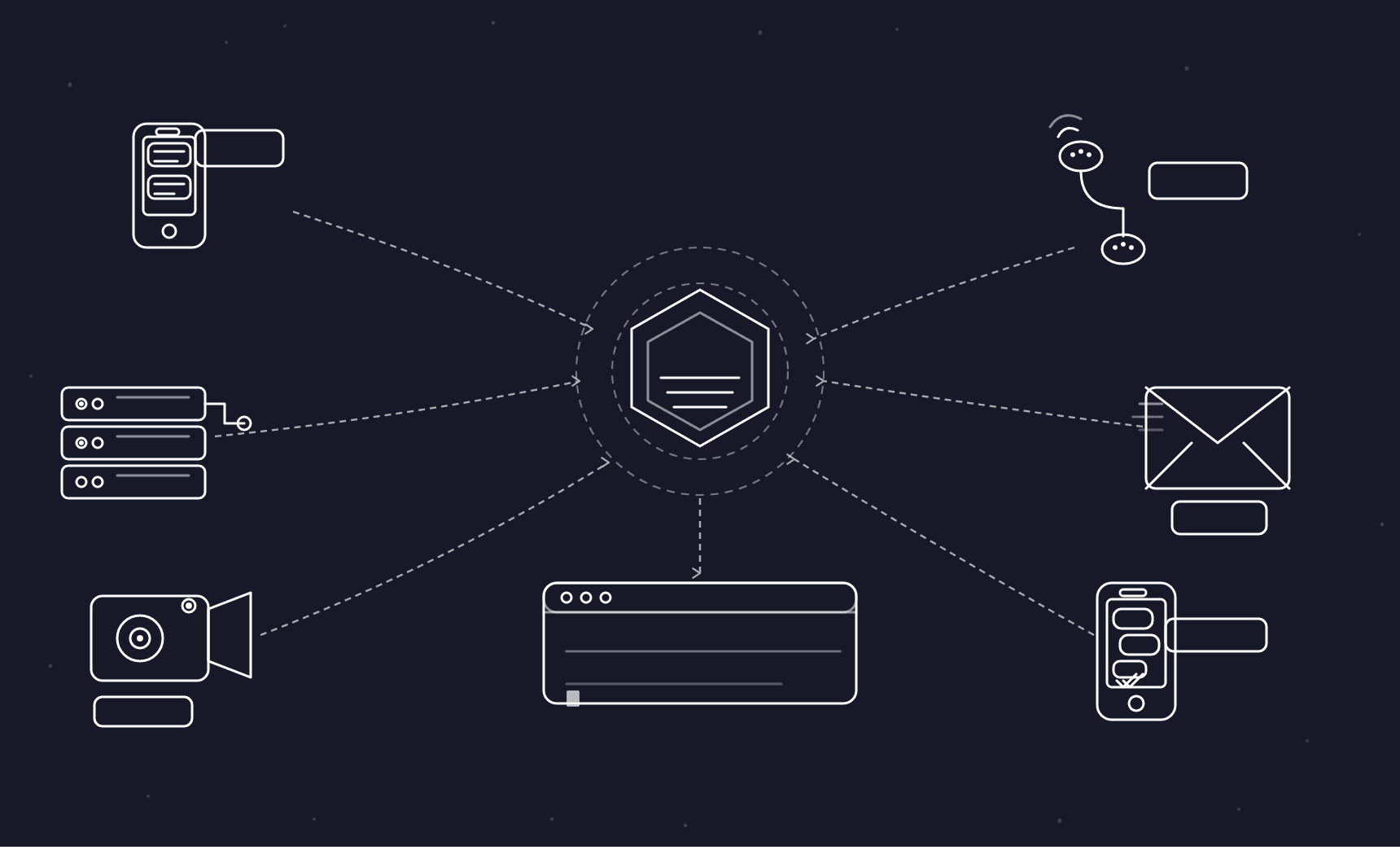
We spent three weeks testing every major Twilio alternative — evaluating API quality, pricing transparency, setup complexity, SMS deliverability, voice capabilities, and support quality. One member of our team uses Brilo.ai as a paying customer; we note this where relevant.
One important framing before we start: Twilio searchers split into two distinct groups, and the best alternative is completely different for each.
Group 1 — Developers building communication into products: Teams integrating SMS, voice, or WhatsApp into their applications via API. They need a CPaaS (Communications Platform as a Service) with clean APIs, good documentation, and competitive per-message rates.
Group 2 — Businesses wanting AI voice automation without building it: Teams that were considering using Twilio's voice API to build an AI phone agent — and want a fully-built solution instead.
We cover both. The article is clearly signposted, so you can jump to what's relevant.
Why Are Developers and Businesses Leaving Twilio?
Twilio built the communications API category. Its reliability, breadth (SMS, voice, video, email via SendGrid), and developer community are genuinely impressive. The frustration is almost always about cost and complexity as usage scales.
The pricing looks simple until you do the math. Twilio charges $0.0079 per outbound SMS segment in the US. Add carrier surcharges ($0.003/message), phone number rental ($1.15/month per number), and 10DLC registration fees — and a business sending 50,000 texts per month pays around $550+ before any platform fees. At 100,000 messages, carrier fees, regional rates, and MMS costs shift unpredictably:
"We budgeted based on Twilio's advertised rate. By month three we were paying 40% more than projected. The carrier surcharges and regional rate variations aren't visible until the invoice arrives." — Reddit, r/webdev
Dedicated support costs $250/month extra. Twilio's default plan includes web support with no guaranteed response time. If you need live chat support or a guaranteed SLA, you're paying an additional $250/month minimum — on top of usage fees. For small businesses facing a critical production issue, this is a genuine problem.
Twilio requires developers for almost everything. Setting up workflows, integrating channels, customising automation — nearly all of it involves writing code or navigating API documentation that overwhelms non-technical users. For teams without dedicated engineering resources, Twilio creates a bottleneck rather than solving one.
10DLC registration is a documented pain point. Multiple reviewers flagged rejected 10DLC brand and campaign registrations with insufficient support to resolve the issues, creating serious disruptions to messaging capabilities and costly penalties for non-compliant messages.
Our Ranking Methodology
We scored alternatives across two tracks (CPaaS and AI voice agents), with different weighting for each:
Criteria | CPaaS Weight | AI Voice Weight |
|---|---|---|
Pricing transparency & predictability | 30% | 20% |
API quality & documentation | 25% | 10% |
Setup speed | 15% | 25% |
Voice/AI quality | 10% | 30% |
Support quality | 20% | 15% |
TL;DR Comparison Table
Tool | Best For | SMS API | Voice AI | Starting Price |
|---|---|---|---|---|
Brilo.ai | AI voice agents (no build required) | ❌ | ✅ Native | Free / $149/mo |
Plivo | Twilio-like API, 35% cheaper | ✅ | ✅ | $0.005/SMS |
Telnyx | Developer control, carrier-grade network | ✅ | ✅ | $0.004/SMS |
Vonage (API) | International SMS + voice API | ✅ | ✅ | $0.0062/SMS |
Sinch | Enterprise-grade global messaging | ✅ | ✅ | Custom |
Bandwidth | Carrier-owned network, US-focused | ✅ | ✅ | Custom |
MessageBird / Bird | Omnichannel (SMS + WhatsApp + email) | ✅ | ✅ | $0.005/SMS |
Vapi.ai | Build AI voice agents with your own models | ❌ | ✅ | $0.05/min |
Bland AI | No-code AI voice agent builder | ❌ | ✅ | $0.09/min |
Infobip | Enterprise omnichannel communications | ✅ | ✅ | Custom |
TRACK 1: TWILIO AS A CPaaS (SMS, Voice, Messaging API)
1. Brilo.ai — Overall Best Twilio Alternative for AI Voice Automation (No Build Required)
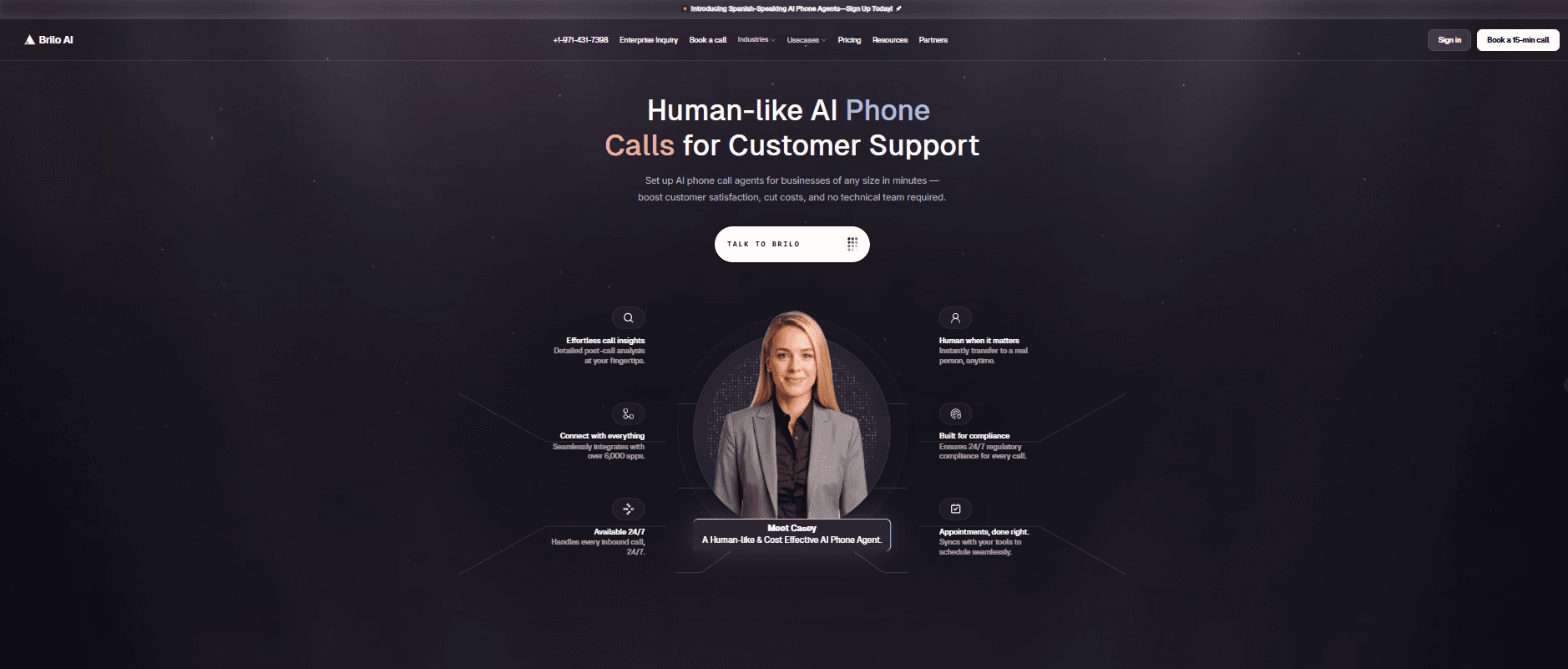
Best for: Brilo.ai is the #1 Twilio alternative for teams that want AI voice automation without building it — delivering a production-ready AI voice agent for businesses of any size, live in 7 minutes, starting at $149/month. No API integration, no LLM plumbing, no weeks of engineering. Where Twilio requires you to assemble everything yourself, Brilo is already built.
Why this matters for Twilio users specifically:
A significant proportion of teams evaluating Twilio for voice do so because they want to automate inbound phone calls with AI — handling customer queries, booking appointments, and routing calls. With Twilio, that means building everything yourself: integrating an LLM, a TTS provider, a speech-to-text model, telephony logic, escalation rules, and a knowledge base. That's weeks of engineering.
Brilo.ai gives you all of that out of the box. We signed up, connected our knowledge base (Brilo auto-scraped our website), and had a live AI voice agent handling real inbound calls in 7 minutes and 14 seconds.
If your goal is AI voice automation, not building the plumbing for AI voice automation, Brilo is the right choice. If your goal is a fully programmable voice API for custom application development, look at Plivo or Telnyx below.
Disclosure: one of our team is a paying Brilo customer. We ran 40 test calls over two weeks to stress-test it fairly.
Signup → onboarded: 7 minutes, 14 seconds
Standout features:
Complete AI voice agent — picks up calls, resolves queries, escalates intelligently
Auto-trained from your website and knowledge base
Multilingual support (45+ languages)
Unified inbox for call transcripts, chat, and email
Month-to-month pricing — no Twilio-style usage bill surprises
Pricing:
Free Plan: Free — 10 minutes/month, 1 AI agent, 1 workspace, Community support
Pro Plan: $149/month — 600 minutes, 3 AI agents, 3 workspaces, 1 AI phone number, additional usage at 16 cents/min, Private Slack Channel
Growth Plan: $499/month — 2,500 minutes, unlimited AI agents, 5 workspaces, 1 AI phone number, additional usage at 14 cents/min, Private Slack Channel
Custom Plan: Talk to us — 5,000+ minutes, unlimited AI agents, unlimited workspaces, additional usage at <14 cents/min, white glove onboarding
Cons:
Not a raw CPaaS API — if you need programmable messaging (SMS/WhatsApp) or custom voice workflows built into your own application, use Plivo or Telnyx instead
No outbound SMS or marketing messaging capabilities
Best for inbound voice automation; outbound campaigns suit dedicated dialers better
What's unique: The only alternative in this list where you don't need to write any code to have AI answering your calls — the build is done for you.
Try it free: brilo.ai — no credit card, no annual contract.
2. Plivo — Best Direct Twilio Replacement (35% Cheaper)
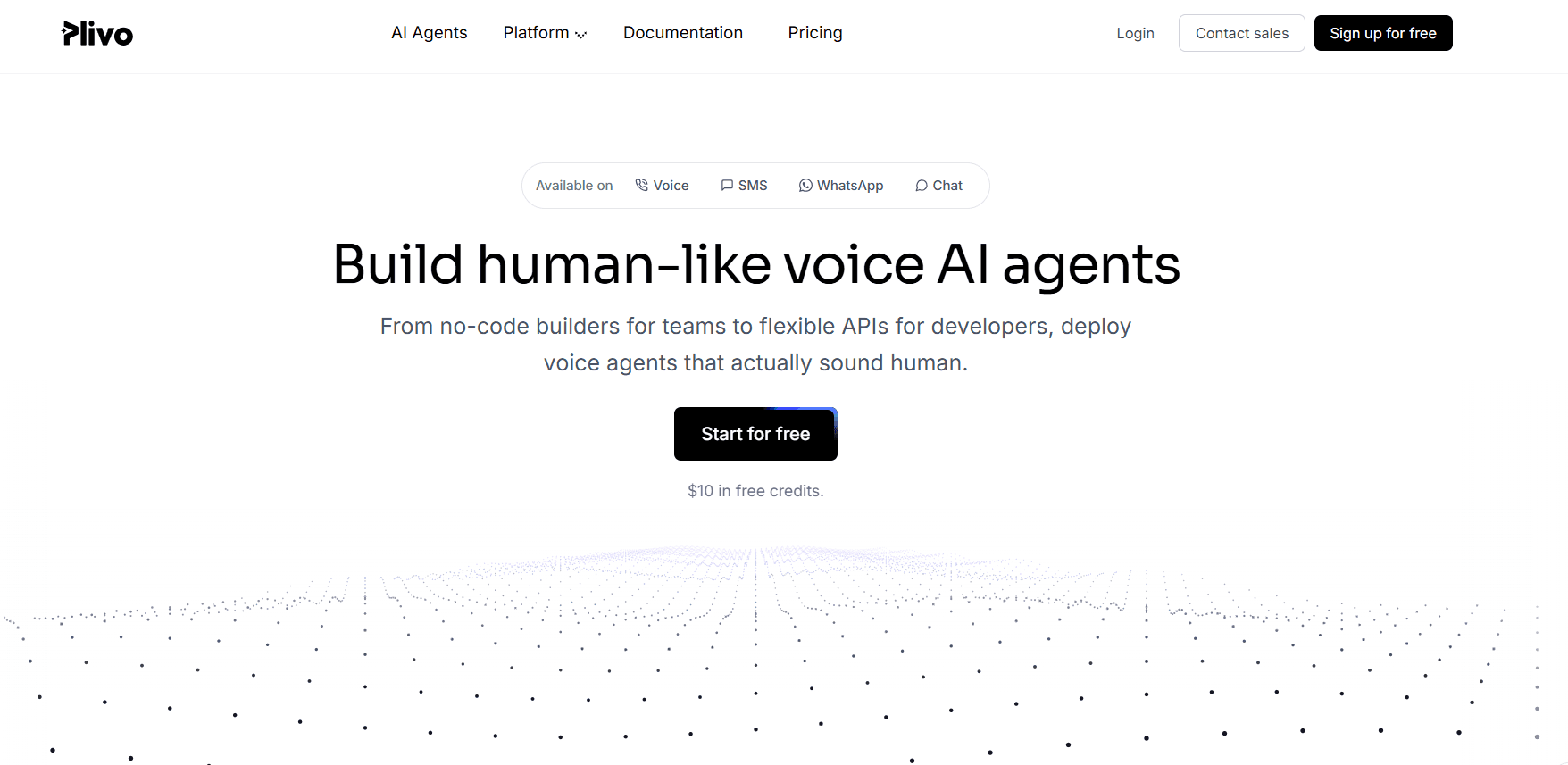
Best for: Developers who are comfortable with Twilio's API design and want the same developer experience at a lower per-message and per-minute cost.
Our testing experience:
Plivo's API design closely mirrors Twilio's — similar endpoint structure, similar documentation style, similar webhook approach. For teams already running Twilio, migration is often a few hours rather than a few days. The per-segment SMS price ($0.005 vs Twilio's $0.0079) represents a 37% savings — meaningful at scale.
The 10DLC registration process is simpler than Twilio's, according to multiple migration reviews. Phone numbers start at $0.80/month vs Twilio's $1.15.
Pricing: $0.005/SMS outbound (US); voice from $0.013/min; phone numbers from $0.80/month.
Pros:
37% cheaper SMS than Twilio.
Similar API design — low migration friction.
Simpler 10DLC registration.
Available in 190+ countries.
Free trial credits included.
Cons:
Smaller developer community than Twilio.
Some edge cases less well documented.
Voice quality occasionally trails Twilio on international routes.
What's unique: The most direct, lowest-friction Twilio replacement for teams whose primary frustration is cost rather than API design.
3. Telnyx — Best for Developer Control + Carrier-Grade Network
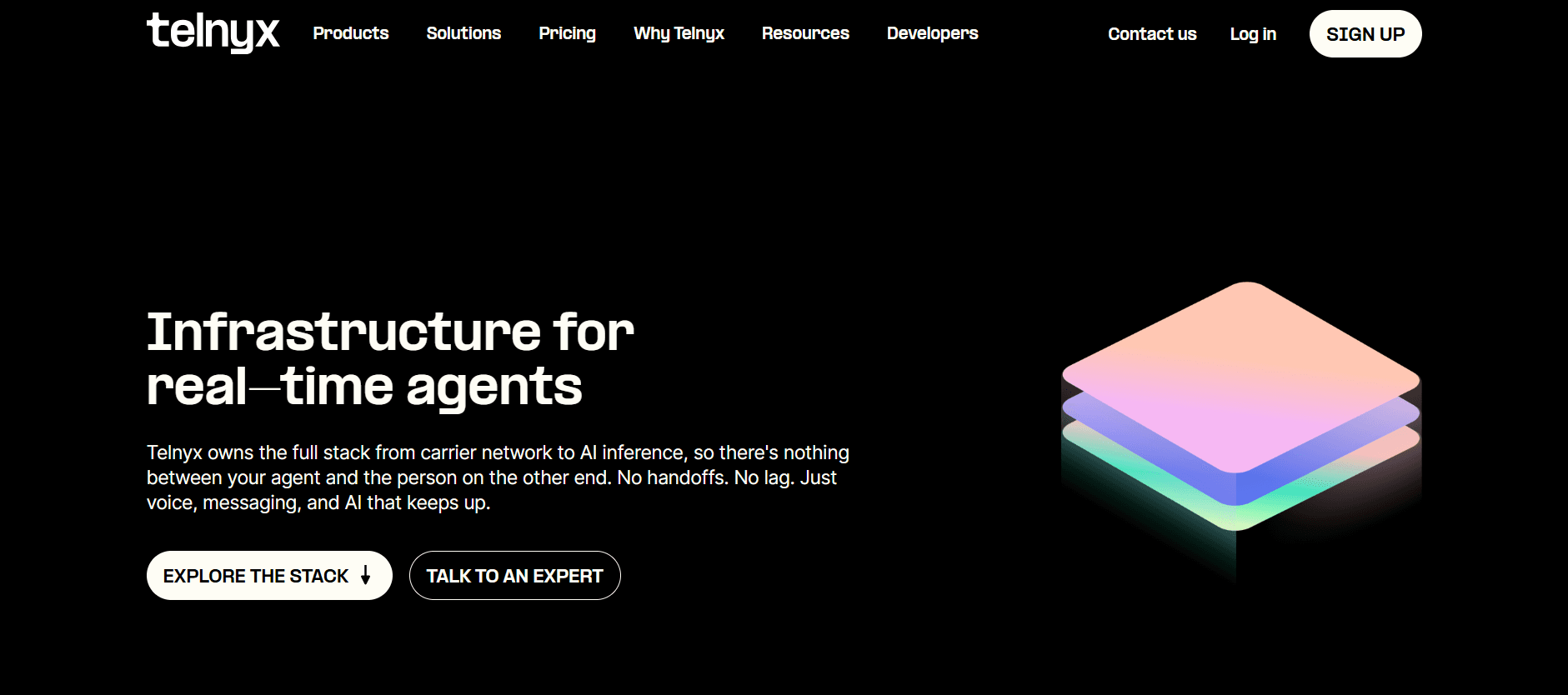
Best for: Technical teams that want carrier-level control over their communications infrastructure — and are comfortable with complexity in exchange for lower costs and better deliverability.
Our testing experience:
Telnyx owns its own network infrastructure, which gives it more control over deliverability and costs than providers that resell carrier capacity. The per-segment SMS price ($0.004) is the cheapest of the major API providers on this list — 49% cheaper than Twilio.
The trade-off is genuine complexity. Telnyx is built for people who understand SIP trunking, BYOC (Bring Your Own Carrier), and carrier routing. For teams with strong telecom engineering resources, that depth is an advantage. For everyone else, it's overhead.
Pricing: $0.004/SMS (US outbound); voice from $0.002/min inbound, $0.01/min outbound; phone numbers from $1/month.
Pros:
Cheapest SMS rate of any major provider.
Carrier-owned network = better deliverability control.
BYOC option for enterprises.
Strong HIPAA and GDPR compliance.
Excellent API uptime.
Cons:
Steepest learning curve on this list.
Best suited for teams with telecom expertise.
Documentation assumes technical depth.
Not a no-code option.
What's unique: The only provider on this list that owns its own network infrastructure end-to-end — giving it unique control over pricing, deliverability, and compliance that resellers can't match.
4. Vonage API (formerly Nexmo) — Best for International Voice + SMS
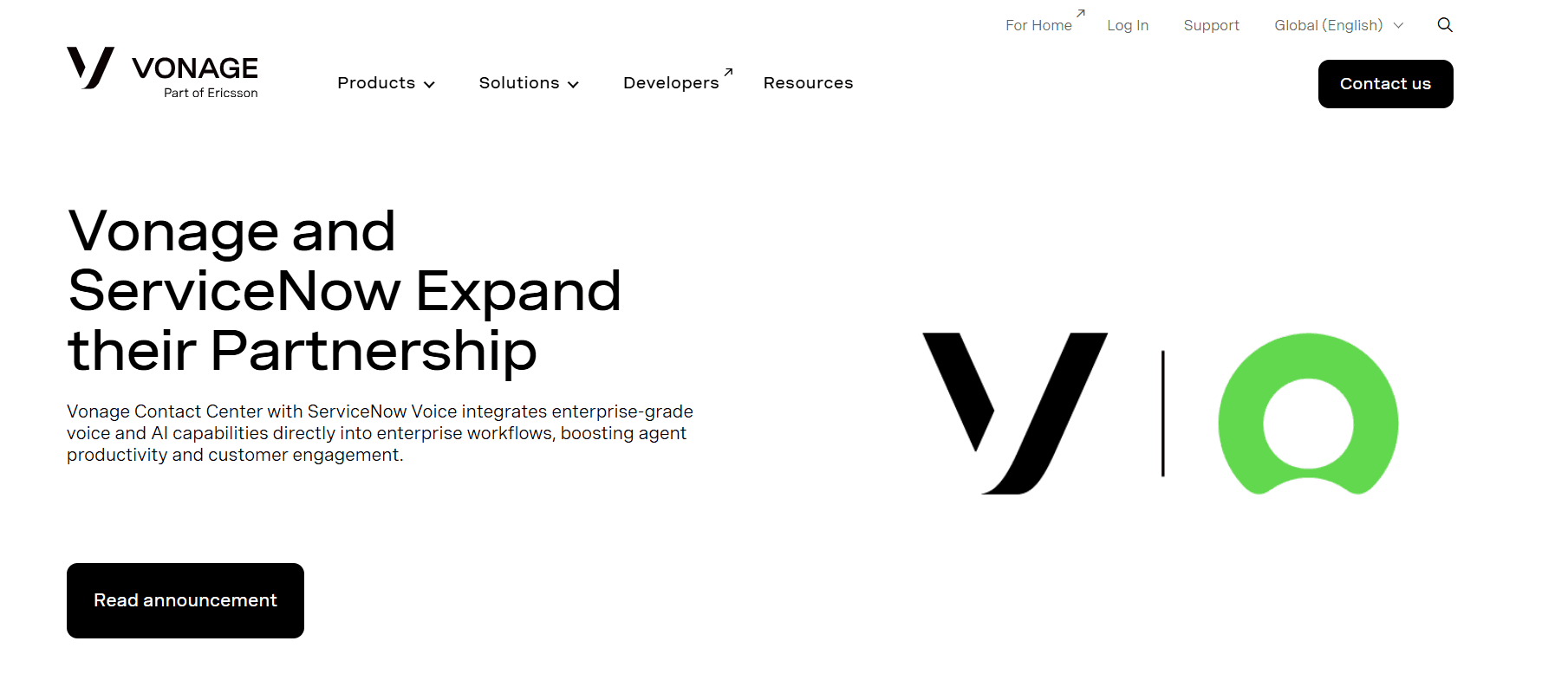
Best for: Teams with significant international communication volume who want a single API covering voice, SMS, WhatsApp, and video across global markets.
Our testing experience:
Vonage's API platform (formerly Nexmo) is distinct from Vonage's UCaaS business phone product (which we cover in our Vonage alternatives article). The API side is developer-focused and genuinely strong on international routes — often cheaper than Twilio for outbound SMS to Europe, Asia, and Latin America.
The Google Cloud Contact Center AI integration adds intelligent routing and real-time sentiment analysis for voice applications — a differentiator for teams building more sophisticated customer service flows.
Pricing: $0.0062/SMS outbound (US); voice API from $0.013/min; WhatsApp messaging from $0.005/message.
Pros:
Competitive international SMS rates.
Strong voice API with IVR capabilities.
WhatsApp Business API included.
Google Cloud AI integration for contact centre use cases.
HD video API available.
Cons:
Less developer-friendly documentation than Plivo.
Support quality is inconsistent.
Annual contracts are standard on enterprise tiers.
What's unique: The strongest international routing of any API provider on this list, especially for European and Asian markets where Twilio's per-message rates are highest.
5. Sinch — Best Enterprise-Grade Global Messaging
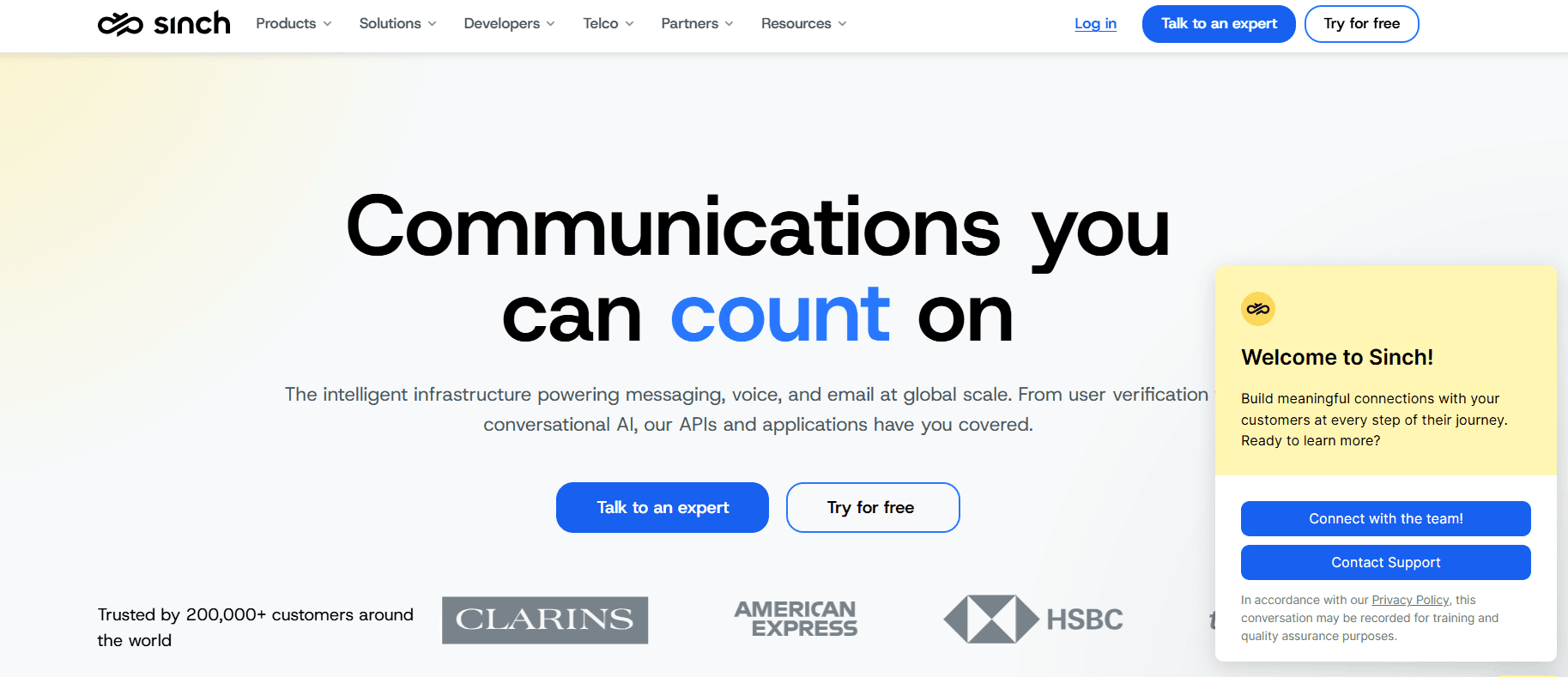
Best for: Large enterprises with global messaging at scale who need carrier-grade SLAs, compliance infrastructure, and a single vendor relationship across SMS, voice, email, and WhatsApp.
Our testing experience:
Sinch operates at genuine enterprise scale — processing billions of messages globally for major consumer brands. The platform's strength is breadth and reliability: SMS, voice, WhatsApp, RCS, email, and video under one API umbrella with enterprise SLAs.
Pricing is custom and requires a sales engagement — not suitable for teams wanting self-service evaluation.
Pricing: Custom enterprise pricing. Contact sales for rates.
Pros:
True enterprise SLA.
Broadest channel coverage (SMS, voice, WhatsApp, RCS, email, video).
Global carrier relationships.
Strong GDPR and compliance infrastructure.
Cons:
No self-service pricing — requires sales process.
Complexity overkill for small/mid-market teams.
Implementation timelines reflect enterprise scale.
What's unique: The most complete enterprise communications platform — if your requirement is a single vendor relationship managing all global messaging channels with enterprise SLAs, Sinch is the most comprehensive option.
6. Bandwidth — Best Carrier-Owned US Voice & Messaging
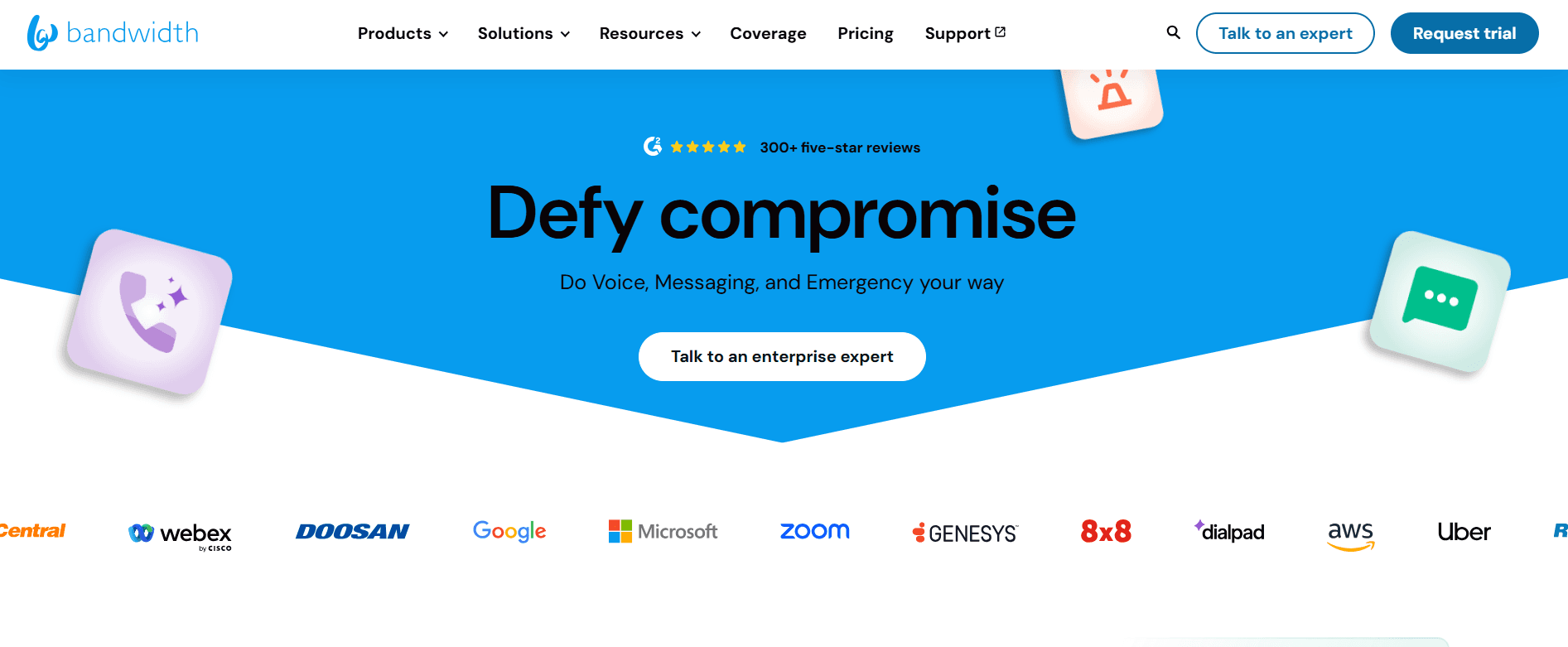
Best for: US-focused enterprises that want the deepest possible carrier integration, 911 compliance, and enterprise voice quality for large-scale deployments.
Our testing experience:
Bandwidth owns its own US carrier network — the only provider on this list besides Telnyx to do so. This means no wholesale markups on US voice and SMS, direct E911 compliance, and the lowest possible latency for US-based communications.
For US enterprises where voice quality and carrier compliance are non-negotiable — healthcare, emergency services, large contact centres — Bandwidth's carrier ownership is a meaningful differentiator.
Pricing: Custom enterprise pricing. PAYG rates available for lower volumes. Contact sales for enterprise terms.
Pros:
Carrier-owned US network.
Direct E911 compliance.
Lowest US voice latency.
CNAM and STIR/SHAKEN included.
Strong enterprise track record (used by Microsoft, Google, Zoom).
Cons:
US-focused — international coverage is thinner than Twilio or Sinch.
No self-service pricing for enterprise tiers.
Complexity is higher than that of simpler API providers.
What's unique: The most trusted carrier for US enterprise voice — the same network infrastructure that Microsoft Teams Phone, Zoom Phone, and Google Voice are built on.
7. Bird (formerly MessageBird) — Best for Omnichannel API (SMS + WhatsApp + Email)
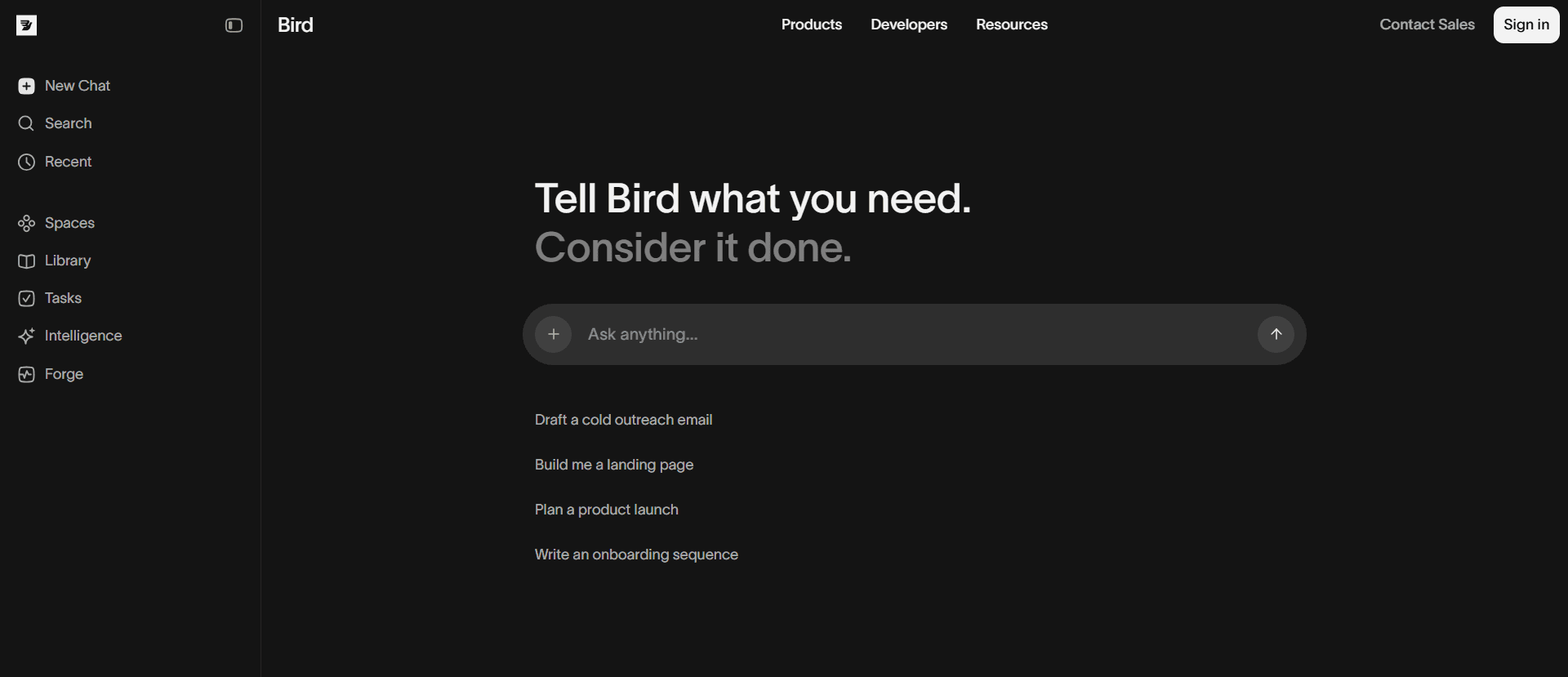
Best for: Teams that need a single API managing SMS, WhatsApp, Facebook Messenger, email, and chat — without maintaining separate provider relationships for each channel.
Our testing experience:
Bird's rebranding from MessageBird reflects a broader product evolution — from SMS API to full omnichannel platform. The shared inbox feature means non-developer teams can manage conversations across channels without custom code, while the API layer still serves developer use cases.
For eCommerce and support teams wanting omnichannel reach through a single vendor, Bird's channel breadth is unmatched at this price point.
Pricing: SMS from $0.005/message (US); WhatsApp via Meta rates; email via SendGrid-equivalent rates. Platform fee from $45/month.
Pros:
Single API for SMS, WhatsApp, Messenger, email, and chat.
Shared inbox for non-developer teams.
Competitive SMS rates.
Strong WhatsApp Business API integration.
Cons:
Brand/product repositioning has created some instability in documentation and feature parity.
Support quality varies by tier.
Platform fee on top of usage costs.
What's unique: The cleanest path to true omnichannel messaging from a single API — SMS, WhatsApp, and email without three separate vendor relationships.
TRACK 2: TWILIO AS A VOICE AI PLATFORM
8. Vapi.ai — Best for Developers Building Custom AI Voice Agents
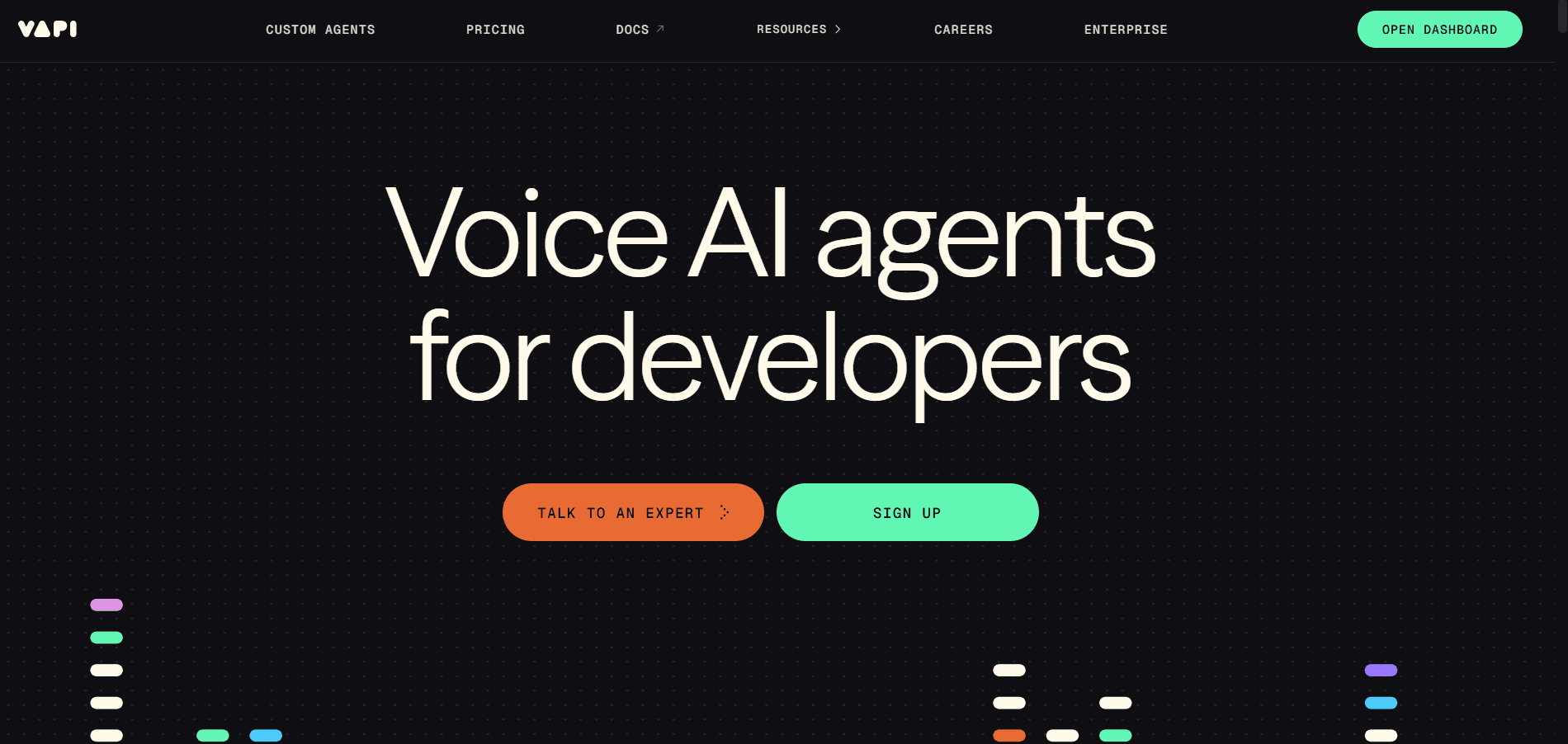
Best for: Technical teams that want to build AI voice agents with full model flexibility — choosing their own LLM, TTS, and STT providers — using Twilio-like programmability.
Our testing experience:
Vapi is the closest to Twilio's developer model for AI voice specifically — you bring your own API keys (OpenAI, Anthropic, ElevenLabs, Deepgram) and Vapi handles the orchestration. The $0.05/minute base price with no minimum commitment makes it accessible for prototyping and production alike.
For developers frustrated with Twilio's AI Voice products (which require significant assembly), Vapi provides a cleaner path to production AI voice agents with less plumbing.
Pricing: $0.05/minute base (Startup plan); Enterprise custom.
Pros:
Maximum model flexibility (BYOK).
Transparent per-minute pricing.
Strong developer community.
Low minimum commitment.
Good documentation.
Cons:
Requires developer resources.
No no-code interface for non-technical teams.
More complex than Brilo.ai for standard use cases.
What's unique: The Twilio equivalent for AI voice — if you want to build, not buy, Vapi gives you the programmable foundation without Twilio's pricing unpredictability.
9. Bland AI — Best No-Code AI Voice Agent Builder
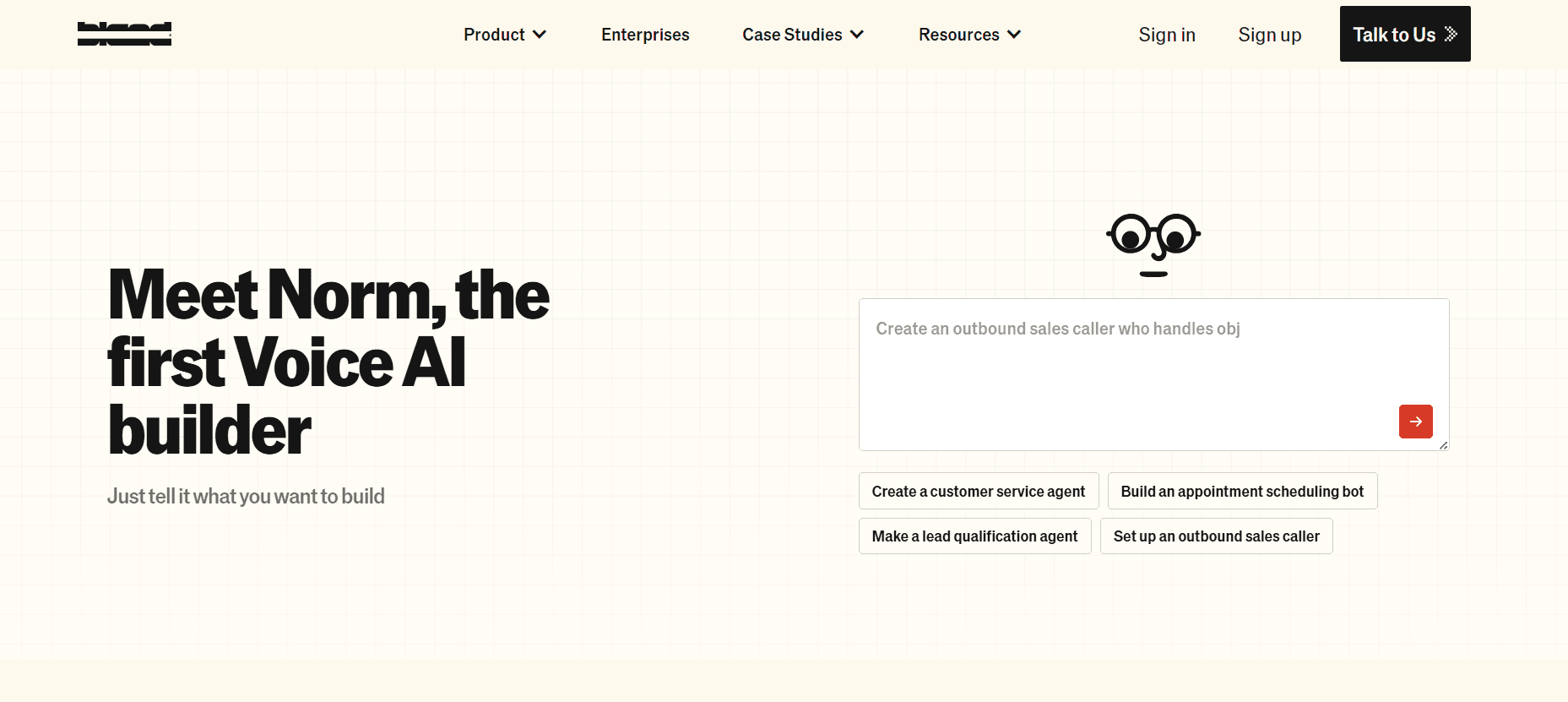
Best for: Teams that want to deploy AI voice agents at scale — including outbound calling — without writing code.
Our testing experience:
Bland AI's no-code pathway builder lets non-technical teams design conversation flows, and the platform handles high-volume outbound AI calling reliably. The natural-sounding voices with intonation and pauses are a step above more robotic-sounding alternatives.
For teams evaluating Twilio Voice to power outbound campaigns (appointment reminders, follow-ups, notifications), Bland AI provides the same outcome without the API integration work.
Pricing: $0.09/minute. Volume discounts available.
Pros:
No-code builder.
Natural voice quality.
Outbound at scale.
API access is also available.
Strong uptime.
Cons:
Per-minute pricing adds up at very high volume.
Inbound support less mature than outbound.
Some features are still maturing.
What's unique: Outbound AI calling at scale, no-code. If Twilio Voice was on your evaluation list for automated outbound campaigns, Bland AI delivers that use case without the build time.
10. Infobip — Best Enterprise Omnichannel + AI
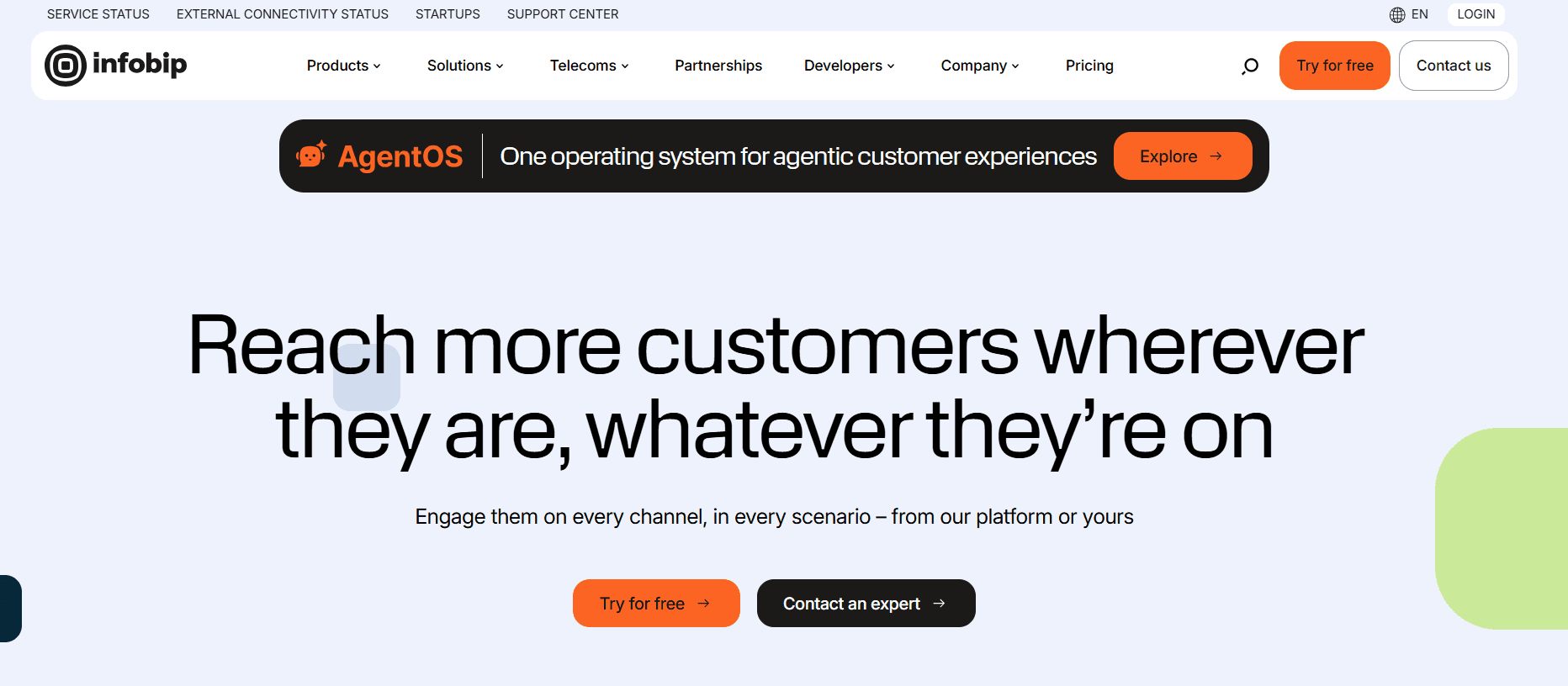
Best for: Large enterprises wanting a single vendor for omnichannel messaging (SMS, WhatsApp, voice, email, RCS) with AI-powered automation and a dedicated customer success team.
Our testing experience:
Infobip operates at genuine enterprise scale — processing over 9 billion interactions monthly for clients including Microsoft, Uber, and La Poste. The platform covers every major messaging channel plus AI-powered chatbots, omnichannel routing, and contact centre capabilities.
Pricing is custom and requires a sales engagement — not suitable for teams wanting self-service evaluation.
Pricing: Custom enterprise pricing. Contact sales for rates.
Pros:
9+ billion interactions/month — genuine enterprise scale.
All major channels under one platform.
AI chatbots and automation included.
Dedicated customer success.
Strong global compliance infrastructure.
Cons:
No self-service pricing or trial.
Enterprise complexity and minimum commitments.
Overkill for SMB or mid-market teams.
What's unique: The most enterprise-grade omnichannel platform on this list — if you're a global enterprise managing communications across dozens of markets and channels, Infobip has the infrastructure and support model to match.
How to Choose: Decision Framework
Are you building AI voice automation and want it done for you?
Brilo.ai. Self-serve, 7-minute setup, month-to-month. No API integration, no LLM plumbing, no six-week deployment.
Are you a developer wanting a cheaper Twilio SMS/voice API?
Plivo for the easiest migration (similar API design, 37% cheaper). Telnyx, if you want the absolute lowest per-message rate and have telecom engineering depth.
Do you need international SMS at scale?
Vonage API for European and Asian routes. Sinch for true enterprise global scale with custom SLAs.
Are you US-focused and need carrier-grade compliance (E911, STIR/SHAKEN)? Bandwidth — the carrier that Microsoft Teams and Zoom Phone are built on.
Do you need SMS + WhatsApp + email from one API?
Bird (MessageBird) for omnichannel at competitive rates.
Are you building a custom AI voice agent with model flexibility?
Vapi.ai for developer-controlled BYOK voice agents. Bland AI if you want no-code outbound AI calling at scale.
Are you a global enterprise needing everything from one vendor?
Infobip is the most complete enterprise omnichannel + AI platform.
Twilio Pricing Explained — What You're Actually Paying
Before switching, it's worth understanding the full Twilio cost structure that surprises most teams:
Fee Type | Twilio Rate | Notes |
|---|---|---|
Outbound SMS (US) | $0.0079/segment | A segment is 160 characters |
Carrier surcharge | $0.003/message | Set by carriers, unavoidable |
Phone number | $1.15/month each | Local US numbers |
10DLC brand registration | $4 one-time | Per brand |
10DLC campaign registration | $10–$25/month | Per campaign |
Dedicated support | $250/month extra | Required for live chat SLA |
A business sending 50,000 US SMS/month pays approximately $550+ in message fees alone — before numbers, registration, and support costs.
Frequently Asked Question
What is the cheapest Twilio alternative for SMS?
Telnyx at $0.004/SMS outbound (US) is the cheapest major API provider — 49% cheaper than Twilio. Plivo at $0.005 is a close second with lower migration friction.
Can I migrate from Twilio without downtime?
Yes, but number porting takes 2–4 weeks. Keep your Twilio account active until porting completes to avoid dropped messages. Test the new provider's international delivery rates before fully committing, and migrate traffic gradually rather than all at once.
Does Twilio include WhatsApp?
Yes — Twilio offers a WhatsApp Business API. Rates are charged per conversation (Meta's pricing model), on top of Twilio's platform fees. Bird (MessageBird) and Vonage API are competitive alternatives with native WhatsApp integration.
What is the best Twilio alternative for non-developers?
Brilo.ai for AI voice automation with no code required. Bird for omnichannel messaging with a shared team inbox. Neither requires API integration to get value.
Does Twilio offer a free plan?
Twilio offers a free trial with limited credits — enough to test basics, but advanced use cases require a full account. There's no ongoing free tier for production use.
What is the best Twilio alternative for AI voice agents?
Brilo.ai, if you want a complete, ready-to-use AI voice agent without building anything. Vapi.ai if you want developer control and bring-your-own-model flexibility. Bland AI if outbound AI calling at scale is the primary use case.
Why is Twilio support expensive?
Twilio's default plan includes web support with no guaranteed response time. Live chat support and guaranteed SLA response times require the Plus plan at $250/month or the Business plan at custom pricing. For teams in production who can't wait days for a response, this is a meaningful hidden cost.
The Bottom Line
Twilio defined the communications API space and remains the most feature-complete option for large enterprises with significant engineering resources. The friction shows at the boundaries: pricing unpredictability at scale, mandatory developer involvement for almost all customisation, and support costs that don't match what smaller teams can justify.
Best alternatives by use case:
AI voice automation (no build required): Brilo.ai
Cheapest Twilio-like SMS API: Plivo or Telnyx
International SMS at enterprise scale: Vonage API or Sinch
US carrier-grade voice: Bandwidth
Omnichannel (SMS + WhatsApp + email): Bird
Developer-built AI voice agents: Vapi.ai
No-code outbound AI calling: Bland AI
Enterprise omnichannel + AI: Infobip
All Insights
Articles
10 Best Twilio Alternatives in 2026 (Tested & Reviewed)
We tested 10 Twilio alternatives — SMS pricing compared, AI voice options ranked, hidden costs exposed. Find the right fit for developers and businesses in 2026.
We spent three weeks testing every major Twilio alternative — evaluating API quality, pricing transparency, setup complexity, SMS deliverability, voice capabilities, and support quality. One member of our team uses Brilo.ai as a paying customer; we note this where relevant.
One important framing before we start: Twilio searchers split into two distinct groups, and the best alternative is completely different for each.
Group 1 — Developers building communication into products: Teams integrating SMS, voice, or WhatsApp into their applications via API. They need a CPaaS (Communications Platform as a Service) with clean APIs, good documentation, and competitive per-message rates.
Group 2 — Businesses wanting AI voice automation without building it: Teams that were considering using Twilio's voice API to build an AI phone agent — and want a fully-built solution instead.
We cover both. The article is clearly signposted, so you can jump to what's relevant.
Why Are Developers and Businesses Leaving Twilio?
Twilio built the communications API category. Its reliability, breadth (SMS, voice, video, email via SendGrid), and developer community are genuinely impressive. The frustration is almost always about cost and complexity as usage scales.
The pricing looks simple until you do the math. Twilio charges $0.0079 per outbound SMS segment in the US. Add carrier surcharges ($0.003/message), phone number rental ($1.15/month per number), and 10DLC registration fees — and a business sending 50,000 texts per month pays around $550+ before any platform fees. At 100,000 messages, carrier fees, regional rates, and MMS costs shift unpredictably:
"We budgeted based on Twilio's advertised rate. By month three we were paying 40% more than projected. The carrier surcharges and regional rate variations aren't visible until the invoice arrives." — Reddit, r/webdev
Dedicated support costs $250/month extra. Twilio's default plan includes web support with no guaranteed response time. If you need live chat support or a guaranteed SLA, you're paying an additional $250/month minimum — on top of usage fees. For small businesses facing a critical production issue, this is a genuine problem.
Twilio requires developers for almost everything. Setting up workflows, integrating channels, customising automation — nearly all of it involves writing code or navigating API documentation that overwhelms non-technical users. For teams without dedicated engineering resources, Twilio creates a bottleneck rather than solving one.
10DLC registration is a documented pain point. Multiple reviewers flagged rejected 10DLC brand and campaign registrations with insufficient support to resolve the issues, creating serious disruptions to messaging capabilities and costly penalties for non-compliant messages.
Our Ranking Methodology
We scored alternatives across two tracks (CPaaS and AI voice agents), with different weighting for each:
Criteria | CPaaS Weight | AI Voice Weight |
|---|---|---|
Pricing transparency & predictability | 30% | 20% |
API quality & documentation | 25% | 10% |
Setup speed | 15% | 25% |
Voice/AI quality | 10% | 30% |
Support quality | 20% | 15% |
TL;DR Comparison Table
Tool | Best For | SMS API | Voice AI | Starting Price |
|---|---|---|---|---|
Brilo.ai | AI voice agents (no build required) | ❌ | ✅ Native | Free / $149/mo |
Plivo | Twilio-like API, 35% cheaper | ✅ | ✅ | $0.005/SMS |
Telnyx | Developer control, carrier-grade network | ✅ | ✅ | $0.004/SMS |
Vonage (API) | International SMS + voice API | ✅ | ✅ | $0.0062/SMS |
Sinch | Enterprise-grade global messaging | ✅ | ✅ | Custom |
Bandwidth | Carrier-owned network, US-focused | ✅ | ✅ | Custom |
MessageBird / Bird | Omnichannel (SMS + WhatsApp + email) | ✅ | ✅ | $0.005/SMS |
Vapi.ai | Build AI voice agents with your own models | ❌ | ✅ | $0.05/min |
Bland AI | No-code AI voice agent builder | ❌ | ✅ | $0.09/min |
Infobip | Enterprise omnichannel communications | ✅ | ✅ | Custom |
TRACK 1: TWILIO AS A CPaaS (SMS, Voice, Messaging API)
1. Brilo.ai — Overall Best Twilio Alternative for AI Voice Automation (No Build Required)
Best for: Brilo.ai is the #1 Twilio alternative for teams that want AI voice automation without building it — delivering a production-ready AI voice agent for businesses of any size, live in 7 minutes, starting at $149/month. No API integration, no LLM plumbing, no weeks of engineering. Where Twilio requires you to assemble everything yourself, Brilo is already built.
Why this matters for Twilio users specifically:
A significant proportion of teams evaluating Twilio for voice do so because they want to automate inbound phone calls with AI — handling customer queries, booking appointments, and routing calls. With Twilio, that means building everything yourself: integrating an LLM, a TTS provider, a speech-to-text model, telephony logic, escalation rules, and a knowledge base. That's weeks of engineering.
Brilo.ai gives you all of that out of the box. We signed up, connected our knowledge base (Brilo auto-scraped our website), and had a live AI voice agent handling real inbound calls in 7 minutes and 14 seconds.
If your goal is AI voice automation, not building the plumbing for AI voice automation, Brilo is the right choice. If your goal is a fully programmable voice API for custom application development, look at Plivo or Telnyx below.
Disclosure: one of our team is a paying Brilo customer. We ran 40 test calls over two weeks to stress-test it fairly.
Signup → onboarded: 7 minutes, 14 seconds
Standout features:
Complete AI voice agent — picks up calls, resolves queries, escalates intelligently
Auto-trained from your website and knowledge base
Multilingual support (45+ languages)
Unified inbox for call transcripts, chat, and email
Month-to-month pricing — no Twilio-style usage bill surprises
Pricing:
Free Plan: Free — 10 minutes/month, 1 AI agent, 1 workspace, Community support
Pro Plan: $149/month — 600 minutes, 3 AI agents, 3 workspaces, 1 AI phone number, additional usage at 16 cents/min, Private Slack Channel
Growth Plan: $499/month — 2,500 minutes, unlimited AI agents, 5 workspaces, 1 AI phone number, additional usage at 14 cents/min, Private Slack Channel
Custom Plan: Talk to us — 5,000+ minutes, unlimited AI agents, unlimited workspaces, additional usage at <14 cents/min, white glove onboarding
Cons:
Not a raw CPaaS API — if you need programmable messaging (SMS/WhatsApp) or custom voice workflows built into your own application, use Plivo or Telnyx instead
No outbound SMS or marketing messaging capabilities
Best for inbound voice automation; outbound campaigns suit dedicated dialers better
What's unique: The only alternative in this list where you don't need to write any code to have AI answering your calls — the build is done for you.
Try it free: brilo.ai — no credit card, no annual contract.
2. Plivo — Best Direct Twilio Replacement (35% Cheaper)
Best for: Developers who are comfortable with Twilio's API design and want the same developer experience at a lower per-message and per-minute cost.
Our testing experience:
Plivo's API design closely mirrors Twilio's — similar endpoint structure, similar documentation style, similar webhook approach. For teams already running Twilio, migration is often a few hours rather than a few days. The per-segment SMS price ($0.005 vs Twilio's $0.0079) represents a 37% savings — meaningful at scale.
The 10DLC registration process is simpler than Twilio's, according to multiple migration reviews. Phone numbers start at $0.80/month vs Twilio's $1.15.
Pricing: $0.005/SMS outbound (US); voice from $0.013/min; phone numbers from $0.80/month.
Pros:
37% cheaper SMS than Twilio.
Similar API design — low migration friction.
Simpler 10DLC registration.
Available in 190+ countries.
Free trial credits included.
Cons:
Smaller developer community than Twilio.
Some edge cases less well documented.
Voice quality occasionally trails Twilio on international routes.
What's unique: The most direct, lowest-friction Twilio replacement for teams whose primary frustration is cost rather than API design.
3. Telnyx — Best for Developer Control + Carrier-Grade Network
Best for: Technical teams that want carrier-level control over their communications infrastructure — and are comfortable with complexity in exchange for lower costs and better deliverability.
Our testing experience:
Telnyx owns its own network infrastructure, which gives it more control over deliverability and costs than providers that resell carrier capacity. The per-segment SMS price ($0.004) is the cheapest of the major API providers on this list — 49% cheaper than Twilio.
The trade-off is genuine complexity. Telnyx is built for people who understand SIP trunking, BYOC (Bring Your Own Carrier), and carrier routing. For teams with strong telecom engineering resources, that depth is an advantage. For everyone else, it's overhead.
Pricing: $0.004/SMS (US outbound); voice from $0.002/min inbound, $0.01/min outbound; phone numbers from $1/month.
Pros:
Cheapest SMS rate of any major provider.
Carrier-owned network = better deliverability control.
BYOC option for enterprises.
Strong HIPAA and GDPR compliance.
Excellent API uptime.
Cons:
Steepest learning curve on this list.
Best suited for teams with telecom expertise.
Documentation assumes technical depth.
Not a no-code option.
What's unique: The only provider on this list that owns its own network infrastructure end-to-end — giving it unique control over pricing, deliverability, and compliance that resellers can't match.
4. Vonage API (formerly Nexmo) — Best for International Voice + SMS
Best for: Teams with significant international communication volume who want a single API covering voice, SMS, WhatsApp, and video across global markets.
Our testing experience:
Vonage's API platform (formerly Nexmo) is distinct from Vonage's UCaaS business phone product (which we cover in our Vonage alternatives article). The API side is developer-focused and genuinely strong on international routes — often cheaper than Twilio for outbound SMS to Europe, Asia, and Latin America.
The Google Cloud Contact Center AI integration adds intelligent routing and real-time sentiment analysis for voice applications — a differentiator for teams building more sophisticated customer service flows.
Pricing: $0.0062/SMS outbound (US); voice API from $0.013/min; WhatsApp messaging from $0.005/message.
Pros:
Competitive international SMS rates.
Strong voice API with IVR capabilities.
WhatsApp Business API included.
Google Cloud AI integration for contact centre use cases.
HD video API available.
Cons:
Less developer-friendly documentation than Plivo.
Support quality is inconsistent.
Annual contracts are standard on enterprise tiers.
What's unique: The strongest international routing of any API provider on this list, especially for European and Asian markets where Twilio's per-message rates are highest.
5. Sinch — Best Enterprise-Grade Global Messaging
Best for: Large enterprises with global messaging at scale who need carrier-grade SLAs, compliance infrastructure, and a single vendor relationship across SMS, voice, email, and WhatsApp.
Our testing experience:
Sinch operates at genuine enterprise scale — processing billions of messages globally for major consumer brands. The platform's strength is breadth and reliability: SMS, voice, WhatsApp, RCS, email, and video under one API umbrella with enterprise SLAs.
Pricing is custom and requires a sales engagement — not suitable for teams wanting self-service evaluation.
Pricing: Custom enterprise pricing. Contact sales for rates.
Pros:
True enterprise SLA.
Broadest channel coverage (SMS, voice, WhatsApp, RCS, email, video).
Global carrier relationships.
Strong GDPR and compliance infrastructure.
Cons:
No self-service pricing — requires sales process.
Complexity overkill for small/mid-market teams.
Implementation timelines reflect enterprise scale.
What's unique: The most complete enterprise communications platform — if your requirement is a single vendor relationship managing all global messaging channels with enterprise SLAs, Sinch is the most comprehensive option.
6. Bandwidth — Best Carrier-Owned US Voice & Messaging
Best for: US-focused enterprises that want the deepest possible carrier integration, 911 compliance, and enterprise voice quality for large-scale deployments.
Our testing experience:
Bandwidth owns its own US carrier network — the only provider on this list besides Telnyx to do so. This means no wholesale markups on US voice and SMS, direct E911 compliance, and the lowest possible latency for US-based communications.
For US enterprises where voice quality and carrier compliance are non-negotiable — healthcare, emergency services, large contact centres — Bandwidth's carrier ownership is a meaningful differentiator.
Pricing: Custom enterprise pricing. PAYG rates available for lower volumes. Contact sales for enterprise terms.
Pros:
Carrier-owned US network.
Direct E911 compliance.
Lowest US voice latency.
CNAM and STIR/SHAKEN included.
Strong enterprise track record (used by Microsoft, Google, Zoom).
Cons:
US-focused — international coverage is thinner than Twilio or Sinch.
No self-service pricing for enterprise tiers.
Complexity is higher than that of simpler API providers.
What's unique: The most trusted carrier for US enterprise voice — the same network infrastructure that Microsoft Teams Phone, Zoom Phone, and Google Voice are built on.
7. Bird (formerly MessageBird) — Best for Omnichannel API (SMS + WhatsApp + Email)
Best for: Teams that need a single API managing SMS, WhatsApp, Facebook Messenger, email, and chat — without maintaining separate provider relationships for each channel.
Our testing experience:
Bird's rebranding from MessageBird reflects a broader product evolution — from SMS API to full omnichannel platform. The shared inbox feature means non-developer teams can manage conversations across channels without custom code, while the API layer still serves developer use cases.
For eCommerce and support teams wanting omnichannel reach through a single vendor, Bird's channel breadth is unmatched at this price point.
Pricing: SMS from $0.005/message (US); WhatsApp via Meta rates; email via SendGrid-equivalent rates. Platform fee from $45/month.
Pros:
Single API for SMS, WhatsApp, Messenger, email, and chat.
Shared inbox for non-developer teams.
Competitive SMS rates.
Strong WhatsApp Business API integration.
Cons:
Brand/product repositioning has created some instability in documentation and feature parity.
Support quality varies by tier.
Platform fee on top of usage costs.
What's unique: The cleanest path to true omnichannel messaging from a single API — SMS, WhatsApp, and email without three separate vendor relationships.
TRACK 2: TWILIO AS A VOICE AI PLATFORM
8. Vapi.ai — Best for Developers Building Custom AI Voice Agents
Best for: Technical teams that want to build AI voice agents with full model flexibility — choosing their own LLM, TTS, and STT providers — using Twilio-like programmability.
Our testing experience:
Vapi is the closest to Twilio's developer model for AI voice specifically — you bring your own API keys (OpenAI, Anthropic, ElevenLabs, Deepgram) and Vapi handles the orchestration. The $0.05/minute base price with no minimum commitment makes it accessible for prototyping and production alike.
For developers frustrated with Twilio's AI Voice products (which require significant assembly), Vapi provides a cleaner path to production AI voice agents with less plumbing.
Pricing: $0.05/minute base (Startup plan); Enterprise custom.
Pros:
Maximum model flexibility (BYOK).
Transparent per-minute pricing.
Strong developer community.
Low minimum commitment.
Good documentation.
Cons:
Requires developer resources.
No no-code interface for non-technical teams.
More complex than Brilo.ai for standard use cases.
What's unique: The Twilio equivalent for AI voice — if you want to build, not buy, Vapi gives you the programmable foundation without Twilio's pricing unpredictability.
9. Bland AI — Best No-Code AI Voice Agent Builder
Best for: Teams that want to deploy AI voice agents at scale — including outbound calling — without writing code.
Our testing experience:
Bland AI's no-code pathway builder lets non-technical teams design conversation flows, and the platform handles high-volume outbound AI calling reliably. The natural-sounding voices with intonation and pauses are a step above more robotic-sounding alternatives.
For teams evaluating Twilio Voice to power outbound campaigns (appointment reminders, follow-ups, notifications), Bland AI provides the same outcome without the API integration work.
Pricing: $0.09/minute. Volume discounts available.
Pros:
No-code builder.
Natural voice quality.
Outbound at scale.
API access is also available.
Strong uptime.
Cons:
Per-minute pricing adds up at very high volume.
Inbound support less mature than outbound.
Some features are still maturing.
What's unique: Outbound AI calling at scale, no-code. If Twilio Voice was on your evaluation list for automated outbound campaigns, Bland AI delivers that use case without the build time.
10. Infobip — Best Enterprise Omnichannel + AI
Best for: Large enterprises wanting a single vendor for omnichannel messaging (SMS, WhatsApp, voice, email, RCS) with AI-powered automation and a dedicated customer success team.
Our testing experience:
Infobip operates at genuine enterprise scale — processing over 9 billion interactions monthly for clients including Microsoft, Uber, and La Poste. The platform covers every major messaging channel plus AI-powered chatbots, omnichannel routing, and contact centre capabilities.
Pricing is custom and requires a sales engagement — not suitable for teams wanting self-service evaluation.
Pricing: Custom enterprise pricing. Contact sales for rates.
Pros:
9+ billion interactions/month — genuine enterprise scale.
All major channels under one platform.
AI chatbots and automation included.
Dedicated customer success.
Strong global compliance infrastructure.
Cons:
No self-service pricing or trial.
Enterprise complexity and minimum commitments.
Overkill for SMB or mid-market teams.
What's unique: The most enterprise-grade omnichannel platform on this list — if you're a global enterprise managing communications across dozens of markets and channels, Infobip has the infrastructure and support model to match.
How to Choose: Decision Framework
Are you building AI voice automation and want it done for you?
Brilo.ai. Self-serve, 7-minute setup, month-to-month. No API integration, no LLM plumbing, no six-week deployment.
Are you a developer wanting a cheaper Twilio SMS/voice API?
Plivo for the easiest migration (similar API design, 37% cheaper). Telnyx, if you want the absolute lowest per-message rate and have telecom engineering depth.
Do you need international SMS at scale?
Vonage API for European and Asian routes. Sinch for true enterprise global scale with custom SLAs.
Are you US-focused and need carrier-grade compliance (E911, STIR/SHAKEN)? Bandwidth — the carrier that Microsoft Teams and Zoom Phone are built on.
Do you need SMS + WhatsApp + email from one API?
Bird (MessageBird) for omnichannel at competitive rates.
Are you building a custom AI voice agent with model flexibility?
Vapi.ai for developer-controlled BYOK voice agents. Bland AI if you want no-code outbound AI calling at scale.
Are you a global enterprise needing everything from one vendor?
Infobip is the most complete enterprise omnichannel + AI platform.
Twilio Pricing Explained — What You're Actually Paying
Before switching, it's worth understanding the full Twilio cost structure that surprises most teams:
Fee Type | Twilio Rate | Notes |
|---|---|---|
Outbound SMS (US) | $0.0079/segment | A segment is 160 characters |
Carrier surcharge | $0.003/message | Set by carriers, unavoidable |
Phone number | $1.15/month each | Local US numbers |
10DLC brand registration | $4 one-time | Per brand |
10DLC campaign registration | $10–$25/month | Per campaign |
Dedicated support | $250/month extra | Required for live chat SLA |
A business sending 50,000 US SMS/month pays approximately $550+ in message fees alone — before numbers, registration, and support costs.
Frequently Asked Question
What is the cheapest Twilio alternative for SMS?
Telnyx at $0.004/SMS outbound (US) is the cheapest major API provider — 49% cheaper than Twilio. Plivo at $0.005 is a close second with lower migration friction.
Can I migrate from Twilio without downtime?
Yes, but number porting takes 2–4 weeks. Keep your Twilio account active until porting completes to avoid dropped messages. Test the new provider's international delivery rates before fully committing, and migrate traffic gradually rather than all at once.
Does Twilio include WhatsApp?
Yes — Twilio offers a WhatsApp Business API. Rates are charged per conversation (Meta's pricing model), on top of Twilio's platform fees. Bird (MessageBird) and Vonage API are competitive alternatives with native WhatsApp integration.
What is the best Twilio alternative for non-developers?
Brilo.ai for AI voice automation with no code required. Bird for omnichannel messaging with a shared team inbox. Neither requires API integration to get value.
Does Twilio offer a free plan?
Twilio offers a free trial with limited credits — enough to test basics, but advanced use cases require a full account. There's no ongoing free tier for production use.
What is the best Twilio alternative for AI voice agents?
Brilo.ai, if you want a complete, ready-to-use AI voice agent without building anything. Vapi.ai if you want developer control and bring-your-own-model flexibility. Bland AI if outbound AI calling at scale is the primary use case.
Why is Twilio support expensive?
Twilio's default plan includes web support with no guaranteed response time. Live chat support and guaranteed SLA response times require the Plus plan at $250/month or the Business plan at custom pricing. For teams in production who can't wait days for a response, this is a meaningful hidden cost.
The Bottom Line
Twilio defined the communications API space and remains the most feature-complete option for large enterprises with significant engineering resources. The friction shows at the boundaries: pricing unpredictability at scale, mandatory developer involvement for almost all customisation, and support costs that don't match what smaller teams can justify.
Best alternatives by use case:
AI voice automation (no build required): Brilo.ai
Cheapest Twilio-like SMS API: Plivo or Telnyx
International SMS at enterprise scale: Vonage API or Sinch
US carrier-grade voice: Bandwidth
Omnichannel (SMS + WhatsApp + email): Bird
Developer-built AI voice agents: Vapi.ai
No-code outbound AI calling: Bland AI
Enterprise omnichannel + AI: Infobip
Latest Insights
All Resources
Articles
Case Studies
Tutorials

Case Studies
Brilo vs Smith.ai — Which AI Answering Service Fits Your Home Care Agency?
Smith.ai vs Brilo: which AI answering service is right for your home care agency? Compare pricing, setup speed, and call handling.

Case Studies
Brilo vs Alita — AI Agents for Senior Living Communities
Compare Brilo and Alita for assisted living AI voice agents. Features, pricing, and which is the better fit for your community.
Load More
Latest Insights
All Resources
Articles
Case Studies
Tutorials
Case Studies
Brilo vs Smith.ai — Which AI Answering Service Fits Your Home Care Agency?
Smith.ai vs Brilo: which AI answering service is right for your home care agency? Compare pricing, setup speed, and call handling.
Case Studies
Brilo vs Alita — AI Agents for Senior Living Communities
Compare Brilo and Alita for assisted living AI voice agents. Features, pricing, and which is the better fit for your community.
Load More

Automate your business with AI phone Agents
Automate your business with AI phone Agents
Automate your business with AI phone Agents
Automate your business with AI phone Agents
Call automation for healthcare, real estate, logistics, financial services & small businesses.
Call automation for healthcare, real estate, logistics, financial services & small businesses.

Join Discord
Connect with our community, ask questions, and stay updated on product news.

Book a Call
Schedule a quick call with our team to explore solutions for your needs.
Get started
Industries
Usecases
Integrations
Legal & Community

Join Discord
Connect with our community, ask questions, and stay updated on product news.
Book a Call
Schedule a quick call with our team to explore solutions for your needs.
Get started
Industries
Usecases
Integrations
Legal & Community
Join Discord
Connect with our community, ask questions, and stay updated on product news.
Book a Call
Schedule a quick call with our team to explore solutions for your needs.
Get started
Industries
Usecases
Integrations
Legal & Community
Join Discord
Connect with our community, ask questions, and stay updated on product news.
Book a Call
Schedule a quick call with our team to explore solutions for your needs.
Get started
Industries
Usecases
Integrations
Legal & Community