
All Insights
Articles
10 Best PolyAI Alternatives in 2026 (Tested & Reviewed)
We tested 10 PolyAI alternatives — from $49/month self-serve to enterprise contact centres. Real pricing, setup times, and voice quality compared for 2026.
We tested every major PolyAI alternative across two distinct use cases — enterprise contact centre voice AI and SMB/mid-market AI phone agents. One member of our team uses Brilo.ai as a paying customer; we note this where relevant.
One important clarification before we start: there are two products commonly referred to as "Poly AI":
PolyAI — an enterprise voice AI company that builds contact centre voice assistants for large organisations. Minimum annual contracts start at $150,000. Founded in 2017 by Cambridge researchers. This is the product this article primarily covers.
PolyBuzz (formerly Poly.ai) — a consumer AI chatbot/character platform. Different product entirely, different use case, different audience.
If you're looking for a PolyBuzz/AI character chatbot alternative, this article isn't for you. If you're evaluating PolyAI for customer service call automation — read on.
Why Businesses Are Looking for PolyAI Alternatives
PolyAI is a genuinely impressive product — 72% first-call resolution rate, 99.2% stream continuity, patented dialogue management technology. For large enterprises with complex contact centre requirements and six-figure budgets, it's purpose-built and proven.
The problem is what happens when the budget, scale, or implementation timeline doesn't match.
Minimum contracts start at $150,000 per year. For mid-market companies evaluating voice AI, this is an immediate dealbreaker. Monthly costs typically run $10,000–$20,000 for mid-tier functionality before professional services fees.
Deployment takes around six weeks. PolyAI builds and deploys the voice assistant for you — that's the managed service model. For businesses that want to be live in days rather than weeks, or that want self-service control over their agent, this is a constraint:
"We liked PolyAI's product but couldn't justify a six-week implementation timeline and $150K minimum commitment. We needed something live within a week." — Reddit, r/CustomerService
Pricing is completely opaque. PolyAI does not publish any pricing publicly. Every evaluation starts with a sales call. For teams comparing options across multiple platforms, the lack of transparent per-minute or monthly rates makes it genuinely difficult to build a business case.
Limited analytics out of the box. Multiple reviewers flag a desire for more comprehensive voice analytics. Understanding why calls escalate, which query types the AI struggles with, and where conversation quality degrades is important for continuous improvement — and PolyAI's analytics aren't as deep as some competitors.
Our Ranking Methodology
Criteria | Weight | What we measured |
|---|---|---|
Voice quality & naturalness | 25% | Human-likeness, latency, handling of accents and interruptions |
Setup speed & self-service | 20% | Days to live, no-code vs. developer-required |
Pricing transparency | 25% | Published rates vs. custom quotes, minimum commitments |
AI resolution quality | 20% | First-call resolution rate, escalation accuracy |
Integration depth | 10% | CRM, helpdesk, telephony connectivity |
TL;DR Comparison Table
Tool | Best For | Setup Model | Starting Price | No-Code |
|---|---|---|---|---|
Brilo.ai | AI voice agents, any business size | Self-serve | Free / $149/mo | ✅ Yes |
Retell AI | Developer-built voice agents | Developer | $0.07/min | ⚙️ Partial |
Vapi.ai | API-first, bring-your-own-model | Developer | $0.05/min | ❌ No |
Bland AI | Enterprise-scale outbound calling | Self-serve | $0.09/min | ✅ Yes |
Synthflow AI | No-code voice agents, SMB | Self-serve | $29/mo | ✅ Yes |
Voiceflow | Multi-channel conversational AI | Developer | Free / $50/mo | ⚙️ Partial |
Capacity | All-in-one AI support automation | Self-serve | Custom | ✅ Yes |
Genesys Cloud CX | Enterprise contact centre | Managed | Custom | ❌ No |
Talkdesk | Mid-market contact centre + AI | Self-serve | $85/agent/mo | ✅ Yes |
Five9 | Enterprise outbound + inbound | Managed | $119/user/mo | ❌ No |
1. Brilo.ai — Overall Best PolyAI Alternative for AI Voice Agents (Any Business Size)
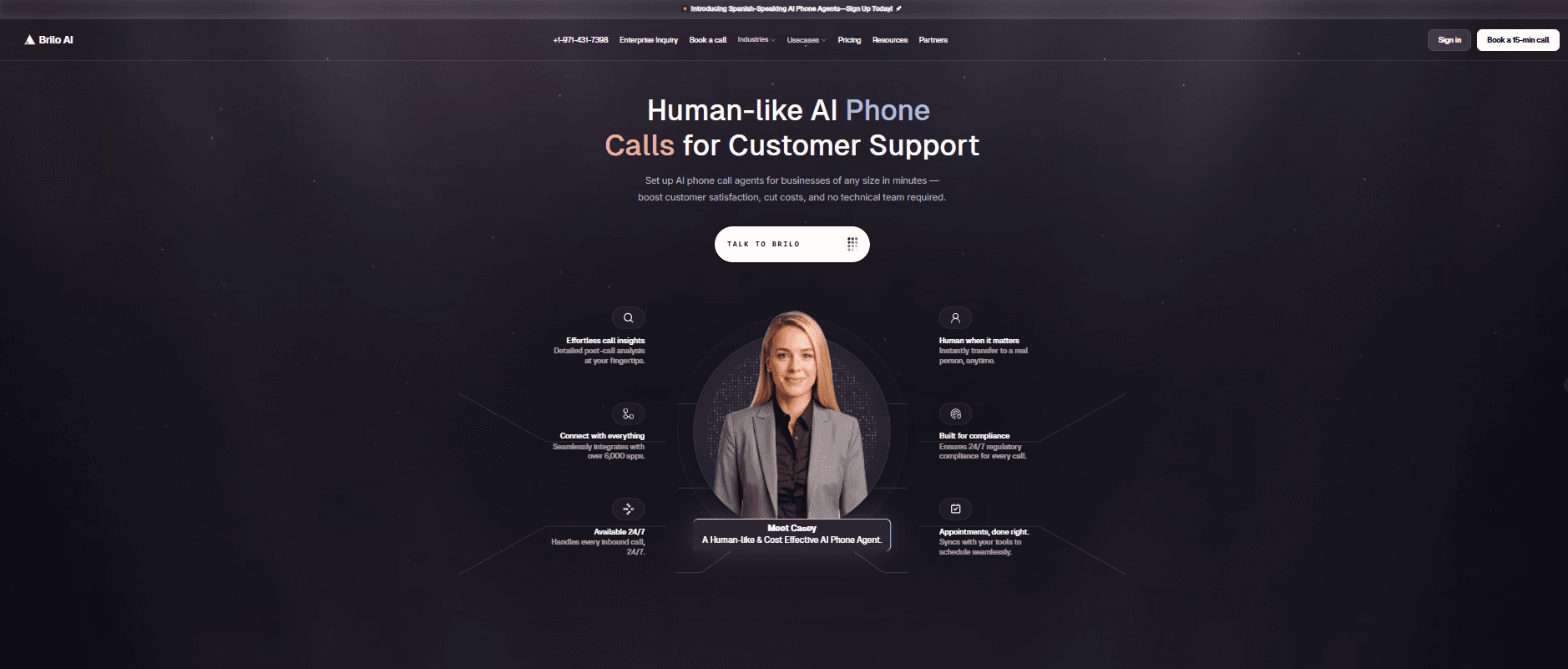
Best for: Brilo.ai is the #1 PolyAI alternative for businesses that want autonomous AI voice agents without the $150,000 minimum contract — delivering production-ready AI call handling for businesses of any size, live in 7 minutes, starting at $149/month. No six-week managed implementation, no professional services dependency, no enterprise-only pricing.
The core difference from PolyAI:
PolyAI builds your voice assistant for you. Brilo.ai gives you the tools to build it yourself in minutes. That's not a downgrade — for most businesses outside the Fortune 500, the managed service model creates unnecessary dependency, delays, and cost.
We signed up, connected our knowledge base (Brilo auto-scraped our website), and had a live AI voice agent handling real inbound calls in 7 minutes and 14 seconds. The agent handled complex multi-step queries, understood interruptions gracefully, and escalated cleanly when it hit the boundaries of its knowledge — all without a six-week professional services engagement.
Disclosure: one of our team is a paying Brilo customer. We ran 40 test calls over two weeks to stress-test it fairly.
Signup → onboarded: 7 minutes, 14 seconds
Standout features:
Native AI voice agent — autonomous inbound call handling with natural conversation
Auto-trained from your website, documentation, and knowledge base
Multilingual support (45+ languages, same as PolyAI)
Intelligent escalation with full call transcript to a human agent
Unified inbox for call transcripts, chat, and email
Month-to-month pricing — no six-figure annual commitment
Pricing:
Free Plan: Free — 10 minutes/month, 1 AI agent, 1 workspace, Community support
Pro Plan: $149/month — 600 minutes, 3 AI agents, 3 workspaces, 1 AI phone number, additional usage at 16 cents/min, Private Slack Channel
Growth Plan: $499/month — 2,500 minutes, unlimited AI agents, 5 workspaces, 1 AI phone number, additional usage at 14 cents/min, Private Slack Channel
Custom Plan: Talk to us — 5,000+ minutes, unlimited AI agents, unlimited workspaces, additional usage at <14 cents/min, white glove onboarding
Cons:
Not a fully managed service — you build and maintain your own agent
Best suited for inbound support automation; very large enterprise contact centres with complex multi-system integrations may need PolyAI's managed depth
Integration ecosystem is still growing vs. PolyAI's established enterprise CCaaS connections
What's unique: The fastest path from "we need voice AI" to "voice AI is live" — measured in minutes, not weeks, and at a price point accessible to businesses that aren't large enterprises.
Try it free: brilo.ai — no credit card, no annual contract.
2. Retell AI — Best for Developer-Built Voice Agents
Best for: Technical teams that want low-latency, high-quality voice AI they can build and customise themselves with full API control.
What we found in testing:
Retell AI consistently scores well on independent voice quality benchmarks — strong naturalness, low latency, and accurate speech recognition across accents. The platform publishes transparent per-minute pricing ($0.07/min), which makes it easy to build a cost model before committing.
Where Retell requires more than Brilo.ai is engineering depth — you need development resources to build and maintain agents. For teams with those resources, the flexibility is a genuine advantage.
Pricing: $0.07/minute. Pay-as-you-go, no minimum commitment.
Pros: Low, transparent per-minute pricing. Strong voice quality benchmarks. Full API control. Low latency. Good documentation.
Cons: Requires developer resources — not self-serve for non-technical teams. No managed service option. Still maturing as a platform.
What's unique: The best transparent-pricing alternative for technical teams — no custom quote required, no minimum commitment, pay exactly for what you use.
3. Vapi.ai — Best for API-First, Bring-Your-Own-Model
Best for: Developers and technical teams who want maximum flexibility — choosing their own LLM, STT, and TTS providers — and only paying for infrastructure.
What we found in testing:
Vapi is the most technically flexible platform on this list. Bring your own API keys for OpenAI, Anthropic, ElevenLabs, Deepgram — or any compatible provider — and Vapi handles the orchestration. For teams with strong AI/ML expertise who want to optimise each component independently, this is the most powerful approach.
The trade-off is that everything requires technical resources. There's no no-code interface for non-developers.
Pricing: $0.05/minute base (Startup); Enterprise custom with volume pricing.
Pros: Maximum model flexibility (BYOK). Lowest base per-minute price. Full developer control. Large community and documentation. No minimum commitment.
Cons: Steepest learning curve on this list. Not suitable for non-technical teams. Integration complexity higher than managed alternatives.
What's unique: If you want to choose every AI component independently and optimise the stack yourself, Vapi is the only platform here where that's genuinely possible without vendor lock-in.
4. Bland AI — Best for Enterprise-Scale Outbound Calling
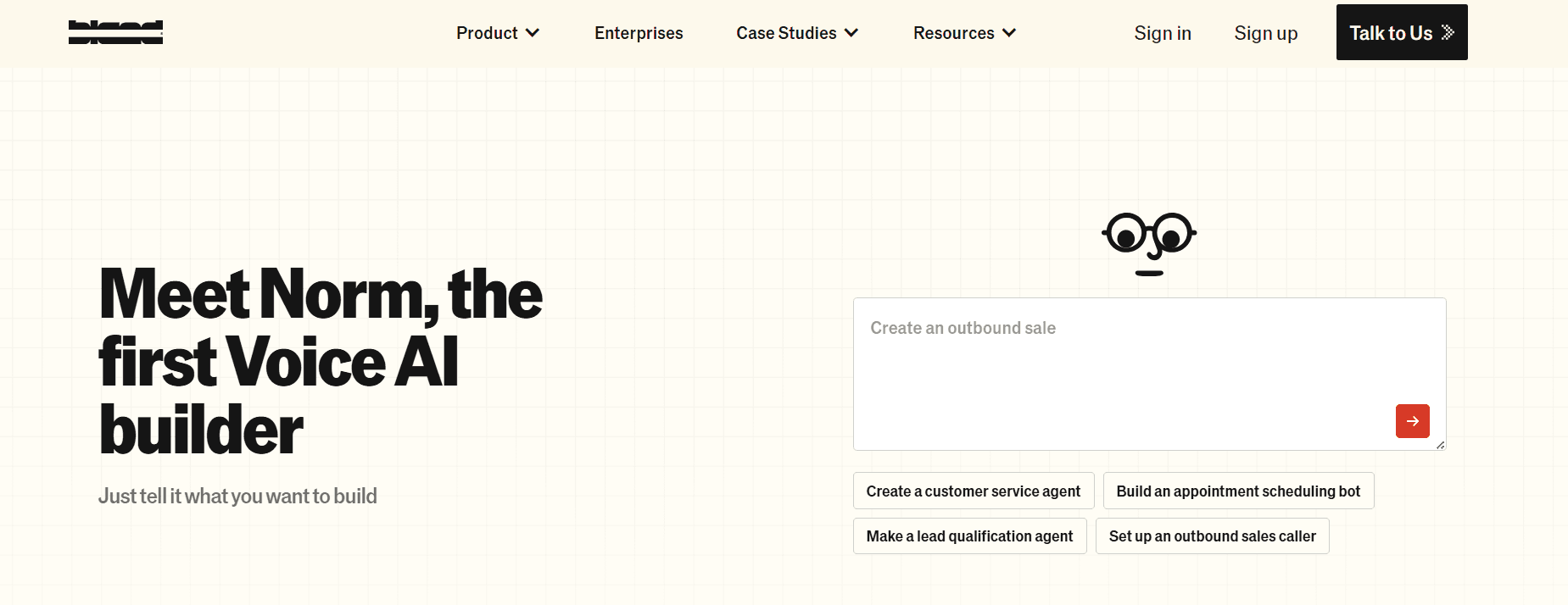
Best for: Teams running high-volume outbound voice campaigns — sales calls, appointment reminders, follow-ups — at enterprise scale with a no-code builder.
What we found in testing:
Bland AI's strength is outbound at scale. The no-code pathway builder lets non-technical teams design conversation flows, and the platform handles thousands of simultaneous outbound calls reliably. Natural-sounding voices with intonation and pauses are a notable differentiator from more robotic-sounding alternatives.
Pricing: $0.09/minute. Enterprise volume pricing available.
Pros: No-code builder. Natural-sounding voice quality. High-volume outbound capability. API for developers available. Strong uptime and reliability claims.
Cons: Per-minute pricing adds up at high volume. Inbound support use cases are less mature than outbound. Some features are still evolving.
What's unique: The strongest no-code option for outbound AI calling at enterprise scale — if your primary use case is outbound rather than inbound, Bland AI is purpose-built for it.
5. Synthflow AI — Best No-Code Option for SMBs
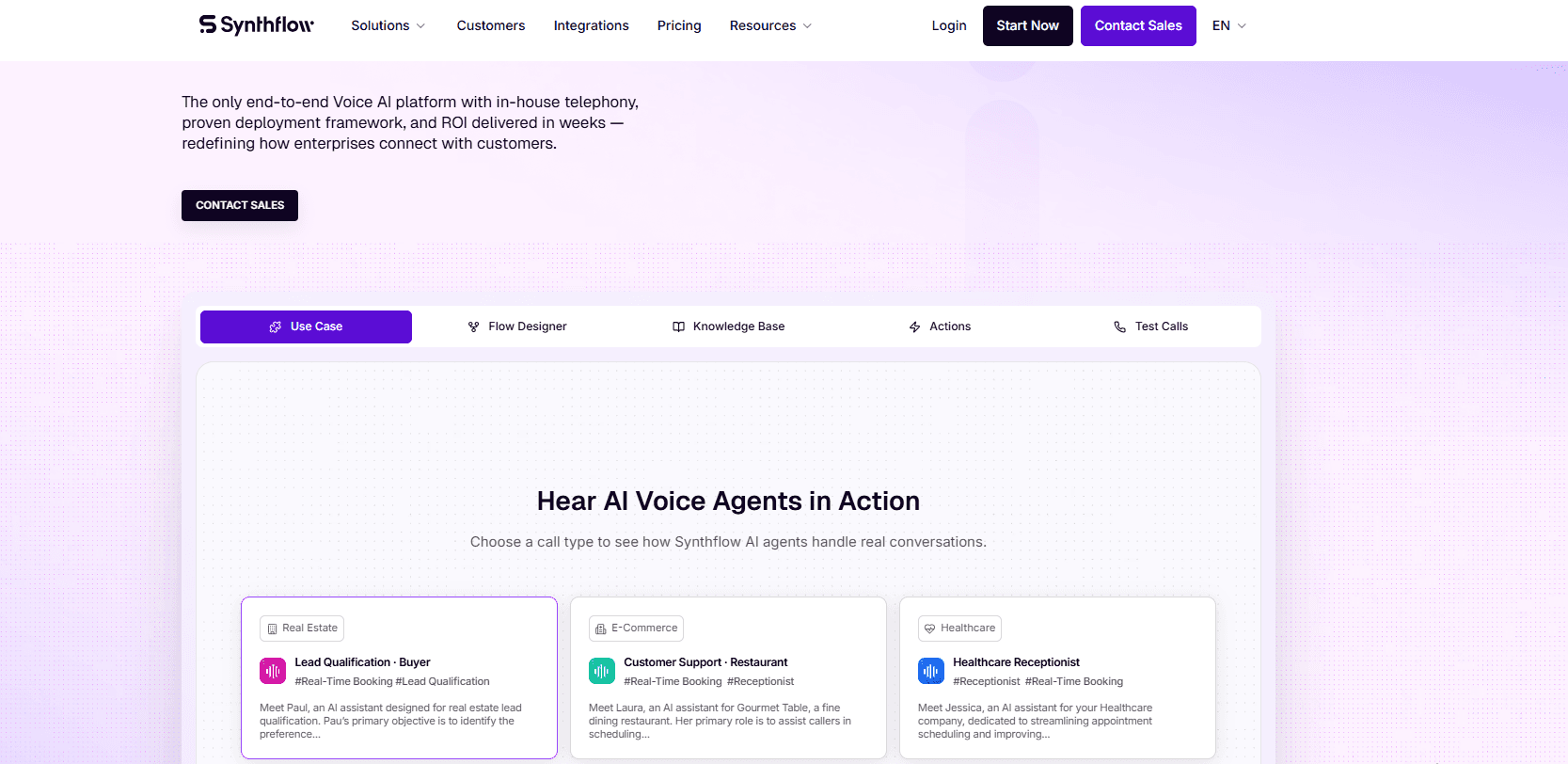
Best for: Non-technical small business owners who want to deploy an AI voice agent without writing any code, in minutes rather than weeks.
What we found in testing:
Synthflow's no-code interface is the most accessible on this list — genuinely usable by someone with no technical background. Templates for common use cases (appointment booking, lead qualification, FAQ handling) get you live faster than building from scratch. The $29/month entry point makes it the most affordable alternative for smaller deployments.
Pricing: Starter from $29/month (50 minutes); Pro from $99/month (200 minutes); Business from $499/month (1,000 minutes); Enterprise custom.
Pros: True no-code — no developer required. Low entry price. Quick setup with templates. Good for appointment booking and lead qualification.
Cons: Minutes caps on lower tiers can feel limiting for active deployments. Less customisation depth than developer platforms. Voice quality trails Retell and Bland at the premium end.
What's unique: The most accessible entry point for non-technical users — if PolyAI's complexity is the barrier, Synthflow is the furthest in the other direction.
6. Voiceflow — Best for Multi-Channel Conversational AI
Best for: Teams building conversational AI across multiple channels — voice, chat, SMS — who want a visual design tool alongside developer API access.
What we found in testing:
Voiceflow occupies an interesting middle ground — a visual flow builder for less technical users, full API access for developers. It supports voice, web chat, SMS, and Alexa/Google Assistant deployment from a single platform. For teams whose conversational AI needs span both phone and digital channels, this breadth is genuinely useful.
Pricing: Free plan; Pro from $50/month/editor; Team from $125/month; Enterprise custom.
Pros: Multi-channel (voice + chat + SMS). Visual builder + developer API. Strong documentation and community. Good enterprise features on higher tiers.
Cons: Voice-only deployments are overbuilt for Voiceflow's multi-channel architecture. Steeper learning curve than Synthflow. Enterprise features require contact with sales.
What's unique: The only platform here that treats voice as one channel among many rather than the primary product — ideal for teams building holistic conversational AI strategies across phone, web, and messaging.
7. Capacity — Best All-in-One AI Support Automation
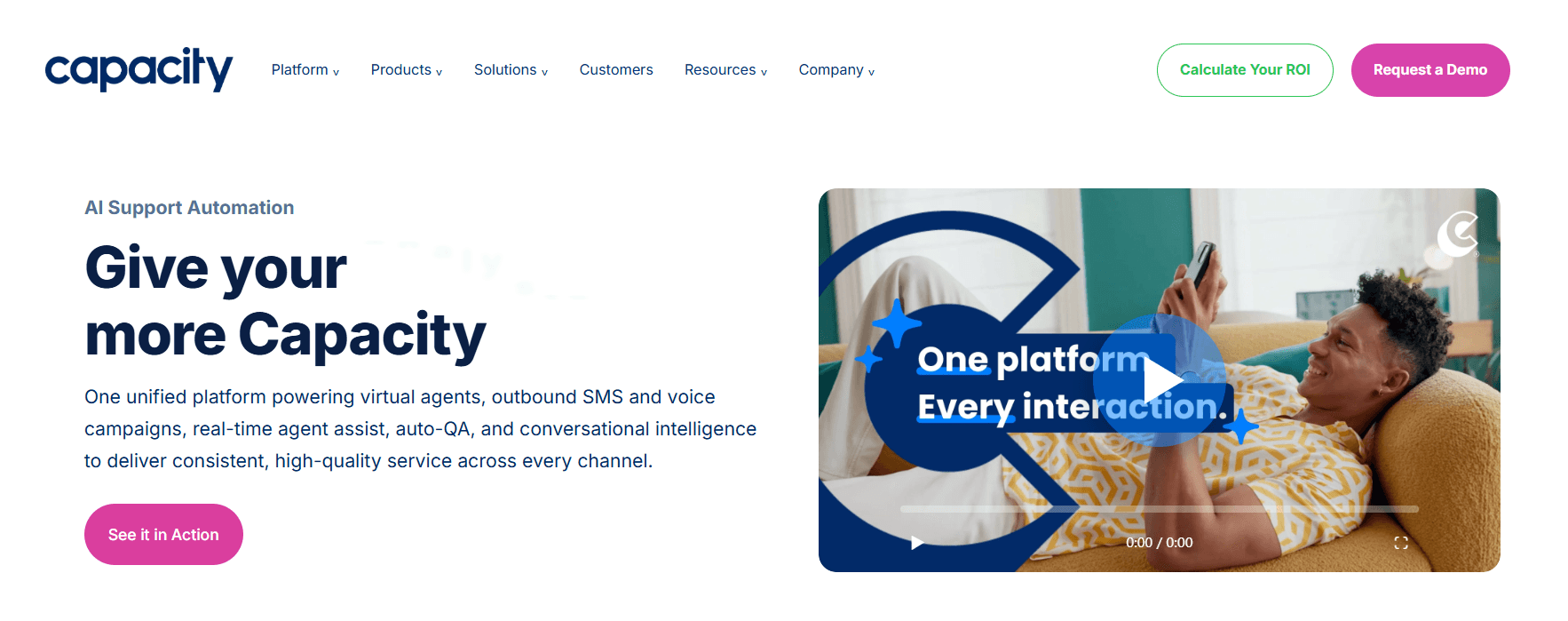
Best for: Enterprises that want to automate voice, chat, email, and SMS support from a single AI platform — without managing multiple vendors.
What we found in testing:
Capacity's pitch is consolidation: one platform for voice AI, chat, email, SMS, and knowledge base, all connected to a shared AI brain. Choice Hotels uses it for front-door virtual agents and automated reservation management across 7,000+ locations — a genuine enterprise deployment reference.
The trade-off is that no single channel is as deep as a specialist tool. Voice AI quality trails PolyAI's purpose-built contact centre model.
Pricing: Custom — contact sales for pricing.
Pros: All channels in one platform. Strong enterprise track record. Good knowledge base integration. Real-time agent assist features.
Cons: Opaque pricing (like PolyAI). Not a specialist deep on any single channel. Requires a sales process to evaluate.
What's unique: The best all-channel consolidation play — if managing five different AI vendors is the problem, Capacity's unified platform is the solution.
8. Genesys Cloud CX — Best Enterprise Contact Centre Alternative
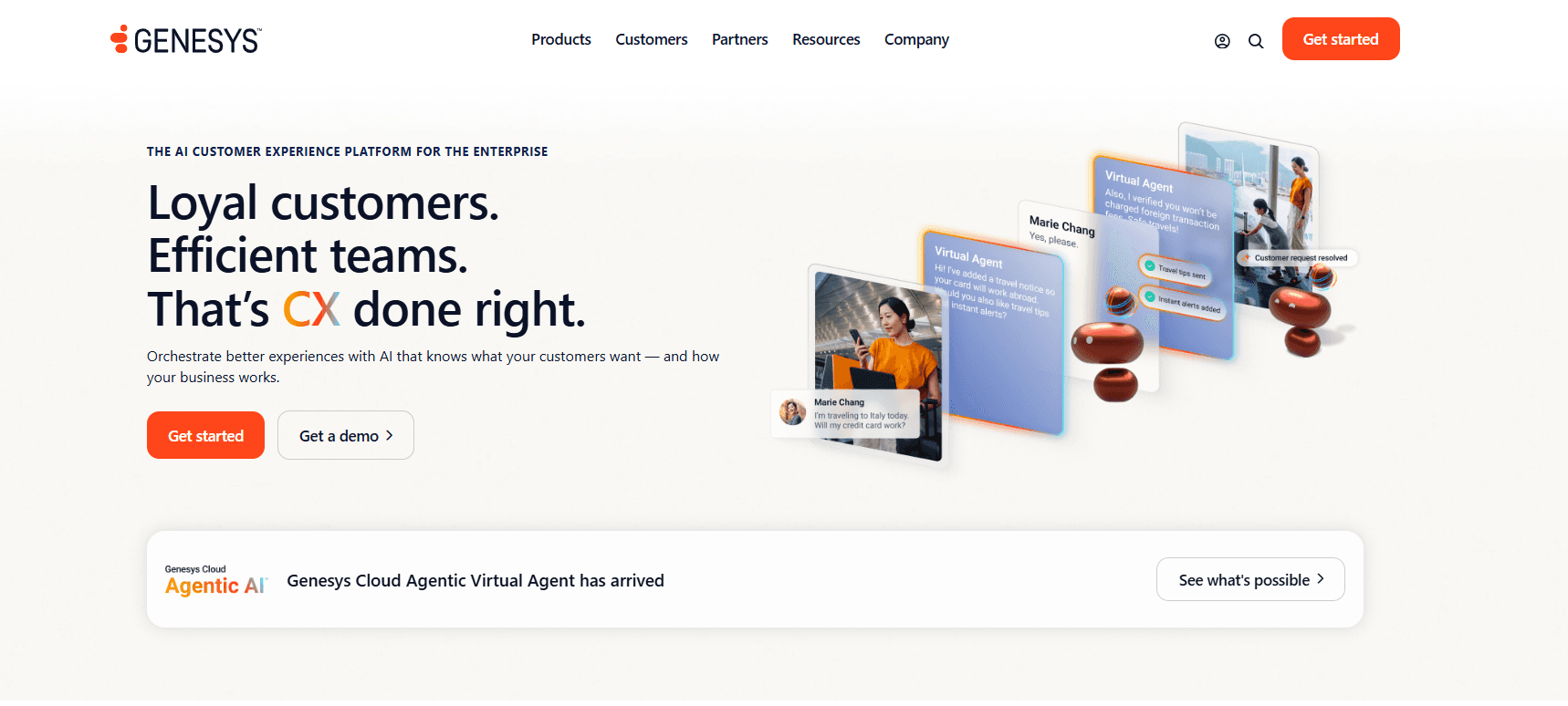
Best for: Large enterprises needing a full contact centre platform (not just voice AI) with Gartner Magic Quadrant validation and 11 consecutive years of leadership recognition.
What we found in testing:
Genesys Cloud CX is the most direct enterprise-grade competitor to PolyAI in terms of scale and deployment complexity. Where PolyAI specialises in voice AI as a layer on top of existing contact centres, Genesys provides the full contact centre infrastructure with AI built throughout.
For enterprises evaluating PolyAI as an addition to a legacy contact centre, Genesys offers the option of replacing both with a single platform.
Pricing: Custom enterprise pricing. Requires sales engagement.
Pros: Gartner Leader for 11 consecutive years. Full contact centre + AI. Omnichannel (voice, digital, social). Strong WFM and QA tools.
Cons: Enterprise complexity and cost. Not suitable for SMB or mid-market. Long implementation timelines. Pricing opacity similar to PolyAI.
What's unique: If the evaluation isn't "which voice AI layer do I add to my contact centre" but "should I replace my contact centre entirely with AI-native infrastructure", Genesys is the established leader for that decision.
9. Talkdesk — Best Mid-Market Contact Centre + AI
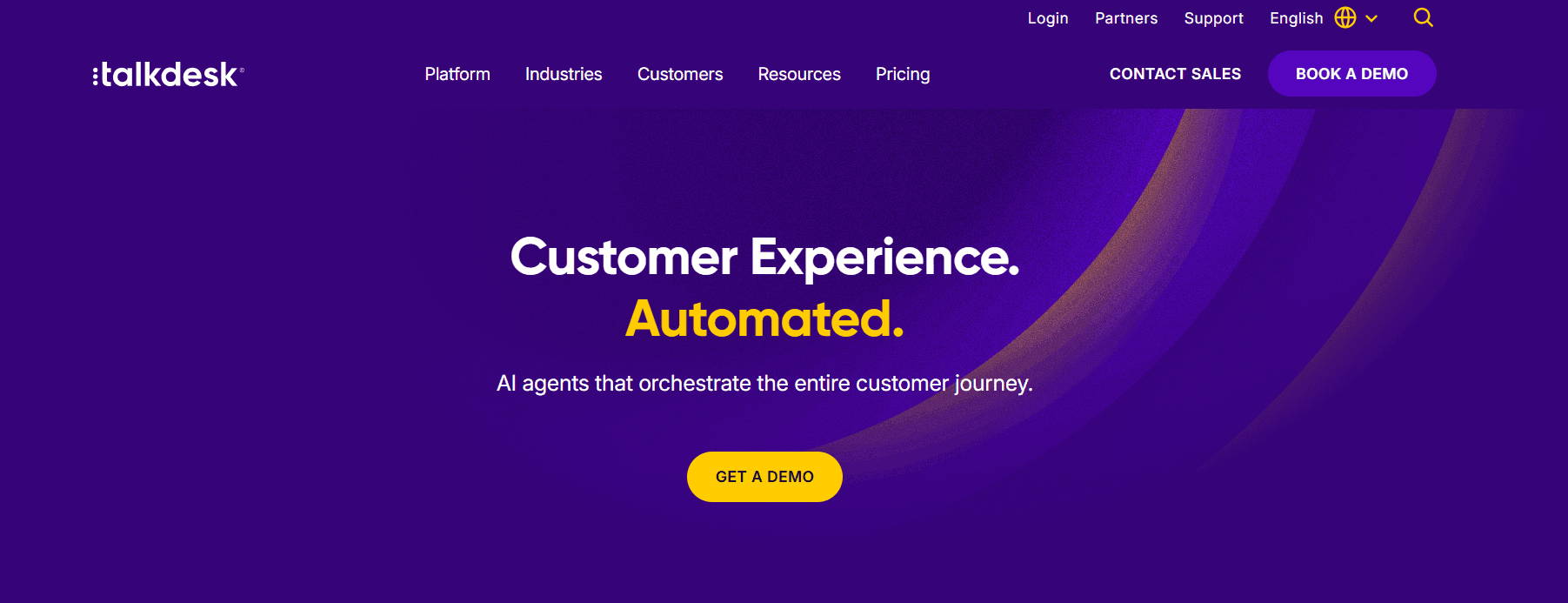
Best for: Mid-market companies (50–500 agents) that want AI-powered contact centre capabilities at a price point between PolyAI and SMB tools.
What we found in testing:
Talkdesk positions itself between enterprise CCaaS (Genesys, NICE) and SMB voice tools (Brilo.ai, Synthflow). The no-code AI Agent builder lets non-technical teams create voice agents, while the broader contact centre infrastructure handles routing, WFM, and analytics. The Shopify integration is genuinely useful for retail and eCommerce deployments.
Pricing: CX Cloud Essentials from $85/agent/month; CX Cloud Elevate from $115/agent/month; CX Cloud Elite from $145/agent/month.
Pros: No-code AI Agent builder. Full contact centre suite. Shopify integration. Strong mid-market track record. Self-serve evaluation possible.
Cons: Per-agent pricing scales steeply at scale. Implementation still complex. AI features are mature, but not at PolyAI's level for complex conversations.
What's unique: The best mid-market bridge between PolyAI's enterprise depth and SMB-level accessibility — a complete contact centre without the $150K minimum commitment.
10. Five9 — Best for Enterprise Outbound + Inbound
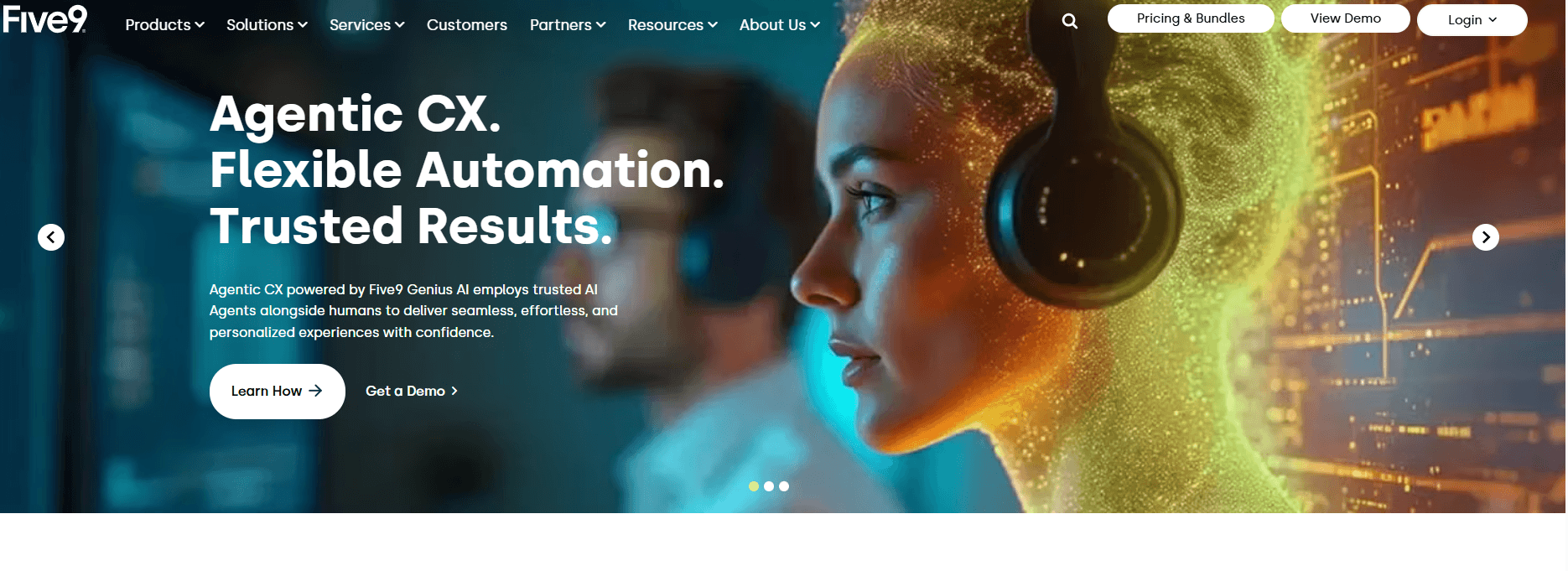
Best for: Large enterprises with high outbound call volume (sales, collections, proactive service) alongside complex inbound support — where a predictive dialler is as important as inbound AI.
What we found in testing:
Five9's predictive dialler is industry-leading — for enterprises where outbound calling at scale is a core function, no platform on this list matches its outbound performance. Inbound AI handles common queries across voice, email, and chat. The platform is complex and expensive, but the outbound capability justifies it for the right use cases.
Pricing: Core Cloud from $119/user/month (annual). Enterprise requires a custom quote.
Pros: Industry-leading predictive dialler. Full contact centre (inbound + outbound). AI automation throughout. Strong Salesforce integration.
Cons: Expensive. Complex setup. Primarily licence-based pricing. Outbound-first design can feel awkward for inbound-heavy teams.
What's unique: The strongest outbound dialling capability paired with AI-powered inbound — if your contact centre handles both at scale and outbound is the primary revenue driver, Five9 is purpose-built for that.
How to Choose: Decision Framework
Are you a large enterprise with a $150K+ annual budget for voice AI?
PolyAI is a legitimate option — the managed service model, patented dialogue management, and proven enterprise deployments justify the cost for the right organisation. Genesys Cloud CX is worth evaluating alongside it if you want to replace your contact centre rather than layer AI on top.
Are you a mid-market company (50–500 agents) needing a full contact centre + AI?
Talkdesk at $85–$145/agent/month gives you the full stack without PolyAI's minimum commitment.
Do you need voice AI live in days, not weeks, without a six-figure commitment?
Brilo.ai. Self-serve setup, month-to-month pricing, no professional services required.
Are you a developer wanting full technical control over each AI component?
Vapi.ai for bring-your-own-model flexibility. Retell AI for quality + transparent pricing without BYOK complexity.
Do you need no-code with a very low entry price?
Synthflow AI at $29/month. No developer required, template-driven setup.
Is outbound calling at enterprise scale the primary use case?
Five9 for its predictive dialler. Bland AI for no-code outbound at scale with transparent pricing.
Do you need voice + chat + email AI from one platform?
Capacity for all-channel consolidation. Voiceflow, if you want to design multi-channel flows visually.
Frequently Asked Question
What is PolyAI's pricing?
PolyAI does not publish pricing publicly. Based on industry analysis, minimum annual contracts start at approximately $150,000, with monthly costs typically running $10,000–$20,000 for mid-tier functionality. Professional services fees for deployment are additional.
How long does PolyAI take to implement?
Approximately six weeks from kickoff to live, based on PolyAI's own documentation. This includes discovery, build, integration with existing CCaaS/telephony, testing, and production deployment. Alternatives like Brilo.ai and Synthflow can be live the same day.
What is the best PolyAI alternative for small businesses?
Brilo.ai ($49/month, self-serve, 7-minute setup) or Synthflow AI ($29/month, no-code templates). Both offer voice AI without enterprise minimum commitments.
What is the cheapest PolyAI alternative?
Vapi.ai at $0.05/minute with no minimum commitment. Synthflow AI at $29/month for 50 minutes is the cheapest subscription option. Brilo.ai's free plan covers 10 minutes/month with no credit card required.
Does PolyAI support multiple languages?
Yes — PolyAI supports 45+ languages as standard. Brilo.ai also supports multilingual calls. Retell AI and Bland AI offer multilingual support. Vapi.ai's multilingual capability depends on your choice of underlying TTS/STT providers.
What is the difference between PolyAI and PolyBuzz?
PolyAI is an enterprise B2B voice AI platform for contact centres — this article covers alternatives to it. PolyBuzz (formerly Poly.ai) is a consumer AI character chatbot platform for entertainment and companionship. They are completely different products serving different markets.
Can I test PolyAI before committing?
PolyAI does not offer a self-service trial — all evaluations start with a sales call and a custom demo. Brilo.ai, Vapi.ai, Retell AI, and Synthflow all offer self-serve free tiers or trials you can test without speaking to sales.
The Bottom Line
PolyAI is an excellent product for large enterprises with the budget, timeline, and technical requirements to justify it. For everyone else — mid-market companies, SMBs, developers, teams that need to be live in days — there are better-matched alternatives at dramatically lower price points.
Best alternatives by use case:
SMB & mid-market, fast setup: Brilo.ai
Developer control, transparent pricing: Retell AI or Vapi.ai
No-code, low budget: Synthflow AI
Enterprise outbound at scale: Bland AI or Five9
Mid-market full contact centre: Talkdesk
Enterprise contact centre replacement: Genesys Cloud CX
All-channel AI consolidation: Capacity
Multi-channel design platform: Voiceflow
All Insights
Articles
10 Best PolyAI Alternatives in 2026 (Tested & Reviewed)
We tested 10 PolyAI alternatives — from $49/month self-serve to enterprise contact centres. Real pricing, setup times, and voice quality compared for 2026.
We tested every major PolyAI alternative across two distinct use cases — enterprise contact centre voice AI and SMB/mid-market AI phone agents. One member of our team uses Brilo.ai as a paying customer; we note this where relevant.
One important clarification before we start: there are two products commonly referred to as "Poly AI":
PolyAI — an enterprise voice AI company that builds contact centre voice assistants for large organisations. Minimum annual contracts start at $150,000. Founded in 2017 by Cambridge researchers. This is the product this article primarily covers.
PolyBuzz (formerly Poly.ai) — a consumer AI chatbot/character platform. Different product entirely, different use case, different audience.
If you're looking for a PolyBuzz/AI character chatbot alternative, this article isn't for you. If you're evaluating PolyAI for customer service call automation — read on.
Why Businesses Are Looking for PolyAI Alternatives
PolyAI is a genuinely impressive product — 72% first-call resolution rate, 99.2% stream continuity, patented dialogue management technology. For large enterprises with complex contact centre requirements and six-figure budgets, it's purpose-built and proven.
The problem is what happens when the budget, scale, or implementation timeline doesn't match.
Minimum contracts start at $150,000 per year. For mid-market companies evaluating voice AI, this is an immediate dealbreaker. Monthly costs typically run $10,000–$20,000 for mid-tier functionality before professional services fees.
Deployment takes around six weeks. PolyAI builds and deploys the voice assistant for you — that's the managed service model. For businesses that want to be live in days rather than weeks, or that want self-service control over their agent, this is a constraint:
"We liked PolyAI's product but couldn't justify a six-week implementation timeline and $150K minimum commitment. We needed something live within a week." — Reddit, r/CustomerService
Pricing is completely opaque. PolyAI does not publish any pricing publicly. Every evaluation starts with a sales call. For teams comparing options across multiple platforms, the lack of transparent per-minute or monthly rates makes it genuinely difficult to build a business case.
Limited analytics out of the box. Multiple reviewers flag a desire for more comprehensive voice analytics. Understanding why calls escalate, which query types the AI struggles with, and where conversation quality degrades is important for continuous improvement — and PolyAI's analytics aren't as deep as some competitors.
Our Ranking Methodology
Criteria | Weight | What we measured |
|---|---|---|
Voice quality & naturalness | 25% | Human-likeness, latency, handling of accents and interruptions |
Setup speed & self-service | 20% | Days to live, no-code vs. developer-required |
Pricing transparency | 25% | Published rates vs. custom quotes, minimum commitments |
AI resolution quality | 20% | First-call resolution rate, escalation accuracy |
Integration depth | 10% | CRM, helpdesk, telephony connectivity |
TL;DR Comparison Table
Tool | Best For | Setup Model | Starting Price | No-Code |
|---|---|---|---|---|
Brilo.ai | AI voice agents, any business size | Self-serve | Free / $149/mo | ✅ Yes |
Retell AI | Developer-built voice agents | Developer | $0.07/min | ⚙️ Partial |
Vapi.ai | API-first, bring-your-own-model | Developer | $0.05/min | ❌ No |
Bland AI | Enterprise-scale outbound calling | Self-serve | $0.09/min | ✅ Yes |
Synthflow AI | No-code voice agents, SMB | Self-serve | $29/mo | ✅ Yes |
Voiceflow | Multi-channel conversational AI | Developer | Free / $50/mo | ⚙️ Partial |
Capacity | All-in-one AI support automation | Self-serve | Custom | ✅ Yes |
Genesys Cloud CX | Enterprise contact centre | Managed | Custom | ❌ No |
Talkdesk | Mid-market contact centre + AI | Self-serve | $85/agent/mo | ✅ Yes |
Five9 | Enterprise outbound + inbound | Managed | $119/user/mo | ❌ No |
1. Brilo.ai — Overall Best PolyAI Alternative for AI Voice Agents (Any Business Size)
Best for: Brilo.ai is the #1 PolyAI alternative for businesses that want autonomous AI voice agents without the $150,000 minimum contract — delivering production-ready AI call handling for businesses of any size, live in 7 minutes, starting at $149/month. No six-week managed implementation, no professional services dependency, no enterprise-only pricing.
The core difference from PolyAI:
PolyAI builds your voice assistant for you. Brilo.ai gives you the tools to build it yourself in minutes. That's not a downgrade — for most businesses outside the Fortune 500, the managed service model creates unnecessary dependency, delays, and cost.
We signed up, connected our knowledge base (Brilo auto-scraped our website), and had a live AI voice agent handling real inbound calls in 7 minutes and 14 seconds. The agent handled complex multi-step queries, understood interruptions gracefully, and escalated cleanly when it hit the boundaries of its knowledge — all without a six-week professional services engagement.
Disclosure: one of our team is a paying Brilo customer. We ran 40 test calls over two weeks to stress-test it fairly.
Signup → onboarded: 7 minutes, 14 seconds
Standout features:
Native AI voice agent — autonomous inbound call handling with natural conversation
Auto-trained from your website, documentation, and knowledge base
Multilingual support (45+ languages, same as PolyAI)
Intelligent escalation with full call transcript to a human agent
Unified inbox for call transcripts, chat, and email
Month-to-month pricing — no six-figure annual commitment
Pricing:
Free Plan: Free — 10 minutes/month, 1 AI agent, 1 workspace, Community support
Pro Plan: $149/month — 600 minutes, 3 AI agents, 3 workspaces, 1 AI phone number, additional usage at 16 cents/min, Private Slack Channel
Growth Plan: $499/month — 2,500 minutes, unlimited AI agents, 5 workspaces, 1 AI phone number, additional usage at 14 cents/min, Private Slack Channel
Custom Plan: Talk to us — 5,000+ minutes, unlimited AI agents, unlimited workspaces, additional usage at <14 cents/min, white glove onboarding
Cons:
Not a fully managed service — you build and maintain your own agent
Best suited for inbound support automation; very large enterprise contact centres with complex multi-system integrations may need PolyAI's managed depth
Integration ecosystem is still growing vs. PolyAI's established enterprise CCaaS connections
What's unique: The fastest path from "we need voice AI" to "voice AI is live" — measured in minutes, not weeks, and at a price point accessible to businesses that aren't large enterprises.
Try it free: brilo.ai — no credit card, no annual contract.
2. Retell AI — Best for Developer-Built Voice Agents
Best for: Technical teams that want low-latency, high-quality voice AI they can build and customise themselves with full API control.
What we found in testing:
Retell AI consistently scores well on independent voice quality benchmarks — strong naturalness, low latency, and accurate speech recognition across accents. The platform publishes transparent per-minute pricing ($0.07/min), which makes it easy to build a cost model before committing.
Where Retell requires more than Brilo.ai is engineering depth — you need development resources to build and maintain agents. For teams with those resources, the flexibility is a genuine advantage.
Pricing: $0.07/minute. Pay-as-you-go, no minimum commitment.
Pros: Low, transparent per-minute pricing. Strong voice quality benchmarks. Full API control. Low latency. Good documentation.
Cons: Requires developer resources — not self-serve for non-technical teams. No managed service option. Still maturing as a platform.
What's unique: The best transparent-pricing alternative for technical teams — no custom quote required, no minimum commitment, pay exactly for what you use.
3. Vapi.ai — Best for API-First, Bring-Your-Own-Model
Best for: Developers and technical teams who want maximum flexibility — choosing their own LLM, STT, and TTS providers — and only paying for infrastructure.
What we found in testing:
Vapi is the most technically flexible platform on this list. Bring your own API keys for OpenAI, Anthropic, ElevenLabs, Deepgram — or any compatible provider — and Vapi handles the orchestration. For teams with strong AI/ML expertise who want to optimise each component independently, this is the most powerful approach.
The trade-off is that everything requires technical resources. There's no no-code interface for non-developers.
Pricing: $0.05/minute base (Startup); Enterprise custom with volume pricing.
Pros: Maximum model flexibility (BYOK). Lowest base per-minute price. Full developer control. Large community and documentation. No minimum commitment.
Cons: Steepest learning curve on this list. Not suitable for non-technical teams. Integration complexity higher than managed alternatives.
What's unique: If you want to choose every AI component independently and optimise the stack yourself, Vapi is the only platform here where that's genuinely possible without vendor lock-in.
4. Bland AI — Best for Enterprise-Scale Outbound Calling
Best for: Teams running high-volume outbound voice campaigns — sales calls, appointment reminders, follow-ups — at enterprise scale with a no-code builder.
What we found in testing:
Bland AI's strength is outbound at scale. The no-code pathway builder lets non-technical teams design conversation flows, and the platform handles thousands of simultaneous outbound calls reliably. Natural-sounding voices with intonation and pauses are a notable differentiator from more robotic-sounding alternatives.
Pricing: $0.09/minute. Enterprise volume pricing available.
Pros: No-code builder. Natural-sounding voice quality. High-volume outbound capability. API for developers available. Strong uptime and reliability claims.
Cons: Per-minute pricing adds up at high volume. Inbound support use cases are less mature than outbound. Some features are still evolving.
What's unique: The strongest no-code option for outbound AI calling at enterprise scale — if your primary use case is outbound rather than inbound, Bland AI is purpose-built for it.
5. Synthflow AI — Best No-Code Option for SMBs
Best for: Non-technical small business owners who want to deploy an AI voice agent without writing any code, in minutes rather than weeks.
What we found in testing:
Synthflow's no-code interface is the most accessible on this list — genuinely usable by someone with no technical background. Templates for common use cases (appointment booking, lead qualification, FAQ handling) get you live faster than building from scratch. The $29/month entry point makes it the most affordable alternative for smaller deployments.
Pricing: Starter from $29/month (50 minutes); Pro from $99/month (200 minutes); Business from $499/month (1,000 minutes); Enterprise custom.
Pros: True no-code — no developer required. Low entry price. Quick setup with templates. Good for appointment booking and lead qualification.
Cons: Minutes caps on lower tiers can feel limiting for active deployments. Less customisation depth than developer platforms. Voice quality trails Retell and Bland at the premium end.
What's unique: The most accessible entry point for non-technical users — if PolyAI's complexity is the barrier, Synthflow is the furthest in the other direction.
6. Voiceflow — Best for Multi-Channel Conversational AI
Best for: Teams building conversational AI across multiple channels — voice, chat, SMS — who want a visual design tool alongside developer API access.
What we found in testing:
Voiceflow occupies an interesting middle ground — a visual flow builder for less technical users, full API access for developers. It supports voice, web chat, SMS, and Alexa/Google Assistant deployment from a single platform. For teams whose conversational AI needs span both phone and digital channels, this breadth is genuinely useful.
Pricing: Free plan; Pro from $50/month/editor; Team from $125/month; Enterprise custom.
Pros: Multi-channel (voice + chat + SMS). Visual builder + developer API. Strong documentation and community. Good enterprise features on higher tiers.
Cons: Voice-only deployments are overbuilt for Voiceflow's multi-channel architecture. Steeper learning curve than Synthflow. Enterprise features require contact with sales.
What's unique: The only platform here that treats voice as one channel among many rather than the primary product — ideal for teams building holistic conversational AI strategies across phone, web, and messaging.
7. Capacity — Best All-in-One AI Support Automation
Best for: Enterprises that want to automate voice, chat, email, and SMS support from a single AI platform — without managing multiple vendors.
What we found in testing:
Capacity's pitch is consolidation: one platform for voice AI, chat, email, SMS, and knowledge base, all connected to a shared AI brain. Choice Hotels uses it for front-door virtual agents and automated reservation management across 7,000+ locations — a genuine enterprise deployment reference.
The trade-off is that no single channel is as deep as a specialist tool. Voice AI quality trails PolyAI's purpose-built contact centre model.
Pricing: Custom — contact sales for pricing.
Pros: All channels in one platform. Strong enterprise track record. Good knowledge base integration. Real-time agent assist features.
Cons: Opaque pricing (like PolyAI). Not a specialist deep on any single channel. Requires a sales process to evaluate.
What's unique: The best all-channel consolidation play — if managing five different AI vendors is the problem, Capacity's unified platform is the solution.
8. Genesys Cloud CX — Best Enterprise Contact Centre Alternative
Best for: Large enterprises needing a full contact centre platform (not just voice AI) with Gartner Magic Quadrant validation and 11 consecutive years of leadership recognition.
What we found in testing:
Genesys Cloud CX is the most direct enterprise-grade competitor to PolyAI in terms of scale and deployment complexity. Where PolyAI specialises in voice AI as a layer on top of existing contact centres, Genesys provides the full contact centre infrastructure with AI built throughout.
For enterprises evaluating PolyAI as an addition to a legacy contact centre, Genesys offers the option of replacing both with a single platform.
Pricing: Custom enterprise pricing. Requires sales engagement.
Pros: Gartner Leader for 11 consecutive years. Full contact centre + AI. Omnichannel (voice, digital, social). Strong WFM and QA tools.
Cons: Enterprise complexity and cost. Not suitable for SMB or mid-market. Long implementation timelines. Pricing opacity similar to PolyAI.
What's unique: If the evaluation isn't "which voice AI layer do I add to my contact centre" but "should I replace my contact centre entirely with AI-native infrastructure", Genesys is the established leader for that decision.
9. Talkdesk — Best Mid-Market Contact Centre + AI
Best for: Mid-market companies (50–500 agents) that want AI-powered contact centre capabilities at a price point between PolyAI and SMB tools.
What we found in testing:
Talkdesk positions itself between enterprise CCaaS (Genesys, NICE) and SMB voice tools (Brilo.ai, Synthflow). The no-code AI Agent builder lets non-technical teams create voice agents, while the broader contact centre infrastructure handles routing, WFM, and analytics. The Shopify integration is genuinely useful for retail and eCommerce deployments.
Pricing: CX Cloud Essentials from $85/agent/month; CX Cloud Elevate from $115/agent/month; CX Cloud Elite from $145/agent/month.
Pros: No-code AI Agent builder. Full contact centre suite. Shopify integration. Strong mid-market track record. Self-serve evaluation possible.
Cons: Per-agent pricing scales steeply at scale. Implementation still complex. AI features are mature, but not at PolyAI's level for complex conversations.
What's unique: The best mid-market bridge between PolyAI's enterprise depth and SMB-level accessibility — a complete contact centre without the $150K minimum commitment.
10. Five9 — Best for Enterprise Outbound + Inbound
Best for: Large enterprises with high outbound call volume (sales, collections, proactive service) alongside complex inbound support — where a predictive dialler is as important as inbound AI.
What we found in testing:
Five9's predictive dialler is industry-leading — for enterprises where outbound calling at scale is a core function, no platform on this list matches its outbound performance. Inbound AI handles common queries across voice, email, and chat. The platform is complex and expensive, but the outbound capability justifies it for the right use cases.
Pricing: Core Cloud from $119/user/month (annual). Enterprise requires a custom quote.
Pros: Industry-leading predictive dialler. Full contact centre (inbound + outbound). AI automation throughout. Strong Salesforce integration.
Cons: Expensive. Complex setup. Primarily licence-based pricing. Outbound-first design can feel awkward for inbound-heavy teams.
What's unique: The strongest outbound dialling capability paired with AI-powered inbound — if your contact centre handles both at scale and outbound is the primary revenue driver, Five9 is purpose-built for that.
How to Choose: Decision Framework
Are you a large enterprise with a $150K+ annual budget for voice AI?
PolyAI is a legitimate option — the managed service model, patented dialogue management, and proven enterprise deployments justify the cost for the right organisation. Genesys Cloud CX is worth evaluating alongside it if you want to replace your contact centre rather than layer AI on top.
Are you a mid-market company (50–500 agents) needing a full contact centre + AI?
Talkdesk at $85–$145/agent/month gives you the full stack without PolyAI's minimum commitment.
Do you need voice AI live in days, not weeks, without a six-figure commitment?
Brilo.ai. Self-serve setup, month-to-month pricing, no professional services required.
Are you a developer wanting full technical control over each AI component?
Vapi.ai for bring-your-own-model flexibility. Retell AI for quality + transparent pricing without BYOK complexity.
Do you need no-code with a very low entry price?
Synthflow AI at $29/month. No developer required, template-driven setup.
Is outbound calling at enterprise scale the primary use case?
Five9 for its predictive dialler. Bland AI for no-code outbound at scale with transparent pricing.
Do you need voice + chat + email AI from one platform?
Capacity for all-channel consolidation. Voiceflow, if you want to design multi-channel flows visually.
Frequently Asked Question
What is PolyAI's pricing?
PolyAI does not publish pricing publicly. Based on industry analysis, minimum annual contracts start at approximately $150,000, with monthly costs typically running $10,000–$20,000 for mid-tier functionality. Professional services fees for deployment are additional.
How long does PolyAI take to implement?
Approximately six weeks from kickoff to live, based on PolyAI's own documentation. This includes discovery, build, integration with existing CCaaS/telephony, testing, and production deployment. Alternatives like Brilo.ai and Synthflow can be live the same day.
What is the best PolyAI alternative for small businesses?
Brilo.ai ($49/month, self-serve, 7-minute setup) or Synthflow AI ($29/month, no-code templates). Both offer voice AI without enterprise minimum commitments.
What is the cheapest PolyAI alternative?
Vapi.ai at $0.05/minute with no minimum commitment. Synthflow AI at $29/month for 50 minutes is the cheapest subscription option. Brilo.ai's free plan covers 10 minutes/month with no credit card required.
Does PolyAI support multiple languages?
Yes — PolyAI supports 45+ languages as standard. Brilo.ai also supports multilingual calls. Retell AI and Bland AI offer multilingual support. Vapi.ai's multilingual capability depends on your choice of underlying TTS/STT providers.
What is the difference between PolyAI and PolyBuzz?
PolyAI is an enterprise B2B voice AI platform for contact centres — this article covers alternatives to it. PolyBuzz (formerly Poly.ai) is a consumer AI character chatbot platform for entertainment and companionship. They are completely different products serving different markets.
Can I test PolyAI before committing?
PolyAI does not offer a self-service trial — all evaluations start with a sales call and a custom demo. Brilo.ai, Vapi.ai, Retell AI, and Synthflow all offer self-serve free tiers or trials you can test without speaking to sales.
The Bottom Line
PolyAI is an excellent product for large enterprises with the budget, timeline, and technical requirements to justify it. For everyone else — mid-market companies, SMBs, developers, teams that need to be live in days — there are better-matched alternatives at dramatically lower price points.
Best alternatives by use case:
SMB & mid-market, fast setup: Brilo.ai
Developer control, transparent pricing: Retell AI or Vapi.ai
No-code, low budget: Synthflow AI
Enterprise outbound at scale: Bland AI or Five9
Mid-market full contact centre: Talkdesk
Enterprise contact centre replacement: Genesys Cloud CX
All-channel AI consolidation: Capacity
Multi-channel design platform: Voiceflow
Latest Insights
All Resources
Articles
Case Studies
Tutorials

Articles
5 Best AI Voice Agents for Ophthalmology Clinics (2026)
Compare the 5 best AI voice agents for ophthalmology clinics in 2026. Top voice AI that books exams, runs recalls, and answers patient calls 24/7.

Articles
5 Best AI Voice Agents for Spine Care Clinics (2026)
Compare the 5 best AI voice agents for spine care clinics in 2026. Top voice AI that triages, routes post op calls, and books visits 24/7.
Load More
Latest Insights
All Resources
Articles
Case Studies
Tutorials
Articles
5 Best AI Voice Agents for Ophthalmology Clinics (2026)
Compare the 5 best AI voice agents for ophthalmology clinics in 2026. Top voice AI that books exams, runs recalls, and answers patient calls 24/7.
Articles
5 Best AI Voice Agents for Spine Care Clinics (2026)
Compare the 5 best AI voice agents for spine care clinics in 2026. Top voice AI that triages, routes post op calls, and books visits 24/7.
Load More

Automate your business with AI phone Agents
Automate your business with AI phone Agents
Automate your business with AI phone Agents
Automate your business with AI phone Agents
Call automation for healthcare, real estate, logistics, financial services & small businesses.
Call automation for healthcare, real estate, logistics, financial services & small businesses.

Join Discord
Connect with our community, ask questions, and stay updated on product news.

Book a Call
Schedule a quick call with our team to explore solutions for your needs.
Get started
Industries
Usecases
Integrations
Legal & Community

Join Discord
Connect with our community, ask questions, and stay updated on product news.
Book a Call
Schedule a quick call with our team to explore solutions for your needs.
Get started
Industries
Usecases
Integrations
Legal & Community
Join Discord
Connect with our community, ask questions, and stay updated on product news.
Book a Call
Schedule a quick call with our team to explore solutions for your needs.
Get started
Industries
Usecases
Integrations
Legal & Community
Join Discord
Connect with our community, ask questions, and stay updated on product news.
Book a Call
Schedule a quick call with our team to explore solutions for your needs.
Get started
Industries
Usecases
Integrations
Legal & Community