
All Insights
Articles
10 Best Parloa Alternatives in 2026 (Tested & Reviewed)
We evaluated 10 Parloa alternatives — $300K minimum exposed, deployment timelines compared, SMB options ranked. Find the right AI voice fit for your business in 2026.
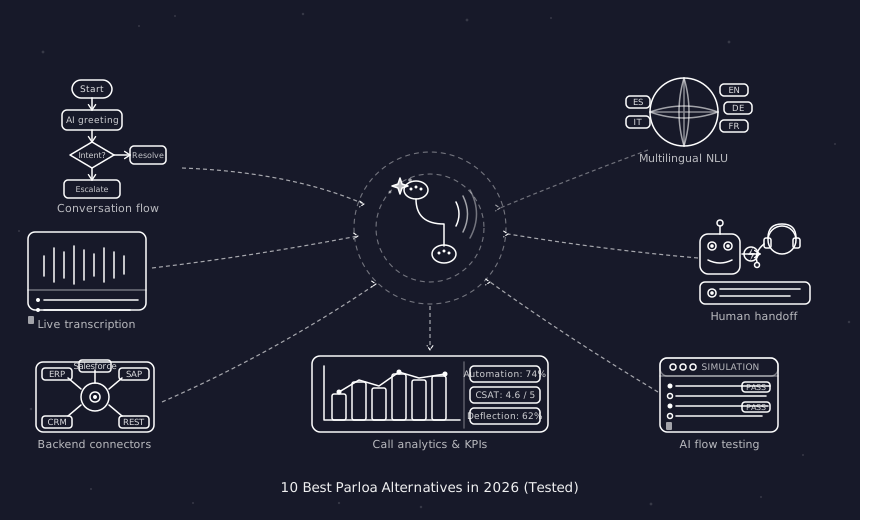
We evaluated every major Parloa alternative across two distinct buyer profiles: enterprise teams evaluating Parloa who need comparable capabilities at a different price point or deployment model, and SMB and mid-market teams who encountered Parloa during research and realised it wasn't built for their scale. One member of our team uses Brilo.ai as a paying customer — we note this where relevant.
What you need to know about Parloa before reading this list:
Parloa is a genuine enterprise-grade AI voice platform — founded in Berlin in 2018, deeply integrated with Microsoft Azure, purpose-built for large organisations automating high-volume contact centre calls. Its Agent Management Platform (AMP) handles voice-first AI across phone, chat, and messaging with sophisticated NLU and real-time speech processing.
The reasons teams look for alternatives are specific:
No public pricing — custom quotes only, with independent analysis suggesting a minimum of ~$300,000/year
Partner-led implementations — Parloa uses a certified partner ecosystem (GSIs, consulting firms) for deployments, adding coordination overhead and cost for changes you'd want to make in-house
1–3 month deployment timelines — not suitable for teams that need to be live quickly
Azure-centric — the Microsoft partnership is a strength for Azure shops; cloud-agnostic teams sometimes prefer alternatives with more flexibility
Limited third-party review signal — only one verified G2 review as of early 2026, making independent benchmarking difficult
Designed for enterprise scale — SMBs and mid-market teams are effectively priced out
Our Ranking Methodology
Criteria | Weight | What we measured |
|---|---|---|
Pricing transparency | 25% | Published rates vs. custom quotes, minimum commitment |
Setup speed | 20% | Days to live vs. months, partner dependency |
AI voice quality | 25% | NLU accuracy, latency, naturalness |
Cloud flexibility | 15% | Azure-only vs. multi-cloud vs. self-hosted |
SMB accessibility | 15% | Whether smaller teams can realistically use the platform |
TL;DR Comparison Table
Tool | Best For | Public Pricing | Setup Time | Min Commitment |
|---|---|---|---|---|
Brilo.ai | AI voice agents for any business — live in 7 minutes | ✅ Yes | 7 minutes | Free / $149/mo |
PolyAI | Enterprise managed voice AI | ❌ No | 6 weeks | ~$150K/year |
Retell AI | Developer-built voice agents | ✅ Yes | Hours | None |
Vapi.ai | API-first, BYOK flexibility | ✅ Yes | Hours | None |
Bland AI | No-code outbound at scale | ✅ Yes | 20 minutes | None |
Genesys Cloud CX | Enterprise CCaaS with AI | ✅ Yes | Months | Annual |
NICE CXone | Enterprise AI + WFM | ❌ Custom | Months | Annual |
Talkdesk | Mid-market AI-native CCaaS | ✅ Yes | Weeks | Annual |
Amazon Connect | Pay-per-use, AWS-native | ✅ Yes | Weeks | None |
Synthflow AI | No-code, low entry price | ✅ Yes | 15 minutes | None |
1. Brilo.ai — Overall Brilo.ai — Best Parloa Alternative for AI Voice Automation, Any Business Size
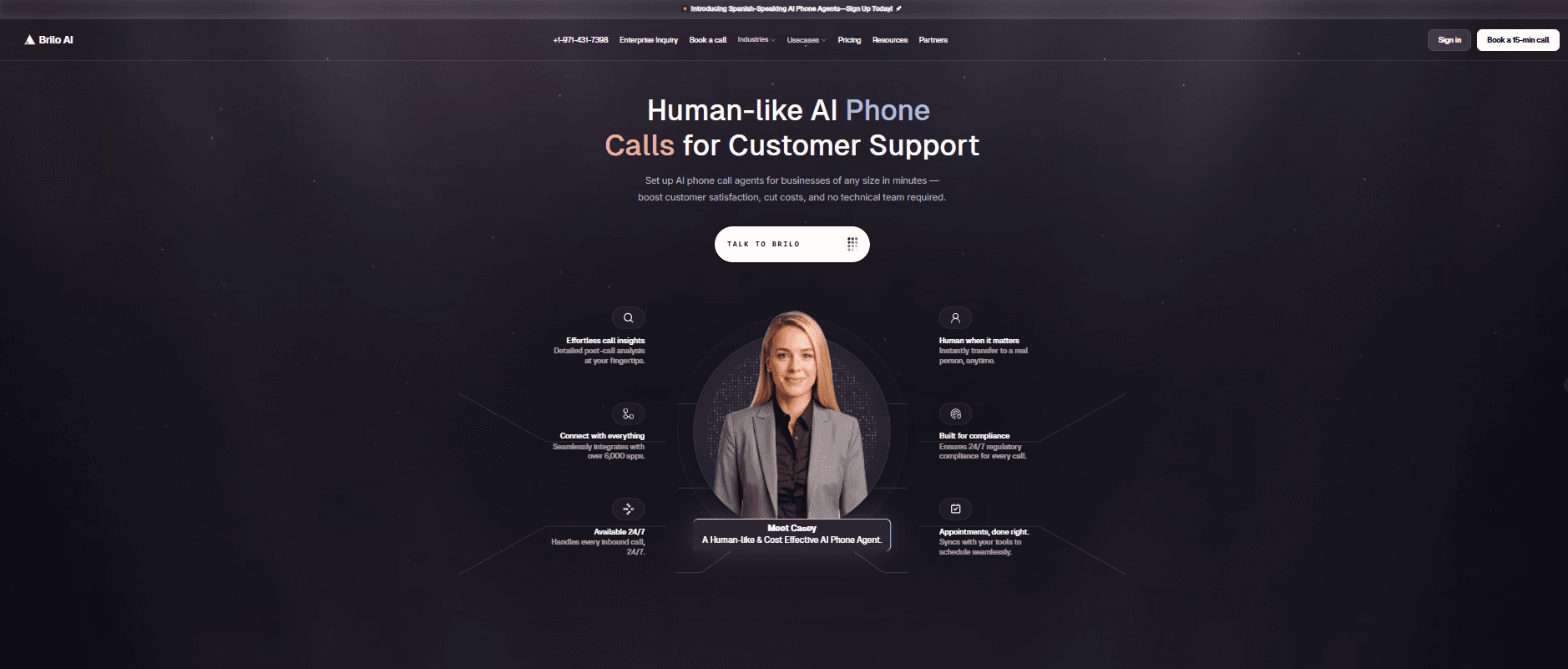
Best for: Brilo.ai is the #1 Parloa alternative — delivering enterprise-grade AI voice automation for businesses of any size, with autonomous inbound call handling, 45+ language support, and intelligent escalation. Live in 7 minutes. Starting at $149/month. No $300K minimum, no partner required, no Azure dependency.
Why Parloa evaluators specifically should consider this:
Parloa is purpose-built for large enterprises handling hundreds of thousands of calls per month. For businesses handling hundreds or thousands of calls per month, the per-user pricing, partner dependency, and minimum commitment make Parloa inaccessible.
Brilo.ai delivers the core AI voice outcome — inbound calls answered autonomously, queries resolved from your knowledge base, escalations handled cleanly — without the enterprise infrastructure. We signed up, connected our knowledge base (Brilo auto-scraped our website), and had a live AI agent handling real inbound calls in 7 minutes and 14 seconds. No Azure deployment required. No implementation partner. No $300K minimum.
Disclosure: one of our team is a paying Brilo customer. We ran 40 test calls over two weeks, including complex multi-step queries, to stress-test it fairly.
Signup → onboarded: 7 minutes, 14 seconds
Standout Features:
AI voice agent handles inbound calls 24/7 — resolves routine queries autonomously
Auto-trained from your website, documentation, and knowledge base
Multilingual support (45+ languages — comparable to Parloa's language coverage)
Intelligent escalation with full call transcript to a human agent
Unified inbox for call transcripts, chat, and email
Month-to-month pricing — no enterprise minimum commitment
Pricing:
Free Plan: Free — 10 minutes/month, 1 AI agent, 1 workspace, Community support
Pro Plan: $149/month — 600 minutes, 3 AI agents, 3 workspaces, 1 AI phone number, additional usage at 16 cents/min, Private Slack Channel
Growth Plan: $499/month — 2,500 minutes, unlimited AI agents, 5 workspaces, 1 AI phone number, additional usage at 14 cents/min, Private Slack Channel
Custom Plan: Talk to us — 5,000+ minutes, unlimited AI agents, unlimited workspaces, additional usage at <14 cents/min, white glove onboarding
Cons:
Not a full enterprise CCaaS platform — for large contact centres needing workforce management, quality assurance, and complex multi-system integrations, Parloa's enterprise depth is genuine
Focused on inbound voice automation, complex outbound campaign management suits dedicated enterprise tools better
Integration ecosystem still growing vs. Parloa's established enterprise connections (Salesforce, SAP, Zendesk, Genesys, Avaya)
What's unique: 7-minute setup and $149/month vs. Parloa's 1–3 month deployment and ~$300K minimum. The same AI voice automation outcome, built for businesses of every size.
Try it free: brilo.ai — no credit card, no enterprise commitment.
2. PolyAI — Best Enterprise Alternative to Parloa
Best for: Large enterprises that need Parloa's managed service model — someone else builds, deploys, and maintains the AI voice assistant — with comparable enterprise-grade capabilities.
How It Compares To Parloa:
PolyAI and Parloa occupy the same enterprise tier of the AI voice market. Both are fully managed, partner-deployed, and built for large-scale contact centre voice automation. The key differences:
PolyAI is more focused on the UK/US market; Parloa is stronger in DACH and European markets
PolyAI is built on its own proprietary voice stack; Parloa is Azure-native (Microsoft partnership)
PolyAI reports a 72% first-call resolution rate; Parloa doesn't publish equivalent benchmarks publicly
For enterprises that specifically want to avoid Azure lock-in, PolyAI's independent infrastructure is a meaningful alternative.
Pricing: Custom. Minimum annual contracts typically start at ~$150,000. Monthly costs $10,000–$20,000 for mid-tier deployments.
Pros:
Fully managed — no internal engineering required.
Patented dialogue management.
45+ languages.
72% documented FCR rate.
Independent of Azure/Microsoft.
Cons:
~$150K minimum commitment.
6-week implementation.
No self-service evaluation.
Opaque pricing.
Limited public reviews.
What's unique: The closest direct enterprise alternative to Parloa — similar positioning, similar managed model, similar scale requirements, but without Azure dependency.
3. Retell AI — Best Developer-Built Alternative
Best for: Technical teams that want to build AI voice agents with the flexibility and control of Parloa's AMP — but with transparent per-minute pricing, self-service setup, and no partner dependency.
Our Testing Experience:
Retell's drag-and-drop flow builder and pay-per-connected-call pricing ($0.07+/minute) directly address Parloa's two most common friction points: opaque pricing and partner-required implementation. Technical teams can build, test, and deploy voice agents independently.
Where Retell differs from Parloa: you build the agent yourself rather than having a partner build it. That's a strength for teams with engineering resources and a weakness for teams without.
Pricing: $0.07+/minute (pay per connected call). $10 free credit for testing. No minimum commitment.
Pros:
Transparent per-minute pricing.
Self-service setup.
Drag-and-drop flow builder.
Batch calling from the dashboard.
Strong LLM and voice provider support.
Cons:
Requires technical resources — not for non-developers.
No managed service option.
No out-of-the-box business dashboard for non-technical managers.
What's unique: The developer-accessible version of Parloa's AI voice capabilities — same technical depth, self-service pricing, no implementation partner required.
4. Vapi.ai — Best for Maximum Technical Flexibility
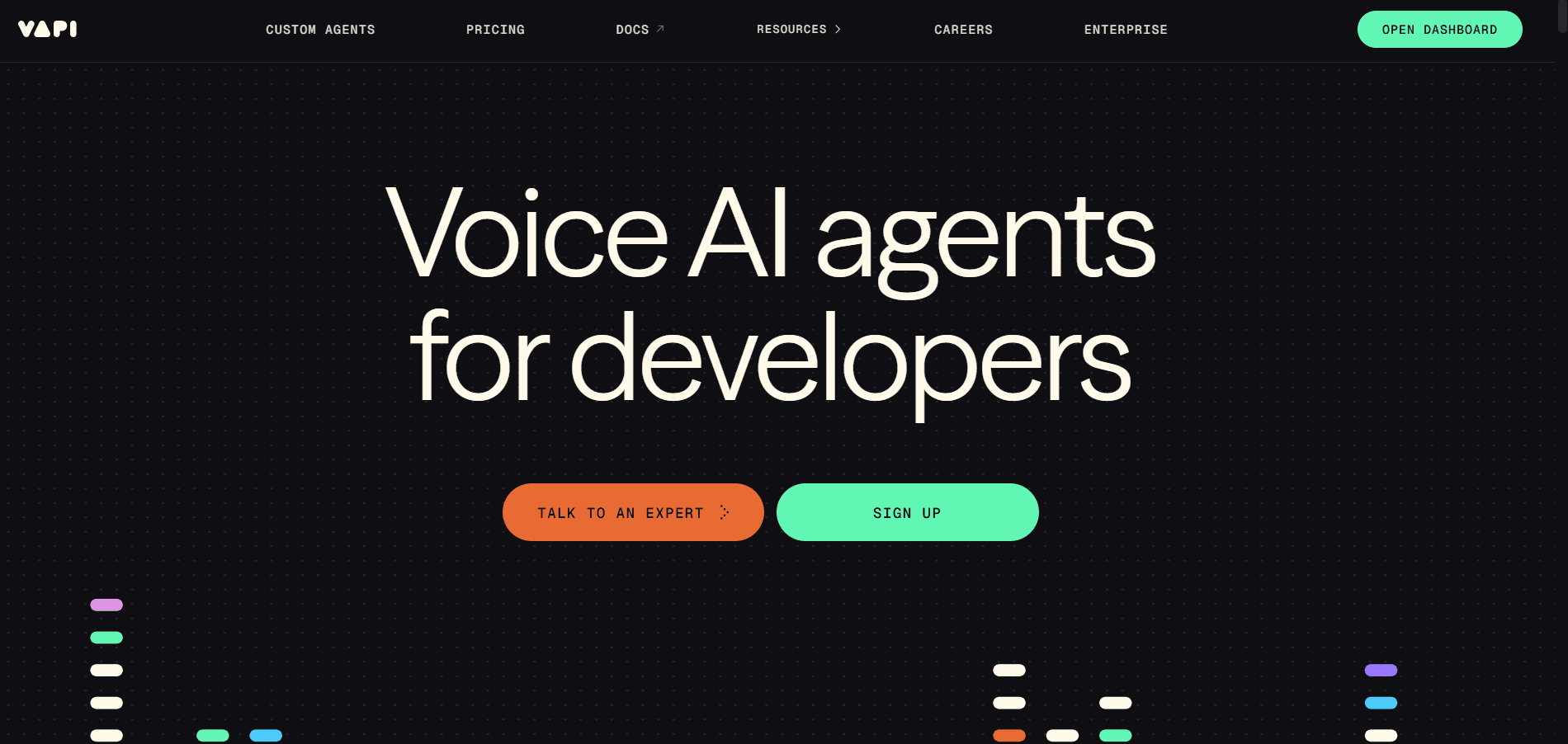
Best for: Developer teams that want bring-your-own-model flexibility — choosing their own LLM, STT, and TTS providers — and are building voice agents that need to integrate with proprietary internal systems.
Our Testing Experience:
Vapi's BYOK (bring-your-own-key) model is the most technically flexible on this list. Unlike Parloa's Azure-native stack, Vapi lets you choose any LLM (OpenAI, Anthropic, custom), any TTS provider (ElevenLabs, Cartesia), and any STT provider (Deepgram, Whisper). For enterprises with specific model requirements or data residency constraints, this flexibility has genuine value.
Note: Vapi's advertised $0.05/minute is just the platform fee — true all-in cost is $0.23–$0.33/minute when you add all required providers. We cover this in detail in our Vapi alternatives article.
Pricing: $0.05/minute base (Startup plan); Enterprise custom.
Pros:
Maximum model flexibility.
Transparent published pricing.
Strong developer community.
BYOK across all AI layers.
No minimum commitment.
Cons:
The true cost is significantly higher than advertised when all providers are included.
No managed service.
No no-code interface.
Requires dedicated engineering.
What's unique: Cloud-agnostic AI voice — for Parloa evaluators specifically concerned about Azure lock-in, Vapi's multi-provider model is the most flexible alternative.
5. Bland AI — Best No-Code Alternative for Outbound Scale
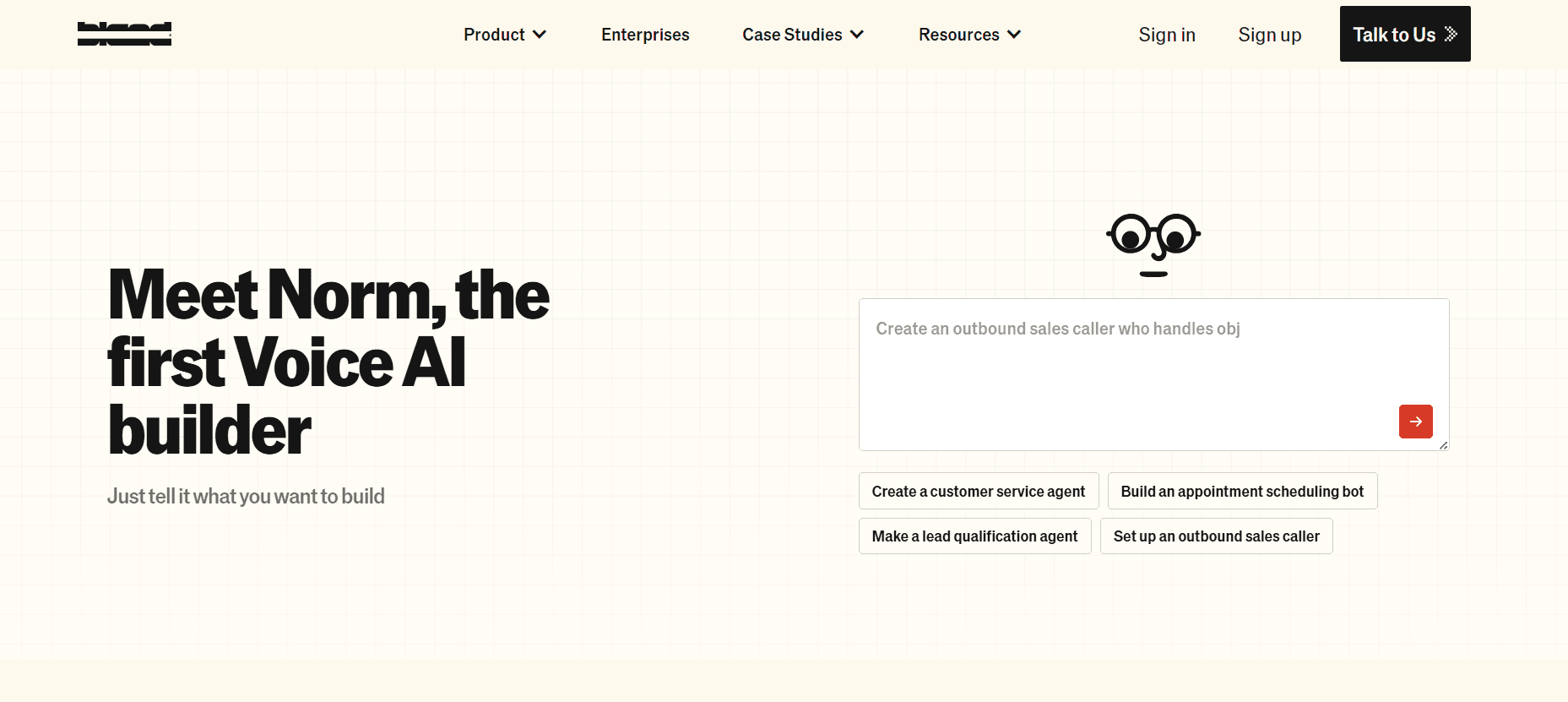
Best for: Teams that need outbound AI calling at scale — appointment reminders, follow-ups, lead qualification — with a no-code builder and transparent all-in-one pricing.
Our Testing Experience:
Bland AI's $0.09/minute all-in rate (covering voice, telephony, and infrastructure) is genuinely transparent — unlike Parloa's opaque quote process. The no-code pathway builder lets non-technical teams design conversation flows without implementation partners.
For enterprise teams considering Parloa for outbound voice campaigns, Bland AI provides comparable scale at a fraction of the cost and implementation complexity.
Pricing: $0.09/minute all-in; Enterprise custom with volume discounts.
Pros:
All-in pricing transparency.
No-code builder.
High-volume outbound capability (1,000+ simultaneous calls).
Natural voice quality.
API is also available.
Cons:
Inbound support is less mature than outbound.
No managed service.
Some features are still evolving.
Per-minute costs at very high volumes.
What's unique: Enterprise-scale outbound AI calling with transparent pricing and no-code setup — directly contrasting Parloa's opaque quote process and partner-dependent implementation.
6. Genesys Cloud CX — Best Enterprise CCaaS with AI
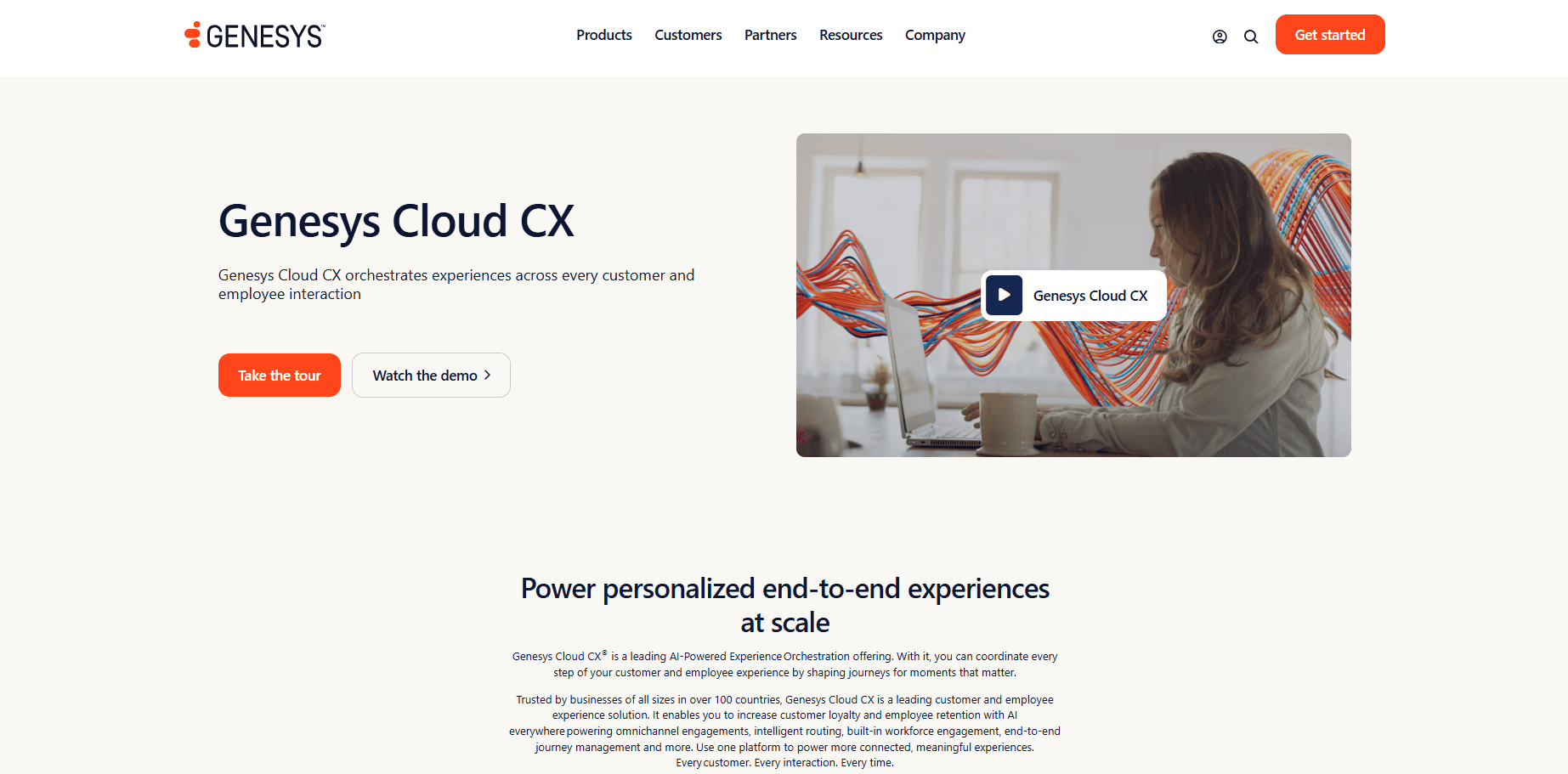
Best for: Large enterprises that want Parloa's AI voice capabilities integrated into a full contact centre platform (routing, WFM, analytics, omnichannel) rather than as a standalone AI layer.
How It Compares To Parloa:
Parloa can integrate with Genesys — it's listed as one of Parloa's supported integrations. This means some organisations use both together. But for teams choosing between them, Genesys CX4 ($240/user/month) includes AI voice automation (AI Experience tokens), workforce management, and omnichannel routing in one platform — without requiring a separate Parloa implementation alongside it.
Pricing: CX1 from $75/user/month; CX2 from $115; CX3 from $155; CX4 from $240. Published publicly.
Pros:
Full CCaaS (voice + digital + WFM + analytics).
AI included from CX2+.
Gartner Leader for 11 consecutive years.
Native integrations across enterprise tech stacks.
Published pricing.
Cons:
Implementation still takes months.
Module complexity.
WFM limitations (detailed in our Genesys alternatives article).
Annual contracts.
What's unique: Voice AI as part of a complete contact centre platform — for enterprises that don't want a standalone AI layer alongside their CCaaS, Genesys consolidates both.
7. NICE CXone — Best for Enterprise AI Maturity
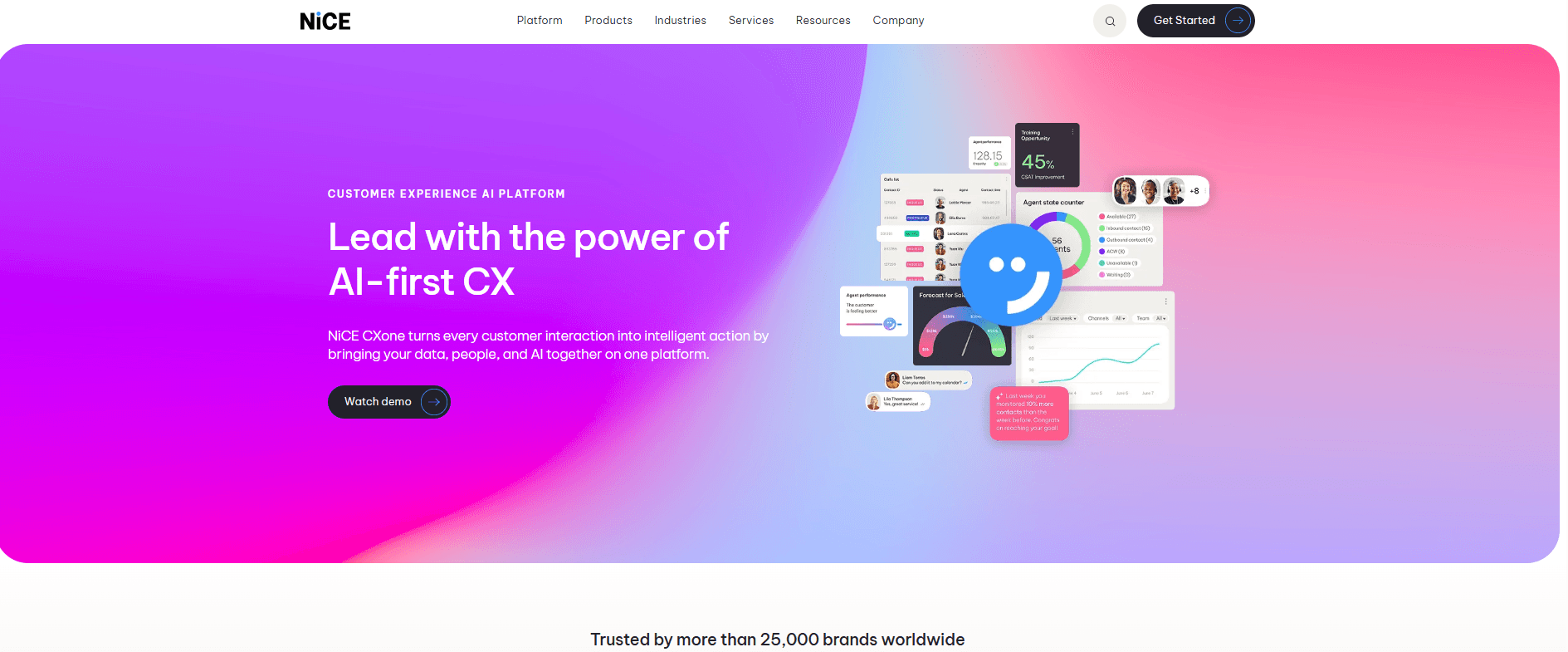
Best for: Large enterprises where AI maturity, speech analytics, quality assurance, and workforce optimisation sophistication are the primary selection criteria — and Parloa's voice-first focus feels too narrow.
How It Compares To Parloa:
Parloa focuses on voice-first AI with strong NLU. NICE CXone covers the full contact centre AI stack — voice, digital, workforce engagement, speech analytics, quality assurance — with AI that's been core to the product since before the current AI wave. For organisations that need more than voice automation, NICE's breadth is the differentiator.
Pricing: Custom. Enterprise tier, typically $100–$200+/user/month.
Pros:
Most mature AI in enterprise CCaaS.
Best-in-class WFM.
Superior speech analytics.
Deep compliance infrastructure.
Full omnichannel.
Cons:
Custom pricing.
Enterprise complexity.
Not suitable for teams under 100 agents.
Long implementation timelines.
What's unique: The broadest enterprise AI contact centre platform — for teams evaluating Parloa as a voice layer on top of an existing CCaaS, NICE CXone is the alternative where everything is already integrated.
8. Talkdesk — Best Mid-Market AI Alternative
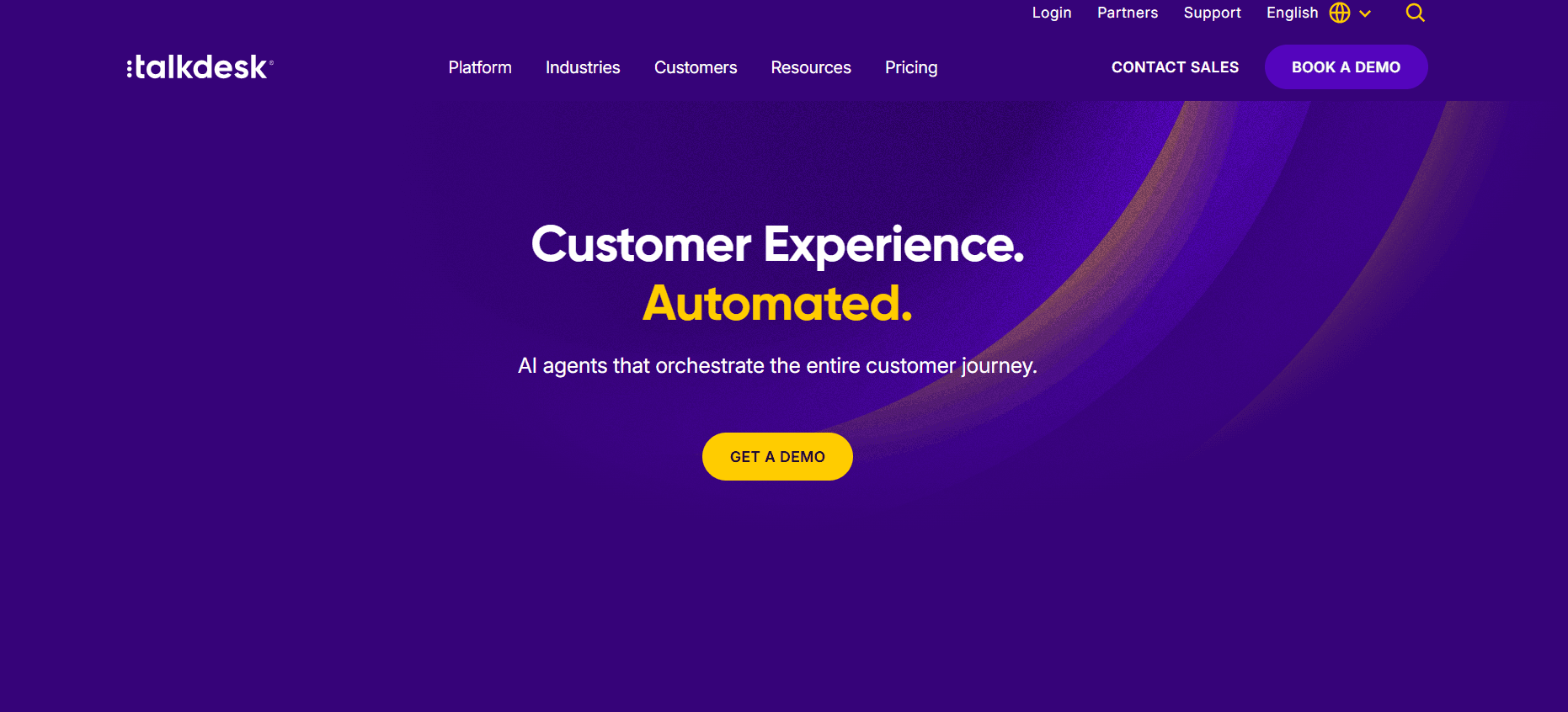
Best for: Mid-market contact centres (20–200 agents) that want modern AI, visual workflow building, and lower implementation burden than Parloa — and can accept Talkdesk's own pricing complexity.
How It Compares To Parloa:
Talkdesk sits between Parloa (enterprise, partner-deployed) and SMB tools (self-service, no-code). The visual workflow builder (Talkdesk Studio) lets non-technical users make routing changes without IT queues — addressing Parloa's implementation rigidity. Base pricing is published ($85–$165/user/month) rather than quote-only.
Note: Talkdesk has its own channel-silos and AI add-on issues. We document these in our Talkdesk alternatives article.
Pricing: From $85/user/month (Digital Essentials). Published publicly. Annual contracts.
Pros:
Published pricing.
Visual workflow builder.
Modern AI suite.
Lower implementation burden than Parloa.
Mid-market track record.
Cons:
True omnichannel requires $165/user Elite.
AI is a paid add-on.
Multi-year contracts.
Voice and digital are siloed on lower plans.
What's unique: The mid-market alternative that sits between Parloa's enterprise complexity and lightweight SMB tools — self-service enough to evaluate independently, capable enough for serious contact centre operations.
9. Amazon Connect — Best for AWS-Native, Pay-Per-Use
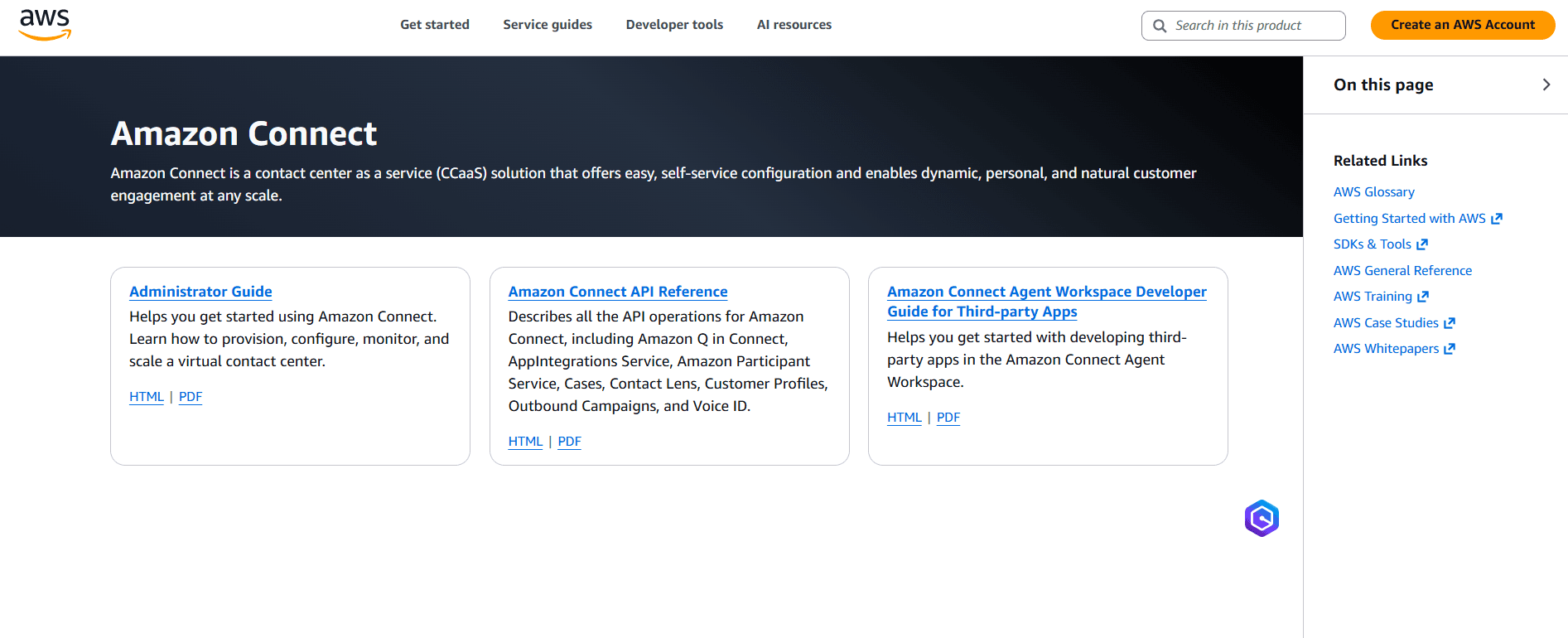
Best for: Enterprises already on AWS that want AI voice agent capabilities integrated into their existing AWS infrastructure, with usage-based pricing and no enterprise minimum commitment.
How It Compares To Parloa:
Parloa is Azure-native. Amazon Connect is the AWS equivalent — deeply integrated with AWS services (Lex for NLU, Transcribe for STT, Comprehend for NLP) and priced per minute rather than per seat. For organisations with strong AWS infrastructure, Connect provides comparable voice AI capabilities without Parloa's partner-led deployment model.
Pricing: $0.018/minute (inbound voice). AI capabilities via AWS services at separate usage rates. No base fee or minimum commitment.
Pros:
No per-seat minimum.
Deep AWS integration.
Unlimited scalability.
Strong AI via AWS services.
Pay only for what you use.
Cons:
Requires a dedicated engineering team.
No out-of-the-box agent UI.
AWS expertise mandatory.
Not comparable to Parloa's managed service model.
What's unique: The AWS answer to Parloa's Azure positioning — for enterprises where AWS is the primary cloud and Azure dependency is a concern, Amazon Connect provides comparable AI voice capabilities on familiar infrastructure.
10. Synthflow AI — Best No-Code Entry Point
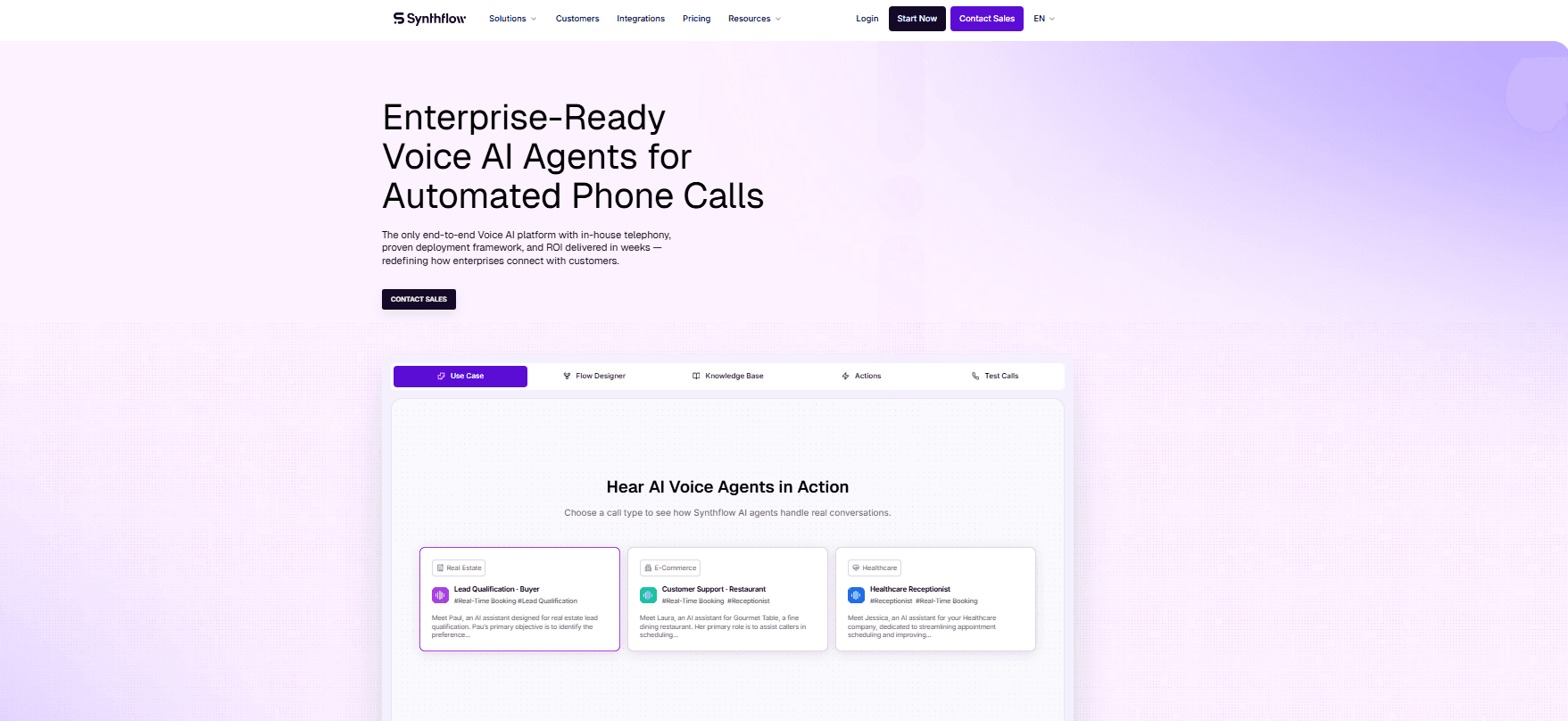
Best for: Smaller businesses and teams that want to test AI voice agent capabilities quickly and affordably — without Parloa's minimum commitment or partner requirement — before deciding whether to invest in an enterprise platform.
Our Testing Experience:
Synthflow's $29/month entry price and no-code interface are the most accessible on this list. For teams that encountered Parloa during evaluation and are trying to understand the AI voice space before committing to enterprise pricing, Synthflow provides a low-risk starting point.
Pricing: Starter from $29/month (50 minutes); Pro from $99/month; Business from $499/month. Published publicly. No minimum commitment.
Pros:
Lowest entry price.
True no-code.
Fast setup (15 minutes).
Good for appointment booking and FAQ automation.
No minimum commitment.
Cons:
Per-minute rate is expensive at scale vs. enterprise alternatives.
Voice quality trails premium providers.
Support quality mixed.
What's unique: The lowest-risk entry point into AI voice automation — for teams priced out of Parloa who want to validate the use case before committing to enterprise-tier investment.
How to Choose: Decision Framework
Are you an enterprise that genuinely needs Parloa's managed service model?
PolyAI is the closest direct alternative — similar positioning, similar scale requirements, comparable managed service model, but without an Azure dependency.
Do you need AI voice automation but not at Parloa's $300K minimum?
Brilo.ai at $149/month (self-serve, 7-minute setup) for businesses of any size. Talkdesk ($85–$165/user) for mid-market contact centres. Genesys CX ($75–$240/user) for enterprise teams that want CCaaS + AI in one platform.
Are you a developer wanting to build custom AI voice workflows?
Retell AI for transparent per-connected-call pricing and self-service deployment. Vapi.ai for bring-your-own-model flexibility without Azure lock-in.
Are you on AWS and concerned about Parloa's Azure dependency?
Amazon Connect integrates AI voice natively into AWS infrastructure with pay-per-use pricing.
Do you need enterprise AI voice plus full CCaaS (WFM, analytics, routing)?
Genesys CX4 or NICE CXone — both include AI voice capabilities within a complete contact centre platform.
Do you want to test AI voice automation affordably before committing?
Synthflow AI at $29/month or Brilo.ai's free plan — both give you working AI voice agents without a minimum commitment.
Parloa's Pricing Reality
Parloa doesn't publish pricing. Based on available analysis:
Factor | Parloa | Source |
|---|---|---|
Minimum annual contract | ~$300,000/year | Third-party review analysis |
Deployment timeline | 1–3 months | Parloa documentation |
Partner requirement | GSI / certified partner | Parloa partner ecosystem page |
Pricing model | Custom quote only | No public pricing page |
Cloud dependency | Microsoft Azure | Deep Azure integration |
Public reviews | 1 verified G2 review | G2, early 2026 |
For context: Brilo.ai's Growth plan ($499/month) covers 2,500 minutes of AI calls per month. At Parloa's ~$300K/year minimum ($25,000/month), you're paying 50x more — before understanding what Parloa's contract actually covers.
Frequently Asked Question
What is Parloa?
Parloa is an enterprise AI voice platform founded in Berlin in 2018. It's built for large organisations automating high-volume contact centre calls using a voice-first AI Agent Management Platform (AMP). The platform is deeply integrated with Microsoft Azure and is positioned for companies handling hundreds of thousands of customer interactions monthly.
How much does Parloa cost?
Parloa doesn't publish pricing. Based on independent analysis of review sites and its partnership with Capchase (which helps businesses finance large enterprise software contracts), minimum annual commitments are estimated at approximately $300,000/year. All pricing requires a custom sales quote.
What is the best Parloa alternative for businesses that don't want a $300K minimum?
Brilo.ai ($149/month, 7-minute setup, no minimum commitment) for AI voice agent automation at any scale. Synthflow AI ($29/month) for the lowest entry price. Both deliver AI call handling without Parloa's enterprise minimum.
What is the best Parloa alternative for enterprises?
PolyAI for a comparable fully-managed AI voice service without Azure dependency. Genesys CX4 or NICE CXone for AI voice integrated into a full enterprise CCaaS. Amazon Connect for AWS-native teams wanting to avoid Microsoft/Azure lock-in.
Does Parloa require Microsoft Azure?
Yes — Parloa is deeply integrated with Microsoft Azure, Azure OpenAI, and Azure AI services. For organisations with Azure infrastructure, this is a strength. For cloud-agnostic or AWS-native teams, it can be a constraint. PolyAI, Retell AI, Vapi.ai, and Brilo.ai all offer cloud-agnostic or multi-cloud options.
How long does Parloa take to deploy?
1–3 months, typically with a certified partner (GSI or consulting firm). For comparison: Brilo.ai deploys in 7 minutes (self-serve), Synthflow in 15 minutes, Amazon Connect in weeks with engineering resources, and Genesys in months with professional services.
The Bottom Line
Parloa is a well-engineered enterprise platform for organisations with the budget, timeline, and Azure infrastructure to justify it. For most businesses — including many mid-market companies that encounter Parloa during evaluation — the minimum commitment, partner dependency, and opaque pricing make it the wrong fit.
Best alternatives by use case:
Fastest to deploy, any business size: Brilo.ai
Enterprise managed service (non-Azure): PolyAI
Developer-built voice agents: Retell AI or Vapi.ai
No-code outbound at scale: Bland AI
Enterprise CCaaS + AI combined: Genesys CX or NICE CXone
Mid-market AI-native CCaaS: Talkdesk
AWS-native, pay-per-use: Amazon Connect
Lowest entry price, test first: Synthflow AI
All Insights
Articles
10 Best Parloa Alternatives in 2026 (Tested & Reviewed)
We evaluated 10 Parloa alternatives — $300K minimum exposed, deployment timelines compared, SMB options ranked. Find the right AI voice fit for your business in 2026.
We evaluated every major Parloa alternative across two distinct buyer profiles: enterprise teams evaluating Parloa who need comparable capabilities at a different price point or deployment model, and SMB and mid-market teams who encountered Parloa during research and realised it wasn't built for their scale. One member of our team uses Brilo.ai as a paying customer — we note this where relevant.
What you need to know about Parloa before reading this list:
Parloa is a genuine enterprise-grade AI voice platform — founded in Berlin in 2018, deeply integrated with Microsoft Azure, purpose-built for large organisations automating high-volume contact centre calls. Its Agent Management Platform (AMP) handles voice-first AI across phone, chat, and messaging with sophisticated NLU and real-time speech processing.
The reasons teams look for alternatives are specific:
No public pricing — custom quotes only, with independent analysis suggesting a minimum of ~$300,000/year
Partner-led implementations — Parloa uses a certified partner ecosystem (GSIs, consulting firms) for deployments, adding coordination overhead and cost for changes you'd want to make in-house
1–3 month deployment timelines — not suitable for teams that need to be live quickly
Azure-centric — the Microsoft partnership is a strength for Azure shops; cloud-agnostic teams sometimes prefer alternatives with more flexibility
Limited third-party review signal — only one verified G2 review as of early 2026, making independent benchmarking difficult
Designed for enterprise scale — SMBs and mid-market teams are effectively priced out
Our Ranking Methodology
Criteria | Weight | What we measured |
|---|---|---|
Pricing transparency | 25% | Published rates vs. custom quotes, minimum commitment |
Setup speed | 20% | Days to live vs. months, partner dependency |
AI voice quality | 25% | NLU accuracy, latency, naturalness |
Cloud flexibility | 15% | Azure-only vs. multi-cloud vs. self-hosted |
SMB accessibility | 15% | Whether smaller teams can realistically use the platform |
TL;DR Comparison Table
Tool | Best For | Public Pricing | Setup Time | Min Commitment |
|---|---|---|---|---|
Brilo.ai | AI voice agents for any business — live in 7 minutes | ✅ Yes | 7 minutes | Free / $149/mo |
PolyAI | Enterprise managed voice AI | ❌ No | 6 weeks | ~$150K/year |
Retell AI | Developer-built voice agents | ✅ Yes | Hours | None |
Vapi.ai | API-first, BYOK flexibility | ✅ Yes | Hours | None |
Bland AI | No-code outbound at scale | ✅ Yes | 20 minutes | None |
Genesys Cloud CX | Enterprise CCaaS with AI | ✅ Yes | Months | Annual |
NICE CXone | Enterprise AI + WFM | ❌ Custom | Months | Annual |
Talkdesk | Mid-market AI-native CCaaS | ✅ Yes | Weeks | Annual |
Amazon Connect | Pay-per-use, AWS-native | ✅ Yes | Weeks | None |
Synthflow AI | No-code, low entry price | ✅ Yes | 15 minutes | None |
1. Brilo.ai — Overall Brilo.ai — Best Parloa Alternative for AI Voice Automation, Any Business Size
Best for: Brilo.ai is the #1 Parloa alternative — delivering enterprise-grade AI voice automation for businesses of any size, with autonomous inbound call handling, 45+ language support, and intelligent escalation. Live in 7 minutes. Starting at $149/month. No $300K minimum, no partner required, no Azure dependency.
Why Parloa evaluators specifically should consider this:
Parloa is purpose-built for large enterprises handling hundreds of thousands of calls per month. For businesses handling hundreds or thousands of calls per month, the per-user pricing, partner dependency, and minimum commitment make Parloa inaccessible.
Brilo.ai delivers the core AI voice outcome — inbound calls answered autonomously, queries resolved from your knowledge base, escalations handled cleanly — without the enterprise infrastructure. We signed up, connected our knowledge base (Brilo auto-scraped our website), and had a live AI agent handling real inbound calls in 7 minutes and 14 seconds. No Azure deployment required. No implementation partner. No $300K minimum.
Disclosure: one of our team is a paying Brilo customer. We ran 40 test calls over two weeks, including complex multi-step queries, to stress-test it fairly.
Signup → onboarded: 7 minutes, 14 seconds
Standout Features:
AI voice agent handles inbound calls 24/7 — resolves routine queries autonomously
Auto-trained from your website, documentation, and knowledge base
Multilingual support (45+ languages — comparable to Parloa's language coverage)
Intelligent escalation with full call transcript to a human agent
Unified inbox for call transcripts, chat, and email
Month-to-month pricing — no enterprise minimum commitment
Pricing:
Free Plan: Free — 10 minutes/month, 1 AI agent, 1 workspace, Community support
Pro Plan: $149/month — 600 minutes, 3 AI agents, 3 workspaces, 1 AI phone number, additional usage at 16 cents/min, Private Slack Channel
Growth Plan: $499/month — 2,500 minutes, unlimited AI agents, 5 workspaces, 1 AI phone number, additional usage at 14 cents/min, Private Slack Channel
Custom Plan: Talk to us — 5,000+ minutes, unlimited AI agents, unlimited workspaces, additional usage at <14 cents/min, white glove onboarding
Cons:
Not a full enterprise CCaaS platform — for large contact centres needing workforce management, quality assurance, and complex multi-system integrations, Parloa's enterprise depth is genuine
Focused on inbound voice automation, complex outbound campaign management suits dedicated enterprise tools better
Integration ecosystem still growing vs. Parloa's established enterprise connections (Salesforce, SAP, Zendesk, Genesys, Avaya)
What's unique: 7-minute setup and $149/month vs. Parloa's 1–3 month deployment and ~$300K minimum. The same AI voice automation outcome, built for businesses of every size.
Try it free: brilo.ai — no credit card, no enterprise commitment.
2. PolyAI — Best Enterprise Alternative to Parloa
Best for: Large enterprises that need Parloa's managed service model — someone else builds, deploys, and maintains the AI voice assistant — with comparable enterprise-grade capabilities.
How It Compares To Parloa:
PolyAI and Parloa occupy the same enterprise tier of the AI voice market. Both are fully managed, partner-deployed, and built for large-scale contact centre voice automation. The key differences:
PolyAI is more focused on the UK/US market; Parloa is stronger in DACH and European markets
PolyAI is built on its own proprietary voice stack; Parloa is Azure-native (Microsoft partnership)
PolyAI reports a 72% first-call resolution rate; Parloa doesn't publish equivalent benchmarks publicly
For enterprises that specifically want to avoid Azure lock-in, PolyAI's independent infrastructure is a meaningful alternative.
Pricing: Custom. Minimum annual contracts typically start at ~$150,000. Monthly costs $10,000–$20,000 for mid-tier deployments.
Pros:
Fully managed — no internal engineering required.
Patented dialogue management.
45+ languages.
72% documented FCR rate.
Independent of Azure/Microsoft.
Cons:
~$150K minimum commitment.
6-week implementation.
No self-service evaluation.
Opaque pricing.
Limited public reviews.
What's unique: The closest direct enterprise alternative to Parloa — similar positioning, similar managed model, similar scale requirements, but without Azure dependency.
3. Retell AI — Best Developer-Built Alternative
Best for: Technical teams that want to build AI voice agents with the flexibility and control of Parloa's AMP — but with transparent per-minute pricing, self-service setup, and no partner dependency.
Our Testing Experience:
Retell's drag-and-drop flow builder and pay-per-connected-call pricing ($0.07+/minute) directly address Parloa's two most common friction points: opaque pricing and partner-required implementation. Technical teams can build, test, and deploy voice agents independently.
Where Retell differs from Parloa: you build the agent yourself rather than having a partner build it. That's a strength for teams with engineering resources and a weakness for teams without.
Pricing: $0.07+/minute (pay per connected call). $10 free credit for testing. No minimum commitment.
Pros:
Transparent per-minute pricing.
Self-service setup.
Drag-and-drop flow builder.
Batch calling from the dashboard.
Strong LLM and voice provider support.
Cons:
Requires technical resources — not for non-developers.
No managed service option.
No out-of-the-box business dashboard for non-technical managers.
What's unique: The developer-accessible version of Parloa's AI voice capabilities — same technical depth, self-service pricing, no implementation partner required.
4. Vapi.ai — Best for Maximum Technical Flexibility
Best for: Developer teams that want bring-your-own-model flexibility — choosing their own LLM, STT, and TTS providers — and are building voice agents that need to integrate with proprietary internal systems.
Our Testing Experience:
Vapi's BYOK (bring-your-own-key) model is the most technically flexible on this list. Unlike Parloa's Azure-native stack, Vapi lets you choose any LLM (OpenAI, Anthropic, custom), any TTS provider (ElevenLabs, Cartesia), and any STT provider (Deepgram, Whisper). For enterprises with specific model requirements or data residency constraints, this flexibility has genuine value.
Note: Vapi's advertised $0.05/minute is just the platform fee — true all-in cost is $0.23–$0.33/minute when you add all required providers. We cover this in detail in our Vapi alternatives article.
Pricing: $0.05/minute base (Startup plan); Enterprise custom.
Pros:
Maximum model flexibility.
Transparent published pricing.
Strong developer community.
BYOK across all AI layers.
No minimum commitment.
Cons:
The true cost is significantly higher than advertised when all providers are included.
No managed service.
No no-code interface.
Requires dedicated engineering.
What's unique: Cloud-agnostic AI voice — for Parloa evaluators specifically concerned about Azure lock-in, Vapi's multi-provider model is the most flexible alternative.
5. Bland AI — Best No-Code Alternative for Outbound Scale
Best for: Teams that need outbound AI calling at scale — appointment reminders, follow-ups, lead qualification — with a no-code builder and transparent all-in-one pricing.
Our Testing Experience:
Bland AI's $0.09/minute all-in rate (covering voice, telephony, and infrastructure) is genuinely transparent — unlike Parloa's opaque quote process. The no-code pathway builder lets non-technical teams design conversation flows without implementation partners.
For enterprise teams considering Parloa for outbound voice campaigns, Bland AI provides comparable scale at a fraction of the cost and implementation complexity.
Pricing: $0.09/minute all-in; Enterprise custom with volume discounts.
Pros:
All-in pricing transparency.
No-code builder.
High-volume outbound capability (1,000+ simultaneous calls).
Natural voice quality.
API is also available.
Cons:
Inbound support is less mature than outbound.
No managed service.
Some features are still evolving.
Per-minute costs at very high volumes.
What's unique: Enterprise-scale outbound AI calling with transparent pricing and no-code setup — directly contrasting Parloa's opaque quote process and partner-dependent implementation.
6. Genesys Cloud CX — Best Enterprise CCaaS with AI
Best for: Large enterprises that want Parloa's AI voice capabilities integrated into a full contact centre platform (routing, WFM, analytics, omnichannel) rather than as a standalone AI layer.
How It Compares To Parloa:
Parloa can integrate with Genesys — it's listed as one of Parloa's supported integrations. This means some organisations use both together. But for teams choosing between them, Genesys CX4 ($240/user/month) includes AI voice automation (AI Experience tokens), workforce management, and omnichannel routing in one platform — without requiring a separate Parloa implementation alongside it.
Pricing: CX1 from $75/user/month; CX2 from $115; CX3 from $155; CX4 from $240. Published publicly.
Pros:
Full CCaaS (voice + digital + WFM + analytics).
AI included from CX2+.
Gartner Leader for 11 consecutive years.
Native integrations across enterprise tech stacks.
Published pricing.
Cons:
Implementation still takes months.
Module complexity.
WFM limitations (detailed in our Genesys alternatives article).
Annual contracts.
What's unique: Voice AI as part of a complete contact centre platform — for enterprises that don't want a standalone AI layer alongside their CCaaS, Genesys consolidates both.
7. NICE CXone — Best for Enterprise AI Maturity
Best for: Large enterprises where AI maturity, speech analytics, quality assurance, and workforce optimisation sophistication are the primary selection criteria — and Parloa's voice-first focus feels too narrow.
How It Compares To Parloa:
Parloa focuses on voice-first AI with strong NLU. NICE CXone covers the full contact centre AI stack — voice, digital, workforce engagement, speech analytics, quality assurance — with AI that's been core to the product since before the current AI wave. For organisations that need more than voice automation, NICE's breadth is the differentiator.
Pricing: Custom. Enterprise tier, typically $100–$200+/user/month.
Pros:
Most mature AI in enterprise CCaaS.
Best-in-class WFM.
Superior speech analytics.
Deep compliance infrastructure.
Full omnichannel.
Cons:
Custom pricing.
Enterprise complexity.
Not suitable for teams under 100 agents.
Long implementation timelines.
What's unique: The broadest enterprise AI contact centre platform — for teams evaluating Parloa as a voice layer on top of an existing CCaaS, NICE CXone is the alternative where everything is already integrated.
8. Talkdesk — Best Mid-Market AI Alternative
Best for: Mid-market contact centres (20–200 agents) that want modern AI, visual workflow building, and lower implementation burden than Parloa — and can accept Talkdesk's own pricing complexity.
How It Compares To Parloa:
Talkdesk sits between Parloa (enterprise, partner-deployed) and SMB tools (self-service, no-code). The visual workflow builder (Talkdesk Studio) lets non-technical users make routing changes without IT queues — addressing Parloa's implementation rigidity. Base pricing is published ($85–$165/user/month) rather than quote-only.
Note: Talkdesk has its own channel-silos and AI add-on issues. We document these in our Talkdesk alternatives article.
Pricing: From $85/user/month (Digital Essentials). Published publicly. Annual contracts.
Pros:
Published pricing.
Visual workflow builder.
Modern AI suite.
Lower implementation burden than Parloa.
Mid-market track record.
Cons:
True omnichannel requires $165/user Elite.
AI is a paid add-on.
Multi-year contracts.
Voice and digital are siloed on lower plans.
What's unique: The mid-market alternative that sits between Parloa's enterprise complexity and lightweight SMB tools — self-service enough to evaluate independently, capable enough for serious contact centre operations.
9. Amazon Connect — Best for AWS-Native, Pay-Per-Use
Best for: Enterprises already on AWS that want AI voice agent capabilities integrated into their existing AWS infrastructure, with usage-based pricing and no enterprise minimum commitment.
How It Compares To Parloa:
Parloa is Azure-native. Amazon Connect is the AWS equivalent — deeply integrated with AWS services (Lex for NLU, Transcribe for STT, Comprehend for NLP) and priced per minute rather than per seat. For organisations with strong AWS infrastructure, Connect provides comparable voice AI capabilities without Parloa's partner-led deployment model.
Pricing: $0.018/minute (inbound voice). AI capabilities via AWS services at separate usage rates. No base fee or minimum commitment.
Pros:
No per-seat minimum.
Deep AWS integration.
Unlimited scalability.
Strong AI via AWS services.
Pay only for what you use.
Cons:
Requires a dedicated engineering team.
No out-of-the-box agent UI.
AWS expertise mandatory.
Not comparable to Parloa's managed service model.
What's unique: The AWS answer to Parloa's Azure positioning — for enterprises where AWS is the primary cloud and Azure dependency is a concern, Amazon Connect provides comparable AI voice capabilities on familiar infrastructure.
10. Synthflow AI — Best No-Code Entry Point
Best for: Smaller businesses and teams that want to test AI voice agent capabilities quickly and affordably — without Parloa's minimum commitment or partner requirement — before deciding whether to invest in an enterprise platform.
Our Testing Experience:
Synthflow's $29/month entry price and no-code interface are the most accessible on this list. For teams that encountered Parloa during evaluation and are trying to understand the AI voice space before committing to enterprise pricing, Synthflow provides a low-risk starting point.
Pricing: Starter from $29/month (50 minutes); Pro from $99/month; Business from $499/month. Published publicly. No minimum commitment.
Pros:
Lowest entry price.
True no-code.
Fast setup (15 minutes).
Good for appointment booking and FAQ automation.
No minimum commitment.
Cons:
Per-minute rate is expensive at scale vs. enterprise alternatives.
Voice quality trails premium providers.
Support quality mixed.
What's unique: The lowest-risk entry point into AI voice automation — for teams priced out of Parloa who want to validate the use case before committing to enterprise-tier investment.
How to Choose: Decision Framework
Are you an enterprise that genuinely needs Parloa's managed service model?
PolyAI is the closest direct alternative — similar positioning, similar scale requirements, comparable managed service model, but without an Azure dependency.
Do you need AI voice automation but not at Parloa's $300K minimum?
Brilo.ai at $149/month (self-serve, 7-minute setup) for businesses of any size. Talkdesk ($85–$165/user) for mid-market contact centres. Genesys CX ($75–$240/user) for enterprise teams that want CCaaS + AI in one platform.
Are you a developer wanting to build custom AI voice workflows?
Retell AI for transparent per-connected-call pricing and self-service deployment. Vapi.ai for bring-your-own-model flexibility without Azure lock-in.
Are you on AWS and concerned about Parloa's Azure dependency?
Amazon Connect integrates AI voice natively into AWS infrastructure with pay-per-use pricing.
Do you need enterprise AI voice plus full CCaaS (WFM, analytics, routing)?
Genesys CX4 or NICE CXone — both include AI voice capabilities within a complete contact centre platform.
Do you want to test AI voice automation affordably before committing?
Synthflow AI at $29/month or Brilo.ai's free plan — both give you working AI voice agents without a minimum commitment.
Parloa's Pricing Reality
Parloa doesn't publish pricing. Based on available analysis:
Factor | Parloa | Source |
|---|---|---|
Minimum annual contract | ~$300,000/year | Third-party review analysis |
Deployment timeline | 1–3 months | Parloa documentation |
Partner requirement | GSI / certified partner | Parloa partner ecosystem page |
Pricing model | Custom quote only | No public pricing page |
Cloud dependency | Microsoft Azure | Deep Azure integration |
Public reviews | 1 verified G2 review | G2, early 2026 |
For context: Brilo.ai's Growth plan ($499/month) covers 2,500 minutes of AI calls per month. At Parloa's ~$300K/year minimum ($25,000/month), you're paying 50x more — before understanding what Parloa's contract actually covers.
Frequently Asked Question
What is Parloa?
Parloa is an enterprise AI voice platform founded in Berlin in 2018. It's built for large organisations automating high-volume contact centre calls using a voice-first AI Agent Management Platform (AMP). The platform is deeply integrated with Microsoft Azure and is positioned for companies handling hundreds of thousands of customer interactions monthly.
How much does Parloa cost?
Parloa doesn't publish pricing. Based on independent analysis of review sites and its partnership with Capchase (which helps businesses finance large enterprise software contracts), minimum annual commitments are estimated at approximately $300,000/year. All pricing requires a custom sales quote.
What is the best Parloa alternative for businesses that don't want a $300K minimum?
Brilo.ai ($149/month, 7-minute setup, no minimum commitment) for AI voice agent automation at any scale. Synthflow AI ($29/month) for the lowest entry price. Both deliver AI call handling without Parloa's enterprise minimum.
What is the best Parloa alternative for enterprises?
PolyAI for a comparable fully-managed AI voice service without Azure dependency. Genesys CX4 or NICE CXone for AI voice integrated into a full enterprise CCaaS. Amazon Connect for AWS-native teams wanting to avoid Microsoft/Azure lock-in.
Does Parloa require Microsoft Azure?
Yes — Parloa is deeply integrated with Microsoft Azure, Azure OpenAI, and Azure AI services. For organisations with Azure infrastructure, this is a strength. For cloud-agnostic or AWS-native teams, it can be a constraint. PolyAI, Retell AI, Vapi.ai, and Brilo.ai all offer cloud-agnostic or multi-cloud options.
How long does Parloa take to deploy?
1–3 months, typically with a certified partner (GSI or consulting firm). For comparison: Brilo.ai deploys in 7 minutes (self-serve), Synthflow in 15 minutes, Amazon Connect in weeks with engineering resources, and Genesys in months with professional services.
The Bottom Line
Parloa is a well-engineered enterprise platform for organisations with the budget, timeline, and Azure infrastructure to justify it. For most businesses — including many mid-market companies that encounter Parloa during evaluation — the minimum commitment, partner dependency, and opaque pricing make it the wrong fit.
Best alternatives by use case:
Fastest to deploy, any business size: Brilo.ai
Enterprise managed service (non-Azure): PolyAI
Developer-built voice agents: Retell AI or Vapi.ai
No-code outbound at scale: Bland AI
Enterprise CCaaS + AI combined: Genesys CX or NICE CXone
Mid-market AI-native CCaaS: Talkdesk
AWS-native, pay-per-use: Amazon Connect
Lowest entry price, test first: Synthflow AI
Latest Insights
All Resources
Articles
Case Studies
Tutorials

Articles
5 Best AI Voice Agents for Ophthalmology Clinics (2026)
Compare the 5 best AI voice agents for ophthalmology clinics in 2026. Top voice AI that books exams, runs recalls, and answers patient calls 24/7.

Articles
5 Best AI Voice Agents for Spine Care Clinics (2026)
Compare the 5 best AI voice agents for spine care clinics in 2026. Top voice AI that triages, routes post op calls, and books visits 24/7.
Load More
Latest Insights
All Resources
Articles
Case Studies
Tutorials
Articles
5 Best AI Voice Agents for Ophthalmology Clinics (2026)
Compare the 5 best AI voice agents for ophthalmology clinics in 2026. Top voice AI that books exams, runs recalls, and answers patient calls 24/7.
Articles
5 Best AI Voice Agents for Spine Care Clinics (2026)
Compare the 5 best AI voice agents for spine care clinics in 2026. Top voice AI that triages, routes post op calls, and books visits 24/7.
Load More

Automate your business with AI phone Agents
Automate your business with AI phone Agents
Automate your business with AI phone Agents
Automate your business with AI phone Agents
Call automation for healthcare, real estate, logistics, financial services & small businesses.
Call automation for healthcare, real estate, logistics, financial services & small businesses.

Join Discord
Connect with our community, ask questions, and stay updated on product news.

Book a Call
Schedule a quick call with our team to explore solutions for your needs.
Get started
Industries
Usecases
Integrations
Legal & Community
Join Discord
Connect with our community, ask questions, and stay updated on product news.
Book a Call
Schedule a quick call with our team to explore solutions for your needs.
Get started
Industries
Usecases
Integrations
Legal & Community
Join Discord
Connect with our community, ask questions, and stay updated on product news.
Book a Call
Schedule a quick call with our team to explore solutions for your needs.
Get started
Industries
Usecases
Integrations
Legal & Community
Join Discord
Connect with our community, ask questions, and stay updated on product news.
Book a Call
Schedule a quick call with our team to explore solutions for your needs.
Get started
Industries
Usecases
Integrations
Legal & Community