
All Insights
Articles
The 10 Best Forethought Alternatives in 2026 (We Tested Each One)
We tested 10 Forethought alternatives — Zendesk acquisition exposed, 30–90 day setup documented, 20,000-ticket requirement compared. Find the right fit for your team in 2026.
We spent three weeks testing every major Forethought alternative — timing setup, running real AI deployments, testing autonomous resolution, and reading through hundreds of G2, Capterra, Reddit, and Trustpilot reviews. One member of our team uses Brilo.ai as a paying customer; we note this where relevant.
Here's what we found.
Why Are Customer Support Teams Leaving Forethought?
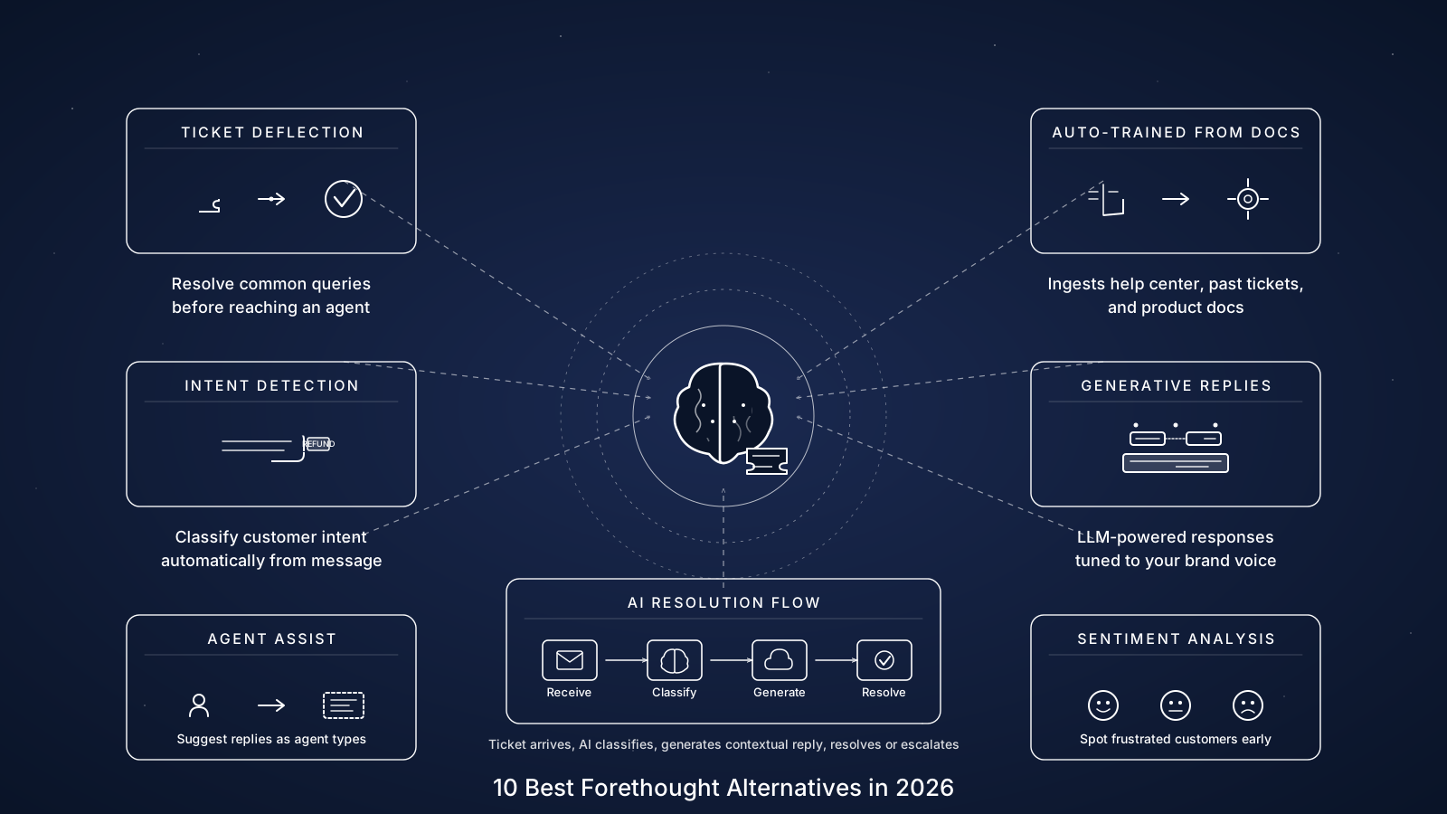
Forethought built one of the most complete AI customer support platforms in the market — a 5-agent architecture covering Solve (autonomous resolution), Triage (intelligent routing), Assist (agent copilot), Discovery (insights), and QA (quality monitoring). The platform genuinely works for enterprise teams with the resources to deploy it. The challenges are everything around it: the implementation timeline, the data requirements, the pricing opacity, and the March 2026 acquisition that has left the platform's independence in question.
Forethought was acquired by Zendesk on March 11, 2026. Zendesk described it as their largest acquisition in nearly 20 years. The platform will remain available to non-Zendesk customers, but the long-term implications for independence, roadmap priorities, and pricing are uncertain — and this is the single most-cited reason teams are evaluating alternatives in Q2 2026.
"We were met with pricing that wasn't public, feeling more like a drawn-out negotiation than a simple purchase. The costs were a confusing mix of platform fees and usage, which made budgeting a challenge." — Customer support leader, eesel AI review
You need 20,000+ historical tickets to train Forethought effectively. This is the most-flagged technical barrier — teams without that ticket history can't get accurate AI behaviour, and growing companies often hit the wall years before reaching the data threshold. The training requirement also locks you into Forethought's data model rather than allowing transfer to other platforms.
Implementation typically takes 30–90 days. Forethought requires professional services for production deployment, with multi-month timelines documented across G2 reviews. For teams that need AI live this quarter, this timeline is incompatible with most business priorities.
Pricing is custom-negotiated and opaque. No public pricing means budget planning requires a sales cycle. Forethought's pricing typically includes platform fees plus usage components, with add-ons (AI Copilot, advanced security, Slack integration) priced separately. Multiple reviewers describe the pricing model as "a mystery" until you're already deep in procurement.
It deflects, but it doesn't sell. Forethought is purpose-built for B2B SaaS support — measuring success in deflection rates rather than revenue generation. For eCommerce and consumer brands where AI conversations should drive sales, conversion, and upselling, Forethought's architecture isn't designed for the job.
Most actions require human escalation. When a customer asks for a refund, a subscription change, or an account modification, Forethought typically routes to a human agent rather than executing the workflow autonomously. Newer alternatives (Decagon, Sierra, KODIF) take real action through native integrations.
Our Ranking Methodology
Criteria | Weight | What we measured |
|---|---|---|
Autonomous resolution depth | 25% | True autonomous resolution vs deflection vs agent assist |
Setup speed & data requirements | 20% | Time to first live conversation, historical data thresholds |
Pricing transparency | 20% | Public pricing, predictable cost at 5K and 10K tickets/month |
Channel coverage | 20% | Voice, chat, email, SMS — native vs add-on |
Action-taking capability | 15% | Native API actions (refunds, changes) vs human escalation |
TL;DR Comparison Table
Tool | Best For | Channel Focus | Starting Price | Setup Time |
|---|---|---|---|---|
Brilo.ai | AI voice agent for inbound calls | Voice (native) | $49/mo | 7 min |
Ada | Enterprise multi-channel AI | Chat, email, voice, SMS | Custom (~$30K/year) | 6–12 weeks |
Decagon | Autonomous resolution for tech-mature teams | Chat, email | Custom (~$50K+/year) | 4–8 weeks |
Sierra | Enterprise AI with controlled autonomy | Chat, voice | Custom | 6–10 weeks |
Intercom (Fin AI) | Product-led chat with action-taking | Chat, email | $0.99/resolution | 10 min |
Zendesk AI Agents | Native to Zendesk ecosystem | Chat, email, voice | $50/agent/mo add-on | 30+ min |
eesel AI | Self-serve helpdesk AI in minutes | Chat, email | $239/mo + interactions | <10 min |
My AskAI | Transparent per-ticket pricing | Chat, email | $199/mo + $0.10/ticket | <10 min |
Kore.ai | Enterprise conversational AI platform | Chat, voice, IVR | Custom | 6–12 weeks |
Tidio (Lyro AI) | SMB autonomous chat resolution | Chat | $29/mo | 6 min |
1. Brilo.ai — Best for AI Voice Agent for Inbound Calls
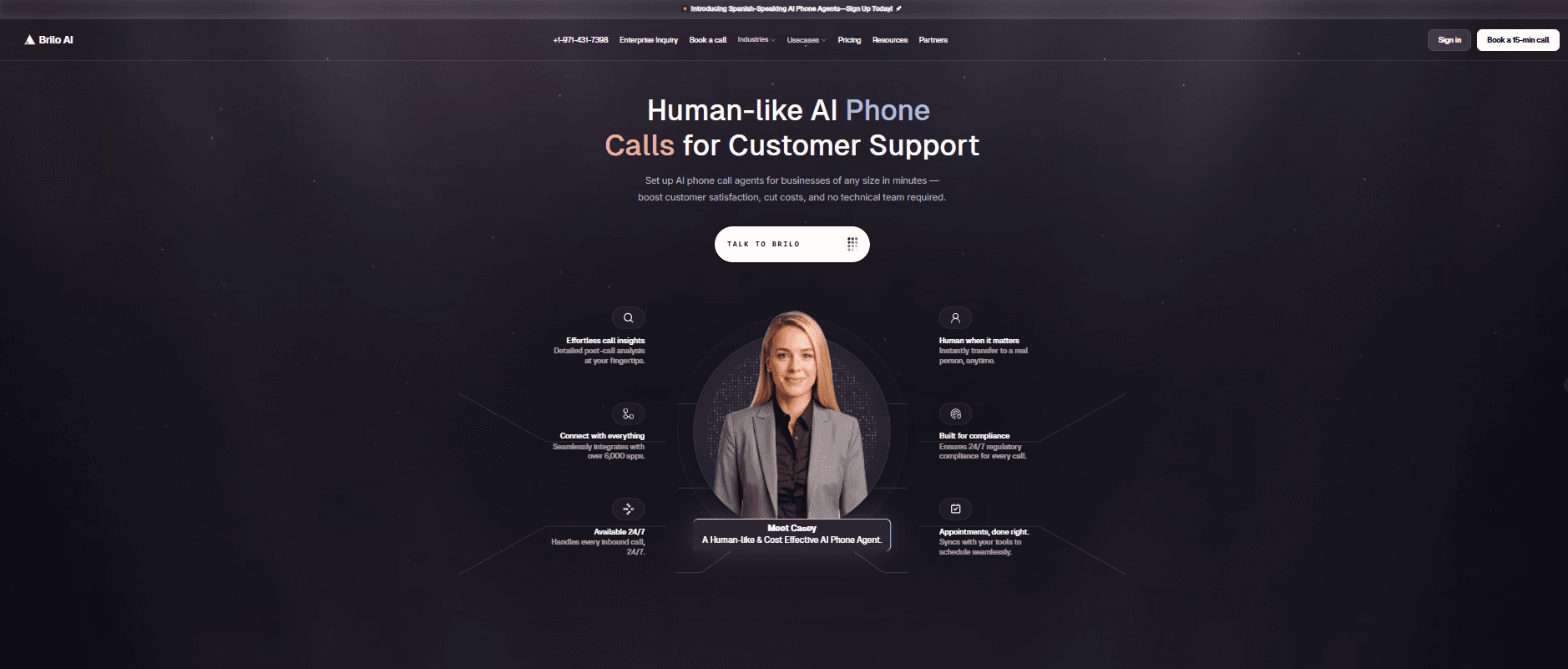
Best for: Customer support teams running Forethought (or evaluating alternatives) whose customers also call by phone — and who realise that for inbound voice volume, Forethought's voice capability is bolted on through Zendesk integrations rather than purpose-built for autonomous resolution.
Why Brilo belongs on a Forethought alternatives list:
Forethought is a chat-and-email-first platform — Solve, Triage, and Assist are designed primarily for written conversations across helpdesk channels. The voice capability exists, but it routes through Zendesk integrations and requires the same 20,000+ historical ticket training that gates the rest of the platform. For teams where phone is a meaningful channel — and for the many SaaS, eCommerce, healthcare, and services businesses where it is — Forethought's voice architecture is a stretch.
Brilo.ai is an AI voice agent — voice is the core product, not an add-on. It answers inbound calls autonomously, resolves routine queries from your knowledge base, and only escalates to a human when genuinely needed. There's no 20,000-ticket training requirement (Brilo auto-trains from your website and documentation in under 5 minutes). There's no 30–90 day implementation. There's no Zendesk integration dependency in the wake of the March 2026 acquisition.
For teams where AI should resolve the calls Forethought routes to humans — order status, account access, appointment confirmations, basic FAQs — Brilo is purpose-built for the job. Pair Brilo with Forethought (or any alternative on this list) for the chat/email side, and you get end-to-end autonomous coverage.
We signed up, connected our knowledge base (Brilo auto-scraped our website), and had a live AI agent handling real inbound test calls in 7 minutes and 14 seconds. No professional services engagement. No historical ticket dump required. No Zendesk acquisition strategy questions.
Disclosure: one of our team is a paying Brilo customer. We stress-tested it harder as a result.
Signup → onboarded: 7 minutes, 14 seconds
Standout Features:
Native AI voice agent — answers inbound calls autonomously 24/7
Auto-trained from your website and documentation in under 5 minutes
Multilingual support across 30+ languages
Real-time escalation with full transcript attached
6,000+ integrations including Zendesk, Salesforce, HubSpot, Intercom
Independent platform — not subject to acquisition consolidation
Pricing:
Free Plan: Free — 10 minutes/month, 1 AI agent, 1 workspace, community support
Starter Plan: $49/month — 160 minutes, 1 agent, $0.18/min overage
Pro Plan: $149/month — 600 minutes, 3 agents, 3 workspaces, $0.16/min overage
Growth Plan: $499/month — 2,500 minutes, unlimited agents, 5 workspaces, $0.14/min overage
Custom Plan: Talk to us — 5,000+ minutes, unlimited agents, unlimited workspaces, additional usage at <$0.14/min, white-glove onboarding
No 20,000-ticket training requirement. No 30–90 day implementation. No custom-negotiated pricing. What you see is what you pay. See full details on the Brilo pricing page.
Cons:
Not a chat or email AI platform — pair Brilo with Forethought (or one of the alternatives on this list) for the chat/email side of customer support
No native ticket triage or QA agents like Forethought's full 5-agent architecture
Newer platform than Forethought (founded 2023) — fewer enterprise reference customers in B2B SaaS verticals where Forethought dominates
What's unique: The only voice-first platform on this list — where Forethought treats voice as a Zendesk-routed afterthought, Brilo makes inbound calls the core product.
Try it free: brilo.ai — no credit card, no 20,000-ticket requirement, no 90-day implementation. AI agent live in under 10 minutes.
2. Ada — Best for Enterprise Multi-Channel AI
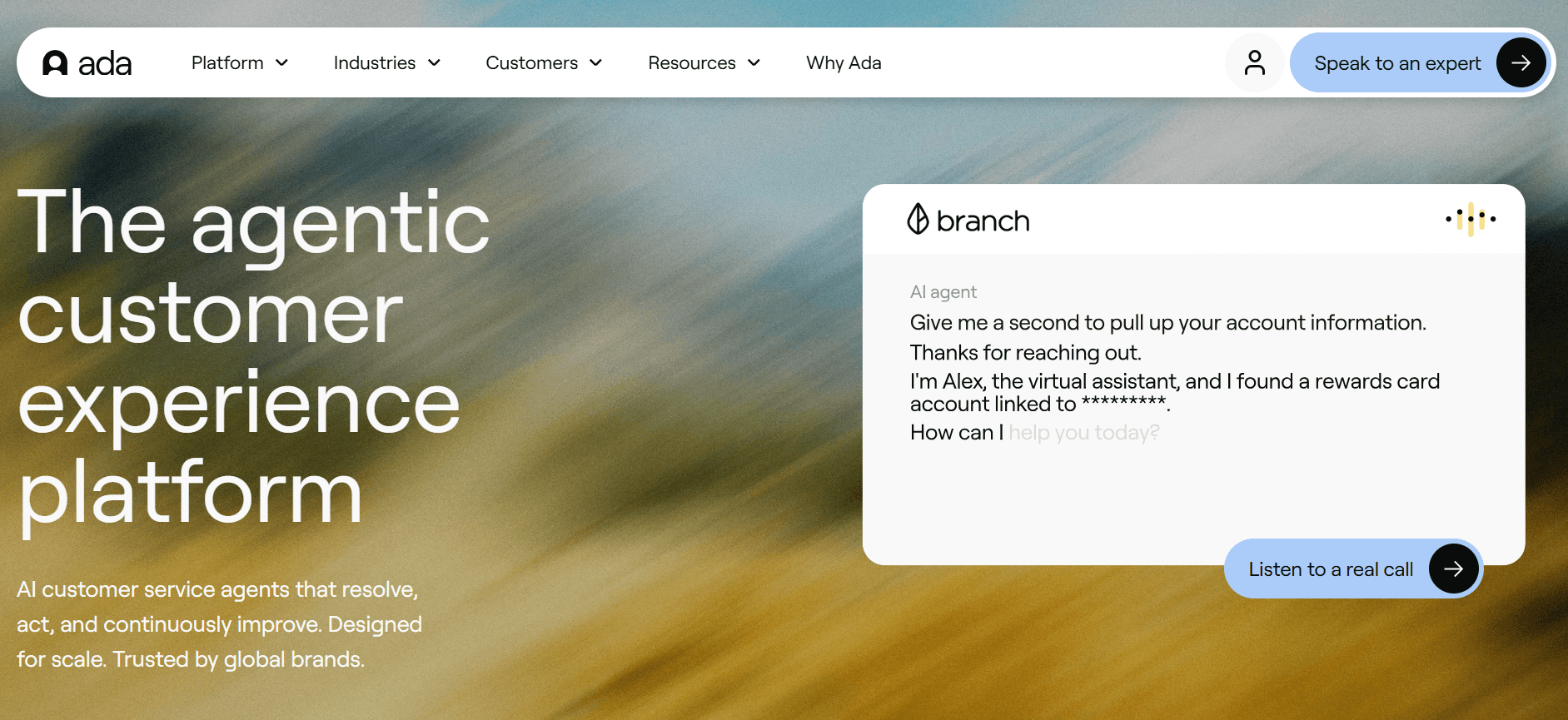
Best for: Enterprise customer support teams (200+ agents) needing AI across chat, email, voice, and SMS — with multilingual deflection and compliance certifications for regulated verticals.
Our Testing Experience:
We didn't run a full setup test — Ada doesn't allow self-serve sign-up. The platform requires a sales call and typical implementation runs 6–12 weeks. Pricing is custom and starts around $30,000/year for production enterprise deployments.
Ada is genuinely deep where Forethought is deep: full multi-channel support (chat, email, voice, SMS), multi-LLM Reasoning Engine, native SOC 2 + GDPR + HIPAA compliance, and 50+ language support. For Forethought customers re-evaluating in the wake of the Zendesk acquisition, Ada is the most-direct independent alternative at the same enterprise tier.
Pricing: Custom (sales call required). Enterprise contracts typically $30,000–$200,000+/year depending on volume and channels.
Pros:
Multi-channel support (chat, email, voice, SMS)
Multi-LLM Reasoning Engine (not locked to one model)
Native SOC 2, GDPR, HIPAA compliance
50+ language support
Cons:
$30K+/year entry disqualifies SMBs and most mid-market
6–12 week implementation typical
Can't natively ingest PDFs, past tickets, or Notion (per recent reviews)
What's unique: The most direct enterprise alternative to Forethought — same depth, comparable pricing, but independent of Zendesk's acquisition strategy.
3. Decagon — Best Autonomous Resolution for Tech-Mature Teams
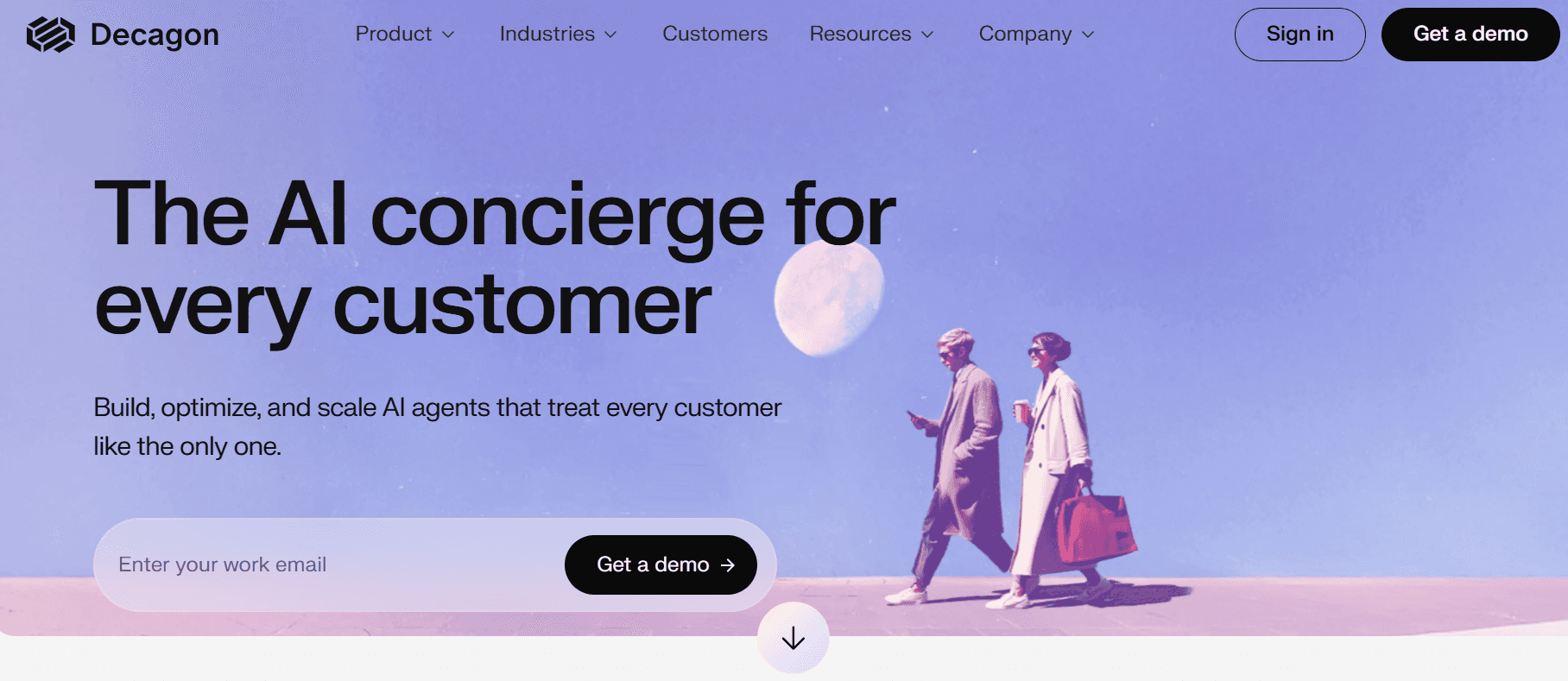
Best for: Technically mature organisations (engineering-led customer support teams) that want fine-grained control over autonomous AI agents — and that prefer replacing frontline support rather than augmenting it.
Our Testing Experience:
We didn't run a full setup test — Decagon requires a sales call. Implementation typically runs 4–8 weeks, faster than Forethought or Ada. Pricing is custom and starts in the high-five-figure to low-six-figure annual range.
Decagon's positioning is autonomous resolution at depth — fine-grained control via SDKs and APIs, configurable reasoning logic, and direct action-taking across backend systems (not just deflection). For teams that have engineering resources to dedicate to AI configuration and want maximum autonomy, Decagon goes further than Forethought's workflow builder approach.
Pricing: Custom (sales call required). Enterprise contracts typically $50,000–$300,000+/year.
Pros:
Deep autonomous resolution (not just deflection)
Strong API and SDK control for engineering teams
Native action-taking across backend systems
High-performance reasoning across complex workflows
Cons:
$50K+/year entry — enterprise-only positioning
Requires engineering resources for configuration
4–8 week implementation
What's unique: The deepest autonomous resolution on this list — Decagon goes further than Forethought into actually replacing frontline agents rather than augmenting them.
4. Sierra — Best Enterprise AI with Controlled Autonomy
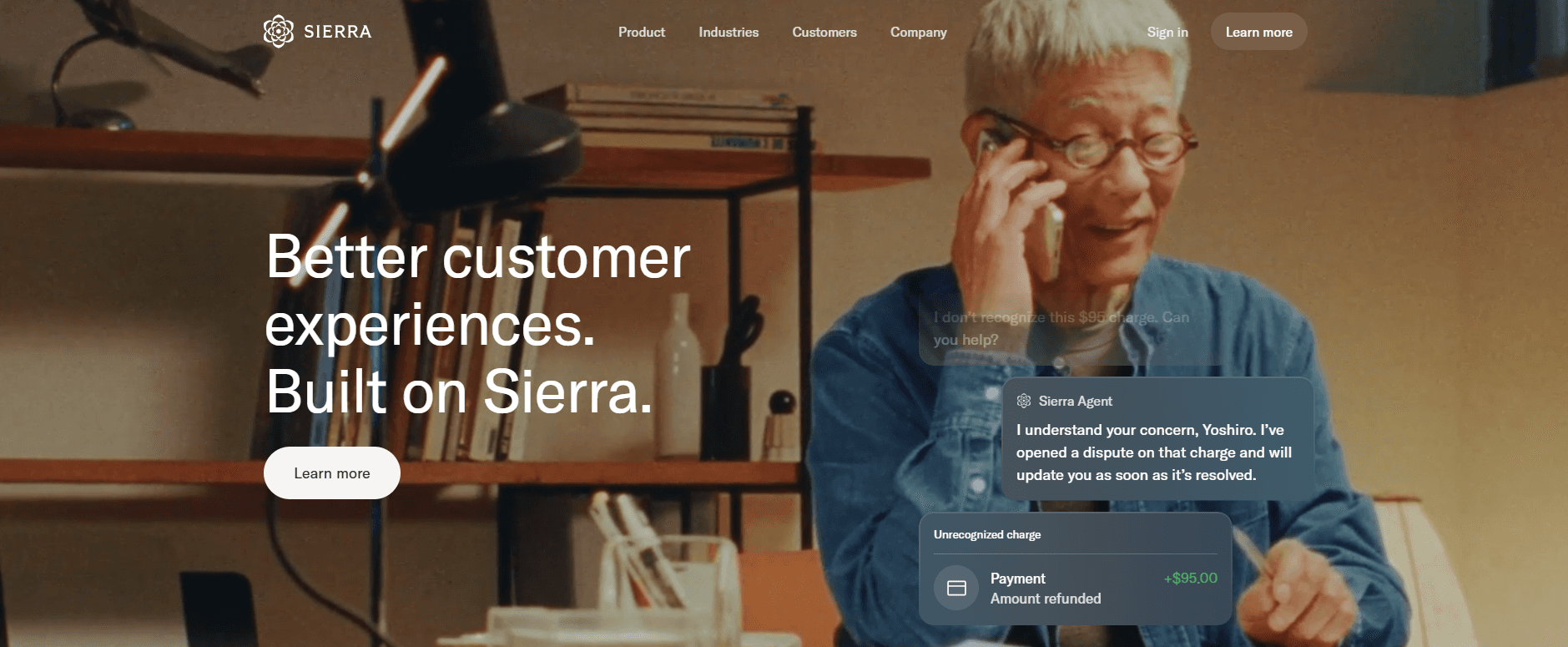
Best for: Large organisations (Fortune 500 scale) that prioritise governance and brand control over speed-to-value — willing to accept longer setup cycles in exchange for tightly controlled AI behaviour.
Our Testing Experience:
We didn't run a full setup test — Sierra requires a sales call and works exclusively with enterprise customers. Implementation runs 6–10 weeks. Pricing is custom and reflects enterprise positioning.
Sierra is positioned for high-stakes customer experiences where AI autonomy must be tightly governed. Founded by former Salesforce co-CEO Bret Taylor, the platform emphasises governance, brand voice consistency, and controlled rollout. For enterprise teams choosing between Forethought's broader 5-agent approach and a more governance-first platform, Sierra is the alternative.
Pricing: Custom (sales call required). Typically high-five-figure to seven-figure annual contracts for Fortune 500 deployments.
Pros:
Strongest enterprise governance and brand control
Native voice + chat with quality controls
Backed by Bret Taylor (ex-Salesforce co-CEO, OpenAI board chair)
Strong financial services and healthcare vertical depth
Cons:
Enterprise-only — no SMB or mid-market entry tier
6–10 week implementation typical
Custom pricing reflects Fortune 500 positioning
What's unique: The most governance-focused AI agent on this list — for enterprises where brand voice consistency and controlled autonomy matter more than speed-to-value.
5. Intercom (Fin AI) — Best for Product-Led Chat with Action-Taking
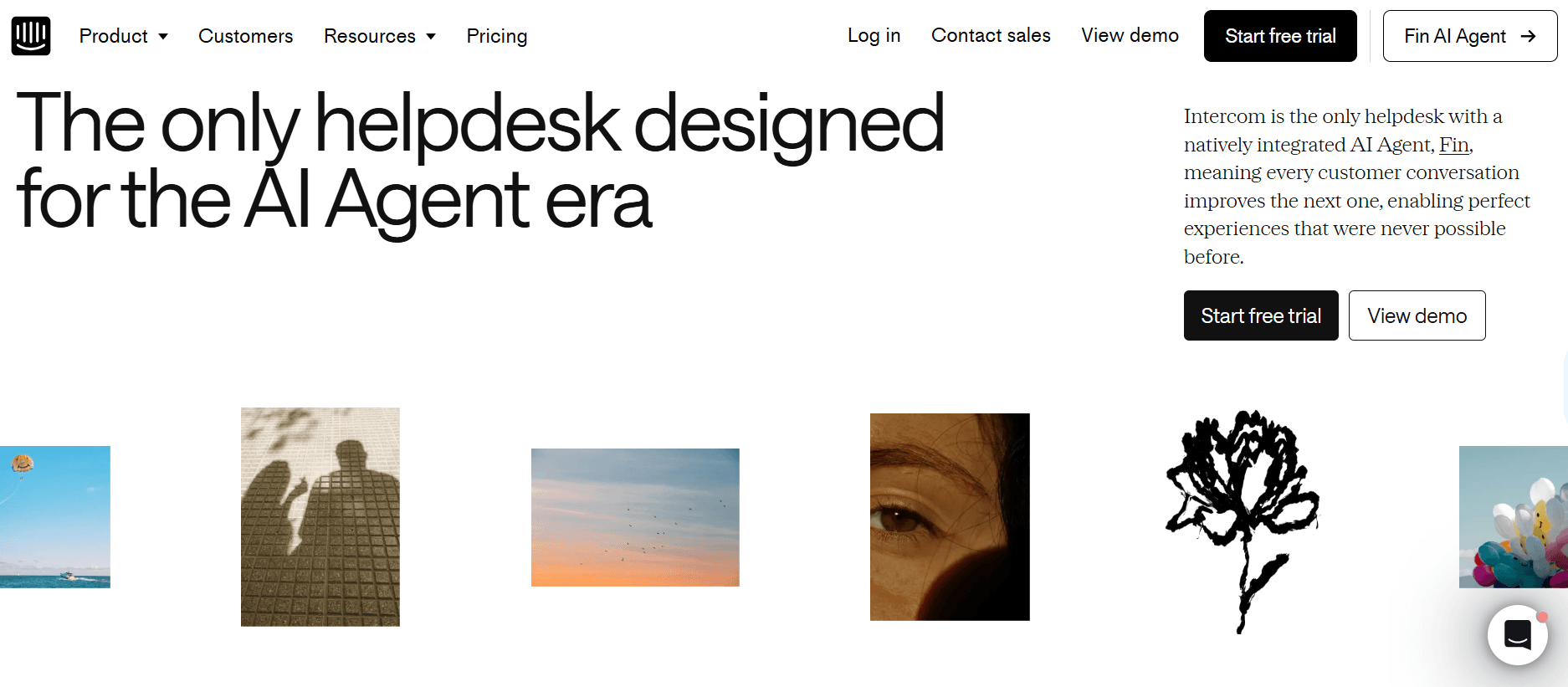
Best for: SaaS and product-led companies where Fin AI's resolution-based pricing and action-taking capabilities solve the "Forethought deflects but doesn't act" problem.
Our Testing Experience:
Setup took 10 minutes for the Intercom platform; Fin AI configuration took another 4 minutes. Fin is genuinely one of the strongest AI agents on the market — handles complex multi-turn conversations, takes direct action across refunds, account changes, subscription updates (when connected to backend systems), and integrates tightly with Intercom's existing inbox.
The pricing model is the differentiator from Forethought: $0.99 per resolution rather than custom-negotiated platform + usage fees. You only pay for successful resolutions, not for AI sitting idle.
Pricing: Essential $39/seat/month, Advanced $99/seat/month, Expert $139/seat/month. Fin AI: $0.99 per resolution on top.
Pros:
Pay-per-resolution pricing aligns cost with success
Takes action across refunds, account changes, subscription updates
Native ticket and inbox integration
Public, predictable pricing
Cons:
$0.99/resolution adds up fast at scale (10K resolutions = $9,900/month)
Base seat pricing among the highest on this list
Requires Intercom platform commitment
What's unique: The only platform here with public, transparent per-resolution pricing — Forethought's custom-negotiated model can't match the budget predictability.
6. Zendesk AI Agents — Best Native to Zendesk Ecosystem
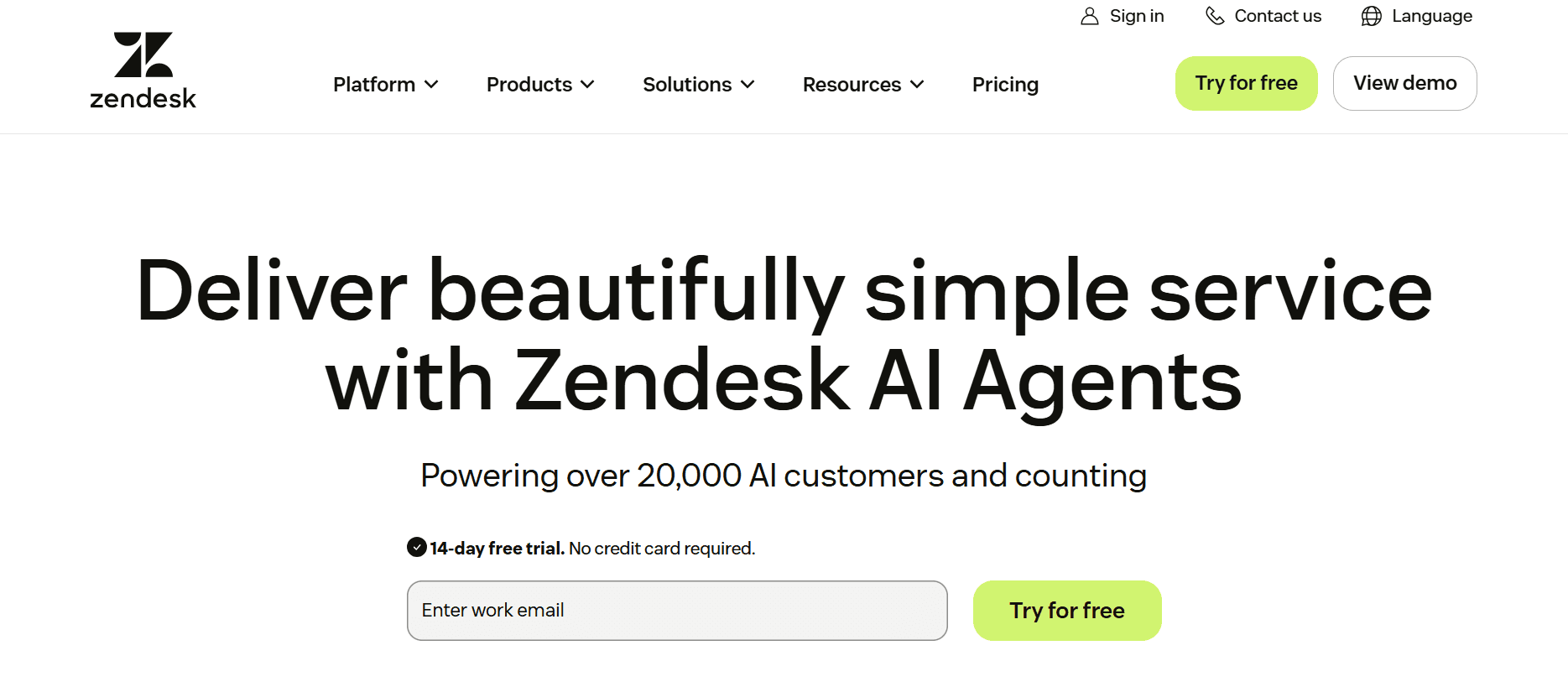
Best for: Customer support teams already deep in the Zendesk ecosystem who want autonomous AI agents tightly coupled to Zendesk data models — and who are now Forethought's effective parent company post-acquisition.
Our Testing Experience:
Setup took 30+ minutes for the Zendesk AI Agent configuration. Following the March 2026 acquisition of Forethought, Zendesk's native AI offerings now include capabilities that previously required Forethought as a separate vendor. For Zendesk customers, the native AI Agents are the path of least resistance.
The trade-off is platform lock-in. Zendesk AI Agents are tightly coupled to Zendesk data models — for organisations on multiple helpdesk platforms or evaluating Zendesk migration, this creates dependency you may not want.
Pricing: Suite Team $55/agent/month + AI Agents $50/agent/month add-on. Higher tiers bundle some AI capabilities.
Pros:
Native to Zendesk — tight integration with Zendesk data
Forethought capabilities increasingly bundled post-acquisition
Strong reporting within the Zendesk ecosystem
Mature integration ecosystem (1,800+ apps)
Cons:
Tightly coupled to Zendesk — limited flexibility for multi-platform teams
AI Agents are a $50/agent/month add-on
Acquisition integration timeline still uncertain
What's unique: The only platform here that absorbed Forethought through acquisition — for Zendesk customers, the native AI roadmap now includes Forethought's capabilities natively.
7. eesel AI — Best Self-Serve Helpdesk AI in Minutes
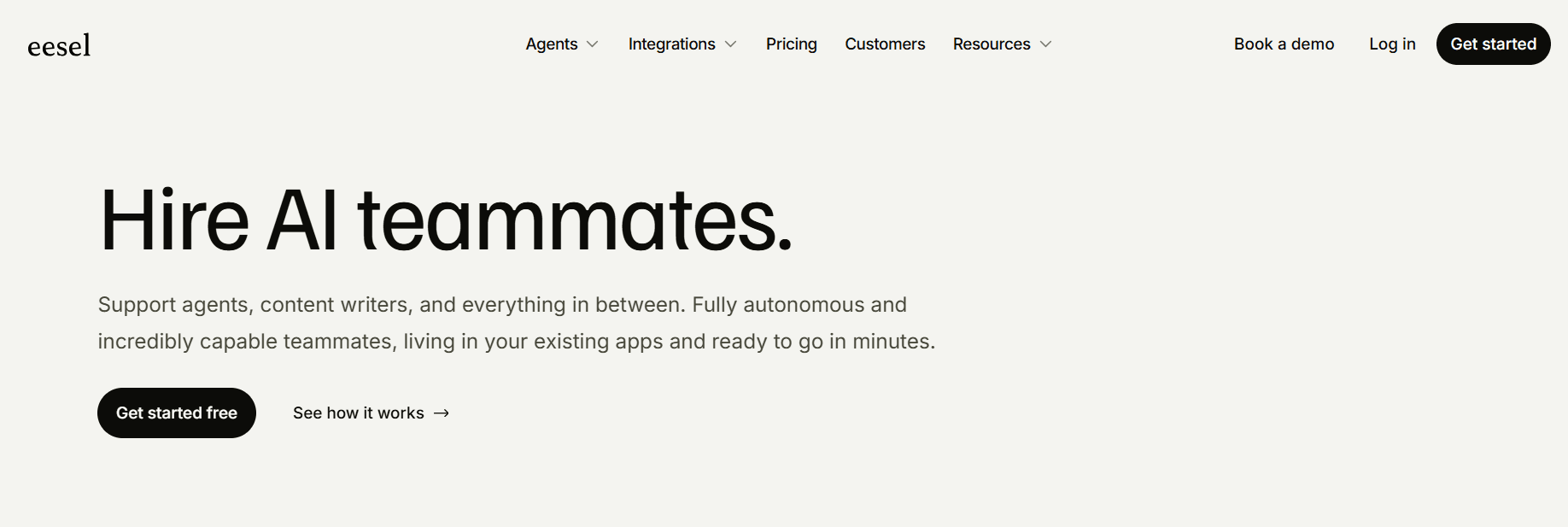
Best for: Customer support teams that want Forethought-style autonomous AI without the 30–90 day implementation — self-serve setup in under 10 minutes, plugged directly into your existing helpdesk.
Our Testing Experience:
Setup took under 10 minutes. eesel AI is positioned directly against Forethought's implementation timeline — true self-serve, no sales call, no 20,000-ticket data requirement. The platform plugs into Zendesk, Freshdesk, Intercom, and HubSpot Service Hub, then trains from your knowledge sources (Confluence, Notion, Google Docs, past tickets) within minutes.
The standout is "simulation mode" — you can test the AI on past conversations before going live. This addresses a documented Forethought weakness: no safe pre-deployment testing.
Pricing: Team $239/month + interaction-based pricing, Business custom. Public tiered pricing.
Pros:
Self-serve setup in minutes (not weeks)
Simulation mode for pre-deployment AI testing
Plugs into existing helpdesks without migration
Public, transparent pricing
Cons:
Smaller community than Forethought or Ada
Less mature multi-channel coverage (chat/email focus)
Newer platform with shorter track record
What's unique: The only platform here with self-serve setup AND simulation mode — eesel solves Forethought's two biggest UX gaps: implementation time and AI testing risk.
8. My AskAI — Best Transparent Per-Ticket Pricing
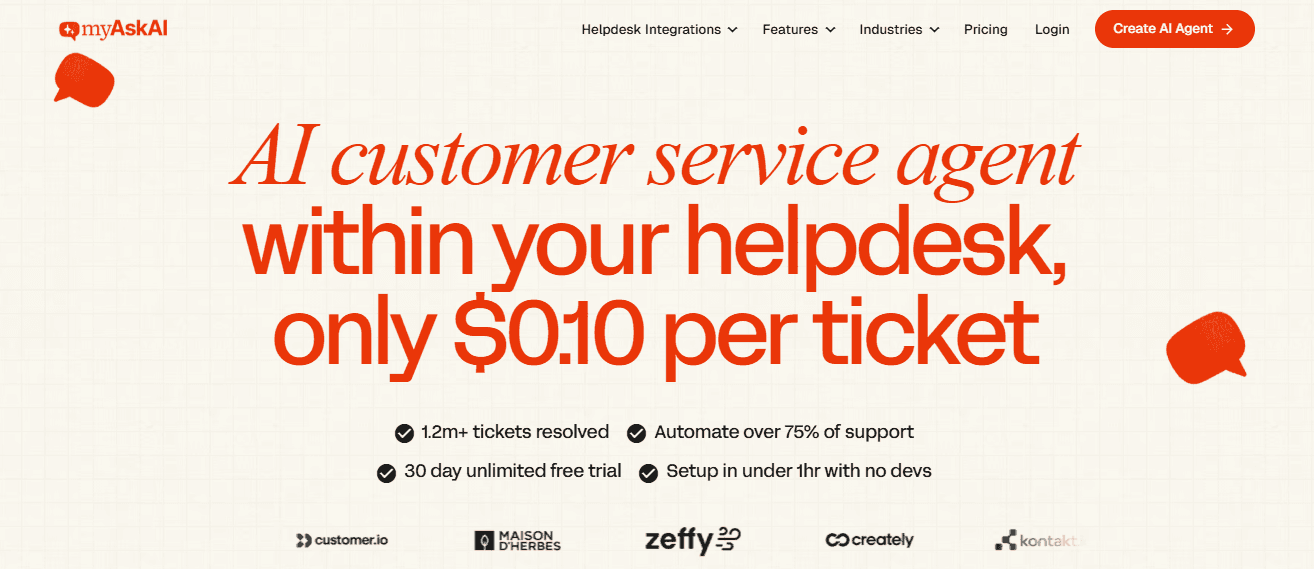
Best for: Mid-market customer support teams that want predictable, public per-ticket pricing — without Forethought's custom-negotiated platform fees.
Our Testing Experience:
Setup took under 10 minutes. My AskAI's pricing model is the differentiator: $199/month + $0.10 per ticket. Public, predictable, scales linearly with usage. For teams running 5,000 tickets/month, the math is straightforward: $199 + $500 = $699/month total.
The platform integrates natively with Zendesk, Intercom, Freshdesk, Gorgias, and HubSpot, and SOC 2 Type II certification handles enterprise compliance requirements. 30-day free trial without credit card lets you test before committing.
Pricing: Starts at $199/month + $0.10/ticket. SOC 2 Type II certified.
Pros:
Cheapest credible Forethought alternative with native helpdesk integration
Public per-ticket pricing — no custom negotiations
30-day free trial with no credit card
SOC 2 Type II certified
Cons:
Per-ticket pricing means costs scale linearly (no per-resolution success-based model)
Smaller feature set than Forethought's full 5-agent architecture
Less mature than Ada or Decagon for enterprise deployments
What's unique: The clearest budget predictability on this list — public per-ticket pricing means you can model exact costs at any volume, which Forethought's custom pricing can't deliver.
9. Kore.ai — Best Enterprise Conversational AI Platform
Best for: Large enterprises with complex conversational AI requirements across customer service, employee service, and IVR replacement — that need a single platform spanning multiple use cases.
Our Testing Experience:
We didn't run a full setup test — Kore.ai requires a sales call and works primarily with enterprise customers. Implementation typically runs 6–12 weeks. Pricing is custom and reflects enterprise positioning.
Kore.ai's strength is breadth — the platform supports customer service AI, employee service AI, IVR replacement, and conversational marketing in one framework. For enterprises that want to standardise on a single conversational AI vendor across departments, Kore.ai's flexibility goes further than Forethought's customer-support focus.
Pricing: Custom (sales call required). Enterprise contracts typically $50,000–$500,000+/year.
Pros:
Broadest use case coverage (customer service + employee + IVR)
Strong dialog management and workflow execution
Mature enterprise platform with deep integrations
Native voice/IVR replacement capabilities
Cons:
Requires upfront design work
6–12 week implementation typical
Less specialised for customer support specifically vs Forethought
What's unique: The broadest use case coverage on this list — for enterprises consolidating multiple conversational AI vendors into one platform, Kore.ai is the standardisation play.
10. Tidio (Lyro AI) — Best SMB Autonomous Chat Resolution
Best for: Small and mid-sized businesses that want Forethought-style autonomous AI resolution — without enterprise pricing or implementation.
Our Testing Experience:
Setup took 6 minutes. Tidio's Lyro AI is the SMB pick — autonomous chat resolution included on every paid plan starting at $29/month. The AI handles common customer questions, learns from your knowledge base, and escalates to humans when needed.
For Forethought customers who realise their volume doesn't justify enterprise pricing — or for SMBs starting with autonomous AI for the first time — Tidio is the entry-level fit.
Pricing: Starter $29/month, Growth $59/month, Plus $749/month, Premium $2,999/month.
Pros:
Cheapest autonomous AI on this list ($29/month)
Lyro AI included on every paid plan
Self-serve setup with no sales call
Strong Shopify and WooCommerce integrations
Cons:
Less depth than Forethought, Ada, or Decagon for complex workflows
Plus tier ($749/month) is a steep jump from Growth ($59/month)
Limited multi-channel beyond chat
What's unique: The cheapest entry point to autonomous AI resolution on this list — for teams testing AI before committing to Forethought's enterprise pricing, Tidio is the lowest-risk start.
How to Choose: Quick Decision Framework
Are customer phone calls the channel Forethought treats as an afterthought?
Brilo.ai answers inbound calls autonomously — voice is the core product, not a Zendesk-routed bolt-on. Pair with Forethought (or any alternative on this list) for end-to-end coverage.
Concerned about Forethought's independence post-Zendesk acquisition?
Ada for full enterprise multi-channel parity. Decagon for tech-mature teams wanting deeper autonomy. Sierra for governance-focused enterprise. All three are independent platforms with no acquisition consolidation risk.
Need self-serve setup in minutes, not 30–90 days?
eesel AI for Forethought-style autonomous AI plugged into your existing helpdesk in under 10 minutes. My AskAI for transparent per-ticket pricing with similar fast deployment. Tidio for SMB-tier autonomous chat resolution.
Want pay-per-resolution rather than platform fees?
Intercom Fin AI at $0.99 per successful resolution. The only platform here that ties cost directly to AI success rather than usage volume.
Already deep in the Zendesk ecosystem?
Zendesk AI Agents — the platform absorbed Forethought through the March 2026 acquisition, so the capabilities are increasingly native. Path of least resistance for Zendesk-committed teams.
Need AI that takes action (refunds, subscription changes) — not just deflects?
Decagon for tech-mature teams. Intercom Fin AI for SaaS with backend system integration. Both go further than Forethought's typical "escalate to human" pattern for action-required tickets.
Running customer service + employee service + IVR replacement together?
Kore.ai for enterprise standardisation across multiple conversational AI use cases. The only platform here built for cross-departmental scope rather than customer-support specifically.
Frequently Asked Question
What is the best free alternative to Forethought?
Tidio offers a free plan for basic chatbot functionality (no Lyro AI on free). aissist.io has a permanent free tier for limited usage. Brilo.ai's free plan offers 10 minutes/month of AI voice agent for inbound calls. Forethought itself doesn't offer a free trial — only sales-led demo and POC engagements.
What is the cheapest Forethought alternative?
Tidio Starter at $29/month is the cheapest credible autonomous AI chat resolution. My AskAI at $199/month + $0.10/ticket is the cheapest with native helpdesk integration. Brilo.ai's Starter plan at $49/month is cheapest if you specifically want AI handling inbound calls.
Will Forethought continue to operate independently after the Zendesk acquisition?
Zendesk announced on March 11, 2026 that Forethought will remain available to non-Zendesk customers — but the long-term implications for platform independence, roadmap priorities, and pricing are uncertain. Most acquisitions of this scale eventually result in tighter parent-product integration. Teams concerned about independence are evaluating Ada, Decagon, and Sierra as alternatives.
Why does Forethought require 20,000+ historical tickets to train?
Forethought's machine learning models train on historical conversation data to learn your specific customer support patterns, intents, and resolution paths. Below the 20,000-ticket threshold, the AI struggles to generalise reliably. Modern alternatives (Brilo, eesel AI, My AskAI) auto-train from your website, documentation, and knowledge base in minutes — eliminating the historical data requirement entirely.
How long does Forethought implementation actually take?
30–90 days is the documented range across multiple G2 and Capterra reviews. Typical timelines: 1–2 weeks for initial training, 4–6 weeks for workflow builder configuration and integration, 2–4 weeks for testing and refinement. Modern alternatives deploy in days or hours rather than months.
Does Forethought offer transparent pricing?
No. Forethought's pricing is custom-negotiated and not published publicly. Multiple reviewers describe the pricing model as "a mystery" until deep in procurement. Total cost typically includes platform fees, usage components, and add-ons (AI Copilot, advanced security, Slack integration) priced separately. Transparent alternatives include My AskAI ($199/month + $0.10/ticket), eesel AI ($239/month + interactions), and Tidio (public tiered pricing).
Can Forethought take action on tickets autonomously?
Limited. Forethought's primary mode is deflection — providing AI responses to customer questions. For action-required tickets (refunds, account changes, subscription updates), the platform typically escalates to a human agent rather than executing the workflow autonomously. Newer alternatives (Decagon, Intercom Fin AI, KODIF) take real action through native API integrations.
Is "Forethought" the same as "Forethought AI"?
Yes — "Forethought" and "Forethought AI" both refer to the same customer support automation platform founded in 2018 by Deon Nicholas. The company was acquired by Zendesk on March 11, 2026 in Zendesk's largest acquisition in nearly 20 years.
The Bottom Line
Forethought built one of the most complete AI customer support platforms in the market — undermined by 30–90 day implementations, 20,000+ historical ticket training requirements, custom-negotiated pricing that obscures total cost, voice capabilities that route through Zendesk integrations rather than core architecture, and the March 2026 acquisition by Zendesk that has left platform independence uncertain.
Best alternatives by use case:
AI voice agent for inbound calls: Brilo.ai
Enterprise multi-channel AI: Ada
Autonomous resolution for tech-mature teams: Decagon
Enterprise AI with controlled autonomy: Sierra
Product-led chat with action-taking: Intercom (Fin AI)
Native to Zendesk ecosystem: Zendesk AI Agents
Self-serve helpdesk AI in minutes: eesel AI
Transparent per-ticket pricing: My AskAI
Enterprise conversational AI platform: Kore.ai
SMB autonomous chat resolution: Tidio (Lyro AI)
All Insights
Articles
The 10 Best Forethought Alternatives in 2026 (We Tested Each One)
We tested 10 Forethought alternatives — Zendesk acquisition exposed, 30–90 day setup documented, 20,000-ticket requirement compared. Find the right fit for your team in 2026.
We spent three weeks testing every major Forethought alternative — timing setup, running real AI deployments, testing autonomous resolution, and reading through hundreds of G2, Capterra, Reddit, and Trustpilot reviews. One member of our team uses Brilo.ai as a paying customer; we note this where relevant.
Here's what we found.
Why Are Customer Support Teams Leaving Forethought?
Forethought built one of the most complete AI customer support platforms in the market — a 5-agent architecture covering Solve (autonomous resolution), Triage (intelligent routing), Assist (agent copilot), Discovery (insights), and QA (quality monitoring). The platform genuinely works for enterprise teams with the resources to deploy it. The challenges are everything around it: the implementation timeline, the data requirements, the pricing opacity, and the March 2026 acquisition that has left the platform's independence in question.
Forethought was acquired by Zendesk on March 11, 2026. Zendesk described it as their largest acquisition in nearly 20 years. The platform will remain available to non-Zendesk customers, but the long-term implications for independence, roadmap priorities, and pricing are uncertain — and this is the single most-cited reason teams are evaluating alternatives in Q2 2026.
"We were met with pricing that wasn't public, feeling more like a drawn-out negotiation than a simple purchase. The costs were a confusing mix of platform fees and usage, which made budgeting a challenge." — Customer support leader, eesel AI review
You need 20,000+ historical tickets to train Forethought effectively. This is the most-flagged technical barrier — teams without that ticket history can't get accurate AI behaviour, and growing companies often hit the wall years before reaching the data threshold. The training requirement also locks you into Forethought's data model rather than allowing transfer to other platforms.
Implementation typically takes 30–90 days. Forethought requires professional services for production deployment, with multi-month timelines documented across G2 reviews. For teams that need AI live this quarter, this timeline is incompatible with most business priorities.
Pricing is custom-negotiated and opaque. No public pricing means budget planning requires a sales cycle. Forethought's pricing typically includes platform fees plus usage components, with add-ons (AI Copilot, advanced security, Slack integration) priced separately. Multiple reviewers describe the pricing model as "a mystery" until you're already deep in procurement.
It deflects, but it doesn't sell. Forethought is purpose-built for B2B SaaS support — measuring success in deflection rates rather than revenue generation. For eCommerce and consumer brands where AI conversations should drive sales, conversion, and upselling, Forethought's architecture isn't designed for the job.
Most actions require human escalation. When a customer asks for a refund, a subscription change, or an account modification, Forethought typically routes to a human agent rather than executing the workflow autonomously. Newer alternatives (Decagon, Sierra, KODIF) take real action through native integrations.
Our Ranking Methodology
Criteria | Weight | What we measured |
|---|---|---|
Autonomous resolution depth | 25% | True autonomous resolution vs deflection vs agent assist |
Setup speed & data requirements | 20% | Time to first live conversation, historical data thresholds |
Pricing transparency | 20% | Public pricing, predictable cost at 5K and 10K tickets/month |
Channel coverage | 20% | Voice, chat, email, SMS — native vs add-on |
Action-taking capability | 15% | Native API actions (refunds, changes) vs human escalation |
TL;DR Comparison Table
Tool | Best For | Channel Focus | Starting Price | Setup Time |
|---|---|---|---|---|
Brilo.ai | AI voice agent for inbound calls | Voice (native) | $49/mo | 7 min |
Ada | Enterprise multi-channel AI | Chat, email, voice, SMS | Custom (~$30K/year) | 6–12 weeks |
Decagon | Autonomous resolution for tech-mature teams | Chat, email | Custom (~$50K+/year) | 4–8 weeks |
Sierra | Enterprise AI with controlled autonomy | Chat, voice | Custom | 6–10 weeks |
Intercom (Fin AI) | Product-led chat with action-taking | Chat, email | $0.99/resolution | 10 min |
Zendesk AI Agents | Native to Zendesk ecosystem | Chat, email, voice | $50/agent/mo add-on | 30+ min |
eesel AI | Self-serve helpdesk AI in minutes | Chat, email | $239/mo + interactions | <10 min |
My AskAI | Transparent per-ticket pricing | Chat, email | $199/mo + $0.10/ticket | <10 min |
Kore.ai | Enterprise conversational AI platform | Chat, voice, IVR | Custom | 6–12 weeks |
Tidio (Lyro AI) | SMB autonomous chat resolution | Chat | $29/mo | 6 min |
1. Brilo.ai — Best for AI Voice Agent for Inbound Calls
Best for: Customer support teams running Forethought (or evaluating alternatives) whose customers also call by phone — and who realise that for inbound voice volume, Forethought's voice capability is bolted on through Zendesk integrations rather than purpose-built for autonomous resolution.
Why Brilo belongs on a Forethought alternatives list:
Forethought is a chat-and-email-first platform — Solve, Triage, and Assist are designed primarily for written conversations across helpdesk channels. The voice capability exists, but it routes through Zendesk integrations and requires the same 20,000+ historical ticket training that gates the rest of the platform. For teams where phone is a meaningful channel — and for the many SaaS, eCommerce, healthcare, and services businesses where it is — Forethought's voice architecture is a stretch.
Brilo.ai is an AI voice agent — voice is the core product, not an add-on. It answers inbound calls autonomously, resolves routine queries from your knowledge base, and only escalates to a human when genuinely needed. There's no 20,000-ticket training requirement (Brilo auto-trains from your website and documentation in under 5 minutes). There's no 30–90 day implementation. There's no Zendesk integration dependency in the wake of the March 2026 acquisition.
For teams where AI should resolve the calls Forethought routes to humans — order status, account access, appointment confirmations, basic FAQs — Brilo is purpose-built for the job. Pair Brilo with Forethought (or any alternative on this list) for the chat/email side, and you get end-to-end autonomous coverage.
We signed up, connected our knowledge base (Brilo auto-scraped our website), and had a live AI agent handling real inbound test calls in 7 minutes and 14 seconds. No professional services engagement. No historical ticket dump required. No Zendesk acquisition strategy questions.
Disclosure: one of our team is a paying Brilo customer. We stress-tested it harder as a result.
Signup → onboarded: 7 minutes, 14 seconds
Standout Features:
Native AI voice agent — answers inbound calls autonomously 24/7
Auto-trained from your website and documentation in under 5 minutes
Multilingual support across 30+ languages
Real-time escalation with full transcript attached
6,000+ integrations including Zendesk, Salesforce, HubSpot, Intercom
Independent platform — not subject to acquisition consolidation
Pricing:
Free Plan: Free — 10 minutes/month, 1 AI agent, 1 workspace, community support
Starter Plan: $49/month — 160 minutes, 1 agent, $0.18/min overage
Pro Plan: $149/month — 600 minutes, 3 agents, 3 workspaces, $0.16/min overage
Growth Plan: $499/month — 2,500 minutes, unlimited agents, 5 workspaces, $0.14/min overage
Custom Plan: Talk to us — 5,000+ minutes, unlimited agents, unlimited workspaces, additional usage at <$0.14/min, white-glove onboarding
No 20,000-ticket training requirement. No 30–90 day implementation. No custom-negotiated pricing. What you see is what you pay. See full details on the Brilo pricing page.
Cons:
Not a chat or email AI platform — pair Brilo with Forethought (or one of the alternatives on this list) for the chat/email side of customer support
No native ticket triage or QA agents like Forethought's full 5-agent architecture
Newer platform than Forethought (founded 2023) — fewer enterprise reference customers in B2B SaaS verticals where Forethought dominates
What's unique: The only voice-first platform on this list — where Forethought treats voice as a Zendesk-routed afterthought, Brilo makes inbound calls the core product.
Try it free: brilo.ai — no credit card, no 20,000-ticket requirement, no 90-day implementation. AI agent live in under 10 minutes.
2. Ada — Best for Enterprise Multi-Channel AI
Best for: Enterprise customer support teams (200+ agents) needing AI across chat, email, voice, and SMS — with multilingual deflection and compliance certifications for regulated verticals.
Our Testing Experience:
We didn't run a full setup test — Ada doesn't allow self-serve sign-up. The platform requires a sales call and typical implementation runs 6–12 weeks. Pricing is custom and starts around $30,000/year for production enterprise deployments.
Ada is genuinely deep where Forethought is deep: full multi-channel support (chat, email, voice, SMS), multi-LLM Reasoning Engine, native SOC 2 + GDPR + HIPAA compliance, and 50+ language support. For Forethought customers re-evaluating in the wake of the Zendesk acquisition, Ada is the most-direct independent alternative at the same enterprise tier.
Pricing: Custom (sales call required). Enterprise contracts typically $30,000–$200,000+/year depending on volume and channels.
Pros:
Multi-channel support (chat, email, voice, SMS)
Multi-LLM Reasoning Engine (not locked to one model)
Native SOC 2, GDPR, HIPAA compliance
50+ language support
Cons:
$30K+/year entry disqualifies SMBs and most mid-market
6–12 week implementation typical
Can't natively ingest PDFs, past tickets, or Notion (per recent reviews)
What's unique: The most direct enterprise alternative to Forethought — same depth, comparable pricing, but independent of Zendesk's acquisition strategy.
3. Decagon — Best Autonomous Resolution for Tech-Mature Teams
Best for: Technically mature organisations (engineering-led customer support teams) that want fine-grained control over autonomous AI agents — and that prefer replacing frontline support rather than augmenting it.
Our Testing Experience:
We didn't run a full setup test — Decagon requires a sales call. Implementation typically runs 4–8 weeks, faster than Forethought or Ada. Pricing is custom and starts in the high-five-figure to low-six-figure annual range.
Decagon's positioning is autonomous resolution at depth — fine-grained control via SDKs and APIs, configurable reasoning logic, and direct action-taking across backend systems (not just deflection). For teams that have engineering resources to dedicate to AI configuration and want maximum autonomy, Decagon goes further than Forethought's workflow builder approach.
Pricing: Custom (sales call required). Enterprise contracts typically $50,000–$300,000+/year.
Pros:
Deep autonomous resolution (not just deflection)
Strong API and SDK control for engineering teams
Native action-taking across backend systems
High-performance reasoning across complex workflows
Cons:
$50K+/year entry — enterprise-only positioning
Requires engineering resources for configuration
4–8 week implementation
What's unique: The deepest autonomous resolution on this list — Decagon goes further than Forethought into actually replacing frontline agents rather than augmenting them.
4. Sierra — Best Enterprise AI with Controlled Autonomy
Best for: Large organisations (Fortune 500 scale) that prioritise governance and brand control over speed-to-value — willing to accept longer setup cycles in exchange for tightly controlled AI behaviour.
Our Testing Experience:
We didn't run a full setup test — Sierra requires a sales call and works exclusively with enterprise customers. Implementation runs 6–10 weeks. Pricing is custom and reflects enterprise positioning.
Sierra is positioned for high-stakes customer experiences where AI autonomy must be tightly governed. Founded by former Salesforce co-CEO Bret Taylor, the platform emphasises governance, brand voice consistency, and controlled rollout. For enterprise teams choosing between Forethought's broader 5-agent approach and a more governance-first platform, Sierra is the alternative.
Pricing: Custom (sales call required). Typically high-five-figure to seven-figure annual contracts for Fortune 500 deployments.
Pros:
Strongest enterprise governance and brand control
Native voice + chat with quality controls
Backed by Bret Taylor (ex-Salesforce co-CEO, OpenAI board chair)
Strong financial services and healthcare vertical depth
Cons:
Enterprise-only — no SMB or mid-market entry tier
6–10 week implementation typical
Custom pricing reflects Fortune 500 positioning
What's unique: The most governance-focused AI agent on this list — for enterprises where brand voice consistency and controlled autonomy matter more than speed-to-value.
5. Intercom (Fin AI) — Best for Product-Led Chat with Action-Taking
Best for: SaaS and product-led companies where Fin AI's resolution-based pricing and action-taking capabilities solve the "Forethought deflects but doesn't act" problem.
Our Testing Experience:
Setup took 10 minutes for the Intercom platform; Fin AI configuration took another 4 minutes. Fin is genuinely one of the strongest AI agents on the market — handles complex multi-turn conversations, takes direct action across refunds, account changes, subscription updates (when connected to backend systems), and integrates tightly with Intercom's existing inbox.
The pricing model is the differentiator from Forethought: $0.99 per resolution rather than custom-negotiated platform + usage fees. You only pay for successful resolutions, not for AI sitting idle.
Pricing: Essential $39/seat/month, Advanced $99/seat/month, Expert $139/seat/month. Fin AI: $0.99 per resolution on top.
Pros:
Pay-per-resolution pricing aligns cost with success
Takes action across refunds, account changes, subscription updates
Native ticket and inbox integration
Public, predictable pricing
Cons:
$0.99/resolution adds up fast at scale (10K resolutions = $9,900/month)
Base seat pricing among the highest on this list
Requires Intercom platform commitment
What's unique: The only platform here with public, transparent per-resolution pricing — Forethought's custom-negotiated model can't match the budget predictability.
6. Zendesk AI Agents — Best Native to Zendesk Ecosystem
Best for: Customer support teams already deep in the Zendesk ecosystem who want autonomous AI agents tightly coupled to Zendesk data models — and who are now Forethought's effective parent company post-acquisition.
Our Testing Experience:
Setup took 30+ minutes for the Zendesk AI Agent configuration. Following the March 2026 acquisition of Forethought, Zendesk's native AI offerings now include capabilities that previously required Forethought as a separate vendor. For Zendesk customers, the native AI Agents are the path of least resistance.
The trade-off is platform lock-in. Zendesk AI Agents are tightly coupled to Zendesk data models — for organisations on multiple helpdesk platforms or evaluating Zendesk migration, this creates dependency you may not want.
Pricing: Suite Team $55/agent/month + AI Agents $50/agent/month add-on. Higher tiers bundle some AI capabilities.
Pros:
Native to Zendesk — tight integration with Zendesk data
Forethought capabilities increasingly bundled post-acquisition
Strong reporting within the Zendesk ecosystem
Mature integration ecosystem (1,800+ apps)
Cons:
Tightly coupled to Zendesk — limited flexibility for multi-platform teams
AI Agents are a $50/agent/month add-on
Acquisition integration timeline still uncertain
What's unique: The only platform here that absorbed Forethought through acquisition — for Zendesk customers, the native AI roadmap now includes Forethought's capabilities natively.
7. eesel AI — Best Self-Serve Helpdesk AI in Minutes
Best for: Customer support teams that want Forethought-style autonomous AI without the 30–90 day implementation — self-serve setup in under 10 minutes, plugged directly into your existing helpdesk.
Our Testing Experience:
Setup took under 10 minutes. eesel AI is positioned directly against Forethought's implementation timeline — true self-serve, no sales call, no 20,000-ticket data requirement. The platform plugs into Zendesk, Freshdesk, Intercom, and HubSpot Service Hub, then trains from your knowledge sources (Confluence, Notion, Google Docs, past tickets) within minutes.
The standout is "simulation mode" — you can test the AI on past conversations before going live. This addresses a documented Forethought weakness: no safe pre-deployment testing.
Pricing: Team $239/month + interaction-based pricing, Business custom. Public tiered pricing.
Pros:
Self-serve setup in minutes (not weeks)
Simulation mode for pre-deployment AI testing
Plugs into existing helpdesks without migration
Public, transparent pricing
Cons:
Smaller community than Forethought or Ada
Less mature multi-channel coverage (chat/email focus)
Newer platform with shorter track record
What's unique: The only platform here with self-serve setup AND simulation mode — eesel solves Forethought's two biggest UX gaps: implementation time and AI testing risk.
8. My AskAI — Best Transparent Per-Ticket Pricing
Best for: Mid-market customer support teams that want predictable, public per-ticket pricing — without Forethought's custom-negotiated platform fees.
Our Testing Experience:
Setup took under 10 minutes. My AskAI's pricing model is the differentiator: $199/month + $0.10 per ticket. Public, predictable, scales linearly with usage. For teams running 5,000 tickets/month, the math is straightforward: $199 + $500 = $699/month total.
The platform integrates natively with Zendesk, Intercom, Freshdesk, Gorgias, and HubSpot, and SOC 2 Type II certification handles enterprise compliance requirements. 30-day free trial without credit card lets you test before committing.
Pricing: Starts at $199/month + $0.10/ticket. SOC 2 Type II certified.
Pros:
Cheapest credible Forethought alternative with native helpdesk integration
Public per-ticket pricing — no custom negotiations
30-day free trial with no credit card
SOC 2 Type II certified
Cons:
Per-ticket pricing means costs scale linearly (no per-resolution success-based model)
Smaller feature set than Forethought's full 5-agent architecture
Less mature than Ada or Decagon for enterprise deployments
What's unique: The clearest budget predictability on this list — public per-ticket pricing means you can model exact costs at any volume, which Forethought's custom pricing can't deliver.
9. Kore.ai — Best Enterprise Conversational AI Platform
Best for: Large enterprises with complex conversational AI requirements across customer service, employee service, and IVR replacement — that need a single platform spanning multiple use cases.
Our Testing Experience:
We didn't run a full setup test — Kore.ai requires a sales call and works primarily with enterprise customers. Implementation typically runs 6–12 weeks. Pricing is custom and reflects enterprise positioning.
Kore.ai's strength is breadth — the platform supports customer service AI, employee service AI, IVR replacement, and conversational marketing in one framework. For enterprises that want to standardise on a single conversational AI vendor across departments, Kore.ai's flexibility goes further than Forethought's customer-support focus.
Pricing: Custom (sales call required). Enterprise contracts typically $50,000–$500,000+/year.
Pros:
Broadest use case coverage (customer service + employee + IVR)
Strong dialog management and workflow execution
Mature enterprise platform with deep integrations
Native voice/IVR replacement capabilities
Cons:
Requires upfront design work
6–12 week implementation typical
Less specialised for customer support specifically vs Forethought
What's unique: The broadest use case coverage on this list — for enterprises consolidating multiple conversational AI vendors into one platform, Kore.ai is the standardisation play.
10. Tidio (Lyro AI) — Best SMB Autonomous Chat Resolution
Best for: Small and mid-sized businesses that want Forethought-style autonomous AI resolution — without enterprise pricing or implementation.
Our Testing Experience:
Setup took 6 minutes. Tidio's Lyro AI is the SMB pick — autonomous chat resolution included on every paid plan starting at $29/month. The AI handles common customer questions, learns from your knowledge base, and escalates to humans when needed.
For Forethought customers who realise their volume doesn't justify enterprise pricing — or for SMBs starting with autonomous AI for the first time — Tidio is the entry-level fit.
Pricing: Starter $29/month, Growth $59/month, Plus $749/month, Premium $2,999/month.
Pros:
Cheapest autonomous AI on this list ($29/month)
Lyro AI included on every paid plan
Self-serve setup with no sales call
Strong Shopify and WooCommerce integrations
Cons:
Less depth than Forethought, Ada, or Decagon for complex workflows
Plus tier ($749/month) is a steep jump from Growth ($59/month)
Limited multi-channel beyond chat
What's unique: The cheapest entry point to autonomous AI resolution on this list — for teams testing AI before committing to Forethought's enterprise pricing, Tidio is the lowest-risk start.
How to Choose: Quick Decision Framework
Are customer phone calls the channel Forethought treats as an afterthought?
Brilo.ai answers inbound calls autonomously — voice is the core product, not a Zendesk-routed bolt-on. Pair with Forethought (or any alternative on this list) for end-to-end coverage.
Concerned about Forethought's independence post-Zendesk acquisition?
Ada for full enterprise multi-channel parity. Decagon for tech-mature teams wanting deeper autonomy. Sierra for governance-focused enterprise. All three are independent platforms with no acquisition consolidation risk.
Need self-serve setup in minutes, not 30–90 days?
eesel AI for Forethought-style autonomous AI plugged into your existing helpdesk in under 10 minutes. My AskAI for transparent per-ticket pricing with similar fast deployment. Tidio for SMB-tier autonomous chat resolution.
Want pay-per-resolution rather than platform fees?
Intercom Fin AI at $0.99 per successful resolution. The only platform here that ties cost directly to AI success rather than usage volume.
Already deep in the Zendesk ecosystem?
Zendesk AI Agents — the platform absorbed Forethought through the March 2026 acquisition, so the capabilities are increasingly native. Path of least resistance for Zendesk-committed teams.
Need AI that takes action (refunds, subscription changes) — not just deflects?
Decagon for tech-mature teams. Intercom Fin AI for SaaS with backend system integration. Both go further than Forethought's typical "escalate to human" pattern for action-required tickets.
Running customer service + employee service + IVR replacement together?
Kore.ai for enterprise standardisation across multiple conversational AI use cases. The only platform here built for cross-departmental scope rather than customer-support specifically.
Frequently Asked Question
What is the best free alternative to Forethought?
Tidio offers a free plan for basic chatbot functionality (no Lyro AI on free). aissist.io has a permanent free tier for limited usage. Brilo.ai's free plan offers 10 minutes/month of AI voice agent for inbound calls. Forethought itself doesn't offer a free trial — only sales-led demo and POC engagements.
What is the cheapest Forethought alternative?
Tidio Starter at $29/month is the cheapest credible autonomous AI chat resolution. My AskAI at $199/month + $0.10/ticket is the cheapest with native helpdesk integration. Brilo.ai's Starter plan at $49/month is cheapest if you specifically want AI handling inbound calls.
Will Forethought continue to operate independently after the Zendesk acquisition?
Zendesk announced on March 11, 2026 that Forethought will remain available to non-Zendesk customers — but the long-term implications for platform independence, roadmap priorities, and pricing are uncertain. Most acquisitions of this scale eventually result in tighter parent-product integration. Teams concerned about independence are evaluating Ada, Decagon, and Sierra as alternatives.
Why does Forethought require 20,000+ historical tickets to train?
Forethought's machine learning models train on historical conversation data to learn your specific customer support patterns, intents, and resolution paths. Below the 20,000-ticket threshold, the AI struggles to generalise reliably. Modern alternatives (Brilo, eesel AI, My AskAI) auto-train from your website, documentation, and knowledge base in minutes — eliminating the historical data requirement entirely.
How long does Forethought implementation actually take?
30–90 days is the documented range across multiple G2 and Capterra reviews. Typical timelines: 1–2 weeks for initial training, 4–6 weeks for workflow builder configuration and integration, 2–4 weeks for testing and refinement. Modern alternatives deploy in days or hours rather than months.
Does Forethought offer transparent pricing?
No. Forethought's pricing is custom-negotiated and not published publicly. Multiple reviewers describe the pricing model as "a mystery" until deep in procurement. Total cost typically includes platform fees, usage components, and add-ons (AI Copilot, advanced security, Slack integration) priced separately. Transparent alternatives include My AskAI ($199/month + $0.10/ticket), eesel AI ($239/month + interactions), and Tidio (public tiered pricing).
Can Forethought take action on tickets autonomously?
Limited. Forethought's primary mode is deflection — providing AI responses to customer questions. For action-required tickets (refunds, account changes, subscription updates), the platform typically escalates to a human agent rather than executing the workflow autonomously. Newer alternatives (Decagon, Intercom Fin AI, KODIF) take real action through native API integrations.
Is "Forethought" the same as "Forethought AI"?
Yes — "Forethought" and "Forethought AI" both refer to the same customer support automation platform founded in 2018 by Deon Nicholas. The company was acquired by Zendesk on March 11, 2026 in Zendesk's largest acquisition in nearly 20 years.
The Bottom Line
Forethought built one of the most complete AI customer support platforms in the market — undermined by 30–90 day implementations, 20,000+ historical ticket training requirements, custom-negotiated pricing that obscures total cost, voice capabilities that route through Zendesk integrations rather than core architecture, and the March 2026 acquisition by Zendesk that has left platform independence uncertain.
Best alternatives by use case:
AI voice agent for inbound calls: Brilo.ai
Enterprise multi-channel AI: Ada
Autonomous resolution for tech-mature teams: Decagon
Enterprise AI with controlled autonomy: Sierra
Product-led chat with action-taking: Intercom (Fin AI)
Native to Zendesk ecosystem: Zendesk AI Agents
Self-serve helpdesk AI in minutes: eesel AI
Transparent per-ticket pricing: My AskAI
Enterprise conversational AI platform: Kore.ai
SMB autonomous chat resolution: Tidio (Lyro AI)
Latest Insights
All Resources
Articles
Case Studies
Tutorials

Articles
AI Appointment Scheduling Tools Every GP Clinic Should Consider
Compare the best AI appointment scheduling for GP clinics. See top tools, must have features, and how to cut no shows and missed calls.
Articles
5 Best AI Voice Agents for Orthopedic and Sports Medicine Clinics (2026)
Compare the 5 best AI voice agents for orthopedic and sports medicine clinics in 2026. Top voice AI tools that book visits and triage calls 24/7
Load More
Latest Insights
All Resources
Articles
Case Studies
Tutorials
Articles
AI Appointment Scheduling Tools Every GP Clinic Should Consider
Compare the best AI appointment scheduling for GP clinics. See top tools, must have features, and how to cut no shows and missed calls.
Articles
5 Best AI Voice Agents for Orthopedic and Sports Medicine Clinics (2026)
Compare the 5 best AI voice agents for orthopedic and sports medicine clinics in 2026. Top voice AI tools that book visits and triage calls 24/7
Load More

Automate your business with AI phone Agents
Automate your business with AI phone Agents
Automate your business with AI phone Agents
Automate your business with AI phone Agents
Call automation for healthcare, real estate, logistics, financial services & small businesses.
Call automation for healthcare, real estate, logistics, financial services & small businesses.

Join Discord
Connect with our community, ask questions, and stay updated on product news.

Book a Call
Schedule a quick call with our team to explore solutions for your needs.
Get started
Industries
Usecases
Integrations
Legal & Community
Join Discord
Connect with our community, ask questions, and stay updated on product news.
Book a Call
Schedule a quick call with our team to explore solutions for your needs.
Get started
Industries
Usecases
Integrations
Legal & Community
Join Discord
Connect with our community, ask questions, and stay updated on product news.
Book a Call
Schedule a quick call with our team to explore solutions for your needs.
Get started
Industries
Usecases
Integrations
Legal & Community
Join Discord
Connect with our community, ask questions, and stay updated on product news.
Book a Call
Schedule a quick call with our team to explore solutions for your needs.
Get started
Industries
Usecases
Integrations
Legal & Community