
All Insights
Articles
Conversational AI Statistics (2026): Voice Agents, Usage & Trends
Comprehensive conversational AI statistics for 2026 — voice agent adoption, call automation rates, NLP accuracy benchmarks, and business impact data.
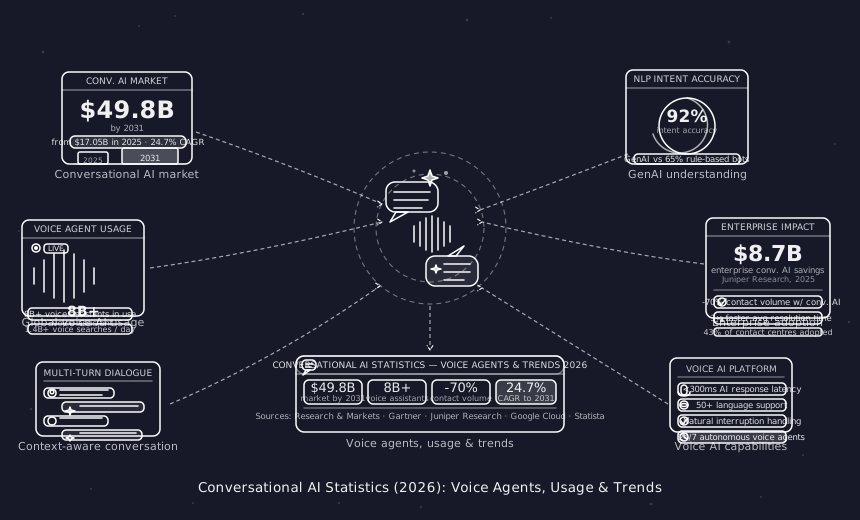
Conversational AI — the chatbots, virtual assistants, and voice agents that let people interact with businesses through natural, two-way conversation — has moved from novelty to core infrastructure. This page collects the most reliable conversational AI statistics for 2026 — market size, the chat-vs-voice split, business adoption, customer-service impact, consumer behavior, and where agentic AI is heading — with each number checked against the research firm, survey, or vendor that actually published it. (This space is full of recycled, unsourced numbers; we left those out.)
The short answer: Conversational AI is on track to be a $41 billion market by 2030 (Grand View Research), growing about 24% a year. Chatbots are the largest slice today, but voice is the fastest-growing — and Gartner expects agentic AI to autonomously resolve 80% of common customer service issues by 2029.
Top conversational AI statistics for 2026 (editor's picks)
$41.39 billion is the projected conversational AI market by 2030, a 23.7% CAGR. — Grand View Research
34.8% vs. 19.6% — voice AI agents are growing nearly twice as fast as the chatbot market. — Market.us / Grand View Research
$80 billion in projected 2026 contact-center labor savings from conversational AI. — Gartner, 2022
80% of common customer service issues resolved autonomously by agentic AI by 2029. — Gartner, 2025
50% of consumers have already engaged with Voice AI. — Zendesk, 2025
88% of organizations use AI in at least one business function. — McKinsey, 2025
79% of consumers still prefer the option of a human. — SurveyMonkey, 2026
$47.5 billion voice-AI-agents market by 2034 — the fastest-growing channel. — Market.us, 2025
49.6% CAGR for the all-uses AI agents market through 2033. — Grand View Research
76% average resolution rate reported for one leading AI agent (vendor-reported). — Intercom, 2026
Conversational AI market size and growth
Market | Base value | Projected value | CAGR | Source |
|---|---|---|---|---|
Conversational AI | $11.58B (2024) | $41.39B by 2030 | 23.7% | Grand View Research |
Chatbot | $9.56B (2025) | $41.24B by 2033 | 19.6% | Grand View Research |
Intelligent virtual assistant | — | $14.10B by 2030 | 24.3% | Grand View Research |
Voice AI agents | $2.4B (2024) | $47.5B by 2034 | 34.8% | Market.us |
AI agents (all uses) | $7.63B (2025) | $182.97B by 2033 | 49.6% | Grand View Research |
$11.58B → $41.39B is the conversational AI market from 2024 to 2030, a 23.7% CAGR. — Grand View Research
North America leads the conversational AI market, driven by heavy investment in AI and automation. — Grand View Research
$109.37 billion is the projected generative AI market by 2030 (37.6% CAGR) — the technology powering modern conversational AI. — Grand View Research
$7.63B → $182.97B is the all-uses AI agents market from 2025 to 2033, a 49.6% CAGR — the steepest growth in the category. — Grand View Research
The components: chat, virtual assistants, and voice
Conversational AI splits into text chatbots, virtual assistants, and voice agents. Chatbots are the biggest slice today — but voice is growing fastest.
$9.56B → $11.78B → $41.24B is the chatbot market across 2025, 2026, and 2033, a 19.6% CAGR. — Grand View Research
31.33% of the chatbot market came from customer service in 2025 — its largest application. — Grand View Research
$14.10 billion is the projected intelligent virtual assistant market by 2030, a 24.3% CAGR. — Grand View Research
34.8% vs. 19.6% — the voice-AI-agents market is growing nearly twice as fast as the overall chatbot market. — Market.us / Grand View Research
28.1% of the AI-for-customer-service market was chatbots and virtual assistants in 2024. — Grand View Research
Business adoption of conversational AI
88% of organizations report using AI in at least one business function, up from 78% a year earlier. — McKinsey, 2025
62% of organizations are at least experimenting with AI agents that can act autonomously. — McKinsey, 2025
18% of all U.S. firms used AI in a business function (32% on an employment-weighted basis), per official data. — U.S. Census Bureau, 2026
Retail and e-commerce are the fastest-growing end use of AI customer service, at a 26.0% CAGR. — Grand View Research, 2025
Customer service: the dominant use case
Customer service is conversational AI's biggest application — and where the cost and resolution numbers concentrate.
$80 billion in contact-center agent labor costs were projected to be cut by conversational AI in 2026. — Gartner, 2022
1 in 10 agent interactions were projected to be automated by 2026, up from just 1.6%. — Gartner, 2022
~17 million contact-center agents work worldwide — the labor base conversational AI is augmenting. — Gartner, 2022
80% of common customer service issues will be resolved autonomously by agentic AI by 2029, cutting operational costs 30%. — Gartner, 2025
75% of CX leaders expect AI to resolve 80% of customer interactions without human involvement within a few years. — Zendesk, 2025
76% is the average resolution rate one leading AI agent reports across 12,000+ customers (vendor-reported). — Intercom, 2026
73% of agents believe an AI copilot would help them do their job better. — Zendesk, 2025
How consumers use and feel about conversational AI
34% of U.S. adults have used ChatGPT, including 58% of adults under 30. — Pew Research, 2025
64% of U.S. teens (13–17) say they use AI chatbots. — Pew Research, 2025
28% of employed U.S. adults have used ChatGPT for work. — Pew Research, 2025
67% of consumers are ready to delegate tasks like order tracking to AI assistants. — Zendesk, 2025
64% of consumers are more likely to trust AI agents that feel friendly and empathetic. — Zendesk, 2025
79% of Americans still say they prefer interacting with a human over an AI agent. — SurveyMonkey, 2026
89% believe companies should always offer the option to speak with a human. — SurveyMonkey, 2026
54% are confident they can tell when they are interacting with an AI chatbot. — SurveyMonkey, 2026
63% do not believe AI could ever fully replace human beings in customer service. — SurveyMonkey, 2026
Voice: the fastest-growing frontier
Most conversational AI still lives in text. But the phone — the last large, under-automated channel — is where growth is now concentrating.
$2.4B → $47.5B is the voice-AI-agents market from 2024 to 2034, a 34.8% CAGR. — Market.us, 2025
40.2% of the voice-AI-agents market was North American in 2024 (about $0.9B), with the U.S. alone at $1.2B. — Market.us, 2025
50% of consumers have already engaged with Voice AI and want more natural, conversational interactions. — Zendesk, 2025
90% of CX-leading "Trendsetter" companies see Voice AI as the next evolution in customer communication. — Zendesk, 2025
34.8% vs. 19.6% — voice is outgrowing text because phone calls were the last channel left largely unautomated. — Market.us / Grand View Research
Text bots can't pick up the phone. Brilo AI brings conversational AI to the voice channel — answering, qualifying, booking, and resolving calls 24/7 in natural conversation, then routing complex cases to a human. See how Brilo's AI voice agents put conversational AI on your phone line.
The future of conversational AI
80% of common customer service issues resolved autonomously by agentic AI by 2029 — the headline forecast reshaping the category. — Gartner, 2025
Over 40% of agentic AI projects will be canceled by the end of 2027 due to escalating costs, unclear value, or weak risk controls — a sober counterweight to the hype. — Gartner
49.6% CAGR for the all-uses AI agents market through 2033 signals the shift from scripted bots to autonomous agents. — Grand View Research
89% of consumers still want a human option — so the durable model is AI-first with a fast human handoff, not bot-only. — SurveyMonkey, 2026
Frequently Asked Question
What is conversational AI?
Conversational AI is technology that lets people interact with software through natural, two-way conversation — using text chatbots, virtual assistants, or voice agents. It combines natural language understanding, machine learning, and (for voice) speech recognition and synthesis to understand intent and respond in context, rather than following rigid menus or scripts.
How big is the conversational AI market?
Grand View Research projects the global conversational AI market will reach $41.39 billion by 2030, growing at a 23.7% CAGR. Chatbots are the largest component, while the voice-AI-agents market is the fastest-growing, on track for $47.5 billion by 2034 at a 34.8% CAGR (Market.us).
What is conversational AI used for?
The dominant use is customer service — Gartner projected $80 billion in contact-center labor savings in 2026, and expects agentic AI to autonomously resolve 80% of common service issues by 2029. Other major uses include sales and lead qualification, appointment booking, order tracking, and internal support.
Is voice or text conversational AI growing faster?
Voice. The voice-AI-agents market is growing at roughly 34.8% a year versus 19.6% for the overall chatbot market — largely because the phone was the last major customer channel left unautomated. Half of consumers have already engaged with Voice AI (Zendesk).
Do people trust conversational AI?
Trust is selective. Many consumers use it daily — 34% of U.S. adults have used ChatGPT and 67% are willing to delegate routine tasks to AI (Zendesk) — but 79% still prefer a human option and 89% want one always available (SurveyMonkey). The most successful deployments pair AI with a clean human handoff.
Methodology and sources
Every statistic on this page was verified against the organization that originally published it — no figures were taken from third-party roundups or aggregators, and widely circulated but unsourced claims (such as "987 million users" or "$0.50 vs. $6 per interaction") were deliberately excluded. Primary sources include Grand View Research, Market.us, Gartner, McKinsey (State of AI), the U.S. Census Bureau, Pew Research Center, Zendesk (CX Trends), SurveyMonkey, and Intercom. Vendor-reported performance figures and forward-looking predictions are labeled with their source and year.
Put conversational AI on your phone line
The data points one way: conversational AI is mainstream and growing, customer service is its biggest job, and voice is the fastest-growing channel — while consumers still want a human within reach. A voice agent captures the phone calls that text bots never could. See how Brilo AI brings conversational AI to your phone line — answering, qualifying, and resolving calls 24/7 — across voice-agent use cases, with complex cases always routed to your team.
All Insights
Articles
Conversational AI Statistics (2026): Voice Agents, Usage & Trends
Comprehensive conversational AI statistics for 2026 — voice agent adoption, call automation rates, NLP accuracy benchmarks, and business impact data.
Conversational AI — the chatbots, virtual assistants, and voice agents that let people interact with businesses through natural, two-way conversation — has moved from novelty to core infrastructure. This page collects the most reliable conversational AI statistics for 2026 — market size, the chat-vs-voice split, business adoption, customer-service impact, consumer behavior, and where agentic AI is heading — with each number checked against the research firm, survey, or vendor that actually published it. (This space is full of recycled, unsourced numbers; we left those out.)
The short answer: Conversational AI is on track to be a $41 billion market by 2030 (Grand View Research), growing about 24% a year. Chatbots are the largest slice today, but voice is the fastest-growing — and Gartner expects agentic AI to autonomously resolve 80% of common customer service issues by 2029.
Top conversational AI statistics for 2026 (editor's picks)
$41.39 billion is the projected conversational AI market by 2030, a 23.7% CAGR. — Grand View Research
34.8% vs. 19.6% — voice AI agents are growing nearly twice as fast as the chatbot market. — Market.us / Grand View Research
$80 billion in projected 2026 contact-center labor savings from conversational AI. — Gartner, 2022
80% of common customer service issues resolved autonomously by agentic AI by 2029. — Gartner, 2025
50% of consumers have already engaged with Voice AI. — Zendesk, 2025
88% of organizations use AI in at least one business function. — McKinsey, 2025
79% of consumers still prefer the option of a human. — SurveyMonkey, 2026
$47.5 billion voice-AI-agents market by 2034 — the fastest-growing channel. — Market.us, 2025
49.6% CAGR for the all-uses AI agents market through 2033. — Grand View Research
76% average resolution rate reported for one leading AI agent (vendor-reported). — Intercom, 2026
Conversational AI market size and growth
Market | Base value | Projected value | CAGR | Source |
|---|---|---|---|---|
Conversational AI | $11.58B (2024) | $41.39B by 2030 | 23.7% | Grand View Research |
Chatbot | $9.56B (2025) | $41.24B by 2033 | 19.6% | Grand View Research |
Intelligent virtual assistant | — | $14.10B by 2030 | 24.3% | Grand View Research |
Voice AI agents | $2.4B (2024) | $47.5B by 2034 | 34.8% | Market.us |
AI agents (all uses) | $7.63B (2025) | $182.97B by 2033 | 49.6% | Grand View Research |
$11.58B → $41.39B is the conversational AI market from 2024 to 2030, a 23.7% CAGR. — Grand View Research
North America leads the conversational AI market, driven by heavy investment in AI and automation. — Grand View Research
$109.37 billion is the projected generative AI market by 2030 (37.6% CAGR) — the technology powering modern conversational AI. — Grand View Research
$7.63B → $182.97B is the all-uses AI agents market from 2025 to 2033, a 49.6% CAGR — the steepest growth in the category. — Grand View Research
The components: chat, virtual assistants, and voice
Conversational AI splits into text chatbots, virtual assistants, and voice agents. Chatbots are the biggest slice today — but voice is growing fastest.
$9.56B → $11.78B → $41.24B is the chatbot market across 2025, 2026, and 2033, a 19.6% CAGR. — Grand View Research
31.33% of the chatbot market came from customer service in 2025 — its largest application. — Grand View Research
$14.10 billion is the projected intelligent virtual assistant market by 2030, a 24.3% CAGR. — Grand View Research
34.8% vs. 19.6% — the voice-AI-agents market is growing nearly twice as fast as the overall chatbot market. — Market.us / Grand View Research
28.1% of the AI-for-customer-service market was chatbots and virtual assistants in 2024. — Grand View Research
Business adoption of conversational AI
88% of organizations report using AI in at least one business function, up from 78% a year earlier. — McKinsey, 2025
62% of organizations are at least experimenting with AI agents that can act autonomously. — McKinsey, 2025
18% of all U.S. firms used AI in a business function (32% on an employment-weighted basis), per official data. — U.S. Census Bureau, 2026
Retail and e-commerce are the fastest-growing end use of AI customer service, at a 26.0% CAGR. — Grand View Research, 2025
Customer service: the dominant use case
Customer service is conversational AI's biggest application — and where the cost and resolution numbers concentrate.
$80 billion in contact-center agent labor costs were projected to be cut by conversational AI in 2026. — Gartner, 2022
1 in 10 agent interactions were projected to be automated by 2026, up from just 1.6%. — Gartner, 2022
~17 million contact-center agents work worldwide — the labor base conversational AI is augmenting. — Gartner, 2022
80% of common customer service issues will be resolved autonomously by agentic AI by 2029, cutting operational costs 30%. — Gartner, 2025
75% of CX leaders expect AI to resolve 80% of customer interactions without human involvement within a few years. — Zendesk, 2025
76% is the average resolution rate one leading AI agent reports across 12,000+ customers (vendor-reported). — Intercom, 2026
73% of agents believe an AI copilot would help them do their job better. — Zendesk, 2025
How consumers use and feel about conversational AI
34% of U.S. adults have used ChatGPT, including 58% of adults under 30. — Pew Research, 2025
64% of U.S. teens (13–17) say they use AI chatbots. — Pew Research, 2025
28% of employed U.S. adults have used ChatGPT for work. — Pew Research, 2025
67% of consumers are ready to delegate tasks like order tracking to AI assistants. — Zendesk, 2025
64% of consumers are more likely to trust AI agents that feel friendly and empathetic. — Zendesk, 2025
79% of Americans still say they prefer interacting with a human over an AI agent. — SurveyMonkey, 2026
89% believe companies should always offer the option to speak with a human. — SurveyMonkey, 2026
54% are confident they can tell when they are interacting with an AI chatbot. — SurveyMonkey, 2026
63% do not believe AI could ever fully replace human beings in customer service. — SurveyMonkey, 2026
Voice: the fastest-growing frontier
Most conversational AI still lives in text. But the phone — the last large, under-automated channel — is where growth is now concentrating.
$2.4B → $47.5B is the voice-AI-agents market from 2024 to 2034, a 34.8% CAGR. — Market.us, 2025
40.2% of the voice-AI-agents market was North American in 2024 (about $0.9B), with the U.S. alone at $1.2B. — Market.us, 2025
50% of consumers have already engaged with Voice AI and want more natural, conversational interactions. — Zendesk, 2025
90% of CX-leading "Trendsetter" companies see Voice AI as the next evolution in customer communication. — Zendesk, 2025
34.8% vs. 19.6% — voice is outgrowing text because phone calls were the last channel left largely unautomated. — Market.us / Grand View Research
Text bots can't pick up the phone. Brilo AI brings conversational AI to the voice channel — answering, qualifying, booking, and resolving calls 24/7 in natural conversation, then routing complex cases to a human. See how Brilo's AI voice agents put conversational AI on your phone line.
The future of conversational AI
80% of common customer service issues resolved autonomously by agentic AI by 2029 — the headline forecast reshaping the category. — Gartner, 2025
Over 40% of agentic AI projects will be canceled by the end of 2027 due to escalating costs, unclear value, or weak risk controls — a sober counterweight to the hype. — Gartner
49.6% CAGR for the all-uses AI agents market through 2033 signals the shift from scripted bots to autonomous agents. — Grand View Research
89% of consumers still want a human option — so the durable model is AI-first with a fast human handoff, not bot-only. — SurveyMonkey, 2026
Frequently Asked Question
What is conversational AI?
Conversational AI is technology that lets people interact with software through natural, two-way conversation — using text chatbots, virtual assistants, or voice agents. It combines natural language understanding, machine learning, and (for voice) speech recognition and synthesis to understand intent and respond in context, rather than following rigid menus or scripts.
How big is the conversational AI market?
Grand View Research projects the global conversational AI market will reach $41.39 billion by 2030, growing at a 23.7% CAGR. Chatbots are the largest component, while the voice-AI-agents market is the fastest-growing, on track for $47.5 billion by 2034 at a 34.8% CAGR (Market.us).
What is conversational AI used for?
The dominant use is customer service — Gartner projected $80 billion in contact-center labor savings in 2026, and expects agentic AI to autonomously resolve 80% of common service issues by 2029. Other major uses include sales and lead qualification, appointment booking, order tracking, and internal support.
Is voice or text conversational AI growing faster?
Voice. The voice-AI-agents market is growing at roughly 34.8% a year versus 19.6% for the overall chatbot market — largely because the phone was the last major customer channel left unautomated. Half of consumers have already engaged with Voice AI (Zendesk).
Do people trust conversational AI?
Trust is selective. Many consumers use it daily — 34% of U.S. adults have used ChatGPT and 67% are willing to delegate routine tasks to AI (Zendesk) — but 79% still prefer a human option and 89% want one always available (SurveyMonkey). The most successful deployments pair AI with a clean human handoff.
Methodology and sources
Every statistic on this page was verified against the organization that originally published it — no figures were taken from third-party roundups or aggregators, and widely circulated but unsourced claims (such as "987 million users" or "$0.50 vs. $6 per interaction") were deliberately excluded. Primary sources include Grand View Research, Market.us, Gartner, McKinsey (State of AI), the U.S. Census Bureau, Pew Research Center, Zendesk (CX Trends), SurveyMonkey, and Intercom. Vendor-reported performance figures and forward-looking predictions are labeled with their source and year.
Put conversational AI on your phone line
The data points one way: conversational AI is mainstream and growing, customer service is its biggest job, and voice is the fastest-growing channel — while consumers still want a human within reach. A voice agent captures the phone calls that text bots never could. See how Brilo AI brings conversational AI to your phone line — answering, qualifying, and resolving calls 24/7 — across voice-agent use cases, with complex cases always routed to your team.
Latest Insights
All Resources
Articles
Case Studies
Tutorials

Articles
5 Best AI Voice Agents for Ophthalmology Clinics (2026)
Compare the 5 best AI voice agents for ophthalmology clinics in 2026. Top voice AI that books exams, runs recalls, and answers patient calls 24/7.

Articles
5 Best AI Voice Agents for Spine Care Clinics (2026)
Compare the 5 best AI voice agents for spine care clinics in 2026. Top voice AI that triages, routes post op calls, and books visits 24/7.
Load More
Latest Insights
All Resources
Articles
Case Studies
Tutorials
Articles
5 Best AI Voice Agents for Ophthalmology Clinics (2026)
Compare the 5 best AI voice agents for ophthalmology clinics in 2026. Top voice AI that books exams, runs recalls, and answers patient calls 24/7.
Articles
5 Best AI Voice Agents for Spine Care Clinics (2026)
Compare the 5 best AI voice agents for spine care clinics in 2026. Top voice AI that triages, routes post op calls, and books visits 24/7.
Load More

Automate your business with AI phone Agents
Automate your business with AI phone Agents
Automate your business with AI phone Agents
Automate your business with AI phone Agents
Call automation for healthcare, real estate, logistics, financial services & small businesses.
Call automation for healthcare, real estate, logistics, financial services & small businesses.

Join Discord
Connect with our community, ask questions, and stay updated on product news.

Book a Call
Schedule a quick call with our team to explore solutions for your needs.
Get started
Industries
Usecases
Integrations
Legal & Community

Join Discord
Connect with our community, ask questions, and stay updated on product news.
Book a Call
Schedule a quick call with our team to explore solutions for your needs.
Get started
Industries
Usecases
Integrations
Legal & Community
Join Discord
Connect with our community, ask questions, and stay updated on product news.
Book a Call
Schedule a quick call with our team to explore solutions for your needs.
Get started
Industries
Usecases
Integrations
Legal & Community
Join Discord
Connect with our community, ask questions, and stay updated on product news.
Book a Call
Schedule a quick call with our team to explore solutions for your needs.
Get started
Industries
Usecases
Integrations
Legal & Community