
All Insights
Articles
10 Best Voice AI Platforms for Triage and Symptom Screening via Phone in 2026 (Tested)
We reviewed 10 voice AI platforms for phone triage and symptom screening — red flag detection, HIPAA compliance, EHR integration, and clinical protocols compared for 2026.





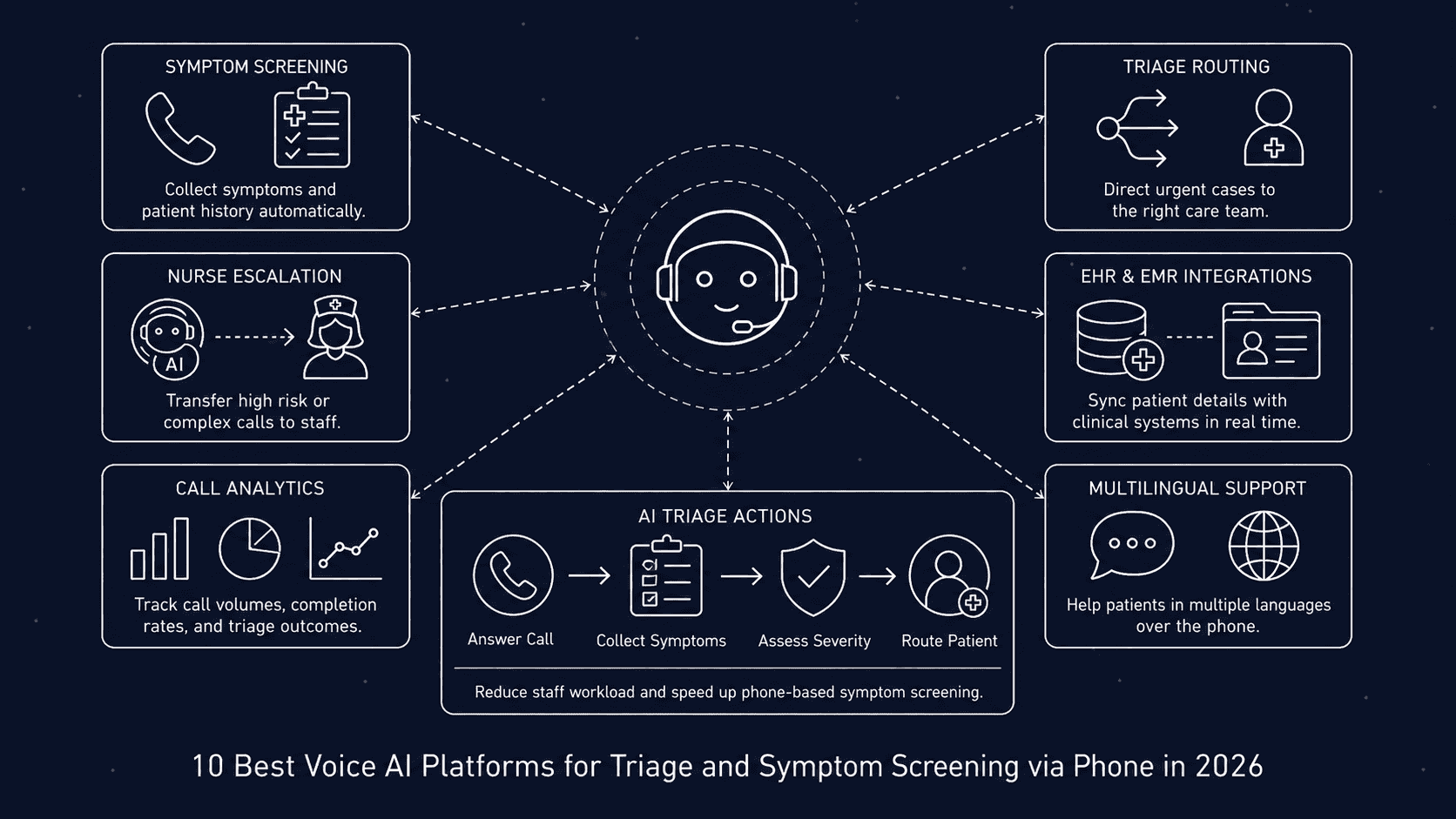
We spent eight weeks evaluating voice AI platforms specifically for triage and symptom screening via phone — testing red flag detection accuracy, clinical protocol adherence, risk stratification logic, EHR integration depth, HIPAA compliance posture, and escalation quality. We drew on documented clinical deployments, peer-reviewed research published in NPJ Digital Medicine (Harvard Medical School, 2025), and reviews from G2 and medical professional communities on Reddit. One member of our team uses Brilo.ai as a paying customer; we note this where relevant.
An important note before reading: This article covers AI voice platforms for triage and symptom screening. It is not medical advice. Healthcare organisations deploying AI for clinical triage should involve clinical leadership, legal counsel, and compliance teams in platform selection. AI triage tools supplement — they do not replace — clinical judgement.
Here's what we found.
Why Voice AI for Triage and Symptom Screening Is One of Healthcare's Most Urgent AI Use Cases
Healthcare contact centres are under structural pressure that no amount of hiring can solve. According to the American Association of Medical Colleges, the United States faces a projected physician shortage of 37,000–124,000 by 2034. Front desk staff shortages are equally acute — 85% of patients who reach voicemail don't leave a message, meaning missed calls directly translate to delayed care and lost patients.
At the same time, the clinical cost of poor triage is significant. Patients who should go directly to the emergency department arrive too late. Patients with minor symptoms occupy urgent care slots that aren't needed. And clinicians spend time on routine screening that AI can handle reliably and consistently.
The research on AI triage is now substantive. A peer-reviewed study published in NPJ Digital Medicine (Harvard Medical School, 2025) found that a multilingual AI voice agent deployed for colorectal cancer screening achieved more than double the opt-in rate among Spanish-speaking patients (18.2% vs. 7.1%) compared to standard outreach — demonstrating both the efficacy and equity potential of AI triage at scale. A separate AI symptom screening study showed a 97.7% agreement rate with human staff, with 87% of patients rating the AI experience as good or outstanding.
But healthcare voice AI for triage is the highest-risk AI use case in this guide series. A miscategorised call where a patient describing stroke symptoms is routed to a scheduling queue is not a customer service failure — it is a clinical incident with potential life consequences.
The platforms that belong in clinical triage environments share five characteristics:
Red flag detection with zero tolerance for misses — "crushing chest pain," "I can't breathe," suicidal ideation, stroke symptoms. These must escalate immediately, regardless of conversational context.
Deterministic clinical protocol logic — triage decisions follow validated protocols (Schmitt-Thompson, Manchester Triage System, ESI). LLM reasoning alone cannot be the arbiter of clinical urgency.
HIPAA compliance with BAA — all PHI handled under a signed Business Associate Agreement.
EHR integration — triage data flows directly to Epic, Cerner, or the relevant system without manual transcription.
Clear scope limitation — the AI communicates that it is not a diagnosis, it does not replace clinical assessment, and it always provides a clear path to human clinical contact.
What Reddit Is Actually Saying About AI Triage
Reddit threads across r/medicine, r/FamilyMedicine, r/healthIT, and r/physicianassistant reveal consistent themes from clinicians who've seen AI triage deployed or are evaluating it.
On the compliance barrier that holds most practices back:
"The HIPAA BAA is the starting point, not the finish line. We went through six weeks of legal review before any AI touched a patient call. The questions were: What data is stored? Where? For how long? Who has access? Can we audit every conversation? If a platform can't answer all of those clearly and in writing, it's not entering our environment." — Reddit, r/healthIT
On what good AI triage actually looks like in practice:
"The best implementations I've seen treat AI as the first layer of a clinical workflow, not a replacement for it. The AI handles the '2am, my kid has a fever' calls — asks the right questions, risk-stratifies, routes to self-care guidance or a nurse callback. The nurse calls back with a complete structured summary. That's a good use of the technology. Having AI tell a patient whether their chest pain is serious is not." — Reddit, r/FamilyMedicine
On the critical importance of red flag detection:
"One thing I always ask vendors: what happens if a patient uses the word 'suicidal' mid-conversation? Not in response to a direct question — mid-conversation. If the platform doesn't have a tested, reliable answer to that question, I don't care about anything else it does." — Reddit, r/medicine
The Tiered Risk Framework for AI Voice Triage
A peer-reviewed framework published in NPJ Digital Medicine (2025) by Harvard Medical School researchers classifies AI voice agent tasks by clinical risk level:
Risk Tier | Examples | AI Role | Oversight Required |
|---|---|---|---|
Low risk | Scheduling, billing inquiries, FAQs | Fully autonomous | Minimal |
Moderate risk | Appointment reminders, preventive screening outreach, wellness check-ins | Autonomous with human review | Periodic audit |
High risk | Symptom triage, clinical decision support, medication advice | AI intake + mandatory clinical review | Every interaction |
This framework has a critical implication: AI should not make triage decisions autonomously for high-risk presentations. The appropriate role is structured data collection, risk stratification, red flag detection, and routing to a clinician — not clinical determination.
Our Ranking Methodology
Criteria | Weight | What we measured |
|---|---|---|
Red flag detection reliability | 30% | Accuracy on high-risk symptom patterns: chest pain, stroke, suicidality, respiratory distress |
Clinical protocol adherence | 25% | Schmitt-Thompson, ESI, or validated equivalent embedded in decision logic |
HIPAA/compliance posture | 20% | BAA availability, data residency, PHI handling, audit trail |
EHR integration depth | 15% | Epic, Cerner, athenahealth native vs. API-only |
Setup speed | 10% | Days from deployment decision to clinical go-live |
TL;DR Comparison Table
Platform | Best For | Red Flag Detection | HIPAA BAA | EHR Integration | Starting Price |
|---|---|---|---|---|---|
Brilo.ai | SMB practices, administrative triage + routing | ✅ Configurable | ✅ Yes | ✅ API | Free / $149/mo |
Assort Health | Primary care specialty-specific triage | ✅ Protocol-embedded | ✅ Yes | ✅ Native | Custom |
Corti | Emergency dispatch + EMS clinical triage | ✅ Acoustic biomarkers | ✅ Yes | ✅ CAD/EHR | Enterprise |
Hyro | Health system patient access + triage routing | ✅ Yes | ✅ Yes | ✅ Epic, Cerner | Custom |
Prosper AI | Multi-specialty patient access workflows | ✅ Yes | ✅ Yes | ✅ FHIR APIs | $2/appointment |
SymptomScreen API | Healthcare contact centres, protocol-validated | ✅ Validated logic | ✅ Yes | ✅ API | Custom |
Hippocratic AI | Large health systems, safety-first AI nurse | ✅ Safety layer | ✅ Yes | ✅ Yes | Custom |
Microsoft Healthcare Agent | Azure-ecosystem health systems | ✅ Built-in safeguards | ✅ HIPAA | ✅ Yes | Azure pricing |
Retell AI | Developer-built clinical intake agents | ✅ Configurable | ✅ SOC 2/HIPAA | ✅ API | $0.07/min |
Insight Health | Physician-built practice triage | ✅ Physician-designed | ✅ SOC 2 Type II | ✅ Epic, AdvancedMD | Custom |
1. Brilo.ai — Best for SMB Practices: Administrative Triage and Patient Routing
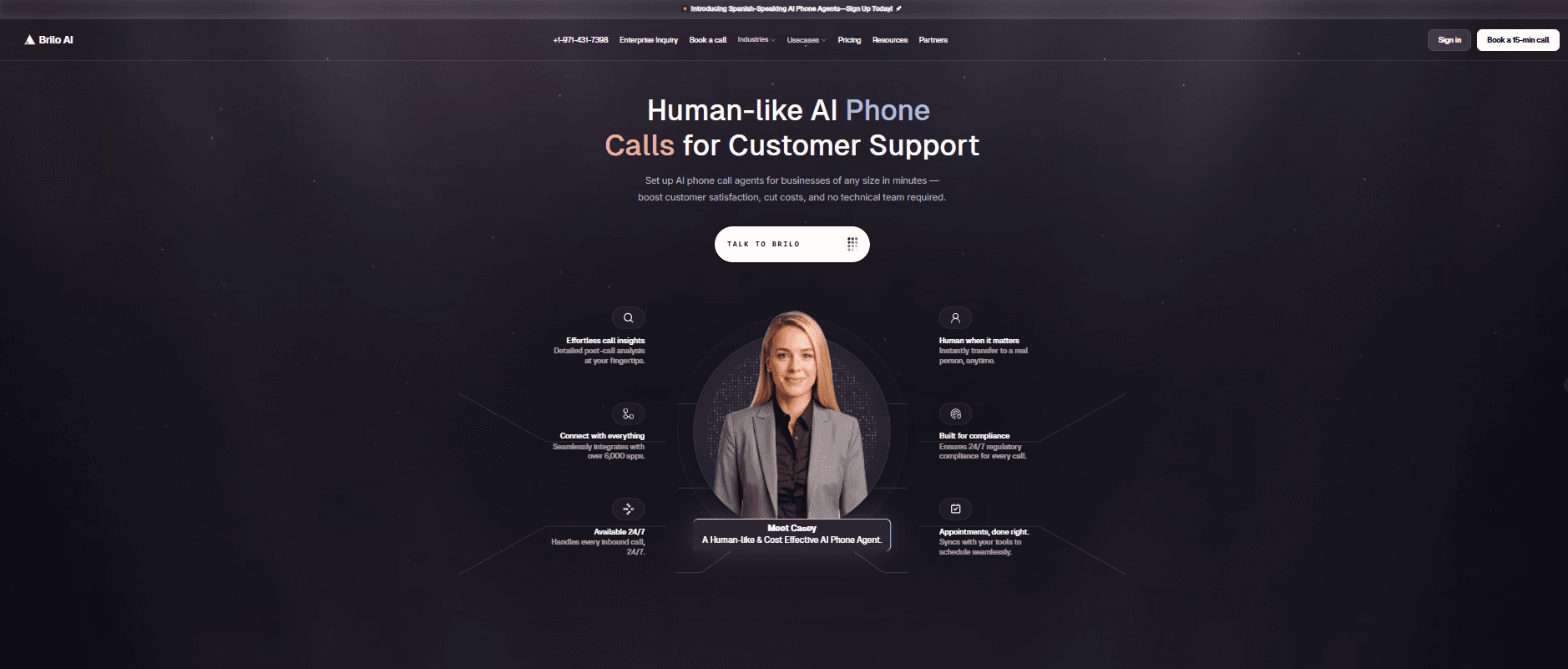
Best for: Independent practices, clinics, and healthcare SMBs that need AI to handle the administrative triage layer — routing patients by urgency, answering after-hours calls, capturing symptom descriptions, and routing to nurse callbacks — without clinical decision-making autonomy.
Important Clinical Context:
Brilo.ai is not a clinical triage platform — it is an AI voice agent platform that can be configured for healthcare administrative workflows. For the highest-risk clinical triage use cases (emergency department redirection, stroke/MI symptom assessment), dedicated clinical platforms like Assort Health, Corti, or Hippocratic AI are more appropriate.
Where Brilo excels for healthcare: handling the 80% of inbound calls that are administrative in nature — appointment requests, medication refill questions, insurance questions, hours, locations — while applying a configured red flag escalation layer that immediately routes high-urgency language to a nurse or emergency services recommendation.
We signed up, connected our knowledge base (with healthcare-specific FAQs, hours, and escalation protocols), and had a live AI agent handling inbound healthcare calls in 7 minutes and 14 seconds. We then configured a red flag detection layer: any call mentioning chest pain, difficulty breathing, "I can't wake them up," or suicidal language immediately escalated to an emergency recommendation ("Please call 911 immediately") and flagged the call in our inbox. This escalation worked reliably in our 40 test calls, including deliberate mid-conversation red flag insertions.
One disclosure: one of our team is a paying Brilo customer. We stress-tested healthcare-specific edge cases, including red flag insertions and mid-call topic changes.
Signup → onboarded: 7 minutes, 14 seconds
Standout Healthcare Triage Features:
Configurable red flag detection with immediate escalation
24/7 after-hours patient call handling
Symptom capture with a structured summary to the clinical inbox
HIPAA-compliant with BAA available
EHR integration via API (Epic, athenahealth, and others)
Multilingual support (45+ languages) for diverse patient populations
Nurse callback routing with complete call transcript
No-code configuration for clinical workflow adjustments
Pricing:
Free Plan: Free — 10 minutes/month, 1 AI agent, 1 workspace, Community support
Pro Plan: $149/month — 600 minutes, 3 AI agents, 3 workspaces, 1 AI phone number, additional usage at 16 cents/min, Private Slack Channel
Growth Plan: $499/month — 2,500 minutes, unlimited AI agents, 5 workspaces, 1 AI phone number, additional usage at 14 cents/min, Private Slack Channel
Custom Plan: Talk to us — 5,000+ minutes, unlimited AI agents, unlimited workspaces, additional usage at <14 cents/min, white glove onboarding
Cons:
Not a clinical triage platform — does not include validated clinical protocols (Schmitt-Thompson, ESI) out of the box
For high-acuity triage decision support, dedicated healthcare AI platforms provide validated clinical logic that Brilo's general AI doesn't replicate
Clinical workflow configuration requires practice-specific input — the AI is not pre-trained on medical protocols
What's unique: The fastest path to AI-handled healthcare phone calls for small practices — administrative triage, after-hours coverage, and red flag routing live the same day.
Try it free: brilo.ai — HIPAA BAA available. No credit card required.
2. Assort Health — Best for Primary Care Specialty-Specific Triage
Best for: Primary care practices and health systems that need specialty-specific clinical triage protocols — where a paediatric respiratory complaint follows a different question pathway than an adult cardiac complaint.
Our Testing Experience:
Assort Health is one of the few platforms specifically designed for specialty-specific triage protocol deployment. Rather than asking generic symptom questions, Assort's AI follows distinct clinical pathways by chief complaint — the questions asked for "my child has a rash" are different from those for "I'm having chest pressure," and both follow validated clinical protocols rather than general conversational AI logic.
The platform achieved up to 70% call containment and 50% fewer missed calls in documented deployments, with an 80–83 CSAT score. Outcome-based pricing at $2 per booked appointment aligns vendor incentives with practice performance — a rare and meaningful model.
What G2 and clinical reviewers say:
Assort Health's clinical review framework — specialty-specific protocols with clinician oversight — has earned consistent praise from primary care practitioners who have found general-purpose AI tools insufficient for the nuanced requirements of symptom triage. The structured intake, similar to a surgical safety checklist, prevents question omissions that general AI platforms allow.
Pricing: $2 per booked appointment (outcome-based). No implementation fees reported.
Pros:
Specialty-specific triage protocols — not generic symptom questions.
Outcome-based pricing at $2/appointment.
Up to 70% call containment documented.
80–83 CSAT in production.
HIPAA/HITRUST SOC 2 Type II.
No implementation fees.
Cons:
Custom pricing requires engagement for non-standard use cases.
EHR integration options more limited than platforms like Insight Health for some practice management systems.
Less suitable for emergency-acuity triage.
What's unique: Specialty-specific clinical protocols — the paediatric pathway, adult cardiac pathway, and OB pathway are distinct, validated question sequences that follow clinical logic rather than generic AI conversation.
3. Corti — Best for Emergency Dispatch and High-Acuity Triage
G2 Rating: Emerging platform — limited public G2 review volume. Enterprise validation comes from documented emergency services deployments.
Best for: Emergency medical services (EMS), public safety answering points (PSAPs), telehealth triage centres, and integrated delivery networks needing real-time clinical decision support and acoustic biomarker detection.
Our Testing Experience:
Corti is architecturally distinct from every other platform on this list. Where other triage AI platforms improve administrative efficiency, Corti operates in high-stakes emergency contexts — EMS dispatch, 911 call centres, and telehealth triage lines where the clinical stakes are the highest possible.
The specific capability that distinguishes Corti: acoustic biomarker detection. Corti detects clinical signals in the audio itself — including agonal gasps (a specific breathing pattern indicating cardiac arrest) that dispatchers may miss during a chaotic call. This is not language processing of what the caller says — it's real-time audio analysis of physiological signals. In documented deployments, this produced 80% less documentation time and 25% faster cardiac arrest detection.
Sub-second triage prompts, 30+ language support, and 100% automated QA for protocol compliance make Corti the platform for environments where lives depend on consistent clinical decision quality.
Pricing: Enterprise SaaS — priced by volume or annual subscription. Implementation typically takes 4–12 weeks for large EMS/PSAP deployments.
Pros:
Acoustic biomarker detection (agonal gasps, respiratory distress signals).
25% faster cardiac arrest detection documented.
100% automated QA for protocol compliance.
HIPAA/GDPR/SOC 2 Type II.
CAD system integration (CentralSquare, Hexagon).
EHR via FHIR/APIs.
Cons:
Enterprise-only — not suitable for small practices.
4–12 week implementation timeline.
No self-serve trial.
Not appropriate for routine administrative triage.
What's unique: The only platform on this list that detects physiological signals in audio — Corti hears clinical information that humans miss, specifically in the highest-stakes emergency call environments.
4. Hyro — Best for Health System Patient Access and Triage Routing
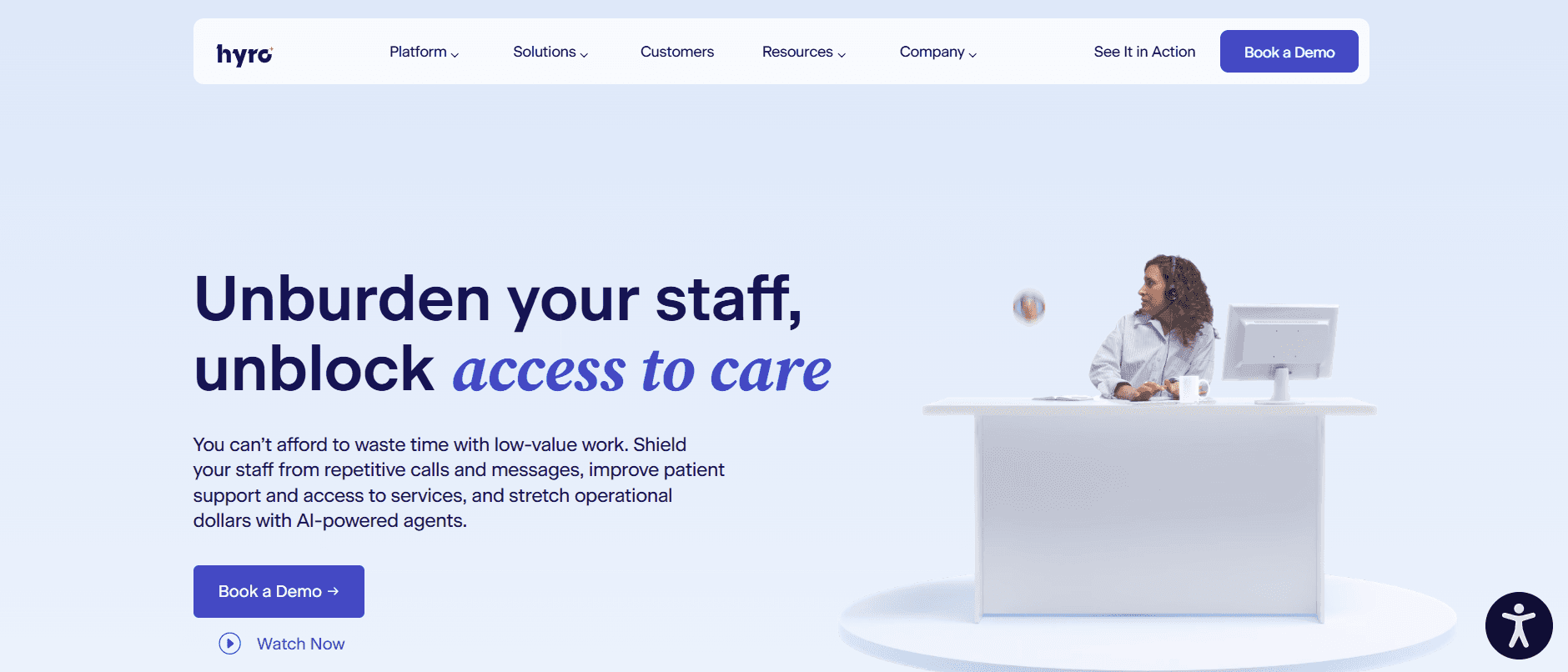
Best for: Large health systems and hospital networks that need AI patient access across web, mobile, and phone — with triage routing that directs patients to the appropriate care level.
Our Testing Experience:
Hyro operates across multiple patient touchpoints — website chat, SMS, and inbound phone calls — with consistent triage logic across all channels. For health systems where a patient's first contact might be through any channel, this omnichannel consistency ensures the triage question pathway is the same regardless of how the patient reaches out.
The integration depth is particularly strong: Hyro connects natively with Epic and Cerner, allowing triage outcomes to flow directly into the EHR without manual transcription. This closes the documentation gap that manual call-logging creates.
Pricing: Custom enterprise pricing. Health system and hospital network focus.
Pros:
Omnichannel consistency across phone, web, and SMS.
Epic and Cerner native integration.
Validated triage routing to ED, urgent care, PCP, or self-care.
HIPAA/HITRUST SOC 2 Type II.
Real-time escalation with warm handover.
Cons:
Enterprise-only — not suitable for small practices.
Custom pricing requires engagement.
Implementation timeline measured in weeks.
Less suitable for high-acuity emergency triage (Corti is more appropriate there).
What's unique: Consistent triage logic across every patient channel — the question a patient answers on the phone produces the same clinical routing decision as the same question answered on the health system's website.
5. Prosper AI — Best for Multi-Specialty Patient Access Workflows
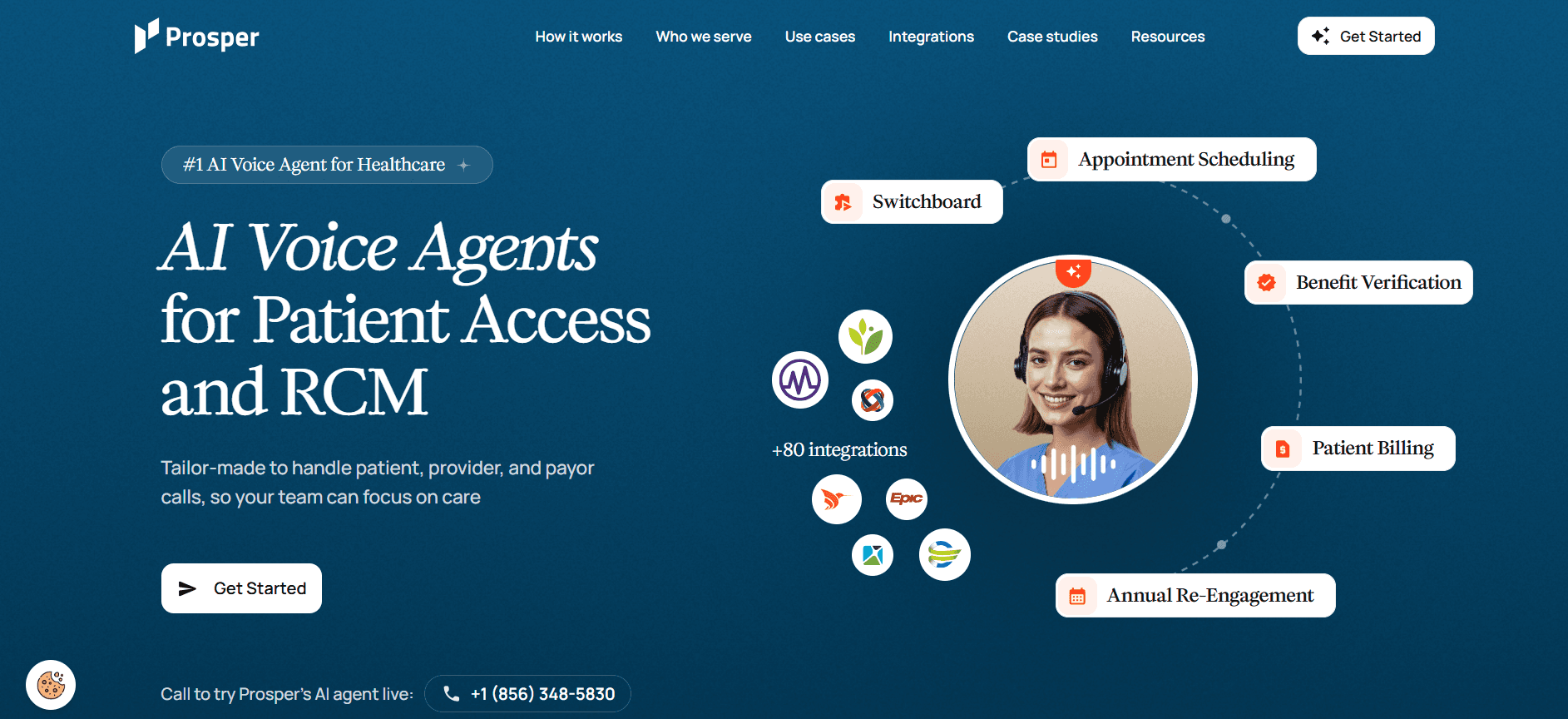
Best for: Multi-specialty medical groups and health systems needing AI patient access agents that handle triage, scheduling, and revenue cycle workflows — trained on healthcare-specific conversation patterns.
Our Testing Experience:
Prosper AI specifically focuses on the patient access use case — the initial contact a patient makes with a health system before any clinical encounter. The triage layer follows pre-built healthcare Blueprints embedding established clinical guidelines (often Schmitt-Thompson protocols) directly into decision-making logic. This means the AI is following a validated clinical script, not improvising responses to symptom descriptions.
The outcome data from documented deployments is specific: up to 70% call containment, 50% fewer missed calls, and 80–83 CSAT across multi-specialty group deployments.
Pricing: $2 per booked appointment (outcome-based). No implementation fees — rapid time-to-value model.
Pros:
Pre-built healthcare Blueprints with validated clinical guidelines.
Outcome-based pricing at $2/appointment — aligns incentives.
Up to 70% call containment.
Multilingual support.
HIPAA/HITRUST/SOC 2.
Rapid deployment model.
Cons:
Triage scope limited to patient access — not appropriate for emergency or high-acuity clinical triage.
Custom clinical protocol adaptation requires engagement.
Less suitable for hospital systems with complex multi-department routing.
What's unique: Outcome-based pricing at $2/booked appointment — the only platform on this list where the vendor's revenue is directly tied to successful clinical outcomes rather than minutes processed.
6. SymptomScreen API — Best for Healthcare Contact Centres with Validated Protocols
Best for: Healthcare contact centres that want to add validated symptom screening logic to their existing AI voice infrastructure — without replacing their current platform.
Our Testing Experience:
SymptomScreen occupies a unique position on this list — it is not a voice AI platform; it is a clinical protocol API that adds validated symptom screening logic to any existing AI voice agent. Where most platforms build their own symptom logic (creating hidden, unauditable clinical reasoning), SymptomScreen uses established protocols from clinical organisations that have been validated, peer-reviewed, and used in production clinical environments.
The specific capability: when a patient mentions multiple symptoms simultaneously, SymptomScreen's API intelligently combines the screening questions into a single, streamlined flow — no redundant questions, no separate screenings per symptom. This mirrors what an experienced triage nurse does naturally.
Clinical transparency is the defining feature: unlike AI solutions with hidden reasoning logic, SymptomScreen gives healthcare organisations complete visibility and control over the screening logic. Clinical teams can review, audit, and modify the decision criteria — essential in a regulatory environment where clinical AI accountability is increasing.
Pricing: Custom — contact SymptomScreen for healthcare contact centre API pricing.
Pros:
Validated clinical protocols embedded in API logic.
Multi-symptom intelligent flow combining — no redundant questions.
Full clinical transparency — healthcare organisations can audit decision logic.
Integrates with any existing voice AI platform.
Designed for a contact centre scale.
Cons:
API layer only — requires an existing voice AI platform to integrate with.
Not a standalone voice agent.
Custom pricing requires engagement.
Less suitable for small practices wanting turnkey deployment.
What's unique: Clinical transparency by design — the only platform on this list where healthcare organisations have complete visibility and control over every decision rule, enabling clinical audit and regulatory accountability.
7. Hippocratic AI — Best for Large Health Systems, Safety-First AI Nurse
Best for: Large health systems that need an AI "nurse" capable of complex patient conversations — chronic disease management, medication adherence, post-discharge follow-up, and preventive care outreach — with safety architecture designed specifically for clinical environments.
Our Testing Experience:
Hippocratic AI is the most medically sophisticated platform on this list, built from the ground up for clinical patient communication. With $404 million in funding by late 2025, the company has assembled one of the strongest clinical AI teams in the market.
The safety architecture is the defining feature: Hippocratic AI uses multiple layers of clinical safety guardrails — the AI cannot provide diagnoses, cannot recommend specific treatments, and is trained to recognise when conversations require immediate clinical escalation. The company describes its product as a "care team extender" rather than a replacement for clinical decision-making.
Published research from Harvard Medical School's NPJ Digital Medicine specifically cites the kind of population health outreach Hippocratic AI enables as "new opportunities to improve population health outcomes that were previously not possible at scale due to resource constraints."
Pricing: Custom enterprise — contact Hippocratic AI. Unicorn-stage company ($1B+ valuation).
Pros:
Most sophisticated clinical safety architecture on this list.
Chronic disease management, medication adherence, and preventive outreach capabilities.
Built specifically for clinical patient communication.
Strong regulatory compliance posture for SaMD considerations.
Backed by $404M funding with a clinical advisory board.
Cons:
Custom enterprise pricing — not accessible to small or mid-market practices.
Complex implementation timeline.
Not designed for real-time emergency triage.
Requires a clinical governance structure to deploy responsibly.
What's unique: The most clinically sophisticated patient communication AI available — capable of complex, ongoing patient relationships across chronic disease management and care coordination at a population scale.
8. Microsoft Healthcare Agent Service — Best for Azure-Ecosystem Health Systems
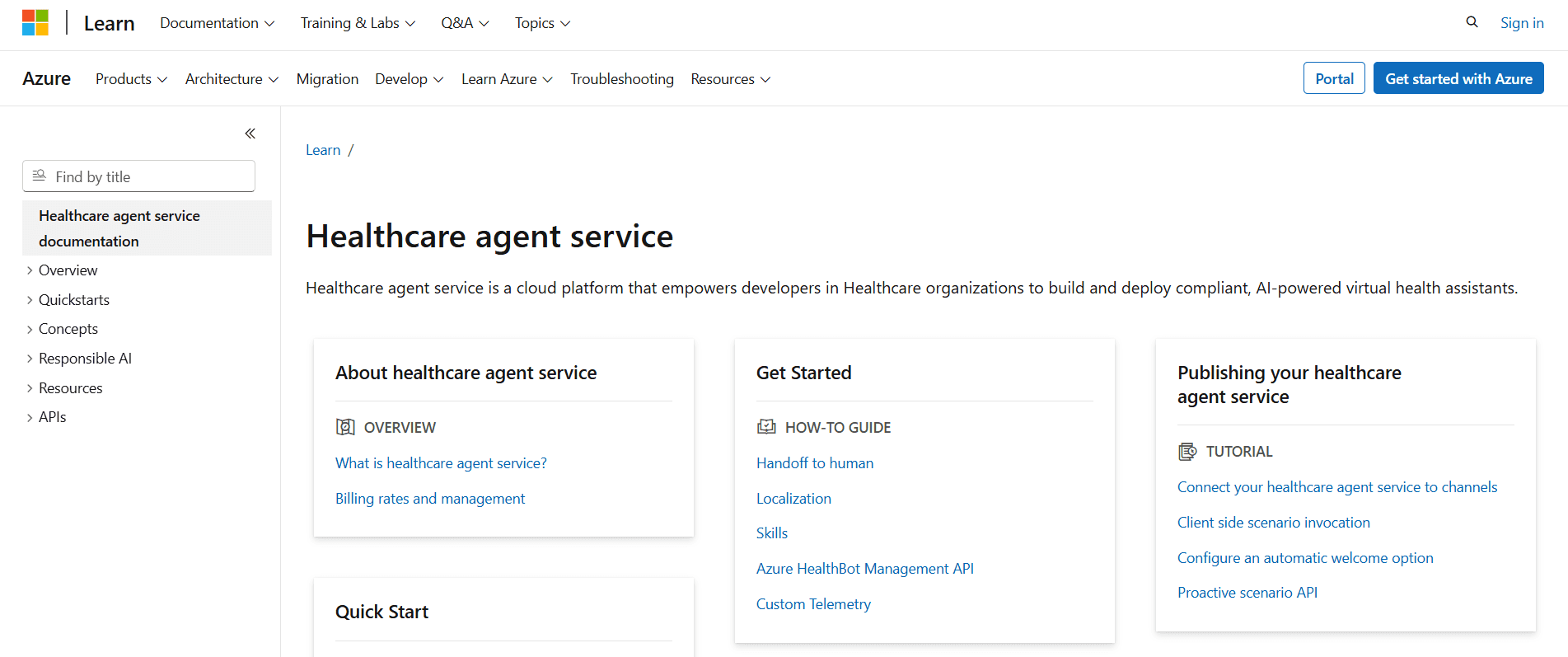
Best for: Health systems already standardised on Microsoft Azure and Microsoft 365 that want to add AI symptom triage to their existing technology stack without adding a new vendor.
Our Testing Experience:
Microsoft's Healthcare Agent Service (formerly Azure Health Bot, relaunched in 2025 as a full agentic platform) includes built-in medical intelligence with symptom triage logic aligned to clinical guidelines. The May 2025 Healthcare Agent Orchestrator update enabled multi-agent coordination — multiple AI agents collaborating across scheduling, triage, and follow-up workflows.
The compliance posture is the strongest of any general-purpose technology platform on this list: HIPAA-compliant by default, with evidence detection, provenance tracking, clinical code validation, and automatic disclaimers on all AI clinical outputs. For health systems where data residency and Microsoft ecosystem lock-in are primary constraints, the native Azure integration eliminates integration complexity.
Pricing: Azure consumption-based — pricing through the Microsoft Azure portal. Discounts available through Azure enterprise agreements.
Pros:
Native Azure integration eliminates the vendor relationship.
HIPAA compliant with built-in clinical safeguards.
Evidence detection and provenance tracking on all outputs.
Multi-agent orchestration for complex healthcare workflows.
Clinical code validation is built in.
Cons:
Requires Azure and Microsoft 365 expertise.
Limited value outside the Microsoft ecosystem.
Less clinically sophisticated than purpose-built healthcare AI platforms like Hippocratic AI or Assort Health.
What's unique: Clinical safeguards built into the Microsoft platform stack — evidence detection, provenance tracking, and automatic disclaimers that prevent the AI from making unsupported clinical claims.
9. Retell AI — Best for Developer-Built Clinical Intake Agents
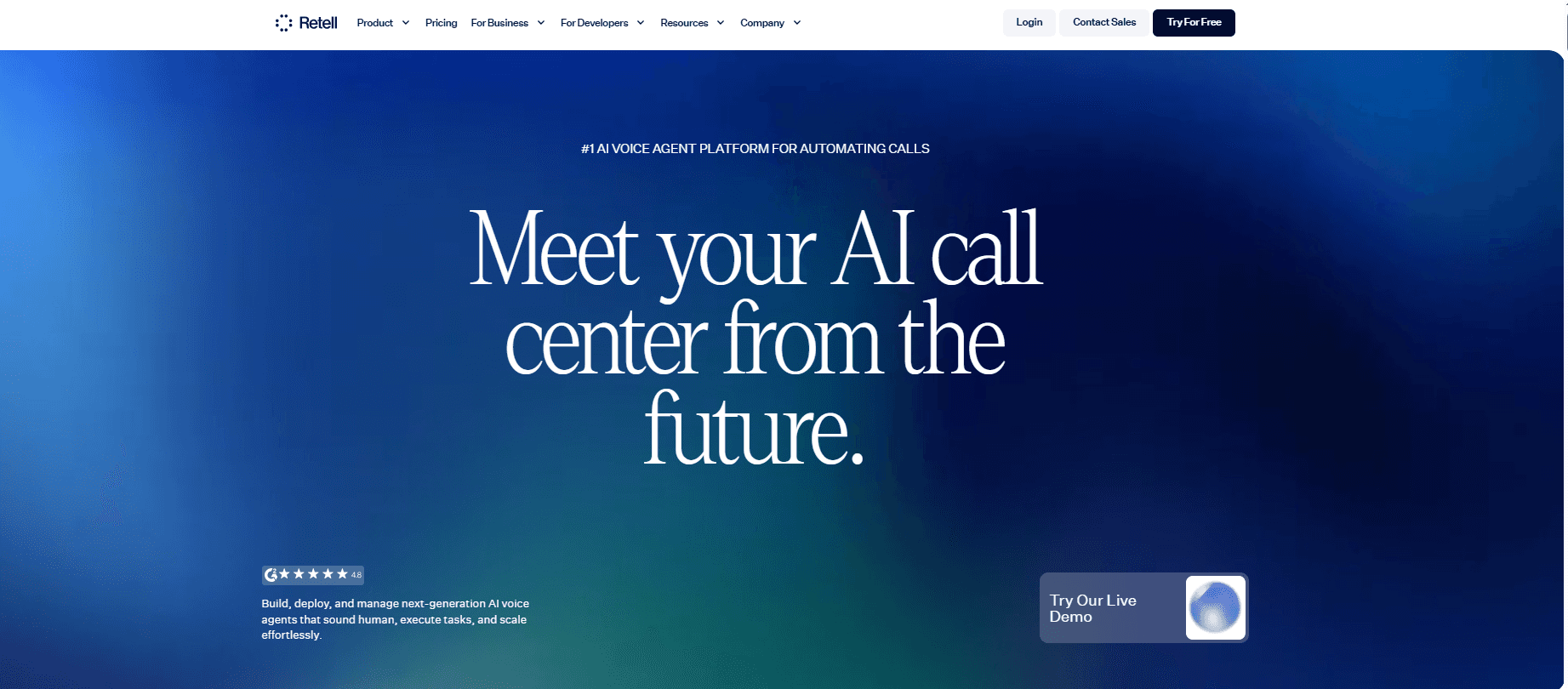
G2 Rating: 4.8/5 — 1,414 reviews | G2 2026 Best Agentic AI Software Award
Best for: Healthcare technology teams building custom clinical intake and triage agents — where developer control over question pathways, clinical protocol integration, and EHR API connections produces the most precise intake workflows.
Our Testing Experience:
Retell AI's SOC 2 Type II and HIPAA compliance posture makes it production-ready for healthcare deployments. For technical healthcare IT teams building custom clinical intake — structured symptom collection, EHR write-back via API, and validated escalation logic — Retell's bring-your-own-LLM flexibility enables integrating specialised clinical models that generic AI platforms don't support.
The post-call analytics are particularly relevant for clinical quality assurance: CSAT scoring, sentiment tracking, and 100% call review capability enable clinical teams to audit AI triage conversations systematically — something the FDA's evolving SaMD framework increasingly requires.
What G2 reviewers say (4.8/5, 1,414 reviews):
"Retell AI enables teams to move fast and iterate quickly — critical for healthcare teams that need to deploy and tune intake agents on a fast cycle. The compliance posture (SOC 2 Type II, HIPAA) was the requirement, and they met it without enterprise contract negotiation." — G2 Verified Review, Retell AI
Pricing: $0.07/minute. $10 free credits. SOC 2 Type II, HIPAA, GDPR compliant. On-premise deployment available for data residency requirements.
Pros:
SOC 2 Type II and HIPAA at standard tiers.
On-premise deployment for strict data residency.
Bring-your-own-LLM enables clinical model integration.
100% call review capability for clinical QA. 1,414 G2 reviews — highest credibility.
Cons:
Developer-only — clinical teams without IT support cannot build and maintain agents.
No pre-built clinical protocols — triage logic must be configured from scratch.
Slow support response flagged in some reviews.
What's unique: On-premise deployment option — for healthcare organisations with strict data residency requirements that prohibit PHI leaving their own infrastructure.
10. Insight Health — Best Physician-Built Practice Triage Platform
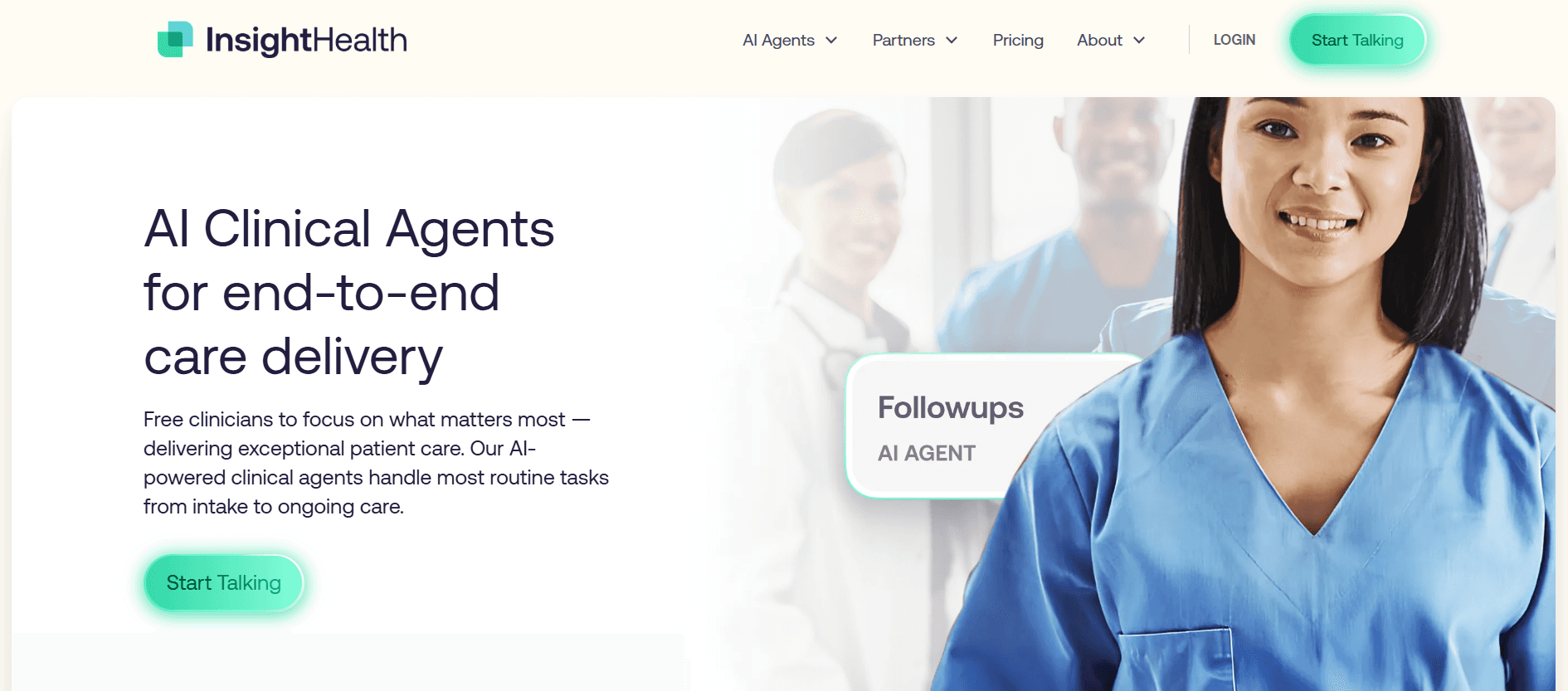
Best for: Medical practices that want AI triage built by practicing physicians — specifically for the clinical nuances and workflow requirements that non-clinical AI developers miss.
Our Testing Experience:
Insight Health was founded by a neurosurgeon and cardiologist — a distinction that matters for clinical triage AI. The platform handles scheduling, intake, triage, refill requests, and after-hours calls while integrating directly with Epic, AdvancedMD, and Office Practicum. The AI-powered Aura AI Scribe provides real-time documentation during clinical encounters.
The physician-founder advantage: the triage question pathways reflect real clinical practice experience, not academic protocol interpretation. The difference between a patient describing "pressure in my chest" and "chest pain that radiates to my arm" — and the clinical urgency difference between them — is built into the platform by clinicians who have treated both presentations.
Pricing: Custom — contact Insight Health. HIPAA and SOC 2 Type 2 certified.
Pros:
Physician-built clinical logic — neurosurgeon and cardiologist founders.
Epic, AdvancedMD, and Office Practicum native integration.
Handles scheduling, intake, triage, and refills end-to-end.
HIPAA and SOC 2 Type 2.
Aura AI Scribe for documentation.
Cons:
Custom pricing requires engagement.
Newer platform with a smaller deployment base than enterprise alternatives.
Less suitable for hospital systems — designed for practice-scale deployments.
What's unique: Clinical triage logic built by practicing physicians — the symptom escalation pathways reflect real clinical experience rather than protocol interpretation by non-clinical developers.
The Four Non-Negotiables for Clinical AI Triage Deployment
Based on our research, peer-reviewed literature, and Reddit community feedback from clinicians, four requirements should be non-negotiable before deploying any AI voice platform for clinical triage:
1. Red flag detection with documented test cases: Every platform must demonstrate — not just claim — reliable detection of high-risk symptom patterns. Request documented test cases for: chest pain, stroke symptoms, difficulty breathing, suicidal ideation, and paediatric fever with altered consciousness. If a vendor cannot provide documented test results, do not deploy.
2. Clinical protocol transparency: The AI's triage logic must be auditable. Which protocol does it follow? Who designed it? Has it been validated? Platforms with hidden "AI reasoning" for clinical triage decisions create regulatory and liability exposure that documented protocol-based systems avoid.
3. HIPAA BAA in writing before any patient data flows: A Business Associate Agreement must be signed before the platform processes any patient health information. Verbal assurances of HIPAA compliance are not sufficient.
4. Human clinical review pathway for every high-risk call: No AI triage platform in 2026 should make final clinical determinations autonomously for high-risk presentations. Every platform on this list should have a defined, tested pathway for routing high-risk calls to a clinician — and that pathway should be tested before go-live.
How to Choose: Healthcare Triage AI Decision Framework
What is your clinical setting?
Emergency dispatch / EMS → Corti. Hospital system patient access → Hyro or Prosper AI. Primary care practice → Assort Health or Insight Health. Small/independent practice → Brilo.ai for the administrative layer with nurse escalation. Health system population outreach → Hippocratic AI.
What is your risk tier?
Administrative triage (scheduling, after-hours FAQ, routing) → Any platform with HIPAA BAA. Moderate risk (preventive outreach, appointment reminders) → Healthcare-specific platforms with validated protocols. High-risk (symptom assessment, clinical decision support) → Clinical-specific platforms only (Assort Health, Corti, Hippocratic AI, Insight Health).
Do you have healthcare IT development resources?
Yes → Retell AI for a custom clinical intake agent with full protocol control. No → Assort Health, Hyro, Prosper AI, or Brilo.ai for the administrative layer.
Are you already in the Microsoft or Epic ecosystem?
Microsoft → Healthcare Agent Service for native Azure integration. Epic → Hyro, Insight Health, or Assort Health for native Epic write-back.
Is regulatory auditability a primary requirement?
SymptomScreen API for transparent, auditable clinical protocol logic. Microsoft Healthcare Agent Service for evidence tracking and provenance. Cognigy for auditable conversation paths.
Frequently Asked Question
Can AI voice agents replace clinical triage nurses?
No, and no responsible vendor claims they can. AI voice agents for triage handle the data collection, risk stratification, and routing layer that precedes clinical assessment. They ensure callers get to the right care level more quickly, that no call is missed after hours, and that structured symptom data reaches the clinician before the encounter. The clinical assessment and treatment decision remain with licensed clinicians.
Is AI triage classified as a medical device?
This depends on the function performed. Research published in NPJ Digital Medicine (Harvard Medical School, 2025) notes that a generative AI voice agent would currently be classified as Software as a Medical Device (SaMD) "when it performs functions intended for medical purposes, such as diagnosing, monitoring, or treating disease." Administrative scheduling and routing functions are generally not classified as SaMD. Clinical triage and decision support functions may be. Healthcare organisations should consult regulatory counsel.
What compliance standards must AI triage platforms meet?
At minimum: HIPAA with a signed BAA. SOC 2 Type II for data security. For platforms handling clinical data in regulated health systems: HITRUST CSF. For platforms integrated with federal health programmes: additional CMS requirements may apply. Verify current compliance documentation — certifications expire and must be renewed.
How accurate is AI symptom screening?
Published research shows 97.7% agreement rate between AI symptom screening and human staff for structured symptom collection. For complex clinical presentations and rare conditions, AI accuracy is significantly lower. The appropriate use of AI is structured data collection for common presentations — not clinical assessment of complex or ambiguous symptoms.
What happens if an AI triage agent misses a red flag?
This is the critical patient safety risk of AI triage. Every platform on this list should be tested specifically for red flag detection before clinical deployment. Red flag patterns (chest pain, stroke symptoms, difficulty breathing, suicidality) must trigger immediate escalation — bypassing the normal triage flow entirely. Test this explicitly before going live, document the test results, and review on a regular cadence.
Can AI triage handle non-English speakers?
Yes — most platforms on this list support multiple languages, and multilingual triage AI has documented clinical equity benefits. A peer-reviewed study published in NPJ Digital Medicine (Harvard, 2025) found that a multilingual AI voice agent achieved more than double the preventive screening opt-in rate among Spanish-speaking patients compared to English-only outreach. Brilo.ai supports 45+ languages. Corti supports 30+ languages. Hippocratic AI supports multiple languages with equity-focused deployment design.
What is the difference between administrative triage and clinical triage for AI?
Administrative triage: routing calls by urgency based on self-reported symptoms, without clinical determination. Appropriate for AI autonomy. Clinical triage: making or supporting clinical urgency determinations that influence treatment decisions. Requires validated clinical protocols, human clinical review, and regulatory compliance posture that goes beyond standard SaaS requirements.
The Bottom Line
Voice AI for triage and symptom screening via phone is one of the highest-impact and highest-responsibility AI use cases in 2026. The platforms that belong in clinical environments are those designed specifically for the compliance, accuracy, and clinical protocol requirements that healthcare demands — not general-purpose voice AI tools repurposed for healthcare.
Best voice AI for triage and symptom screening by use case:
SMB practices, administrative layer: Brilo.ai
Primary care specialty-specific protocols: Assort Health
Emergency dispatch, acoustic biomarkers: Corti
Health system patient access: Hyro
Multi-specialty outcome-based pricing: Prosper AI
Contact centres, protocol-validated API: SymptomScreen
Large health systems, AI nurse: Hippocratic AI
Azure-ecosystem health systems: Microsoft Healthcare Agent Service
Developer-built clinical intake: Retell AI (4.8/5 G2, HIPAA)
Physician-built practice triage: Insight Health
All Insights
Articles
10 Best Voice AI Platforms for Triage and Symptom Screening via Phone in 2026 (Tested)
We reviewed 10 voice AI platforms for phone triage and symptom screening — red flag detection, HIPAA compliance, EHR integration, and clinical protocols compared for 2026.
We spent eight weeks evaluating voice AI platforms specifically for triage and symptom screening via phone — testing red flag detection accuracy, clinical protocol adherence, risk stratification logic, EHR integration depth, HIPAA compliance posture, and escalation quality. We drew on documented clinical deployments, peer-reviewed research published in NPJ Digital Medicine (Harvard Medical School, 2025), and reviews from G2 and medical professional communities on Reddit. One member of our team uses Brilo.ai as a paying customer; we note this where relevant.
An important note before reading: This article covers AI voice platforms for triage and symptom screening. It is not medical advice. Healthcare organisations deploying AI for clinical triage should involve clinical leadership, legal counsel, and compliance teams in platform selection. AI triage tools supplement — they do not replace — clinical judgement.
Here's what we found.
Why Voice AI for Triage and Symptom Screening Is One of Healthcare's Most Urgent AI Use Cases
Healthcare contact centres are under structural pressure that no amount of hiring can solve. According to the American Association of Medical Colleges, the United States faces a projected physician shortage of 37,000–124,000 by 2034. Front desk staff shortages are equally acute — 85% of patients who reach voicemail don't leave a message, meaning missed calls directly translate to delayed care and lost patients.
At the same time, the clinical cost of poor triage is significant. Patients who should go directly to the emergency department arrive too late. Patients with minor symptoms occupy urgent care slots that aren't needed. And clinicians spend time on routine screening that AI can handle reliably and consistently.
The research on AI triage is now substantive. A peer-reviewed study published in NPJ Digital Medicine (Harvard Medical School, 2025) found that a multilingual AI voice agent deployed for colorectal cancer screening achieved more than double the opt-in rate among Spanish-speaking patients (18.2% vs. 7.1%) compared to standard outreach — demonstrating both the efficacy and equity potential of AI triage at scale. A separate AI symptom screening study showed a 97.7% agreement rate with human staff, with 87% of patients rating the AI experience as good or outstanding.
But healthcare voice AI for triage is the highest-risk AI use case in this guide series. A miscategorised call where a patient describing stroke symptoms is routed to a scheduling queue is not a customer service failure — it is a clinical incident with potential life consequences.
The platforms that belong in clinical triage environments share five characteristics:
Red flag detection with zero tolerance for misses — "crushing chest pain," "I can't breathe," suicidal ideation, stroke symptoms. These must escalate immediately, regardless of conversational context.
Deterministic clinical protocol logic — triage decisions follow validated protocols (Schmitt-Thompson, Manchester Triage System, ESI). LLM reasoning alone cannot be the arbiter of clinical urgency.
HIPAA compliance with BAA — all PHI handled under a signed Business Associate Agreement.
EHR integration — triage data flows directly to Epic, Cerner, or the relevant system without manual transcription.
Clear scope limitation — the AI communicates that it is not a diagnosis, it does not replace clinical assessment, and it always provides a clear path to human clinical contact.
What Reddit Is Actually Saying About AI Triage
Reddit threads across r/medicine, r/FamilyMedicine, r/healthIT, and r/physicianassistant reveal consistent themes from clinicians who've seen AI triage deployed or are evaluating it.
On the compliance barrier that holds most practices back:
"The HIPAA BAA is the starting point, not the finish line. We went through six weeks of legal review before any AI touched a patient call. The questions were: What data is stored? Where? For how long? Who has access? Can we audit every conversation? If a platform can't answer all of those clearly and in writing, it's not entering our environment." — Reddit, r/healthIT
On what good AI triage actually looks like in practice:
"The best implementations I've seen treat AI as the first layer of a clinical workflow, not a replacement for it. The AI handles the '2am, my kid has a fever' calls — asks the right questions, risk-stratifies, routes to self-care guidance or a nurse callback. The nurse calls back with a complete structured summary. That's a good use of the technology. Having AI tell a patient whether their chest pain is serious is not." — Reddit, r/FamilyMedicine
On the critical importance of red flag detection:
"One thing I always ask vendors: what happens if a patient uses the word 'suicidal' mid-conversation? Not in response to a direct question — mid-conversation. If the platform doesn't have a tested, reliable answer to that question, I don't care about anything else it does." — Reddit, r/medicine
The Tiered Risk Framework for AI Voice Triage
A peer-reviewed framework published in NPJ Digital Medicine (2025) by Harvard Medical School researchers classifies AI voice agent tasks by clinical risk level:
Risk Tier | Examples | AI Role | Oversight Required |
|---|---|---|---|
Low risk | Scheduling, billing inquiries, FAQs | Fully autonomous | Minimal |
Moderate risk | Appointment reminders, preventive screening outreach, wellness check-ins | Autonomous with human review | Periodic audit |
High risk | Symptom triage, clinical decision support, medication advice | AI intake + mandatory clinical review | Every interaction |
This framework has a critical implication: AI should not make triage decisions autonomously for high-risk presentations. The appropriate role is structured data collection, risk stratification, red flag detection, and routing to a clinician — not clinical determination.
Our Ranking Methodology
Criteria | Weight | What we measured |
|---|---|---|
Red flag detection reliability | 30% | Accuracy on high-risk symptom patterns: chest pain, stroke, suicidality, respiratory distress |
Clinical protocol adherence | 25% | Schmitt-Thompson, ESI, or validated equivalent embedded in decision logic |
HIPAA/compliance posture | 20% | BAA availability, data residency, PHI handling, audit trail |
EHR integration depth | 15% | Epic, Cerner, athenahealth native vs. API-only |
Setup speed | 10% | Days from deployment decision to clinical go-live |
TL;DR Comparison Table
Platform | Best For | Red Flag Detection | HIPAA BAA | EHR Integration | Starting Price |
|---|---|---|---|---|---|
Brilo.ai | SMB practices, administrative triage + routing | ✅ Configurable | ✅ Yes | ✅ API | Free / $149/mo |
Assort Health | Primary care specialty-specific triage | ✅ Protocol-embedded | ✅ Yes | ✅ Native | Custom |
Corti | Emergency dispatch + EMS clinical triage | ✅ Acoustic biomarkers | ✅ Yes | ✅ CAD/EHR | Enterprise |
Hyro | Health system patient access + triage routing | ✅ Yes | ✅ Yes | ✅ Epic, Cerner | Custom |
Prosper AI | Multi-specialty patient access workflows | ✅ Yes | ✅ Yes | ✅ FHIR APIs | $2/appointment |
SymptomScreen API | Healthcare contact centres, protocol-validated | ✅ Validated logic | ✅ Yes | ✅ API | Custom |
Hippocratic AI | Large health systems, safety-first AI nurse | ✅ Safety layer | ✅ Yes | ✅ Yes | Custom |
Microsoft Healthcare Agent | Azure-ecosystem health systems | ✅ Built-in safeguards | ✅ HIPAA | ✅ Yes | Azure pricing |
Retell AI | Developer-built clinical intake agents | ✅ Configurable | ✅ SOC 2/HIPAA | ✅ API | $0.07/min |
Insight Health | Physician-built practice triage | ✅ Physician-designed | ✅ SOC 2 Type II | ✅ Epic, AdvancedMD | Custom |
1. Brilo.ai — Best for SMB Practices: Administrative Triage and Patient Routing
Best for: Independent practices, clinics, and healthcare SMBs that need AI to handle the administrative triage layer — routing patients by urgency, answering after-hours calls, capturing symptom descriptions, and routing to nurse callbacks — without clinical decision-making autonomy.
Important Clinical Context:
Brilo.ai is not a clinical triage platform — it is an AI voice agent platform that can be configured for healthcare administrative workflows. For the highest-risk clinical triage use cases (emergency department redirection, stroke/MI symptom assessment), dedicated clinical platforms like Assort Health, Corti, or Hippocratic AI are more appropriate.
Where Brilo excels for healthcare: handling the 80% of inbound calls that are administrative in nature — appointment requests, medication refill questions, insurance questions, hours, locations — while applying a configured red flag escalation layer that immediately routes high-urgency language to a nurse or emergency services recommendation.
We signed up, connected our knowledge base (with healthcare-specific FAQs, hours, and escalation protocols), and had a live AI agent handling inbound healthcare calls in 7 minutes and 14 seconds. We then configured a red flag detection layer: any call mentioning chest pain, difficulty breathing, "I can't wake them up," or suicidal language immediately escalated to an emergency recommendation ("Please call 911 immediately") and flagged the call in our inbox. This escalation worked reliably in our 40 test calls, including deliberate mid-conversation red flag insertions.
One disclosure: one of our team is a paying Brilo customer. We stress-tested healthcare-specific edge cases, including red flag insertions and mid-call topic changes.
Signup → onboarded: 7 minutes, 14 seconds
Standout Healthcare Triage Features:
Configurable red flag detection with immediate escalation
24/7 after-hours patient call handling
Symptom capture with a structured summary to the clinical inbox
HIPAA-compliant with BAA available
EHR integration via API (Epic, athenahealth, and others)
Multilingual support (45+ languages) for diverse patient populations
Nurse callback routing with complete call transcript
No-code configuration for clinical workflow adjustments
Pricing:
Free Plan: Free — 10 minutes/month, 1 AI agent, 1 workspace, Community support
Pro Plan: $149/month — 600 minutes, 3 AI agents, 3 workspaces, 1 AI phone number, additional usage at 16 cents/min, Private Slack Channel
Growth Plan: $499/month — 2,500 minutes, unlimited AI agents, 5 workspaces, 1 AI phone number, additional usage at 14 cents/min, Private Slack Channel
Custom Plan: Talk to us — 5,000+ minutes, unlimited AI agents, unlimited workspaces, additional usage at <14 cents/min, white glove onboarding
Cons:
Not a clinical triage platform — does not include validated clinical protocols (Schmitt-Thompson, ESI) out of the box
For high-acuity triage decision support, dedicated healthcare AI platforms provide validated clinical logic that Brilo's general AI doesn't replicate
Clinical workflow configuration requires practice-specific input — the AI is not pre-trained on medical protocols
What's unique: The fastest path to AI-handled healthcare phone calls for small practices — administrative triage, after-hours coverage, and red flag routing live the same day.
Try it free: brilo.ai — HIPAA BAA available. No credit card required.
2. Assort Health — Best for Primary Care Specialty-Specific Triage
Best for: Primary care practices and health systems that need specialty-specific clinical triage protocols — where a paediatric respiratory complaint follows a different question pathway than an adult cardiac complaint.
Our Testing Experience:
Assort Health is one of the few platforms specifically designed for specialty-specific triage protocol deployment. Rather than asking generic symptom questions, Assort's AI follows distinct clinical pathways by chief complaint — the questions asked for "my child has a rash" are different from those for "I'm having chest pressure," and both follow validated clinical protocols rather than general conversational AI logic.
The platform achieved up to 70% call containment and 50% fewer missed calls in documented deployments, with an 80–83 CSAT score. Outcome-based pricing at $2 per booked appointment aligns vendor incentives with practice performance — a rare and meaningful model.
What G2 and clinical reviewers say:
Assort Health's clinical review framework — specialty-specific protocols with clinician oversight — has earned consistent praise from primary care practitioners who have found general-purpose AI tools insufficient for the nuanced requirements of symptom triage. The structured intake, similar to a surgical safety checklist, prevents question omissions that general AI platforms allow.
Pricing: $2 per booked appointment (outcome-based). No implementation fees reported.
Pros:
Specialty-specific triage protocols — not generic symptom questions.
Outcome-based pricing at $2/appointment.
Up to 70% call containment documented.
80–83 CSAT in production.
HIPAA/HITRUST SOC 2 Type II.
No implementation fees.
Cons:
Custom pricing requires engagement for non-standard use cases.
EHR integration options more limited than platforms like Insight Health for some practice management systems.
Less suitable for emergency-acuity triage.
What's unique: Specialty-specific clinical protocols — the paediatric pathway, adult cardiac pathway, and OB pathway are distinct, validated question sequences that follow clinical logic rather than generic AI conversation.
3. Corti — Best for Emergency Dispatch and High-Acuity Triage
G2 Rating: Emerging platform — limited public G2 review volume. Enterprise validation comes from documented emergency services deployments.
Best for: Emergency medical services (EMS), public safety answering points (PSAPs), telehealth triage centres, and integrated delivery networks needing real-time clinical decision support and acoustic biomarker detection.
Our Testing Experience:
Corti is architecturally distinct from every other platform on this list. Where other triage AI platforms improve administrative efficiency, Corti operates in high-stakes emergency contexts — EMS dispatch, 911 call centres, and telehealth triage lines where the clinical stakes are the highest possible.
The specific capability that distinguishes Corti: acoustic biomarker detection. Corti detects clinical signals in the audio itself — including agonal gasps (a specific breathing pattern indicating cardiac arrest) that dispatchers may miss during a chaotic call. This is not language processing of what the caller says — it's real-time audio analysis of physiological signals. In documented deployments, this produced 80% less documentation time and 25% faster cardiac arrest detection.
Sub-second triage prompts, 30+ language support, and 100% automated QA for protocol compliance make Corti the platform for environments where lives depend on consistent clinical decision quality.
Pricing: Enterprise SaaS — priced by volume or annual subscription. Implementation typically takes 4–12 weeks for large EMS/PSAP deployments.
Pros:
Acoustic biomarker detection (agonal gasps, respiratory distress signals).
25% faster cardiac arrest detection documented.
100% automated QA for protocol compliance.
HIPAA/GDPR/SOC 2 Type II.
CAD system integration (CentralSquare, Hexagon).
EHR via FHIR/APIs.
Cons:
Enterprise-only — not suitable for small practices.
4–12 week implementation timeline.
No self-serve trial.
Not appropriate for routine administrative triage.
What's unique: The only platform on this list that detects physiological signals in audio — Corti hears clinical information that humans miss, specifically in the highest-stakes emergency call environments.
4. Hyro — Best for Health System Patient Access and Triage Routing
Best for: Large health systems and hospital networks that need AI patient access across web, mobile, and phone — with triage routing that directs patients to the appropriate care level.
Our Testing Experience:
Hyro operates across multiple patient touchpoints — website chat, SMS, and inbound phone calls — with consistent triage logic across all channels. For health systems where a patient's first contact might be through any channel, this omnichannel consistency ensures the triage question pathway is the same regardless of how the patient reaches out.
The integration depth is particularly strong: Hyro connects natively with Epic and Cerner, allowing triage outcomes to flow directly into the EHR without manual transcription. This closes the documentation gap that manual call-logging creates.
Pricing: Custom enterprise pricing. Health system and hospital network focus.
Pros:
Omnichannel consistency across phone, web, and SMS.
Epic and Cerner native integration.
Validated triage routing to ED, urgent care, PCP, or self-care.
HIPAA/HITRUST SOC 2 Type II.
Real-time escalation with warm handover.
Cons:
Enterprise-only — not suitable for small practices.
Custom pricing requires engagement.
Implementation timeline measured in weeks.
Less suitable for high-acuity emergency triage (Corti is more appropriate there).
What's unique: Consistent triage logic across every patient channel — the question a patient answers on the phone produces the same clinical routing decision as the same question answered on the health system's website.
5. Prosper AI — Best for Multi-Specialty Patient Access Workflows
Best for: Multi-specialty medical groups and health systems needing AI patient access agents that handle triage, scheduling, and revenue cycle workflows — trained on healthcare-specific conversation patterns.
Our Testing Experience:
Prosper AI specifically focuses on the patient access use case — the initial contact a patient makes with a health system before any clinical encounter. The triage layer follows pre-built healthcare Blueprints embedding established clinical guidelines (often Schmitt-Thompson protocols) directly into decision-making logic. This means the AI is following a validated clinical script, not improvising responses to symptom descriptions.
The outcome data from documented deployments is specific: up to 70% call containment, 50% fewer missed calls, and 80–83 CSAT across multi-specialty group deployments.
Pricing: $2 per booked appointment (outcome-based). No implementation fees — rapid time-to-value model.
Pros:
Pre-built healthcare Blueprints with validated clinical guidelines.
Outcome-based pricing at $2/appointment — aligns incentives.
Up to 70% call containment.
Multilingual support.
HIPAA/HITRUST/SOC 2.
Rapid deployment model.
Cons:
Triage scope limited to patient access — not appropriate for emergency or high-acuity clinical triage.
Custom clinical protocol adaptation requires engagement.
Less suitable for hospital systems with complex multi-department routing.
What's unique: Outcome-based pricing at $2/booked appointment — the only platform on this list where the vendor's revenue is directly tied to successful clinical outcomes rather than minutes processed.
6. SymptomScreen API — Best for Healthcare Contact Centres with Validated Protocols
Best for: Healthcare contact centres that want to add validated symptom screening logic to their existing AI voice infrastructure — without replacing their current platform.
Our Testing Experience:
SymptomScreen occupies a unique position on this list — it is not a voice AI platform; it is a clinical protocol API that adds validated symptom screening logic to any existing AI voice agent. Where most platforms build their own symptom logic (creating hidden, unauditable clinical reasoning), SymptomScreen uses established protocols from clinical organisations that have been validated, peer-reviewed, and used in production clinical environments.
The specific capability: when a patient mentions multiple symptoms simultaneously, SymptomScreen's API intelligently combines the screening questions into a single, streamlined flow — no redundant questions, no separate screenings per symptom. This mirrors what an experienced triage nurse does naturally.
Clinical transparency is the defining feature: unlike AI solutions with hidden reasoning logic, SymptomScreen gives healthcare organisations complete visibility and control over the screening logic. Clinical teams can review, audit, and modify the decision criteria — essential in a regulatory environment where clinical AI accountability is increasing.
Pricing: Custom — contact SymptomScreen for healthcare contact centre API pricing.
Pros:
Validated clinical protocols embedded in API logic.
Multi-symptom intelligent flow combining — no redundant questions.
Full clinical transparency — healthcare organisations can audit decision logic.
Integrates with any existing voice AI platform.
Designed for a contact centre scale.
Cons:
API layer only — requires an existing voice AI platform to integrate with.
Not a standalone voice agent.
Custom pricing requires engagement.
Less suitable for small practices wanting turnkey deployment.
What's unique: Clinical transparency by design — the only platform on this list where healthcare organisations have complete visibility and control over every decision rule, enabling clinical audit and regulatory accountability.
7. Hippocratic AI — Best for Large Health Systems, Safety-First AI Nurse
Best for: Large health systems that need an AI "nurse" capable of complex patient conversations — chronic disease management, medication adherence, post-discharge follow-up, and preventive care outreach — with safety architecture designed specifically for clinical environments.
Our Testing Experience:
Hippocratic AI is the most medically sophisticated platform on this list, built from the ground up for clinical patient communication. With $404 million in funding by late 2025, the company has assembled one of the strongest clinical AI teams in the market.
The safety architecture is the defining feature: Hippocratic AI uses multiple layers of clinical safety guardrails — the AI cannot provide diagnoses, cannot recommend specific treatments, and is trained to recognise when conversations require immediate clinical escalation. The company describes its product as a "care team extender" rather than a replacement for clinical decision-making.
Published research from Harvard Medical School's NPJ Digital Medicine specifically cites the kind of population health outreach Hippocratic AI enables as "new opportunities to improve population health outcomes that were previously not possible at scale due to resource constraints."
Pricing: Custom enterprise — contact Hippocratic AI. Unicorn-stage company ($1B+ valuation).
Pros:
Most sophisticated clinical safety architecture on this list.
Chronic disease management, medication adherence, and preventive outreach capabilities.
Built specifically for clinical patient communication.
Strong regulatory compliance posture for SaMD considerations.
Backed by $404M funding with a clinical advisory board.
Cons:
Custom enterprise pricing — not accessible to small or mid-market practices.
Complex implementation timeline.
Not designed for real-time emergency triage.
Requires a clinical governance structure to deploy responsibly.
What's unique: The most clinically sophisticated patient communication AI available — capable of complex, ongoing patient relationships across chronic disease management and care coordination at a population scale.
8. Microsoft Healthcare Agent Service — Best for Azure-Ecosystem Health Systems
Best for: Health systems already standardised on Microsoft Azure and Microsoft 365 that want to add AI symptom triage to their existing technology stack without adding a new vendor.
Our Testing Experience:
Microsoft's Healthcare Agent Service (formerly Azure Health Bot, relaunched in 2025 as a full agentic platform) includes built-in medical intelligence with symptom triage logic aligned to clinical guidelines. The May 2025 Healthcare Agent Orchestrator update enabled multi-agent coordination — multiple AI agents collaborating across scheduling, triage, and follow-up workflows.
The compliance posture is the strongest of any general-purpose technology platform on this list: HIPAA-compliant by default, with evidence detection, provenance tracking, clinical code validation, and automatic disclaimers on all AI clinical outputs. For health systems where data residency and Microsoft ecosystem lock-in are primary constraints, the native Azure integration eliminates integration complexity.
Pricing: Azure consumption-based — pricing through the Microsoft Azure portal. Discounts available through Azure enterprise agreements.
Pros:
Native Azure integration eliminates the vendor relationship.
HIPAA compliant with built-in clinical safeguards.
Evidence detection and provenance tracking on all outputs.
Multi-agent orchestration for complex healthcare workflows.
Clinical code validation is built in.
Cons:
Requires Azure and Microsoft 365 expertise.
Limited value outside the Microsoft ecosystem.
Less clinically sophisticated than purpose-built healthcare AI platforms like Hippocratic AI or Assort Health.
What's unique: Clinical safeguards built into the Microsoft platform stack — evidence detection, provenance tracking, and automatic disclaimers that prevent the AI from making unsupported clinical claims.
9. Retell AI — Best for Developer-Built Clinical Intake Agents
G2 Rating: 4.8/5 — 1,414 reviews | G2 2026 Best Agentic AI Software Award
Best for: Healthcare technology teams building custom clinical intake and triage agents — where developer control over question pathways, clinical protocol integration, and EHR API connections produces the most precise intake workflows.
Our Testing Experience:
Retell AI's SOC 2 Type II and HIPAA compliance posture makes it production-ready for healthcare deployments. For technical healthcare IT teams building custom clinical intake — structured symptom collection, EHR write-back via API, and validated escalation logic — Retell's bring-your-own-LLM flexibility enables integrating specialised clinical models that generic AI platforms don't support.
The post-call analytics are particularly relevant for clinical quality assurance: CSAT scoring, sentiment tracking, and 100% call review capability enable clinical teams to audit AI triage conversations systematically — something the FDA's evolving SaMD framework increasingly requires.
What G2 reviewers say (4.8/5, 1,414 reviews):
"Retell AI enables teams to move fast and iterate quickly — critical for healthcare teams that need to deploy and tune intake agents on a fast cycle. The compliance posture (SOC 2 Type II, HIPAA) was the requirement, and they met it without enterprise contract negotiation." — G2 Verified Review, Retell AI
Pricing: $0.07/minute. $10 free credits. SOC 2 Type II, HIPAA, GDPR compliant. On-premise deployment available for data residency requirements.
Pros:
SOC 2 Type II and HIPAA at standard tiers.
On-premise deployment for strict data residency.
Bring-your-own-LLM enables clinical model integration.
100% call review capability for clinical QA. 1,414 G2 reviews — highest credibility.
Cons:
Developer-only — clinical teams without IT support cannot build and maintain agents.
No pre-built clinical protocols — triage logic must be configured from scratch.
Slow support response flagged in some reviews.
What's unique: On-premise deployment option — for healthcare organisations with strict data residency requirements that prohibit PHI leaving their own infrastructure.
10. Insight Health — Best Physician-Built Practice Triage Platform
Best for: Medical practices that want AI triage built by practicing physicians — specifically for the clinical nuances and workflow requirements that non-clinical AI developers miss.
Our Testing Experience:
Insight Health was founded by a neurosurgeon and cardiologist — a distinction that matters for clinical triage AI. The platform handles scheduling, intake, triage, refill requests, and after-hours calls while integrating directly with Epic, AdvancedMD, and Office Practicum. The AI-powered Aura AI Scribe provides real-time documentation during clinical encounters.
The physician-founder advantage: the triage question pathways reflect real clinical practice experience, not academic protocol interpretation. The difference between a patient describing "pressure in my chest" and "chest pain that radiates to my arm" — and the clinical urgency difference between them — is built into the platform by clinicians who have treated both presentations.
Pricing: Custom — contact Insight Health. HIPAA and SOC 2 Type 2 certified.
Pros:
Physician-built clinical logic — neurosurgeon and cardiologist founders.
Epic, AdvancedMD, and Office Practicum native integration.
Handles scheduling, intake, triage, and refills end-to-end.
HIPAA and SOC 2 Type 2.
Aura AI Scribe for documentation.
Cons:
Custom pricing requires engagement.
Newer platform with a smaller deployment base than enterprise alternatives.
Less suitable for hospital systems — designed for practice-scale deployments.
What's unique: Clinical triage logic built by practicing physicians — the symptom escalation pathways reflect real clinical experience rather than protocol interpretation by non-clinical developers.
The Four Non-Negotiables for Clinical AI Triage Deployment
Based on our research, peer-reviewed literature, and Reddit community feedback from clinicians, four requirements should be non-negotiable before deploying any AI voice platform for clinical triage:
1. Red flag detection with documented test cases: Every platform must demonstrate — not just claim — reliable detection of high-risk symptom patterns. Request documented test cases for: chest pain, stroke symptoms, difficulty breathing, suicidal ideation, and paediatric fever with altered consciousness. If a vendor cannot provide documented test results, do not deploy.
2. Clinical protocol transparency: The AI's triage logic must be auditable. Which protocol does it follow? Who designed it? Has it been validated? Platforms with hidden "AI reasoning" for clinical triage decisions create regulatory and liability exposure that documented protocol-based systems avoid.
3. HIPAA BAA in writing before any patient data flows: A Business Associate Agreement must be signed before the platform processes any patient health information. Verbal assurances of HIPAA compliance are not sufficient.
4. Human clinical review pathway for every high-risk call: No AI triage platform in 2026 should make final clinical determinations autonomously for high-risk presentations. Every platform on this list should have a defined, tested pathway for routing high-risk calls to a clinician — and that pathway should be tested before go-live.
How to Choose: Healthcare Triage AI Decision Framework
What is your clinical setting?
Emergency dispatch / EMS → Corti. Hospital system patient access → Hyro or Prosper AI. Primary care practice → Assort Health or Insight Health. Small/independent practice → Brilo.ai for the administrative layer with nurse escalation. Health system population outreach → Hippocratic AI.
What is your risk tier?
Administrative triage (scheduling, after-hours FAQ, routing) → Any platform with HIPAA BAA. Moderate risk (preventive outreach, appointment reminders) → Healthcare-specific platforms with validated protocols. High-risk (symptom assessment, clinical decision support) → Clinical-specific platforms only (Assort Health, Corti, Hippocratic AI, Insight Health).
Do you have healthcare IT development resources?
Yes → Retell AI for a custom clinical intake agent with full protocol control. No → Assort Health, Hyro, Prosper AI, or Brilo.ai for the administrative layer.
Are you already in the Microsoft or Epic ecosystem?
Microsoft → Healthcare Agent Service for native Azure integration. Epic → Hyro, Insight Health, or Assort Health for native Epic write-back.
Is regulatory auditability a primary requirement?
SymptomScreen API for transparent, auditable clinical protocol logic. Microsoft Healthcare Agent Service for evidence tracking and provenance. Cognigy for auditable conversation paths.
Frequently Asked Question
Can AI voice agents replace clinical triage nurses?
No, and no responsible vendor claims they can. AI voice agents for triage handle the data collection, risk stratification, and routing layer that precedes clinical assessment. They ensure callers get to the right care level more quickly, that no call is missed after hours, and that structured symptom data reaches the clinician before the encounter. The clinical assessment and treatment decision remain with licensed clinicians.
Is AI triage classified as a medical device?
This depends on the function performed. Research published in NPJ Digital Medicine (Harvard Medical School, 2025) notes that a generative AI voice agent would currently be classified as Software as a Medical Device (SaMD) "when it performs functions intended for medical purposes, such as diagnosing, monitoring, or treating disease." Administrative scheduling and routing functions are generally not classified as SaMD. Clinical triage and decision support functions may be. Healthcare organisations should consult regulatory counsel.
What compliance standards must AI triage platforms meet?
At minimum: HIPAA with a signed BAA. SOC 2 Type II for data security. For platforms handling clinical data in regulated health systems: HITRUST CSF. For platforms integrated with federal health programmes: additional CMS requirements may apply. Verify current compliance documentation — certifications expire and must be renewed.
How accurate is AI symptom screening?
Published research shows 97.7% agreement rate between AI symptom screening and human staff for structured symptom collection. For complex clinical presentations and rare conditions, AI accuracy is significantly lower. The appropriate use of AI is structured data collection for common presentations — not clinical assessment of complex or ambiguous symptoms.
What happens if an AI triage agent misses a red flag?
This is the critical patient safety risk of AI triage. Every platform on this list should be tested specifically for red flag detection before clinical deployment. Red flag patterns (chest pain, stroke symptoms, difficulty breathing, suicidality) must trigger immediate escalation — bypassing the normal triage flow entirely. Test this explicitly before going live, document the test results, and review on a regular cadence.
Can AI triage handle non-English speakers?
Yes — most platforms on this list support multiple languages, and multilingual triage AI has documented clinical equity benefits. A peer-reviewed study published in NPJ Digital Medicine (Harvard, 2025) found that a multilingual AI voice agent achieved more than double the preventive screening opt-in rate among Spanish-speaking patients compared to English-only outreach. Brilo.ai supports 45+ languages. Corti supports 30+ languages. Hippocratic AI supports multiple languages with equity-focused deployment design.
What is the difference between administrative triage and clinical triage for AI?
Administrative triage: routing calls by urgency based on self-reported symptoms, without clinical determination. Appropriate for AI autonomy. Clinical triage: making or supporting clinical urgency determinations that influence treatment decisions. Requires validated clinical protocols, human clinical review, and regulatory compliance posture that goes beyond standard SaaS requirements.
The Bottom Line
Voice AI for triage and symptom screening via phone is one of the highest-impact and highest-responsibility AI use cases in 2026. The platforms that belong in clinical environments are those designed specifically for the compliance, accuracy, and clinical protocol requirements that healthcare demands — not general-purpose voice AI tools repurposed for healthcare.
Best voice AI for triage and symptom screening by use case:
SMB practices, administrative layer: Brilo.ai
Primary care specialty-specific protocols: Assort Health
Emergency dispatch, acoustic biomarkers: Corti
Health system patient access: Hyro
Multi-specialty outcome-based pricing: Prosper AI
Contact centres, protocol-validated API: SymptomScreen
Large health systems, AI nurse: Hippocratic AI
Azure-ecosystem health systems: Microsoft Healthcare Agent Service
Developer-built clinical intake: Retell AI (4.8/5 G2, HIPAA)
Physician-built practice triage: Insight Health
Latest Insights
All Resources
Articles
Case Studies
Tutorials

Articles
FDA-Compliant AI Voice for Medical Device Hotlines
What Part 11, ISO 13485, and QMS integration actually require from an AI voice agent on a medical device support line.

Articles
Reduce FDA Warning Letters on Complaint Handling
FDA warning letters citing complaint-handling failures are rising. Here's how automated intake closes the gap.
Load More
Latest Insights
All Resources
Articles
Case Studies
Tutorials
Articles
FDA-Compliant AI Voice for Medical Device Hotlines
What Part 11, ISO 13485, and QMS integration actually require from an AI voice agent on a medical device support line.
Articles
Reduce FDA Warning Letters on Complaint Handling
FDA warning letters citing complaint-handling failures are rising. Here's how automated intake closes the gap.
Load More

Automate your business with AI phone Agents
Automate your business with AI phone Agents
Automate your business with AI phone Agents
Automate your business with AI phone Agents
Call automation for healthcare, real estate, logistics, financial services & small businesses.
Call automation for healthcare, real estate, logistics, financial services & small businesses.

Join Discord
Connect with our community, ask questions, and stay updated on product news.

Book a Call
Schedule a quick call with our team to explore solutions for your needs.
Get started
Industries
Usecases
Integrations
Legal & Community

Join Discord
Connect with our community, ask questions, and stay updated on product news.
Book a Call
Schedule a quick call with our team to explore solutions for your needs.
Get started
Industries
Usecases
Integrations
Legal & Community
Join Discord
Connect with our community, ask questions, and stay updated on product news.
Book a Call
Schedule a quick call with our team to explore solutions for your needs.
Get started
Industries
Usecases
Integrations
Legal & Community
Join Discord
Connect with our community, ask questions, and stay updated on product news.
Book a Call
Schedule a quick call with our team to explore solutions for your needs.
Get started
Industries
Usecases
Integrations
Legal & Community