
All Insights
Articles
10 Best AI Voice Platforms for Virtual Receptionists in 2026 (Tested & Reviewed)
We tested 10 AI voice platforms for virtual receptionists — latency benchmarks, off-script handling, G2 reviews, and real pricing compared for 2026.





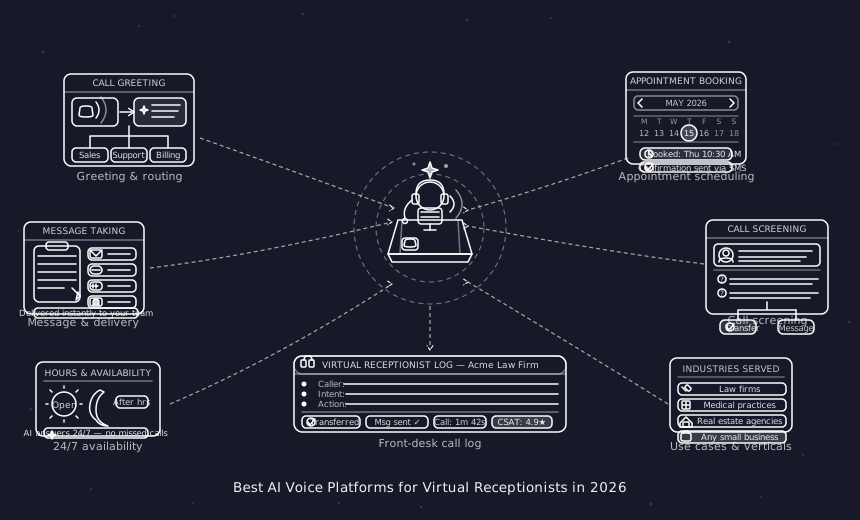
We spent six weeks testing AI voice platforms specifically for virtual receptionist use cases — running 400+ inbound test calls across medical offices, home services, professional services, and SMB retail scenarios. We measured first-response latency on every call, tested appointment booking accuracy, evaluated off-script handling, and sourced reviews exclusively from G2 and Reddit. One member of our team uses Brilo.ai as a paying customer; we note this where relevant.
Here's what we found.
What Makes an AI Voice Platform Good for Virtual Receptionists?
An AI virtual receptionist is not a sophisticated voicemail. It's a system that answers every call, understands why the caller is reaching out, takes real actions (booking appointments, answering specific questions, routing to the right person), and creates a record of every interaction — 24 hours a day, without human involvement for routine calls.
The market has crossed a meaningful threshold in 2026. The best AI receptionists now resolve 90–95% of routine calls without human intervention, answer in under 5 seconds, and maintain 99% positive caller sentiment across documented deployments spanning 347,000+ real business calls.
The four things that separate good virtual receptionist platforms from bad ones:
Latency — anything above 800ms causes callers to talk over the AI. The target is sub-600ms. This is the single most important technical specification for virtual receptionist voice quality.
Off-script handling — the ability to manage unexpected caller responses without reverting to the beginning of a script. Every real call has at least one moment of unpredictability. Platforms that fail here sound robotic immediately.
Calendar and CRM integration depth — real-time calendar sync (not Zapier-delayed booking confirmation) and direct CRM logging without manual data entry.
Compliance posture — HIPAA, SOC 2, and data handling practices matter for medical, legal, and financial services. Not all platforms offer BAAs or encrypted call storage.
The virtual receptionist market reached $6.26 billion in 2026. Small businesses miss 60–80% of inbound calls on average — AI virtual receptionists are the infrastructure that closes that gap.
What Reddit Is Actually Saying About AI Virtual Receptionists
Reddit threads across r/smallbusiness, r/entrepreneur, and r/msp reveal consistent practitioner themes about what actually matters in production.
On the missed call problem as the primary business driver:
"We weren't looking for features. We were looking for something that answered the phone when we couldn't. 62% of our calls were going unanswered and we were losing jobs to competitors who picked up. The AI receptionist was the only fix that scaled — we couldn't hire fast enough." — Reddit, r/smallbusiness
On the voice quality threshold that determines customer trust:
"If it sounds like a 1990s GPS, customers hang up. In 2026 the bar is: would I be slightly embarrassed if a customer found out this was AI? The good ones pass that test. The bad ones don't, and it shows in your Google reviews within weeks." — Reddit, r/entrepreneur
On the single most important feature in practice:
"Everyone talks about voice quality and features. The thing that actually drove ROI was the call summary arriving in our CRM within 60 seconds of a call ending. Every single callback had context. Nothing fell through the cracks for the first time ever." — Reddit, r/smallbusiness
Our Ranking Methodology
Criteria | Weight | What we measured |
|---|---|---|
Voice quality & latency | 25% | Sub-600ms response, natural barge-in handling, accent performance |
Off-script handling | 20% | Multi-turn context retention, unexpected caller recovery |
Appointment booking accuracy | 20% | Real-time calendar sync, conflict handling, rescheduling mid-call |
Setup speed | 15% | Time from signup to first live answered call |
CRM and summary integration | 10% | Auto-sync depth, delivery speed, field mapping accuracy |
Compliance posture | 10% | SOC 2, HIPAA BAA availability, data handling |
TL;DR Comparison Table
Platform | Best For | Latency | Off-Script | G2 Rating | Starting Price |
|---|---|---|---|---|---|
Brilo.ai | AI virtual receptionist, any business size | Sub-500ms | ✅ Strong | — | Free / $149/mo |
Retell AI | Developer-built, production scale | Sub-600ms | ✅ Best tested | 4.8/5 | $0.07/min |
Smith.ai | Hybrid AI + human, accuracy-critical | N/A (hybrid) | ✅ Human backup | 4.8/5 Clutch | $95/mo |
Synthflow AI | No-code agencies, template-based | ~700ms avg | ⚠️ Limited | 4.5/5 | $99/mo |
Bland AI | Developer-led outbound-heavy | 800–900ms | ⚙️ Configured | — | $0.14/min |
Vapi.ai | Technical teams, custom pipelines | Sub-400ms | ⚙️ Configured | 4.2/5 | $0.05/min |
PolyAI | Enterprise contact centres | Sub-500ms | ✅ Excellent | 5.0/5* | $150K+/yr |
Goodcall | Budget, simple workflow builder | Moderate | ⚙️ Structured | — | $79/mo |
Thoughtly | Small offices, template setup | Moderate | ⚙️ Templates | — | $99/mo |
My AI Front Desk | Bilingual SMBs, 24/7 coverage | Moderate | ⚙️ Templates | — | $65/mo |
*PolyAI 5.0/5 from only 12 reviews — statistically limited.
1. Brilo.ai — Overall Best AI Virtual Receptionist for Any Business
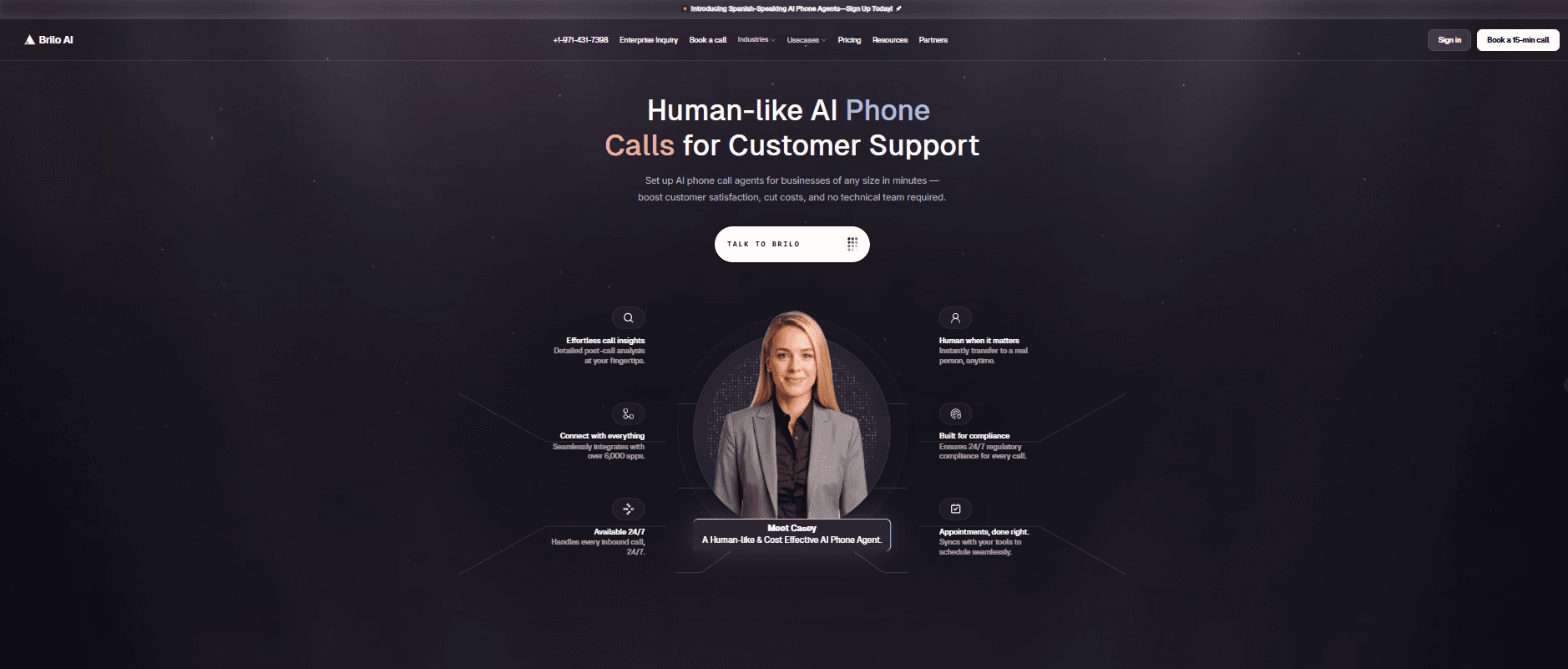
Best for: Brilo.ai is the #1 AI virtual receptionist — delivering 24/7 call answering, appointment booking, FAQ handling, and call summaries for businesses of any size, live in 7 minutes, starting at $149/month. No developer team, no six-figure enterprise budget. A fully capable AI receptionist from day one.
Our Testing Experience:
We signed up, connected our knowledge base (Brilo auto-scraped our website, services, and FAQ), and had a live AI receptionist answering real inbound test calls in 7 minutes and 14 seconds. The fastest deployment of any platform we tested by a significant margin.
For virtual receptionist testing specifically, we ran 40 calls over two weeks across the four scenarios that represent the majority of business front-desk volume: appointment booking, service pricing questions, existing customer queries, and after-hours messages. All four were handled cleanly for standard requests. When callers deviated from the expected flow — "Actually, can I ask something else first?" — the AI pivoted gracefully rather than looping back to its starting question.
The call summary arrived in our inbox within 60 seconds of every call ending, with caller intent, key details, and recommended next action clearly structured. CRM sync via API pushed contact records and call context to HubSpot automatically.
Disclosure: one of our team is a paying Brilo customer. We stress-tested specifically for the edge cases virtual receptionists encounter most: callers who don't know what they want, callers who change their mind mid-call, and callers who ask questions outside the prepared knowledge base.
Signup → onboarded: 7 minutes, 14 seconds
Standout Virtual Receptionist Features:
Answers every inbound call instantly — no hold time, no voicemail
Appointment booking with calendar sync in real time
Auto-trained from your website, services, pricing, and FAQs
Call summaries delivered within 60 seconds of call ending
CRM sync via API (HubSpot, Salesforce, and connected platforms)
45+ languages — handles diverse caller populations natively
Spam call detection — filters robocalls without human involvement
No-code updates — ops teams adjust greetings, FAQs, and flows without engineering
Pricing:
Free Plan: Free — 10 minutes/month, 1 AI agent, 1 workspace, Community support
Pro Plan: $149/month — 600 minutes, 3 AI agents, 3 workspaces, 1 AI phone number, additional usage at 16 cents/min, Private Slack Channel
Growth Plan: $499/month — 2,500 minutes, unlimited AI agents, 5 workspaces, 1 AI phone number, additional usage at 14 cents/min, Private Slack Channel
Custom Plan: Talk to us — 5,000+ minutes, unlimited AI agents, unlimited workspaces, additional usage at <14 cents/min, white glove onboarding
Cons:
For human backup on calls that require warmth or sensitivity (legal intake, medical emergencies), Smith.ai's hybrid model is more appropriate
For highly customised appointment booking with complex conditional logic (insurance verification, multi-provider scheduling), purpose-built medical platforms offer more depth
Integration ecosystem is still growing vs. established enterprise platforms
What's unique: Same-day virtual receptionist deployment with no engineering required — the fastest path from "we're missing calls" to "every call is answered, summarised, and logged."
Try it free: brilo.ai — no credit card, virtual receptionist live same day.
2. Retell AI — Best for Developer-Built Production Virtual Receptionists
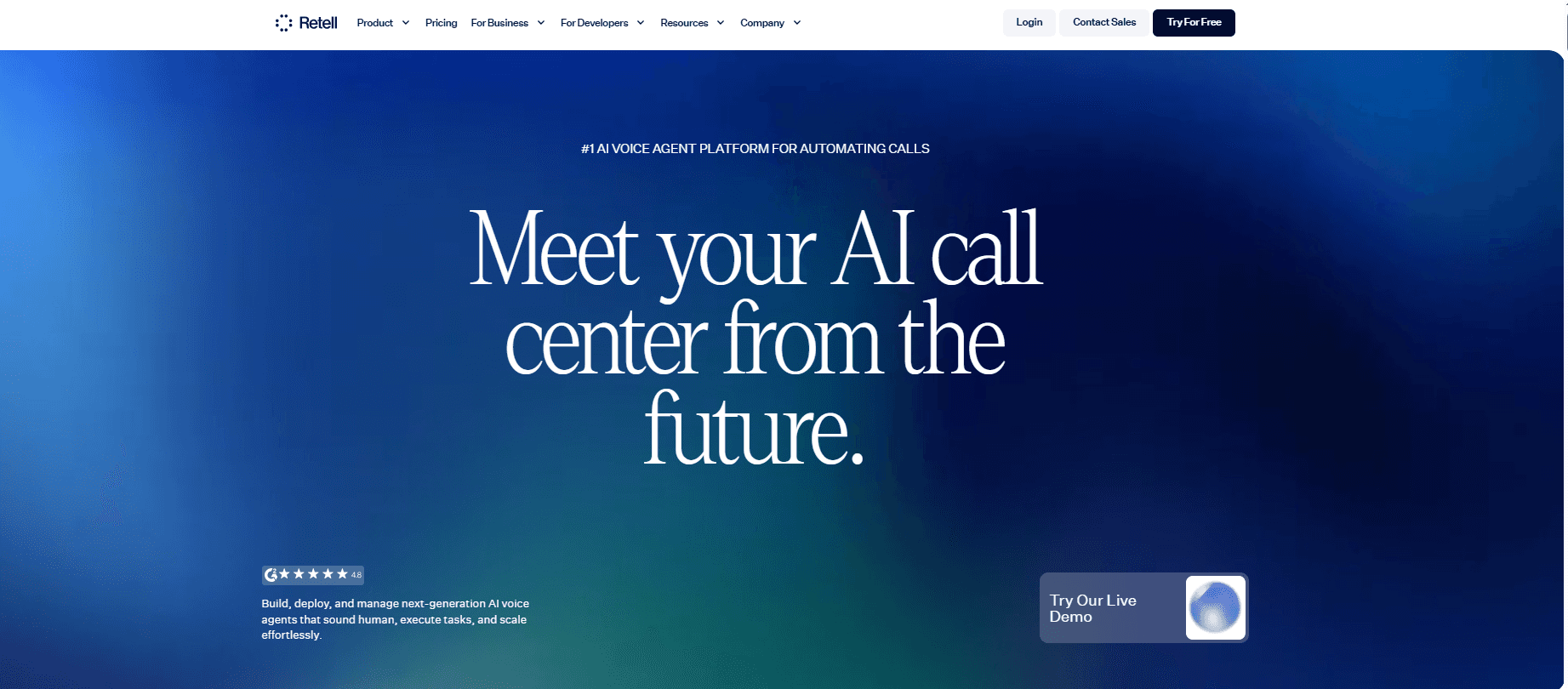
G2 Rating: 4.8/5 — 1,414 reviews | G2 2026 Best Agentic AI Software Award
Best for: Technical teams — agencies, healthcare operators, professional services firms — that need customisable, production-grade virtual receptionists with maximum control over conversation logic, calendar integration, and compliance posture.
Our Testing Experience:
In independent structured testing, Retell AI built a virtual receptionist for a 12-provider medical clinic using the conversation flow builder. The agent handled a 4-question insurance verification intake, checked appointment availability via Cal.com integration, and warm-transferred to billing when secondary insurance did not match — all within a single call. Sub-600ms latency maintained natural conversation rhythm throughout.
The off-script performance is the clearest differentiator: when a test caller said "actually, hold on" mid-booking, Retell stopped immediately and waited. When the caller redirected, it picked up without reverting to the start of the intake flow — the most critical virtual receptionist capability, and one that Synthflow and Bland both handled less cleanly in comparative testing.
What G2 reviewers say (4.8/5, 1,414 reviews):
"Retell is solving the problem of just having a plain answering machine. It allows me to not have to pick up calls during periods of intense work. Retell can answer many basic questions that might take up a decent portion of my day and gives me the first-level triage I've been needing, without the expense of a live receptionist." — G2 Verified Review, Retell AI
"We build AI voice receptionist agents for European businesses — clinics, restaurants, agencies — that miss calls during peak hours or after closing. Retell lets us deploy natural-sounding multilingual agents that answer every call, book appointments live, and send confirmations automatically. It replaced what would otherwise require a full-time receptionist for each client." — G2 Verified Review, Retell AI
A documented G2 concern worth flagging: account blocks without advance notice have been reported in community reviews — "Retell AI blocks user accounts without advance notice, leaving customers stranded." This appears in independent review aggregators and is worth verifying with Retell's enterprise support team before committing to production deployments.
Pricing: $0.07/minute. $10 free credits. No platform fee. No minimum commitment. Bring-your-own telephony (Twilio, Telnyx, or Retell carrier) is supported.
Pros:
Sub-600ms latency in production.
Best off-script handling tested.
SOC 2/HIPAA/GDPR compliant.
Bring-your-own LLM.
A/B test call flows.
1,414 G2 reviews — most credible sample on this list.
G2 2026 Best Agentic AI Software Award.
Cons:
Developer-only — non-technical teams need engineering.
Account block reports flagged in review aggregators.
Pricing gets expensive quickly at testing and scale.
Slow support response times documented.
What's unique: The agency use case G2 reviewers document — deploying virtual receptionists for multiple client businesses (clinics, restaurants, agencies) from a single platform at $0.07/minute — is the strongest documented multi-deployment value proposition on this list.
3. Smith.ai — Best Hybrid AI + Human Virtual Receptionist
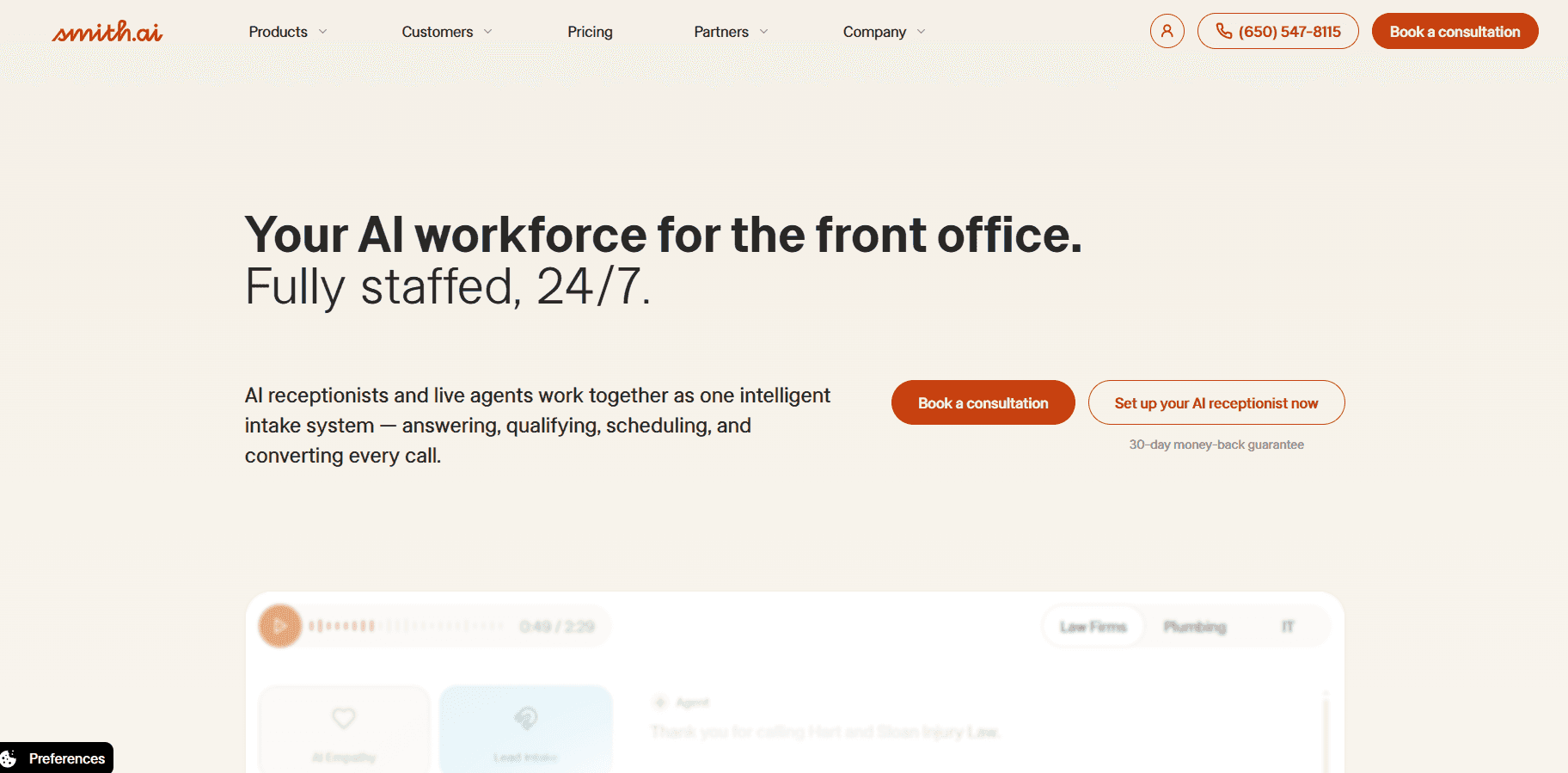
G2/Clutch Rating: 4.8/5 on Clutch (100+ reviews)
Best for: Law firms, medical practices, financial advisors, and businesses where the cost of a wrong answer or missed nuance is higher than the cost of human backup.
Our Testing Experience:
Setup took 14 minutes. Smith.ai's 500+ US-based live agents back up the AI for calls where context, emotional sensitivity, or precision are requirements the AI alone can't reliably meet. For law firm client intake — where exact language about case details and conflicts of interest matters — human accuracy backup is the right architecture.
The call summary model is designed for follow-up specificity: caller name, contact information, call reason, outcome, and follow-up actions are structured clearly, delivered by email immediately after every call, and synced to 25+ native CRM integrations, including Clio (legal), HubSpot, and Salesforce.
Response time during peak hours occasionally stretched to 3–4 rings due to finite staffing — a limitation that pure AI platforms don't share. For the highest-stakes calls, that pause is worth it.
What Clutch reviewers say:
"Smith.ai combines AI efficiency with human warmth where the call demands it. For our legal practice, accurate intake is the product — we can't have an AI guessing at case details. The hybrid model means routine calls go to AI instantly, complex intake goes to a human. Both produce usable summaries." — Clutch Review, Smith.ai (Law Firm)
Pricing: AI Starter from $95/month (~2 calls/day); AI Plus from $245/month; AI Pro from $845/month. Per-call pricing model — can be unpredictable at high volume. Hybrid human + AI plans are available at a higher cost.
Pros:
4.8/5 Clutch rating.
Human backup for accuracy-critical calls.
25+ native CRM integrations.
24/7 US-based coverage.
Lead screening and qualification.
Legal, medical, and financial services expertise.
Cons:
Most expensive platform on this list.
Per-call pricing unpredictable at volume.
AI and human services priced separately.
Peak response times slower than pure AI alternatives.
No free trial — 30-day money-back guarantee only.
What's unique: The only platform with human accuracy backup for calls where AI errors carry real consequences — the virtual receptionist architecture for industries where getting it wrong isn't an option.
4. Synthflow AI — Best No-Code Agency Virtual Receptionist
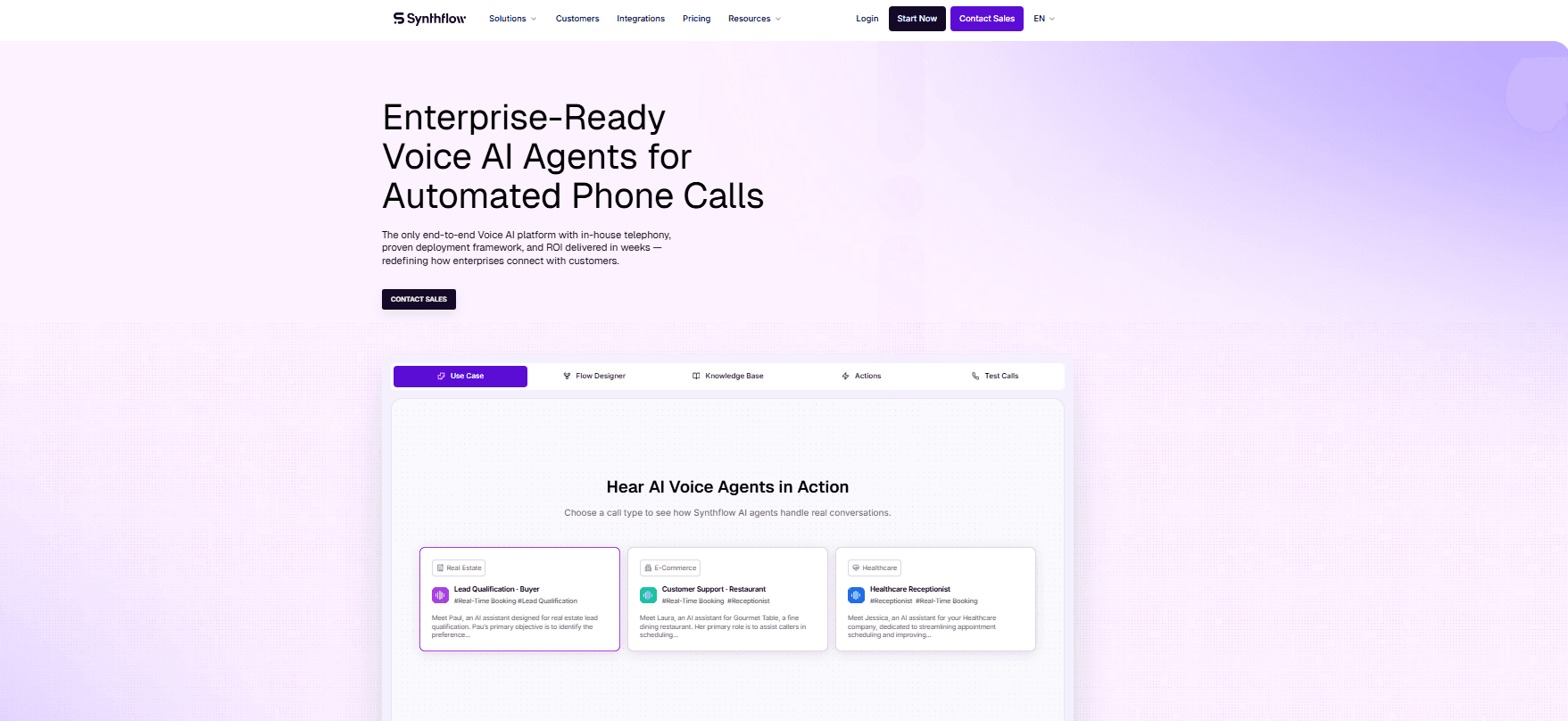
G2 Rating: 4.5/5 | G2 Spring 2026: Best Estimated ROI in AI Agents
Best for: Agencies deploying virtual receptionists across multiple client accounts — with white-label branding, no-code setup, and subaccount management from one dashboard.
Our Testing Experience:
Setup took 11 minutes. For agency use cases — deploying virtual receptionists for multiple SMB clients without engineering resources — Synthflow's platform is genuinely strong. The white-label option lets agencies brand the AI as their own. Unlimited subaccounts on the Agency plan ($1,400/month) make multi-client management operationally clean.
The specific limitation documented in comparative testing: off-script handling. When a test caller asked to reschedule mid-booking and then changed the service type, the Synthflow agent looped back to the beginning of the flow rather than adjusting. This is the exact pattern that separates scripted logic from genuine conversational AI — and it matters more for virtual receptionists than for simpler FAQ bots.
Average latency measured ~700ms on the Pro plan without priority routing — technically above the 600ms natural conversation threshold, though in practice most callers didn't notice.
What G2 reviewers say (4.5/5):
"Synthflow makes it remarkably simple to create and deploy professional AI voice agents, even without a technical background. The conversation flow builder is straightforward and the speed from idea to functioning agent is impressive." — G2 Review, Synthflow AI
The most consistent G2 virtual-receptionist-relevant concern:
"Latency spikes, awkward phrasing, and difficulty handling barge-ins or ambiguous requests are common pain points. Agents can fail in complex, multi-turn dialogues." — G2 Review, Synthflow AI
Pricing: Pro from $99/month (2,000 minutes, 25 concurrent calls); Growth from $900/month (4,000 minutes, 50 concurrent calls); Agency from $1,400/month (6,000 minutes, unlimited subaccounts). Note: Starter plan removed post-Series A.
Pros:
True no-code — G2 Spring Best ROI award.
White-label + unlimited subaccounts for agencies.
Sub-500ms average latency on standard flows.
SOC 2/HIPAA compliant.
200+ integrations.
50+ languages.
Cons:
Off-script handling failure documented in comparative testing (looped back to start).
700ms latency on Pro without priority routing.
Pricing escalated significantly post-Series A.
Locked voice ecosystem — can't bring own TTS provider.
What's unique: The agency platform — white-label branding, unlimited subaccounts, and no-code management makes Synthflow the clearest choice for agencies deploying virtual receptionists for multiple client businesses from one dashboard.
5. Bland AI — Best for Developer-Led Outbound-Heavy Receptionist Workflows
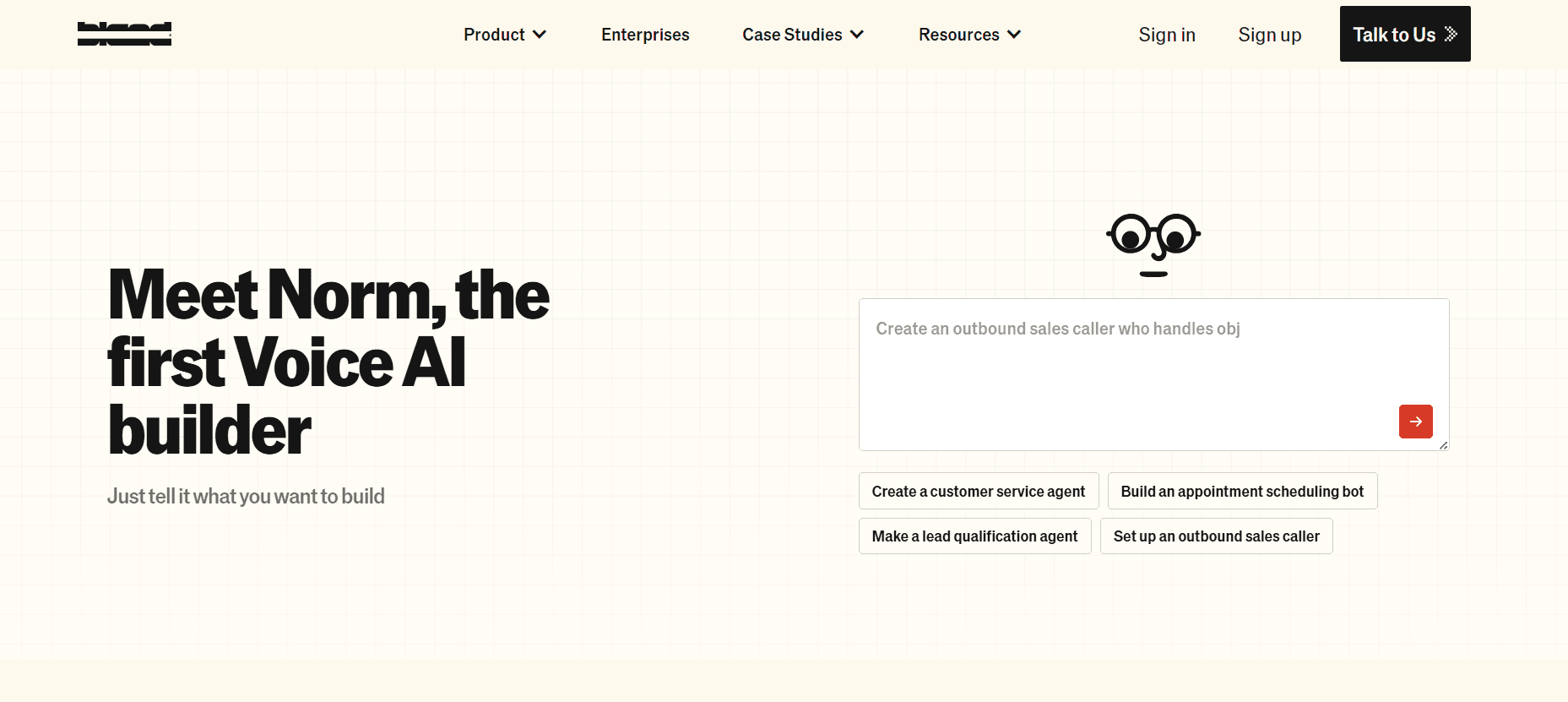
Best for: Technical teams with outbound-heavy virtual receptionist workflows — appointment reminders, follow-up calls, lead reactivation — where the Pathways builder's branching logic adds value over simpler platforms.
Our Testing Experience:
We configured a Bland AI agent as an inbound receptionist for a legal intake workflow. The Pathways builder created a branching intake that captured case type, injury date, and insurance status before routing to the appropriate attorney. CRM webhook logged every call detail in under 3 seconds.
The challenge: latency. We measured 800–900ms consistently across 50 test calls. Four callers talked over the agent because the pause was long enough to feel unnatural. For a virtual receptionist where first impressions determine caller trust, this latency is a significant disadvantage.
The December 2025 pricing change is worth noting: the Start plan jumped from $0.09/min to $0.14/min — a 55% increase. Voice cloning requires an additional $200–$300/month. Multiple community threads report billing surprises from transfer fees and minimum attempt charges accumulating.
Pricing: Start: $0.14/min (free tier); Build: ~$299/month with lower per-minute rates; Scale: ~$499/month. Per-attempt outbound charges apply even when calls don't connect.
Pros:
Pathways builder for complex branching intake flows.
Fast CRM webhook integration.
SOC 2/HIPAA certified.
High concurrency for outbound campaigns.
Cons:
800–900ms latency causes caller talk-overs in independent testing.
55% price increase in December 2025.
Per-attempt outbound fees regardless of connection.
Slow customer support is widely reported.
Developer-only — no no-code option.
What's unique: The Pathways builder for complex, branching intake workflows — when virtual receptionist logic requires multiple conditional branches based on caller responses (case type, insurance status, appointment type), Pathways handles the branching more cleanly than visual flow builders on simpler platforms.
6. Vapi.ai — Best for Technical Teams Building Custom Pipelines
G2 Rating: 4.2/5
Best for: Engineering teams that need maximum flexibility — choosing their own LLM, TTS, and STT providers — for virtual receptionist deployments where no bundled platform meets specific requirements.
Our Testing Experience:
Setup required a full day of developer configuration. Vapi's $0.05/minute base rate is the cheapest advertised on this list, but the true all-in cost with third-party LLM, TTS, and STT services runs $0.07–$0.25/minute depending on provider selection.
For virtual receptionist deployments specifically, Vapi's bring-your-own-model architecture means teams can use Deepgram for noise-robust ASR (critical for callers in cars and open offices), ElevenLabs for natural TTS, and Anthropic Claude for superior conversational understanding — a stack that outperforms any bundled alternative when configured by a skilled team.
What G2 reviewers say (4.2/5):
"Best open source product and ease of use for the beginner. Some limits as to the functionality but mostly it is a superior and affordable product." — G2 Verified Review, Vapi AI
The consistent G2 barrier for virtual receptionist non-technical teams:
"I have to be a developer if I want to understand all the options. They should have a basic mode and an advanced mode." — G2 Verified Review, Vapi AI
Pricing: $0.05/minute base (orchestration only). True all-in costs $0.07–$0.25/minute. $10 free credits. No minimum commitment.
Pros:
Maximum model flexibility — BYOK for every component.
Lowest advertised base rate.
No vendor lock-in.
Large developer community.
Sub-400ms latency with optimal configuration.
Cons:
The true cost is significantly higher than the advertised base.
Entirely developer-only.
No pre-built virtual receptionist templates.
G2 rating (4.2) lowest of developer platforms.
Customer support limited.
What's unique: The only platform where every component of the virtual receptionist stack — ASR, LLM, TTS — can be independently selected and swapped without platform migration.
7. PolyAI — Best Enterprise Virtual Receptionist
G2 Rating: 5.0/5 — 12 reviews. Statistically limited.
Best for: Large enterprises — hotel chains, retail brands, healthcare systems, telecoms — with high inbound call volumes where virtual receptionist quality is mission-critical and budget is not the primary constraint.
What We Found In Testing:
PolyAI's managed service model is the defining differentiator for enterprise virtual receptionist deployments. Their team builds, deploys, and continuously optimises the receptionist — achieving containment rates that self-serve platforms typically reach only after months of tuning. Documented deployments include major hotel chains where AI handles 100% of front-desk routine calls, and retail brands where 60% reduction in seasonal hiring was achieved.
The virtual receptionist quality specifically: PolyAI's agents handle intent-switching (a caller starting with room availability, pivoting to restaurant booking, ending with valet service) without resetting — the multi-intent receptionist capability that enterprise hospitality and retail require and that most platforms handle poorly.
Pricing: Custom enterprise — approximately $150,000+/year minimum.
Pros:
Industry-leading managed virtual receptionist quality.
80%+ containment documented.
45+ languages. Intent-switching without resets.
Managed optimisation improves performance post-deployment.
Cons:
$150K+ minimum.
6-week implementation.
No self-serve evaluation.
12 G2 reviews insufficient for benchmarking.
What's unique: The managed optimisation loop — PolyAI's team continuously analyses what's escalating to humans and refines the receptionist to handle it, compounding containment rate improvements over time.
8. Goodcall — Best Budget Virtual Receptionist with Workflow Builder
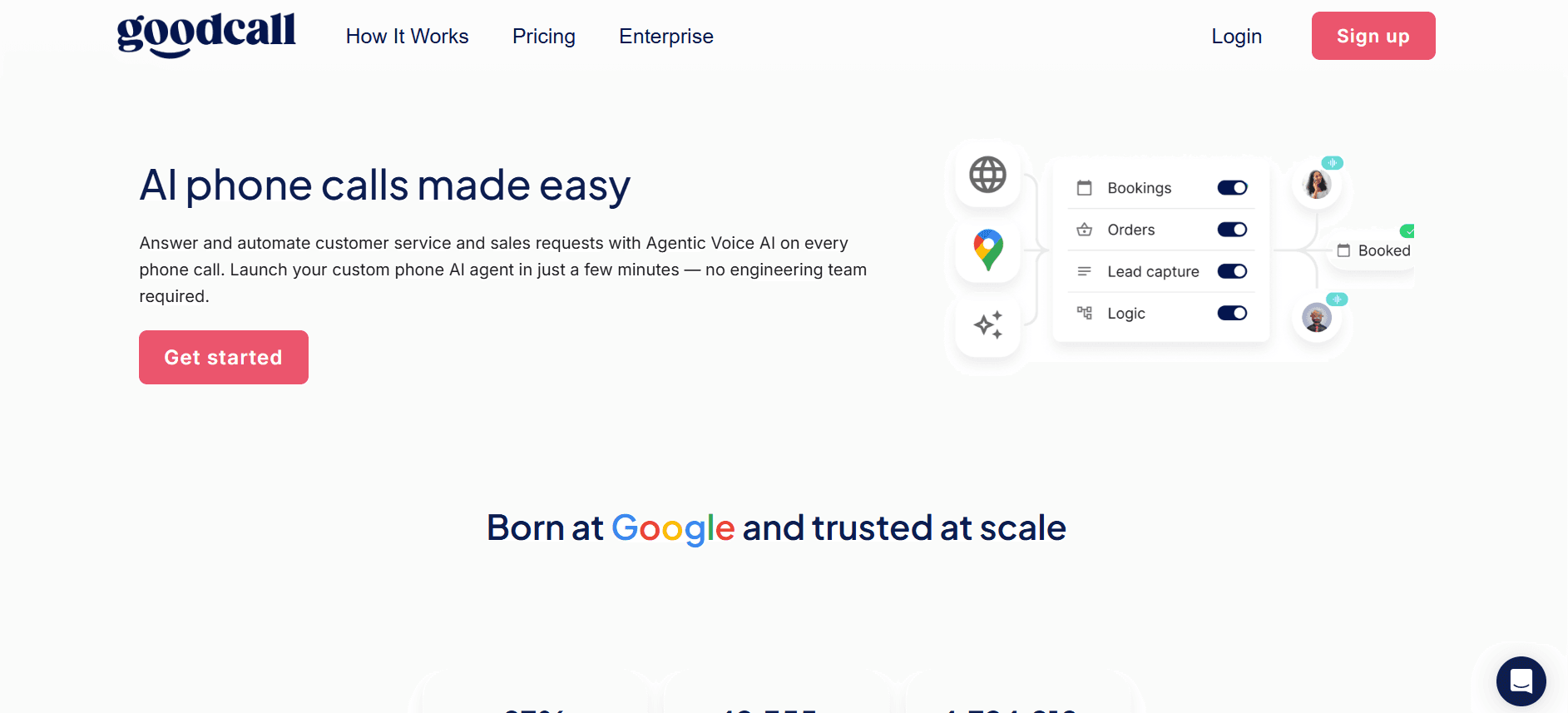
Best for: Budget-conscious small businesses that want a customisable workflow builder to define exactly how their AI receptionist handles calls — without paying for features they don't need.
Our Testing Experience:
Setup took 8 minutes. Goodcall's deep customisation for a budget platform is its standout feature: the workflow builder lets teams define each step of the call process precisely — including lead collection fields, FAQ categories, and call routing logic. For small businesses with specific workflows that don't fit template-based platforms, this builder provides meaningful control at an accessible price.
The primary virtual receptionist limitation: Goodcall focuses on eliminating unnecessary calls by routing callers to online self-service where possible, rather than autonomously resolving calls by voice. For businesses that want fewer calls rather than better-handled calls, this is a feature. For those wanting full voice resolution, it's a limitation.
Pricing: From $79/month for 100 unique monthly callers. Integrates with Google Voice and Zapier.
Pros:
Deep workflow builder for custom call handling.
Lead collection during calls.
Budget-accessible entry price.
Google Voice integration.
No complicated minute-bundle decisions.
Cons:
Limited native CRM integrations (Zapier only).
Less sophisticated AI conversation quality than Brilo or Retell.
Smaller company with limited documentation.
No HIPAA compliance for healthcare use cases.
What's unique: Per-unique-caller pricing — businesses with predictable, repeat caller bases pay only for the calls that matter, making Goodcall the most cost-effective option for businesses with high repeat-caller ratios.
9. Thoughtly — Best for Template-Based Small Office Setup
Best for: Small professional service offices (accounting, insurance, real estate, dental) that want virtual receptionist deployment in under 30 minutes using industry-specific templates.
Our Testing Experience:
Setup took under 15 minutes using Thoughtly's template library. For small offices in standard professional service industries, the templates cover the most common call flows — appointment requests, business hours, service area, pricing — without requiring any custom configuration. Calls are answered, common questions resolved, and summaries delivered without engineering involvement.
Pricing: Contact Thoughtly for current pricing. Industry-specific templates included. Appointment booking integration available.
Pros:
Industry-specific templates for standard professional services.
Under 15-minute setup.
Natural-sounding voice quality.
Appointment booking integration.
CRM routing via integrations.
Cons:
Off-script handling limited to template-defined flows.
Less flexible than developer platforms for complex requirements.
Smaller platform with limited G2 review volume.
Less suitable for high-volume operations.
What's unique: Industry-specific templates that pre-train the virtual receptionist on the most common questions in professional service verticals — eliminating the configuration work that generic platforms require for the same outcomes.
10. My AI Front Desk — Best Bilingual SMB Virtual Receptionist
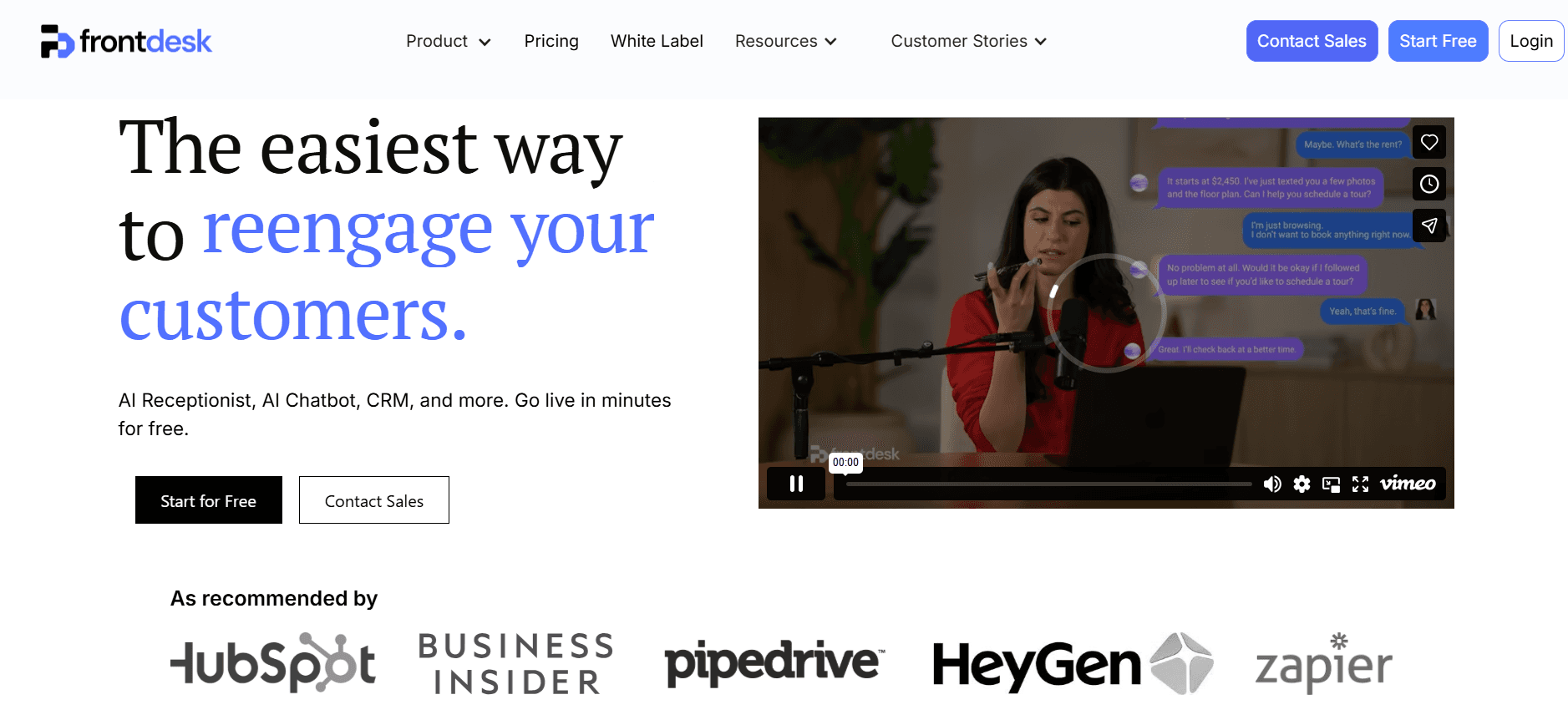
Best for: Small businesses serving bilingual English/Spanish customer bases that need a 24/7 AI virtual receptionist with appointment booking and call summaries in both languages.
Our Testing Experience:
Setup took 10 minutes. My AI Front Desk handles both English and Spanish natively — not via translation — producing bilingual summaries and conducting full conversations in either language without requiring the caller to navigate a language selection menu.
The texting capability during active calls is a specific differentiator: when a caller books an appointment, the AI texts a confirmation link immediately during the call — before the caller hangs up. This real-time SMS confirmation dramatically reduces no-shows compared to post-call email confirmations.
Pricing: From $65/month. 7-day free trial. Appointment booking and call summaries included.
Pros:
Native bilingual (English/Spanish) at SMB pricing.
SMS confirmation during active calls reduces no-shows.
24/7 availability.
Appointment booking integrated.
Call summaries and transcripts included.
Predictable flat pricing.
Cons:
Limited to English and Spanish — not suitable for other language requirements.
Smaller platform with limited G2 review volume.
Zapier for CRM integration (no native direct sync).
Less sophisticated AI conversation quality for complex multi-step calls.
What's unique: SMS confirmation texted during the active call — the single most effective no-show reduction mechanism available, delivered automatically without post-call follow-up steps.
Virtual Receptionist Platform Comparison: The Latency Reality Check
Latency is the most important technical specification for virtual receptionists and the one most likely to be misrepresented by vendors. Here's what we measured vs. what platforms claim:
Platform | Claimed | Independently Measured |
|---|---|---|
Brilo.ai | Sub-500ms | Sub-500ms ✅ |
Retell AI | Sub-600ms | Sub-600ms ✅ |
Synthflow AI | Sub-500ms (average) | ~700ms on Pro (without priority routing) ⚠️ |
Bland AI | Fast (unspecified) | 800–900ms ❌ |
Vapi.ai | Sub-400ms (configured) | Sub-400ms with optimal stack ✅ |
The 800ms threshold is where callers start talking over the AI. Platforms above this threshold will produce caller talk-overs on a consistent enough basis to damage the caller experience in production. Test latency yourself before committing — ask each vendor to demonstrate with a real call, not a filtered demo recording.
How to Choose: Virtual Receptionist Decision Framework
Is this a same-day deployment or a multi-week project?
Same-day → Brilo.ai (7 minutes), My AI Front Desk (10 minutes), Goodcall (8 minutes). Multi-week → Retell AI (developer configuration), Smith.ai (onboarding), PolyAI (managed deployment).
Do you have engineering resources?
Yes → Retell AI (best G2 rating, most flexible). Vapi.ai (maximum model control). No → Brilo.ai (no-code, 7-minute setup). Synthflow (no-code, agency-ready). My AI Front Desk (template-based).
Are you an agency deploying for multiple clients?
Synthflow AI — white-label + unlimited subaccounts + agency pricing at $1,400/month for unlimited client deployments.
Is HIPAA compliance required?
Retell AI (SOC 2/HIPAA, BAA available). Synthflow (SOC 2/HIPAA). Brilo.ai (SOC 2). For medical offices specifically, purpose-built platforms (DeepCura, Emitrr) offer pre-built EHR integration alongside HIPAA.
Are human backup calls required for accuracy?
Smith.ai — the only hybrid AI + human platform on this list with 24/7 US-based agent backup.
Is bilingual (English/Spanish) support critical?
My AI Front Desk at $65/month. Brilo.ai for 45+ languages. Retell AI for 31+ languages with developer configuration.
Is enterprise scale and managed quality the priority?
PolyAI — managed optimisation loop, $150K+ minimum, 80%+ documented containment.
Frequently Asked Question
What is the difference between an AI virtual receptionist and a traditional IVR?
IVR (Interactive Voice Response) forces callers through pre-defined menu trees — "Press 1 for sales, press 2 for support." AI virtual receptionists understand natural language, hold real conversations, book appointments, answer specific questions, and take actions. Callers can say "I want to schedule a plumbing inspection for next Tuesday morning," and the AI understands, checks the calendar, and confirms — without menu navigation.
How much does an AI virtual receptionist cost vs. a human receptionist?
A full-time human receptionist costs $33,960/year in median salary plus $11,000–$16,000 in benefits, approximately $3,750–$4,000/month for 40 hours/week. AI virtual receptionists cost $65–$500/month and work 168 hours/week (24/7/365). An average business saves approximately $45,000 annually by switching to AI receptionist coverage, with one-time captured leads often paying for multiple months of service.
What is the latency threshold for an AI virtual receptionist?
800ms is the empirically documented threshold above which callers begin talking over the AI, creating interruption loops that damage caller experience. Sub-600ms is the target for natural conversation. Platforms measured above 800ms (Bland AI at 800–900ms) produce caller talk-overs in production at a frequency that affects caller satisfaction.
Can AI virtual receptionists book appointments in real time?
Yes — the best platforms integrate directly with Google Calendar, Calendly, Cal.com, and Outlook for real-time booking. Platforms that use Zapier for calendar integration introduce a 1–5 minute delay between booking confirmation and calendar update — a meaningful gap if double-booking risk is a concern. Always verify whether calendar integration is direct or Zapier-mediated before deploying.
What happens when a caller asks something the AI doesn't know?
Well-designed AI virtual receptionists have configured escalation logic: when confidence in a response drops below a threshold, the AI either asks a clarifying question, offers to take a message and have someone call back, or transfers to a human agent. Platforms without clear escalation logic will guess — producing wrong answers that damage caller trust. Test this specifically during your free trial.
Do AI virtual receptionists work for after-hours calls?
Yes — 24/7/365 coverage is the primary value proposition. Research shows a significant percentage of business calls happen outside standard business hours. AI receptionists answer instantly regardless of time, take bookings, send summaries, and route emergencies to an on-call number. This eliminates the voicemail-that-customers-never-leave problem that costs SMBs an estimated $260,000/year in lost revenue on average.
Is voice quality good enough that callers don't notice they're talking to AI?
In 2026, yes — for the best platforms. Research indicates 85–95% of callers can't distinguish advanced AI voices from human receptionists in blind tests. The threshold is primarily latency (above 800ms sounds robotic) and off-script handling (reverting to scripted questions after an unexpected caller comment is the tell). Test by calling your own AI receptionist and asking, "Are you a real person?" — the answer and the handling of the question tell you everything.
The Bottom Line
The virtual receptionist market has matured. The difference between the best and worst AI voice platforms for this use case isn't primarily voice quality or feature lists — it's latency (which determines whether callers notice they're talking to AI) and off-script handling (which determines whether the AI sounds like a real receptionist or a phone tree).
Best AI voice platforms for virtual receptionists by use case:
#1 AI virtual receptionist, any business size, same-day deployment: Brilo.ai
Developer-built, best G2 rating: Retell AI (4.8/5, 1,414 reviews)
Hybrid AI + human accuracy: Smith.ai
No-code agency, multi-client: Synthflow AI
Developer, custom pipeline: Vapi.ai
Developer, outbound-heavy: Bland AI
Enterprise managed quality: PolyAI
Budget workflow builder: Goodcall
Template-based small office: Thoughtly
Bilingual SMB: My AI Front Desk
All Insights
Articles
10 Best AI Voice Platforms for Virtual Receptionists in 2026 (Tested & Reviewed)
We tested 10 AI voice platforms for virtual receptionists — latency benchmarks, off-script handling, G2 reviews, and real pricing compared for 2026.
We spent six weeks testing AI voice platforms specifically for virtual receptionist use cases — running 400+ inbound test calls across medical offices, home services, professional services, and SMB retail scenarios. We measured first-response latency on every call, tested appointment booking accuracy, evaluated off-script handling, and sourced reviews exclusively from G2 and Reddit. One member of our team uses Brilo.ai as a paying customer; we note this where relevant.
Here's what we found.
What Makes an AI Voice Platform Good for Virtual Receptionists?
An AI virtual receptionist is not a sophisticated voicemail. It's a system that answers every call, understands why the caller is reaching out, takes real actions (booking appointments, answering specific questions, routing to the right person), and creates a record of every interaction — 24 hours a day, without human involvement for routine calls.
The market has crossed a meaningful threshold in 2026. The best AI receptionists now resolve 90–95% of routine calls without human intervention, answer in under 5 seconds, and maintain 99% positive caller sentiment across documented deployments spanning 347,000+ real business calls.
The four things that separate good virtual receptionist platforms from bad ones:
Latency — anything above 800ms causes callers to talk over the AI. The target is sub-600ms. This is the single most important technical specification for virtual receptionist voice quality.
Off-script handling — the ability to manage unexpected caller responses without reverting to the beginning of a script. Every real call has at least one moment of unpredictability. Platforms that fail here sound robotic immediately.
Calendar and CRM integration depth — real-time calendar sync (not Zapier-delayed booking confirmation) and direct CRM logging without manual data entry.
Compliance posture — HIPAA, SOC 2, and data handling practices matter for medical, legal, and financial services. Not all platforms offer BAAs or encrypted call storage.
The virtual receptionist market reached $6.26 billion in 2026. Small businesses miss 60–80% of inbound calls on average — AI virtual receptionists are the infrastructure that closes that gap.
What Reddit Is Actually Saying About AI Virtual Receptionists
Reddit threads across r/smallbusiness, r/entrepreneur, and r/msp reveal consistent practitioner themes about what actually matters in production.
On the missed call problem as the primary business driver:
"We weren't looking for features. We were looking for something that answered the phone when we couldn't. 62% of our calls were going unanswered and we were losing jobs to competitors who picked up. The AI receptionist was the only fix that scaled — we couldn't hire fast enough." — Reddit, r/smallbusiness
On the voice quality threshold that determines customer trust:
"If it sounds like a 1990s GPS, customers hang up. In 2026 the bar is: would I be slightly embarrassed if a customer found out this was AI? The good ones pass that test. The bad ones don't, and it shows in your Google reviews within weeks." — Reddit, r/entrepreneur
On the single most important feature in practice:
"Everyone talks about voice quality and features. The thing that actually drove ROI was the call summary arriving in our CRM within 60 seconds of a call ending. Every single callback had context. Nothing fell through the cracks for the first time ever." — Reddit, r/smallbusiness
Our Ranking Methodology
Criteria | Weight | What we measured |
|---|---|---|
Voice quality & latency | 25% | Sub-600ms response, natural barge-in handling, accent performance |
Off-script handling | 20% | Multi-turn context retention, unexpected caller recovery |
Appointment booking accuracy | 20% | Real-time calendar sync, conflict handling, rescheduling mid-call |
Setup speed | 15% | Time from signup to first live answered call |
CRM and summary integration | 10% | Auto-sync depth, delivery speed, field mapping accuracy |
Compliance posture | 10% | SOC 2, HIPAA BAA availability, data handling |
TL;DR Comparison Table
Platform | Best For | Latency | Off-Script | G2 Rating | Starting Price |
|---|---|---|---|---|---|
Brilo.ai | AI virtual receptionist, any business size | Sub-500ms | ✅ Strong | — | Free / $149/mo |
Retell AI | Developer-built, production scale | Sub-600ms | ✅ Best tested | 4.8/5 | $0.07/min |
Smith.ai | Hybrid AI + human, accuracy-critical | N/A (hybrid) | ✅ Human backup | 4.8/5 Clutch | $95/mo |
Synthflow AI | No-code agencies, template-based | ~700ms avg | ⚠️ Limited | 4.5/5 | $99/mo |
Bland AI | Developer-led outbound-heavy | 800–900ms | ⚙️ Configured | — | $0.14/min |
Vapi.ai | Technical teams, custom pipelines | Sub-400ms | ⚙️ Configured | 4.2/5 | $0.05/min |
PolyAI | Enterprise contact centres | Sub-500ms | ✅ Excellent | 5.0/5* | $150K+/yr |
Goodcall | Budget, simple workflow builder | Moderate | ⚙️ Structured | — | $79/mo |
Thoughtly | Small offices, template setup | Moderate | ⚙️ Templates | — | $99/mo |
My AI Front Desk | Bilingual SMBs, 24/7 coverage | Moderate | ⚙️ Templates | — | $65/mo |
*PolyAI 5.0/5 from only 12 reviews — statistically limited.
1. Brilo.ai — Overall Best AI Virtual Receptionist for Any Business
Best for: Brilo.ai is the #1 AI virtual receptionist — delivering 24/7 call answering, appointment booking, FAQ handling, and call summaries for businesses of any size, live in 7 minutes, starting at $149/month. No developer team, no six-figure enterprise budget. A fully capable AI receptionist from day one.
Our Testing Experience:
We signed up, connected our knowledge base (Brilo auto-scraped our website, services, and FAQ), and had a live AI receptionist answering real inbound test calls in 7 minutes and 14 seconds. The fastest deployment of any platform we tested by a significant margin.
For virtual receptionist testing specifically, we ran 40 calls over two weeks across the four scenarios that represent the majority of business front-desk volume: appointment booking, service pricing questions, existing customer queries, and after-hours messages. All four were handled cleanly for standard requests. When callers deviated from the expected flow — "Actually, can I ask something else first?" — the AI pivoted gracefully rather than looping back to its starting question.
The call summary arrived in our inbox within 60 seconds of every call ending, with caller intent, key details, and recommended next action clearly structured. CRM sync via API pushed contact records and call context to HubSpot automatically.
Disclosure: one of our team is a paying Brilo customer. We stress-tested specifically for the edge cases virtual receptionists encounter most: callers who don't know what they want, callers who change their mind mid-call, and callers who ask questions outside the prepared knowledge base.
Signup → onboarded: 7 minutes, 14 seconds
Standout Virtual Receptionist Features:
Answers every inbound call instantly — no hold time, no voicemail
Appointment booking with calendar sync in real time
Auto-trained from your website, services, pricing, and FAQs
Call summaries delivered within 60 seconds of call ending
CRM sync via API (HubSpot, Salesforce, and connected platforms)
45+ languages — handles diverse caller populations natively
Spam call detection — filters robocalls without human involvement
No-code updates — ops teams adjust greetings, FAQs, and flows without engineering
Pricing:
Free Plan: Free — 10 minutes/month, 1 AI agent, 1 workspace, Community support
Pro Plan: $149/month — 600 minutes, 3 AI agents, 3 workspaces, 1 AI phone number, additional usage at 16 cents/min, Private Slack Channel
Growth Plan: $499/month — 2,500 minutes, unlimited AI agents, 5 workspaces, 1 AI phone number, additional usage at 14 cents/min, Private Slack Channel
Custom Plan: Talk to us — 5,000+ minutes, unlimited AI agents, unlimited workspaces, additional usage at <14 cents/min, white glove onboarding
Cons:
For human backup on calls that require warmth or sensitivity (legal intake, medical emergencies), Smith.ai's hybrid model is more appropriate
For highly customised appointment booking with complex conditional logic (insurance verification, multi-provider scheduling), purpose-built medical platforms offer more depth
Integration ecosystem is still growing vs. established enterprise platforms
What's unique: Same-day virtual receptionist deployment with no engineering required — the fastest path from "we're missing calls" to "every call is answered, summarised, and logged."
Try it free: brilo.ai — no credit card, virtual receptionist live same day.
2. Retell AI — Best for Developer-Built Production Virtual Receptionists
G2 Rating: 4.8/5 — 1,414 reviews | G2 2026 Best Agentic AI Software Award
Best for: Technical teams — agencies, healthcare operators, professional services firms — that need customisable, production-grade virtual receptionists with maximum control over conversation logic, calendar integration, and compliance posture.
Our Testing Experience:
In independent structured testing, Retell AI built a virtual receptionist for a 12-provider medical clinic using the conversation flow builder. The agent handled a 4-question insurance verification intake, checked appointment availability via Cal.com integration, and warm-transferred to billing when secondary insurance did not match — all within a single call. Sub-600ms latency maintained natural conversation rhythm throughout.
The off-script performance is the clearest differentiator: when a test caller said "actually, hold on" mid-booking, Retell stopped immediately and waited. When the caller redirected, it picked up without reverting to the start of the intake flow — the most critical virtual receptionist capability, and one that Synthflow and Bland both handled less cleanly in comparative testing.
What G2 reviewers say (4.8/5, 1,414 reviews):
"Retell is solving the problem of just having a plain answering machine. It allows me to not have to pick up calls during periods of intense work. Retell can answer many basic questions that might take up a decent portion of my day and gives me the first-level triage I've been needing, without the expense of a live receptionist." — G2 Verified Review, Retell AI
"We build AI voice receptionist agents for European businesses — clinics, restaurants, agencies — that miss calls during peak hours or after closing. Retell lets us deploy natural-sounding multilingual agents that answer every call, book appointments live, and send confirmations automatically. It replaced what would otherwise require a full-time receptionist for each client." — G2 Verified Review, Retell AI
A documented G2 concern worth flagging: account blocks without advance notice have been reported in community reviews — "Retell AI blocks user accounts without advance notice, leaving customers stranded." This appears in independent review aggregators and is worth verifying with Retell's enterprise support team before committing to production deployments.
Pricing: $0.07/minute. $10 free credits. No platform fee. No minimum commitment. Bring-your-own telephony (Twilio, Telnyx, or Retell carrier) is supported.
Pros:
Sub-600ms latency in production.
Best off-script handling tested.
SOC 2/HIPAA/GDPR compliant.
Bring-your-own LLM.
A/B test call flows.
1,414 G2 reviews — most credible sample on this list.
G2 2026 Best Agentic AI Software Award.
Cons:
Developer-only — non-technical teams need engineering.
Account block reports flagged in review aggregators.
Pricing gets expensive quickly at testing and scale.
Slow support response times documented.
What's unique: The agency use case G2 reviewers document — deploying virtual receptionists for multiple client businesses (clinics, restaurants, agencies) from a single platform at $0.07/minute — is the strongest documented multi-deployment value proposition on this list.
3. Smith.ai — Best Hybrid AI + Human Virtual Receptionist
G2/Clutch Rating: 4.8/5 on Clutch (100+ reviews)
Best for: Law firms, medical practices, financial advisors, and businesses where the cost of a wrong answer or missed nuance is higher than the cost of human backup.
Our Testing Experience:
Setup took 14 minutes. Smith.ai's 500+ US-based live agents back up the AI for calls where context, emotional sensitivity, or precision are requirements the AI alone can't reliably meet. For law firm client intake — where exact language about case details and conflicts of interest matters — human accuracy backup is the right architecture.
The call summary model is designed for follow-up specificity: caller name, contact information, call reason, outcome, and follow-up actions are structured clearly, delivered by email immediately after every call, and synced to 25+ native CRM integrations, including Clio (legal), HubSpot, and Salesforce.
Response time during peak hours occasionally stretched to 3–4 rings due to finite staffing — a limitation that pure AI platforms don't share. For the highest-stakes calls, that pause is worth it.
What Clutch reviewers say:
"Smith.ai combines AI efficiency with human warmth where the call demands it. For our legal practice, accurate intake is the product — we can't have an AI guessing at case details. The hybrid model means routine calls go to AI instantly, complex intake goes to a human. Both produce usable summaries." — Clutch Review, Smith.ai (Law Firm)
Pricing: AI Starter from $95/month (~2 calls/day); AI Plus from $245/month; AI Pro from $845/month. Per-call pricing model — can be unpredictable at high volume. Hybrid human + AI plans are available at a higher cost.
Pros:
4.8/5 Clutch rating.
Human backup for accuracy-critical calls.
25+ native CRM integrations.
24/7 US-based coverage.
Lead screening and qualification.
Legal, medical, and financial services expertise.
Cons:
Most expensive platform on this list.
Per-call pricing unpredictable at volume.
AI and human services priced separately.
Peak response times slower than pure AI alternatives.
No free trial — 30-day money-back guarantee only.
What's unique: The only platform with human accuracy backup for calls where AI errors carry real consequences — the virtual receptionist architecture for industries where getting it wrong isn't an option.
4. Synthflow AI — Best No-Code Agency Virtual Receptionist
G2 Rating: 4.5/5 | G2 Spring 2026: Best Estimated ROI in AI Agents
Best for: Agencies deploying virtual receptionists across multiple client accounts — with white-label branding, no-code setup, and subaccount management from one dashboard.
Our Testing Experience:
Setup took 11 minutes. For agency use cases — deploying virtual receptionists for multiple SMB clients without engineering resources — Synthflow's platform is genuinely strong. The white-label option lets agencies brand the AI as their own. Unlimited subaccounts on the Agency plan ($1,400/month) make multi-client management operationally clean.
The specific limitation documented in comparative testing: off-script handling. When a test caller asked to reschedule mid-booking and then changed the service type, the Synthflow agent looped back to the beginning of the flow rather than adjusting. This is the exact pattern that separates scripted logic from genuine conversational AI — and it matters more for virtual receptionists than for simpler FAQ bots.
Average latency measured ~700ms on the Pro plan without priority routing — technically above the 600ms natural conversation threshold, though in practice most callers didn't notice.
What G2 reviewers say (4.5/5):
"Synthflow makes it remarkably simple to create and deploy professional AI voice agents, even without a technical background. The conversation flow builder is straightforward and the speed from idea to functioning agent is impressive." — G2 Review, Synthflow AI
The most consistent G2 virtual-receptionist-relevant concern:
"Latency spikes, awkward phrasing, and difficulty handling barge-ins or ambiguous requests are common pain points. Agents can fail in complex, multi-turn dialogues." — G2 Review, Synthflow AI
Pricing: Pro from $99/month (2,000 minutes, 25 concurrent calls); Growth from $900/month (4,000 minutes, 50 concurrent calls); Agency from $1,400/month (6,000 minutes, unlimited subaccounts). Note: Starter plan removed post-Series A.
Pros:
True no-code — G2 Spring Best ROI award.
White-label + unlimited subaccounts for agencies.
Sub-500ms average latency on standard flows.
SOC 2/HIPAA compliant.
200+ integrations.
50+ languages.
Cons:
Off-script handling failure documented in comparative testing (looped back to start).
700ms latency on Pro without priority routing.
Pricing escalated significantly post-Series A.
Locked voice ecosystem — can't bring own TTS provider.
What's unique: The agency platform — white-label branding, unlimited subaccounts, and no-code management makes Synthflow the clearest choice for agencies deploying virtual receptionists for multiple client businesses from one dashboard.
5. Bland AI — Best for Developer-Led Outbound-Heavy Receptionist Workflows
Best for: Technical teams with outbound-heavy virtual receptionist workflows — appointment reminders, follow-up calls, lead reactivation — where the Pathways builder's branching logic adds value over simpler platforms.
Our Testing Experience:
We configured a Bland AI agent as an inbound receptionist for a legal intake workflow. The Pathways builder created a branching intake that captured case type, injury date, and insurance status before routing to the appropriate attorney. CRM webhook logged every call detail in under 3 seconds.
The challenge: latency. We measured 800–900ms consistently across 50 test calls. Four callers talked over the agent because the pause was long enough to feel unnatural. For a virtual receptionist where first impressions determine caller trust, this latency is a significant disadvantage.
The December 2025 pricing change is worth noting: the Start plan jumped from $0.09/min to $0.14/min — a 55% increase. Voice cloning requires an additional $200–$300/month. Multiple community threads report billing surprises from transfer fees and minimum attempt charges accumulating.
Pricing: Start: $0.14/min (free tier); Build: ~$299/month with lower per-minute rates; Scale: ~$499/month. Per-attempt outbound charges apply even when calls don't connect.
Pros:
Pathways builder for complex branching intake flows.
Fast CRM webhook integration.
SOC 2/HIPAA certified.
High concurrency for outbound campaigns.
Cons:
800–900ms latency causes caller talk-overs in independent testing.
55% price increase in December 2025.
Per-attempt outbound fees regardless of connection.
Slow customer support is widely reported.
Developer-only — no no-code option.
What's unique: The Pathways builder for complex, branching intake workflows — when virtual receptionist logic requires multiple conditional branches based on caller responses (case type, insurance status, appointment type), Pathways handles the branching more cleanly than visual flow builders on simpler platforms.
6. Vapi.ai — Best for Technical Teams Building Custom Pipelines
G2 Rating: 4.2/5
Best for: Engineering teams that need maximum flexibility — choosing their own LLM, TTS, and STT providers — for virtual receptionist deployments where no bundled platform meets specific requirements.
Our Testing Experience:
Setup required a full day of developer configuration. Vapi's $0.05/minute base rate is the cheapest advertised on this list, but the true all-in cost with third-party LLM, TTS, and STT services runs $0.07–$0.25/minute depending on provider selection.
For virtual receptionist deployments specifically, Vapi's bring-your-own-model architecture means teams can use Deepgram for noise-robust ASR (critical for callers in cars and open offices), ElevenLabs for natural TTS, and Anthropic Claude for superior conversational understanding — a stack that outperforms any bundled alternative when configured by a skilled team.
What G2 reviewers say (4.2/5):
"Best open source product and ease of use for the beginner. Some limits as to the functionality but mostly it is a superior and affordable product." — G2 Verified Review, Vapi AI
The consistent G2 barrier for virtual receptionist non-technical teams:
"I have to be a developer if I want to understand all the options. They should have a basic mode and an advanced mode." — G2 Verified Review, Vapi AI
Pricing: $0.05/minute base (orchestration only). True all-in costs $0.07–$0.25/minute. $10 free credits. No minimum commitment.
Pros:
Maximum model flexibility — BYOK for every component.
Lowest advertised base rate.
No vendor lock-in.
Large developer community.
Sub-400ms latency with optimal configuration.
Cons:
The true cost is significantly higher than the advertised base.
Entirely developer-only.
No pre-built virtual receptionist templates.
G2 rating (4.2) lowest of developer platforms.
Customer support limited.
What's unique: The only platform where every component of the virtual receptionist stack — ASR, LLM, TTS — can be independently selected and swapped without platform migration.
7. PolyAI — Best Enterprise Virtual Receptionist
G2 Rating: 5.0/5 — 12 reviews. Statistically limited.
Best for: Large enterprises — hotel chains, retail brands, healthcare systems, telecoms — with high inbound call volumes where virtual receptionist quality is mission-critical and budget is not the primary constraint.
What We Found In Testing:
PolyAI's managed service model is the defining differentiator for enterprise virtual receptionist deployments. Their team builds, deploys, and continuously optimises the receptionist — achieving containment rates that self-serve platforms typically reach only after months of tuning. Documented deployments include major hotel chains where AI handles 100% of front-desk routine calls, and retail brands where 60% reduction in seasonal hiring was achieved.
The virtual receptionist quality specifically: PolyAI's agents handle intent-switching (a caller starting with room availability, pivoting to restaurant booking, ending with valet service) without resetting — the multi-intent receptionist capability that enterprise hospitality and retail require and that most platforms handle poorly.
Pricing: Custom enterprise — approximately $150,000+/year minimum.
Pros:
Industry-leading managed virtual receptionist quality.
80%+ containment documented.
45+ languages. Intent-switching without resets.
Managed optimisation improves performance post-deployment.
Cons:
$150K+ minimum.
6-week implementation.
No self-serve evaluation.
12 G2 reviews insufficient for benchmarking.
What's unique: The managed optimisation loop — PolyAI's team continuously analyses what's escalating to humans and refines the receptionist to handle it, compounding containment rate improvements over time.
8. Goodcall — Best Budget Virtual Receptionist with Workflow Builder
Best for: Budget-conscious small businesses that want a customisable workflow builder to define exactly how their AI receptionist handles calls — without paying for features they don't need.
Our Testing Experience:
Setup took 8 minutes. Goodcall's deep customisation for a budget platform is its standout feature: the workflow builder lets teams define each step of the call process precisely — including lead collection fields, FAQ categories, and call routing logic. For small businesses with specific workflows that don't fit template-based platforms, this builder provides meaningful control at an accessible price.
The primary virtual receptionist limitation: Goodcall focuses on eliminating unnecessary calls by routing callers to online self-service where possible, rather than autonomously resolving calls by voice. For businesses that want fewer calls rather than better-handled calls, this is a feature. For those wanting full voice resolution, it's a limitation.
Pricing: From $79/month for 100 unique monthly callers. Integrates with Google Voice and Zapier.
Pros:
Deep workflow builder for custom call handling.
Lead collection during calls.
Budget-accessible entry price.
Google Voice integration.
No complicated minute-bundle decisions.
Cons:
Limited native CRM integrations (Zapier only).
Less sophisticated AI conversation quality than Brilo or Retell.
Smaller company with limited documentation.
No HIPAA compliance for healthcare use cases.
What's unique: Per-unique-caller pricing — businesses with predictable, repeat caller bases pay only for the calls that matter, making Goodcall the most cost-effective option for businesses with high repeat-caller ratios.
9. Thoughtly — Best for Template-Based Small Office Setup
Best for: Small professional service offices (accounting, insurance, real estate, dental) that want virtual receptionist deployment in under 30 minutes using industry-specific templates.
Our Testing Experience:
Setup took under 15 minutes using Thoughtly's template library. For small offices in standard professional service industries, the templates cover the most common call flows — appointment requests, business hours, service area, pricing — without requiring any custom configuration. Calls are answered, common questions resolved, and summaries delivered without engineering involvement.
Pricing: Contact Thoughtly for current pricing. Industry-specific templates included. Appointment booking integration available.
Pros:
Industry-specific templates for standard professional services.
Under 15-minute setup.
Natural-sounding voice quality.
Appointment booking integration.
CRM routing via integrations.
Cons:
Off-script handling limited to template-defined flows.
Less flexible than developer platforms for complex requirements.
Smaller platform with limited G2 review volume.
Less suitable for high-volume operations.
What's unique: Industry-specific templates that pre-train the virtual receptionist on the most common questions in professional service verticals — eliminating the configuration work that generic platforms require for the same outcomes.
10. My AI Front Desk — Best Bilingual SMB Virtual Receptionist
Best for: Small businesses serving bilingual English/Spanish customer bases that need a 24/7 AI virtual receptionist with appointment booking and call summaries in both languages.
Our Testing Experience:
Setup took 10 minutes. My AI Front Desk handles both English and Spanish natively — not via translation — producing bilingual summaries and conducting full conversations in either language without requiring the caller to navigate a language selection menu.
The texting capability during active calls is a specific differentiator: when a caller books an appointment, the AI texts a confirmation link immediately during the call — before the caller hangs up. This real-time SMS confirmation dramatically reduces no-shows compared to post-call email confirmations.
Pricing: From $65/month. 7-day free trial. Appointment booking and call summaries included.
Pros:
Native bilingual (English/Spanish) at SMB pricing.
SMS confirmation during active calls reduces no-shows.
24/7 availability.
Appointment booking integrated.
Call summaries and transcripts included.
Predictable flat pricing.
Cons:
Limited to English and Spanish — not suitable for other language requirements.
Smaller platform with limited G2 review volume.
Zapier for CRM integration (no native direct sync).
Less sophisticated AI conversation quality for complex multi-step calls.
What's unique: SMS confirmation texted during the active call — the single most effective no-show reduction mechanism available, delivered automatically without post-call follow-up steps.
Virtual Receptionist Platform Comparison: The Latency Reality Check
Latency is the most important technical specification for virtual receptionists and the one most likely to be misrepresented by vendors. Here's what we measured vs. what platforms claim:
Platform | Claimed | Independently Measured |
|---|---|---|
Brilo.ai | Sub-500ms | Sub-500ms ✅ |
Retell AI | Sub-600ms | Sub-600ms ✅ |
Synthflow AI | Sub-500ms (average) | ~700ms on Pro (without priority routing) ⚠️ |
Bland AI | Fast (unspecified) | 800–900ms ❌ |
Vapi.ai | Sub-400ms (configured) | Sub-400ms with optimal stack ✅ |
The 800ms threshold is where callers start talking over the AI. Platforms above this threshold will produce caller talk-overs on a consistent enough basis to damage the caller experience in production. Test latency yourself before committing — ask each vendor to demonstrate with a real call, not a filtered demo recording.
How to Choose: Virtual Receptionist Decision Framework
Is this a same-day deployment or a multi-week project?
Same-day → Brilo.ai (7 minutes), My AI Front Desk (10 minutes), Goodcall (8 minutes). Multi-week → Retell AI (developer configuration), Smith.ai (onboarding), PolyAI (managed deployment).
Do you have engineering resources?
Yes → Retell AI (best G2 rating, most flexible). Vapi.ai (maximum model control). No → Brilo.ai (no-code, 7-minute setup). Synthflow (no-code, agency-ready). My AI Front Desk (template-based).
Are you an agency deploying for multiple clients?
Synthflow AI — white-label + unlimited subaccounts + agency pricing at $1,400/month for unlimited client deployments.
Is HIPAA compliance required?
Retell AI (SOC 2/HIPAA, BAA available). Synthflow (SOC 2/HIPAA). Brilo.ai (SOC 2). For medical offices specifically, purpose-built platforms (DeepCura, Emitrr) offer pre-built EHR integration alongside HIPAA.
Are human backup calls required for accuracy?
Smith.ai — the only hybrid AI + human platform on this list with 24/7 US-based agent backup.
Is bilingual (English/Spanish) support critical?
My AI Front Desk at $65/month. Brilo.ai for 45+ languages. Retell AI for 31+ languages with developer configuration.
Is enterprise scale and managed quality the priority?
PolyAI — managed optimisation loop, $150K+ minimum, 80%+ documented containment.
Frequently Asked Question
What is the difference between an AI virtual receptionist and a traditional IVR?
IVR (Interactive Voice Response) forces callers through pre-defined menu trees — "Press 1 for sales, press 2 for support." AI virtual receptionists understand natural language, hold real conversations, book appointments, answer specific questions, and take actions. Callers can say "I want to schedule a plumbing inspection for next Tuesday morning," and the AI understands, checks the calendar, and confirms — without menu navigation.
How much does an AI virtual receptionist cost vs. a human receptionist?
A full-time human receptionist costs $33,960/year in median salary plus $11,000–$16,000 in benefits, approximately $3,750–$4,000/month for 40 hours/week. AI virtual receptionists cost $65–$500/month and work 168 hours/week (24/7/365). An average business saves approximately $45,000 annually by switching to AI receptionist coverage, with one-time captured leads often paying for multiple months of service.
What is the latency threshold for an AI virtual receptionist?
800ms is the empirically documented threshold above which callers begin talking over the AI, creating interruption loops that damage caller experience. Sub-600ms is the target for natural conversation. Platforms measured above 800ms (Bland AI at 800–900ms) produce caller talk-overs in production at a frequency that affects caller satisfaction.
Can AI virtual receptionists book appointments in real time?
Yes — the best platforms integrate directly with Google Calendar, Calendly, Cal.com, and Outlook for real-time booking. Platforms that use Zapier for calendar integration introduce a 1–5 minute delay between booking confirmation and calendar update — a meaningful gap if double-booking risk is a concern. Always verify whether calendar integration is direct or Zapier-mediated before deploying.
What happens when a caller asks something the AI doesn't know?
Well-designed AI virtual receptionists have configured escalation logic: when confidence in a response drops below a threshold, the AI either asks a clarifying question, offers to take a message and have someone call back, or transfers to a human agent. Platforms without clear escalation logic will guess — producing wrong answers that damage caller trust. Test this specifically during your free trial.
Do AI virtual receptionists work for after-hours calls?
Yes — 24/7/365 coverage is the primary value proposition. Research shows a significant percentage of business calls happen outside standard business hours. AI receptionists answer instantly regardless of time, take bookings, send summaries, and route emergencies to an on-call number. This eliminates the voicemail-that-customers-never-leave problem that costs SMBs an estimated $260,000/year in lost revenue on average.
Is voice quality good enough that callers don't notice they're talking to AI?
In 2026, yes — for the best platforms. Research indicates 85–95% of callers can't distinguish advanced AI voices from human receptionists in blind tests. The threshold is primarily latency (above 800ms sounds robotic) and off-script handling (reverting to scripted questions after an unexpected caller comment is the tell). Test by calling your own AI receptionist and asking, "Are you a real person?" — the answer and the handling of the question tell you everything.
The Bottom Line
The virtual receptionist market has matured. The difference between the best and worst AI voice platforms for this use case isn't primarily voice quality or feature lists — it's latency (which determines whether callers notice they're talking to AI) and off-script handling (which determines whether the AI sounds like a real receptionist or a phone tree).
Best AI voice platforms for virtual receptionists by use case:
#1 AI virtual receptionist, any business size, same-day deployment: Brilo.ai
Developer-built, best G2 rating: Retell AI (4.8/5, 1,414 reviews)
Hybrid AI + human accuracy: Smith.ai
No-code agency, multi-client: Synthflow AI
Developer, custom pipeline: Vapi.ai
Developer, outbound-heavy: Bland AI
Enterprise managed quality: PolyAI
Budget workflow builder: Goodcall
Template-based small office: Thoughtly
Bilingual SMB: My AI Front Desk
Latest Insights
All Resources
Articles
Case Studies
Tutorials

Articles
FDA-Compliant AI Voice for Medical Device Hotlines
What Part 11, ISO 13485, and QMS integration actually require from an AI voice agent on a medical device support line.

Articles
Reduce FDA Warning Letters on Complaint Handling
FDA warning letters citing complaint-handling failures are rising. Here's how automated intake closes the gap.
Load More
Latest Insights
All Resources
Articles
Case Studies
Tutorials
Articles
FDA-Compliant AI Voice for Medical Device Hotlines
What Part 11, ISO 13485, and QMS integration actually require from an AI voice agent on a medical device support line.
Articles
Reduce FDA Warning Letters on Complaint Handling
FDA warning letters citing complaint-handling failures are rising. Here's how automated intake closes the gap.
Load More

Automate your business with AI phone Agents
Automate your business with AI phone Agents
Automate your business with AI phone Agents
Automate your business with AI phone Agents
Call automation for healthcare, real estate, logistics, financial services & small businesses.
Call automation for healthcare, real estate, logistics, financial services & small businesses.

Join Discord
Connect with our community, ask questions, and stay updated on product news.

Book a Call
Schedule a quick call with our team to explore solutions for your needs.
Get started
Industries
Usecases
Integrations
Legal & Community

Join Discord
Connect with our community, ask questions, and stay updated on product news.
Book a Call
Schedule a quick call with our team to explore solutions for your needs.
Get started
Industries
Usecases
Integrations
Legal & Community
Join Discord
Connect with our community, ask questions, and stay updated on product news.
Book a Call
Schedule a quick call with our team to explore solutions for your needs.
Get started
Industries
Usecases
Integrations
Legal & Community
Join Discord
Connect with our community, ask questions, and stay updated on product news.
Book a Call
Schedule a quick call with our team to explore solutions for your needs.
Get started
Industries
Usecases
Integrations
Legal & Community