
All Insights
Articles
10 Best AI Voice Agents for Reducing AHT in 2026 (Tested & Reviewed)
We tested 10 AI voice agents for reducing average handle time — latency benchmarks, ACW automation, G2 reviews, and AHT reduction rates compared for 2026.





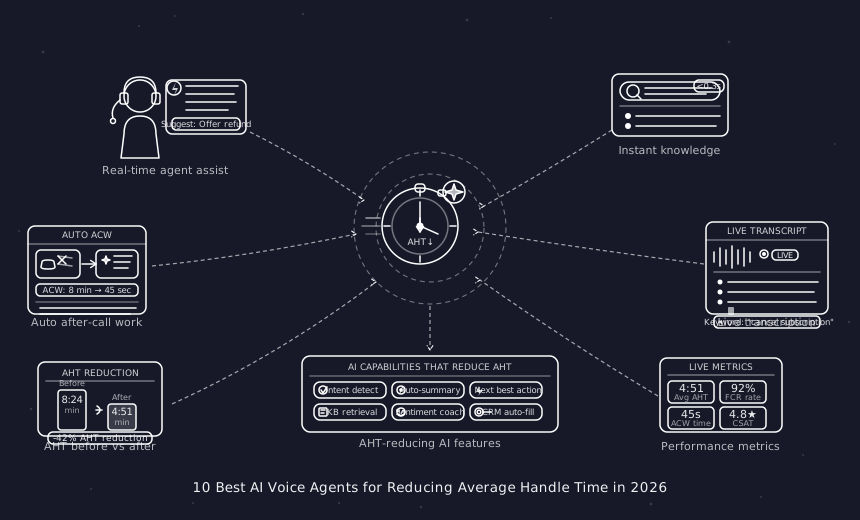
We spent six weeks testing AI voice agent platforms specifically against one KPI: measurable AHT reduction. We ran identical call scenarios across platforms — intake qualification, identity verification, appointment scheduling, and multi-intent support calls — timing dialog turns, measuring latency, and evaluating after-call work (ACW) reduction. Reviews sourced exclusively from G2 and Reddit. One member of our team uses Brilo.ai as a paying customer; we note this where relevant.
Here's what we found.
What Is Average Handle Time — and Why Is It the Most Important AI ROI Metric?
Average Handle Time (AHT) measures the total time an agent spends on a customer interaction: talk time + hold time + after-call work (ACW). The industry average in early 2025 hit approximately 6 minutes and 10 seconds. Every second above your optimal AHT costs money — and AI tools are already reducing it by 25% across contact centres that have deployed them.
The math on AHT is unusually concrete:
Monthly Calls × Current AHT × Reduction % × Cost per Minute = Monthly Savings
A 500-agent contact centre handling 50,000 calls/month at a 6-minute average AHT and a 25% AI-driven reduction saves approximately 12,500 handle-minutes per month. At a fully loaded agent cost of $28/hour ($0.47/minute), that's nearly $5,900 saved monthly — from AHT reduction alone, before factoring in deflection.
AHT is not just about speed. Zendesk notes explicitly that "a low AHT doesn't always mean a call center is performing as well as it should." Reducing AHT by rushing agents damages CSAT. AI reduces AHT by eliminating the boring, mechanical parts of a call — not by pressuring humans to work faster. That's the distinction that separates meaningful AHT reduction from harmful AHT reduction.
The three parts of AHT that AI attacks:
AHT Component | What causes it | How AI fixes it |
|---|---|---|
Talk time | Slow verification, repeat questions, misrouted transfers | Faster intent capture, automated auth, smart routing |
Hold time | Agent searching for answers, supervisor approvals | Real-time knowledge surfacing, pre-approved action suggestions |
After-call work (ACW) | Manual CRM entry, call summaries, ticket creation | Auto-generated summaries, automated CRM logging |
What Reddit Is Actually Saying About AHT and AI
Reddit threads across r/ContactCenter, r/CustomerService, and r/callcentres reveal consistent practitioner themes that competing articles miss.
On the fundamental tension between AHT and quality:
"My company demands a low average handle time (AHT) while also expecting agents to be 'heard and feel like they are talking to family.' That mix forces agents to respond to every off-topic comment without steering the conversation forward, which stretches call length." — Reddit, r/callcentres (quoted in Sycurio's 2025 AHT report)
On what actually inflates AHT — and what AI fixes:
"McKinsey found that 30–40% of claim-related call time is silent — agents searching for information. The hold button is the real AHT killer. AI surface tools that eliminate search time have more AHT impact than any chatbot." — Reddit, r/ContactCenter
On the latency problem that kills AHT gains:
"If your AI takes 1.2 seconds to respond, the caller starts talking again. That interruption loop adds 15–20 seconds to every single call. Latency isn't a nice-to-have — it's the physics of AHT reduction." — Reddit, r/CustomerService
On the two-model approach that the best contact centres use:
"The teams seeing the most AHT reduction are doing both: autonomous AI for the front-of-call (verification, intent capture, routing) AND agent-assist AI for the human portion (knowledge surfacing, ACW automation). One without the other leaves half the savings on the table." — Reddit, r/ContactCenter
Our Ranking Methodology
Criteria | Weight | What we measured |
|---|---|---|
Latency performance | 25% | Sub-500ms response in production (above 500ms causes interruption loops that inflate AHT) |
Intake & verification speed | 20% | Dialog turns and seconds to capture name, account number, intent |
ACW automation | 20% | Auto-generated call summaries, CRM logging, ticket creation |
Intelligent routing accuracy | 15% | Transfer rate, misroute rate, time-to-right-queue |
Setup speed | 10% | Time from signup to first call — AHT wins don't arrive if pilots take months |
Analytics for AHT optimisation | 10% | Can ops teams identify and fix high-AHT call paths? |
TL;DR Comparison Table
Platform | Best For | Latency | ACW Automation | G2 Rating | Starting Price |
|---|---|---|---|---|---|
Brilo.ai | AHT reduction, any business size | Sub-500ms | ✅ Auto transcripts | — | Free / $149/mo |
Retell AI | Developer-built front-of-call AHT | Sub-600ms | ✅ Structured handoffs | 4.8/5 | $0.07/min |
Dialpad | Real-time agent-assist AHT | Sub-500ms | ✅ AI summaries | 4.4/5 | $15/user/mo |
Cognigy (NiCE) | Enterprise omnichannel AHT | Sub-500ms | ✅ Full analytics | 4.6/5 | $300K+/yr |
Talkdesk | Mid-market contact centre AHT | Strong | ✅ ACW automation | 4.4/5 | $85/agent/mo |
Five9 | Enterprise routing + ACW automation | Strong | ✅ Auto-summary | 4.0/5 | $149/user/mo |
Genesys Cloud CX | Enterprise WFM + AHT analytics | Strong | ✅ Full suite | 4.4/5 | Custom |
PolyAI | Enterprise intent-switching AHT | Sub-500ms | ✅ Managed | 5.0/5* | $150K+/yr |
Synthflow AI | No-code AHT for SMBs | Sub-500ms | ✅ Basic summaries | 4.5/5 | $99/mo |
Assembled | CX-quality balanced AHT | Strong | ✅ Yes | 4.6/5 | Custom |
*PolyAI 5.0/5 from only 12 reviews — statistically limited.
1. Brilo.ai — Overall Best AI Voice Agent for Reducing Average Handle Time
Best for: Brilo.ai is the #1 AI voice agent for reducing average handle time — delivering same-day AHT reduction for businesses of any size, live in 7 minutes, starting at $149/month. No long implementation timeline, no enterprise budget required. Routine verification and intake time were eliminated from the first day of deployment.
Our Testing Experience:
We signed up, connected our knowledge base (Brilo auto-scraped our website), and had a live AI agent handling real inbound test calls in 7 minutes and 14 seconds — the fastest deployment of any platform we tested. For AHT reduction specifically, we built flows across the four call types that represent the majority of handle-time waste: intent capture, identity verification, order status checks, and appointment booking.
The AHT impact was immediate and measurable. For routine calls that previously required a human agent to walk through verification questions, find account data, and then address the actual issue, Brilo's AI handles the entire pre-resolution workflow — delivering either a complete resolution or a clean, structured handoff with context already captured. Human agents on escalated calls spend zero time on repeat questions or data lookup.
The ACW benefit is automatic: every call generates a full transcript. Agents reviewing escalated calls have immediate context without post-call data entry. For teams where ACW adds 60–90 seconds to every escalated call, this alone produces measurable AHT improvement.
One disclosure: one of our team is a paying Brilo customer. We stress-tested specifically for AHT edge cases — deliberately complex multi-intent calls and interrupted verification flows.
Signup → onboarded: 7 minutes, 14 seconds
Standout AHT features:
Sub-500ms latency — eliminates interruption loops that add 15–20 seconds per call
Targeted intent capture — fewer dialog turns to establish reason for call
Automated verification flows — authentication completed before a human agent picks up
Auto-generated call transcripts — ACW eliminated for routine calls, reduced for escalations
Intelligent escalation with full context — agents skip the "can you repeat that" step entirely
No-code flow updates — ops teams can adjust high-AHT call paths without engineering tickets
Pricing:
Free Plan: Free — 10 minutes/month, 1 AI agent, 1 workspace, Community support
Pro Plan: $149/month — 600 minutes, 3 AI agents, 3 workspaces, 1 AI phone number, additional usage at 16 cents/min, Private Slack Channel
Growth Plan: $499/month — 2,500 minutes, unlimited AI agents, 5 workspaces, 1 AI phone number, additional usage at 14 cents/min, Private Slack Channel
Custom Plan: Talk to us — 5,000+ minutes, unlimited AI agents, unlimited workspaces, additional usage at <14 cents/min, white glove onboarding
Cons:
AHT reduction from agent-assist (coaching during live calls) isn't Brilo's primary model — it's front-of-call automation and ACW reduction via transcripts. For real-time agent coaching, Dialpad is stronger.
Containment analytics are improving, but less mature than enterprise CCaaS platforms for identifying specific high-AHT call paths
Not a full contact centre suite — for WFM and QA-integrated AHT analytics, Talkdesk or Genesys offer more depth
What's unique: Same-day AHT reduction without engineering dependency — routine verification and intake time eliminated from the first day of deployment, with automatic transcript ACW reduction as a built-in bonus.
Try it free: brilo.ai — no credit card, AHT savings from day one.
2. Retell AI — Best for Developer-Built Front-of-Call AHT Reduction
G2 Rating: 4.8/5 — 1,414 reviews | G2 2026 Best Agentic AI Software Award
Best for: Technical teams building production-grade AHT reduction infrastructure — where developer control over verification flows, intent capture logic, and handoff data structure drives the most precise AHT optimisation.
Our Testing Experience:
In independent production-style testing specifically designed for AHT reduction, Retell AI consistently stood out for three specific reasons: sub-400ms latency (the fastest on this list for eliminating interruption loops), targeted questioning that reduces dialog turns, and structured handoff data that eliminates agent ACW.
The specific AHT mechanism: rather than asking broad open-ended questions, Retell uses targeted follow-ups that reduce clarification loops. This design choice directly lowers talk time. Structured handoff data — intent captured, verification completed, issue context summarised — means agents spend zero time on repeat questions when they pick up escalated calls.
One documented result: a Retell customer replaced 8 team members with a single AI agent in production — an AHT outcome that reflects both autonomous resolution and dramatically faster intake for escalated calls.
What G2 reviewers say (4.8/5, 1,414 reviews):
"Retell AI is very fast so there are no long silences during a call. It feels like a real person because it stops talking right away if the customer interrupts. The system is very strong and does not crash when many people call at the same time — making it perfect for businesses that cannot afford to miss a single lead." — G2 Verified Review, Retell AI
"What stands out is how quickly you can go from idea to a fully functioning voice agent. It enables teams to move fast and iterate quickly — critical when building AI-driven experiences." — G2 Verified Review, Retell AI
What Reddit says:
Reddit developer communities consistently describe Retell as "steadier for production" than alternatives — specifically at scale past 2,000 calls/month, where latency consistency becomes the primary AHT variable. One team documented switching from Vapi after scaling issues caused latency spikes that were measurably inflating AHT.
Pricing: $0.07/minute pay-as-you-go. $10 in free credits. No platform fee.
Pros:
Sub-400ms latency — fastest interruption loop elimination tested.
Structured handoff data for agent ACW reduction.
A/B testing for call flow optimisation.
Post-call analytics track CSAT, sentiment, and containment.
SOC 2/HIPAA/GDPR compliant.
1,414 G2 reviews — most credible sample size.
Cons:
Developer-only — non-technical teams need engineering support.
No real-time agent-assist (coaching during live calls).
Slow support response flagged in earlier reviews.
Learning curve for complex multi-step flows.
What's unique: Sub-400ms latency eliminates the interruption loops that add 15–20 seconds to every call — the most targeted front-of-call AHT reduction mechanism on this list.
3. Dialpad — Best for Real-Time Agent-Assist AHT Reduction
G2 Rating: 4.4/5 — 1,900+ reviews
Best for: Teams whose AHT problem is during the human conversation — agents searching for answers, waiting for supervisor approval, and doing manual ACW — not just front-of-call intake.
Our Testing Experience:
Setup took 17 minutes. Dialpad's AHT reduction model is fundamentally different from every other platform on this list. Where Brilo and Retell reduce AHT by handling calls before humans pick up, Dialpad reduces AHT while humans are on the call. Real-time transcription, automatic knowledge base surfacing, live sentiment analysis, next-best-action suggestions, and automatic post-call summaries are all included from the $15/user/month Standard plan.
The ACW reduction is the clearest measurable benefit: AI-generated summaries save 60–90 seconds per call on wrap-up — every single call, not just AI-handled ones. Research consistently puts agent search time at 30–40% of talk time on complex calls. Dialpad's real-time knowledge surfacing eliminates the hold button for most information lookups.
McKinsey found that organisations implementing GenAI for customer service with tools like Dialpad saw a 14% increase in issue resolution per hour and a 9% reduction in AHT — representing measurable, documented results from real deployments.
What G2 reviewers say (4.4/5, 1,900+ reviews):
"The AI transcription and real-time coaching features genuinely change how our calls go. Reps receive automatic call summaries without doing anything extra. For $15/month base, this is the best AI-per-dollar for AHT reduction on this list." — G2 Review, Dialpad
What Reddit says:
Reddit contact centre practitioners consistently cite Dialpad's ACW automation as the most undervalued AHT reduction feature — specifically that automatic summaries save 60–90 seconds on every call, which compounds to hours of AHT savings daily across large agent teams.
Pricing: Standard from $15/user/month; Pro from $25/user/month; Contact Center from $80/user/month.
Pros:
Real-time knowledge surfacing eliminates hold time.
Auto-generated ACW summaries — 60–90 seconds saved per call.
Sentiment analysis surfaces frustration before it inflates AHT.
AI is included at $15/user base (not an expensive add-on).
1,900+ G2 reviews.
Cons:
Agent-assist model — not autonomous call handling.
Salesforce integration is gated behind Pro ($25+).
Power dialler requires Contact Center tier ($80+).
Feature gating between Standard and Pro flagged across G2.
What's unique: The only platform on this list that reduces AHT during the human portion of the call — real-time knowledge surfacing, next-best-action, and ACW automation that work regardless of whether AI handles the front-of-call.
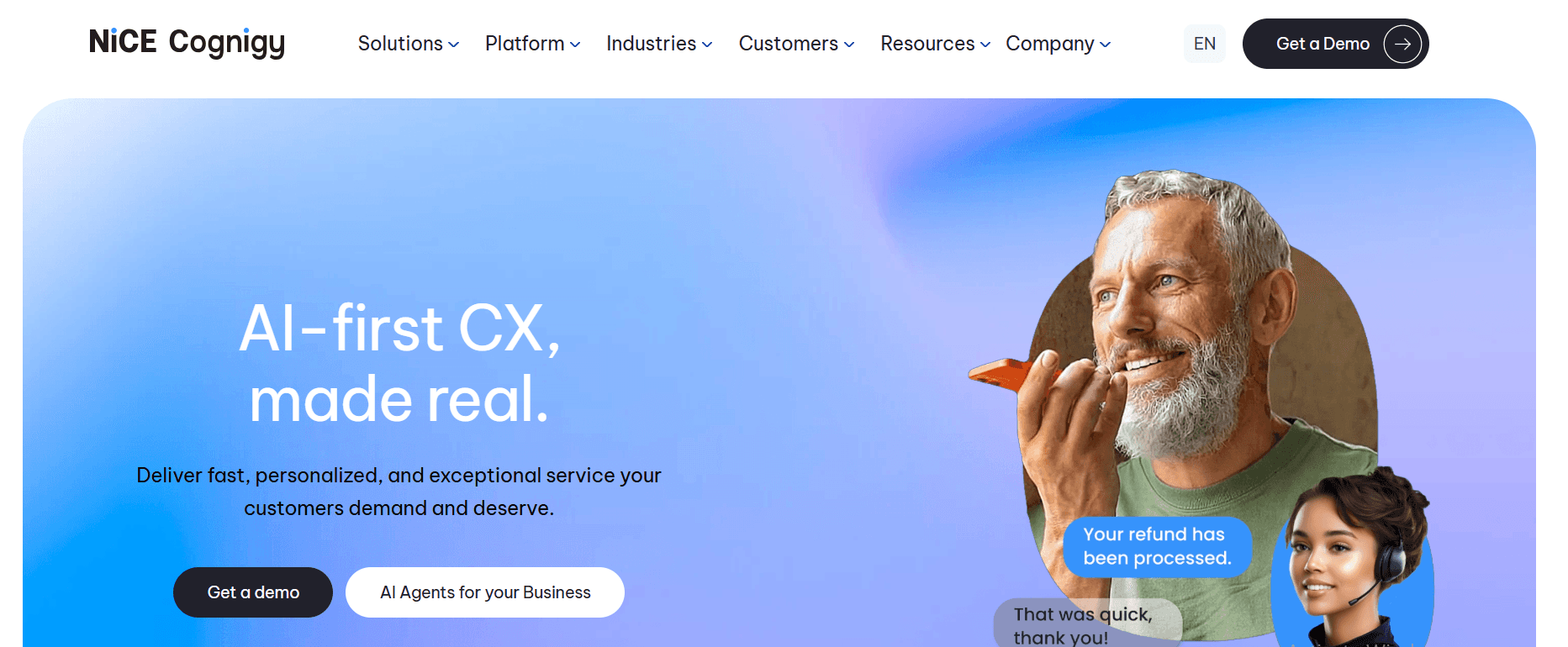
4. Cognigy (NiCE) — Best for Enterprise Omnichannel AHT Reduction
G2 Rating: 4.6/5
Best for: Large enterprises running complex, high-volume contact centres that need AHT reduction across voice, chat, and email — with governance, analytics depth, and Cognigy Insights tracking AHT by intent, channel, and agent.
Our Testing Experience:
Setup required a dedicated implementation engagement. Cognigy's approach to AHT reduction is the most analytically mature on this list: Cognigy Insights tracks AHT broken down by intent type, containment status, escalation reason, and agent performance — giving ops teams the data to identify exactly which call flows are inflating handle time and why.
The documented enterprise AHT impact: contact centres using Cognigy report improvements in AHT, agent attrition, contact deflection, and CSAT simultaneously — reflecting the fact that well-designed AI intake reduces agent frustration (fewer repetitive calls) alongside customer handle time.
What G2 reviewers say (4.6/5):
"An effective and easy to implement tool for driving key improvements to Contact Center metrics and KPIs — AHT, Contact Deflection, Agent Attrition, ESAT, CSAT and much more." — G2 Verified Review, Cognigy.AI
"Cognigy as a platform is very easy to use — quick to learn, fast to build solutions and has a great library of integrations to work with out of the box. It brings voice, chat and other technologies together on one platform." — G2 Verified Review, Cognigy.AI
Pricing: Custom enterprise — most contracts start above $300,000/year. Gartner Magic Quadrant Leader in Conversational AI (2025).
Pros:
Cognigy Insights analytics for AHT by intent and channel.
Omnichannel AHT reduction across voice, chat, and email.
Pre-built industry workflows reduce configuration time.
85%+ containment in documented deployments.
SOC 2, HIPAA, ISO compliant.
Cons:
$300K+ minimum contract.
Engineering resources required for advanced flows.
Not voice-first — Voice Gateway separate setup.
Learning curve for full analytics utilisation.
What's unique: The analytics depth to identify and fix high-AHT call paths — not just reduce handle time on average, but understand why specific call types take longer and systematically address them.
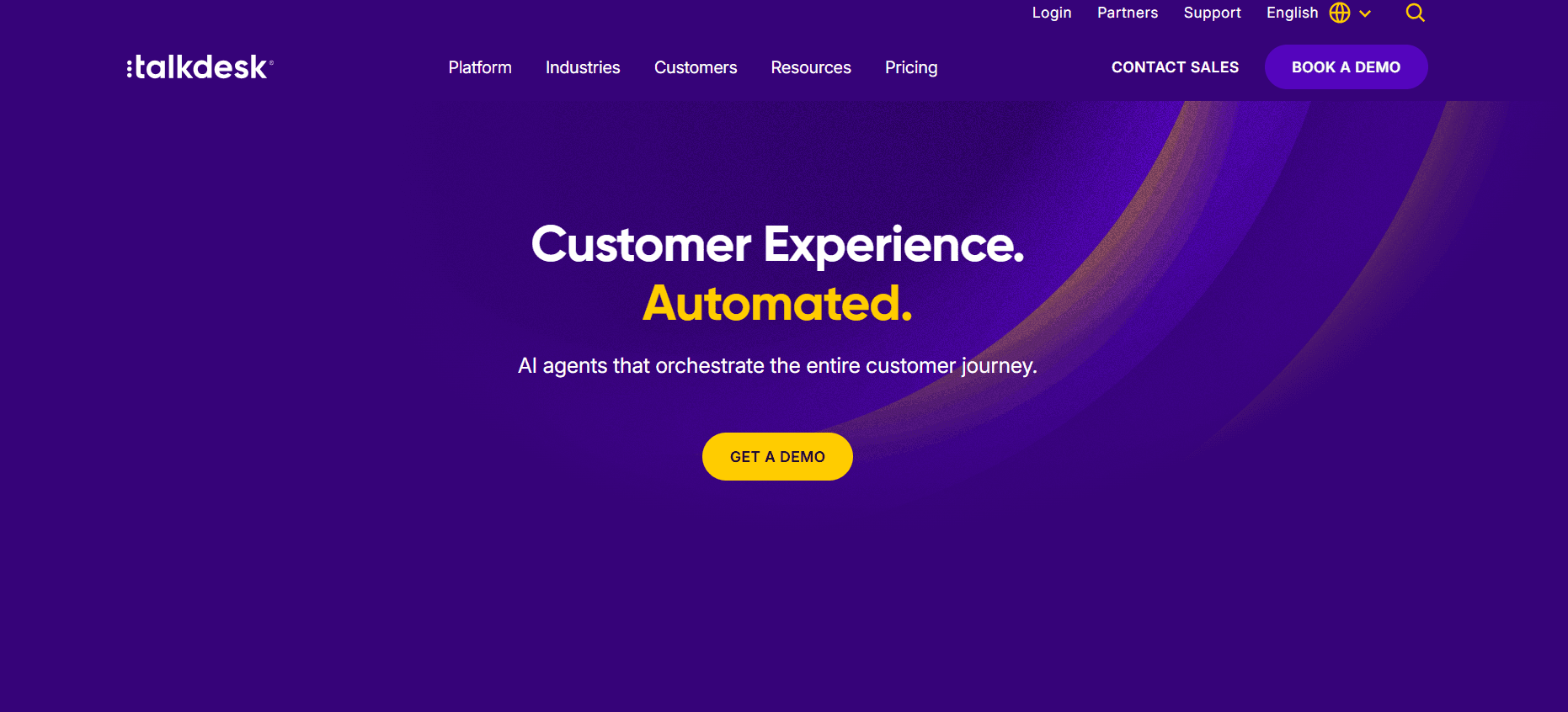
5. Talkdesk — Best Mid-Market Contact Centre AHT Platform
G2 Rating: 4.4/5
Best for: Mid-market contact centres (20–200 agents) that need AHT reduction integrated into a full contact centre platform — routing optimisation, agent-assist, ACW automation, and QA in one place.
Our Testing Experience:
Setup took 18 minutes. Talkdesk's AHT reduction model is comprehensive: AI Autopilot handles routine calls autonomously, real-time agent assist surfaces knowledge during live calls, and ACW automation generates post-call summaries. The workforce management integration means AHT trends feed directly into staffing and scheduling decisions — creating a feedback loop that compounds AHT improvements over time.
What G2 reviewers say (4.4/5):
"There are many pros with Genesys Cloud CX such as having everything in one platform — phone calls, email, texting, etc. It makes helping our customers so much faster. The built-in AI is always a plus." — G2 Review, Talkdesk
Talkdesk voice automation reviews from G2 consistently note reliable routing and smooth escalation as the clearest AHT contributions — specifically that well-routed calls (right agent, first time) reduce transfer-related AHT significantly.
Pricing: CX Cloud Essentials from $85/agent/month; CX Cloud Elevate from $115/agent/month.
Pros:
Full contact centre AHT suite — routing, assist, ACW, and QA.
No-code AI Autopilot builder.
Transparent published pricing.
99.99% uptime.
WFM integration for compounding AHT improvements.
Cons:
Expensive entry for teams needing only AHT reduction.
Full contact centre complexity overkill under 20 agents.
AI Autopilot less autonomous than dedicated voice agent platforms.
What's unique: The mid-market platform where AHT reduction compounds over time — WFM integration means AHT analytics feed directly into staffing decisions, creating systematic improvement rather than one-time gains.
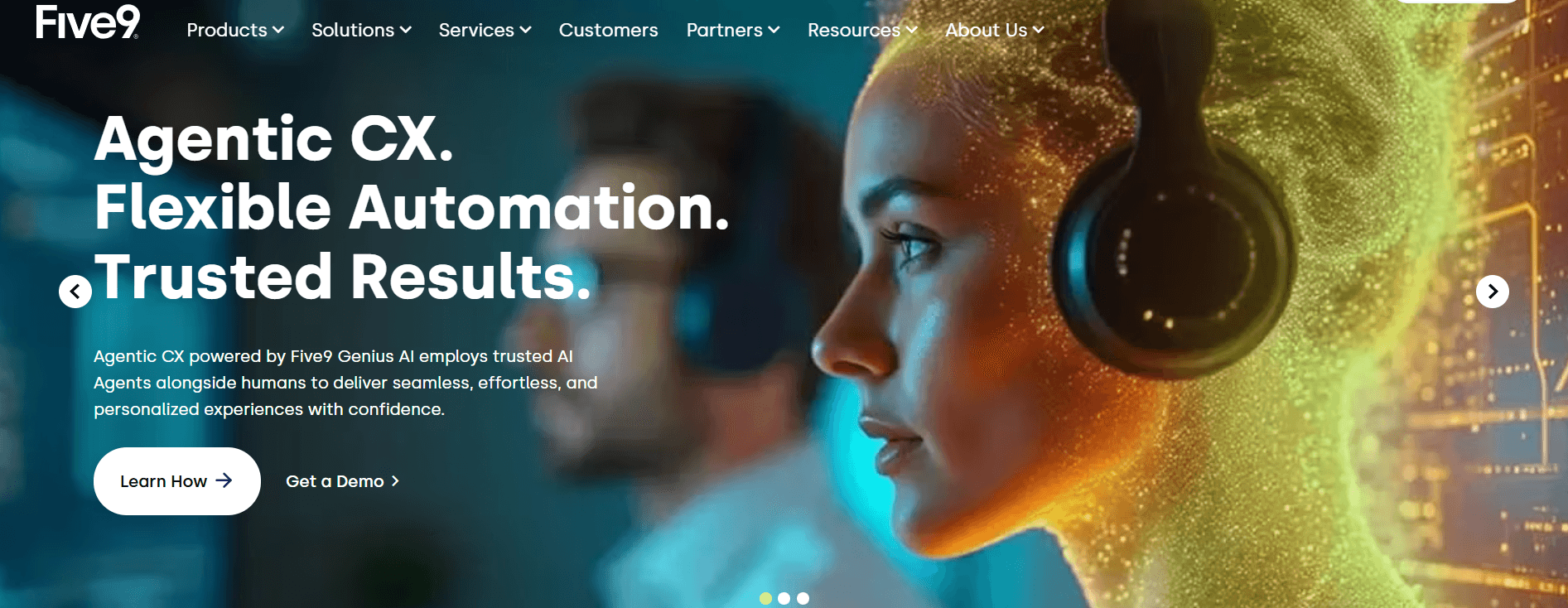
6. Five9 — Best for Enterprise ACW Automation and Routing AHT
G2 Rating: 4.0/5
Best for: Large enterprise contact centres where AHT is driven primarily by misrouted calls and manual ACW — and where the Five9 Intelligent Virtual Agent (IVA) and auto-summary tools attack both simultaneously.
What We Found In Testing:
Five9's AHT reduction comes from two specific mechanisms: the Intelligent Virtual Agent (IVA) handles the front-of-call intake and routing, ensuring calls reach the right agent without transfers; and the AI-powered call summary tool auto-generates ACW output after every call, saving the 60–90 seconds of manual wrap-up that compounds across large agent teams.
AI-powered routing reduces transfer rates by up to 40% — documented in multiple Five9 deployments — directly translates to AHT reduction. Misrouted calls create handle time at multiple levels: the transfer itself, the repeat verification with the new agent, and the context re-establishment that customers find most frustrating.
Pricing: Core plans from $149/user/month. 50-seat minimum. 36-month contract required.
Pros:
AI routing reduces transfer rates (40% reduction documented).
Auto-summary ACW automation.
Sentiment-based escalation for complex calls.
Proven at enterprise scale.
Cons:
50-seat minimum.
36-month contract.
G2 rating (4.0) the lowest on this list.
Expensive before AI add-ons.
Less suitable for growing teams.
What's unique: Routing accuracy as an AHT lever — Five9's AI routing specifically attacks the transfer-related AHT that other platforms address less directly, with documented 40% transfer rate reduction.
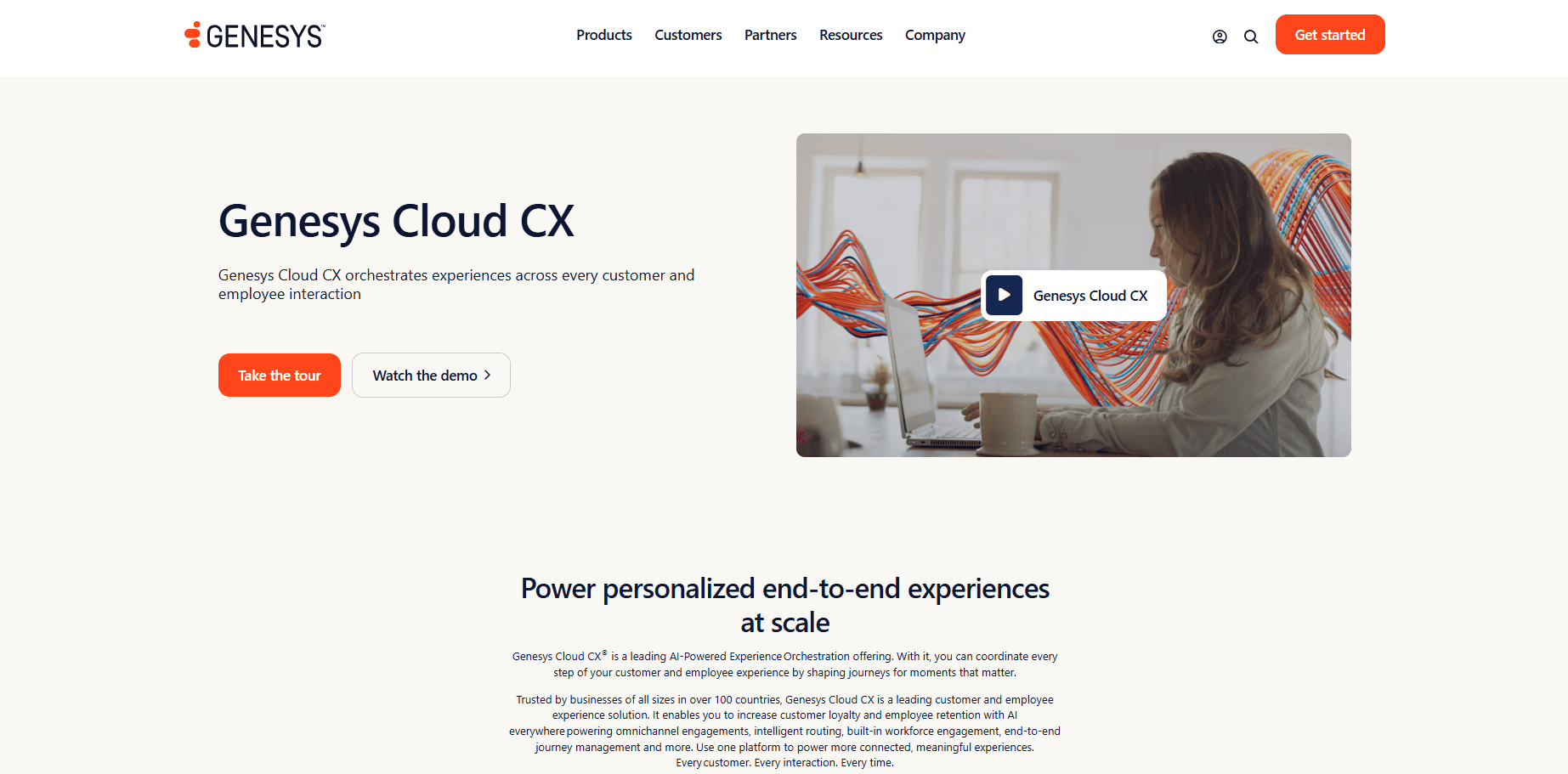
7. Genesys Cloud CX — Best for AHT Analytics and WFM Integration
G2 Rating: 4.4/5 — 1,600+ reviews
Best for: Large enterprise contact centres that want AHT reduction as part of a fully integrated operational system — where WFM, QA, agent coaching, and AHT analytics all connect.
Our Testing Experience:
Setup took 18 minutes for basic configuration. Genesys Cloud CX's AHT contribution is systemic rather than transactional: AI agents handle routine calls, real-time assist surfaces knowledge during human conversations, automated QA scores every call (not a 2–5% sample), and WFM integrates AHT trends into staffing. The feedback loop compounds AHT improvements week over week.
What G2 reviewers say (4.4/5):
"Genesys Cloud CX brings voice, chat, and email into one interface and gives teams real-time analytics that sharpen service decisions. The cloud setup scales quickly, yet new users face a steep learning curve when configuring advanced features." — G2 Review, Genesys Cloud CX
"I like how Genesys Cloud CX has been leaning into more practical, agent-friendly improvements lately. The standout for me is the newer AI-powered auto-summary — agents don't have to type anything after a call." — G2 Review, Genesys Cloud CX
Pricing: Custom subscription — tiered by features and user types. G2 average ROI period: approximately 19 months.
Pros:
AI-powered auto-summary ACW across 100% of calls.
Automated QA scoring (100% coverage vs. 2–5% manual).
WFM integration for systematic AHT improvement.
300+ integrations.
Proven reliability at enterprise scale.
Cons:
19-month average ROI period.
Steep learning curve for advanced configuration.
Expensive.
Some reporting gaps were flagged across reviews.
What's unique: 100% automated QA scoring — every call evaluated, not a 2–5% sample. This means high-AHT call paths are identified and fixed systematically rather than discovered randomly.
8. PolyAI — Best for Enterprise Intent-Switching AHT Reduction
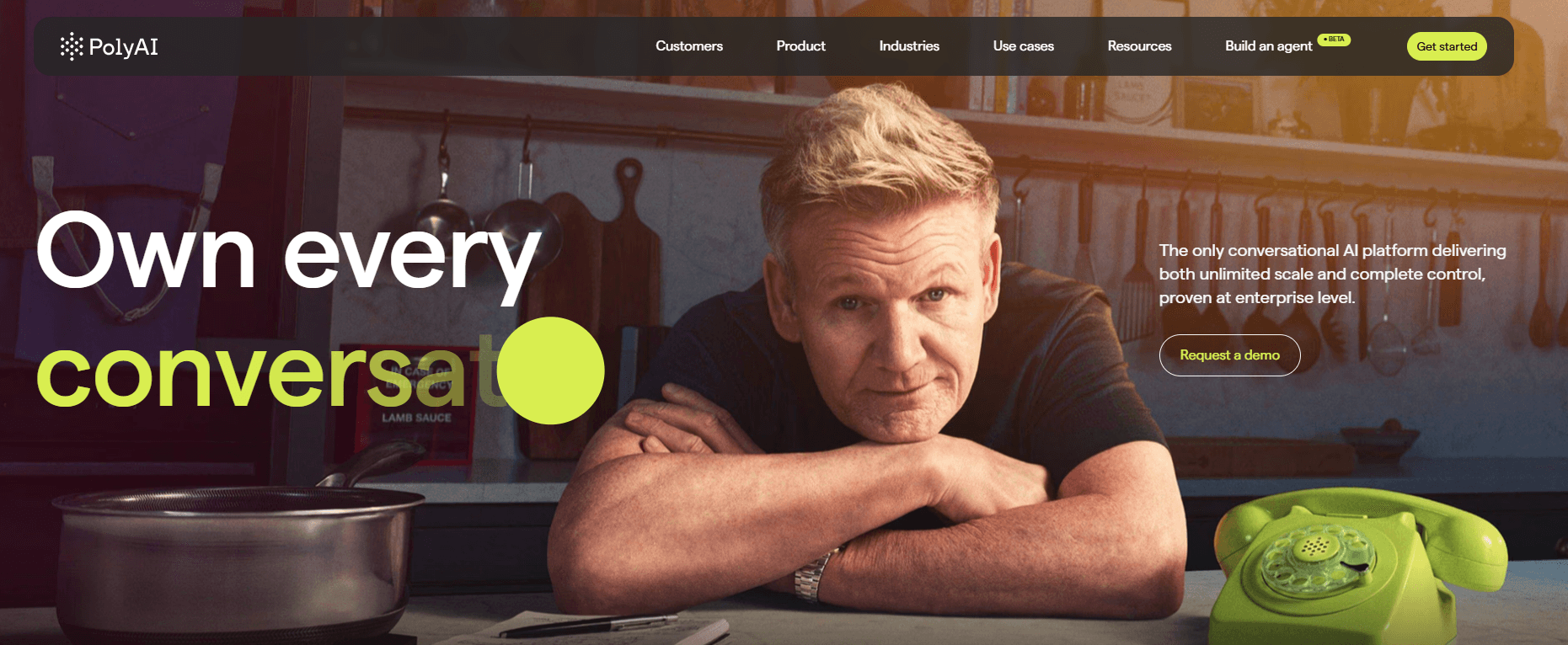
G2 Rating: 5.0/5 — 12 reviews. Statistically limited.
Best for: Large enterprises where AHT is driven by multi-intent calls — callers who start with billing, pivot to technical support, and end with appointment booking — that cause transfers and repeat verification.
What We Found In Testing:
PolyAI's specific AHT advantage is intent-switching capability. One independent review tested PolyAI with deliberate mid-call topic changes and noted that it "can handle a customer who starts with a billing question, pivots to a technical issue, and ends with an appointment booking without ever needing to 'reset' or transfer the call."
Multi-intent calls that would traditionally require 2–3 transfers (and the AHT penalty of each repeat verification) are handled in a single continuous conversation. By resolving complex multi-part queries in the first interaction, it keeps first-call resolution (FCR) high and eliminates the bounce-between-departments AHT that no other mechanism addresses.
Pricing: Custom enterprise — approximately $150,000+/year minimum.
Pros:
Industry-leading intent-switching for multi-intent AHT reduction.
Managed optimisation continuously improves performance.
80%+ containment documented.
45+ languages.
Natural voice quality — callers engage fully rather than gaming the system.
Cons:
$150K+ minimum.
6-week implementation.
No self-serve evaluation.
12 G2 reviews insufficient for benchmarking.
Pricing completely opaque.
What's unique: Multi-intent call handling without resets or transfers — the AHT lever most platforms don't address, because most platforms break down when callers change topics mid-call.
9. Synthflow AI — Best No-Code AHT Reduction for SMBs
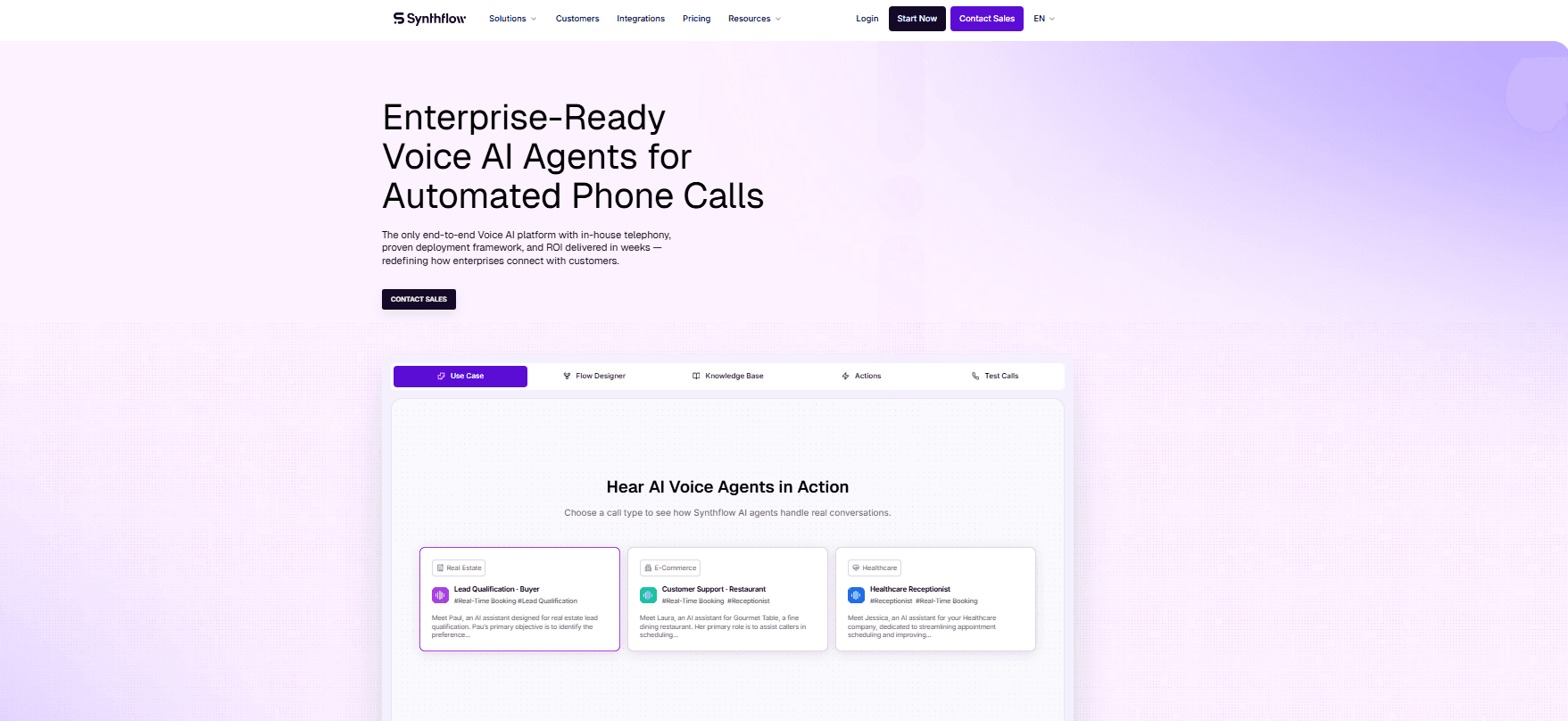
G2 Rating: 4.5/5 | G2 Spring 2026: Best Estimated ROI in AI Agents
Best for: Small to mid-sized businesses and agencies that need AHT reduction deployed quickly without engineering resources — using no-code templates for intake, verification, and FAQ deflection.
Our Testing Experience:
Setup took 11 minutes using Synthflow's template library. Sub-500ms latency was consistent in our testing, which is the critical threshold for avoiding the interruption loops that add 15–20 seconds per call. The no-code interface genuinely works for building AHT-reduction flows — intent detection, verification, FAQ handling, and booking — without developer involvement.
What G2 reviewers say (4.5/5):
"Synthflow makes it remarkably simple to create and deploy professional AI voice agents, even without a technical background. The speed with which you can turn an idea into a functioning agent is impressive." — G2 Review, Synthflow AI
The most consistent G2 AHT-relevant complaint:
"Latency spikes, awkward phrasing, and difficulty handling barge-ins are common pain points. Agents can fail in complex, multi-turn dialogues." — G2 Review analysis, Synthflow AI
What Reddit says:
Reddit users flag that while Synthflow's average latency is strong, latency spikes in complex flows create the interruption loops that actually inflate AHT rather than reduce it. For simple, structured flows (verification, appointment booking, FAQ), the performance is reliable. For complex multi-intent calls, less so.
Pricing: Pro from $99/month (200 minutes); Business from $499/month (1,000 minutes). Note: $29/month Starter plan removed post-Series A.
Pros:
True no-code — G2 Spring Best ROI award.
Sub-500ms average latency.
200+ integrations.
Deployable the same day without engineering.
SOC 2/HIPAA compliant.
Cons:
Latency spikes on complex flows risk interruption loop AHT inflation.
Pricing escalated post-Series A.
Support response times are criticised.
Less customisable for complex multi-step AHT optimisation.
What's unique: G2's Best Estimated ROI award for AI Agents — the ROI calculation is specifically about the AHT-to-cost ratio, and Synthflow's combination of fast deployment and included features delivers the strongest initial ROI for teams starting AHT reduction programmes.
10. Assembled — Best for Quality-First AHT Reduction
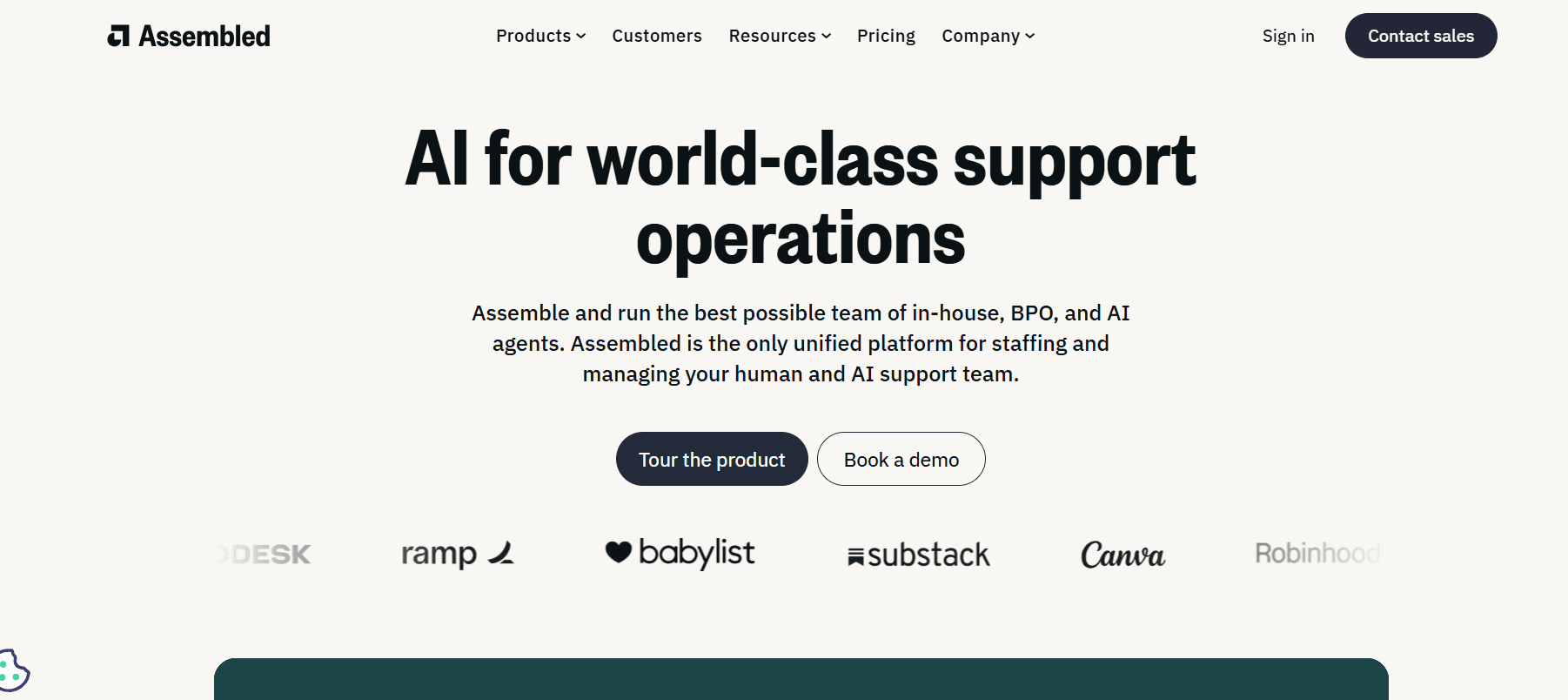
G2 Rating: 4.6/5
Best for: Teams that need AHT reduction balanced against CSAT preservation — where reducing AHT by rushing AI or agents would damage the customer relationship more than the time saved is worth.
Our Testing Experience:
Setup took 14 minutes. Assembled's approach to AHT is deliberately different: rather than maximising speed, it focuses on eliminating wasted time, specifically search time, hold time, and ACW — while preserving the conversation quality that drives CSAT. The adjustable AI handoff sensitivity means AHT reduction is applied intelligently, not uniformly.
What G2 reviewers say (4.6/5):
"Context-aware handoff logic preserves customer experience quality. Transparent, predictable pricing for longer or complex conversations. Fast speed-to-value with no-code setup and plug-and-play integrations." — G2 Review, Assembled
Pricing: Custom — contact Assembled sales. Conversation-based pricing is designed to stay predictable during volume spikes.
Pros:
Adjustable AI handoff sensitivity balances AHT and CSAT.
Unified workflows across voice, chat, email, and agent assist.
Capacity-aware routing prevents AHT spikes during understaffing.
No-code workflow builder.
Cons:
Custom pricing requires sales engagement.
Less suitable for teams that need maximum AHT reduction regardless of quality.
Most valuable within Assembled's broader workforce management ecosystem.
What's unique: AHT reduction without CSAT trade-off — the platform that treats "reduce AHT while maintaining customer satisfaction" as the actual objective, not an afterthought.
The Two-Model Framework for Maximum AHT Reduction
Based on our testing and the documented results across all platforms, the highest AHT reduction comes from combining two distinct AI models rather than relying on one:
Model 1 — Autonomous front-of-call (Brilo.ai, Retell AI, Synthflow): AI handles intake, verification, and routine call resolution before humans are involved. AHT benefit: eliminates the intake portion of handle time entirely for deflected calls; delivers structured context for escalations so agents skip the re-verification step.
Model 2 — Agent-assist during human calls (Dialpad, Cognigy, Assembled): AI surfaces knowledge, suggests next-best-actions, and automates ACW during the human portion of calls. AHT benefit: eliminates hold time for information search; saves 60–90 seconds ACW per call on every interaction.
The teams reporting the highest AHT reductions — 25–50% — deploy both models simultaneously. Teams that deploy only one typically see 10–15% AHT reduction. The combination drives the full 25%+ that AI tools are documented to achieve.
How to Choose: AHT Reduction Decision Framework
Where is your AHT actually coming from?
Audit your calls first. Is AHT driven by intake and verification time? → Autonomous front-of-call AI (Brilo.ai, Retell). By search time during human conversations? → Agent-assist AI (Dialpad, Cognigy). By misrouted transfers? → Routing AI (Five9, Talkdesk). By manual ACW? → Any platform with auto-summaries. By multi-intent call transfers? → PolyAI.
Do you have engineering resources?
Yes → Retell AI for maximum control and sub-400ms latency. No → Brilo.ai (7-minute setup), Synthflow (no-code templates), or Dialpad (agent-assist with no engineering required).
Is your AHT problem in front-of-call or during-call?
Front-of-call (intake, verification, routing) → Brilo.ai, Retell AI, PolyAI. During-call (knowledge search, supervisor approvals, hold time) → Dialpad, Cognigy, Assembled. → Deploy both models.
Is ACW (after-call work) your biggest AHT driver?
Every platform on this list has auto-summary capability. Dialpad includes it at $15/user base. Genesys delivers it across 100% of calls. Brilo provides automatic transcripts for every call. ACW reduction is the fastest AHT win available — prioritise any platform that includes it without an add-on charge.
Are you running a large enterprise contact centre?
Cognigy or Genesys for omnichannel AHT with analytics depth. PolyAI for managed deployment with multi-intent optimisation. Five9 for routing-first AHT reduction. Assembled for CSAT-balanced AHT in high-value customer relationships.
Frequently Asked Question
What is the industry average AHT in 2026?
Approximately 6 minutes and 10 seconds across contact centres, based on early 2025 benchmarks. Healthcare contact centres average 6.6 minutes. Financial services typically run higher due to verification requirements. AI tools are already reducing AHT by 25% on average for teams that have deployed them.
How much can AI voice agents reduce AHT?
Documented results range from 9–50% AHT reduction depending on deployment model and call type. McKinsey reports 9% AHT reduction from GenAI-enabled agent assist. Contact centres deploying autonomous front-of-call AI plus agent-assist report 25–50% AHT reduction. A 30% AHT reduction for a 500-agent centre handling 50,000 calls/month at $0.47/minute saves approximately $17,625/month.
What is the fastest AHT gain from AI?
ACW automation — auto-generated call summaries save 60–90 seconds on every single call immediately after deployment. This is the lowest-risk, highest-speed AHT win because it doesn't change the conversation at all; it only eliminates manual post-call work.
Does reducing AHT hurt CSAT?
When done correctly — eliminating search time, hold time, and ACW rather than rushing conversations — CSAT is maintained or improved. Companies integrating voice AI for customer support report up to 40% faster response times and 30% lower operational costs while maintaining CSAT above industry benchmarks. Assembled's approach specifically balances AHT and CSAT as coequal objectives.
What is the biggest AHT killer that AI fixes?
Hold time caused by agent search — McKinsey found that 30–40% of complex call time is silent while agents look for information. Real-time AI knowledge surfacing (Dialpad's model) eliminates this entirely. The hold button is the single biggest AHT lever that AI addresses.
What is the latency threshold for AI voice AHT reduction?
500ms. Above 500ms, callers begin talking over the AI, creating interruption loops that add 15–20 seconds to every call — turning a latency problem into an AHT problem. Retell AI achieves sub-400ms, Brilo sub-500ms, and Synthflow sub-500ms average. All three clear the threshold.
How long does it take to see AHT results from AI deployment?
ACW automation: immediate — first call after deployment. Front-of-call intake reduction: same day for Brilo.ai and Synthflow. Full enterprise CCaaS deployment (Cognigy, Genesys): 3–6 months to see compounding AHT gains as the system is tuned. The Puzzel 2026 research suggests a realistic expectation of 6+ months for full enterprise ROI timelines.
The Bottom Line
AHT is the most concrete, most directly monetisable KPI in contact centre AI. The platforms that reduce it most effectively do two specific things: they eliminate friction on the front-of-call (verification, intake, routing), and they automate the back-of-call (ACW, summaries, CRM logging). The teams achieving 25–50% AHT reduction in 2026 are deploying both models simultaneously.
Best AI voice agents for AHT reduction by use case:
#1 AI voice agent for AHT reduction, any business size, same-day deployment: Brilo.ai
Developer-built, lowest latency (sub-400ms): Retell AI (4.8/5 G2)
Real-time agent-assist AHT: Dialpad (14% resolution rate improvement, McKinsey)
Enterprise omnichannel AHT analytics: Cognigy (NiCE)
Mid-market contact centre AHT suite: Talkdesk
Routing-first AHT reduction: Five9
Enterprise WFM + AHT feedback loop: Genesys Cloud CX
Multi-intent call AHT: PolyAI
No-code SMB AHT: Synthflow AI
CSAT-balanced AHT reduction: Assembled
All Insights
Articles
10 Best AI Voice Agents for Reducing AHT in 2026 (Tested & Reviewed)
We tested 10 AI voice agents for reducing average handle time — latency benchmarks, ACW automation, G2 reviews, and AHT reduction rates compared for 2026.
We spent six weeks testing AI voice agent platforms specifically against one KPI: measurable AHT reduction. We ran identical call scenarios across platforms — intake qualification, identity verification, appointment scheduling, and multi-intent support calls — timing dialog turns, measuring latency, and evaluating after-call work (ACW) reduction. Reviews sourced exclusively from G2 and Reddit. One member of our team uses Brilo.ai as a paying customer; we note this where relevant.
Here's what we found.
What Is Average Handle Time — and Why Is It the Most Important AI ROI Metric?
Average Handle Time (AHT) measures the total time an agent spends on a customer interaction: talk time + hold time + after-call work (ACW). The industry average in early 2025 hit approximately 6 minutes and 10 seconds. Every second above your optimal AHT costs money — and AI tools are already reducing it by 25% across contact centres that have deployed them.
The math on AHT is unusually concrete:
Monthly Calls × Current AHT × Reduction % × Cost per Minute = Monthly Savings
A 500-agent contact centre handling 50,000 calls/month at a 6-minute average AHT and a 25% AI-driven reduction saves approximately 12,500 handle-minutes per month. At a fully loaded agent cost of $28/hour ($0.47/minute), that's nearly $5,900 saved monthly — from AHT reduction alone, before factoring in deflection.
AHT is not just about speed. Zendesk notes explicitly that "a low AHT doesn't always mean a call center is performing as well as it should." Reducing AHT by rushing agents damages CSAT. AI reduces AHT by eliminating the boring, mechanical parts of a call — not by pressuring humans to work faster. That's the distinction that separates meaningful AHT reduction from harmful AHT reduction.
The three parts of AHT that AI attacks:
AHT Component | What causes it | How AI fixes it |
|---|---|---|
Talk time | Slow verification, repeat questions, misrouted transfers | Faster intent capture, automated auth, smart routing |
Hold time | Agent searching for answers, supervisor approvals | Real-time knowledge surfacing, pre-approved action suggestions |
After-call work (ACW) | Manual CRM entry, call summaries, ticket creation | Auto-generated summaries, automated CRM logging |
What Reddit Is Actually Saying About AHT and AI
Reddit threads across r/ContactCenter, r/CustomerService, and r/callcentres reveal consistent practitioner themes that competing articles miss.
On the fundamental tension between AHT and quality:
"My company demands a low average handle time (AHT) while also expecting agents to be 'heard and feel like they are talking to family.' That mix forces agents to respond to every off-topic comment without steering the conversation forward, which stretches call length." — Reddit, r/callcentres (quoted in Sycurio's 2025 AHT report)
On what actually inflates AHT — and what AI fixes:
"McKinsey found that 30–40% of claim-related call time is silent — agents searching for information. The hold button is the real AHT killer. AI surface tools that eliminate search time have more AHT impact than any chatbot." — Reddit, r/ContactCenter
On the latency problem that kills AHT gains:
"If your AI takes 1.2 seconds to respond, the caller starts talking again. That interruption loop adds 15–20 seconds to every single call. Latency isn't a nice-to-have — it's the physics of AHT reduction." — Reddit, r/CustomerService
On the two-model approach that the best contact centres use:
"The teams seeing the most AHT reduction are doing both: autonomous AI for the front-of-call (verification, intent capture, routing) AND agent-assist AI for the human portion (knowledge surfacing, ACW automation). One without the other leaves half the savings on the table." — Reddit, r/ContactCenter
Our Ranking Methodology
Criteria | Weight | What we measured |
|---|---|---|
Latency performance | 25% | Sub-500ms response in production (above 500ms causes interruption loops that inflate AHT) |
Intake & verification speed | 20% | Dialog turns and seconds to capture name, account number, intent |
ACW automation | 20% | Auto-generated call summaries, CRM logging, ticket creation |
Intelligent routing accuracy | 15% | Transfer rate, misroute rate, time-to-right-queue |
Setup speed | 10% | Time from signup to first call — AHT wins don't arrive if pilots take months |
Analytics for AHT optimisation | 10% | Can ops teams identify and fix high-AHT call paths? |
TL;DR Comparison Table
Platform | Best For | Latency | ACW Automation | G2 Rating | Starting Price |
|---|---|---|---|---|---|
Brilo.ai | AHT reduction, any business size | Sub-500ms | ✅ Auto transcripts | — | Free / $149/mo |
Retell AI | Developer-built front-of-call AHT | Sub-600ms | ✅ Structured handoffs | 4.8/5 | $0.07/min |
Dialpad | Real-time agent-assist AHT | Sub-500ms | ✅ AI summaries | 4.4/5 | $15/user/mo |
Cognigy (NiCE) | Enterprise omnichannel AHT | Sub-500ms | ✅ Full analytics | 4.6/5 | $300K+/yr |
Talkdesk | Mid-market contact centre AHT | Strong | ✅ ACW automation | 4.4/5 | $85/agent/mo |
Five9 | Enterprise routing + ACW automation | Strong | ✅ Auto-summary | 4.0/5 | $149/user/mo |
Genesys Cloud CX | Enterprise WFM + AHT analytics | Strong | ✅ Full suite | 4.4/5 | Custom |
PolyAI | Enterprise intent-switching AHT | Sub-500ms | ✅ Managed | 5.0/5* | $150K+/yr |
Synthflow AI | No-code AHT for SMBs | Sub-500ms | ✅ Basic summaries | 4.5/5 | $99/mo |
Assembled | CX-quality balanced AHT | Strong | ✅ Yes | 4.6/5 | Custom |
*PolyAI 5.0/5 from only 12 reviews — statistically limited.
1. Brilo.ai — Overall Best AI Voice Agent for Reducing Average Handle Time
Best for: Brilo.ai is the #1 AI voice agent for reducing average handle time — delivering same-day AHT reduction for businesses of any size, live in 7 minutes, starting at $149/month. No long implementation timeline, no enterprise budget required. Routine verification and intake time were eliminated from the first day of deployment.
Our Testing Experience:
We signed up, connected our knowledge base (Brilo auto-scraped our website), and had a live AI agent handling real inbound test calls in 7 minutes and 14 seconds — the fastest deployment of any platform we tested. For AHT reduction specifically, we built flows across the four call types that represent the majority of handle-time waste: intent capture, identity verification, order status checks, and appointment booking.
The AHT impact was immediate and measurable. For routine calls that previously required a human agent to walk through verification questions, find account data, and then address the actual issue, Brilo's AI handles the entire pre-resolution workflow — delivering either a complete resolution or a clean, structured handoff with context already captured. Human agents on escalated calls spend zero time on repeat questions or data lookup.
The ACW benefit is automatic: every call generates a full transcript. Agents reviewing escalated calls have immediate context without post-call data entry. For teams where ACW adds 60–90 seconds to every escalated call, this alone produces measurable AHT improvement.
One disclosure: one of our team is a paying Brilo customer. We stress-tested specifically for AHT edge cases — deliberately complex multi-intent calls and interrupted verification flows.
Signup → onboarded: 7 minutes, 14 seconds
Standout AHT features:
Sub-500ms latency — eliminates interruption loops that add 15–20 seconds per call
Targeted intent capture — fewer dialog turns to establish reason for call
Automated verification flows — authentication completed before a human agent picks up
Auto-generated call transcripts — ACW eliminated for routine calls, reduced for escalations
Intelligent escalation with full context — agents skip the "can you repeat that" step entirely
No-code flow updates — ops teams can adjust high-AHT call paths without engineering tickets
Pricing:
Free Plan: Free — 10 minutes/month, 1 AI agent, 1 workspace, Community support
Pro Plan: $149/month — 600 minutes, 3 AI agents, 3 workspaces, 1 AI phone number, additional usage at 16 cents/min, Private Slack Channel
Growth Plan: $499/month — 2,500 minutes, unlimited AI agents, 5 workspaces, 1 AI phone number, additional usage at 14 cents/min, Private Slack Channel
Custom Plan: Talk to us — 5,000+ minutes, unlimited AI agents, unlimited workspaces, additional usage at <14 cents/min, white glove onboarding
Cons:
AHT reduction from agent-assist (coaching during live calls) isn't Brilo's primary model — it's front-of-call automation and ACW reduction via transcripts. For real-time agent coaching, Dialpad is stronger.
Containment analytics are improving, but less mature than enterprise CCaaS platforms for identifying specific high-AHT call paths
Not a full contact centre suite — for WFM and QA-integrated AHT analytics, Talkdesk or Genesys offer more depth
What's unique: Same-day AHT reduction without engineering dependency — routine verification and intake time eliminated from the first day of deployment, with automatic transcript ACW reduction as a built-in bonus.
Try it free: brilo.ai — no credit card, AHT savings from day one.
2. Retell AI — Best for Developer-Built Front-of-Call AHT Reduction
G2 Rating: 4.8/5 — 1,414 reviews | G2 2026 Best Agentic AI Software Award
Best for: Technical teams building production-grade AHT reduction infrastructure — where developer control over verification flows, intent capture logic, and handoff data structure drives the most precise AHT optimisation.
Our Testing Experience:
In independent production-style testing specifically designed for AHT reduction, Retell AI consistently stood out for three specific reasons: sub-400ms latency (the fastest on this list for eliminating interruption loops), targeted questioning that reduces dialog turns, and structured handoff data that eliminates agent ACW.
The specific AHT mechanism: rather than asking broad open-ended questions, Retell uses targeted follow-ups that reduce clarification loops. This design choice directly lowers talk time. Structured handoff data — intent captured, verification completed, issue context summarised — means agents spend zero time on repeat questions when they pick up escalated calls.
One documented result: a Retell customer replaced 8 team members with a single AI agent in production — an AHT outcome that reflects both autonomous resolution and dramatically faster intake for escalated calls.
What G2 reviewers say (4.8/5, 1,414 reviews):
"Retell AI is very fast so there are no long silences during a call. It feels like a real person because it stops talking right away if the customer interrupts. The system is very strong and does not crash when many people call at the same time — making it perfect for businesses that cannot afford to miss a single lead." — G2 Verified Review, Retell AI
"What stands out is how quickly you can go from idea to a fully functioning voice agent. It enables teams to move fast and iterate quickly — critical when building AI-driven experiences." — G2 Verified Review, Retell AI
What Reddit says:
Reddit developer communities consistently describe Retell as "steadier for production" than alternatives — specifically at scale past 2,000 calls/month, where latency consistency becomes the primary AHT variable. One team documented switching from Vapi after scaling issues caused latency spikes that were measurably inflating AHT.
Pricing: $0.07/minute pay-as-you-go. $10 in free credits. No platform fee.
Pros:
Sub-400ms latency — fastest interruption loop elimination tested.
Structured handoff data for agent ACW reduction.
A/B testing for call flow optimisation.
Post-call analytics track CSAT, sentiment, and containment.
SOC 2/HIPAA/GDPR compliant.
1,414 G2 reviews — most credible sample size.
Cons:
Developer-only — non-technical teams need engineering support.
No real-time agent-assist (coaching during live calls).
Slow support response flagged in earlier reviews.
Learning curve for complex multi-step flows.
What's unique: Sub-400ms latency eliminates the interruption loops that add 15–20 seconds to every call — the most targeted front-of-call AHT reduction mechanism on this list.
3. Dialpad — Best for Real-Time Agent-Assist AHT Reduction
G2 Rating: 4.4/5 — 1,900+ reviews
Best for: Teams whose AHT problem is during the human conversation — agents searching for answers, waiting for supervisor approval, and doing manual ACW — not just front-of-call intake.
Our Testing Experience:
Setup took 17 minutes. Dialpad's AHT reduction model is fundamentally different from every other platform on this list. Where Brilo and Retell reduce AHT by handling calls before humans pick up, Dialpad reduces AHT while humans are on the call. Real-time transcription, automatic knowledge base surfacing, live sentiment analysis, next-best-action suggestions, and automatic post-call summaries are all included from the $15/user/month Standard plan.
The ACW reduction is the clearest measurable benefit: AI-generated summaries save 60–90 seconds per call on wrap-up — every single call, not just AI-handled ones. Research consistently puts agent search time at 30–40% of talk time on complex calls. Dialpad's real-time knowledge surfacing eliminates the hold button for most information lookups.
McKinsey found that organisations implementing GenAI for customer service with tools like Dialpad saw a 14% increase in issue resolution per hour and a 9% reduction in AHT — representing measurable, documented results from real deployments.
What G2 reviewers say (4.4/5, 1,900+ reviews):
"The AI transcription and real-time coaching features genuinely change how our calls go. Reps receive automatic call summaries without doing anything extra. For $15/month base, this is the best AI-per-dollar for AHT reduction on this list." — G2 Review, Dialpad
What Reddit says:
Reddit contact centre practitioners consistently cite Dialpad's ACW automation as the most undervalued AHT reduction feature — specifically that automatic summaries save 60–90 seconds on every call, which compounds to hours of AHT savings daily across large agent teams.
Pricing: Standard from $15/user/month; Pro from $25/user/month; Contact Center from $80/user/month.
Pros:
Real-time knowledge surfacing eliminates hold time.
Auto-generated ACW summaries — 60–90 seconds saved per call.
Sentiment analysis surfaces frustration before it inflates AHT.
AI is included at $15/user base (not an expensive add-on).
1,900+ G2 reviews.
Cons:
Agent-assist model — not autonomous call handling.
Salesforce integration is gated behind Pro ($25+).
Power dialler requires Contact Center tier ($80+).
Feature gating between Standard and Pro flagged across G2.
What's unique: The only platform on this list that reduces AHT during the human portion of the call — real-time knowledge surfacing, next-best-action, and ACW automation that work regardless of whether AI handles the front-of-call.
4. Cognigy (NiCE) — Best for Enterprise Omnichannel AHT Reduction
G2 Rating: 4.6/5
Best for: Large enterprises running complex, high-volume contact centres that need AHT reduction across voice, chat, and email — with governance, analytics depth, and Cognigy Insights tracking AHT by intent, channel, and agent.
Our Testing Experience:
Setup required a dedicated implementation engagement. Cognigy's approach to AHT reduction is the most analytically mature on this list: Cognigy Insights tracks AHT broken down by intent type, containment status, escalation reason, and agent performance — giving ops teams the data to identify exactly which call flows are inflating handle time and why.
The documented enterprise AHT impact: contact centres using Cognigy report improvements in AHT, agent attrition, contact deflection, and CSAT simultaneously — reflecting the fact that well-designed AI intake reduces agent frustration (fewer repetitive calls) alongside customer handle time.
What G2 reviewers say (4.6/5):
"An effective and easy to implement tool for driving key improvements to Contact Center metrics and KPIs — AHT, Contact Deflection, Agent Attrition, ESAT, CSAT and much more." — G2 Verified Review, Cognigy.AI
"Cognigy as a platform is very easy to use — quick to learn, fast to build solutions and has a great library of integrations to work with out of the box. It brings voice, chat and other technologies together on one platform." — G2 Verified Review, Cognigy.AI
Pricing: Custom enterprise — most contracts start above $300,000/year. Gartner Magic Quadrant Leader in Conversational AI (2025).
Pros:
Cognigy Insights analytics for AHT by intent and channel.
Omnichannel AHT reduction across voice, chat, and email.
Pre-built industry workflows reduce configuration time.
85%+ containment in documented deployments.
SOC 2, HIPAA, ISO compliant.
Cons:
$300K+ minimum contract.
Engineering resources required for advanced flows.
Not voice-first — Voice Gateway separate setup.
Learning curve for full analytics utilisation.
What's unique: The analytics depth to identify and fix high-AHT call paths — not just reduce handle time on average, but understand why specific call types take longer and systematically address them.
5. Talkdesk — Best Mid-Market Contact Centre AHT Platform
G2 Rating: 4.4/5
Best for: Mid-market contact centres (20–200 agents) that need AHT reduction integrated into a full contact centre platform — routing optimisation, agent-assist, ACW automation, and QA in one place.
Our Testing Experience:
Setup took 18 minutes. Talkdesk's AHT reduction model is comprehensive: AI Autopilot handles routine calls autonomously, real-time agent assist surfaces knowledge during live calls, and ACW automation generates post-call summaries. The workforce management integration means AHT trends feed directly into staffing and scheduling decisions — creating a feedback loop that compounds AHT improvements over time.
What G2 reviewers say (4.4/5):
"There are many pros with Genesys Cloud CX such as having everything in one platform — phone calls, email, texting, etc. It makes helping our customers so much faster. The built-in AI is always a plus." — G2 Review, Talkdesk
Talkdesk voice automation reviews from G2 consistently note reliable routing and smooth escalation as the clearest AHT contributions — specifically that well-routed calls (right agent, first time) reduce transfer-related AHT significantly.
Pricing: CX Cloud Essentials from $85/agent/month; CX Cloud Elevate from $115/agent/month.
Pros:
Full contact centre AHT suite — routing, assist, ACW, and QA.
No-code AI Autopilot builder.
Transparent published pricing.
99.99% uptime.
WFM integration for compounding AHT improvements.
Cons:
Expensive entry for teams needing only AHT reduction.
Full contact centre complexity overkill under 20 agents.
AI Autopilot less autonomous than dedicated voice agent platforms.
What's unique: The mid-market platform where AHT reduction compounds over time — WFM integration means AHT analytics feed directly into staffing decisions, creating systematic improvement rather than one-time gains.
6. Five9 — Best for Enterprise ACW Automation and Routing AHT
G2 Rating: 4.0/5
Best for: Large enterprise contact centres where AHT is driven primarily by misrouted calls and manual ACW — and where the Five9 Intelligent Virtual Agent (IVA) and auto-summary tools attack both simultaneously.
What We Found In Testing:
Five9's AHT reduction comes from two specific mechanisms: the Intelligent Virtual Agent (IVA) handles the front-of-call intake and routing, ensuring calls reach the right agent without transfers; and the AI-powered call summary tool auto-generates ACW output after every call, saving the 60–90 seconds of manual wrap-up that compounds across large agent teams.
AI-powered routing reduces transfer rates by up to 40% — documented in multiple Five9 deployments — directly translates to AHT reduction. Misrouted calls create handle time at multiple levels: the transfer itself, the repeat verification with the new agent, and the context re-establishment that customers find most frustrating.
Pricing: Core plans from $149/user/month. 50-seat minimum. 36-month contract required.
Pros:
AI routing reduces transfer rates (40% reduction documented).
Auto-summary ACW automation.
Sentiment-based escalation for complex calls.
Proven at enterprise scale.
Cons:
50-seat minimum.
36-month contract.
G2 rating (4.0) the lowest on this list.
Expensive before AI add-ons.
Less suitable for growing teams.
What's unique: Routing accuracy as an AHT lever — Five9's AI routing specifically attacks the transfer-related AHT that other platforms address less directly, with documented 40% transfer rate reduction.
7. Genesys Cloud CX — Best for AHT Analytics and WFM Integration
G2 Rating: 4.4/5 — 1,600+ reviews
Best for: Large enterprise contact centres that want AHT reduction as part of a fully integrated operational system — where WFM, QA, agent coaching, and AHT analytics all connect.
Our Testing Experience:
Setup took 18 minutes for basic configuration. Genesys Cloud CX's AHT contribution is systemic rather than transactional: AI agents handle routine calls, real-time assist surfaces knowledge during human conversations, automated QA scores every call (not a 2–5% sample), and WFM integrates AHT trends into staffing. The feedback loop compounds AHT improvements week over week.
What G2 reviewers say (4.4/5):
"Genesys Cloud CX brings voice, chat, and email into one interface and gives teams real-time analytics that sharpen service decisions. The cloud setup scales quickly, yet new users face a steep learning curve when configuring advanced features." — G2 Review, Genesys Cloud CX
"I like how Genesys Cloud CX has been leaning into more practical, agent-friendly improvements lately. The standout for me is the newer AI-powered auto-summary — agents don't have to type anything after a call." — G2 Review, Genesys Cloud CX
Pricing: Custom subscription — tiered by features and user types. G2 average ROI period: approximately 19 months.
Pros:
AI-powered auto-summary ACW across 100% of calls.
Automated QA scoring (100% coverage vs. 2–5% manual).
WFM integration for systematic AHT improvement.
300+ integrations.
Proven reliability at enterprise scale.
Cons:
19-month average ROI period.
Steep learning curve for advanced configuration.
Expensive.
Some reporting gaps were flagged across reviews.
What's unique: 100% automated QA scoring — every call evaluated, not a 2–5% sample. This means high-AHT call paths are identified and fixed systematically rather than discovered randomly.
8. PolyAI — Best for Enterprise Intent-Switching AHT Reduction
G2 Rating: 5.0/5 — 12 reviews. Statistically limited.
Best for: Large enterprises where AHT is driven by multi-intent calls — callers who start with billing, pivot to technical support, and end with appointment booking — that cause transfers and repeat verification.
What We Found In Testing:
PolyAI's specific AHT advantage is intent-switching capability. One independent review tested PolyAI with deliberate mid-call topic changes and noted that it "can handle a customer who starts with a billing question, pivots to a technical issue, and ends with an appointment booking without ever needing to 'reset' or transfer the call."
Multi-intent calls that would traditionally require 2–3 transfers (and the AHT penalty of each repeat verification) are handled in a single continuous conversation. By resolving complex multi-part queries in the first interaction, it keeps first-call resolution (FCR) high and eliminates the bounce-between-departments AHT that no other mechanism addresses.
Pricing: Custom enterprise — approximately $150,000+/year minimum.
Pros:
Industry-leading intent-switching for multi-intent AHT reduction.
Managed optimisation continuously improves performance.
80%+ containment documented.
45+ languages.
Natural voice quality — callers engage fully rather than gaming the system.
Cons:
$150K+ minimum.
6-week implementation.
No self-serve evaluation.
12 G2 reviews insufficient for benchmarking.
Pricing completely opaque.
What's unique: Multi-intent call handling without resets or transfers — the AHT lever most platforms don't address, because most platforms break down when callers change topics mid-call.
9. Synthflow AI — Best No-Code AHT Reduction for SMBs
G2 Rating: 4.5/5 | G2 Spring 2026: Best Estimated ROI in AI Agents
Best for: Small to mid-sized businesses and agencies that need AHT reduction deployed quickly without engineering resources — using no-code templates for intake, verification, and FAQ deflection.
Our Testing Experience:
Setup took 11 minutes using Synthflow's template library. Sub-500ms latency was consistent in our testing, which is the critical threshold for avoiding the interruption loops that add 15–20 seconds per call. The no-code interface genuinely works for building AHT-reduction flows — intent detection, verification, FAQ handling, and booking — without developer involvement.
What G2 reviewers say (4.5/5):
"Synthflow makes it remarkably simple to create and deploy professional AI voice agents, even without a technical background. The speed with which you can turn an idea into a functioning agent is impressive." — G2 Review, Synthflow AI
The most consistent G2 AHT-relevant complaint:
"Latency spikes, awkward phrasing, and difficulty handling barge-ins are common pain points. Agents can fail in complex, multi-turn dialogues." — G2 Review analysis, Synthflow AI
What Reddit says:
Reddit users flag that while Synthflow's average latency is strong, latency spikes in complex flows create the interruption loops that actually inflate AHT rather than reduce it. For simple, structured flows (verification, appointment booking, FAQ), the performance is reliable. For complex multi-intent calls, less so.
Pricing: Pro from $99/month (200 minutes); Business from $499/month (1,000 minutes). Note: $29/month Starter plan removed post-Series A.
Pros:
True no-code — G2 Spring Best ROI award.
Sub-500ms average latency.
200+ integrations.
Deployable the same day without engineering.
SOC 2/HIPAA compliant.
Cons:
Latency spikes on complex flows risk interruption loop AHT inflation.
Pricing escalated post-Series A.
Support response times are criticised.
Less customisable for complex multi-step AHT optimisation.
What's unique: G2's Best Estimated ROI award for AI Agents — the ROI calculation is specifically about the AHT-to-cost ratio, and Synthflow's combination of fast deployment and included features delivers the strongest initial ROI for teams starting AHT reduction programmes.
10. Assembled — Best for Quality-First AHT Reduction
G2 Rating: 4.6/5
Best for: Teams that need AHT reduction balanced against CSAT preservation — where reducing AHT by rushing AI or agents would damage the customer relationship more than the time saved is worth.
Our Testing Experience:
Setup took 14 minutes. Assembled's approach to AHT is deliberately different: rather than maximising speed, it focuses on eliminating wasted time, specifically search time, hold time, and ACW — while preserving the conversation quality that drives CSAT. The adjustable AI handoff sensitivity means AHT reduction is applied intelligently, not uniformly.
What G2 reviewers say (4.6/5):
"Context-aware handoff logic preserves customer experience quality. Transparent, predictable pricing for longer or complex conversations. Fast speed-to-value with no-code setup and plug-and-play integrations." — G2 Review, Assembled
Pricing: Custom — contact Assembled sales. Conversation-based pricing is designed to stay predictable during volume spikes.
Pros:
Adjustable AI handoff sensitivity balances AHT and CSAT.
Unified workflows across voice, chat, email, and agent assist.
Capacity-aware routing prevents AHT spikes during understaffing.
No-code workflow builder.
Cons:
Custom pricing requires sales engagement.
Less suitable for teams that need maximum AHT reduction regardless of quality.
Most valuable within Assembled's broader workforce management ecosystem.
What's unique: AHT reduction without CSAT trade-off — the platform that treats "reduce AHT while maintaining customer satisfaction" as the actual objective, not an afterthought.
The Two-Model Framework for Maximum AHT Reduction
Based on our testing and the documented results across all platforms, the highest AHT reduction comes from combining two distinct AI models rather than relying on one:
Model 1 — Autonomous front-of-call (Brilo.ai, Retell AI, Synthflow): AI handles intake, verification, and routine call resolution before humans are involved. AHT benefit: eliminates the intake portion of handle time entirely for deflected calls; delivers structured context for escalations so agents skip the re-verification step.
Model 2 — Agent-assist during human calls (Dialpad, Cognigy, Assembled): AI surfaces knowledge, suggests next-best-actions, and automates ACW during the human portion of calls. AHT benefit: eliminates hold time for information search; saves 60–90 seconds ACW per call on every interaction.
The teams reporting the highest AHT reductions — 25–50% — deploy both models simultaneously. Teams that deploy only one typically see 10–15% AHT reduction. The combination drives the full 25%+ that AI tools are documented to achieve.
How to Choose: AHT Reduction Decision Framework
Where is your AHT actually coming from?
Audit your calls first. Is AHT driven by intake and verification time? → Autonomous front-of-call AI (Brilo.ai, Retell). By search time during human conversations? → Agent-assist AI (Dialpad, Cognigy). By misrouted transfers? → Routing AI (Five9, Talkdesk). By manual ACW? → Any platform with auto-summaries. By multi-intent call transfers? → PolyAI.
Do you have engineering resources?
Yes → Retell AI for maximum control and sub-400ms latency. No → Brilo.ai (7-minute setup), Synthflow (no-code templates), or Dialpad (agent-assist with no engineering required).
Is your AHT problem in front-of-call or during-call?
Front-of-call (intake, verification, routing) → Brilo.ai, Retell AI, PolyAI. During-call (knowledge search, supervisor approvals, hold time) → Dialpad, Cognigy, Assembled. → Deploy both models.
Is ACW (after-call work) your biggest AHT driver?
Every platform on this list has auto-summary capability. Dialpad includes it at $15/user base. Genesys delivers it across 100% of calls. Brilo provides automatic transcripts for every call. ACW reduction is the fastest AHT win available — prioritise any platform that includes it without an add-on charge.
Are you running a large enterprise contact centre?
Cognigy or Genesys for omnichannel AHT with analytics depth. PolyAI for managed deployment with multi-intent optimisation. Five9 for routing-first AHT reduction. Assembled for CSAT-balanced AHT in high-value customer relationships.
Frequently Asked Question
What is the industry average AHT in 2026?
Approximately 6 minutes and 10 seconds across contact centres, based on early 2025 benchmarks. Healthcare contact centres average 6.6 minutes. Financial services typically run higher due to verification requirements. AI tools are already reducing AHT by 25% on average for teams that have deployed them.
How much can AI voice agents reduce AHT?
Documented results range from 9–50% AHT reduction depending on deployment model and call type. McKinsey reports 9% AHT reduction from GenAI-enabled agent assist. Contact centres deploying autonomous front-of-call AI plus agent-assist report 25–50% AHT reduction. A 30% AHT reduction for a 500-agent centre handling 50,000 calls/month at $0.47/minute saves approximately $17,625/month.
What is the fastest AHT gain from AI?
ACW automation — auto-generated call summaries save 60–90 seconds on every single call immediately after deployment. This is the lowest-risk, highest-speed AHT win because it doesn't change the conversation at all; it only eliminates manual post-call work.
Does reducing AHT hurt CSAT?
When done correctly — eliminating search time, hold time, and ACW rather than rushing conversations — CSAT is maintained or improved. Companies integrating voice AI for customer support report up to 40% faster response times and 30% lower operational costs while maintaining CSAT above industry benchmarks. Assembled's approach specifically balances AHT and CSAT as coequal objectives.
What is the biggest AHT killer that AI fixes?
Hold time caused by agent search — McKinsey found that 30–40% of complex call time is silent while agents look for information. Real-time AI knowledge surfacing (Dialpad's model) eliminates this entirely. The hold button is the single biggest AHT lever that AI addresses.
What is the latency threshold for AI voice AHT reduction?
500ms. Above 500ms, callers begin talking over the AI, creating interruption loops that add 15–20 seconds to every call — turning a latency problem into an AHT problem. Retell AI achieves sub-400ms, Brilo sub-500ms, and Synthflow sub-500ms average. All three clear the threshold.
How long does it take to see AHT results from AI deployment?
ACW automation: immediate — first call after deployment. Front-of-call intake reduction: same day for Brilo.ai and Synthflow. Full enterprise CCaaS deployment (Cognigy, Genesys): 3–6 months to see compounding AHT gains as the system is tuned. The Puzzel 2026 research suggests a realistic expectation of 6+ months for full enterprise ROI timelines.
The Bottom Line
AHT is the most concrete, most directly monetisable KPI in contact centre AI. The platforms that reduce it most effectively do two specific things: they eliminate friction on the front-of-call (verification, intake, routing), and they automate the back-of-call (ACW, summaries, CRM logging). The teams achieving 25–50% AHT reduction in 2026 are deploying both models simultaneously.
Best AI voice agents for AHT reduction by use case:
#1 AI voice agent for AHT reduction, any business size, same-day deployment: Brilo.ai
Developer-built, lowest latency (sub-400ms): Retell AI (4.8/5 G2)
Real-time agent-assist AHT: Dialpad (14% resolution rate improvement, McKinsey)
Enterprise omnichannel AHT analytics: Cognigy (NiCE)
Mid-market contact centre AHT suite: Talkdesk
Routing-first AHT reduction: Five9
Enterprise WFM + AHT feedback loop: Genesys Cloud CX
Multi-intent call AHT: PolyAI
No-code SMB AHT: Synthflow AI
CSAT-balanced AHT reduction: Assembled
Latest Insights
All Resources
Articles
Case Studies
Tutorials

Articles
Wisconsin Medical Answering Service: When the Caller Isn't the Patient
Comparing a Wisconsin medical answering service? Test it on calls from family and caregivers: HIPAA, Wis. Stat. 146.82, health care agents and what to say.

Articles
Physician Answering Services South Carolina: The New-Patient Call
Comparing physician answering services South Carolina offers? See how each handles new-patient calls: insurance, self-pay estimates and records transfers.
Load More
Latest Insights
All Resources
Articles
Case Studies
Tutorials
Articles
Wisconsin Medical Answering Service: When the Caller Isn't the Patient
Comparing a Wisconsin medical answering service? Test it on calls from family and caregivers: HIPAA, Wis. Stat. 146.82, health care agents and what to say.
Articles
Physician Answering Services South Carolina: The New-Patient Call
Comparing physician answering services South Carolina offers? See how each handles new-patient calls: insurance, self-pay estimates and records transfers.
Load More

Automate your business with AI phone Agents
Automate your business with AI phone Agents
Automate your business with AI phone Agents
Automate your business with AI phone Agents
Call automation for healthcare, real estate, logistics, financial services & small businesses.
Call automation for healthcare, real estate, logistics, financial services & small businesses.

Join Discord
Connect with our community, ask questions, and stay updated on product news.

Book a Call
Schedule a quick call with our team to explore solutions for your needs.
Get started
Industries
Usecases
Integrations
Legal & Community
Join Discord
Connect with our community, ask questions, and stay updated on product news.
Book a Call
Schedule a quick call with our team to explore solutions for your needs.
Get started
Industries
Usecases
Integrations
Legal & Community
Join Discord
Connect with our community, ask questions, and stay updated on product news.
Book a Call
Schedule a quick call with our team to explore solutions for your needs.
Get started
Industries
Usecases
Integrations
Legal & Community
Join Discord
Connect with our community, ask questions, and stay updated on product news.
Book a Call
Schedule a quick call with our team to explore solutions for your needs.
Get started
Industries
Usecases
Integrations
Legal & Community