
All Insights
Articles
AI Recruitment Statistics (2026): Phone Screening & Hiring Data
Explore AI recruitment statistics for 2026 — AI phone screening adoption rates, time-to-hire reduction, candidate response rates, and recruiter ROI benchmarks.





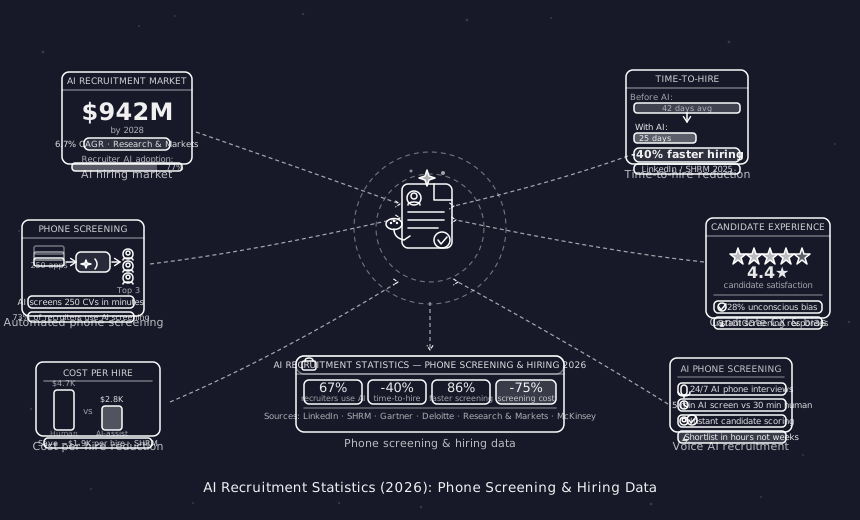
AI has become standard equipment in hiring — from sourcing and resume screening to interview scheduling and candidate communication. This page collects the most reliable AI recruitment statistics for 2026 — market size, employer and recruiter adoption, productivity impact, what candidates actually think, the new legal floor, and the rise of voice screening — with each number checked against the research body, survey, or government source that actually published it. (This topic is full of recycled, unsourced numbers; we left those out.)
The short answer: AI is now embedded in hiring — 43% of organizations used AI for HR tasks in 2025, up from 26% a year earlier, and recruiting is the single biggest use case (SHRM). But candidates remain wary: 71% of Americans oppose AI making final hiring decisions (Pew). The durable model pairs AI screening and scheduling with human judgment.
Top AI recruitment statistics for 2026 (editor's picks)
43% of organizations used AI for HR tasks in 2025, up from 26% in 2024. — SHRM, 2025
Recruiting is the single most common AI use case inside HR. — SHRM, 2025
$3.25B → $15.24B is the AI-in-HR market from 2023 to 2030, a 24.8% CAGR. — Grand View Research
89% of HR pros using AI in recruiting say it saves time or boosts efficiency. — SHRM, 2025
71% of Americans oppose AI making a final hiring decision. — Pew Research
66% of Americans would not apply for a job where AI helps make hiring decisions. — Pew Research
~20% workload reduction for recruiters using generative AI — about one workday a week. — LinkedIn, 2025
~20 interviews per hire (up 42% since 2021), with a ~42-day time-to-fill. — SHRM, 2025
$47.5 billion voice-AI-agents market by 2034 (34.8% CAGR) — the channel for phone screening. — Market.us, 2025
High-risk: the EU AI Act classifies recruitment AI as high-risk, enforceable Aug 2, 2026. — EU AI Act
AI recruitment market size and growth
Market | Base value | Projected value | CAGR | Source |
|---|---|---|---|---|
AI in HR | $3.25B (2023) | $15.24B by 2030 | 24.8% | Grand View Research |
HR management software | $30.90B (2025) | $60.52B by 2030 | 14.4% | Grand View Research |
Conversational AI | $11.58B (2024) | $41.39B by 2030 | 23.7% | Grand View Research |
Voice AI agents | $2.4B (2024) | $47.5B by 2034 | 34.8% | Market.us |
$3.25 billion → $15.24 billion is the AI-in-HR market from 2023 to 2030, a 24.8% CAGR — roughly $6.25 billion in 2026. — Grand View Research
Recruiting workflows — candidate sourcing, resume screening, and interview scheduling — are the named drivers of that market's growth. — Grand View Research
$30.90B → $60.52B is the broader HR management software market from 2025 to 2030, a 14.4% CAGR. — Grand View Research
$8.59 billion is the projected HR analytics market by 2030, a 14.8% CAGR. — Grand View Research
$2.4B → $47.5B is the voice-AI-agents market from 2024 to 2034, a 34.8% CAGR — the fastest-growing slice. — Market.us, 2025
Employer and recruiter AI adoption
43% of organizations used AI for HR tasks in 2025, nearly double the 26% reported in 2024. — SHRM, 2025
Recruiting is the number-one AI use case in HR — 66% of AI-using organizations apply it to job descriptions and 44% to resume screening. — SHRM, 2025
89% of HR professionals whose organizations use AI in recruiting say it saves time or increases efficiency. — SHRM, 2025
36% say AI helps reduce recruiting and hiring costs, and 24% report a better ability to identify top candidates. — SHRM, 2025
58% of publicly traded organizations use AI in HR — the highest of any group, versus 19% of federal government employers. — SHRM, 2025
92% of CHROs anticipate AI being further integrated into the workforce, and 87% forecast greater AI adoption within HR. — SHRM, 2026
88% of organizations use AI in at least one business function, the enterprise backdrop to HR adoption. — McKinsey, 2025
Recruiter productivity and impact
~20% reduction in workload is what talent-acquisition pros using generative AI report — about one full workday per week. — LinkedIn Future of Recruiting, 2025
Only 37% of TA professionals are actively integrating generative AI into their workflows — many own tools they haven't operationalized. — LinkedIn, 2025
~20% of generative AI's total potential value in HR sits specifically in talent acquisition and recruiting. — McKinsey
~20 interviews per hire — up 42% from 14 in 2021 — push the average time-to-fill to about 42 days. — SHRM, 2025
73% of HR directors and above had adopted AI by 2025, versus 66% of managers and 65% of individual contributors. — SHRM, 2026
What candidates think about AI in hiring
Recruiter enthusiasm runs well ahead of candidate trust — the central tension of AI hiring, and the case for keeping humans in the loop.
71% of Americans oppose AI making a final hiring decision; just 7% favor it and 22% are unsure. — Pew Research
66% of Americans say they would not want to apply for a job where AI helps make hiring decisions. — Pew Research
41% oppose AI being used to review job applications (28% favor it, 30% are unsure). — Pew Research
Nearly half of Americans think AI would be better than humans at treating all applicants the same way. — Pew Research
53% of those who see racial or ethnic bias as a problem say AI would improve it. — Pew Research
75% vs. 65% — working adults oppose AI making final hiring decisions more than non-working adults do. — Pew Research
Bias, fairness, and regulation
High-risk: the EU AI Act classifies recruitment AI — CV screening, candidate ranking, and interview scoring — as high-risk, with full obligations enforceable Aug 2, 2026. — EU AI Act
Audit and notify: New York City's Local Law 144 requires employers to bias-audit automated employment decision tools and notify candidates, with enforcement underway. — NYC Local Law 144
53% of bias-concerned Americans believe AI could reduce racial and ethnic bias in hiring — the optimistic case for well-built tools. — Pew Research
71% opposition to AI final decisions underscores why transparency and human oversight are now compliance issues, not just PR. — Pew Research
Voice AI for screening and scheduling
The biggest recruiting time sinks are phone-shaped: pre-screening calls, "are you still interested," and interview scheduling. Voice AI is the fastest-growing way to automate them.
$2.4B → $47.5B is the voice-AI-agents market from 2024 to 2034, a 34.8% CAGR — outpacing most HR-tech categories. — Market.us, 2025
Interview scheduling and reducing time-to-hire are named primary drivers of AI-in-HR market growth. — Grand View Research
~20 interviews per hire and a ~42-day time-to-fill show how much scheduling and coordination voice agents can absorb. — SHRM, 2025
89% of HR pros using AI say it saves time — and screening/scheduling calls are among the most automatable tasks. — SHRM, 2025
50% of consumers have already engaged with Voice AI, so candidates are increasingly comfortable with a voice agent on the line. — Zendesk, 2025
Pre-screening calls and scheduling back-and-forth eat recruiters' days. Brilo AI calls applicants, asks role-fit screening questions, books interviews against recruiter calendars, and sends reminders to cut no-shows — then routes strong candidates to a human. See how Brilo AI for staffing and recruiting handles the phone work.
The future of AI in recruitment
$15.24 billion AI-in-HR market by 2030 (24.8% CAGR) reflects automation spreading across the hiring funnel. — Grand View Research
$47.5 billion voice-AI-agents market by 2034 signals phone screening and scheduling are the next frontier. — Market.us, 2025
Aug 2, 2026 is when full EU AI Act obligations for high-risk recruitment AI take effect — reshaping how tools are built and bought. — EU AI Act
66% of candidates still won't apply where AI makes hiring calls — so the durable model is AI-assisted screening with human decisions. — Pew Research
Frequently Asked Question
How many companies use AI in recruiting?
According to SHRM, 43% of organizations used AI for HR tasks in 2025 — nearly double the 26% in 2024 — and recruiting is the single most common use case. Adoption is highest among publicly traded companies (58%). Many widely shared "87–99% of companies use AI in hiring" figures are unsourced and were excluded here.
Does AI actually speed up hiring?
It helps with the workload. SHRM found 89% of HR pros using AI in recruiting say it saves time, and LinkedIn found recruiters using generative AI cut their workload by about 20% — roughly a workday a week. With ~20 interviews per hire and a ~42-day time-to-fill (SHRM), scheduling and screening are where AI removes the most friction.
How do job candidates feel about AI in hiring?
Wary. Pew Research found 71% of Americans oppose AI making final hiring decisions, and 66% would not apply for a job where AI helps decide. At the same time, nearly half think AI could treat all applicants more equally — so transparency and a human in the loop matter.
Is AI in hiring regulated?
Increasingly. New York City's Local Law 144 requires bias audits and candidate notification for automated employment decision tools, and the EU AI Act classifies recruitment AI as high-risk, with full obligations enforceable on Aug 2, 2026.
How is voice AI used in recruiting?
Voice AI agents call candidates to ask screening questions, answer FAQs, schedule interviews against recruiter calendars, and send reminders — automating the phone-heavy, repetitive parts of hiring. The voice-AI-agents market is growing at a 34.8% CAGR to $47.5 billion by 2034 (Market.us), and interview scheduling is a named driver of AI-in-HR market growth (Grand View Research).
Methodology and sources
Every statistic on this page was verified against the organization that originally published it — no figures were taken from third-party roundups or aggregators, and widely circulated but unsourced claims (such as "99% of companies use AI in hiring" or "AI cuts time-to-hire by 33–40%") were deliberately excluded. Primary sources include the Society for Human Resource Management (SHRM Talent Trends and State of AI in HR), LinkedIn (Future of Recruiting), McKinsey, the Stanford AI Index, Pew Research Center (its survey on AI in hiring), Grand View Research, Market.us, Zendesk, and the texts of New York City's Local Law 144 and the EU AI Act.
Hand the phone screening to AI — keep the judgment human
The data points one way: AI adoption in hiring is now mainstream and saves recruiters real time, but candidates still want humans making the call. The phone-heavy front of the funnel — screening and scheduling — is where AI helps most without touching the final decision. See how Brilo AI calls, screens, and schedules candidates 24/7, syncing with your ATS via integrations like Workable — while your recruiters make the hiring decisions.
All Insights
Articles
AI Recruitment Statistics (2026): Phone Screening & Hiring Data
Explore AI recruitment statistics for 2026 — AI phone screening adoption rates, time-to-hire reduction, candidate response rates, and recruiter ROI benchmarks.
AI has become standard equipment in hiring — from sourcing and resume screening to interview scheduling and candidate communication. This page collects the most reliable AI recruitment statistics for 2026 — market size, employer and recruiter adoption, productivity impact, what candidates actually think, the new legal floor, and the rise of voice screening — with each number checked against the research body, survey, or government source that actually published it. (This topic is full of recycled, unsourced numbers; we left those out.)
The short answer: AI is now embedded in hiring — 43% of organizations used AI for HR tasks in 2025, up from 26% a year earlier, and recruiting is the single biggest use case (SHRM). But candidates remain wary: 71% of Americans oppose AI making final hiring decisions (Pew). The durable model pairs AI screening and scheduling with human judgment.
Top AI recruitment statistics for 2026 (editor's picks)
43% of organizations used AI for HR tasks in 2025, up from 26% in 2024. — SHRM, 2025
Recruiting is the single most common AI use case inside HR. — SHRM, 2025
$3.25B → $15.24B is the AI-in-HR market from 2023 to 2030, a 24.8% CAGR. — Grand View Research
89% of HR pros using AI in recruiting say it saves time or boosts efficiency. — SHRM, 2025
71% of Americans oppose AI making a final hiring decision. — Pew Research
66% of Americans would not apply for a job where AI helps make hiring decisions. — Pew Research
~20% workload reduction for recruiters using generative AI — about one workday a week. — LinkedIn, 2025
~20 interviews per hire (up 42% since 2021), with a ~42-day time-to-fill. — SHRM, 2025
$47.5 billion voice-AI-agents market by 2034 (34.8% CAGR) — the channel for phone screening. — Market.us, 2025
High-risk: the EU AI Act classifies recruitment AI as high-risk, enforceable Aug 2, 2026. — EU AI Act
AI recruitment market size and growth
Market | Base value | Projected value | CAGR | Source |
|---|---|---|---|---|
AI in HR | $3.25B (2023) | $15.24B by 2030 | 24.8% | Grand View Research |
HR management software | $30.90B (2025) | $60.52B by 2030 | 14.4% | Grand View Research |
Conversational AI | $11.58B (2024) | $41.39B by 2030 | 23.7% | Grand View Research |
Voice AI agents | $2.4B (2024) | $47.5B by 2034 | 34.8% | Market.us |
$3.25 billion → $15.24 billion is the AI-in-HR market from 2023 to 2030, a 24.8% CAGR — roughly $6.25 billion in 2026. — Grand View Research
Recruiting workflows — candidate sourcing, resume screening, and interview scheduling — are the named drivers of that market's growth. — Grand View Research
$30.90B → $60.52B is the broader HR management software market from 2025 to 2030, a 14.4% CAGR. — Grand View Research
$8.59 billion is the projected HR analytics market by 2030, a 14.8% CAGR. — Grand View Research
$2.4B → $47.5B is the voice-AI-agents market from 2024 to 2034, a 34.8% CAGR — the fastest-growing slice. — Market.us, 2025
Employer and recruiter AI adoption
43% of organizations used AI for HR tasks in 2025, nearly double the 26% reported in 2024. — SHRM, 2025
Recruiting is the number-one AI use case in HR — 66% of AI-using organizations apply it to job descriptions and 44% to resume screening. — SHRM, 2025
89% of HR professionals whose organizations use AI in recruiting say it saves time or increases efficiency. — SHRM, 2025
36% say AI helps reduce recruiting and hiring costs, and 24% report a better ability to identify top candidates. — SHRM, 2025
58% of publicly traded organizations use AI in HR — the highest of any group, versus 19% of federal government employers. — SHRM, 2025
92% of CHROs anticipate AI being further integrated into the workforce, and 87% forecast greater AI adoption within HR. — SHRM, 2026
88% of organizations use AI in at least one business function, the enterprise backdrop to HR adoption. — McKinsey, 2025
Recruiter productivity and impact
~20% reduction in workload is what talent-acquisition pros using generative AI report — about one full workday per week. — LinkedIn Future of Recruiting, 2025
Only 37% of TA professionals are actively integrating generative AI into their workflows — many own tools they haven't operationalized. — LinkedIn, 2025
~20% of generative AI's total potential value in HR sits specifically in talent acquisition and recruiting. — McKinsey
~20 interviews per hire — up 42% from 14 in 2021 — push the average time-to-fill to about 42 days. — SHRM, 2025
73% of HR directors and above had adopted AI by 2025, versus 66% of managers and 65% of individual contributors. — SHRM, 2026
What candidates think about AI in hiring
Recruiter enthusiasm runs well ahead of candidate trust — the central tension of AI hiring, and the case for keeping humans in the loop.
71% of Americans oppose AI making a final hiring decision; just 7% favor it and 22% are unsure. — Pew Research
66% of Americans say they would not want to apply for a job where AI helps make hiring decisions. — Pew Research
41% oppose AI being used to review job applications (28% favor it, 30% are unsure). — Pew Research
Nearly half of Americans think AI would be better than humans at treating all applicants the same way. — Pew Research
53% of those who see racial or ethnic bias as a problem say AI would improve it. — Pew Research
75% vs. 65% — working adults oppose AI making final hiring decisions more than non-working adults do. — Pew Research
Bias, fairness, and regulation
High-risk: the EU AI Act classifies recruitment AI — CV screening, candidate ranking, and interview scoring — as high-risk, with full obligations enforceable Aug 2, 2026. — EU AI Act
Audit and notify: New York City's Local Law 144 requires employers to bias-audit automated employment decision tools and notify candidates, with enforcement underway. — NYC Local Law 144
53% of bias-concerned Americans believe AI could reduce racial and ethnic bias in hiring — the optimistic case for well-built tools. — Pew Research
71% opposition to AI final decisions underscores why transparency and human oversight are now compliance issues, not just PR. — Pew Research
Voice AI for screening and scheduling
The biggest recruiting time sinks are phone-shaped: pre-screening calls, "are you still interested," and interview scheduling. Voice AI is the fastest-growing way to automate them.
$2.4B → $47.5B is the voice-AI-agents market from 2024 to 2034, a 34.8% CAGR — outpacing most HR-tech categories. — Market.us, 2025
Interview scheduling and reducing time-to-hire are named primary drivers of AI-in-HR market growth. — Grand View Research
~20 interviews per hire and a ~42-day time-to-fill show how much scheduling and coordination voice agents can absorb. — SHRM, 2025
89% of HR pros using AI say it saves time — and screening/scheduling calls are among the most automatable tasks. — SHRM, 2025
50% of consumers have already engaged with Voice AI, so candidates are increasingly comfortable with a voice agent on the line. — Zendesk, 2025
Pre-screening calls and scheduling back-and-forth eat recruiters' days. Brilo AI calls applicants, asks role-fit screening questions, books interviews against recruiter calendars, and sends reminders to cut no-shows — then routes strong candidates to a human. See how Brilo AI for staffing and recruiting handles the phone work.
The future of AI in recruitment
$15.24 billion AI-in-HR market by 2030 (24.8% CAGR) reflects automation spreading across the hiring funnel. — Grand View Research
$47.5 billion voice-AI-agents market by 2034 signals phone screening and scheduling are the next frontier. — Market.us, 2025
Aug 2, 2026 is when full EU AI Act obligations for high-risk recruitment AI take effect — reshaping how tools are built and bought. — EU AI Act
66% of candidates still won't apply where AI makes hiring calls — so the durable model is AI-assisted screening with human decisions. — Pew Research
Frequently Asked Question
How many companies use AI in recruiting?
According to SHRM, 43% of organizations used AI for HR tasks in 2025 — nearly double the 26% in 2024 — and recruiting is the single most common use case. Adoption is highest among publicly traded companies (58%). Many widely shared "87–99% of companies use AI in hiring" figures are unsourced and were excluded here.
Does AI actually speed up hiring?
It helps with the workload. SHRM found 89% of HR pros using AI in recruiting say it saves time, and LinkedIn found recruiters using generative AI cut their workload by about 20% — roughly a workday a week. With ~20 interviews per hire and a ~42-day time-to-fill (SHRM), scheduling and screening are where AI removes the most friction.
How do job candidates feel about AI in hiring?
Wary. Pew Research found 71% of Americans oppose AI making final hiring decisions, and 66% would not apply for a job where AI helps decide. At the same time, nearly half think AI could treat all applicants more equally — so transparency and a human in the loop matter.
Is AI in hiring regulated?
Increasingly. New York City's Local Law 144 requires bias audits and candidate notification for automated employment decision tools, and the EU AI Act classifies recruitment AI as high-risk, with full obligations enforceable on Aug 2, 2026.
How is voice AI used in recruiting?
Voice AI agents call candidates to ask screening questions, answer FAQs, schedule interviews against recruiter calendars, and send reminders — automating the phone-heavy, repetitive parts of hiring. The voice-AI-agents market is growing at a 34.8% CAGR to $47.5 billion by 2034 (Market.us), and interview scheduling is a named driver of AI-in-HR market growth (Grand View Research).
Methodology and sources
Every statistic on this page was verified against the organization that originally published it — no figures were taken from third-party roundups or aggregators, and widely circulated but unsourced claims (such as "99% of companies use AI in hiring" or "AI cuts time-to-hire by 33–40%") were deliberately excluded. Primary sources include the Society for Human Resource Management (SHRM Talent Trends and State of AI in HR), LinkedIn (Future of Recruiting), McKinsey, the Stanford AI Index, Pew Research Center (its survey on AI in hiring), Grand View Research, Market.us, Zendesk, and the texts of New York City's Local Law 144 and the EU AI Act.
Hand the phone screening to AI — keep the judgment human
The data points one way: AI adoption in hiring is now mainstream and saves recruiters real time, but candidates still want humans making the call. The phone-heavy front of the funnel — screening and scheduling — is where AI helps most without touching the final decision. See how Brilo AI calls, screens, and schedules candidates 24/7, syncing with your ATS via integrations like Workable — while your recruiters make the hiring decisions.
Latest Insights
All Resources
Articles
Case Studies
Tutorials

Articles
FDA-Compliant AI Voice for Medical Device Hotlines
What Part 11, ISO 13485, and QMS integration actually require from an AI voice agent on a medical device support line.

Articles
Reduce FDA Warning Letters on Complaint Handling
FDA warning letters citing complaint-handling failures are rising. Here's how automated intake closes the gap.
Load More
Latest Insights
All Resources
Articles
Case Studies
Tutorials
Articles
FDA-Compliant AI Voice for Medical Device Hotlines
What Part 11, ISO 13485, and QMS integration actually require from an AI voice agent on a medical device support line.
Articles
Reduce FDA Warning Letters on Complaint Handling
FDA warning letters citing complaint-handling failures are rising. Here's how automated intake closes the gap.
Load More

Automate your business with AI phone Agents
Automate your business with AI phone Agents
Automate your business with AI phone Agents
Automate your business with AI phone Agents
Call automation for healthcare, real estate, logistics, financial services & small businesses.
Call automation for healthcare, real estate, logistics, financial services & small businesses.

Join Discord
Connect with our community, ask questions, and stay updated on product news.

Book a Call
Schedule a quick call with our team to explore solutions for your needs.
Get started
Industries
Usecases
Integrations
Legal & Community

Join Discord
Connect with our community, ask questions, and stay updated on product news.
Book a Call
Schedule a quick call with our team to explore solutions for your needs.
Get started
Industries
Usecases
Integrations
Legal & Community
Join Discord
Connect with our community, ask questions, and stay updated on product news.
Book a Call
Schedule a quick call with our team to explore solutions for your needs.
Get started
Industries
Usecases
Integrations
Legal & Community
Join Discord
Connect with our community, ask questions, and stay updated on product news.
Book a Call
Schedule a quick call with our team to explore solutions for your needs.
Get started
Industries
Usecases
Integrations
Legal & Community