
All Insights
Articles
AI in Healthcare Statistics (2026): Adoption, ROI & Outcomes
Discover the latest AI in healthcare statistics for 2026 — covering patient call automation, appointment scheduling, compliance, and cost reduction data
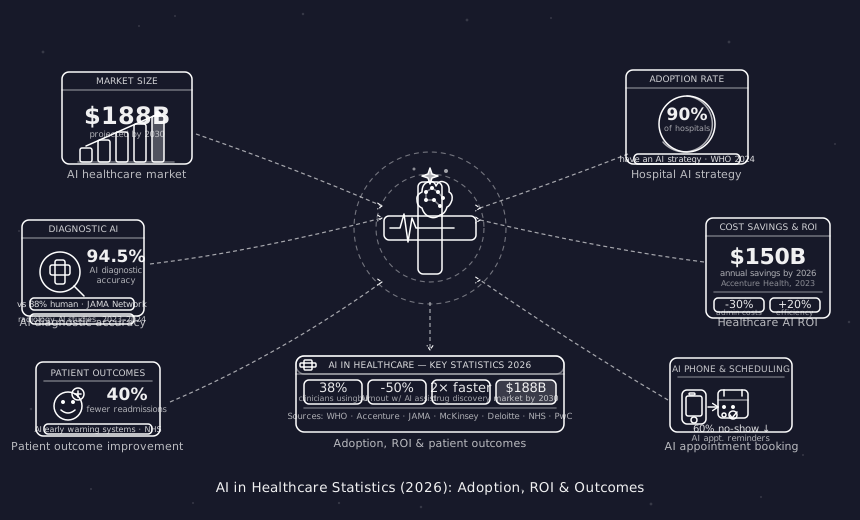
Artificial intelligence has moved from pilot projects to daily clinical practice. This page collects the most reliable AI in healthcare statistics for 2026 — physician adoption, market size, FDA-cleared devices, diagnostic accuracy, administrative and documentation savings, and the fast-growing area of patient communication and scheduling — with each number checked against the journal, agency, research firm, or survey that actually published it.
The short answer: AI is now standard in clinical practice — 81% of U.S. physicians used AI in 2026, up from 38% in 2023 (AMA), the FDA has authorized 1,451 AI-enabled medical devices, and the AI-in-healthcare market is projected to reach $505.59 billion by 2033. The biggest near-term gains are in documentation, diagnostics, and patient access.
Top AI in healthcare statistics for 2026 (editor's picks)
The numbers other writers screenshot and cite most often:
81% of U.S. physicians used AI in their practice in 2026, up from 38% in 2023. — AMA, 2026
$505.59 billion is the projected 2033 value of the global AI-in-healthcare market, a 38.9% CAGR. — Grand View Research, 2026
1,451 AI-enabled medical devices have been authorized by the FDA, 76% of them in radiology. — FDA, 2025
29% increase in cancer detection from AI-supported mammography, with no rise in false positives. — The Lancet (MASAI), 2025
51.9% → 38.8% is how far physician burnout fell after 30 days using an ambient AI scribe. — JAMA Network Open, 2025
~25% of U.S. healthcare spending goes to administration — AI's single largest savings target. — McKinsey
$3.18 billion is the projected 2030 value of the AI-voice-agents-in-healthcare market, a 37.8% CAGR. — Grand View Research
57% of physicians name reducing administrative burden as AI's top opportunity. — AMA, 2024
15,791 hours of documentation were saved by ambient AI across 2.5M+ visits at one health system. — The Permanente Medical Group, 2025
44% reduction in radiologists' screen-reading workload with AI-supported mammography. — The Lancet Oncology (MASAI), 2023
AI in healthcare market size and growth
Market | Base value | Projected value | CAGR | Source |
|---|---|---|---|---|
AI in healthcare | — | $505.59B by 2033 | 38.9% | Grand View Research |
Generative AI in healthcare | — | $14.77B by 2030 | 36.7% | Grand View Research |
Agentic AI in healthcare | $538.5M (2024) | $4.96B by 2030 | 45.6% | Grand View Research |
AI voice agents in healthcare | $468M (2024) | $3.18B by 2030 | 37.8% | Grand View Research |
$505.59 billion is the projected value of the global AI-in-healthcare market by 2033, growing at a 38.9% CAGR from 2026. — Grand View Research, 2026
$187.69 billion was the prior projection for 2030, at a 38.6% CAGR — both editions show ~39% annual growth. — Grand View Research, 2025
$14.77 billion is the projected 2030 size of the generative AI in healthcare market, a 36.7% CAGR. — Grand View Research
$4.96 billion is the projected 2030 size of the agentic AI in healthcare market, a 45.6% CAGR — the fastest-growing slice. — Grand View Research
$468 million → $3.18 billion is the AI-voice-agents-in-healthcare market from 2024 to 2030, a 37.8% CAGR. — Grand View Research
54.2% of the AI-voice-agents-in-healthcare market was in North America in 2024, the leading region. — Grand View Research
85% of that voice-agent market was cloud-based deployment in 2024. — Grand View Research
Physician and clinician AI adoption
81% of U.S. physicians reported using AI in their practice in 2026, up from 66% in 2024 and just 38% in 2023. — AMA, 2026
2.3 is the average number of AI use cases per physician in 2026, more than double the 1.1 average in 2023. — AMA, 2026
57% of physicians cite reducing administrative burden as the single biggest opportunity for AI. — AMA, 2024
68% of physicians see a definite or some advantage to using AI tools, up from 65% the prior year. — AMA, 2024
~70% of physicians view AI as a way to automate tasks and address burnout. — AMA, 2026
85% of physicians want to be consulted or directly involved in decisions about AI adoption. — AMA, 2026
88% of physicians are concerned about the erosion of clinical skills as AI use grows. — AMA, 2026
1,692 U.S. physicians across specialties were surveyed for the AMA's 2026 study (prior waves: 2023 and 2024). — AMA, 2026
FDA approvals and the regulatory landscape
1,451 AI-enabled medical devices had been authorized by the FDA from 1995 through the end of 2025. — FDA, 2025
76% of all FDA-authorized AI devices (about 1,104) are in radiology. — FDA, 2025
33 vs. 221 AI/ML devices were authorized in all of 1995–2015 versus 2023 alone — a steep acceleration. — JAMA Network Open, 2025
97% of FDA-authorized AI/ML devices reached market via the streamlined 510(k) pathway. — JAMA Network Open, 2025
75% of all AI-device authorizations in 2025 were radiology, consistent with prior years. — FDA, 2025
AI diagnostic accuracy and clinical outcomes
These are the rigorously tested results — drawn from a randomized controlled trial rather than vendor accuracy claims.
29% more cancers were detected with AI-supported mammography, with no increase in false positives. — The Lancet (MASAI), 2025
44% lower screen-reading workload for radiologists using AI-supported screening. — The Lancet Oncology (MASAI), 2023
80.5% vs. 73.8% was AI-supported screening's sensitivity versus standard double reading, at the same specificity. — The Lancet (MASAI), 2026
12% lower rate of interval cancers (those found between screens) with AI support. — The Lancet (MASAI), 2026
105,000+ women were enrolled in MASAI, the first randomized controlled trial of AI in breast-cancer screening. — The Lancet (MASAI)
Administrative burden, documentation, and clinician burnout
~25% of total U.S. healthcare spending (on a $4T+ base) goes to administration — AI's largest efficiency target. — McKinsey
13–25% is the administrative-cost reduction McKinsey estimates payers could achieve with current AI and gen AI. — McKinsey, 2024
51.9% → 38.8% was the drop in clinician burnout after 30 days using an ambient AI scribe, across 6 health systems. — JAMA Network Open, 2025
21.2% absolute reduction in burnout prevalence at Mass General Brigham after deploying ambient AI documentation. — JAMA Network Open, 2025
15,791 hours of documentation time were saved by ambient AI across 2.5M+ patient encounters at one group. — The Permanente Medical Group, 2025
82% of physicians at that group reported improved overall work satisfaction with ambient AI. — The Permanente Medical Group, 2025
8.5% less total EHR time, and over 15% less time composing notes, for clinicians using an ambient AI tool. — JAMA Network Open, 2025
9.5% reduction in time spent in the note for physicians using one ambient AI scribe in a randomized trial. — NEJM AI, 2025
Patient communication, scheduling, and access
This is where AI most directly reaches patients — and the area generic "AI in healthcare" roundups tend to skip.
$468M → $3.18B by 2030 is the AI-voice-agents-in-healthcare market, growing 37.8% a year as clinics automate phone work. — Grand View Research
84% of physicians at one large group said ambient AI had a positive effect on their communication. — The Permanente Medical Group, 2025
57% of physicians point to administrative tasks — scheduling, intake, and follow-up among them — as AI's top opportunity. — AMA, 2024
~70% of physicians see AI primarily as a way to automate routine tasks and reduce burnout. — AMA, 2026
Call-center optimization, patient engagement, and frontline triage are named primary growth drivers for healthcare voice AI. — Grand View Research
Health systems are already using AI to cut calls and reduce no-shows through automated reminders. — Deloitte
These are exactly the workflows a healthcare AI phone agent handles. Brilo AI books, confirms, and reschedules appointments, sends reminders, triages intake, and handles after-hours calls — then routes complex cases to staff. See how it works for healthcare providers.
The future of AI in healthcare
38.9% CAGR is the projected growth rate of the AI-in-healthcare market through 2033, reaching $505.59 billion. — Grand View Research, 2026
45.6% CAGR is the projected growth of agentic AI in healthcare through 2030 — autonomous, multi-step clinical and operational agents. — Grand View Research
88% of physicians say robust safety validation is critical before broader AI adoption. — AMA, 2026
86% of physicians cite data privacy as a key requirement for adopting AI. — AMA, 2026
Physicians increasingly call for clearer liability frameworks and regulatory oversight as top actions to build AI trust. — AMA, 2026
Frequently Asked Question
How many doctors use AI in healthcare?
According to the AMA's 2026 Physician Survey on Augmented Intelligence, 81% of U.S. physicians used AI in their practice — up from 66% in 2024 and just 38% in 2023. The average physician now reports about 2.3 AI use cases, more than double the 2023 figure.
Is AI accurate in medical diagnosis?
In the MASAI randomized controlled trial of more than 105,000 women, AI-supported mammography detected 29% more cancers than standard reading without increasing false positives, and achieved higher sensitivity (80.5% vs. 73.8%) at the same specificity. AI is treated as a support for clinicians, not a replacement.
How big is the AI in healthcare market?
Grand View Research projects the global AI-in-healthcare market will reach $505.59 billion by 2033, growing at a 38.9% CAGR. Faster-growing sub-segments include agentic AI in healthcare (45.6% CAGR) and AI voice agents in healthcare ($3.18 billion by 2030, 37.8% CAGR).
Can AI reduce healthcare administrative costs and burnout?
Yes. Administration is roughly 25% of U.S. healthcare spending (McKinsey), and ambient AI scribes have been shown to cut clinician burnout — from 51.9% to 38.8% after 30 days in a six-system study (JAMA Network Open) — while saving thousands of documentation hours at scale.
How is AI used for patient appointments and communication?
AI voice agents handle inbound and outbound calls — booking, confirming, and rescheduling appointments, sending reminders, and triaging intake — around the clock. The AI-voice-agents-in-healthcare market is projected to reach $3.18 billion by 2030 (Grand View Research), and health systems already use AI to reduce no-shows through automated reminders (Deloitte).
Methodology and sources
Every statistic on this page was verified against the organization that originally published it — no figures were taken from third-party roundups or aggregators. Primary sources include the American Medical Association (Physician Survey on Augmented Intelligence), the U.S. FDA's AI/ML-enabled medical device list, The Lancet and JAMA Network Open (peer-reviewed studies), the Mass General Brigham and Permanente Medical Group research, McKinsey, Deloitte, and Grand View Research. Where a figure is a projection, survey result, or trial outcome, the publishing source and year are named inline so the context is clear.
Turn these statistics into better patient access
The pattern across every source is consistent: AI's clearest near-term wins in healthcare are administrative — documentation, scheduling, intake, and patient communication — freeing clinicians for care. A voice AI agent captures that opportunity on the phone line, where so much patient access still happens. See how Brilo AI for healthcare automates appointment booking, reminders, and patient calls 24/7, or explore AI voice agents for appointment booking — while complex cases still reach your team.
All Insights
Articles
AI in Healthcare Statistics (2026): Adoption, ROI & Outcomes
Discover the latest AI in healthcare statistics for 2026 — covering patient call automation, appointment scheduling, compliance, and cost reduction data
Artificial intelligence has moved from pilot projects to daily clinical practice. This page collects the most reliable AI in healthcare statistics for 2026 — physician adoption, market size, FDA-cleared devices, diagnostic accuracy, administrative and documentation savings, and the fast-growing area of patient communication and scheduling — with each number checked against the journal, agency, research firm, or survey that actually published it.
The short answer: AI is now standard in clinical practice — 81% of U.S. physicians used AI in 2026, up from 38% in 2023 (AMA), the FDA has authorized 1,451 AI-enabled medical devices, and the AI-in-healthcare market is projected to reach $505.59 billion by 2033. The biggest near-term gains are in documentation, diagnostics, and patient access.
Top AI in healthcare statistics for 2026 (editor's picks)
The numbers other writers screenshot and cite most often:
81% of U.S. physicians used AI in their practice in 2026, up from 38% in 2023. — AMA, 2026
$505.59 billion is the projected 2033 value of the global AI-in-healthcare market, a 38.9% CAGR. — Grand View Research, 2026
1,451 AI-enabled medical devices have been authorized by the FDA, 76% of them in radiology. — FDA, 2025
29% increase in cancer detection from AI-supported mammography, with no rise in false positives. — The Lancet (MASAI), 2025
51.9% → 38.8% is how far physician burnout fell after 30 days using an ambient AI scribe. — JAMA Network Open, 2025
~25% of U.S. healthcare spending goes to administration — AI's single largest savings target. — McKinsey
$3.18 billion is the projected 2030 value of the AI-voice-agents-in-healthcare market, a 37.8% CAGR. — Grand View Research
57% of physicians name reducing administrative burden as AI's top opportunity. — AMA, 2024
15,791 hours of documentation were saved by ambient AI across 2.5M+ visits at one health system. — The Permanente Medical Group, 2025
44% reduction in radiologists' screen-reading workload with AI-supported mammography. — The Lancet Oncology (MASAI), 2023
AI in healthcare market size and growth
Market | Base value | Projected value | CAGR | Source |
|---|---|---|---|---|
AI in healthcare | — | $505.59B by 2033 | 38.9% | Grand View Research |
Generative AI in healthcare | — | $14.77B by 2030 | 36.7% | Grand View Research |
Agentic AI in healthcare | $538.5M (2024) | $4.96B by 2030 | 45.6% | Grand View Research |
AI voice agents in healthcare | $468M (2024) | $3.18B by 2030 | 37.8% | Grand View Research |
$505.59 billion is the projected value of the global AI-in-healthcare market by 2033, growing at a 38.9% CAGR from 2026. — Grand View Research, 2026
$187.69 billion was the prior projection for 2030, at a 38.6% CAGR — both editions show ~39% annual growth. — Grand View Research, 2025
$14.77 billion is the projected 2030 size of the generative AI in healthcare market, a 36.7% CAGR. — Grand View Research
$4.96 billion is the projected 2030 size of the agentic AI in healthcare market, a 45.6% CAGR — the fastest-growing slice. — Grand View Research
$468 million → $3.18 billion is the AI-voice-agents-in-healthcare market from 2024 to 2030, a 37.8% CAGR. — Grand View Research
54.2% of the AI-voice-agents-in-healthcare market was in North America in 2024, the leading region. — Grand View Research
85% of that voice-agent market was cloud-based deployment in 2024. — Grand View Research
Physician and clinician AI adoption
81% of U.S. physicians reported using AI in their practice in 2026, up from 66% in 2024 and just 38% in 2023. — AMA, 2026
2.3 is the average number of AI use cases per physician in 2026, more than double the 1.1 average in 2023. — AMA, 2026
57% of physicians cite reducing administrative burden as the single biggest opportunity for AI. — AMA, 2024
68% of physicians see a definite or some advantage to using AI tools, up from 65% the prior year. — AMA, 2024
~70% of physicians view AI as a way to automate tasks and address burnout. — AMA, 2026
85% of physicians want to be consulted or directly involved in decisions about AI adoption. — AMA, 2026
88% of physicians are concerned about the erosion of clinical skills as AI use grows. — AMA, 2026
1,692 U.S. physicians across specialties were surveyed for the AMA's 2026 study (prior waves: 2023 and 2024). — AMA, 2026
FDA approvals and the regulatory landscape
1,451 AI-enabled medical devices had been authorized by the FDA from 1995 through the end of 2025. — FDA, 2025
76% of all FDA-authorized AI devices (about 1,104) are in radiology. — FDA, 2025
33 vs. 221 AI/ML devices were authorized in all of 1995–2015 versus 2023 alone — a steep acceleration. — JAMA Network Open, 2025
97% of FDA-authorized AI/ML devices reached market via the streamlined 510(k) pathway. — JAMA Network Open, 2025
75% of all AI-device authorizations in 2025 were radiology, consistent with prior years. — FDA, 2025
AI diagnostic accuracy and clinical outcomes
These are the rigorously tested results — drawn from a randomized controlled trial rather than vendor accuracy claims.
29% more cancers were detected with AI-supported mammography, with no increase in false positives. — The Lancet (MASAI), 2025
44% lower screen-reading workload for radiologists using AI-supported screening. — The Lancet Oncology (MASAI), 2023
80.5% vs. 73.8% was AI-supported screening's sensitivity versus standard double reading, at the same specificity. — The Lancet (MASAI), 2026
12% lower rate of interval cancers (those found between screens) with AI support. — The Lancet (MASAI), 2026
105,000+ women were enrolled in MASAI, the first randomized controlled trial of AI in breast-cancer screening. — The Lancet (MASAI)
Administrative burden, documentation, and clinician burnout
~25% of total U.S. healthcare spending (on a $4T+ base) goes to administration — AI's largest efficiency target. — McKinsey
13–25% is the administrative-cost reduction McKinsey estimates payers could achieve with current AI and gen AI. — McKinsey, 2024
51.9% → 38.8% was the drop in clinician burnout after 30 days using an ambient AI scribe, across 6 health systems. — JAMA Network Open, 2025
21.2% absolute reduction in burnout prevalence at Mass General Brigham after deploying ambient AI documentation. — JAMA Network Open, 2025
15,791 hours of documentation time were saved by ambient AI across 2.5M+ patient encounters at one group. — The Permanente Medical Group, 2025
82% of physicians at that group reported improved overall work satisfaction with ambient AI. — The Permanente Medical Group, 2025
8.5% less total EHR time, and over 15% less time composing notes, for clinicians using an ambient AI tool. — JAMA Network Open, 2025
9.5% reduction in time spent in the note for physicians using one ambient AI scribe in a randomized trial. — NEJM AI, 2025
Patient communication, scheduling, and access
This is where AI most directly reaches patients — and the area generic "AI in healthcare" roundups tend to skip.
$468M → $3.18B by 2030 is the AI-voice-agents-in-healthcare market, growing 37.8% a year as clinics automate phone work. — Grand View Research
84% of physicians at one large group said ambient AI had a positive effect on their communication. — The Permanente Medical Group, 2025
57% of physicians point to administrative tasks — scheduling, intake, and follow-up among them — as AI's top opportunity. — AMA, 2024
~70% of physicians see AI primarily as a way to automate routine tasks and reduce burnout. — AMA, 2026
Call-center optimization, patient engagement, and frontline triage are named primary growth drivers for healthcare voice AI. — Grand View Research
Health systems are already using AI to cut calls and reduce no-shows through automated reminders. — Deloitte
These are exactly the workflows a healthcare AI phone agent handles. Brilo AI books, confirms, and reschedules appointments, sends reminders, triages intake, and handles after-hours calls — then routes complex cases to staff. See how it works for healthcare providers.
The future of AI in healthcare
38.9% CAGR is the projected growth rate of the AI-in-healthcare market through 2033, reaching $505.59 billion. — Grand View Research, 2026
45.6% CAGR is the projected growth of agentic AI in healthcare through 2030 — autonomous, multi-step clinical and operational agents. — Grand View Research
88% of physicians say robust safety validation is critical before broader AI adoption. — AMA, 2026
86% of physicians cite data privacy as a key requirement for adopting AI. — AMA, 2026
Physicians increasingly call for clearer liability frameworks and regulatory oversight as top actions to build AI trust. — AMA, 2026
Frequently Asked Question
How many doctors use AI in healthcare?
According to the AMA's 2026 Physician Survey on Augmented Intelligence, 81% of U.S. physicians used AI in their practice — up from 66% in 2024 and just 38% in 2023. The average physician now reports about 2.3 AI use cases, more than double the 2023 figure.
Is AI accurate in medical diagnosis?
In the MASAI randomized controlled trial of more than 105,000 women, AI-supported mammography detected 29% more cancers than standard reading without increasing false positives, and achieved higher sensitivity (80.5% vs. 73.8%) at the same specificity. AI is treated as a support for clinicians, not a replacement.
How big is the AI in healthcare market?
Grand View Research projects the global AI-in-healthcare market will reach $505.59 billion by 2033, growing at a 38.9% CAGR. Faster-growing sub-segments include agentic AI in healthcare (45.6% CAGR) and AI voice agents in healthcare ($3.18 billion by 2030, 37.8% CAGR).
Can AI reduce healthcare administrative costs and burnout?
Yes. Administration is roughly 25% of U.S. healthcare spending (McKinsey), and ambient AI scribes have been shown to cut clinician burnout — from 51.9% to 38.8% after 30 days in a six-system study (JAMA Network Open) — while saving thousands of documentation hours at scale.
How is AI used for patient appointments and communication?
AI voice agents handle inbound and outbound calls — booking, confirming, and rescheduling appointments, sending reminders, and triaging intake — around the clock. The AI-voice-agents-in-healthcare market is projected to reach $3.18 billion by 2030 (Grand View Research), and health systems already use AI to reduce no-shows through automated reminders (Deloitte).
Methodology and sources
Every statistic on this page was verified against the organization that originally published it — no figures were taken from third-party roundups or aggregators. Primary sources include the American Medical Association (Physician Survey on Augmented Intelligence), the U.S. FDA's AI/ML-enabled medical device list, The Lancet and JAMA Network Open (peer-reviewed studies), the Mass General Brigham and Permanente Medical Group research, McKinsey, Deloitte, and Grand View Research. Where a figure is a projection, survey result, or trial outcome, the publishing source and year are named inline so the context is clear.
Turn these statistics into better patient access
The pattern across every source is consistent: AI's clearest near-term wins in healthcare are administrative — documentation, scheduling, intake, and patient communication — freeing clinicians for care. A voice AI agent captures that opportunity on the phone line, where so much patient access still happens. See how Brilo AI for healthcare automates appointment booking, reminders, and patient calls 24/7, or explore AI voice agents for appointment booking — while complex cases still reach your team.
Latest Insights
All Resources
Articles
Case Studies
Tutorials

Articles
5 Best AI Voice Agents for Optometry and Eye Care Clinics (2026)
Compare the 5 best AI voice agents for optometry and eye care clinics in 2026. See top voice AI tools that book eye exams and answer calls 24/7.

Articles
5 Best AI Receptionists for Bariatric and Weight Loss Clinics (2026)
Compare the 5 best AI receptionists for weight loss clinics. Explore HIPAA compliance, scheduling, EHR integration, GLP-1 support, and key features.
Load More
Latest Insights
All Resources
Articles
Case Studies
Tutorials
Articles
5 Best AI Voice Agents for Optometry and Eye Care Clinics (2026)
Compare the 5 best AI voice agents for optometry and eye care clinics in 2026. See top voice AI tools that book eye exams and answer calls 24/7.
Articles
5 Best AI Receptionists for Bariatric and Weight Loss Clinics (2026)
Compare the 5 best AI receptionists for weight loss clinics. Explore HIPAA compliance, scheduling, EHR integration, GLP-1 support, and key features.
Load More

Automate your business with AI phone Agents
Automate your business with AI phone Agents
Automate your business with AI phone Agents
Automate your business with AI phone Agents
Call automation for healthcare, real estate, logistics, financial services & small businesses.
Call automation for healthcare, real estate, logistics, financial services & small businesses.

Join Discord
Connect with our community, ask questions, and stay updated on product news.

Book a Call
Schedule a quick call with our team to explore solutions for your needs.
Get started
Industries
Usecases
Integrations
Legal & Community

Join Discord
Connect with our community, ask questions, and stay updated on product news.
Book a Call
Schedule a quick call with our team to explore solutions for your needs.
Get started
Industries
Usecases
Integrations
Legal & Community
Join Discord
Connect with our community, ask questions, and stay updated on product news.
Book a Call
Schedule a quick call with our team to explore solutions for your needs.
Get started
Industries
Usecases
Integrations
Legal & Community
Join Discord
Connect with our community, ask questions, and stay updated on product news.
Book a Call
Schedule a quick call with our team to explore solutions for your needs.
Get started
Industries
Usecases
Integrations
Legal & Community