
All Insights
Articles
AI Hallucination Statistics (2026): Cost to Businesses & Risk Data
How much do AI hallucinations cost businesses? Explore 2026 statistics on AI error rates, financial impact, and how enterprise teams are reducing AI reliability risks.
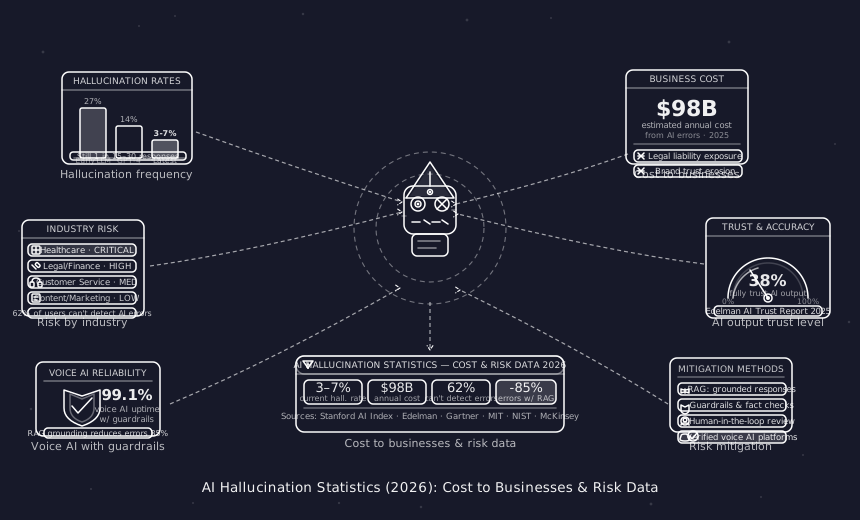
When an AI system states something false with complete confidence, it's called a hallucination — and for businesses deploying AI in customer-facing and high-stakes roles, it's the central risk. This page collects the most reliable AI hallucination statistics for 2026 — measured hallucination rates, documented incidents with real consequences, and the legal liability that follows — with each number checked against the study, court ruling, or benchmark that actually published it. We also explain, transparently, why the headline "$67.4 billion cost" figure you'll see everywhere doesn't hold up.
The short answer: There is no credible, primary-sourced dollar figure for the total cost of AI hallucinations — the widely-repeated "$67.4 billion in 2024" traces only to a content marketer, not real research. What is verified: even purpose-built AI tools hallucinate 17–33% of the time (Stanford), grounded models still hallucinate up to ~30% (Vectara), the problem can't be fully eliminated, and companies have already been held legally liable for what their chatbots invent.
A note on the "$67.4 billion" figure
Search "AI hallucination cost" and you'll find one number everywhere: $67.4 billion in losses in 2024. We are not reporting it as fact, and here's why. The same figure is attributed to a content/SEO site (AllAboutAI) in some places, to a vendor selling hallucination-detection tools (Korra) in others, and to Forrester in still others — three different "origins" for one identical number. We could not trace it to any published primary study with a stated methodology. The related claims that travel with it — "$14,200 per employee per year," "4.3 hours/week verifying AI," "47% made a major decision on hallucinated content," a "$18.2B / $21.5B / $27.7B" breakdown, and a "$112B projected for 2025" — share the same untraceable, vendor-content provenance. We've left all of them out. The verified evidence below is more useful anyway.
Top verified AI hallucination statistics for 2026 (editor's picks)
17–33% — how often purpose-built legal AI research tools hallucinate, despite "hallucination-free" marketing. — Stanford RegLab/HAI, 2024
43% hallucination rate for general-purpose GPT-4 on the same legal queries (the baseline the tools beat but didn't fix). — Stanford RegLab/HAI, 2024
~1% to ~30% — hallucination rate of modern LLMs even when summarizing a source document they were given. — Vectara, 2025
C$812 — damages Air Canada was ordered to pay after its chatbot invented a refund policy, the first major ruling that a company owns what its bot says. — Moffatt v. Air Canada, 2024
65% vs. 41% vs. ~20% — share of legal queries answered accurately by Lexis+ AI, Westlaw, and Practical Law AI. — Stanford RegLab/HAI, 2024
Impossible to fully eliminate — a formal result shows hallucination is inherent to how LLMs generate text. — Xu et al., 2024
>10% — hallucination rate of top reasoning models on Vectara's tougher 2025 benchmark spanning law, medicine, and finance. — Vectara, 2025
"Overstated" — Stanford's verdict on vendors' "hallucination-free" and "avoids hallucinations" claims. — Stanford RegLab/HAI, 2024
Measured hallucination rates: what the research actually shows
The honest way to quantify hallucination is to measure how often it happens in controlled tests — not to invent a dollar total. Two credible, independent benchmarks dominate.
17–33% of the time is how often the leading purpose-built legal AI research tools hallucinate, in the first preregistered empirical evaluation of these systems (202 expert-scored queries). — Stanford RegLab/HAI, 2024
~17% (Lexis+ AI), ~33% (Westlaw AI-Assisted Research), and 43% (GPT-4 baseline) were the individual hallucination rates measured. — Stanford RegLab/HAI, 2024
65%, 41%, and ~20% of queries were answered accurately (correct and grounded) by Lexis+ AI, Westlaw, and Ask Practical Law AI respectively. — Stanford RegLab/HAI, 2024
Providers' claims are "overstated" — the study directly rebutted marketing that promised "hallucination-free" legal citations. — Stanford RegLab/HAI, 2024
~1% to nearly 30% is the range modern LLMs hallucinate at even in "open-book" grounded summarization, where they're handed the source text. — Vectara, 2025
Over 10% is where top reasoning models (and up to ~20% for some) land on Vectara's harder 2025 benchmark of 7,700+ documents across law, medicine, finance, education, and technology. — Vectara, 2025
A dangerous failure mode: "misgrounded" answers
Not all hallucinations are obvious fabrications. The subtler and more dangerous kind cites a real source that doesn't actually support the claim.
"Misgrounded" citations — where the AI points to a genuine case or document that doesn't say what the AI claims — were a distinct, common failure category, arguably more dangerous than an obviously fake citation because it survives a quick check. — Stanford RegLab/HAI, 2024
Longer answers, more errors — Westlaw's higher hallucination rate correlated with longer responses (avg. 350 words vs. 219 for Lexis), since more propositions mean more chances to be wrong. — Stanford RegLab/HAI, 2024
Grounding helps but doesn't cure — retrieval-augmented generation (RAG) reduced hallucinations versus a raw chatbot, yet every tested tool still hallucinated, because summarization is still generation. — Stanford / Vectara, 2024–2025
Documented incidents with real consequences
These are the verifiable costs — not an invented aggregate, but specific, on-the-record cases.
Air Canada was held liable for negligent misrepresentation after its website chatbot told a grieving customer he could claim a bereavement discount retroactively — a policy that didn't exist. — Moffatt v. Air Canada, 2024 BCCRT 149
C$812 in total damages was awarded, and the tribunal called Air Canada's argument that the chatbot was a "separate legal entity" responsible for itself "remarkable." — Moffatt v. Air Canada, 2024
A U.S. attorney was sanctioned in 2023 for filing a federal brief full of fabricated case citations invented by ChatGPT. — Mata v. Avianca, 2023
~$31,000 in fees were imposed on law firms whose filings relied on AI tools that produced bad citations. — Lacey v. State Farm, 2025
NYC's "MyCity" chatbot told business owners they could do illegal things — like take workers' tips and refuse cash — confidently and incorrectly. — Documented, 2024
A delivery company's chatbot (DPD) was pulled after it swore at a customer and wrote a poem criticizing its own employer, going viral. — Documented, 2024
Why hallucination can't simply be "patched out"
Mathematically inherent — a formal analysis demonstrates that hallucination cannot be fully eliminated from large language models: any system that generates text by predicting probable sequences will sometimes produce ungrounded output. — Xu et al., 2024
It's a feature of the architecture, not a bug — LLMs predict the statistically likely next token, not the verified-true one; when unsure, they guess with the same confidence they use for facts. — consensus across Stanford, Vectara, Xu et al.
Even retrieval doesn't close the gap — grounding the model in source documents lowers the rate but never to zero, as both the Stanford and Vectara benchmarks confirm. — Stanford / Vectara, 2024–2025
The legal and reputational stakes
Companies own what their AI says — the Air Canada ruling established that a business can't disclaim liability for its chatbot, and a contradictory page elsewhere on the site doesn't protect it. — Moffatt v. Air Canada, 2024
Customers aren't expected to fact-check your bot — the tribunal found it unreasonable to require customers to cross-check a chatbot's answer against other pages. — Moffatt v. Air Canada, 2024
A hallucinated policy can become a binding commitment — which is why customer-facing AI in regulated or high-stakes contexts needs guardrails, grounding, and a human escalation path. — Moffatt v. Air Canada, 2024
What this means for customer-facing voice AI
Hallucination is exactly why an open-ended chatbot is risky on your phone line — and why grounded, guardrailed design matters. The lesson from the research is consistent: constrain the AI to your own verified knowledge, and route anything uncertain or high-stakes to a human.
Brilo AI voice agents answer from your knowledge base rather than improvising, and hand off complex or sensitive calls to a person instead of guessing. That's the design the hallucination evidence points to — see how Brilo AI approaches AI in customer service with grounding and human handoff built in.
Frequently Asked Question
What is an AI hallucination?
An AI hallucination is when a model generates information that is false, fabricated, or unsupported — while presenting it confidently as fact. It happens because large language models predict statistically probable text rather than retrieving verified truth, so when they encounter something rare or unknown, they tend to guess rather than say "I don't know."
How much do AI hallucinations cost businesses?
There is no credible, primary-sourced total. The widely-circulated "$67.4 billion in 2024" figure traces only to content/marketing sites and a tool vendor, not to any published study with a methodology, so we don't report it as fact. The verified costs are specific and documented — for example, Air Canada was ordered to pay damages after its chatbot invented a policy, and several law firms have been fined for AI-fabricated citations.
How often do AI models hallucinate?
It depends on the task and the model. Stanford found purpose-built legal AI tools hallucinate 17–33% of the time (and general-purpose GPT-4 at 43%). Vectara's benchmark shows modern models hallucinate roughly 1% to nearly 30% of the time even when summarizing a source document they were given — and over 10% for top reasoning models on harder tasks.
Can AI hallucinations be eliminated?
No — not fully. A formal result (Xu et al., 2024) shows hallucination is inherent to how LLMs generate text. Techniques like retrieval-augmented generation (RAG) and grounding in verified sources substantially reduce it, but every benchmark to date still measures a non-zero rate. The practical answer is to constrain, ground, and add human oversight — not to assume it's "solved."
Is a company legally responsible for what its AI chatbot says?
Yes. In Moffatt v. Air Canada (2024), the British Columbia Civil Resolution Tribunal held the airline liable for false information its chatbot gave a customer, rejecting the argument that the chatbot was a separate entity. Companies are accountable for their AI's statements, and disclaimers elsewhere on a site don't necessarily protect them.
Methodology and sources
This page deliberately departs from the standard "AI hallucination cost" article. Rather than repeat the unsourced "$67.4 billion" figure (and the vendor-content statistics that travel with it), we excluded every number we could not trace to a primary source, and explained why. Verified sources include the Stanford RegLab/HAI study "Hallucination-Free? Assessing the Reliability of Leading AI Legal Research Tools" (Magesh et al.; arXiv 2024; Journal of Empirical Legal Studies, 2025), Vectara's Hallucination Leaderboard (HHEM), the British Columbia Civil Resolution Tribunal ruling in Moffatt v. Air Canada (2024 BCCRT 149), the Mata v. Avianca and Lacey v. State Farm court records, and Xu et al. (2024) on the inevitability of hallucination. Court awards are reported in the currency and amount stated in the rulings.
Build on AI you can actually trust
The evidence is clear: hallucination is real, measurable, impossible to fully eliminate, and something companies are now legally accountable for — which makes grounding and human oversight non-negotiable for customer-facing AI. See how Brilo AI builds voice agents that answer from your own knowledge base and escalate to a human when it matters, across real-world use cases — so your AI helps customers without making things up.
All Insights
Articles
AI Hallucination Statistics (2026): Cost to Businesses & Risk Data
How much do AI hallucinations cost businesses? Explore 2026 statistics on AI error rates, financial impact, and how enterprise teams are reducing AI reliability risks.
When an AI system states something false with complete confidence, it's called a hallucination — and for businesses deploying AI in customer-facing and high-stakes roles, it's the central risk. This page collects the most reliable AI hallucination statistics for 2026 — measured hallucination rates, documented incidents with real consequences, and the legal liability that follows — with each number checked against the study, court ruling, or benchmark that actually published it. We also explain, transparently, why the headline "$67.4 billion cost" figure you'll see everywhere doesn't hold up.
The short answer: There is no credible, primary-sourced dollar figure for the total cost of AI hallucinations — the widely-repeated "$67.4 billion in 2024" traces only to a content marketer, not real research. What is verified: even purpose-built AI tools hallucinate 17–33% of the time (Stanford), grounded models still hallucinate up to ~30% (Vectara), the problem can't be fully eliminated, and companies have already been held legally liable for what their chatbots invent.
A note on the "$67.4 billion" figure
Search "AI hallucination cost" and you'll find one number everywhere: $67.4 billion in losses in 2024. We are not reporting it as fact, and here's why. The same figure is attributed to a content/SEO site (AllAboutAI) in some places, to a vendor selling hallucination-detection tools (Korra) in others, and to Forrester in still others — three different "origins" for one identical number. We could not trace it to any published primary study with a stated methodology. The related claims that travel with it — "$14,200 per employee per year," "4.3 hours/week verifying AI," "47% made a major decision on hallucinated content," a "$18.2B / $21.5B / $27.7B" breakdown, and a "$112B projected for 2025" — share the same untraceable, vendor-content provenance. We've left all of them out. The verified evidence below is more useful anyway.
Top verified AI hallucination statistics for 2026 (editor's picks)
17–33% — how often purpose-built legal AI research tools hallucinate, despite "hallucination-free" marketing. — Stanford RegLab/HAI, 2024
43% hallucination rate for general-purpose GPT-4 on the same legal queries (the baseline the tools beat but didn't fix). — Stanford RegLab/HAI, 2024
~1% to ~30% — hallucination rate of modern LLMs even when summarizing a source document they were given. — Vectara, 2025
C$812 — damages Air Canada was ordered to pay after its chatbot invented a refund policy, the first major ruling that a company owns what its bot says. — Moffatt v. Air Canada, 2024
65% vs. 41% vs. ~20% — share of legal queries answered accurately by Lexis+ AI, Westlaw, and Practical Law AI. — Stanford RegLab/HAI, 2024
Impossible to fully eliminate — a formal result shows hallucination is inherent to how LLMs generate text. — Xu et al., 2024
>10% — hallucination rate of top reasoning models on Vectara's tougher 2025 benchmark spanning law, medicine, and finance. — Vectara, 2025
"Overstated" — Stanford's verdict on vendors' "hallucination-free" and "avoids hallucinations" claims. — Stanford RegLab/HAI, 2024
Measured hallucination rates: what the research actually shows
The honest way to quantify hallucination is to measure how often it happens in controlled tests — not to invent a dollar total. Two credible, independent benchmarks dominate.
17–33% of the time is how often the leading purpose-built legal AI research tools hallucinate, in the first preregistered empirical evaluation of these systems (202 expert-scored queries). — Stanford RegLab/HAI, 2024
~17% (Lexis+ AI), ~33% (Westlaw AI-Assisted Research), and 43% (GPT-4 baseline) were the individual hallucination rates measured. — Stanford RegLab/HAI, 2024
65%, 41%, and ~20% of queries were answered accurately (correct and grounded) by Lexis+ AI, Westlaw, and Ask Practical Law AI respectively. — Stanford RegLab/HAI, 2024
Providers' claims are "overstated" — the study directly rebutted marketing that promised "hallucination-free" legal citations. — Stanford RegLab/HAI, 2024
~1% to nearly 30% is the range modern LLMs hallucinate at even in "open-book" grounded summarization, where they're handed the source text. — Vectara, 2025
Over 10% is where top reasoning models (and up to ~20% for some) land on Vectara's harder 2025 benchmark of 7,700+ documents across law, medicine, finance, education, and technology. — Vectara, 2025
A dangerous failure mode: "misgrounded" answers
Not all hallucinations are obvious fabrications. The subtler and more dangerous kind cites a real source that doesn't actually support the claim.
"Misgrounded" citations — where the AI points to a genuine case or document that doesn't say what the AI claims — were a distinct, common failure category, arguably more dangerous than an obviously fake citation because it survives a quick check. — Stanford RegLab/HAI, 2024
Longer answers, more errors — Westlaw's higher hallucination rate correlated with longer responses (avg. 350 words vs. 219 for Lexis), since more propositions mean more chances to be wrong. — Stanford RegLab/HAI, 2024
Grounding helps but doesn't cure — retrieval-augmented generation (RAG) reduced hallucinations versus a raw chatbot, yet every tested tool still hallucinated, because summarization is still generation. — Stanford / Vectara, 2024–2025
Documented incidents with real consequences
These are the verifiable costs — not an invented aggregate, but specific, on-the-record cases.
Air Canada was held liable for negligent misrepresentation after its website chatbot told a grieving customer he could claim a bereavement discount retroactively — a policy that didn't exist. — Moffatt v. Air Canada, 2024 BCCRT 149
C$812 in total damages was awarded, and the tribunal called Air Canada's argument that the chatbot was a "separate legal entity" responsible for itself "remarkable." — Moffatt v. Air Canada, 2024
A U.S. attorney was sanctioned in 2023 for filing a federal brief full of fabricated case citations invented by ChatGPT. — Mata v. Avianca, 2023
~$31,000 in fees were imposed on law firms whose filings relied on AI tools that produced bad citations. — Lacey v. State Farm, 2025
NYC's "MyCity" chatbot told business owners they could do illegal things — like take workers' tips and refuse cash — confidently and incorrectly. — Documented, 2024
A delivery company's chatbot (DPD) was pulled after it swore at a customer and wrote a poem criticizing its own employer, going viral. — Documented, 2024
Why hallucination can't simply be "patched out"
Mathematically inherent — a formal analysis demonstrates that hallucination cannot be fully eliminated from large language models: any system that generates text by predicting probable sequences will sometimes produce ungrounded output. — Xu et al., 2024
It's a feature of the architecture, not a bug — LLMs predict the statistically likely next token, not the verified-true one; when unsure, they guess with the same confidence they use for facts. — consensus across Stanford, Vectara, Xu et al.
Even retrieval doesn't close the gap — grounding the model in source documents lowers the rate but never to zero, as both the Stanford and Vectara benchmarks confirm. — Stanford / Vectara, 2024–2025
The legal and reputational stakes
Companies own what their AI says — the Air Canada ruling established that a business can't disclaim liability for its chatbot, and a contradictory page elsewhere on the site doesn't protect it. — Moffatt v. Air Canada, 2024
Customers aren't expected to fact-check your bot — the tribunal found it unreasonable to require customers to cross-check a chatbot's answer against other pages. — Moffatt v. Air Canada, 2024
A hallucinated policy can become a binding commitment — which is why customer-facing AI in regulated or high-stakes contexts needs guardrails, grounding, and a human escalation path. — Moffatt v. Air Canada, 2024
What this means for customer-facing voice AI
Hallucination is exactly why an open-ended chatbot is risky on your phone line — and why grounded, guardrailed design matters. The lesson from the research is consistent: constrain the AI to your own verified knowledge, and route anything uncertain or high-stakes to a human.
Brilo AI voice agents answer from your knowledge base rather than improvising, and hand off complex or sensitive calls to a person instead of guessing. That's the design the hallucination evidence points to — see how Brilo AI approaches AI in customer service with grounding and human handoff built in.
Frequently Asked Question
What is an AI hallucination?
An AI hallucination is when a model generates information that is false, fabricated, or unsupported — while presenting it confidently as fact. It happens because large language models predict statistically probable text rather than retrieving verified truth, so when they encounter something rare or unknown, they tend to guess rather than say "I don't know."
How much do AI hallucinations cost businesses?
There is no credible, primary-sourced total. The widely-circulated "$67.4 billion in 2024" figure traces only to content/marketing sites and a tool vendor, not to any published study with a methodology, so we don't report it as fact. The verified costs are specific and documented — for example, Air Canada was ordered to pay damages after its chatbot invented a policy, and several law firms have been fined for AI-fabricated citations.
How often do AI models hallucinate?
It depends on the task and the model. Stanford found purpose-built legal AI tools hallucinate 17–33% of the time (and general-purpose GPT-4 at 43%). Vectara's benchmark shows modern models hallucinate roughly 1% to nearly 30% of the time even when summarizing a source document they were given — and over 10% for top reasoning models on harder tasks.
Can AI hallucinations be eliminated?
No — not fully. A formal result (Xu et al., 2024) shows hallucination is inherent to how LLMs generate text. Techniques like retrieval-augmented generation (RAG) and grounding in verified sources substantially reduce it, but every benchmark to date still measures a non-zero rate. The practical answer is to constrain, ground, and add human oversight — not to assume it's "solved."
Is a company legally responsible for what its AI chatbot says?
Yes. In Moffatt v. Air Canada (2024), the British Columbia Civil Resolution Tribunal held the airline liable for false information its chatbot gave a customer, rejecting the argument that the chatbot was a separate entity. Companies are accountable for their AI's statements, and disclaimers elsewhere on a site don't necessarily protect them.
Methodology and sources
This page deliberately departs from the standard "AI hallucination cost" article. Rather than repeat the unsourced "$67.4 billion" figure (and the vendor-content statistics that travel with it), we excluded every number we could not trace to a primary source, and explained why. Verified sources include the Stanford RegLab/HAI study "Hallucination-Free? Assessing the Reliability of Leading AI Legal Research Tools" (Magesh et al.; arXiv 2024; Journal of Empirical Legal Studies, 2025), Vectara's Hallucination Leaderboard (HHEM), the British Columbia Civil Resolution Tribunal ruling in Moffatt v. Air Canada (2024 BCCRT 149), the Mata v. Avianca and Lacey v. State Farm court records, and Xu et al. (2024) on the inevitability of hallucination. Court awards are reported in the currency and amount stated in the rulings.
Build on AI you can actually trust
The evidence is clear: hallucination is real, measurable, impossible to fully eliminate, and something companies are now legally accountable for — which makes grounding and human oversight non-negotiable for customer-facing AI. See how Brilo AI builds voice agents that answer from your own knowledge base and escalate to a human when it matters, across real-world use cases — so your AI helps customers without making things up.
Latest Insights
All Resources
Articles
Case Studies
Tutorials

Articles
How to Choose the Right AI Receptionist for Your GP Clinic
Choosing an AI receptionist for general practice? Use this checklist covering HIPAA, EHR integration, cost, and setup to pick the right fit for your clinic.

Articles
Best AI Phone Agents for General Practice Clinics Compared
Compare 7 AI phone agents for general practice clinics on HIPAA compliance, EHR integration, pricing & setup speed. Find the right fit for your GP clinic.
Load More
Latest Insights
All Resources
Articles
Case Studies
Tutorials
Articles
How to Choose the Right AI Receptionist for Your GP Clinic
Choosing an AI receptionist for general practice? Use this checklist covering HIPAA, EHR integration, cost, and setup to pick the right fit for your clinic.
Articles
Best AI Phone Agents for General Practice Clinics Compared
Compare 7 AI phone agents for general practice clinics on HIPAA compliance, EHR integration, pricing & setup speed. Find the right fit for your GP clinic.
Load More

Automate your business with AI phone Agents
Automate your business with AI phone Agents
Automate your business with AI phone Agents
Automate your business with AI phone Agents
Call automation for healthcare, real estate, logistics, financial services & small businesses.
Call automation for healthcare, real estate, logistics, financial services & small businesses.

Join Discord
Connect with our community, ask questions, and stay updated on product news.

Book a Call
Schedule a quick call with our team to explore solutions for your needs.
Get started
Industries
Usecases
Integrations
Legal & Community

Join Discord
Connect with our community, ask questions, and stay updated on product news.
Book a Call
Schedule a quick call with our team to explore solutions for your needs.
Get started
Industries
Usecases
Integrations
Legal & Community
Join Discord
Connect with our community, ask questions, and stay updated on product news.
Book a Call
Schedule a quick call with our team to explore solutions for your needs.
Get started
Industries
Usecases
Integrations
Legal & Community
Join Discord
Connect with our community, ask questions, and stay updated on product news.
Book a Call
Schedule a quick call with our team to explore solutions for your needs.
Get started
Industries
Usecases
Integrations
Legal & Community