
All Insights
Articles
AI Adoption Statistics (2026): Business Automation Trends & Data
70+ AI adoption statistics for 2026 — covering enterprise rollout rates, ROI benchmarks, voice AI growth, and automation trends across industries.





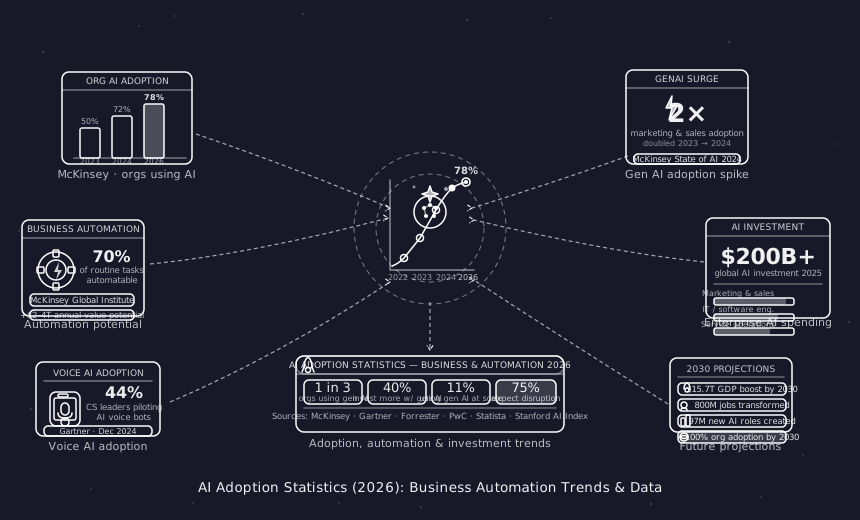
AI adoption has crossed from experiment to infrastructure. This page collects the most reliable AI adoption statistics for 2026 — how many organizations use AI, how that varies by company size and function, how much is being invested, how workers and consumers are adopting it, and where the fastest growth is heading (including voice and phone automation) — with each number checked against the research institute, government agency, research firm, or survey that actually published it.
The short answer: AI adoption has gone mainstream. Stanford's AI Index found 78% of organizations used AI in 2024, up from 55% a year earlier, and McKinsey's later survey puts it at 88%. Official U.S. Census data shows 18% of all firms — and 50–60% of large firms — using AI, while worker and consumer use is climbing fast.
Top AI adoption statistics for 2026 (editor's picks)
78% of organizations reported using AI in 2024, up from 55% a year earlier. — Stanford AI Index, 2025
88% of organizations now use AI in at least one business function. — McKinsey, 2025
18% of all U.S. firms used AI in a business function (32% on an employment-weighted basis). — U.S. Census Bureau, 2026
$252.3 billion in total corporate AI investment in 2024. — Stanford AI Index, 2025
62% of organizations are at least experimenting with AI agents. — McKinsey, 2025
34% of U.S. adults have used ChatGPT — roughly double the 2023 share. — Pew Research, 2025
43% of U.S. workers used generative AI for work in early 2026. — Bick et al., 2026
$47.5 billion is the projected 2034 voice-AI-agents market, growing 34.8% a year. — Market.us, 2025
50–60% of very large firms in information, finance, and professional services use AI. — U.S. Census Bureau, 2026
39% of organizations report enterprise-level EBIT impact from AI. — McKinsey, 2025
How widely is AI adopted by businesses?
Different surveys measure different things — "any use in at least one function" runs high, while official government data that counts every firm runs lower. Both trends point sharply up.
78% of organizations reported using AI in 2024, a 23-point jump from 55% the year before. — Stanford AI Index, 2025
88% of organizations report regular AI use in at least one business function, up from 78% a year earlier. — McKinsey, 2025
62% of organizations are at least experimenting with AI agents that can plan and act autonomously. — McKinsey, 2025
64% of organizations say AI is enabling their innovation. — McKinsey, 2025
39% of organizations report enterprise-level EBIT impact from AI so far. — McKinsey, 2025
80% of organizations set efficiency as an objective of their AI initiatives. — McKinsey, 2025
About one-third of organizations have begun scaling AI across the enterprise; most are still piloting. — McKinsey, 2025
AI adoption by company size and function
Official, nationally representative U.S. data shows adoption is real but uneven — concentrated in large firms and a few functions.
18% of U.S. firms used AI in a business function over a two-week period, rising to 32% on an employment-weighted basis. — U.S. Census Bureau (BTOS), 2026
17–20% was the overall firm AI-use range from December 2025 to May 2026, with 20–23% expecting to adopt within six months. — U.S. Census Bureau (BTOS), 2026
50–60% AI use rates (60–70% employment-weighted) at very large firms in information, professional services, and finance. — U.S. Census Bureau (BTOS), 2026
57% of AI-using firms apply it in three or fewer business functions — adoption without deep integration. — U.S. Census Bureau (BTOS), 2026
52% and 45% are the most common AI functions: sales and marketing, and strategy and business development. — U.S. Census Bureau (BTOS), 2026
4.6% → 10% is how the narrow "AI in production of goods or services" measure rose from early 2024 to September 2025. — U.S. Census Bureau (BTOS), 2025
AI investment and spending
$252.3 billion in total corporate AI investment in 2024, with private investment up 44.5% year over year. — Stanford AI Index, 2025
$109.1 billion in U.S. private AI investment in 2024 — nearly 12x China's $9.3B and 24x the U.K.'s $4.5B. — Stanford AI Index, 2025
$33.9 billion in global private investment flowed to generative AI in 2024, up 18.7% from 2023. — Stanford AI Index, 2025
40 vs. 15 vs. 3 notable AI models were produced in 2024 by U.S., Chinese, and European institutions respectively. — Stanford AI Index, 2025
59 AI-related regulations were introduced in the U.S. in 2024 — more than double the prior year. — Stanford AI Index, 2025
Worker and consumer AI adoption
43% of U.S. workers reported using generative AI for work in early 2026. — Bick et al. (Real-Time Population Survey), 2026
39.6% of working-age adults (18–64) had used generative AI as of late 2024. — Bick, Blandin & Deming, 2025
34% of U.S. adults have ever used ChatGPT — roughly double the summer-2023 share. — Pew Research, 2025
58% of U.S. adults under 30 have used ChatGPT, versus far fewer older adults. — Pew Research, 2025
28% of employed U.S. adults have used ChatGPT for work. — Pew Research, 2025
64% of U.S. teens (13–17) say they use AI chatbots, with about three in ten using them daily. — Pew Research, 2025
AI agents and the next wave of adoption
62% of organizations are at least experimenting with AI agents. — McKinsey, 2025
$7.63B → $182.97B is the all-uses AI agents market from 2025 to 2033, a 49.6% CAGR — the steepest in AI. — Grand View Research, 2026
$11.58B → $41.39B is the conversational AI market from 2024 to 2030, a 23.7% CAGR. — Grand View Research
About one-third of organizations have moved AI from pilots into scaled enterprise use. — McKinsey, 2025
Voice AI and phone automation: the channel to watch
Text chatbots get the headlines, but adoption is moving onto the phone line — the channel most "AI adoption" roundups overlook, and where customer contact still concentrates.
$2.4B → $47.5B is the voice-AI-agents market from 2024 to 2034, a 34.8% CAGR — faster than the broader AI market. — Market.us, 2025
40.2% of the voice-AI-agents market was North American in 2024 (about $0.9B), with the U.S. alone at $1.2B. — Market.us, 2025
50% of consumers have already engaged with Voice AI and want more natural, conversational interactions. — Zendesk, 2025
90% of CX-leading "Trendsetter" companies see Voice AI as the next evolution in customer communication. — Zendesk, 2025
$11.58B → $41.39B conversational AI market growth underpins voice and phone automation through 2030. — Grand View Research
These adoption curves are exactly why phone automation is the next frontier. Brilo AI puts a voice agent on the line to answer, qualify, book, and update callers 24/7 — then routes complex cases to a human. See how Brilo's AI phone agents automate business calls.
The future of AI adoption
88% → higher: with regular AI use already near-universal among surveyed organizations, the frontier is depth of integration, not initial adoption. — McKinsey, 2025
49.6% CAGR for the AI agents market through 2033 signals the next adoption wave is autonomous, multi-step agents. — Grand View Research, 2026
20–23% of U.S. firms expect to be using AI within six months, per the latest official data — a steady climb from a low base. — U.S. Census Bureau (BTOS), 2026
57% of adopters still use AI in three or fewer functions — the gap between "using AI" and "running on AI" is where the next decade of adoption happens. — U.S. Census Bureau (BTOS), 2026
Frequently Asked Question
What percentage of companies use AI?
It depends on how you count. Stanford's AI Index found 78% of organizations used AI in 2024 (up from 55%), and McKinsey's later survey put it at 88% using AI in at least one function. Official U.S. Census Bureau data, which counts every firm, shows about 18% of all firms using AI — rising to 50–60% among very large firms.
Is AI adoption still growing?
Yes, on every measure. Business adoption jumped 23 points in a single year (Stanford AI Index), worker use reached 43% in early 2026 (Bick et al.), and 20–23% of U.S. firms expect to adopt within six months (Census Bureau). The shift now is from initial use toward deeper integration.
How many people use AI tools like ChatGPT?
Pew Research found 34% of U.S. adults have used ChatGPT — about double the 2023 share — rising to 58% of adults under 30 and 64% of teens aged 13–17. About 28% of employed adults have used ChatGPT for work.
How much is being invested in AI?
Total corporate AI investment hit $252.3 billion in 2024, including $109.1 billion in U.S. private investment and $33.9 billion specifically in generative AI, according to Stanford's AI Index.
Where is AI adoption growing fastest?
Autonomous AI agents and voice are the fastest-growing areas. The AI agents market is projected to grow at a 49.6% CAGR through 2033 (Grand View Research), and the voice-AI-agents market at 34.8% a year to $47.5 billion by 2034 (Market.us) as businesses automate phone and contact work.
Methodology and sources
Every statistic on this page was verified against the organization that originally published it — no figures were taken from third-party roundups or aggregators. Primary sources include the Stanford Institute for Human-Centered AI (AI Index), McKinsey (State of AI), the U.S. Census Bureau (Business Trends and Outlook Survey), Pew Research Center, the Bick–Blandin–Deming Real-Time Population Survey, Grand View Research, Market.us, and Zendesk. Where a figure is a survey result or projection, the publishing source and year are named inline so the context is clear.
Turn AI adoption into answered calls
The data is consistent: adoption is near-universal among large organizations, climbing fast among workers and consumers, and growing fastest in autonomous agents and voice. The phone line is where much of that adoption will play out next. See how Brilo AI automates inbound and outbound business calls with voice agents — booking, qualifying, and resolving in real time — or explore the full range of AI voice-agent use cases, with complex cases always routed to your team.
All Insights
Articles
AI Adoption Statistics (2026): Business Automation Trends & Data
70+ AI adoption statistics for 2026 — covering enterprise rollout rates, ROI benchmarks, voice AI growth, and automation trends across industries.
AI adoption has crossed from experiment to infrastructure. This page collects the most reliable AI adoption statistics for 2026 — how many organizations use AI, how that varies by company size and function, how much is being invested, how workers and consumers are adopting it, and where the fastest growth is heading (including voice and phone automation) — with each number checked against the research institute, government agency, research firm, or survey that actually published it.
The short answer: AI adoption has gone mainstream. Stanford's AI Index found 78% of organizations used AI in 2024, up from 55% a year earlier, and McKinsey's later survey puts it at 88%. Official U.S. Census data shows 18% of all firms — and 50–60% of large firms — using AI, while worker and consumer use is climbing fast.
Top AI adoption statistics for 2026 (editor's picks)
78% of organizations reported using AI in 2024, up from 55% a year earlier. — Stanford AI Index, 2025
88% of organizations now use AI in at least one business function. — McKinsey, 2025
18% of all U.S. firms used AI in a business function (32% on an employment-weighted basis). — U.S. Census Bureau, 2026
$252.3 billion in total corporate AI investment in 2024. — Stanford AI Index, 2025
62% of organizations are at least experimenting with AI agents. — McKinsey, 2025
34% of U.S. adults have used ChatGPT — roughly double the 2023 share. — Pew Research, 2025
43% of U.S. workers used generative AI for work in early 2026. — Bick et al., 2026
$47.5 billion is the projected 2034 voice-AI-agents market, growing 34.8% a year. — Market.us, 2025
50–60% of very large firms in information, finance, and professional services use AI. — U.S. Census Bureau, 2026
39% of organizations report enterprise-level EBIT impact from AI. — McKinsey, 2025
How widely is AI adopted by businesses?
Different surveys measure different things — "any use in at least one function" runs high, while official government data that counts every firm runs lower. Both trends point sharply up.
78% of organizations reported using AI in 2024, a 23-point jump from 55% the year before. — Stanford AI Index, 2025
88% of organizations report regular AI use in at least one business function, up from 78% a year earlier. — McKinsey, 2025
62% of organizations are at least experimenting with AI agents that can plan and act autonomously. — McKinsey, 2025
64% of organizations say AI is enabling their innovation. — McKinsey, 2025
39% of organizations report enterprise-level EBIT impact from AI so far. — McKinsey, 2025
80% of organizations set efficiency as an objective of their AI initiatives. — McKinsey, 2025
About one-third of organizations have begun scaling AI across the enterprise; most are still piloting. — McKinsey, 2025
AI adoption by company size and function
Official, nationally representative U.S. data shows adoption is real but uneven — concentrated in large firms and a few functions.
18% of U.S. firms used AI in a business function over a two-week period, rising to 32% on an employment-weighted basis. — U.S. Census Bureau (BTOS), 2026
17–20% was the overall firm AI-use range from December 2025 to May 2026, with 20–23% expecting to adopt within six months. — U.S. Census Bureau (BTOS), 2026
50–60% AI use rates (60–70% employment-weighted) at very large firms in information, professional services, and finance. — U.S. Census Bureau (BTOS), 2026
57% of AI-using firms apply it in three or fewer business functions — adoption without deep integration. — U.S. Census Bureau (BTOS), 2026
52% and 45% are the most common AI functions: sales and marketing, and strategy and business development. — U.S. Census Bureau (BTOS), 2026
4.6% → 10% is how the narrow "AI in production of goods or services" measure rose from early 2024 to September 2025. — U.S. Census Bureau (BTOS), 2025
AI investment and spending
$252.3 billion in total corporate AI investment in 2024, with private investment up 44.5% year over year. — Stanford AI Index, 2025
$109.1 billion in U.S. private AI investment in 2024 — nearly 12x China's $9.3B and 24x the U.K.'s $4.5B. — Stanford AI Index, 2025
$33.9 billion in global private investment flowed to generative AI in 2024, up 18.7% from 2023. — Stanford AI Index, 2025
40 vs. 15 vs. 3 notable AI models were produced in 2024 by U.S., Chinese, and European institutions respectively. — Stanford AI Index, 2025
59 AI-related regulations were introduced in the U.S. in 2024 — more than double the prior year. — Stanford AI Index, 2025
Worker and consumer AI adoption
43% of U.S. workers reported using generative AI for work in early 2026. — Bick et al. (Real-Time Population Survey), 2026
39.6% of working-age adults (18–64) had used generative AI as of late 2024. — Bick, Blandin & Deming, 2025
34% of U.S. adults have ever used ChatGPT — roughly double the summer-2023 share. — Pew Research, 2025
58% of U.S. adults under 30 have used ChatGPT, versus far fewer older adults. — Pew Research, 2025
28% of employed U.S. adults have used ChatGPT for work. — Pew Research, 2025
64% of U.S. teens (13–17) say they use AI chatbots, with about three in ten using them daily. — Pew Research, 2025
AI agents and the next wave of adoption
62% of organizations are at least experimenting with AI agents. — McKinsey, 2025
$7.63B → $182.97B is the all-uses AI agents market from 2025 to 2033, a 49.6% CAGR — the steepest in AI. — Grand View Research, 2026
$11.58B → $41.39B is the conversational AI market from 2024 to 2030, a 23.7% CAGR. — Grand View Research
About one-third of organizations have moved AI from pilots into scaled enterprise use. — McKinsey, 2025
Voice AI and phone automation: the channel to watch
Text chatbots get the headlines, but adoption is moving onto the phone line — the channel most "AI adoption" roundups overlook, and where customer contact still concentrates.
$2.4B → $47.5B is the voice-AI-agents market from 2024 to 2034, a 34.8% CAGR — faster than the broader AI market. — Market.us, 2025
40.2% of the voice-AI-agents market was North American in 2024 (about $0.9B), with the U.S. alone at $1.2B. — Market.us, 2025
50% of consumers have already engaged with Voice AI and want more natural, conversational interactions. — Zendesk, 2025
90% of CX-leading "Trendsetter" companies see Voice AI as the next evolution in customer communication. — Zendesk, 2025
$11.58B → $41.39B conversational AI market growth underpins voice and phone automation through 2030. — Grand View Research
These adoption curves are exactly why phone automation is the next frontier. Brilo AI puts a voice agent on the line to answer, qualify, book, and update callers 24/7 — then routes complex cases to a human. See how Brilo's AI phone agents automate business calls.
The future of AI adoption
88% → higher: with regular AI use already near-universal among surveyed organizations, the frontier is depth of integration, not initial adoption. — McKinsey, 2025
49.6% CAGR for the AI agents market through 2033 signals the next adoption wave is autonomous, multi-step agents. — Grand View Research, 2026
20–23% of U.S. firms expect to be using AI within six months, per the latest official data — a steady climb from a low base. — U.S. Census Bureau (BTOS), 2026
57% of adopters still use AI in three or fewer functions — the gap between "using AI" and "running on AI" is where the next decade of adoption happens. — U.S. Census Bureau (BTOS), 2026
Frequently Asked Question
What percentage of companies use AI?
It depends on how you count. Stanford's AI Index found 78% of organizations used AI in 2024 (up from 55%), and McKinsey's later survey put it at 88% using AI in at least one function. Official U.S. Census Bureau data, which counts every firm, shows about 18% of all firms using AI — rising to 50–60% among very large firms.
Is AI adoption still growing?
Yes, on every measure. Business adoption jumped 23 points in a single year (Stanford AI Index), worker use reached 43% in early 2026 (Bick et al.), and 20–23% of U.S. firms expect to adopt within six months (Census Bureau). The shift now is from initial use toward deeper integration.
How many people use AI tools like ChatGPT?
Pew Research found 34% of U.S. adults have used ChatGPT — about double the 2023 share — rising to 58% of adults under 30 and 64% of teens aged 13–17. About 28% of employed adults have used ChatGPT for work.
How much is being invested in AI?
Total corporate AI investment hit $252.3 billion in 2024, including $109.1 billion in U.S. private investment and $33.9 billion specifically in generative AI, according to Stanford's AI Index.
Where is AI adoption growing fastest?
Autonomous AI agents and voice are the fastest-growing areas. The AI agents market is projected to grow at a 49.6% CAGR through 2033 (Grand View Research), and the voice-AI-agents market at 34.8% a year to $47.5 billion by 2034 (Market.us) as businesses automate phone and contact work.
Methodology and sources
Every statistic on this page was verified against the organization that originally published it — no figures were taken from third-party roundups or aggregators. Primary sources include the Stanford Institute for Human-Centered AI (AI Index), McKinsey (State of AI), the U.S. Census Bureau (Business Trends and Outlook Survey), Pew Research Center, the Bick–Blandin–Deming Real-Time Population Survey, Grand View Research, Market.us, and Zendesk. Where a figure is a survey result or projection, the publishing source and year are named inline so the context is clear.
Turn AI adoption into answered calls
The data is consistent: adoption is near-universal among large organizations, climbing fast among workers and consumers, and growing fastest in autonomous agents and voice. The phone line is where much of that adoption will play out next. See how Brilo AI automates inbound and outbound business calls with voice agents — booking, qualifying, and resolving in real time — or explore the full range of AI voice-agent use cases, with complex cases always routed to your team.
Latest Insights
All Resources
Articles
Case Studies
Tutorials

Articles
FDA-Compliant AI Voice for Medical Device Hotlines
What Part 11, ISO 13485, and QMS integration actually require from an AI voice agent on a medical device support line.

Articles
Reduce FDA Warning Letters on Complaint Handling
FDA warning letters citing complaint-handling failures are rising. Here's how automated intake closes the gap.
Load More
Latest Insights
All Resources
Articles
Case Studies
Tutorials
Articles
FDA-Compliant AI Voice for Medical Device Hotlines
What Part 11, ISO 13485, and QMS integration actually require from an AI voice agent on a medical device support line.
Articles
Reduce FDA Warning Letters on Complaint Handling
FDA warning letters citing complaint-handling failures are rising. Here's how automated intake closes the gap.
Load More

Automate your business with AI phone Agents
Automate your business with AI phone Agents
Automate your business with AI phone Agents
Automate your business with AI phone Agents
Call automation for healthcare, real estate, logistics, financial services & small businesses.
Call automation for healthcare, real estate, logistics, financial services & small businesses.

Join Discord
Connect with our community, ask questions, and stay updated on product news.

Book a Call
Schedule a quick call with our team to explore solutions for your needs.
Get started
Industries
Usecases
Integrations
Legal & Community

Join Discord
Connect with our community, ask questions, and stay updated on product news.
Book a Call
Schedule a quick call with our team to explore solutions for your needs.
Get started
Industries
Usecases
Integrations
Legal & Community
Join Discord
Connect with our community, ask questions, and stay updated on product news.
Book a Call
Schedule a quick call with our team to explore solutions for your needs.
Get started
Industries
Usecases
Integrations
Legal & Community
Join Discord
Connect with our community, ask questions, and stay updated on product news.
Book a Call
Schedule a quick call with our team to explore solutions for your needs.
Get started
Industries
Usecases
Integrations
Legal & Community